Monday, April 14, 2025


New method for detecting nanoplastics in body fluids


Together with the company BRAVE Analytics, researchers at TU Graz have developed a method for detecting nanoplastics in liquids and determining their composition


Graz University of Technology

Nano-Vision 

image: 

The sensor platform uses laser light to detect nanoplastic particles in liquids. Image source: Lunghammer - TU Graz

view more 

Credit: Lunghammer - TU Graz


Microplastics and the much smaller nanoplastics enter the human body in various ways, for example through food or the air we breathe. A large proportion is excreted, but a certain amount remains in organs, blood and other body fluids. In the FFG bridge project Nano-VISION, which was launched two years ago together with the start-up BRAVE Analytics, a team led by Harald Fitzek from the Institute of Electron Microscopy and Nanoanalysis at Graz University of Technology (TU Graz) and an ophthalmologist from Graz addressed the question of whether nanoplastics also play a role in ophthalmology. The project partners have now been able to develop a method for detecting and quantifying nanoplastics in transparent body fluids and determining their chemical composition. As an exemplary application of the method, the research team is investigating whether intraocular lenses release nanoplastics. There have been no such studies to date, and initial results have already been submitted to a scientific journal.

Scattered laser light reveals concentration and composition

Micro- and nanoplastics are detected in two steps. The sensor platform developed by BRAVE Analytics draws in the liquid to be analysed and pumps it through a glass tube. There, a weakly focused laser is shone through the liquid in or against the direction of flow. If the light hits any particles, the laser pulse accelerates or decelerates them – larger particles more strongly than smaller ones. The different velocity values allow conclusions to be drawn about the size of the particles and their concentration in the liquid. This method, called optofluidic force induction, was developed by Christian Hill from BRAVE Analytics at the Medical University of Graz.

What is new is the combination of optofluidic force induction with Raman spectroscopy. Now the spectrum of the laser light scattered by individual particles in the liquid is also analysed. A small part of the light, the so-called Raman scattering, has a different frequency to the laser itself and thus allows conclusions to be drawn about the composition of the particles. “Depending on the material of the focused particles, the frequency values are slightly different in each case and thus reveal the exact chemical composition,” says Raman spectroscopy expert Harald Fitzek. “This works particularly well with organic materials and plastics.”

Intraocular lenses: Tests on the possible presence of nanoparticles

The Institute of Electron Microscopy and Nanoanalysis is currently conducting further investigations into the extent to which intraocular lenses yield nanoplastics spontaneously, after mechanical stress or when exposed to laser energy. The findings from these tests are extremely important for ophthalmic surgeons and lens manufacturers and will be published in a scientific journal.

“Our method for detecting micro- and nanoplastics can be applied to clear body fluids such as urine, tear fluid or blood plasma,” says Harald Fitzek. “However, it is also suitable for the continuous monitoring of liquid flows in industry as well as drinking and waste water.”


Pioneering research reveals Arctic matter pathways poised for major shifts amidst climate change


University of Bristol
Pioneering research reveals Arctic matter pathways poised for major shifts amidst climate change 

image: 

Image shows the German research icebreaker Polarstern moored to an ice floe during the polar night.

view more 

Credit: Steffen Graupner / Alfred Wegener Institute


A new study has shed unprecedented light on the highly variable and climate-sensitive routes that substances from Siberian rivers use to travel across the Arctic Ocean. The findings raise fresh concerns about the increasing spread of pollutants and the potential consequences for fragile polar ecosystems as climate change accelerates.

The international research, published today in Nature Communications and led by the University of Bristol, in the UK, provides the clearest ever picture of how the underlying transport system, known as the Transpolar Draft, operates. It also uncovers the various factors controlling this major Arctic surface current, including warmer temperatures which could increase the spread of human-made pollutants.

The Transpolar Drift carries sea ice, fresh water, and suspended matter from the Siberian shelves across the central Arctic towards the Fram Strait channel, which connects to the Nordic Seas.

This cross-Arctic flow influences the delivery of both natural substances, such as nutrients, gases, organic compounds, and human-made pollutants – including microplastics and heavy metals – from Siberian river systems into the central Arctic and the North Atlantic. This material affects Arctic biogeochemistry and ecosystems, while the fresh water itself alters ocean circulation.

As the Arctic Ocean is a highly changeable environment, rather than following a steady course, river-sourced matter takes diverse, seasonally shifting routes shaped by changing shelf conditions and ocean currents, along with the formation, drift, and melting of sea ice. This results in rapid and widespread redistribution of both natural and pollutant matter.

Lead author Dr Georgi Laukert, Marie Curie Postdoctoral Fellow in Chemical Oceanography at the University of Bristol, UK and Woods Hole Oceanographic Institution in Massachusetts, US, said: “We found pronounced changes in the composition of Siberian river water along the Transpolar Drift, demonstrating this highly dynamic interplay. Seasonal shifts in river discharge and dynamic circulation on the Siberian shelf drive ocean surface variability, while interactions between sea ice and the ocean further increase the redistribution of river-borne matter.

“Another key discovery is the increasingly central role of sea ice formed along the Transpolar Drift – not only as a passive transport medium, but as an active agent in shaping dispersal patterns. This sea ice captures material from multiple river sources during growth, unlike most coastal sea ice, creating complex mixtures that are transported across vast distances.”

To decode these complex pathways, the international research team analysed seawater, sea ice, and snow samples using oxygen and neodymium isotopes, along with measurements of rare earth elements to produce geochemical tracer data. This geochemical fingerprinting allowed the researchers to track the origins of river-sourced matter and follow how it evolved along its route through the central Arctic over a year-long period.

The study draws on samples from MOSAiC, the largest-ever Arctic expedition and among the most ambitious polar research efforts, involving seven ice breakers and more than 600 global scientists.

Co-author Dr Dorothea Bauch, Researcher at Kiel University in Germany, said: “The findings represent unprecedented year-round observations. Previously, we only had summer data because it was too slow and hard to break through the ice in the winter. This sustained, interdisciplinary Arctic evidence offers important and comprehensive insights, which help us better understand highly complex ocean systems and the possible future implications.”

As summer sea ice continues to retreat due to warmer temperatures, circulation and drift patterns are changing.

Co-author Professor Benjamin Rabe, Research Scientist from the Alfred Wegener Institute and Honorary Professor at the University of Applied Science, in Bremerhaven, Germany said: “These shifts could significantly alter how fresh water and river-derived matter spread through the Arctic, with far-reaching implications for ecosystems, biogeochemical cycles, and ocean dynamics.”

The research also challenges a long-standing perception of the Transpolar Drift as a stable conveyor of river water. First observed during Norwegian explorer Fridtjof Nansen’s historic Fram expedition in the 1890s, these latest findings discovered more than 130 years later indicate the Transpolar Drift is highly variable in both space and time.

Dr Laukert added: “While the study does not focus on individual compounds, it illuminates the underlying transport mechanisms—a critical step for predicting how Arctic matter transport will evolve in a warming climate. If even this iconic current is so dynamic, then the entire Arctic Ocean may be more variable and vulnerable than we thought.”

MAKE IT A  LIVING WAGE: $20

Bernie Sanders Demands a $17 Minimum Wage as Trump’s Tariffs Embarrass GOP

Hungry for an economic populism that challenges Trump, Democrats line up behind Sanders’s latest minimum wage push.
April 10, 2025

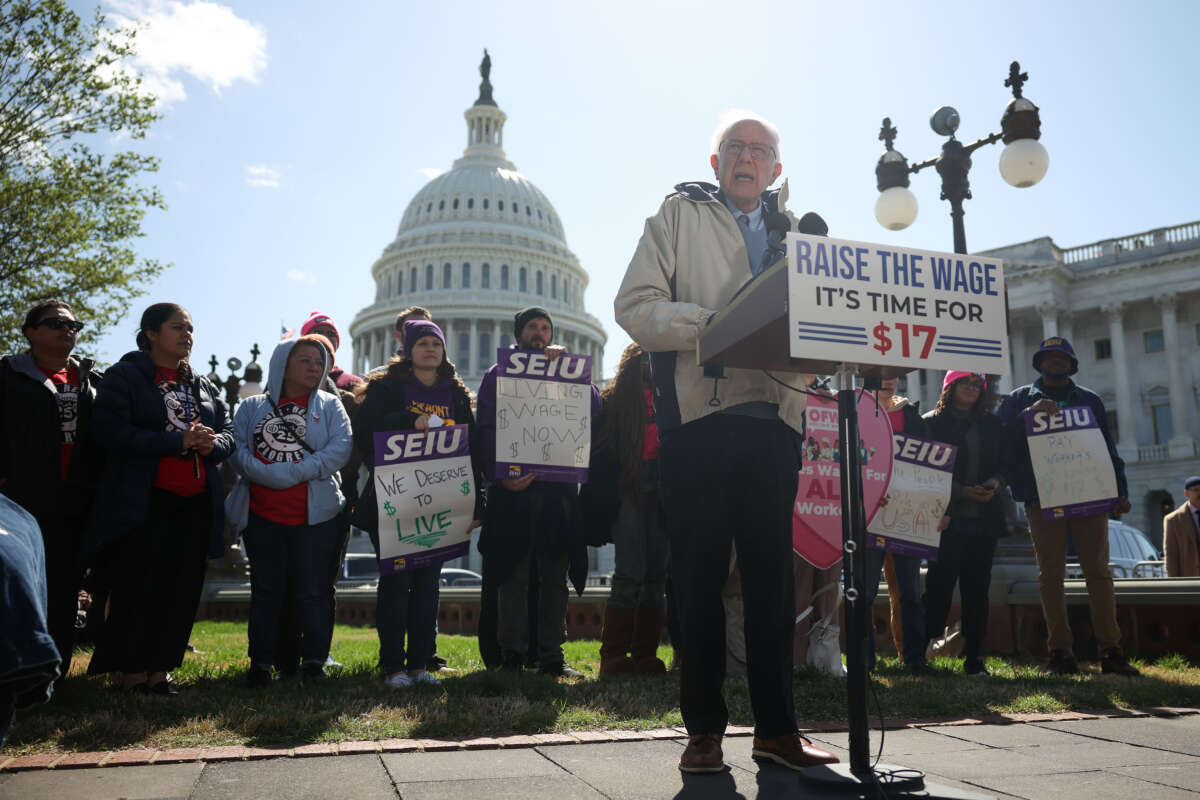
Sen. Bernie Sanders speaks during a press conference to introduce the "Raise the Wage Act" on April 8, 2025, in Washington, D.C. The "Raise the Wage Act" would raise federal minimum wage over the next 5 years to at least $17 an hour.
Kayla Bartkowski / Getty Images

With whirlwind tariffs and a looming trade war with China threatening to raise prices, government services halted by sweeping staffing cuts and Republicans in Congress moving to slash the social safety net to pay for tax cuts that would primarily benefit the wealthy, experts say the GOP agenda coalescing under President Donald Trump poses a “triple threat” to the economic well-being of millions of low- and moderate-income families in the U.S.

On the campaign trail, Trump wooed swing voters with promises to tackle the affordability crisis and make the United States “wealthy again.” The U.S is among the world’s richest nations, but inequality has ballooned since the 1970s as wages stagnated and incomes for the ultra-rich soared. Wealth is also disappearing from retirement portfolios as stock market values plummet in response to tariffs unilaterally imposed by Trump. Tariffs are taxes on imports the president is leveraging to initiate painful trade negotiations with other countries, but much of the cost is passed on to U.S. consumers.

After several days of watching the global economy suffer completely avoidable damage, Trump abruptly changed course and announced on Wednesday a 90-day pause on his steepest global tariffs, but kept sky-high tariffs on China, a top supplier of affordable consumer goods. Economists across the political spectrum have panned Trump’s approach to tariffs as flawed and warn that rising prices could cost the typical household up to $3,800 a year and spark a global recession.

Republicans in Congress may be wary (if not terrified) of challenging the president on tariffs and other destructive policies, at least in public, but they are already lining up against raising the minimum wage, a widely popular policy that would help protect workers and lower-income families from the potential economic fallout of Trump’s policy gambles.

Earlier this week, Sen. Bernie Sanders (I-Vermont) forced a vote on an amendment to the Senate budget resolution that would have called on lawmakers to gradually raise the federal minimum wage from a paltry $7.25 to $17 over the next five years. The Senate’s Democratic minority united behind the amendment along with one Republican, but the GOP majority voted against the minimum wage hike before sending the controversial budget blueprint to the House for approval.

Determined to make Republicans own their opposition to raising wages during a moment of acute economic anxiety and popular backlash to the Trump regime, Sanders and Rep. Robert C. “Bobby” Scott (D-Virginia) introduced the Raise the Wage Act of 2025 on Tuesday. Backed by 85 civil society groups and the vast majority of Democrats in Congress, the legislation would gradually increase the federal minimum wage to $17 by 2030. This would provide a pay raise for more than 22 million workers, or 15 percent of the U.S. workforce, according to the Economic Policy Institute.

Since Congress last raised the federal wage floor in 2009, the purchasing power of the $7.25 minimum wage has dropped by 32 percent to the lowest overall value since 1956, Sanders pointed out.

“We need the Republicans to understand that workers in their states can’t make it on $7.25 and $10 an hour, they have got to join us and help us raise that minimum wage to $17 an hour,” Sanders said during a press conference with labor activists on Tuesday.

As economists point out, raising the minimum wage would disproportionately benefit lower-wage employees in red states, particularly in the South, where workers have been left behind by decades of post-Jim Crow policies designed to maintain a pool of cheap labor. As a result, poverty rates across much of the South are higher than the rest of the country and often concentrated in Black and Brown communities.

“There’s some kind of mythology out there that the only people working for minimum wage are kids trying to make some extra spending money … and that is not the case,” Sanders said. “The vast majority of minimum wage earners are adults trying to make money to support their families.”

Last year, nearly one in four U.S. workers made less than $17 an hour, which is well below the living wage needed to make ends meet for a family of two working adults and at least one child in all 50 states. Meanwhile, workers saw the cost of housing and other essentials explode over the past two decades. In 2024, homelessness across the U.S. spiked by 18 percent. And last week, a Gallup survey found that 35 percent of Americans say they could not afford high quality health care if they needed it today, suggesting that lack of access has reached a new high in a nation that spends more on health care than any other.

“I sleep on the floor so my son can have the bed. I rent out rooms in my house just to keep a roof over our heads,” said Thomas White, a ramp worker at Dulles International Airport and member of Airport Workers United, during the press conference on raising the minimum wage. “I work full time at the airport and still can’t afford to live.”

The federal “subminimum wage” for tipped workers has been stuck at $2.13 per hour since 1991, and the current median wage for at least 38,000 workers with disabilities is just $3.50 per hour. The Raise the Wage Act would gradually phase out these subminimum wages for tipped workers, workers with disabilities and youth workers, assuring all workers earn at least $17 an hour by 2032.

While Trump has proposed eliminating taxes on tips in an effort to please working-class supporters, Republicans are still debating how to pay for such a policy without raising taxes on higher-income earners or adding to the federal debt, which many in the GOP oppose.

On the other end of the spectrum is Sanders, who argues that service workers are unable to stay out of poverty as long as the federal subminimum wage floor remains stagnant at $2.13 an hour plus tips.

“In the year 2025, in the richest country in the history of world, nobody should be forced to work for starvation wages,” Sanders said.

We’ve been here before. Along with a handful of progressive Democrats, Sanders has been the leading voice in Congress pushing for a minimum wage hike for years. In 2021, the House passed legislation to raise the minimum from $7.25 to $15 an hour, but it failed in the Senate despite a slim Democratic majority after eight centrist Democrats voted against the measure. Sanders introduced legislation to raise the minimum wage again in 2023 to push reluctant Democrats on the issue, but Congress failed to act before President Joe Biden left office.

Now that the GOP controls all branches of the federal government, a majority of Democrats in both the House and Senate are backing Sanders’s latest minimum wage push as party leaders prepare for a partisan showdown over federal spending reductions to pay for Trump’s signature tax cuts.

In a letter to GOP House Speaker Mike Johnson this week, Democratic Minority Leader Hakeem Jeffries challenged the Republican from Louisiana to a one-on-one debate over the budget resolution currently before the House. Jeffries and other Democrats say Republicans are playing games with the budget numbers to conceal from public view drastic cuts to Medicaid, Medicare and other popular programs that are needed to pay for tax cuts that “primarily benefit wealthy billionaires like Elon Musk.”

If Democrats are finally finding their voice when it comes to pushing back on Trump’s economic policies with their own ideas, then Sanders has just the legislation to rub in Republicans’ faces. After years of congressional inaction, the bill would finally raise the minimum wage past $7.25 as the fallout from Trump’s federal power grab and tariff gambit become painfully clear to millions of people.
This Passover, We Must Reckon With Israel’s Massacre of Children in Gaza

The Passover story decries a ruler who inflicts atrocities on children. The Israeli military is doing that now in Gaza.
April 11, 2025
Palestinian children play in Gaza City, on March 30, 2025.Majdi Fathi / NurPhoto via 
By Brant Rosen , TruthoutPublishedApril 11, 2025

Content Warning: This article contains graphic descriptions of violence to children.

As the Jewish community prepares to observe Passover this year, I’m thinking a great deal about the centrality of children to the Exodus story we tell around the seder table. In particular, I’m struck that this narrative from the Torah begins with a terrifying description of atrocities committed against children. As Exodus opens, a new pharaoh arises over Egypt who openly dreads the demographic growth of the Israelite minority. After oppressing them with forced labor, he orders Hebrew midwives to kill newborn male children. When they resist his demand, he charges the Egyptians to throw all baby boys into the Nile. Shortly after, Moses is born and is saved from this decree of death by his mother, his sister and the pharaoh’s daughter, who adopts him.

Among other things, the Exodus story drives home the tragically familiar truth that children are not mere casualties of wartime atrocities, but are actually targeted by state violence. According to a 2014 report in The New Yorker, “The specific targeting of children is one of the grimmest new developments in the way conflicts have been waged over the past fifty years.”

Those who participate in the Passover seder are required not only to read the story of the Exodus, but to examine its relevance, as the Haggadah instructs us, “in every generation.” As such, the opening of the narrative presents us with all too disturbing parallels — and a critical moral challenge. This Passover — the second to come amidst the ongoing genocide perpetrated by Israel against Palestinians in Gaza and mass forced displacement in the West Bank — we would be grievously remiss if we failed to acknowledge the scores of children who have been killed, maimed and traumatized by Israel’s ongoing military onslaught.

The official death toll in Gaza has now broken the 50,000 mark, including more than 17,000 children. (The medical journal The Lancet has concluded that the total number of those killed is likely 40 percent higher.) On March 18, the day that Israel broke a two-month ceasefire, the Israeli military killed more than 400 Palestinians, including 183 children and 94 women — on what observers call the single bloodiest day of the genocide.

More recently, on April 3, Israel bombed the Dar al-Arqam School-turned-shelter in Gaza City, killing 29 people, 18 of whom were children. In its report on the attack, Al Jazeera quoted a spokesperson from Gaza’s emergency rescue workers: “What is going on here is a wake-up call to the entire world. This war and these massacres against women and children must stop immediately. Children are being killed with cold blood here in Gaza.”

Related Story

We Charge Genocide: The Shofar Calls Us to Account on Rosh Hashanah
In the Jewish new year, we must confront the carnage that Zionism has wrought.
By Brant Rosen , Truthout October 3, 2024


For those who stand in solidarity with Palestinians, certain reports and images have become seared into our hearts and minds. For many, the tipping point moment into the abyss occurred in early 2024, with the phone recording of 6-year-old Hind Rajab, pleading with her mother for rescue before the Israeli military shot 335 bullets into her family’s car. One month later, the world was horrified by the image of Sidra Hassouna, a 7-year-old Palestinian girl from northern Gaza, hanging dead off the ledge of a destroyed house with half her body missing.

On May 26, 2024, a 1-year-old baby, Ahmad Al-Najjar, whose headless body was held aloft by a terrified, grief stricken man following what has come to known as the Rafah Tents Massacre — a night in which 45 Palestinians, most of them women and children, were killed, burned alive and beheaded. One doctor who witnessed the carnage commented, “In all my years of humanitarian work, I have never witnessed something so barbaric, so atrocious, so inhumane. These images will haunt me forever… And will stain our conscience for eternity.”

Denial can take many forms. For some, it is rooted in racist dehumanization of the other; others may be just too overwhelmed to allow themselves to comprehend the massive slaughter of children in such a heinous fashion; still others rationalize the truth of it away, dismissing mass murder as “collateral damage” or Hamas’s use of “human shields” (a cynical claim that has been consistently debunked by human rights observers).

For Israel’s supporters, it is even more unthinkable to face the increasing evidence that the Israeli military might well be intentionally targeting children for mass murder. A recent Al Jazeera “Fault Lines” documentary, “Kids Under Fire,” makes a compelling case for this claim, with extensive eyewitness interviews with volunteer American health care workers and human rights experts. Their accounts, corroborated across hospitals and over time, suggest a systematic pattern: increasing numbers of child victims were not injured as a result of bombing raids, but of direct gunshot wounds, often to the head. One of the doctors interviewed in the film, Tammy Abughnaim, an American emergency physician from Chicago, commented:

More and more, I started to see children with penetrating injuries like gunshot wounds. After five, six, seven, eight, I came to the realization that somebody is shooting children. I didn’t want to believe that children were being shot. Nobody wants to believe that. Nobody wants to think that other humans are capable of annihilating children in that way.

Abughnaim’s testimony is corroborated in the film by Mark Perlmutter, an orthopedic surgeon from North Carolina: “The target at the end of a scope is unmistakable. They are a young human being, and when that trigger gets pulled on that target, it is not by accident. At all. Ever.”

At one point, the interviewer asked Miranda Cleland of Defense for Children International – Palestine, “How you ever thought through ‘what’s the strategic reason to shoot a child? What message should we take from a military that would target children?’” Cleland’s reply: “I’ve thought about it a lot and the only conclusion I can come to is that Israeli soldiers are shooting Palestinian children because they want to. And I think they do it because they are allowed to and nobody has stopped them.”

Nabeel Rana, a vascular surgeon from Peoria, Illinois, put a finer point on it: “You’re wiping out a certain number, maiming a certain number and permanently mentally and emotionally disabling the rest. And that’s going to be passed down to the next generation. So, this is how you cripple a society.”

As centuries of state violence against oppressed communities have long demonstrated, the most direct way to undermine and even eradicate a society is to target its children. In December 2024, the Palestinian Centre for Human Rights (PCHR) released a report, “Generation Wiped Out: Gaza’s Children in the Crosshairs of Genocide,” examining Israel’s crime of genocide against Gazans, including the genocide of children. The PCHR report concluded:

The killing of children, infliction of serious physical and mental harm, and subjection to harsh living conditions that destroy their lives cannot be dismissed as mere collateral damage of military attacks. Instead, these actions are part of a systematic strategy aimed at erasing Palestinian identity and annihilating future generations.

There are ominous indications that this annihilation is well underway. A Reuters analysis of data from the Gaza Health Ministry revealed that at least 1,238 families — defined as married couples and any children they might have — have been totally erased, with no survivors. In an AP article on this issue last year, Omar Shabaan, a Gazan researcher and economist, observed that of Gaza’s 400,000 families, none have been spared, causing permanent harm to Gaza’s society, history and future. “It is becoming clear,” he said, “that this is a targeting of the social structure.”

This dramatic upsurge in the killing of Palestinian children is not limited solely to Gaza. According to a recent report on the “Gazafication” of the West Bank, the Israeli human rights group B’Tselem found that Israel is now using the military tactics of its assault on Gaza throughout the Occupied Territories, “where Palestinians face mass forced displacements, a surge in airstrikes and a sharp rise in attacks on children and other civilians.” B’Tselem reported that 180 children have been killed by Israeli forces in the West Bank since the Gazan genocide began, making it the deadliest period of Israel’s nearly 60-yearlong occupation for adults and children alike.

Reports of violence against children are indeed reminiscent of reports from Gaza. In an article entitled “Child Deaths Surge Amid ‘Gazafication’ of the West Bank,” the Guardian, interviewed Rigd Gasser, the father of 14-year-old Ahmad Rashid Jazar, who was shot in the chest in the village of Sebastia by an Israeli soldier while on an errand to get bread in January. Gasser was in a cafe when he heard the gunshots and rushed out when he heard calls for help. “I got closer and recognized my son. I knew him by his clothes, his body was all covered in blood,” he said.

The article also reports on the killing of cousins Reda Basharat (8) and Hamza Basharat (10) who were killed near home by an Israeli drone strike on January 8. The children were sitting outside with their 23-year-old cousin Adam when Hamza’s mother Eman heard the explosion. When she ran outside, she found Hamza injured and struggling to breathe. “He died in my arms,” she said. Eman added, “When I think about what happened to my son and remember the images of their bodies, and I see what is happening in Gaza on TV, I felt suddenly that they are doing the same thing.”

While these individual reports portray unspeakable cruelty, it’s important to bear in mind that it ultimately serves a larger purpose. Just like the violence inflicted by the pharaoh in the Exodus story, Israel’s violence toward children stems from the view of an entire people as a “demographic threat.” This view itself stems from Zionism: an ideology and movement that seeks to create and maintain a majority Jewish nation-state in historic Palestine. As such, the targeting of children is part of a larger effort to ethnically cleanse Gaza through a variety of means, including demolition of homes, population transfer and, as the PCHR report puts it, “erasing Palestinian identity and annihilating future generations.”

In this regard, Israel’s open fire policy toward Palestinian children is inseparable from other draconian actions that clearly seek the depopulation of Gaza and the West Bank. As of this writing, the AP has reported that Israel now controls 50 percent of Gaza as it enlarges its buffer zone, razing Palestinian homes, farmland and infrastructure to “the point of uninhabitability.” The military has also destroyed 90 percent of the southern city of Rafah, after issuing evacuation orders to its residents.

If there could be any doubt as to Israel’s intentions, Deputy Speaker of the Knesset Nissim Vaturi, of the Likud party, like so many other Israeli politicians and military leaders before him, recently made Israel’s end game all too clear. In a radio interview he said pointedly that Israel should “wipe Gaza off the face of the earth,” adding, “There are no innocents there.… I have no mercy for those who are still there. We need to eliminate them.” More recently he commented in a TV interview: “You can’t live with these creatures next to us.… There is no peace with anyone here.… Every child born now — in this minute — is already a terrorist when he is born.”

Notably, Vaturi has also made similar comments about the West Bank region of Jenin, where 40,000 Palestinians were displaced by Israel in the month of February alone. “Erase Jenin. Don’t start looking for the terrorists — if there’s a terrorist in the house, take him down, tell the women and children to get out.” While Israel’s apologists dismiss comments such as these as hyperbole, it is critical to note that these very clear statements of intent are being backed up by very clear action.

As a congregational rabbi, I’ve been asked recurring questions over the last two Passovers. How can I celebrate this holiday while a genocide is being committed in my name? How can I observe a festival of Jewish liberation while a Jewish nation-state is acting as a pharaoh over an entire people? While I understand the anguish behind these questions, I believe the Passover ritual actually offers us an important opportunity: to squarely face the way the Exodus narrative is playing out in a very real way in our own day, to ask hard questions and avoid the simple, pat answers.

In his searing book about Israel’s genocide, One Day, Everyone Will Have Always Been Against This, writer Omar El Akkad writes:


A woman’s leg amputated, without anesthesia, the surgery conducted on a kitchen table. A boy holding his father’s shoe, screaming. A girl whose jaw has been torn off. A child, still in diapers, pulled out of the tents after the firebombing, his head severed from his body.

Is there distance great enough, to be free of this? To be made clean?

This Passover, the season for asking questions, El Akkad’s challenge pounds insistently on the collective conscience of the world.

This article is licensed under Creative Commons (CC BY-NC-ND 4.0), and you are free to share and republish under the terms of the license.


Brant Rosen is the rabbi of congregation Tzedek Chicago and co-founder of the Jewish Voice for Peace Rabbinical Council.
Why Does “National Security” Always Mean More War, Not More Health Care?

We already have the money for social programs. We just choose to spend it on war instead of on people.
April 13, 2025

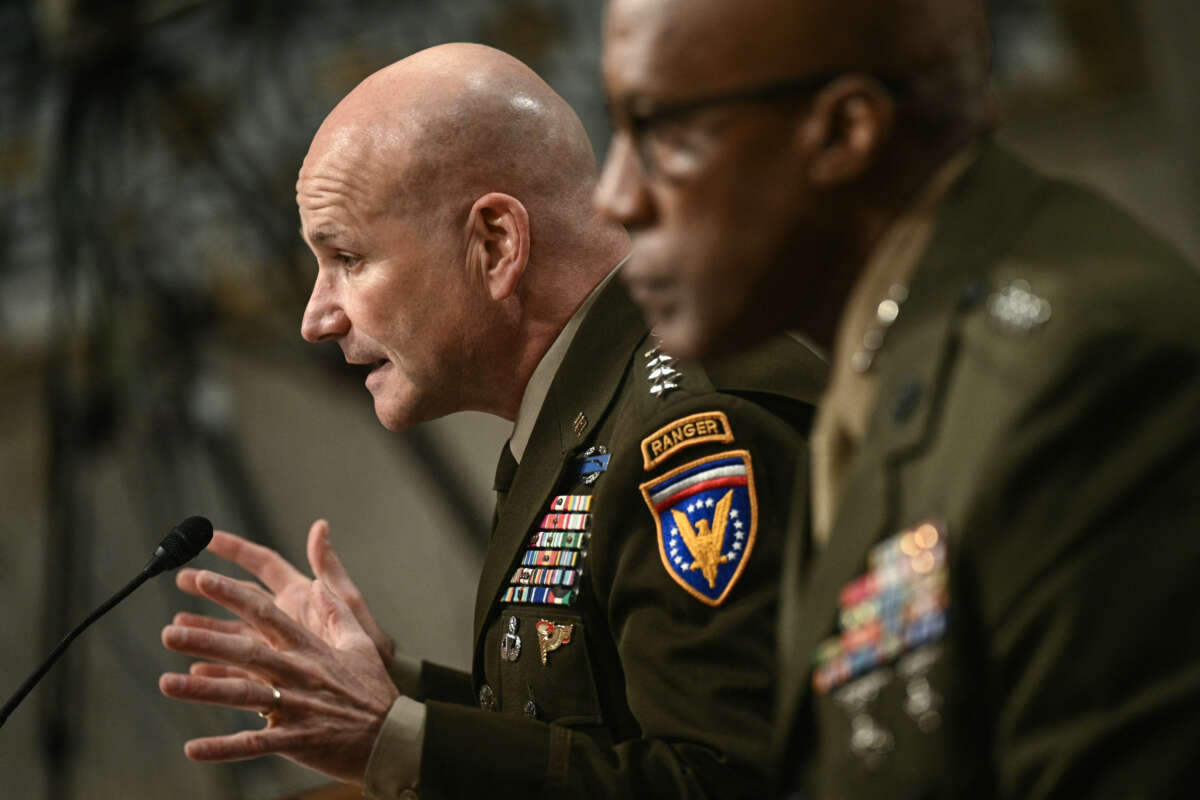
Generals Christopher Cavoli and Michael Langley tesfiy during a Senate Armed Services Committee hearing on fiscal year 2026 defense budget requests, on Capitol Hill in Washington, D.C., on April 3, 2025.BRENDAN SMIALOWSKI/AFP via Getty Images

On March 17, 2025, DefenseScoop reported that Congress approved $141 billion for Pentagon research and development — an amount larger than the budgets of most federal agencies, and close to the size of the seven next largest military budgets around the world. Yet, as usual, there was little debate. Instead, military leaders and lawmakers lamented that the figure was $7 billion less than last year due to budget caps set under the Fiscal Responsibility Act of 2023, as if anything short of perpetual increases is a crisis.

Meanwhile, how many times have we heard that there’s no money for universal pre-K? That expanding Medicare is too expensive? That raising the minimum wage would hurt the economy?

In the United States, “national security” has become an unquestioned justification for endless military spending — even as millions of Americans struggle with medical debt, housing instability and underfunded schools. The real crisis isn’t that the Pentagon’s budget decreased — it’s that our leaders continue to prioritize war over human well-being.

Despite years of record-high military budgets, politicians and defense officials act as if the Pentagon is perpetually underfunded. This year’s defense topline is still $892.5 billion, with major allocations going to the Department of Defense, Oversees Contingency Operations and nuclear weapons activities through the Department of Energy — and yet, Washington claims that even this isn’t enough.

This trend of ever-expanding military budgets spans administrations and party lines. In April, President Donald Trump reportedly floated a $1 trillion military budget, a move that was met with fierce criticism from peace advocates and policy experts who called it a “profound moral failure” — especially in a nation where millions struggle with housing insecurity, medical debt and food instability. While the details of Trump’s proposed plan were vague, the fact that such a number was even considered illustrates how normalized excessive military spending has become. Whether it’s $892.5 billion or $1 trillion, the result is the same: a militarized state that funnels public resources into war readiness rather than community care.

Related Story

Tlaib: Congress Shouldn’t Be Able to Trade Military Stock and “Profit Off Death”
US military contractors receive hundreds of billions of dollars from Pentagon funding each year.By Sharon Zhang , Truthout  January 30, 2025

What gets lost in these conversations is that real national security isn’t about military dominance — it’s about ensuring that people have stable lives. Yet we are conditioned to accept that security means an arsenal of hypersonic missiles, autonomous war drones and next-generation cyberwarfare capabilities — not affordable housing, debt-free education or accessible health care.

Consider what $141 billion — the Pentagon’s research and development budget alone — could fund instead: universal pre-K for every U.S. child for over five years, free school meals for 10 million students for a decade, tens of thousands of affordable housing units and full Medicaid expansion in every state that refused it.

Instead, these billions will be spent developing new weapons, artificial intelligence-driven warfare and military space technology, ensuring that military contractors remain flush with taxpayer dollars.

When it comes to funding war, we are always told that “we must do what is necessary.” But when it comes to funding the basic needs of Americans, we hear a different story: Expanding health care? Too expensive. Free community college? Unrealistic. Paid family leave? Who will pay for it? Climate resilience? No room in the budget.

This contradiction is not accidental — it is by design. The same lawmakers who eagerly approve nearly a trillion dollars in military spending claim that helping working people is fiscally irresponsible.

Even within the military budget itself, it’s not troops or veterans who benefit most — it’s military contractors. The Pentagon continues to waste billions on weapons systems that go unused or overbudget, all while companies like Lockheed Martin, Raytheon and Northrop Grumman rake in massive profits.

For example, the ongoing war in Ukraine has led to heightened demand for Raytheon’s defense systems. Specifically, their Patriot missile defense systems have been in greater demand as countries bolster their defense capabilities. Northrop Grumman reported a 4 percent increase in net sales for the fiscal year 2024, reaching $41 billion. This growth is attributed to rising geopolitical tensions and the corresponding demand for military equipment.

But this year’s Pentagon budget isn’t just about war abroad. Recent developments have intensified the U.S. military’s role in domestic operations, particularly concerning immigration enforcement along the southern border. This shift reflects a strategic move towards increased militarization within U.S. borders.

At a recent press conference, military officials framed immigration as a security threat and announced that the U.S.S. Gravely is being sent to patrol the Gulf of Mexico. The administration is seeking “100% operational control” of the southern border, further blurring the line between national defense and domestic militarization. The U.S.S. Gravely is tasked with intercepting unauthorized maritime activities, including unauthorized immigration and drug smuggling. Admiral Daryl Caudle, commander of U.S. Naval Forces Northern Command, stated that this deployment significantly strengthens the nation’s border security framework.

Similarly, the U.S.S. Spruance has been deployed to patrol the West Coast, contributing to a coordinated Department of Defense response to achieve operational control of the border.

Beyond naval deployments, approximately 10,000 active-duty troops and 2,500 National Guardsmen have been stationed along the U.S.-Mexico border. These forces are equipped with armored fighting vehicles, helicopters and advanced surveillance technologies, including spy planes and drones, to monitor and deter unauthorized border crossings. This represents a significant escalation in the militarization of border enforcement.

These actions have raised concerns among legal experts and human rights advocates. The deployment of military forces for domestic law enforcement purposes may conflict with the Posse Comitatus Act, which limits the use of federal military personnel in civilian law enforcement roles.

The current administration’s approach emphasizes a militarized response to immigration, prioritizing force and surveillance over addressing the root causes of migration — climate change, economic instability and violence exacerbated by past U.S. interventions.

The endless cycle of military expansion ensures that every crisis — whether global or domestic — is treated as an excuse for bigger military budgets.

What if we defined security not as military supremacy, but as people having what they need to live stable, dignified lives? What if, instead of spending billions on war technology, we invested in a health care system where no one goes bankrupt over medical bills, a living wage and universal paid leave, schools that don’t rely on GoFundMe for supplies, infrastructure that doesn’t crumble at the first sign of disaster?

True national security starts with collective well-being. When people don’t have access to housing, education, medical care and basic stability, the entire society becomes more vulnerable — economically, emotionally and politically. A secure nation is one where people are not living on the edge. When everyone has what they need to thrive, we are all safer.

The truth is, we already have the money. We just choose to spend it on war instead of on people.

Angry, shocked, overwhelmed? Take action: Support independent media.

We’ve borne witness to a chaotic first few months in Trump’s presidency.

Over the last months, each executive order has delivered shock and bewilderment — a core part of a strategy to make the right-wing turn feel inevitable and overwhelming. But, as organizer Sandra Avalos implored us to remember in Truthout last November, “Together, we are more powerful than Trump.”

Indeed, the Trump administration is pushing through executive orders, but — as we’ve reported at Truthout — many are in legal limbo and face court challenges from unions and civil rights groups. Efforts to quash anti-racist teaching and DEI programs are stalled by education faculty, staff, and students refusing to comply. And communities across the country are coming together to raise the alarm on ICE raids, inform neighbors of their civil rights, and protect each other in moving shows of solidarity.

It will be a long fight ahead. And as nonprofit movement media, Truthout plans to be there documenting and uplifting resistance.

As we undertake this life-sustaining work, we appeal for your support. We have 10 days left in our fundraiser: Please, if you find value in what we do, join our community of sustainers by making a monthly or one-time gift.

This article is licensed under Creative Commons (CC BY-NC-ND 4.0), and you are free to share and republish under the terms of the license.

Katerina Canyon is the executive director of the Peace Economy Project, an organization advocating for the reallocation of military spending toward social programs. She writes about the intersection of economic justice, public policy and militarization.
'Trump has eclipsed Jesus himself': Here’s what really drives evangelicals’ MAGA rage


Donald Trump's supporters at Union Station Columbus Circle along 1st Street at Massachusetts Avenue, NE, Washington, D.C. on January 6, 2021.
April 11, 2025
ATERNET

A rising group of conservatives is increasingly challenging conventional ideas about empathy, often calling it "sinful."

Amanda Marcotte, a senior writer at Slate, wrote in an article published Friday that the Make America Great Again (MAGA) movement considers empathy to be a weakness and that sentiment is what makes them support President Donald Trump, who she referred to as "incapable of empathy."

She referred to the transition of Albert Mohler, the head of the Southern Baptist Theological Seminary, from denouncing Trump as a "predator" in 2016 to being one of his "loudest Christian right defenders." In a recent interview, Mohler said he now condemns empathy, calling it "an artificial virtue" and "destructive."

Marcotte noted in the article that the right-wing figures who openly deride empathy follow Trump so much that many high-profile psychologists have argued that he should be considered a sociopath, "despite not consenting to a formal diagnosis."

"The political impetus behind this overt assault on what was once considered a baseline virtue is obvious enough," she said.

She added, "Trump has eclipsed Jesus himself as the object of worship on the Christian right, as evidenced by the hosts of "Girls Gone Bible" invoking Trump's name as if he were God in their rewrite of the Lord's Prayer. At his inauguration ball, a 'worship painter" even replicated Trump's image while the crowd sang 'amen' over and over, underscoring this shift in the de facto theology of these 'Christians.'"

The author further said Trump's "sociopathy" has now surpassed the empathy of Jesus in MAGA eyes. She added that the MAGA movement has an "unhinged obsession with gender and escalating hatred of women," which is why they see empathy as "feminine."

ALSO READ: 'The arc of concentration camps is twofold': Experts detail the 'logical endpoint' of MAGA’s rhetoric

"Both firmly agree that femininity is the root of all evil. One doesn't have to speculate, either, to see this aspect of the war on empathy. Plenty of MAGA leaders will say the misogynist part out loud," she wrote.

Many commentators described misogyny as a reason why former Vice President Kamala Harris, who would have been the first female president of the United States had she won the 2024 election, lost to Trump.

In December last year, just days after the election, a panel of Black female experts argued that "misogynoir, the intersection of racism and sexism," was the main factor in Harris's loss.

“Racism is designed in such a way to make you question your humanity, but sexism is also. Sexism is really a power move,” LaTosha Brown, co-founder of the Black Voters Matter Fund said at the time. “When you combine those two things together, I think that that best explains what [Harris] experienced.”
Outrage as video of Trump bragging about enriching his billionaire pals emerges


Former President Donald Trump Jr. speaks to the press after attending wake for NYPD officer Jonathan Diller at Massapequa Funeral Home in Massapequa Park, NY on March 28, 2024, Image via Shutterstock.
April 11, 2025
COMMON DREAMS

 A video clip of U.S. President Donald Trump openly boasting about enriching his billionaire friends is drawing outrage as the administration faces growing scrutiny for possible market manipulation and insider trading in the aftermath of his partial tariff pause.

"He made two-and-a-half billion today," Trump said in the Oval Office on Wednesday, just hours after announcing the pause, "and he made $900 million."


"That's not bad," the president added.

Trump was referring to wealth gains that investor Charles Schwab and businessman Roger Penske—both billionaires—notched during a historic stock market rally sparked by the president's decision to pump the brakes on massive tariffs he imposed on most countries across the globe. (Trump left in place a 10% universal tariff on imports.)

The market surge added over $300 billion to the collective wealth of the world's top billionaires in a matter of hours, according to Bloomberg. Shortly before announcing the tariff pause, Trump posted to his social media platform that it is a "great time to buy" stocks, prompting accusations of market manipulation.

Watch the Oval Office video:


"Donald Trump in a nutshell: doing everything he can to make the ultra-rich even richer," Sen. Elizabeth Warren (D-Mass.) wrote Thursday in response to the clip. "We need to find out if Trump's tariff chaos was used as cover for insider trading."

Dean Baker, senior economist at the Center on Economic and Policy Research, wrote Thursday that it's not yet clear whether Trump tipped off any of his ultra-rich associates about the partial tariff pause ahead of time.

"But does anyone think that Trump would have any qualms about sharing such a secret?" Baker asked. "Does anyone think that the people around Trump would have any qualms about trading on the ultimate inside information? I leave that to your judgment."

On Thursday, a group of Democratic lawmakers led by Rep. Maxine Waters (D-Calif.) called on the U.S. Securities and Exchange Commission to investigate "possible insider trading and market manipulation violations that took place between Sunday, April 6, 2025, when U.S. Treasury Secretary Scott Bessent visited President Trump at his Florida resort, and Wednesday, April 9, 2025, when the president announced the pausing of the tariffs—and whether such unlawful activities are ongoing."


"Insider trading by federal officials and their friends or family is not only a breach of trust of the American people, but erodes the integrity of government institutions and raises concerns about corruption and fairness in the political system," the lawmakers wrote. "There should be zero tolerance for this kind of corruption in our society, let alone from those we entrust to lead us in the public sphere."
'It was culture': Gen Z activist details how 'unhinged' Trump won his 'nihilistic' generation


Supporters of Donald Trump celebrate after the Fox Network called the election in his favor at the site of his rally, at the Palm Beach County Convention Center in West Palm Beach, Florida, U.S., November 6, 2024. REUTERS/Brian Snyder/File Photo

Ailia Zehra
April 11, 2025
ALTERNET

Activist Cameron Kasky said during an appearance on CNN that young white men think Democrats are "leaving" them out and MAGA is able to manipulate them into thinking the party's steps towards equity for women and minorities are "being taken at our expense."

Kasky, 24, is the cofounder of the student-led gun violence prevention advocacy group Never Again MSD. He co-hosts a podcast on Gen Z politics and culture.

He said President Donald Trump was able to garner support from Gen Z, but not due to his policies. "It was culture," he said.

ALSO READ: A Republican women's group is targeting Gen Z voters

"People in my generation are not focused on the nitty gritty," he said. "They're not thinking about the economy, health care and how those things exactly work," Kasky told CNN.

The activist said Trump is speaking in a language that resonates with them "and is pompous and aggressive enough that people respond to it."

"I always say the right has been able to cultivate fear more effectively than the Democrats have been able to inspire hope. So, what happens is: young men, especially young white men, say the democrats are leaving us out and MAGA is able to manipulate us into thinking that steps forward towards equity for women and minorities are being taken at our expense," he explained.

Kasky said the Democratic Party needs to "bargain" with people to convince them to vote for the party. "You can't just feel entitled to those votes," he added.

ALSO READ: Gen-Z congressman: Republicans 'want government to be in children's pants'

In the 2024 presidential election, the Democratic Party experienced a significant decline in support from younger voters, even among those who are historically marginalized.

Young white men from Gen Z, particularly those without a college degree, favored Trump with a substantial 67 percent vote.


"There's something so nihilistic in Gen Z right now, because we haven't been given a very clear direction to strive towards," Kasky said when asked by the host what the 'American experience' means for Gen Z.

"We're not quite sure what exactly we're fighting for at this point," he added.

He said he was 15 when he heard Trump make a sexually suggestive comment about women, and later saw him become president.

"This next generation is growing up with an even more aggressive, unhinged and fascist version of that," Kasky added.

Watch the video below or at this link.link.

- YouTubewww.youtube.com

'The Southern border is under attack': Trump orders US military to take over strip of land

President Donald J. Trump, joined by Department of Homeland Security Acting Secretary Kevin McAleenan Department of Homeland Security, speaks with United States Customs and Border Protection officers along the border area of Otay Mesa, Wednesday, Sept. 18, 2019, a neighborhood along the Mexican border in San Diego, Calif.
 (Official White House Photo by Shealah Craighead)

Adam Lynch
April 12, 2025
ALTERNET

President Donald Trump is authorizing the U.S. military to take jurisdiction over federal lands along the southern border to help enforce his immigration agenda.

On Friday, Trump issued a memorandum entitled "Military Mission for Sealing the Southern Border of the United States and Repelling Invasions" to the secretaries of Defense, Interior, Agriculture and Homeland Security, reports USA Today.

The memo names the Roosevelt Reservation, which lies between Mexico and the states of California, Arizona and New Mexico, as "National Defense Areas.” And it frames immigrants as “invaders” threatening “the territorial integrity and sovereignty of the United States.”

“Our southern border is under attack from a variety of threats. The complexity of the current situation requires that our military take a more direct role in securing our southern border than in the recent past,” the memo reads.

While long, the territory is only about 60 feet wide, "the distance from home plate to the pitcher’s mound,” according to Adam Isacson, director of defense oversight for the Washington Office on Latin America, in Washington, D.C.

Isacson told USA Today the consequences of the Department of Defense assuming control of federal land at the border was not “immediately clear,” but he said it could result in “more severe criminal charges for migrants” unlawfully crossing the border. This is primarily because migrants may qualify as having “trespassed on a military installation” if they set foot on it, and they could potentially face more than the federal misdemeanor of “entry without inspection.”

“In carrying out activities under this memorandum, members of the Armed Forces will follow rules for the use of force prescribed by the Secretary of Defense,” the memo reads.

The administration is increasingly pressing migrants to self-deport. Earlier this week the administration asked the Social Security Administration to relist thousands of immigrants as “dead” to remove their ability to legally work in the country and access credit and banking services.

American Immigration Council senior fellow Aaron Reichlin-Melnick posted to Bluesky that Trump's deployment of the military to take over the Roosevelt Reservation could be an effort to "bypass the Posse Comitatus Act," which prohibits the U.S. military from enforcing civilian law. He added that Trump's move was "bad and dumb."

Read USA Today’s full article at this link.