It’s possible that I shall make an ass of myself. But in that case one can always get out of it with a little dialectic. I have, of course, so worded my proposition as to be right either way (K.Marx, Letter to F.Engels on the Indian Mutiny)
Wednesday, April 16, 2025
SPACE/COSMOS
Crystal clues on Mars point to watery and possibly life-supporting past
A new QUT-led study using data collected by NASA’s Perseverance Rover mission has revealed compelling evidence that could help scientists answer whether life ever existed on Mars. l/r- Dr Michael Jones, Associate Professor Christoph Schrank, Mr Peter Nemere and Mr Brendan Orenstein.
A QUT-led study analysing data from NASA’s Perseverance rover has uncovered compelling evidence of multiple mineral-forming events just beneath the Martian surface – findings that bring scientists one step closer to answering the profound question: did life ever exist on Mars?
The findings were published in the prestigious journal Science Advances.
“Sulphate minerals exist with different amounts of water in most regions on Mars and allow us to understand how water moved around the planet, which is key to understanding its past habitability,” Dr Jones said.
“However, we don’t yet fully understand how or when these minerals formed. Our team found a way to measure the internal crystal structure of these minerals directly in the rock, which had thought to be impossible on the surface of Mars.”
The team adapted a new analytical method called X-ray Backscatter Diffraction Mapping (XBDM) developed by Dr Jones and Professor Schrank at the Australian Synchrotron to Perseverance’s onboard PIXL instrument developed by QUT alumna Abigail Allwood.
This allowed the team to determine the orientation of the crystal structures, essentially providing a fingerprint of how and when they grew, and what the environment on Mars was like at that time.
Two separate generations of calcium-sulphate minerals were uncovered at Hogwallow Flats and Yori Pass in the Shenandoah formation, part of the sedimentary fan in Jezero crater: one formed just beneath the surface and the other formed deeper underground, at least 80 meters down.
“This discovery highlights the diversity of environments that existed in the Shenandoah formation’s history — indicating multiple potential windows when life might have been possible on Mars,” Dr Jones said.
Since its landing in Jezero Crater in February 2021, the Perseverance rover has been exploring a wide variety of Martian rock types, from ancient lava flows to sedimentary layers left behind by a long-vanished lake and river delta.
One of its key mission goals is to study environments that could have supported microbial life – and collect samples that might someday be returned to Earth.
The QUT research team is part of the multidisciplinary QUT Planetary Surface Exploration Research Group which focuses on interplanetary science and is actively involved in projects within NASA and the Australian Space Agency.
Professor Flannery, long-term planner for the NASA Perseverance mission, said QUT is at the forefront of planetary science in Australia.
“Experience gained by QUT researchers exposed to the cutting edge of the robotics, automation, data science and astrobiology fields has the potential to kick start Australia’s space industry,” he said.
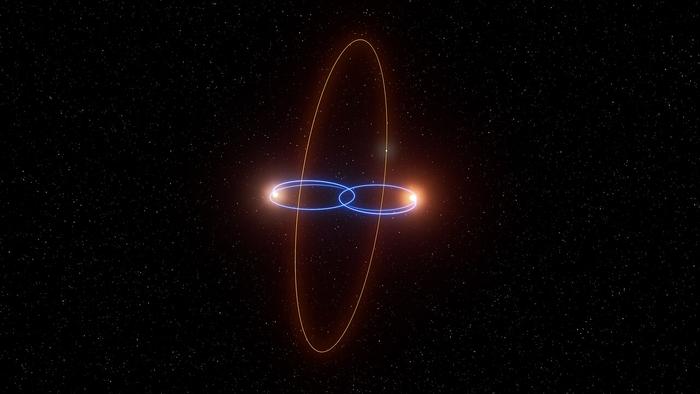
The meteoroid stream of long-period comet Thatcher (white line). Each meteoroid moved on its own orbit and created a Lyrid shower meteor when it hit Earth after approaching the orbit of Earth (blue line) from the north.
The orange line is the orbit of Jupiter. Image from video-based meteor observations at Earth, displayed at https://meteorshowers.org.
April 16, 2025, Mountain View, CA -- Why do comets and their meteoroid streams weave in and out of Earth's orbit and their orbits disperse over time? In a paper published online in the journal Icarus this week, two SETI Institute researchers show that this is not due to the random pull of the planets, but rather the kick they receive from a moving Sun.
"Contrary to popular conception, everything in the solar system does not orbit the Sun," said lead author and SETI Institute scientist Stuart Pilorz. "Rather, the Sun and planets all orbit their common center of mass, known to scientists as the solar system barycenter."
The Solar System barycenter is the proverbial point where the Greek god Atlas would keep his finger to balance the mass of Sun and planets. All planets circle this barycenter, but so does the Sun.
"Usually when we build our numerical models," said Pilorz, "we put the Sun at the center out of convenience because it's the most massive body in the solar system, and it simplifies the relativistic equations."
The team found that this perspective may not be the best way to understand the physical processes underlying the orbital evolution of long-period comets. Those move in orbits that take longer than 200 years to circle the Sun.
"Long-period comets spend most of their lives so far away from the solar system that they feel the tug from the barycenter," said Pilorz. "But every few hundred years they swoop inside Jupiter's orbit and come under the Sun's influence."
Close to the Sun, the comets shed particles called "meteoroids." These meteoroids follow along with the comet, but some travel a shorter orbit and return early, others late, creating a meteoroid stream. When they first form, these streams are extremely thin and chances of hitting Earth are low.
"Back in 1995, our field was in its infancy and many thought that predicting when these streams would cause a meteor shower on Earth was as hard as predicting the weather," said meteor astronomer and co-author Peter Jenniskens of the SETI Institute and NASA Ames Research Center.
Jenniskens noticed that the streams were weaving in and out of Earth's orbit following the Sun's wobble around the solar system barycenter. He predicted that the shower would return when Jupiter and Saturn were back at certain positions along their orbit.
"We traveled to Spain in an attempt to record one of these showers and saw what was described in the past as 'stars fall at midnight'," said Jenniskens. "The whole shower lasted only 40 minutes, but there was a bright meteor every minute at the peak."
That prediction had been based on how the Sun's wobble mostly mirrors the motion of the two most massive planets, Jupiter and Saturn, in their orbit around it. The wobble is small, barely outside the Sun itself, but enough to move the position of the Sun and its velocity over periods of 12 years (Jupiter's orbit) and 30 years (Saturn's orbit), roughly causing a 60-year pattern.
"We were previously able to show in computer models that these streams do wander in and out of Earth's path and do follow the Sun's wobble," said Jenniskens, "but we didn't know why."
In this newly published study, Jenniskens teamed up with Pilorz to investigate how the meteoroid streams of long-period comets disperse over time to learn how best to use that trail of crumbs to search for their parent comets.
"A principal result of this study," said Pilorz, "was merely noticing that if we keep track of the fact that the Sun is in motion about the barycenter, we see that most of what actually causes the comets and meteoroids to disperse is that they each pick up a gravitational boost or braking from the moving Sun as they pass close to it -- exactly in the same way that we use planetary encounters to speed or slow down spacecraft."
The phenomenon of gravitational boost or braking is often compared to bouncing a tennis ball off the front or back of a moving train.
"But the train has to be moving for it to work," Pilorz noted. "In our case, if we consider the Sun fixed at the center, we don't see that this is all that's happening."
The researchers noticed that inside the orbit of Jupiter, the meteoroid changed from moving around the barycenter to moving around the Sun's center.
"We found that the two jumps in the plane of motion, when the Sun takes control as the comet approaches and then again when it hands control back to the barycenter as the comet heads away, kicked the inclination and node of the orbit by a small amount," said Pilorz. "Again, if we consider the Sun fixed at the center, the reason for this change is not obvious."
Meteoroids at different locations in the stream encounter the Sun at different times, so they get different kicks over time and the stream weaves and disperses. The randomness is primarily due to the Sun's place and velocity in its orbit around the barycenter when each meteoroid encounters it.
"This is where one's point of view can be important," added Pilorz. "We're used to telling ourselves that a comet's motion changes randomly due to a series of complex perturbations from the planets. That isn't wrong, but if we recall that the Sun also orbits the barycenter, the explanation becomes much simpler."
To be fair, the planets determine the Sun's motion equally as much as it determines theirs. However, to know how quickly long-period comet streams tend to disperse, the details of this dance are not needed.
"It's still necessary to account for the planetary forces to provide a systematic torque that causes precession," said Pilorz. "This happens mostly when the meteoroids are between the orbits of Jupiter and Saturn."
From the measured shower dispersions, the team calculated the ages of over 200 long-period comet meteoroid streams, which were published in Jenniskens' most recent book "Atlas of Earth's Meteor Showers," an Association of American Publishers' 2025 PROSE Book Award Finalist.
About the SETI Institute Founded in 1984, the SETI Institute is a non-profit, multi-disciplinary research and education organization whose mission is to lead humanity’s quest to understand the origins and prevalence of life and intelligence in the Universe and to share that knowledge with the world. Our research encompasses the physical and biological sciences and leverages expertise in data analytics, machine learning and advanced signal detection technologies. The SETI Institute is a distinguished research partner for industry, academia and government agencies, including NASA and NSF.
Schematic diagram showing how the inclination of the comet orbit changes when the comet moves first around the barycenter of the solar system (*), then around the center of the Sun (•) when inside Jupiter’s orbit. Perspective is from far away, in the plane of the comet orbit, while the separation between barycenter and Sun center is exaggerated for clarity.
Astronomers have detected the most promising signs yet of a possible biosignature outside the solar system, although they remain cautious.
Using data from the James Webb Space Telescope (JWST), the astronomers, led by the University of Cambridge, have detected the chemical fingerprints of dimethyl sulfide (DMS) and/or dimethyl disulfide (DMDS), in the atmosphere of the exoplanet K2-18b, which orbits its star in the habitable zone.
Credit: A. Smith, N. Madhusudhan (University of Cambridge)
Astronomers have detected the most promising signs yet of a possible biosignature outside the solar system, although they remain cautious.
Using data from the James Webb Space Telescope (JWST), the astronomers, led by the University of Cambridge, have detected the chemical fingerprints of dimethyl sulfide (DMS) and/or dimethyl disulfide (DMDS), in the atmosphere of the exoplanet K2-18b, which orbits its star in the habitable zone.
On Earth, DMS and DMDS are only produced by life, primarily microbial life such as marine phytoplankton. While an unknown chemical process may be the source of these molecules in K2-18b’s atmosphere, the results are the strongest evidence yet that life may exist on a planet outside our solar system.
The observations have reached the ‘three-sigma’ level of statistical significance – meaning there is a 0.3% probability that they occurred by chance. To reach the accepted classification for scientific discovery, the observations would have to cross the five-sigma threshold, meaning there would be below a 0.00006% probability they occurred by chance.
The researchers say between 16 and 24 hours of follow-up observation time with JWST may help them reach the all-important five-sigma significance. Their results are reported in The Astrophysical Journal Letters.
Earlier observations of K2-18b — which is 8.6 times as massive and 2.6 times as large as Earth, and lies 124 light years away in the constellation of Leo — identified methane and carbon dioxide in its atmosphere. This was the first time that carbon-based molecules were discovered in the atmosphere of an exoplanet in the habitable zone. Those results were consistent with predictions for a ‘Hycean’ planet: a habitable ocean-covered world underneath a hydrogen-rich atmosphere.
However, another, weaker signal hinted at the possibility of something else happening on K2-18b. “We didn’t know for sure whether the signal we saw last time was due to DMS, but just the hint of it was exciting enough for us to have another look with JWST using a different instrument,” said Professor Nikku Madhusudhan from Cambridge’s Institute of Astronomy, who led the research.
To determine the chemical composition of the atmospheres of faraway planets, astronomers analyse the light from its parent star as the planet transits, or passes in front of the star as seen from the Earth. As K2-18b transits, JWST can detect a drop in stellar brightness, and a tiny fraction of starlight passes through the planet’s atmosphere before reaching Earth. The absorption of some of the starlight in the planet’s atmosphere leaves imprints in the stellar spectrum that astronomers can piece together to determine the constituent gases of the exoplanet’s atmosphere.
The earlier, tentative, inference of DMS was made using JWST’s NIRISS (Near-Infrared Imager and Slitless Spectrograph) and NIRSpec (Near-Infrared Spectrograph) instruments, which together cover the near-infrared (0.8-5 micron) range of wavelengths. The new, independent observation used JWST’s MIRI (Mid-Infrared Instrument) in the mid-infrared (6-12 micron) range.
“This is an independent line of evidence, using a different instrument than we did before and a different wavelength range of light, where there is no overlap with the previous observations,” said Madhusudhan. “The signal came through strong and clear.”
“It was an incredible realisation seeing the results emerge and remain consistent throughout the extensive independent analyses and robustness tests,” said co-author Måns Holmberg, a researcher at the Space Telescope Science Institute in Baltimore, USA.
DMS and DMDS are molecules from the same chemical family, and both are predicted to be biosignatures. Both molecules have overlapping spectral features in the observed wavelength range, although further observations will help differentiate between the two molecules.
However, the concentrations of DMS and DMDS in K2-18b’s atmosphere are very different than on Earth, where they are generally below one part per billion by volume. On K2-18b, they are estimated to be thousands of times stronger - over ten parts per million.
“Earlier theoretical work had predicted that high levels of sulfur-based gases like DMS and DMDS are possible on Hycean worlds,” said Madhusudhan. “And now we’ve observed it, in line with what was predicted. Given everything we know about this planet, a Hycean world with an ocean that is teeming with life is the scenario that best fits the data we have.”
Madhusudhan says that while the results are exciting, it’s vital to obtain more data before claiming that life has been found on another world. He says that while he is cautiously optimistic, there could be previously unknown chemical processes at work on K2-18b that may account for the observations. Working with colleagues, he is hoping to conduct further theoretical and experimental work to determine whether DMS and DMDS can be produced non-biologically at the level currently inferred.
“The inference of these biosignature molecules poses profound questions concerning the processes that might be producing them” said co-author Subhajit Sarkar of Cardiff University.
“Our work is the starting point for all the investigations that are now needed to confirm and understand the implications of these exciting findings,” said co-author Savvas Constantinou, also from Cambridge’s Institute of Astronomy.
“It’s important that we’re deeply sceptical of our own results, because it’s only by testing and testing again that we will be able to reach the point where we’re confident in them,” Madhusudhan said. “That’s how science has to work.”
While he is not yet claiming a definitive discovery, Madhusudhan says that with powerful tools like JWST and future planned telescopes, humanity is taking new steps toward answering that most essential of questions: are we alone?
“Decades from now, we may look back at this point in time and recognise it was when the living universe came within reach,” said Madhusudhan. “This could be the tipping point, where suddenly the fundamental question of whether we’re alone in the universe is one we’re capable of answering.”
The James Webb Space Telescope is a collaboration between NASA, ESA and the Canadian Space Agency (CSA). The research is supported by a UK Research and Innovation (UKRI) Frontier Research Grant.
The graph shows the observed transmission spectrum of the habitable zone exoplanet K2-18 b using the JWST MIRI spectrograph. The vertical shows the fraction of star light absorbed in the planet's atmosphere due to molecules in the planet's atmosphere. The data are shown in the yellow circles with the 1-sigma uncertainties. The curves show the model fits to the data, with the black curve showing the median fit and the cyan curves outlining the 1-sigma intervals of the model fits. The absorption features attributed to dimethyl sulphide and dimethyl disulphide are indicated by the horizontal lines and text. The image behind the graph is an illustration of a hycean planet orbiting a red dwarf star.
Credit
A. Smith, N. Madhusudhan (University of Cambridge)
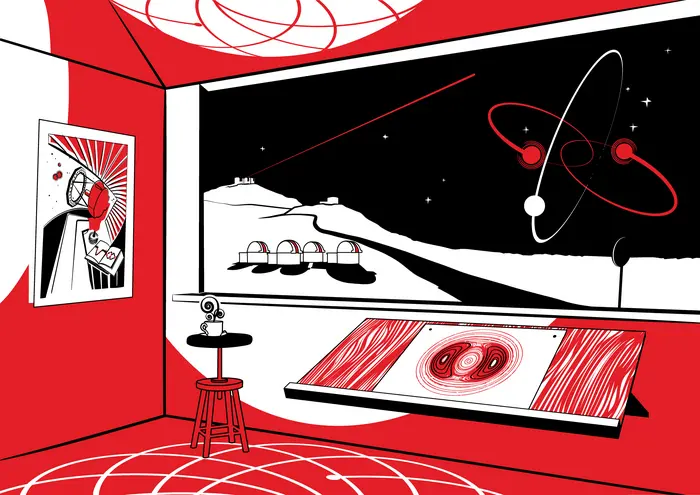
A hypothetical office overlooking the Paranal Observatory in Chile, with the European Southern Observatory’s VLT visible with its laser on the hill, and the four small SPECULOOS telescopes nearer the foreground. In the sky is a depiction of the orbital configuration of the 2M1510 system with the two brown dwarf stars in red orbiting one another, and the inferred exoplanet on a polar orbit in white. Within the office, a poster celebrating the original discovery of 2M1510’s two brown dwarfs is on the wall, while diagrams and patterns showing the apsidal precession of the brown dwarf’s orbit caused by the planets are shown on the table the roof and the floor
Astronomers have discovered a planet that orbits at a 90-degree angle around a rare pair of strange stars – a real-life ‘twist’ on the fictional twin suns of Star Wars hero Luke Skywalker’s home planet of Tatooine.
The exoplanet, named 2M1510 (AB) b, orbits a pair of young brown dwarfs — objects bigger than gas-giant planets but too small to be proper stars. Only the second pair of eclipsing brown dwarfs known – this is the first exoplanet found on a right-angled path to the orbit of its two host stars.
An international team of researchers led by the University of Birmingham, made the surprise discovery using the European Southern Observatory’s Very Large Telescope (VLT). The brown dwarfs produce eclipses of one another, as seen from Earth, making them part of an ‘eclipsing binary’.
Publishing their discovery today (16 Apr) in Science Advances, the researchers note that this is the first time such strong evidence for a ‘polar planet’ orbiting a stellar pair is collected.
Thomas Baycroft, a PhD student at the University of Birmingham who led the study commented: “I’m particularly excited to be involved in detecting credible evidence that this configuration exists. We had hints that planets on perpendicular orbits around binary stars could exist, but until now we lacked clear evidence of this type of polar planet. We reviewed all possible scenarios, and the only consistent with the data is if a planet is on a polar orbit about this binary.”
The team found this planet while refining the orbital and physical parameters of the two brown dwarfs by collecting observations with the Ultraviolet and Visual Echelle Spectrograph (UVES) instrument on the VLT at Paranal Observatory, Chile.
The astronomers observed the orbital path of the two stars in 2M1510 being pushed and pulled in unusual ways, leading them to infer the existence of an exoplanet with its strange orbital angle.
The pair of brown dwarfs, known as 2M1510, were detected in 2018 by Professor Amaury Triaud and others with the Search for habitable Planets EClipsing ULtra-cOOl Stars (SPECULOOS) that the University of Birmingham partially owns.
Co-author Professor Triaud, from the University of Birmingham, commented: “A planet orbiting not just a binary, but a binary brown dwarf, as well as being on a polar orbit is rather incredible and exciting.
“The discovery was serendipitous, as our observations were not collected to seek such a planet, or orbital configuration. As such, it is a big surprise and shows what is possible in the fascinating universe we inhabit, where a planet can affect the orbits of its two stars, creating a delicate celestial dance.”
The discovery was made possible thanks to pioneering data analysis developed at Birmingham by Dr Lalitha Sairam (now at the University of Cambridge), who developed new methods that improved precision by a factor of 30.
Dr Sairam explains: “From variations in velocity of the two brown dwarfs, we can measure their physical and orbital parameters, however being faint, these measurements and therefore their parameters were uncertain. Thanks to that improvement we noticed the orbits of the two brown dwarfs around one another were being delicately affected.”
This is an artist’s impression of the exoplanet 2M1510 (AB) b’s unusual orbit around its host stars, a pair of brown dwarfs. The newly discovered planet has a polar orbit, which is perpendicular to the plane in which the two stars are travelling.
Polar planets around single stars had been found before, as well as polar discs of gas and dust capable of forming planets around binary stars. But thanks to ESO’s Very Large Telescope (VLT) this is the first time we have strong evidence that such a planet actually exists in a polar orbit around two stars.
The two brown dwarfs appear as a single source in the sky, but astronomers know there are two of them because they periodically eclipse each other. Using the UVES spectrograph on the VLT they measured their orbital speed, and noticed that their orbits change over time. After carefully ruling out other explanations, they concluded that the gravitational tug of a planet in a polar orbit was the only way to explain the motion of the brown dwarfs.
Astronomers have found a planet that orbits at an angle of 90 degrees around a rare pair of peculiar stars. This is the first time we have strong evidence for one of these ‘polar planets’ orbiting a stellar pair. The surprise discovery was made using the European Southern Observatory’s Very Large Telescope (VLT).
Several planets orbiting two stars at once, like the fictional Star Wars world Tatooine, have been discovered in the past years. These planets typically occupy orbits that roughly align with the plane in which their host stars orbit each other. There have previously been hints that planets on perpendicular, or polar, orbits around binary stars could exist: in theory, these orbits are stable, and planet-forming discs on polar orbits around stellar pairs have been detected. However, until now, we lacked clear evidence that these polar planets do exist.
“I am particularly excited to be involved in detecting credible evidence that this configuration exists,” says Thomas Baycroft, a PhD student at the University of Birmingham, UK, who led the study published today in Science Advances.
The unprecedented exoplanet, named 2M1510 (AB) b, orbits a pair of young brown dwarfs — objects bigger than gas-giant planets but too small to be proper stars. The two brown dwarfs produce eclipses of one another as seen from Earth, making them part of what astronomers call an eclipsing binary. This system is incredibly rare: it is only the second pair of eclipsing brown dwarfs known to date, and it contains the first exoplanet ever found on a path at right angles to the orbit of its two host stars.
“A planet orbiting not just a binary, but a binary brown dwarf, as well as being on a polar orbit is rather incredible and exciting,” says co-author Amaury Triaud, a professor at the University of Birmingham.
The team found this planet while refining the orbital and physical parameters of the two brown dwarfs by collecting observations with the Ultraviolet and Visual Echelle Spectrograph (UVES) instrument on ESO's VLT at Paranal Observatory, Chile. The pair of brown dwarfs, known as 2M1510, were first detected in 2018 by Triaud and others with the Search for habitable Planets EClipsing ULtra-cOOl Stars (SPECULOOS), another Paranal facility.
The astronomers observed the orbital path of the two stars in 2M1510 being pushed and pulled in unusual ways, leading them to infer the existence of an exoplanet with its strange orbital angle. “We reviewed all possible scenarios, and the only one consistent with the data is if a planet is on a polar orbit about this binary,” says Baycroft [1].
“The discovery was serendipitous, in the sense that our observations were not collected to seek such a planet, or orbital configuration. As such, it is a big surprise,” says Triaud. “Overall, I think this shows to us astronomers, but also to the public at large, what is possible in the fascinating Universe we inhabit.”
Notes
[1] In the new Science Advances study, 2M1510 or 2M1510 AB are the names given to the eclipsing binary of two brown dwarfs, 2M1510 A and 2M1510 B. The same system is known to have a third star, orbiting at large distance from the pair, which the study authors call 2M1510 C. The study shows this third star is too far away to cause the orbital disturbances.
More information
This research was presented in a paper to appear in Science Advances titled “Evidence for a polar circumbinary exoplanet orbiting a pair of eclipsing brown dwarfs” (https://doi.org/10.1126/sciadv.adu0627).
The team is composed of: T. A. Baycroft (University of Birmingham, Birmingham, United Kingdom), L. Sairam (University of Birmingham, Birmingham, United Kingdom; University of Cambridge, Cambridge, United Kingdom), A. H. M. J. Triaud (University of Birmingham, Birmingham, United Kingdom), and A. C. M. Correia (Universidade de Coimbra, Coimbra, Portugal; Observatoire de Paris, Université PSL, France).
The European Southern Observatory (ESO) enables scientists worldwide to discover the secrets of the Universe for the benefit of all. We design, build and operate world-class observatories on the ground — which astronomers use to tackle exciting questions and spread the fascination of astronomy — and promote international collaboration for astronomy. Established as an intergovernmental organisation in 1962, today ESO is supported by 16 Member States (Austria, Belgium, Czechia, Denmark, France, Finland, Germany, Ireland, Italy, the Netherlands, Poland, Portugal, Spain, Sweden, Switzerland and the United Kingdom), along with the host state of Chile and with Australia as a Strategic Partner. ESO’s headquarters and its visitor centre and planetarium, the ESO Supernova, are located close to Munich in Germany, while the Chilean Atacama Desert, a marvellous place with unique conditions to observe the sky, hosts our telescopes. ESO operates three observing sites: La Silla, Paranal and Chajnantor. At Paranal, ESO operates the Very Large Telescope and its Very Large Telescope Interferometer, as well as survey telescopes such as VISTA. Also at Paranal ESO will host and operate the Cherenkov Telescope Array South, the world’s largest and most sensitive gamma-ray observatory. Together with international partners, ESO operates ALMA on Chajnantor, a facility that observes the skies in the millimetre and submillimetre range. At Cerro Armazones, near Paranal, we are building “the world’s biggest eye on the sky” — ESO’s Extremely Large Telescope. From our offices in Santiago, Chile we support our operations in the country and engage with Chilean partners and society.
The University of Birmingham is ranked amongst the world’s top 100 institutions. Our work brings people from across the world to Birmingham, including researchers, teachers and more than 8,000 international students from over 150 countries.
“To paraphrase the Greek philosopher Heraclitus of Ephesus, who famously said “Panta Rhei”—everything moves, we thought that perhaps Panta Kykloutai—everything turns,” said Szapudi.
Current models say the universe expands evenly in all directions, with no sign of rotation. This idea fits most of what astronomers observe. But it doesn’t explain the so-called “Hubble tension”—a long-standing disagreement between two ways of measuring how fast the universe is expanding.
Supernovae, Big Bang
One method looks at distant exploding stars or supernovae, to measure the distances to galaxies, and gives an expansion rate for the universe throughout the past few billion years. The other method uses the relic radiation from the Big Bang and gives the expansion rate of the very early Universe, about 13 billion years ago. Each gives a different value for the expansion rate.
Szapudi’s team developed a mathematical model of the universe. First, it followed standard rules. Then they added a tiny amount of rotation. That small change made a big difference.
“Much to our surprise, we found that our model with rotation resolves the paradox without contradicting current astronomical measurements. Even better, it is compatible with other models that assume rotation. Therefore, perhaps, everything really does turn. Or, Panta Kykloutai! ” noted Szapudi.
Their model suggests the universe could rotate once every 500 billion years—too slow to detect easily, but enough to affect how space expands over time.
The idea doesn’t break any known laws of physics. And it might explain why measurements of the universe’s growth don’t quite agree.
The next step is turning the theory into a full computer model—and finding ways to spot signs of this slow cosmic spin.
Journal
Monthly Notices of the Royal Astronomical Society
Article Title
Can rotation solve the Hubble Puzzle?
Article Publication Date
14-Apr-2025
The most distant twin of the Milky Way ever observed
An international team led by UNIGE has discovered a massive, Milky Way-like spiral galaxy that formed just 1 billion years after the Big Bang, revealing an unexpectedly mature structure
An international team led by the University of Geneva (UNIGE) has discovered the most distant spiral galaxy candidate known to date. This ultra-massive system existed just one billion years after the Big Bang and already shows a remarkably mature structure, with a central old bulge, a large star-forming disk, and well-defined spiral arms. The discovery was made using data from the James Webb Space Telescope (JWST) and offers important insights into how galaxies can form and evolve so rapidly in the early Universe. The study is published in Astronomy & Astrophysics.
Large spiral galaxies like the Milky Way are expected to take several billion years to form. During the first billion years of cosmic history, galaxies are thought to be small, chaotic, and irregular in shape. However, the JWST is beginning to reveal a very different picture. Its deep infrared imaging is uncovering surprisingly massive and well-structured galaxies at much earlier times than previously expected – prompting astronomers to reassess how and when galaxies take shape in the early Universe.
A Milky Way Twin in the Early Universe
Among these new findings is Zhúlóng, the most distant spiral galaxy candidate identified to date, seen at a redshift of 5.2 – just 1 billion years after the Big Bang. Despite this early epoch, the galaxy exhibits a surprisingly mature structure: a central old bulge, a large star-forming disk, and spiral arms – features typically seen in nearby galaxies.
‘‘We named this galaxy Zhúlóng, meaning ‘Torch Dragon’ in Chinese mythology. In the myth, Zhúlóng is a powerful red solar dragon that creates day and night by opening and closing its eyes, symbolizing light and cosmic time,’’ says Dr. Mengyuan Xiao, postdoctoral researcher at the Department of Astronomy of the Faculty of Science of UNIGE and lead author of the study.
“What makes Zhúlóng stand out is just how much it resembles the Milky Way – both in shape, size, and stellar mass,” she adds. Its disk spans over 60,000 light-years, comparable to our own galaxy, and contains more than 100 billion solar masses in stars. This makes it one of the most compelling Milky Way analogues ever found at such an early time, raising new questions about how massive, well-ordered spiral galaxies could form so soon after the Big Bang.
A serendipitous discovery
Zhúlóng was discovered in deep imaging from JWST’s PANORAMIC survey (GO-2514), a wide-area extragalactic program led by Christina Williams (NOIRLab) and Pascal Oesch (UNIGE). PANORAMIC exploits JWST’s unique “pure parallel” mode – an efficient strategy to collect high-quality images while JWST’s main instrument is taking data on another target. “This allows JWST to map large areas of the sky, which is essential for discovering massive galaxies, as they are incredibly rare,” says Dr. Christina Williams, assistant astronomer at NOIRLab and principal investigator of the PANORAMIC program. “This discovery highlights the potential of pure parallel programs for uncovering rare, distant objects that stress-test galaxy formation models.”
Rewriting the Story
Spiral structures were previously thought to take billions of years to develop, and massive galaxies were not expected to exist until much later in the universe, because they typically form after smaller galaxies merged together over time. “This discovery shows how JWST is fundamentally changing our view of the early Universe,” says Prof. Pascal Oesch, associate professor in the Department of Astronomy at the Faculty of Science of UNIGE and co-principal investigator of the PANORAMIC program.
Future JWST and Atacama Large Millimeter Array (ALMA) observations will help confirm its properties and reveal more about its formation history. As new wide-area JWST surveys continue, astronomers expect to find more such galaxies – offering fresh insights into the complex processes shaping galaxies in the early Universe.
The image of Zhúlóng, the most distant spiral galaxy discovered to date. It has remarkably well-defined spiral arms, a central old bulge, and a large star-forming disk, resembling the structure of the Milky Way. This galaxy was discovered as part of the PANORAMIC Survey — a wide-area imaging survey being conducted with the James Webb Space Telescope (JWST). The project is co-led by NSF NOIRLab assistant astronomer Christina Williams and Pascal Oesch of the University of Geneva (UNIGE).
Credit: NOIRLab/NSF/AURA/NASA/CSA/ESA/M. Xiao (University of Geneva)/G. Brammer (Niels Bohr Institute)/D. de Martin & M. Zamani (NSF NOIRLab)
Large, grand-design spiral galaxies like our own Milky Way are common in the nearby Universe. But they have proven hard to find in the early Universe, which is consistent with expectations that large disks with spiral arms should take many billions of years to form. However, assistant astronomer Christina Williams of NSF NOIRLab, which is funded by the U.S. National Science Foundation, has discovered a surprisingly mature spiral galaxy just one billion years after the Big Bang[1]. This is the most distant, earliest known spiral galaxy in the Universe.
This galaxy, named Zhúlóng — meaning ‘Torch Dragon’ in Chinese mythology, a creature associated with light and cosmic time — was discovered as part of the PANORAMIC Survey. This project is being conducted with the James Webb Space Telescope (JWST) and is co-led by Williams and Pascal Oesch of the University of Geneva (UNIGE).
The research was motivated by building a wide-area imaging survey using JWST to complement future wide-area surveys based out of NOIRLab, such as the upcoming Legacy Survey of Space and Time (LSST), which will be conducted using the NSF–DOE Vera C. Rubin Observatory.
“Wide-area surveys are necessary to discover rare, massive galaxies,” says Williams, co-author on the paper presenting these results. “We were hoping to discover massive and bright galaxies across the earliest epochs of the Universe to understand how massive galaxies form and evolve, which helps to interpret the later epochs of their evolution that will be observed with the LSST.”
Zhúlóng has a surprisingly mature structure that is unique among distant galaxies, which are typically clumpy and irregular. It resembles galaxies found in the nearby Universe and has a mass and size similar to those of the Milky Way. Its structure shows a compact bulge in the center with old stars, surrounded by a large disk of younger stars that concentrate in spiral arms.
This is a surprising discovery on several fronts. First, it shows that mature galaxies that resemble those in our neighborhood can develop much earlier in the Universe than was previously thought possible. Second, it has long been theorized that spiral arms in galaxies take many billions of years to form, but this galaxy demonstrates that spiral arms can also develop on shorter timescales. There is no other galaxy like Zhúlóng that astronomers know of during this early era of the Universe.
“It is really exciting that this galaxy resembles a grand-design spiral galaxy like our Milky Way,” says Williams. “It is generally thought that it takes billions of years for this structure to form in galaxies, but Zhúlóng shows that this could also happen in only one billion years.”
The rarity of galaxies like Zhúlóng suggests that spiral structures could be short-lived at this epoch of the Universe. It’s possible that galactic mergers, or other evolutionary processes that are more common in the early Universe, might destroy the spiral arms. Thus, spiral structures might be more stable later in cosmic time, which is why they are more common in our neighborhood.
The PANORAMIC survey is novel in that it is one of the first JWST projects to use “pure parallel mode” — an efficient observing strategy in which a second camera collects additional images while JWST’s main camera is pointed elsewhere. “It was definitely an adventure to be one of the first to use a new observing mode on a new telescope,” says Williams.
Future JWST and Atacama Large Millimeter/submillimeter Array (ALMA) observations will help confirm Zhúlóng’s properties and reveal more about its formation history. As new wide-area extragalactic surveys continue, astronomers expect to find more such galaxies, offering fresh insights into the complex processes shaping the early Universe.
Notes
[1] Zhúlóng was discovered at redshift 5.2, which equates to a light-travel time of about 12.5 billion years.
More information
This research was presented in a paper titled “PANORAMIC: Discovery of an Ultra-Massive Grand-Design Spiral Galaxy at z∼5.2” appearing in Astronomy & Astrophysics. DOI: 10.1051/0004-6361/202453487
The team is composed of Mengyuan Xiao (University of Geneva), Christina C. Williams (NSF NOIRLab, University of Arizona), Pascal A. Oesch (University of Geneva, University of Copenhagen), David Elbaz (Université Paris Cité), Miroslava Dessauges-Zavadsky (University of Geneva), Rui Marques-Chaves (University of Geneva), Longji Bing (University of Sussex), Zhiyuan Ji (University of Arizona), Andrea Weibel (University of Geneva), Rachel Bezanson (University of Pittsburgh), Gabriel Brammer (University of Copenhagen), Caitlin Casey (University of California, University of Texas at Austin, University of Copenhagen), Aidan P. Cloonan (University of Massachusetts Amherst), Emanuele Daddi (Université Paris Cité), Pratika Dayal (University of Groningen), Andreas L. Faisst (Caltech/IPAC), Marijn Franx (Leiden University), Karl Glazebrook (Swinburne University of Technology), Anne Hutter (University of Copenhagen), Jeyhan S. Kartaltepe (Rochester Institute of Technology), Ivo Labbe (Swinburne University of Technology), Guilaine Lagache (Aix-Marseille Université), Seunghwan Lim (University of Cambridge), Benjamin Magnelli (Université Paris Cité), Felix Martinez (Rochester Institute of Technology), Michael V. Maseda (University of Wisconsin-Madison), Themiya Nanayakkara (Swinburne University of Technology), Daniel Schaerer (University of Geneva), and Katherine E. Whitaker (University of Massachusetts Amherst).
The scientific community is honored to have the opportunity to conduct astronomical research on I’oligam Du’ag (Kitt Peak) in Arizona, on Maunakea in Hawai‘i, and on Cerro Tololo and Cerro Pachón in Chile. We recognize and acknowledge the very significant cultural role and reverence of I’oligam Du’ag to the Tohono O’odham Nation, and Maunakea to the Kanaka Maoli (Native Hawaiians) community.
This image of Zhúlóng, the most distant spiral galaxy discovered to date, shows its remarkably well-defined spiral arms, a central old bulge, and a large star-forming disk, resembling the structure of the Milky Way. This galaxy was discovered as part of the PANORAMIC Survey — a wide-area imaging survey being conducted with the James Webb Space Telescope (JWST).
At the center of this image, placed subtly amongst the dense galactic field, is Zhúlóng, the most distant spiral galaxy discovered to date. It has remarkably well-defined spiral arms, a central old bulge, and a large star-forming disk, resembling the structure of the Milky Way. This galaxy was discovered as part of the PANORAMIC Survey — a wide-area imaging survey being conducted with the James Webb Space Telescope (JWST).
Credit
NOIRLab/NSF/AURA/NASA/CSA/ESA/M. Xiao (University of Geneva)/G. Brammer (Niels Bohr Institute)/D. de Martin & M. Zamani (NSF NOIRLab)
On Jupiter, it's mushballs all the way down
Strange as it may seem, slushy hailstones of ammonia and water may form on all gas giant planets
A cross section of the upper atmosphere, or troposphere, of Jupiter, showing the depth of storms in a north-south swath that crosses the planet's equator, or equatorial zone (EZ). Blue and red represent, respectively, higher- and lower-than-normal abundances of ammonia gas. By tracking the ammonia, two new UC Berkeley studies show that the rapidly changing weather systems on Jupiter are mostly very shallow (left), though two types of storms — rapidly rising plumes of ammonia (center) and tornado-like vortices — punch more deeply and are responsible for unmixing atmospheric gases. Large-scale storms produce mushballs that rain downward even deeper than the plumes and vortices.
Imagine a Slushee™ composed of ammonia and water encased in a hard shell of water ice. Now picture these ice-encrusted slushballs, dubbed "mushballs," raining down like hailstones during a thunderstorm, illuminated by intense flashes of lightning.
Planetary scientists at the University of California, Berkeley, now say that hailstorms of mushballs accompanied by fierce lightning actually exist on Jupiter. In fact, mushball hailstorms may occur on all gaseous planets in the galaxy, including our solar system's other giant planets, Saturn, Uranus and Neptune.
The idea of mushballs was initially put forth in 2020 to explain nonuniformities in the distribution of ammonia gas in Jupiter's upper atmosphere that were detected both by NASA's Juno mission and by radio telescopes on Earth.
At the time, UC Berkeley graduate student Chris Moeckel and his adviser, Imke de Pater, professor emerita of astronomy and of earth and planetary science, thought the theory too elaborate to be real, requiring highly specific atmospheric conditions.
"Imke and I both were like, ‘There's no way in the world this is true,’" said Moeckel, who received his UC Berkeley Ph.D. last year and is now a researcher at UC Berkeley's Space Sciences Laboratory. "So many things have to come together to actually explain this, it seems so exotic. I basically spent three years trying to prove this wrong. And I couldn't prove it wrong."
The confirmation, reported March 28 in the journal Science Advances, emerged together with the first 3D visualization of Jupiter's upper atmosphere, which Moeckel and de Pater recently created and describe in a paper that is now undergoing peer review and is posted on the preprint server arXiv.
The 3D picture of Jupiter's troposphere shows that the majority of the weather systems on Jupiter are shallow, reaching only 10 to 20 kilometers below the visible cloud deck or “surface” of the planet, which has a radius of 70,000 km. Most of the colorful, swirling patterns in the bands that encircle the planet are shallow.
Some weather, however, emerges much deeper in the troposphere, redistributing ammonia and water and essentially unmixing what was long thought to be a uniform atmosphere. The three types of weather events responsible are hurricane-like vortices, hotspots coupled to ammonia-rich plumes that wrap around the planet in a wave-like structure, and large storms that generate mushballs and lightning.
"Every time you look at Jupiter, it's mostly just surface level," Moeckel said. "It's shallow, but a few things — vortices and these big storms — can punch through."
"Juno really shows that ammonia is depleted at all latitudes down to about 150 kilometers, which is really odd," said de Pater, who discovered 10 years ago that ammonia was depleted down to about 50 km. "That's what Chris is trying to explain with his storm systems going much deeper than we expected."
Inferring planet composition from observations of clouds
Gas giants like Jupiter and Saturn and ice giants like Neptune and Uranus are a major focus of current space missions and large telescopes, including the James Webb Space Telescope, in part because they can help us understand the formation history of our solar system and ground truth observations of distant exoplanets, many of which are large and gaseous. Since astronomers can see only the upper atmospheres of faraway exoplanets, knowing how to interpret chemical signatures in these observations can help scientists infer details of exoplanet interiors, even for Earth-like planets.
"We're basically showing that the top of the atmosphere is actually a pretty bad representative of what is inside the planet," Moeckel said.
That's because storms like those that create mushballs unmix the atmosphere so that the chemical composition of the cloud tops does not necessarily reflect the composition deeper in the atmosphere. Jupiter is unlikely to be unique.
"You can just extend that to Uranus, Neptune — certainly to exoplanets as well," de Pater said.
The atmosphere on Jupiter is radically different from that on Earth. It's primarily made of hydrogen and helium gas with trace amounts of gaseous molecules, like ammonia and water, which are heavier than the bulk atmosphere. Earth's atmosphere is mainly nitrogen and oxygen. Jupiter also has storms, like the Great Red Spot, that last for centuries. And while ammonia gas and water vapor rise, freeze into droplets, like snow, and rain down continually, there is no solid surface to hit. At what point do the raindrops stop falling?
"On Earth, you have a surface, and rain will eventually hit this surface," Moeckel said. "The question is: What happens if you take the surface away? How far do the raindrops fall into the planet? This is what we have on the giant planets."
That question has piqued the interest of planetary scientists for decades, because processes like rain and storms are thought to be the main vertical mixers of planetary atmospheres. For decades, the simple assumption of a well-mixed atmosphere guided inferences about the interior makeup of gas giant planets like Jupiter.
Observations by radio telescopes, much of it conducted by de Pater and colleagues, show that this simple assumption is false.
"The turbulent cloud tops would lead you to believe that the atmosphere is well mixed," said Moeckel, invoking the analogy of a boiling pot of water. "If you look at the top, you see it boiling, and you would assume that the whole pot is boiling. But these findings show that even though the top looks like it’s boiling, below is a layer that really is very steady and sluggish."
The microphysics of mushballs
On Jupiter, the majority of water rain and ammonia snow appears to cycle high up in the cold atmosphere and evaporate as it falls, Moeckel said. Yet, even before Juno's arrival at Jupiter, de Pater and her colleagues reported an upper atmosphere lacking in ammonia. They were able to explain these observations, however, through dynamic and standard weather modeling, which predicted a rainout of ammonia in thunderstorms down to the water layer, where water vapor condenses into a liquid.
But radio observations by Juno traced the regions of poor mixing to much greater depths, down to about 150 km, with many areas puzzlingly depleted of ammonia and no known mechanism that could explain the observations. This led to proposals that water and ammonia ice must form hailstones that fall out of the atmosphere and remove the ammonia. But it was a mystery how hailstones could form that were heavy enough to fall hundreds of kilometers into the atmosphere.
To explain why ammonia is missing from parts of Jupiter’s atmosphere, planetary scientist Tristan Guillot proposed a theory involving violent storms and slushy hailstones called mushballs. In this idea, strong updrafts during storms can lift tiny ice particles high above the clouds — more than 60 kilometers up. At those altitudes, the ice mixes with ammonia vapor, which acts like antifreeze and melts the ice into a slushy liquid. As the particles continue to rise and fall, they grow larger — like hailstones on Earth — eventually becoming mushballs the size of softballs.
These mushballs can trap large amounts of water and ammonia with a 3 to 1 ratio. Because of their size and weight, they fall deep into the atmosphere — well below where the storm started — carrying the ammonia with them. This helps explain why ammonia appears to be missing from the upper atmosphere: it’s being dragged down and hidden deep inside the planet, where it leaves faint signatures to be observed with radio telescopes.
However, the process depends on a number of specific conditions. The storms need to have very strong updrafts, around 100 meters per second, and the slushy particles must quickly mix with ammonia and grow large enough to survive the fall.
"The mushball journey essentially starts about 50 to 60 kilometers below the cloud deck as water droplets. The water droplets get rapidly lofted all the way to the top of the cloud deck, where they freeze out and then fall over a hundred kilometers into the planet, where they start to evaporate and deposit material down there," Moeckel said. "And so you have, essentially, this weird system that gets triggered far below the cloud deck, goes all the way to the top of the atmosphere and then sinks deep into the planet."
Unique signatures in the Juno radio data for one storm cloud convinced him and his colleagues that this is, indeed, what happens.
"There was a small spot under the cloud that either looked like cooling, that is, melting ice, or an ammonia enhancement, that is, melting and release of ammonia," Moeckel said. "It was the fact that either explanation was only possible with mushballs that eventually convinced me."
The radio signature could not have been caused by water raindrops or ammonia snow, according to paper co-author Huazhi Ge, an expert in cloud dynamics on giant planets and a postdoctoral fellow at the California Institute of Technology in Pasadena.
"The Science Advances paper shows, observationally, that this process apparently is true, against my best desire to find a simpler answer," Moeckel said.
Coordinated observations of Jupiter
Scientists around the world observe Jupiter regularly with ground-based telescopes, timed to coincide with Juno's closest approach to the planet every six weeks. In February 2017 and April 2019 — the periods covered by the two papers — the researchers used data from both the Hubble Space Telescope (HST) and the Very Large Array (VLA) in New Mexico to complement Juno observations in an attempt to create a 3D picture of the troposphere. The HST, at visible wavelengths, provided measurements of reflected light off the cloud tops, while the VLA, a radio telescope, probed tens of kilometers below the clouds to provide global context. Juno's Microwave Radiometer explored the deep atmosphere of Jupiter over a limited region of the atmosphere.
"I essentially developed a tomography method that takes the radio observations and turns them into a three-dimensional rendering of that part of the atmosphere that is seen by Juno," Moeckel said.
The 3D picture of that one swath of Jupiter confirmed that most of the weather is happening in the upper 10 kilometers.
"The water condensation layer plays a crucial role in controlling the dynamics and the weather on Jupiter," Moeckel said. “Only the most powerful storms and waves can break through that layer.
Moeckel noted that his analysis of Jupiter’s atmosphere was delayed by the lack of publicly available calibrated data products from the Juno mission. Given the current level of data released, he was forced to independently reconstruct the mission team’s data processing methods — tools, data and discussions that, if shared earlier, could have significantly accelerated independent research and broadened scientific participation. He has since made these resources publicly available to support future research efforts.
The work was funded in part by a Solar System Observations (SSO) award from NASA (80NSSC18K1003).
An illustration depicting how violent storms on Jupiter — and likely other gas giants — generate mushballs and shallow lightning. The mushballs are created by thunderstorm clouds that form about 40 miles beneath the cloud tops and fuel a strong updraft that carries water ice upward to extreme altitudes, occasionally above the visible cloud layer. Once they reach altitudes of about 14 miles below the visible cloud layer, ammonia acts like an antifreeze, melting the ice and combining with it to form a slushy ammonia-water liquid that gets coated with water ice — a mushball. The mushballs keep rising until they become too heavy and fall back through the atmosphere, growing until they reach the water condensation layer, where they evaporate. This ends up redistributing ammonia and water from the upper atmosphere (green and blue layer) to layers deep below the clouds, creating areas of depleted ammonia visible in radio observations.
Scientists have designed a ‘cosmic radio’ detector which could discover dark matter in 15 years.
Published today in Nature, scientists at King’s College London, Harvard University, UC Berkley and others have shared the foundation of what they believe will be the most accurate dark matter detector to date.
Dark matter is the unobservable form of matter could make up as much as 85% of mass in the Universe, but scientists are not sure exactly what it is.
Axions are one of the leading candidates for dark matter. These are tiny, weakly interacting particles that could exist in the universe – responsible for gravitational effects in space which cannot yet be explained.
Axions are thought to have a frequency like a wave, but scientists do not know where they exist on the electromagnetic spectrum – though they are thought to range from kilohertz, a frequency that can be heard by humans, to the very high terahertz frequency.
In the latest study, researchers explain how a detector which they dub a cosmic car radio, could alert scientists when it finds the frequency of the axion. Known as a Axion quasiparticle (AQ), the team believe it could help discover dark matter in fifteen years.
The AQ is designed so its frequency can be transmitted into space, a frequency that would match with the axion. When it identifies and ‘tunes in’ to that frequency, it will emit very small amounts of light. AQ operates at the highest terahertz frequencies, which many researchers believe to be the most promising place to look for axions.
Co-author Dr David Marsh, Ernest Rutherford Fellow at King’s College London, said: “We can now build a dark matter detector that is essentially a cosmic car radio, tuning into the frequencies of the wider galaxy until we find the axion. We already have the technology, now it’s just a matter of scale and time.”
The team believe by creating a much larger piece of AQ material, they can create a functioning detector in five years. After that, they estimate it will take another decade of scanning the spectrum of high frequencies where dark matter is thought to be hiding before they find it.
To create the quasiparticles, the researchers used manganese bismuth telluride (MnBi₂Te₄), a material known for its unique electronic and magnetic properties. This was shaved down to just a few two-dimensional layers of material layered on top of one another.
Having developed the material over the past six years in the lab, Jian-Xiang Qiu, lead author from Harvard University said “Because MnBi₂Te₄ is so sensitive to air we needed to exfoliate it down to a few atomic layers to tune its properties accurately. This means we get to see this kind of interesting physics, and see how it interacts with other quantum entities like the axion.”
Dr Marsh added: “This is a really exciting time to be a dark matter researcher. There are as many papers being published now about axions as there were about the Higgs-Boson a year before it was found. Theorists proposed that axions acted like a radio frequency in 1983 and we now know we can tune in to it – we’re closing in on the axion and fast.”
Credit: Binghamton University, State University of New York
BINGHAMTON, N.Y. -- Thanks to funding from New York state, Binghamton University, State University of New York will establish an Institute for AI and Society that taps into the power of Empire AI, the most powerful academic research computer in the country.
Gov. Kathy Hochul has announced a new program providing $5 million to eight SUNY campuses, including Binghamton, to engage diverse disciplines and communities, broaden AI development to prepare students for the future, and advance the use of AI for the public good.
“The progression of AI research in New York state is going to inspire other states to follow our path,” Hochul said. “Investing in AI within the SUNY system is an investment in our students to expand their knowledge about what the future will bring. We are not just preparing students for AI – we’re shaping how AI serves society, ensuring it strengthens communities and our economy.”
Other SUNY schools receiving funding are University at Albany, University at Buffalo, SUNY Downstate, SUNY ESF, SUNY Polytechnic Institute, Stony Brook University and Upstate Medical University.
Binghamton University is conducting research on large language models and antisemitism on social media to detect hateful content. Another project creates 3D foundation models for high-throughput characterization of metal-organic frameworks for climate-change applications.
“I’m proud to see New York leveraging the power of Binghamton University’s expert faculty in striving to make the state a leader in artificial intelligence,” said President Harvey Stenger. “The University’s researchers are already doing tremendous work in AI. By sharing resources across the state, we’re going to solve real-world problems and create new opportunities in economic development and in academic research.”
Empire AI is a consortium of public and private universities in New York — CUNY, SUNY, Cornell University, Columbia University, New York University and Rensselaer Polytechnic Institute — building a state-of-the-art artificial intelligence computing center at University at Buffalo, scheduled to open in 2026.
In October, Empire AI launched Phase Alpha, a smaller but still powerful version of the final supercomputer.
Associate Professor Jeremy Blackburn, who will serve as the director of Binghamton University’s Institute for AI and Society, sees AI as a tool to gain a large-scale, quantitative understanding of disinformation, harassment campaigns, extremism, risks to children and antisemitism. Previous hardware, however, made it impractical to analyze the sheer amount of data his work explores.
“Previously, it would take nearly 20 years to run our experiments on even a sample of the billions of social media data points we collect yearly. By pooling resources from New York state and the six member universities to build something more powerful, I can complete my research on online antisemitism in a matter of weeks. It is hard to overstate just how much more this increase in computing power will allow me to accomplish.”
The Alpha computer is already running at maximum capacity, with 85 projects and more than 250 researchers across the state using it to do work for the public good. Other research at Binghamton includes protecting power systems from malicious attacks and developing a robotic seeing-eye dog for people who are visually impaired.
“Empire AI will also open unique doors for collaboration between disciplines,” Blackburn said. “Scientists and faculty in the humanities and the arts will have expanded access to computing power that was previously unavailable to public research institutions. This coalition will open doors to scholars, especially to those in public universities dedicated to establishing New York state as a leader in AI.”
Study links climate change to rising arsenic levels in paddy rice, increasing health risks
Findings suggest a higher incidence of lung, bladder, and skin cancer, as well as cardiovascular disease and diabetes
Columbia University's Mailman School of Public Health
Climate change may significantly impact arsenic levels in paddy rice, a staple food for millions across Asia, reveals a new study from Columbia University’s Mailman School of Public Health. The research shows that increased temperatures above 2°C, coupled with rising carbon dioxide (CO2) levels, lead to higher concentrations of inorganic arsenic in rice, potentially raising lifetime health risks for populations in Asia by 2050. Until now, the combined effects of rising CO2 and temperatures on arsenic accumulation in rice have not been studied in detail. The research done in conjunction with colleagues at John Hopkins Bloomberg School of Public Health and the Chinese Academy of Sciences is published in The Lancet Planetary Health.
“Our results suggest that this increase in arsenic levels could significantly elevate the incidence of heart disease, diabetes, and other non-cancer health effects,” said Lewis Ziska, PhD, Columbia Mailman School associate professor of Environmental Health Sciences. “As rice is a dietary staple in many parts of the world, these changes could lead to a substantial rise in the global burden of cancer, cardiovascular diseases, and other arsenic-related health issues.”
Ziska explained that the higher arsenic levels are likely due to climate-related changes in soil chemistry that favor arsenic that can more easily be absorbed into rice grain.
“From a health perspective, the toxicological effects of chronic iAs exposure are well established; and include cancers of the lung, bladder, and skin, as well as ischemic heart disease, Emerging evidence also suggests that arsenic exposure may be linked to diabetes, adverse pregnancy outcomes, neurodevelopmental issues, and immune system effects. In fact, “ingesting rice in regions like southern China and Southeast and South Asia is already a significant source of dietary arsenic and cancer risk,” said Ziska.
By measuring the effects of rising temperatures and CO2 on 28 rice strains over ten years in the field using FACE (Free-Air CO2 Enrichment) methodology, and combining advanced modeling techniques, the team estimated inorganic arsenic doses and health risks for seven Asian countries: Bangladesh, China, India, Indonesia, Myanmar, the Philippines, and Vietnam.
Health risks were calculated for cancer and non-cancer outcomes. Estimates of rice availability in 2021 by country, as reported in Food and Agriculture Organization of the United Nations (FAO) food balance sheets, were used as the starting point for estimating rice ingestion. The standard deviation of rice ingestion per kg bodyweight from the U.S. Environmental Protection Agency datawas used to create a normal distribution for each country.
The study's projections for 2050 suggest a sharp rise in lifetime cancer cases, particularly lung and bladder cancers. China is projected to see the highest number of cases, with an estimated 13.4 million cancers linked to rice-based arsenic exposure.
“Based on our findings, we believe there are several actions that could help reduce arsenic exposure in the future,” Ziska noted. “These include efforts in plant breeding to minimize arsenic uptake, improved soil management in rice paddies, and better processing practices. Such measures, along with public health initiatives focused on consumer education and exposure monitoring, could play a critical role in mitigating the health impacts of climate change on rice consumption.”
“Our study underscores the urgent need for action to reduce arsenic exposure in rice, especially as climate change continues to affect global food security,” says Ziska.
Co-authors are Dongming Wang, Brent F. Kim, Keeve E. Nachman, Andrea A. Chiger, Julie Herbstman, Irakli Loladze, Fang-Jie Zhao, Chuan Chen, Axiang Gao, Yongguan Zhu, Fangbai Li, Ren Fang Shen, Xiaoyuan Yan, Jiabao Zhang, Chuang Cai, Lian Song, Min Shen, Chuanqi Ma, XiongYang, Wei Zhou, Yujun Wang, Haoye Tang, Yu Jiang, Yanfeng Ding, Wuxing Liu, Jianqiang Sun, Wei Zhou, Ana Navas-Acien, Chunwu Zhu.
Author affiliations and sources of funding can be found in the paper.
Columbia University Mailman School of Public Health
Founded in 1922, the Columbia University Mailman School of Public Health pursues an agenda of research, education, and service to address the critical and complex public health issues affecting New Yorkers, the nation and the world. The Columbia Mailman School is the third largest recipient of NIH grants among schools of public health. Its nearly 300 multi-disciplinary faculty members work in more than 100 countries around the world, addressing such issues as preventing infectious and chronic diseases, environmental health, maternal and child health, health policy, climate change and health, and public health preparedness. It is a leader in public health education with more than 1,300 graduate students from 55 nations pursuing a variety of master’s and doctoral degree programs. The Columbia Mailman School is also home to numerous world-renowned research centers, including ICAP and the Center for Infection and Immunity. For more information, please visit www.mailman.columbia.edu.
Journal
The Lancet Planetary Health
Article Title
Impact of climate change on arsenic concentrations in paddy rice and the associated dietary health risks in Asia: an experimental and modelling study
Blood pressure: New research shows a changing climate may jeopardise global blood supply
A new study published in The Lancet Planetary Health suggests a changing climate threatens the continuous availability of safe blood across the world.
Blood pressure: New research shows a changing climate may jeopardise global blood supply
A new study published in The Lancet Planetary Healthsuggests a changing climate threatens the continuous availability of safe blood across the world.
Researchers at the University of the Sunshine Coast and Australian Red Cross Lifeblood say health issues, the spread of infectious disease and extreme weather exacerbated by climate change will impact the ability of people to donate, and at the same time may trigger a rise in the need for blood.
Lifeblood researcher and UniSC Adjunct Research Fellow Dr Elvina Viennet said this threatened the safety and supply of life-saving blood products crucial for surgeries, trauma care, chronic disease management – and saving lives in emergency situations.
“As well as limiting the mobility of large numbers of people, these events disrupt the storage, safety, and transportation of blood which has a short shelf life.
“We experienced this recently with ex-Tropical Cyclone Alfred in Australia, when an extreme weather event drastically reduced national blood supplies for the first time.”
“For example, predictions of increased rainfall and warmer temperatures in certain regions including Australia, could intensify mosquito-borne diseases such as Dengue Fever, West Nile Virus and Malaria, and potentially see them spread to new areas,” Dr Faddy said.
“At the same time, shifts in disease prevalence and natural disaster frequency could increase the demand for blood transfusions due to conditions such as pregnancy complications, cardiovascular disease and sickle cell disease.
“We could also face greater difficulty in finding the right blood for patients. With rising sea levels increasing migration rates, it’s essential to have more donors from a variety of ethnic backgrounds, and to increase the number of people who give blood.”
Less obvious health conditions and heat-related illness could also impact donors, staff, and volunteers.
“We could see new diseases emerge, health issues such as blood pressure and hydration that are exacerbated by heat, as well as psychological distress and ‘climate anxiety’, impact donors,” she said.
The study emphasises the need to reduce reliance on traditional blood supply chains and have adaptable strategies that offer rapid responses to climate-related challenges.
The researchers recommend Governments and blood services can prepare with critical tools such as early warning systems, disease surveillance, flexible approaches to donor eligibility and blood transport in emergencies, hospital preparation, and expanding collection services so donations can be relocated quickly.
“Recent global innovations include cell salvage techniques during surgery, the use of drones to transport blood when other transit is disrupted, and walking blood banks, which collect donations at the site of crises,” Dr Faddy said.
“As our environment evolves, we need to reduce reliance on traditional blood supply chains and have adaptable strategies that offer rapid responses to climate-related challenges.”
d emergency blood type
Flooding due to climate change
Mozzie sucking blood
Donated blood at Australian Red Cross Lifeblood
Credit
Australian Red Cross Lifeblood
Journal
The Lancet Planetary Health
Method of Research
Systematic review
Subject of Research
People
Article Title
Blood under pressure: how climate change threatens blood safety and supply chains