It’s possible that I shall make an ass of myself. But in that case one can always get out of it with a little dialectic. I have, of course, so worded my proposition as to be right either way (K.Marx, Letter to F.Engels on the Indian Mutiny)
Wednesday, April 16, 2025
Trump Targets Migrants amid Human
Trafficking Allegation
by Francisco Dominguez and Roger D. Harris / April 16th, 2025
Donald Trump has launched an aggressive campaign that targets Latino migrants – particularly Venezuelans – as scapegoats in a broader geopolitical agenda. Bolstered through a controversial alliance with the Salvadoran president, Trump has overseen mass deportations, detentions in Guantánamo Bay and El Salvador’s notorious CECOT prison, and invoked 18th-century war powers to justify these actions.
Trump’s brutal attacks on the working class have been supplemented by the systematic demonization of immigrants – many of whom are themselves working class. During his electoral campaign, Trump not only promised large-scale deportations but, pandering to a far-right base, vilified migrants to unprecedented degrees.
In his 2015 campaign, Trump vowed to deport millions of undocumented immigrants. And upon returning to the presidency in 2025, Trump again promised to round up millions in what he boasted would be the largest deportation operation in US history.
However, as the record shows, immigrant deportations are, unfortunately, a bipartisan project. Contrary to Trump’s grandiose rhetoric, once in office for his first term, he deported less than one million rather than the 11 million he claimed would be expelled. That was less than the 1.6 million evicted by his Democratic predecessor Barack Obama in a his first 4 years in office. While Democrat Joe Biden still holds the record for the most deportations in a year, Trump is determined to beat it.
To this end, Trump and his ultra-conservative Project 2025 confederates would like to end birthright citizenship, which would disproportionately affect nearly 65 million Latinos in the US. Arbitrary arrests, deportations, and the revocation of documentation – even for legal residents – are escalating daily, with Latino immigrants being the primary target in operations rife with racial profiling.
Trump is also trying to terminate the Humanitarian Parole program for Cubans, Haitians, Nicaraguans, and Venezuelans (CHNV), although the revocation has been halted pending legal proceedings. Ironically, Secretary of State Marco Rubio, once a vocal advocate for Cuban immigrants, now spearheads policies stripping them of legal protection.
Trump’s Fictional Gang Scare
Trump’s demonization of migrants affords him a patina of populism by falsely posing as a supporter of US workers erroneously threatened by aliens. Of course, Elon Musk’s buddy is no friend of the working class.
There is another more deeply political underpinning to Trump’s campaign related to Venezuela. Trump has falsely accused some Venezuelan migrants of being members of the Tren de Aragua gang on the flimsiest of reasons such as a tattoo in support of a football club. Thus immigrants, especially from Venezuela, are conflated with criminality. In fact, studies show US immigrants do not commit crime at a higher rate than the native-born.
In a highly redacted document, the US designated the Tren de Aragua to be a “transnational criminal organization” (TCO) in December 2024. This came after the Venezuelan government largely dismantled the gang in September 2023 at Tocorón Penitentiary, demonstrating the government’s antagonistic relationship to the gang. But its existence was being politically weaponized by the US.
On his first day in office, Trump initiated the process of designating the gang as a foreign terrorist organization (FTO), legally making it a crime to provide it material support. In so doing, a circle of conflation was being constructed from migrant, to criminal, to gang member, and then the big leap to terrorist.
The final link in the circle of conflation was Trump’s invocation on March 15 of the Alien Enemies Act accusing the Venezuelan government of an “invasion” of the US by the Tren de Aragua.
A media campaign – spearheaded by Trump in concert with far-right Venezuelan opposition leader Maria Corina Machado and US senators like Ted Cruz– has propagated the myth of a Venezuelan government-backed Tren de Aragua cartel flooding the US with criminals. Venezuelan President Nicolás Maduro has described this as “the biggest lie ever told about our country.” To wit, El Pais verified the gang is “without the capacity to be a national security problem” in the US. The New York Timesdemonstrated that the Tren de Aragua is “not invading America.” And Trump’s own US Intelligence Community assessment concluded that the gang was not acting on the Venezuelan government’s orders.
Alien Enemies Act
Trump’s invocation of the Alien and Enemies Act serves dual purposes. It is a legal pretext to justify mass expulsions. At the same time, it is a salvo in Washington’s renewed “maximum pressure” regime-change campaign against Caracas.
The application of the Alien Enemies Act for deporting individuals based on alleged gang affiliations is unprecedented and has raised legal and ethical concerns. While being adjudicated in the courts, the archaic 1789 war-time legislation is being used to target Venezuelans and Nicaraguans, even though the US is not at war with these countries…at least not officially. Nevertheless, some have been sent to detention facilities like the notorious internment camp in Guantánamo Bay.
The administration’s lack of transparency regarding deportation criteria has been staggering, as has its blatant disregard for due process. Many deportees were detained without evidence, arrest warrants, or probable cause – let alone justification for imprisonment.
The degrading treatment of detainees in Guantánamo has drawn wide condemnation as has the administration’s obsessive drive to deport Latinos – whether undocumented, temporary, or permanent.
Migrants Vanish into Trump’s Offshore Prison
Trump is also shipping Venezuelan migrants and lesser numbers of Salvadorians to El Salvador’s CECOT prison, a so-called “Terrorism Confinement Centre,” where conditions are subhuman. No visitation, recreation, or education are allowed at the extremely overcrowded facility. Lack of medical care and abuse are rampart, with reports of over 300 deaths in custody, some showing clear signs of violence.
The Trump administration struck a deal with Salvadoran President Nayib Bukele, paying $6 million to detain 238 Venezuelans branded “foreign terrorists.”
Meanwhile, Bukele boasted about the financial benefits of the arrangement. His Ocio Cero (zero leisure) prison labour program will, he said, contribute to the economic self-sustainability of the prison system, which critics say is tantamount to human trafficking.
Trump and Bukele both falsely claim to have no power to bring back a mistakenly deported Salvadoran legal immigrant. Kilmar Armando Abrego García is now held at CECOT, even though a US judge ordered his return and despite the US Supreme Court’s ruling to do so. Instead, Trump and Bukele declared their intention to expand the scheme. Trump floated deporting even US citizens to CECOT, with Bukele responding: “Yeah, we’ve got space.”
BPR (Bloque de Resistencia y Rebeldía Popular), a Salvadoran human rights organization denounced the Trump-Bukele pact as “arbitrary and dehumanizing,” violating international law and making El Salvador complicit in Trump’s criminalizing immigration policies. They demanded the Supreme Court nullify the detentions, arguing they violate constitutional protections against foreign judicial overreach.
Venezuela’s government has also taken action. Attorney General Tarek Williams Saab petitioned El Salvador’s Supreme Court for habeas corpus relief for detained Venezuelans. President Maduro condemned the deportations as kidnappings and sought intervention from the U.N. by contacting Secretary General Antonio Guterres and the U.N. high commissioner for human rights.
President Maduro has vowed to fight for the repatriation of every wrongfully detained Venezuelan. This struggle must be joined by the international solidarity movement, demanding the immediate release of all unjustly imprisoned migrantsFacebookTwitterRedditEmail
After he lost the 1912 presidential election on the Progressive Party ticket, Roosevelt wrote his lengthy Autobiography. His insights on “the malefactors of great wealth”–and the urgent need to regulate and/or dismantle them–remain as perspicacious as ever.
Regarding a sycophantic judge who had written to a prominent finance-capitalist that he was “willing to go to the very verge of judicial discretion to serve your vast interests,” Roosevelt commented on the judge’s “wholly inexplicable reverence for the possession of a great fortune as such. He sincerely believed that business was the end of existence… and the bigger the business, the more he desired to favor it” (p. 50). Roosevelt noted as well “the largely unconscious way in which the courts had been twisted into the exaltation of property rights over human rights” (p. 251).
During his first term as president, recognizing the inadequacy of the Sherman Antitrust Act (1890), Roosevelt successfully pursued the dissolution of the Northern Securities railroad oligopoly (J.P. Morgan and others), as well as the American Tobacco and Standard Oil monopolies. (As to the latter, under Republicrat Clinton in the Nineties, oil giants were allowed to merge, once again–as ExxonMobil, ChevronTexaco, etc.).
Commenting on the folly of the single-minded pursuit of great fortunes, on the actual uselessness of massive personal wealth far beyond one’s needs–and on the public’s absurd reverence for the super-wealthy–Roosevelt commented that he was “simply unable to make myself take the attitude of respect toward the very wealthy men which such a multitude of people evidently really feel…. I wholly fail to see where any real enjoyment comes from a dozen automobiles…and a good many different homes luxuriously upholstered” (p. 243-244).
Finally, anticipating the danger of a “Citizens United” type of corporate take-over of electoral democracy, Roosevelt noted that “those artificial individuals called corporations become so very big that the ordinary individual is utterly dwarfed beside them, and cannot deal with them on terms of equality…. It is necessary that laws be passed to prohibit the use of corporate funds directly or indirectly for political purposes” (p. 257, 329).
All quotations from: The Autobiography of Theodore Roosevelt, edited by Wayne Andrews, Scribner’s (New York), 1958.
Intellectual historian and psychoanalytic anthropologist, William Manson (Ph.D., Columbia) has published numerous scholarly books and papers, and is a longtime contributor to Dissident Voice. Read other articles by William.
‘Tariffs are a beautiful thing to behold’: A Marxist analysis of protectionism and the crisis of global capitalism
“Tariffs are a beautiful thing to behold,” proclaimed Donald Trump on his Truth Social account. But as the saying goes, beauty is in the eye of the beholder. Judging by the global reaction, few outside Trump’s inner circle share this aesthetic sentiment. Since April 2 — declared “Liberation Day” by the president — his sweeping new tariffs have thrown the international economic order into turmoil.
A universal 10% tariff on all imports took effect on April 5, followed by additional country-specific duties — 34% on Chinese goods and 20% on imports from the European Union — implemented on April 9. When China announced retaliatory tariffs on US goods, Washington responded by raising the levy on Chinese products to a staggering 104%, escalating the trade confrontation. Even Serbia was not spared, slapped with a 37% tariff on its exports to the US, a move that baffled Serbia’s pro-Trump admirers and prompted officials in Belgrade to seek clarification from Washington.
The method behind the tariff assignment has little to do with subsidies, tax policy or non-tariff barriers. It follows a mechanical logic: divide the US trade deficit with a country by the total value of imports, then halve the result. For countries with large and persistent trade surpluses with the US, this may seem internally consistent. But when applied to others, the logic collapses.
Serbia is a case in point. According to the Statistical Office of Serbia, the country exported $556.9 million to the US in 2023 while importing $588 million, a modest trade deficit. The same pattern held in 2022. Yet Serbia has been slapped with a 37% tariff, as if it were a major surplus economy. The mismatch lays bare the arbitrary and coercive logic of the new regime.
From a Marxist perspective, these measures are not about rebalancing trade but enforcing imperial hierarchies. The policy reflects power, not data. Serbia, despite its deficit, has been cast as collateral in the broader drama of US capitalist crisis management. The aesthetic of protectionism masks a geopolitical operation, in which tariffs are deployed not to protect national industry, but to reassert control in an increasingly fractured world economy.
The perils of peripheral integration
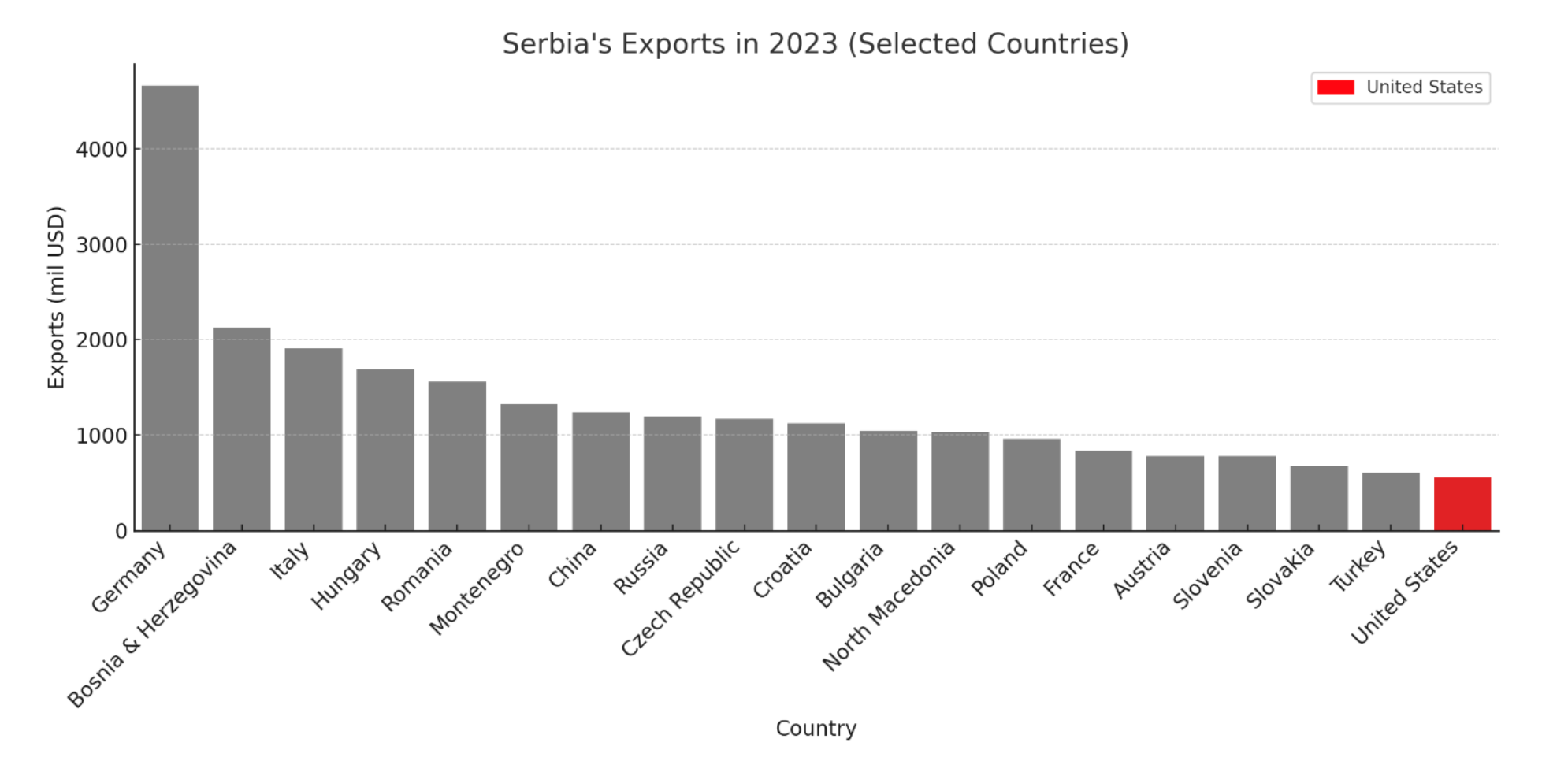
The Serbian economic community agrees that the direct effect of the new US tariffs on Serbia is negligible. As mentioned, Serbia exported only $556.9 million worth of goods to the United States in 2023, accounting for less than 2% of its total exports. A 37% tariff on this modest trade volume may hurt specific companies, but it poses no systemic risk to Serbia’s economy. The real threat lies elsewhere — in the ripple effects these tariffs may produce through Serbia’s export dependency on Germany.
Germany is Serbia’s largest trading partner by far, absorbing over €4.3 billion worth of Serbian exports in 2023 — more than 16% of total export volume (Figure 1 below). Crucially, this trade is not composed of final consumer goods, but intermediate inputs for German industrial production. The most significant Serbian exports to Germany last year included rotating electrical machines (18.7%), electrical distribution equipment (13.9%), parts and accessories for motor vehicles (7.9%), and railway vehicles and components (4.6%).
Figure 1. Serbia’s exports in 2023. Source: Author, based on the data from the Statistical Office of Serbia
In other words, Serbia functions as a specialised supplier to the German manufacturing sector, particularly the automotive industry, which is now directly targeted by US tariffs: 20% on general EU goods, and a punitive 25% on imported vehicles. Covering everything from cars and auto parts to pharmaceuticals and machinery, the US was Germany’s biggest trading partner in 2024, according to the statistics office, with 253 billion euros worth of goods exchanged between them. If German carmakers scale back production or shift supply chains, Serbia’s industry will feel the shock.
This is not a theoretical scenario. LEONI Srbija, for instance, produces cable harnesses for premium-class vehicles made by the world’s leading auto manufacturers. The company employs about 10,000 workers, making it one of Serbia’s largest industrial employers. It exports 100% of its production, and in 2023 ranked among the top five Serbian exporters. LEONI also collaborates with around 700 local suppliers, creating extensive linkages across the economy. A contraction in German auto exports could result in downsizing at LEONI, with cascading effects on employment, local subcontractors, and regional development.
This illustrates a fundamental truth of dependency theory: Serbia’s industrial structure is not designed to meet domestic demand but to serve the accumulation needs of the capitalist core. Value is added here only to the extent that it facilitates value realisation elsewhere. When accumulation in the centre is disrupted — whether by crisis, protectionism or political conflict — the periphery is exposed. Its prosperity is conditional, not sovereign. Samir Amin noted in Unequal Development that dependent integration into global capitalism creates a structure of vulnerability, where growth is tethered to decisions made in boardrooms far beyond national control.
These latest developments confirm the empirical findings I presented in Serbia as the Super-Periphery of Europe: Growth Without Quality and Transformation (2024), where I argued Serbia functions not merely as a periphery, but as a super-periphery — an economy structurally locked into low-value, dependent growth trajectories with minimal prospects for qualitative transformation or autonomous development. This reinforces the subordinate position of the Serbian economy in the global division of labor, where even integration into industrial supply chains serves primarily to enhance capital accumulation in the core, not to foster developmental convergence in the periphery.
Tariffs and the logic of capitalist accumulation
Trump’s advocacy for tariffs is more than a populist talking point; it is a political response to contradictions within global capitalist accumulation. His argument works on two levels. On the surface, it invokes fairness and sovereignty. Beneath, it expresses anxiety over a system increasingly reliant on globalised production and financial abstraction.
Trump claims the US is being “taken advantage of” by countries with trade surpluses — naming China, Germany and Mexico as culprits that distort trade through subsidies, currency manipulation and tariffs. This, he argues, harms US workers and producers, resulting in persistent trade deficits.
What this account ignores is the structural function of the US dollar. As the world’s primary reserve currency, the dollar places the US in a unique position. It can run sustained trade deficits without facing balance-of-payments crises. Other countries export goods to the US not due to weak negotiations, but because they need dollars — to service debt, stabilise exchange rates and accumulate reserves. Modern Monetary Theory (MMT) scholars correctly point out (even if their broader prescriptions are debatable) that the US is a monetary sovereign. It issues the global currency, faces no external constraint on its supply, and settles debts in its own units.
Thus, global trade is not an exchange of goods for goods, but of goods for claims — namely US Treasury securities and dollar reserves. Critics from Marxist and post-Keynesian traditions note that this amounts to a structural exchange of material output for fiat tokens emblazoned with US ruling-class saints: presidents, a Treasury boss (Alexander Hamilton), and a polymath who never ruled but helped build the system (Benjamin Franklin). The arrangement enables the US to consume more than it produces and finance its global dominance through a currency others must hold. Far from being exploited, the US enjoys what former French President Valéry Giscard d’Estaing famously called an “exorbitant privilege”.
Trump’s demand that countries buy more US goods while simultaneously threatening sanctions against those who de-dollarise (such as BRICS countries: Brazil, Russia, India, China and South Africa) reveals an internal contradiction. For the dollar to maintain its hegemonic role, others must sell more to the US than they buy — accumulating dollar reserves. Trump’s vision turns this logic on its head. The contradiction is not personal, but systemic: a reflection of a global economy stretched between the imperatives of imperial control and economic nationalism.
This contradiction has two effects. First, it deepens financialisation in the US, where capital abandons productive investment for speculative activities — propped up by foreign demand for dollar assets. Second, it offloads adjustment costs onto the periphery, where states lack the privilege of issuing a global reserve currency. In this light, Trump’s narrative of trade injustice reverses reality. It is not the US that suffers from the current order, but countries structurally tethered to a system they cannot control.
Still, Trump’s rhetoric resonates because parts of the US, particularly the industrial Midwest, have experienced real economic dislocation. As Janesville: An American Story shows, the closure of a single GM plant can unravel entire communities. Boris Kagarlitsky notes in The Long Retreat, even capitalism’s metropoles have become victims of their own neoliberal designs. But this is not due to US weakness — it is the result of an economic structure tilted toward finance and consumption at the expense of labour and production. Tariffs, in this sense, are less a solution than a spectacle, redirecting blame while leaving structural causes untouched.
The second pillar of Trump’s case — that dependence on foreign goods undermines domestic industry — deserves closer attention. It reflects a deeper transformation: decades of deindustrialisation and the erosion of high-wage manufacturing employment. But his across-the-board tariff response lacks historical grounding or strategic coherence.
From a Marxist perspective, protectionism has historically played a role in capitalist development. Samir Amin and other dependency theorists argue tariffs have been tools of primary accumulation and industrial takeoff. They were selective and temporary, designed to shield nascent industries until they became globally competitive. The goal was not autarky but a controlled insertion into global markets on more favourable terms.
Marxist economist Rudolf Hilferding observed more than a century ago that free trade evangelism typically follows successful industrialisation. Britain, for instance, had relied on high tariffs to develop, only to champion free markets once its supremacy was secure — a classic case of “kicking away the ladder.”
Trump’s use of tariffs, by contrast, lacks any developmental rationale. They are not targeted toward strategic sectors, nor linked to investments in innovation or infrastructure. Many apply to goods the US no longer has the capacity or interest to produce. As such, they are unlikely to spark industrial renewal or create stable employment. Rather, they function as political theatre — a reactive gesture from a capitalist core grappling with the limits of globalization.
As Michael Roberts points out in his latest piece, the hope that tariffs will revive US industry and create new jobs is unfounded. Employment in the manufacturing sector has been declining since the 1960s, primarily due to falling profitability and technological displacement of labour — not trade liberalisation. Even if exports increased enough to close the trade deficit, which is highly unlikely, the share of industrial workers would rise only from 8% to 9%.
If Trump truly wants to restore the industrial base, huge investment is needed. But US companies outside the tech “Magnificent Seven” are already facing low profitability and are unlikely to invest — except perhaps in military production funded by government contracts. In this context, tariffs are not a tool of renewal but a symptom of systemic impotence.
Strategic protectionism as capitalist crisis management
If Trump’s tariffs appear irrational from the standpoint of conventional economics, they make far more sense when viewed as responses to the deeper contradictions of global capitalism. From a Marxist perspective, protectionism today reflects not merely incoherent populism, but a systemic effort to manage a global order that no longer delivers reliable returns for capital.
At the root of this crisis lies what Karl Marx identified as the tendency of the rate of profit to fall. As capitalists invest more in machinery and technology (constant capital) and relatively less in labor (variable capital), the overall rate of profit declines — even if the mass of profit continues to grow temporarily. Empirical studies by Michael Roberts confirm this trend in the US economy. His analysis shows a 27% fall in the rate of profit for non-financial corporations from 1945 to 2021, with pronounced declines during periods of rising investment in constant capital. This validates Marx’s insight: the capitalist drive to increase productivity ultimately undermines profitability.
To counteract this tendency, capital resorts to various strategies. It intensifies labour exploitation, relocates production to cheaper labour markets, invests in technological innovation, inflates asset bubbles, and — when under duress — retreats behind protective barriers. Trump’s tariffs represent such a retreat. By raising the cost of foreign goods, they aim to carve out a protected space for US capital, shielding it from more productive or lower-cost competitors. The tariffs also serve to shift the burden of the crisis onto rival capitals — above all, China and the European Union — in the hope that US producers can regain some of the competitive ground they lost in the era of hyper-globalisation. The goal is not economic nationalism per se, but the temporary restoration of profitability.
Yet, these measures do not resolve the underlying contradictions of accumulation; they merely redistribute its effects. The structural tendency toward overaccumulation and profitability crisis remains. In the absence of a comprehensive industrial policy, the breathing space created by tariffs is not used to revitalise production, but rather to sustain the circulation of fictitious capital.
This is where the strategy of share repurchases — or buybacks — enters the picture. In the current phase of financialised capitalism, falling share prices are not necessarily a threat; they are an opportunity. When markets respond to tariff announcements or economic uncertainty with a decline in stock valuations, corporations often respond by using excess cash — or low-interest credit — to buy back their own shares. This artificially inflates earnings per share (EPS), props up share prices, and secures executive compensation, even when underlying productivity remains stagnant.
Now that Trump has temporarily backed off for 90 days (with the notable exception of China, where tariffs have reached an astronomical 125%), some cynical followers of conspiracy theories claim the tariff announcement served precisely this purpose: to allow US companies, and other well-informed speculators, to buy shares cheaply before the US stock market rebounded by 10% on April 9 — the largest single-day increase since 2008.
Another effect of this dynamic is seen in how corrections on capital markets — provided that business profitability remains nominally unchanged — can contribute to a rise in the profit rate. As the value of shares and other assets falls, the market value of total capital declines — that is, the denominator in the profit rate formula shrinks. If the mass of profit remains constant, the mathematical consequence is a rise in the rate of profit.
Similarly, from a Marxist perspective, the reduction in the market value of constant capital increases the relative importance of variable capital (labour) in the production process, thereby enhancing the potential for extracting surplus value. In other words, a nominal decline in capital value can act as a systemic rebalancing mechanism, restoring profitability even in the absence of real production growth.
In this system, capital accumulation increasingly bypasses production. Instead of funding technology, jobs or infrastructure, surplus flows into asset inflation. Tariffs and buybacks work in tandem: the former shields domestic capital from global competition, while the latter sustains shareholder value through fictitious capital — asset prices divorced from underlying production.
This shift also reflects a deeper transition. The globalised model of accumulation that dominated the late 20th and early 21st centuries is no longer delivering. The basic mechanism, in which capital from the core exploits cheap labour in the periphery, has begun to exhaust itself. Wages in China and other emerging economies have risen, logistics have become more fragile and politicised, and political consensus in the core countries has eroded. Public patience with deindustrialisation, wage stagnation and dependency on foreign supply chains has worn thin.
Technological advances in robotics, AI and 3D manufacturing now make reshoring technically feasible, but not necessarily labour-intensive. What looms is not a revival of 20th-century industrial capitalism, but a dystopian configuration in which US robots compete with Bangladeshi workers for the same sliver of global value. Trump’s tariffs are less a blueprint for industrial renewal than a prelude to a new techno-nationalist order organised around capital control, technological dominance and regional economic blocs.
The same logic of crisis management is evident in financial markets. During the COVID-19 pandemic, the Federal Reserve injected huge liquidity into the system. This intervention stabilised markets in the short term but created vast distortions. By early 2025, the total capitalisation of the US stock market was estimated to exceed its “fair value” by $25 to $30 trillion — an unprecedented divergence between market valuation and real economic output. This was not the return of growth but the inflation of fictitious capital to new heights.
The correction is now underway. Roughly $11 trillion in market capitalisation has already been wiped out, and another $15 to $20 trillion may yet vanish. However, this process is not solely destructive; it serves a systemic function. As capital retreats from risky assets to the relative safety of US Treasury bonds, yields on government debt fall, easing the cost of public borrowing and alleviating major drivers of the federal deficit. In effect, the crisis in capital markets becomes a backdoor mechanism for restoring fiscal space — not through taxation or austerity, but through the disciplining of capital itself. The state gains room to maneuver not in spite of the crash, but because of it.
As Adam Tooze emphasizes in his Chartbook 369, the US Treasury market, encompassing all $28 trillion of it, is the truly systemic bond market. In the normal course of a stock market correction, we would expect to see bond prices rising and yields falling, thereby lowering interest rates and easing pressure on businesses. This reflects the see-sawing, balancing effect of markets operating across assets, where Treasuries serve as a safe haven in times of uncertainty.
Crisis as transition, not collapse
Taken together, Trump’s tariffs, the resurgence of protectionism, the persistence of fictitious capital, and the current stock market correction are not disconnected phenomena. They are linked responses to the systemic contradictions of capitalism — and particularly to the long-term tendency of the rate of profit to fall. They reflect an increasingly desperate attempt by the ruling class to defend profitability and maintain hegemony in the face of stagnation, overaccumulation and political disintegration.
What we are witnessing is not the end of capitalism but its mutation. The neoliberal globalisation of the past four decades is being dismantled, not to make way for socialism or democratic planning but to construct a new regime of accumulation — one more suited to capital’s current needs. This regime will likely be marked by intensified state intervention, regionalised production zones, and a deepening reliance on financial manipulation to sustain capital values. It will not resolve the contradictions at the heart of the system. It will simply displace them, once again, into new geographies, new technologies, and new crises.
In this reconfiguration, peripheral states such as Serbia are not passive observers but collateral damage. The 37% tariff imposed on Serbian exports — despite the country running a trade deficit with the US — exposes the arbitrary and coercive logic of this transition. It signals that the new regime of accumulation will be policed not by rules or multilateral institutions, but by power and geoeconomic intimidation. As capital reshuffles its priorities and blocs harden into protectionist zones, countries such as Serbia find themselves caught in the crossfire — punished not for any economic offense, but for occupying a structurally dependent position within the global system. The crisis, in this sense, is not merely economic. It is a geopolitical sorting process that reasserts imperial hierarchies even as the old liberal order dissolves.
Xi Warns US Will Isolate Itself
There are no winners in a tariff war, the Chinese president has said
The United States risks isolating itself by pursuing unilateral trade restrictions, Chinese President Xi Jinping warned on Friday during a visit of Spanish Prime Minister Pedro Sanchez to Beijing.
The administration of US President Donald Trump has launched an escalating tariff war with China, imposing a total of 145% in duties on Chinese imports this week. Beijing has retaliated by hiking tariffs on American goods to 125%.
“There are no winners in the tariff war and standing against the world ultimately results in self-isolation,” Xi said, as cited by Xinhua news agency.
Xi called on China and the European Union to “jointly resist unilateral bullying” in order to protect their legitimate rights and interests, and uphold international rules and order.
The EU, which has been targeted with a 20% tariff by the US, has warned of significant global economic repercussions and has vowed to take countermeasures. Earlier this week, Trump declared a 90-day pause on reciprocal duties for most US trading partners, including the EU, allowing a window for negotiation.
Brussels has adopted a policy of “de-risking” towards Chinese imports, balancing protective trade measures such as tariffs on electric vehicles with efforts to maintain constructive economic relations.
The Chinese president also stated that regardless of changes in the external environment, the country would remain steadfast, focused, and would efficiently manage its own affairs.
“For over seven decades, China’s growth has been fueled by self-reliance and hard work, never depending on favors from others and never backing down in the face of unreasonable suppression,” Xi explained.
Trump argues that the increased duties are needed to address trade imbalances and stop China from “ripping off the USA.” Earlier this week, he opined that the “proud” Chinese would have to “make a deal at some point.”
China has slammed Trump’s “abnormally high tariffs” on Chinese products as “unilateral bullying and coercion.” The move by the US president represents “a serious violation of international economic and trade rules, as well as of basic economic laws and common sense,” Beijing stressed.
The trade dispute between the world’s two largest economies has disrupted global markets, sent oil prices to four-year lows and caused concerns over global supply chains.
Why the Elitists and Many Americans Applaud Trump’s Tariffs
by Dimitris Eleas / April 12th, 2025
Donald J. Trump is reinstating protectionist rhetoric, using tariffs as a tool for reindustrialization, political pressure, and wealth redistribution, while the American elite continues to support him, despite the potentially devastating effects on the global economy.
Is Trump turning his tariffs against the United States’ historic allies? One doesn’t have to be a genius to see that. At the same time, the local elite stands by Trump, seeing him as a savior, even when stock market indices on Wall Street fall or the competitiveness of American businesses declines.
Why did America have to resort to tariffs (taxes on imports)? The reason is simple: The US owes huge amounts of money. Many countries earn significant amounts from trade with the US and then, use that revenue to buy up some of the US debt (see: China). The total debt is $36 trillion and requires over a trillion dollars a year to service it! At the same time, the US spends 35% more than its government revenues annually, which increases the federal budget deficit and adds new debt every year. The amounts are unimaginable… while Americans save very little.
As is well known, the way tariffs are imposed causes disruption and chaos, as they are mainly retaliatory measures. Is this some kind of solution that “returns America” to the 19th century? Maybe. But back then we had high tariffs and low taxes.
How does the average American view the tariffs imposed by the 47th President? Americans elected Trump for many reasons. He said from the beginning what he would do, so what is happening is not surprising. A very large part of society in the US believes that he is leading the country on the right path. They believe that his moves, both domestically and internationally, will pay off in the long run. Many believe that, at some point, they will benefit from these excessive moves.
Trump has a lot of “weapons” in his quiver. He’s smart, and he knows how to use language. When he talks about “Liberation Day,” many Americans—even if they haven’t seen much change in their wallets yet—feel like someone is fighting for them. Despite the fact that products in the supermarket remain expensive, they believe that when tariffs of 34% are imposed on China, 20% on the EU, 24% on Japan and 27% on India, then “something is happening.”
Thus, Americans will be forced to produce goods and consume American products, since – in an ideal scenario – these will be cheaper, of higher quality, and produced by American hands.
How and why is Trump using tariffs? I wish he knew. He has been convinced that imposing them will benefit the economy in the long run and lead to the reindustrialization of America. That is, it will reverse the massive transfer of industries to Asia – mainly to China – that began under Reagan, with the support of the Republicans, in the 1980s. Then, the same Party that promoted globalization is today trying to overthrow it – and noisily so…
Here, it should be noted that the moves of the American “deep state” at that time were aimed at exploiting China. However, the Chinese seized the opportunity and steadily and methodically began the “miracle” that their economic rise symbolizes today.
However, with tariffs, Trump is turning historic allies against the US. However, he believes that tariffs give him great negotiating power. In other words, by imposing tariffs, he is trying to revoke them if the country on which he imposed the tariffs has achieved what he wanted. It is as if he is playing chess with tariffs for various geopolitical benefits (energy, rare earths, real estate deals for his family, etc.).
If his advisors see how a new 1929 is about to begin, then he will take them back immediately. Or, it may be too late, because a new global recession will have begun. Perhaps, then, it will be too late. But again, “the tariff game” is a tool for reshaping American hegemony in the world. And it is certainly also a means of redistributing wealth, especially if the “difficult reindustrialization” is achieved. (Note: At some point, after many hours, he paused tariffs on many countries, but left tariffs on China, raising them, first to 125% and later to 145%!)
Ultimately, tariffs are “psychological ash” in the eyes of the country’s friends and enemies, and a temporary psychological solution for Americans. Will they ever react? Perhaps, after a year, strong reactions will begin to arise with what he is doing, when the poor, pensioners and the lower classes will have been mainly affected by the increases in consumer goods… That is, those who helped him get elected!
Until then, the elite and many Americans (thankfully not all) will have fun, loving their Emperor…FacebookTwitterRedditEmail
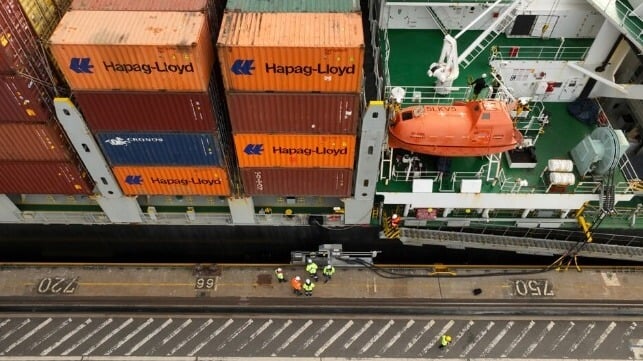
Less than a year after becoming the first port in Europe to offer shore power for large containerships, Hamburg, Germany is on track to complete the installation of shore power capabilities at all its terminals for large containerships. Testing commenced last week at the third of the port’s container terminals with officials saying they remain on track to provide shore power at all the large containership terminals by the end of this year.
The port is well ahead of the EU mandate requiring the use of shore power. Regulations mandating shore power be phased in starting in 2030 for containerships and passenger vessels over 5,000 gross tons. By 2035, all EU ports are required to have an on-shore power supply or alternative zero-emission technologies.
Last week, a further important milestone for the sustainable development of the Port of Hamburg was reached as the shore-side power station of the Hamburg Port Authority at HHLA Container Terminal Altenwerder (CTA) completed its first practical test. The first “ship integration test” was conducted and in the coming weeks, the terminal will continue to increase its power. Further test runs have already been planned to integrate the supply of shore-side power for containerships into regular operations in the Port of Hamburg.
The testing was done with the MSC Athens (110,853 dwt). It is one of the company’s smaller vessels with a capacity of 8,800 TEU but is a stepping stone to the larger vessels.
“Every successful ship integration test brings us one step closer to integrating the power stations into regular operations,” said Friedrich Stuhrmann, Chief Commercial Officer of HPA.
With the power station at CTA, the third shore-side power station for containerships in the Port of Hamburg is now in the transitional phase leading up to regular operations. Additionally, the power station at HHLA Container Terminal Burchardkai is expected to be ready this year. The 18,000 TEU box ship CMA CGM Vasco de Gama became the first vessel to plug into shore power at the Container Terminal Hamburg in May 2024.
To facilitate shore power connections to box ships, Hamburg began investments in 2022 for the necessary infrastructure culminating in a plant that will operate at the container terminal providing connections for three mega-ship berths. Each has a connection capacity of 7.5 MVA. The plant will supply the ships with renewable energy from the public grid. Half of the funding for the shore power installation at Container Terminal Hamburg came from the German government through the Federal Ministry of Economics and Climate Protection.
MSC announced in June 2024 that it had agreed to work with Hamburg to install shore power for its terminal. Later last year MSC became the lead investor in the port operator along with the City of Hamburg.
“The integration of shore power into our fleet is an important step towards sustainable shipping,” said Nils Kahn, Managing Director, MSC Germany. The shipping company reports it owns approximately 40 vessels that can be charged with shore-side electricity. The number continues to grow as it takes delivery of its newbuilds.
COSCO Shipping & Norsepower Enable a Step Change in the Rotor Sail Market
Norsepower, the global leader in wind propulsion, has signed a strategic Memorandum of Understanding (MOU) agreement with COSCO Shipping Heavy Industry Equipment (Nantong) Co., Ltd. (CHIC) to accelerate the serial production, sales, installation, and service of Norsepower Rotor Sails™ in the region.
The partnership builds on Norsepower Rotor Sail™ Factory in Dafeng, China. This is the world’s first factory specializing in rotor sail manufacturing, which guarantees the needed capacity and high-quality in serial production of Norsepower’s products. Combined with this factory and Norsepower’s exclusive production hub in Poland, the new cooperation with CHIC strengthens the company’s ability to meet growing global demand.
By leveraging CHIC’s extensive resources in shipbuilding and offshore equipment, the collaboration will drive innovation in wind propulsion and further integrate Norsepower Rotor Sails™ into the regional market. The partnership aims to provide shipping companies with practical, cost-effective solutions to reduce fuel consumption and emissions in line with tightening IMO regulations.
Heikki Pöntynen, CEO of Norsepower, commented: "This agreement marks a significant step forward in expanding access to wind propulsion solutions in China. By combining Norsepower’s technology leadership with CHIC’s shipbuilding expertise, we are creating a strong foundation for advancing sustainable shipping. We will achieve breakthroughs in both product supply efficiency and application expansion. We look forward to building on this collaboration and exploring further opportunities together."
Zhang Jianxin, Deputy General Manager of CHIC, added: "We are excited to partner with Norsepower to advance wind propulsion technology. This cooperation will enhance innovation across product design, manufacturing, and business development, ensuring we deliver high-quality, energy-efficient solutions for the shipping industry."
With increasing regulatory pressure to decarbonise shipping, Norsepower’s partnership with CHIC underscores the growing momentum behind wind propulsion. By combining expertise and resources, both companies are committed to accelerating the adoption of sustainable products and supporting the industry’s transition to a low-carbon future.
The products and services herein described in this press release are not endorsed by The Maritime Executive.