Saturday, April 19, 2025

China Rejects Russia's Eastern Pipeline Plan


  • China has rejected Russia's proposal to increase gas exports through Kazakhstan, worsening Gazprom's financial problems.

  • Gazprom is struggling financially due to the loss of European markets and is facing restructuring and asset sales.

  • Central Asian countries are reducing their reliance on Russian gas due to political factors.

China has put an abrupt stop to a Russian proposal to export added volumes of natural gas eastward via Kazakhstan, deepening the financial woes of the erstwhile Russian energy behemoth, Gazprom.

The Russian state-controlled entity, once a critical foreign policy instrument of the Kremlin, has been forced to abandon projects in Central Asia and Latin America recently due to a lack of fiscal muscle.

Gazprom has been urgently looking east to add export volume after the dramatic loss of market share in Europe. One idea promoted by Gazprom representatives was exporting an additional 35 billion cubic meters (bcm) of gas to China via Kazakhstan’s existing pipeline network.

On April 15, China’s envoy to Russia, Zhang Hanhui, put a pin in Gazprom’s trial balloon. “The supply of [additional] gas from the Russian Federation through Kazakhstan is not possible, because there is one gas pipeline and it is overloaded. If we transport [more] Russian gas along this route, we will have to build a new [pipeline]. It is quite expensive. The Russian side is studying [this option], but it is not realistic. In fact, it is not going to work,” the Interfax news agency quoted Zhang as telling Russian journalists. Zhang insisted that to facilitate additional Chinese gas imports, the already planned Power of Siberia 2 (PS-2) route via Mongolia would be a better option.

Construction of PS-2, which has a projected capacity of 50 bcm, was originally slated to start last year, but the project has faced delays due to unresolved financing questions and political factors. Russia’s and Gazprom’s lack of resources to fund the cost of new pipeline construction appears to be one of the major obstacles facing the country’s energy industry.

Once a cash cow for the Kremlin, the Russia-Ukraine war has caused Gazprom’s gas unit to hemorrhage money after the company lost most of its lucrative European gas markets. The entity reported a loss of about $7 billion in 2023 for the first time in its history; annual losses grew to around $10 billion in 2024. The red ink is expected to expand from a puddle into a lake in the coming decade; according to some media reports, Gazprom losses are projected to total $179 billion over the next 10 years at current exchange rates.

The Moscow Times reports that a major restructuring of the Gazprom is in the offing, including the selling off of assets and layoffs of up to 40 percent of staff at the company’s headquarters. “Gazprom's gas business is suffering catastrophic losses, along with it, the Russian budget is running out of money, about 40 percent of which [Vladimir] Putin spends on war,” the Moscow Times report commented.

Already, Gazprom has had to cease involvement in energy development projects in Bolivia, India, Tajikistan, Uzbekistan and Venezuela, due to the heavy losses they were incurring. For instance, Gazprom walked away from the “Shahpakhty” project in Uzbekistan after a production sharing agreement expired.

Central Asian states had been benefiting of late by buying comparatively large volumes of Russian gas at heavily discounted prices. But political factors, in particular Russia’s ongoing crackdown on Central Asian guest workers, are prompting officials in Central Asian capitals to rethink their purchasing approach. 

Kyrgyzstan’s foreign minister, Zheenbek Kulubaev, announced April 15 that Bishkek was looking to reduce its purchases of Russian gas, hinting that the growing Kyrgyz interest in diversifying suppliers is linked to Russia’s rough treatment of Kyrgyz nationals rounded up in a raid of a Moscow bathhouse, the TASS news agency reported. Kulubaev, speaking during a parliament session, urged would-be Kyrgyz labor migrants to avoid Russia.

By Eurasianet.org

Trump’s Tariffs Just Torched His Own Energy Agenda


By Tsvetana Paraskova - Apr 16, 2025


President Trump’s tariff-driven price slump threatens America’s hard?won petroleum export surplus.

Ongoing tariff uncertainty and volatile oil prices make budgeting and drilling decisions difficult.

With a cash?flow breakeven around $62.50–$65/barrel, U.S. producers fear lower prices will stall new well drilling and long?term growth.


The Trump Administration insists that U.S. shale will survive lower oil prices and could work well and innovate further at current price levels of WTI crude prices of about $60 per barrel, and even lower.

The industry is not convinced.

While public statements from the oil lobby and oil producers welcome President Donald Trump’s rollback of regulations and eased permitting processes, executives are privately fuming about the administration’s perceived target to bring oil prices down to $50 a barrel.

Separately, the trade and tariff chaos in markets – triggered by President Trump’s tariffs, tariff pauses, and tariff exemptions – is depressing oil prices as analysts now believe a recession followed by lower energy demand is more likely to happen than not.

U.S. Petroleum Trade Surplus Undermined


With oil prices down by more than 15% from last year’s levels, American oil exports could fetch lower prices for export. This will dent the absolute value of the U.S. petroleum trade surplus, which America began to show with the surge in oil production in the shale revolution era.

Before the shale boom in the 2010s, the U.S. was running a deficit in petroleum trade as it was importing more crude and petroleum products than it exported.

The shale revolution flipped the trade position to a surplus for America, and the U.S. has been a net petroleum exporter every year since 2020.

Related: Trump’s Trade War With China Enters a More Aggressive Phase

President Trump’s tariff policies – which tanked oil prices and raised the odds of a recession – are undermining America’s petroleum trade surplus. That’s not a desirable outcome for an administration fixated on fixing trade deficits. Petroleum and energy trade, in fact, is one of the few sectors in which the U.S. has a large trade surplus in the dozens of billions of U.S. dollars annually.

Even if the EU, Japan, and South Korea pledge to buy and indeed buy more U.S. LNG and oil, part of the gains could be offset by weak prices and lower demand for energy in case all the tariff uncertainty brings about a global downturn or recession.

Weaker global demand for oil and gas would not support increases in U.S. oil production and doesn’t bode well for the future LNG export projects which need firm commitments to take the plans to final investment decisions.

“You claim that the energy industry is the darling of your economic plan, and you just made life very difficult,” Robert Yawger, director of the futures division at investment bank Mizuho Americas, told The Wall Street Journal.

U.S. Shale Growth At Risk


Then there is the issue of how the U.S. could sustain production to remain the energy export superpower it has been over the past few years.

U.S. Energy Secretary Chris Wright, the former boss at fracking firm Liberty Energy, remains bullish on U.S. oil production—and believes that the industry will not only survive but thrive even with oil at $60 or below.

Yet, the industry begs to differ—at least that’s what executives wrote anonymously in March in comments to the quarterly Dallas Fed Energy Survey for the first quarter.

“There cannot be "U.S. energy dominance" and $50 per barrel oil; those two statements are contradictory. At $50-per-barrel oil, we will see U.S. oil production start to decline immediately and likely significantly (1 million barrels per day plus within a couple quarters),” an executive at an exploration and production firm said.

“The U.S. oil cost curve is in a different place than it was five years ago; $70 per barrel is the new $50 per barrel,” the executive noted.

Another executive put it even more bluntly, “The administration’s chaos is a disaster for the commodity markets. "Drill, baby, drill" is nothing short of a myth and populist rallying cry. Tariff policy is impossible for us to predict and doesn't have a clear goal. We want more stability.”

Stability is the furthest from where the oil market has been in the past two weeks. Stability may be OPEC’s buzzword for ‘relatively high oil prices,’ but it is also crucial for the capital investment and drilling decisions in the U.S. shale patch.

Without any certainty about the cost of drilling wells – including the price of steel – producers face difficulty budgeting and maintaining shareholder payouts at current levels.

Drilling and ‘all-in’ corporate costs, including overhead, dividend, and servicing debt, amounts to a cash flow WTI breakeven of $62.50 per barrel for new activity in 2025, according to estimates by Rystad Energy.

Executives at U.S. firms think they need $65 per barrel, on average, to profitably drill a new well this year, per the Dallas Fed Energy Survey.

WTI Crude prices have already dropped below this level and were below $62 a barrel early on Tuesday.

Prices could drop further if global oil demand growth slows with weakening economies amid the trade and tariff chaos.

Even OPEC, the most bullish on oil demand of any forecaster, has just cut its 2025 and 2026 demand growth estimate.

In the monthly report on Monday, OPEC said it sees global oil demand growth at 1.3 million barrels per day (bpd) in each of 2025 and 2026, down by 150,000 bpd for each of the two years.

OPEC’s very bullish forecast (and it should be such if the OPEC+ alliance wants to continue justifying easing of the production cuts) is two to three times higher than most other growth estimates by major Wall Street banks.


After years of supporting oil prices with the production cuts, OPEC will also seek to regain market share at the expense of U.S. shale.

In this context, the U.S. Administration’s tariffs and the uncertainty they bring for American producers undermine the American energy dominance agenda.

By Tsvetana Paraskova for Oilprice.com


U.S. Onshore Oil Production Faces Economic Policy Challenges

By Rystad Energy - Apr 16, 2025

Recent economic policy changes, particularly tariffs, have created market uncertainty for US oil and gas operators, potentially causing production to fall below record highs.

Oil producers are concerned about policy unpredictability and its impact on capital investment programs, especially as they aim to balance growth with shareholder returns.

While steel tariffs have some effect on cost structures, the larger risk to the industry comes from potential demand destruction due to an economic recession spurred by tariff strategies.


US oil and gas operators have encountered an avalanche of economic policy changes from the Trump administration over the last week, creating market uncertainty in an already maturing industry. Rystad Energy expects onshore Lower-48 production will fall short of the record high output of 11.37 million barrels per day (bpd) of oil, achieved in November 2023, until at least June of this year. However, this outlook faces serious downside pressure should the recent price downturn hold, forcing operators to cut back on rig activity.

Consistent returns are top of mind for US producers looking to squeeze as many dollars as possible out of their barrels. For these tight oil players, decreased reinvestment rates result from fewer growth-oriented private players on the market along with their continued focus on disciplined spending and modest growth. Existing capital frameworks will be put to the test over the coming quarters, should President Trump’s tariff strategy lead to an economic recession and, by extension, oil demand destruction.

US oil operators face both significant subsurface and above ground risks as they plan their capital investment programs. While most oil plays are seeing deteriorating normalized productivity, US producers must also compete on a global market to meet an uncertain but likely decelerating demand outlook.

Matthew Bernstein, Vice President, North America Oil and Gas Research, Rystad Energy


Read the full Rystad Energy Shale Trends whitepaper here.

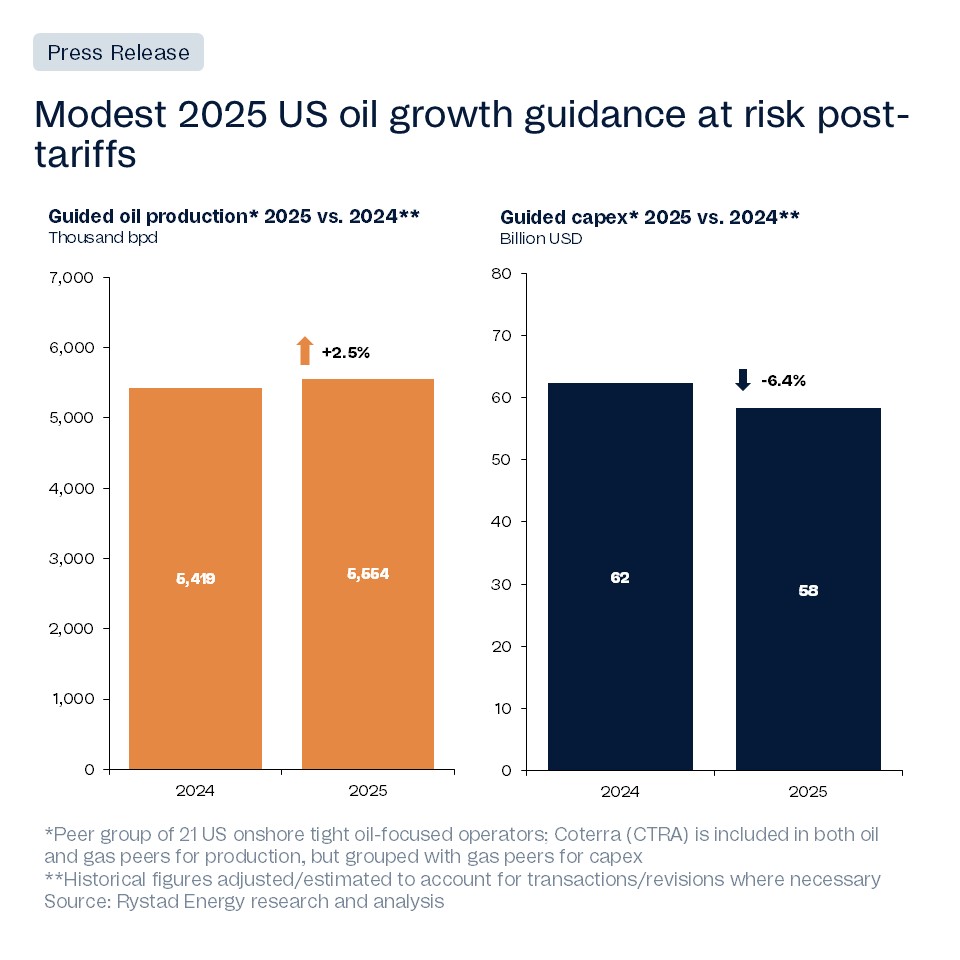
Even prior to the drop in prices following the president’s tariff rollout, exploration and production (E&P) management teams worried about policy unpredictability. Publicly traded firms guided plans to increase volumes by roughly 2.5% in 2025 while reducing spending by more than 6%. Much of this growth, which is now at risk due to the collapse in prices, is driven by some of the largest diversified public players and supermajors, capable of diverting cash flows from global operations to fund more growth-oriented programs in US tight oil, while still maintaining capital discipline at a corporate level. Although half-cycle breakeven prices of most wells being drilled today are in the $50 per barrel range, we estimate that public, tight oil E&Ps need more than another $9 per barrel to cover shareholder returns.

Rystad Energy has long maintained that presidents have very few supply-oriented policy measures at their disposal to increase US oil output. Doing this while also bringing down prices at the same time is even more unrealistic, as producers see WTI in the $70 per barrel range as supportive of only modest growth

Matthew Bernstein, Vice President, North America Oil and Gas Research, Rystad Energy

E&P executives also stressed the negative impact from steel tariffs on their cost structure and the extent to which higher input costs make it even harder to grow volumes in a soft oil market. However, relative to the price drop caused by the onset of tariffs, Rystad Energy sees the tariffs themselves as only having a minimal net impact on well costs.


Currently, we expect about 300,000 bpd of exit-to-exit growth in 2025, all in the Permian—a concentration that presents another risk. Permian natural gas prices remain weak, and our projections show that dry gas production in the basin has little or no growth potential in 2025.

By Rystad Energy

Construction Firms Brace for Increased Costs

By Metal Miner - Apr 17, 2025


President Trump's administration has implemented new tariffs, including a 10% blanket levy on many imports and increased tariffs on China, which significantly impacts the cost and availability of construction metals in the US.

The tariffs are creating volatility in the prices of construction materials like steel and aluminum, leading to concerns about increased costs, project delays, and potential shifts in the market favoring domestic producers.

Geopolitical tensions, particularly with China, are central to the tariff situation, as China is a major source of US imports and a large global metals producer, and its trade practices are a key driver of the new policies.


The Construction MMI (Monthly Metals Index) broke out of its over 6-month-long sideways trend to pivot down 5.41%. This new movement outside of its sideways range could indicate more volatility in the short term than the index experienced in the past 12 months.


The new Trump tariffs on China caused some volatility in the price of construction materials, including H-beam steel and steel rebar. If the U.S. and China fail to negotiate these new policies, the index will likely remain unpredictable for the short term..

The U.S. construction and manufacturing sectors are bracing for impact as President Trump’s 2025 10% blanket tariffs take shape. Trump has declared a 10% levy on all foreign goods entering the United States, a sweeping tariff policy aimed at bolstering domestic industry which was recently covered in MetalMiner’s weekly newsletter. That figure excludes Canada and Mexico, which already incurred 25% tariffs earlier this year.

However, as of April 9, the White House announced that the 10% tariffs are on hold for 90 days, except for those levied against China. This trade move could dramatically reshape the flow of construction metals like steel, aluminum and copper into the U.S. market.

Trump Tariffs: 10% Blanket Levy on Imports

Trump’s 10% blanket levy marks a sharp departure from the targeted tariffs of the past. Trump has defended the sweeping tariffs as necessary to address large trade deficits and nonreciprocal trade practices he says have hollowed out U.S. manufacturing. “They give us great power to negotiate,” the president stated, suggesting the tariffs could be a lever for further mediation.

China has been hit especially hard by the Trump tariffs. Imports from China, including construction metals like H-beam steel and steel rebar, faced a punitive 54% duty as of early April. Despite the broad reach, the duties do not treat all products equally, and the administration has carved out some notable exemptions.

According to a White House fact sheet, the Trump tariffs currently exempt certain critical goods and prior tariff regimes from the new 10% levy. For example, steel, aluminum, automobiles and automobile parts remain governed by existing Section 232 tariffs and won’t incur the additional 10% charge, a move that MetalMiner’s free comprehensive tariff guide offers revenue saving strategies on.

Along with this, Trump has separately raised the Section 232 tariff on aluminum from 10% to 25%, matching the 25% rate on foreign steel while ending country exemptions under that program.

U.S. Construction Metals Imports in the Crosshairs

For the U.S. construction industry, metals like steel and aluminum are in the crosshairs of the new trade barriers. Even though steel and primary aluminum fall under pre-existing tariffs, Trump’s latest actions expand and reinforce those duties while including new duties on other construction materials separate from metals. As of March 12, the administration eliminated all country exemptions for steel and aluminum tariffs.

The new 10% blanket tariff further complicates the picture for construction metals that previously went without duties. On July 9, imported construction materials like copper wiring, structural components, nails, fasteners and machinery will soon face a 10% cost increase if the country of origin is subject to the tariffs.

Although raw copper is exempt, many finished products or alloys used in construction will be subject to the extra fees. Indeed, early signs of the impact are already emerging in price indices. The U.S. Producer Price Index for March showed that industrial metals costs were climbing, driven by tariffs on steel and aluminum, which had been in effect for only a month.

Domestic Ripple Effects: Winners and Losers

Domestically, Trump’s tariffs are reshaping the landscape for construction metals, bringing both gains and setbacks. U.S.-based steel producers and aluminum manufacturers stand to gain the most right out of the gate as the new trade barriers tilt the playing field in their favor.

However, these gains come with some pain for downstream industries. Construction firms, real estate developers and manufacturers that consume large volumes of metal will encounter higher input costs almost immediately. Industry observers warn of project delays and cancellations if metal prices continue to climb.

Geopolitical Tensions and the “China Factor”

As both the largest source of U.S. non-North American imports and the world’s biggest metals producer, China lies firmly at the center of the tariff storm. Meanwhile, China’s real estate boom has cooled dramatically under the weight of debt crises and slowing growth. On a related note, Chinese steel exports recently surged to a 9-year high, and countries like Turkey and Indonesia have already imposed fresh tariffs or duties to block the influx of Chinese steel.

By Jennifer Kary

Auto Industry Navigates Shifting Tariff Landscape

  • Automakers are implementing various strategies, including adjusting prices, incentives, and production, in response to the uncertainty and potential impact of tariffs.

  • Deutsche Bank predicts a potential slowdown in US auto sales due to tariffs, with significant cost increases for major manufacturers like Ford and GM.

  • The situation remains highly fluid, with the possibility of tariff suspensions alongside the expectation that all imported vehicles and parts could be subject to increased duties.


In a new note out this week, Deutsche Bank laid out how it believes auto OEMs are going to shift their businesses to adapt to tariffs. 

Deutsche Bank reports that automakers (OEMs) are adopting a wide range of strategies to navigate the uncertainty—adjusting pricing, incentives, and production plans on a rolling basis.

The situation remains highly fluid, with the Trump administration recently floating the possibility of temporarily suspending tariffs to allow more time for OEMs to adjust. However, Deutsche Bank emphasizes that the market should operate under the assumption that “all imported vehicles are currently subject to the 25% tariff,” with imported parts facing similar duties starting May 3.

In its April 15 update, Deutsche Bank observes, “Across OEMs, we continue to see a dispersion of reactions.”

For instance, Tesla has paused sales of U.S.-built Model X and S vehicles in China, while GM halted operations at its CAMI Assembly Plant. Mazda, Mitsubishi, and Subaru have also taken a variety of measures—ranging from absorbing price increases to stopping U.S. inventory shipments altogether.

Among notable strategic shifts, Ford is offering broad employee pricing discounts and reshuffling production to its Fort Wayne facility and Honda has publicly stated it will not raise consumer prices as it evaluates its response.

Meanwhile, Infiniti has indefinitely paused production of two crossover models built in Mexico and Rivian and several other EV manufacturers have so far maintained operations but are assessing longer-term impacts.

While some OEMs are absorbing tariff costs temporarily—Mazda, for instance, will do so through April—others are preparing to pass the cost downstream. Deutsche Bank notes that despite a lack of sweeping public announcements, “the cost impact will not be trivial,” as one unnamed CEO warned.

Deutsche Bank continues to track weekly developments and offers updated data in spreadsheet form upon request, cautioning investors that policy developments could shift “overnight.”

We noted earlier this week Deutsche was still cautious on auto stocks. In a note on Monday it said that as Q1 2025 earnings approach, automakers still face significant uncertainty from new tariffs. They expect strong early-year demand as consumers buy ahead of price hikes, followed by a slowdown in the second half as tariffs bite—pushing 2025 U.S. auto sales to 15.4 million, down from 16.0 million in 2024.

Ford and GM could see gross costs rise by over $10 billion, while Tesla and Rivian face smaller impacts due to their supply chains, the note said. These estimates assume a 25% tariff on imported vehicles and parts starting May 3, with exemptions for USMCA-compliant content.

Deutsche said it believes automakers will share the cost burden with dealers and consumers and use various cost-offsetting strategies. Still, Ford and GM may see a $4–7 billion EBIT hit annually.

"In such a context, we think Rivian may have the cleanest set-up given its relatively small exposure to the tariffs and prospects for a strong R2 product cycle (naturally subject to execution risk though)," analysts wrote.

"We continue to view Tesla favorably longer term as an embodied AI secular winner but acknowledge it faces many cross currents for the next quarter or two.

By Zerohedge.com 


Breakthrough Technology Extracts Hydrogen from Natural Gas Wells

THAT WILL SELL WELL IN ALBERTA


  • A new method has been developed to extract hydrogen directly from natural gas fields by injecting steam, a catalyst, and oxygen, resulting in hydrogen and carbon monoxide that can be separated while trapping carbon emissions underground.

  • This breakthrough in blue hydrogen production offers a potential solution to the challenges of green hydrogen, which requires diverting renewable energy and faces high production costs.

  • The scientists behind this technology aim to expand testing and believe their method can significantly impact the energy sector by providing a more efficient and low-emissions way to produce hydrogen.

Many thought that green hydrogen would be a silver bullet for decarbonization, particularly in hard-to-abate industries. But the green hydrogen revolution has not yet materialized as the fuel’s production remains expensive and economically inefficient. But a new breakthrough in hydrogen harvesting could put the sector back on track for major industry disruption.

Green hydrogen is lauded as a potential game-changer for clean energy because it can be combusted at high heat like fossil fuels to power sectors like steelmaking, shipping, and transport. But unlike fossil fuels, when hydrogen burns it leaves behind nothing but water vapor. Hydrogen is already widely used in industrial applications worldwide, but it is produced using fossil fuels. This type is known as gray hydrogen. Green hydrogen is produced using purely clean energies. And some consider hydrogen made using natural gas to be in its own category, calling it blue hydrogen, as it is cleaner than gray hydrogen but is still associated with greenhouse gas emissions. 

And a new breakthrough may be poised to put blue hydrogen on the map in a major way, while also reducing the sector's emissions. A group of Russian scientists has found a way to extract hydrogen out of natural gas fields, which are extremely rich in hydrocarbons, while leaving carbon emissions trapped underground. The method, pioneered by Moscow’s Skoltech, can produce hydrogen directly in gas fields with an efficiency level of 45%. To achieve this, the researchers injected steam and a catalyst into a gas well, followed by oxygen to create combustion. The result is “a mixture of hydrogen and carbon monoxide, from which hydrogen can be efficiently separated.”

“The carbon dioxide formed from the carbon monoxide remains in the reservoir and does not contribute to the greenhouse effect,” SciTechDaily reports. “At the final stage, hydrogen is extracted from the well through a membrane that blocks other combustion products, leaving the carbon monoxide and carbon dioxide permanently trapped underground.”

If the method is indeed as “green” as the scientific team contends, it could be a major step forward for the hydrogen industry as well as the global decarbonization movement. It would solve a major issue in the sector’s development, as it doesn’t require renewable energy to be diverted to hydrogen production. A 2022 report from the International Renewable Energy Agency (IRENA) warned that extensive use of hydrogen “may not be in line with the requirements of a decarbonised world” as green hydrogen “requires dedicated renewable energy that could be used for other end uses.” Low-emissions hydrogen production that does not require such energy resources could therefore be a game-changer.

For this and other key reasons, including high production costs and a lack of sufficiently supportive policy measures, green hydrogen ambitions have more or less fizzled out in recent years. In 2023, less than one tenth of planned green hydrogen projects were actually carried out. Indeed, “only 7% of global capacity announcements finished on schedule,” according to a report, “The green hydrogen ambition and implementation gap”, which tracked 190 projects over 3 years.

The Skoltech technology wouldn’t technically turn around what may be the terminal decline of green hydrogen implementation, but could introduce low-emissions blue hydrogen in a revolutionary way. The research is still in its early stages, but the scientists hope to expand their testing soon, and are confident that their breakthrough will yield meaningful results for the energy sector.

“All the stages of the process are based on well-established technologies that have not previously been adapted for hydrogen production from real gas reservoirs,” said Elena Mukhina, project leader and senior research scientist at Skoltech Petroleum. “We have demonstrated that our approach can help convert hydrocarbons into “green” fuels in the field environment with an efficiency of up to 45%. In the future, we plan to test our method in real gas fields.”

By Haley Zaremba for Oilprice.com 

Middle East Eyes Clean Energy Trade, But Markets Lag Behind


By Alan Mammoser - Apr 17, 2025


Gulf countries are preparing to export renewable electricity are a large scale.

Despite technological readiness, power export ambitions hinge on improved regional interconnections and the creation of functional electricity markets.

Strong growth in renewables across the UAE, Saudi Arabia, Oman, and Egypt could position the region as a clean power hub.


The energy transition through the perspective of the power sector came into view last week at the annual Middle East Energy conference and exhibition in Dubai.

What appeared was a region ready to think about leveraging its growing array of renewable energy resources to maintain its role as a leading energy exporter. Exports of power from the Gulf’s thriving renewables sector, to countries needing more clean power to meet climate goals, could become an important driver of the region’s economic growth.

Conference participants expressed enthusiasm as well as caution. While the technology is proven, the markets are not quite ready. The Gulf countries themselves will need to greatly enhance intra-regional grid connectivity and market mechanisms before significant international power trading can take off.

Undersea advances

For renewable energy, grids are the highways of the system and international connections require subsea cables. Two projects, seen almost as prototypes, were much discussed in Dubai.

The Abu Dhabi National Oil Company (Adnoc), in a shift from gas-fired to low-carbon power in its operations, is working with Abu Dhabi National Energy Company (Taqa), on high-voltage direct current (HVDC) subsea cables. Two HVDC segments, each more than 130 km, will connect the onshore power grid to two islands in the Gulf, from which power will be distributed to offshore production platforms.

The $3.8 billion project is planned to begin operation this year. It is the first subsea transmission system in the Middle East, with grid power from solar and nuclear sources, according to the companies.

“Once the link is commissioned it will help Adnoc decarbonize more than 30 percent of offshore facilities, allowing them to electrify and reduce a lot of emissions,” said Esam Al Murawwi, Chief Projects Officer, TAQA Transmission.

Rekated: Could Shell or Chevron Make a Move on BP?

Al Murawwi also mentioned a much bigger plan to move power undersea.

“We are a major investor in Xlinks, a link between Morocco and the UK, with renewable generation in Morocco to support the UK’s demand for clean power,” he said.

“When commissioned, it will be the largest HVDC in the world with 4000 km of subsea cables.”

Xlinks, led by a high profile board of power sector veterans, has investors including TAQA, Total Energies, Octopus, GE Vernova, and others for its flagship Morocco–UK Power Project.

According to plan, it will build an enormous solar, wind and battery facility in Tan-Tan province, Morocco to begin supplying energy in the 2030s, connecting to the British national grid at the Devon coast. Once complete, it will supply 3.6GW, approximately 8% of the UK’s current electricity needs, according to the company.

The project, which will boost Britain’s effort toward its national renewable energy targets, was named a ‘project of national significance’ by the UK’s energy secretary in 2023. Still, government approval is pending and the project has stalled despite significant financial backing. There has been recent talk of shifting the connection to Germany but Xlinks says it remains committed to the UK for now.

Surveys have been completed with cables to be installed below the seabed. Anticipated transmission losses from the long cables will be relatively high at 13 percent, but the project will benefit from climatic variation that makes power from Morocco available at higher prices when the UK lacks solar and wind power.

Frank Wouters, director of MED-GEM network, an EU-funded initiative to support clean energy development in the southern Mediterranean area, says the project is technically feasible.

"Of course you don't want to lose anything but at the same time, if the power source is so cheap, it won't break the business case, the losses are not determining,” says Wouters.

“It's not so much a technical issue because the production in Morocco is low cost,” he says. “It has been more a market issue, when the European market was not ready, when Europe's electricity markets were not yet open.”

Connecting countries

That situation is changing. Other long-distance undersea power connections are now in consideration, including a Saudi Arabia–India connector. But Gulf countries may find more potential westward.

A long-planned HVDC interconnection between Egypt and Saudi Arabia is expected to begin operating this year, facilitating the exchange of up to 3GW of power. Meanwhile Egypt is part of planning for international power connections across the Mediterranean.

The Master Plan of Mediterranean Interconnections (2022), developed in collaboration among 22 Transmission System Operators in the region, shows a robust network of subsea connections with 19 proposed projects. Of these, Spain–Morocco, Italy–Tunisia, and Israel–Cyprus–Greece, are under development. Other projects in planning include Cyprus–Egypt, and Egypt–Greece.

Should these projects move forward, they will create connections for Gulf countries to reach the eastern Mediterranean, opening the way to export renewable power to Europe. Electricity cables connecting Egypt–Cyprus–Greece and possibly Israel–Cyprus –Greece would forge links between the GCC, Eastern Mediterranean, and EU systems.

Such a scenario is made more feasible with the ongoing rise of renewable power in Egypt, Saudi Arabia, the UAE, and Oman. These countries are making significant strides in 24/7 renewable power with utility-scale battery energy storage systems, embracing ongoing advances in batteries, transformers and other hardware required to support large shares of renewable power.

In the UAE, the expansion of solar power and nuclear energy pushed the share of power generated by low-emissions sources to 35 percent last year according to the IEA’s Electricity 2025 report. The country now has four huge solar power plants and a large nuclear plant displacing thermal generation, which is down by almost 8 percent annually, according to the IEA report.

Saudi Arabia is catching up. The country now targets 50 percent of its power from renewable energy by 2030, the most ambitious among Gulf Cooperation Council (GCC) countries. Its renewable capacity, expected to be 12.7 GW this year, would reach 130 GW, or half of its electricity generation, a mix of solar and wind power by 2030. The country’s National Renewable Energy Program last year included 3.7 GW of solar PV projects, with all bids below $.02/kWh.

Oman and even Qatar are also making important strides. But for carbon-free energy to find export markets, the GCC countries will need to create new market structures that facilitate trade.

Missing market

For now the Gulf countries, working through the GCC Interconnection Authority (GCCIA), are building new connections to power-starved Kuwait and Iraq. They are also, like most countries, facing increasing domestic demand for electric power.

Before they become big power exporters to other regions they will likely need to strengthen their own intra-regional connections and create a functioning regional power market.

An insightful recent analysis discusses the shortcomings in the region’s current electricity trade, which does not run on a market basis.

Robin Mills, head of Qamar Energy in Dubai, writes that exports of power from the Gulf countries’ thriving renewables and battery sector could drive sustainable economic development, but restrained grid interconnectivity with neighbors means that electricity trade in the GCC and with Iraq, Egypt, and Jordan falls far short of potential.

His essay, The Reach of the GCC’s Booming Renewables Sector Exceeds Grasp, was published last month by The Arab Gulf States Institute in Washington (AGSIW).

Mills makes the point that the GCCIA’s system does not systematically move large quantities of electricity from lower-cost to high cost areas. Only one GCC country, Oman, has a domestic power market that allows trading.


What’s missing is a regional market. He writes:

“GCC electricity trade in 2021 amounted to only about 0.15 percent of the total generation, while in the much more integrated European Union market, it is about 5%... Unlike the closely integrated power market in Europe…there are no real-time price signals for electricity to flow from one country to another.”

Getting power trade going on a market basis, with financially settled transactions, requires connections and market infrastructure that do not currently exist. He concludes that the GCC, with its impressive adoption of renewables and batteries, now needs to shift to a more ‘strategic perspective’.

Looking ahead

There’s no doubt that the GCC linked to Egypt, Jordan and Iraq, with an open traded power market (spot, term, intraday, balancing), would enjoy all the advantages of risk hedging with major cost savings. This in turn would support long-distance power connections linking systems of the GCC, the Eastern Mediterranean and other regions.

The outlook was decidedly upbeat in Dubai last week as speakers reflected on the technological advances, the remarkable rise of renewables, and ongoing planning to interconnect countries and regions.

The motivating factor for growing this renewable power potential was stated by Dr. Adnan Alhosani, Director of Electricity & Energy Trade at the UAE’s Ministry of Energy and Infrastructure.

He referenced a well known statement by Sheikh Mohamed bin Zayed Al Nahyan, President of the United Arab Emirates and Ruler of Abu Dhabi.

Looking 50 years into the future, Sheikh Mohamed expressed his aspiration for the United Arab Emirates to "celebrate the last barrel of oil."

A lot more renewable power, together with transmission systems and markets to move it, will be needed to reach that goal.

By Alan Mammoser for Oilprice.com


BP Faces Major Shareholder Revolt Over Climate Strategy

  • BP faced a significant protest vote against the re-election of its outgoing chair due to investor dissatisfaction with the company's decision to scale back climate goals.

  • The company's CEO is under pressure to improve the struggling share price and has announced plans to increase investment in oil and gas production.

  • Despite the controversy, BP maintains its current strategy, stating it will respond pragmatically to grow and protect value.

BP has suffered a huge rebellion from its shareholders as the London-listed oil giant’s annual general meeting faces scrutiny of its environmental policy.

Nearly a quarter voted against the re-election of outgoing chair Helge Lund at the firm’s annual general meeting. as conflict swirls over BP’s decision to cut back on climate goals.

Chief executive Murray Auchincloss has faced mounting pressure to turn around the company’s struggling share price and in February announced plans to pivot back to oil and gas.

Lund played a significant role in delivering BP’s green agenda but is set to step down in April 2026, leading climate-friendly investors to target his re-election as a protest vote.

The revolt was the largest protest vote against the chair of a FTSE 100 company in half a decade.

“In a changing environment, action taken over the past year has positioned bp to become stronger and more resilient,” Lund said in a statement on Thursday. “We can and will respond pragmatically to grow value – and to protect value.”

Investors had fiercely criticised BP’s management for failing to offer the chance for a vote on February’s decision.

Even after Auchincloss announced the move, shares failed to respond meaningfully. They are down around 17 per cent over the last month.

But the BP executive is also under pressure to return to oil and gas from Elliott Management, a US hedge fund known for its aggressive tactics, which took a near five per cent stake in the oil major in February.

“We’re going to be simpler and more focused. Higher value and higher performing,” Auchincloss told shareholders on Thursday.

“First, we’re growing the upstream. We plan to increase oil and gas investment by a fifth to around $10bn a year. 

“We’re starting up more projects, unlocking more discovered resource and spending more on exploration.”

BP shares were trading up 0.82 per cent by mid-afternoon following the vote.

Auchincloss, BP’s former finance chief, took up the top job in September 2023 following the shock departure of Bernard Looney after revelations of “serious misconduct” tied to his relationships with colleagues.

By City AM 

CRIMINAL CAPITALI$M

Australian 
Mineral Resources tumbles after two governance directors quit


16th April 2025

By: Bloomberg

Mineral Resources shares fell more than 7% after two board members overseeing corporate governance resigned.

Jacqueline McGill, who joined the board in early 2024, and Susie Corlett, a member since 2021, quit as non-executive directors on Wednesday, the Perth-based miner of iron-ore and other minerals said in a statement. It didn’t give a reason for their departures.


The pair sat on the company’s ethics and governance committee, according to the Australian Financial Review, which was set up in the wake of a probe late last year into allegations of financial impropriety by MD Chris Ellison. Ellison was fined millions of dollars and subsequently committed to leaving the business he founded within 18 months.

The company said McGill and Corlett “dedicated substantial time and effort over recent months in our efforts to improve governance and procedures across the business, whilst navigating their significant other professional commitments,” according to the statement.


Earlier this month, Mineral Resources said it had been served with a class action suit filed in the Supreme Court of Victoria tied to Ellison’s alleged misconduct. The company said it planned to defend the matter.

Ellison had declared in February that governance issues at Mineral Resources were “finished,” after the company posted a hefty first-half loss.

Its shares in Sydney dropped 7.2% to A$16.94 as of 2:46 p.m. local time. They’ve fallen more than 50% over the year to date.
Kodal Minerals secures key Mali mining licence transfer


Company News
Published 04/17/2025


LONDON - Kodal Minerals PLC (AIM:LON:KOD), a mineral exploration and development company, has announced the successful transfer of the Foulaboula exploitation permit, a crucial mining licence for its fully-funded Bougouni Lithium Project in Southern Mali. The transfer from Future Minerals SARL to Kodal’s subsidiary, Les Mines de Lithium de Bougouni (LMLB), became effective immediately, solidifying the licence’s active status.

The company, on Monday, confirmed that the transfer was completed following the resolution of all compliance requirements, including the inclusion of the Government of Mali as a shareholder in LMLB. This step was necessary before the transfer could be authorized.

Kodal Minerals is also advancing discussions to secure the necessary permits for the export of spodumene concentrate produced at the project. Exports are anticipated to commence in the next quarter, marking a significant milestone for the company’s operations in the region.

The Bougouni Lithium Project is a flagship venture for Kodal Minerals, reflecting the company’s focus on the burgeoning lithium market, which is driven by the increasing demand for electric vehicles and energy storage solutions.

This development is based on a press release statement and constitutes inside information as stipulated under the Market Abuse Regulations (EU) No. 596/2014. The transfer represents a step forward for Kodal Minerals as it continues to develop its lithium extraction and production capabilities in Mali.

This article was generated with the support of AI and reviewed by an editor. For more information see our T&C.


Turkish nickel bull plans $2 billion M&A spree to rival China

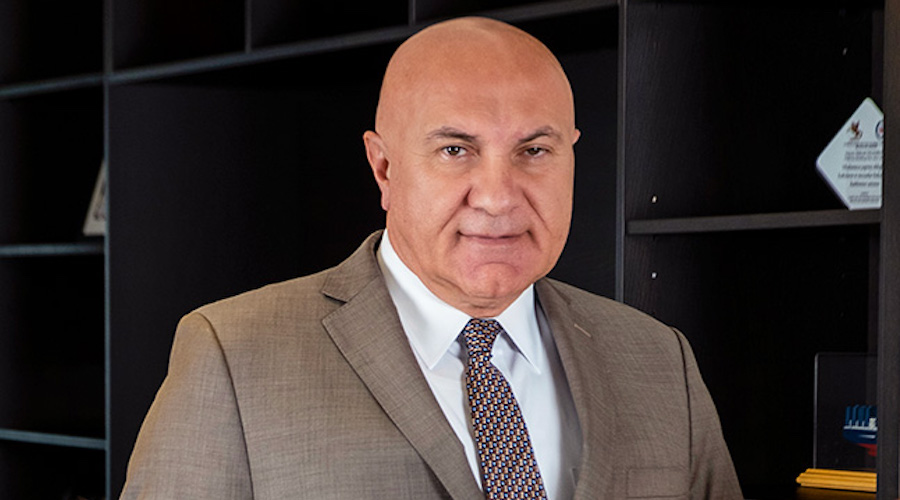
Robert Yuksel Yildirim. (Image: Yildirim Group.)

Turkish billionaire Robert Yuksel Yildirim is on a $2 billion hunt for nickel mines, betting that the battery metal’s price will rebound and that the West will want those supplies to cut its reliance on China.

After making his fortune in chrome and shipping under family conglomerate Yildirim Holding AS, he spun off those businesses this year into CoreX Holding. The new venture already has some nickel-processing facilities, and with prices near a multiyear low, Yildirim sees now as a good time to scale up.

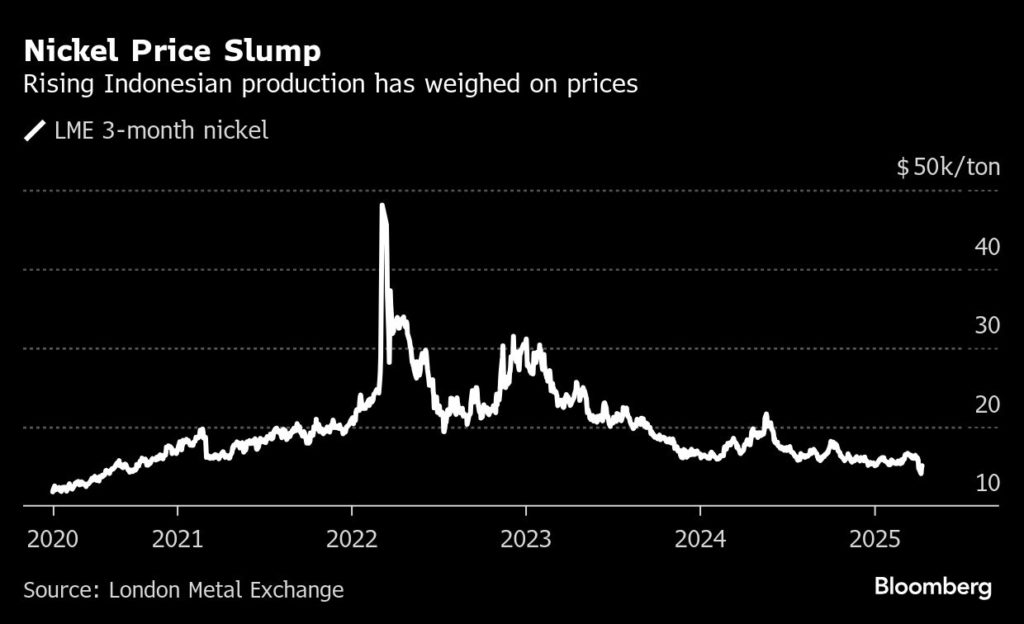
Nickel has slid as Chinese firms ramped up output in Indonesia, leading to fire sales from some major miners as their higher-cost assets struggle to compete. Yildirim thinks he can make such assets profitable by improving operations, and initially focusing on products with higher nickel content than Chinese nickel pig iron. He expects nickel prices to recover in the next two to three years.

“We want to come to the nickel market when people are exiting,” the 65-year-old said in an interview in his Istanbul office. “Eventually it will come up and find an equilibrium.”

His foray into nickel also comes at a time when critical metals are increasingly under the spotlight as Western nations view supplies as a matter of national security, especially as the global energy transition stokes fears of potential future shortages. China is the key player in the nickel market, both through its own domestic industry and investments by its firms in places like Indonesia.

He has put about $500 million into the nickel push so far, which includes CoreX’s first acquisition — a majority stake in Ivory Coast miner Compagnie Minière Du Bafing SA in December — and ferronickel plants in North Macedonia and Kosovo that were transfered from the family holding firm. Other parts of his existing metals business include ferroalloy plants in Sweden and Russia, a US chrome and chemicals unit and mining companies in Kazakhstan.

With $2 billion earmarked for more deals, Yildirim said he’s in talks to buy six mines in Colombia, Guatemala and Africa, without elaborating. As the portfolio grows, he plans to order newbuild vessels to cover the supply chain from production to shipping.

The aim is to offer nickel buyers in Europe and the US an alternative to Chinese-supplied products. That will initially be in the stainless steel industry due to the crossover with Yildirim’s chrome business, before expanding to nickel used in batteries, and then to metals including copper, gold and zinc.

China has become a leader in many critical minerals used in everything from electric-vehicle batteries to wind turbines. Western governments are trying to reduce their dependence on those supplies — including through boosting domestic output and striking trade alliances.

To help fund the nickel deals, the billionaire has started talks with long-term investors, and is targeting those including infrastructure and sovereign wealth funds, private equity and family offices.

“I’m not young, I don’t have too much time to waste,” Yildirim said. “So I need to focus on the mid-size or big size projects.”

Anglo-MMG deal

CoreX had its first major setback earlier this year, when it lost out to MMG Ltd. in a bid to buy Anglo American Plc’s nickel business in Brazil. Yildirim said he offered $900 million with financing from UBS Group AG — much higher than the transaction value — and got as far as negotiating the terms of a deal, but Anglo hasn’t explained to why his offer was rejected.

When disposing of assets, it’s not uncommon for sellers to prefer more established miners where there’s more certainty around financing. MMG, controlled by state-owned China Minmetals Corp., has mines across the globe, including the giant Las Bambas copper mine in Peru.

Yildirim bemoaned the decision, calling it a “game-changer in nickel history.” Anglo said it can’t discuss those involved in the process.

“China has grabbed this very important asset from the West to take to China and Anglo is the company letting this happen,” Yildirim said.

(By Patrick Sykes)