Saturday, April 19, 2025


Trump’s National Security Team Is a House Divided Against Itself


Reprinted with permission from The Realist Review.

Only three months into his second term, Donald Trump’s national security team looks to be seriously divided. As I reported late last year as the administration was taking shape, Commerce Secretary Howard Lutnick, who led the transition and is known to have played a major role in vetting candidates for top national security posts, was intent on repeating the mistakes of the first Trump term by handing hardline neoconservatives plum roles within the administration, including, fatefully, the job of national security adviser to Florida Congressman Michael Waltz.

The division between America First stalwarts such as Vice President JD Vance and neocons like Waltz burst out into the open last month thanks to Signal-gate. The decision to bomb the Houthis (and killing at least 13 civilians in the process) was met with childish exuberance by the likes of Defense Secretary Pete Hegseth and CIA Director John Ratcliffe. Vance, on the other hand, was the sole participant on the now infamous chat to express any reservations about the (pointless, illegal, immoral, and counterproductive) airstrikes. Addressing the underlying motives for the Houthi attacks on the Red Sea shipping lanes is how an America First, rather than an AIPAC First, foreign policy ought to be conducted.

That aside, last week Presidential Envoy Steve Witkoff, who is Secretary of State in all but name, met with Russian President Vladimir Putin and Iranian Foreign Minister Abbas Araghchi. Witkoff, like his boss, appears to favor dialogue and diplomacy over endless war. To the former real estate moguls, it’s about the art of the deal. Witkoff’s elevation over the ostensible Secretary of State, Marco Rubio, recalls a time when the national security advisers under Nixon and Carter (Henry Kissinger and Zbigniew Brzezinski) ran roughshod over the good men (William Rogers and Cyrus Vance) who were then serving as Secretary of State. The difference here of course is that while the nation would have been far better served if Rogers and Vance had won their respective power struggles with Kissinger and Brzezinski, President Trump has made the right call in downgrading Rubio. Trump appears equally intent on downgrading Rubio’s department – proposing a 50 percent cut in the State Department’s budget for FY2026.

Not surprisingly, the divide between the Neocon (Waltz, Rubio) and the American First (Vance, Gabbard) camps extends to the administration’s policies toward Russia, Iran and Africa.

The recent Russian airstrikes on Sumy only underscore the humanitarian imperative to put an end to the conflict. On that score, Europe is being particularly unhelpful, its continent-wide policy hijacked by the smallest yet hardest-line nations within the EU. A former Estonian Prime Minister, Kaja Kallas, is at the forefront of the effort to prolong the war in her new role as the EU’s chief diplomat. Last week, European states committed to sending $24 billion in military aid to Ukraine to Kiev. This no doubt came as welcome news to Trump administration hard-liners. According to a Tuesday (April 14) report in the Wall Street Journal, Rubio and Trump’s Envoy to Ukraine, Keith Kellogg, have “recommended more caution when dealing with Putin and for a harder line against Moscow’s demands for territorial concessions from Kyiv.” Yet, the Journal concedes that Trump continues to back Witkoff in his effort to broker a deal to end the fighting.

Trump and Witkoff are facing similar headwinds from their own team when it comes to talks with Tehran. Witkoff has said publicly that Trump has suggested the establishment of “a verification program so no one has to worry about the weaponization of your [Iran’s] nuclear material.” The mere prospect of Witkoff succeeding (and thereby thwarting Netanyahu’s long held dream of an American war on Iran) has the neocons foaming at the mouth. Matthew Continetti, who, like his father-in-law Bill Kristol, has never been shy about his desire to send your kids to fight in wars he never would, believes that Iran is ripe (yet again) for regime change. And, unfortunately, there are elements within the Republican party and Trump’s own NSC that are inclined to agree.

One such Trump adviser is the improbable Sebastian Gorka, who is now serving as NSC senior director for counterterrorism. Unceremoniously shown the door during Trump’s first term, the Hungarian-British operative is back with a vengeance. According to career neocon stenographer Eli Lake, upon returning to the White House this year, one of the first things Gorka did was to,

…order new lanyards for his team with eight letters and an ampersand: WWFY & WWKY. These cryptic abbreviations were drawn from a quote from Gorka’s boss, President Donald Trump: “We will find you, and we will kill you.”

The terrorists Gorka wants to find and kill seem to be, well, everywhere. At his urging, Trump has already launched airstrikes on Somalia, Syria, and Yemen. Somalia looms large in Gorka’s imagination and a battle seems to be shaping up within the administration over what approach to take in Somalia as the terrorist group Al Shabab threatens Mogadishu. Last Thursday (April 10) the New York Times reported that at an interagency meeting in early April,

…Mr. Gorka is said to have argued against shrinking the U.S. presence, contending that it would be intolerable to let Al Shabab take over the country and proposing to instead step up strikes targeting militants.

Intolerable for whom?

Cooler heads are said to be arguing for closing the US Embassy in Mogadishu and withdrawing diplomatic personnel from the country. They should also consider withdrawing the 500-600 American troops stationed there as well.

James W. Carden is the editor of The Realist Review.  He is a columnist and former adviser to the US-Russia Bilateral Presidential Commission at the U.S. Department of State. His articles and essays have appeared in a wide variety of publications including The Nation, The American Conservative, Responsible Statecraft, The Spectator, UnHerd, The National Interest, Quartz, The Los Angeles Times, and American Affairs.


The Stones Still Cry Out: Holy Week’s Political Reckoning


Holy Week is no mere ritual rehearsal for Christians; it’s a political dynamite keg, detonating the myth of human order built on blood. Jesus’ trial, crucifixion, and resurrection expose the scaffolding of power – then and now – as a rickety structure held together by scapegoats and silenced victims. As we navigate our fractured polis in 2025, the Passion narrative demands we confront the same temptations: to cheer for Barabbas, to wash our hands with Pilate, or to abandon the One who reveals the stones crying out for justice.

The Gospels unravel the political with surgical precision. Jesus enters Jerusalem to Hosannas, a king on a donkey, mocking the pomp of empire. Days later, the crowd – fickle as any mob – trades him for Barabbas, a man whose name in the earliest texts is Jesus Barabbas, a violent revolutionary mirroring the establishment’s own brutality. The symmetry is no accident. Barabbas represents the allure of might-makes-right, the seductive promise of force to bind us against a villain. Sound familiar? Our politics thrives on this old magic trick: rally the crowd against a demonized other – be it a marginalized group or a foreign foe in some proxy war. Yet the cross exposes this as a lie. The knowledge of the Lord, as Habakkuk 2 foretold, fills the earth like water, not through conquest but through the slain Lamb who unmasks the guilt we project onto scapegoats.

Habakkuk’s warning haunts Jesus’ words. The prophet condemns cities founded on bloodshed, their walls built with “unjust gain” (Hab. 2:12). In ancient practice, this wasn’t metaphor – immurement, the ritual sacrifice of victims sealed in foundations, was the cornerstone of many societies. Jesus alludes to this when he predicts the stones will cry out if the crowd falls silent (Luke 19:40). And silent they became, abandoning him to the cross. Yet the stones did cry out – not just in the temple’s rubble in 70 AD, but in the resurrection’s seismic ripple. The Passion revealed Israel’s hypocrisy: a nation claiming purity while rejecting prophets, excluding lepers, and mirroring the pagan sacrifices it condemned. Jesus, the cornerstone, becomes both the first victim buried under the city’s weight and the capstone lifted high on the cross, exposing the violence propping up every polis – Jewish, Roman, and ours.

Consider Caiaphas’ chilling logic: “It is better that one man die than the whole nation perish” (John 11:50). This is the scapegoat mechanism laid bare, the crowd’s dispersion of guilt onto a single figure to preserve order. Gentile societies did the same, projecting violence onto mythological gods to obscure their shame. The cross dismantles this. Jesus, numbered among the transgressors, reveals the victim’s innocence, shattering the unanimous fervor that binds societies against a “guilty” other. Pilate and Herod, rivals united in his persecution (Luke 23:12), show how power aligns to excise the misfit who disturbs the status quo. The Sanhedrin fears the crowd; Pilate fears revolt; Herod plays the sycophant. Politicians, then as now, are weak before the mob’s volatility.

The Gospels texts didn’t just expose politics, they transformed it. Jesus’ followers, emboldened by the resurrection, cared for plague-stricken pagans when Rome’s elite fled. Their nonviolent witness won hearts, forcing the empire to adapt. By the fourth century, Rome adorned itself with the cross – a scandal we can scarcely grasp today. Imagine a meek libertarian dissident like Ron Paul becoming the rallying symbol for both our parties; even that falls short of this historical scandal. A tortured, abandoned God, forgiving his killers, was no mere mascot. Yet Rome’s conversion was half-baked. It abandoned gladiatorial games and overt sacrifice but clung to slavery and war. Christianity’s demystification of guilt-projection clashed with sacrificial violence like oil and water, leaving Rome ripe for schism and collapse.

Today, the stones still cry out. Every story of victims – whether nonviolent prisoners like those Steve Bannon met in jail, or casualties of wars we fuel in Israel-Gaza or Ukraine-Russia – haunts our collective conscience. Jesus tied the stones’ cries to Jerusalem’s fall in 70 AD, when Israel’s zeal for violence mirrored Rome’s and left both exposed as complicit in the same sin. America stands at a similar crossroads. Our politics, like Caiaphas’, justifies flesh-and-blood victims for “national security” or “progress.” We cheer Barabbas-types – leaders promising strength through exclusion or war – while ignoring the Lamb who redefines polis not as the victors’ club but as the refuge for the least of these.

The Passion’s political implications are radical. It reveals power as a house of cards, sustained by silencing victims. The resurrection vindicates those victims, proving that no empire, no mob, can bury the truth. Jesus’ movement upended history toward the marginalized, as he predicted. But it also warns us: clinging to sacrificial violence – be it cultural scapegoating or global wars – dooms us to Rome’s fate. The cross haunts every nation, breaking us into rivalry and schism until we repent.

America must choose now. Nonviolence and repentance are not moral platitudes; they are political necessities. The alternative is more rubble, more cries from the stones we’ve buried. Holy Week is not a call to nostalgia and private religion but to revolution – a revolution of the heart that dismantles the altars of might-makes-right. The Lamb has spoken. Will we listen, or will we keep building on blood?

David Gornoski is a writer and host of the news podcast A Neighbor’s Choice (listen here), which has been described as “an apocalyptic Mr. Roger’s for adults.” He covers politics, culture, anthropology, health, and science. Email him at hello[at]aneighborschoice.com.

Refugee. Dissident. Enemy of the State. Would ICE Have Crucified Jesus?


Homegrowns are next. The homegrowns. You gotta build about five more places [like the CECOT prison]. It’s not big enough.

— President Trump on his desire to send American citizens to a megaprison in El Salvador, beyond the reach of U.S. courts and the Constitution

It has begun, just as we predicted, justified in the name of national security.

Mass roundups. Raids. Indefinite detentions in concentration camps. Martial law. The erosion of habeas corpus protections. The suspension of the Constitution, at least for select segments of the population. A hierarchy of rights, contingent on whether you belong to a favored political class.

This is what it looks like when the government makes itself the arbiter of who is deserving of rights and who isn’t.

Here is what we know: one segment of the population at a time, the Trump Administration is systematically and without due process attempting to cleanse the country of what it perceives to be “undesirables” as part of its purported effort to make America great again.

This is how men, women and children are being made to disappear, snatched up off the streets by press-gangs of plainclothes, masked government agents impersonating street thugs.

Presently, these so-called “undesirables” include both undocumented and legal immigrants—many labeled terrorists despite having no criminal record, no court hearing, and no due process—before being extradited to a foreign concentration camp in an effort to sidestep judicial oversight.

By including a handful of known members of a vicious gang among those being rounded up, the government is attempting to whitewash the public into believing that everyone being targeted is, in fact, a terrorist.

In recent years, the government has used the phrase “domestic terrorist” interchangeably with “anti-government,” “extremist” and “terrorist” to describe anyone who might fall somewhere on a very broad spectrum of viewpoints, characteristics and behaviors that could be considered “dangerous.”

Thus, without proof, a sheet metal worker has been labeled a terrorist. A musician has been labeled a terrorist. A makeup artist has been labeled a terrorist. A cellular biologist has been labeled a terrorist. A soccer player has been labeled a terrorist. A food delivery driver has been labeled a terrorist.

Unfortunately, the government’s attempts to dehumanize and strip individuals of their inalienable rights under the Constitution by labeling them criminals and “terrorists” is just the beginning of the dangerous game that is afoot.

It’s only a matter of time before American citizens who refuse to march in lockstep with the government’s dictates are classified as terrorists, denied basic rights, and extradited to a foreign prison.

That time is drawing closer.

Indeed, Trump has repeatedly spoken of his desire to be able to send American citizens—whom he refers to as “homegrowns,” as in homegrown terrorists—on a one-way trip to El Salvador’s mega-prison, where conditions are so brutal that officials brag the only way out is in a coffin. His administration is currently trying to find a way to accomplish that very objective.

We’re not quite there yet, but it’s coming.

What we are witnessing is history repeating itself in real-time: the widening net that ensnares us all. In other words, it’s only a matter of time before anyone who is not fully compliant gets labeled a terrorist.

A prime example of how the government casting its net in ever-widening circles can be seen in the government’s sudden decision to target academics in the U.S. on work and student visas who have been critical of Israel’s war on Gaza, which has killed more than 50,000 people (nearly a third of them under the age of 18), as threats to national security.

Given Trump’s eagerness to take ownership of the Gaza strip in order to colonize it, build resorts and turn it into “the Riviera of the Middle East”—at taxpayer expense—it should come as no surprise that the Trump Administration is attempting to muzzle any activities that might stir up sympathy for the Palestinians.

Thus, the government is classifying any criticism of Israel as antisemitic and equating it with terrorism.


Under such a broad definition, Jesus himself would be considered antisemitic.

So you can add antisemitic to the list of viewpoints that could have one classified as a terrorist, rounded up by ICE, stripped of the fundamental rights to due process and a day in court, and made to disappear into a detention center.

Mind you, the government isn’t just targeting protest activities and expression that might have crossed over into civil disobedience. It’s also preemptively targeting individuals who have committed no crimes but whose views might at some point in the future run counter to the government’s self-serving interests.

This is precrime taken to a whole new level: targeting thoughts, i.e., thought crime.

The ramifications are so far-reaching as to render almost every American with an opinion about the government or who knows someone with an opinion about the government an extremist in word, deed, thought or by association.

As German pastor Martin Niemöller lamented:

“First they came for the socialists, and I did not speak out—because I was not a socialist. Then they came for the trade unionists, and I did not speak out— because I was not a trade unionist. Then they came for the Jews, and I did not speak out—because I was not a Jew. Then they came for me—and there was no one left to speak for me.

You see how this works?

Let’s not mince words about what’s happening here: under the guise of fighting terrorism, the U.S. government is not just making people disappear—it is making the Constitution disappear.

When rights become privileges, the Constitution—and the rule of law—becomes optional.

We are almost at that point already.

Trump’s list of “the enemies from within” is growing in leaps and bounds.

The list of individuals and groups being classified as anti-American gets bigger by the day: Immigrants, both legal and undocumented. Immigration attorneys. Judges. Lawyers. Law firms. Doctors. Scientists. Students. Universities. Nonprofits.

Given what we know about the government and its expansive definition of what constitutes a threat to its power, any one of us who dare to speak truth to power could be targeted next as an enemy of the state.

Certainly, it is easy to remain silent in the face of evil.

What is harder—what we lack today and so desperately need—are those with moral courage who will risk their freedoms and lives in order to speak out against evil in its many forms.

Throughout history, individuals or groups of individuals have risen up to challenge the injustices of their era. Nazi Germany had its Dietrich Bonhoeffer. The gulags of the Soviet Union were challenged by Aleksandr Solzhenitsyn. America had its color-coded system of racial segregation and warmongering called out for what it was, blatant discrimination and profiteering, by Martin Luther King Jr.

And then there was Jesus Christ who not only died challenging the police state of his day but provided a blueprint for civil disobedience that would be followed by those, religious and otherwise, who came after him.

Any reflection on Jesus’ life and death within a police state must take into account several factors: Jesus spoke out strongly against such things as empires, controlling people, state violence and power politics. Jesus challenged the political and religious belief systems of his day. And worldly powers feared Jesus, not because he challenged them for control of thrones or government but because he undercut their claims of supremacy, and he dared to speak truth to power in a time when doing so could—and often did—cost a person his life.

It makes you wonder how Jesus—a Palestinian refugee, a radical, and a revolutionary—would have fared in the American police state under a Trump regime.

Would Jesus—who spent his adult life speaking truth to power, challenging the status quo of his day, and pushing back against the abuses of the Roman Empire—have been snatched up in the dead of night, stripped of any real due process, made to disappear into a detention center, and handed a death sentence when he was delivered into a prison where the only way out is in a wooden box?

Consider that the charges leveled against Jesus—that he was a threat to the stability of the nation, opposed paying Roman taxes and claimed to be the rightful King—were purely political, not religious.

Jesus was presented to Pontius Pilate “as a disturber of the political peace,” a leader of a rebellion, a political threat, and most gravely—a claimant to kingship, a “king of the revolutionary type.”

After Jesus was formally condemned by Pilate, he was sentenced to death by crucifixion, “the Roman means of executing criminals convicted of high treason.”  The purpose of crucifixion was not so much to kill the criminal, as it was an immensely public statement intended to visually warn all those who would challenge the power of the Roman Empire. Hence, it was reserved solely for the most extreme political crimes: treason, rebellion, sedition, and banditry.

This radical Jesus, the political dissident who took aim at injustice and oppression, is not the politically mute, humble and obedient one whom Trump praised in his presidential proclamation.

Almost 2,000 years after Jesus was crucified by the police state of his era, we find ourselves confronted by a painful irony: that in the same week commemorating the death and resurrection of Jesus, a Palestinian refugee who was killed by the police state for speaking truth to power, the U.S. government is prosecuting Palestinian refugees who are daring to challenge another modern-day police state’s injustices, while threatening to impose widespread martial law on the country to put down any future rebellions.

President Trump has hinted that he could invoke the Insurrection Act of 1807, which would allow the president to use the military on American soil.

This would in effect be a declaration of martial law.

Trump has already authorized the military to take control of the southern border, which puts parts of the domestic United States under martial law.

What comes next?

Trump has long speculated about using his presidential powers under the Insurrection Act to direct the military to deal with his perceived political opponents, whom he likens to “the enemy from within.”

As Austin Sarat writes for Salon: “The president alone gets to decide what constitutes an ‘insurrection,’ ‘rebellion,’ or ‘domestic violence.’ And once troops are deployed, it will not be easy to get them off the streets in any place that the president thinks is threatened by ‘radical left lunatics.’”

So where do we go from here?

History offers some clues.

Exactly 250 years ago, on April 19, 1775, the American Revolution began with a “shot heard round the world.” It wasn’t sparked by acts of terrorism or rebellion—it was triggered by a government that had grown deaf to the cries of its people.

What we don’t need is violence in any form—by the people or their government.

What we do need is a revival of moral courage.

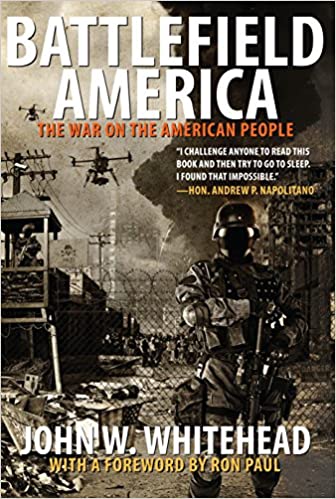
As I make clear in my book Battlefield America: The War on the American People and in its fictional counterpart The Erik Blair Diaries, we are desperately overdue for a reminder to our government: this is still our country.

Or, as Thomas Paine so powerfully put it: “It is the duty of the patriot to protect his country from its government.”

John W. Whitehead, constitutional attorney and author, is founder and president of The Rutherford Institute. He wrote the book Battlefield America: The War on the American People (SelectBooks, 2015). He can be contacted at johnw@rutherford.orgNisha Whitehead is the Executive Director of The Rutherford Institute. Read other articles by John W. Whitehead and Nisha Whitehead.


The Cross and the Pieta: The Passion of Palestine

In every parent cradling a lifeless child, we see the Pieta. In every bombed home, a new Golgotha. Gaza suffers an unending Good Friday.

 Posted on

Reprinted with permission from The Kucinich Report.

Michelangelo’s Pieta, the larger-than-life sculpture of the crucified Christ held tenderly in Mother Mary’s lap, has attracted visitors to Rome since it was installed in the old St. Peter’s Basilica more than 500 years ago.

Contemplation of the Pieta gifts one with the powerful presence of sacrifice and divine acceptance, life summoned from stone, transcending death. Christians approach Good Friday with two powerful remembrances: Christ’s sacrifice and redemption on The Cross, and the acceptance, love and compassion expressed through The Pieta.

Countless images emerging from Gaza, of the sudden deaths of children, by bombing, shrapnel, gunshots, and grieving parents evoke modern day Pietas, occurring with terrible frequency. Unlike Michaelangelo’s crucified Christ, the dead children are seldom intact.

They are horribly mangled and disfigured, limbless, headless, often identified by a scrap of clothing. Yet, the bereaved parents, holding what is left of their child wrapped in white shroud, look to the heavens, and, resonating with divine grace and acceptance recite “Allah Akbar,” God is Great.

The forbearance, the courage under fire, the suffering of the people of Gaza in the face of the relentless and cowardly bombing attack which seeks to exterminate them has awakened the moral conscience of people all over the world.

As my own attention is riveted to the daily massacres in Gaza, to the graphic videos of extraordinary human suffering sent to me, I find myself filled with a deep sense of anguish at witnessing the collective punishment, the death and destruction of innocents and, equally, the loss of humanity of the perpetrators, which leads us all into an eternal Valley of Shadows.

The feeling of grief at what is unfolding before our eyes is unshakable, at times unbearable, and I know I am not alone in sensing this.

It is not only Gaza which is dying.

Our country is dying, from indifference, distraction and crass political calculations which justify mass murder on the installment plan, with the remorseless, clipped reduction: “They are human shields!” Or, for those mired in genocidal sanctimony: “Kill the children before they become terrorists.”

And so, the children of Gaza are being killed, by the tens of thousands. Videos of those deceased children whose bodies were not mangled, show they were obviously well cared for by their families, some dressed smartly, some dead in their resplendent Eid finery, the boys with neat haircuts and the girls, long hair, beautifully combed, with colorful bows.

As to the survivors holding dead children, their soul-piercing cries of grief invite deep compassion for all those who bear the cross of war. The Pieta is a universal symbol. It speaks to a broken-hearted father or mother grieving a dying child who was the center of a family’s existence.

All of Palestine is a children’s graveyard. Numerous doctors have testified to the unusually large numbers of children who have been killed by sniper shots to the head. Most deaths, however, are due to a stunning array of U.S. munitions being used on defenseless Gazans.

A child is either made a casualty or an orphan by the thousands of U.S.-made MK-84, 2000 lb bombs, costing $16,000 each, which upon impact wields a shrapnel-flinging, death-dealing blast radius of hundreds of yards.

The MK-84 carries 945 lbs. of tritonal explosives and can create a crater 50 ft. deep. This bomb was used to massive impact at the Jabalia Refugee Camp on October 31, 2023, killing over 100 civilians. The U.S. transferred 14,000 of these bombs to be used against Gazans in the past 18 months.

There is more. The BLU-109 Penetrator Bomb with 530 lbs. of high explosives, can blast through concrete or rock, and detonate with the force of an earthquake. When it hits a Gaza apartment building, everyone inside is killed. Even nearby non-target apartment buildings, with the residents inside, collapse, with crushing force.

The GBU-39 Small Diameter Bomb (SBD) is a precision-guided, glide bomb. It weighs 250 lbs., and delivers a highly explosive 36 lbs. of AFX-757. It produces high civilian casualties in Gaza residential areas and in Gaza schools, through fragmentation over an area the size of a football field. Each bomb cost $40,000.

In May of 2024, GBU-39’s hit a designated safe zone, in the Tel al-Sultan Tent Camp, killing countless civilians. This precision bomb was used to strike the Al-Sardi UNRWA School on June 6, 2024, where 6,000 displaced Gazans waited for relief. The same bombs killed over 100 Gazans, when the Al-Tabaeen School was attacked on August 10, 2024, during dawn prayers.

These bombs, and specially fitted Joint Attack Munitions (JDAMS), have been dropped on the people of Gaza, including in so-called safe zones such as Deir al-Balah, using a variety of US-made aircraft, including F-151s, F161s and F-351s, whose pilots are either trained in the U.S. or by US personnel abroad, with respect to combat doctrines, weapons deployment, precision guidance and rules of engagement.

On the ground, U.S.-supplied tank shells, rifles, sniper ammunition, firearms, assault rifles, grenade launchers , and tens of thousands of small arms rounds are used against Gazans.

U.S. tax dollars, U.S. planes, U.S. bombs, U.S. missiles, U.S. tank shells, U.S. rifles, ammunition, U.S. grenade launchers, U.S. training, U.S. guidance from a trillion dollar military budget, using U.S. proxies to annihilate the 2.2 million defenseless people of Gaza.

The destruction has been accomplished during both Democratic and Republican administrations. Congress has never given explicit approval for a war against the people of Gaza. It has massively rejected efforts by Senator Bernie Sanders to block arms sales. Absent the support of the United States of America, this war would have ended shortly after it started.

Yet it continues. Nearly 100,000 tons of US bombs have been dropped on Gaza, about 6 times the explosive power of bombs dropped on Hiroshima in 1945, which equaled 15,000 tons of TNT. This in one of the world’s most densely populated, areas. There are 15,000 people per square mile in Gaza, compared with the average American population density of 94 persons per square mile.

On September 11, 2001, the United States was attacked. Over 3,000 people were killed in a nation of 300,000,000 persons, equal to one death per 100,000. Gaza has experienced at least 55,000 deaths, in a population of 2.2 million, a death rate of 2,500 per 100,000 people.

In terms of a population-adjusted equivalence, Gaza has experienced a 9/11-equivalent every five hours, or over four population-adjusted 9/11s every day for the last year and a half.

If the US had experienced the same per capita death toll, population-adjusted deaths would number 8,350,000. (This number arrived at by applying Gaza (population 2.2 million death rate since October 2023, 55,000 for a death rate of .025, times the current US population of 334 million).

Based on UN reports, an estimated 15,000 children have been killed, with at least 30,000 with injuries, many life-altering, including amputations; tens of thousands of children are suffering from severe malnutrition.

So frequently perilous is everyday life for the children of Gaza and their parents that one young Palestinian girl, as she lay in shocked agony on a cart, seriously injured by shrapnel, asked over and over, through acute pain: “Uncle, is this a dream, or is it reality?” She is/was five years old.

Then there is the young Gazan boy, asked what he wanted to be when he grew up. His heartbreaking answer: “Children in Gaza do not get to grow up.”

One official quoted in a report by the United Nations Human Rights office, described residents of Gaza as “human beasts… dealt with accordingly,” recalling the Nazi-era language of untermensch, beasts, classic dehumanization used to justify violence.

There is an inhuman, organized effort to bomb and to destroy the people of Gaza.

The world is witnessing the systematic destruction of homes, mosques, schools, universities, hospitals, markets, water systems, and sewer systems, and the calculated attempt to kill off an entire people.

Through their great tribulations, the people of Gaza have demonstrated an uncanny resistance which defines not the character of terrorists, but of a brave people, who face death with faith and fortitude.

My wife, Elizabeth, visited Gaza after the last major incursion. What she saw there would shake the soul of anyone not hardened by ideology. She entered schools that served as classrooms by day and emergency shelters by night. She sat with trauma therapists tending to shattered minds and broken families. She met university students who still spoke of dreams. Her account, published in The Hill, is a witness to the truth so often buried under official narratives.

We must believe, even now, that the great suffering of Gaza, reminiscent of the Passion itself, may one day give rise to a resurrection – not only of lives, but of dignity, justice, and peace. The arc of crucifixion to resurrection is sacred metaphor and moral instruction.

Gaza images also challenge doom, such as the hands of Gazans which reach out from underneath the rubble, stretching toward the sky, defiantly, triumphantly.

Millions are marching for peace, globally, waving the Palestinian flag, to end the war, and to demand accountability for those who instigated it, and those who prosecuted it. Young people, refusing to serve in the military, are rejecting the call to kill Gazans, to occupy, to bulldoze homes, to drop bombs, rejecting orders that nullify one’s soul.

The world is changing and the world is watching. No nation can forever remain above the law. There will be legal consequences even for those who do not believe in international law, who practice genocide with an air of impunity. I predict those in authority who have enabled or prosecuted this war against the people of Gaza will one day be held responsible. They will be brought before a world tribunal and they will meet justice, in a new Nuremburg proceeding.

What People of Conscience Can Do:

The path to peace begins with recognizing the humanity of all people. Let us grieve for every innocent life lost – Israeli and Palestinian, Christian, Muslim, Jewish. Let us speak not from a place of hostility, but from a deep moral longing to prevent further bloodshed, and to chart a future rooted in dignity and justice for all.

Rather than be immobilized by the immensity of the Gaza tragedy, we can use the power of our hearts and our intent for peace to:

1. Raise a Voice for Ceasefire and Life

  • Encourage elected leaders to support a permanent ceasefire, the opening of humanitarian corridors, and the protection of civilians.
  • Join with others across faiths and backgrounds in peaceful vigils, calls, and community forums.

2. Support Humanitarian Relief – Without Borders

Give generously to organizations providing life-saving aid:

  • International Red Cross and Red Crescent
  • World Food Program (WFP)
  • UNRWA, Catholic Relief Services, Lutheran World Federation, and other Christian and interfaith relief groups
  • Palestine Children’s Relief Fund (PCRF) and Doctors Without Borders

3. Build Bridges Through Education and Empathy

  • Host or attend events that elevate the stories of both Palestinians and Israelis working for peace.
  • Share voices from those directly affected, including Christian leaders in Bethlehem, peace advocates in Tel Aviv, and trauma healers in Gaza

4. Engage in Nonviolent Advocacy

  • Promote dialogue, not division. Advocate with compassion – for policies that protect civilians, honor human rights, and de-escalate conflict.
  • Avoid demonization. Instead, call on all governments and actors to uphold their highest values and responsibilities.

5. Support Economic Accountability With Care

  • Where appropriate, consider thoughtful economic action to encourage institutions to stop violations of human rights.
  • Ensure all actions are rooted in ethics and transparency, not punishment or hostility.

What Congress and the International Community Can Do:

We must engage with members of Congress, to demand that the United States change its policies in Gaza and the West Bank.

1. Lead with Moral Clarity: Stop Funding the Killing!

  • Congress has the power of the purse. It must stop all appropriations being used to destroy Palestine.
  • The killing must stop. Congress should support a bipartisan, permanent ceasefire resolution and advocate for negotiations that include all parties.

2. Ensure Humanitarian Access and Protection

  • Demand safe passage for food, water, fuel, and medicine.
  • Restore full funding to UNRWA and support agencies feeding, sheltering, and treating civilians.

3. Uphold U.S. and International Law

  • Conduct full, independent investigations of all civilian harm – including the use of U.S.-supplied weapons.
  • Condition any military assistance on clear adherence to international humanitarian law, as required by the Leahy Law and Arms Export Control Act.

4. Support a Long-Term Political Solution

  • Champion efforts toward a just and lasting peace that guarantees safety, dignity, and self-determination for Palestinians and security for Israelis.
  • Recommit to a diplomatic process that includes diverse voices: religious leaders, youth, civil society, and those committed to coexistence.

5. Protect Civil Liberties and Dialogue at Home

  • Safeguard the rights of Americans to speak, protest, and organize nonviolently for peace.
  • Ensure campuses, houses of worship, and communities are safe spaces for open dialogue, not silencing or fear.

A Final Word: Peace Is the Moral Center

This is a crisis of leadership, power, and policy. People of every background long for peace. Let us be among those who do not just curse the darkness, but light candles; who build bridges, not walls; who seek not revenge, but reconciliation.

May our beloved United States begin to turn its swords into plowshares and spears into pruning hooks, for the survival of our nation and the world.

And may the deeply mournful scenes in Gaza, reminiscent of the Pieta, reenacted daily, be followed by a new dawn of restoration and healing of the Palestinian people, celebrating the indomitability of the human spirit, bringing with it a new human hope for peace, salaam, shalom.

Read Elizabeth Kucinich’s account of her visit to Gaza following Israel’s 2014 military assault, here.

The Kucinich Report is a reader-supported publication. To receive new posts and support our work, consider becoming a free or paid subscriber.


SIPRI’s Ongoing Decay from Peace to Mainstream Military Security


Naturally, nobody cares about that fraud in today’s Sweden


SIPRI is the Stockholm International Peace Research Institute, established in 1966. Read about it here and see how it has twisted its aims to not include the words ‘peace research.’ Because here is what it should do according to § 2 of its statutes: “…to conduct scientific research on questions of conflict and cooperation of importance for international peace and security, with the aim of contributing to an understanding of the conditions for peaceful solutions of interstate conflicts and for stable peace. (My italics).

The low intellectual level is indicated by the statement that “SIPRI’s vision is a world in which sources of insecurity are identified and understood, conflicts are prevented or resolved, and peace is sustained.” Sources of insecurity shall not be removed, they shall just be identified and understood. Conflicts shall be prevented – what an absurd idea since any dynamic organisation will always have conflicts; what we shall prevent or reduce is, of course, not conflicts but violence in all its forms and shapes. And peace is ‘sustained’ – such nonsense sounds like a marketing firm formulation. Excuse us all: How shall that peace come about before it is sustained?

I’ve written about SIPRI as a totally lost institution for peace and disarmament, conflict-resolution, mediation and the outlining of peaceful proposals since 2016. It’s a parody of peace for more than a decade. Read herehere and here.

Editorial offices and journalists in Sweden and elsewhere never took up this criticism. It’s so natural in these militarist times that the world’s perhaps most well-known “peace” research institute – originally a pride of the Swedish government and ‘ranked among the most respected think tanks worldwide’ – simply drops its mandate and becomes yet one more former peace research institute devoted to military-based security issues in total contrast to what it was supposed to do.

The reason is simple: for years, it has had no creative or moral leadership with any understanding of peace, and it is mainly financed by NATO member governments. Its kind of “peace” is NATO “peace.” In addition, the concept/word – and discourse – of ‘peace’ has been deliberately cancelled in Western societies.

I’ve therefore suggested a change of name to SIMSI, Stockholm International Military Security Institute. A bit of honesty instead of continued faking would be appropriate.

You may ask what peace research is, and there are many definitions and approaches. But one overarching element can be formulated this way: an intellectual effort to understand all kinds of violence with the aim of devising strategies to reduce every kind and outline strategies for intelligent conflict-resolution with the least possible use of violence – on the road to more peaceful, nonviolent futures for the whole human being and all human beings.

Now, keep that in mind and then click here to see today’s front page of SIPRI – “the independent source on international security” accompanied with images, headlines, titles and texts filled with arms…

And it’s extremely deceptive that this institute calls itself independentJust look at its funding here.

To continue the decay and get even further away from anything called peace, SIPRI has just appointed a new director. His name is Karim Haggag, and you can read about this Egyptian career diplomat and his role at the The American University in Cairo here – a servant, one can safely assume, of US military interests with close relations to hawkish people like Madeleine Albright and Sandy Berger of the Albright Stonebridge Group – that, by the way, goes unmentioned in SIPRI’s official announcement about him here.

In case you want to know more about Madeleine Albright, she served as Bill Clinton’s Secretary of State, masterminded the fake negotiation at Rambouillet about Kosovo with the NATO bombings that followed and thought, as she stated it, it was acceptable to kill half a million Iraqi women and children by the US economic sanctions.

Haggag holds only a master’s degree in War Studies from King’s College, London, and has served as a career diplomat most of his life, in Washington. Here is his official CV at the American University Cairo – which indicates two selected publications ten years ago and his academic interests in “security.” Nothing indicates any knowledge, experience or interest in the academic discipline of peace and conflict research.

In short, surely the right mainstream man for the former peace research institute SIPRI, in the year 2025.FacebookTwitterRedditEmail

Jan Oberg is a peace researcher, art photographer, and Director of The Transnational (TFF) where this article first appeared. Reach him at: oberg@transnational.orgRead other articles by Jan.