Saturday, April 19, 2025

How the EU’s reliance on China has exposed carmakers to trade shocks

Caught in the middle of a deepening trade row between the United States and China, Europe’s car industry is under growing strain. The latest round of US tariffs on Chinese vehicles and components is shaking up global supply chains – and putting French and European carmakers in a tough spot.


Issued on: 18/04/2025 

A Volkswagen Touran on the production line in Wolfsburg, Germany. Many EU carmakers rely on global supply chains that include Chinese components. AP - Joerg Sarbach


By:Jan van der Made
RFI

For companies like Stellantis and Renault, which rely heavily on Chinese suppliers, the ripple effects are already being felt. Higher costs, delayed shipments and tougher choices about where to invest next are all part of the fallout.

"For the last 30 or so years, the global auto industry has moved toward markets that can lower the overall cost" of cars for sale, Bill Russo, CEO of Shanghai-based car industry watchdog Automobility, told RFI.

China played a central role in that shift. Its car production jumped from 1 million vehicles a year to 30 million over three decades, helping drive down prices across the sector.

European brands followed the trend, entering joint ventures and building cars and parts in China before exporting them back home.

But the latest tariffs from Washington – 10 percent on all imported cars and 145 percent on vehicles made in China – threaten to upend that model.

Russo said the measures create “additional friction to the system, adding additional costs”, which will result in “less competitive pricing among the domestic industries that have relied on low-cost country sourcing”.

European carmakers spent decades building production models based on low-cost Chinese parts and joint ventures. But with higher tariffs and rising costs, that strategy now looks increasingly fragile.

Who stands in the crosshairs of Trump's tariffs?

Twin pressures

The US tariffs are more than just a bilateral issue. They disrupt the intricate web of global supply chains, raising costs for all automakers who source components from China, including European firms.

"By increasing costs of components, you're increasing the price of the vehicle or decreasing margin. When you do that, you shrink your market," Russo explained.

This is particularly problematic for European manufacturers, who are already grappling with the twin pressures of US tariffs and the European Union’s own trade barriers against Chinese electric vehicles.

The result is a squeeze that threatens to undermine the competitiveness of European brands both at home and abroad.

From the consumer's point of view, tariffs do nothing that benefits the customer.
01:51

Bill Russo, CEO of Automobility, comments on the downside of tariffs.Jan van der Made

EU votes to impose tough new tariffs on Chinese electric vehicles
Chinese globalisation

However, the tariffs in fact have little direct effect on Chinese automakers themselves. "It does not have a tremendous negative impact on the Chinese automakers because they don't sell cars in the United States," Russo pointed out.

Instead, Chinese firms are simply redirecting their export strategies to other regions, building factories in Southeast Asia, the Middle East – and Europe itself. Companies including BYD, Geely, and new entrants such as Xiaomi, are all planning or building factories overseas to circumvent trade barriers.

"The unintended consequence of tariffs is it will accelerate the globalisation of the Chinese supply chain and automakers," Russo said.
Europe’s challenge

Unlike the US – which, according to Russo, has adopted "a clear policy of decoupling from China" – Europe remains dependent on Chinese supply chains, particularly for next-generation technology such as electric vehicles and batteries.


Electric cars made by BYD waiting to be loaded on to a ship Taicang Port in Suzhou, eastern China, on 8 February, 2024. © AFP - STR

"China makes one out of every three cars made in the world. They actually make three out of every four electric vehicles. They make about three out of every four EV batteries. What are you going to replace that with?" Russo asked.

Hermes to hike US prices to offset tariff impact

European policymakers are caught between the need to protect domestic industry and the practical reality that cutting off Chinese supply would jeopardise the continent’s ambitions for electrification and carbon neutrality.

"If the source for that efficient supply of materials and products is cut off from the European Union, you've got a big problem of fulfilling the vision of a carbon-free or an electrified transportation sector," warned Russo.
'Smartphones on wheels'

For multinational automakers such as Stellantis and Renault-Nissan-Mitsubishi, the path forward may lie in deepening partnerships with Chinese firms.

"Stellantis formed a partnership invested in a Chinese company called Leapmotor, to be able to partner with them to get access to EVs that can be sold through their network. That's a way," said Russo. But he cautioned that collaboration must go beyond hardware.

Emmanuel Macron looks at a Peugeot Inception concept car, as he visits the Stellantis stand at the Paris Motor Show on 14 October, 2024. via REUTERS - LUDOVIC MARIN

"Cars today are becoming smartphones on wheels. They're becoming smart devices. You need to build not just the hardware associated with that, but you need the software and you need the infrastructure ... that part, China is building.

"I think in countries like France, you should be thinking about the whole ecosystem and how to collaborate with Chinese companies to build that."
'Flip the script'

Russo suggests that Europe should "flip the script" and adopt the same playbook China used during its own industrial rise: to require that Chinese investment in Europe come with technology transfer and joint ventures.

When China opened up to outside investment in 1979, foreign companies were welcome provided they formed joint ventures with a local Chinese partner, and provided them with the latest technology and know-how. Established Western car companies – including GM, Volkswagen and Peugeot – invested heavily.

Tesla sales plunge in France as more owners resell their cars

But, decades later, the tables have turned.

"Get China to invest and guide the investment toward forming partnerships, maybe joint ventures, maybe some other way of transferring knowledge. But don't give it away. The tariffs shouldn't be the end game," Russo said.

"Tariffs are not the end of the conversation. They should be the beginning of the discussion around how to level the playing field."

International report


Turkey's rivalry with Iran shifts as US threats create unlikely common ground


Issued on: 19/04/2025 - 

With Ankara warning Tehran not to undermine Syria’s new rulers and its ongoing peace efforts with Kurdish rebels, regional rivalry with Iran has been intensifying. However, Turkey’s concerns about potential US military action against Iran over its nuclear energy programme are now providing a rare point of convergence between the two rivals.


Turkish President Recep Tayyip Erdogan (right), met Ahmad al-Sharaa (left) just after he came to power in Syria. © AP Photo/Francisco Seco


After months of diplomatic barbs and threats exchanged between Ankara and Tehran, the Iranian Foreign Minister, Abbas Araghchi, on Wednesday praised his Turkish counterpart, Hakan Fidan, for what he described as a “constructive and supportive position” regarding the indirect US-Iranian talks in Oman over Iran’s nuclear energy programme.

Oman Talks

The Oman talks aim to avert a possible US military strike on Iran, an option that President Donald Trump has not ruled out. Despite the strained relations with Tehran, avoiding confrontation remains a priority for Ankara.

“Turkey would be concerned for many reasons,” claims Özgür Ünlühisarcıklı, who heads the German Marshall Fund’s office in Ankara.

“This would be just another war on Turkey’s borders. Turkey would have to deal with difficult problems, and instability in Iran would almost certainly lead to an additional wave of refugees,” he added.

Kurdish leader Ocalan calls for PKK disarmament, paving way for peace

Turkish diplomatic tensions with Iran have been on the rise, with Turkish President Recep Tayyip Erdoğan issuing thinly veiled threats to Tehran, urging it not to interfere in Ankara’s efforts to end the conflict with the Kurdistan Workers’ Party (PKK), which has waged a decades-long campaign for greater minority rights within Turkey.

“Ankara believes that Iran is trying to undermine this [peace] process both in Turkey and in Syria,” observes Serhan Afacan, who heads the Centre for Iranian Studies, a research organisation based in Ankara.

In February, the imprisoned PKK leader, Abdullah Öcalan, called for his organisation to disarm. With the PKK operating from bases in Iraq and having an affiliated group in Syria, Ankara has frequently accused Tehran of using the PKK as a proxy in its regional contest for power and influence. Afacan contends that Ankara fears Tehran still holds sway over the Kurdish rebels.

“Especially in Syria, Iran might try to convince them not to respond positively to Öcalan’s call – this has been Turkey’s main concern,” warned Afacan.
Iranian unease

The recent ousting of long-time Syrian leader Bashar al-Assad has deprived Iran of a key ally, while Syria’s new rulers are aligned with Ankara rather than Tehran. A peace agreement between Turkish forces and Kurdish rebels would only deepen Iran’s unease over Turkey’s growing regional influence.

“Turkey is about to end the PKK through its policies both domestically and regionally, and this is causing a kind of panic on the Iranian side,” observes Bilgehan Alagöz, a professor of international relations at Istanbul’s Marmara University. “Iran sees this as a threat to its regional influence and a development that could empower Turkey,” Alagöz added.

Nevertheless, Syria’s Kurdish-led militia, the Syrian Democratic Forces (SDF), which maintains close ties with the PKK, has stated it is not bound by Öcalan’s call to disarm. Although it has agreed in principle with Syria’s new rulers to merge its forces, the precise terms of the arrangement remain unclear.
Syria’s new leadership

Tensions also persist between the SDF and Syria’s new leadership. The Kurdish-led militia continues to demand greater autonomy within Syria — a position opposed by Damascus’s new rulers and their backers in Ankara. Turkey suspects Tehran of favouring a decentralised and weakened Syria — a goal analysts say is also shared by Israel.

“The Middle East makes strange bedfellows,” notes Gallia Lindenstrauss, a foreign policy expert at the Institute for National Security Studies in Tel Aviv. “Sometimes, these things unfold in ways that are surprising.”

Lindenstrauss also questions the Israeli government’s zero-sum view of Turkey, which it sees as both a rival and a supporter of Syria’s new rulers.

He told RFI: “I’m not sure this idea of a decentralised Syria is fully thought through by Jerusalem. I know there’s a lot of intellectual energy devoted to this line of thinking. But clearly, we don’t want Iran to use Syria to its advantage. A centralised regime might be a better scenario for Syria. But that comes at a cost — and the cost is increased Turkish involvement and influence in Syria. So, there is a dilemma.”

Last month, Fidan angered Tehran by warning that Iran could face instability if it attempted to destabilise Syria — a statement some analysts interpret as a veiled reference to Iran’s sizeable and often restive Turkish minority, which is viewed with suspicion by Tehran.

Ünlühisarcıklı believes Ankara sees itself as gaining the upper hand in its regional rivalry with Tehran, yet remains cautious about the risks posed by a potential US-Iran conflict.

Turkey’s Erdogan sees new Trump presidency as opportunity

“Turkey has outcompeted Iran, and it has no objection to Iran being further weakened,” Ünlühisarcıklı remarked.

“But Turkey would have a serious problem with Iran being targeted militarily, as that would destabilise the entire region.”

Avoiding such a conflict now offers common ground for Turkey and its long-time regional competitor Iran — a relationship often described as a delicate balance between cooperation and competition.

Analysts expect this balancing act to be severely tested in the months to come.
By:Dorian Jones
PSYCHOSOMATIC HEALING
Easter joy as Lourdes declares new miracle after Italian woman walks again

The reported healing of an Italian woman during a pilgrimage to Lourdes has been officially recognised as the 72nd “miracle” linked to the Catholic shrine in south-western France.

RFI
Issued on: 19/04/2025 

Pilgrins at the Lourdes shrine, southwestern France, during a mass ceremony in August 2010. ASSOCIATED PRESS - Bob Edme

The bishop of Tursi-Lagonegro, a diocese in southern Italy, made the announcement this week – just ahead of Easter.

Antonietta Raco, 67, reported a sudden recovery in 2009 during a visit to Lourdes.

At the time, she had been living with primary lateral sclerosis since 2004. The illness affects the nervous system and had made it difficult for her to walk or breathe.

“I walked with crutches, I had muscle pain, I kept falling all the time and I didn’t know why,” she told French radio station RTL.


A prayer and a voice


In 2009, Raco joined a five-day pilgrimage to Lourdes organised by her local diocese.

She took part in what is known as the “gesture of water” – a ritual in which pilgrims bathe in spring water from the shrine as an act of inner purification.

“When I went down, we said a prayer and that’s when I felt like a caress on my neck,” she said.

“I thought it was a volunteer, but in an instant I heard a very soft woman’s voice that told me three times, ‘Don’t be afraid'. And I started crying. I cried and I prayed.”

Raco later felt what she described as “atrocious” pain in her legs. But once back in Italy, she began to notice changes in her condition.

#TikTokChristian: the Catholic influencers bringing young people into the fold
Doctors ‘amazed’

“After about 20 days, the doctors visited me and they were extremely surprised,” Raco added.

“They said they had never seen anything like it. I was in a wheelchair, and that’s when they saw me standing up and walking very freely. They were amazed because they couldn’t explain it.”

In 2010, Raco reported her recovery to the Lourdes Medical Bureau.

Three years later, specialists at the University of Milan also examined her and confirmed that her symptoms had disappeared. No medical explanation could be found.

In November 2024, the international medical committee that advises Lourdes judged her recovery to be “unexpected, complete, lasting and unexplained”.

Her local bishop then formally recognised it as a miracle.

“You must never lose hope,” said Raco. “It’s the jubilee year. We must have confidence and faith in our Lord.”

Book alleges Vatican knew of French priest's sexual abuse as early as 1955
Long tradition of healing

The Sanctuary of Our Lady of Lourdes said it welcomes the recognition of the 72nd miracle. “The miracle is open to all,” it said in a statement.

Lourdes has been a major site of pilgrimage since 1858, when a 14-year-old girl named Bernadette Soubirous said she saw apparitions of the Virgin Mary.

Millions of people now visit each year, many of them hoping for healing in the waters of the spring.

Only a small number of recoveries are officially recognised by the Catholic Church as miracles.

To meet the criteria, the healing must be immediate, long-lasting and medically unexplained.
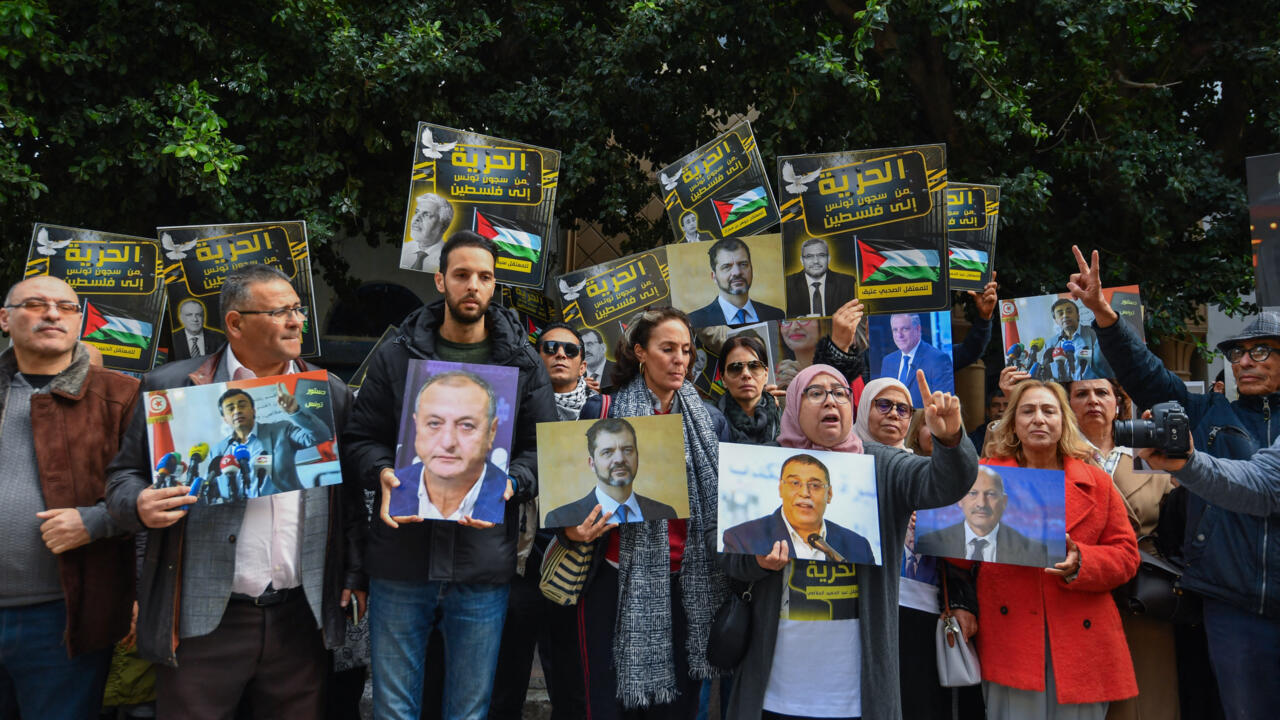
Tunisian opposition figures get prison sentences of 13 to 16 years


Prominent politicians, businessmen and lawyers are among those that have been sentenced to decades in prison by a Tunisian court on charges of conspiring against state security, state media said Saturday, as part of a mass trial against opposition figures and vocal critics of President Kais Saied's administration.


Issued on: 19/04/2025
By: FRANCE 24


Relatives of detainees accused of involvement in a conspiracy case against state security, gesture on the day of a first hearing in front of the court in Tunis on March 4, 2025. © Fethi Belaid, AFP


A Tunisian court handed jail terms of 13 to 66 years to opposition leaders, businessmen and lawyers on charges of conspiring against state security, the state news agency TAP reported on Saturday, citing a judicial official.

The opposition says the charges were fabricated and the trial a symbol of President Kais Saied's authoritarian rule.

Rights groups say Saied has had full control over the judiciary since he dissolved parliament in 2021 and began ruling by decree. He dissolved the independent Supreme Judicial Council in 2022.

The state news agency did not provide further details about the sentences.


Issam Chebbi and Jawhar Ben Mbarek of the opposition National Salvation Front coalition, as well as lawyer Ridha Belhaj and activist Chaima Issa, were sentenced to 18 years behind bars, defence lawyer Abdessatar Messaoudi told AFP.

Activists Khayam Turki was handed a 48-year term while businessman Kamel Eltaief received the harshest penalty of 66 years in prison, added the lawyer.

Forty people, including high-profile politicians, businessmen and journalists, were being prosecuted in the case on charges of "plotting against state security" and "belonging to a terrorist group". More than 20 have fled abroad since being charged.

Watch moreTunisians divided over leader Kais Said ahead of presidential election

Some of the opposition defendants – including Chebbi, Ben Mbarek, Belhaj, Turki, Ghazi Chaouachi and Abdelhamid Jlassi – have been in custody since being detained in 2023.

"In my entire life, I have never witnessed a trial like this. It's a farce, the rulings are ready, and what is happening is scandalous and shameful," said lawyer Ahmed Souab, who represents the defendants, on Friday before the ruling was handed down.

Authorities say the defendants, who include former officials and former head of intelligence, Kamel Guizani, tried to destabilise the country and overthrow Saied.

"This authoritarian regime has nothing to offer Tunisians except more repression," the leader of the opposition Workers' Party, Hamma Hammami, said.

Saied rejects accusations that he is a dictator and says he is fighting chaos and corruption that is rampant among the political elite.

(FRANCE 24 with Reuters and AFP)


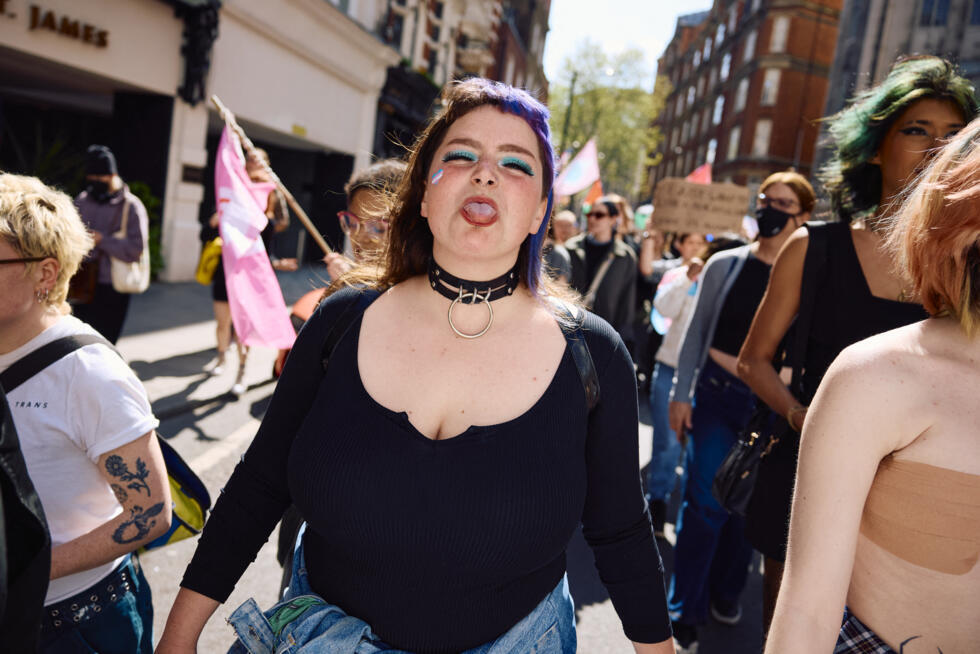
Thousands rally for trans rights after top UK court backs ‘biological’ definition of woman
Europe


Thousands of London trans rights protesters gathered in Parliament Square on Saturday, days after the UK Supreme Court ruled that a woman is someone born biologically female and that transgender women are excluded from that legal definition.


Issued on: 19/04/2025 
Protesters hold up a sign that reads "fuck reform" as they gather in Parliament Square in London on April 19, 2025. © Benjamin Cremel, AFP

Thousands of people on Saturday rallied in central London in support of trans rights, after a landmark court ruling on the definition of a "woman".

Britain's Supreme Court on Wednesday ruled that the legal definition of a "woman" is based on a person's sex at birth, with potentially far-reaching consequences for how single-sex spaces and services are run.

Read more
UK Supreme Court rules the legal definition of a 'woman' refers to 'biological sex'

At a protest in Parliament Square, activists, protesters, trade unions and community groups waved flags and held up banners with slogans such as "trans women are women!" and "trans rights are human rights".

Demonstrators wave flags and hold placards on Parliament Square in London.
 © Benjamin Cremel, AFP

"My main fear [is that] the extremists will feel empowered by this decision. Hate crimes against [the] trans community [will] go up," said Eevee Zayas, a 32-year-old researcher from Spain, describing themself as non binary transgender.

The court ruling said that single-sex spaces and services including changing rooms, toilets and women-only hospital wards "will function properly only if sex is interpreted as biological sex".

Parallels between the US and UK in the wake of Trump's return to power

11:00© France 24


"Everything in the transition is going to be harder. Coming here in big numbers is very important to stand gainst the Supreme Court decision," added Joe Brown, a trans woman in the process of transitioning.

Brown said other fears included not being able to access health care and children being scared to come out as trans.

Britain's Supreme Court said the legal definition of a "woman" is based on a person's sex at birth. © Benjamin Cremel, AFP

The court ruling followed a legal battle between the Scottish government and campaign group For Women Scotland (FWS) involving clashing interpretations of the Equality Act.

While the Scottish government argued that the law gave trans women with a Gender Recognition Certificate (GRC) the same protections as a biological female, the campaign group disagreed.

(FRANCE 24 with AFP)


US Supreme Court pauses Trump's deportations of Venezuelan migrants


The US Supreme Court issued a brief order early Saturday temporarily blocking the deportation of Venezuelan migrants detained in northern Texas. While US President Donald Trump has justified the mass detention and deportation of migrants under an 18th century wartime law, the Supreme Court has ruled that deportees must be given a chance to legally challenge their expulsion.


Issued on: 19/04/2025 
By:FRANCE 24
US military personnel escort an alleged gang member deported by the US to be imprisoned in the Terrorism Confinement Center (CECOT) prison, at the El Salvador International Airport in San Luis Talpa, El Salvador April 12, 2025. © SECOM via Reuters


The US Supreme Court, in a dramatic nighttime intervention Saturday, paused President Donald Trump's unprecedented use of an obscure law to deport Venezuelan migrants without due process.

The emergency ruling, delivered in two terse paragraphs, noted that two of the most conservative of the nine justices had dissented.

The order temporarily prevents the government from continuing to expel migrants under the 1798 Alien Enemies Act – last used to round up Japanese-American citizens during World War II.

Trump invoked the law last month to deport Venezuelans to a notorious prison in El Salvador.

Read moreVenezuelans watch in horror as Trump sends family to El Salvador

The unusual decision was triggered by imminent plans late Friday to expel dozens more Venezuelans under the Act, meaning they would have been deported with next to no ability to hear evidence against them or challenge their cases.

The court said "the government is directed not to remove any member of the putative class of detainees from the United States until further order."

Trump justifies summary expulsions – and the detention of people in El Salvador – by insisting that he is cracking down on violent Venezuelan criminal gangs now classified by the US government as terrorists.

But the policy is fueling opposition concerns that the Republican is ignoring the US constitution in a broader bid to amass power.

Read moreUS senator meets with wrongfully deported Salvadoran migrant Kilmar Abrego Garcia

The row over the Alien Enemies Act comes amid muscular assaults by the administration on big law firms, Harvard and other universities, and major independent media outlets.

The American Civil Liberties Union, which took the lead in seeking to halt Friday's planned deportations, welcomed the Supreme Court ruling.

"These men were in imminent danger of spending their lives in a horrific foreign prison without ever having had a chance to go to court. We are relieved that the Supreme Court has not permitted the administration to whisk them away the way others were just last month," lead attorney Lee Gelernt said.
Tattoos and due process

Trump's election last November was won in large part on his aggressive promises to combat what he has repeatedly claimed is an "invasion" of violent migrants.

While there is no evidence to support the narrative of the United States being "invaded," Trump's rhetoric about rapists and murderers descending on suburban homes resonated with swaths of voters who have long been concerned about high levels of illegal immigration.

Trump has sent troops to the Mexican border, imposed tariffs on Mexico and Canada for allegedly not doing enough to stop illegal crossings, and designated narco-gangs like Tren de Aragua and MS-13 terrorist groups.

However, Democrats and civil rights groups have expressed alarm at an erosion of constitutional rights.

Former ICE lawyer says US deportations are eroding public trust
13:33


Under Trump's use of the Alien Enemies Act – previously seen only during the War of 1812, World War I and World War II – migrants have been accused of gang membership and sent to El Salvador without ability to go before a judge or being charged with a crime.

Attorneys for several of the Venezuelans already deported had said their clients were targeted largely on the basis of their tattoos.

In the most publicized case, Maryland resident Kilmar Abrego Garcia was deported last month to the infamous El Salvador mega-prison without charge.

The Trump administration said he had been included in a bigger batch of deportees due to an "administrative error" and a court ruled that it must facilitate his return.

However, Trump has since doubled down, insisting that Abrego Garcia is in fact a gang member, including posting an apparently doctored photo on social media Friday that showed MS-13 on his knuckles.

Most of the deported migrants are currently held in El Salvador's maximum security Terrorism Confinement Center (CECOT), a mega-prison southeast of the capital San Salvador with capacity for 40,000 prisoners.

Inmates are packed in windowless cells, sleep on metal beds with no mattresses, and are forbidden visitors.

(FRANCE 24 with AFP)
Attackers burn vehicles and fire automatic weapons at French prisons overnight

Several French prisons were attacked overnight, Justice Minister Gérald Darmanin said Tuesday, with assailants burning vehicles and in one instance firing automatic weapons. Darmanin, who was quick to link the incidents to France's campaign against drug trafficking, is travelling to the site of one of the attacks in the southern city of Toulon.

15/04/2025 - 
By:FRANCE 24

Journalists gather in front of the Toulon-La Farlede prison ahead of a visit of the French Minister of Justice in La Farlede, near Toulon, southern France on April 15, 2025, after 15 bullet impacts were found on the front gate following an attack with a "Kalashnikov-type" assault weapon. Cars have been set on fire near several prisons in France while one was targeted with automatic gunfire, in possible retaliation against government anti-drug policies, justice ministry officials said. (Photo by Miguel MEDINA / AFP) © Miguel Medina, AFP


French justice minister Gérald Darmanin confirmed on Tuesday that attacks had been carried out overnight on several French prisons, and added he would travel to the southern city of Toulon, whose prison was among those attacked.

"Attempts have been made to intimidate staff in several prisons, ranging from burning vehicles to firing automatic weapons," Darmanin said on social media platform X.


"I am going to Toulon to support the officers concerned. The French Republic is facing up to the problem of drug trafficking and is taking measures that will massively disrupt the criminal networks," he added.

In recent months Darmanin and Interior Minister Bruno Retailleau have vowed to intensify the fight against narcotics and drug-related crime.


"All this appeared to have been coordinated and is clearly linked to the anti-drug gang strategy" introduced by Darmanin, a source close to the matter told AFP.

According to prison staff union FO Justice, "vehicles were torched, prison gates set on fire, and even targeted with heavy guns".

Three vehicles, including two belonging to prison staff, were set on fire in the car park of the Villepinte prison north of Paris, a police source said. A fuel canister was found on site, and CCTV footage showed two individuals torching cars.

Cars parked outside three other prisons, one near Paris and two in southern France, were also set on fire, another police source said.

In a prison in Toulon, on France's southern coast, 15 bullet impacts were found on the front gate following an attack with a "Kalashnikov-type" assault weapon, FO Justice said.

In a prison in nearby Aix, two vehicles were set on fire and the gate of the local ERIS prison surveillance unit was damaged, the union added.

Overnight Sunday to Monday, fires had already been set in the parking lots of a prison staff training centre and a prison near Paris, several sources said.

"These criminal acts are a full-on attack on our institution, on the republic and the staff who serve the republic every day," FO Justice said, calling for a "strong, clear response by the government".

Wilfried Fonck, national secretary for Ufap Unsa Justice, another union, told AFP that the prison system did not have enough staff to secure prison perimeters "24/7".

France's national anti-terrorism prosecutor's office said on Tuesday it had taken charge of the investigation into attacks. The DGSI national security agency will also be involved, the prosecutor said.

(FRANCE 24 with AFP and Reuters)
Read next
Biden blasts Trump 'destruction' in first post-presidency speech

In his first major speech since leaving office, former US president Joe Biden slammed his successor Donald Trump's frenetic government overhaul, warning that Trump’s cuts to Social Security risk devastating the lives of millions of retirees who depend on the programme for survival.


Issued on: 16/04/2025 -

By: FRANCE 24/

Video by: Fraser JACKSON

02:22
Former US President Joe Biden speaks at Advocates, Counselors, and Representatives for the Disabled conference in Chicago, Tuesday, April 15, 2025. © Nam Y. Huh, AP


Joe Biden, in his first major speech since leaving the White House, railed Tuesday against his successor Donald Trump's frenetic government overhaul, claiming the "hatchet" effort put Americans' retirement benefits at risk.

"Fewer than 100 days, this administration has done so much damage, and so much destruction – it's kind of breathtaking it could happen that soon," Biden told a conference of disability advocates in Chicago.

"They've taken a hatchet to the Social Security administration, pushing 7,000 employees out the door," said the former president, referring to the national agency that pays out retirement and disability benefits.

Wearing a blue suit and tie, and standing in front of American flags, the 82-year-old Democrat spoke for around a half-hour, displaying at times the signs of aging that prompted him to abandon his re-election campaign last year.


President Trump, in a jab at Biden, posted a short video on social media of one of his rambling anecdotes without comment.

Biden's choice of topic, Social Security, aimed to ramp up pressure on Trump over his rampaging government overhaul efforts.

He highlighted staff reductions at the agency that Trump and his billionaire aide Elon Musk have pushed as part of their self-declared "Department of Government Efficiency", saying the Social Security website "is crashing" and hindering retirees from getting their benefits.

The programme, which more than 65 million Americans rely on, is colloquially known in Washington as the "third rail of politics" for its sensitivity to voters.

Many Americans "literally count on social security to buy food, just to get by", Biden said, and "many of these beneficiaries, it's their only income. If it were cut or taken away, it would be devastating, devastating for millions of people".

He bashed Trump's commerce secretary, former hedge fund manager Howard Lutnick, over a recent remark in which he said "fraudsters" would complain about a missing check, but not his mother-in-law.

Biden scoffed at that characterisation, saying, "what about the 94-year-old mother living all by herself – who doesn't have a billionaire in the family?"

(FRANCE 24 with AFP)


Oppose the Trump‑Putin axis, oppose European rearmament


Published 

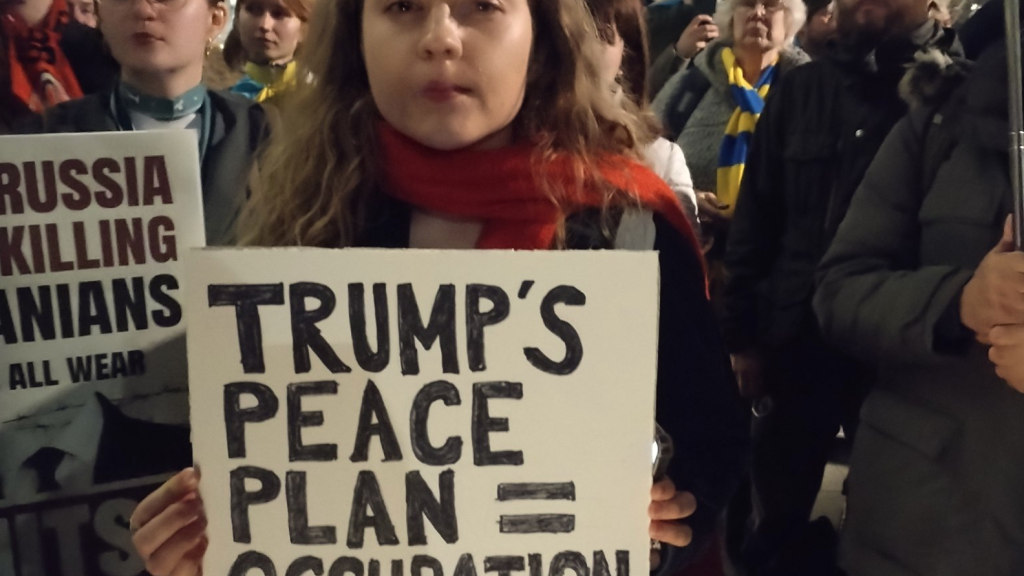
Trump's peace plan = occupation

First published at Anti*Capitalist Resistance. Slightly edited.

Anti*Capitalist Resistance (ACR) stands in solidarity with the people of Ukraine fighting to defend their country against occupation and annexation. We have done so since Putin’s first aggression in 2014. We therefore support the right of Ukraine to obtain the weapons and aid necessary for its fight against Russian imperialism.

The support for Ukraine by NATO and Western imperialism has been for geostrategic and political self-interest. This war has given the West legitimacy after 20 years of the failed “war against terrorism” in the “clash of civilisation” with its wars in Afghanistan and Iraq.

Imperialism is a global system where powerful nations with developed financial and industrial capital seek to dominate the rest of the world by extracting resources and wealth. In order to do this they use military means to back their project — and sometimes to get one up on their competitors

Economic stagnation has made global competition increasingly violent, as each state tries to maintain its position in the world market at the expense of others. This translates into new trade wars and new territorial divisions.

Trump’s presidency has shifted global politics onto dangerous new terrain. His bellicose claims against Greenland, Panama and even Canada — coupled with his tariff war — shows we are at an end to the era of Pax Americana and Washington Consensus neoliberalism. Instead Trump’s argument that “might makes right” because it makes economic sense opens the door for a more violent world with even less checks and balances against the actions of great powers

Imperialism never went away, but now it is even more aggressive. The United States prepares for war against China and negotiates with Russia to divide up Ukraine. Trump and Putin have a similar vision of powerful nations carving up the world into their own spheres of influence. Smaller nations are simply bargaining chips or prey for imperialist expansionist endeavours. This has always been the case to some extent, but Trump is being more honest about it.

Peace deals being discussed in oil rich Gulf Nations without any Ukrainians present are a return to the old colonial order where people’s fates were decided by imperialist leaders in rooms far away. The Ukrainians are left with no agency, no national sovereignty, no ability to determine their own national future.

The Trump regime is tearing up established obligations and alliances in favour of a new way of “doing business” that is almost entirely transactional — reflecting Trump’s background as neither a military man nor a politician but a simple capitalist. If anyone wants military support they have to pay for it — no more “freebies”.

The proposed mineral deal is an example of this: Ukraine is not a nation to be supported against Russia’s imperialist invasion, but a business partner that must pay for military assistance through decades long extractive deals that benefit the US.

Imperialist countries intervene in the struggles of people fighting for independence and democracy to deflect the outcomes to suit their interests. This is the case in Ukraine, where countries providing arms are doing it slowly and in quantities that are insufficient. They are shackling Ukraine with further debt and blocking a socially just reconstruction to impose a deeper neoliberal order. Imperialist countries backing Ukraine are divided in wanting to end the war as soon as possible to resume normal business with Russia, or dragging it out to weaken an imperialist rival.

The idea that Russia is a military threat to “democratic” Western Europe is not credible. It has been unable after three years of war to achieve its objectives: demilitarisation and denazification of Ukraine, subordinating it to Russia. In rejecting Trump’s peace plan, Putin has demanded new elections in Ukraine claiming Zelensky has no mandate. His real goal is to colonise Ukraine again.

In this global reordering European leaders are increasingly taking measures to remilitarise the continent. Governments who claimed there was “no money” for social spending or the public sector suddenly have billions for the rearming and expansion of their military forces.

This is posed as a “common sense” view that European nations should rearm against expansionist Russian imperialism. But supporting this “multipolar world” is not an alternative to a third world war but likely a prelude to it.

Rearmament or Putin’s victory will fuel the further rise of the extreme right. It is their vision of the world that is being fostered: powerful militarised nations, facing off against each other in a world where there is not even the flimsy liberal pretension of human rights or an “international order”. Patriotism, militarism and nationalism are their guiding ethos, a world defined by men like Trump and Putin.

Keir Starmer’s Labour — ruling over a declining imperial power like Britain — has no alternative but to follow in line and accept this new world order, trying to play nicely with Trump to hope he throws some scraps from his table. It hopes to use the debate among the ruling classes over the war in Ukraine, along with the debate about Trump’s tariffs, to reassert Britain’s position as a major imperialist power — balancing between support for the US and Atlanticism while at the same time trying to build stronger links with the EU, particularly with France and Germany. It also uses the cover of jingoism and militarism to justify austerity measures such as the attacks on disabled people that it wished to carry out anyway in order to present itself as a safe pair of hands for capital

Ecosocialists oppose increased spending on European imperialist war machines. It would be a waste of the limited resources we have as a species with the climate crisis bearing down on us. Their geopolitical calculations ignore the horrors of what a war inflicts on us and our planet.

We do not trust European states claims’ to defend democracy when they back the genocide of Palestinians, support the Gulf States monarchies, have a legacy of colonialism, and have worked tirelessly since WWII to crush national liberation movements, mass socialist parties and any alternatives to their capitalist world order.

ACR rejects imperialist rearmament and instead argues for a new internationalism of the people. Therefore:

  • We support the right of countries to self-determination and to resist occupation and annexation, including by military means. This applies to Ukraine, Palestine, Kurdistan, Kashmir, etc. Ukraine should get the arms necessary and without delay and without strings from wherever possible. We also argue that there should be no illusions in the intentions of the countries supplying arms in exchange for deep neoliberal reforms and increasing debt.

  • Arms shipments to Israel and Saudi Arabia, other Gulf monarchies, India, etc. should be halted immediately. The supply of arms necessary to Ukraine can be done without increasing Britain’s military budget. Britain’s military budget is not for defence. Nuclear weapons are offensive and retaliatory (they should never be used and therefore be abolished) and aircraft carriers are designed for imperialist adventures far away from Britain.

  • Anti-militarism is not the same as pacifism. We counterpose the military institution, its chain of command, the barracks without democracy, and its nationalistic fervour around the flag and “King and Country” to a civic and popular armed territorial defence. The arms industry should be nationalised to remove the profit motive and ensure that it supplies arms to those fighting for the liberation of their country. We demand an end to the production of weapons of mass destruction such as nuclear bombs and those that are indiscriminate and disproportionately affect civilians such as cluster bombs, land mines, phosphorus).

  • Britain and others should rigorously respect UN treaties, for example The Convention on the Prevention and Punishment of the Crime of Genocide, and the decisions of the International Criminal Court and International Court of Justice.

  • Britain should halt F35 purchases, scrap its Trident missiles, and remove the 18 US military bases in Britain


Ukraine: To avoid warlike escalation, weapons for Ukraine!

Friday 18 April 2025, by Gin VolaElias Vola


Since the abrupt reversal of US policy towards Ukraine, the Russian concessions obtained by President Trump have been non-existent. The ceasefire on energy infrastructure has not been implemented; worse, bombing on Ukrainian territory has never been so intense, while the opening of a corridor to resume maritime trade in the Black Sea only benefits Russia.


These negotiations deprive the Ukrainian people of the essential means for their defence, while helping the Russian regime to hide the military and human disaster of its offensive. Trump’s latest threats of sanctions against Russia are part of this asymmetrical logic. His annoyance at the immobility of Putin, in whom he continues to place “his trust”, has not been followed by any action. At the same time, the US President has urged Ukraine to sign an agreement on minerals without delay, which would establish a new kind of economic colonialism. Aware of his advantage, Putin continues to play the maximalist card, calling for elections in occupied Ukraine.
Weapons, not speeches

Yet the Ukrainian people continue to stand united in defence of their right to self-determination. For “if Ukraine is partitioned, the millions who are either in the occupied territories or have had to flee will have nowhere to return. They know that an outcome that hugely rewards the aggressor will only strengthen Putin’s authoritarian regime and mean even more repression, especially in the occupied territories. So, Ukrainians have two things in mind when thinking about any deal: the fate of the people in the occupied territories and how to prevent Russia from restarting the war.” [1]

For that Ukraine needs weapons, and it needs them now. But on the European side, the dangerous excessiveness of the military investments announced by certain countries (led by France, Germany and the UK), contrasts radically with the weakness of the concrete and immediate military aid they are providing to Ukraine. The meeting between Zelensky and Macron finally resulted in two billion in aid... in old military equipment invoiced at new prices.

Standing by Ukraine

Let’s make no mistake: the return to militarism of the imperialist powers of Western Europe is not the right response to Putin’s imperialist war. All the more so when the neo-fascist danger is growing all over the continent. It is the Ukrainian resistance that can stop this madness and avert a warlike escalation.

Between a bloc of conservatives and liberals, seeking to defend their national interests and continue to attack our social rights, and a Left locked in a chauvinistic pacifism that offers no solution to the peoples of Eastern Europe faced with the neo-fascist peril, it is up to an internationalist, anti-fascist Left to be the best ally of the resisting Ukraine. We will proudly continue this fight!

L’Anticapitaliste 2 April 2025


Attached documentsukraine-to-avoid-warlike-escalation-weapons-for-ukraine_a8943.pdf (PDF - 905.2 KiB)
Extraction PDF [->article8943]

Footnotes


[1] ‘The left should support a just peace for Ukraine, not a Trump-Putin deal to appease the aggressor’: An interview with Ukrainian socialist Denys Pilash - Europe Solidaire Sans Frontières, March 2025.


Elias Vola

Gin Vola


International Viewpoint is published under the responsibility of the Bureau of the Fourth International. Signed articles do not necessarily reflect editorial policy. Articles can be reprinted with acknowledgement, and a live link if possible.


Western Media Continues To Prepare the Public for Defeat in Ukraine


On March 29, The New York Times published an article that “reveal[ed] that America was woven into the war far more intimately and broadly than previously understood.” Its undeclared thesis was that the U.S. has done everything possible for Ukraine to win the war. Ukraine would not trust them and listen. Now the war is lost, and there is no choice but to negotiate. The article was the first major attempt to prepare the public for defeat in Ukraine.

Not to be outdone or left behind, less than two weeks later, the British paper The Sunday Times has published the British version, establishing the pattern of preparing the public for defeat.

Though the British version, like its American predecessor, is full of daring British accomplishments, its real, undeclared thesis is that if America did everything to achieve victory in Ukraine, the United Kingdom did everything to make what America did possible.

The New York Times piece credits Britain for managing “the logistics hub.” The British piece claims they did much more. It opens with the same drama as its American counterpart: “the extent of its involvement and influence – last-minute dashes to Kyiv, help forging battle plans and collecting vital intelligence on the Russians – has remained largely hidden. Until now.”

The Sunday Times claims credit for Britain for three pivotal roles in the war. The first is that they were the vanguard of the operation, the first to push many of the red lines. The UK “played a leading role in getting Ukraine the weapons it needed in the early days of the war.” Britain’s Secretary of Defense, Ben Wallace, we are told, was affectionately called “the man who saved Kyiv” by the Ukrainians. Later they would be the first “to provide Ukraine with long-range Storm Shadow cruise missiles to boost its chances of success.” Anti-tank missiles, tanks, long-range missiles “all happened as early as they did because of” Wallace and Britain.

But it was not just in sending weapons to Ukraine that Britain was the first. It was also the first to put boots on the ground. In its cheap novel narrative style, The Times says that the UK had “the derring-do to deploy troops inside the country when no one else would.” The UK, The Times reports, had boots on the ground in Ukraine from the beginning. Early on, London had sent “a few dozen regular British troops” to Kiev “to instruct new and returning military recruits to use NLAWs, British-supplied anti-tank missiles that were delivered in February 2022 as the invasion was just beginning.” Later, they would “secretly” send troops “to fit Ukraine’s aircraft with the [long-range] missiles and teach troops how to use them.”

While U.S. military chiefs would only go to Ukraine “on rare occasions… Britain’s military chiefs… were given the freedom to go whenever necessary.”

The second pivotal role claimed by Britain is that it was the brains of the operation. “Behind closed doors,” The Sunday Times reports, “the Ukrainians refer to Britain’s military chiefs as the “brains” of the “anti-Putin” coalition.” They helped in “forging battle plans and collecting vital intelligence on the Russians.”

The Sunday Times piece also flirts with familiar themes from The New York Times article, like the known risk of nuclear war and the incompetence of the Ukrainian government and military command that led to defeat. There was “nervousness,” we are briefly told, “that giving Ukraine increasingly heavy weaponry could escalate tensions with Russia.” The Russians “had been rattling the nuclear sabre.”

We are told that the United States and Britain had carefully planned Ukraine’s counteroffensive but that Ukrainian President Volodymyr Zelensky and General Oleksandr Syrsky, Ukraine’s ground forces commander, “had other ideas.” To emphasize again the thesis that the U.S. and Britain had done all they could and that defeat rests with the Ukrainian political and military leadership, The Times stresses that the U.S. was getting “frustrated” and “impatient.”

Though it again spends less time on these digressions, The Times also touches upon one of the more cynical aspects of The New York Times’ reporting. The New York Times reports that one value of the war in Ukraine is that it was “a grand experiment in war fighting, one that would not only help the Ukrainians but reward the Americans with lessons for any future war.” While “the Ukrainians were the ones fighting and dying,” the U.S. was “testing American equipment and tactics and sharing lessons learned.” The Sunday Times makes a similar cynical point: “Ukraine has paid a terrible price in defending themselves but they’ve also given us a window on modern warfare.” The UK would take “the lessons [they] learnt during the spring and summer of 2023 to the army, which [they are] seeking to transform into a more lethal, agile force.”

But the third and most pivotal role that The Times piece claims for Britain is that they played the role of mediator between the U.S. and Ukraine that kept the partnership together and made the war effort possible. “Most crucially,” The Times reveals, “as the Americans provided the ‘cream’ of the weapons to Ukraine and the precise targeting data to use them effectively, it was British military chiefs, under Operation Scorpius, holding Washington and Kyiv’s difficult relationship together.” Unreported at the time, while the Biden administration was “still presenting a faultless, united front with its Ukrainian allies… behind the scenes tensions had been mounting for months and by the early summer of 2023 had reached a point where they threatened to spiral out of control.”

At the point that “relations between the Ukrainians and Americans hit rock bottom,” British Admiral Sir Tony Radakin broke off “a long-planned holiday” and, telling Wallace that it was getting “too fractious,” said “he needed to get out to Ukraine to pull both sides together.” Radakin “would sit down with Zaluzhny, hear the Ukrainians out, and try to explain their perspective to the Americans.”

Britain’s mediation was a success. Its “diplomacy brought the two sides back together and in mid-August, Radakin, Zaluzhny, and [commander of US Army Europe and Africa] Cavoli met in person on the Polish-Ukrainian border. During a five-hour discussion, they thrashed out plans for the counteroffensive and plotted for the winter, as well as the following year. It was a sign that the Americans were not going anywhere soon.” Once again, Britain had saved the partnership and kept America in the war. This was a regular role for Radakin: “He was the person keeping the U.S. on side, and keeping the Biden administration leaning into Ukraine.”

The U.K. has done everything it can to help Ukraine win the war. It has provided “unwavering support” for Ukraine. It led the charge to send weapons and long-range missiles, and it put boots on the ground “when no one else would.” It was the “brains” of the coalition and brought “vital intelligence… to the table.” “Most crucially,” The Sunday Times tells us, the British provided the indispensable mediation that preserved the American-Ukrainian relationship and kept America in the war and the war effort and the partnership possible.

There is a pattern emerging in Western mainstream media reporting of the history of the war. It is not Ukraine that did everything it could and the West who let them down with insufficient weapons and limits on their use. It is the West who did everything that it could and Ukraine who let them down by not following orders. The New York Times’ March article led the way, and The Sunday Times’ April article establishes the pattern. The undeclared purpose of all these top-secret revelations American and British officials are choosing to share with the press seems to be the preparation of the public in the West for defeat in Ukraine and preparation for whatever comes next.

Ted Snider is a regular columnist on U.S. foreign policy and history at Antiwar.com and The Libertarian Institute. He is also a frequent contributor to Responsible Statecraft and The American Conservative as well as other outlets. To support his work or for media or virtual presentation requests, contact him at tedsnider@bell.net.

Bogged down in east Ukraine, Putin’s Russia eyes ‘opportunistic’ gains in northern Sumy

Analysis

Russia’s grisly Palm Sunday attack on the city of Sumy has focused attention on the northern Ukrainian region where Kyiv says an expected Russian spring offensive is already under way. Experts say the push into Sumy is aimed at stretching Ukraine’s defensive lines and projecting an image of Russian progress on the front – even as Moscow’s war of attrition in the east grinds to a bloody stalemate.


Issued on: 15/04/2025 
By: Benjamin DODMAN


The aftermath of Russian missile strikes on Ukraine's Sumy, in which at least 35 people were killed and more than a hundred injured, on April 13, 2025. © Sofiia Gatilova, Reuters


In the weeks before a pair of ballistic Iskandar-M missiles slammed into the heart of Ukraine’s Sumy, torching cars and gutting buildings as people gathered to celebrate Palm Sunday, Vladimir Putin’s gruesome war had been inching steadily closer to the northern city known for its elegant architecture and picturesque, tree-lined streets.

Sumy, where Sunday’s successive strikes left at least 35 dead and more than a hundred wounded, lies just 18 miles from the Russian border. A regional capital, it has witnessed a steady influx of civilians seeking refuge as the fighting draws closer to their homes.

“Every day in Sumy we saw several hundred people arrive in the city looking for shelter,” said FRANCE 24’s senior reporter James André, who recently visited a centre for internally displaced people in the northern city.

“They were fleeing the constant drone attacks and artillery shells that have become a daily occurrence for villagers who live close to the border,” he added.

Sumy, in northern Ukraine, borders Russia's western region of Kursk. © FRANCE 24

The escalated attacks come after Russia recently recaptured much of its territory in neighbouring Kursk oblast, which Ukraine attacked last year in a lightning offensive ostensibly designed to pre-empt a Russian offensive on Sumy.

“Russia is now pressing its advantage, pushing Ukrainian forces out of Kursk and carrying the momentum into Ukraine,” said André. “Sumy is the main city in their path.”
Putin’s message

Russia’s deadliest attack this year, the Sumy strikes have made a mockery of Washington’s attempts to secure a ceasefire in Ukraine – let alone the type of durable peace deal President Donald Trump had boasted he would deliver in a matter of days.

The Palm Sunday attack came two days after Putin hosted Trump’s special envoy Steve Witkoff for talks the Kremlin described as “extremely useful and very effective”. It came a day after the US president told reporters that negotiations between Russia and Ukraine were “going fine”.

Peter Zalmayev, director of the Eurasia Democracy Initiative, spoke of an “opportunistic crime” facilitated by the city’s proximity to the border, which ensured Ukraine’s air defences had no time to respond.

The twin strikes “send a signal that Putin doesn’t really care and is beholden to no agreement, and that Trump needs to make even more concessions to the Russian side", Zalmayev said.

“They show Putin is confident there’s still more Ukrainian territory to grab and more lives to be taken before he is willing to sit down at the negotiating table,” he added.


Ukrainian officials have been warning for weeks that Russia is poised to launch a new offensive against Sumy and the neighbouring Kharkiv oblast to strengthen its hand in future negotiations.

On April 9, days after President Volodymyr Zelensky warned that Russian forces were mustering for a new push into the northeastern regions, Ukraine's commander in chief, General Oleksandr Syrskiy, stated that the offensive had “effectively already begun”.

“For several days, almost a week, we have observed almost a doubling of the number of enemy attacks in all main directions,” Syrskiy said in an interview published by the Ukrainian newspaper LB.ua.

Later that day, Zelensky claimed more than 67,000 Russian soldiers deployed in the Kursk operation had been “relocated for an attack on Sumy”.

But neither the scope nor the scale of the Russian push was immediately clear.

When visiting Kursk in March, Putin instructed military commanders to set up a buffer zone along the border to prevent further Ukrainian incursions. Experts say Russia could be tempted to push further into Ukraine while Kyiv’s troops are on the back foot.

“It’s too early to say whether the Russians want to seize swaths of Sumy region or establish a buffer zone at the border to stave off a repeat of the Kursk offensive,” said retired French general Jérôme Pellistrandi, chief editor of the monthly review Défense nationale.

“Either way, the Russians won’t miss a tactical opportunity to seize territory and wear down Ukraine’s defences,” he added.


‘No reason for panic’


Less than a year after Russia suffered its first major territorial incursion since World War II, Moscow’s forces have pushed Ukrainian troops out of all but 50 square kilometres of Kursk region, according to data from the Institute for the Study of War, which has mapped the conflict and published daily updates since the start of the war.

Pushing into neighbouring Sumy region, Moscow's army has also captured several border settlements and controls around 95 square kilometres in the Ukrainian oblast – up from virtually nothing at the start of 2025.

“The speed with which Russia has recaptured Kursk has been quite surprising, particularly when compared with the stalemate elsewhere,” said Veronika Poniscjakova, a Ukraine war expert at the University of Portsmouth in Britain. “So it’s fair to say they have the momentum there and could be tempted to push even further.”

Some Ukrainian sources on the ground, however, have played down the reports of Russian progress.

“There’s no reason for panic over Sumy,” Maksym Zhorin, deputy commander of Ukraine’s 3rd Assault Brigade, wrote in a Telegram post on April 12. “Enemy sabotage groups and border attacks have been happening there constantly. The region is shelled regularly – that’s nothing new.”

Zhorin claimed that the situation had not fundamentally changed, adding: “The enemy hasn’t made any real gains in this direction. Our forces have long since learned how to counter them.”

Ukrainian security officers work at the site of the Palm Sunday missile strikes on Sumy. © Oleg Voronenko, AFP

In its April 13 update on the conflict, the ISW also said Russia had failed to make further gains in Sumy region despite continuing its offensive operations. It suggested Moscow’s primary objective in the northern region was to “create defensible buffer zones (...) and approach to within tube artillery range of Sumy City”.

An earlier assessment by the war monitor, published on April 9, said Russian units along the border were “unlikely to launch a major offensive on Sumy without substantial reinforcements”.

What has changed, argued Zhorin, is Russia’s broader strategy. He said Moscow’s troops were “trying to stretch the frontline – redirecting forces, opening up new zones of contact".

“There are more important parts of the front line that Russia is likely to continue focusing on,” added Poniscjakova. “But in so far as the Sumy attacks help stretch Ukrainian lines, they can indeed be considered a significant element in Russia’s spring offensive.”

‘Active defence’


True to form, Kyiv has responded to Russia’s attacks with cross-border incursions of its own, recently launching operations near the junction of the Kursk and Belgorod oblasts in western Russia.

Zelensky confirmed last week that Ukrainian units were operating in Russia’s Belgorod, where Moscow reported land attacks in March, while also maintaining a bridgehead in Kursk.

“We continue to conduct active operations in the border areas on the enemy's territory, and this is absolutely right – the war must return to where it came from,” the Ukrainian leader added.

According to the DeepState military blog, which is considered close to Ukraine's army, Kyiv’s troops have gained a foothold inside the Russian region, around the border villages of Demidovka and Popivka.

As with the Kursk offensive last year, Ukrainian commanders say the goal is to divert Russian forces and pre-empt attacks on Ukrainian soil.

Read moreWhy Ukraine’s Kursk offensive has failed to distract Russia from Donbas push

“We understand that after Russia constantly brings in additional forces to regroup its positions and replenish losses, the risks for Sumy and its city centre grow,” Ukrainian military expert Oleksandr Musiyenko said in an interview with Radio Free Europe/Radio Liberty last week.

Musiyenko described Ukrainian cross-border incursions as “preventive actions to prevent the enemy from rapidly launching their offensive operations.” He added: “This is why we speak of active defence – to stop the enemy from quickly advancing into Ukrainian territory and minimising the risks to the Sumy region.”
Deadlock

Even as they warn of the threat to Sumy and neighbouring Kharkiv, Ukrainian officials have cautioned that they still expect the main thrust of Russia’s spring offensive to bear down on key battleground areas further east.

In an interview with Reuters last week, senior Ukrainian official Pavlo Palisa said he expected Russia to focus its offensive push on the strategic eastern city of Pokrovsk, which Russian forces have been trying to encircle for the past year.

Moscow’s troops have advanced less than 50 kilometres in the Pokrovsk area over the past year, according to the ISW, which registered a slowdown in Russian advances across the front line this winter. This has led several Russian military bloggers to lament a strategy of securing marginal gains at a tremendous cost both in lives and material.

In an April 12 post on Telegram, blogger “Philologist in Ambush”, a former instructor for Storm-Z units made up of convicts, blasted Russian commanders for seeking to “grind” down Ukraine’s defences by deploying poorly trained, ill-equipped infantry units that incur massive losses.


FRANCE 24 in Ukraine: 'When leaders talk about a ceasefire, soldiers don't believe it at all'
06:29© France 24

“Will they continue pushing for Pokrovsk? Yes, likely,” said Poniscjakova. “But they’ve been trying for a year now and the situation is largely deadlocked.”

In fact, she added, “with the exception of Kursk, the entire front line has been in a state of deadlock, with neither side making any kind of significant operational advance".
Fooling Trump

“The Russians are still inching forward, but the fact is Ukraine is holding on, however high the cost,” added Pellistrandi.

The retired general said Ukraine’s army is now in a better shape than it was last autumn, at the height of Russia’s territorial advances in the east, with fewer shortages of artillery pieces.

“They’ve also built up stronger defences, though that necessarily implies that they have largely given up on hopes of recapturing lost territory – at least militarily,” he said.

“On the Russian side, meanwhile, the armaments industry is in full swing and they’ve launched a new recruitment drive. And yet they still can’t secure a decisive breakthrough, the kind of tactical victory that would force Ukraine to fall back,” he added. “It's a problem for Putin, who won’t have a lot to show for at his annual May 9 Victory Day parade.”

A cap with a Ukrainian flag lies on the ground after Russia's Palm Sunday missile attack on Sumy. © Volodymyr Hordiienko, AP

That is where Kursk and Sumy present an opportunity for the Kremlin, eager to play up its advantage on the battlefield and persuade the Trump administration it is on the verge of a decisive win.

“We can definitely say this war is not just about the fighting, but also about the perceptions of who has the upper hand – both domestically and abroad,” said Poniscjakova. “It’s especially the case with the United States, who are going to play a major role in any kind of negotiation.”

Russian propaganda has been in full drive during the recapture of territory seized by Ukraine in Kursk region, sometimes shaping the White House’s own narrative of events. Trump notably picked up on the Kremlin’s unverified claim that Ukrainian forces had been encircled in Kursk, allowing Putin to suggest he might spare them in a goodwill gesture.

Likewise, the attacks on Sumy “indicate that Russia is trying to make a point to the United States, claiming it is the winning side and that it therefore should not be the one making any concessions", said Poniscjakova. “And it seems the Americans may well be listening.”