Monday, April 21, 2025

Honoring Pope Francis, Who Championed the Glorious World Around Us

Francis’s project for the Earth—a recovery of fellow feeling, with a special attention to the poor—is the only thing that can save us over time.
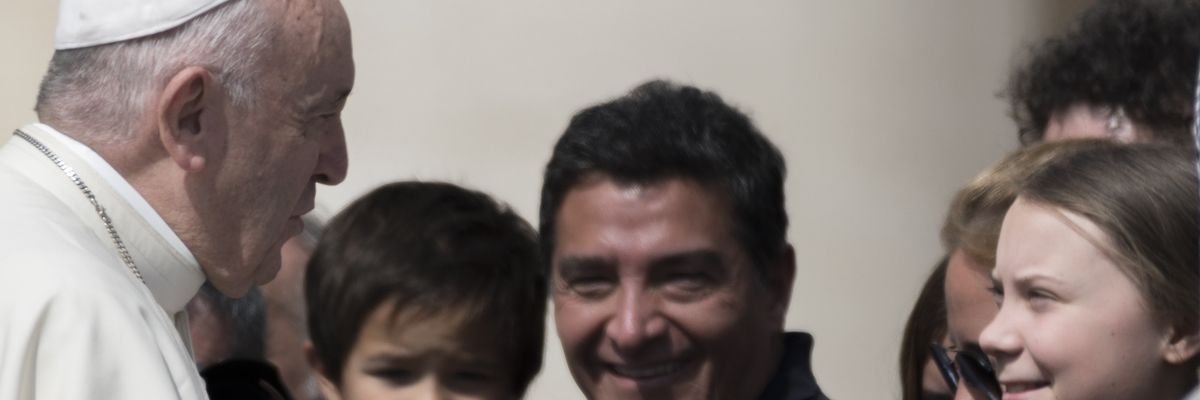

Pope Francis greets Swedish teenage environmental activist Greta Thunberg, right, during his weekly general audience in St. Peter's Square, at the Vatican, on Wednesday, April 17, 2019.
(Photo: Massimo Valicchia/NurPhoto via Getty Images)
350.ORG
Apr 21, 2025
The Crucial Years


Just in case I thought one couldn’t feel more forlorn right now, the word came this morning of the death of Pope Francis. It hit me hard—not because I’m a Catholic (I’m a Methodist) but because I had always felt buoyed by his remarkable spirit. If he could bring new hope and energy to an institution as hidebound as the Vatican, there was reason for all of us to go on working on our own hidebound institutions—and if he could stand so completely in solidarity with the world’s poor and vulnerable, then it gave the rest of us something to aim for.

I thought this from the start, when he became the first pope to choose the name of Francis—that countercultural blaze of possibility in a dark time—and when he showed his mastery of the art of gesture, washing the feet of women, of prisoners, of Muslim refugees. (Only Greta Thunberg, with her school strike, has so mastered the power of gesture in modern politics).

But he brought that moral resolve to the question of climate change, making it the subject of his 2015 encyclical “Laudato Si,” the most important document of his papacy and arguably the most important piece of writing so far this millennium. I spent several weeks living with that book-length epistle in order to write about it for The New York Review of Books, and though I briefly met the man himself in Rome, it is that encounter with his mind that really lives with me. “Laudato Si” is a truly remarkable document—yes, it exists as a response to the climate crisis (and it was absolutely crucial in the lead-up to the Paris climate talks, consolidating elite opinion behind the idea that some kind of deal was required). But it uses the climate crisis to talk in broad and powerful terms about modernity.

The ecological problems we face are not, in their origin, technological, says Francis. Instead, “a certain way of understanding human life and activity has gone awry, to the serious detriment of the world around us.” He is no Luddite (“who can deny the beauty of an aircraft or a skyscraper?”) but he insists that we have succumbed to a “technocratic paradigm,” which leads us to believe that “every increase in power means ‘an increase of “progress” itself’… as if reality, goodness and truth automatically flow from technological and economic power as such.” This paradigm “exalts the concept of a subject who, using logical and rational procedures, progressively approaches and gains control over an external object.” Men and women, he writes, have from the start
intervened in nature, but for a long time this meant being in tune with and respecting the possibilities offered by the things themselves. It was a matter of receiving what nature itself allowed, as if from its own hand.


In our world, however, “human beings and material objects no longer extend a friendly hand to one another; the relationship has become confrontational.” With the great power that technology has afforded us, it’s become
easy to accept the idea of infinite or unlimited growth, which proves so attractive to economists, financiers, and experts in technology. It is based on the lie that there is an infinite supply of the Earth’s goods, and this leads to the planet being squeezed dry beyond every limit.


The deterioration of the environment, he says, is just one sign of this “reductionism which affects every aspect of human and social life.”

I think Francis’s project for the Earth—a recovery of fellow feeling, with a special attention to the poor—is the only thing that can save us over time. But it will take time—obviously for the moment we’ve chosen the opposite path, as exemplified by the fact that JD Vance, scourge of the refugee, darkened his last day on Earth.

In the meantime, Francis was very much a pragmatist, and one advised by excellent scientists and engineers. As a result, he had a clear technological preference: the rapid spread of solar power everywhere. He favored it because it was clean, and because it was liberating—the best short-term hope of bringing power to those without it, and leaving that power in their hands, not the hands of some oligarch somewhere.

As a result, he followed up “Laudato Si” with a letter last summer, “Fratello Sole,” which reminds everyone that the climate crisis is powered by fossil fuel, and which goes on to say
There is a need to make a transition to a sustainable development model that reduces greenhouse gas emissions into the atmosphere, setting the goal of climate neutrality. Mankind has the technological means to deal with this environmental transformation and its pernicious ethical, social, economic, and political consequences, and, among these, solar energy plays a key role.


As a result, he ordered the Vatican to begin construction of a field of solar panels on land it owned near Rome—an agrivoltaic project that would produce not just food but enough solar power to entirely power the city-state that is the Vatican. It is designed, in his words, to provide “the complete energy sustenance of Vatican City State.” That is to say, this will soon be the first nation powered entirely by the sun.

The level of emotion—of love—in this decision is notable. The pope named “Laudato Si” (“Praised be”) after the first two words of his namesake’s “Canticle to the Sun,” and “Fratello Sole” was even more closely tied—those are the words that the first Francis used to address Brother Sun. I reprint the opening of the Canticle here, in homage to both men, and to their sense of humble communion with the glorious world around us.
All praise be yours, my Lord, through all that you have made,
And first my lord Brother Sun,
Who brings the day; and light you give to us through him.
How beautiful is he, how radiant in all his splendor!
Of you, Most High, he bears the likeness.

The world is a poorer place this morning. But far richer for his having lived.

© 2022 Bill McKibben


Bill Mckibben is the Schumann Distinguished Scholar at Middlebury College and co-founder of 350.org and ThirdAct.org. His most recent book is "Falter: Has the Human Game Begun to Play Itself Out?." He also authored "The End of Nature," "Eaarth: Making a Life on a Tough New Planet," and "Deep Economy: The Wealth of Communities and the Durable Future."
Full Bio >


Scientific consensus, climate and Catholicism: A look back at Pope Francis’s environmental legacy
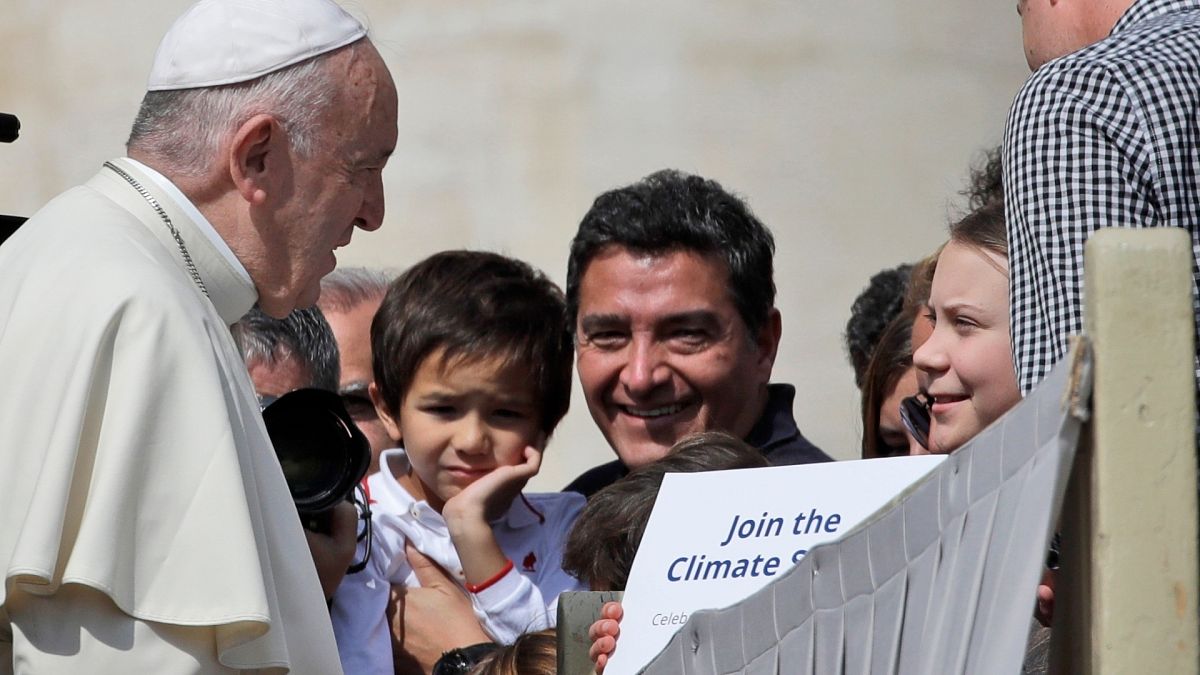
Pope Francis greets Swedish teenage environmental activist Greta Thunberg, right, during his weekly general audience in St. Peter's Square, at the Vatican in 2019.
Copyright AP Photo/Alessandra Tarantino
By Euronews Green
Published on 

Pope Francis's legacy includes efforts to open the eyes of the world’s 1.3 billion Catholics to the dangers of climate change.

Pope Francis has died on Easter Monday, 21 April, aged 88, the Vatican has announced.

Elected in 2013 following the resignation of Pope Benedict XVI, he was the head of the Catholic Church for just over a decade.

He will be remembered in part for his efforts to open the eyes of the world’s 1.3 billion Catholics to the dangers of climate change.

Throughout his life, he was vocal about these risks, especially their impact on the world’s poorest and most vulnerable people.

"Pope Francis has been a towering figure of human dignity, and an unflinching global champion of climate action as a vital means to deliver it," UN climate chief Simon Stiell said on the passing of Pope Francis.

"Through his tireless advocacy, Pope Francis reminded us there can be no shared prosperity until we make peace with nature and protect the most vulnerable, as pollution and environmental destruction bring our planet close to ‘breaking point’."

Stiell added that Pope Francis "had a deep working knowledge of complex climate issues, and his leadership brought together those most powerful forces of faith and science to deliver unimpeachable truths, highlighting the costs of the climate crisis for billions of people".

"His Holiness’ passing will be felt profoundly by countless millions, but his message will live on: Humanity is community. And when any one community is abandoned – to poverty, starvation, climate disasters and injustice – all of humanity is deeply diminished, materially and morally, in equal measures."

‘The planet being squeezed dry’

During his leadership of the Catholic Church, Pope Francis frequently spoke about climate change.

Perhaps his most striking note on the subject was Laudato si’: On Care For Our Common Home, a 184-page landmark document published in 2015. In this pastoral letter, Pope Francis laments the state of environmental damage and global warming, criticising consumerism and taking aim at the “modern myth of unlimited material progress”.

“It is based on the lie that there is an infinite supply of the earth’s goods, and this leads to the planet being squeezed dry beyond every limit,” he wrote.
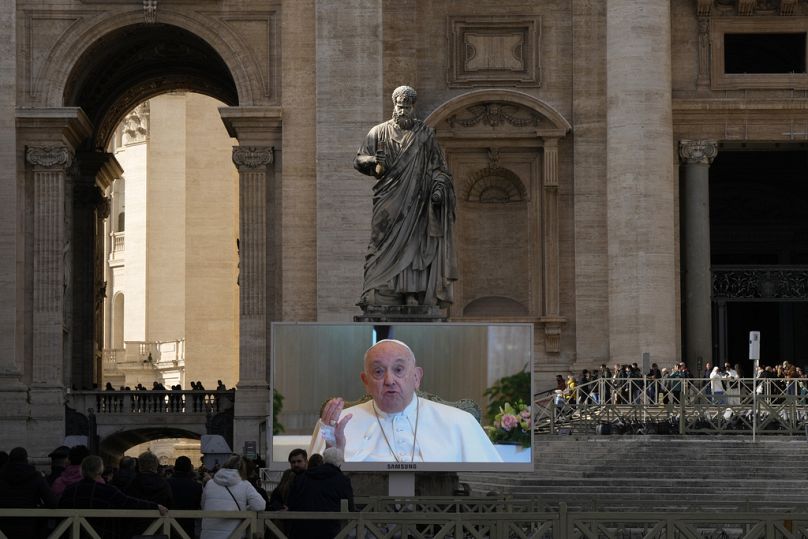

A giant screen broadcasts Pope Francis waving at the end of the Angelus noon prayer, 
from the chapel of the hotel at the Vatican grounds where he lives.AP Photo/Alessandra Tarantino

The text also lays out the scientific case for human-caused climate change, linking it to a moral perspective and warning of “serious consequences” if things don’t change. Pope Francis left no doubt that he backed the scientific consensus that global warming was down to greenhouse gases released by human activity.

This document also came just six months before COP21 - the UN climate change conference where the historic Paris Agreement was signed. Many believe it, and the Vatican’s involvement in negotiations, had a not insignificant impact on this outcome.

Delegations from Catholic countries made strong climate commitments during this COP. The Pope’s ability to speak to people across many divides paved the way for him to become even more deeply involved in future UN climate change conferences.

The Catholic Church and UN climate conferences

Ahead of COP28 in Dubai in 2023, Pope Francis revisited the topic with an updated treatise on climate change. Laudate Deum is an apostolic exhortation calling for urgent action on the crisis.

“With the passage of time,” he wrote, “I have realised that our responses have not been adequate, while the world in which we live is collapsing and may be nearing breaking point.”

This time, he specifically took aim at citizens of wealthy countries living an “irresponsible lifestyle.” In the US, for example, Pope Francis highlighted that emissions per person were two times higher than in China and seven times more than the average of the world’s poorest countries.

He also pinpointed the continued use of fossil fuels as the primary driver of climate change.

Pope Francis intended to go to COP28 himself, making history as the first Pope to address the climate change conference. Flu and lung inflammation, however, prevented him from travelling to Dubai, with his speech instead read by Vatican Secretary of State Cardinal Parolin.
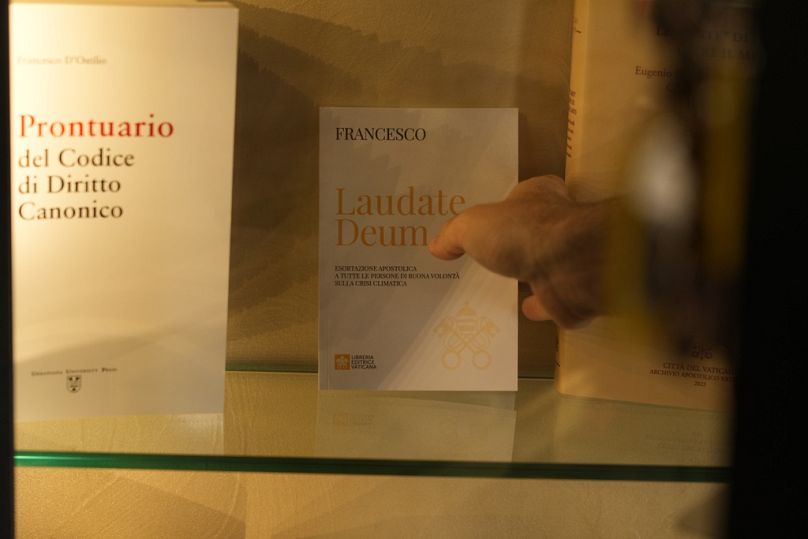

Copies of Pope Francis' encyclical letter on environment "Laudate Deum" are prepared for sale in a bookshop in Rome.AP Photo/Andrew Medichini

Again, drawing together moral obligations and scientific consensus, he criticised efforts to shift blame for the climate crisis to the rising population figures in poor countries. Instead, he singled out historic emitters “responsible for a deeply troubling ecological debt”.

Hitting on one of the main topics of COP28, he said it was only fair that these countries that have used excessive amounts of fossil fuels wipe out the debts of poorer nations. Who pays for the loss and damage done by climate change is an argument that still continues to this day.

Pope Francis was once again too unwell to travel to COP29 in Azerbaijan last year but sent a message to the UN climate conference. Vatican’s secretary of state, Cardinal Pietro Parolin, instead delivered his message to world leaders gathered in Baku.

He said that the "real challenge of our century” was indifference towards the climate crisis, emphasising that “indifference is an accomplice to injustice”.

The Pope appealed to countries which have contributed the most greenhouse gases to acknowledge their "ecological debt" to others.

He called for “a new international financial architecture” that was “based on the principles of equity, justice, and solidarity”.

The Catholic Church organises its own climate conference

Throughout his life and even up to the end, Pope Francis continued to highlight issues of inequality in the consequences of climate change.

In 2019, he backed calls for ecocide to be made the “fifth crime against peace” - an evil equivalent to genocide and ethnic cleansing - and declared it a sin. He has met with presidents, prime ministers, heads of state, CEOs, and boards of big companies over the years to talk about the issue.

And in May 2024, he organised the Catholic Church’s own three-day conference on climate resilience at the Vatican. Attendees included 16 mayors of international cities such as London Mayor Sadiq Khan and Paris Mayor Anne Hidalgo, as well as governors from around the world.

Rather than solely focusing on mitigating climate change, it drew attention to the need for human adaptation. The Pope questioned political leaders on whether “we are working for a culture of life or for a culture of death.”

“The wealthier nations, around one billion people, produce more than half of the heat-trapping pollutants,” he told participants of the summit.

“On the contrary, the three billion poorer people contribute less than 10 per cent, yet they suffer 75 per cent of the resulting damage.”

This summit once again saw Pope Francis reiterate his belief that the destruction of the environment is an “offence against God” and a “structural sin” that endangers all people.

It is statements like these that made Pope Francis a respected voice on climate change, with many praising his ability to drive collective action across divides. He will be remembered for his moral leadership that bridged the gap between the interconnected issues of poverty, climate adaptation and the consequences of human-caused global warming.

Francis: radical leader who broke the papal mould

THE FIRST JESUIT POPE!


ByAFP
April 21, 2025


Francis was the first pope from the Americas and from the southern hemisphere - Copyright AFP/File Filippo MONTEFORTE

Ella IDE

Pope Francis, who died Monday aged 88, will go down in history as a radical pontiff, a champion of underdogs who forged a more compassionate Catholic Church while stopping short of overhauling centuries-old dogma.

Dubbed “the people’s Pope”, the Argentine pontiff loved being among his flock and was popular with the faithful, though he faced bitter opposition from traditionalists within the Church.

The first pope from the Americas and the southern hemisphere, he staunchly defended the most disadvantaged, from migrants to communities battered by climate change, which he warned was a crisis caused by humankind.

But while he confronted head-on the global scandal of sex abuse by priests, survivors’ groups said concrete measures were slow in coming.

From his election in March 2013, Jorge Mario Bergoglio was eager to make his mark as the leader of the Catholic Church.

He became the first pope to take the name Francis after Saint Francis of Assisi, a 13th-century mystic who renounced his wealth and devoted his life to the poor.

“How I would like a poor church for the poor,” he said three days after his election as the 266th pope.

He was a humble figurehead who wore plain robes, eschewed the sumptuous papal palaces and made his own phone calls, some of them to widows, rape victims or prisoners.

The football-loving former archbishop of Buenos Aires was also more accessible than his predecessors, chatting with young people about issues ranging from social media to pornography — and talking openly about his health.

Francis always left the door open to retiring like his predecessor Benedict XVI, who in 2013 became the first pontiff since the Middle Ages to step down.

After Benedict died in December 2022, Francis became the first sitting pope in modern history to lead a papal funeral.

He suffered increasingly poor health, from colon surgery in 2021 and a hernia in June 2023 to bouts of bronchitis and knee pain that forced him to use a wheelchair.

His fourth hospitalisation, of more than a month for bronchitis in both lungs, was his longest, raising speculation he might step down.

But he brushed off talk of quitting, saying in February 2023 that papal resignations should not become “a normal thing”.

In a 2024 memoir, he wrote that resignation was a “distant possibility” justified only in the event of “a serious physical impediment”.


– Kissed prisoners’ feet –


Before his first Easter at the Vatican, he washed and kissed the feet of prisoners at a Rome prison.

It was the first in a series of powerful symbolic gestures that helped him achieve enthusiastic global admiration that eluded his predecessor.

For his first trip abroad, Francis chose the Italian island of Lampedusa, the point of entry for tens of thousands of migrants hoping to reach Europe, and slammed the “globalisation of indifference”.

He also condemned plans by US President Donald Trump during his first term to build a border wall against Mexico as un-Christian.

After Trump’s re-election, Francis denounced his planned migrant deportations as a “major crisis” that “will end badly”.

In 2016, with Europe’s migration crisis at a peak, Francis flew to the Greek island of Lesbos and returned to Rome with three families of asylum-seeking Syrian Muslims.

He was also committed to inter-faith reconciliation, kissing the Orthodox Patriarch Kirill of Moscow in a historic February 2016 encounter, and making a joint call for freedom of belief with leading Sunni cleric Sheikh Ahmed al-Tayeb in 2019.

Francis re-energised Vatican diplomacy in other ways, helping facilitate a historic rapprochement between the United States and Cuba, and encouraging the peace process in Colombia.

And he sought to improve ties with China through a historic — but criticised — 2018 accord on the naming of bishops.


– Climate appeal –


Experts credited Francis with having influenced the landmark 2015 Paris climate accords with his “Laudato Si” encyclical, an appeal for action on climate change that was grounded in science.

He argued that developed economies were to blame for an impending environmental catastrophe, and in a fresh appeal in 2023 warned that some of the damage was “already irreversible”.

An advocate of peace, the pontiff repeatedly denounced arms manufacturers and argued that in the myriad of conflicts seen around the globe, a Third World War was underway.

But his interventions were not always well received, and he sparked outrage from Kyiv after praising those in war-torn Ukraine who had the “courage to raise the white flag and negotiate”.

In his modest rooms in the Vatican’s Casa Santa Marta guesthouse, Francis dealt with stress by writing down his problems in letters to Saint Joseph.

“From the moment I was elected I had a very particular feeling of profound peace. And that has never left me,” he said in 2017.

He also loved classical music and tango, stopping off once at a shop in Rome to buy records.


– ‘Who am I to judge?’ –


Francis’s admirers credit him with transforming perceptions of an institution beset by scandals when he took over, helping to bring lapsed believers back into the fold.

He will be remembered as the pope who, on the subject of gay Catholics, said: “Who am I to judge?”

He allowed divorced and remarried believers to receive communion, and approved the baptism of transgender believers as well as blessings for same-sex couples.

But he dropped the idea of letting priests marry after an outcry, and despite nominating several women to leading positions inside the Vatican, he disappointed those who wanted women allowed to be ordained.

Critics accused him of tampering dangerously with tenets of Catholic teaching, and he faced strong opposition to many of his reforms.

In 2017, four conservatives cardinals made an almost unheard of public challenge to his authority, saying his changes had sown doctrinal confusion among believers.

But his Church showed no inclination to relax its ban on artificial contraception or opposition to gay marriage — and he insisted that abortion was “murder”.

Francis also pushed reforms within the Vatican, from allowing cardinals to be tried by civilian courts to overhauling the Holy See’s banking system.

He also sought to address the enormously damaging issue of sex abuse by priests by meeting victims and vowing to hold those responsible accountable.

He opened up Vatican archives to civil courts and made it compulsory to report suspicions of abuse or its cover-up to Church authorities.

But critics say his legacy will be a Church that remains reluctant to hand paedophile priests over to the police.


– ‘Raised on pasta’ –


Jorge Mario Bergoglio was born into an Italian emigrant family in Flores, a middle-class district of Buenos Aires, on December 17, 1936.

The eldest of five children, he was “born an Argentine but raised on pasta”, wrote biographer Paul Vallely.

From 13, he worked afternoons in a hosiery factory while studying to become a chemical technician in the mornings. Later he had a brief stint as a nightclub bouncer.

He was said to have liked dancing and girls, even coming close to proposing to one before, at age 17, he found a religious vocation.

Francis later recounted a period of turmoil during his Jesuit training, when he became besotted with a woman he met at a family wedding.

By then he had survived a near-fatal infection that resulted in the removal of part of a lung. His impaired breathing scuppered his hopes of becoming a missionary in Japan.

He was ordained a priest in 1969 and appointed the provincial, or leader, of the Jesuits in Argentina just four years later.

His time at the helm of the order, which spanned the country’s years of military dictatorship, was difficult.

Critics accused him of betraying two radical priests who were imprisoned and tortured by the regime.

No convincing evidence of the claim ever emerged but his leadership of the order was divisive and, in 1990, he was demoted and exiled to Argentina’s second-largest city, Cordoba.

Then, in his 50s, Bergoglio is seen by most biographers as having undergone a midlife crisis.

He emerged to embark on a new career in the mainstream of the Catholic hierarchy, reinventing himself first as the “Bishop of the Slums” in Buenos Aires and later as the pope who would break the mould.

A progressive Pope? Here are Francis' greatest reforms and controversies


REUTERS/Dylan Martinez/File Photo

April 21, 2025

Pope Francis has died on Easter Monday, aged 88, the Vatican announced. The head of the Catholic Church had recently survived being hospitalized with a serious bout of double pneumonia.

Cardinal Kevin Farrell’s announcement began:
Dearest brothers and sisters, with deep sorrow I must announce the death of our Holy Father Francis. At 7:35 this morning, the Bishop of Rome, Francis, returned to the house of the Father.

There were many unusual aspects of Pope Francis’ papacy. He was the first Jesuit pope, the first from the Americas (and the southern hemisphere), the first to choose the name “Francis” and the first to give a TED talk. He was also the first pope in more than 600 years to be elected following the resignation, rather than death, of his predecessor.

From the very start of his papacy, Francis seemed determined to do things differently and present the papacy in a new light. Even in thinking about his burial, he chose the unexpected: to be placed to rest not in the Vatican, but in the Basilica of St Mary Major in Rome – the first pope to be buried there in more than 300 years.

Vatican News reported the late Pope Francis had requested his funeral rites be simplified.

“The renewed rite,” said Archbishop Diego Ravelli, “seeks to emphasise even more that the funeral of the Roman Pontiff is that of a pastor and disciple of Christ and not of a powerful person of this world.”

Straddling a line between “progressive” and “conservative”, Francis experienced tension with both sides. In doing so, his papacy shone a spotlight on what it means to be Catholic today.The day before his death, Pope Francis made a brief appearance on Easter Sunday to bless the crowds at St Peter’s Square.

Between a rock and a hard place

Francis was deemed not progressive enough by some, yet far too progressive by others.

His apostolic exhortation (an official papal teaching on a particular issue or action) Amoris Laetitia, ignited great controversy for seemingly being (more) open to the question of whether people who have divorced and remarried may receive Eucharist.

He also disappointed progressive Catholics, many of whom hoped he would make stronger changes on issues such as the roles of women, married clergy, and the broader inclusion of LGBTQIA+ Catholics.

The reception of his exhortation Querida Amazonia was one such example. In this document, Francis did not endorse marriage for priests, despite bishops’ requests for this. He also did not allow the possibility of women being ordained as deacons to address a shortage of ordained ministers. His discerning spirit saw there was too much division and no clear consensus for change.

Francis was also openly critical of Germany’s controversial “Synodal Way” – a series of conferences with bishops and lay people – that advocated for positions contrary to Church teachings. Francis expressed concern on multiple occasions that this project was a threat to the unity of the Church.

At the same time, Francis was no stranger to controversy from the conservative side of the Church, receiving “dubia” or “theological doubts” over his teaching from some of his Cardinals. In 2023, he took the unusual step of responding to some of these doubts.
Impact on the Catholic Church

In many ways, the most striking thing about Francis was not his words or theology, but his style. He was a modest man, even foregoing the Apostolic Palace’s grand papal apartments to live in the Vatican’s simpler guest house.

He may well be remembered most for his simplicity of dress and habits, his welcoming and pastoral style and his wise spirit of discernment.

He is recognised as giving a clear witness to the life, love and joy of Jesus in the spirit of the Second Vatican Council – a point of major reform in modern Church history. This witness has translated into two major developments in Church teachings and life.


Love for our common home


The first of these relates to environmental teachings. In 2015, Francis released his ground-breaking encyclical, Laudato si’: On Care for Our Common Home. It expanded Catholic social teaching by giving a comprehensive account of how the environment reflects our God-given “common home”.

Consistent with recent popes such as Benedict XVI and John Paul II, Francis acknowledged climate change and its destructive impacts and causes. He summarised key scientific research to forcefully argue for an evidence-based approach to addressing humans’ impact on the environment.

He also made a pivotal and innovative contribution to the climate change debate by identifying the ethical and spiritual causes of environmental destruction.

Francis argued combating climate change relied on the “ecological conversion” of the human heart, so that people may recognise the God-given nature of our planet and the fundamental call to care for it. Without this conversion, pragmatic and political measures wouldn’t be able to counter the forces of consumerism, exploitation and selfishness.

Francis argued a new ethic and spirituality was needed. Specifically, he said Jesus’ way of love – for other people and all creation – is the transformative force that could bring sustainable change for the environment and cultivate fraternity among people (and especially with the poor).


Synodality: moving towards a Church that listens


Francis’s second major contribution, and one of the most significant aspects of his papacy, was his commitment to “synodality”. While there’s still confusion over what synodality actually means, and its potential for political distortion, it is above all a way of listening and discerning through openness to the guidance of the Holy Spirit.

It involves hierarchy and lay people transparently and honestly discerning together, in service of the mission of the church. Synodality is as much about the process as the goal. This makes sense as Pope Francis was a Jesuit, an order focused on spreading Catholicism through spiritual formation and discernment.

Drawing on his rich Jesuit spirituality, Francis introduced a way of conversation centred on listening to the Holy Spirit and others, while seeking to cultivate friendship and wisdom.

With the conclusion of the second session of the Synod on Synodality in October 2024, it is too soon to assess its results. However, those who have been involved in synodal processes have reported back on their transformative potential.

Archbishop of Brisbane, Mark Coleridge, explained how participating in the 2015 Synod “was an extraordinary experience [and] in some ways an awakening”.


Catholicism in the modern age

Francis’ papacy inspired both great joy and aspirations, as well as boiling anger and rejection. He laid bare the agonising fault lines within the Catholic community and struck at key issues of Catholic identity, triggering debate over what it means to be Catholic in the world today.

He leaves behind a Church that seems more divided than ever, with arguments, uncertainty and many questions rolling in his wake. But he has also provided a way for the Church to become more converted to Jesus’ way of love, through synodality and dialogue.

Francis showed us that holding labels such as “progressive” or “conservative” won’t enable the Church to live out Jesus’ mission of love – a mission he emphasised from the very beginning of his papacy.

Joel Hodge, Senior Lecturer, Faculty of Theology and Philosophy, Australian Catholic University and Antonia Pizzey, Postdoctoral Researcher Research Centre for Studies of the Second Vatican Council, Australian Catholic University

This article is republished from The Conversation under a Creative Commons license. Read the original article.


Pope Francis, born Jorge Mario Bergoglio, 1936-2025

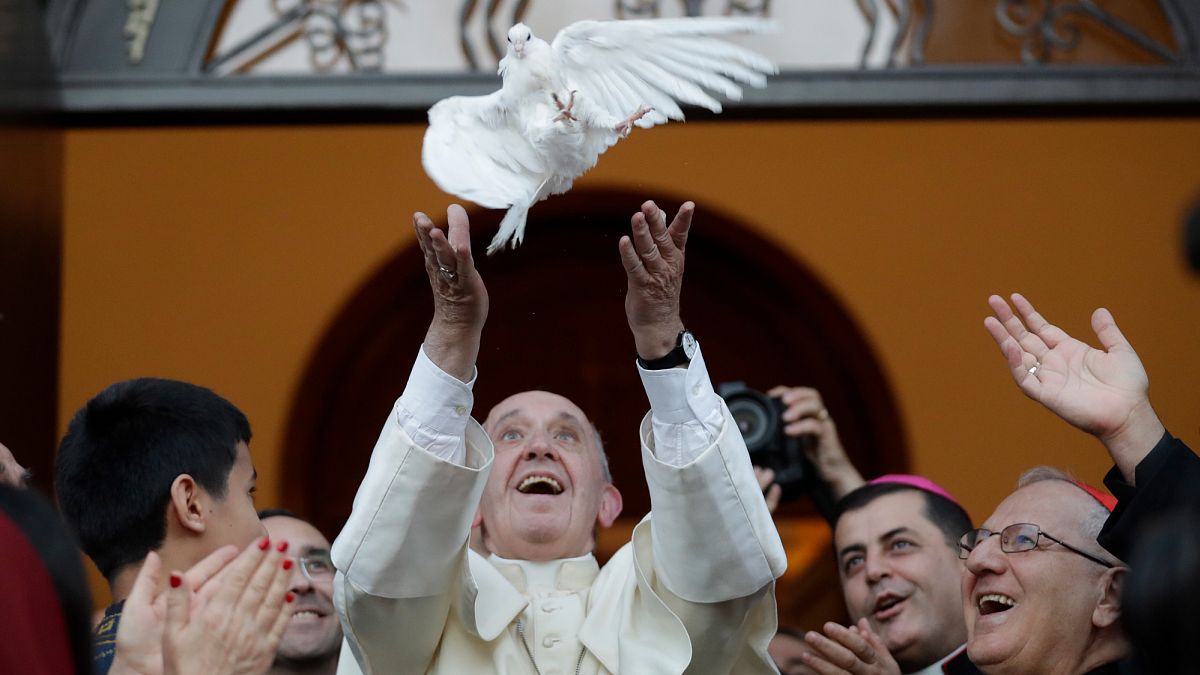
Pope Francis frees a dove after meeting with the Assyro-Chaldean community in the Chaldean catholic church of St. Simon Bar Sabbae in Tbilisi, 30 September, 2016
Copyright AP Photo
By Euronews
Published on 

"Pope Francis died on Easter Monday, April 21, 2025, at the age of 88 at his residence in the Vatican's Casa Santa Marta," the Vatican said in a statement posted on X.

The head of the Catholic Church Pope Francis has died at 88 after a short illness.

The pontiff was admitted to hospital in February with a respiratory tract infection, having suffered various ailments in his final years. Despite his declining health, he had firmly and repeatedly made clear that unlike his predecessor, he had no intention of resigning the papacy.

Born in Argentina in 1936, Jorge Mario Bergoglio took over the papacy in 2013 after Benedict XVI stood down. At the time the Jesuit Archbishop of Buenos Aires, he was the first pope from the Americas, and had already become a high-profile figure in Latin America in general, particularly thanks to his public statements during Argentina’s financial crisis in the early 2000s.

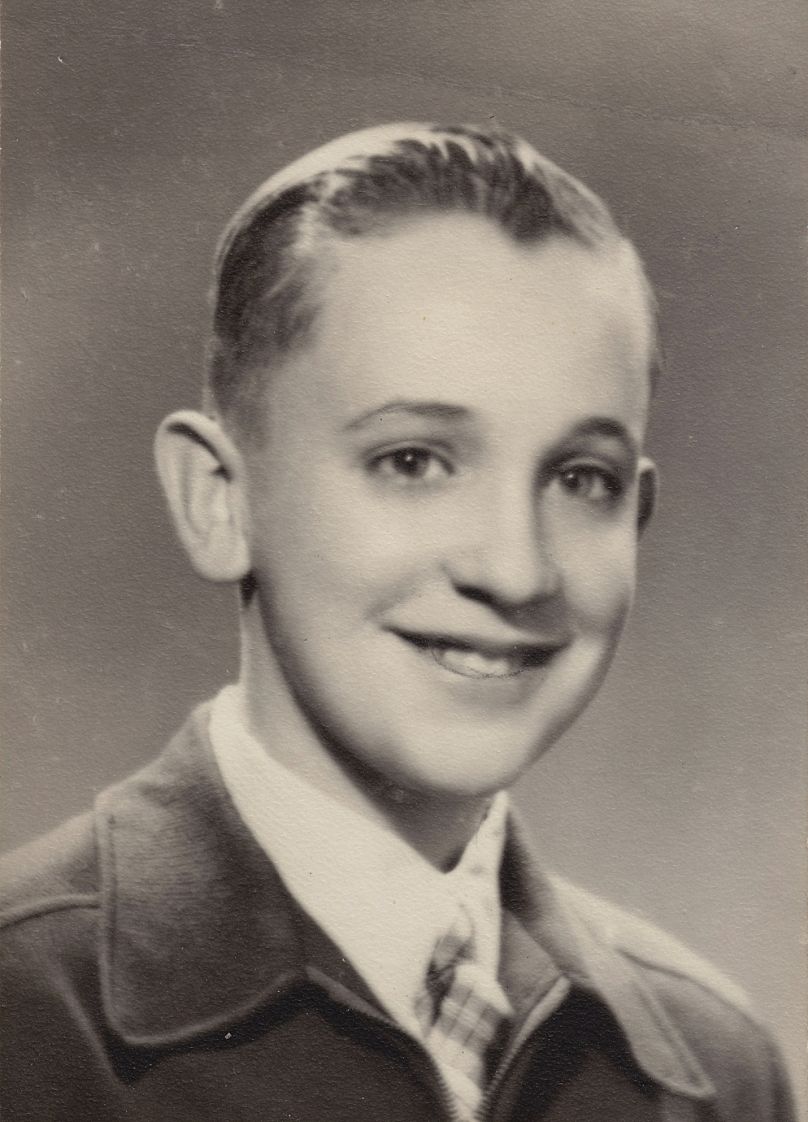
This undated file photo made available by Maria Helena Bergoglio shows Jorge Mario Bergoglio as a teenager in Buenos Aires Uncredited/AP

As Pope Francis, he projected a more austere, scaled-back image than his predecessor; one often-repeated story, never officially confirmed, claims that he refused to wear elaborate papal garb for his first public appearance, telling an aide that "the carnival is over." 

The pope frequently expressed a personal identification with the poor and was known for speaking up for refugees and people displaced by conflict. During the 2015 migration crisis, which saw a surge in dangerous and deadly crossings to Europe over the Mediterranean, Pope Francis announced that the Vatican would take in two refugee families and called on Catholics to offer their help as well.

"Before the tragedy of tens of thousands of refugees fleeing death in conflict and hunger and are on a journey of hope, the gospel calls us to be close to the smallest and to those who have been abandoned," he said.

The pontiff also called for peace in various conflicts, including Israel’s recent assault on Gaza.

"We cannot in any way accept the bombing of civilians," he wrote in an address delivered in January. "We cannot accept that children are freezing to death because hospitals have been destroyed or a country's energy network has been hit."

"My wish for the year 2025 is that the entire international community will work above all to end the conflict that, for almost three years now, has caused so much bloodshed."

While the pope's comments about conflict and humanitarian crises won him sympathy around the world, he also created occasional controversy.

In May 2024, he was forced to issue an apology after two Italian newspapers reported he had used a homophobic insult in a private meeting where he expressed opposition to allowing homosexual men to train as priests.

The incident went against Pope Francis’ image as relatively tolerant of LGBTQ+ people compared to his predecessors. In 2013, he famously opined that "If someone is gay and is searching for the Lord and has good will, then who am I to judge him" — and in 2023, he gave permission for priests to informally bless same-sex relationships.

"I don't bless a 'same-sex marriage,' I bless two people who love each other and I also ask them to pray for me," he said in an interview at the time. "Always in confession, when these situations come, homosexual people, remarried people, I always pray and bless. Blessing should not be denied to anyone."

Towards the end of his papacy, Pope Francis also had to confront persistent anger over the Church's cover-ups of child sexual abuse committed by clergy around the world. In 2014, he described the global scandal as "moral damage carried out by men of the Church" and said he felt the need to "personally ask for forgiveness" for the abuse itself and the protection of abusers by Catholic authorities.


Pope Francis holds the pastoral staff as he presides over the Sunday mass at King Baudouin Stadium in Brussels, 29 September, 2024AP Photo

A particularly sensitive moment came last year with a papal visit to Belgium, where the pope apologised for the abuse of hundreds of children by priests in Flanders and accepted that the Church should be "ashamed."

But while reforms and procedures to safeguard against abuse and hold perpetrators accountable were put in place under Pope Francis' leadership, there have still been numerous allegations of priests accused of abuse being moved to other dioceses rather than subject to formal investigation or criminal charges.

 Pope uses final speech to blast Trump policies: 'How much contempt?'

Krystina Alarcon Carroll
April 21, 2025 
RAW STORY


Pope Francis meets with U.S. Vice President JD Vance on Easter Sunday at the Vatican, April 20, 2025. Vatican Media/­Handout via REUTERS

One of Pope Francis’s last acts was to slam President Donald Trump policies.

The pope died early Monday at 88 years old.

But his final hours were spent meeting Vice President JD Vance, followed by an official Easter speech in which he said, “How much contempt is stirred up at times towards the vulnerable, the marginalized and migrants?"

According to the Daily Beast, the Pope gave Vance Easter eggs for his children in the meeting. Vance told Francis, “It’s good to see you in better health.”

But his last official speech was less friendly. Francis rejected the MAGA/Trump/Vance stance on immigrants and foreign aid.

According to Bloomberg, Vance and the Pope spoke on Trump’s “commitment to restoring world peace,” and they did not talk specifically about migrants

This is not the first time the Holy Father has questioned President Donald Trump and Vance's policies.

Earlier this year, Francis critiqued Vance, saying, “Christian love is not a concentric expansion of interests that little by little extend to other persons and groups.”

Vance responded to the critique, saying he is a “baby Catholic. ” He also admitted there are “things about the faith that I don’t know.” He converted to Catholicism in 2019.

In February, the pope shared his thoughts on the mass deportations of undocumented immigrants on the Italian talk show Che Tempo Che Fa, “If true, this will be a disgrace… This is not the way to solve things.”

During Trump’s first term, Pope Francis said building the border wall was “not Christian.” In reply, Trump called him “disgraceful” and a “very political person.” The pair met in 2017. Trump called it the “honor of a lifetime.”


After Brief Face-to-Face With Vance, Pope's Easter Address Denounces 'Contempt' for Migrants


"How much contempt is stirred up at times towards the vulnerable, the marginalized, and migrants," the pope's speech read.


Pope Francis stands on the main balcony of St. Peter's basilica at St Peter's Square in the Vatican on April 20, 2025.
(Photo: Tiziana Fabi/AFP via Getty Images)

Julia Conley
Apr 20, 2025
COMMON DREAMS


After a brief meeting with U.S. Vice President JD Vance on Sunday morning, Pope Francis' annual Easter speech included a condemnation of unnamed political leaders who use "fear" to oppress marginalized people including immigrants and refugees.


Pope Francis, who is recovering from a bout of pneumonia that kept him in a hospital for five weeks, met for a few minutes in the papal residence with the vice president, a Catholic convert who has drawn criticism from the Vatican for his claims that Catholic teachings support the Trump administration's mass deportation campaign.

The pope, who is 88, said little during the encounter, thanking Vance for his visit through a translator and overseeing a presentation of several Easter gifts to the vice president.

After the meeting, the pope was wheeled out to the Loggia of Blessings overlooking St. Peter's Square, where 35,000 congregants had just heard the Easter Mass delivered by Cardinal Angelo Comastri,the archpriest emeritus of St. Peter's Basilica, who filled in for Pope Francis due to his fragile health.

The pope gave a brief greeting to the crowd before another surrogate, Archbishop Diego Ravelli, read aloud Francis' Easter speech.

"How much contempt is stirred up at times towards the vulnerable, the marginalized, and migrants," the speech read. "I appeal to all those in positions of political responsibility in our world not to yield to the logic of fear which only leads to isolation from others, but rather to use the resources available to help the needy, to fight hunger, and to encourage initiatives that promote development. These are the 'weapons' of peace: weapons that build the future, instead of sowing seeds of death."

"May the principle of humanity never fail to be the hallmark of our daily actions," the pope's speech continued before condemning military attacks that violate international law: "In the face of the cruelty of conflicts that involve defenseless civilians and attack schools, hospitals, and humanitarian workers, we cannot allow ourselves to forget that it is not targets that are struck, but persons, each possessed of a soul and human dignity."

"I appeal to all those in positions of political responsibility in our world not to yield to the logic of fear which only leads to isolation from others, but rather to use the resources available to help the needy, to fight hunger and to encourage initiatives that promote development."

The Daily Beast reported that on Saturday, the pope did not attend the Vatican's official meeting with Vance, instead having Cardinal Pietro Parolin "deliver a lecture on compassion."

The Vatican released a statement saying that the meeting included "an exchange of opinions on the international situation, especially regarding countries affected by war, political tensions, and difficult humanitarian situations, with particular attention to migrants, refugees, and prisoners."

A statement from the vice president's office about the discussion omitted the topic of migration, saying Vance discussed "the plight of persecuted Christian communities around the world" and President Donald Trump's "commitment to restoring world peace" with the cardinal.

The pope has been open about his disapproval of Trump's anti-immigrant agenda and mass deportation operation, in which international students who have exercised their free speech rights as well as immigrants and asylum-seekers have been detained in recent weeks. The administration has accused hundreds of migrants of being gang members—with little to no evidence in many cases and without providing due process as required by the U.S. Constitution—and has sent them to El Salvador's Terrorist Confinement Center under a $6 million deal with Salvadoran President Nayib Bukele.

In February, Pope Francis wrote a letter to U.S. bishops condemning Trump's deportation operation and specifically referenced the Catholic concept of "ordo amoris"—order of love—which Vance has pointed to in defense of mass deportations.

The vice president cited the concept when he said in January, "You love your family, and then you love your neighbor, and then you love your community, and then you love your fellow citizens in your own country. And then after that, you can focus and prioritize the rest of the world."

Francis wrote in his letter to the bishops that "Christians know very well that it is only by affirming the infinite dignity of all that our own identity as persons and as communities reaches its maturity."

"Christian love is not a concentric expansion of interests that little by little extend to other persons and groups. In other words: the human person is not a mere individual, relatively expansive, with some philanthropic feelings!" he added. "The true ordo amoris that must be promoted is that which we discover by meditating constantly on the parable of the 'Good Samaritan,' that is, by meditating on the love that builds a fraternity open to all, without exception."


Pope Francis Dies at 88 After Final Appeal for Gaza Cease-Fire

"Will the millions who will mourn his death these coming days respect this wish of his? Will they care for Gazans and Palestinians the way he did?"


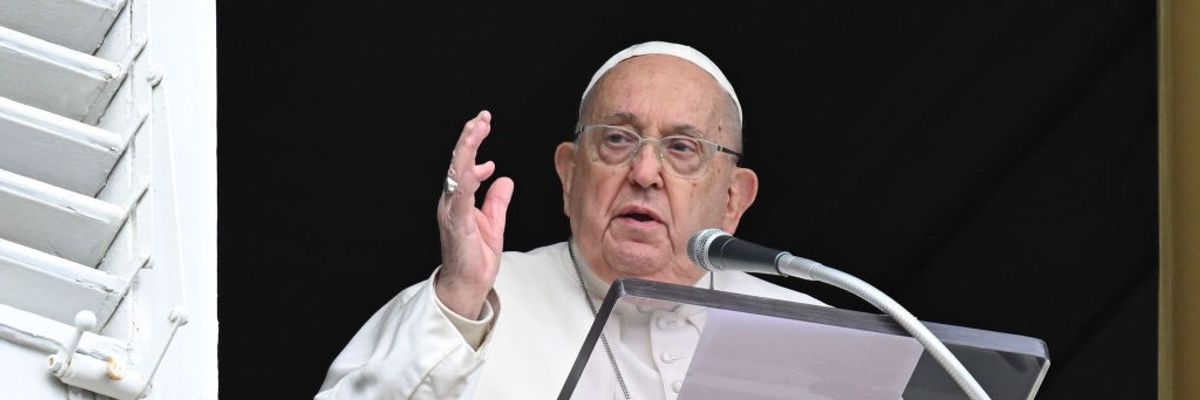
Pope Francis delivered a Sunday Angelus blessing from the window of his studio overlooking St. Peter's Square on January 12, 2025 in Vatican City.
(Photo: Vatican Media via Vatican Pool/Getty Images)

Common Dreams Staff
Apr 21, 2025

The Vatican announced Monday that Pope Francis has died at the age of 88, hours after he appeared at an Easter mass and appealed for an end to Israel's war on the Gaza Strip.

The pope's Easter address, read aloud by Archbishop Diego Ravelli, decried the "terrible conflict" in Gaza that "continues to cause death and destruction and to create a dramatic and deplorable humanitarian situation."

"I appeal to the warring parties: call a cease-fire, release the hostages, and come to the aid of a starving people that aspires to a future of peace!" said the message from the pope, an outspoken opponent of military conflict and war profiteers, climate destruction, and runaway economic inequality.

"In the face of the cruelty of conflicts that involve defenceless civilians and attack schools, hospitals, and humanitarian workers, we cannot allow ourselves to forget that it is not targets that are struck, but persons, each possessed of a soul and human dignity," the pope's address continued.

News of Pope Francis' death came after a bout with double pneumonia left him hospitalized for more than a month. The Vatican did not specify a cause of death in its announcement.

The Nation's John Nichols wrote Sunday that Pope Francis' calls for peace have made him "arguably the most consistent high-profile defender of the humanity of the Palestinian people during a period when the Israeli assault on Gaza has been pursued with relentless violence."

Nichols continued:
With a boldness and specificity that has often sparked controversy, this pope has challenged economic injustice, racism, environmental neglect, militarism, and the abuses of new technologies that increase inequality. He has faced his share of criticism, not just from conservatives who disapprove of his views but also from reformers who sincerely wish that he would do more to modernize the church. Yet, in a time of too much indifference and impunity, this pope has remained uniquely engaged with the embattled regions that political and media elites neglect or abandon.

That's been especially true when it comes to Gaza, where Pope Francis has long argued for cease-fires, arms blockades, aid convoys, and a diplomatic urgency that recognizes that Palestinians and Israelis are "fraternal peoples [who] have the right to live in peace."

In a tribute to Pope Francis, Palestinian theologian Munther Isaac wrote Monday that "he conveyed true compassion to Palestinians, most notably to those in Gaza during this genocide."


"The pope left our world today, and the occupation and the wall remained. Even worse, he left our world while a genocide continues to unfold," Isaac wrote, pointing to the pontiff's call for a thorough international investigation of Israel's assault on Gaza.

"Today I wonder: Will the millions who will mourn his death these coming days respect this wish of his?" Isaac asked. "Will they care for Gazans and Palestinians the way he did?"
Salvadoran Catholic leader urges Bukele not to turn country into US prison

Agence France-Presse
April 20, 2025 


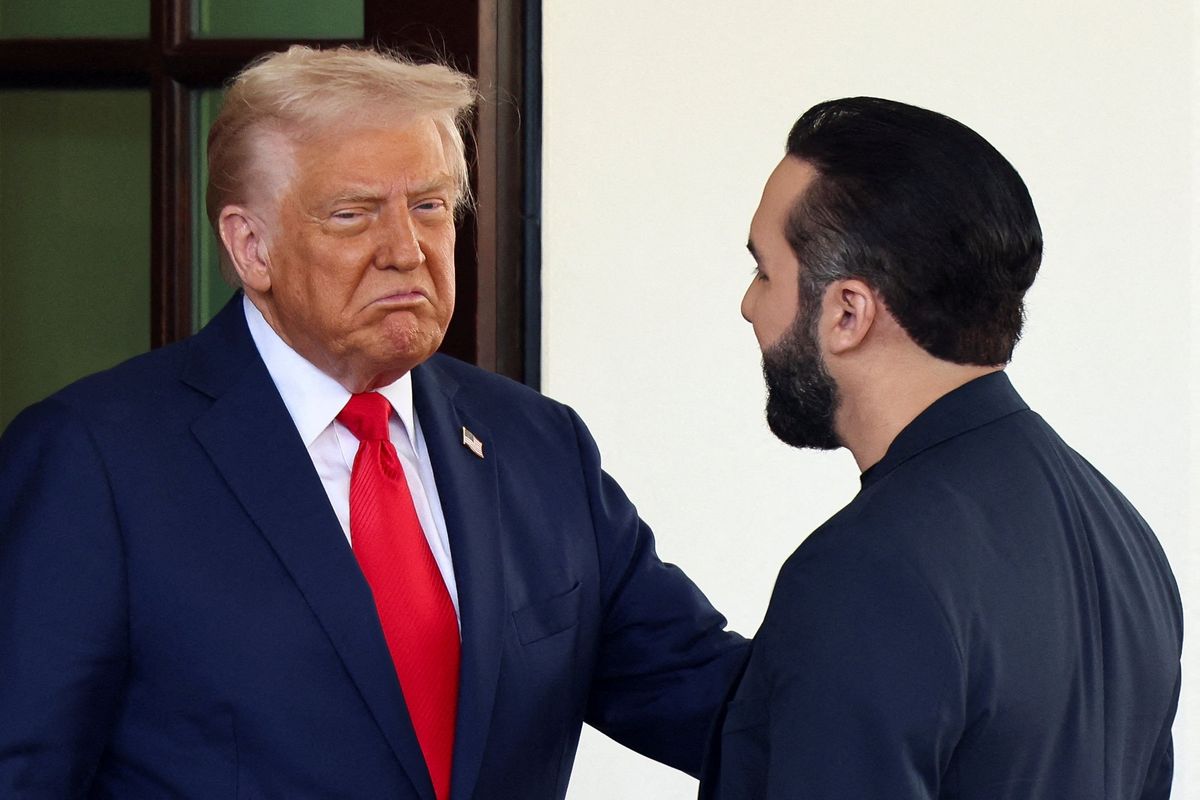
U.S. President Donald Trump welcomes El Salvador's President Nayib Bukele at the White House in Washington, D.C., U.S., April 14, 2025. REUTERS/Evelyn Hockstein TPX IMAGES OF THE DAY

El Salvador's top Catholic leader on Sunday urged President Nayib Bukele not to turn the country into a Guantanamo-style US prison, after Bukele made a deal with Washington to house deported migrants from the United States in a notorious jail.

"We ask that our authorities not allow our country to become a big international prison," Jose Luis Escobar, the archbishop of San Salvador, told reporters.

Bukele's visit Monday to the White House confirmed his growing alliance with like-minded US President Donald Trump.

The Salvadoran leader has agreed to imprison hundreds of migrants, many of them Venezuelans, expelled by the United States. They are being held in an enormous mega-prison where rights groups have decried conditions as inhumane.

Trump has invoked the little-known Alien Enemies Act of 1798, previously used only in times of war, as he moves to expel migrants who he says are mostly violent criminals.

Families and lawyers of many of those expelled under the crackdown dispute that characterization, with some saying their family members were targeted largely on the basis of their tattoos.

Escobar mentioned recent opinion articles warning that "El Salvador could become a new Guantanamo" -- the sprawling Cuban territory leased by the United States to serve as a naval base.

In recent decades it has seen use by Washington as a prison for detainees accused of terrorism but held without trial and for expelled migrants.

Bukele has said he is eager to help with Trump's effort to drastically reduce the number of undocumented migrants in the United States.

But Escobar warned that El Salvador "could become a prison where the United States could send prisoners at a lower cost than what they spend in Guantanamo."

"We ask the government not to allow it," he added.

Several of those expelled to El Salvador were first jailed in Guantanamo.


bur-nl/val/ial/thm/bbk/aha

© Agence France-Presse