Saturday, May 10, 2025

Pembina Pipeline sees demand for potential expansion to Cedar LNG project


By The Canadian Press
Published: May 09, 2025 

The corporate logo of Pembina Pipeline Corp. is shown. THE CANADIAN PRESS/HO

The chief executive of Pembina Pipeline Corp. says he believes there will be enough demand to support an expansion to the Cedar LNG project on the B.C. coast as it looks to sign on more shippers for the first phase now in early construction.


Pembina has shortlisted the preferred counterparties, and has begun negotiating definitive agreements, Scott Burrows told analysts on a conference call Friday to discuss his company’s first-quarter results.

“They’re big, complicated agreements. We’ll do the right deal for Pembina, not the fastest deal for Pembina,” he said.

The US$4-billion floating liquefied natural gas export terminal in Kitimat, B.C., is a partnership between Pembina and the Haisla Nation. The first phase of the project was given the green light almost a year ago and is on track to come into service in late 2028. The cargoes of LNG — gas that has been chilled into a liquid state so it can be transported overseas on specialized tankers — will be bound for high-demand Asian markets.

ARC Resources Ltd. is to supply gas for about half of the plant’s capacity from the Montney shale in northeastern B.C. and northwestern Alberta.

Pembina has been looking to contract out its 1.5-millon-tonne-per-year share of capacity, and Burrows said talks are going well.

Based on conversations around bringing more producers into the first phase, Burrows said it appears a second phase would be welcome.

“Certainly the gas demand is there,” he said. “Based on early-stage negotiations on Cedar capacity, we believe there is demand for a Cedar 2.”

A question mark, however, would be whether there would be enough pipeline capacity to get the gas from inland to the coast, he added.

There are two other B.C. LNG projects in the works. Also in Kitimat, LNG Canada, a partnership between Shell and four Asian partners, is slated to start delivering shipments in the next few months. Meanwhile, Woodfibre LNG, owned by Pacific Energy Corp. and Enbridge Inc., is being built near Squamish, B.C., and is on track to be complete in 2027.

Also Friday, Pembina said it is not seeing a significant near-term financial impact related to Dow Inc.’s delay of a net-zero petrochemical project northeast of Edmonton.

Dow said last month it is still committed to the nearly $9-billion Path2Zero project in Fort Saskatchewan, Alta., but that it has decided to push back the timeline due to weak market conditions.

Pembina was to supply and transport ethane to the project.

“To date, Pembina has not spent material capital to support the ethane supply agreement and will continue to progress these projects, but may now have more time available to execute them,” Burrows said.

On Thursday, Pembina reported earnings of $502 million for the three months ended March 31, up from $438 million during the same period of 2024.

That amounted to 80 cents per diluted share versus 73 cents a year earlier.

Revenue was $2.28 billion, an increase from $1.54 billion.

The Calgary-based company says it doesn’t expect any impact from U.S. tariffs on energy imports this year given much of its business is under contract.

It says it has also not seen any significant decline in activity from producers in Western Canada who use Pembina’s system to get their oil and gas to market.

This report by The Canadian Press was first published May 9, 2025.

Companies in this story: (TSX: PPL)

Lauren Krugel, The Canadian Press


Kitimat is a district municipality in the North Coast region of British Columbia, Canada. It is a member municipality of the Regional District of Kitimat–Stikine regional government. The Kitimat Valley is part of the most populous urban district in northwest British Columbia, which includes Terrace to the north along the Skeena River Valley. The city was planned and built by the Aluminum Company of Canada (Alcan) during the 1950s. Its post office was approved on 6 June 1952.[4]

Kitimat's municipal area is 242.63 km2 (93.68 sq mi). It is located on tidewater in one of the few wide, flat valleys on the coast of British Columbia. The 2016 census recorded 8,131 citizens.[5]

The District of Kitimat Development Services situates the port of Kitimat as an integral part of the Northwest Corridor connecting North America to the Pacific Ocean and the Pacific Rim.[6]

History

[edit]

"Kitimat" in the Tsimshian language refers to the Haisla First Nation as the "People of the Snow". Before 1950 the Kitimat township was a small fishing village at the head of the Kitimat Arm of the Douglas Channel, a deepwater fjord.[7]

The municipal town of Kitimat came into existence in 1951 after the Provincial Government of British Columbia invited Alcan to develop hydroelectric facilities to support one of the most power-intensive of all industries—the aluminum smelting industry.[8] The company built a dam, 16 km (10 mi) tunnel, powerhouse, 82 km (51 mi) transmission line, a deep-sea terminal and smelter. The company also designed, laid out and assisted with the initial construction of the city. At the time, the combined development was considered "the most expensive project ever attempted by private industry."[7]

Alcan employed the services of city planner Clarence Stein in order to ensure the community design facilitated an environment that would attract and retain workers, although Alcan intended it to not be a company town.[9] Today, Kitimat benefits from the quality of planning resulting from the Garden City design concept. Stein's design kept industry well separated from the community with large areas for expansion. He also created looped streets surrounding an urban city centre mall and linked by over 45 km (28 mi) of walkways connecting to all areas of the community.

The substantial greenspace areas and future expansion concepts designed by Stein have been upheld to this day by the city planners, thereby resulting in a low-density settlement pattern interspersed with forested patches. Also, the Alcan-based city origin and land provenance remain documented in the form of restrictive covenants registered on title.[10]

Economy

[edit]

Aluminum producer Rio Tinto is the main employer in the municipality. Local government, schools, small manufacturing and service/retail are secondary contributors. Secondary core activities include engineering, import of petrochemical products (methanol and condensate), and metal fabrication. Approximately $5 billion in manufacturing investment is anticipated in the 2010–2015 period with a further $5 billion-plus in the investigative stage over the next decade.[citation needed] Anticipated investment includes an approximately $2 billion modernization to the Rio Tinto Alcan facilities and $3 billion in the Kitimat liquefied natural gas export development on Haisla Industrial Land at Bish Creek. The export facility would see natural gas piped in from the Western Canadian Sedimentary Basin (particularly from shale gas developments such as the Montney and Horn River) and shipped to Asian markets.[11] The LNG Canada project, a joint venture between Shell and affiliates of PetronasMitsubishi CorporationKorea Gas Corporation and PetroChina would, if permitted, begin construction in 2015 of a gas pipeline from northeastern BC and a LNG export terminal with an expected lifespan of 30 years. The terminal, located on the Douglas Channel near the aluminum refinery, would be able to accommodate two LNG vessels at a time. Annual volume would be 24 million tonnes.[12] In July 2014 the Financial Post reported that Apache Corp. will "completely exit" the Kitimat LNG mega-project planned for B.C.'s West Coast. The U.S. hedge fund Jana Partners LLC has pressured Houston-based Apache to sell its 50% stake in the BC shale gas plays.[13]

Pending energy projects that have identified Kitimat as a strategic gateway include Pacific Northern Gas' Pacific Trail Pipeline (federal and provincial environmental assessments issued) and the Enbridge Northern Gateway Pipelines (currently being reviewed by the National Energy Board).

Additional investigations into clean energy developments include a Kitimat port development project featuring break-bulk port facilities and consideration of the best uses for the former Eurocan Wharf.[citation needed] In addition, the decommissioning of the former Eurocan pulp and paper facilities or a slimmed down operation are still under consideration. There is also renewed interest in mineral development potential in the Kitimat area. The neighbouring community of Terrace is also in advanced stages of approval for a number of clean energy projects along with the associated infrastructure for linking those projects to the provincial electrical grid.

Air services for the community are provided through Northwest Regional Airport, with connections to Prince GeorgeSmithers, and Vancouver.

Kemano hydroelectric project

[edit]

In the 1920s, the provincial government of British Columbia extensively evaluated the province's hydroelectric generating potential. In the late 1940s, the Canadian Government sought to tap the untapped resources of northwest British Columbia. All this led to the identification of the Eutsuk/Ootsa/Nechako River drainage basin as a potential site for a sizable reservoir. The potential of this vast system of rivers and lakes prompted British Columbia to invite Alcan to conduct a detailed investigation of the area. Alcan was searching for a site for a large aluminum smelter, an activity requiring vast amounts of electricity. Alcan concluded that the area was more than adequate to generate the required electricity, and decided to build a smelter there. The timing was right because the post-World War II boom saw a rising demand for aluminum.

Between 1951 and 1954, after signing the agreement with the British Columbia government for land and water rights, Alcan undertook the Kitimat–Kemano Project, one of the most ambitious Canadian engineering projects of the 20th century.[7] The project required not only building the Kenney Dam to reverse the Nechako River, but also boring a 16 km (10 mi) tunnel under Mt. Dubose, within the Coast Range, to the large hydroelectric Kemano Generating Station built under Mt. Dubose. Electricity from Kemano is transported 80 km (50 mi) across mountains via a custom built twin circuit transmission line. After avalanches tore away transmission towers, a catenary system was built.[14]

In three years, 6,000 construction workers built the dam, tunnel, powerhouse, transmission line, smelter, and town.[15]

The town of Kitimat was carved out of old-growth forest. The company invested over CA$500 million (equivalent to CA$3.3 billion) and employed over 35,000 workers over the five years required to build the Kenney Dam, the hydropower plant under Mt. Dubose at Kemano, a 250,000 tpy aluminum smelter, a year-round deepwater port, a townsite designed for a population of 50,000, and a paved highway to the outside world. As a result of this project other companies saw the potential of the area, resulting in further industrial development in the Kitimat valley.

LNG Canada terminal project

[edit]

On 1 October 2018, Royal Dutch Shell and its Asia partners gave formal approval to an estimated $40 billion investment into the construction of a new liquified natural gas port terminal project named LNG Canada, coupled with the construction by a subsidiary of TransCanada of a gas pipeline, known as the Coastal GasLink Pipeline, linking this terminal to the Montney, British Columbia, natural gas field.[16][17]

When completed, LNG Canada will become the first Canadian LNG export ocean terminal, which will compete with other LNG terminals in the US, either existing or planned on the West (AlaskaWashingtonOregon), Gulf (LouisianaTexas) and Atlantic coasts (MarylandVirginia).

In October 2023, pipeline installation on the project was 100% complete.[18]

This new terminal being built in the port of Kitimat will be connected to the Pacific Ocean via the existing Douglas Channel. This development will add new sensitive ship traffic when the LNG Canada natural gas storage and liquefaction terminal will be completed and operational, which is estimated to be in 2025. The LNG Canada terminal project will see large LNG carrier ships loading liquefied natural gas at the future Kitimat LNG terminal, and sailing along the Douglas Channel to carry it to export destinations, mainly in Asia.

Pacific Future pipeline and refinery

[edit]

The Pacific Future Energy Refinery was projected to refine more than 30,000 m3 per day of nearly solid bitumen of the Western Canadian Select variety for at least 60 years.[19] Grupo Salinas were the owners, and "European technology" was touted as the solution to environmental ills.[20] The construction of the plant was budgeted at $11 billion and included carbon capture and storage (CCS) technology.[21] Capacity would be increased in 200,000 bpd stages that would cost $6 billion. Simeco, a Milan engineering and construction firm would provide the design. Modules would be built in Asia and transported to Prince Rupert for assembly. The project headquarters was in Vancouver. When the project was announced in June 2014 the funds has yet to be assembled, and a preliminary venture round for design work was budgeted at $250 million.[20] Stockwell Day was hired by the proponents, as well as Shawn Atleo and Ovide Mercredi.[17] The Northern Gateway pipeline, originally proposed by Enbridge, would have supplied the resource.[21][17]

Opponents of the project included SkeenaWild Conservation Trust, and Haida people First Nations, as well as the KitselasMetlakatla and Gitga'at tribes of Tsimshian people.[17]

The CEO of Pacific Future, Samer Salameh, notified the Impact Assessment Agency of Canada (IAAC) in December 2024 of the project's failure,[21][22] and on 11 February 2025 Minister Steven Guilbeault wrote that the sponsors confirmed that they had discontinued the project, and that "This letter provides [Pacific Future] with notification that I have terminated the environmental assessment for the project."[21][19]

Geography

[edit]

Kitimat is located 63 km (39 mi) south of Terrace and Thornhill on Highway 37. Prince Rupert is 207 km (129 mi) northwest, and Prince George is 629 km (391 mi) to the east.

Climate

[edit]

Kitimat has a warm-summer humid continental (Köppen climate classification Dfb) with mild summers and cold, snowy winters (much warmer than inland) with significant snowfall averaging 128 inches (325 cm) each year. The rainiest season is fall, with the wettest month, October, having 320 mm of rainfall. There is also a significant drying trend (Mediterranean pattern) in summer, but it is too cold and rainy to classify as such. Cloud cover is significant, especially in winter, and less than 30% of possible sunshine occurs each year.

WIKIPEDIA

Jobless rate rises as tariffs take ‘bite’ out of Canada’s labour market in April


By The Canadian Press
Updated: May 09, 2025


OTTAWA — Canada’s labour market was showing cracks in April as the early impacts of the tariff dispute with the United States started to appear in economic data.

Economists expect that weakness could persist through the summer in an uncertain trade war and some argue it could push the Bank of Canada off the sidelines and toward an interest rate cut in June.

The national unemployment rate ticked up to two tenths of a point to 6.9 per cent in April, Statistics Canada said Friday, returning to a recent high seen in November.

“This is the first major data reading for April, and it shows that tariffs are already taking a material bite out of the economy,” BMO chief economist Doug Porter said in a note to clients Friday.

Canada’s manufacturing industry led job losses in April, shedding 31,000 positions, with the bulk of the impact in Ontario. The wholesale and retail trade sector also lost some 27,000 jobs.


The hit came after the United States imposed tariffs starting in March on non-CUSMA compliant imports from Canada as well as sector-specific levies on steel and aluminum and automobiles.

Manufacturing-heavy Windsor, Ont., saw its unemployment rate jump 1.4 percentage points to 10.7 per cent last month, StatCan noted.

Nathan Janzen, assistant chief economist at RBC, said in an interview that while local employment data can be “volatile,” weakness is to be expected in communities that are weighted toward trade-sensitive sectors like auto manufacturing.

StatCan said the April figures showed the first significant decline in manufacturing jobs since November, though employment levels for the industry remain steady year-over-year.

While the economy did add 7,400 net new jobs in April, the rising unemployment rate suggests employers were not hiring as quickly as Canada’s population was growing.


StatCan noted that’s a reversal of earlier this year, when strong employment gains coincided with slowing population growth.

Offsetting the declines last month was a gain of 37,000 jobs in the public administration sector, which the agency said was largely temporary work tied to the federal election in April.

Janzen said the election hiring “flattered” the headline jobs number, and that without the temporary surge, employment likely would have outright declined nationally in April.

Derek Holt, vice-president and head of capital market economics at Scotiabank, said in a note that the details of the jobs data like the election hiring bump are “messy” and make the report difficult to trust.

He said the jump in full-time positions likely reflects retirees taking on some temporary work during the election — effects that will reverse come May.

StatCan said average hourly wages rose 3.4 per cent in April, down slightly from 3.6 per cent in March.

There were some positive surprises as well, Janzen said, such as an increase in total hours worked.

While RBC forecasts unemployment will continue to rise in the coming months — projected to peak at 7.1 per cent sometime this summer — Janzen said there are likely strong enough fundamentals to avoid a complete labour market crash.

“We do expect the unemployment rate to drift higher into the summer, but at the same time, we don’t really expect the bottom to fall out of the labour market,” he said.

“That’s still also highly contingent on not seeing further escalation in U.S. tariff policy.”

Despite economic uncertainty tied to the U.S. trade dispute, most workers were telling Statistics Canada they felt secure in their jobs.

Some 73.9 per cent of workers aged 15-69 disagreed when asked if they thought they’d lose their job in the next six months, though the proportion of those who felt otherwise was highest in industries reliant on exports to the United States.

The April job figures mark the last reading the Bank of Canada will get on the health of the labour market before its next interest rate decision set for June 4.

The central bank held its benchmark rate steady at 2.75 per cent at its decision last month, breaking a streak of seven consecutive cuts as it waited for more clarity on how Canada’s trade dispute with the United States would unfold.

Ali Jaffery, senior economist at CIBC, said in a note that the latest jobs report supports the case for a return to cuts in June.

“Overall, we are seeing a job market that was weak heading into the trade war, now looking like it could soon buckle,” Jaffery said.

Porter echoed that call, arguing the odds are now higher for a quarter-point cut in June.

Financial markets as of early Friday afternoon were pricing in odds of a 25-basis-point cut from the central bank in June at roughly 64 per cent, according to LSEG Data & Analytics.

Holt said he doesn’t believe the April jobs report will change the math for the Bank of Canada — in part because of the “messy” data, and in part because significant uncertainty still remains on the trade and fiscal fronts.

Janzen said signs of weakness in the labour market on their own aren’t enough to warrant a lower policy rate from the Bank of Canada right now.

He said the central bank has signalled that it can’t address weakness tied to the trade war on its own, and that there’s a larger role for fiscal policy to play in stimulus than monetary policy.

That said, Janzen also expects a quarter-point cut in June as a weaker labour market sets conditions for lower inflation in the months ahead.

“It lowers the bar to potentially cutting rates a bit further.”

By Craig Lord

This report by The Canadian Press was first published May 9, 2025.
Stakes in WestJet sold to other airlines, including Delta

By The Canadian Press
Updated: May 09, 2025 

WestJet passenger jets parked at departure gates at the Calgary International Airport on Wednesday, May 31, 2023. THE CANADIAN PRESS/Jeff McIntosh

Onex Corp. has sold a minority stake in WestJet to Delta Air Lines and Korean Air in a US$550-million deal that aims to position the Calgary-based airline for growth abroad amid intensifying domestic competition and plummeting demand for flights to the U.S.

Under the deals announced Friday, Delta will acquire a 15 per cent stake in WestJet for US$330 million, while Korean Air will buy a 10 per cent stake for US$220 million.

After the agreement closes, Delta plans to sell a 2.3 per cent stake in WestJet to its joint venture partner Air France-KLM for US$50 million.

Onex, a Toronto-based private equity firm chaired by Gerry Schwartz, made a long-coveted leap into aviation in 2019 by signing a friendly deal to buy WestJet in an all-cash transaction of $3.5 billion, or about $5 billion including debt.


WestJet already counts itself a code-share partner with Delta, Korean and Air France -- three of the world’s largest carriers. But it is not plugged into any airline alliance, including the 18-member SkyTeam alliance which includes its new shareholders.

In a code-share agreement, both airlines can sell -- under their own code -- flights operated by their partner, enabling travellers to combine flight segments on a single ticket and check their bags just once.


Partnership in an airline alliance taps into a much broader network of global carriers.

“This does point towards WestJet eventually going down the road of full SkyTeam membership,” said Robert Kokonis, president of consulting firm AirTrav Inc.

“If WestJet were to become a SkyTeam member bringing WestJet rewards into the global ecosystem of other SkyTeam loyalty programs, that would be a massive change in the Canadian business and leisure travel landscape.”

Air Canada is a member of the Star Alliance network.

“This is a very, very smart and shrewd tactical play by WestJet and Onex,” Kokonis said.

Announced Friday, the sale values WestJet at $3.1 billion and allows Onex to recoup the balance of its equity investment in the carrier while retaining a 75 per cent stake, according to CIBC Capital Markets analyst Nik Priebe.

That recouping owes partly to the fact Onex has reaped about US$510 million in dividends from the company since the acquisition, according to figures from Onex’s fourth-quarter financial filings.

Onex bought WestJet in December 2019, three months before the COVID-19 pandemic upended the global aviation industry. Passenger volumes in many regions still haven’t recovered.

Unlike competitors such as Air Canada, WestJet opted not to take a federal aid package during the pandemic. It proceeded to buy Sunwing’s main airline and vacation divisions in May 2023 in a major consolidation of the Canadian aviation market. And last year, it scooped up all nine Boeing 737 jets that had been operated by defunct discount carrier Lynx Air.

However, U.S. President Donald Trump’s tariffs and annexation threats have prompted many Canadians to spurn travel south of the border. WestJet has cut U.S. flight capacity in response, suspending nine cross-border routes this summer. It has rerouted some planes for flights within Canada, but competition is heating up due to greater supply as rival airlines take similar steps.

Delta and Korean Air will occupy two seats on WestJet’s 13-member board. Before it goes through, the deal needs U.S. regulatory approval.

Under federal law, no single foreign entity can control more than 25 per cent of a Canadian airline, whose ownership must also be at least 51 per cent Canadian.

Tawfiq Popatia, co-head of Onex Partners, said in a statement the company was “delighted to welcome” its three new investors.

“Delta, Korean and Air France-KLM are among the world’s most prominent and best-managed airlines,” he said.

WestJet has partnered with Delta since 2011, and with Korean Air since 2012.

“Investing in a world-class partner like WestJet aligns our interests and ensures that we remain focused on providing a world-class global network and customer experience for travellers in the United States and Canada,” Delta CEO Ed Bastian said.

Air Canada’s chief executive said Friday that “we don’t expect anything” to change as a result of the deal.

“We all know Delta has a strategy of putting minority interest in airlines around the world,” Michael Rousseau said.

This report by The Canadian Press was first published May 9, 2025.

Companies in this story: (TSX:ONEX)

Canada could soon have G7’s first small modular nuclear reactors. Here’s what that means

Published: May 09, 2025 

An artist rendering of the first small modular reactor (SMR) being built in Ontario. (Source: Ontario Power Generation)

For the last 15 years, there’s been a lot of talk about the possibilities of small modular reactors – mini nuclear plants that could be factory built and power an industrial site or a small city. Now, Ontario is pressing ahead with a plan to build four of them – the first in the western world.

“A lot of governments are watching to see how this goes,” said Brendan Frank with the group Clean Prosperity, a non-profit.

Significantly smaller in size and power output compared to a traditional nuclear plant, small modular reactors (SMRs) are based on the same science. Fission is used to generate heat, which is then used to make electricity.

“SMRs are basically shrunken down technology, about a third or quarter in size, but have many of the same principals,” said Frank.

Ontario is giving the green light for Ontario Power Generation to spend $7.7 billion to build the first of the reactors and common systems for all four next to the Darlington power plant east of Toronto.


The modular plant, called the BWRX 300, was designed by American based G.E. Hitachi Nuclear Energy and will be able to provide 300 megawatts of electricity, which is enough to power 300,000 homes.
Saskatchewan next?

It’s hoped the finished plant will show both the feasibility and benefits of SMRs and encourage broader adoption. Their compact size and modular design means they could be suitable for remote locations.

“The Saskatchewan government is considering the same reactor model,” said Frank.

“They’re basically hinging their decision on whether to build their first nuclear reactor based on whether or not things go well in Ontario.”

Construction site where four SMRs will be built generating enough electricity to power 1.2 million homes. (Source: Ontario Power Generation)

Alberta, New Brunswick?


Alberta and New Brunswick are also considering SMRs, and Ontario has been helping to try and export the technology to countries like Poland and Estonia.

Frank says there’s a global commitment to triple existing nuclear capacity by 2050.“Canada can be a huge contributor to global efforts to build out that capacity while generating jobs and growth here at home.”

More than 80 Ontario companies will be involved in the construction. The plant is expected to be online by 2030. All four will cost nearly $21 billion and are scheduled to run by 2035.

Ontario’s government says the plants will help meet energy demands in the future which are expected to rise by 75 per cent by 2050. The province’s minister of energy and mines Stephen Lecce says construction will employ 18,000 people and adds the plants should last 65 years.

“This is a bold decision we’re making,” said Lecce.

Tech is vulnerable to U.S. whims: critic

But the project isn’t without its critics. Jack Gibbons is with the Ontario Clean Air Alliance. He says an analysis by his group shows solar and wind power would be much cheaper.

He also believes going with the reactor design by U.S.-based GE Hitachi is not good for national security.

“These new American reactors will require us to import enriched uranium from the United States,” said Gibbons. “That enriched uranium could be cut off by President Trump at any moment.”


John Vennavally-Rao

Senior Correspondent, 
CTV National News


OPG gets go-ahead to build first SMR in Canada


Thursday, 8 May 2025

The Province of Ontario has approved Ontario Power Generation to start construction of the first of four small modular reactors planned at the Darlington New Nuclear Project site.

OPG gets go-ahead to build first SMR in Canada
The Darlington New Nuclear Project site (the existing Darlington nuclear power plant can be seen in the background) (Image: OPG)

It will be the first new nuclear build in Ontario in more than three decades and Ontario Power Generation (OPG) said it was set to be the first commercial grid-scale small modular reactor (SMR) in North America, with an in-service target date of 2030.

The GE Hitachi BWRX-300 SMR will be able to generate 300 MW, enough to power about 300,000 homes.

Nicolle Butcher, OPG’s President and CEO, said: "This is truly a historic moment. This made-in-Ontario project will support provincial companies, create jobs for Ontarians, and spur growth for our economy. OPG is proud to be leading this first-of-a-kind project. With the province’s robust nuclear supply chain and our successful track record on nuclear projects, particularly our Darlington Refurbishment, we are confident we will be able to deliver the first SMR unit for Ontario, on-time and on-budget."

The support from the provincial government for OPG's CAD20.9 billion (USD15 billion) budget for the Darlington New Nuclear Project came after OPG received a Licence to Construct in April from the Canadian Nuclear Safety Commission.

Ontario's Ministry of Energy and Mines said its approval of OPG's plan would create up to 18,000 Canadian jobs and inject CAD500 million annually into the Ontario economy, with the construction, operation and maintenance of the four units set to add CAD38.5 billion to the country's GDP over 65 years. It said the provincial government and OPG have worked together to ensure that 80% of project spending goes to companies in Ontario.

Stephen Lecce, Minister of Energy and Mines, said; "This is a historic day for Canada as we start construction on the first small modular reactor in the G7 ... this nation-building project being built right here in Ontario will be led by Canadian workers using Canadian steel, concrete and materials to help deliver the extraordinary amount of reliable and clean power we will need to deliver on our ambitious plan to protect Ontario and unleash our economy."

The Independent Electricity System Operator for Ontario said that the Darlington New Nuclear Project was the "best option to meet growing demand in terms of costs and risks, when compared against non-emitting generation alternatives".

GE Vernova Hitachi SMR Canada's Lisa McBride said: "This is a proud moment for GE Vernova Hitachi and Ontario as we move from vision to reality with construction of the G7's first SMR, the BWRX-300. With dozens of Ontario-based suppliers contributing to this project, we’re not just building a reactor - we are generating thousands of good-paying jobs, driving investment into communities across the province, and reinforcing Ontario’s global leadership in clean energy technology. That leadership is already opening doors to international export opportunities for Ontario companies, helping position our province as a global hub for next-generation nuclear innovation. GE has been part of Canada’s nuclear story from the very beginning, and we're honoured to carry that legacy forward by delivering a made-in-Ontario solution that strengthens our economy and powers our future."

Article researched and written by WNN's Alex Hunt

Chinese Candu reactor sets operating records

Tuesday, 6 May 2025

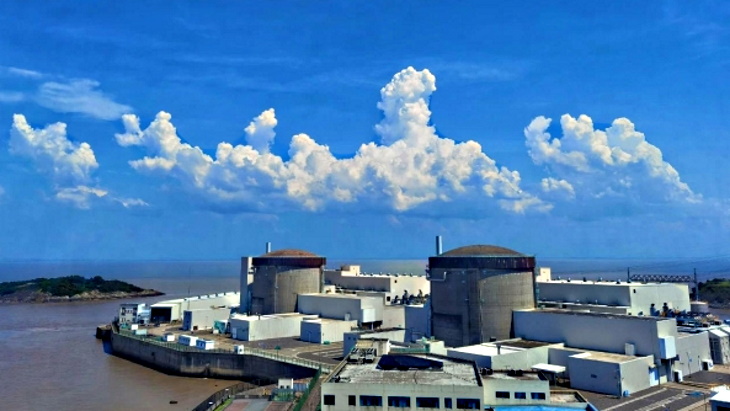
Unit 1 of the Qinshan Phase III nuclear power plant near Shanghai in China's Zhejiang province was taken offline on 1 May after 738 days of continuous operation. It has set a new record for the longest uninterrupted operation of a power reactor in China as well as a world record for an operating run for a Candu-6 reactor.

Chinese Candu reactor sets operating records
Qinshan III units 1 and 2 (Image: CNNC)

During the latest operating cycle, which began on 24 April 2023, Qinshan III unit 1 has generated more than 12.5 billion kilowatt-hours of electricity, equivalent to reducing standard coal consumption by 3.8 million tonnes and reducing carbon dioxide emissions by 9.97 million tonnes, China National Nuclear Corporation (CNNC) noted.

A total of nine Candu-6 reactors are currently in operation around the world. These are units 1 and 2 of Romania's Cernavoda plant, Argentina's Embalse plant, Canada's Point Lepreau plant, units 1 and 2 of China's Qinshan III plant and units 2-4 of South Korea's Wolsong plant.

Candus are pressurised heavy water reactors (PHWRs), which are designed to be refuelled without being shut down. The world record for continuous operation of a nuclear reactor is currently held by Darlington unit 1 in Canada - also a PHWR - which was taken offline on 5 February 2021 after 1106 days of operation.


(Image: CNNC)

Units 1 and 2 of the Qinshan Phase III plant - majority owned by CNNC - use the Candu-6 pressurised heavy water reactor technology, with Atomic Energy of Canada Limited (AECL) being the main contractor of the project on a turnkey basis. Construction began in 1997 and unit 1 started up in September 2002 and unit 2 in April 2003.

The two reactors are now approaching the end of their initial 30-year design life. Operator Third Qinshan Nuclear Power Company is undertaking a programme to refurbish the reactors and associated fuel channels. The refurbishment will allow the Candu units to continue generating power for a further 30 years.

Candu reactors feature a large horizontal calandria vessel with 480 tubes through which cooling water flows at high temperature. Each one has two end fittings which allow it to be isolated so the fuel bundles it contains can be replaced without having to shut down the whole reactor. Refurbishment to prolong the life of the power plant requires all this as well as thousands of auxiliary components to be dismantled.

Article researched and written by WNN's Warwick Pipe

 World Nuclear News


Google to fund development of three nuclear power sites


Wednesday, 7 May 2025
World Nuclear News

Tech giant Google is expanding its nuclear energy plans by providing early-stage capital for Elementl Power to prepare three potential sites in the USA for advanced nuclear power projects.

Google to fund development of three nuclear power sites
(Image: Sundry Photography - stock.adobe.com)

The aim is that each of the three sites would have "at least 600 MW of capacity". The value of the investment has not been included in the two companies' collaboration announcement, or the locations of the three proposed sites.

Google said: "This agreement is part of our continued work to source 24/7 baseload energy to support our operations and strengthen power grids. It also helps Elementl advance its goal of bringing significant nuclear capacity online by 2035. This innovative approach links capital investment directly with the growing demand for clean baseload power, with Google having the option for commercial off-take once projects are complete."

Elementl Power Chairman and CEO Chris Colbert said: "Innovative partnerships like this are necessary to mobilise the capital required to build new nuclear projects, which are critical to deliver safe, affordable and clean baseload power and help companies advance their long-term net-zero goals. We look forward to working with Google to execute these projects and bring safe, carbon-free, baseload electricity to the grid."

The two companies will work "with utility and regulated power partners to identify and advance new projects" and Elementl "will continue the evaluation of potential technology, engineering, procurement and construction, and other project partners, while prioritising specific sites for accelerated development".

Elementl Power, founded in 2022, describes itself as a technology-agnostic advanced nuclear project developer which aims to provide "turn-key development, financing and ownership solutions for customers that want access to clean baseload power but may not want to own or operate nuclear power assets".  It says its mission is to "to deploy over 10 gigawatts of next-generation nuclear power in the US by 2035".

It is not Google's first nuclear power deal - in October 2024 the company signed an agreement with Kairos Power to purchase power from its fluoride salt-cooled high-temperature small modular reactors, with a fleet of up to 500 MW of capacity by 2035. The aim of the power purchase agreement was to facilitate Kairos Power to develop, construct, and operate plants and sell energy, ancillary services, and environmental attributes to Google.

At the time of that announcement Google said that it would help it achieve net-zero emissions across all of its operations and value chain by 2030.

Fellow tech companies Amazon, Microsoft and Facebook owner Meta have all signed agreements in recent months which could lead to them utilising nuclear technology to provide power for their growing data centre needs. The advantage of nuclear power is seen to be the ability to have 24/7 reliable, and clean, energy.

Article researched and written by WNN's Alex Hunt