Tuesday, May 13, 2025

China’s rare earth curbs have ‘changed psychology’ at US firms

Bloomberg News | May 12, 2025 | 


Mountain Pass in California. The only producing rare earth mine in the US. Image from Wikimedia Commons

China’s weaponization of rare earths in its trade war with the US will spark a much greater focus on American supply security for critical minerals, according to MP Materials Corp., the only US miner of the key materials used in smartphones and defense applications.


“Regardless of how trade negotiations evolve from here, the system as it existed is broken, and the rare-earth Humpty Dumpty, so to speak, is not getting put back together,” the miner’s chief executive officer, Jim Litinsky, said on an earnings call last Friday.

China, which dominates global supply, put export restrictions on seven types of rare earths last month, widely viewed as a response to President Donald Trump’s trade assault. Companies including Ford Motor Co. have warned of shortages, and US negotiators had hoped to address rare earths in their Geneva appointment with Chinese officials, according to people familiar with the matter.

China may expedite US rare earth permit approvals after trade truce: Reuters

The teams emerged from two days of talks touting “substantial progress” toward resolving trade differences, leaving markets waiting for more details due to be outlined later on Monday.

Litinsky used the company’s earnings call — before the meetings in Switzerland — to argue that China’s measures were a decisive break with the past by exposing the vulnerability of key industries. MP Materials began mining rare earths in California in 2017, started refining in 2023, and plans to sell rare-earth magnets to General Motors Co. by the end of 2025.

“This idea that there was a threat that has now been utilized has really changed psychology, I think, from everybody across the board,” Litinsky said. “My impression from conversations with the Department of Defense is that there is a full-on recognition that we can’t be reliant on Chinese magnetics for national security purposes.”

China’s previous use of rare earths as a trade weapon — against Tokyo more than a decade ago — mobilized Japanese industry to significantly reduce its reliance on Chinese supplies. The US and other western nations had already begun moves to mitigate China’s grip on critical minerals, but the curbs on rare earths and other niche commodities has prompted greater urgency.

“For years, we have warned that the global rare-earths supply chain was built on a single point of failure,” Litinsky said. “With China’s sweeping tariffs and export restrictions, that geopolitical fault line has now become a commercial reality.”

China Bolsters Export Controls on Critical Minerals

China is bolstering export controls on the entire supply chain of critical minerals as it seeks to keep its dominant position in the sector.

China’s relevant authorities will track the exports of critical minerals and will strictly prevent illegal exports, the Chinese Commerce Ministry said on Monday.

“Since the export control of strategic minerals has much to do with national security, strengthening the control of the whole export chain is the key,” the ministry’s statement read, as carried by Reuters.

Last week, the commerce ministry announced “a special operation to crack down on the smuggling and illegal export of strategic minerals.”

China aims to fight the smuggling and illegal exports of strategic minerals by targeting evasion methods such as false reporting, concealment, smuggling, and “third country” transshipments, the authorities said.

Earlier this year, China, which dominates the global rare earth and critical minerals supply chain, announced it would curb its exports of dysprosium, gadolinium, scandium, terbium, samarium, yttrium, and lutetium. These so-called “heavy” and “medium” rare earth elements are mostly used in automotive applications, including rotors, motors, and transmission in electric vehicles and hybrids, as well as in the defense industry in parts of jets, missiles, and drones.

Following Beijing’s move, Chinese exporters of these seven rare earth metals will need to apply for licenses to export, while re-export to the United States is banned. China placed 16 U.S. entities – mostly in the defense and aerospace sectors – on an export control list, limiting them from receiving dual-use goods.

Monday’s announcement of stricter controls on exports of critical minerals comes just as China and the United States announced they are backing off from 100%-plus tariffs on each other’s goods.

The U.S. and China agreed to suspend the tariffs for 90 days, except a 10% baseline rate, the countries said in a joint statement at the end of this weekend’s trade talks in Geneva, Switzerland.

By Charles Kennedy for Oilprice.com


HD Hyundai and Maersk Cooperate on Researching Decarbonization Technology

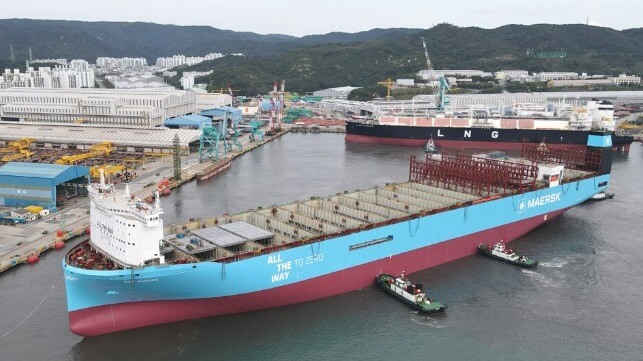
Hyundai launching Maersk containership
HD Hyundai and Maersk will expand the relationship building ships to explore new decarbonization technologies (HD Hyundai)

Published May 11, 2025 6:21 PM by The Maritime Executive


HD Hyundai and A.P. Moller – Maersk have agreed to expand their long-term working relationship to jointly develop future decarbonization solutions for vessels while HD Hyundai will expand its use of Maersk’s integrated logistics services across its affiliates. The companies plan to explore technology for vessel efficiency and route optimization as well as research on Solid Oxide Fuel Cell systems.

Maersk has long worked with Hyundai as a shipbuilder for its containerships. The companies starting in 2021 worked closely on the development and construction of the first methanol dual-fuel containerships. HD Hyundai’s Mipo Shipyard in South Korea built the Laura Maersk, the company’s 2,100 TEU feeder ship that was the first to use methanol. It was delivered in 2023 and was followed with the order for 18 large 16,000 TEU methanol dual-fuel containerships. The first was christened in January 2024 and the company has continued the integration of the ships into its fleet.

Discussing the new agreement, Chung Kisun, Vice Chairman & CEO of HD Hyundai said, “We will rapidly advance the world’s best shipbuilding technologies with the goal of building a sustainable maritime logistics network that ensures safety, low-emissions, and optimal efficiency.”

Initially, the two companies will conduct a six-month trial of new technologies on a Maersk container vessel built by HD Hyundai Heavy Industries. They will test applying Avikus’ HiNAS, an advanced navigation solution for energy-efficient vessel operations, and HD Hyundai Marine Solution's OCEANWISE route optimization to the operations of the boxship. The purpose of this trial is to validate the fuel-saving and greenhouse gas emission-reduction impacts of optimized navigation systems.

Robert Maersk Uggla, Chairman of A.P. Moller – Maersk, called the Memorandum of Understanding signed between the company on May 6 at the HD Hyundai Global R&D Center in Seongnam, “an important milestone, reinforcing the strong relationship we have developed.” He said it would pave the way for even greater collaboration in the future.

The companies also plan to explore cooperation in the field of ship retrofitting for decarbonization, including optimizing engine efficiency, increasing container ship cargo capacity, and retrofitting dual-fuel propulsion systems, Maersk has previously worked with China’s  Zhoushan Yatai Ship Engineering and Repair Co. for the first conversion of a conventional containership to dual-fuel methanol.

Maersk and Hyundai report they will also collaborate on joint research to examine the feasibility of the Solid Oxide Fuel Cell (SOFC) system. Testing of hydrogen-based systems is in an early phase as multiple companies look at fuel cells as a source of electric power in the future.

HD Hyundai reports it will also strengthen its global supply chain by leveraging Maersk’s integrated logistics services. This includes expanding ocean freight volumes supported by Maersk’s East-West network and utilizing Maersk’s capabilities across airfreight services and land transportation, as well as warehousing infrastructure. The initial phase of the partnership will focus on providing tailored logistics solutions for HD Hyundai’s affiliates including HD Hyundai XiteSolution, and HD Hyundai Marine Solution, and will be gradually rolled out across other affiliates.


ClassNK Releases Guidelines for Safety Operation for Ammonia-Fueled Vessels

ClassNK
Front cover - Guidelines for Safety Operation for Ammonia-Fueled Vessels

Published May 12, 2025 4:34 PM by The Maritime Executive


[By: ClassNK]

ClassNK has released the ‘Guidelines for Safety Operation for Ammonia-Fueled Vessels’ for considering the introduction of ammonia-fueled vessels to ensure safe operation on board ammonia-fueled vessels. By following these guidelines, safe and secure operation can be achieved for those involved in the operation of ammonia-fueled vessels.

The Guidelines give top priority to protecting the safety of seafarers, and cover matters to be kept in mind in daily operations, such as measures to be taken in the event of an ammonia leak in consideration of health, and requirements for personnel protection equipment (PPE) and emergency equipment in case of an emergency.

With the aim of decarbonizing the shipping industry, the introduction of alternative fuel vessels is approaching 40% of the total on an order basis and is expected to increase further in the future. On the other hand, although alternative fuels such as ammonia have unique risks that conventional heavy oil fuels do not, there is not enough information on the operation of such vessels. In order to provide proactive information on the operation of ammonia-fueled vessels, this guideline was prepared based on the latest information in Japan and overseas, and published as the Ammonia Fuel Operation Guidelines. The guidelines summarize specific precautions and management methods for the transportation, storage, and operation of ammonia fuel, and provide practical content that can be used in the field from the perspective of seafarers.

The guidelines will be continuously and flexibly updated according to future industry discussions, research results, and the latest knowledge. As part of the ClassNK Transition Support Services, which comprehensively supports the smooth transition of customers to zero emissions, ClassNK will continue to contribute to the safe operation and active introduction of alternative fuel vessels.

The guidelines are available to download via ‘Guidelines’ of My Page on ClassNK’s website after registration.
https://www.classnk.or.jp/account/ja/Rules_Guidance/ssl/guidelines.aspx

The products and services herein described in this press release are not endorsed by The Maritime Executive.


Russian Navy's Weakness in the Mediterranean Becomes Clear

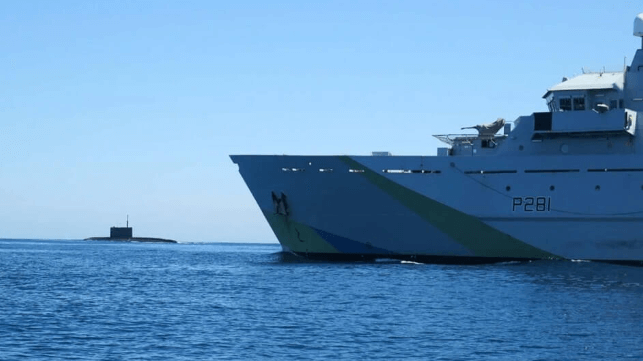
HMS Tyne monitors the Kilo-class sub Krasnodar on its way back from the Mediterranean, May 2025 (Royal Navy / MOD)

Published May 11, 2025 8:47 PM by The Maritime Executive


Since the downscaling of its Mediterranean footprint at Tartus in Syria from a fully-fledged naval base, complete with refueling, logistics and munitions warehouses, Russia’s Mediterranean Squadron has been without an alternative facility. This might not be a serious operational impediment had Russian naval vessels been able to access the facilities they once enjoyed in Sevastopol. But since the Turkish authorities exercised their right under the Montreux Convention to restrict the passage of combatant nations through the Bosporus, such an alternative arrangement is not possible - and even if it were, the no-ship Ukrainian Navy would still be waiting in ambush.

The exact status which the Russian Navy enjoys still in Tartus is unclear. Russian warships and parastatal cargo vessels still visit, and indeed the requirement to escort cargo vessels evacuating military equipment from Tartus places a major escort burden on the Russian warships which are present. But based on the long waits for entrance to the inner harbor, and the short duration of visits, the Russians no longer enjoy basing rights at Tartus, and have the same level of access that would be granted on a case by case basis to foreign warships making port calls. Russian cargo ships seem to enjoy easier access than warships, which normally have to anchor offshore.

The Russians have kept more access rights at their airbase at Khmeimim, 35 miles to the north, where Russian aircraft still stop to refuel on the way to Africa and where there are still logistics facilities. But even the Russian tenancy at Khmeimim is beginning to look somewhat fragile, as there having been a number of drone attacks on the base in recent weeks. The Russians are also sitting between a local population of Assad loyalists and their old adversaries, who are seeking revenge.

In the meantime, Russian naval operations in the Mediterranean have shrunk in scope. In the week to May 5, the Russian presence consisted of the cruiser Admiral Grigorovich (F745) off Tartus, the corvette Soobrazitelny (F531) and the Altay Class auxiliary Kola lingering off the Moroccan coast, the oiler Vyazma (A275) making a port visit in Alexandria, with the Vishnya Class intelligence collector Viktor Leonov (H175) shadowing the Royal Navy HMS Prince of Wales carrier strike group off Sicily and refueling in Algiers. The Kilo Class submarine Krasnodar (B265) left the Mediterranean without replacement (an unusual change) on April 27.

Until now, the Russians have usually maintained a force double this size in the Mediterranean. The lack of local maintenance facilities means that ships now have to be home-ported in the Baltic. This means that Russia’s ships can now keep station for shorter periods, sea transits to and from the Baltic reduce endurance, and the smaller deployed footprint requires proportionally higher support from oilers and auxiliaries. Moreover, the Mediterranean Squadron is now short on air cover and support in times of trouble.

Algeria has been touted as an alternative to Tartus. Russian and Algeria have historically enjoyed good relations, dating from the war of independence. Algeria still buys large volumes of Russian weapons, and there is still a large contingent of Russian instructors and technical support staff spread between five locations in Algeria. The Algerian Navy has a six-strong Kilo Class submarine fleet (and has recently taken delivery of its first 4th generation Sukhoi Su-35 fighters). But Article 31 of the Algerian constitution explicitly prohibits the establishment of foreign military bases on Algerian soil. A request from the Russians to establish a base at Mers El Kébir was rejected in 1968 and again in 2001, even though until recently Algeria was purchasing about 70% of its weapons from Russia and sourcing the bulk of its overseas technical training from Russia as well.

However, tensions have crept into the relationship of late, prompted by Russia’s interference in neighboring Mali, and by Algeria’s need to keep friendly with the United States and the United Arab Emirates over their support for Algerian rival Morocco. Algeria guards its independence and non-aligned status carefully, notwithstanding its historic ties with Russia.

Libya was also considered a naval base option, either in Benghazi or Tobruk. However, both ports lack infrastructure and lie in the contested area controlled for the moment by the mercurial Field Marshall Khalifa Haftar. Haftar is himself dependent on a changing cast of foreign backers, and his territory is unrecognized by the international community, making this option little more reliable than Russia’s former arrangement in Syria.

Egypt is no longer within the Russian orbit, and is good only for the occasional port visit. Port Sudan in the Red Sea could provide the necessary facilities, but as it is on the south side of the Suez Canal, it lies at some distance from the Mediterranean. Serbia, Russia’s only friend to the north, doesn’t have a coastline or port to offer.

For the present, Russia has no alternative but to operate in the Mediterranean with a reduced presence. It would not be so without Russia’s invasion of Ukraine, which not only has closed off the Bosporus to Russian warships, but has also cast doubt in the minds of potential alternative hosts about the wisdom of aligning with a heavily-sanctioned partner.

The opinions expressed herein are the author's and not necessarily those of The Maritime Executive.


USCG Releases Rules to Streamline and Consolidate U.S. Reflagging Process

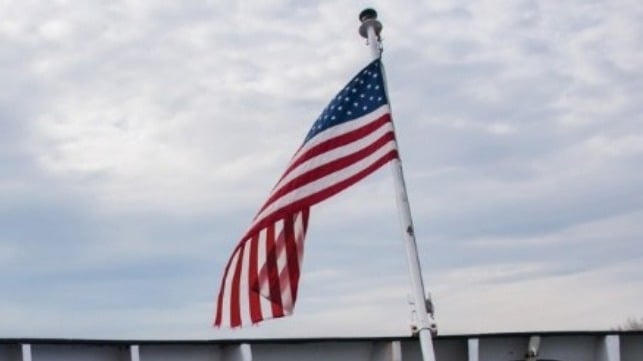
US flag on ship
USCG reports the process for reflagging to the U.S. has been streamlined and consolidated

Published May 12, 2025 1:10 PM by The Maritime Executive


The U.S. Coast Guard released a series of new rules on May 9 that it says are designed to streamline and consolidate the process for foreign ships to be certified under the American registry. It reflects the dual ambitions of the Trump administration to grow the American merchant marine and reduce excess regulations imposed by the U.S. government on industry.

According to the announcement from USCG, the process of reflagging into the American registry is being consolidated under a single program based on international standards. Historically, it has been considered to be an onerous process requiring a demonstration of need, review and acceptance by the Maritime Administration and other government agencies, a planning process, and entailed inspection. 

USCG reports the changes to the process reduces pre-inspection plan review, which will result in avoiding scheduling delays and minimizing modification costs. They contend it will provide more job opportunities for American mariners.

One of the common means that foreign ships have entered the U.S. registry is through the Maritime Security Program established nearly 30 years ago by the Clinton administration. The U.S. Congress extended the program till 2035, guaranteeing 60 positions (all currently filled) for ships to operate under the U.S. flag and receive what MARAD calls a “financial stipend” (or incentive). It is to offset U.S. operating costs in exchange for making their ships and commercial transportation resources available upon request by the Secretary of Defense during times of war or national emergency. It provides a simplified certification process for ships to enter the U.S. registry.

USCG in the new iteration is offering foreign-built vessels the option of enrolling in voluntary sealift support without being in the 60 spots that receive financial incentives. They write that receiving payments as part of MSP enrollment is not a precondition for certification. This also includes vessels reflagging as part of the Ready Reserve Force recapitalization. 

The change was reportedly spearheaded by Captain Cory Heard, who is the Chief, Office of Commercial Vessel Compliance from USCG, and heading an interagency team to support Donald Trump’s executive orders. Wayne Arguin Jr., Assistant Commandant for Prevention Policy at the U.S. Coast Guard, writes online that simplifying reflagging and certification for foreign-built vessels is the “first of many (initiatives) as we work to Restore American Maritime Dominance.”

This comes as the Governor of the U.S. Virgin Islands on Saturday, May 10, confirmed in a social media posting a report from Reuters that the Trump administration is reviewing an idea that was first floated a few years ago to create a second U.S. flag registry in the U.S. Virgin Islands. It would be an open registry administered by a third-party commercial organization.

The plan was put forward by a private group in 2021 calling itself the Center for Ocean Policy and Economics, and winning support from conservative groups, including in 2023 from the Hudson Institute, a conservative think-tank. The groups said it would be a way to bypass burdensome domestic regulations that restrict entry into the U.S. registry for foreign-built ships and deal with the limited U.S. shipbuilding capacity. They argue it would create jobs and support the development of a shipyard in the Virgin Islands for maintenance work. The Hudson Institute set a target for 250 U.S.-registered ships, a goal that has now found its way into the recently introduced legislation in the U.S. Congress to support reinvigorating the U.S. merchant marine and shipbuilding.

The U.S.’s leading maritime unions have repeatedly joined together to oppose the proposed open registry. The unions in the past opposed the plan as it would permit foreign seafarers to crew the vessels, a move they said made the plan nothing more than a ploy to generate registry fees.

Reports say the Trump administration is looking at it as a possible “bold, private-sector driven initiative.” Reuters wrote in an exclusive story on May 9 that the National Security Council was aware of the proposed USVI Registry and was possibly considering the plan.


Insurer Covers Costs When Port Agent Fails to Get a Pilot for a Ship

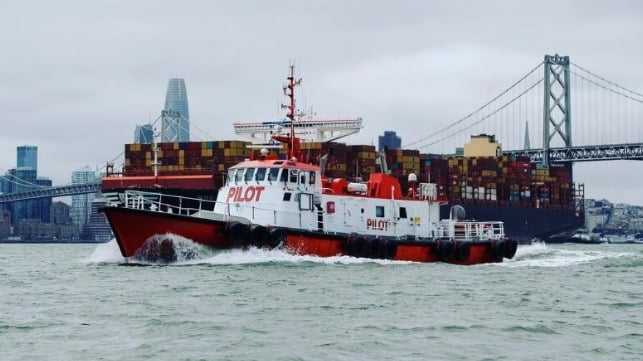
pilot boat
The omission only became apparent when there was no pilot available for the ship (SF Pilots file photo)

Published May 12, 2025 4:38 PM by The Maritime Executive


The International Transport Intermediaries Club (ITIC) is highlighting how it stepped in to aid one of its customers when a simple oversight racked up large fees. The provider of professional indemnity insurance settled a claim that it acknowledges was a lack of communication that led to a simple oversight.

The ship’s owner filed a claim for $135,000 in expenses and late fees it incurred when one of its ships was operating outside its normal liner schedule. It had scheduled special port calls and notified the liner agent of the inbound schedule, requesting that arrangements be made for the calls outside the regular service pattern.

Using the initial arrival plan, an agent scheduled the pilot for the ship and initiated the customs clearance for the ports. The agent, however, was heading out of the office on leave and handled the assignment over to a covering team.

When the ship was delayed in its first port of call, the company notified the agency of a three-day delay for the first of the two scheduled discharge ports. The agency’s team adjusted the arrangements at the first port but omitted to make changes for the second port.

The problem only became apparent when the ship reached the second port, and there was no pilot available. The company reports it incurred the $135,000 expense due to the urgent need to finalize a pilot and late fees that were incurred. It requested reimbursement from the insurance company, placing the blame for the expenses on the agent’s mistakes.

ITIC reports that the agency cooperated and provided the documentation and acknowledged their omission in adjusting the schedule at the second port. “As there was no defense,” ITIC said it “honored the claim and reimbursed the full amount.”

“A mistake like this highlights the need for clear internal communication and robust handover procedures,” said Mark Brattman, Claims Director at ITIC. “Our goal is to help members learn from such incidents and strengthen their operational procedures.”

Despite the modernization of so much of the operations and the push toward electronics and digitalization, it highlights that much of the shipping industry remains concentrated on fulfilling basic daily tasks. A simple oversight resulted in the delay and expense for the vessel and ultimately the insurance provider. 


Is This the End of the World As We Know It?

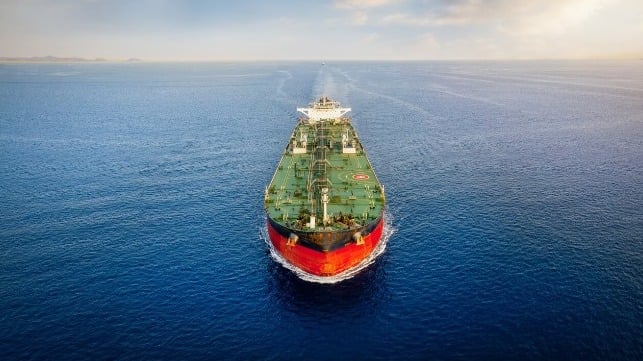
tanker
iStock / SHansche

Published May 12, 2025 5:31 PM by G. Allen Brooks


(Article originally published in Mar/Apr 2025 edition.)

[This article was published in the March/April edition of The Maritime Executive, before the White House scaled back tariffs on China.]

At the turn of the century, Robert Mabro, energy economist and founder of the Oxford Institute for Energy Studies, wrote, "Is our world subject to sudden and radical transformations? Are there discontinuities that change, in a significant way, the course of historical developments? Or, on the contrary, should we agree with the lament of Ecclesiastes: 'There is nothing new under the sun'?"

While his questions were in the Forward to a book on oil economics and were meant to apply to the industry's challenges in 2000, the questions are legitimate for framing a broader discussion of economics, energy and geopolitics.

Given the turmoil engulfing the world following the election of Donald Trump to the U.S. presidency and his activist governing style, Mabro's questions are appropriate. We wonder which answer Mabro would think most suitable.

DISRUPTOR

Trump has been a disruptor since he descended the Trump Tower escalator in 2015 and announced his candidacy for the U.S. presidency. A real estate developer and television personality, he was an atypical candidate. Since his declaration, nothing has been the same politically in the U.S. or worldwide.

During his 2024 campaign, Trump set forth an ambitious agenda of actions that stirred the emotions of many Americans and led to his reelection in a surprising outcome. He won every battleground state, scored record support among minorities and moved 90 percent of the 3,100 counties in the country to the political right.

Something was going on.

Trump's agenda for change was laid out in long, rambling campaign speeches, so few people should have been surprised by what his Administration is doing. As a lame-duck President, he knows he has, at best, two years to complete his task given Republican control of both houses of Congress until the 2026 election.

Therein lies the motivation to "flood the zone" via Executive Orders, appointing like-minded cabinet officers and instituting activist policies to fulfill his agenda. At the core of Trump's actions is his willingness to ask, "Why are we doing this?" It's no longer acceptable to answer, "because it's always been done that way."

Understanding how successful real estate developers operate helps to understand some of Trump's seemingly outlandish ideas. They create visions of the future and then work to make them happen. This often means taking controversial positions and pushing what seem unrealistic ideas.

His Gaza proposal is such an example. Dismissed by the media, Trump challenged Gaza's neighbors to resolve the 80-year-old refugee issue they have shunned or he would solve it by removing the one million refugees to camps the U.S. would construct and then turning the land into a glitzy Las Vagas of the Middle East.

The outrage was intense. However, in response, the 57-member Organization of Islamic Cooperation adopted a $53 billion counter-proposal suggesting that the people best able to deal with it are meeting Trump's challenge.

Another untraditional approach to international relationships is Trump's willingness to aggressively use tariffs against friends and foes to secure better trade terms for the country. No one is happy with his plan. Compared to the economic brushfire of his anti-China tariffs during his first Administration, an all-out global trade war risks more significant financial harm.

It will likely spike inflation, potentially pushing the economy into recession. In response, the OECD lowered its global GDP growth projections to 3.1 percent for 2025 and three percent next year. Those projections are down by 0.2 and 0.3 percent, respectively. The agency also increased its inflation projections by a third of a percentage point for both years.

Are there routes to revised trade relationships that avoid an all-out trade war? Economists are pessimistic such a scenario exists without a return to the status quo. Therefore, they warn about disastrous outcomes – weak economic growth, increased inflation, higher interest rates and rising unemployment. Such an outlook has stock markets fading, consumer optimism sliding and expectations rising for higher living costs and interest rates. This is not a good outlook for energy demand.

"DRILL, BABY, DRILL"

At the same time, Trump has called for enhancing America's energy self-sufficiency by encouraging a "Drill, baby, drill" mantra for the domestic oil and gas business. He has suspended the prior Administration's push for offshore wind, wants to cut renewable energy subsidies and reversed Biden's pause on new LNG export terminals.

The problem with Trump's mantra is he has also signaled to OPEC that he wants it to help lower global oil prices. That news, coupled with the belief in slowing economic growth, has pushed crude oil prices below $70 a barrel – testing the resolve of domestic producers.

The 2000s shale oil miracle reversed the nation's long-term production decline and sent it to record output. U.S. oil production peaked in 1970 after growing by 55 times from 1900 (earliest data available). Once production peaked, it began sliding, falling nearly in half by 2008. However, when horizontal drilling and hydraulic fracturing were applied to shale oil formations, production rose two and a half times in 16 years. In 2024, crude oil output averaged 13.2 million barrels daily, making the U.S. the world's largest producer.

Drilling and unlocking shale oil is expensive. However, tapping these formations is easier since they are blanket subsurface layers in significant basins around the nation. This makes drilling and production more manageable and less risky than traditional exploration. Therefore, shale production can be highly responsive to market price signals. However, it also makes it susceptible to falling oil prices. This prospect worries domestic oil producers about how much drilling they should undertake if oil prices slide into the low $60s-a-barrel range.

Their concern is amplified by Trump's appeal to OPEC to boost production and help lower oil prices. He sees lower oil prices helping consumers at the gas pump and with home heating expenses. Lower oil prices mean less-costly diesel and jet fuel, reducing the cost of living for Americans and others worldwide.

Another energy issue weighing on commodity prices is the resolution of the Russia-Ukraine war. In preliminary peace talks, new sanctions against Russia and its allies, China and Iran, are being proposed if a final resolution isn't found. The sanctions would be levied not only on the energy output of the countries but also against the ghost fleet of tankers hauling their oil and gas to customers.

With a lack of clarity on the outcome of the peace talks, producers worry about prices in the event of more or less crude oil reaching the market. Many producers assume that Trump will negotiate the war's end and that more oil will push prices down.

Trump's push for greater U.S. energy security reflects his administration's goal to reduce the industry's red tape, making securing permits to drill, produce and transport hydrocarbon energy easier. A less restrained energy industry can be more responsive to market dynamics. The Secretary of the Interior has proposed resurrecting the construction of new natural gas pipelines from the Marcellus Formation in Pennsylvania to New England, helping lower that region's energy costs.

ALL OF THE ABOVE

How do we answer Mabro's questions? In our view, all of them are true. How can that be? The idea that there is nothing new under the sun is correct because we cannot repeal the laws of physics that govern energy. Likewise, we have a two-century-long history of transitioning from less to more dense energy fuels. That transition has lowered costs and improved living standards and people's longevity.

In the name of clean energy, we're reversing that transition and using less-dense energy sources dependent on a fickle Mother Nature. Such discontinuities and radical changes to our history of progress will retard it. At the same time, billions of people in the Southern Hemisphere want to enjoy higher living standards, which require massive increases in power consumption.

Despite claims about the apocalypse of climate change unless we cease using hydrocarbon energy, the world's atmosphere is cleaner. The economic gains fossil energy has delivered allowed society to improve living standards, clean the environment and better adapt to weather conditions.

The affordable, clean and reliable energy trifecta must be upheld for the betterment of humanity. This favors the increased use of fossil fuels.


The opinions expressed herein are the author's and not necessarily those of The Maritime Executive.


Shipping Stocks Take Off With Trump Tariff Announcement

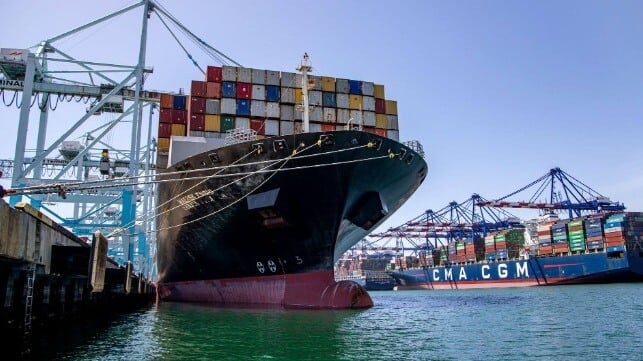
Container ships LA
File image courtesy Port of Los Angeles

Published May 12, 2025 3:28 PM by The Maritime Executive


Just in time for the peak container shipping season on the China-U.S. transpacific route, the Trump administration has negotiated a deal with the government of China to relax unprecedented tariffs on bilateral trade. The U.S. will drop its net tariffs on Chinese goods from 145 percent down to 30 percent, well below the levels that many market participants predicted. China will drop its tariffs on U.S. goods from 125 percent down to 10 percent. 

The temporary agreement is valid for at least the next 90 days while the two sides discuss permanent terms, giving U.S. importers a window to stock up on Chinese-made goods for the back-to-school and Christmas holiday shopping seasons.

After April 2, facing unprofitable tariff levels, many American importers had stopped shipping goods out of China to await more favorable developments, hitting U.S. inventories and Chinese consumer-goods manufacturers hard. The slowdown will now shift in reverse as retailers move to rebuild stock. "Get ready for a shipping boom," said Flexport CEO Ryan Petersen in a statement early Monday. 

Stocks soared on news of the agreement, with the Nasdaq jumping by four percent by midafternoon. The Dow and the S&P 500 both gained about three percent. All three indices have now regained all of the losses incurred after the White House's April 2 tariff announcement; China-dependent consumer retail stocks showed particular strength, reflecting renewed confidence in their ability to source imported goods. Stock for toymaker Mattel jumped 10 percent, Best Buy rose six percent, and discount chain Five Below soared 20 percent. 

"We believe new highs for the market and tech stocks are now on the table in 2025," said Dan Ives of Wedbush Securities, speaking to the WSJ. "This morning is a huge win for the bulls."

Trade-dependent container shipping stocks took off, regaining much of the lost ground of recent weeks. Matson, the Jones Act carrier that operates a specialty service from East Asia to the U.S. West Coast, jumped 19 percent in midday trading. Maersk's OTC stock traded up 10 percent, Hapag-Lloyd was up more than two percent, NYK by nearly four percent, and Yang Ming by one percent. Zim was a clear winner, with shares up by 14 percent. 

“We expect bookings from China to the U.S. to increase, which should help us . . . into peak season," Hapag-Lloyd told Reuters in a statement. 

The reduced level of activity at West Coast gateway ports is still built into the forecast through the end of May: the dozens of blanked sailings that ocean carriers implemented on ex-China routes are a guarantee of fewer ships with less cargo arriving LA/Long Beach in the immediate term. The first San Pedro port activity rebound could be expected in two to three weeks at the earliest, reflecting the minimum transit time needed for a box from eastern China to reach California. Some analysts predict that the San Pedro ports could swing from light activity to significant congestion by midsummer as retailers rush to bring cargo in from China at comparatively affordable tariff levels. 

Gene Seroka, head of the Port of LA, told the Wall Street Journal that he was less bullish about a spike in shipping volume. “I don’t see all of the normal cargo coming back to the levels that we had witnessed in recent weeks and months,” Seroka said. “Reason being, you’re not going to be frontloading at 30 percent [tariffs].”

Veteran shipping analyst Peter Sand concurred. :It must not be ignored there is still a 30% tariff on imports from China to the US and this will be prohibitive for some businesses with lower-margin goods, so there will still be an adverse impact on ocean container shipping demand," he said in a research note Monday. "It may also take shippers a little time to ramp up sourcing and manufacturing in China again if they took the foot off the gas following the 145 percent tariffs announced on 9 April."



US Coast Guard Boat Crew Shoots Out Engine of Migrant Smuggling Boat

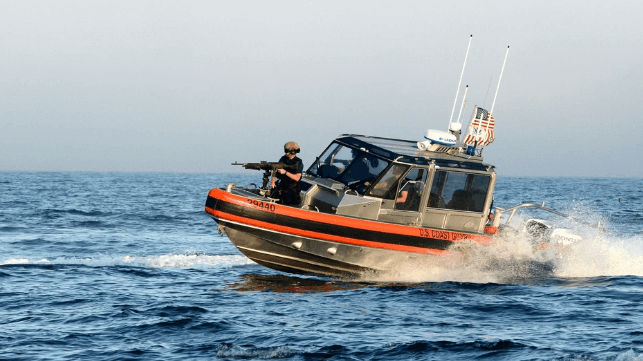
A USCG tactical small boat crew off San Diego, 2019 (U.S. Coast Guard file image)

Published May 12, 2025 6:08 PM by The Maritime Executive


On Saturday evening, a U.S. Coast Guard boat crew shot out the engine of a high-speed smuggling boat off Point Loma after the vessel ignored repeated commands to stop and be boarded.  

At about 1750 hours, Coast Guard Sector San Diego spotted an 18-foot cuddy cabin boat moving at high speed about two miles south of Point Loma, making a northbound course. Watchstanders followed the suspicious boat using surveillance cameras as it entered San Diego Bay.

A Coast Guard Station San Diego patrol boat was diverted to intercept the vessel. The patrol boat found the speeding suspects and tried to make contact with the operator, but the cuddy cabin boat fled the scene. 

The Coast Guard response boat crew tried to get the speedboat to stop by issuing orders and firing warning shots. When this did not work, the crew shot four rounds into the vessel’s engine, disabling it and forcing it to stop. 

The Coast Guard crew boarded the vessel and took control of the scene. They found eight foreign nationals aboard: five adult men, one woman, and two male teenagers aged 16 and 17.

The suspects were taken to Ballast Point, near the entrance to San Diego's harbor, where they were transferred to officers from the Department of Homeland Security.

The intercept was the most dramatic of three separate interdictions off San Diego on Saturday. Earlier the same day, cutter Sea Otter intercepted a migrant boat off La Jolla, resulting in the capture of seven suspected illegal aliens, and cutter Terrell Horne interdicted a 20-foot pleasure craft off Point Loma, capturing another three suspects. 

Coast Guard and CBP boat crews routinely intercept human smuggling attempts off the coast of Southern California. Human trafficking methods on this route are hazardous, and migrants regularly lose their lives on the route. Just last week, a rustic smuggling boat capsized off San Diego, leaving three dead and seven missing.


DP World to Invest $760M to Create Transshipment Hub in Dominican Republic

Dominican Republic container port
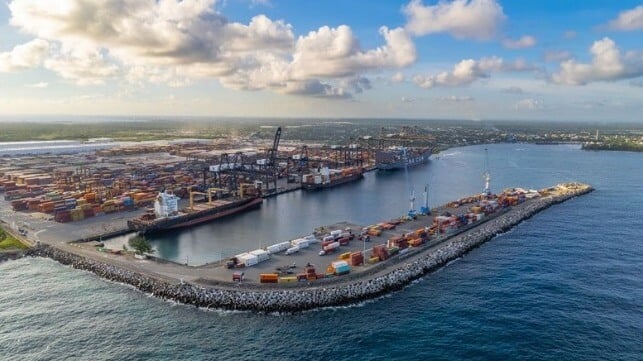
DP World plans to expand the DR's Port of Caucedo to make it a regional transshipment hub (DP World)

Published May 12, 2025 6:31 PM by The Maritime Executive


Plans were announced laying the groundwork for the creation of a transshipment hub in the Dominican Republic. It comes at a critical time as shippers consider steps to manage the Trump policies ranging from tariffs to port fees for Chinese-built ships. 

DP World, which has been operating in the Dominican Republic for more than 25 years, reports it signed a memorandum of understanding with the government of the Dominican Republic that calls for expanding its port and Free Trade Zone operations. The company will initiate negotiations with the Ministry of Industry, Commerce and MSMES to finalize the expansion agreement.

Industry analysts have called for the development of a transshipment hub that could better serve the needs of the Caribbean. Wth the changes in U.S. policies, it could now also provide an alternative to transshipping cargo via the United States and promote economic development.

DP World’s agreement calls for expanding the operations at the Port of Caucedo on the south coast of the island on the Caribbean Sea east of Santo Domingo. Since 2003, DP World reports it has invested more than $700 million in the development of the operations, including increasing capacity from 900,000 to 2.5 million TEU with three berths. It also operates a logistics center in the free trade zone with six warehouses. 

The company highlights the strategic location of the facility noting that it handles more than 60 percent of the DR’s market share. It says that with proximity to the United States and duty-free access, the DR offers a compelling environment and the opportunity to become the transshipment hub for the region.

The plan calls for investing $380 million into the port to increase capacity to approximately 3.1 million TEU. It would expand the quay and breakwater to accommodate larger vessels, add new ship-to-shore cranes and yard equipment. An additional $380 million would be invested in the Free Trade Zone to add 225 hectares of development-ready land and infrastructure improvements.

The website for the operation notes that it has already become one of the most important ports in the Americas region and is among the top 15 ports in Latin America. DP World highlights that it has the opportunity to be a strategic location for the redistribution of cargo to the Caribbean, Central and South America, and the United States.


Russia Plans $6.2B Outlay to Build 1,600 Commercial Ships by 2036

Russian shipbuilding
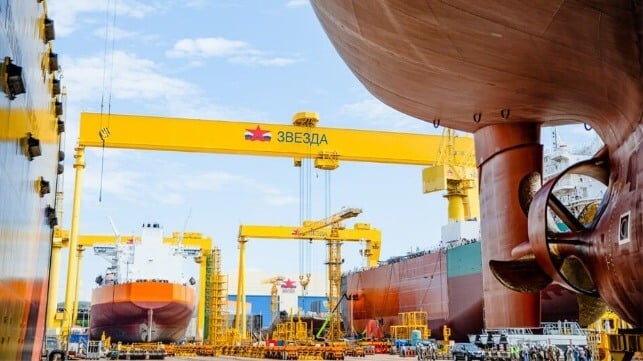
Russia plans to invest in its shipbuilding operations to expand its commercial fleet (Zvezda Shipbuilding)

Published May 12, 2025 3:48 PM by The Maritime Executive


The Russian government mapped out its ambitious plans to modernize and expand its national fleet to counter the impact of foreign sanctions and restrictions. The shipbuilding industry is one of the hardest hit by the restrictions on exports of advanced technology and machinery to Russia since the start of the war in Ukraine.

Russian Prime Minister Mikhail Mishustin has spoken out on the efforts to fulfil the plans called for by President Vladimir Putin. Mishustin outlined today, May 12, at a meeting of the region premiers what he called an updated strategy for the development of the shipbuilding industry. In addition to expansion and modernization, one of the key goals is to develop the domestic capabilities to replace foreign shipboard equipment and create a domestic supply chain.

“In the next six years, we will spend over 500 billion rubles ($6.2 billion) in federal funding for these purposes, which is a record figure for the industry,” said Mishustin. He said the priorities would be to support freight traffic via the Northern Sea Route and to establish logistics routes between Russia and friendly countries. They are also seeking to support inland navigation and expand river tourism.

First Deputy Prime Minister Denis Manturov provided specific details on the plan, noting that they must replace the existing fleet that was built in the 1970s and 1980s. The strategy calls for building more than 1,600 ships by 2036 and more than 2,600 by 2050. Previous reports said they would build 713 vessels by 2030.

The plan focuses on large-capacity projects including crude oil tankers, gas carriers, shuttle tankers, and bulk carriers. Published reports said 51 of the vessels would be for the Northern Sea Route, while there will also be a focus on icebreakers and the fishing fleet, which would add 279 vessels. They also look to support the North-South route, which includes Caspian Sea shipping.

To achieve the ambitious building plans, Mishustin said they will need to build new shipyards, expand production capacity, and undertake R&D to attract investors.  They will need to overcome “structural barriers” within the industry.

The priority remains on fulfilling the state’s defense needs, with a new plan being developed for the Russian Navy. They look to coordinate the needs of the Navy with the goals of expanding the merchant fleet.