Friday, May 30, 2025

How Switzerland's Birch glacier collapsed

Geneva (AFP) – A cascade of events in the Swiss Alps led to the dramatic collapse of the Birch glacier, wiping out Blatten village in the valley below, glaciologists and geoscientists told AFP on Friday.


Issued on: 30/05/2025 -

The Birch Glacier collapsed into the Lotschental valley, destroying the village of Blatten © Fabrice COFFRINI / AFP

Experts knew days ahead of Wednesday's landslide that the glacier was likely to suffer a catastrophic failure. But the reasons why date back much further.

There are strong theories on the causes, and to what degree the disaster is linked to climate change -- but these are yet to be confirmed by scientific analysis.

"This can be considered as a cascading event, because we have different processes involved," explained Christophe Lambiel, senior lecturer at the University of Lausanne's Institute of Earth Surface Dynamics.


Mountain above the glacier

The 3,342-metre (10,965-foot) high Kleines Nesthorn mountain above the glacier was already somewhat unstable, and rockfalls accelerated dramatically around 10 days beforehand.

Experts feared a total collapse within hours, but instead there were successive rockfalls over several days, which was actually the best-case scenario.
Rockfall onto glacier
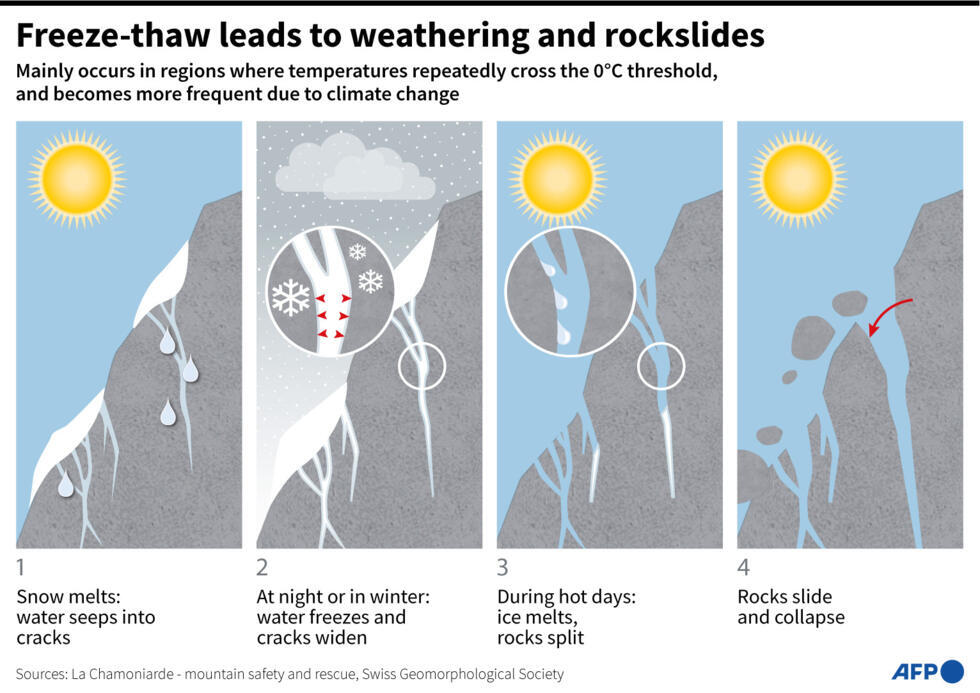
Freeze-thaw leads to weathering and rockslides © Valentin RAKOVSKY, Sophie RAMIS / AFP

Three million cubic metres of rock were deposited on the glacier.

"If you put a lot of weight on an unstable foundation, it can just slip away. And this is what actually happened," Matthias Huss, the director of Glacier Monitoring Switzerland (GLAMOS), told AFP.

"The glacier accelerated strongly in response to this additional loading, and then the disaster struck."


The Birch glacier

The Birch glacier was a special case: the only Swiss glacier that was advancing rather than shrinking. However, this was not because of extra snowfall.
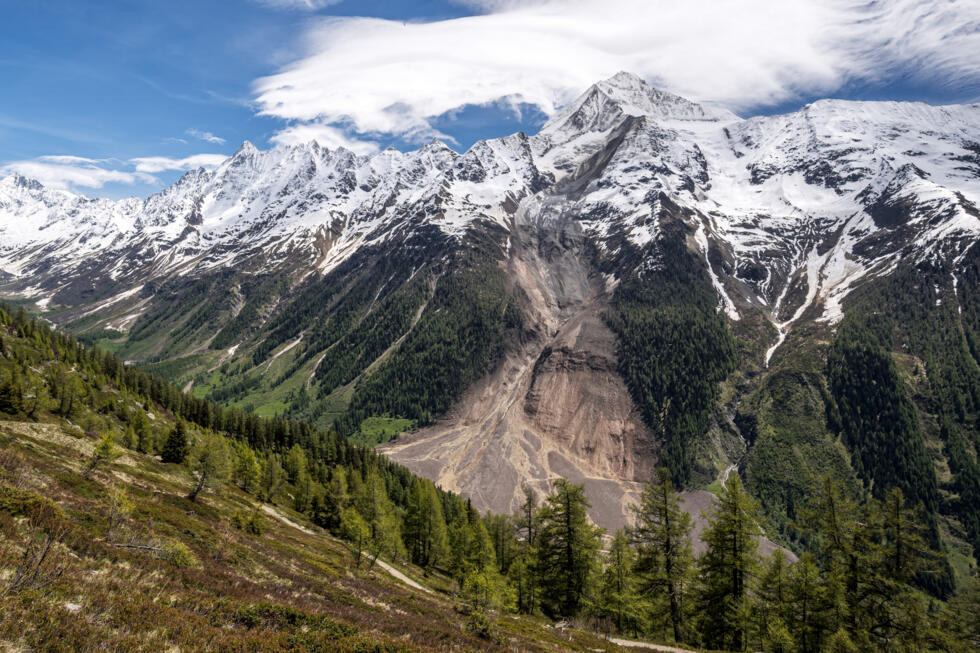
Around three million cubic metres of rock fell on top of the glacier, increasing its weight © FABRICE COFFRINI / AFP

Its advance "was quite likely due to the pre-loading with rockfalls from this mountain, which has finally collapsed. So the landslide didn't start from nothing," said Huss.

The glacier was on a steep slope, and even steeper at the front, worsening the dynamics.

Smaller-scale falls from the front of the glacier Tuesday were expected to continue, with Wednesday's sudden total collapse considered a less-probable scenario.
How the glacier collapsed

The rockfalls altered the stress equation between the weight of the glacier and the slope, which governs its forward speed, Lambiel told AFP.

Like pushing a car, it takes a lot of force to initiate movement, but less once it is on the move, he explained.

Huss said the 1,000 metres of elevation between the glacier and the Lotschental valley floor added a "huge amount of potential energy", which through friction melts part of the ice, making the fall "much more dynamic than if it was just rock".
Role of melting permafrost

Permafrost conditions are degrading throughout the Alps. Ice inside the cracks in the rocks has been thawing to ever-deeper levels over the last decade, especially after the summer 2022 heatwave.

"Ice is considered as the cement of the mountains. Decreasing the quality of the cement decreases the stability of the mountain," said Lambiel.

Huss added: "At the moment, we can't say it's because of permafrost thaw that this mountain collapsed -- but it is at least a very probable explanation, or one factor, that has triggered or accelerated this process of the mountain falling apart."


Role of climate change

Jakob Steiner, a geoscientist at the University of Graz in Austria, told AFP: "There is no clear evidence as of yet, for this specific case, that this was caused by climate change."

Huss said making such a direct link was "complicated".
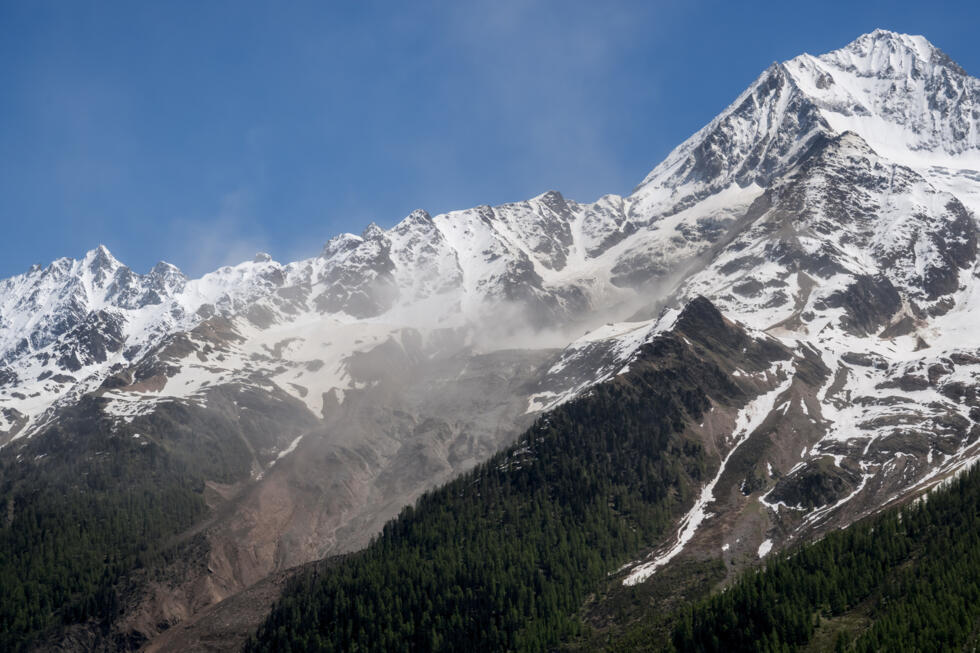
Dust rising after the collapse of the Birch glacier in Wallis canton
 © Fabrice COFFRINI / AFP

"If it was just because of climate change that this mountain collapsed, all mountains in the Alps could collapse -- and they don't," he said.

"It's a combination of the long-term changes in the geology of the mountain.

"The failing of the glacier as such -- this is not related to climate change. It's more the permafrost processes, which are very complex, long-term changes."

Lambiel said of a link between climate change and the glacier moving forward over time: "Honestly, we don't know.

"But the increasing rockfalls on the glacier during the last 10 years -- this can be linked with climate change."

Other glaciers

Modern monitoring techniques detect acceleration in the ice with high precision -- and therefore allow for early warning.
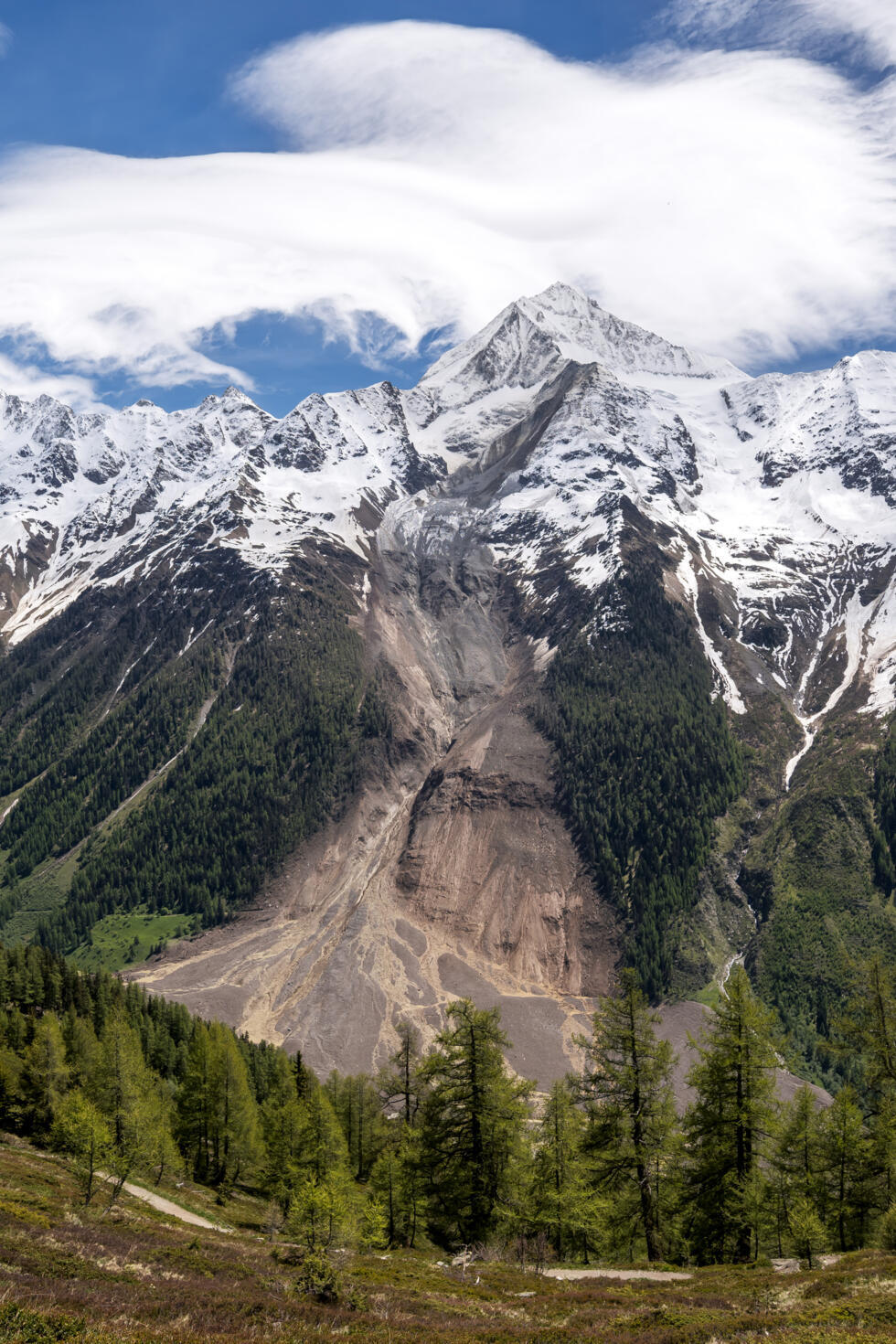
The Birch glacier plunged down the side of the valley © FABRICE COFFRINI / AFP

Lambiel said around 80 glaciers in the same region of Switzerland were considered dangerous, and under monitoring.

"The big challenge is to recognise where to direct the detailed monitoring," said Huss.

Lambiel said sites with glacier-permafrost interactions above 3,000 metres would now need more research. But they are difficult to reach and monitor.

Steiner said: "Probably the rapidly changing permafrost can play some kind of role.

"This is concerning because this means that mountains are becoming a lot more unstable."

rjm-burs/phz/jhb

© 2025 AFP

Swiss Glacier Collapse That Buried Village Likely a 'Direct Result of Our Warming Climate'


"What happened to Birch Glacier is what we would expect from rising temperatures in the Alps and elsewhere," one scientist said.


This May 29, 2025 aerial photograph shows the town of Blatten, in the Bietschhorn mountain of the Swiss Alps, destroyed by a landslide after part of the huge Birch Glacier collapsed and was swallowed up by the river Lonza the day before.
(Photo: Fabrice Coffrini/AFP via Getty Images)


Brett Wilkins
May 29, 2025

Thawing permafrost exacerbated by human-caused global heating is the likely culprit behind a massive glacier collapse that buried nearly the entire Swiss town of Blatten, one scientist said Thursday while warning of the likelihood of similar disasters in the future.

The alpine hamlet of 300 inhabitants—who were evacuated earlier amid warning signs of disaster—was almost completely wiped out on Wednesday after the Birch Glacier, located in the Lötschental Valley in northern Switzerland, collapsed. The glacial avalanche, laden with boulders and other debris, cascaded down the mountainside and into the village, obliterating everything in its path. Local officials said around 90% of Blatten was buried.


"We've lost our village," Blatten Mayor Matthias Bellwald told reporters. "The village is under rubble. We will rebuild."


While there are no verified casualties from the disaster, one 64-year-old man has been reported missing.

Mathieu Morlighem, a glaciologist at Dartmouth College in New Hampshire, toldABC News that permafrost thaw under and along the sidewalls surrounding the glacier likely caused the collapse.

"What happened to Birch Glacier is what we would expect from rising temperatures in the Alps and elsewhere," he explained. "I think we can expect more events like this in the future."


As ABC News reported:
Glaciers in Switzerland have lost almost 40% of their volume since 2000, and the loss is accelerating, according to the Swiss Federal Institute for Forest, Snow, and Landscape Research. Record-high summer temperatures in 2022 and 2023 caused a 10% glacial ice loss in the country.

Experts warn that Switzerland's glaciers could disappear completely by 2100 due to the climate emergency.

As Common Dreamsreported in March, the crisis is planetary and is predicted to adversely affect nearly 2 billion people who depend upon glaciers for agricultural irrigation and drinking water.

"Most of the world's glaciers, including those in mountains, are melting at an accelerated rate worldwide," a United Nations Educational, Scientific, and Cultural Organization report published earlier this year warned. "Combined with accelerating permafrost thaw, declining snow cover, and more erratic snowfall patterns... this will have significant and irreversible impacts on local, regional, and global hydrology, including water availability."

The Swiss collapse happened a day before Thursday's opening of the High-Level International Conference on Glaciers' Preservation in Tajikistan, which aims to "highlight the vital role of glaciers in maintaining global ecological balance and addressing water-related challenges."

Rock and ice prevent rescue work after Swiss glacier collapse


By AFP
May 29, 2025


Swiss authorities say huge amounts of rock and ice from a glacier that collapsed in the Alps are hampering emergency services - Copyright AFP -


Fabrice Coffrini, with Christophe Vogt in Geneva

Swiss authorities said Thursday that rock and ice piles from a collapsed glacier that destroyed a village were preventing emergency services from working, but that they were cautiously optimistic no more homes were at risk.

The Birch glacier in Switzerland’s southern Valais (Wallis) region collapsed on Wednesday, sending a mass of rock, ice and scree hurtling down the mountain slope and into the valley below.

The barrage largely destroyed the most of Blatten, which had been home to 300 people and was evacuated last week due to the impending danger.

One 64-year-old man, believed to have been in the danger zone at the time, remains missing. A police spokesman said the difficult conditions had forced the search to be called off Thursday.

The unstable mountain face and thousands of tonnes of rocky debris also made it impossible for emergency workers to intervene to stabilise the zone and contain the risk of flooding in the valley below, officials told a news conference.

The huge pile of glacier debris, stretching some two kilometres (1.25 miles), has blocked the river Lonza.

After initially warning of a potentially devastating flood from water trapped above the debris, authorities said expert analysis indicated the risk had eased.

“The information we’ve received from geologists and other specialists tends to indicate such an event is unlikely,” Valais security chief Stephane Ganzer told a news conference.

An artificial dam in the village of Ferden, just below, has been emptied and should be able to contain any downward rush of water if it happens, said Ganzer.

However, he added: “It’s unlikely, but we don’t really like that word ‘unlikely’ here since yesterday, because we know that unlikely can become likely.”


– ‘Terrible catastrophe’ –


Authorities are studying evacuation plans and have warned residents who could be affected, Ganzer said.

“We have one person missing, we don’t want anyone else missing or deceased from this terrible catastrophe,” he said.

As a precaution, 16 more people were evacuated Wednesday from two villages located downstream from the disaster area in the Loetschental valley, known for scenic views and home to around 1,500 people living in villages.

Their views of the valley have definitively changed now.

Where the Birch glacier used to sit, there is now a gaping hole in the mountainside.

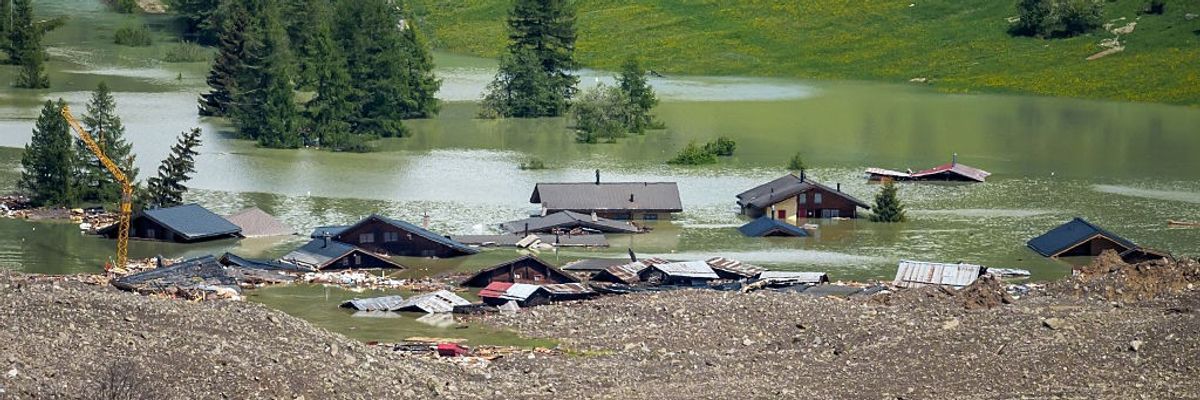
What is left of the village of Blatten is being submerged beneath the accumulating water of the Lonza river.

A sunny and warm weather forecast means “lots of snow” will melt in the coming days, meaning “we’re still facing colossal water levels” in the artificial lake that has formed, Ganzer said.


– Seismic event –


YouTube footage of the collapse showed a huge cloud of ice and rubble hurtling down the mountainside, into the valley and partially up the mountain slope on the other side.

The force was such that Swiss monitoring stations registered the phenomenon as a seismic event.

According to officials, three million cubic metres of rock fell suddenly onto the glacier, pushing it down into the valley.

Warming temperatures have shrunk the Alps’ glaciers and made them more unstable.

Swiss glaciers, severely impacted by climate change, melted as much in 2022 and 2023 as between 1960 and 1990, losing in total about 10 percent of their volume.

In August 2017, approximately 3.1 million cubic meters of rock fell from Pizzo Cengalo, a mountain in the Alps in Graubuenden canton, near the Italian border, killing eight hikers.

Some 500,000 cubic metres of rock and mud flowed as far as the town of Bondo, causing significant damage there but no casualties.


Falling debris forces suspension of search for missing man after landslide buries Swiss village
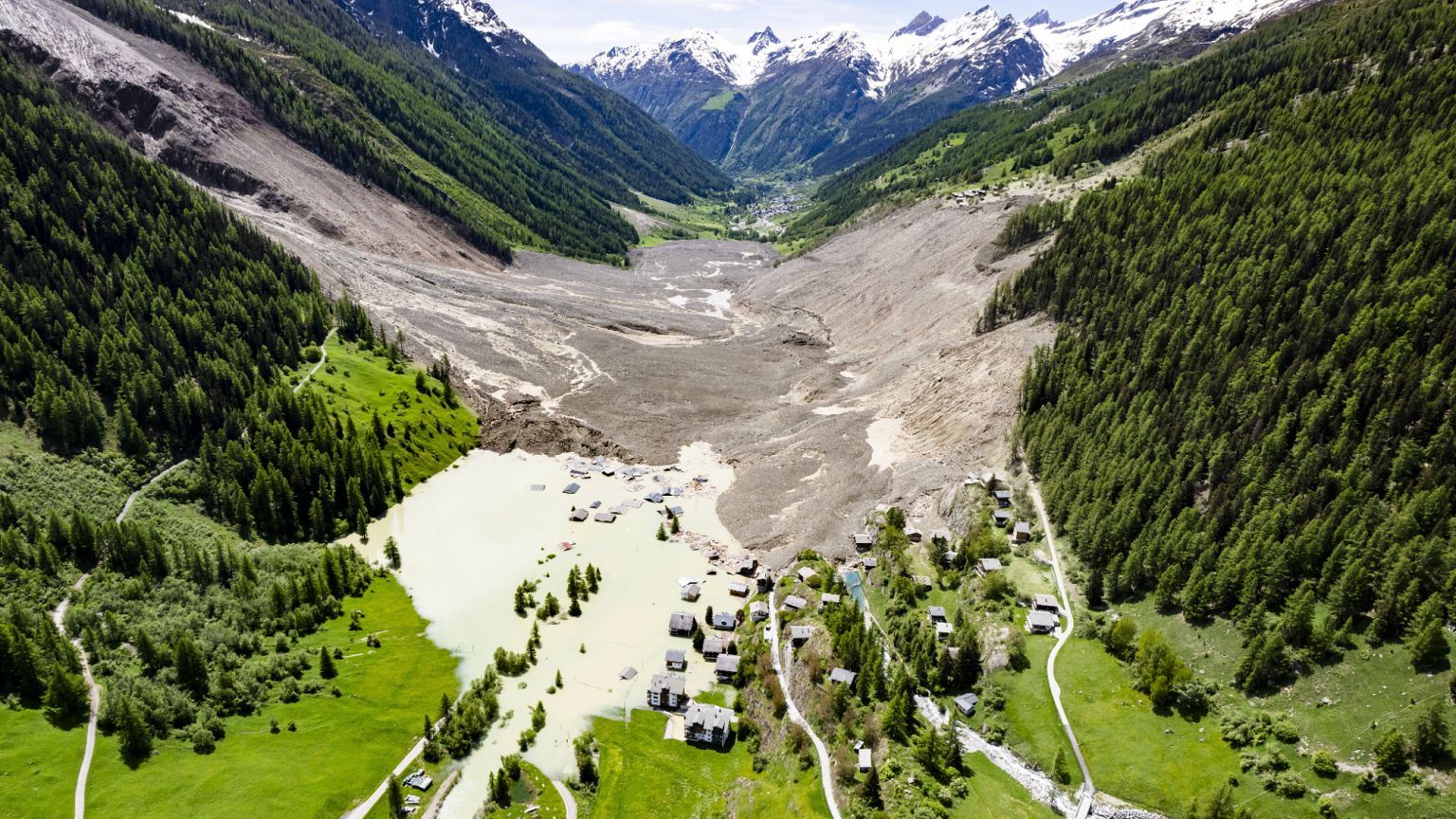
An aerial view shows the destruction after a landslide hit Blatten, 29 May, 2025
Copyright AP Photo

By Gavin Blackburn with AP
Published on 

The regional government said that a large chunk of the Birch Glacier above Glatten had broken off, causing the landslide, which also buried the nearby Lonza River bed.

The search for a missing 64-year-old man has been suspended because of unsafe conditions after a huge mass of rock and ice from a glacier crashed down a mountainside in Switzerland, burying the village of Glatten.

The landslide sent plumes of dust skyward and coated with nearly all of the Alpine village with mud that authorities had evacuated earlier this month as a precaution.

State Councillor Stéphane Ganzer told Radio Télévision Suisse (RTS) that 90% of the village was destroyed.

The Cantonal Police of Valais said that a search and rescue operation was temporarily suspended later on Thursday afternoon because of falling debris.

The regional government said in a statement that a large chunk of the Birch Glacier above the village had broken off, causing the landslide, which also buried the nearby Lonza River bed, raising the possibility of dammed water flows.
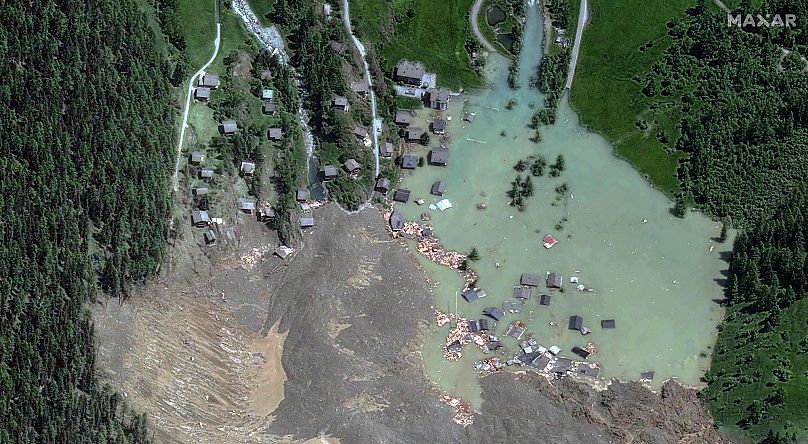
This satellite image provided by Maxar Technologies shows the village of Blatten after suffering a mudslide, 29 May, 2025AP Photo

Video on social media and Swiss television showed that the mudslide near Blatten, in the southern Lötschental valley, partially submerged homes and other buildings under a mass of brownish sludge.

Swiss President Karin Keller-Sutter is expected to visit the area on Friday.

In recent days, authorities had ordered the evacuation of around 300 people, as well as all livestock, from the village amid fears that the 1.5 million-cubic metre glacier was at risk of collapse.

Swiss glaciologists have repeatedly expressed concerns about a thaw in recent years, attributed in large part to global warming, that has accelerated the retreat of glaciers in Switzerland.

The landlocked Alpine country has the most glaciers of any country in Europe and saw 4% of its total glacier volume disappear in 2023.

That was the second-biggest decline in a single year after a 6% drop in 2022.


Climate action could save half of world’s vanishing glaciers, says study


By AFP
May 29, 2025


A tourist explores the Ritacuba Blanco glacier at the Natural National Park Nevado El Cocuy in Boyaca Department, Colombia, on April 19, 2024 - Copyright AFP/File Luis ACOSTA

Issam AHMED

More than three-quarters of the world’s glaciers are set to vanish if climate change continues unchecked, a major new study warned Thursday, fueling sea-level rise and jeopardizing water supplies for billions.

Published in Science, the international analysis provides the clearest picture yet of long-term glacier loss, revealing that every fraction of a degree in global temperature rise significantly worsens the outlook.

It may sound grim, but co-lead author Harry Zekollari, a glaciologist at Vrije Universiteit Brussel and ETH Zurich, told AFP the findings should be seen as a “message of hope.”

Under existing climate policies, global temperatures are projected to reach 2.7 degrees Celsius (4.9F) above pre-industrial levels by 2100 — a pathway that would ultimately erase 76 percent of current glacier mass over the coming centuries.

But if warming is held to the Paris Agreement’s 1.5C target, 54 percent of glacial mass could be preserved, according to the study, which combined outputs from eight glacier models to simulate ice loss across a range of future climate scenarios.

“What is really special about this study is we can really show how every tenth of a degree of additional warming matters,” co-lead author Lilian Schuster of the University of Innsbruck told AFP.

The paper’s release comes as Swiss authorities monitor flood risks following the collapse of the massive Birch Glacier, which destroyed an evacuated village.

While Swiss glaciers have been heavily impacted by climate change, it remains unclear how much the latest disaster was driven by warming versus natural geological forces.


– Cultural and economic importance –


Glaciers are found on every continent except Australia — from Mount Kilimanjaro to the Austrian Alps and the Karakoram range in Pakistan.

While most are clustered in the polar regions, their presence in mountain ranges across the world makes them vital to local ecosystems, agriculture and human communities.

Vast bodies of snow, ice, rock, and sediment that gain mass in winter and lose it in summer, glaciers formed in the Earth’s deep past when conditions were far colder than today.

Their meltwater sustains rivers critical for farming, fisheries, and drinking water.

Their loss can have profound ripple effects, from disrupting tourism economies to eroding cultural heritage.

In recent years, symbolic glacier funerals have been held in Iceland, Switzerland and Mexico.

“The question I always get is, why are you a glaciologist in Belgium?” said Zekollari. “Well — sea level rise. Glaciers melt everywhere on Earth… and that affects coastal defenses even in places far from mountains.”

Around 25 percent of current sea-level rise is attributed to glacier melt.

Even if all fossil fuel use stopped today, the study finds that 39 percent of glacier mass loss is already locked in — enough to raise sea levels by at least 113 millimeters (4.4 inches).


– Uneven impacts –


One key finding of the study is that some glaciers are far more vulnerable than others — and the global average obscures drastic regional losses.

Glaciers in the European Alps, the Rockies of the US and Canada, and Iceland are expected to lose nearly all their ice at 2C of warming — the fallback goal of the Paris accord.

In the central and eastern Himalayas, whose rivers support hundreds of millions of people, only 25 percent of glacier ice would remain at 2C.

By contrast, the west of the range may retain 60 percent of its ice at the same temperature thanks to its wide range of elevations, which allows some glaciers to persist at colder, higher altitudes, said Shuster.

Glacier loss is already affecting communities.

In a related commentary in Science, Cymene Howe and Dominic Boyer of Rice University describe how the retreat of Oregon’s Glisan Glacier has imperiled orchards, fisheries, and the cultural heritage of the Indigenous Quinault people.

“Unfortunately we’ll lose a lot, but with ambitious targets we can still save many of these glaciers — which are not only beautiful, but vital for water supply, sea-level regulation, tourism, hydroelectricity, spiritual values, ecology, and more,” said Zekollari.
Extreme environments and the triggering of wildfires

By Dr. Tim Sandle
May 29, 2025
DIGITAL JOURNAL


The aerial firefight has been crucial in the battle to tame huge wildfires that roared through Los Angeles - Copyright AFP Peter PARKS

North America regularly sees wildfires – from Hawaii up to Maui, Canada. Across a typical summer there can be more than 1,000 active fires. Despite the geographical distances, the wildfires share some similarities. Here, there is a connection to climate shifts and the anthroprocene.

These are drawn out by Brian Lattimer, Director of Virginia Tech’s Extreme Environments and Materials Lab, who has explained the ramifications to Digital Journal.

Wildfires

Wildfires can be classified by cause of ignition, physical properties, combustible material present, and the effect of weather on the fire. Climatic cycles with wet periods that create substantial fuels, followed by drought and heat, often precede severe wildfires.

Wildfires impact atmospheric conditions through emissions of gases, particles, water, and heat. An important consideration is radiative forcing, which refers to the change in net (down minus up) irradiance (solar plus longwave) at the tropopause, the top of the troposphere where most weather takes place.

Climate changes

While studies show links between climate change and increased frequency or severity of fire weather — periods with a high fire risk due to a combination of high temperatures, low humidity, low rainfall and often high winds – there is a human-centric connection.

Rising global temperatures, more frequent heatwaves and associated droughts in some regions increase the likelihood of wildfires by stimulating hot and dry conditions, promoting fire weather, which can be used as an overall measure of the impact of climate change on the risk of fires occurring.

Common factors


According to Lattimer points of similarity include: “Very high winds and dry vegetation are two primary things that you typically will see with all such fires. High winds typically tilt the fire in such a way that it’s able to propagate quickly, advancing to vegetation that’s not ignited. Very high winds also tend to dry out vegetation even more, so you have this situation where things can ignite very quickly. Terrain is a factor as well. Where it’s sloped upward, fire will advance very quickly.”

Another factor is the presence of ‘firebrands’. Lattimer defines these as: “Firebrands are these small pieces of vegetation that break off from burning trees or grass, fly up in the air, land on stuff a mile or two away, and ignite things. (If it’s flying in the air, then that’s a firebrand, and once it lands, it’s an ember.) It appears that this kind of thing may have been happening in Hawaii and happens all the time — they ignite things a mile or two away from the main fire, where firefighters aren’t located. By the time they get there, there’s usually a lot of damage.”

Lattimer directs the Extreme Environments and Materials Lab, which focuses on safety in extreme environments primarily related to fire.

Remediation


While humans have created climatic conditions that have the potential to lead to more wildfires, humans can also exert a significant potential to control how this fire risk translates into fire activity, in particular through land management decisions and ignition sources.


Driven by Groundwater Depletion, Colorado River Basin Has Lost Equivalent of Underground Lake Mead

"Everyone in the U.S. should be worried about it, because we grow a lot of food in the Colorado River Basin, and that's food that's used all over the entire country."


Aerial view of the Colorado River delta meeting the Cortes Sea at Valle de Mexicali, Baja California state, Mexico, on April 4, 2025.
(Photo: Guillermo Arias/AFP via Getty Images)


Julia Conley
May 28, 2025
COMMON DREAMS


The authors of a new study on water loss in the Colorado River Basin say "large-scale industrial farming" is closely tied to a major depletion of groundwater in the Southwest, where the pumping of groundwater is largely unregulated.

Researchers at Arizona State University used satellite data to measure groundwater supplies across the basin, which runs through seven states including Arizona, California, and Utah.

Measuring the Earth's gravity field to estimate the mass of underground water in the region, they found that the area has lost 27.8 million acre-feet of groundwater since 2003—roughly the same volume as the capacity of the nation's largest reservoir, Lake Mead.

The loss of groundwater has especially accelerated in the past decade, and the basin lost more than twice as much groundwater since 2003 as the amount of water taken out of reservoirs.

"Groundwater is disappearing 2.4 times faster than the surface water," Jay Famiglietti, the senior author of the study and a hydrologist at Arizona State University, told The Guardian.

Groundwater pumping is unregulated in much of the region, and the researchers noted that parts of the basin that have experienced the greatest losses are in areas with industrial alfalfa farming operations.

"Groundwater is disappearing 2.4 times faster than the surface water."

"Overpumping" is the main driver of groundwater loss in the past two decades, Famigletti said. "There's nothing illegal about it, it's just unprotected."

The Colorado River provides water to about 40 million people and millions of acres of farmland.

"Everyone in the U.S. should be worried about it, because we grow a lot of food in the Colorado River Basin, and that's food that's used all over the entire country," Famigletti told The Guardian.

While groundwater has been depleted, hotter temperatures fueled by the burning of fossil fuels have also contributed to especially arid conditions in the region over the past two decades. Since the beginning of the century the Colorado River's natural flow has been 13% lower than it was in the middle of the 20th century.

"We need to recognize where all this is happening and work with the state to put the brakes on," Famigletti toldThe Washington Post. "We used to say the Colorado River is the lifeblood of the western United States, but now it's becoming groundwater is the lifeblood."

States in the region were forced to reach a federal agreement in 2023 to limit water usage and try to protect the river's supply.

The more water that is lost from the river, Famigletti toldthe Post, "the more pressure there's going to be on the groundwater" in the basin.

"And then," he said, "it becomes a ticking time bomb."
Youth Sue Over Trump Executive Orders That 'Escalate' Climate Crisis

"He's waging war on us with fossil fuels as his weapon, and we're fighting back with the Constitution," said one of the 22 plaintiffs.


Eva Lighthiser, a 19-year-old from Livingston, Montana, is the named plaintiff in a federal lawsuit targeting three of U.S. President Donald Trump's anti-climate executive orders.
(Photo: Our Children's Trust)


Jessica Corbett
May 29, 2025
COMMMON DREAMS


Nearly two dozen American children and young adults sued U.S. President Donald Trump, leaders in his administration, and various agencies in federal court on Thursday over a trio of executive orders they argue "escalate" the climate emergency that imperils their futures.

Lighthiser v. Trump, filed in the U.S. District Court for the District of Montana, challenges executive orders (EOs) 1415614154, and 14261—which, respectively, declared a "national energy emergency," directed agencies to "unleash" American energy by accelerating fossil fuel development, and called for boosting the country's coal industry.

"Trump's fossil fuel orders are a death sentence for my generation," said named plaintiff Eva Lighthiser in a statement. "I'm not suing because I want to—I'm suing because I have to. My health, my future, and my right to speak the truth are all on the line. He's waging war on us with fossil fuels as his weapon, and we're fighting back with the Constitution."

Specifically, the complaint argues that "the EOs violate the Fifth Amendment substantive due process clause on their face by depriving plaintiffs of their fundamental rights to life and liberty." The filing also states that the orders are ultra vires—meaning they go beyond Trump's presidential authority "in assuming powers reserved to and exercised by Congress through Article I" of the U.S. Constitution.

"From day one of the current administration, President Trump has issued directives to increase fossil fuel use and production, and block an energy transition to wind, solar, battery storage, energy efficiency, and electric vehicles," the complaint reads. "President Trump's EOs falsely claim an energy emergency, while the true emergency is that fossil fuel pollution is destroying the foundation of plaintiffs' lives."

"These unconstitutional directives have the immediate effect of (a) slowing the buildout of U.S. energy infrastructure that eliminates planet-heating fossil fuel greenhouse gas pollution... and (b) increasing the use of fossil fuels that pollute the air, water, lands, and climate on which plaintiffs' lives depend," the filing stresses.


The youth are asking the district court to declare Trump's EOs and related executive actions "unlawful, unconstitutional, ultra vires, and invalid," and to issue a permanent injunction blocking the long list of defendants from implementing or enforcing them.

Lighthiser is a 19-year-old from Livingston, Montana. She and 24-year-old Rikki Held are among 10 of 22 plaintiffs in this case who were also part of Held v. State of Montana, in which a judge in 2023 agreed with young residents who argued that Montana violated their state constitutional rights by promoting fossil fuel extraction. The Montana Supreme Court upheld that decision last December.

Both groups of young plaintiffs are represented by Our Children's Trust, known for several youth climate lawsuits, including Juliana v. United States, the landmark constitutional case that the U.S. Supreme Court ended in March.

Lead attorney Julia Olson of Our Children's Trust said Thursday that "these executive orders are an overt abuse of power. The president is knowingly putting young people's lives in danger to serve fossil fuel interests, while silencing scientists and defying laws passed by Congress."

"These young plaintiffs refuse to be collateral damage in a fossil fuel war on their future," Olson continued. "They are demanding accountability where it still matters—in a court of law. The executive branch is not above the Constitution, and these young people are here to prove it."

For Lighthiser v. Trump, Our Children's Trust has partnered with Gregory Law Group, McGarvey Law, and Public Justice.

"The government's actions irreparably harm our nation's most important asset: our children," said Dan Snyder, director of the Environmental Enforcement Project for Public Justice. "The science is irrefutable that humans and their pollution are causing climate change, and that a changing climate will result in a growing list of injuries that are uniquely felt by America's youngest population."

"Our children enjoy the same constitutional rights to life and liberty as adults, yet have been tasked with shouldering the impact of a destabilized climate system without ever having a say in the matter," he added. "President Trump's executive orders are unlawful and intolerable, and these youth plaintiffs shall put an end to it."

Woman Files First Climate-Related Wrongful Death Suit Against Fossil Fuel Companies


"These fossil fuel actors should be held accountable to the victims of their lethal conduct, and this wrongful death suit provides a compelling new approach for climate victims moving forward."


A billboard displays a temperature of 118°F during a record heatwave in Phoenix, Arizona on July 18, 2023.
(Photo: Patrick T. Fallon/AFP via Getty Images)


Julia Conley
May 29, 2025
COMMON DREAMS

Two years after legal scholars wrote in the Harvard Environmental Law Review that fossil fuel companies could feasibly be charged with homicide in cases of people who are killed by climate-fueled extreme weather events, one woman is taking a major step toward holding oil and gas giants accountable for a specific death—that of her mother, who died during an extreme heatwave in 2021.

Misti Leon filed a civil lawsuit against Exxon Mobil, Chevron, Shell, BP, ConocoPhillips, Phillips 66, and BP subsidiary Olympic Pipeline Company, arguing that their knowledge going back decades that extracting oil and gas would heat the planet makes them liable for the death of her mother, Juliana.

Juliana Leon, who was 65, was making a 100-mile drive home from a doctor's appointment in Seattle on June 28, 2021 when she pulled over and rolled down her car windows. Emergency workers found her hours later having died of hyperthermia, or overheating, with her body temperature having reached 110°F.

A heat dome had settled over the Pacific Northwest, with high pressure trapping hot air over the region, and the World Weather Attribution later found that the heat dome would have been "virtually impossible" without climate change resulting from fossil fuel emissions.

About 600 more people died in Oregon and Washington in late June 2021 than would have been typical for a one-week period, and Leon is arguing that the death of her mother from hyperthermia, or overheating, was the direct result of fossil fuel companies' actions.

Leon is arguing in the case that, as numerous investigations have found, fossil fuel companies have known for decades that extracting oil and gas would cause planet-heating emissions and could result in extreme, potentially deadly weather events like heatwaves, flooding, and wildfires.

"The purpose of criminal law enforcement is to deter future crimes, promote public safety, punish wrongdoers, and encourage the convicted to pursue less harmful practices. All of these public safety goals apply to Big Oil's continuing contributions to climate change."

"Why shouldn't we hold someone legally accountable for this kind of behavior?" David Arkush, director of Public Citizen's Climate Program and a co-author of the Harvard Environmental Law Review paper, toldThe New York Times. "There would be no question that we would hold them accountable if they caused other types of deaths. This is no different. They foresaw this, they did it anyway, and they hurt people."

Lee Wasserman of the Rockefeller Family Fund called the lawsuit an "important moment for climate accountability."

Although Leon's case is the first, according to legal experts, to attempt to hold fossil fuel giants accountable for a specific death, it is a significant step in a wider effort to bring the industry to justice for its role in causing weather disasters.

Vermont and New York both passed climate superfund laws last year that would allow the states to hold oil companies financially liable for extreme weather events and force them to pay for damages. U.S. Attorney General Pam Bondi has announced lawsuits against the two states over the laws.

In the past decade, dozens of localities and states have also filed lawsuits against oil and gas companies for hiding their knowledge of the impact fossil fuel extraction would have on average global temperatures and the climate.

Aaron Regunberg, accountability project director for Public Citizen's Climate Program, said climate disasters like the one that allegedly killed Juliana Leon "are the foreseeable, and foreseen, consequences of specific actions by fossil fuel corporations, CEOs, and boards of directors."

"They caused the climate crisis and deceived the public about the dangerousness of their products in order to block and delay solutions that could prevent heat deaths like Juliana's," said Regunberg. "These fossil fuel actors should be held accountable to the victims of their lethal conduct, and this wrongful death suit provides a compelling new approach for climate victims moving forward."

"The purpose of criminal law enforcement is to deter future crimes, promote public safety, punish wrongdoers, and encourage the convicted to pursue less harmful practices," he added. "All of these public safety goals apply to Big Oil's continuing contributions to climate change, and prosecutors across the country should take note of this new wrongful death suit and carefully consider how the climate effects their constituents are experiencing fit the criminal laws they are charged with enforcing."
'Devastating Loss for Our Wild Places': Supreme Court Attacks Bedrock Environmental Law


"The Trump administration will treat this decision as an invitation to ignore environmental concerns as it tries to promote fossil fuels, kill off renewable energy, and destroy sensible pollution regulations."


A Utah oil extraction site with storage tanks was photographed on September 3, 2024.
(Photo: Zen Rial/Getty Images)


Jessica Corbett
May 29, 2025
COMMON DREAMS

In a 8-0 ruling on Thursday, the U.S. Supreme Court not only reversed a block on a proposed oil train in Utah but also narrowed a landmark federal environmental law, sparking intense alarm about what the ruling will mean for communities and all living things across the country.

"Today's decision undermines decades of legal precedent that told federal agencies to look before they leap when approving projects that could harm communities and the environment," said Earthjustice senior vice president of program Sam Sankar in a statement. "The Trump administration will treat this decision as an invitation to ignore environmental concerns as it tries to promote fossil fuels, kill off renewable energy, and destroy sensible pollution regulations."


Since the National Environmental Policy Act (NEPA) was signed into law in 1970 by Republican then-President Richard Nixon, it has become a key target for GOP policymakers aligned with the planet-wrecking fossil fuel industry, including President Donald Trump, who swiftly took aim at the law after returning to office in January.

"We urgently need to strengthen laws like NEPA, not weaken or narrow them, so that we can prioritize the health of people over polluters and corporate greed."

NEPA requires federal agencies to prepare an environmental impact statement (EIS) for certain infrastructure projects. In 2023, the U.S. Court of Appeals for the District of Columbia Circuit tossed both an EIS for the proposed Uinta Basin Railway and the U. S. Surface Transportation Board's approval of the project, which would connect Utah's oil fields to the national rail network.


After hearing arguments for Seven County Infrastructure Coalition v. Eagle County in December, the nation's highest court reversed that decision on Thursday, continuing a trend of rulings slammed by environmentalists as gifts to corporate polluters.

Conservative Justice Neil Gorsuch recused himself without explanation. Politiconoted that "it followed a public pressure campaign from environmental groups and Democrats who argued his close connections to the owner of oil and gas producer Anschutz—which filed a brief in the case saying NEPA's scope was critical to developing oil and gas reserves—disqualified him."

Justice Brett Kavanagh delivered the opinion, joined by the other right-wingers who participated in the case. Justice Sonia Sotomayor filed a concurring opinion, joined by the other two liberals.

Kavanaugh wrote for the majority that "the D. C. Circuit failed to afford the board the substantial judicial deference required in NEPA cases and incorrectly interpreted NEPA to require the board to consider the environmental effects of upstream and downstream projects that are separate in time or place from the Uinta Basin Railway."


Environmental and public health advocates were quick to warn of the impacts of not only this 88-mile rail project, if completed, but also the decision more broadly.

"This decision is terrible news for the entire Colorado River Basin," said John Weisheit, conservation director at Living Rivers. "To avoid the pending collapse of the Colorado River, we have to immediately reduce water consumption by 25% and cut carbon emissions by 50% by the end of this decade. Our federal decision-makers must deny any project that counters these objectives. The Uinta Basin Railway unquestionably falls into that category and should never see the light of day."

Critics of the ruling are worried about increased oil extraction in Utah as well as additional refining in Gulf of Mexico communities.

"Regrettably, the Supreme Court has scored one for the oil companies who don't want you to look too closely at the harm their product will do to Black and Brown communities in Cancer Alley," said Sierra Club senior attorney Nathaniel Shoaff. "Our bedrock environmental laws, like NEPA, are meant to ensure people are protected from corporate polluters."

"Fossil fuel infrastructure projects do not exist in a vacuum and have far-reaching impacts on communities, especially those on the frontlines of climate change or those who face serious health harms from increased pollution," Shoaff stressed.

"The last thing we need is another climate bomb on wheels that the communities along its proposed route say they don't want."

Center for Biological Diversity senior attorney Wendy Park declared that "the last thing we need is another climate bomb on wheels that the communities along its proposed route say they don't want," and vowed to "keep fighting to make sure this railway is never built."

Park also looked beyond the train project, warning that "this disastrous decision to undermine our nation's bedrock environmental law means our air and water will be more polluted, the climate and extinction crises will intensify, and people will be less healthy."

WildEarth Guardians staff attorney Katherine Merlin similarly emphasized that "today's decision is a devastating loss for our wild places, our wild rivers, and for all of the human and nonhuman communities that depend on a clean environment and stable climate."

The ruling comes as the Trump administration and congressional Republicans are working to boost planet-heating fossil fuels, ignoring scientists' warnings about the worsening climate emergency.

"After the hottest year on record, when the U.S. should be improving environmental safeguards and empowering frontline communities, this decision is a giant step backwards," said Ashfaq Khalfan, Oxfam America's director of climate justice. "Everyone deserves to live and work in communities with clean air and safe drinking water. We urgently need to strengthen laws like NEPA, not weaken or narrow them, so that we can prioritize the health of people over polluters and corporate greed."
German Court Tosses Farmer's Case But Climate Groups Cheer 'Remarkable Precedent'

"This historic judgment lays the next building block in corporate climate accountability," said Jasper Tuelings of the Climate Litigation Network.


Peruvian mountain farmer Saúl Luciano Lliuya arrives for a court hearing in Huaraz, Peru on May 27, 2022.
(Photo: Steven Guio Osorio/picture alliance via Getty Images)

Jessica Corbett
May 28, 2025
COMMON DREAMS


After a decade of legal proceedings, a German court on Wednesday dismissed a Peruvian farmer's case against energy giant RWE, but both he and green groups still hailed what they called a "landmark ruling" that launched a "new era of accountability" by "setting a powerful precedent."

The farmer, 44-year-old Saúl Luciano Lliuya, grows barley, corn, potatoes, and wheat outside Huaraz, Peru. In 2015, he sued RWE—one of Europe's biggest climate polluters—in Essen, Germany, where the company is headquartered. Although the German utility doesn't operate in Luciano Lliuya's country, he argued that its emissions contributed to the melting of Andean glaciers.

"He said that as a result, Lake Palcacocha—which is located above the city—now has four times as much water than in 2003 and that residents like him were at risk of flooding, especially if blocks of ice were to break off from Palcacocha glacier and fall into the lake, causing it to overflow," according to the BBC. The farmer sought around €17,000, or $19,000, from RWE toward a $3.5 million project to protect Huaraz.

As Reutersreported Wednesday:
Presiding judge Rolf Meyer, at the court in the western city of Hamm, said experts' estimate of the 30-year damage risk to the plaintiff's house of 1% was not enough to take the case further.

Had there been a larger adverse effect, a polluter could have been made to slash emissions or pay damages, Meyer said.

Meyer said the plaintiff's case was argued coherently and that it was "like a microcosm of the world's problems between people of the southern and the northern hemisphere, between the poor and the rich."

"Today the mountains have won," Luciano Lliuya said in a Wednesday statement. "Even if my case doesn't go any further, it has reached an important milestone, and that makes me proud. This ruling shows that the big polluters driving the climate can finally be held legally responsible for the harm they have caused."

"I am, of course, disappointed that the court reached a different conclusion from the glacier scientists who have studied this region for decades and believe my home is at risk," he continued. "We won't receive support from RWE to protect us from the flood risk. But this case was never just about me. It was about all the people who, like us in Huaraz, are already living with the consequences of a crisis we did not create. This ruling opens the door for others to demand justice."

The farmer's lawyer, Roda Verheyen, also framed the decision as a major step forward, saying that "today's ruling is a milestone and will give a tailwind to climate lawsuits against fossil fuel companies, and thus to the move away from fossil fuels worldwide. The plaintiff is grateful to the German courts for the seriousness with which his case was treated."

Other advocates and experts similarly weighed in. Ecojustice climate director Charlie Hatt declared that "this is a historic moment for climate litigation," while University of Oxford professor Thom Wetzer said that "this decadelong case has borne fruit," setting "a remarkable precedent that could enable future cases."

Jasper Tuelings, a strategic adviser with Climate Litigation Network, said that "this historic judgment lays the next building block in corporate climate accountability. Last year's Shell ruling showed us that big polluters have a legal obligation to reduce their future emissions in line with the Paris agreement—today's ruling affirms that these companies can be held accountable for their past emissions too."


RWE, meanwhile, said in a statement that "the decision of the Hamm Higher Regional Court means that the attempt, supported by German NGOs, to use Mr Luciano Lliuya's lawsuit to create a precedent for holding individual companies responsible for the effects of climate change worldwide under German law has failed."

"RWE has always considered such civil 'climate liability' to be inadmissible under German law," RWE added, warning of "unforeseeable consequences for Germany as an industrial location," and noting that "other German courts have dismissed similar climate lawsuits—for example against Volkswagen, Mercedes-Benz, and BMW."

Despite the company's comments, climate advocates appeared undeterred. Sebastien Duyck, a senior attorney at the Center for International Environmental Law, said that "Saul's breakthrough opens up a well of opportunities for the more than 40 similar cases ongoing. It makes it more likely that those living at the sharp edge of climate change, such as Saul and his community, can succeed in holding heavy emitters to account for the damage they cause."

Friederike Otto, a senior lecturer at the Grantham Institute for Climate Change and the Environment, highlighted how science has evolved since Luciano Lliuya's case began a decade ago, which could impact ongoing and future legal proceedings.

"The science is absolutely clear... Human-induced climate change is already affecting weather and climate extremes in every region across the globe," Otto said, citing the Intergovernmental Panel on Climate Change. "This includes Saul's city of Huaraz and RWE contributed without any doubt to climate change."

"The precedent that this case has set underlines just how important scientific evidence is in the global fight against climate change," Otto added. "Since the case was filed 10 years ago, scientists have developed a large body of evidence showing how much companies and states can be held responsible for climate disasters. This is therefore a landmark moment for climate justice, ensuring that communities living in constant danger can hold carbon majors to account."
'This Is Bad': Haiti Reportedly Hired Erik Prince to Help Kill Gang Members

"It's hard to overstate how badly wrong bringing in foreign mercenaries, such as those allied with Erik Prince, will likely go given the current security, social, and political dynamics," one journalist warned.


Blackwater founder Erik Prince walks with police during an anti-crime operation on April 5, 2025 in Guayaquil, Ecuador.
(Photo: Agencia Press South/Getty Images)

Jessica Corbett
May 28, 2025
COMMON DREAMS

"What could possibly go wrong?"

That's a questionNew York Times readers sarcastically asked on social media Wednesday, after the newspaper reported that Erik Prince, founder of the notorious mercenary firm Blackwater and a key ally of U.S. President Donald Trump, is working with Haiti's interim government "to conduct lethal operations against gangs that are terrorizing the nation and threatening to take over its capital."

The newspaper noted that Prince declined to comment, and while Blackwater is now defunct, the former Navy SEAL "owns other private military entities." The reporting is based on unnamed American and Haitian officials and other security experts.

"Haiti's government has hired American contractors, including Mr. Prince, in recent months to work on a secret task force to deploy drones meant to kill gang members," who "have been killing civilians and seizing control of vast areas of territory" in the Caribbean country, the Times detailed.

"Mr. Prince's team has been operating the drones since March, but the authorities have yet to announce the death or capture of a single high-value target," according to the paper. Pierre Espérance, executive director of the National Human Rights Defense Network in Haiti, said the drone attacks have killed more than 200 people.

American journalist Michael Deibert said on social media, "If this story is accurate, on what authority does Haiti's unelected, temporary interim [government] invite foreign forces into the country and by what means—with whose money—do they intend to pay them for their work there?"

The U.S. State Department has poured millions into Haiti's National Police but told the Times it is not paying Prince.

Deibert said that "as someone who has reported on Haiti's armed groups for 25 years, it's hard to overstate how badly wrong bringing in foreign mercenaries, such as those allied with Erik Prince, will likely go given the current security, social, and political dynamics in the country."


Also weighing in on social media, Keanu Heydari, a history Ph.D. candidate at the University of Michigan, said: "A lot's going on here! A majority-Black nation, hollowed out by decades of foreign intervention, 'turning to' a white war profiteer to restore 'order.' That is not about logistics, this is about coloniality."

Heydari continued:
This isn't a story about drones and gangs. It's about how the world has made it structurally impossible for Haiti to govern itself—then offers mercenaries as a "solution." Haiti's sovereignty has been chipped away by debt, coups, U.N. missions, and now private warlords.

Why does Erik Prince show up where Black and Brown countries are in crisis? Because the global market rewards violence disguised as security, especially when it's sold by Westerners to postcolonial states. It's racial capitalism in full view.

The NYT missed the story: This isn't a desperate government making tough choices. It's a story of empire outsourcing control, where mercenaries profit from the very chaos empire helped produce. Haiti deserves justice, not occupation by other means.


The Times article follows The Economist's reporting earlier this month that Haiti's interim government, the Transitional Presidential Council, "is so desperate that it is exploring deals with private military contractors. It has been talking to Osprey Global Solutions, a firm based in North Carolina. The founder of Blackwater, Erik Prince, visited Haiti in April to negotiate contracts to provide attack drones and training for an anti-gang task force. The council declined to comment."

In response to that paragraph in the May 7 article, Jake Johnston, director of international research at the Center for Economic and Policy Research and author of Aid State: Elite Panic, Disaster Capitalism, and the Battle to Control Haiti, also asked, "What could possibly go wrong?"


THE BLACK PRINCE OF PRIVATE SECURITY SERVICES
Exclusive: Trump supporter Prince reaches deal with Congo to help secure mineral wealth


Insiders Say Trump Foreign Aid Cuts Causing 'Violence and Chaos' in Fragile Nations

"It is devastating, but it's not surprising," said one former senior State Department official. "It's all what people in the national security community have predicted."


A woman walks in the Dzaleka Refugee Camp in Dowa, Malawi.
(Photo: Angela Jimu/Universal Images Group via Getty Images)


Brett Wilkins
May 28, 2025
COMMON DREAMS

U.S. State Department officials in at least two countries have recently warned that the Trump administration's sudden foreign aid cutoff is fueling "violence and chaos" in some of the world's most vulnerable nations, according to a report published Wednesday.

Internal State Department communications viewed by ProPublicarevealed that U.S. Embassy officials in the southeastern African nation of Malawi sounded the alarm on cuts to the United Nations World Food Program (WFP), which have "yielded a sharp increase in criminality, sexual violence, and instances of human trafficking" in the Dzaleka refugee camp.

Meanwhile, dramatically reduced U.S. funding to feed refugees in Kenya has sparked violent protests and other incidents, including the trampling death of a pregnant woman during a stampede for food in which police opened fire on desperately hungry people.


This, as President Donald Trump's administration—spearheaded by the so-called Department of Government Efficiency and its de facto leader, Elon Musk—has taken a wrecking ball approach to vital offices and programs including the U.S. Agency for International Development (USAID), where contracts for programs including those that fed and provided healthcare for millions of people and fought diseases like malaria and HIV/AIDS have been slashed by up to 90%.

Republicans have attempted to justify the cuts under the guise of tackling the staggering U.S. national debt, even as they push a massive tax cut that would disproportionately benefit the ultrarich and corporations while adding trillions of dollars to the deficit, according to a nonpartisan congressional committee.

Although a federal judge ruled in March that Musk's moves to shutter USAID were likely unconstitutional and ordered a halt to the effort, much damage has already been done.

"It is devastating, but it's not surprising," Eric Schwartz, a former State Department assistant secretary and National Security Council member, told ProPublica. "It's all what people in the national security community have predicted."

"I struggle for adjectives to adequately describe the horror that this administration has visited on the world," Schwartz added. "It keeps me up at night."

It is unclear if any of the cables were sent via the official dissent channel set up during the administration of then-President Richard Nixon in an effort to allow State Department personnel to voice opposition to U.S. policies and practices—especially in regard to the Vietnam War—and stop leaks to the press.

The State Department responded to the ProPublica exposé in a statement saying: "It is grossly misleading to blame unrest and violence around the world on America. No one can reasonably expect the United States to be equipped to feed every person on Earth or be responsible for providing medication for every living human."

Earlier this month, U.S. Secretary of State Marco Rubio claimed during a congressional hearing that "no one has died" due to USAID cuts, an assertion refuted by Congressman Brad Sherman (D-Calif.), who displayed photos and harrowing stories of people who have, in fact, died since funding for vital programs was slashed or eliminated.

"It's clear that people are dying because U.S. aid was suspended and then reduced. But it's difficult to come up with a precise death toll that can be tied directly to Trump administration policies," according to a Washington Post analysis by Glenn Kessler published on Tuesday. "The death certificates, after all, aren't marked, 'Due to lack of funding by U.S. government.'"

Last month, the international medical charity Doctors Without Borders (MSF) said that there will be "more preventable deaths and untold suffering around the world" due to the Trump administration.

"These sudden cuts by the Trump administration are a human-made disaster for the millions of people struggling to survive amid wars, disease outbreaks, and other emergencies," Avril Benoît, who heads the U.S. branch of MSF, said last month.

"We are living off the fumes of what was delivered in late 2024 or early 2025."

On the ground in Kenya, WFP country director Lauren Landis told ProPublica that her organization is cutting daily aid rations to less than 600 calories per person—far less than the standard minimum 2,100 calories per day under agency guidelines.

"We are living off the fumes of what was delivered in late 2024 or early 2025," Landis said, describing children who look like "walking skeletons" due to severe malnutrition.

Meanwhile, enough food to feed more than 1 million people in some of the world's most fragile places through most of the summer is moldering in storage as USAID funds run dry and workers are laid off.

This, warned WFP last month, "could amount to a death sentence for millions of people facing extreme hunger and starvation."
THE GRIFT

Musk Exits Trump Administration, Leaving 'Legacy of Carnage and Corruption' in His Wake


"We will have to keep up the pressure, scrutiny, and eventually formal oversight until we finally take back our government from Musk and the entire billionaire class," said Rep. Greg Casar.


Elon Musk is pictured at a SpaceX facility in Brownsville, Texas on May 27, 2025.
(Photo: Marvin Joseph/The Washington Post via Getty Images)

Jake Johnson
May 29, 2025
COMMON DREAMS


Billionaire Elon Musk announced late Wednesday that he is leaving the Trump administration after spearheading a monthslong, lawless rampage through the government that hollowed out entire agencies, hurled critical functions such as the distribution of Social Security benefits into chaos, and installed many unqualified lackeys whose work will continue in the coming months and years.

Musk's announcement came just ahead of the official May 30 deadline for his departure as a special government employee. That designation allowed the world's richest man to play a key role in the Trump White House without facing Senate confirmation or the full slate of ethics rules that apply to ordinary federal officials.

"As my scheduled time as a special government employee comes to an end, I would like to thank President [Donald Trump] for the opportunity to reduce wasteful spending," Musk wrote on his social media platform, X. "The DOGE mission will only strengthen over time as it becomes a way of life throughout the government."

While Musk came nowhere close to his initially stated goal of slashing $2 trillion in federal spending, his team's infiltration and efforts to gut federal agencies inflicted lasting damage, progressive lawmakers and watchdog groups said in response to news of his departure.

"DOGE is not a way of life, it's a mantra of destruction," said Lisa Gilbert, co-president of Public Citizen. "The legacy of Elon Musk is lost livelihoods for critical government employees, hindered American education, loss of funding for scientists, and the violation of Americans' personal privacy, all in the service of corrupt tech-bro billionaire special interests."

"The carnage is even more horrifying internationally, as Musk's chainsaw will lead to the pointless and needless deaths of likely millions of people in the developing world," Gilbert added. "This is a legacy of carnage and corruption that will haunt us for many years to come."

Rep. Greg Casar (D-Texas), chair of the Congressional Progressive Caucus, called Musk's exit a win for "the anti-corruption, anti-billionaire movement in American politics" but warned that the Tesla and SpaceX CEO's "likely goal is to continue exercising corrupt influence—just from behind a curtain, as billionaires too often do."

"We will have to keep up the pressure, scrutiny, and eventually formal oversight until we finally take back our government from Musk and the entire billionaire class," Casar said.

Next week, the Trump White House plans to send to the Republican-controlled Congress a $9.4 billion rescission package that, if passed, would codify some of the spending cuts pursued by Musk's team. Politicoreported that the package "will target NPR and PBS, as well as foreign aid agencies that have already been gutted by the Trump administration."

The impact of DOGE-led attacks on federal agencies and Trump's withholding of hundreds of billions of dollars of congressionally approved spending will persist long after Musk's exit.

Reuters highlighted one example last week, reporting that "Head Start preschool programs for low-income U.S. children are scrambling to cope with funding cuts and delays, as they feel the squeeze of President Donald Trump's cost-cutting drive."

"Adding to the strain," the outlet noted, "Elon Musk's Department of Government Efficiency released $943 million less in congressionally approved funding for distribution through April 15 compared with the previous year."