Friday, May 30, 2025


Eregli Shipyard Builds Tugboats for General Directorate of Coastal Safety

Med Marine

Published May 30, 2025 4:54 PM by The Maritime Executive


[By: Med Marine]

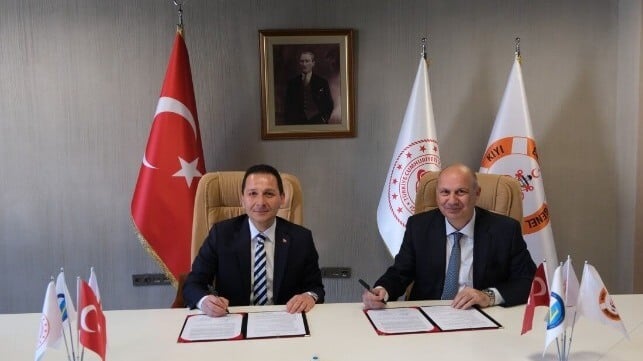
Eregli Shipyard proudly announces its latest achievement: being awarded the tender by the Directorate General of Coastal Safety (KEGM) for the construction of two of Turkiye’s most powerful escort tugboats—each measuring 42 meters in length and delivering an impressive 130 tons of bollard pull. The contract was officially signed on May 5, marking a significant milestone in Med Marine’s Eregli Shipyard’s continued contributions to maritime excellence both in its home country and abroad.

A signing ceremony has been held for the construction of two emergency response tugboats, each with a minimum bollard pull of 130 tons—set to become the most powerful escort tugs in Türkiye. Having left its mark across the globe through a multitude of distinguished projects, Eregli Shipyard now welcomes the privilege of contributing to the safety and strength of Turkiye’s maritime domain.

Each vessel, stretching 42 meters in length, will be meticulously crafted to meet the demands of modern port operations. Fitted with an advanced off-ship fire-fighting system in accordance with Class Fire Fighting Ship 1 requirements, the tugboats are designed to respond swiftly and effectively to emergency scenarios, including high-risk terminal operations.

The advanced firefighting system, supplied by Fire Fighting Systems (FFS), includes two engine-driven pumps feeding monitors capable of delivering 1200 m³/h of water and 300 m³/h of foam—ensuring rapid and effective emergency response. A robust fendering layout, including cylindrical and 'W' block bow fenders, 'D' fenders along the sheer line, provides safe and reliable manoeuvring in high-risk operations.

Commenting on this significant partnership, Recai Hakan ?en, Chairman of Med Marine Holding and Eregli Shipyard, stated:

“As a company that has successfully delivered tailor-made vessels to clients across the globe, it is a source of great pride for us to now channel our expertise into serving our own country. Working alongside the Directorate General of Coastal Safety on such a strategically important project holds special significance for all of us at Eregli Shipyard. These powerful tugboats are more than just vessels—they represent our responsibility to contribute to the safety of Turkish waters with the same care and precision we bring to every project, near or far.”

Chairman of the Board and Director General of the Directorate General of Coastal Safety, Mr. Mustafa Bankao?lu, stated the following:

“As the Directorate General of Coastal Safety, the operational force of the Ministry of Transport and Infrastructure at sea, uninterrupted service is provided 24/7, and all necessary measures are taken at the highest level to enhance navigational safety as well as the safety of life, property, and the environment. National and domestically developed projects are being steadily implemented. Today, we take great pride and joy in witnessing the signing ceremony for the construction of two Emergency Response Tugboats, which will each have a minimum bollard pull of 130 tons and will stand as the most powerful escort tugs in Türkiye—representing one of the finest and most concrete examples of these projects. On this occasion, I would like to once again express my sincere thanks to our Minister of Transport and Infrastructure, Mr. Abdulkadir Uralo?lu, for his strong support and vision throughout the process, as well as to ERE?L? SHIPYARD and all colleagues involved in the project.”

With this prestigious project, Eregli Shipyard once again blends its global engineering vision with a deep-rooted dedication to serving its country — setting course for a safer, stronger, and more resilient maritime future.

Technical specifications of the tugboats:

Length: 42 m
Max. Draft: 7.5 m
Depth: 6.4 m
Beam: 16 m
Bollard Pull: Min. 130 tons
Speed: 14 knots
Crew: 11 persons

The products and services herein described in this press release are not endorsed by The Maritime Executive.


UCL: Ammonia is the Cheapest Compliance Option for New IMO Carbon Rules

Ammonia
File image

Published May 29, 2025 9:08 PM by The Maritime Executive


When the University College London's Energy Institute used detailed modeling to evaluate the IMO's highly complex new carbon price structure, they came to a surprising conclusion: if proven safe, dual-fuel ammonia propulsion will be the least-cost alternative for shipowners who want to comply with the rules in the 2030s and beyond - and it reduces the risk of fuel unavailability, too.

"Although there are significant complexities and uncertainties in what was agreed [at IMO MEPC 83] in April, even conservative projections of how remaining policy details will be finalised results in a ‘no brainer’ choice for shipowners in dual fuel ammonia," said Dr. Tristan Smith, Professor of Energy and Transport at the UCL Energy Institute. 

UCL's 40-page study illustrates what owners are quickly finding out: a winning business strategy for carbon compliance is going to require a lot of math.

The IMO is not planning a simple flat tax on bunker fuel. Instead, ships will be expected to meet an emissions intensity standard, which gets more strict over time. If owners meet the standard, they pay the IMO nothing. If they emit too much, they can comply by paying a tax (remedial units) at prices that will rise at a yet-to-be-determined pace. Alternatively, they can overcomply and sell their emissions credits (surplus units) to other owners, and collect yet-to-be-determined subsidies (rewards) for using low-emission fuels.

The details for these factors change over time, so a business plan for the 25-year lifespan of a newbuild has to account for different compliance requirements and cost structures in the 2020s, 2030s and 2040s. 

Initially, UCL found, LNG dual-fuel ships will have an edge on cost. But as the emissions intensity standard gets tougher in the mid-2030s, the cost of compliance for LNG will go up. Ammonia dual-fuel ships begin to win out because they can burn blue ammonia, made from cheap natural gas with the added bonus of onshore carbon capture. Running a ship on blue ammonia will generate a lot of IMO surplus units, which can be sold to other shipowners to offset the cost of the fuel. 

"Blue ammonia, which also benefits from the low gas price outlook modelled, is the only fuel with an abatement cost lower than the initial [remedial unit] price and the only fuel capable of generating significant volumes of [surplus units] into the mid-2030s," UCL concluded. 

This is enough to make the ammonia dual-fuel strategy the winning business case, even before taking expected IMO rewards for zero and near-zero fuels into account, according to UCL. 

Optionality adds another bonus in an uncertain landscape. With a dual-fuel ammonia hull, the operator can burn fossil bunker fuel; biofuel; blue ammonia; or e-ammonia, made with green electricity. This means the operator can pick from the best available pricing in the markets for natural gas, oil, biofuel or green power, depending on how the energy market fluctuates. 

The study's findings would put LNG in second place, and the authors included a warning that LNG bunkering infrastructure investments could prove unnecessary if ammonia takes hold (a cautionary note that UCL has sounded before). The authors also discounted the possibility of onboard carbon capture, noting cost and infrastructure requirements. 

"Despite any early dominance LNG may achieve in the late 2020s, its prospects become more challenging by the early 2030s. LNG's relatively high emissions intensity presents a fundamental constraint—it cannot generate surplus units (SUs) without onboard carbon capture and storage technology," found UCL. "Consequently, LNG dual-fuel (DF) ships must rely on either lower-emission drop-in fuels (such as bio-LNG, bio-marine gas oil, or e-LNG) or accept penalty costs."


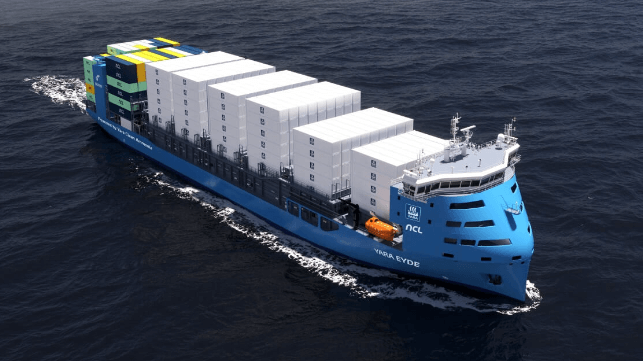
Yara is Ready for Ammonia-Powered Shipping

Yara ammonia powered ship
Courtesy Yara

Published May 29, 2025 6:18 PM by Nor-Shipping


As the maritime industry scans the horizon for scalable zero-emission fuels, low emission ammonia is looming ever larger as a potential solution for deep sea operators. Here Hans Olav Raen, CEO of Yara Clean Ammonia, explains the universal appeal of the power source, while outlining why his company has the experience, knowledge and global vision to help fuel the future of sustainable shipping.

“No one is better positioned than Yara to capture value in the clean ammonia market,” states Hans Olav Raen, the man leading the charge for one of the longest established producers of this zero-to-near-zero emission fuel.

“We’re the world’s second-largest ammonia producer and operate the largest export and trading network. This gives us a unique platform to support maritime in the transition to a more sustainable future.”

Ammonia, as many readers will be aware, is often regarded as the closest thing to a ‘silver bullet’ shipping has in its voyage towards net zero by 2050. With no carbon dioxide released at combustion point, ammonia edges ahead of close cousin hydrogen (for some) with easier handling and higher energy density. It also liquefies at -33°C (versus hydrogen’s -253°C), making storage and transportation simpler and cheaper using existing technology and infrastructure.

“If you're serious about decarbonization, you want a fuel that doesn’t emit CO? in the first place. That’s the fundamental advantage of ammonia,” Raen underscores. “Handling requires obvious precautions (ammonia is a hazardous chemical that deserves respect, but should not be feared… and is very, very smelly), but we’ve been producing and transporting ammonia safely since the early 1900s. So this not new territory for us—it’s what we do.”

It is, however, new territory for shipping.

Accelerating adoption

Despite the appeal of ammonia, there are still a relatively small number of orders for ammonia vessels. That said, the pace has picked up over the past 12 months. According to the Ammonia Energy Association, as of 2024 there were 25 dual-fuel ships on the orderbook, but this had increased to 45 ammonia fuelled vessels, despite the fact that engines are still being developed and prepared for commercial sales.

“Adoption of any breakthrough solution starts slowly,” he comments, “but with ammonia engines essentially sharing technology with traditional combustion engines, and the strong sustainability/regulatory rewards, we expect to see rapid acceleration once the business case becomes clearer.”

And it’s here where Yara has decided to take some eye-catchingly proactive action.

“We’re putting our money where our mouth is,” says Raen with a smile.

Walking the talk

Yara Clean Ammonia has joined forces with shipowner Delphis, the container division of CMB.TECH, and logistics partner North Sea Container Line to place an order last year with China’s Qingdao Yangfan Shipbuilding for the world’s first ammonia-powered container ship.

Set to be delivered in 2026, the Yara Eyde will operate between the Oslofjord area and the European continent, transporting both Yara’s fertilizer products (accounting for between 40 and 60% of the 1,400 TEU capacity) and third party cargoes for businesses also looking to cut scope three emissions. The pioneering vessel will feature dual-fuel engines and offer reduced emissions for all parties in the value chain.

“This project is proof that the value chain can come together to make clean shipping happen,” says Raen. “From shipyards to fuel suppliers and cargo owners, everyone involved is taking a share of the risk because we all believe in the opportunity. Collectively, we are ‘walking the talk’ with Yara Eyde.”

He adds that, when in operation, the “real world business case” becomes much easier to demonstrate, which, he believes, can be another “persuasive catalyst” for wider adoption.

Scalable solution

Although the engine technology and awareness of ammonia as a zero emission power source are maturing, devil’s advocates would argue that the required infrastructure and availability remain stuck in their infancy.

Is this a concern for a maritime industry facing a future already seemingly defined by uncertainty?

Raen thinks not.

“Our message is simple,” he states. “When the ships are ready, the fuel will be too.” Yara is already producing low emission ammonia today and is scaling up production to meet growing maritime demand, with ambitious plans for global ‘hubs’ ready to roll.

“We’re looking to establish bunkering hubs in strategic locations for the industry – for example in Europe, Asia, and North America - where demand is expected to emerge first. We see no insurmountable barriers here in terms of scalability.”

With 15 ammonia carriers already in operation and 4 million tons transported annually, Raen stresses that Yara has the infrastructure and expertise to act as a reliable partner. “We’re ready to help shipowners transition - today and in the future.”

This also applies in terms of safety.

A call for clarity

“We never compromise on safety,” Raen affirms.

“Our ships, terminals, and people are already trained and equipped to handle ammonia, while we’ve also developed safety procedures with DNV, UN Global Compact and work closely with other partners to professionalise the entire value chain - from port to propulsion.”

This includes training seafarers and providing technical guidance to new entrants:

“We support our partners every step of the way to ensure ammonia is used and handled safely onboard ships.”

Although Raen is confident in this regard, he’s less effusive when it comes to regulatory and market clarity. A little more of this, he stresses, would help supercharge the transition.

“We always say going green can’t be achieved with red numbers. The economics must work for everyone involved,” he explains. “We need regulators to establish clear rules and rewards for using net zero fuels. If you do it right, you should benefit. An equal playing field for zero and net zero fuels is crucial to get the transition moving. That’s the only way to drive change at scale.”

Raen welcomes the emerging momentum from both IMO and the EU, with FuelEU Maritime offering tangible signs of progress: “There’s a real opportunity here for first movers. If you're building ammonia fuelled ships now, you can secure a competitive advantage - not just in compliance, but in customer value too.”

Next stop Nor-Shipping

Raen, as demonstrated by this interview, is eager for engagement industry wide.

He says a diverse array of stakeholders can benefit from ammonia’s advance and believes we need to take not just discussions but actions “to the next level.”

It’s a message he and his team will be keen to communicate at this year’s Nor-Shipping, taking place in Oslo and Lillestrøm 2-6 June. Yara Clean Ammonia is participating in the event week as a Partner for the always anticipated Blue Talks programme.

“Nor-Shipping offers an ideal platform for engaging with decision-makers across the global maritime value chain,” Raen concludes. “We want to collaborate - with shipbuilders, operators, port authorities, regulators, technology developers, and other key stakeholders.

“The advantages of clean ammonia for an industry in transition are huge. It may not be a silver bullet for everyone, but it’s an absolutely critical part of the global solution.

“And Yara Clean Ammonia is here to help lead the way.”

The opinions expressed herein are the author's and not necessarily those of The Maritime Executive.
 

Research Confirms Digital Port Queuing System Also Cuts Shipping Emissions

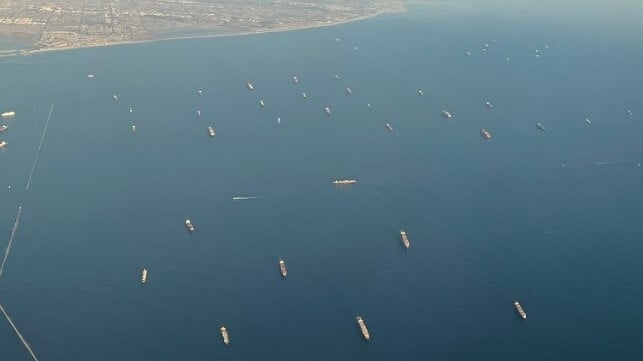
vessel backlog in Southern California
Image from November 2021 with vessels piled up anchoring or loitering waiting for their SoCal berth (MXSOCAL photo)

Published May 30, 2025 5:17 PM by The Maritime Executive


Researchers based in California studied the electronic reservation system established for containerships and have now concluded that the digital port queuing system is low-hanging fruit that can help drastically cut shipping emissions. They are the latest to endorse versions of slow steaming for vessels while warning that ports and liners are clinging to the archaic “first-come, first-served” approach.

The starting point for their research focused on the fact that the commercial shipping industry contributes nearly three percent of global greenhouse gasses (GHG) emissions and approximately two percent of global carbon dioxide (CO2), making it a major accelerator of climate change. The researchers said that while shipping is coming under intense pressure to decarbonize, the industry has failed to utilize a system that is the easiest to implement and which can cut GHG emissions by 16 to 24 percent.

Worldwide, ports continue to rely on the century-old “first-come, first-served” system for ship berthing. Typically, vessels continue to race across the ocean and then line up and idle at ports as they wait to be unloaded. The researchers write that “first-come, first-served” incentivized a practice known as “sail fast, then wait” where vessels rush to reach their destination port to secure a place in the berthing queue. As port congestion around the world has grown, vessels can wait at anchorage or loiter near ports at low speed for hours, days, or even weeks.

In normal times at busy ports like Los Angeles and Long Beach, it was typical to have as many as four vessels backlogged and waiting for a berth. At the heart of the pandemic, the backlog for the Southern California ports ballooned to over 100 vessels and even today major ports around the world still have large backlogs.

The ports of Los Angeles and Long Beach implemented a queuing system in 2022 that assigned predetermined positions when vessels departed their last port of call. Essentially, the system means that containerships get a spot in line based on when they left the last port of call. With their place in line secure, vessels delivering cargo to the ports do not have to rush during their trans-Pacific voyage, giving them the luxury to reduce speed which in effect meant burning less fuel and creating fewer emissions. 

The researchers at the University of California believed the system is low-hanging fruit that can have the added benefit of reducing CO2 emissions. The team was able to substantiate this conclusion and make a new case for slow steams after applying a bottom-up emissions model using vessel technical specifications and automatic identification system data from 10,000 voyages by 1,157 containerships across 6.5 years (2017–2023). The voyages represented more than 47 million miles of traffic crossing the Pacific.

By comparing emissions before and after the new queuing system was implemented at Los Angeles and Long Beach, the team observed 16 to 24 percent reductions in emissions per voyage post-implementation. The researchers published their findings in the journal Marine Pollution Bulletin.

“Integrating digital queueing represents a straightforward win within the broader technology and digital transformation initiatives that ports and logistics companies are already pursuing, offering an easy-to-implement solution that could scale globally as ports modernize and streamline their operations to reduce emissions,” said Douglas McCauley, a marine ecologist UC Santa Barbara.

He added that if other ports deploy the system, this could offer a relatively simple pathway for the maritime industry to contribute to emissions reduction efforts. Notably, the system does not require massive investments or time to deploy. At Los Angeles and Long Beach, the world’s ninth busiest port complex, the system was up and running in just one month.

The researchers highlight that additional fine-tuning of the queueing system may yield even bigger climate wins. A case in point is tweaking the system slightly so ships traveled at an average speed of 17 knots instead of 18 knots across the Pacific, something that has the capacity to shave off another approximately 308,000 tonnes of CO2 emissions, translating to an additional nine percent reduction.

THIRD WORLD U$A

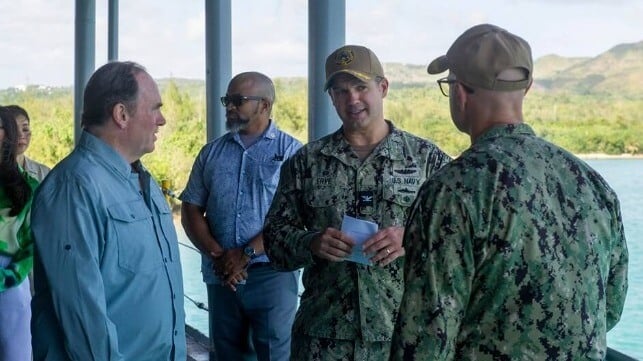
Navy Secretary "Shocked and Dismayed" at Condition of Base Housing on Guam

Phelan
Secretary of the Navy John Phelan (left) aboard sub tender USS Frank Cable, Guam, May 1 (USN)

Published May 29, 2025 8:53 PM by The Maritime Executive


After the Secretary of the Navy inspected a block of aging barracks on Guam and was "shocked and dismayed" by their poor condition, the U.S. Navy's top facilities officer has ordered a worldwide review of the condition of all housing for unaccompanied servicemembers. 

Vice Adm. Scott Gray, commanding officer of Navy Installations Command, has ordered a global review after the "baffling" discovery of substandard housing on Guam. Photos from the site show exposed wiring, crumblng concrete and visibly corroded plumbing. While concerning, the housing block in question is not Navy-operated: it is maintained by the Air Force. 

“The conditions shown in the photos are a failure of leadership across multiple echelons of command,” Gray said in an email obtained by the Project on Government Oversight.

Gray ordered each command to inspect all barracks housing by May 27, and asked them to use the "Washington Post test" to determine if the facilities are up to par - regardless of whether the housing is Navy-owned or belongs to another service.

"If the pictures you have taken or the results of your assessment conducted of a particular facility were published online tomorrow, would you be able to personally justify Sailors living there?" Gray asked commanding officers to consider.

According to Task & Purpose, Secretary Phelan was irate when he saw the condition of housing at Andersen Air Force Base's Palau Hall, which is home to a mix of sailors and marines. Phelan suggested that the on-base golf course was in far better shape than the barracks. 

At the secretary's urging, a new Marine Corps housing complex at the base opened a month early, and 73 servicemembers from the dilapidated hall were allowed to move in. 

It is not the first time that scandalous - or even dangerous - living conditions have been reported in enlisted housing. Inadequate berthing was an identified factor in a string of three suicides aboard the carrier USS George Washington in 2022. 


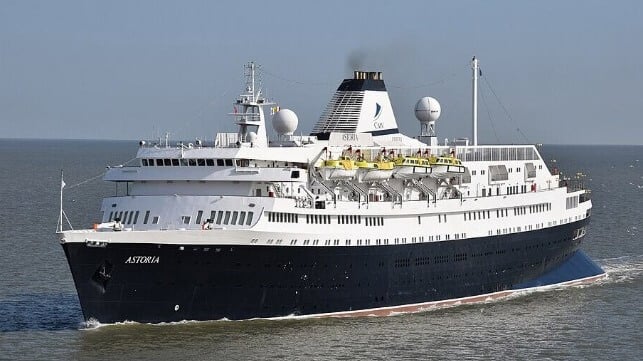
Infamous Liner Turned Cruise Ship to Be Sold at Auction 77 Years After MV

liner Stockholm turned cruise ship Astoria
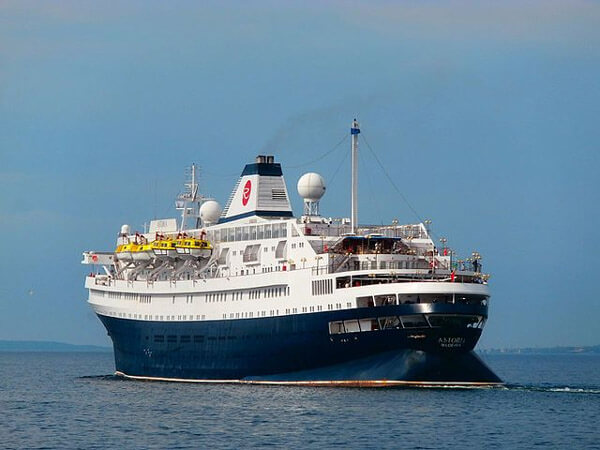
Astoria seen in 2017 for her last operator, the UK's CMV (Niels Johannes photo - CC BY-SA 4.0)

Published May 30, 2025 3:54 PM by The Maritime Executive


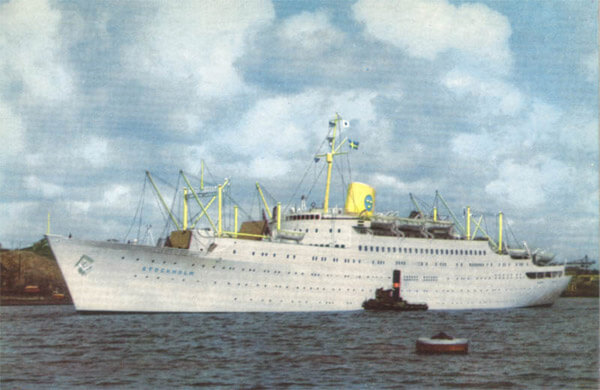
One of the most historic passenger ships is facing an uncertain future that will likely end with the ship being removed for scrap after not having operated for the past five years. Today known as Astoria, the ship is best remembered as the Swedish liner Stockholm that was involved in the fatal collision with the Italian liner Andrea Doria in 1956. 

The Rotterdam District Court has ordered the ship to be sold at auction on June 17. The proceeds of the sale will be used to pay her dockage fees in Rotterdam. She was moved to the Dutch port in December 2020 after having been laid up in the UK at the onset of the pandemic. 

Previously, it was reported that she had been offered for sale and various rumors circled of efforts to save the ship which is one of the last ocean liners and the oldest ocean-going cruise ship. She was placed on the auction block in 2021 with a minimum bid of €10 million but failed to receive sufficient bids. In 2023, it was rumored that the ship had been sold for scrap, but the owners denied it saying they were still working on plans for her future.

The ship was ordered at the close of World War II as one of the first modern passenger liners. Limited by post-war shortages of materials and the capabilities of Scandinavian shipyards, Swedish American Line which had operated well-known luxury liners before the war, was limited to a 525-foot liner that at 11,700 gross tons would be a workhorse carrying cargo and mostly tourist class passengers. She was designed for year-round Atlantic service and sailing to Scandinavia she was given an ice-reinforced hull and bow which would forever seal her legacy.


1950s vintage post card view of the Stockholm

She entered service in February 1948 as Stockholm and was rebuilt in 1952 expanding her accommodations, but she had a mostly unremarkable career. Swedish American added a new modern liner in 1953 meaning Stockholm could also occasionally sail cruises.

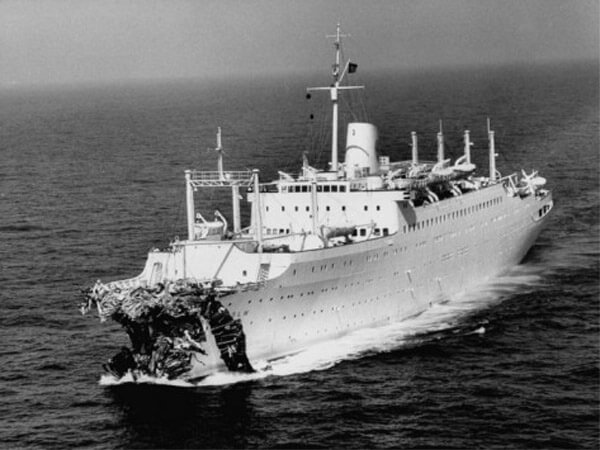
Her legacy came however on the fateful night of July 25, 1956. Outbound from New York to Scandinavia, she was near the Nantucket Lightship when the Italian liner Andrea Doria emerged out of a fog bank making a turn across the course of the Stockholm. Her ice-strengthened bow tore through the Andrea Doria starboard side causing a fatal wound. A massive sea rescue effort saved most of the passengers aboard the Italian ship, which sank the following morning, while the badly damaged Stockholm limped back to New York for repairs. A total of 51 passengers and crew on the two liners were killed in the tragedy.


Stockholm returned to New York badly damaged after her collision with the Italian liner Andrea Doria (USCG photo)


Swedish American rebuilt the ship but retired her four years later selling her to an East German group that used her as the Volkerfreundschaft for cruises for trade unionists and Community Party members. Retired by the Germans in 1985, she ended up in Italy where in a project reportedly heavily subsidized by the government she was rebuilt into a modern cruise ship. She was stripped to the steel and given a new diesel power plant as well as sponsons along the hull.

Mostly unrecognizable, she returned to service in 1994 and operates cruises for various companies under multiple names including Italia PrimaValtur PrimaCaribe, and Athena. She was renamed Azores in 2013 by her latest owner/operator, and three years later was chartered to the UK’s Cruise & Maritime Voyages (CMV) who changed her name to Astoria. She continued to cruise building a loyal following because of her quirky history but CMV planned to retire her by 2020. The pandemic however brought her career to a premature close.

Unlike the vessels that were owned by CMV, Astoria was operating on charter so she reverted to her owners, which by that point was a Portuguese bank that had financed her last owners. An investment group acquired the Astoria but later abandoned plans to rebuild her due to advanced age. Since 2021, she has been listed for sale.

Due to her age, and reports that her interiors are in poor condition after years of being laid up, it is unlikely that she would be reactivated. She is to be sold to the highest bidder with the speculation that would be a cash buyer or a scrapyard.


Near the end of her career, although heavily rebuilt, the sheer of the liner hull is still visible (Pjotr Mahhonin photo -  CC BY-SA 4.0)


Top photo by Niels Johannes - CC BY-SA 4.0


Royal Navy Monitors Russian Spy Ship Loitering Near NATO Exercise

Russian war ship and Royal Navy tracking
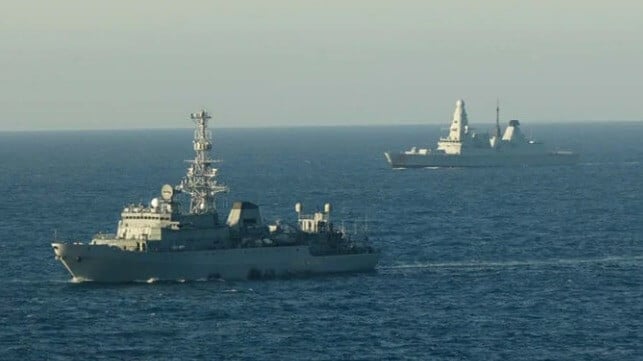
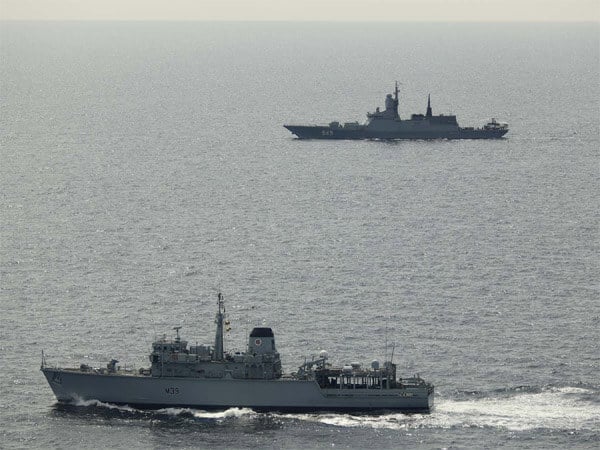
Russian spy ship Yuri Ivanov being shadowed by MHS Dragon (Royal Navy)

Published May 30, 2025 2:50 PM by The Maritime Executive


The Royal Navy reports that it is continuing to monitor the movement of Russian warships in the waters around the UK. While it is a regular operation for the navy, awareness has increased since the recent incidents in the Baltic with undersea infrastructure and the continuing concern over the shadow fleet of tankers.

One of the recent deployments involved monitoring the Russian “intelligence gathering ship” Yuri Ivanov which the Royal Navy reports was loitering in the waters off the Outer Hebrides in Scotland. In addition, a Russian corvette was also monitored as it was escorting merchant ships through the English Channel.

“Monitoring activity on the seas and seabed around the UK is one of the core roles of the Royal Navy’s 2nd Mine-Countermeasures Squadron,” said Lieutenant Commander James Bradshaw, Commanding Officer of Hunt-class minehunter HMS Hurworth, which was deployed as part of the monitoring in the English Channel. “This operation was all in a day’s work for the ship’s company who have shown great professionalism.”

The Russian spy ship was tracked from the Outer Hebrides where it was spotted following the completion of NATO’s exercise Formidable Shield which took place in the region. NATO had reported that it would be the largest live-fire naval exercise in Europe. It had begun in Norway earlier in the month and later moved to the waters off Scotland. It involved NATO, UK, Norwegian, and U.S. forces with both air and sea assets deployed from a total of nine nations.

The Yuri Ivanov is one of two 95-meter (312-foot) surveillance vessels Russia placed in operation in 2015. The U.S. has reported in the past that the vessel is equipped with antennae and electronics intended to provide intelligence-gathering, surveillance, electronic warfare, command and control, communications, fleet management, and signals intelligence capabilities tacking naval assets and can also perform air defense missile systems detection and tracking.

The Portsmouth-based Type 45 destroyer HMS Dragon was deployed to monitor the vessel and track its movements. It also deployed its Merlin helicopter to collect information about the vessel’s activities. They continued to track the vessel until it headed north toward its home base in the Arctic.


Russian corvette being tracked by the Royal Navy during a transit through the English Channel (Royal Navy)


Late on May 18, HMS Ledbury was also dispatched to monitor the Russian Steregushchiy-class corvette RFN Stoikiy. The UK shadowed the Russian warship which was sailing west through the English Channel. It later met up with two merchant vessels, Sparta IV and General Skobelev, which were returning from the Mediterranean the Royal Navy reports.

HMS Hurworth took over the monitoring on May 19 off Brighton and watched the Stoikiy and the two merchant ships. The operation concluded on the afternoon of May 22 when the vessels entered the North Sea.

The Royal Navy also reports that during the English Channel transit, it deployed aircraft from the Naval Air Squadron at Culdrose. Aircraft and warships from NATO allies were also involved.


Finland Nears Completion of Criminal Investigation as Cable Repairs Proceed

shadow tanker detained in Finland
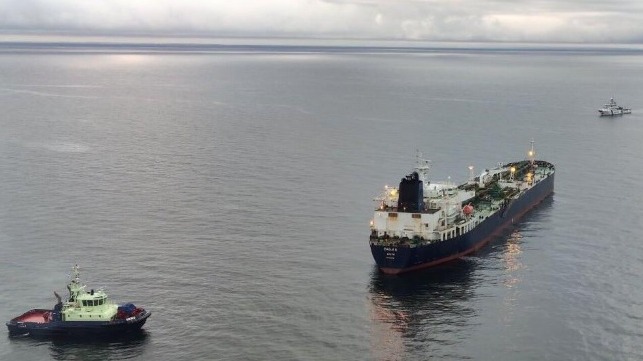
Finland detained the Eagle S tanker for more than two months during the investigation (Helsinki Police)

Published May 29, 2025 4:54 PM by The Maritime Executive


Finnish authorities have nearly completed the nearly six-month criminal investigation into the damage to the subsea power cable believed to have been caused by a shadow fleet tanker while the national energy company reports progress on repairing the cables. The Helsinki Times reported last week that Finnish grid operator Fingrid expects to spend between €50 and €60 million ($57 to $68 million) on repairs to the Estlink2 power cable running between Finland and Estonia.

“The repair is highly complex,” Fingrid’s Head of Submarine Cable Operations Kimmo Nepola told the Helsinki Times. He said about a kilometer (nearly two-thirds of a mile) of damaged cable must be replaced. 

The cable was damaged on December 25 and the authorities quickly linked the interruptions to the shadow fleet tanker Eagle S (74,000 dwt) registered in the Cook Islands. The police reported that one of the vessel’s anchors was missing and later recovered from the sea floor. It was believed the tanker dragged the anchor for up to 50 miles. The vessel was detained with reports that 32 deficiencies were found during a port state inspection. The vessel was finally released and escorted out of Finnish waters on March 2.

Initially, eight crewmembers were ordered to remain in Finland. Five were released with the vessel while three continued to be suspects in the incident.

The Chief Inspector for the National Bureau of Investigation, Risto Lohi, told the Helsinki Times that three individuals remain as suspects. The report says the investigation is in its final stages. A statement is expected to be delivered to prosecutors shortly.

Fingrid reports a repair vessel has been operational in the Gulf of Finland since mid-May. It says the weather has been favorable for the work but vessel traffic makes it a more complicated operation. They aim to restore power transmission on the cable by mid-July.

The incident raised international awareness of the threat to key undersea infrastructure and contributed to new efforts to monitor and protect critical cables. Scandinavian and Baltic countries increased their patrols and later won an agreement from the European Union to contribute to the efforts. Despite that, there have been several additional incidents where the authorities feared undersea cables were being targeted.

The crude oil tanker Eagle S was among the vessels added as sanctions have been increased on the shadow fleet. The increase in sanctions and efforts to inspect vessels operating in the Baltic has contributed to increased tensions and recent reports that the Russian Navy has begun escorting shadow fleet tankers in the Baltic.


FASCIST Italy Puts NGO Rescuers of Migrants on Maersk Etienne on Trial

Mediterranean rescue boat
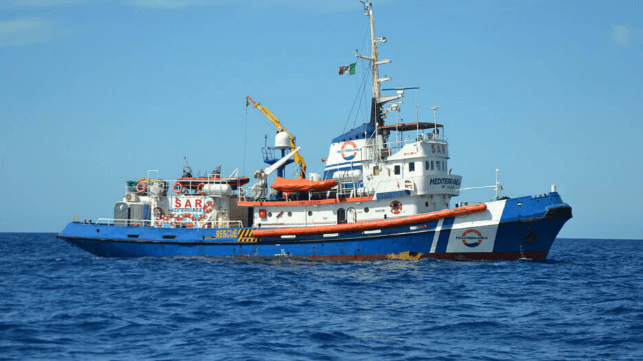
The captain and three crewmembers from the rescue vessel are being brought up on charges related to the 2020 rescue from the Maersk Etienne (Mediterranea Saving Humans file photo)

Published May 29, 2025 2:59 PM by The Maritime Executive


A court in Italy has ordered six activists with the organization Mediterranea Saving Humans to stand trial related to the 2020 rescue of 27 migrants who were stranded in the Mediterranean on the product tanker Maersk Etienne. A lawyer for the NGO is reporting that it is the first time one of these cases has been ordered to go to trial with previous attempts at prosecution stopped either during investigation or at preliminary hearings.

The Italian government has taken an aggressive stance against the NGOs operating in the Mediterranean in an effort to stop the influx of migrants and refugees. The groups which operate more than a dozen rescue vessels contend they are being harassed. After Giorgia Meloni became Prime Minister of Italy in 2022 new rules were put in place giving the Coast Guard added authority over the landing of the migrants. The NGOs contend they are being sent to more distant ports in an effort to disrupt their operations and the ships have been subjected to frequent port inspections.

The new case is being complicated by allegations that the NGO profited from the rescue. Three months after it removed the 27 migrants that had been aboard the tanker for 38 days, Maersk Tankers made a donation of approximately $140,000 to Mediterranea Saving Humans, which reports said was to cover the costs associated with the rescue. Prosecutors are alleging the group’s organizers profited from the donation.

On August 4, 2020, the product tanker Maersk Etienne (37,000 dwt) responded to a call for assistance from a small boat about 70 nautical miles north of Libya and acting on instructions of Maltese rescue coordination officials, took the boat's 27 occupants aboard. However, the tanker then found itself in a standoff with Malta which refused to give permission for the migrants to be landed. The tanker highlighted it did have the facilities to care for 27 people and required assistance.

Mediterranea Saving Humans responded by sending its vessel Mare Jonio, a 1972-built tugboat, to provide aid. Aboard it had a doctor to offer basic medical care. The refugees were transferred to the tugboat but Malta continued to refuse permission to disembark the individuals. They were finally landed in the Italian port of Pozzallo on Sicily. 

The captain of the Mare Jonio and three crewmembers are among those being charged with aiding illegal immigration. Among those that the court ordered remanded was the doctor from the rescue boat. It has also remanded the founder of the group, Luca Casarini, a prominent left-wing activist and critic of the government. 

The NGO responded saying its team had done nothing wrong and it is the latest case of harassment against its efforts. They allege that prosecutors have been asked several times to pursue cases or to arrest the heads of the organization but grounds were never established. They say that judicial police reports have been prepared and allege a campaign of slander and spying. It recently came out that the founder’s phone had been hacked with spyware.

“We will not be frightened by anyone,” said Casarini after today’s court hearing. “We know very well what we have done: we have helped 27 people, left in the middle of the sea for 38 days. This trial will become an opportunity to ask ministers, governments, and authorities to account for why these people were left in the middle of the sea.” 

The group says it will not be intimidated. After the 2020 rescue, its vessel Mare Jonio was held and not able to return to sea till June 2021 but since then they report having conducted dozens of missions. Today, they also announced an agreement with the German group Sea-Eye to take over the Sea-Eye 4, a 1972-built offshore supply ship that is being renamed Mediterranean to continue its rescue missions. At 931 gross tons, it is significantly larger than the Mare Jonio with the group highlighting that it is doubling its rescue efforts.

The court in Ragusa (Sicily) has set October 21 as the date for the first hearing in the trial of the six individuals.


Norway Confirms Bridge Alarms Were Turned Off Before Boxship Grounded

containership being towed
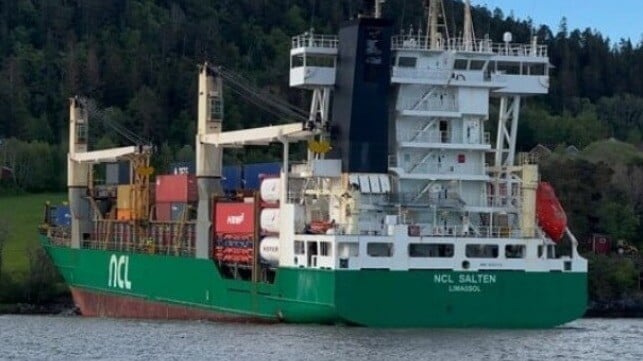
An inspection after the vessel was refloated found deficiencies including confirming the bridge alarm system was turned off before it grounded (Trondheim Rescue Company)

Published May 29, 2025 12:56 PM by The Maritime Executive


The Norwegian authorities released the details of a Port State inspection after the feeder ship NCL Salten was refloated and moved to a dock. The Norwegian Maritime Authority reports multiple deficiencies were found on the ship and it is being held at the dock in Orkanger until plans are finalized to move the vessel to a repair yard.

The inspection confirmed that the Bride Navigation Watch Alarm System was switched off before the vessel grounded. The second officer who has been charged with negligent navigation admitted to falling asleep on watch but contended alarms did not sound. 

The Norwegian newspaper NRK is quoting a spokesperson from the Norwegian Maritime Authority saying if the alarm had been turned on, the accident might never have happened. They point out that the system is designed to prevent this type of accident. The AIS track shows the vessel failed to change course in the fjord and proceeded straight at a reported speed of 16 knots before it came to rest on the lawn of a shoreside home.

The Port State inspection further found that the ship’s ISM system did not meet requirements. The authority did not provide details but said the ship was given three months to correct the problem with the ISM system.

However, the ship must repair the bridge alarm system before it can depart Orkanger. Further, the authority wants written confirmation from Cyprus as the flag state of the vessel before it can move to a repair yard. They confirmed the earlier reports that the hull suffered damage during the grounding.

In addition, they also cited the vessel for a problem with its emergency exits. The authority found that the hatch from the engine room is too heavy and difficult to open from the inside. The ship has 14 days to repair the exit hatch.

The Norwegian Maritime Authority says it has been monitoring the salvage operation with an inspector aboard the ship. It is now coordinating with the shipping company and the flag state on the next steps in the salvage efforts.

The ship is operating under charter to North Sea Container Line on a feeder route along the Norwegian coast that connects to Rotterdam and Hamburg. The company emphasized that the accident seriously while reporting that the ship is owned by Waterway Shipping and operated by Baltnautic Shipmanagement, both incorporated in Lituania.

The NCL Salten was refloated on Tuesday, May 27, after having grounded on May 22. After being towed to the dock, they were offloading all of the containers from the ship while the surveys continued. The police also reported that they planned to interview the master of the vessel after the salvage operation was completed.