Friday, July 25, 2025


Brookfield Sells Stake in PD Ports to Billionaire Founder of Spain’s Zara

UK ports
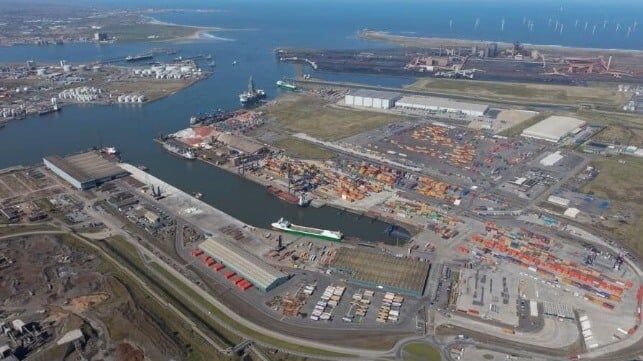
PD Ports oversees 12 miles of the River Tees and has a total of 11 locations in the UK (Brookfield)

Published Jul 23, 2025 6:30 PM by The Maritime Executive


Canadian investment manager Brookfield Asset Management has agreed to sell a 49 percent stake in the ownership of UK ports and logistics company PD Ports to an investment company controlled by Spain’s Amancio Ortega, the owner of brands including Zara, Pull & Bear, and Massimo Dutti. PD Ports confirmed the deal while reporting that Brookfield will remain invested in the business, and as a long-term shareholder, will work closely with the new investor Pontegadea to support the continued growth of PD Ports.

The company was established in 1992 as a private business as part of the UK’s efforts to reduce government holdings. It is the authority responsible for the River Tees, where it oversees navigation and operations. In total, it has 11 locations in the UK, including Teesport, Hartlepool, a cluster around the River Humber, Felixstowe, Thames, and the Isle of Wight. 

Brookfield became an investor in the company and, in November 2009, after a series of deals, took ownership of PD Ports. The companies report under Brookfield’s ownership, PD Ports has repositioned itself from focusing primarily on coal, oil, and steel, to a diversified revenue base that now includes sustainable renewable energy sources, agribulk, and containers.

Pontegadea Group was created in 2001, and it is today an investment group focused on sectors ranging from real estate to energy, infrastructure, and retail. 

According to the company, this transaction, a further step for Pontegadea’s global strategy of investment diversification, consolidates its commitment to invest in innovative infrastructures with solid partners of international renown. Pontegadea has significant experience working with scaled businesses, holding stakes in companies such as Inditex, Enagás, REN, Redeia, and Q-Park.

Antonio Ortega opened the first Zara store in 1975 and built a fashion empire under the Inditex group. After announcing his retirement in 2011, he expanded his real estate investments and was briefly reported to be the richest person in the world. Forbes estimated his net worth in 2024 at over $100 billion.

Brookfield had been looking for an investor as it works to reshape its portfolio. Reports said it had briefly explored the sale of PD Ports in 2021. Media accounts said it was seeking as much as £2 billion for the company, but the offers were between £1.1 and 1.4 billion.

Peel Ports, which is another large UK port operator also created in a 1992 privatization, was reportedly in the running to acquire PD Ports. Reports said it withdrew in April, but several other investment managers were thought to be exploring the company, while rumors said Pontegadea was exploring the investment.
 

Singapore Now Has Drones Delivering Bunker Samples

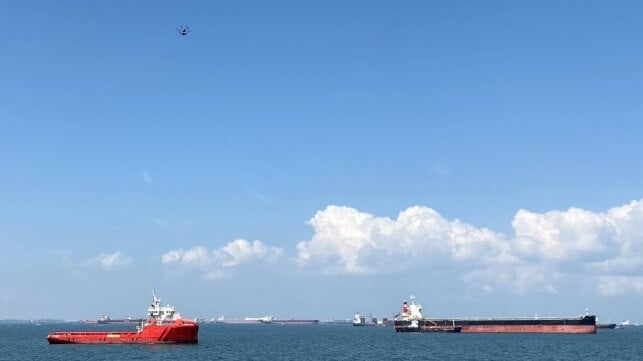
Skyports drone
Courtesy Skyports

Published Jul 23, 2025 10:27 PM by The Maritime Executive


Skyports, the world's leading drone service company, has been expanding its footprint in Singapore's busy harbor for years. Drone deliveries offer a fast and efficient way to deliver small spares, medical supplies and cash-to-master payments, and Skyports provides these services to ships at anchor in partnership with Sumitomo, ST Engineering and Singapore's port authority. The firm says it now has a new application for drone logistics in the world's busiest bunkering port: picking up fuel oil samples for testing, a task that previously required a manned harbor boat. 

The trial was carried out in partnership with the bunker supplier TFG Marine, tanker operator CBS Ventures, and the Maritime and Port Authority of Singapore (MPA). It focused on developing safety protocols for flying to and from a bunker tanker in the harbor. The flights showed that Skyports' drones can be safely used around bunker tankers, which operate under under stringent requirements.

The live trials have been a long time coming. Skyports began the process of research and regulatory discussions nearly two years ago, and gradually worked the concept up to maturity. It figured out how to monitor bunker tanker movement during the approach, conducted tests to ensure that there would be no issues with electrostatic discharge from the drone, and planned out the best possible sequence of movements to safely reach a clear deck area. In case of loss of remote control, the team programmed the drone to reverse out along the same route that it flew in.  

When all was ready, Skyports made multiple runs to and from the TFG Marine bunker tanker MT Diligence, approaching on a designated safe flight plan. Upon reaching location, the drone winched down a sample box, which crewmembers filled with vials of bunker fuel. After loading the cargo, the crew stepped back to a safe distance, the drone winched the box back up, and the samples were flown back to shore for lab analysis - saving TFG Marine the cost of a small-boat delivery run. 

For merchant ships, Skyports offers fast transport for cash-to-master, engine fluid samples, and cargo deliveries for packages up to 22 pounds. This covers a solid share of the rush-service transportation previously performed by supply boats - though there will always be business for Singapore's boat operators, given the harbor's abundant activity for crew transfers and larger stores deliveries. 


Equinor Takes $955 Million Charge Citing US Wind Policy and Tariffs

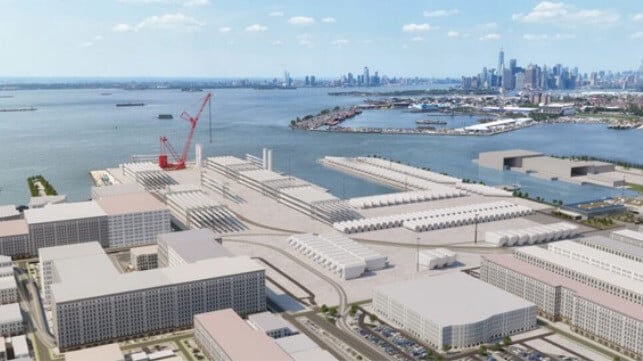
South Brooklyn Marine Terminal
Equinor cited the diminished prospects and the costs for the development of the terminal, which it expected would be covered by multiple projects (Equinor)

Published Jul 23, 2025 4:08 PM by The Maritime Executive


The Norwegian state-owned energy company Equinor included a nearly $1 billion impairment charge in its second quarter financial report linked to the changing outlook for the U.S. offshore wind industry. While the company reports the Empire Wind I offshore project is back on track after a month-long stop-work order by the U.S., it said the outlook for the offshore wind industry in the U.S. is diminished.

Speaking on the outlook, CFO Torgrim Reitan told investors, “Without investment tax credits and without a government that wants it to happen, we are not going to invest in it.” He said the main driver for this charge is the “changes in regulations for future offshore wind projects in the U.S.”

In April, Equinor called the actions by the Trump administration “unlawful” as it related to a stop work order issued days before offshore work began on Empire Wind I, an 810 MW project being built 15 to 30 miles off New York. The company denied the administration’s allegations that the approval process had been rushed, noting it won the lease in 2017 during the first Trump administration. Final approvals were issued in February 2024.

The company said, however, that the charges were due to the future outlook. It is taking a $192 million charge to reduce the value of the lease for Empire Wind II, a planned second phase of the project that it does not expect will proceed in the near term. The bulk of the charge, $763 million, is related to Empire Wind I and the investment in the redevelopment of the South Brooklyn Marine Terminal. 

The company said that the investment in the terminal had included the assumption that it would be a base for two more developments in addition to Empire Wind, which would help pay for the project. “That is now unlikely,” Reitan said.

While the tax credits will remain in place for Empire Wind I, the company pointed out that other costs are rising due to the tariffs Trump has imposed. It cited specifically the impact on the cost of steel and other key materials for Empire Wind I. While it had reported significant daily costs during the work stoppage, the company said the charge included “a more limited amount” related to the pause in work.

The charges came in what was overall a positive quarter for the company. It highlighted its investments in U.S. offshore gas, which it said delivered substantial value during the quarter. The company also cited the stabilized production from the Johan Castberg FPSO as contributing to it meeting its forecasts.


First US-Flagged Subsea Rock Installation Vessel Floated at Hanwha Philly

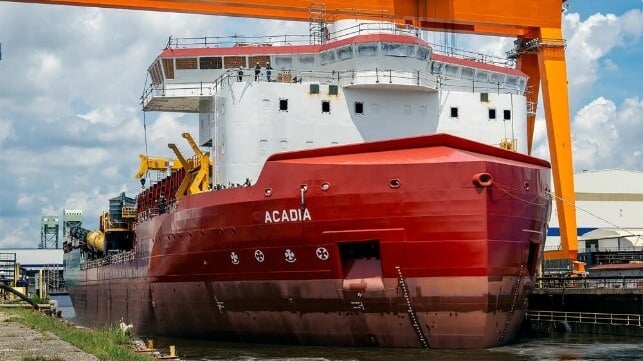
rock installation vessel floated
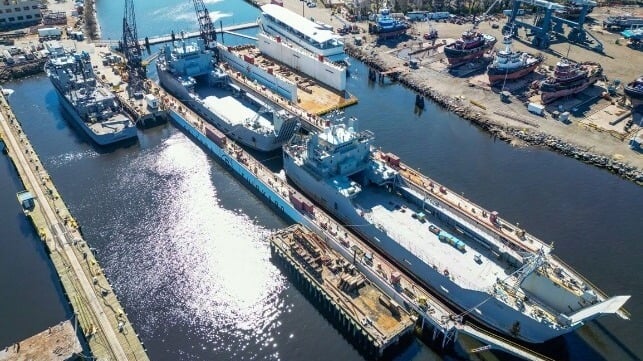
Arcadia was recently moved from the building dock at Hanwha Philly (Great Lakes Dredge & Dock Corp.)

Published Jul 23, 2025 12:35 PM by The Maritime Executive


The first U.S.-flagged, Jones Act-compliant, subsea rock installation vessel designed to support the offshore energy sector marked a milestone as the vessel was floated out at the Hanwha Philly Shipyard. The vessel has faced delays in its construction and challenges as the U.S. offshore wind market largely collapsed, but owners Great Lakes Dredge & Dock Corporation continue to express confidence as it expands its strategy for the vessel.

The Arcadia is engineered to transport and install up to 20,000 metric tons of rock on the seabed. This is a vital part of the offshore energy projects, providing scour protection for subsea infrastructure, including cables. Great Lakes initially ordered the vessel at a cost of $197 million in November 2021, focusing on the offshore wind energy sector to protect offshore wind turbine foundations and cables. It points out that the rock installation is a critical element of the project, as it prevents erosion caused by waves and currents and mechanical impacts from equipment and vessels.

“The company proactively expanded its strategic target markets for the Arcadia to include oil and gas pipeline and power and telecommunications cable protection, as well as international offshore wind,” Great Lakes wrote in a recent stock exchange filing. It has contracts to support Equinor’s Empire Wind I and Ørsted’s Sunrise Wind, both of which are fully permitted projects and under construction. Work began on Sunrise Wind in 2024 and Empire Wind I in 2025. 

Great Lakes reported that it also has a reservation for the vessel from a third, unnamed offshore wind project in the United States. However, a contract to support Empire Wind II was canceled by Equinor. Great Lakes expects the projects will keep the vessel engaged through 2026, and it reports it has used the past two years for discussions with clients for new offshore energy projects domestically and internationally, where the vessel would be employed in 2027 and beyond.


“We are excited to see the launch of the Acadia, getting us closer to her expected delivery early next year, which will also mark the completion of our major new build program,” said Lasse Petterson, President and Chief Executive Officer of Great Lakes Dredge & Dock Corp. “The Acadia is the centerpiece of our Offshore Energy growth strategy and will begin operations immediately upon leaving the shipyard.”

Work on the vessel began in the summer of 2023 with a ceremonial first steel cut attended by President Joe Biden, and assembly began on May 2, 2024, when the first section, known as the grand block, was placed into the assembly dry dock. When completed, Arcadia will be 461 feet (140.5 meters) with crew accommodations for 45 people.

The owner and Philly Shipyard have been in dispute over delays on the construction timeline. The vessel was due for delivery in November 2024, but it has been postponed several times. Great Lakes filed a complaint in court regarding the construction delays, but says the situation changed after the sale of the yard to Hanwha Ocean was completed in December 2024. In April 2025, it notified the court that it was voluntarily withdrawing the complaint and was pursuing a private dispute resolution, including possibly arbitration, as set out in the construction agreement.

Arcadia is one of several large vessels that were ordered in the U.S. to support the offshore wind energy sector. The offshore wind industry also spurred the construction of a U.S.-flagged turbine installation vessel, several offshore support vessels, and multiple crew transfer vessels.


Sri Lanka Orders $1B in Compensation for Damages from Loss of X-Press Pearl

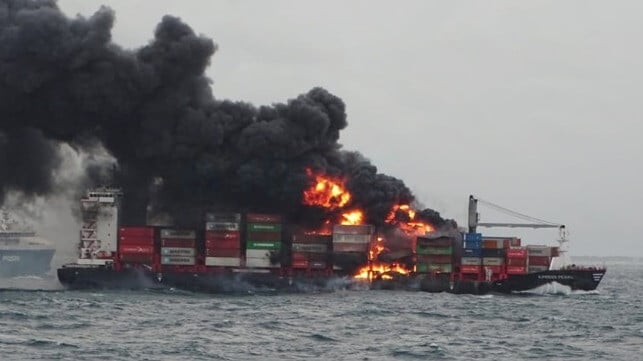
X-Press Pearl fire
X-Press Pearl caught fire on May 21, 2023 and burned for nearly two weeks before it sank (Sri Lanka Navy)

Published Jul 24, 2025 1:40 PM by The Maritime Executive


The Supreme Court of Sri Lanka issued a sweeping condemnation of the events surrounding the fire aboard the containership X-Press Pearl in May 2021 and the resulting environmental damage. The court ordered $1 billion in compensation to be paid by the shipping companies and their agents, while also ordering investigations into the government’s handling of the casualty.

The case was initiated by the fishing community, which filed petitions citing the extensive environmental damage and loss of their livelihood. After reviewing extensive reports, the court agreed, calling the casualty “the worst marine chemical catastrophe in recorded history in the Indian Ocean.” They cite the release of 25 tons of nitric acid, 70 billion plastic nurdles, and other hazardous chemicals from the loss of the vessel, which was carrying 1,500 containers. It also cites the numerous dead turtles, dolphins, and whales that washed ashore.

In a 361-page judgment released today, July 24, the court finds the shipping companies and their agents “conceded” the casualty resulted in significant environmental harm. However, it says the non-state respondents in the case “did not present their own qualification of the loss caused in financial terms.”

The five-member court set the loss at $1 billion and is giving the owner, charterer, and agent one year to pay the compensation. The first installment of $250 million is due by September 23. They have six months to make the second installment of $500 million, and the final payment of $250 million is due within one year of the ruling. All the money will be deposited in court-administered funds for compensation to the fishing community and environmental remediation.

A key part of the court’s ruling was based on its finding that in an attempt to gain entry to the port of Colombo, the master of the X-Press Pearl, the vessel’s operator, and its agents “intentionally suppressed and withheld from the Harbor Master of the Colombo Port, truthful, timely, comprehensive, and accurate information regarding the situation that evolved over a period of time.” The court confirmed the reports in the media that a container transporting nitric acid was leaking after the ship departed Jebel Ali, but the X-Press Pearl was refused entry into the ports of Hamad and Hazira before arriving in Colombo. Further, the court ruled that the shipping companies “violated international law” by failing to notify Sri Lanka about the extent of the problem aboard the vessel.

The court, however, was equally critical of former government officials. According to the reports, it found the Attorney General’s Department “acted arbitrarily, irrationally, and unliterally by failing to take criminal action under environmental law.” Sri Lanka has pursued criminal charges against the master, chief engineer, and chief officer, but the Attorney General’s Department chose to pursue civil litigation in a Singaporean court against the vessel’s owner and charterer, which the court termed “unjust, irrational, and arbitrary.”

The Attorney General’s Department issued orders to initiate, within three months, a formal investigation into the handling of the disaster and report back to the court. This is to be led by the Criminal Investigation Department, and they are instructed to also look for indications of bribery or other wrongdoing. It is to look at all parts of the government, including the ministries and the Attorney General’s Department.

The court is establishing a Compensation Commission headed by its chief justice. The Secretary of the Ministry of Environment is instructed to form the Marine and Coastal Environmental Restoration Commission, and both commissions are instructed to appoint independent experts.

Sri Lanka’s Marine Environment Protection Authority (MEPA) previously estimated damages related to the loss of the X-Press Pearl at $6.4 billion. The legal cases are expected to continue for years.


Oil Cleanup Underway After Vessels Collide in Cuxhaven’s Outer Harbor

oil spill Cuxhaven Germany
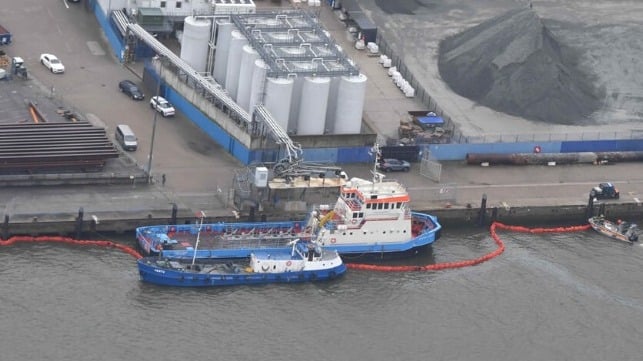
Oil boom as deployed and a tanker was offloading fuel from the damaged OSV (Havariekommando)

Published Jul 23, 2025 2:57 PM by The Maritime Executive


German authorities are reporting that at least 6,000 liters of fuel were spilled into the harbor after a small product tanker inbound to Cuxhaven collided with an outbound OSV. They were working to prevent the spill from entering the Elbe River while efforts were also underway to stop the leak from the damaged OSV.

Capella, a German-flagged product tanker, was arriving from Bremerhaven when it collided with the outbound OSV Coastal Legend (Netherlands flag). Capella is a 1,340 dwt tanker, and it reportedly suffered minor damage. The OSV Coastal Legend (328 gross tons) is reported to have a gash approximately 80 centimeters (2.5 feet) and was leaking fuel.

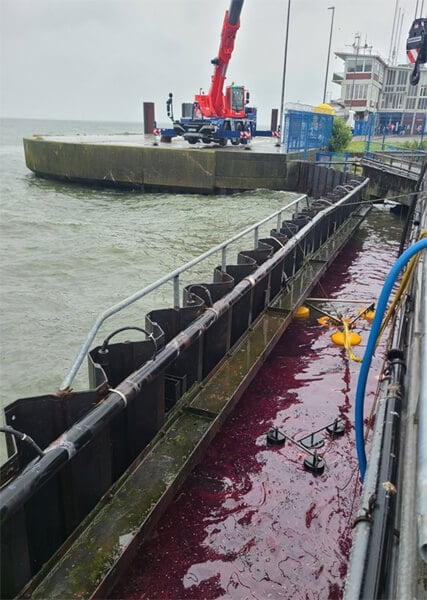
A “red, oily film” was reported in the harbor after the collision. None of the crew aboard either vessel was injured, and the German Seaman’s Mission and Stella Maris were attending to the crewmembers after the vessels docked in Cuxhaven.


Skimmers and booms were being used to recover the oil (Havariekommando)


An oil boom was placed around the Coastal Legend, and a pumping operation was underway to remove the fuel from the vessel to the bunker vessel Herta. Divers were working at the same time to seal the leak coming from near the ship’s stern.

The German command sent an oil reconnaissance aircraft to monitor the spill, and it made a second overflight later in the day. The authorities reported that they had been successful in preventing most of the fuel from entering the Elba. 

Skimmers were being employed in the harbor. As of later in the day, they reported 80 cubic meters of a watery fuel mix had been recovered. It was being pumped into a tanker and trucks for disposal.

The Water Police were investigating the cause of the collision. They reported that both vessels were stable and in no immediate danger. Shipping traffic on the Elbe was not being impacted by the recovery operation.


F. A. Vinnen & Co. Trial Inmarsat NexusWave for Home-Like Crew Connectivity

Inmarsat Maritime
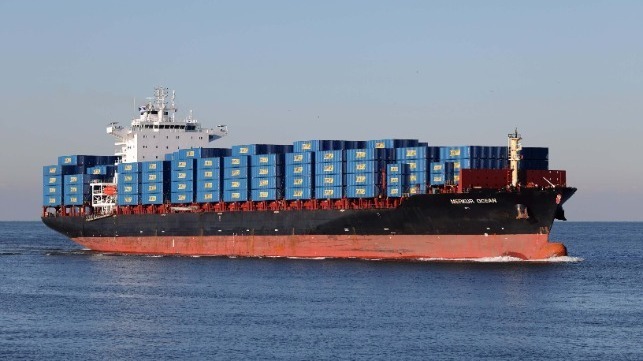
F. A. Vinnen & Co. will trial Inmarsat's NexusWave on Merkur Ocean and Merkur Fjord to offer crew seamless onboard internet connectivity

Published Jul 24, 2025 5:58 PM by The Maritime Executive


[By: Inmarsat Maritime]

Inmarsat Maritime, a Viasat company, has announced that F. A. Vinnen & Co. will trial Inmarsat’s fully managed bonded connectivity service, NexusWave, across part of its fleet, as the Bremen-based mid-size container vessel owner addresses increasing internal data transfer volumes and demand among crew members for home-like internet experience onboard.

NexusWave brings together GX Ka-band, LEO, LTE and an additional layer of L-band resiliency into one bonded, secure network solution. This innovative technology leverages the combined capacity of all available network underlays simultaneously to provide high-speed, global, reliable connectivity with an average network availability of over 99.9%. The solution’s unique network-bonding technology, combined with global coverage and unlimited data, is designed so that seafarers can enjoy a wide range of applications, such as web browsing, streaming, gaming, video and voice calling, messaging, and social media access, offering home-like connectivity experience while at sea.

For the ship owner, NexusWave offers the aggregate performance of multiple networks with the convenience of a single provider. The fully managed solution eliminates unexpected charges and includes enterprise-grade cybersecurity and Care Programme with round-the-clock worldwide technical support, giving customers complete ‘connected confidence'.

Daniel Harms, Manager Controlling, F. A. Vinnen & Co., said: “Crew welfare is our utmost priority, and providing a home-like internet experience onboard plays an increasingly important role in keeping our crews happy and motivated. Recognizing the growing traffic demand on the commercial side and the need to ensure a steady availability of high-speed internet, we have chosen NexusWave to upgrade our present system. We are excited to partner with Inmarsat for a trial on two of our vessels to assess the system in real-world conditions. We share a longstanding relationship with Inmarsat, and the opportunity to work with one trusted provider, with no overages and a single point of contact, is another clear advantage of NexusWave.”

Jan Stehr, Sales Manager, Inmarsat Maritime, said: “As the oldest ship owner in Bremen, Vinnen has a rich tradition in the maritime industry. Its decision to trial Inmarsat NexusWave underscores Vinnen’s commitment to seafarers, whose sustained well-being is vital to the company’s success. We are delighted to renew our partnership with Vinnen, and we are confident that NexusWave will meet the expectations of both management and crew for seamless, office-like and home-like connectivity.”

The products and services herein described in this press release are not endorsed by The Maritime Executive.


New Lloyd’s Register Assessment Boosts Containership Fatigue Life Up to 15%

Lloyd's Register
New methodology delivers more accurate fatigue life predictions for containerships and gas carriers through revision of worldwide trading routes.

Published Jul 24, 2025 6:04 PM by The Maritime Executive


[By: Lloyd's Register]

Lloyd's Register (LR) has enhanced its Fatigue Design Assessment (FDA) methodology by updating worldwide trading patterns for containerships and gas carriers based on comprehensive analysis of Automatic Identification System (AIS) data from the past 11 years.  

This major revision represents the first update to FDA trading routes in over 12 years. The updated trading patterns reveal encouraging results for vessel operators, with the revised analysis showing increases in predicted fatigue life of up to 10-15% for containerships and up to 10% for gas vessels.  

These improvements result from incorporating routing factors obtained from extensive AIS data analysis, delivering more accurate structural assessments that reflect actual vessel operations rather than relying on historical estimates. LR's updated approach enables more precise fatigue life calculations, supporting better-informed decisions regarding vessel design, maintenance scheduling, and operational planning. 

LR has also refined its containership categorisation to reflect the segmentation of modern container vessels. The updated classification system now includes Ultra Large Container Vessels (ULCVs) with capacity of 14,501 TEUs or greater, alongside revised categories for New Panamax (10,000-14,500 TEUs), Post-Panamax (5,101-10,000 TEUs), Panamax (3,001-5,100 TEUs), Feedermax (2,001-3,000 TEUs), and Feeder vessels (1,001-2,000 TEUs). 

Nick Gross, Global Containerships Segment Director, Lloyd's Register, said: “This comprehensive update to our Fatigue Design Assessment methodology represents a significant advancement in how we evaluate vessel structural integrity. Our analysis of extensive AIS data revealed that ships are operating quite differently from our previous models, particularly in terms of route optimisation and weather routing. This translates directly into improved fatigue life predictions that shipowners can rely on for better operational and maintenance planning.” 

For more information about LR’s enhanced FDA methodology, visit: https://www.lr.org/en/knowledge/lloyds-register-rules/shipright/fatigue-design-assessment-fda/

The products and services herein described in this press release are not endorsed by The Maritime Executive.


Saipem and Subsea 7 Agree to Merger Terms to Form Offshore Giant 

offshore oil and gas services
Terms were announced for the merger of equals to form and offshore engineering and services mega company (Subsea 7)

Published Jul 24, 2025 7:29 PM by The Maritime Executive


Saipem and Subsea 7 announced terms for their previously proposed merger to create a giant in the offshore services sector, supporting the oil and gas and other industries. The companies initially proposed the merger in February, saying terms would be set for the deal by mid-year. They expect to complete the merger by the second half of 2026.

Terms for the deal call for a true merger of equals. Under the binding merger agreement, on completion, Saipem and Subsea 7 shareholders will each own 50 percent of the share capital of the new company to be known as Saipem7. Subsea 7 shareholders will receive nearly 6.7 new Saipem shares for each share of Subsea 7 and a pre-closing extraordinary dividend valued at approximately $529 million.

They expect the deal will create a global leader in energy services. Highlighting the benefits, the merger announcement cites the highly complementary geographical footprint, competencies and capabilities, vessel fleets, and technologies. They report the combined company will have revenues of approximately €21 billion based on 2024 results. Earnings (EBITDA) will be in excess of €2 billion, and the operation is expected to generate more than €800 million in free cash flow.

Highlighting the global reach of the combined business, the companies report that the new Saipem7 will have projects in more than 60 countries. Its current backlog will be €43 billion. Operations will range from drilling, engineering, and construction to services and decommissioning.

The company will have a diversified fleet of more than 60 construction vessels, giving it the ability to work from shallow water to ultra-deep. They point to opportunities ranging from oil and gas to carbon capture and renewable energy.

The main shareholders, Eni, CDP Equity, and Siem Industries, fully support the proposed merger and have signed agreements to vote in favor of the deal. The CEO of the new company will be designated by Eni and CDP Equity, and currently, they report that it will be Alessandro Puliti. After years with Eni, Puliti was appointed General Manager of Saipem in February 2022, and he has been a Board Member, as well as Chief Executive Officer and General Manager of Saipem, since August 2022. Siem Industries will designate the Chairman of the Board of Directors, who is expected to be Kristian Siem.

The merger reflects the optimism for the sector, which rebounded after several hard years. In 2021, suffered strong setbacks that it linked to the offshore wind industry. The prolonged downturn in the oil and gas sectors also hit the industry hard.

The companies independently developed as leaders in the offshore services industry, tracing their origins to the 1950s and the start of modern offshore operations. Each has been involved in the consolidation and growth of the industry. The modern Subsea 7 emerged in the early 2000s and reports it is the product of over 25 different legacy companies and businesses, with Kristian Siem continuing to drive the company as its chairman. Saipem was also the product of mergers and served as the service supplier for Eni until 2015, when it reduced its holding, setting the stage for the modern company.


Sesquicentennial: Colonna's Shipyard Celebrates 150 Years

shipyard
Courtesy Colonna's Shipyard

Published Jul 24, 2025 9:21 PM by Tony Munoz


(Article originally published in May/June 2025 edition.

"My role is to continue the legacy started by my great-great-grandfather, Charles J. Colonna, in 1875," says Randall Crutchfield, Chairman & CEO of Colonna's Shipyard. "That means doing the right thing, investing for the long term and ensuring that this company is around for many more generations to come."

It's a big responsibility, but Crutchfield embraces it. His sense of stewardship is strong. He feels an obligation not just to his forebears but to his employees and their families, many of whom have been with the company for generations.

He has big shoes to fill, having taken the helm in January 2024 following the retirement of long-time CEO Tom Godfrey and the passing of his grandfather, Willoughby Warren ("Bill") Colonna. He credits his grandfather with being the visionary, who made the investments that transformed the company into more than just a shipyard, and Godfrey with being the perfect complement in making it happen.

Crutchfield has his own #2 in Jordan Webb, who functions as President & General Manager and assumed his new position the same day Crutchfield did.

150 years is a long time in anyone's book, and Colonna's is in fact the oldest continuously owned and operated family shipyard in the U.S. And while it may not be a household name, it's the kind of blue collar, nose-to-the-grindstone family business that's been the backbone of America from the very beginning.

There were ups and downs along the way, of course. Two world wars, the Great Depression, a bankruptcy filing. There's even a book about it, The History of Colonna's Shipyard and Its People, written by Crutchfield's grandfather, that traces the family lineage back to 1609 in Virginia and before that to England and a small town in Italy.

Through it all – the good and the bad – the company persevered, remained true to its values, kept its promises and emerged stronger than ever.

MORE THAN A SHIPYARD

What started as a single marine railway powered by horses is now a multifaceted company with a number of related businesses, all centered on blue-collar craftsmanship. The heart of the operation remains the shipyard in Norfolk, a sprawling 120-acre complex with room to grow and housing three drydocks, a 1,000-metric-ton Travelift, a marine railway (not the original, but one dating back to 1891), more than 100,000 square feet of heavy industrial shop space with cranes and perhaps the largest layout area on the East Coast.

Its legacy business is ship repair, and – given its strategic location at the center of the Tidewater Virginia's military/industrial complex – there's no shortage of both commercial and government customers. On the commercial side, there's the Chesapeake Bay fishing fleet, harbor and offshore tugs, dredgers, barges and ferries. Customers include well-known names like McAllister and Moran Towing, Norfolk Dock and Great Lakes Dredge & Dock.

On the government side, there's the military – the U.S. Coast Guard, Navy, Army and Army Corps of Engineers. "A lot of people don't know this," notes Crutchfield, "but the U.S. Army has more vessels than the Navy does." Then there's what Crutchfield calls the "quasi-government" side, not Department of Defense but government agencies like NOAA and the Virginia Department of Transportation: "Basically, we're a jack-of-all-trades. Whoever comes knocking, we answer the door."

The business is traditionally divided roughly 50-50 between the government and commercial sectors. Right now, it's running more like 60 percent government and 40 percent commercial.

Supplementing the bread-and-butter ship repair business are three other operations – all located on the Norfolk campus. The first is Steel America, established by Tom Godfrey and Crutchfield's grandfather in 2000 to provide some diversity while capitalizing on the company's core welding and machining skills.

"Steel America started with a contract from the Ford Motor Company, which had a F-150 assembly plant about two miles down the road, to put together some additional assembly capacity," Crutchfield explains. "It's basically a commercial fabrication business. Today, it's largely supporting the prime shipbuilders like Newport News Shipbuilding and Electric Boat on some of the programs you read about in the headlines – the aircraft carrier program, the Columbia submarine program, the Virginia submarine program."

Crutchfield sees Steel America's long-term role as supporting the prime shipbuilders in building more ships for the U.S. Navy in tune with the Trump Administration's goals.

The second piece is Weld America, started just a few years ago and featuring an elite team of welders and state-of-the-art equipment including the latest in mechanized welding systems. Crutchfield calls it a "turnkey weld solution provider," which can mobilize anywhere in the world, work with customers and give them what they need.

The final piece on the Norfolk campus is the Down River division, a sort of traveling shipyard designed to mobilize outside the gate on a 24/7 basis, bringing the topside resources of a major shipyard directly to the customer. "They're on multiple contracts at Naval Operations Base, Norfolk," says Crutchfield, "as well as in other shipyards right now, just bringing our skilled trades people to where they're most needed."

The company's Norfolk Barge fleet is also based in Norfolk and leased to customers on a project basis.

Two other operations extend Colonna's reach beyond the Tidewater region. There's Colonna's Shipyard West, based in San Diego, not a full-fledged shipyard but rather a subcontractor, and Accurity Industrial Contractors in Owensboro, Kentucky, which Colonna's purchased two years ago. Accurity is a premier specialty contractor focused on welding, piping and industrial plant maintenance services – land-based but offering the same project management, skilled tradespeople approach as the marine repair business.

THE ROAD AHEAD

Crutchfield sees more acquisitions like Accurity in the future, but his main focus is growing the company organically and investing for the long term. He's got his leadership team in place, and the many apprenticeship and training programs the company sponsors guarantee a highly skilled and disciplined workforce for the foreseeable future.

But you don't last 150 years without a strong culture and work ethic, and that's at the heart of everything Colonna's does. It's all about the people and the values – Respect, Pride, Truth and Family – that the company promulgates and cherishes.

"I've been working here since my teenage years," says Crutchfield. "I know almost everyone in the yard. When I give a tour to guests, I recognize employees on a first-name basis. There are people who've been here 30, 40, 50 years. Their fathers worked here. Their children work here. We're like one big family, and we all share the same values. We keep our word. We respect one another. We believe in the dignity of work, of always telling the truth and of taking pride in a job well done. That's who we are and who we'll always be."

So there will be many small and not-so-small 150-year celebrations, all centered on the families of people (retired and active) who made the company what it is today. In the 150 days leading up to January 1, for example, the company gave out 150 challenge coins that commemorated the event to individual employees. "We were able to bring back some of the folks who had recently retired and had worked here for 30+ years and celebrate them in front of everybody," says Crutchfield.

There'll be a commemorative video and a commemorative plaque with employee signatures on it and several more events. Customers will also be recognized, many of whom have been with the company for decades.

"We're taking an entire year and just making sure that everything we do is centered around honoring the legacy of 150 years," Crutchfield adds. "For me to be able to do that from the CEO's position and really speak for the entire company, to express our appreciation for the last 150 years, is really, really humbling and one of the greatest honors of my life."

What's more, the best is yet to come.

Tony Munoz is the magazine's Founder, Publisher & Editor-in-Chief.

The opinions expressed herein are the author's and not necessarily those of The Maritime Executive.
 

Trinity House Grant Boosts Service at Seafarers Advice & Information Line

Seafarers Advice and Information Line

Published Jul 24, 2025 6:12 PM by The Maritime Executive


[By: Seafarers Advice and Information Line]

The Seafarers Advice and Information Line (SAIL) has been granted an extra £30k by leading maritime charity, Trinity House. The extra funds will be used to employ another part-time adviser to join the existing SAIL team in providing vital support to seafarers and their families. Trinity House joins three other major maritime charities, Seafarers Hospital Society, The Seafarers’ Charity and Greenwich Hospital, in supporting SAIL. 

Welcoming the extra funds, Emma Knight, CEO, Citizens Advice Greenwich, which runs SAIL, said: “We’re incredibly grateful to Trinity House for this extra funding. It will enable us to help more seafarers and their families with issues such as debt, welfare benefits and housing. It will make a huge difference.”

SAIL is the only Citizens Advice service dedicated to seafarers and their families living in the UK. Like the rest of the Citizens Advice service, the advice they provide is independently quality assured and they are registered with the Financial Conduct Authority to offer the full range of debt advice. Last year SAIL advised 1,140 people on 5,375 new problems and achieved financial gains for clients totalling over £1.4million. Benefits and debt are the most common issues facing SAIL clients and accounted for over 60% of all enquiries.

Trinity House’s Deputy Master, Rear Admiral Iain Lower CB, commented on the grant: “Merchant seafarers do so much for all of us, making our daily lives possible - and prosperous - by carrying vital goods around the world. To do this, they spend much of their lives at sea, working in the engine rooms, the galleys, on the bridges and on the decks in very challenging conditions. Our seafarers are often taken for granted. We forget, because seafarers operate out of sight, that they, just like many of the rest of us, need support to deal with the same worries and issues we face on shore: money, health, relationships and more. SAIL’s advice service provides a critical lifeline to all seafarers and their families, and so we are only too happy to support them with funding to help amplify their reach and make an even bigger difference to improve the lives of seafarers.”

The products and services herein described in this press release are not endorsed by The Maritime Executive.