It’s possible that I shall make an ass of myself. But in that case one can always get out of it with a little dialectic. I have, of course, so worded my proposition as to be right either way (K.Marx, Letter to F.Engels on the Indian Mutiny)
Tuesday, August 05, 2025
Netanyahu holds talks with Israeli security officials over full Gaza occupation plans
Netanyahu reportedly told ministers this week that he would seek security cabinet backing for a plan to fully occupy Gaza, despite objections from within the IDF.
Israel's Prime Minister Benjamin Netanyahu is meeting with senior security officials to discuss war plans for Gaza on Tuesday as tensions between him and the military reportedly rise over the prospect of the IDF fully occupying the Strip, domestic media say.
On Monday night, Netanyahu said that a decision had been made for the complete occupation of Gaza, including in areas where Hamas-held hostages are believed to be located.
"We're committing to free Gaza from the tyranny of these terrorists," Netanyahu said in a video address posted on X.
"Many Gazans come to us and they say 'Help us be free. Help us be free of Hamas' and that's what we will do.
Tuesday's talks include Defence Minister Israel Katz, Strategic Affairs Minister Ron Dermer and IDF Operations Directorate head Major General Itzik Cohen, Israel’s Channel 12 reported.
Israeli Prime Minister Benjamin Netanyahu speaks to the audience at a conference in Jerusalem, 27 July, 2025 AP Photo
But the far-right National Security Minister Itamar Ben Gvir and Finance Minister Bezalel Smotrich, who are both staunch supporters of the complete takeover of Gaza, have been excluded from the meeting, the Israel Hayom daily said.
Netanyahu reportedly told ministers this week that he would seek cabinet backing for a plan to fully occupy Gaza, despite objections from within the IDF.
In comments directed to his chief of staff, Lieutenant General Eyal Zamir, in his message on Monday night, Netanyahu said, "If this does not suit you, then you should resign."
Zamir is believed to be against the takeover plan, which has sparked anger among those loyal to Netanyahu.
Ben Gvir said Zamir should commit to carrying out the orders of elected officials.
"The chief of staff must say clearly that he will fully carry out the orders of the political echelon, even if it's decided to go for full conquest and a clear result," Ben Gvir said in a post on X. Gaza Security and Recovery Programme on the table?
No other details have so far been released about what the plans for a post-war Gaza would look like, but they could match those in a document seen by Euronews dated December 2023.
That proposal, in the form of a 32-page academic paper titled "Gaza Security and Recovery Programme, How Should The Day After Look Like," was authored by the Israel Defence and Security Forum, a group of over 35,000 Israeli security force reservists and the think tank Jerusalem Centre for Security and Foreign Affairs.
The study was presented to the Israeli government at an unknown date and represents one of the future options currently under consideration by Israel for the Gaza Strip, according to officials who spoke to Euronews.
The proposal depicts what "the day after" should look like in the scenario of the fall of Hamas.
An aerial photograph taken by a drone shows the destruction caused by the Israeli air and ground offensive in Rafah, 21 January, 2025 AP Photo
It entails economic reconstruction, building infrastructure and, as the authors of the study say, "uprooting a murderous ideology," also labelled as a process of "de-Nazification."
"In order to prepare for the new state of affairs, even though the results of the military operation have not yet been achieved, it is necessary to prepare an orderly plan for the control of the Gaza Strip after the fall of Hamas," the document reads.
The plan explicitly excludes the sovereignty of Palestine, or more specifically the Palestinian Authority (PA), or the presence of the United Nations relief agency, UNRWA, as a source for humanitarian aid.
"No less serious is the foolhardy idea of establishing a Palestinian state in Gaza," the document reads.
However, it is not said in the document whether Israel intends to annex the Strip, although it is clearly stated that Israeli military (IDF) wants to have a greater say in the overall administration of Gaza's affairs.
The document's authenticity was confirmed by one senior government official who talked to Euronews on the condition of anonymity to avoid interfering with the government's work, as well as Ohad Tal and Simcha Rothman, two Knesset members of the far-right National Religious Party, which is part of the ruling coalition.
"The contents in this paper are part of the plans the government is looking at, they are on the table," the senior government official confirmed to Euronews.
Palestinians rush to collect humanitarian aid airdropped by parachutes into Deir al-Balah, 5 August, 2025 AP Photo
The official specified that it is not a "finalised plan," however, it is "definitely part of the scenarios that are on the table."
"This plan is on the table and consistent with the direction the government is going," Tal confirmed.
Rothman told Euronews that, while the plan remains a "moving target," the framework outlined criteria, such as "elimination of Hamas, no PA (Palestinian Authority) presence in Gaza, no Palestinian state, no UNWRA, (are) consistent with my approach and to the best of my knowledge, with the approach of the government." Rebuttal from Sa’ar
Netanyahu's comments on Monday contradict those of Israel's Foreign Minister, Gideon Sa'ar, who told Euronews last month that Israel doesn’t have "any intention" of controlling Gaza long term.
"We don't have any intention to do so," Sa’ar said. "With regard to the Gaza Strip, we have only security concerns."
Israel's Foreign Minister Gideon Sa'ar attends a flower laying ceremony at the Memory Wall of Fallen Defenders of Ukraine in Kyiv, 23 July, 2025 AP Photo
"We (will) implement (US President Donald) Trump's plan, it is a good plan and makes a difference, and it means something very simple, that the residents of Gaza who want to leave can leave," Netanyahu said, referring to a proposal floated by Trump of resettling all of Gaza's population in other countries.
That plan was met with horror by regional countries and international humanitarian groups, who said the forced resettlement of the population would be a violation of international law.
Trump said he had plans to redevelop Gaza in the "Riviera of the Middle East" with upmarket resort hotels and shopping malls.
SPACE/COSMOS
NASA races to put nuclear reactors on Moon and Mars
Washington (AFP) – The United States is rushing to put nuclear power reactors on the Moon and Mars, and hopes to launch the first system by the end of the decade.
Issued on: 05/08/2025 - FRANCE24
Signed by acting administrator Sean Duffy, the July 31 memo is the latest sign of the agency's shift towards prioritizing human space exploration over scientific research under President Donald Trump's second term
A new NASA directive -- first reported by Politico and seen by AFP on Tuesday -- calls for the appointment of a nuclear power czar to select two commercial proposals within six months, framing the push as crucial to outpacing a joint Chinese-Russian effort.
Signed by acting NASA chief Sean Duffy, who is also US transportation secretary, the July 31 memo is the latest sign of the agency's shift towards prioritizing human space exploration over scientific research under President Donald Trump's second term.
"Since March 2024, China and Russia have announced on at least three occasions a joint effort to place a reactor on the Moon by the mid-2030s," it says.
"The first country to do so could potentially declare a keep-out zone which would significantly inhibit the United States from establishing a planned Artemis presence if not there first."
The idea of using nuclear energy off-planet is not new.
Since 2000, NASA has invested $200 million towards developing small, lightweight fission power systems, though none have progressed towards flight readiness, according to the directive.
The most recent effort came in 2023 with the completion of three $5 million industry study contracts that focused on generating 40 kilowatts of power, enough to continuously run 30 households for ten years.
Unlike solar power, fission systems can operate around the clock -- invaluable during the weeks-long lunar nights or Martian dust storms.
Advances in technology have made such systems increasingly compact and lightweight.
NASA formally committed to using nuclear power on Mars in December 2024 -- the first of seven key decisions necessary for human exploration of the Red Planet.
Based on feedback by industry, surface power needs should be at least 100 kilowatts to support "long-term human operations including in-situ resource utilization," meaning things like life support, communications, and mining equipment to collect surface ice.
It assumes the use of a "heavy class lander" that carries up to 15 metric tons of mass, and targets a "readiness to launch by the first quarter of FY30," meaning late 2029.
NASA's Artemis program to return to the Moon and establish a lasting presence near the south pole has faced repeated delays.
The timeline for Artemis 3, the first planned crewed landing, has slipped to 2027, a date few see as realistic given the planned lander, SpaceX's Starship, is far from ready.
China meanwhile is targeting 2030 for its first crewed mission and has proven more adept at meeting its deadlines in recent years.
NASA Installs Key ‘Sunblock’ Shield On Roman Space Telescope
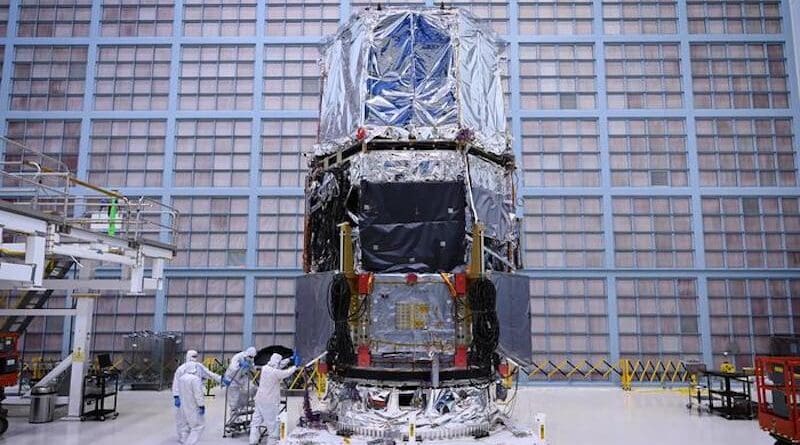
Technicians manually deploy the Lower Instrument Sun Shield for NASA's Nancy Grace Roman Space Telescope. The test helps verify the panels will operate as designed in space. CREDIT: NASA/Sophia Roberts
Technicians have successfully installed two sunshields onto NASA’s Nancy Grace Roman Space Telescope’s inner segment. Along with the observatory’s Solar Array Sun Shield and Deployable Aperture Cover, the panels (together called the Lower Instrument Sun Shade), will play a critical role in keeping Roman’s instruments cool and stable as the mission explores the infrared universe.
The team is on track to join Roman’s outer and inner assemblies this fall to complete the full observatory, which can then undergo further prelaunch testing.
“This shield is like an extremely strong sunblock for Roman’s sensitive instruments, protecting them from heat and light from the Sun that would otherwise overwhelm our ability to detect faint signals from space,” said Matthew Stephens, an aerospace engineer at NASA’s Goddard Space Flight Center in Greenbelt, Maryland.
The sunshade, which was designed and engineered at NASA Goddard, is essentially an extension of Roman’s solar panels, except without solar cells. Each sunshade flap is roughly the size of a garage door — about 7 by 7 feet (2.1 by 2.1 meters) — and 3 inches (7.6 centimeters) thick.
“They’re basically giant aluminum sandwiches, with metal sheets as thin as a credit card on the top and bottom and the central portion made up of a honeycomb structure,” said Conrad Mason, an aerospace engineer at NASA Goddard.
This design makes the panels lightweight yet stiff, and the material helps limit heat transfer from the side facing the Sun to the back –– no small feat considering the front will be hot enough to boil water (up to 216 degrees Fahrenheit, or 102 degrees Celsius) while the back will be much colder than Antarctica’s harshest winter (minus 211 Fahrenheit, or minus 135 Celsius). A specialized polymer film blanket will wrap around each panel to temper the heat, with 17 layers on the Sun side and one on the shaded side.
The sunshade will be stowed and gently deploy around an hour after launch.
“The deploying mechanisms have dampers that work like soft-close hinges for drawers or cabinets, so the panels won’t slam open and rattle the observatory,” Stephens said. “They each take about two minutes to move into their final positions. This is the very first system that Roman will deploy in space after the spacecraft separates from the launch vehicle.”
Now completely assembled, Roman’s inner segment is slated to undergo a 70-day thermal vacuum test next. Engineers and scientists will test the full functionality of the spacecraft, telescope, and instruments under simulated space conditions. Following the test, the sunshade will be temporarily removed while the team joins Roman’s outer and inner assemblies, and then reattached to complete the observatory. The mission remains on track for launch no later than May 2027 with the team aiming for as early as fall 2026.
Trump’s Nuclear Energy Overhaul Sparks Alarms Over Safety
Trump has announced plans to quadruple U.S. nuclear power by 2050, pushing for rapid approval of new reactors and slashing regulatoy barriers.
Experts warn that undermining the independent Nuclear Regulatory Commission could erode essential safety standards and risk public backlash.
Critics argue the slow growth of U.S. nuclear energy stems from high costs, not overregulation, citing costly delays at projects like Plant Vogtle.
The President of the United States, Donald Trump, is betting big on nuclear power and aims to fast-track projects to prepare for the massive increase in electricity demand over the next decade. However, experts fear that his plans to accelerate project development could compromise safety standards, particularly as the independent U.S. Nuclear Regulatory Commission comes under threat.
Trump’s orders establish arbitrary deadlines for decisions on construction permits and operating licenses, even for new designs that have not yet been assessed; demand a review of all NRC regulations within 18 months; and allow for the construction of nuclear reactors on federal lands without NRC review.
While deploying more nuclear power could help the U.S. respond to the rising domestic electricity demand, there are widespread concerns that President Trump’s rapid approval of new nuclear projects threatens to weaken the independent Nuclear Regulatory Commission (NRC), which assesses projects for health and safety and ensures reactors operate securely. The objective of Trump’s executive orders is to reduce regulations and accelerate the approval of nuclear plants by overhauling the NRC.
Trump has said that he believes the NRC is too risk-averse and has blamed the agency for the how few nuclear plants have been constructed in the U.S. over the last 30 years. He stated in one executive order that the NRC is overly focused on protecting the public from “the most remote risks,” suggesting that such a cautious approach to approving nuclear facilities limits access to reliable electricity. During one press conference in July, Trump said, “We’ll be very safe, but we’ll be fast and safe,” about nuclear plant development. He added that his administration will get a “whole different group of people” to regulate the industry.
However, several former chairs from the NRC have told reporters that the prohibitive cost of building new nuclear plants is to blame for the slow sectoral development, rather than the strict safety standards of the agency. Just two new reactors have been constructed in the U.S. in the last three decades, both of which are at Plant Vogtle in Georgia. Building these reactors cost $18 billion more than originally anticipated and took seven years longer. Meanwhile, two reactors in South Carolina were cancelled in 2017 due to the higher-than-expected price of construction. The nuclear company Westinghouse filed for bankruptcy following several failings in the development of these projects.
For decades, the public perception of nuclear power has been extremely poor in the U.S, following three nuclear disasters at Chernobyl, Fukushima, and Three Mile Island. These incidents have led international and national nuclear regulators to employ stringent safety standards and assess new nuclear projects thoroughly before approval.
The NRC has overseen the sector for 50 years without a single civilian reactor radiation-related death. In recent years, largely thanks to the strict regulations and the safe running of nuclear power plants around the world for several decades, public perception has once again shifted in favour of nuclear power.
However, reducing the powers of the independent nuclear regulatory commission in the U.S. could undermine the safety standards of the industry and spur greater public backlash when developing new projects. In June, Trump fired the NRC chairman, Christopher Hanson, as part of his bid to take away authority from the agency. Hanson said that Trump terminated his role as chairman without cause, contrary to existing law and longstanding precedent regarding the removal of independent agency appointees.”
As part of the shake-up, Adam Blake, a Department of Government Efficiency representative, reportedly told the NRC’s chair that the agency will be expected to give “rubber-stamp” approval to new reactors tested by the departments of Energy or Defence, during a meeting in May.
The NRC has since responded to Trump’s recent executive orders concerning nuclear power. “The NRC is working quickly to implement the executive orders reforming the agency and modernising our regulatory and licensing processes,” said NRC spokesperson Maureen Conley. “We look forward to continuing to work with the administration, Department of Energy and Department of Defence on future nuclear programmes.”
Weakening the powers of the independent NRC to give greater control to the government’s Department of Energy and Defence undermines the stringent safety standards that were previously enforced for the development and running of nuclear plants. At worst, this could lead to another nuclear disaster, which could jeopardise the health, or even lives, of people across the U.S.
The authors said they hope the research will "improve confidence among policymakers and the public in the long-term safety of underground nuclear waste disposal".
Monday, 4 August 2025
A study shows that simulations of underground radioactive waste interactions, generated by new, high-performance computing software, aligned well with experimental results from a research facility in Switzerland.
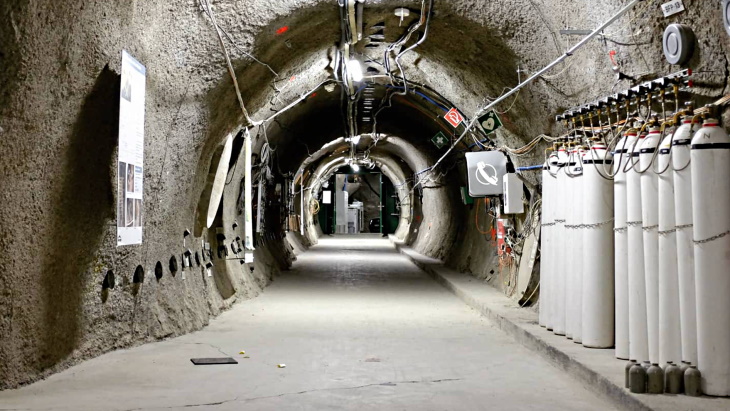
The Mont Terri underground rock laboratory (Image: Mont Terri Project)
The study, which was co-authored by Massachusetts Institute of Technology PhD student Dauren Sarsenbayev and Assistant Professor Haruko Wainwright, along with Christophe Tournassat from Lawrence Berkeley National Laboratory (LBNL) and the University of Orléans in France, as well as Carl Steefel from LBNL.
Tournassat and Steefel have developed high-performance computing software - called CrunchODiTi - to improve modelling of interactions between the radioactive waste and both engineered and natural materials.
The CrunchODiTi software accounts for electrostatic effects associated with the negatively charged clay minerals used in the barriers within a waste repository, making it the only one that can simulate those interactions in three-dimensional space. The software was developed from established software known as CrunchFlow and was most recently updated this year. It is designed to be run on many high-performance computers at once in parallel.
The research builds on the developing work of the Mont Terri Project near St-Ursanne in Switzerland, an international research project for the hydrogeological, geochemical and geotechnical characterisation of an Opalinus Clay formation. Founded in 1996, the rock laboratory is situated about 300 metres underground.
"It is widely regarded as one of the most valuable real-world experiment sites because it provides us with decades of datasets around the interactions of cement and clay, and those are the key materials proposed to be used by countries across the world for engineered barrier systems and geological repositories for nuclear waste," Sarsenbayev said.
Within the last several years, a mix of both negatively and positively charged ions were added to the borehole located near the centre of the cement emplaced in the formation. The researchers focused on a 1-cm-thick zone between the radionuclides and cement-clay referred to as the 'skin'. They compared their experimental results with the software simulation, finding the two datasets aligned.
The experimental results showed the model successfully accounted for electrostatic effects associated with the clay-rich formation and the interaction between materials in Mont Terri over time.
The new model could now replace older models that have been used to conduct safety and performance assessments of underground geological repositories.
"These powerful new computational tools, coupled with real-world experiments like those at the Mont Terri research site in Switzerland, help us understand how radionuclides will migrate in coupled underground systems," Sarsenbayev said.
Wainwright added: "This research - coupling both computation and experiments - is important to improve our confidence in waste disposal safety assessments. With nuclear energy re-emerging as a key source for tackling climate change and ensuring energy security, it is critical to validate disposal pathways."
The authors said they hope the research will "improve confidence among policymakers and the public in the long-term safety of underground nuclear waste disposal".
A Geological Disposal Facility comprises a network of highly-engineered underground vaults and tunnels built to permanently dispose of higher activity radioactive waste so that no harmful levels of radiation ever reach the surface environment. Countries such as Finland, Sweden, France, Canada, the UK and the USA are pursuing this option.
Polish research reactor permitted to continue operating
Monday, 4 August 2025
Poland's National Atomic Energy Agency has issued a new operating licence for the MARIA nuclear research reactor, operation of which was suspended after its previous licence expired at the end of March.
An external view of the MARIA reactor building (Image: NCBJ)
MARIA is the only operating nuclear reactor in Poland. The high flux research reactor - located at the Świerk Research Centre about 30 kilometres south-east of Warsaw - is a water and beryllium moderated reactor of a pool type with graphite reflector and pressurised channels containing concentric six-tube assemblies of fuel elements. The 30 MWt reactor achieved first criticality in December 1974.
The National Centre for Nuclear Research (NCBJ) submitted an application to the National Atomic Energy Agency (NAEA) for a new permit to operate MARIA, along with the required documents, on 20 August last year. However, NCBJ was repeatedly requested to provide clarifications and supplement the documentation. Due to the lack of a permit from 1 April, the reactor's operation has been suspended until a new permit is issued.
The NAEA said the decision by its president to issue a new licence for an indefinite period was "preceded by a months-long analysis and evaluation of all documents attached to the application, during which the applicant was repeatedly requested to provide clarifications and additional information on issues that were unclear but related to the facility's operational safety".
"Receiving the new permit confirms the high level of safety of our infrastructure and the competence of the team of engineers, physicists, and specialists involved in the operation of the MARIA reactor," said Agnieszka Pollo, acting director of NCBJ. "We thank the Polish Atomic Energy Agency for its substantive and responsible cooperation, and all domestic and international partners for their trust during the reactor's outage. We are initiating the procedure to resume the reactor's operation and will continue its research and service mission."
The MARIA reactor (Image: NCBJ)
"This is very good news for us, and even a relief," said Polish Energy Minister Miłosz Motyka. "The reactor plays a very important role, but nuclear safety requirements must always be met. Now that all the necessary analyses and procedures have been properly prepared and approved, MARIA can return to work, and the priority is to implement the modernisation programme, which will allow it to operate for another 20 years."
In June 2023, Poland's Council of Ministers adopted a resolution on the modernisation of the MARIA nuclear research reactor, enabling its operation after 2027. According to NCBJ, it could operate for another 30 years, subject to sufficient funds for operating it and modernisation.
For many years, MARIA has played a key role in the production of medical radioisotopes, including molybdenum-99, accounting for a portion of the global supply. Furthermore, it provides an important base for research in nuclear physics, materials science, and nuclear energy, as well as for staff training for the implementation of Poland's nuclear power programme.
IAEA concern after explosions heard near Zaporizhzhia nuclear plant
Monday, 4 August 2025
International Atomic Energy Agency Director General Rafael Mariano Grossi has repeated calls for "maximum military restraint near nuclear facilities".
There have been IAEA experts stationed at the plant since Septemeber 2022 (Image: IAEA, March 2023))
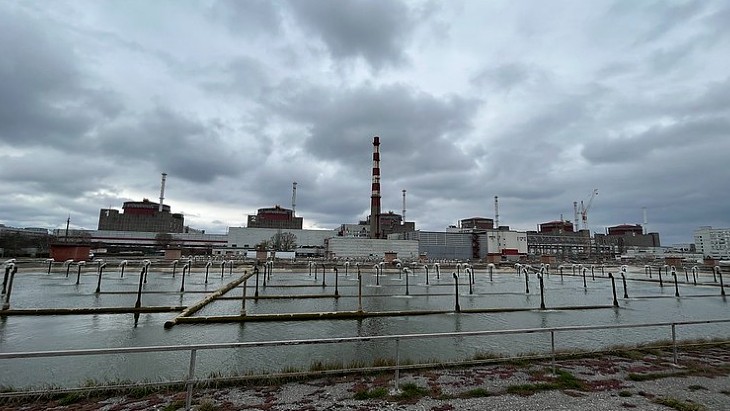
His comments came after the agency's experts stationed at Zaporizhzhia Nuclear Power Plant, which has been under Russian military control since early March 2022, heard explosions and saw smoke at a nearby location.
The International Atomic Energy Agency (IAEA) staff at the plant were told by its operators that an auxiliary facility about 1,200 metres from the plant site's perimeter had been struck by shelling and drones on Saturday morning, with smoke still visible from the location in the afternoon.
Grossi said: "Any attack in the vicinity of a nuclear power plant - regardless of the intended target - poses potential risks also for nuclear safety and must be avoided. Once again, I call for maximum military restraint near nuclear facilities to prevent the continued risk of a nuclear accident."
The Zaporizhzhia plant is situated near the frontline of Russian and Ukrainian forces. As well as direct security risks - IAEA staff have reported hearing military activity regularly in recent weeks at different distances from the plant - it also continues to rely on one external power line, compared with the 10 lines it had before the conflict. If that external power line is lost, it has to rely on emergency back-up diesel generators to provide the power required for essential safety functions.
IAEA teams at the Khmelnitsky, Rivne and South Ukraine nuclear power plants in Ukraine - as well as at Chernobyl - have also heard regular air raid sirens over recent weeks, and drones were detected within a few kilometres of plants, the IAEA has reported.
Delay in Flamanville 3 attaining full power
Monday, 4 August 2025
The long-delayed Flamanville 3 EPR reactor in Normandy in northern France is now expected to reach full power for the first time "before the end of autumn 2025", EDF said. It had earlier been scheduled to reach full power in "summer 2025".
The Flamanville EPR (Image: Alexis Morin and Antoine-Soubigou/EDF)
The 1630 MWe (net) pressurised water reactor was connected to the grid for the first time on 21 December 2024. At that time, EDF said that "in accordance with the startup operations, the phases of testing and of connection and disconnection to the grid will continue for several months ... until the reactor reaches 100% power". This had been scheduled for summer 2025.
However, EDF has now said: "After its next reconnection to the grid, the Flamanville 3 teams will continue the testing phase before commissioning with an objective to reach full capacity before the end of autumn 2025.
"At the end of this testing period, the unit is expected to be operated at 100% capacity until the first planned outage for maintenance and refuelling, called Visite Complète 1 (VC1). This first planned outage should mainly take place in 2026."
Construction work began in December 2007 on the third unit at the Flamanville site - where two reactors have been operating since 1986 and 1987. The dome of the reactor building was put in place in July 2013 and the reactor vessel was installed in January 2014. The reactor was originally expected to start commercial operation in 2013 but has faced a series of delays.
The first EPR units came online at Taishan in China, where unit 1 became the first EPR to enter commercial operation in 2018 followed by Taishan 2 in September 2019. In Europe, Olkiluoto 3 in Finland entered commercial operation in 2023, and two units are currently under construction at Hinkley Point C in the UK, with two more planned at Sizewell C.
Key equipment manufactured for BREST-OD-300 reactor
Monday, 4 August 2025
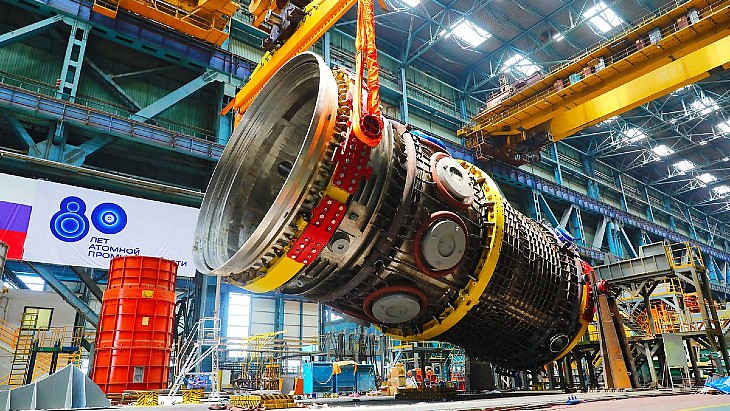
Six items weighing more than 1,000 tonnes have been manufactured for the BREST-OD-300 lead-cooled fast neutron reactor which is being built at the Siberian Chemical Combine site in Seversk, in the Tomsk Region of Russia.
(Image: Rosatom)
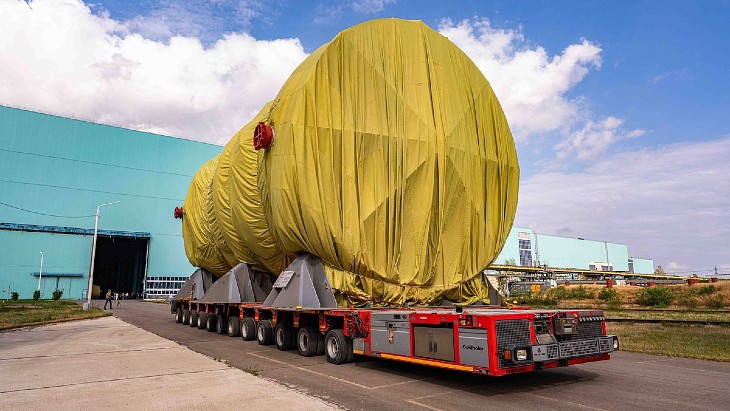
The Atommash plant in Volgodonsk - part of Rosatom’s Mechanical Engineering Division - has shipped to the construction site the central void shell and inner casing for the core support barrel, components which will hold nuclear fuel once installed. The Izhora plant in St Petersburg - also part of the same Rosatom division - shipped four peripheral cavity shells which will house steam generators and pumps for circulation of the coolant.
Each item is more than 15 metres high and 8 metres wide, with dimensions that differ from items manufactured for VVER and RITM units and with special steels able to withstand temperatures up to 600ºC. Production facilities had to be adapted “to handle products as tall as a five-storey building as well as developing unique packaging that weighed a total of 700 tonnes to safely transport and roll the equipment during installation”, Rosatom said.
In total about 2,300 tonnes of equipment will be sent to the construction site where the reactor will be assembled. The total weight of the installation will be 16,000 tonnes including the concrete which will be used.
(Image: Rosatom)
Igor Kotov, Head of Rosatom’s Mechanical Engineering Division, said: “Russian designers, engineers, and machine builders are pioneering the future of the energy industry. Our machine builders, with their extensive experience and the latest scientific advancements, were the first in the world to embark on the practical realisation of the fourth generation reactor project. This achievement has laid a robust foundation for technologies that will benefit our children, grandchildren, and future generations.”
The background
The BREST-OD-300 fast reactor is part of Rosatom's Proryv, or Breakthrough, project to enable a closed nuclear fuel cycle. The 300 MWe unit will be the main facility of the Pilot Demonstration Energy Complex at the Siberian Chemical Combine site. The complex will demonstrate an on-site closed nuclear fuel cycle with a facility for the fabrication/re-fabrication of mixed uranium-plutonium nitride nuclear fuel, as well as a used fuel reprocessing facility.
A progress update in November said that the cooling tower had been built, the walls of the reactor containment building erected and the reactor shaft and the enclosing structure of the reactor vessel have also been installed.
Initial operation of the demonstration unit will be focused on performance and after 10 years or so it will be commercially oriented. The plan has been that if it is successful as a 300 MWe (700 MWt) unit, a 1200 MWe (2800 MWt) version will follow - the BR-1200.

 Israeli Prime Minister Benjamin Netanyahu speaks to the audience at a conference in Jerusalem, 27 July, 2025 AP Photo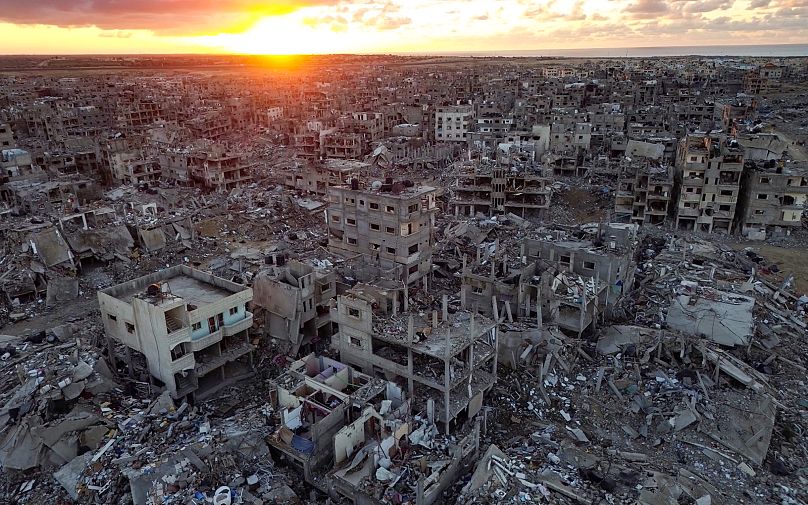






_98198.jpg)
_32715.jpg)