SPACE/COSMOS
NASA races to put nuclear reactors on Moon and Mars
Washington (AFP) – The United States is rushing to put nuclear power reactors on the Moon and Mars, and hopes to launch the first system by the end of the decade.
Issued on: 05/08/2025 - FRANCE24
A new NASA directive -- first reported by Politico and seen by AFP on Tuesday -- calls for the appointment of a nuclear power czar to select two commercial proposals within six months, framing the push as crucial to outpacing a joint Chinese-Russian effort.
Signed by acting NASA chief Sean Duffy, who is also US transportation secretary, the July 31 memo is the latest sign of the agency's shift towards prioritizing human space exploration over scientific research under President Donald Trump's second term.
"Since March 2024, China and Russia have announced on at least three occasions a joint effort to place a reactor on the Moon by the mid-2030s," it says.
"The first country to do so could potentially declare a keep-out zone which would significantly inhibit the United States from establishing a planned Artemis presence if not there first."
The idea of using nuclear energy off-planet is not new.
Since 2000, NASA has invested $200 million towards developing small, lightweight fission power systems, though none have progressed towards flight readiness, according to the directive.
The most recent effort came in 2023 with the completion of three $5 million industry study contracts that focused on generating 40 kilowatts of power, enough to continuously run 30 households for ten years.
Unlike solar power, fission systems can operate around the clock -- invaluable during the weeks-long lunar nights or Martian dust storms.
Advances in technology have made such systems increasingly compact and lightweight.
NASA formally committed to using nuclear power on Mars in December 2024 -- the first of seven key decisions necessary for human exploration of the Red Planet.
Based on feedback by industry, surface power needs should be at least 100 kilowatts to support "long-term human operations including in-situ resource utilization," meaning things like life support, communications, and mining equipment to collect surface ice.
It assumes the use of a "heavy class lander" that carries up to 15 metric tons of mass, and targets a "readiness to launch by the first quarter of FY30," meaning late 2029.
NASA's Artemis program to return to the Moon and establish a lasting presence near the south pole has faced repeated delays.
The timeline for Artemis 3, the first planned crewed landing, has slipped to 2027, a date few see as realistic given the planned lander, SpaceX's Starship, is far from ready.
China meanwhile is targeting 2030 for its first crewed mission and has proven more adept at meeting its deadlines in recent years.
© 2025 AFP
NASA Installs Key ‘Sunblock’ Shield On Roman Space Telescope
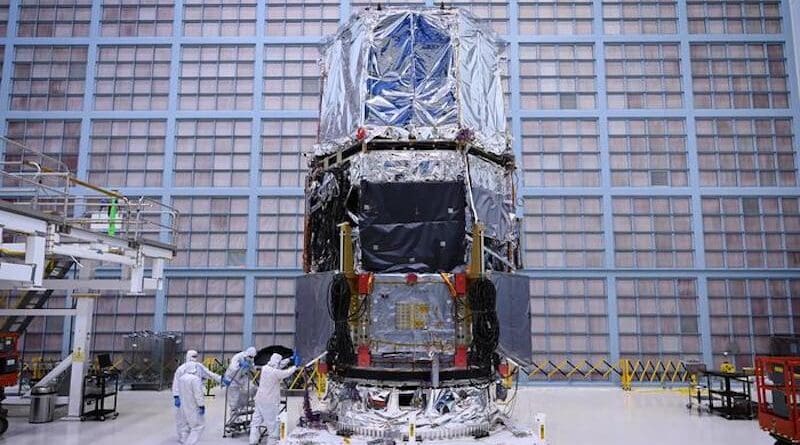
Technicians manually deploy the Lower Instrument Sun Shield for NASA's Nancy Grace Roman Space Telescope. The test helps verify the panels will operate as designed in space. CREDIT: NASA/Sophia Roberts
Technicians have successfully installed two sunshields onto NASA’s Nancy Grace Roman Space Telescope’s inner segment. Along with the observatory’s Solar Array Sun Shield and Deployable Aperture Cover, the panels (together called the Lower Instrument Sun Shade), will play a critical role in keeping Roman’s instruments cool and stable as the mission explores the infrared universe.
The team is on track to join Roman’s outer and inner assemblies this fall to complete the full observatory, which can then undergo further prelaunch testing.
“This shield is like an extremely strong sunblock for Roman’s sensitive instruments, protecting them from heat and light from the Sun that would otherwise overwhelm our ability to detect faint signals from space,” said Matthew Stephens, an aerospace engineer at NASA’s Goddard Space Flight Center in Greenbelt, Maryland.
The sunshade, which was designed and engineered at NASA Goddard, is essentially an extension of Roman’s solar panels, except without solar cells. Each sunshade flap is roughly the size of a garage door — about 7 by 7 feet (2.1 by 2.1 meters) — and 3 inches (7.6 centimeters) thick.
“They’re basically giant aluminum sandwiches, with metal sheets as thin as a credit card on the top and bottom and the central portion made up of a honeycomb structure,” said Conrad Mason, an aerospace engineer at NASA Goddard.
This design makes the panels lightweight yet stiff, and the material helps limit heat transfer from the side facing the Sun to the back –– no small feat considering the front will be hot enough to boil water (up to 216 degrees Fahrenheit, or 102 degrees Celsius) while the back will be much colder than Antarctica’s harshest winter (minus 211 Fahrenheit, or minus 135 Celsius). A specialized polymer film blanket will wrap around each panel to temper the heat, with 17 layers on the Sun side and one on the shaded side.
The sunshade will be stowed and gently deploy around an hour after launch.
“The deploying mechanisms have dampers that work like soft-close hinges for drawers or cabinets, so the panels won’t slam open and rattle the observatory,” Stephens said. “They each take about two minutes to move into their final positions. This is the very first system that Roman will deploy in space after the spacecraft separates from the launch vehicle.”
Now completely assembled, Roman’s inner segment is slated to undergo a 70-day thermal vacuum test next. Engineers and scientists will test the full functionality of the spacecraft, telescope, and instruments under simulated space conditions. Following the test, the sunshade will be temporarily removed while the team joins Roman’s outer and inner assemblies, and then reattached to complete the observatory. The mission remains on track for launch no later than May 2027 with the team aiming for as early as fall 2026.

No comments:
Post a Comment