Tuesday, August 19, 2025

US Human Rights Report on Venezuela Doesn’t Pass the Mirror Test


The US State Department’s latest Human Rights Report condemns Venezuela for serious abuses. Weaponizing human rights, accusations are selectively applied to serve a destabilization campaign. In this article, a mirror is held up to Uncle Sam to see how well “America the beautiful” holds up to the same charges, while also exposing the role of sanctions, compliant NGOs, and military threats in Washington’s hybrid war on Venezuela.

The carceral state

The US report indicts Venezuela for “arbitrary or unlawful killings.” Meanwhile, in the land of the free, police killings hit a record high in 2024. Impunity is high with charges brought against offending officers in fewer than 3% of cases. The FBI itself admits that transparency is hampered.

Prolonged solitary confinement, recognized as torturous, is widespread in US prisons and ICE detention centers, affecting over 122,000 people daily. A US Senate report on torture documented CIA abuses, yet meaningful accountability has failed. Hundreds of political prisoners languish in penitentiaries in the US and in Guantánamo, the majority of whom are people of color. Roughly 70% of local jail inmates are held in pretrial detention, often pressured with coercive plea deals, undermining equality before the law.

The US has the largest prison population in the world (about 1.8 to 2 million) and an incarceration rate over 2.5 times greater than Venezuela’s. Even after release, about four million citizens remain disenfranchised due to felony convictions, disproportionately affecting Black communities.

Freedom to protest

Washington faults Venezuela for limiting freedom of expression. Yet, numerous US states have passed or considered anti-protest laws (e.g., “critical infrastructure” bills) that civil-liberties groups warn chill peaceful assembly.

Reporters without Borders (RSF) observes, “the country is experiencing its first significant and prolonged decline in press freedom in modern history.” This accusation is particularly notable because RSF is strongly biased in support of the US and receives funding from the State Department and the National Endowment for Democracy. Arrests and detentions of journalists surged in 2024; schoolbook bans spiked across 29 states. In April 2024, Congress reauthorized and expanded FISA §702, enabling warrantless surveillance according to legal scholars.

As the US-based Black Alliance for Peace observes, “domestic repression in the US colonial/capitalist core is imperative to support the aggressive militarism abroad.”

This coupling of domestic subjugation with the international is painfully evident with the US imperialist/Israeli zionist aggression abroad in Gaza, while pro-Palestine advocates are suppressed at home. Zionist curricula are being imposed at all levels of education; at least half of the US states now require so-called “Holocaust education.” Pro-Palestine faculty, students, and staff are being purged.

Washington’s accusation of Venezuelan antisemitism cites President Nicolás Maduro calling Israel’s assault on Gaza “the most brutal genocide” since Hitler. Its charge of antisemitism conflates Venezuela’s political criticism of the zionist state with hatred of the Jewish religion. If “antisemitism” includes Muslim Arabs, US culpability is so blatant that it requires no additional documentation.

Meanwhile, the US accuses Venezuela of failing to protect refugees and asylum seekers. This projection does not deserve any rebuttal other than to mention that the US has a documented history of family separation of migrants and deaths in custody.

Likewise, the world’s rogue nation does not recognize the jurisdiction of the International Court of Justice and similar institutions, while reproaching Caracas for attempting to “misuse international law.” If anything, the Maduro government has gone out of its way to defend international law with initiatives upholding the UN Charter.

Social welfare

The US report scolds Venezuela for a minimum wage “under the poverty line.” Yet, its own federal minimum wage has been $7.25/hour since 2009; insufficient to lift a full-time worker out of poverty.

A UN special rapporteur for human rights estimated that sanctions – more properly “unilateral coercive measures” – by the US and allies have caused over 100,000 excess deaths in Venezuela. Yet purported human rights NGOs Amnesty International (AI), Human Rights Watch (HRC), and the Washington Office on Latin American (WOLA) omit this glaring human toll in their reports on human rights in Venezuela.

Predictably, they make nearly identical evaluations of the Venezuelan human rights situation as does the US-dominated Organization of American States (OAS) and the US State Department itself.  Their reports (AIHRWWOLA, US, OAS) either ignore or, at best, make passing references to the sanctions. No mention is made of the illegality of sanctions under international law – they are a form of collective punishment.

In other contexts, the NGOs have acknowledged the horrific human impact of sanctions. Regardless, they were in a panic that the Trump administration might ease sanctions over the Chevron license, thus rewarding bad behavior. For these soft power apparatchiks of the US imperial project, the pain endured by the Venezuelans is worth it. WOLA has been particularly vocal about counseling against direct US military intervention, when sanctions afford an equally lethal but less obvious form of coercion.

Hybrid war on Venezuela

In his first term, Donald Trump levied a $15m bounty on Maduro, framing the Venezuela government as a transnational criminal enterprise tied to terrorism. This lowered the potential threshold for extraordinary US measures. Joe Biden seamlessly upped the bounty to $25m, which Trump then doubled on August 7.

Evidence-free allegations linking the Venezuelan president to the dismantled Tren de Aragua drug cartel, the fictitious Cartel of the Suns criminal organization, and the actual Sinaloa Cartel (which is in Mexico) were conveniently used to justify invoking the Alien Enemies Act of 1798, which is supposed to be a wartime measure. This is coupled with the designation of drug cartels as foreign terrorist organizations (FTOs) and periodic threats of US military intervention.

This is from the country that is the world’s biggest launderer of illicit drug money and the largest consumer of illicit drugs. Even US agencies recognize that very few of these US-bound drugs move through Venezuela.

Most recently, the US deployed an additional 4,000 troops and warships to the Caribbean and around Latin America. Venezuela responded by mobilizing its navy in its territorial waters.

Leading Venezuelan opposition politician María Corina Machado expressed her “immense gratitude” for the imperialist measures against her country. In contrast, thousands of her compatriots took the opposite stance and marched in protest. Venezuela-American Michelle Ellner calls the US policy “a green light for open-ended US military action abroad, bypassing congressional approval, sidestepping international law.”

Weaponizing human rights for regime change

Venezuela is caught in a hybrid war that is as deadly as if it were being bombed. Washington’s strangling of its economy, making wild accusations against its leaders, sponsoring opponents, and threatening armed interventions are all designed to provoke and destabilize. Venezuela’s response is best seen as self-defense against an immensely powerful foreign bully that exploits any weakness, imperfection, or lapse in vigilance.

The US weaponizes human rights to overthrow Venezuela’s Bolivarian Revolution. Its exaggerated or outright fabricated allegations are echoed by the “human rights industry.” Where problems exist, they must be viewed in the context of US economic warfare, which has strained Venezuelan institutions. North Americans genuinely concerned about Venezuelan human rights should be highly skeptical of corporate media reports and recognize the need to end US interference. Escalating provocations will only necessitate Venezuela’s greater defensiveness.

Roger D. Harris was an international observer for Venezuela’s 2024 presidential election. He is with the US Peace Council and the Task Force on the AmericasRead other articles by Roger.

 Cancelling the Ethnic Cleansers: Australia Revokes Simcha Rothman’s Visa

It is a curious feeling to see a government, let alone any politician, suddenly find their banished backbones and retired principles. The spine, on being discovered, adds a certain structural integrity to arguments otherwise lacking force and credibility. The recent spat between Israel and Australia suggests that Prime Minister Anthony Albanese’s often insecure and often overly cautious administration is starting to show some muscle and certitude.

The cancellation of Simcha Rothman’s visa by the Albanese government was something of a minor revelation. Rothman is a member of Mafdal-Religious Zionism, a party led by Finance Minister Bezalel Smotrich that has made its position on Palestinians unmistakably clear.  (Smotrich became the subject of sanctions by Australia along with Canada, New Zealand, Norway, and the United Kingdom in June for “inciting violence against Palestinians in the West Bank.”) As a certain garden variety shrub of hate, he decries countries for not taking in Palestinians as part of an approved ethnic cleansing program, accusing them of “aiding and abetting a terrorist organisation using them as human shields”. In an interview with Australia’s national broadcaster, Rothman made his primary colour position clear: “I think the government of Australia needs to decide, do they want to be on the side of Hamas, or do they want to be on the side of Israel?”

The letter of revocation stated that he would be engaged in events that would “promote his controversial views and ideologies, which may lead to fostering division in the community”. Being in Australia “would or might be a risk to the good order of the Australian community or a segment of the Australian community, namely, the Islamic population”.

Adduced examples of demerit included arguments that Palestinian children were not perishing from hunger in the Gaza Strip, that those children, in any case, were enemies of the Israeli state, along with the notion that the two-state solution had “poisoned the minds of the entire world”. The nature of such “inflammatory statements” might, were Rothman to enter Australia licensed by the government, “encourage others to feel emboldened to voice any anti-Islamic sentiments, if not to take action to give effect to that prejudice”.

Far from engaging these reasons, Rothman’s enchantingly shrunken worldview was clear in its chiselled simplicity: Australia was behaving undemocratically, its government falsely claiming to argue against “hate and division” despite permitting protestors “to shout on the streets calls for genocide of the Jewish people.”

Israel’s Foreign Minister Gideon Sa’ar was quick in response, revoking the residency visas of Australia’s diplomatic representatives responsible for affairs concerning the Palestinian Authority in Ramallah. “I also instructed the Israeli Embassy in Canberra to carefully examine any official Australian visa application for entry to Israel,” Sa’ar fumed on X.

In this apoplectic reaction, no one seemed to recall that Australia had already revoked the visa of a former Israeli justice minister, Ayelet Shaked, at the end of October last year over what Australia’s Home Minister Tony Burke described as “concerns she would threaten social cohesion”. Shaked had been slated to attend events organised by the Australia Israel & Jewish Affairs Council (AIJAC). Admittedly, she was a former politician rather than a sitting member of the Israeli parliament.

In an interview with the Erin Molan Show, an otherwise underwhelming program, Sa’ar recapitulated his cranky position. “This is the opposite of what should be done,” he objected. “Instead of battling antisemitism in Australia, the Australian government is doing the opposite – they are fuelling it.”

The Palestinian Authority surprised nobody in calling the measure to cancel visas “illegal and in violation of the Geneva Conventions, international law, the United Nations resolutions, which do not grant the occupying power such authority.” The statement went on to stress “that such actions reflect Israeli arrogance and a state of political imbalance, and will only strengthen Australia’s and other countries’ determination to uphold international law, the two-state solution, and recognition of the State of Palestine as the path to peace.”

Australia’s foreign minister, Penny Wong, also thought this all a bit much. Calling the decision to cancel the visas of Australia’s diplomats in the West Bank an “unjustified reaction” to Canberra’s decision to recognise Palestine, Wong felt confident enough to retort that the Israeli decision had been foolish. “At a time when dialogue and diplomacy are needed more than ever, the Netanyahu Government is isolating Israel and undermining international efforts towards peace and a two-state solution.”

This messiness was appropriately crowned by that grand figure of demagoguery himself, the Israeli Prime Minister. “History will remember Albanese for what he is: A weak politician who betrayed Israel and abandoned Australia’s Jews,” came the scornful blast from the office of Prime Minister Benjamin Netanyahu. The Israeli PM is certainly not wrong about Albanese being weak, but mistaken about what he has been weak about. Most intriguingly, Albanese has found some courage on this front, albeit the sort of courage fortified by allies. But that’s something.

Binoy Kampmark was a Commonwealth Scholar at Selwyn College, Cambridge. He lectures at RMIT University, Melbourne. Email: bkampmark@gmail.comRead other articles by Binoy.
US Air Force official’s 'forced' resignation sending 'shockwaves through the Pentagon'


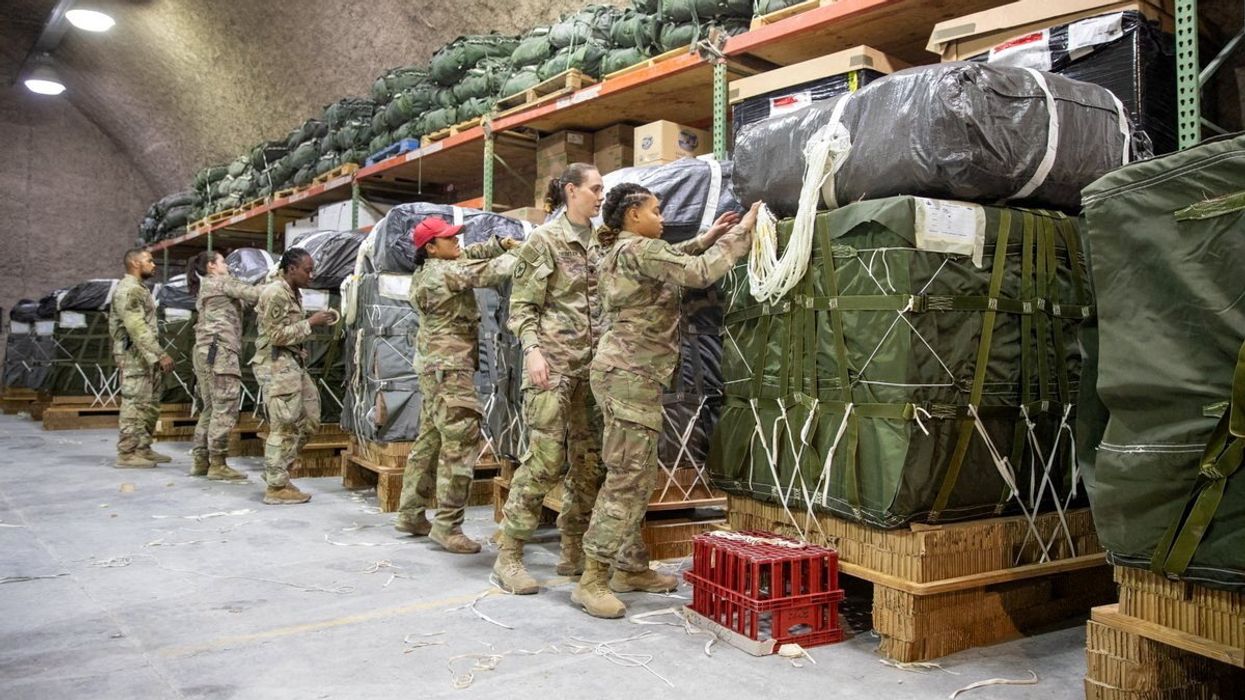
 U.S. Air Force members work on the preparation of a humanitarian aid drop for Gaza residents, in this picture released on March 5, 2024.
August 19, 2025
ALTERNET

Gen. David Allvin, chief of staff for the U.S. Air Force, was appointed to a four-year term under former President Joe Biden and ex-Defense Secretary Lloyd Austin. But now, according to reporting in the Washington Post and the Daily Beast, he is being forced out only two years into that term — a development that, Dan Lamothe and Tara Copp report in the Post, is "sending shockwaves through the Pentagon."

Allvin's resignation, according to Lamothe and Copp, was confirmed by Pentagon officials on Monday, August 19. And his departure is consistent with a pattern that is occurring under President Donald Trump and Defense Secretary Pete Hegseth.

Lamothe and Copp report, "Allvin's impending departure follows the firings of several other senior military officers since Trump's return to the White House this year, including the chairman of the Joint Chiefs of Staff, the chief of naval operations, the commandant of the Coast Guard, and the vice chief of staff of the Air Force. Generals and admirals serving in less prominent roles also have been purged, sending shockwaves through the Pentagon and much of the U.S. military, where stability typically is seen as an asset."

A Pentagon source, interviewed on condition of anonymity, told the Post that Allvin had a choice of either announcing his resignation or getting fired. And he agreed to step down if he could make the announcement himself.

According to the Pentagon source, "It was certainly not his choice."

Lamothe and Copp report, "Allvin was informed last week that he would be asked to retire and that the Pentagon, under Defense Secretary Pete Hegseth, wanted to go in another direction, said a person familiar with the matter, who, like some others, spoke on the condition of anonymity to discuss a sensitive issue."

Although Allvin didn't give a specific reason for his departure in his resignation announcement, a Post source, according to Lamothe and Copp, "said he was surprised it took as long as it did for the Trump Administration to remove Allvin" because "administration officials have been frustrated for some time with his oversight of preparations for a potential security crisis involving China."

The Daily Beast's Ewan Palmer notes, "The retirement is expected to be on or about November 1. Allvin said he was 'grateful for the opportunity' to serve as the 23rd Air Force chief of staff. 'More than anything, I'm proud to have been part of the team of airmen who live out our core values of integrity, service, and excellence every day as we prepare to defend this great nation,' he added. Allvin will remain in his role until a successor is confirmed."

Palmer adds, "Gen. Thomas Bussiere, Trump's pick for Air Force vice chief of staff who played a key role in Operation Midnight Hammer — the U.S. military strikes targeting Iranian nuclear facilities in June — is believed to be the frontrunner."

Read the Washington Post's full article at this link (subscription required) and the Daily Beast's reporting here (subscription required).
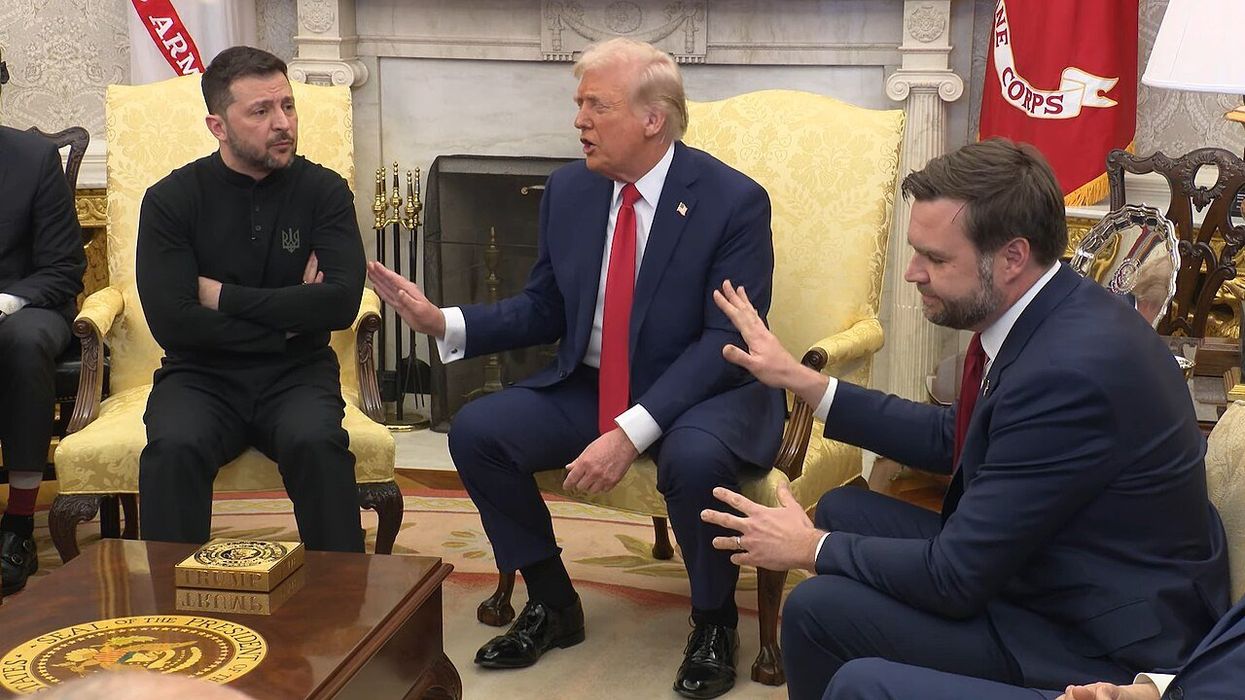
Trump blames Ukraine: 'You don’t take on a nation that’s 10 times your size'


U.S. President Donald Trump and U.S. Vice President JD Vance with Ukrainian President Volodymyr Zelensky in the White House Oval Office on February 28, 2025 (The White House/YouTube/Wikimedia Commons)
David Badash
August 19, 2025
ALTERNET

President Donald Trump is blaming Ukraine for being attacked by Russia in President Vladimir Putin’s illegal war against the sovereign nation.

In a rambling and wide-ranging “Fox & Friends” interview on Tuesday, the President covered a lot of ground, including declaring that it would be unfair to Russia to allow Ukraine to become a part of NATO.

“It can’t be NATO because that’s just not something that would ever ever happen. He couldn’t. They couldn’t do that. If you were Russia, who would want to have your enemy, your opponent, sitting on your line? You don’t do that,” Trump said.

Trump then falsely claimed, “It was always thought that Ukraine was a, sort of a buffer between Russia and the rest of Europe — and it was, it was a big, wide buffer — everything worked out well until Biden got involved.”

Ukraine was promised future entry into NATO at an undetermined date, back in 2008. Finland borders Russia and is a member of NATO. Trump also did not say why there needed to be a “buffer” between Russia and Europe.

Trump also expressed that, he believes, Ukraine will have to give up land to Russia.

Asked what the European leaders thought about “land swaps,” which may or may not include Russia giving back land it took illegally, but no actual Russian land, Trump replied: “While they understand — look, everybody can play cute and this and that, but, you know, Ukraine’s gonna get their life back.”

“They’re gonna stop having people killed all over the place, and they’re gonna get a lot of land,” he claimed, not mentioning that that land belongs to Ukraine.

Then he accused Ukraine of attacking Russia, and suggested they were the provocateur.

“But this was a war, and Russia is a powerful military nation, you know, whether people like it or not, it’s a powerful nation,” Trump said. “It’s a much bigger nation.”

“It’s not a war that should have been started. You don’t do that. You don’t take on a nation that’s ten times your size and you know, military experts — look, look, here, if it wasn’t for the greatest military equipment. We make the greatest military equipment in the world, and we gave them— So, you know, whatever they took — probably a lot of money, too — but they had tremendous, you know, they had the Patriot missile, which is the best in the world.”

“All the equipment, we make the best equipment in the world by far. Everyone else is like, nothing. So we gave them a lot of equipment. Now, with that said, the Ukrainian soldiers were brave as hell. Cause’s fighting a force that’s much, much bigger. Superior, much more powerful.”

Critics denounced Trump’s claims.

“For the umpteenth time, Trump blames Ukraine for starting the war. Trump can never be trusted. He works for Putin,” wrote podcaster and former GOP congressman Joe Walsh.

“Really crystallizesTrump’s world view that bigger nations can bully smaller ones just because they can,” wrote communications expert Eric Koch.

 Watch the video below or at this link.


Zelensky Rejects Trump’s Push for Peace Deal


The Ukrainian leader has again claimed that a ceasefire is needed to negotiate an end to the conflict with Russia


Zelensky rejects Trump’s push for peace deal
Ukrainian President Vladimir Zelensky meets European Commission President Ursula von der Leyen in Brussels. © Getty Images / EU Commission

Ukraine’s Vladimir Zelensky has rejected US President Donald Trump’s call for a peace deal between Moscow and Kiev, reiterating that a truce has to be implemented before discussing details of a possible settlement.

Zelensky made the statement on Sunday during a joint press-conference with European Commission President Ursula von der Leyen, who will accompany him to Washington for talks with Trump on Monday.

The Ukrainian leader claimed that Moscow had made “many demands” on the settlement of the conflict and that Kiev needs to be made aware of them.

“If there are really as many as we have heard, then it will take time to go through them all,” he said.

According to Zelensky, it is “impossible” for Ukraine to negotiate “under pressure of weapons.”

“It is necessary to ceasefire and work quickly on a final deal,” he insisted.

Russia has repeatedly turned down Ukraine’s demands for a ceasefire, saying that a pause in the fighting would be exploited by Kiev to rearm and regroup its forces.

The Ukrainian leader also ruled out the possibility of making territorial concessions to Russia as part of a peace deal, saying that trading land is forbidden by the country’s constitution.

Earlier this month, Trump expressed frustration over Zelensky’s attempts to use the Ukrainian constitution as an excuse to avoid making compromises. The US president said that he was “a little bothered by the fact that Zelensky was saying, well, I have to get constitutional approval… I mean, he has got approval to go into war and kill everybody, but he needs approval to do a land swap.”

During the press-conference with Zelensky, Von der Leyen insisted that “Ukraine must become a steel porcupine, indigestible to potential invaders,” repeating a metaphor that she has used before. She promised that the EU would keep working to strengthen the Ukrainian defense industry, especially when it comes to drone production.

The European Commission head claimed that decisions regarding territory “belong only to Ukraine, and cannot be taken without Ukraine at the table.” The EU will continue trying to apply diplomatic and economic pressure on Russia, with its 19th sanctions package against Moscow currently in preparation, Von der Leyen said.Facebook
The RT network now consists of three global news channels broadcasting in English, Spanish, and Arabic. Read other articles by RT, or visit RT's website.
Despite MAGA whining about diversity, the data shows white Americans are still advantaged


(REUTERS)
August 19, 2025

Two big assumptions underlie President Donald Trump’s attack on diversity, equity and inclusion policies. The first is that discrimination against people of color is a thing of the past. The second is that DEI policies and practices discriminate against white people – especially white men – in what’s sometimes called “reverse discrimination.”

I’m a sociologist who’s spent decades studying race and inequality, and when I read the documents and statements coming out of the Trump White House, these assumptions jump out at me again and again – usually implicitly, but always there.

The problem is that the evidence doesn’t back these assumptions up.

For one thing, if discrimination against white Americans were widespread, you might expect large numbers to report being treated unfairly. But polling data shows otherwise. A 2025 Pew survey found that 70% of white Americans think Black people face “some” or “a lot” of discrimination in general, and roughly two-thirds say the same of Asian and Hispanic people. Meanwhile, only 45% of white Americans believe that white people in general experience that degree of discrimination.

In other words, white Americans believe that people of color, as a group, face more discrimination than white people do. People of color agree – and so do Americans overall.

In a second national study, using data collected in 2023, Americans were asked if they had personally experienced discrimination within the past year. Thirty-eight percent of white people said they had, compared to 54% of Black Americans, 50% of Latinos and 42% of Asian Americans. In other words, white Americans are much less likely to say that they’ve been discriminated against than people of color.
The ‘hard’ numbers show persistent privilege

These statistics are sometimes called “soft” data because they reflect people’s perceptions rather than verified incidents. To broaden the picture, it’s worth looking at “hard” data on measures like income, education and employment outcomes. These indicators also suggest that white Americans as a group are advantaged relative to people of color.

For example, federal agencies have documented racial disparities in income for decades, with white Americans, as a group, generally outearning Black and Latino Americans. This is true even when you control for education. When the Census Bureau looked at median annual earnings for Americans between 25 and 64 with at least a bachelor’s degree, it found that Black Americans received only 81% of what comparably educated white Americans earned, while Latinos earned only 80%. Asian Americans, on the other hand, earned 119% of what white people earned.

These gaps persist even when you hold college major constant. In the highest-paying major, electrical engineering, Black Americans earned only 71% of what white people did, while Latinos earned just 73%. Asian Americans, in contrast, earned 104% of what white people earned. In the lowest-paid major, family and consumer sciences, African Americans earned 97% of what white people did, and Latinos earned 94%. Asian Americans earned 117% of what white people earned. The same general pattern of white income advantage existed in all majors with two exceptions: Black people earned more in elementary education and nursing.

Remember, this is comparing individuals with a bachelor’s degree or higher to people with the same college major. Again, white Americans are still advantaged in most career paths over Black Americans and Latinos.
Disparities persist in the job market

Unemployment data show similar patterns. The July 2025 figures for workers at all education levels show that Black people were 1.9 times more likely to be unemployed than white Americans. Latinos were 1.4 times more likely to be unemployed, and Asian Americans, 1.1 times.

This same white advantage still occurs when looking only at workers who have earned a bachelor’s degree or more. Black Americans who have earned bachelor’s degrees or higher were 1.3 times more likely to be unemployed than similarly educated white Americans as of 2021, the last year for which data is available. Latinos with college degrees were 1.4 times more likely to be unemployed than similar white Americans. The white advantage was even higher for those with only a high school degree or less. Unfortunately, data for Asian Americans weren’t available.

In another study, researchers sent 80,000 fake resumes in response to 10,000 job listings posted by 97 of the largest employers in the country. The credentials on the resumes were essentially the same, but the names signaled race: Some had Black-sounding names, like Lakisha or Leroy, while others had more “white-sounding” names like Todd or Allison. This method is known as an “audit study.”

This research, which was conducted between 2019 and 2021, found that employers were 9.5% more likely to contact the Todds and Allisons than the Lakishas and Leroys within 30 days of receiving a resume. Of the 28 audit studies that have been conducted since 1989, each one showed that applicants with Black- or Latino-sounding names were less likely to be contacted that those with white-sounding or racially neutral names.

Finally, a 2025 study analyzed 600,000 letters of recommendation for college-bound students who used the Common App form during the 2018-19 and 2019-20 academic years. Only students who applied to at least one selective college were included. The study found that letters for Black and Latino students were shorter and said less about their intellectual promise.

Similarly, letters in support of first-generation students – that is, whose parents hadn’t graduated from a four-year college, and who are disproportionately likely to be Black and Latino – had fewer sentences dedicated to their scientific, athletic and artistic abilities, or their overall academic potential.

These and other studies don’t provide evidence of massive anti-white discrimination. Although scattered cases of white people being discriminated against undoubtedly exist, the data suggest that white people are still advantaged relative to non-Asian people of color. White Americans may be less advantaged than they were, but they’re still advantaged.

While it’s true that many working-class white Americans are having a tough time in the current economy, it’s not because of their race. It’s because of their class. It’s because of automation and overseas outsourcing taking away good jobs. It’s because of high health care costs and cuts in the safety nets.

In other words, while many working-class white people are struggling now, there’s little evidence race is the problem.

Fred L. Pincus, Emeritus Professor of Sociology, University of Maryland, Baltimore County

This article is republished from The Conversation under a Creative Commons license. Read the original article.


As Trump Wages War on the Homeless, His Budget Will Kill a Policy That Helped Them Find Housing

The National Alliance to End Homelessness estimates that the proposal could increase the number of homeless people in the US by 36%.


A homeless individual sits on a fence outside of the Martin Luther King Jr. Memorial Library on August 14, 2025, in Washington, DC.
(Photo by Kayla Bartkowski/Getty Images)


Stephen Prager
Aug 18, 2025
COMMON DREAMS

As US President Donald Trump moves forward with a nationwide purge of homeless people from America's streets, his administration is moving to kill a program that has helped many of those in need find permanent housing.

The White House's fiscal year 2026 budget proposes ending a program under the Department of Housing and Urban Development known as Continuum of Care, which has helped cities across the country address or, in some cases, nearly eliminate their homelessness problem.

To receive federal funds, cities are required to adopt community-wide plans to end homelessness with the goal of moving people from the streets into shelters and then into stable housing.

The National Alliance to End Homelessness describes Continuum of Care as "the federal government's key vehicle for distributing homelessness funds."

As the Washington Post reports, Dallas has become a model for the program's effectiveness:
Instead of shuffling people to other neighborhoods, [the city] offered wraparound social services—and a permanent place to live.

The approach worked. Even as homelessness nationwide has surged to record levels, Dallas has emerged as a national model. The city declared an end to downtown homelessness in May after more than 270 people moved off the streets.

Other places, it says, have used Continuum of Care to substantially reduce homelessness, including San Bernardino, California, and Montgomery County, Maryland.

But the White House budget, unveiled in May, would eliminate Continuum of Care, instead shifting its resources to the Emergency Solutions Grant (ESG) program, which prioritizes shelters and transitional housing, as well as mental health and substance abuse counselling, rather than "Housing First" solutions.


The National Alliance to End Homelessness says the administration's plan to consolidate the program "would place thousands of projects and the hundreds of thousands of people they serve at risk."

The Alliance estimated that the proposal would effectively end funding of permanent supportive housing for 170,000 residents and potentially increase the number of homeless people in the US by 36%.

In addition to eliminating Continuum of Care, the White House budget cuts $532 million in funding to the federal government's Homeless Assistance Grants account. That money, the Alliance says, could fund over 60,000 Rapid Re-Housing Units—enough to serve 8% of the US homeless population.

"Between 2023 and 2024, homelessness increased by 18%, yet this proposal would strip funding for the US Department of Housing and Urban Development (HUD)'s homelessness programs by 12%," said Ann Oliva, CEO of the National Alliance to End Homelessness. "That is a recipe for disaster. We know that these programs have been chronically underfunded for decades."

In recent weeks, the Trump administration has declared an all-out war on the nation's homeless population. In July, he signed an executive order requiring states and cities to remove homeless people from public places, expanding cases where they must be involuntarily committed to psychiatric hospitals, and requiring sobriety preconditions for them to receive housing assistance.

During his federal takeover of Washington, DC, Trump ordered homeless people in encampments to move "FAR from the Capital." Press secretary Karoline Leavitt has said those who refuse to accept services at a shelter will face jail time.

The advocacy group Housing Not Handcuffs reported Friday that "police evicted and destroyed the property of homeless people throughout DC, throwing away people's personal belongings, including tents and other property."


"Homelessness is a market failure, a housing problem," said Rob Robinson, a formerly homeless community organizer in New York City, in USA Today. "Rent prices have exceeded income gains by 325% nationally since 1985. Rates of homelessness are tied to rental affordability."

"The White House's recent moves toward the criminalization of homelessness and forced institutionalization," he said, "ignore decades of research and real-world outcomes."

"If Donald Trump really wanted to help people and solve homelessness, he would use his power to lower rents and help people make ends meet," said Jesse Rabinowitz from the National Homelessness Law Center. "Estimates show that taxpayers are spending over $400,000 a day for Trump to use the DC National Guard for photo ops. Why can they find money for that but not for housing and help?"
Study Finds Cash Transfers Reduce Childhood Deaths by Nearly Half as Trump Cuts Threaten Direct Aid

"This is easily the biggest impact on child survival that I've seen from an intervention that was designed to alleviate poverty," said one researcher.


35-year-old Letebrahan sits outside the tent she shares with her one-year-old daughter, Zenehawit, in Mekele, Ethiopia, on March 20, 2025.
(Photo by Ximena Borraza/Middle East Images via AFP/Getty Images)

Julia Conley
Aug 18, 2025
COMMON DREAMS

With newly embraced direct cash assistance programs a casualty of the Trump administration's slashes to foreign aid, a study released Monday showed that such direct transfers had a "showstopping result" in reducing child mortality rates in low-income families in the Global South.

The National Bureau of Economic Research (NBER) on Monday released a study of cash transfers given to more than 10,000 households in Siaya County, Kenya between 2014-17 by the nonprofit group GiveDirectly.

The group provided $1,000 in three installments—without conditions on how it would be spent—over eight months to the families, covering about 75% of their expenses.

Researchers examined the effects over a decade, completing census surveys and collecting data on households that received the funds versus those that didn't.

Unsurprisingly, and as numerous previous studies have shown, the NBER found that the cash transfers dramatically improved the families' lives, helping them to sustain themselves even amid a drought and the coronavirus pandemic. Economic activity in the 650 villages the researchers examined also improved.

But the dramatic decline in infant and childhood mortality rates "became obvious almost immediately," the New York Times reported, and surprised the researchers and other observers.

"This is easily the biggest impact on child survival that I've seen from an intervention that was designed to alleviate poverty," Harsha Thirumurthy, an economist at the University of Pennsylvania who was not involved in the study, told the Times.

NBER found that the unconditional cash transfers led to 48% fewer deaths before a child reached age 1 and 45% fewer deaths in children under the age of 5.

The transfers appeared to help mothers take parental leave, with a 51% decline in women performing hard labor in the last months of their pregnancies and the three months after giving birth.

The direct infusion of cash also helped women receive prenatal care they might otherwise not have received.

"I have seen firsthand what it means when an expectant mother can't access timely care," said Dr. Miriam Laker-Oketta, a senior research adviser for GiveDirectly, in a video posted on YouTube by the group about the project's results. "I remember a time when a woman arrived after being in labor for three days. Sadly, by the time she arrived, her baby had already died. Our clinic was nearby, but she never had a prenatal visit where her condition might have been caught early."


Laker-Oketta told the Times that "when you come across an intervention that reduces child mortality by almost a half, you cannot understate the impact."

The research was released four months after US State Department spokesperson Tammy Bruce said in a press briefing that the Trump administration was terminating a number of foreign assistance awards "because they provided cash-based assistance, which the administration is moving away from given concerns about misuse and lack of appropriate accountability for American taxpayers here at home."

That announcement came just six months after the US Agency for International Development (USAID) signaled a long-awaited shift and said it would "include direct monetary transfers to individuals, households, and microenterprises... as a core element of its development toolkit."

"Critically, transfers respect the dignity of individuals, households, and microenterprises by allowing them to make spending and investing decisions, while also promoting efficient markets such that entire communities and regions, not just recipients benefit. In sum, direct monetary transfers provide USAID with a flexible and localized programming approach to achieve development objectives," said the agency in a position paper last October.

As Daniel Handel, a policy director at the foreign aid think tank Unlock Aid, told NPR this month, the embrace of direct monetary aid at the agency "was largely unheard of" a decade earlier.

"There was an amazing amount of handwringing about the idea," Handel told NPR, with officials concerned about families "misspending" the money. The shift last year was "a real sea change," he added.

As Common Dreams has reported, experts have warned that President Donald Trump's cuts to foreign aid will be a "death sentence for millions of people" in the Global South.

According to a study published in The Lancet last month, "projections suggest that ongoing deep funding cuts—combined with the potential dismantling of the agency—could result in more than 14 million additional deaths by 2030, including 4-5 million deaths among children younger than 5 years."

A federal court ruled last week that Trump can move forward with the cuts, including nearly $4 billion in funding for global health programs and more than $6 billion for HIV and AIDS programs.

NBER's study suggested the State Department's plan to abandon cash transfers could be a driving cause of the "death sentence" caused by the cuts; the researchers found that "infant and child mortality largely revert to pre-program levels after cash transfers end."


Ukraine and Gaza Confirm That the Post-War International Order Is Obsolete

Reflections on recent events in this dark and brutal world.


Israeli soldiers look at destructed buildings in the Northern Gaza Strip as they are standing at a view point on the Israeli side of the border on August 13, 2025 in Southern Israel, Israel. .
(Photo by Amir Levy/Getty Images)
Alexandra Boutri
Aug 18, 2025
Common Dreams

The war in Ukraine continues unabated and the international community has failed to stop Israel’s genocide in Gaza and its forced replacement campaign in the West Bank. As such, the limits of international law and the ever-declining influence of the United Nations (UN) are there for all to see. Indeed, we live in extremely dark times, and the need for a new world order architecture beyond the nation-state and capitalism is more urgent than ever before, says political scientist, political economist, author, and journalist C. J. Polychroniou in the interview that follows with the French-Greek independent journalist Alexandra Boutri.

Alexandra Boutri: Let me start by asking you about the Trump-Putin summit which ended without a concrete deal. What’s your take on it? Do you agree with the view that sees a Trump alignment with Putin?

C. J. Polychroniou: Among the major takeaways from the Trump-Putin summit in Alaska is that Trump’s image as a dealmaker has suffered yet another massive blow. Of course, we already knew that Trump is the ultimate bullshitter and the slickest con artist in modern political history. His position on the war in Ukraine has changed on numerous occasions, most likely out of frustration for his failure in fulfilling his promise to end the war between Russia and Ukraine, which is now well into its third year. But that’s because he lacks even a rudimentary understanding of how complex of a situation this is since the two sides, i.e., Russia and Ukraine, are diametrically opposed in their positions to end the war. In Alaska, Trump aligned with Putin by dropping his demand for a ceasefire in favor of pursuing a full peace accord. Russia had opposed US and European ceasefire proposals, so Trump’s shift to a peace deal is undoubtedly a win for Putin. In addition, no sanctions against Russia were announced, so the Alaska summit turns out to be a double win for Putin. But that’s not the end of the story. With the Trump-Putin summit, the U.S. has shown Europeans that it and it alone decides how to deal with Russia in ending the Ukraine war. Thus, we may speak of a third major win for Putin.

Alexandra Boutri: What does the Russia’s invasion of Ukraine tells us about the current world order architecture?C. J. Polychroniou: One may have thought that such aggression would be a thing of the past in the twentieth-first century, but the reality is that not much has changed in state behavior since the end of the Second World War. International law in establishing standards of behavior remains a weak law and collective security as a mechanism to prevent or resolve conflicts is something of an illusion. Ukraine and Gaza are striking examples of the failure of the current world order architecture.


Alexandra Boutri: Is there any justification for Putin’s war?

C. J. Polychroniou: The Russian position on Ukraine had been quite explicit for quite some time before the invasion. Putin had warned NATO against deploying its troops and weapons to Ukraine, saying that this represented a red line for Russia. But the U.S. was obsessed with bringing Ukraine into NATO and the Biden administration backed Ukraine for NATO membership just as strongly as the George W. Bush administration had done in 2008. Obama, of course, was also open to accepting Ukraine as a NATO member and had in fact urged NATO to increase its military support for Ukraine. The point here is that the West in general was always in favor of NATO’s eastward expansion since the end of the Cold War and did not take into account Russia’s security concerns. The US that is principally responsible for the Ukraine crisis although Putin’s invasion of Ukraine is unmistakably a criminal act of aggression.

Alexandra Boutri: Let’s move on to Israel’s barbaric assault on Gaza. What are the cold facts behind this terrible drama?

C. J. Polychroniou; The cold facts? That will require an extensive discussion of the Israeli-Palestinian conflict, which is impossible to offer here. The “terrible drama” doesn’t start with the atrocious attack and kidnapping by Hamas-led forces in Israel on October 7, 2023. Israel has a long history of occupation and dispossession, coupled with systematic violation of human rights against Palestinians. Anyone denying this “cold fact” is either ignorant of history or simply an Israeli propagandist. Nonetheless, it was the criminal and shockingly stupid cross-border raids by Hamas and other Palestinian armed groups on October 7, 2023, that led to Israeli vows of greater retaliation, which eventually took the form of ethnic cleansing and genocide. Another “cold fact” behind this terrible drama is that the Israeli occupation, dispossession, and killing of Palestinians would not have been possible without the backing and support of the US and major European powers. The western governments are fully complicit in Israeli crimes and the genocide taking place in Gaza today. Yet another “cold fact” is that the holy mantra of the “two-state solution,” cited for many years now by western powers and even so-called progressives in the western world as the only way forward for the Palestinian question, is a delusion as it has ignored the facts on the ground. Israel has always been bent on the creation of an ethnic state and a "greater Israel" and thus would never accept a Palestinian state near its own borders.Alexandra Boutri: You described the Hamas-led attacks of October 7 not only as criminal but also utterly stupid. Yet, there are many siding with the Palestinian cause who feel that the case for Palestinian self-determination stands now a better chance precisely because of the global condemnation against Israeli actions in Gaza.

C J. Polychroniou: This is utterly absurd. Complete rubbish, I must say. Palestinians in Gaza are faced with total extinction because of the Hamas-led attacks on October 7. Israel has killed tens of thousands of Palestinians (it’s more likely than not that the actual death toll in Gaza is much higher than what the Gaza health ministry has reported) and the number of injured exceeds 150,000. More carnage is sure to follow with Israel's plan to take control of all of Gaza. And bear in mind that most of Gaza’s infrastructure is totally destroyed as it has experienced one of the most intense bombardments in history. Israel has dropped more than 90,000 tons of bombs on the Gaza Strip, which happens to be one of the most densely populated territories in the world, exceeding World War II bombings in Dresden, Hamburg, and London combined. Indeed, it has been estimated that the Israeli bombardment of Gaza is the equivalent of six atomic bombs dropped in Hiroshima. How anyone can speak of “progress” on the Palestinian front in the midst of such immense human tragedy is mind-boggling to me. Israel is now more determined than ever before not to co-exist with Palestinians in its midst. You have a neo-Nazi government in power, actually using Nazi-like tactics against Palestinians, while a sizeable majority of Israeli citizens appear to be applauding the government’s campaign to liquidate them because they feel that “there are no innocent civilians” in Gaza. The fact that the western governments not only tolerate but support the actions of a neo-Nazi regime in Israel speaks volumes of their moral depravity. But, yes, Hamas’ actions have been not only criminal but utterly destructive for the Palestinian cause.


Alexandra Boutri: Under what circumstances can you imagine the restructuring of the current world order architecture and the end of capitalism?

C. J. Polychroniou: Unfortunately, I cannot imagine the restructuring of the world order architecture or the end of capitalism in my own lifetime. Such radical transformations would mandate, first and foremost, the end of the nation-state and the subsequent rise of cosmopolitanism. The driving force behind the formation of the nation-state was capitalism itself, so the two are deeply intertwined even though global capitalism gives the impression that it seeks to transcend the nation-state framework but, in reality, depends on it for its own expansion. Be that as it may, the point is that neither international law nor the UN collective security system work in preventing wars and resolving conflicts. Certain progress in human affairs notwithstanding, we continue to live in a dark and brutal world.


Our work is licensed under Creative Commons (CC BY-NC-ND 3.0). Feel free to republish and share widely.


C.J. Polychroniou
C.J. Polychroniou is a political economist/political scientist who has taught and worked in numerous universities and research centers in Europe and the United States. His latest books are The Precipice: Neoliberalism, the Pandemic and the Urgent Need for Social Change (A collection of interviews with Noam Chomsky; Haymarket Books, 2021), and Economics and the Left: Interviews with Progressive Economists (Verso, 2021).
Full Bio >

Alexandra Boutri
Alexandra Boutri is a freelance journalist and writer.
Full Bio >