Sunday, August 24, 2025

Watch: Historian warns Nobel-winning economist midterms could spark a 'dark' global period

Alex Henderson,
 AlterNet
August 24, 2025 


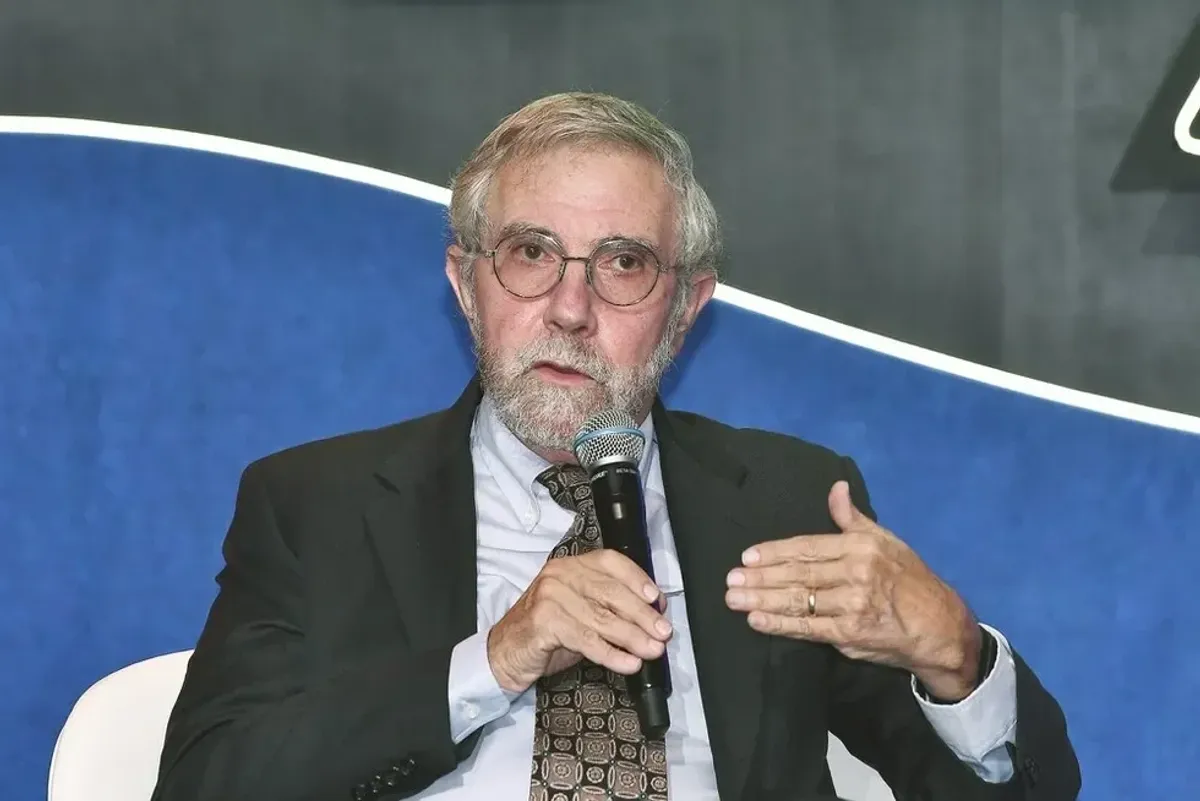
Economist Paul Krugman, economist during FIDES 2023 in Rio de Janeiro, Brazil on September 25, 2023 (A.PAES/ Shutterstock.com)

During his four years as president, Joe Biden worried that if Donald Trump ever returned to the White House, it would pose a major threat to the North Atlantic Treaty Organization (NATO). Trump, during his first term, toyed with the idea of withdrawing the U.S. from NATO — whereas Biden, as president, aggressively championed NATO's expansion when Sweden and Finland opted to join the alliance.

Seven months into Trump's second presidency, the U.S. is still a NATO member. But author/military historian Phillips O'Brien, during an interview with economist Paul Krugman, stressed that Trump's return to the White House marks a dramatic change in U.S./Europe relations.

Krugman, on August 23, posted video of the interview on his SubStack page and also published it as a Q&A article. And O'Brien voiced major concerns about the United States' relationship with Europe.

"The United States is going to great lengths to antagonize its allies," O'Brien told Krugman. "I don't get it. None of this makes any sense to me."

The author/historian said of the Ukraine/Russia War, "I think what happens to Ukraine will determine how Europe deals with this. If Ukraine is sacrificed, I think Europe is going to have a terrible future. Because it's going to be dependent on the U.S., which has basically sacrificed Ukraine to (Russian President Vladimir) Putin's Russia. Europe might even break apart, structurally, such that you'll have the Central Eastern Europeans, the ones who want to stand by Ukraine, the Finns, the Baltics, the Nordics going one way and then the Western Europeans sort of pretending things are OK."

O'Brien added, "So, I think people are underrating the chance of Europe splitting over Ukraine, which is why it's so important, I think, that Ukraine comes out of the war in good shape."

According to O'Brien, U.S. allies in Europe will be paying very close attention to the outcome of the United States' 2026 midterms.

"Well, that's the key thing, isn't it? The 2026 midterms," O'Brien told Krugman. "I don't think people are paying enough attention, because they have to be run fairly. I do think the Democrats have a very good chance of winning them if they are run fairly and happen under normal conditions. But they could also be easily perverted…. I would say that 2026 elections will show not whether America can come back, but whether it has a chance to come back — or whether the period we're going into could be a lot longer and darker than we imagined."

Paul Krugman's full interview with Phillips O'Brien is available on his SubStack page as a video and a Q&A article.

'Danger remains': Nobel-winning economist issues warning about 'drag' of Trump's policies


Robert Davis
August 24, 2025 
RAW STORY


A Nobel Prize-winning economist issued a dire warning on Sunday about the potential impact of President Donald Trump's signature economic policies.

Paul Krugman, who won the Nobel in 2008 for his work on trade theory, wrote in a new Substack essay that Trump's deportation and tariff policies could create stagflation, or a period characterized by low economic growth, high inflation, and high unemployment.

"Stagflation is very much on people’s minds again, for good reason," Krugman wrote. "The Trump administration’s tariff and deportation policies are creating a significant inflationary shock. They’re also imposing a significant drag on economic growth."

Krugman added that there has been one saving grace to Trump's economy: investments in artificial intelligence. Several AI companies from NVIDIA to Apple and Taiwan Semiconductor Manufacturing Company have made centi-billion-dollar investments in the U.S. during Trump's second term, according to figures from the White House.

However, Krugman warned that any slowdown to the AI space could spell trouble for the U.S. economy.

"Today, it’s likely that the United States would be heading into a recession under the weight of higher prices and slower growth if the economy weren’t being supported by a huge boom in AI-related investment," Krugman added. "And this danger remains: if the AI boom goes bust, the odds are high that the US economy will be plunged into a recession."


Read the entire essay by clicking here.
'Not what I voted for!' MAGA fans slam Trump's latest 'socialist' move

ALL CAPITALI$M IS STATE CAPITALI$M

Carl Gibson, 
AlterNet
August 22, 2025 


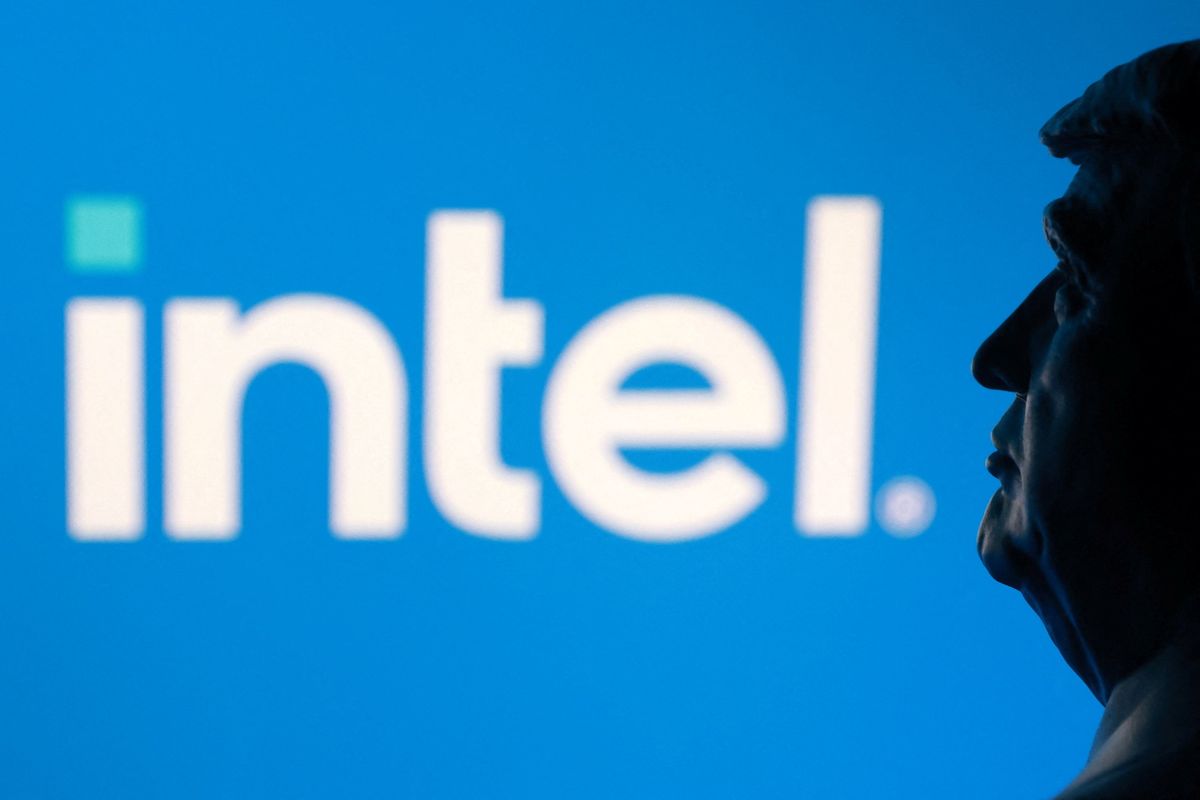
A 3D-printed miniature model depicting U.S. President Donald Trump and Intel logo are seen in this illustration taken August 22, 2025. REUTERS/Dado Ruvic/Illustration

On Friday, President Donald Trump announced that the U.S. government was now a part-owner of a major publicly traded tech company. The reaction among his base was less than enthusiastic.

Trump announced via his Truth Social platform that as of Friday the U.S. is a multibillion-dollar shareholder in Intel as part of an agreement with CEO Lip-Bu Tan — with the U.S. supposedly paying nothing for its new stake. The announcement notably came roughly two weeks after Trump's angry social media tirade against Tan, in which he demanded that Tan "resign immediately" from his role due to his investments in Chinese tech companies.

"It is my Great Honor to report that the United States of America now fully owns and controls 10% of INTEL, a Great American Company that has an even more incredible future," Trump wrote in his signature style of oddly placed capital letters. "I negotiated this Deal with Lip-Bu Tan, the Highly Respected Chief Executive Officer of the Company. The United States paid nothing for these Shares, and the Shares are now valued at approximately $11 Billion Dollars. This is a great Deal for America and, also, a great Deal for INTEL. Building leading edge Semiconductors and Chips, which is what INTEL does, is fundamental to the future of our Nation. MAKE AMERICA GREAT AGAIN! Thank you for your attention to this matter.

While some of the responses to the Trump administration's post on X announcing the news were complimentary, many replies were deeply critical of the government taking ownership of a private company. One user who described themselves in their bio as a "Constitutional Conservative" wrote: "Not what I voted for. I voted against this specifically." Conservative podcast host @amandatalks_ tweeted: "ngl [not gonna lie] don't love this guys."

"I'm a Republican but I do not agree with this," another user posted. "Government and privately owned businesses should not mix."

"Governments shouldn't own private business," tweeted retired Naval officer Mike Rodman.

Aerospace engineer Michael Heil also weighed in, responding to the White House's post by writing: "Not good. Even partial government ownership of private industry is socialism."


'Washington is becoming Chinatown': Wall Street Journal bashes Trump's 'statism' move

Robert Davis
August 24, 2025
RAW STORY


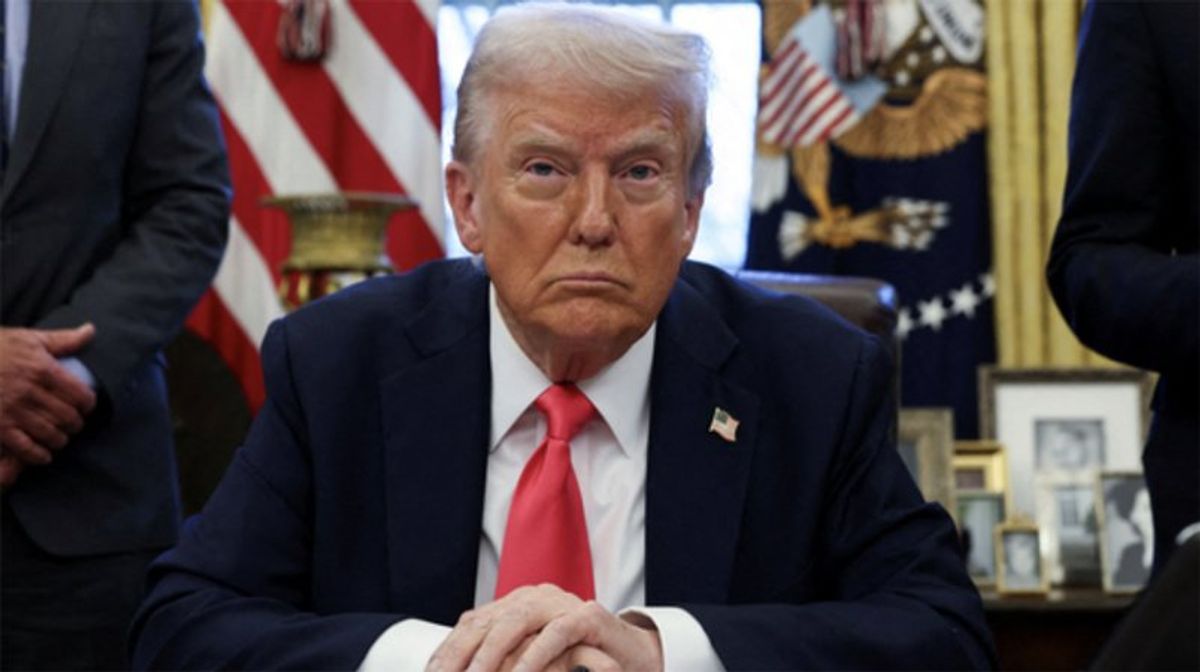
Donald Trump (Photo via Reuters)

The Wall Street Journal's conservative editorial board bashed President Donald Trump's latest business move, arguing that it models China's "statism."

On Friday, Trump announced that the U.S. government is taking a 10% stake in computer chip-maker Intel. The government is paying the company $8.7 billion in all, with the funds coming from an approved but not yet paid grant under the U.S. CHIPS and Science Act and the Secure Enclave program, according to a statement from the company.

The Wall Street Journal's editorial board slammed the deal in a new op-ed, arguing that the deal will stifle innovation at the struggling company

"In the name of competing with China, the U.S. is imitating its model of state-run business," the editorial reads in part. "Washington is becoming Chinatown."

"Mr. Trump accused Kamala Harris of being a socialist, but the Biden Administration never nationalized companies," the editorial continues.

The Journal's editors also found it curious that Trump's policies have not yet received significant pushback from Republicans in Congress.

Why aren’t Republicans pushing back on Mr. Trump’s Intel deal?" the editors asked. "They might consider how the next Democratic President could use the government’s stake to press the left’s political imperatives—Intel profits to build low-income housing? Statism is gaining currency on the political left and right, resulting in a bizarre fusion of ideas."

Read the entire editorial by clicking here.


Trump thinks owning a piece of Intel would be a good deal for the US. Here's what to know

An Intel sign is shown at the chipmaker's global headquarters in Santa Clara, Calif. on Friday, Aug. 8, 2025. (AP Photo/Terry Chea · Associated Press

MICHAEL LIEDTKE
Wed, August 20, 2025 


SAN FRANCISCO (AP) — President Donald Trump wants the U.S. government to own a piece of Intel, less than two weeks after demanding the Silicon Valley pioneer dump the CEO that was hired to turn around the slumping chipmaker. If the goal is realized, the investment would deepen the Trump administration's involvement in the computer industry as the president ramps up the pressure for more U.S. companies to manufacture products domestically instead of relying on overseas suppliers.


What’s happening?

The Trump administration is in talks to secure a 10% stake in Intel in exchange for converting government grants that were pledged to Intel under President Joe Biden. If the deal is completed, the U.S. government would become one of Intel's largest shareholders and blur the traditional lines separating the public sector and private sector in a country that remains the world's largest economy.

Why would Trump do this?

In his second term, Trump has been leveraging his power to reprogram the operations of major computer chip companies. The administration is requiring Nvidia and Advanced Micro Devices, two companies whose chips are helping to power the craze around artificial intelligence, to pay a 15% commission on their sales of chips in China in exchange for export licenses.

Trump’s interest in Intel is also being driven by his desire to boost chip production in the U.S., which has been a focal point of the trade war that he has been waging throughout the world. By lessening the country's dependence on chips manufactured overseas, the president believes the U.S. will be better positioned to maintain its technological lead on China in the race to create artificial intelligence.

Didn’t Trump want Intel’s CEO to quit?

That's what the president said August 7 in an unequivocal post calling for Intel CEO Lip-Bu Tan to resign less than five months after the Santa Clara, California, company hired him. The demand was triggered by reports raising national security concerns about Tan's past investments in Chinese tech companies while he was a venture capitalist. But Trump backed off after Tan professed his allegiance to the U.S. in a public letter to Intel employees and went to the White House to meet with the president, who applauded the Intel CEO for having an “amazing story.”

Why would Intel do a deal?

The company isn't commenting about the possibility of the U.S. government becoming a major shareholder, but Intel may have little choice because it is currently dealing from a position of weakness. After enjoying decades of growth while its processors powered the personal computer boom, the company fell into a slump after missing the shift to the mobile computing era unleashed by the iPhone’s 2007 debut.

Intel has fallen even farther behind in recent years during an artificial intelligence craze that has been a boon for Nvidia and AMD. The company lost nearly $19 billion last year and another $3.7 billion in the first six months of this year, prompting Tan to undertake a cost-cutting spree. By the end of this year, Tan expects Intel to have about 75,000 workers, a 25% reduction from the end of last year.

Would this deal be unusual?

Although rare, it’s not unprecedented for the U.S. government to become a significant shareholder in a prominent company. One of the most notable instances occurred during the Great Recession in 2008 when the government injected nearly $50 billion into General Motors in return for a roughly 60% stake in the automaker at a time it was on the verge of bankruptcy. The government ended up with a roughly $10 billion loss after it sold its stock in GM.

Would the government run Intel?

U.S. Commerce Secretary Howard Lutnick told CNBC during a Tuesday interview that the government has no intention of meddling in Intel's business, and will have its hands tied by holding non-voting shares in the company. But some analysts wonder if the Trump administration's financial ties to Intel might prod more companies looking to curry favor with the president to increase their orders for the company's chips.


What government grants does Intel receive?

Intel was among the biggest beneficiaries of the Biden administration’s CHIPS and Science Act, but it hasn’t been able to revive its fortunes while falling behind on construction projects spawned by the program.

The company has received about $2.2 billion of the $7.8 billion pledged under the incentives program — money that Lutnick derided as a “giveaway” that would better serve U.S. taxpayers if it’s turned into Intel stock. “We think America should get the benefit of the bargain,” Lutnick told CNBC. “It’s obvious that it’s the right move to make.”


'Something needs to change': Anti-Trump vendors flood Bernie Sanders resistance rally
RAW STORY
August 24, 2025


Stan Sinberg with his wagon dubbed “The Roving Anti-Trump ‘Save Democracy Tour!’ Band-Wagon.” (Photo by Alexandria Jacobson/Raw Story)


CHICAGO — From crude to punny, rebellious to pleading, outside of Sen. Bernie Sanders’ “Fighting Oligarchy” rally in Chicago on Sunday, dozens of vendors sold a colorful array of shirts, hats and buttons slamming President Donald Trump.

Stan Sinberg traveled from San Francisco with a blue wagon he dubbed the “The Roving Anti-Trump ‘Save Democracy Tour!’ Band-Wagon.”

“Now in its 9th WTF Year!” read a sign Sinberg affixed atop an array of buttons he created and sold for $5.

Their slogans: “Non-Felon for President”

“Deport ICE”

“Don’t Drink the Bleach!”

“Border Personality Disorder" with a frowning photo of Trump.


Buttons on Stan Sinberg's wagon dubbed “The Roving Anti-Trump ‘Save Democracy Tour!’ Band-Wagon.” (Photo by Alexandria Jacobson/Raw Story)

For seven years, Sinberg has traveled with his “band-wagon” to protests across the country.

“When [Trump] lost in 2020, I had a banner that said ‘happily going out of business sale,’ but he didn’t leave,” Sinberg said.

“He tried to steal the election, and then he just kept being a presence.”

Sinberg has been protesting against Trump since he secured the Republican nomination for president the first time in 2016.


“I wanted to do what I could to prevent him from foisting himself on the rest of the country,” said Sinberg, who was living in Trump’s native New York at the time.

Sinberg wasn’t the only vendor to travel thousands of miles to sell merchandise outside the University of Illinois Chicago Isadore and Sadie Dorin Forum.

Bobby Murray from Alabama sold T-shirts and hats with JR Concessions featuring a range of rallying cries from “MAGA More Are Getting Arrested” to simply “F— Trump."

“I like old Bernie,” Murray said.

“Something needs to change, that’s for sure.”


Bobby Murray sells T-shirts outside Sen. Bernie Sanders' "Fighting Oligarchy" rally. 
(Photo by Alexandria Jacobson/Raw Story)


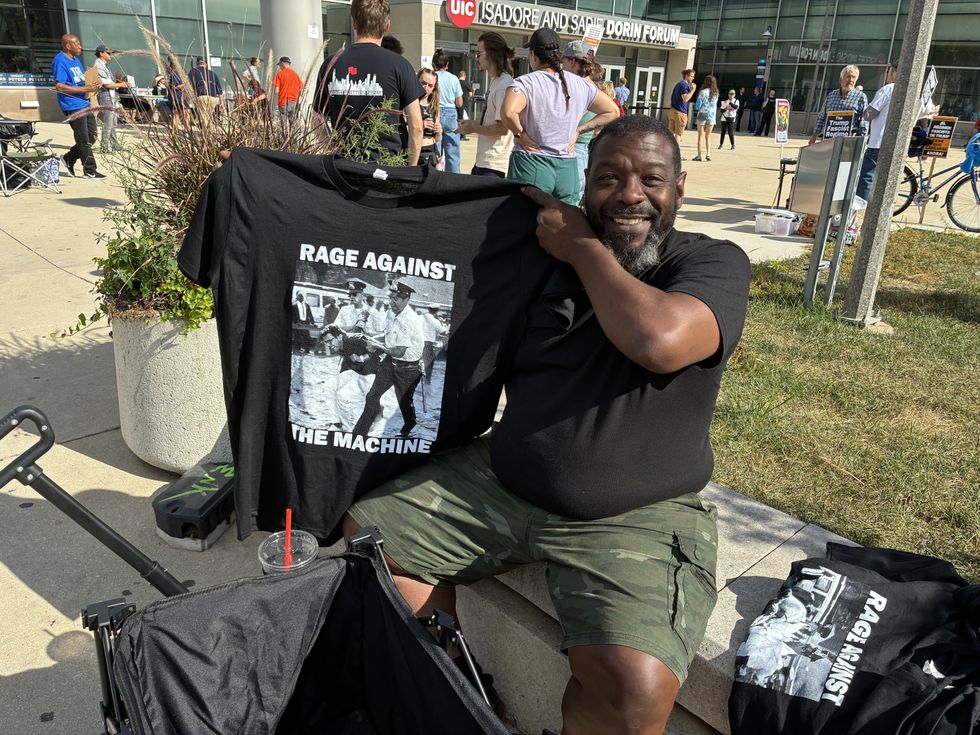
Terrill Leathers sold black “Rage Against the Machine” shirts showing Sanders resisting arrest at a Chicago civil rights protest in 1963.

“It should be important for all Americans to come out because the things that’s going on right now is outrageous,” Leathers said.


Terrill Leathers sells "Rage Against the Machine" shirts in Chicago. (Photo by Alexandria Jacobson/Raw Story)

A button vendor, Sunshine Tea, who uses a “stage” last name, lives on the South Side of Chicago but spent years in Vermont and once met Sanders.

“When I met him, he was in the grocery store,” Tea said. “He was sick, and he was a senator. He was buying his own groceries, so I know for a fact he’s the only congressperson that knows what a gallon of milk costs.”


Sunshine Tea sells buttons outside the "Fighting Oligarchy" rally in Chicago. (Photo by Alexandria Jacobson/Raw Story)

Tajh Pordos from St. Louis sold T-shirts featuring the "Fight Oligarchy" slogan with photos of Sanders and Rep. Alexandria Ocasio-Cortez (D-NY), who has shown up at some of Sanders' events on the tour.

“I really feel like this is a very good hustle,” Pordos said. “Overall, it’s a good thing.”


Tajh Pordos sells "Fight Oligarchy" shirts in Chicago. (Photo by Alexandria Jacobson/Raw Story)

Sanders, an independent from Vermont, spoke alongside Rep. Delia Ramirez (D-IL), a member of the progressive "Squad" with Ocasio-Cortez, and Illinois Sen. Robert Peters, who is running for Congress in Illinois' 2nd Congressional District.

Sanders called Trump "the most dangerous president in perhaps the history of this country" at the Chicago event.

"This is a demagogue whose function in life is to serve the oligarchy and to try to divide us up," Sanders said.


Alexandria Jacobson is a Chicago-based investigative reporter at Raw Story, focusing on money in politics, government accountability and electoral politics. Prior to joining Raw Story in 2023, Alex reported extensively on social justice, business and tech issues for several news outlets, including ABC News, the Chicago Sun-Times and the Chicago Tribune. She can be reached at alexandria@rawstory.com. More about Alexandria Jacobson.


Evidence, not ideology, must guide preventive health care


Canadian Medical Association Journal


A recent review of the Canadian Task Force on Preventive Health Care underscores the need for expert bodies to produce evidence-based guidance and that Canada should ensure a renewed task force is adequately funded and supported, argues a commentary in CMAJ (Canadian Medical Association Journalhttps://www.cmaj.ca/lookup/doi/10.1503/cmaj.251038.

Dr. Vivek Goel, President and Vice-Chancellor of the University of Waterloo and author of the commentary, chaired the External Expert Review panel that reviewed the task force’s structure, methodologies, and clinical practice guidelines, and looked at international best practices along with input from various groups.

“Our review affirmed that we need expert bodies like the task force, now more than ever, to produce evidence-based guidance for the public, health care practitioners, and health systems,” writes Dr. Goel.

There have been several versions of the task force that, over decades, helped to change the way medicine is practised, moving from opinion-based medicine to evidence-based medicine.

“Those with stature, influence, and authority could drive care and policy in entire populations, with the potential to lead to substantial harm,” writes Dr. Goel. “The task force pioneered the now-standard methods of evaluating clinical interventions not by tradition or authority but according to rigorous scientific evidence. The evidence-based medicine movement, whose development was led by clinicians at McMaster University, transformed preventive medicine globally and is among the most important achievements in health care worldwide.”

He calls for adequate funding and support to help the task force provide timely guidance on a national scale. The modernized task force should incorporate updated methodologies, take an inclusive, transparent approach in its work, and have protection from political interference.

“For decades, this important body has delivered high-impact work on a shoestring budget, relying on the time and expertise of many volunteers,” Dr. Goel writes.

With Robert F. Kennedy Jr.’s directives affecting many similar guideline-producing bodies in the United States, this could be an opportune time for Canada.

“Canada has the opportunity to reclaim global leadership in preventive health. A modernized Canadian body that makes national preventive care recommendations will not just improve care — it will be a statement of Canadian values. As others retreat from science, Canada can lead with integrity, inclusiveness, and evidence, with a strong, independent body that is well resourced to produce high-quality guidance,” Dr. Goel concludes.


Gun injury odds up to 20x higher for kids in disadvantaged ZIP codes


Most hospitalizations for gun injuries among kids are the result of unintentional shootings


Northwestern University


  • Study analyzed nearly 7,000 pediatric gun injuries and mapped odds by ZIP code

  • Kids in ‘low-opportunity’ neighborhoods far more likely to be shot than those in ‘high-opportunity’ areas
  • ‘High-opportunity’ kids are far less likely to be shot, but twice as likely to die when it happens
  • Authors stress urgent need for safe storage and firearm safety education

CHICAGO --- Children residing in “very low-opportunity” neighborhoods are up to 20 times more likely to be hospitalized for gun injuries than those living in the most advantaged areas, reports a new multi-state study led by Northwestern Medicine.

The study also found that most hospitalizations for gun injuries among children under 18 are the result of unintentional shootings — incidents caused by mishandling or accidental discharge of a gun.

The paper, which was funded by families who have lost children to firearm injuries, will be published on Monday (Aug. 25) in the journal Pediatrics.

“Our study shows that where you and your family live is directly tied to your child’s odds of being injured or killed by a firearm,” said senior study author Dr. Anne Stey, assistant professor of surgery at Northwestern University Feinberg School of Medicine and a Northwestern Medicine trauma surgeon. “Unintentional injuries, which are often preventable, make up the largest share of these cases.”

“The fewer opportunities a child has in their neighborhood, the greater their odds of ending up in the hospital with a firearm injury,” added study co-author Dr. Mehul Raval, professor of surgery at Northwestern University Feinberg School of Medicine and head of pediatric surgery at Ann & Robert H. Lurie Children's Hospital of Chicago.

This is the first study to examine, across multiple states, how children’s neighborhood conditions are linked to firearm injuries, which is currently the leading cause of death among U.S. children.

How the study was conducted

Stey and her team analyzed hospital discharge data for nearly 7,000 gun injuries among children ages 0 – 17 between 2016 and 2021, capturing every documented case in Florida, Maryland, New York and Wisconsin.

Then they paired those records with Child Opportunity Index (COI) ZIP code data, which ranks neighborhoods from very low- to very high-opportunity based on education, health and socioeconomic factors. This allowed them to identify “hot spots” of firearm injury and see how odds varied by communities.

The findings

More than one in four ZIP codes (28%) in very low–opportunity neighborhoods were hot spots for pediatric firearm injuries, compared with just 5% in very high–opportunity areas.

In Maryland, children in very low–opportunity areas were more than 20 times more likely to be hospitalized with a gun injury than those in the most advantaged neighborhoods. That disparity was nearly 19 times in Wisconsin, 16 in New York, and eight in Florida.

Unintentional shootings were the leading cause of pediatric firearm injuries in all four states, accounting for roughly 57 — 63% of all hospitalizations, followed by assaults (32 to 39%) and self-inflicted injuries (1 to 7%).

Children in high-opportunity neighborhoods were far less likely to be injured, but more than twice as likely to die when they were — in part because self-inflicted injuries were more common in these areas.

Prevention strategies

Because most injuries were unintentional, the Northwestern team emphasized implementing prevention strategies at both the policy and community levels in neighborhoods identified as gun violence hot spots. These strategies include safe storage and firearm safety education. They also noted that health systems serving children in low-opportunity areas should anticipate higher volumes of firearm injuries.

“Child Access Prevention laws, which require safe storage of guns, have already been shown to reduce accidental and suicide-related deaths among children,” Stey said. “Our next step is to measure how these interventions can further lower unintentional firearm injuries.”

Limitations

The study only included children who presented to an acute care hospital following a firearm injury. Therefore, it misses those who died before reaching a hospital or never sought medical care.

This study, titled “Pediatric Firearm-Related Hospital Encounters by Child Opportunity Index Level,” was made possible by the philanthropic support of families who have lost children due to firearms.

A final push': Spain has nearly contained deadly wildfires, official says

FRANCE 24
Sat 23 August 2025


Firefighters try to control a wildfire near the village of Mougas in Oia municipality, northwestern Spain on August 22, 2025.

Historic wildfires that have raged across Spain and killed four people are beginning to relent, the head of the country's civil protection and emergencies service Virginia Barcones said Saturday. Weeks of heatwaves exacerbated by the climate crisis have fuelled devastating fires across southern Europe this summer.

Spain has almost beaten back wildfires that have swept across the country this month, killing four people and ravaging huge swathes of land, the head of its civil protection and emergencies service said Saturday.

"There are fewer of them, and the end is a lot nearer," the official, Virginia Barcones, told state television network TVE.

The ones remaining were still very "treacherous", she said, however, and "we will need a final push to be done with this horrible situation".

Spanish firefighters, helped by other EU countries, have been battling blazes that have scorched a record 403,000 hectares, most of it in the past two weeks, according to the European Forest Fire Information System (EFFIS).

The regions hardest hit were in the north and the west: Castile and Leon, Extremadura, and Galicia. The wildfires flared during a heatwave that baked the country for two weeks, sending temperatures to 40°C and above.

The fire emergency has thrown a spotlight not only on climate change but also trends that have left Spain's countryside vulnerable.

Castile and Leon suffers from decades of rural exodus, an ageing population, and a decline of farming and livestock grazing that once helped keep forests clear of tinder.

Strong winds that had spread the flames for weeks had weakened recently.

Barcones said there were still 18 active wildfires, with all but one classified at operational level 2, meaning they represent a danger to people and property.

She said she was particularly concerned about a fire in Iguena, in northwest Castile and Leon.

Even so, "the overall feeling is that it is improving, going in the right direction, and that less is burning", she said.

While numerous villages remain evacuated for their inhabitants' safety, many residents have been able to return to their properties since Friday.

The fires have fuelled accusations that politicians mishandled the crisis.

Read moreResearchers race to predict wildfire behaviour as France battles biggest blaze in decades

The main opposition party, the conservative Popular Party (PP), has accused Socialist Prime Minister Pedro Sanchez of having withheld aid to damaged regions where its officials govern.

The government has hit back, accusing the PP of having underfunded public services needed face such emergencies. They argue that these regions refused to take the climate change which fuelled the wildfires seriously.

According to EFFIS data analysed by AFP, Spain is one of four EU countries experiencing its worst year for wildfires since statistics began in 2006.

The other three are Cyprus, Germany and Slovakia.


Fourth fatality in Portugal's wildfires


A firefighter killed in Portugal while battling a wildfire has become the fourth fatality in the emergency the country has faced this summer, the presidency said on Saturday.

The office of President Marcelo Rebelo de Sousa sent condolences to the family of the fireman "who tragically lost his life after directly combating the forest fires in Sabugal municipality", in the northeast of the country.

Scientists say climate change is driving longer, more intense and more frequent heatwaves worldwide.

Lower humidity in the air, vegetation and soil makes it easier for wildfires to ignite and harder to control once they spread.

(FRANCE 24 with AFP)
Elon Musk Just Suffered a Humiliating Defeat in China


Joe Wilkins
Sun 24 August 2025 
FUTURISM


So far, 2025 hasn't exactly been a year of resounding success for centibillionaire Elon Musk's AI efforts.

The richest man on earth has struggled to get xAI's Grok off the ground, with setbacks taking the form of privacy scandals, misinformation controversies, not to mention a highly-public white supremacy episode.

And now, more than a month after Musk promised to roll Grok out to Teslas "next week," it turns out a Chinese AI model will be taking the chatbot's place.

According to Bloomberg, Tesla's Chinese division is planning to introduce in-car voice assistance via DeepSeek and Bytedance's AI models at some point in the near future.

Essentially, the voice-controlled software will let drivers utilize amenities like navigation apps and climate control hands-free. Bytedance's Doubao, the company's flagship large language model (LLM) chatbot, will process user voice commands, while DeepSeek will handle "AI interaction," Bloomberg reported.

It's not clear why Grok wasn't chosen for this honor, given the staggering amount of money Musk is pouring into xAI. The foul-mouthed chatbot began trickling out to US-based Teslas in the last month, with mixed results.

Bloomberg, though, speculates that the western company could have hit some legal hurdles involved with integrating American tech into Chinese cars.

Other theories abound, like that Chinese consumers simply have no interest in Grok, despite its availability, unlike other US AI models — at least not compared to DeepSeek, which has become a symbol of national pride for the People's Republic since its open-source V3 model shocked the world earlier this year.

Known as the "low-cost equivalent" to heftier AI models developed in the US, DeepSeek recently released its impressive V3.1 model, which is said to score only slightly lower than Grok 4 on intelligence tests, and at one twelfth the cost.

There's also the question of perception, with Musk's empire in China rapidly crumbling over the past year; even the US government-funded Voice of America reported earlier this year that Chinese netizens were "not impressed" with previous versions of Grok.

DeepSeek, meanwhile, has inked deals with two dozen Chinese automakers, including the Tesla-killer BYD, to install its software in new vehicles.

"While many recognize DeepSeek’s achievements, this represents just the beginning of China’s AI innovation wave," Louis Liang, an AI investor told Bloomberg of the previous deals. "We are witnessing the advent of AI mass adoption — this goes beyond national competition."

More on Grok: Community Complains of Choking Fumes From Elon Musk's AI Fortress
Exclusive-China's new mega dam triggers fears of water war in India

INDIA HAS DECLARED A WATER WAR WITH PAKISTAN

Sarita Chaganti Singh and Krishna N. Das
Sun 24 August 2025
REUTERS


A view shows the Siang river in Parong

PARONG, India (Reuters) -India fears a planned Chinese mega-dam in Tibet will reduce water flows on a major river by up to 85% during the dry season, according to four sources familiar with the matter and a government analysis seen by Reuters, prompting Delhi to fast-track plans for its own dam to mitigate the effects.

The Indian government has been considering projects since the early 2000s to control the flow of water from Tibet's Angsi Glacier, which sustains more than 100 million people downstream in China, India and Bangladesh. But the plans have been hindered by fierce and occasionally violent resistance from residents of the border state of Arunachal Pradesh, who fear their villages will be submerged and way of life destroyed by any dam.

Then in December, China announced that it would build the world's largest hydropower dam in a border county just before the Yarlung Zangbo river crosses into India. That triggered fears in New Delhi that its longtime strategic rival - which has some territorial claims in Arunachal Pradesh - could weaponize its control of the river, which originates in the Angsi Glacier and is known as the Siang and Brahmaputra in India.

India's largest hydropower company in May moved survey materials under armed police protection near a prospective site of the Upper Siang Multipurpose Storage Dam, which would be the country's biggest dam, if completed. Senior Indian officials have also been holding meetings about accelerating construction this year, including one organized in July by Prime Minister Narendra Modi's office, according to two of the sources, who spoke on condition of anonymity to discuss sensitive government matters.

Delhi's concerns were described in the undated Indian government analysis of the Chinese dam's impact, the specifics of which Reuters corroborated with four sources and is reporting for the first time.

Beijing hasn't released detailed plans about the dam's construction, but the analysis drew on past work conducted by Indian government-affiliated institutions like the Central Water Commission and accounted for the expected size of the Chinese project, which broke ground in July and will cost nearly $170 billion

Delhi estimates the Chinese dam will allow Beijing to divert as much as 40 billion cubic meters of water, or just over a third of what is received annually at a key border point, according to the sources and the document. The impact would be especially acute in the non-monsoon months, when temperatures rise and lands become barren across swathes of India.

The Upper Siang project would alleviate that with its projected 14 BCM of storage capacity, allowing India to release water during the dry season. That could mean the major regional city of Guwahati, which is dependent on water-intensive industry and farming, would see a reduction in supply of 11%, according to the sources and the document, as opposed to 25% if the Indian dam isn't built.

The project could also mitigate any move by Beijing to release devastating torrents of water downstream, the sources said.

If the dam is at its minimum drawdown level - where water is stored at less than 50% of its height - it would be able to fully absorb any excess water released from a breach in Chinese infrastructure, according to the document and the sources. India is considering a proposal to keep 30% of its dam empty at any time in order to account for unexpected surges, two of the sources said

A spokesperson for China's foreign ministry said in response to Reuters' questions that the hydropower projects "have undergone rigorous scientific research on safety and environmental protection, and will not adversely impact the water resources, ecology, or geology of downstream countries."

"China has always maintained a responsible attitude toward the development and utilization of transboundary rivers, and has maintained long-term communication and cooperation with downstream countries such as India and Bangladesh," the spokesperson added.

Modi's office and the Indian ministries responsible for water and external affairs did not respond to Reuters' questions. State-owned hydropower major NHPC also did not return a request for comment.

India's foreign ministry has said that top diplomat S. Jaishankar raised concerns about the dam during a meeting with his Chinese counterpart on Aug. 18. A Jaishankar deputy also told lawmakers in August that the government was implementing measures to safeguard the lives and livelihoods of citizens in downstream areas, including building the dam.

India has itself been accused by Pakistan, a Chinese ally that it briefly clashed with in May, of weaponizing water. Delhi this year suspended its participation in a 1960 water-sharing treaty with Islamabad and is considering diverting flows from another crucial river away from its downstream neighbour.


An international tribunal has ruled that India must adhere to the agreement but Delhi says the panel lacks jurisdiction.


DEVELOPMENT OR DESTRUCTION?


When NHPC workers moved surveying materials near the village of Parong in May, angry locals damaged their machinery, destroyed a nearby bridge and looted the tents of police sent to guard the operation.

Many of them are members of Arunachal's Adi community, who live off paddy, orange and sweet lime farms in the mist-shrouded hills and valleys nourished by the Siang.

The villagers have set up makeshift watch posts on regional roads to deny access to NHPC workers. That has forced security personnel to trek miles, often under cover of night, to reach a prospective site of the dam.

At least 16 Adi villages are likely to be lost to the storage area of the dam, directly affecting an estimated 10,000 people, according to two of the sources. Community leaders say more than 100,000 people will be impacted overall.

"The cardamom, paddy, jackfruit and pear we grow on this land help educate our children and support our family," said Odoni Palo Pabin, an Adi grocer and mother of two. "We will fight the dam to death."

The dam has the support of Arunachal's chief minister, who is a member of Modi's party and has called the Chinese project an existential threat.

The project will "ensure water security and provide flood moderation to counter any potential water surges," the state government said in a statement, adding that it decided in June to engage in detailed compensation discussions with families that could be affected by the dam.

Lawmaker Alo Libang, an Adi who represents an area that would be submerged by the Indian project, said he believed locals could be convinced to move if they received generous compensation.

NHPC has plans to spend more than $3 million on education and emergency infrastructure to incentivize the villagers to move elsewhere, three of the sources said, citing instructions from Modi's office.

In one sign of progress, three villages in the area recently agreed to let NHPC officials carry out dam-related work, according to the Arunachal government and dozens of locals.

India has a history of activist movements against large dams, which have sometimes slowed these projects by years or forced them to scale down.

Even if the Upper Siang dam gets the go-ahead, it could take a decade to build after breaking ground, according to four of the sources. That means the project would likely be completed after China's project, which Beijing expects to start generating power by the early-to-mid 2030s.

The delay means an Indian project would be vulnerable during construction if Beijing suddenly releases water during the monsoon season, triggering a surge that could wash away temporary dams, two of the sources said.

International experts and Adi activists have also warned that building large dams in seismically active Tibet and Arunachal could heighten risks for downstream communities.


The Chinese "dam is being built in a zone of high seismicity and in a zone that experiences extreme weather events," said Sayanangshu Modak, an expert on the India-China water relationship at the University of Arizona.

"These kinds of extreme weather events trigger landslides, mudslides, glacial lake outburst flooding," he said. "So that raises concerns about dam safety... it's a very legitimate concern and India should engage with China."


(Reporting by Sarita Chaganti Singh in New Delhi and Krishna N. Das in Arunachal Pradesh; Additional reporting by Laurie Chen in Beijing and David Stanway in Singapore; Graphics by Jitesh Chowdhury; Editing by Katerina Ang)