Monday, August 25, 2025

Exclusive-U.S. confirms nation's first travel-associated human screwworm case connected to Central American outbreak


Mexican government and livestock farmers struggle to control the outbreak of the screwworm

Sun, August 24, 2025
By Cassandra Garrison, Tom Polansek and Leah Douglas

BUENOS AIRES/CHICAGO/WASHINGTON (Reuters) -The U.S. Department of Health and Human Services on Sunday reported the first human case in the United States of travel-associated New World screwworm, a flesh-eating parasite, from an outbreak-affected country.

The case, investigated by the Maryland Department of Health and the U.S. Centers for Disease Control and Prevention, was confirmed by the CDC as New World screwworm on August 4, and involved a patient who returned from travel to El Salvador, HHS spokesman Andrew G. Nixon said in an email to Reuters.

Earlier, Reuters reported that beef industry sources said last week that the CDC had confirmed a case of New World screwworm in a person in Maryland who had traveled to the United States from Guatemala.

Nixon did not address the discrepancy on the source of the human case.

"The risk to public health in the United States from this introduction is very low," he said.

The U.S. government has not confirmed any cases in animals this year.

The differing accounts from the U.S. government and industry sources on the human case are likely to further rattle an industry of cattle ranchers, beef producers and livestock traders already on high alert for potential U.S. infestations as screwworm has moved northward from Central America and southern Mexico.

The government's confirmation of a screwworm case comes just over a week after U.S. Department of Agriculture Secretary Brooke Rollins traveled to Texas to announce plans to build a sterile fly facility there as part of efforts to combat the pest.

The USDA has estimated a screwworm outbreak could cost the economy in Texas, the biggest U.S. cattle-producing state, about $1.8 billion in livestock deaths, labor costs and medication expenses.

An executive of the industry group Beef Alliance sent emails last week to about two dozen people in the livestock and beef sectors, informing them that the CDC had confirmed a human case of screwworm in Maryland in a person who had traveled to the U.S. from Guatemala, according to a source, who asked not to be identified, and who shared the contents of the emails with Reuters.

Beth Thompson, South Dakota's state veterinarian, told Reuters on Sunday that she was notified of a human case in Maryland within the last week by a person with direct knowledge of it. CDC deferred questions to Maryland on a call with state animal health officials, Thompson said. “We found out via other routes and then had to go to CDC to tell us what was going on,” she said. “They weren’t forthcoming at all. They turned it back over to the state to confirm anything that had happened or what had been found in this traveler.”

Another source said that state veterinarians had learned about a human case in Maryland during a call last week with the CDC. A Maryland state government official also confirmed a case.

A spokesperson for the Maryland Department of Health did not immediately respond to requests for comment.

WHAT ARE SCREWWORMS?

 Screwworms are parasitic flies whose females lay eggs in wounds on any warm-blooded animal. Once the eggs hatch, hundreds of screwworm larvae use their sharp mouths to burrow through living flesh, eventually killing their host if left untreated.

The maggots' feeding is similar to a screw being driven into wood, giving the pests their name.

Screwworms can be devastating in cattle and wildlife, and rarely infest humans, though an infestation in either an animal or a person can be fatal.

Treatment is onerous, and involves removing hundreds of larvae and thoroughly disinfecting wounds. But infestations are typically survivable if treated early enough.

The emails from the Beef Alliance executive said that due to patient privacy laws, there were no other details available about the positive human case of screwworm. The person was treated and prevention measures were implemented in the state, the email said.

A livestock economist at Texas A&M University was asked to prepare a report for Rollins on the impacts to industry of the border closure to Mexican cattle, according to the emails, a measure that has largely been in effect since November to prevent the arrival of screwworm to the United States.

The CDC was required to report the positive New World screwworm case to both Maryland health officials and the Maryland state veterinarian, one of the emails said, adding that the CDC also notified other agriculture stakeholders.

"We remain hopeful that, since awareness is currently limited to industry representatives and state veterinarians, the likelihood of a positive case being leaked is low, minimizing market impact," the beef industry executive wrote.

A representative for the Beef Alliance did not respond to requests for comment.

IMPACT ON BEEF AND CATTLE FUTURES


Livestock traders and beef producers have been on edge about the potential for cases in cattle as prices have already hit record highs because the U.S. cattle herd is at its smallest size in seven decades.

A human case and the lack of transparency around it could present a political challenge for Rollins. The USDA has set traps and sent mounted officers along the border, but it has faced criticism from some cattle producers and market analysts for not acting faster to pursue increased fly production.

Rollins first announced plans for a sterile fly facility at Moore Air Force Base in Edinburg, Texas - near where a production facility to combat screwworm operated during the last major outbreak 50 years ago - in June, saying that the facility would take two to three years to come online. A spokesperson for the USDA did not immediately respond to a request for comment. Mexico has also taken efforts to limit the spread of the pest, which can kill livestock within weeks if not treated. The Mexican government said in July that it started to build a $51 million sterile fly production facility in the country's south.

The sole operating plant is in Panama City and can produce a maximum of 100 million sterile screwworm flies each week. The USDA has estimated that 500 million flies would need to be released weekly to push the fly back to the Darien Gap, the stretch of rainforest between Panama and Colombia.

Screwworms have been traveling north through Mexico from Central America since 2023. They are endemic in Cuba, Haiti, the Dominican Republic and countries in South America, according to the USDA.


Advertisement


Mexico reported a new case about 370 miles (595 km) south of the U.S. border in Ixhuatlan de Madero, Veracruz, in July. The USDA immediately ordered the closure of livestock trade through southern ports of entry, after previously halting imports in November and May.

The U.S. typically imports over a million cattle from Mexico a year to fatten in feedlots and process into beef.

Screwworms were eradicated from the United States in the 1960s when researchers began releasing massive numbers of sterilized male screwworm flies that mate with wild female screwworms to produce infertile eggs.

(Reporting by Cassandra Garrison in Buenos Aires, Tom Polansek in Chicago and Leah Douglas in Washington. Additional reporting by Heather Schlitz in Chicago and Jarrett Renshaw in Washington. Editing by Emily Schmall, Diane Craft and Sonali Paul)

Satellites Spotted a Strange Glow in the Ocean, and Scientists Have a Wild Explanation


Victor Tangermann
Sun, August 24, 2025  
FUTURISM


Since the early 2000s, scientists have been puzzled by a gleaming turquoise spot in the middle of the Antarctic Ocean showing up in satellite images.

The patch is located just south of the great calcite belt, a region that's rich in the mineral form of calcium carbonate, and teeming with coccolithophores, tiny marine organisms that grow reflective calcite shells out of the mineral.

The patch itself, however, has been considered far too frigid to support these tiny plankton, causing a longstanding marine mystery.

Now, as detailed in a paper published in the journal Global Biogeochemical Cycles, scientists say they've finally nailed down a possible reason for the existence of the otherworldly iridescence.

The team ventured into the rough ocean waters on board a research vessel, taking detailed measurements at various depths to collect data that satellite images can't provide.

"Satellites only see the top several meters of the ocean, but we were able to drill down with multiple measurements at multiple depths," said Bigelow Laboratory for Ocean Sciences senior research scientist Barney Balch in a statement about the research.

To their surprise, they found that coccolithophores did, in fact, live in the frigid waters where no one thought they could survive — albeit in much smaller concentrations than in the great calcite belt. In the process, they got an unprecedented peek at how the ocean's carbon cycles function.

Coccolithophores are caught in a massive war with another type of plankton, called diatoms, which turn organic carbon into energy, a vital source of food for marine life.

The border between the great calcite belt and the mysterious turquoise region was previously seen as a kind of no man's land between these two factions of plankton.

But the researchers' findings suggest that "moderate concentrations of plated coccolithophores and detached coccoliths were observed south of the great calcite belt all the way to 60°S," the paper reads.

However, the majority of the reflectiveness is the result of the shiny outer layers of diatom plankton scattering the light, the researchers posit.

The findings could have considerable implications for our planet. Coccolithophores are so widespread, they're considered a critical sink for atmospheric carbon.

"We’re expanding our view of where coccolithophores live and finally beginning to understand the patterns we see in satellite images of this part of the ocean we rarely get to go to," Balch explained in the statement.

"There’s nothing like measuring something multiple ways to tell a more complete story," he added.

 Scientists Say They've Created a New Form of Life More Perfect Than the One Nature Made


Joe Wilkins
Sun, August 24, 2025 
FUTURISM


We've heard of GMOs, but this is ridiculous.

Scientists at the Medical Research Council's Laboratory of Molecular Biology say they've engineered a bacteria whose genetic code is more efficient than any other lifeform on Earth.

They call their creation "Syn57," a bioengineered strain of E. coli — yes, the same bad boy that can make you extremely sick if you eat an undercooked hot dog — which uses seven less codons than all life on earth. A codon, put simply, is a three-letter sequence found in DNA and RNA which delivers instructions for amino acids, a fundamental "building block" of life.


For the past billions years or so, all known life on earth has used 64 codons. Scientists cracked the code detailing which codons corresponded to which amino acids — mapping the standard genetic code, in other words — in 1966, revealing only 20 total amino acids.

Intriguingly, they realized, evolution hadn't resulted in perfect efficiency, since some of the codons were clearly redundant. It raised a tantalizing possibility: was there room to trim some of the fat, engineering a more efficient organism from scratch?

First they just needed a proof of concept. In 2010, a team 24 researchers detailed the steps taken to create the world's first synthetic bacteria cell. Though it was — and still is — an astonishing feat, taking some 15 years to complete, the faux-cell was still only a faithful recreation of the stuffy ol' 64 codon version.

Then, in 2019, genetic researchers at Cambridge University were able to chip off at that natural redundancy and rework an E. coli strand down to 61 codons — demonstrating without a doubt that life can function with less than the tried-and-true 64. The incredible feat was heralded at the time as the "most ambitious attempt at a completely synthetic form of life" to date.

And now they've gone even further. To make Syn57, the researchers went through the painstaking processing of altering over 101,000 lines of genetic code — first in theory, then in practice.

Unlike the synthetic bacteria from 2010, according to the New York Times, advances in DNA synthesis mean that genetic researchers can now construct genomes from scratch, avoiding some of the redundant codons from the start.

"You can start exploring what life will tolerate," Akos Nyerges, a synthetic biologist at Harvard told the newspaper. "We can finally test these alternative genetic codes."

Nyerges was on one of the teams engaged in the race to build Syn57, which was ultimately won by the team at Cambridge

"We definitely went through these periods where we were like, 'Well, will this be a dead end, or can we see this through?'" said Medical Research Council researcher Wesley Robertson, one of the authors of the Cambridge study.

The result of their back-breaking experimentation?

"Life still works," Robertson told the paper.
My trip to North Korea's 'Benidorm' - flanked by guards and full of rules

Yaroslava Kiryukhina
 BBC News Russian
Sun, August 24, 2025 


Anastasia Samsonova was among the first group of tourists to visit Wonsan Kalma's beaches [Anastasia Samsonova]


It was the security guards accompanying Anastasia Samsonova's group that suggested this wasn't a typical beach holiday.

In July, the 33-year-old human resources worker was one of the first tourists to stay at a new holiday resort in North Korea, a country largely closed to the outside world.

Set in an exclusive area on the east coast where leader Kim Jong Un spent much of his youth, the Wonsan Kalma Coastal Tourist Zone opened on 1 July.


Built near a missile testing site, the resort features hotels, restaurants, shopping malls and a water park, according to state media.

But while it was initially billed as being open to international tourists, so far only Russians, entering in groups and organised by accredited travel agencies, have been allowed in.


The resort features hotels, restaurants, shopping malls and a water park, according to state media [KCNA]

Anastasia travelled there last month with 14 other people. The visit was tightly controlled, with guides and guards accompanying them and a fixed itinerary that could not be diverged from without permission from North Korean authorities.

She says the guides told her the guards were needed to "prevent situations where we interacted with locals and startled them".

"When we walked down the street, they [North Koreans] looked at us with great surprise because the country has been closed for a very long time," says Anastasia.

BBC News Russian got in contact with her after searching the geotags of people on social media who had travelled to the resort, independently of any travel agency or media outlet.
No scramble for sunloungers

Anastasia says her group was also told not to photograph construction sites and was expected not to wear revealing clothes.

Yet despite the restrictions, she says she "enjoyed a vacation without people" on almost-empty beaches with white sand

"Every day the [beach] was cleaned and levelled perfectly. Everything was immaculate," she says.

"The loungers were absolutely new, everything spotless. The entrance to the sea was very gentle, so yes, it really was a very good beach."


Anastasia said the beaches were "immaculate" and mostly deserted
 [Anastasia Samsonova]

First British tourists allowed back into North Korea tell BBC what they saw


BBC Verify looks at North Korea's Benidorm-style resort


North Koreans tell BBC they are being sent to work 'like slaves' in Russia

Since the Covid pandemic, international tourism into North Korea had been on pause to prevent the spread of the virus.

But last year, the republic began allowing Russian tourists to visit again.

In February, it also started receiving tourists from the West, including Australia, France, Germany and the UK, though it abruptly halted this weeks later, without saying why.

Wonsan Kalma has been touted as a key part of Kim's ambitions to boost tourism in the country.

It is said to have drawn inspiration from Spain's tourism hotspot Benidorm, where a North Korean delegation was sent on a fact-finding mission in 2017.

But details of how it was built have been shrouded in secrecy, and human rights groups have criticised the alleged harsh treatment of workers, including claims of forced labour, harsh conditions, long hours and locals being driven out of their homes.

Weeks after it opened, North Korea announced that foreigners were "temporarily" not allowed to visit - except tourists from Russia, an ally of the republic.

So far, two Russian tour groups have visited the resort, with another currently there.


North Korean rocket models cost around $40 each [Anastasia Samsonova]

A week-long trip from Russia to North Korea, including three days at the Wonsan Kalma resort, costs $1,800 (£1,300) - 60% more than the average monthly salary in Russia.

Some adverts for the trip even reference the nearby missile testing site, describing it as a "unique" vacation spot.

Anastasia says no missiles were launched while she was there, but toy rockets were being sold nearby for $40 (£30).

Describing a typical day while on her trip, Anastasia says the group would have breakfast at 08:00 when lots of activities were planned and 09:30 on a more relaxed day.

In terms of the food they were given, there was "lots of meat", typically in sweet and sour sauce, and a dish involving finely chopped cabbage and carrots in sauce.

She says a 500ml bottle of beer was very cheap, costing about 60 cents at the beach, while the souvenir of choice for tourists was North Korean Olympic clothing.

Another tourist, Daria, writing on Instagram, described the resort as "very raw" and "not the kind of vacation Russian tourists are used to".

"But if you're tired of Asia, Turkey, etc., and want something exotic — this is it," she added.


A week's tour of North Korea costs a Russian traveller around $1,800 (£1,300) 
[Vostok Intur]

However, there is uncertainty over when the next Russian tourists will be allowed into Wonsan Kalma.

The travel agency which organised the first three trips to the resort, Vostok Intur, said there was high interest in potential tours in September, but North Korean authorities had yet to agree to them.

Initially, tours were advertised online by Russian travel agencies for mid-September, but these were later removed.

It is not just Russians who face difficulties getting to Wonsan Kalma.

Even citizens of China, which borders North Korea and is its main ally and economic partner, are having difficulties accessing the resort, according to Andrei Lankov, an expert in North Korea-Russia relations and a professor at Kookmin University in Seoul.

He says Pyongyang deliberately limits the number of tourists and closely controls their movements, in part so North Koreans won't compare themselves unfavourably to richer foreigners.

"Ordinary people might begin to wonder, 'How is it that even without our great leader, or his son or daughter, they seem to live so well?'", Lankov says.

For that reason, North Korea has concluded it's largely better not to have too many foreigners entering the country, he adds.


The resort features a water park, but Anastasia's group did not get to visit it [AFP]

With travel restrictions into North Korea easing, tourism from Russia has been rising, though it remains modest compared with other destinations.

In 2024, about 1,500 Russians travelled to North Korea for tourism, according to Russia's Federal Security Service border guards.

In contrast, more than 6.7 million visited Turkey and almost 1.9 million went to China.

However, in the second quarter of 2025, 1,673 Russians entered North Korea as tourists – a level last seen in 2010, before tourist restrictions were introduced.

Wonsan Kalma is seen as key to reviving North Korea's ailing economic fortunes, but it's not been without controversy.

Since the resort began construction in 2018, human rights groups have protested the alleged mistreatment of its workers. They point to reports of people being forced to work long hours to finish the massive project in a rapid timeframe under harsh conditions and inadequate compensation.

As BBC Verify reported last month, the UN has highlighted a system of forced labour used in North Korea, in particular "shock brigades" where workers often face harsh conditions, long hours, and inadequate compensation.

James Heenan of the UN Human Rights Office in Seoul has said "there are reports that the resort was built using what they call shock brigades".

"We've also seen reports that people were working 24 hours at the end to get this thing finished, which sounds like a shock brigade to me."

The BBC has approached the North Korean embassy in London for comment.


There is a long promenade that lines the front of the hotels at the resort [Anastasia Samsonova]

Despite the challenges of getting to Wonsan Kalma, and the restrictions on what Russian tourists can do when they arrive in North Korea, Anastasia says she hopes to come back next year.

"We're actually thinking about gathering the whole group next year to go to the same place.

"I'm not sure if it will work out, but I've heard there's also a ski resort near Wonsan Kalma. So, maybe one day I'll visit that resort too."


Anastasia says the beaches were "immaculate" and virtually deserted most of the time [Anastasia Samsonova]


What to know about visas for foreign truckers and the politics of a deadly Florida crash

Tim Sullivan And Cathy Bussewitz
Sat, August 23, 2025 

Secretary of State Marco Rubio announced this week that the U.S. will pause issuing work visas to some foreign truck drivers, warning darkly that they are “endangering American lives and undercutting the livelihoods of American truckers.”

He provided no details Thursday in his two-sentence post on the social platform X, leaving some in the trucking industry wondering if many drivers would be affected.

The short answer: No.

But the announcement appeared to be as much about politics as road safety, coming as a deadly Florida crash involving a foreign truck driver became increasingly politicized, with the offices of two ambitious governors battling publicly over responsibility.

With the Florida crash spilling into national politics, here’s what you should know:

Will many drivers be affected?

It depends how you define “many,” and the exact number isn’t clear. But it appears that at most a few thousand of the country’s estimated 3.5 million commercial truck drivers would be affected by the new directive.

The pause is aimed at drivers applying for three types of visas, the State Department said Friday, most notably the H-2B visa for temporary workers.

Only roughly 1,500 visas for truck drivers were issued this fiscal year under the program, and 1,400 last year, according to Jeff Joseph, president of the American Immigration Lawyers Association.

The program has helped offset what many observers see as a persistent shortage of commercial drivers.

But H-2B visas are capped for most years at 66,000, with drivers making up only a couple percent of the total.

The other two visa categories listed by the State Department are the E-2, for people who make substantial investments in a U.S. business, and the EB-3, which is for skilled workers such as health care employees, IT professionals and skilled tradespeople like electricians.

Trucking groups are pleased … and relieved

The Owner-Operator Independent Drivers Association, a trade association representing small-business truck drivers, applauded the administration for “seeing through the myth of a truck driver shortage and continuing efforts to restore commonsense safety standards on our nation’s highways.”

The association dismisses talk of scarcity, saying there are often independent truckers available but companies prefer drivers who cost less.

Jerry Maldonado of the Laredo Motor Carriers Association, a group of 200 trucking companies operating on both sides of the southern border, was relieved when the State Department released more details about Rubio’s announcement.

Mexican and Canadian drivers operate in the U.S. with B-1 visas, he said, which allow non-U.S. citizens to enter the country briefly. Some worried those visas could also be paused.


“The announcement did scare some people, but I’m glad for the clarification,” Maldonado said.

The deadly Florida crash

Rubio’s announcement came after three people were killed when truck driver Harjinder Singh made an illegal U-turn on a highway, according to the state’s Highway Patrol.

A nearby minivan slammed into Singh’s trailer as he made the turn. Singh and his passenger were not injured.

The Department of Homeland Security said Monday that Singh, a native of India, was in the country illegally.

The crash quickly turned political, with supporters of Florida’s Republican governor, Ron DeSantis, blaming California’s Democratic governor, Gavin Newsom.

Both men have been mentioned as possible presidential contenders.

Homeland Security said Singh obtained a commercial driver’s license in California, one of 19 states that issues licenses regardless of immigration status, according to the National Immigration Law Center.

“Three lives lost because of Gavin Newsom. Because of California’s failed policies,” Florida Lt. Gov. Jay Collins said Thursday at a news conference in Stockton, California.

Singh, who flew to California after the Aug. 12 crash, was arrested by U.S. Marshals in that city.

DeSantis sent Collins to California to oversee Singh’s return to Florida, where he is charged with three counts of vehicular homicide and immigration violations. Collins, accompanied by law enforcement personnel, escorted Singh onto the plane.

A Newsom spokesperson called Collins’ trip a "photo op” and criticized Florida officials for letting a “murder suspect walk.”

Safety? Or politics?

Trump administration and Florida officials insist that their concerns center on immigration and road safety.

In recent months the administration has taken steps to enforce English-language proficiency requirements for truckers, following incidents in which drivers’ ability to read signs or speak English may have contributed to traffic deaths.

On Friday the State Department also said the government is launching a review of how it screens foreign drivers and “enhanced vetting” will apply to those without valid visas.

Others see things differently.

“It’s part of this game to show the voters who put Trump in power that he’s doing his daily job to enforce immigration," said Joseph, of the American Immigration Lawyers Association. “You create fear and panic in communities that there’s a bunch of ‘illegal alien’ drivers on the roads.”

Tim Sullivan And Cathy Bussewitz, The Associated Press
Paul Krugman Says 1 Shaky Thing Stands Between Donald Trump And A Recession

If it goes bust, "the odds are high that the US economy will be plunged into a recession," warned the famed economist.


By Lee Moran
Aug 25, 2025
HUFFPOST

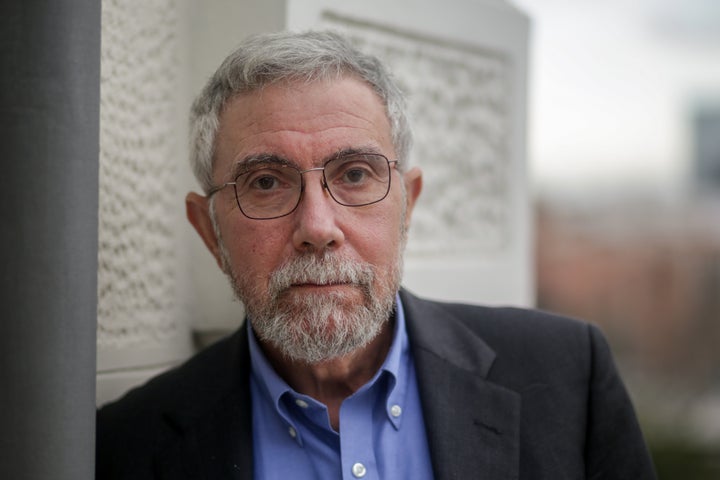
Famed economist Paul Krugman argued it’s “likely” the United States “would be heading into a recession” right now were it not for the massive financial investment that is currently being made in the development of artificial intelligence.

“Stagflation is very much on people’s minds again, for good reason,” the 2008 winner of the Nobel Memorial Prize in Economic Sciences wrote in his Substack newsletter published Sunday.

Krugman has previously warned of the devastating effect that President Donald Trump’s tariffs and anti-immigrant crackdowns could have on the U.S. economy.

And now, he said, they are combining and “creating a significant inflationary shock” and “imposing a significant drag on economic growth.”


Paul Krugman, the 2008 winner of the Nobel Memorial Prize in Economic Sciences, warned of the potential of a recession in the U.S.
Europa Press News via Getty Images

If “the AI boom goes bust,” he cautioned, “the odds are high that the US economy will be plunged into a recession.”

Last week, Krugman warned how the Trump administration is about to “ICE the economy” with its deportation program, predicting how certain industries that rely on undocumented workers ― like agriculture and meatpacking ― will be decimated by the policy and ultimately lead to further inflation.

Read Krugman’s full analysis.


'American mediocrity': US economy no longer 'envy of the world' — thanks to Trump


U.S. President Donald Trump looks on during a press conference with Russian President Vladimir Putin following their meeting to negotiate an end to the war in Ukraine, at Joint Base Elmendorf-Richardson, in Anch

August 23, 2025
COMMON DREAMS

Market and economics writer Jonathan Levin says the Trump economy is not in flames, but it is limping along when it should be doing much better.

“A lazy interpretation is that critics were simply wrong about the Trump agenda, and that his unorthodox style of governing has somehow been vindicated. But just because calamity has been avoided doesn't mean praise is warranted,” said Levin.

“The reality is that America's economy is … expanding just enough to keep the recession fears at bay yet far from its performance the last couple of years when it was widely regarded as ‘the envy of the world,’” said Levin. “Consider it a downshift from ‘American exceptionalism’ to ‘American mediocrity.’”

Levin points out that the benchmark S&P 500 Index is up 9.6 percent for the year on a total return basis, which looks like a fine performance — but the MSCI World Index Excluding the United States has surged 23.4 percent thanks to global financial, industrial and communication services companies.

“At this pace, American stocks would deliver their worst relative performance since 1993,” Levin said.

Personal consumption expenditures “have been essentially treading water this year, and growth in payrolls has basically stalled,” he adds, and while tariff rates might not ultimately end up as high as Trump threatened on "Liberation Day" in April, they’re “still poised to land at the highest in a century.” This is thwarting corporate planning, with a record 40 percent of chief financial officers in one survey saying trade and tariff policy is their biggest concern.

“With employers seemingly paralyzed, it's no wonder that consumer confidence is depressed,” said Levin.

It’s clear why the International Monetary Fund now expects the U.S. economy to grow around 1.9 percent this year, he said, even as the global economy was expected to expand about 3 percent.

“Despite extraordinary structural advantages and exciting technological advances, the U.S. economy and financial markets are mostly just muddling through 2025,” said Levin. “Be careful not to confuse that with vindication for bad policies.”


Read the report at this Kansas City Star link.

Sex Workers Already Predicted There's A Recession Coming — Here's How They Know


Jamie Davis Smith
Sun 24 August 2025 
HUFFPOST

While some people anxiously watch the stock market for signs of a recession, others look for more subtle cues that the economy is in trouble.

One of them is Catherine De Noire, a manager of a legal brothel, a Ph.D. candidate in organizational psychology and an influencer. When business at her brothel unexpectedly dips, De Noire takes it as a sign that the economy is in trouble.

Although De Noire is based in Europe, she believes that economic upheaval in the United States “triggers huge uncertainty” across the pond because of America’s global influence. De Noire first noticed a decline in business right after Donald Trump was elected in November 2024, as Americans and the rest of the world anticipated upheaval.

Strippers in the U.S. are also feeling the pinch. Dancer and influencer Vulgar Vanity said that when she first started dancing in 2022, she could earn six figures just by dancing during a handful of big events in Austin, such as the Formula 1 Grand Prix and South by Southwest music festival. This year is different.

“I didn’t even bother working South by Southwest because the first Friday night I attempted to work, I walked into a completely empty club and didn’t make any money at all,” she said.

Vanity also says that many of her regular customers aren’t tipping at all or tipping less than half of what they used to. She is quick to point out that she is just one dancer and “obviously not an economist,” but she notes that other dancers and tipped workers are also hurting. Her theory is that her customers are no longer tipping as generously because of rising costs and economic uncertainty. Vanity is worried that this means we are on the verge of a recession or full-blown depression.

The theory behind the "lipstick index" is that when money is tight, consumers substitute costly purchases with cheap luxuries like lipstick. PeopleImages via Getty Images

Are these astute women onto something? Indicators like a decline in business at brothels, lower tips for strippers and other nontraditional measures of economic health “have a measure of validity but may be more coincident indicators than leading ones,” said Marta Norton, a chief investment strategist at Empower. While Norton finds this type of anecdotal evidence interesting, she says she looks at more traditional sources of data, especially corporate earnings and the stock market, to predict if a recession is in our future. By those traditional measures, “We may be slowing, but we aren’t facing a looming recession. Yet,” she said. De Noire believes that the tariffs Trump announced on what he called “Liberation Day” will “definitely contribute to a further decline and recession.”


Nevertheless, the past has shown that nontraditional measures can tell us a lot about the economy’s health. Here are some of the anecdotal indicators of the economy about whether a recession is likely.

The Brothel Index

According to De Noire, business at her brothel usually picks up in the spring once people give up on their New Year’s resolutions and recover from holiday spending. But this year, business is down. She attributes the “huge dip” in earnings at her brothel to customers feeling insecure about the economy.

“There are significantly fewer clients coming in, and the sex workers are reporting noticeably lower earnings,” she said. Although De Noire emphasizes that the top sex workers at her brothel are still earning more compared to the general population, she said some of the highest earners at her brothel are earning about half of what they did during the same time last year.

“We’re seeing clients come in less often, try to negotiate lower prices or stop visiting altogether. We’re also hearing from our workers that more clients are going for the cheapest possible service,” she said.

According to De Noire, this suggests that people are saving money or reallocating their spending toward things they see as more essential, likely because they’re preparing for challenging times ahead.

Legal brothels in the U.S. are seeing a similar trend, according to Andrew Lokenauth, a data analyst and founder of BeFluentInFinance.com. He explains that revenue at legal brothels in Nevada is down roughly 20% since last quarter. “My research shows this correlates strongly with discretionary spending trends,” indicating a recession is likely.

The Stripper Index

Strippers are often the first ones to notice a downturn in the economy.Dancers are “obviously not a priority or household necessity” and “are the first to feel it because we’re the first ones tossed aside,” Vanity said.

“The ‘stripper index’ is one of those odd but oddly effective indicators” of economic health, said David Kindness, a certified public accountant and finance expert. It tracks how much strippers are earning and how often customers are going to strip clubs, he explained.

“When tips slow down and foot traffic thins out, it often means people are holding onto their extra cash,” Kindness explained. According to Lokenauth, Vanity isn’t the only dancer feeling the squeeze, and that’s not a good sign. “Strip club revenue in Vegas is down about 12%,” which could indicate we are headed for a recession, Lokenauth said.

The Beer Index


What type of beer people drink is a “pretty good indicator” of whether a recession is on the horizon, said Jack Buffington, an assistant professor of supply chain management at the Daniels College of Business at the University of Denver.

“Beer is a discretionary spend and a social spend,” so people cut back on how much they spend on beer when they are worried about the economy, he explained. Since it’s much less expensive to pick up a six-pack than to go out for draft beers, how much money people are spending on draft beer, and pricey craft beers in particular, is a harbinger of a recession.

“Craft beer sales are way down,” potentially indicating a recession is likely, Buffington said.

Since it’s much less expensive to pick up a six-pack than to go out for draft beers, how much money people are spending on draft beer is a harbinger of a recession. Kevin Trimmer via Getty Images


The Men’s Underwear Index


In 2008, former Federal Reserve Chairman Alan Greenspan observed that declining sales of men’s underwear likely meant we were headed for a recession. “There’s a concerning trend. Sales dropped roughly 6% over these past months,” Lokenauth says. “Guys only skip replacing underwear when they’re worried about money,” so we may be in trouble, he says.


The Lipstick Index

The “lipstick index” “illustrates a seemingly contradictory consumer pattern during economic recessions,” explains Kevin Shahnazari, a data analyst and co-founder of FinlyWealth.

The Lipstick Index doesn’t just apply to lipstick. The theory behind the Lipstick Index is that when money is tight, consumers substitute costly purchases with cheap luxuries like lipstick.

“In the 2008 recession, cosmetics sales increased, showing that even in tough times, individuals crave tiny comfort purchases that give psychological boosts without a hefty financial outlay,” Shahnazari explained.

For example, someone might skip a costly facial but buy a $10 lipstick. Or they might skip an expensive dinner out but still buy a $6 latte or a box of expensive chocolates.

Today, cosmetics sales are strong. “MAC and Sephora sales are up about 15%, not a great sign for the broader economy,” Lokenauth said.Moreover, there “is a quiet trend towards lower-cost, no-frills beauty,” and cosmetic sales in drugstores have risen over the past few months, Shahnazari said. This could be a sign we are headed for a recession.

The Online Dating Index

How people date can also indicate whether or not we are headed for a recession. Paid subscriptions for online dating services have fallen, even though the total number of users has risen, Shahnazari said. “Free and lower-tier use of dating apps has risen by about 12%, indicating social and financial stress,” he explained.


Related: Hair Stylists Are Bracing For A Recession — And Noticing A Hot New Trend With Clients

Additionally,increased use of online dating apps can be a sign that people are looking for “cheaper entertainment and companionship instead of expensive nights out,” Lokenauth said. “I’ve tracked this metric for years, and it’s scarily accurate,” he added.


The Hemline Index


Hemlines “rise with optimism, fall with doubt,” Shahnazari said. “Although absurd, this psychological anomaly quantifies consumer confidence and social mood,” he explained. Historically, shorter hemlines meant economic optimism, and longer hemlines signaled economic trouble. For example, the happy-go-lucky flappers in the Roaring Twenties wore short dresses, but hemlines got longer during the Great Depression in the 1930s.

Currently, the Hemline Index is sending mixed signals because recent designer collections are featuring both long and short hems, Lokenauth said. Thanks to fast fashion, hemlines aren’t as clear an indicator as they once were, he explains. However, given the accuracy of the Hemline Index in the past, he thinks it’s worth keeping an eye on the runways next season.

The Brunette Index


If you notice fewer blond hairdos, it could be a sign a recession is looming. “Stylists are often the first to notice economic shifts, and lately, many have mentioned clients asking for easier and cheaper options,” Kindness said.

Clients may shift from high-maintenance hairstyles to lower-maintenance natural looks as a way to save money, Kindness explained. There are signs spending at salons is down. If you see formerly blond “recession brunettes” out and about, it might be a sign a recession is coming, he said.


‘Cajun Navy’ volunteers who participate in search-and-rescue operations after hurricanes are forming long-lasting organizations

THEY DO NOT REPLACE FEMA

THE CONVERSATION
Kyle Breen, Texas A&M International University 
J. Carlee Purdum, University of Houston
Sat 23 August 2025 


Volunteers with Savage Freedoms Relief Operation coordinates aid in Swannanoa, on Oct. 7, 2024, after Hurricane Helene severely damaged the North Carolina town. 
Allison Joyce/AFP via Getty Images

The volunteers who take part in search-and-rescue operations and then support disaster survivors belong to organizations that have become more formal and established over the past decade. That’s what we found after spending more than four years volunteering alongside eight of these groups to better understand their role and the motivations of the people who participate in these efforts.

We did this research as part of a larger team of sociologists, an urban planning scholar and emergency management specialists. All of us worked alongside civilian volunteer search-and-rescue groups from Louisiana and Texas between 2017 and 2022 during and after many hurricanes, including Harvey and Laura, the winter storm known as Uri and other major disasters.

While we volunteered with these organizations, we observed them in action and interviewed their leaders and volunteers to learn why they were making the time and taking personal risks to save others. Many cited their personal values, expressed their need to belong to a group, and said it had helped them find a sense of purpose. Others shared that they were motivated by their personal circumstances and experiences or feelings of guilt, or that this kind of volunteering gave them a deep sense of satisfaction.

“I lost everything I owned in Katrina. They deemed my family’s property uninhabitable,” said a boater we’ll call Dylan to protect his anonymity. “I can’t sit here after knowing what it is to lose everything.”

Some volunteers said that one reason why they have repeatedly done this work is to counter stereotypes about people who engage in these efforts. When he’s heard people say, “Oh you’re just out there, doing it for the spotlight,” said Roger, he told us he wants to respond by saying, “Yeah, dude. If you flood, call me, I’ll come get you.”

While the organizations we researched were based in Louisiana and Texas, the volunteers who participate in these efforts come from across the U.S. and, in some cases, other countries. One volunteer we met was from the United Kingdom.
Why it matters

Since Hurricane Katrina struck the Gulf Coast in 2005, volunteers have been participating in search-and-rescue efforts after big disasters – especially in that region. But these volunteers come from all over.

Many of these groups are known as “Cajun Navy” organizations. Whether or not these organizations use the Cajun Navy branding in their names they share, a common mission of helping others in emergencies.

These volunteers aren’t just operating boats and helicopters. Others serve as dispatchers, handle logistics, and run social media operations.

Over time, some of the organizations have begun to team up with local emergency responders, signing memorandums of understanding with them. They partner with government agencies while assisting in disaster response and relief efforts, but they primarily operate with autonomy and are able to travel where they perceive the need is greatest.

This kind of group tends to dissolve after a disaster is over, instead of evolving into an established nonprofit.

But many of the eight groups we studied have become nonprofits or are in the process of doing so.


How we do our work

We were able to do this research by becoming volunteers ourselves. We took part in dispatch operations on the ground and remotely, and we supported logistics planning. We also observed and, in some cases, participated in search-and-rescue training and operations in the water and on land.

The Research Brief is a short take about interesting academic work.

This article is republished from The Conversation, a nonprofit, independent news organization bringing you facts and trustworthy analysis to help you make sense of our complex world. It was written by: Kyle Breen, Texas A&M International University and J. Carlee Purdum, University of Houston


Read more:


‘Cajun Navy’ rescuers in Hurricane Harvey show vital role of volunteer boats


Rural counties increasingly rely on prisons to provide firefighters and EMTs who work for free, but the inmates have little protection or future job prospects


Recovery from a disaster like Hurricane Ian takes years, and nonprofits play many pivotal roles before and after FEMA aid runs out

Kyle Breen received funding from the National Science Foundation for this research. He currently holds funding from the Social Sciences and Humanities Research Council of Canada and the Canadian Institutes of Health Research for other research projects.

J. Carlee Purdum received funding from The National Science Foundation for this research and for other ongoing projects.


Analyzing poll claiming to show Trump's approval rating rose to 54% after Putin summit

Taija Perry Cook
Sat, August 23, 2025


Getty Images

Following a historic meeting in Alaska between U.S. President Donald Trump and Russian President Vladimir Putin on Aug. 15, 2025, a claim spread online that a poll found Trump's approval rating had increased to 54%.

The claim made its way across multiple platforms, including the official White House X account (archived), where it received more than 371,600 views, as of this writing. "Majority of Americans APPROVE of the PRESIDENT OF PEACE!" The post read.


The White House post did not include a source for the claim, but other posts and articles (archived) pointed to the website InsiderAdvantage, which published a poll on Aug. 18 that it said was conducted between Aug. 15-17 and measured participants' opinion of Trump.

It claimed that out of 1,000 participants, 54% approved, 43.6% disapproved and 2.4% had no opinion or were undecided following Trump's summit with Putin. The poll cited a 3.09% Margin of Error (MOE) — which represents the potential for statistical error in the survey.


(insideradvantage.com)

The site also published an analysis of the poll results by InsiderAdvantage Pollster Matt Towery, who stated:

Donald Trump now has an advantage among every age group other than the most senior of voters. He has improved his numbers among African-Americans and Hispanic-Latinos. White voters are at a near record 64%. Voters under 65 years of age now approve of his job performance by wide margins. Only the nation's oldest voters disapprove of his job performance, which is consistent with our prior surveys. Overall, his approval numbers are surging upwards post-summit.

We reached out to InsiderAdvantage seeking further information on the pool of participants and any context supporting the results' credibility, but we have not, as of this writing, received an answer. We will update this story if we do.

The website doesn't include an About page or any information regarding any funding, origins or capacity of the organization. The site lists a physical and a mailing address in Georgia but it's unclear what exists at the address listed.

Typically, credible poll sites provide information on their polling methodology and generally offer readers transparency regarding their approach. InsiderAdvantage did not publish any information about the poll's methodology, the credentials of the pollster(s) or how they reached participants, etc.

Better-known pollsters such as Gallup and YouGov estimated Trump's approval rating, as of this writing, to be around 40%. The most recent Gallup poll was taken between July 7-21, 2025, and it estimated his approval rating at that time to be 37%.

More recently, a poll by YouGov — cited by The Economist and others in their live tracker of Trump's rating — estimated his rating at 40% approval, 55% disapproval, and 4% unsure, as of Aug. 21, close to the time range of the InsiderAdvantage poll. According to YouGov's data, instead of increasing following Trump's meeting with Putin, his approval rating went down 1.0 point in the time since the previous week.


(The Economist)

InsiderAdvantage did not provide the necessary context or information on methodology to verify the accuracy of its poll. Other, more transparent surveys' results differed from InsiderAdvantage's, indicating Trump's approval rating around a similar time frame was approximately 40%, not 54%. In fact, YouGov's data from Aug. 17 indicated his disapproval rating was at 54%.


(today.yougov.com)


Sources:

'Donald Trump's Approval Rating'. The Economist, https://www.economist.com/interactive/trump-approval-tracker. Accessed 21 Aug. 2025.

Home of the Marist Poll | Polls, Analysis, Learning, and More. https://maristpoll.marist.edu/. Accessed 21 Aug. 2025.

Inc, Gallup. 'Methodology Center'. Gallup.Com, 17 Oct. 2014, https://www.gallup.com/178685/methodology-center.aspx.

Inc, Gallup. 'Presidential Approval Ratings -- Donald Trump'. Gallup.Com, 16 Nov. 2016, https://news.gallup.com/poll/203198/presidential-approval-ratings-donald-trump.aspx.

'InsiderAdvantage - Bias and Credibility'. Media Bias/Fact Check, 21 Aug. 2025, https://mediabiasfactcheck.com/insideradvantage-bias-and-credibility/.

InsiderAdvantage. https://insideradvantage.com/. Accessed 21 Aug. 2025.

Methodology | YouGov. https://today.yougov.com/about/panel-methodology. Accessed 21 Aug. 2025.

President Trump's Second-Term Job Approval Rating. https://today.yougov.com/topics/politics/trackers/donald-trump-approval. Accessed 21 Aug. 2025.

Top Line Tabs Trump Approval – InsiderAdvantage. https://insideradvantage.com/top-line-tabs-trump-approval/. Accessed 21 Aug. 2025.

Trump Approval Surges Post Summit: 54%-44%; All Voters Under 65 Years of Age Approve…Older Voters Not So Much – InsiderAdvantage. https://insideradvantage.com/trump-approval-surges-post-summit-54-44-all-voters-under-65-years-of-age-approve-older-voters-not-so-much/. Accessed 21 Aug. 2025.

'400 Galleria Pkwy Suite 1500 · 400 Galleria Pkwy, Atlanta, GA 30339'. 400 Galleria Pkwy Suite 1500 · 400 Galleria Pkwy, Atlanta, GA 30339, https://www.google.com/maps/place/400+Galleria+Pkwy+Suite+1500,+Atlanta,+GA+30339/@33.8852679,-84.4615083,21z/data=!4m7!3m6!1s0x88f51048660aa79b:0x18bf86b16b686e98!8m2!3d33.8852763!4d-84.4613172!10e3!16s%2Fg%2F11nssm8zw7?entry=ttu&g_ep=EgoyMDI1MDgxOS4wIKXMDSoASAFQAw%3D%3D. Accessed 21 Aug. 2025.

China willing to supply Ukraine peacekeepers if there is a UN mandate

China willing to supply Ukraine peacekeepers if there is a UN mandate
Beijing has said that it open to the idea of sending peacekeepers to Ukraine if a ceasefire is called, but only if its underpinned by a UN mandate. / bne IntelliNews
By Ben Aris in Berlin August 24, 2025

China has indicated its readiness to send troops to Ukraine as part of a peacekeeping mission, but only if such a deployment is authorised by the United Nations, Welt am Sonntag reported on August 24, citing European Union diplomats.

Beijing has been seeking to position itself as a potential mediator in the conflict, while carefully limiting any military involvement to a framework sanctioned by international law. According to the diplomats, Chinese officials made clear that participation would be contingent on a UN mandate, rather than on bilateral or regional arrangements.

“China has signalled readiness to send troops to Ukraine as part of a peacekeeping mission, but only under a UN mandate,” the German newspaper quoted EU diplomats as saying.

The move, if pursued, would represent Beijing’s most direct role in the conflict since Russia’s full-scale invasion began in 2022. China has so far balanced its stance between maintaining close ties with Moscow and promoting itself as a neutral actor advocating for negotiations.

Beijing has consistently called for an end to the war. While it has backed Russia and continues to provide an economic backstop, providing Russia with a myriad of goods and dual use technology, it has shied away from throwing its full weight behind Russia. In all the UN voting to condemn Russia’s unprovoked invasion of Ukraine, China has consistently abstained rather than join the handful of nations that have voted in support of Russia’s actions. Likewise, Beijing presented a 12-point peace plan on the anniversary of the start of the war, which is very similar to the terms that US President Donald Trump is proposing now.

Western governments remain cautious over Beijing’s intentions, noting that China has deepened trade and energy cooperation with Russia while opposing sanctions imposed by the EU and the United States. At the same time recently Beijing’s support seems to have gone up a notch after a new Chinese-made decoy drone was found on the battlefield and most of the tech in Russia’s missiles is now of Chinese origin. A Chinese troop presence in Ukraine under UN auspices would require approval from the Security Council, where Beijing holds veto power alongside Moscow.

“China’s position is framed entirely within a UN context,” one EU diplomat told Welt am Sonntag, underscoring that no independent Chinese mission is under consideration.

The idea of peacekeepers, now downgraded to a “reassurance force”, was originally floated by French President Emmanuel Macron, but the idea was abandoned in March as unworkable. However, as talks on providing Ukraine with real security guarantees started following the Alaska summit on August 15 and then the White House summit on August 18 ahead of a mooted meeting between Ukrainian President Volodymyr Zelenskiy and Russian President Vladimir Putin the idea has been revived.

Russian Foreign Minister Sergei Lavrov has adamantly and repeatedly said placing Nato-backed troops in Ukraine is unacceptable to the Kremlin and would have “unpredictable” consequences. However, the Kremlin may be open to non-Nato peacekeepers in Ukraine, especially if it was backed by a UN resolution and was made up of forces provided by its fellow BRICS partners.

Ramaphosa, Macron step up talks on Ukraine as South Africa joins push for peace

South Africa's President Cyril Ramaphosa is stepping up his diplomacy, engaging President Emmanuel Macron and other European leaders in a renewed drive for peace efforts in Ukraine


Issued on: 24/08/2025 - RFI


France's President Emmanuel Macron shakes hands with South Africa's President Cyril Ramaphosa on the sidelines of the G20 summit in Rio de Janeiro, Brazil, on 19 November 2024. AFP - LUDOVIC MARIN

South African President Cyril Ramaphosa has placed himself more firmly on the diplomatic stage, holding a conversation with French President Emmanuel Macron on Saturday that touched on the war in Ukraine, the Middle East and other pressing global crises.

Posting on X, Macron said their discussion covered “the war of aggression waged by Russia against Ukraine in the context of Monday’s meeting in Washington, as well as the situation in the Great Lakes region”.

The two leaders agreed to meet again in September on the margins of the United Nations General Assembly in New York.

The exchange with Macron underlines Ramaphosa’s growing role as a mediator as he seeks to rally support from both the Global South and Europe.

Pretoria later confirmed that Ramaphosa, who currently chairs the G20, also spoke with Finnish President Alexander Stubb and will reach out to other European leaders in the weeks ahead.

'Oil and vinegar'

At the heart of his message is a call for a direct meeting between Kyiv and Moscow.

Earlier on Saturday, Ramaphosa held a phone call with Ukrainian President Volodymyr Zelensky in which he pressed the urgency of “bilateral and trilateral meetings between the leaders of Russia, Ukraine and the United States as key to signal a firm commitment to ending the war”.

Zelensky reiterated his openness to “any format of meeting with the head of Russia”.

Yet he voiced frustration that Moscow was “once again trying to drag everything out even further”, urging the Global South to apply pressure to steer the Kremlin towards peace.

On Sunday – as Ukrainians celebrated Independence Day – Zelensky struck a defiant note, declaring that his country would “never surrender”.

The intervention comes as momentum for a Russia–Ukraine summit appears to be stalling. US President Donald Trump, who earlier in the week suggested that Vladimir Putin and Zelensky had agreed to meet face-to-face, has since compared the pair to “oil and vinegar”.

On Friday, Russian Foreign Minister Sergei Lavrov bluntly stated that “no meeting” was on the cards.

Balancing act

Despite his warm personal ties with Putin – whom he called a “dear ally” and “valued friend” at last year’s BRICS summit – Ramaphosa has gradually shifted South Africa’s stance.

For the first time since the war began, Pretoria this year voted in favour of a United Nations resolution describing Russia’s actions as a full-scale invasion of Ukraine.

That balancing act – keeping dialogue open with Moscow while engaging with Western partners such as France – has made Ramaphosa an increasingly interesting figure in international diplomacy.

His latest round of calls suggests he intends to use his G20 presidency to keep the pressure on for talks, even as trust between Kyiv and Moscow remains scarce.