Tuesday, September 02, 2025


El Salvador breaks up Bitcoin stash amid quantum security concerns

El Salvador breaks up Bitcoin stash amid quantum security concerns
The move follows warnings from investment giant BlackRock in May about quantum technology potentially undermining the cryptographic algorithms supporting prized digital assets. / pixabay
By Mathew Cohen September 2, 2025

El Salvador will redistribute its Bitcoin reserves across multiple new addresses to mitigate potential quantum computing threats, the country's National Bitcoin Office announced on X. The cryptocurrency holdings, currently stored in a single address, will be divided into wallets containing up to 500 Bitcoin each, worth approximately $54mn per wallet according to exchange rates cited by Reuters.

According to 36Crypto, El Salvador's total Bitcoin reserves valued at $682mn will be split across 14 separate wallets for enhanced security. A public dashboard will maintain transparency by displaying the full balance across all addresses.

"Quantum computers have the theoretical capability to break public-private key cryptography using Shor's algorithm," the National Bitcoin Office explained in its X post, noting that this cryptography underpins not only Bitcoin but also banking, email, and communications systems. The office warned that when Bitcoin transactions are broadcast, public keys become visible on the blockchain, potentially exposing addresses to quantum attacks that could discover private keys.

The move follows warnings from investment giant BlackRock in May about quantum technology potentially undermining the cryptographic algorithms supporting prized digital assets.

Quantum computing researcher Project Eleven estimates roughly 6 million bitcoin could be vulnerable to quantum machines because of exposed public keys, the Independent reported.

But some industry figures have downplayed these concerns. MicroStrategy's Michael Saylor, whose company holds 629,000 bitcoins, suggested to CNBC that software upgrades could address quantum threats.

El Salvador's Bitcoin strategy, championed by President Nayib Bukele, has attracted scrutiny from the International Monetary Fund (IMF), which initially required the country to reduce cryptocurrency purchases. However, the IMF clarified in July that continued Bitcoin accumulation remains consistent with El Salvador's Extended Fund Facility (EFF) programme requirements.

This proactive security measure demonstrates El Salvador's commitment to protecting its pioneering digital asset reserves amid evolving technological threats, though the quantum computing timeline and Bitcoin's adaptive capabilities remain subjects of ongoing debate.


Happy music could help you recover from motion sickness


Listening to joyful music helped study participants with motion sickness recover better than other participants — while sad music helped less than doing nothing


Frontiers


Scientists studying ways of improving motion sickness have found that playing different types of music may help people recover more effectively. Using a specially calibrated driving simulator, they induced car sickness in participants and then played different types of music while they tried to recover. Soft and joyful music produced the best recovery effects, while sad music was less effective than doing nothing at all.  

“Motion sickness significantly impairs the travel experience for many individuals, and existing pharmacological interventions often carry side-effects such as drowsiness,” explained Dr Qizong Yue of Southwest University, China, corresponding author of the article in Frontiers in Human Neuroscience. “Music represents a non-invasive, low-cost, and personalized intervention strategy.” 

Controlling carsickness 

For those who get carsick, there’s nothing worse — and feeling tense in anticipation of possible sickness can trigger a physical reaction, bringing sickness on more quickly. Because music can be used to alleviate tension, Yue and his team wondered if it could help people who get carsick. 

The researchers started by developing a model to induce motion sickness. They recruited 40 participants to screen routes on a driving simulator and select the best route for making people feel carsick. They then screened a group of participants for their previous susceptibility to carsickness and selected 30 who reported moderate levels of past carsickness.  

These participants wore electroencephalogram (EEG) caps, to try to identify quantifiable signals of carsickness in the brain’s activity. They were divided into six groups —  four that received a music intervention, one that received no music, and one whose simulators were stopped when they started to report that they might feel slightly carsick. The last group acted as a comparative sample for the EEG data. They’d received the same stimuli as the other 25 participants, but weren’t allowed to become nauseous, so the difference between their brain activity and the other participants’ should help identify signals characteristic of carsickness. 

First, the participants sat still in the simulator for a few minutes to capture baseline EEG signals from their brains. Then they performed a driving task and reported their level of carsickness to the scientists. Once they stopped driving, the participants in the music groups were played music for 60 seconds, and then asked to report how sick they felt.   

All in your head? 

The scientists found that joyful music alleviated carsickness the most, reducing it by 57.3%, very closely followed by soft music, at 56.7%. Passionate music reduced motion sickness by 48.3%, while playing sad music turned out to be slightly less effective than doing nothing. The control group reported a reduction of carsickness symptoms by 43.3% after their rest, while those who listened to sad music reported a reduction of only 40%.  

The EEG data, meanwhile, showed that participants’ brain activity in the occipital lobe changed when they reported carsickness. The EEG measured less complex activity in this brain region when participants said they felt quite sick. The better recovering participants said they felt, the more the activity measured by the EEG returned to normal levels. It’s possible that soft music relaxes people, relieving tension which exacerbates carsickness, while joyful music might distract people by activating brain reward systems. Sad music could have the opposite effect, by amplifying negative emotions and increasing overall discomfort.  

However, the scientists pointed out that further work is needed to confirm these results. “The primary limitation of this study is its relatively small sample size,” explained Yue. “This constraint results in limited statistical power.” 

More research with larger samples will be needed to validate EEG patterns as a quantitative indicator of motion sickness, and to improve our understanding of the impact of music on motion sickness. The researchers also call for studies under real-life conditions, which could impact the brain differently compared to simulated roads. They plan to follow up these experiments with investigations of different forms of travel-sickness and the role played by personal musical taste.  

“Based on our conclusions, individuals experiencing motion sickness symptoms during travel can listen to cheerful or gentle music to achieve relief,” said Yue. “The primary theoretical frameworks for motion sickness genesis apply broadly to sickness induced by various vehicles. Therefore, the findings of this study likely extend to motion sickness experienced during air or sea travel.” 


Fossil fish sheds new light on extra teeth evolution to devour prey


University of Birmingham
Platysomus parvulus 

image: 

Fossils over 300 million years old reveal the evolution of a tongue bite in an ancient group of deep-bodied ray-finned fishes, such as Platysomus parvulus.

view more 

Credit: Joschua Knüppe


Experts have uncovered the earliest known example of a fish with extra teeth deep inside its mouth - a 310-million-year-old fossilised ray-finned fish that evolved a unique way of devouring prey.

Platysomus parvulus had a unique way of eating never seen in ray-finned fish from that time – a ‘tongue bite’, using a special set of teeth on the floor and roof of the mouth to help it crush and chew tough food like shells or insects.

Most fish today use their jaws to bite and chew, but some also have tongue bites, which work like a second set of jaws. Until now, the oldest known fish with such a dental arrangement lived about 150 million years later

Publishing their findings today (3 Sep) in Biology Letters, the international research team used high-resolution CT scanning to reconstruct the internal anatomy of the fossil, which was discovered in Carboniferous rock formations in the UK county of Staffordshire.

Supported by the Royal Society, the National Science Foundation, and the Natural Environment Research Council, the researchers discovered a sophisticated arrangement of tooth plates on the roof of the fish’s mouth and the gill skeleton.

Lead author Professor Sam Giles, from the University of Birmingham, commented: “Our discovery helps us understand how fish evolved after the End-Devonian Mass Extinction, which wiped out many species. After this extinction event, fish started to change and develop new body shapes and ways of feeding.

“Tongue bites have evolved many times in different fish groups - including in modern ones such as trout and bonefish, demonstrating that it is a useful tool that helps fish eat a wider variety of food and survive in different environments.”

The tongue bite mechanism involves opposing sets of teeth—one on the roof of the mouth and another on the gill skeleton—that work together to grip and crush prey.

The Platysomus fossil studied is uniquely preserved in 3D, allowing researchers to peer inside its mouth and digitally dissect its anatomy. This reveals a multi-part lower tooth plate and narrow upper plate, both bearing a single layer of pointed teeth - suggesting a transitional stage in the evolution of more advanced tongue bite systems seen in later fish like Bobasatrania.

Co-author Dr Matthew Kolmann, from the University of Louisville, commented: “Later fish, like the Bobasatrania group, had more advanced tongue bites and did not use their jaws at all, relying on their tongue bite to crush hard food. Platysomus parvulus is like a missing link between simple jawed fish and more advanced tongue-biters.”

The discovery supports a model of rapid innovation in early ray-finned fishes following the End-Devonian Mass Extinction, with ray-finned fishes' experimentation with new feeding strategies.

Co-author Prof Matt Friedman, from the University of Michigan, commented: “Tongue bites are just one of many feeding innovations that emerged during this time. This fish represents a key evolutionary step and helps us understand how ancient ecosystems functioned and how modern fish lineages came to be.”

For more information, please contact the University of Birmingham press office on pressoffice@contacts.bham.ac.uk or +44 (0) 121 414 2772.

Image caption – please credit Joschua Knüppe:

  • Fossils over 300 million years old reveal the evolution of a tongue bite in an ancient group of deep-bodied ray-finned fishes, such as Platysomus parvulus.

Notes to Editors

  • The University of Birmingham is ranked amongst the world’s top 100 institutions, its work brings people from across the world to Birmingham, including researchers and teachers and more than 8,000 international students from over 150 countries.
  • 'Tongue bite apparatus highlights functional innovation in a 310-million-year-old ray-finned fish’ - Sam Giles, Matthew Kolmann, and Matthew Friedman is published in Biology Letters.
  • Participating institutions: University of Birmingham, UK; Natural History Museum, London, UK; University of Louisville, USA; and University of Michigan, USA


Desert soils emit greenhouse gases in minutes — even without live microbes


Ben-Gurion University study reveals surprising sources of climate-relevant emissions from dryland soils


Ben-Gurion University of the Negev


SDE BOKER, Israel, September 3, 2025 — A groundbreaking study from researchers at Ben-Gurion University of the Negev reveals that desert soils can emit powerful greenhouse gases within minutes of being wetted—even in the absence of microbial life.

Published by Dr. Isaac Yagle and Prof. Ilya Gelfand at BGU's Blaustein Institutes for Desert Research in Scientific Reports, the study challenges long-standing assumptions that soil microbes are solely responsible for post-rain “pulse emissions” of gases like carbon dioxide (CO₂), nitrous oxide (N₂O), and nitric oxide (NO). These gas bursts—common in drylands after rainfall—are known to contribute significantly to atmospheric warming and pollution.

Using laboratory experiments, the team compared emissions from natural and sterilized desert soils collected near the Dead Sea. The sterilization, achieved through high-dose gamma irradiation, eliminated most living organisms from the soil. Yet, even without live microbes, the sterilized soils released large quantities of N₂O and NO immediately after wetting—up to 13 times more NO and 5 times more N₂O than the live soils.

“Our results show that chemical reactions—not just biology—drive these immediate emissions, especially for nitrogen-based gases,” said Dr. Yagle. “This changes how we understand and model greenhouse gas emissions from soils in drylands.”

While CO₂ emissions remained higher in live soils due to microbial respiration, a substantial portion was still generated through non-biological processes, such as reactions involving soil carbonates and physical gas release.

These findings are particularly important as drylands expand globally due to climate change. With increasingly erratic rainfall patterns, the frequency of soil wetting and drying cycles is rising—potentially increasing the contribution of these abiotic emissions to the global greenhouse gas budget.

“Our work highlights the need to factor in abiotic processes when assessing the environmental impact of dryland soils,” added Prof. Gelfand. “Ignoring them may lead to underestimation of regional and global emissions.”

The research was supported by the Israel Science Foundation (Grant No. 305/20) and the Ministry of Science, Technology and Space of Israel (Grant No. 16797-3).

'Taking to the streets!' Another massive anti-Trump protest in the works

Common Dreams
September 2, 2025 


People protest after U.S. President Donald Trump announced he would deploy the National Guard to the nation's capital and place D.C.'s Metropolitan Police Department under federal control, in Washington, D.C., U.S., August 11, 2025. REUTERS/Ken Cedeno


The organizers behind the anti-Trump "No Kings" demonstrations that saw millions take to the streets earlier this year announced Tuesday their next major protest will take place on Oct. 18.

Following thousands of events nationwide on June 14 that brought millions of people out to decry the actions of President Donald Trump, the announcement for the new date, said organizers in a media alert,

Fresh links on the website of the No Kings coalition—which includes Indivisible, the ACLU, the American Federation of Teachers, Public Citizen, SEIU, MoveOn, and dozens of others—include a place to "learn more" about planned actions in your local city and ways to support the effort.

"Just picking a day on the calendar won’t be enough to generate the kind of response we need in this moment," said Invisible in a call to action sent to members on Tuesday. "A national day of protest takes time and immense resources to prepare—tech and online infrastructure, marketing materials, security investments, staging/sounds, and so much more."

With Trump "doubling down on his authoritarian tactics," the group continued, the need for sustained opposition has only grown more clear since the earlier actions.

Trump, said Invisible, "is disappearing immigrants to sprawling concentration camps, sending troops into our cities, threatening to interfere in elections, rigging maps to steal power from the voters, and orchestrating a massive giveaway to his billionaire allies as families struggle. Trump is ramping up his attacks on our rights and democracy, but we’re not backing down. On October 18, we're taking to the streets in more cities and in larger numbers to remind Trump, his cronies, and those on the sidelines looking for hope: America has no kings."
'Stupid': Trump's 'silly' decision to move Space Command slammed by analysts

Robert Davis
September 2, 2025
RAW STORY


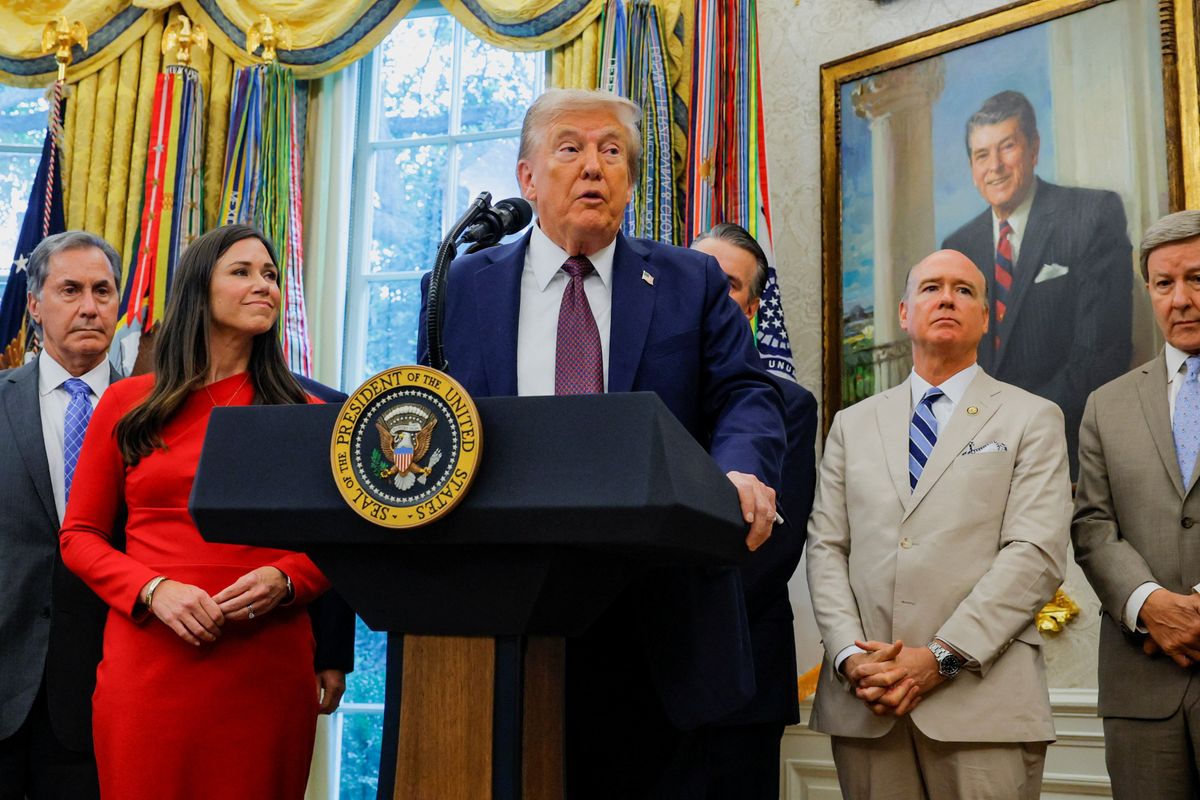
U.S. President Donald Trump, flanked by Representative Gary Palmer (R-AL), Senator Katie Britt (R-AL), Representative Robert Aderholt (R-AL) and Representative Mike Rogers (R-AL) speaks during an event to announce that the Space Force Command will move from Colorado to Alabama, in the Oval Office at the White House in Washington, D.C., U.S., September 2, 2025. REUTERS/Brian Snyder

President Donald Trump's decision to relocate the headquarters for the U.S. Space Command from Colorado to Alabama on Tuesday was met with fierce criticism.

During a news conference, Trump said Colorado's mail-in voting laws influenced his decision to relocate the agency. "They do mail-in voting, they went to all mail-in voting, so they have automatically crooked elections," he said, baselessly, according to NBC News.

Trump's decision was slammed on social media.

"Coloradans and Americans should all be provided full transparency and the full details of this poor decision," Colorado Gov. Jared Polis, a Democrat, said in a statement, adding that Colorado is still an "ideal location" for other missions like Trump's proposed "Golden Dome" project.

"Today’s decision to move U.S Space Command’s headquarters out of Colorado and to Alabama will directly harm our state and the nation," Colorado's bicameral Congressional delegation said in a statement. "Moving Space Command sets our space defense apparatus back years, wastes billions of taxpayer dollars, and hands the advantage to the converging threats of China, Russia, Iran, and North Korea."


"For anyone not watching, the Space Command press conference is like the Cliff Notes version of the 3-hour-long cabinet meeting where everyone told Trump how much of a visionary he is and how they're all so honored to work for him," Mike Boylan-Kolchin, astronomy professor at the University of Texas, Austin, posted on Bluesky.


"Just to get ahead of things, I live in Alabamastan and think it's stupid to move Space Command – or really, anything – here," writer Scott Adamson posted on Bluesky.

"Moving Space Command to Alabama is silly," writer and film critic Eric D. Snider posted on Bluesky. "Also silly: Space Command."

"U.S. Space Command is the central nervous system of our government's nuclear infrastructure," writer Charlotte Clymer posted on Bluesky. "This is why Pres. Biden chose to headquarter U.S. Space Command in Colorado in 2023. Because all the pertinent Space Force facilities were already there. Peterson, Schriever, Cheyenne Mountain, and Buckley military bases, the whole of USSPACECOM. Sure, it saved money, but it was common sense."
This Trump assault is against more than just so-called 'woke' ideas

Robert Reich
September 2, 2025
RAW STORY


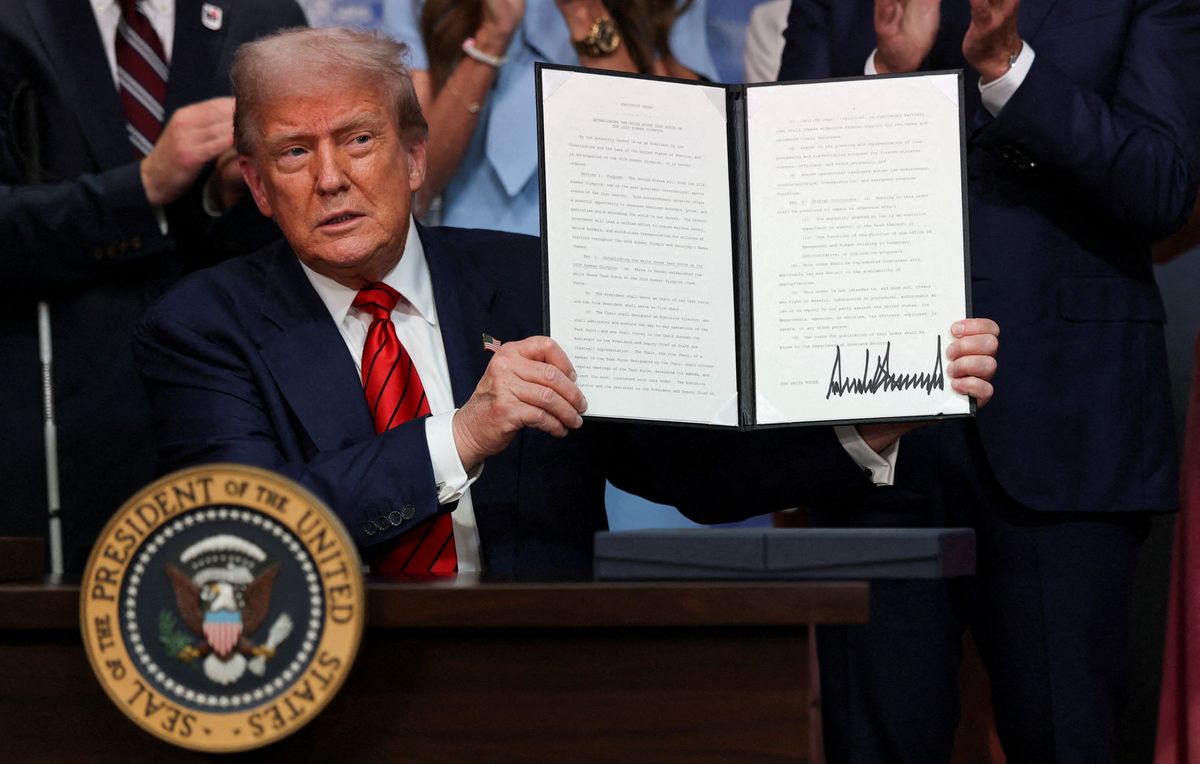
Donald Trump holds up an executive order. REUTERS/Jonathan Ernst

“The Museums throughout Washington, but all over the Country are, essentially, the last remaining segment of ‘WOKE,’” Donald Trump wrote recently on his Truth Social.

“The Smithsonian is OUT OF CONTROL, where everything discussed is how horrible our Country is, how bad Slavery was, and how unaccomplished the downtrodden have been — Nothing about Success, nothing about Brightness, nothing about the Future.”

So, Trump has ordered that the Smithsonian replace “divisive or ideologically driven language with unifying, historically accurate and constructive descriptions.

JD Vance calls American universities “fundamentally corrupt” and has referred to them as “the enemy.”

In his 2021 speech at the National Conservatism Conference, Vance stated that universities “control the knowledge in our society” and promote “deceit and lies” rather than truth, and he pledged to “aggressively attack” these institutions to reform what he sees as their left-wing ideological domination.

So, the Trump regime has attacked Harvard, Columbia, and many other institutions of higher learning and is withholding government funds until they agree to the Trump regime’s terms for deciding what they teach.

Trump has for years condemned what he terms the “liberal bias” in the the media, calling journalists the “enemy within.”

So, he has defunded PBS, NPR, the Voice of America, and Radio Free Europe. He has sued ABC and CBS. His Federal Communications Commission refused to allow CBS’s parent company, Paramount, to be sold until CBS purged itself of commentary and programming critical of Trump, including Stephen Colbert’s late-night comedy show.

Are Trump and Vance correct that museums, universities, and the media have a left-wing “woke” bias?

It’s the wrong question. It’s the question Trump would like everyone to be asking, but it obscures the more important question: Should government be determining the content of museums, universities, and the media? Or should the responsibility rest with these institutions?

Logically, someone has to decide what a museum will display. Usually this is left to people known as “curators.”

Someone has to decide what courses universities will offer. Usually this is left to university professors and professional staff.

Someone in media corporations has to decide what stories they’re going to report and which news items they’ll feature as important. Usually these decisions are left to managing editors and senior producers.

We’d be concerned if wealthy donors or advertisers played roles in these choices, because their economic interests may conflict with our interests as members of the public in learning the truth.

We’d also be concerned if politicians played roles in such choices, because their interests in remaining in power may conflict with our interests in learning the truth.

Better that professional museum curators, university faculties, and managing editors and producers make those choices because they’re “unbiased” in the sense that they don’t have ulterior motives.

The issue isn’t any mythological left-wing “woke.” It’s trust that potential conflicts of interest don’t determine content.

We wouldn’t and shouldn’t trust what we learn from a museum curated by Trump and his lapdogs, or a university whose curriculum and faculty were influenced by them, or a media corporation under their patronage. Why? Because Trump and his lapdogs would want to promote themselves and their views and censor anything critical of them.

Just as many readers are now suspicious of the editorial page of The Washington Post because the paper’s owner, Jeff Bezos, has censored pieces critical of Trump — and many worry about CBS News because the network’s new owner, David Ellison, has promised Trump’s FCC that its news coverage will reflect “varied ideological perspectives” — we have reason to worry that the museums, universities, and media with which Trump is “negotiating” will censor themselves from writing anything critical of Trump for fear of offending him.

We don’t trust Trump because he has shown a brazen disregard for the truth.

But we shouldn’t trust any administration to decide what museums, universities, or the media tell us. It’s not a matter of right or left or “woke.” It’s about the political independence of truth-tellers.

A free people needs to know things that an administration may not want them to know and must be able to trust that the agents of truth — museums, universities, the media — are not compromised.


Robert Reich is an emeritus professor of public policy at Berkeley and former secretary of labor. His writings can be found at https://robertreich.substack.com/

Robert Reich's new memoir, Coming Up Short, can be found wherever you buy books. You can also support local bookstores nationally by ordering the book at bookshop.org.
'Gibberish': Treasury sec hammered after wild claim touting Trump's 'magic taxes'

Matthew Chapman
September 2, 2025 
RAW STORY


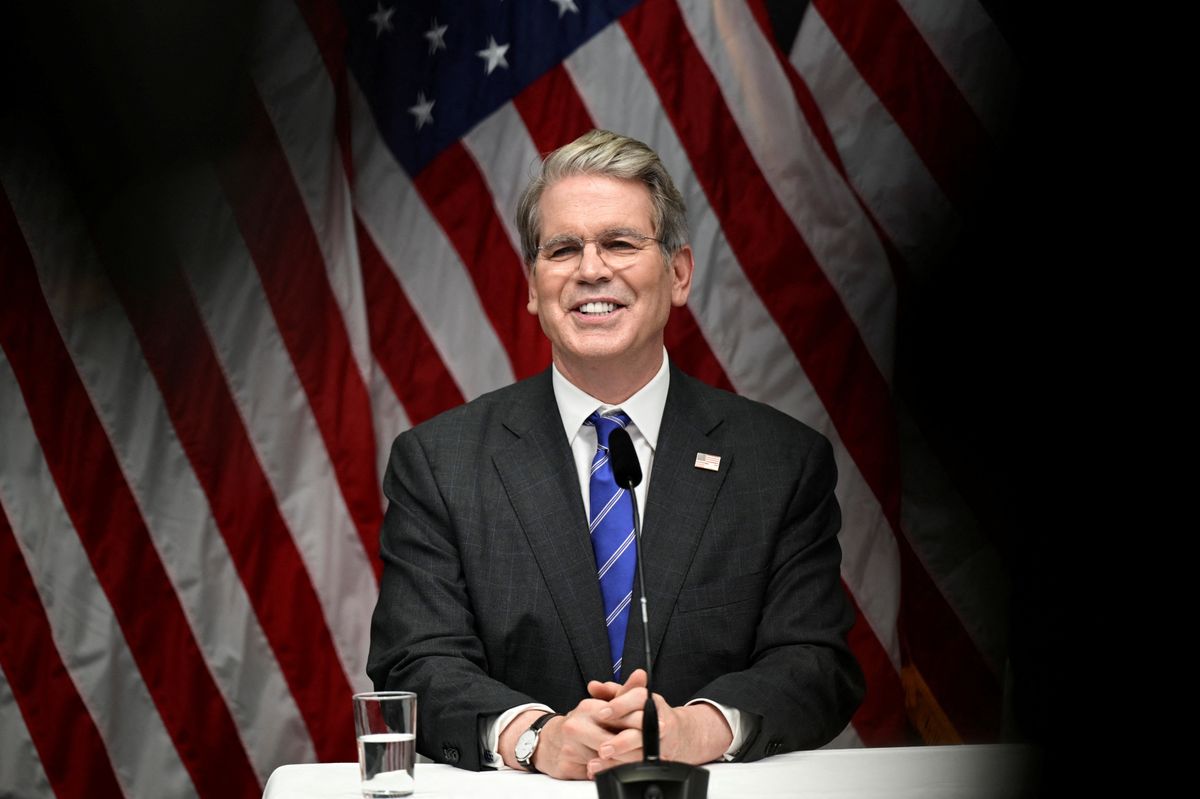
U.S. Treasury Secretary Scott Bessent attends a press conference at government quarters Rosenbad after the trade talks between the U.S. and China concluded, in Stockholm, Sweden, July 29, 2025. Magnus Lejhall/TT News Agency/via REUTERS

President Donald Trump's Treasury Secretary Scott Bessent appeared to suggest in a new interview with Lara Trump on Fox News that the massive tariffs imposed by the administration, far from shrinking the economy, will actually grow it.

"Tariffs are delivering historic results for the American people," Bessent posted on X, accompanying a video of his interview. "Even the mainstream media is starting to admit it. I’ve said total tariff revenue could reach $300B this year, but it could be much higher. Every $300B adds 1% to GDP. With tariffs alone, growth could hit 5%."

Bessent's claims were swiftly smacked down by experts, who pointed out that money is not extra economic growth, but a tax being paid by Americans — something Bessent himself has admitted in his more candid moments.

"This is economic gibberish," wrote analyst John Harwood.

"Tariffs are mostly taxes on Americans. Trade deficit is getting worse," wrote conservative analyst Jonah Goldberg. "I guess those are historic results."


"Magnitude is about right, but the sign is wrong. The $300 billion in tariffs will reduce long run output by a little less than 1%," wrote Kyle Pomerleau, tax policy strategist for the conservative American Enterprise Institute.

"Collecting $300bn in tariffs does not 'add' 1% to GDP. It just transfers it from US consumers and businesses to the government while making goods more expensive, hurting exporters, and creating an exemptions process ripe for corruption," wrote Phil Gordon of the Brookings Institution. "And the worst thing is Bessent knows that."

"In this video, the Treasury secretary tells the president's daughter-in-law that the president's illegal taxes are magic taxes that make us richer," wrote Dominic Pino of the National Review. "And he's supposed to be one of the positive influences in the administration."

"You cannot grow GDP by collecting taxes," wrote North Carolina State University agricultural economist Jeffrey Dorfman. "GDP is the total value of everything we produce. Tariffs are not production. To the extent they raise the price of products, then we all have less money to spend on other products. If we are lucky, tariffs have a zero effect."

A federal appeals court last week invalidated Trump's ability to impose tariffs under emergency powers without Congress, but the ruling is on hold to give the president time to appeal to the Supreme Court.

Trump dealt another court blow as Dem official ordered reinstated

Daniel Hampton
September 2, 2025 
RAW STORY


FILE PHOTO: A view of signage at the Federal Trade Commission (FTC) headquarters in Washington, D.C., U.S., November 24, 2024. REUTERS/Benoit Tessier/File Photo

A divided appeals court in Washington, D.C., dealt the Trump administration a blow in its quest to oust a Democratic Federal Trade commissioner.

Rebecca Slaughter was fired by President Donald Trump in March, alongside fellow Democratic Commissioner Alvaro Bedoya. The move was widely viewed as unlawful, as the FTC is meant to be an independent agency and its commissioners have removal protections. A federal judge ruled in July that Slaughter’s firing violated federal law and Supreme Court precedent, and mandated she be reinstated to serve out her full term, which runs through September 2029.

On Tuesday, an appeals court denied the federal government’s request to pause the lower court's order reinstating her. The judges noted Trump fired Slaughter without cause.

"The government now seeks a stay of that decision pending appeal. That motion must be denied. The government has no likelihood of success on appeal given controlling and directly on point Supreme Court precedent," they said.

"To grant a stay would be to defy the Supreme Court's decisions that bind our judgments. That we will not do," the judges added.
Trump's 'crusade to rehabilitate the Confederacy' has backfired: conservative analyst

September 2, 2025
RAW STORY


President Donald Trump appears to face a demographics problem as the 2026 midterm election nears, and one analyst thinks his "crusade to rehabilitate the Confederacy" could make matters worse.

Stuart Stevens, an advisor to the anti-Trump group The Lincoln Project, joined The Bulwark's Tim Miller on the "Bulwark Super Speed" podcast on Tuesday to discuss the issue Trump is having with recruiting new voters to the Republican Party. Trump has previously touted gains he made among Black and Hispanic voters as evidence of his ability to grow the party. Stevens suggested those voters may be tiring of Trump's policies, some of which appear racist.

"The Trump coalition that existed was always kind of a Faberge Egg because you had MAGA that would demand you chase gardeners through Brentwood with masked men, and if you did that, you were going to hurt yourself with Hispanics without a doubt," Stevens said

Stevens also addressed Trump's comments that the 2024 election was an endorsement of his policies.

"I don't think that it's an endorsement of Trumpism," Stevens said. "They knew that Project 2025 was poison. Now they're making people drink it. It's not going down any easier."

"They did a little better with African-Americans, only 87% voted against them [in 2024]," he added. "This crusade to rehabilitate the Confederacy isn't particularly helping them with African-Americans. We've seen that little boom that they had with young voters, particularly male voters, seems to have collapsed."


"Right now, racism is working completely to the benefit of the Trump people," Stevens said. "They get out there and they can use all this racial stuff and it works, and no one in the Democratic party is calling their number on it. No one is making them pay for being racist."

Watch the entire episode below or by clicking here.