It’s possible that I shall make an ass of myself. But in that case one can always get out of it with a little dialectic. I have, of course, so worded my proposition as to be right either way (K.Marx, Letter to F.Engels on the Indian Mutiny)
Wednesday, September 03, 2025
Trade War
The majority of Canadians that own property in the U.S. plan to sell, survey finds
Royal LePage broker Shawn Zigelstein discusses a new report which found 54 per cent of Canadians with U.S. property are planning to sell.
Trade tensions between Canada and the United States have many Canadians that own U.S. property weighing a sale of their home south of the border due to the economic policies of U.S. President Donald Trump‘s administration.
“Those are big numbers, particularly when you consider that we have about 1 million snowbird Canadians travel the United States each year, particularly during the six months of fall through spring, so the wintertime, and about over 60 per cent of those own property,” Phil Soper, president and CEO of Royal LePage, told BNNBloomberg.ca in a Wednesday interview.
Nearly two-thirds (62 per cent) of respondents surveyed, who are considering a sale, point to concerns with Trump and the White House. Meanwhile, 33 per cent are motivated by personal and financial reasons and five per cent are worried about extreme weather conditions such as hurricanes, floods and forest fires.
“My belief is, most Canadians believe this current era in American politics is extreme, and the pendulum will swing back towards something more normal or moderate,” said Soper. “But four years is a long time. He’s only six months into his term. There’s a lot of runway left, and a lot of uncertainty in terms of the direction America will take after the Trump presidency.”
Of those who went through a sale and sold their U.S. property within the last year, 44 per cent say it was because of the political climate, while 27 per cent say it was for personal reasons, and 22 per cent because of increasingly extreme weather conditions. ‘Buy Canadian’ sentiment resonating with residents
Canadians have been among the top two largest contributors of foreign investment in U.S. real estate for the last two decades, although transactions have been significantly lower the last five years compared to the majority of the 2010s, according to the National Association of Realtors.
Almost one third (32 per cent) of respondents who have recently sold or are planning to sell within the next year say they plan to reinvest the proceeds of sales into the Canadian market.
Real estate professionals in the U.S. have reported more than twice as many residential property sales by international clients over the last year, the largest group being Canadian.
“We only have between (450,000) and 500,000 overall real estate transactions in a year in all of Canada,” said Soper. “When you’re talking about potentially hundreds of thousands of Canadians selling property, that’s a big deal. It’s a real material change in attitude. Now we often investigate intent, and intent doesn’t always translate to action, but it’s clear that there has been a change in attitude, and that will be a seismic shift in Canadians investment in American property.”
The exodus from the American market follows a trend of residents travelling and spending less in the United States. Royal LePage points out, for example, Canadians made 6.1 million trips to the U.S. during the first quarter of 2025, a 10.8 per cent decline compared to the same period last year, according to Statistics Canada.
At the same time, spending during those visits fell 7.9 per cent year over year, totalling $5.7 billion. Soper said Canadians are bringing back money to Canada.
“We’re talking billions of dollars of Canadians’ money being spent in these regions in the United States, where they own properties, and bringing those billions back to Canada,” said Soper. “That will both have a material impact on the areas in which they live in Canada, the regions, but also on the regions in which they’re leaving”. Methodology
Burson used the Leger Opinion online panel to survey some 2,500 adult residents across Canada. The survey was conducted between Aug. 4 and 9, 2025 encompassing a variety of ages, genders, and other representations in line with the 2021 census figures.
No margin of error can be associated with a non-probability sample. For comparison purposes, a probabilistic sample of 2,500 respondents would have a margin of error of ±2 per cent, 19 times out of 20, and results from smaller subsamples should be interpreted with the understanding that their associated margin of error increases.
People walk through Harry Reid International Airport, Friday, Aug. 29, 2025, in Las Vegas. (AP Photo/John Locher)
LAS VEGAS — For a few hopeful weeks this summer, a bright billboard on the major highway linking Toronto to New York greeted Canadian drivers with a simple message: “Buffalo Loves Canada.”
The marketing campaign, which included a US$500 gift card giveaway, was meant to show Buffalo’s northern neighbors they were welcome, wanted and missed.
At first, it seemed like it might work, said Patrick Kaler, CEO of the local tourism organization Visit Buffalo Niagara. More than 1,000 people entered the giveaway. But by the end of July, it was clear the city’s reliable summer wave of Canadian visitors would not arrive this year.
Buffalo’s struggle reflects a broader downturn in international tourism to the U.S. that travel analysts warn could persist well into the future. From northern border towns to major hot spots like Las Vegas and Los Angeles, popular travel destinations reported hosting fewer foreign visitors this summer.
Experts and some local officials attribute the trend that first emerged in February to President Donald Trump’s return to the White House. They say his tariffs, immigration crackdown and repeated jabs about the U.S. acquiring Canada and Greenland alienated travelers from other parts of the world.
“To see the traffic drop off so significantly, especially because of rhetoric that can be changed, is so disheartening,” Kaler said.
Forecasts show U.S. losing foreign travelers
The World Travel & Tourism Council projected ahead of Memorial Day that the U.S. would be the only country among the 184 it studied where foreign visitor spending would fall in 2025. The finding was “a clear indicator that the global appeal of the U.S. is slipping,” the global industry association said.
“The world’s biggest travel and tourism economy is heading in the wrong direction,” Julia Simpson, the council’s president and CEO, said. “While other nations are rolling out the welcome mat, the U.S. government is putting up the ‘closed’ sign.”
Travel research firm Tourism Economics, meanwhile, predicted this month that the U.S. would see 8.2 per cent fewer international arrivals in 2025, an improvement from its earlier forecast of a 9.4 per cent decline but well below the numbers of foreign visitors to the country before the COVID-19 pandemic.
“The sentiment drag has proven to be severe,” the firm said, noting that airline bookings indicate “the sharp inbound travel slowdown” of May, June and July would likely persist in the months ahead.
Deborah Friedland, managing director at the financial services firm Eisner Advisory Group, said he U.S. travel industry faced multiple headwinds — rising travel costs, political uncertainty and ongoing geopolitical tensions.
Since returning to office, Trump has doubled down on some of the hard-line policies that defined his first term, reviving a travel ban targeting mainly African and Middle Eastern countries, tightening rules around visa approvals and ramping up mass immigration raids. At the same time, the push for tariffs on foreign goods that quickly became a defining feature of his second term gave some citizens elsewhere a sense they were unwanted.
“Perception is reality,” Friedland said.
International arrivals down from Western Europe, Asia and Africa
Organizers of an international swing dancing said an impression of America’s hostility to foreigners led them to postpone the event, which had been scheduled to take place this month in the Harlem area of New York City.
About three months into Trump’s second term, international competitors began pulling out of the world finals of the International Lindy Hop Championships, saying they felt unwelcome, event co-producer Tena Morales said. About half of attendees each year come from outside the U.S., primarily from Canada and France, she said.
Contest organizers are considering whether to host the annual competition in another country until Trump’s presidency ends, Morales said.
“The climate is still the same and what we’re hearing is still the same, that (dancers) don’t want to come here,” she said.
The nation’s capital, where the Trump administration in recent weeks deployed U.S. National Guard members and took over management of Union Station, also has noticed an impact.
Local tourism officials have projected a 5.1 per cent dip in international visitors for the year. Marketing organization Destination DC said last week it planned to “counter negative rhetoric” about the city with a campaign that would feature residents and highlight the “more personal side” of Washington.
U.S. government data confirms an overall drop-off in international arrivals during the first seven months of the year. The number of overseas visitors, a category that doesn’t include travelers from Mexico or Canada, declined by more than three million, or 1.6 per cent, compared to the same period a year earlier, according to preliminary figures from the National Travel and Tourism Office.
As a tourist generator, Western Europe was down 2.3 per cent, with visitors from Denmark dropping by 19 per cent, from Germany by 10 per cent, and from France by 6.6 per cent. A similar pattern surfaced in Asia, where the U.S. data showed double-digit decreases in arrivals from Hong Kong, Indonesia and the Philippines. Fewer residents of countries throughout Africa also had traveled to the U.S. as of July.
However, visitors from some countries, among them Argentina, Brazil, Italy and Japan, have arrived in greater numbers.
Filling a void left by Canadian tourists
Neither did all U.S. destinations report sluggish summers for tourism.
On eastern Wisconsin’s Door Peninsula, which straddles Lake Michigan and Green Bay, a steady stream of loyal Midwest visitors helped deliver a strong summer for local businesses, according to Jon Jarosh, a spokesperson for Destination Door County.
Many business owners reported a noticeable uptick in foot traffic after a quieter start to the season, Jarosh said, and sidewalks were bustling and restaurants were packed by midsummer.
Executives from the major U.S. airlines said last month that American passengers booking premium airfares helped fill their international flights and that demand for domestic flights was picking up after a weaker than expected showing in the first half of 2025.
The Federal Aviation Administration said it was gearing up for what is expected to be the busiest Labor Day weekend in 15 years. Bookings for U.S. airlines were up about 2 per cent compared to 2024 for the long holiday weekend that started Thursday, aviation analytics firm Cirium said.
As the summer winds down, though, the absence of foreign visitors in Buffalo was still visible, according to Kaler, the head of Visit Buffalo Niagara.
Canada sent over 20.2 million visitors to the U.S. last year, more than any other country, U.S. government data showed. But this year, residents of Canada have been among the most reluctant to visit.
In a major U-turn, more U.S. residents drove into Canada in June and July than Canadians making the reverse trip, according to Canada’s national statistical agency. Statistics Canada said it was the first time that happened in nearly two decades with the exception of two months during the pandemic.
In July alone, the number of Canadian residents returning from the U.S. by car was down 37 per cent from the year before, and return trips by plane fell 26 per cent, the agency said.
As a result, Visit Buffalo Niagara shifted its marketing efforts this summer to cities like Boston, Philadelphia and Chicago. Amateur children’s sporting events also helped fill the void left by Canadian tourists.
“We will always welcome Canadians back when the time is right,” Kaler said. “I don’t want Canadians to feel like we see them as just dollar signs or a transaction at our cash registers. They mean more to us that that.”
Rio Yamat, The Associated Press
Trade War Carney cabinet meets to prepare for Parliament’s return, debate trade war strategy
Prime Minister Mark Carney delivers remarks in Ottawa on Thursday, Aug. 7, 2025. THE CANADIAN PRESS/Spencer Colby
TORONTO — American tariffs and an upcoming review of the continental trade pact will headline discussions today as Prime Minister Mark Carney’s cabinet begins its two-day retreat in Toronto.
While previous governments referred to these sorts of gatherings as cabinet “retreats,” Carney’s office is rebranding the event as a “cabinet planning forum.”
The meetings come two weeks before the House of Commons is to return for the fall sitting and about a month or so before Carney’s new government presents its first federal budget.
Ministers are expected to spend most of their time discussing U.S. President Donald Trump’s tariff war.
Just over a week ago cabinet approved a decision to tamp down Canada’s tariff retaliation, aligning most tariffs with the U.S. by exempting goods covered under the Canada-U.S.-Mexico Agreement.
That trade deal will also be on the agenda as cabinet preps for the review of the pact that could begin as early as this fall.
Canada’s quest to build up Canada’s domestic defence industry, building more affordable housing and tackling crime will also highlight the discussions.
While the discussions will happen behind closed doors, ministers typically use these meetings to make announcements on the margins and position themselves for Parliament.
The Liberal caucus will also hold planning meetings in Edmonton next week before Parliament returns on Sept. 15.
This report by The Canadian Press was first published Sept. 3, 2025
Kyle Duggan, The Canadian Press
Trade War
‘Mercy of politics’: Canadian farmers weigh plans as Chinese tariff hits canola price
Canola plants bloom in a pasture on a farm near Cremona, Alta., Friday, July 18, 2025. THE CANADIAN PRESS/Jeff McIntosh
As Chinese tariffs on Canadian canola products continue to hamper the cash price of one of the country’s most valuable crops, farming experts say producers have big decisions ahead of them.
Market analyst Chuck Penner with LeftField Commodity Research said while future prices are down slightly, the cash price farmers receive for their canola, also known as the basis, is much lower.
He said the drop has resulted in farmers losing at least $140 million on their canola in the last two weeks. But compared with March, when China imposed a 100 per cent tariff on canola oil and meal, losses amount to $800 million, he said.
“There’s other factors going on in the market as well, but that’s just a quick and dirty look at it,” Penner said.
“(Farmers) don’t like it, and they feel like they’re being sacrificed to support eastern Canadian industries, whether that’s true or not.”
The hit to Canada’s canola industry comes more than two weeks after China hit Canadian canola seed with a 75.8 per cent tariff.
Beijing’s duty on canola seed was seen as a response to Canada’s 100 per cent tariff on Chinese electric vehicles.
Penner said farmers plan on growing canola next year, but just how much will depend on market forces and their land management practices, known as crop rotations.
Producers change out the crops they plant each year to manage soil nutrients and limit diseases. Prairie farmers tend to cycle their fields with oilseeds, cereals and pulses over a three-year period.
“You can’t just stop growing one of those crops wholesale because it’s a complex system,” Penner said. “Farmers have been through low price environments before, but usually they’re related to supply and demand, rather than these abrupt trade decisions.
“If we didn’t have this China situation, farmers would be able to plan and look ahead more effectively.”
Canola is considered a high source of farm revenue for Canadian producers, but it’s also among the most expensive to grow.
Chris Davison with the Canola Council of Canada says canola has historically been a productive and profitable crop.
“We’re certainly going to do everything we can to help support and create the conditions that enable that to continue,” Davison said.
“A big part of that is working to make sure that we’ve got our export markets and demand for Canadian canola seed, oil and meal functioning optimally.”
China is Canada’s second-largest importer of canola products, behind only the United States.
Davison said this year’s canola crop is shaping up to be more bountiful than last, which could create additional pressures should China’s tariffs persist.
“If harvest is larger than what is estimated, then we lose the demand signal for Canadian canola. That certainly has the real potential to make things more challenging,” he said.
Alberta Premier Danielle Smith and Saskatchewan Premier Scott Moe have said Ottawa should drop its 100 per cent electric vehicle tariff on Beijing.
Davison said doing so should be part of discussions between China and Canada.
“They are political issues that require a political solution,” he said. “It’s really important that we understand what it’s going to take to resolve the issue before determining which levers we can pull.”
The canola industry contributed $43 billion to Canada’s economy last year and employs roughly 200,000 people.
The canola seed tariff came into force nearly a year after Beijing launched an anti-dumping probe into the crop.
China’s Ministry of Commerce has argued Canadian canola companies were dumping the product into the Chinese market, hurting its domestic canola oil market.
Ottawa and farmers have denied dumping, saying exporters are following rules-based trade.
Ottawa has said China has until September, when the anti-dumping investigation formally ends, to make a final decision on the duty. China can extend the deadline by six months.
In 2019, China restricted canola imports from two grain companies after Canada detained Meng Wanzhou, a Chinese business executive.
Canadians Michael Spavor and Michael Kovrig were also detained in China days after Meng’s arrest.
Meng and the two Canadians were released to their countries in 2021 and China lifted its ban on canola the next year.
Penner said the issue this time is different, as 2019 didn’t involve broad tariffs.
“What we can take from it is farmers and industry are at the mercy of politics,” he said. “There is precious little they can do about it.”
This report by The Canadian Press was first published Sept. 1, 2025.
Centrica has confirmed that Heysham 1 and Hartlepool nuclear power stations will remain in operation until March 2028, extending their previously expected closure dates by one year.
The extension, approved following graphite core inspections in 2025, secures continued output of homegrown, low-carbon electricity capable of powering more than four million UK homes annually. Centrica, which holds a 20% stake in the stations alongside operator EDF, said the additional year of generation would contribute around 3TWh of electricity to its portfolio between 2026 and 2030.
This move comes amid mounting pressure on the UK to bolster energy security and reduce reliance on fossil fuels. Since December 2024, lifetime extensions across the UK’s nuclear fleet are expected to add about 60TWh of supply, with Centrica’s share totaling 12TWh.
Centrica has been deepening its involvement in nuclear power, most recently committing £1.3 billion to acquire a 15% equity stake in Sizewell C, the 3.2GW plant under construction in Suffolk. Once operational, Sizewell C is expected to deliver reliable zero-carbon baseload electricity for at least six decades.
Chris O’Shea, Centrica’s Chief Executive, said the extensions demonstrate the importance of nuclear in a diversified UK energy mix: “The UK needs more reliable, affordable, zero-carbon electricity, so the extension of Heysham 1 and Hartlepool is great news. We believe in having a diversified energy system, with nuclear power playing a key role in ensuring stability and sustainability for decades to come.”
The announcement highlights how existing nuclear assets are being leveraged to support the country’s decarbonisation strategy while bridging the gap until new capacity comes online. Heysham 2 and Torness are still expected to close in 2030, but further reviews will depend on ongoing inspections and regulatory assessments.
Further life extension of two UK nuclear power stations
The Heysham 1 and Hartlepool advanced gas-cooled reactor nuclear power plants will continue generating electricity until March 2028, an extension of 12 months, EDF Energy has announced.
The Heysham 1 AGR plant (Image: EDF Energy)
In December 2024, EDF Energy extended the lifetimes of all four of its generating advanced gas-cooled reactor (AGR) plants. It said Heysham 1 and Hartlepool - which were due to move into defuelling in March 2026 based on a review in 2023 - would continue operating until March 2027. Meanwhile, Heysham 2 and Torness - which were due to move into defuelling in March 2028 based on a review in 2021 - will operate until March 2030.
The company has now announced that, following a series of positive graphite inspections at both plants over the past nine months, it has decided Heysham 1 and Hartlepool will continue operating until March 2028.
"Extending the life of these stations makes sense," said Mark Hartley, Managing Director of EDF's Nuclear Operations business. "It secures employment for longer for more than 1,000 people who work at those sites, and it supports the UK's ambitions to have a clean, secure electricity supply. A further year of operation for these two stations has the potential to power more than four million homes and reduce the need for imported gas."
EDF Energy noted that Heysham 2 and Torness were not in scope for this review after a two-year extension and remain scheduled to generate until March 2030.
"EDF's ambition is to continue making zero-carbon electricity at its four generating AGR stations for as long as it is safe and commercially viable to do so and will keep station lifetimes under review," it said.
Centrica, which has a 20% share in the Heysham and Hartlepool plants, noted: "The total life extensions announced since December 2024 are projected to add approximately 12 TWh to the company's electricity generation volumes between 2026 and 2030, with 3 TWh attributable to the extensions announced today."
"The UK needs more reliable, affordable, zero-carbon electricity, so the extension of Heysham 1 and Hartlepool is great news," said Centrica Group CEO Chris O'Shea. "We believe in having a diversified energy system, with nuclear power playing a key role in ensuring stability and sustainability for decades to come."
Tom Greatrex, Chief Executive of the Nuclear Industry Association, commented: "These lifetime extensions are hugely welcome - they'll cut bills, cut emissions and protect jobs in communities that rely on them. It's the single biggest step forward for energy security this year, and a vital boost for our stretched power grid. And the real opportunity ahead is even greater: by building new nuclear alongside these extensions, we can secure a clean, reliable and resilient power system for the long term."
US uranium company unveils conversion facility plans
Uranium Energy Corp has launched a new subsidiary to pursue the feasibility of developing a new US uranium refining and conversion facility.
UEC's Wyoming operations (Image: UEC)
Texas-headquartered UEC said the new company will be called United States Uranium Refining & Conversion Corp. (UR&C). The initiative responds to federal policy under recent Executive Orders from the White House calling for a fourfold increase of US nuclear generating capacity by 2050 and reducing reliance on overseas suppliers. Onshoring the nuclear fuel cycle is seen as a priority for national security.
"Positioning UEC as the only vertically integrated US company with uranium mining, processing, refining and conversion capabilities is both a significant commercial opportunity and a strategic necessity for the United States," UEC President and CEO Amir Adnani said. UEC's end-to-end capabilities would provide a secure, geopolitically reliable source of uranium hexafluoride - the feedstock needed for uranium enrichment to produce nuclear fuel - for "undersupplied domestic and allied markets," he added.
"We are structuring UR&C as a subsidiary to advance this initiative in a fiscally optimal manner, including tactical partnerships and direct investments. This allows UEC to maintain a strong balance sheet and continue to prioritise its core uranium mining and processing business, while separately advancing UR&C to enhance UEC shareholder value," Adnani said.
UEC Chairman and former US Secretary of Energy Spencer Abraham said the USA has "for far too long" relied on foreign sources to supply and process the critical materials essential for national and economic security. "We are seeking to address this problem by advancing a vertically integrated supply chain for natural UF6, providing essential feedstock for commercial enrichment to power the world's largest nuclear reactor fleet and supplying the unobligated US-origin uranium required to fuel America's nuclear navy. The proposed facility directly aligns with US policy and would contribute to unlocking American enrichment growth."
UEC has three hub and spoke in-situ recovery uranium platforms in South Texas and Wyoming with a combined licensed production capacity of 12.1 million pounds U3O8 (4654 tU) per year. UR&C will position UEC as the only American company with a nuclear fuel supply chain capability from uranium production to refining, conversion, and delivery of natural UF6, the company said. High conversion prices in both the spot and long-term markets are "indicative of a highly undersupplied market and a major bottleneck in the US nuclear fuel supply chain, and market conditions, plus current federal government support, have created a "prime opportunity" for a US company to develop a new uranium refining and conversion plant, it added.
The proposed facility - which UEC says will be the largest conversion facility in the USA and "amongst the most modern in the Western world" - is envisaged as having a designed capacity to produce some 10,000 tU per year as UF6, representing a "substantial share" of the USA's 18,000 tU per year demand.
The proposed facility is the result of work initiated with Fluor Corporation in July 2024 and supported by a recently completed AACE Class 5 conceptual study. UEC said it has initiated discussions on potential siting options, "evaluating factors such as logistics, workforce availability, public acceptance, local incentives, and synergies with other fuel cycle facilities."
"The project will move forward contingent on several factors, including completion and assessment of additional engineering and economic studies, securing strategic government commitments, utility contracts, regulatory approvals, and favorable market conditions," the company said. "UEC has begun initial discussions with the United States government, state-level energy authorities, utilities, and financial entities, and will report further updates as these engagements advance."
Conversion is a chemical process to refine U3O8 to uranium dioxide, which can then be converted into uranium hexafluoride gas. Honeywell's Metropolis Works plant, built in the 1950s in southern Illinois, is currently the only uranium conversion facility in the USA. It was temporarily shut down from 2017 to 2023 due to poor market conditions, but was restarted in July 2023.
Yellowcake production begins at Kayelekera
Production of the first dried and drummed U3O8 is the final step in the commissioning of the process plant at Lotus Resources Inc's 85%-owned project in Malawi.
Yellowcake being drummed at Kayelekera's packaging and drying plant (Image: Lotus Resources)
Kayelekera first produced uranium in 2009, but when Australian-based Lotus Resources acquired the project from Paladin Energy in 2020 it had been under care-and-maintenance since 2014. Last year, the company announced plans for an accelerated restart of the project, and earlier this month Malawi's President Lazarus McCarthy Chakwera took part in a ceremony to officially inaugurate the mine as it moved into the final commissioning stages.
Samples from Kayelekera will soon be sent to each of the three western uranium converters for qualification ahead of the first shipment of uranium from the site. In the meantime, the company will continue to focus on ramping up production and building inventory in anticipation of making its first uranium shipment later this year, Lotus Managing Director Greg Bittar said.
The company is now "positioned to join the ranks of global uranium producers" at a crucial time for the global uranium market, Bittar noted. "Achieving this milestone on budget and within the timeline of Q3 CY25 targeted at the beginning of Kayelekera's accelerated restart is a testament to the quality and dedication of Lotus' team, contractors and all stakeholders," he said.
Lotus plans to ramp up to a steady-state production level of 200,000 pounds U3O8 (77 tU) per month in the first quarter of 2026. The company currently has four binding sale arrangements for a minimum of 3.5 million pounds, and up to 3.8 million pounds U3O8 of Kayelekera's output starting from 2026, including with three leading North American power utilities, the company said.
Go-ahead for preliminary works at Polish plant site
Polskie Elektrownie Jądrowe has been granted a permit by the head of the Pomeranian Voivode to begin preparatory works related to the construction of Poland's first nuclear power plant at Lubiatowo-Kopalino.
(Image: Polish Government)
The permit, issued by Beata Rutkiewicz, covers: surveying works; development of the construction site, including the construction of temporary technical and other facilities; removal of trees; construction of a temporary fence; and levelling the terrain.
Polskie Elektrownie Jądrowe (PEJ) said the works - which will cover an area of about 330 hectares - will begin in the coming months.
Preparatory works will begin with the staking out of the area, where site facilities will be prepared, the company said. In parallel, checking the area for possible archaeological sites and unexploded ordnance will continue, "so that the work will be carried out in a safe manner for personnel and bystanders". Then, in late October/early November, tree and shrub removal will begin. According to the plan, tree clearing will be completed by spring 2026.
PEJ noted that, over the past year and a half, it has conducted an extensive environmental and survey campaign that precedes the start of preparatory works. The site of the future power plant was surveyed once again to determine the conditions before the start of works and to effectively relocate protected plant and animal species. These activities, it said, fulfilled the obligation under the environmental decision issued by the General Director for Environmental Protection.
"The beginning of preparatory works is an important landmark in our project, which is why obtaining this permit is so important to us," said Marek Woszczyk, President of the Management Board of PEJ. "In accordance with the established schedule, we are consistently moving towards starting the key stage of the investment project, which is the construction of the power plant. Timely delivery of such a complex project would not have been possible without efficient and professional cooperation with government administration, in this case with the Head of the Pomorskie Voivodship and representatives of the Pomorskie Voivodship Office."
In November 2022, the Polish government selected Westinghouse AP1000 reactor technology for construction at the Lubiatowo-Kopalino site in the Choczewo municipality in Pomerania in northern Poland. In September 2023, Westinghouse, PEJ - a special-purpose vehicle 100% owned by Poland's State Treasury - signed an 18-month Engineering Services Contract under which Westinghouse and Bechtel will finalise a site-specific design for a plant featuring three AP1000 reactors. The aim is for Poland's first AP1000 reactor to enter commercial operation in 2033. The total investment costs of the project are estimated to be about PLN192 billion (USD49 billion).
SASKATCHEWAN
McArthur River delays impact Cameco production
Cameco's 2025 production figures will be impacted by development delays at McArthur River, although strong production at Cigar Lake will help make up for this, the company has said. Meanwhile, together with Orano Canada, it has signed a new agreement with an Indigenous-owned airline to ensure transport to its operations in northern Saskatchewan.
(Image: Cameco)
Development delays and the expected timing of ground freezing as the mine transitioned into two new mining areas were among a list of potential risks to the McArthur River mine production schedule that were identified by the company back in January. These delays have meant that some production from operations at the site in Saskatchewan is being deferred, although this is partially being offset by strong performance at the Cigar Lake mine, Cameco said in its latest update on its 2025 production plans.
"The impact of these risks was dependent on the magnitude of the delay, the McArthur River mine’s ability to substitute feed for the Key Lake mill with production from alternative mining areas, and our ability to offset reduced production from McArthur River/Key Lake with additional production from the Cigar Lake mine," the company said in an update released on 28 August. "We have determined that we are unable to fully mitigate the expected impact of the delayed development and slower than anticipated ground freezing in the first half of 2025."
2025 production from the McArthur River/Key Lake operation is now anticipated to be between 14 million and 15 million pounds U3O8 (5385-5770 tU) on a 100% basis (9.8-10.5 million pounds for Cameco's share) in 2025. This is down from the previous forecast, of 18 million pounds U3O8 (100% basis; 12.6 million for Cameco's share).
"At the Cigar Lake mine, we continue to expect to produce 18 million pounds U3O8 (100% basis; 9.8 million pounds our share) this year, however performance to date at Cigar Lake has been strong, creating an opportunity to potentially offset up to 1 million pounds (100% basis) of the shortfall at the McArthur River/Key Lake operation," the company said.
The McArthur River mine is owned 69.805% by Cameco and 30.195% by Orano. The Key Lake mill is owned 83.333% by Cameco and 16.667% by Orano. Cigar Lake is owned 54.547% by Cameco, 40.453% by Orano Canada Inc. (Orano) and 5% by TEPCO Resources Inc.
Rise Air contract
In a separate announcement, Cameco and Orano Canada Inc announced the signature of a 15-year agreement with Indigenous-owned airline Rise Air, to provide workforce transportation services for northern Saskatchewan operations. The agreement is worth around CAD500 million (USD364 million).
This is the latest agreement between the companies in a relationship dating back to 1993, although previous agreements with Rise Air have typically spanned three years or less.
Rise Air CEO Derek Nice said the 15-year agreement will be transformative for Saskatchewan’s largest regional airline, which plays a vital role in connecting northern communities and supporting regional economic development. "It means we can plan for the future with confidence - investing in modern equipment, upgrading our facilities, and expanding hiring and training. Most importantly, it allows us to focus on building long-term careers for residents of northern Saskatchewan."
"Air transportation is critical to our operations in northern Saskatchewan," Cameco President and CEO Tim Gitzel said. "Without the ability to fly workers to our remote sites, we cannot operate. This contract ensures continued access to our sites through an exciting new fleet of aircraft."
Rise Air is owned by Athabasca Basin Development and Prince Albert Development Corp, and is one of Canada’s largest indigenous-owned air carriers operating 24 aircraft. The ownership collectively impacts 12 First Nations and four municipalities.
EIA programme proposed for Norwegian plant
At the request of Norwegian government, three state agencies have set out their proposed programme for the environmental impact assessment for a small modular reactor power plant in the municipalities of Aure and Heim. Meanwhile, a joint venture of Norsk Kjernekraft and Austrheim Municipality has begun the formal regulatory process to assess the construction of a nuclear power plant in Austrheim.
The proposed location for the SMR plant (Image: Norsk Kjernekraft)
Nuclear project developer Norsk Kjernekraft submitted a proposal to Norway's Ministry of Energy in November 2023 for an assessment of the construction of the small modular reactor (SMR) plant. According to the preliminary plan, the plant will be located in a common industrial area - the Taftøy industrial park - in the border area between Aure and Heim. The plant is planned to consist of several SMRs, which together will produce around 12.5 TWh of electricity annually, if the plant is realised in its entirety.
In April this year, the Ministry of Energy, the Ministry of Health and Care Services, the Ministry of Justice and Public Security, and the Ministry of Climate and Environment requested the Norwegian Water Resources and Energy Directorate (NVE), the Norwegian Radiation and Nuclear Safety Authority (DSA), and the Norwegian Directorate for Civil Protection (DSB) prepare an Environmental Impact Assessment (EIA) programme for the proposed plant.
"An assessment programme is a review of which topics a developer must investigate before applying for licences, permits and approvals in line with current regulations," DSA noted. "The goal is to ensure that environmental and social considerations are taken into account."
"The three directorates have submitted a proposal for which topics should be investigated in order to assess a nuclear power plant in Aure and Heim," Kjetil Lund, Director of Water Resources and Energy at NVE said. "Now it is up to the ministries to consider how the further work should be organised."
DSA Director Per Strand added: "Nuclear power plants must be operated safely, securely and responsibly to ensure that people and the environment are protected from the negative consequences of radiation, and it is important that the assessment programme is clear about the consequences a nuclear power plant will have on the environment and society. The regulations impose strict requirements on nuclear power plants."
DSA noted that although the assessment programme is designed specifically for a nuclear power plant at Taftøy industrial park, "most of the proposed assessment topics and requirements will still be relevant for any other nuclear power plants".
"The directorates believe that the development of nuclear power production in Norway should start with an overall, state-wide approach, rather than a local initiative for a specific facility with a given location," Strand said. "This is also in line with international recommendations from the International Atomic Energy Agency."
Austrheim proposal
The proposal for an assessment programme is the first formal step in Norway towards establishing a nuclear power plant. The submission of a proposal by Norsk Kjernekraft in November 2023 for the Aure and Heim SMR plant was the first of many such proposals that have since been submitted for SMR plants in various locations across the country.
Today, Norsk Kjernekraft and Austrheim Municipality announced that the joint venture Fensfjorden Kjernekraft AS has submitted a notification with a proposal for an assessment programme to the Ministry of Energy. The notification marks the start of the formal regulatory process to assess the construction of a nuclear power plant in Austrheim Municipality, Vestland County.
In June 2024, the Norwegian government appointed a committee to conduct a broad review and assessment of various aspects of a possible future establishment of nuclear power in the country. It must deliver its report by 1 April 2026.
Record-breaking year for nuclear electricity generation
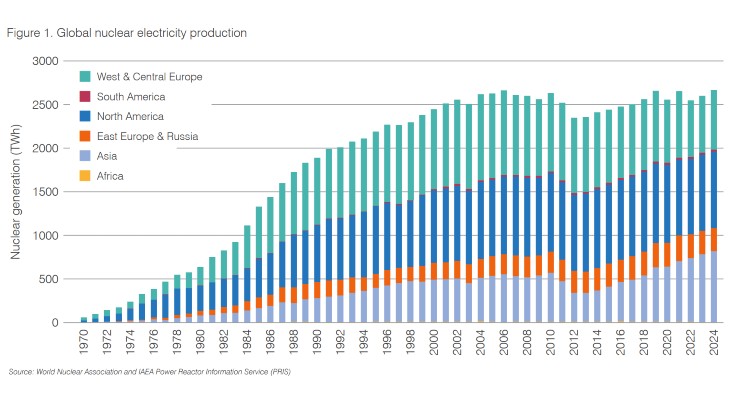
Nuclear reactors worldwide generated 2667 TWh of electricity in 2024, beating the previous record of 2660 TWh which was set back in 2006, according to World Nuclear Performance Report 2025.
(Image: World Nuclear Association)
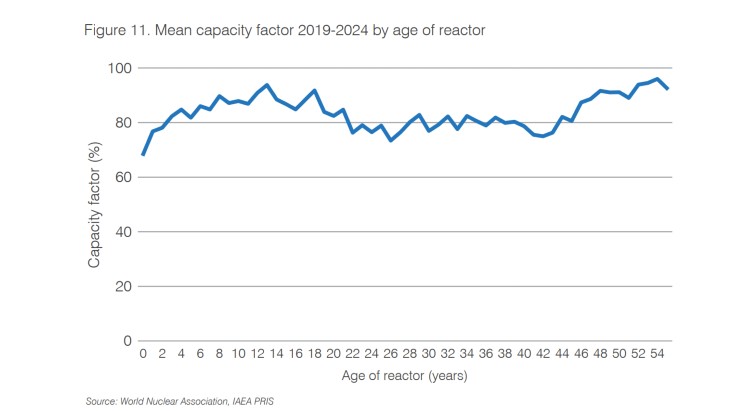
The latest edition of the yearly report, produced by World Nuclear Association, also recorded that the average capacity factor increased to 83% - the capacity factor is how much electricity is produced as a percentage of what could be produced if a power plant was operating at full power non-stop for the entire year.
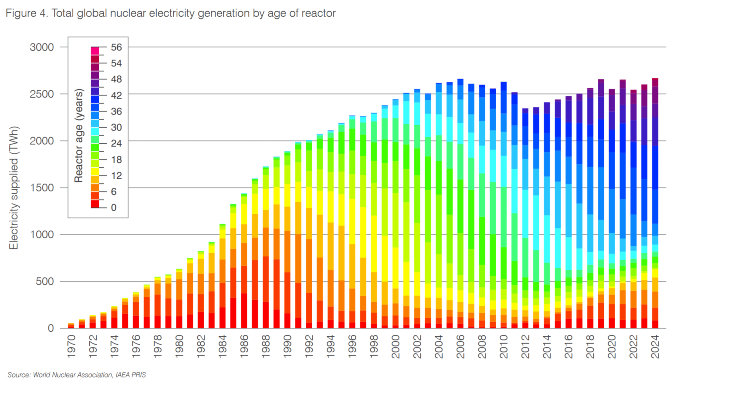
One of the findings of World Nuclear Performance Report 2025 was that there is no decline in performance of reactors as they age, with more than 60% of reactors achieving a capacity factor of more than 80%.
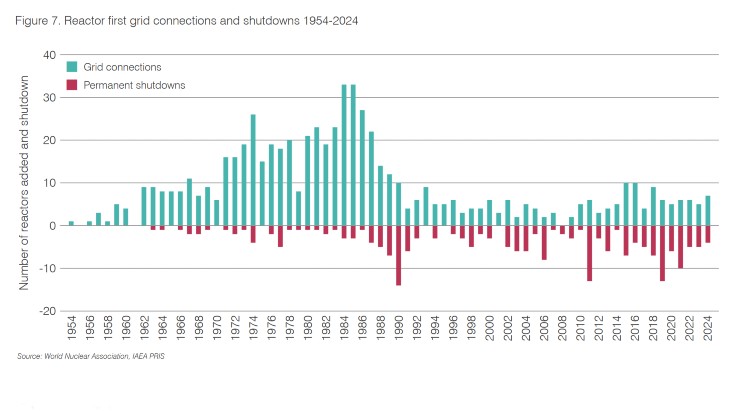
The report says that the increase in global nuclear generation over the past decade is primarily down to Asia, which accounts for 56 of the 68 reactors commissioned. And of the 70 reactors currently under construction, 59 are located in the region.
Director General of World Nuclear Association Sama Bilbao y León said: "The new record electricity generation from nuclear energy in 2024 is a testament to the industry. To meet our global energy and climate goals, it is a record that needs to be bettered again and again, every year, by increasingly larger amounts.
"The challenge ahead is immense, but so is the opportunity. With the backing of bold global industry leaders, forward-thinking governments, and an increasingly engaged public, the path to tripling nuclear capacity is not only achievable, it is necessary. This is our chance to build a cleaner, more secure energy future for everyone everywhere, powered by reliable, low-carbon nuclear energy."
During 2024 seven reactors were connected to the grid - Zhangzhou 1 in China, Vogtle 4 in the USA, Shidaowan Guohe One in China, Kakrapar 4 in India, Flamanville 3 in France, Fangchenggang 4 in China and Barakah 4 in the UAE.
Construction began on nine more during 2024 - Chashma 5 in Pakistan, El Dabaa 4 in Egypt, Leningrad II-3 in Russia, and in China, Lianjiang 2, Ningde 5, Shidaowan 1, Xudabao 2 and Zhangzhou units 3 and 4.
Four reactors were permanently shut down in 2024. These were Kursk 2 in Russia, an RBMK light water graphite reactor, Pickering 1 and 4 PHWRs in Canada, which had operated for 53 and 51 years respectively, and Maanshan 2, a 41-year-old pressurised water reactor that was closed as part of the Taiwanese government phase-out policy.
Report author, Jonathan Cobb, senior programme lead, climate, at World Nuclear Association, told the World Nuclear News podcast that he expects to see the new record broken again in the next years.
"As the reactors currently under construction are grid-connected over the next five to six years, we should see global nuclear capacity and total nuclear generation continuing to rise. There may be some closures of older plants, but our analysis has shown that for the current reactor fleet, including those reactors that have operated for at least 50 years, there is no decline in reactor performance related to age ... indeed, in the US, we are seeing some reactors that recently shut being reopened," he said.
Microsoft has become the first of the global tech giants to join World Nuclear Association, underscoring the growing recognition of nuclear energy as an essential foundation for powering the digital economy and achieving ambitious climate goals, the Association said.
Microsoft is participating in World Nuclear Symposium, taking place in London from 3-5 September
Microsoft has emerged as a leader in securing reliable, carbon-free electricity to meet growing energy demand. It has signed long-term agreements including a 20-year power purchase agreement with Constellation Energy to restart the Crane Clean Energy Center, formerly known as the Three Mile Island nuclear facility, in the USA and signed one of the first deals with fusion energy technology company Helion, through a long-term power purchase agreement.
"Microsoft's membership with the Association is a game-changing moment for our industry," said World Nuclear Association Director General Sama Bilbao y León. "When one of the world's most innovative technology companies recognises nuclear energy as essential to their carbon-negative future, it sends a powerful signal to markets, policymakers, and industry leaders worldwide. This partnership will accelerate nuclear deployment at the scale needed to meet both climate goals and the growth in energy demand from data centres."
Melissa Lott, leader of Microsoft's Energy Technology team, said the company's World Nuclear Association membership reflects a "strategic moment" as the technology industry works to meet its carbon-free energy goals. "When you combine Microsoft's technological capabilities with the nuclear industry's proven track record of delivering reliable, carbon-free baseload power, you create the foundation for unprecedented innovation in carbon-free energy technology deployment," she said.
"Nuclear energy isn't just part of the technology sector’s energy strategy - it's essential to it," Bilbao y León said. "Microsoft joining the Association allows greater collaboration between one of the major energy users and the nuclear industry to address the regulatory, technical, and financial challenges to accelerate nuclear deployment. The global nuclear industry isn't just generating electricity; we're energising technology."
The announcement came as the World Nuclear Association-hosted Symposium 50: Energizing the Future Now began in London.


_63014.jpg)
_74650.jpg)
_54848.jpg)
_49559.jpeg)

_45872_49591.jpg)