Wednesday, October 08, 2025


Steel Import Appetite Slows in the U.S.

  • US steel prices have continued to decline, reaching their lowest levels since February, despite ongoing maintenance outages and significant cuts in steel production.

  • Steel imports to the US have fallen by nearly 32% in the first eight months of 2025 compared to last year, which mills are hoping will help tighten the market.

  • Europe and the US have restarted discussions regarding a tariff rate quota agreement for steel and steel products, potentially impacting future import competitiveness.


The Raw Steels Monthly Metals Index (MMI) remained sideways, with a modest 0.82% rise from September to October.

Raw steels MMI, October 2025

U.S. Steel Prices Remain in Search of a Bottom

U.S. steel prices continued to soften throughout September as they entered Q4 in search of a new low. Based on their October 3 close, HRC prices have now unraveled $80/st from their late March peak, leaving them sitting at their lowest level since February. 

While they remained somewhat slow, the second and third quarters showed largely steady bearish momentum across the flat rolled steel category. Once tariffs took effect, buyers backed away from the market immediately. Meanwhile, strategic purchasing efforts left the market well-stocked as mills ramped up their production. 

Maintenance Outages on Deck

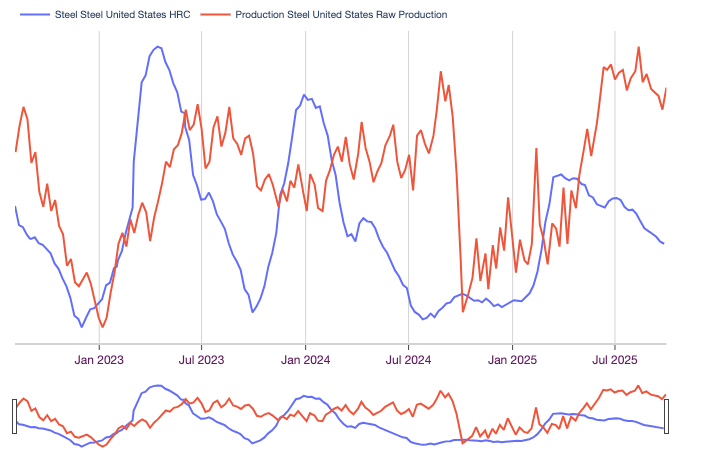
Fall maintenance outages commenced in September. Mills often use these outages to help tighten weak markets, as occurred last year. Steel prices witnessed significant declines during the first half of 2024, which triggered an over 1,500,000-ton cut before production slowly ticked upward. Prices ultimately found a bottom in anticipation of outages despite a slowdown in shipments during the final quarter.
image

Source: MetalMiner Insights, Chart & Correlation Analysis Tool

This time around, estimates suggest cuts will total less than half of what was taken offline during the fall of 2024. Most of the cutbacks will take place in October, with the final one completing in December. Thus far, data from the American Iron and Steel Institute shows only a modest downtrend in raw steel production levels, far short of the sharp drop that occurred last year.    

Steel Import Appetite Remains Low

While the volume of the planned steel cuts currently stands far short of what occurred last year, mills are likely banking on the absence of imports to help tighten the market. 
Import information for steel coming into the U.S., October 2025

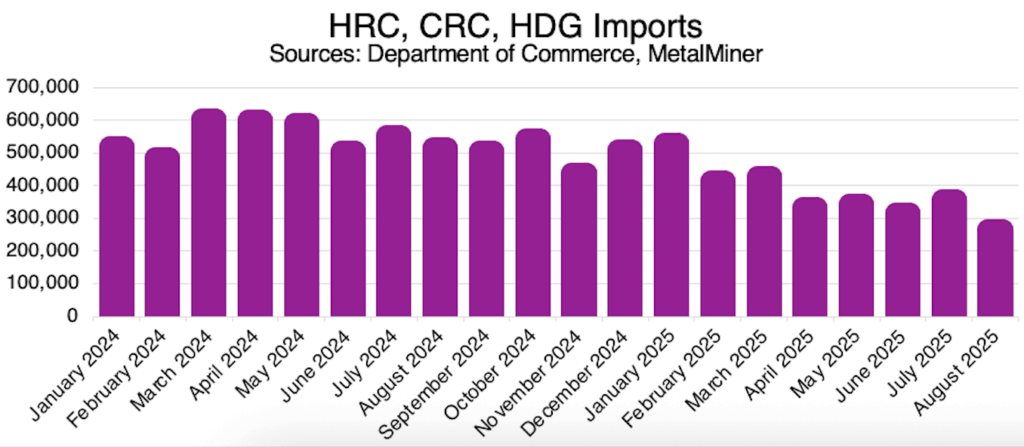
Data from the Department of Commerce shows that HRC, CRC and HDG imports to the U.S have fallen nearly 32% during the first eight months of 2025 compared to the same period of last year. This reflects a year-over-year drop of over 1.3 million tons. Preliminary import data also showed that August volumes fell to their lowest level since the Department of Commerce began reporting in 2019.

While demand conditions are decidedly soft, mills are wise to assume that the volume of output cuts necessary to regain control over the steel price trend is less significant than it would be under pre-tariff circumstances.

Low Demand Could Put Mills in a Tough Spot

All things considered, it is worth asking if this year’s maintenance outages will be enough to halt prices. For now, the bias remains to the downside. While mill lead times have held steady over the past month, demand conditions remain soft, with no rebound from the manufacturing sector. The ISM’s Manufacturing PMI remained in contraction during September, and U.S. construction spending continued to ease.

As the market heads into the end-of-year slow season, weakness from major steel-consuming sectors means that any attempt by mills to foment a strong uptrend in steel prices will likely prove difficult. However, the currently low import environment will give mills a chance to flatten out the current downtrend.

Europe Restarts Tariff Talks with U.S.

While the current outlook for offshore supply looks grim following the imposition of 50% tariffs on steel and steel products, hope is not entirely lost for buyers. The EU continues to push for a tariff rate quota agreement with the U.S. In fact, trade officials met in late September in an effort to revive the conversation. 
Steel, HRC correlation, MetalMiner 2025

Source: MetalMiner Insights, Chart & Correlation Analysis Tool

This was preceded by a meeting between German Finance Minister Lars Klingbeil and the U.S.’s Scott Bessent in early August. Ahead of the conference, Klingbeil stated, “There is talk of a quota system for steel, and it would be good if there were one…I will test out what steps the American government is prepared to take and what the solution might look like.” As with the UK, the original bilateral framework trade agreement between the EU and the U.S. left an open door for potential tariff rate deductions and/or exemptions.

Q1 Restocking Estimates Lackluster in Current Conditions

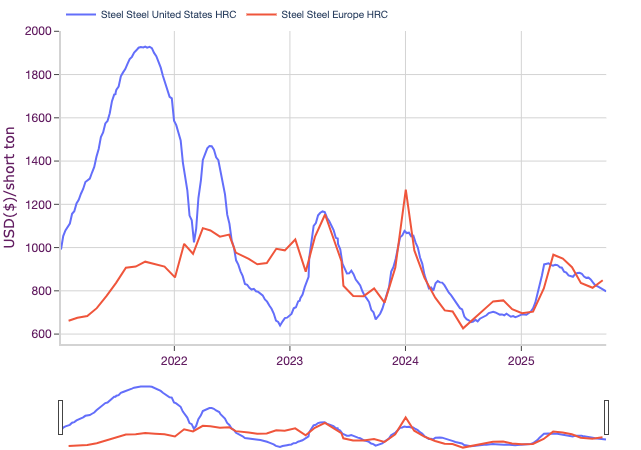
Thus far, no details have been released about the latest meeting and what, if any, progress was made. European steel prices are currently not competitive within the U.S. market. In order to become attractive to U.S. buyers, they would need to decline significantly.

Combined with soft demand, which shows no evidence of a near-term rebound, the possibility of trade shifts will likely add to buyer reluctance, even as U.S. supply conditions tighten. As a result, Q1 restocking efforts among buyers and suppliers may prove disappointing, offering yet another headwind to the steel price trend.

By Nichole Bastin


How the European Hydrogen Bank is Jump-Starting Europe’s Hydrogen Economy

  • The European Hydrogen Bank’s auction system is transforming hydrogen from ambition into action.

  • This bank awards fixed-premium subsidies to the most efficient, bankable projects.
  • Its second auction in early 2025 allocated €992 million to 15 projects out of 61 bids,
  •  expanding Europe’s committed green hydrogen capacity to over 5 GW.
\

A few years ago, clean hydrogen in Europe seemed stuck in ambition. Targets were bold, but execution was thin. That’s changing fast, thanks to a smart new mechanism that tackles one of hydrogen’s toughest challenges: bridging the cost gap between low-carbon hydrogen and fossil-derived alternatives.

Auctions that de?risk and prioritize

The European Hydrogen Bank operates via competitive auctions under the Innovation Fund. Producers bid on a fixed-premium subsidy per kilo of hydrogen for up to ten years. Only projects with credible offtake agreements and feasibly demonstrated paths to Final Investment Decision (FID) qualify. The effect: cheaply structured projects get funded, low-cost hydrogen thrives, and risk gets spread, while taxpayers get better value.

This pilot mechanism applied real pressure on project economics, and the first auction in April 2024 delivered €720?million to seven winners. Bids ranged around €0.4–0.5/kg, well below expectations, unlocking more hydrogen per euro than anticipated. That auction funded production volumes that could reach 6?GW electrolyser capacity, or around 0.7?Mt/year by 2030, almost doubling what was committed beforehand.

Second round confirms momentum, and competitive bids

The second auction in early 2025 showed the model is working. With a budget of €1.2?billion, it attracted 61 bids representing 6.3?GW of planned electrolyser capacity and over 7.3?Mt hydrogen production over ten years, four times what the budget could support. The winners, 15 projects across the EU, will receive nearly €992?million in support.

Most successful bids came from Spain (8 projects), Germany (2), the Netherlands (1), Finland (1) and Norway’s maritime corridor (3 projects). Bids in the general category clustered between €0.20–0.60/kg, while maritime-focused bids ranged €0.45–1.88/kg due to higher production or delivery complexity. If all proceed to FID, Europe’s committed green hydrogen capacity jumps from ~2.7?GW to ~5?GW, the clearest signal yet that rational scale is arriving.

Related: IEA Slashes U.S. Renewables Growth Forecast Due to Trump Policies

Why this matters: efficiency, price, impact

The Hydrogen Bank is not just offering subsidies; it is sorting the hydrogen supply chain by efficiency and credibility. Regions with the best renewable resource costs, like the Iberian Peninsula and Nordics, dominated winning bids. That ensures hydrogen comes online where it can be cheapest and most scalable.

Policymakers also introduced aftermarket rules in the second auction, such as limiting Chinese-sourced electrolyser stack content to 25% and requiring stricter timelines and bonds, ensuring projects are not only low-cost but also secure and resilient.

Case studies: real projects, real promise

For some context, let’s have a look at some of the winners;

  • Industrial hydrogen hubs in Spain, geared to supply ammonia, methanol, or transport fuel customers. These projects requested premiums as low as €0.20/kg and tied directly to buyer-side demand in chemicals and heavy transport sectors.
  • Germany and Netherlands projects, larger in scale (hundreds of ktons over 10 years), situated near existing industrial clusters, benefiting from infrastructure and local offtakers, capturing scale economies.
  • Maritime hydrogen proposals in Norway, securing higher premiums but filling niche demand from ports and green shipping corridors. Their presence underscores diverse hydrogen use cases beyond static industrial uses.

One notable analogy: Germany’s Skipavika green ammonia project (in collaboration with EnBW and FUELLA) took part in the pilot auction, securing hydrogen backing tied to ammonia exports, anchoring hydrogen imports alongside domestic production.

Building investor confidence, and the wider market

This auction model has drawn sharp attention from policymakers and industry alike. The oversubscription by a wide margin shows strong investor appetite. Importantly, the Bank’s mechanisms encourage co-financing from national funds via its Auction-as-a-Service feature, boosting support from member states like Spain, Austria and Lithuania with additional billions, still through the same competitive process.

Each project needs to reach FID within 2.5 years and start producing within five years; failure to do so risks losing the subsidy. That tight timeline ensures only mature, bankable projects make it to the finish line, cutting scope for speculative proposals.

Complementing import plans, not replacing them

While the Hydrogen Bank currently focuses on EU production, its design allows for future import auctions under the same framework, complementing domestic supply with diversified overseas renewable hydrogen. This dual pillar model balances internal scale?up with global sourcing, reinforcing energy security and competitive pricing.

By deploying subsidies via auctions, the Bank achieves four main objectives: closing the green premium gap, facilitating price discovery, de-risking projects, and leveraging private capital, all while protecting public funds through a merit-based system.

It also supports broader EU policy goals: meeting RED III mandates for renewable hydrogen supply in industry (e.g. 42.5% of industrial hydrogen by 2030), and embedding green hydrogen targets in the EU’s REPowerEU plan and Net Zero Industry Act framework.

The bottom line: hydrogen market formation in action

The Hydrogen Bank has now turned hydrogen from a vague ambition into an actionable pipeline. Through its structured auctions and clear criteria, it focuses capital and confidence on the most efficient projects in Europe: those that require minimal public support, leverage renewable energy resources well, and serve real end?user demand in transport, chemicals, ammonia, or maritime use.

The second auction's €992?million to 15 projects, the fourfold oversubscription, and the increase to over 5?GW committed capacity, all signal healthy institutional demand and market appetite. Wins in diverse member states, including Spain, Germany, the Netherlands, Finland, and Norway, confirm that hydrogen is moving from fringe pilot status into industrial reality.

Yes, volumes remain modest versus the ambition of 20?Mt/year by 2030, but this is a realistic scale-up, not hype. And, crucially, every tonne backed by the Hydrogen Bank is more likely to materialize.

By Leon Stille for Oilprice.com


U.S. REVANCHIST

Energy Shift Bolsters China's Offshore Wind Dominance

  • The US strategy to decouple from Chinese supply chains by focusing on domestic oil and gas has created economic challenges for its offshore wind industry, leading to decreased investments and project halts.

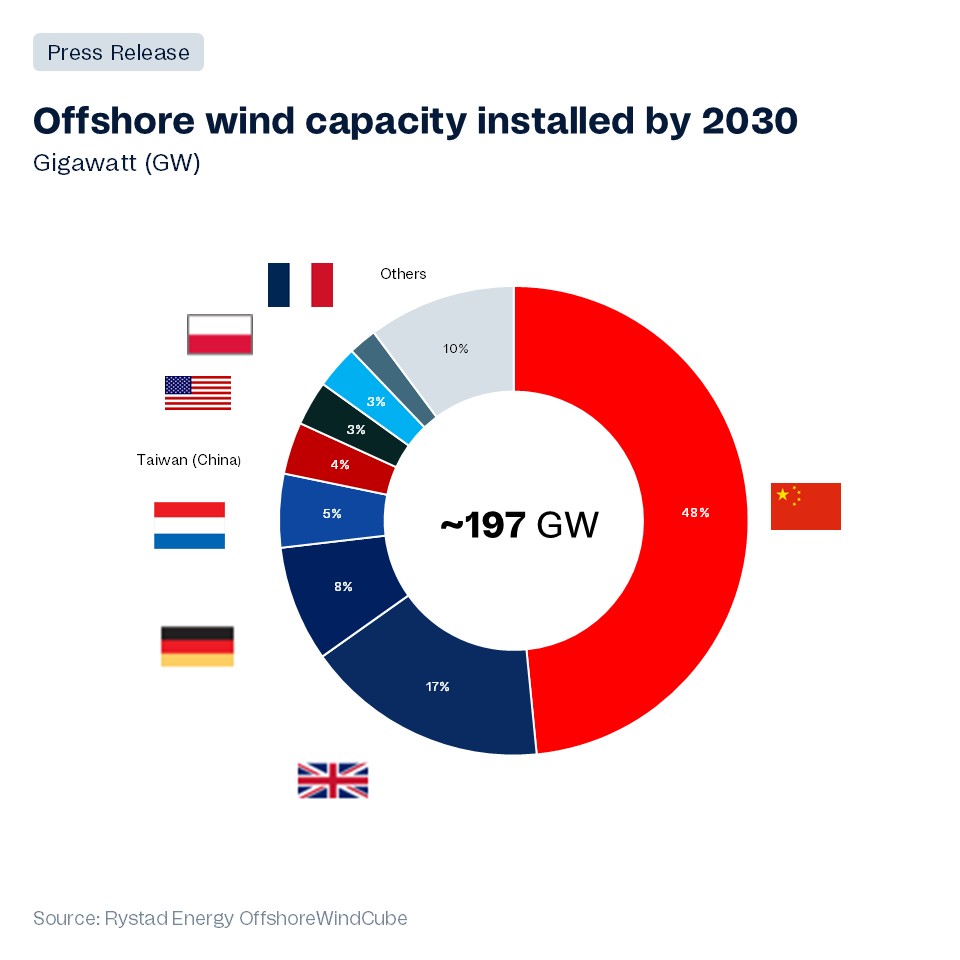
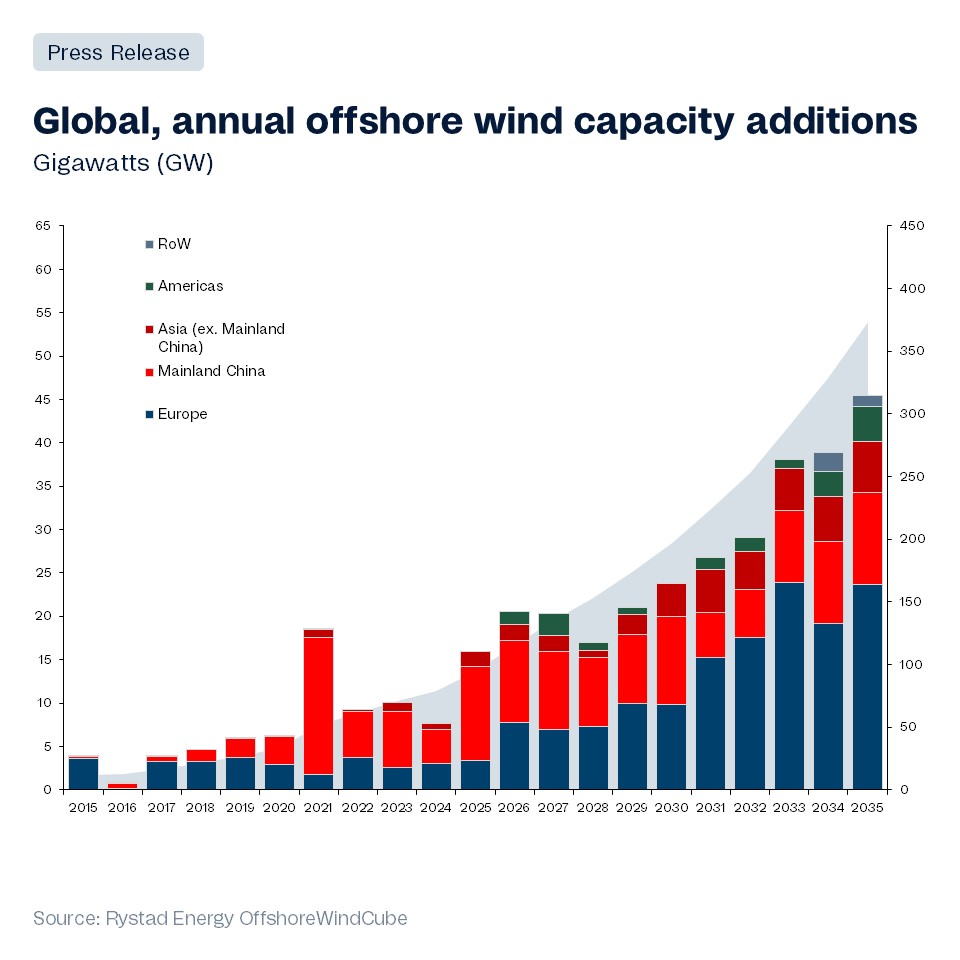
  • Despite US setbacks, global offshore wind capacity is projected to reach 16 gigawatts by 2025, with China developing two-thirds of these projects and forecasted to hold 45% of the world's cumulative capacity by 2030.

  • The shift in US energy policy is deterring European wind developers from US investment, and Western original equipment manufacturers are returning to China's favorable business environment, making it difficult for the US to compete in the long term

As the US aims to decouple from Chinese supply chains by doubling down on its domestic oil and gas resources, industries such as offshore wind have faced a barrage of economic challenges, from stop-work orders, to tax break rollbacks and rising inflationary costs. Despite unfavorable conditions in the US, Rystad Energy research shows new global offshore wind capacity will reach 16 gigawatts (GW) by the end of 2025 due to projects already underway, with two thirds of them being developed in China. By 2030, Rystad Energy forecasts China’s offshore wind projects will claim 45% of the world’s cumulative capacity, making it difficult for the US market to compete in the long term, regardless of policy reversals. 

It is now clear that the energy policy shift in the US not only halts or slows progress on offshore wind projects that were previously greenlit but pushes European wind developers away from US investment. The US-China supply chain may be decoupled, but China’s position as a global renewables leader may have only been strengthened because of it.

Alexander Fløtre, senior vice president and head of offshore wind research, Rystad Energy

Learn more with Rystad Energy’s Offshore Wind Solution.

Some clear effects are already emerging. US renewable energy investments have plunged 36% year-on-year?so far in 2025, whereas European investments are rising as companies redirect capital away from the US. Stop work orders were issued for both Orsted’s Rhode Island offshore wind development and Equinor’s New York project, with the latter reaching a deal that lifted the administration’s ban. A federal judge has reversed the order on Orsted’s Revolution project, with the question of a continued legal battle waiting to be answered. To remain attractive to investors, Orsted and companies like it must evaluate all options for offshore wind developments and their overall US presence.  

On the flipside, China-based CNOOC stated that it is staging its offshore wind portfolio expansion, with a key project in the 1.5 GW Hainan CZ7 aimed to be commissioned before 2030. The project is approved and is to be the first utility-scale project for CNOOC.?For European energy companies with less US exposure, their reliance on China and other nations will only be enhanced.  

The chances of creating an alternate, renewables-driven supply chain to compete with China are low, with Western original equipment manufacturers (OEMs) flocking back to the country’s favorable business environment after fleeing in 2020. The challenge is formidable: an analysis of turbine platforms with IEC-type certification commonly used across Europe, for example, reveals that approximately 25% of the manufacturing sites producing key components for Western OEMs are in China.  

Europe’s wind industry has taken notice, and policymakers are mobilizing to help reduce the reliance on Chinese imports and beef up the domestic wind energy supply chain. Officials hope such measures will encourage manufacturing buildouts while keeping costs in check.

Andrea Scassola, vice president of supply chain research at Rystad Energy

By Rystad Energy

SouthCoast Wind Challenges DOJ’s Delaying and Political Agenda

offshore wind turbines
The offshore wind industry continues to fight DOJ and Trump administrations efforts to end the projects (file photo)

Published Oct 7, 2025 7:17 PM by The Maritime Executive


The developers of the proposed SouthCoast offshore wind project filed their response to the Department of Justice’s efforts to derail the approved project, calling the filing “yet another example of the president’s ongoing coordinated attack on this renewable energy industry.”

The response came as the Department of Justice filed on September 18 with the U.S. District Court in the District of Columbia seeking to voluntarily remand and stay a suit by the Town of Nantucket against the Department of the Interior, the Bureau of Ocean Energy Management, and SouthCoast Wind. DOJ is asking the court to defer indefinitely the case and to remand the December 2024 Record of Decision for the project so that BOEM can reconsider the approval of the Construction and Operations Plan.

Nantucket challenged the approvals repeatedly for the project, which would provide 2.4 GW of electricity to Massachusetts and Rhode Island. The project, which would be located over 20 miles south of Nantucket and 30 miles south of Martha’s Vineyard, gained its final approvals in the last days of the Biden administration. Nantucket’s latest challenge alleges violations of the National Environmental Policy Act and the National Historic Preservation Act, largely related to the alleged visual impacts of the project on historic resources.

The Trump administration has alleged various issues and claimed the Biden administration rushed the approvals. In the response, the lawyers cite that vital energy infrastructure, of which they said SouthCoast Wind is, was covered under the FAST-41 (Fixing America’s Surface Transportation) Act adopted in 2015, which entitled it to a “streamlined and predictable review and permitting process.” They note the lease dates to 2018 and that they underwent years of rigorous review. They assert that the COP approval was valid and lawfully granted.

The response asserts that the “Federal Defendants have no genuine legal basis to reconsider the COP,” and that it is part of the administration’s “obvious disdain for offshore wind.”

They call the DOJ filing “a verbatim, copy-and-paste request,” from similar filings made in other cases challenging offshore wind. They assert the litigation tactic is made “in bad faith without legal authority.” DOJ’s assertions that the project lacks permits, they contend, is because the pending permits “have been unlawfully withheld” by the administration.

Further, they call it a delaying tactic, noting that DOJ is aware SouthCoast Wind has until December 31 to execute its Power Purchase Agreement with the states. The reconsideration, they note, is an open-ended delay. They highlight that the DOJ already filed for and received a 90-day extension before making its filing in September.

Based on the fact that the Federal Defendant has failed to “demonstrate any genuine or good-faith basis to support their remand request,” calling it instead a “pretext,” SouthCoast Wind asks the court to reject the remand request. 

If the court grants the remand, SouthCoast says judicial intervention would be required. They ask the court to limit the time of the review, to require the Federal Defendants to file biweekly status reports, and to require a monthly status conference until BOEM renders its final decision. They ask the court to require a final decision within 60 days if the court grants a remand.

It is one of several cases that the DOJ is seeking to have the courts remand. Last week, a Maryland district court rejected a filing by the DOJ to stay its case against the US Wind offshore project while the government is in shutdown. The company argued that the government could continue to undermine its project outside the court, and the judge agreed, ordering the case to proceed.


Orsted Raises $9.4 Billion in Heavily-Discounted Rights Issue

Hornsea wind farm
File image courtesy Orsted

Published Oct 7, 2025 10:04 PM by The Maritime Executive


Danish offshore wind giant Orsted has raised $9.4 billion by selling new shares to existing stockholders at a steeply discounted price. With 99 percent of the new shares sold immediately and the remaining one percent swiftly sold to the public, the firm is now on firmer financial ground as it faces market headwinds and political risk in its core markets. 

Orsted sold the shares at a price of 66 Danish kroner each ($10.30), a fraction of the stock's publicly-traded price of about 120 kroner and a third of the most recent peak, 180 kroner, reached in early August. Just five years ago, when Orsted's prospects seemed brighter and it was expanding into new markets, its stock briefly traded above 600 kroner.

The extra cash on hand will help Orsted weather a difficult period. Since the pandemic-era inflation bubble began, Orsted has been forced to write down or cancel multiple offshore wind ventures in the United States, suffering billions in losses on its balance sheet. The Trump administration has added more difficulty by pulling the plug on all future leasing and attempting to cancel development of multiple fully-permitted projects, including Orsted's nearly-complete Revolution Wind. The administration ordered the firm to halt work on the project in August, but a federal judge overturned that order and allowed construction to continue. 

The firm is adapting its structure in response to regulatory pressure in the U.S. and the deteriorating business case for offshore wind in many overseas markets. In addition to raising fresh capital from shareholders, Orsted is said to be in talks with Apollo to sell half of its giant Hornsea 3 project for more than $11 billion, bringing in more liquidity. Its management has also announced plans to retrench, reduce headcount and refocus on its core European operations.  

"The rights issue strengthens Orsted’s financial foundation, allowing us to focus on delivering our six offshore wind farms under construction, continue to handle the regulatory uncertainty in the U.S., and strengthen our position," said CEO Rasmus Errboe. 


After Tariffs, Trump Courts India With Energy and Defense Deals


  • After doubling tariffs on Indian goods to 0%, U.S. President Donald Trump is offering India expanded U.S. oil and gas supplies as part of a broader deal.

  • The move builds on the U.S.–India Comprehensive Global Strategic Partnership, which includes defense co-production, technology cooperation, and a goal to double bilateral trade to $500 billion by 2030.

  • While Washington seeks to align India against both Russia and China, New Delhi remains cautious.

U.S. President Donald Trump’s core financial strategy for ending Russia’s war in Ukraine is to starve it of oil and gas revenue. The initial focus of this from Washington’s perspective in the immediate aftermath of the 24 February 2022 invasion was to stop Europe, especially its de facto leader Germany, from continuing to import the huge quantities of cheap gas and oil that had powered its economic expansion from the late 1990s. The U.S.’s efforts at that point were broadly successful, and the pressure is now on Europe to reduce these imports to zero as soon as possible. To do so, Washington has offered Europe U.S. gas and oil as replacements, in addition to the ongoing deals with other countries that stepped in during 2022 with replacement gas and oil supplies for those lost from Russia. In recent days, U.S. Energy Secretary Chris Wright has made the same offer to India about substituting Russian energy supplies with American ones, only shortly after Washington doubled its tariffs on Indian goods to 50% on 27 August due to New Delhi’s continued importation of Moscow’s oil and gas. President Trump has also hinted at a faster rollout of the wide-ranging agreements made in February between his country and India as a further enticement to toe the line on Russia. So, will India stop buying Russian oil and gas, so putting enormous pressure on Moscow to sit down at the negotiating table over Ukraine?

Related: Saudi Arabia’s Spending Spree Meets Oil Price Reality

One element that works especially well with Europe in favour of Trump’s strategy on Russia-Ukraine, but not so well with India, is that he can legitimately highlight the absurdity of the continent continuing to bankroll Russia’s war machine with ongoing oil and gas imports. This is a war machine that is highly likely to be turned on the rest of Europe itself, should Moscow be triumphant in Ukraine. However, Russia is not likely to turn its military on India anytime soon -- indeed, relations between Moscow and New Delhi have been good for decades. During the Soviet years, India was largely reliant on Russia for the mainstay of its weaponry, as well as for sizeable imports of cheap oil and gas. These two key elements for India were also included in the extraordinary series of deals signed between the two countries in December 2021 to the great shock of the then-President Joe Biden, as fully analysed in my latest book on the new global oil market order. One of those deals centred on heightened energy cooperation, including Rosneft supplying Indian Oil with almost 15 million barrels of crude to the end of 2022. The deal took on even more significance as it was just one part of 28 investment deals between Russia and India signed during the earlier visit of Putin himself to Indian Prime Minister, Narendra Modi. These covered a broad range of subjects, including not just oil, gas, and petrochemicals, steel, and shipbuilding, but military matters too. Specifically, according to further official statements from one or both sides, Indian would produce at least 600,000 Kalashnikov assault rifles and, even more disturbing for the U.S., India’s Foreign Secretary, Harsh Vardhan Shringla, said that a 2018 contract for the S-400 air defence missile systems was in the process of being implemented. At that point, Modi said: “We have set a target of US$30 billion in trade and US$50 billion in investment [with Russia] by 2025.” In a joint statement from Russia and India around the time, it was also agreed that both leaders: “Reiterated their intention to strengthen defence cooperation, including in the joint development of production of military equipment.”

Consequently, there is nothing new about India’s oil and gas imports from Russia, nor its close military cooperation with it either, although recent events may have galvanised Washington into action. In particular, according to Russian state news agency TASS, Indian troops took part in the 12 September-16 September Russian-led ‘Zapad’ military manoeuvres, along with Belarus. These drills also included rehearsals for the use of tactical nuclear weapons for the first time. Also taking part in these manoeuvres were servicemen from several key units of the Iranian armed forces, a senior source from the European Union’s security apparatus exclusively told OilPrice.com at the time. This in turn is part of the wide-ranging 20-year comprehensive strategic cooperation deal between Iran and Russia (actually entitled, ‘The Treaty on the Basis of Mutual Relations and Principles of Cooperation between Iran and Russia’) that was agreed in January 2024 and fully ratified in all respects around a year later. It replaced the previous 10-year deal signed in March 2001 (extended twice by five years) and was expanded not only in duration but also in scope and scale, particularly in the defence and energy sectors. In several respects, the new deal complements key elements of the all-encompassing ‘Iran-China 25-Year Comprehensive Cooperation Agreement’, as first revealed anywhere in the world in my 3 September 2019 article on the subject and analysed in full in my new book on the new global oil market order.

Although Russia poses no true threat to India, China is a different matter, and a key part of the U.S.’s long-term strategy regarding New Delhi was to leverage these fears into establishing India as the regional economic and military counterbalance to Beijing. The catalysts for enhanced action by Washington in this regard came at the time of the 15 June 2020 clash between Chinese and Indian troops in the disputed territory of the Galwan Valley in the Himalayas. The U.S. believed this evidenced a new pushback strategy from India against China’s policy of seeking to increase its economic and military alliances through its multi-generational power-grab project, the ‘Belt and Road Initiative’ (BRI). The U.S. further believed that this pushback might also be echoed in India’s economic desire to finally make substantive progress on its ‘Neighbourhood First’ policy as an alternative to China’s BRI programme. However, for this to work, India would need access to secure energy sources over the long term, as it has few oil and gas sources of its own. Indeed, given the potential economic growth projections for India, the International Energy Agency (IEA) forecast that the Asian sub-continental power would constitute the biggest share of global energy demand growth at 25% in the coming two decades. In fact, the IEA predicted India would overtake the European Union as the world’s third-biggest energy consumer by 2030. It was at this point that the plan was hatched to link the plan to use India as a challenge to China as Asia’s major power to a parallel corollary objective to use the UAE (which would be used by the U.S. as a major oil provider to India) to promote further relationship normalisation deals (‘Abraham Accords’) between Israel and key Arab states in the Middle East. This plan remains in effect, but the U.S. has now added its own oil and gas supplies into the mix, as the UAE, on its own, would be unable to meet all of India’s future oil and gas requirements without Russian supplies factored into the mix.

To counter the huge and wide-ranging cooperation agreements signed between India and Russia, the U.S. has augmented its oil and gas supply offer with the enactment of several key elements of its own broad ‘India-U.S. Comprehensive Global Strategic Partnership’ plan that was sketched out in February this year during meetings between President Trump and Prime Minister Modi. One of these elements is to be formalised in a new initiative -- the ‘U.S.-India COMPACT (Catalyzing Opportunities for Military Partnership, Accelerated Commerce & Technology) for the 21st Century’. On the defence side, the two sides agreed that Washington would expand its defence sales and co-production with India to strengthen interoperability and defence industrial cooperation. On commerce, the two sides set a new goal for bilateral trade –to more than double the current figure, to US$500 billion by 2030. Making good on these, and the many moving parts of these broad agreements, is the U.S.’s next challenge in keeping India on side.

By Simon Watkins for Oilprice.com


Data Centers Lit the Fuse on the Next Nuclear Age

  • AI’s power hunger is driving a U.S. electricity boom, forcing tech giants to seek stable, low-carbon energy sources beyond intermittent renewables.

  • Nuclear power—both conventional and modular—is making a comeback.

  • Nuclear’s reliability, despite its higher cost profil,e is appealing to data centre clients.

Just five years ago, no one could predict the surge in electricity demand that the United States is currently experiencing because of the proliferation of data centers as AI takes center stage in the tech industry. Many, however, predicted that nuclear is due for a renaissance—and it is getting it, in both conventional form and, in the future, in small modular reactors.

A lot of studies have looked into the amount of energy that AI data centers consume, and while their calculations may vary, the overall conclusion does not: AI consumes enormous amounts of electricity to perform he tasks that people and companies use it for: query responses, data analysis, and so on. One study, from Cornell University, estimated the amount of energy generative AI consumes at 33 times that of task-specific software. Other studies have compared this energy to the amount of energy a whole country consumes. In short, AI needs a lot of electricity—and it must be reliable.

Big Tech has made a big deal of its green goals and ambitions, its power purchase agreements with wind and solar power capacity operators, and its plans for reducing emissions. Yet Big Tech cannot deny the fact that data centers run on baseload electricity, not solar power, because they cannot allow downtime of more than a fraction of the time—and it is a small fraction. Enter nuclear as the perfect combination of baseload and low-emission footprint.

Earlier this year, Meta signed a power supply deal with Constellation Energy, the operator of a nuclear power plant in Illinois that was supposed to be retired in 2017. Microsoft is also in a deal with Constellation Energy, for none other than the Three Mile Island nuclear plant. All Big Tech majors have a nuclear deal or two for their data centers. Yet support for nuclear is growing outside the Big Tech industry as well.

CNBC reported this week that Holtec Corporation planned to build two small modular reactors in Michigan at the site of a conventional—and operating—nuclear power plant. The local business community appears to be thrilled about it as the new facility, to be completed in the early 2030s will create jobs and give the local economy a boost. As long as they get completed, that is.

Small modular reactors have been hyped as the next level in nuclear power evolution. Cheaper, faster to get built, and as safe as a conventional reactor, SMRs have become really popular—in the media. Actual construction of a small modular reactor has stalled. One company, NuScale, began building a small nuclear reactor a while ago but had to stop when the cost swelled and investors scattered. Initially pegged at $58 per MW, the cost of the reactor rose to $89 per MW and construction stopped.

Yet NuScale made a comeback this year, after the Tennessee Valley Authority picked its small modular reactor design to build new generation capacity of as much as 6 GW across seven states. It was the largest small modular reactor deal in history, hailed as guarantee of SMR technology’s viability.

It seems there is growing eagerness for more nuclear capacity across the business community and the household community as well—because electricity costs are on the rise. Here, the finger once again points to Big Tech and its data centers. Bloomberg last month reported that the proliferation of data centers had sent wholesale electricity prices soaring across states and end-consumers are shouldering the burden. “Electricity now costs as much as 267% more for a single month than it did five years ago in areas located near significant data center activity,” the publication reported. If nuclear can bring these costs down—and it can, over the long term—then a nuclear renaissance is a no-brainer.

By Irina Slav for Oilprice.com


Leaders Calling for Unity, Innovation & a Sustainable Future for Shipping

Maritime Cyprus 2025 Conference
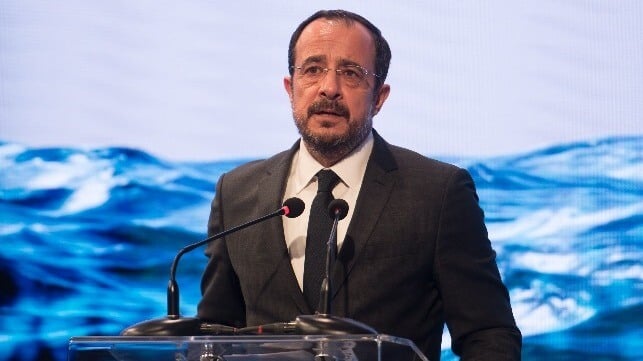
H.E. Mr. Nikos Christodoulides, President of the Republic of Cyprus, delivers his keynote address at Maritime Cyprus 2025.

Published Oct 7, 2025 10:50 PM by The Maritime Executive


[By: Maritime Cyprus 2025 Conference]

The Maritime Cyprus 2025 Conference opened today in Limassol under the main theme “Unlocking the Future of Shipping.” The event brought together more than one thousand participants from thirty-five countries, including heads of state, ministers, regulators, shipowners and senior industry figures. Organized by the Shipping Deputy Ministry, the Cyprus Union of Shipowners and the Cyprus Shipping Chamber, the three-day Conference reaffirmed Cyprus’s position as one of the world’s foremost maritime centers, and a bridge linking regional and global shipping communities.

Opening the proceedings, Dr. Stelios Himonas, Conference Chairman of the Shipping Deputy Ministry, reflected on the event’s legacy since its first edition in 1989. He described Maritime Cyprus as a forum where those who govern, regulate, innovate and navigate come together to address the sector’s most pressing challenges – from decarbonization and digitalization to geopolitical uncertainty. Dr. Himonas noted that this year’s Conference has broken participation records, demonstrating its growing influence as a platform for maritime dialogue and collaboration.

H.E. Mr. Nikos Christodoulides, President of the Republic of Cyprus, reaffirmed his government’s commitment to strengthening the competitiveness of Cyprus shipping and announced that the digitalization of services within the Shipping Deputy Ministry will officially begin next week. He highlighted a 20 per cent increase in tonnage under the Cyprus flag over the past two years – the highest level in two decades – together with a 15 per cent rise in companies registered under the tonnage-tax system and a 27 per cent increase in the ship-management sector’s contribution to national GDP. The President also confirmed Cyprus’s accession to the Hong Kong Convention for the Safe and Environmentally Sound Recycling of Ships, strengthening the country’s commitment to sustainability. Looking ahead to Cyprus’s forthcoming Presidency of the Council of the European Union, he said maritime competitiveness and sustainable growth would be central to the national agenda.

Ms. Marina Hadjimanolis, Shipping Deputy Minister to the President of the Republic of Cyprus, welcomed delegates to “the capital of shipping” and thanked international counterparts from Greece, Qatar, and Bahrain for their participation. She stressed that Cyprus shipping is defined not only by its fleet but by its people – the professionals who drive the sector forward – and emphasized that collaboration between the public and private sectors has been key to Cyprus’s success. She encouraged delegates to innovate, collaborate, and invest in the future of shipping so that the industry remains competitive and resilient in the years ahead.

H.E. Mr. Arsenio Dominguez, Secretary-General of the International Maritime Organization, praised Cyprus for its strong alignment with IMO regulations, its green incentives and its leadership in digitalization. He urged the international community to pursue a just and equitable transition in shipping and to work collectively to achieve the IMO’s long-term decarbonization objectives. Mr. Dominguez highlighted ongoing initiatives to enhance safety, seafarer welfare, and mental-health awareness, as well as announcing the forthcoming Global Digital Strategy for Shipping, which will guide the sector’s transition toward greater automation and trade facilitation.

H.E. Mr. Apostolos Tzitzikostas, European Commissioner for Sustainable Transport and Tourism, offered a European perspective on competitiveness and sustainability. He underlined the need to balance environmental ambition with economic reality, confirming that during the Cyprus EU Presidency the Commission will present both a European Industrial Maritime Strategy and a European Port Strategy aimed at promoting innovation, fair competition, clean technologies and the development of ports as energy hubs for offshore wind and hydrogen. He also announced a Sustainable Investment Plan to accelerate the production and use of alternative fuels for transport. Describing Cyprus as “a global maritime force,” he expressed confidence that the country will play a defining role in shaping Europe’s maritime future.

A special ministerial panel, “Ministers at the Helm of Maritime Transformation,” expanded the day’s discussions to a regional level. Moderated by Ms. Souzana Psara, Business and Finance Reporter at Cyprus Mail, the panel brought together Dr. Sheikh Abdullah bin Ahmed Al Khalifa, Minister of Transportation and Telecommunications of the Kingdom of Bahrain; Mr. Vasilis Kikilias, Minister of Maritime Affairs and Insular Policy of Greece; Mr. Sheikh Mohammed bin Abdullah bin Mohammed Al Thani, Minister of Transport of the State of Qatar; and Ms. Marina Hadjimanolis, Shipping Deputy Minister to the President of the Republic of Cyprus. The discussion focused on policy coordination, investment in human capital, and innovation as essential drivers of maritime transformation. The Ministers called for stronger regional cooperation on safety, efficiency, and digitalization, agreeing that global challenges such as decarbonization and seafarer shortages can only be addressed through collective action. Mr. Kikilias stressed that Europe must act pragmatically to maintain competitiveness with other major economies, while Ms. Hadjimanolis underscored the need for inclusivity and mutual understanding in maritime decision-making, stating that Ministers must “decide with the industry, not for it.”

The first industry panel of the day, “Navigating Disruption: Steering the Shipping Industry Through Global Turbulences,” moderated by Mr Thomas A. Kazakos, Secretary General of the International Chamber of Shipping, examined how shipowners and policymakers are responding to shifting market, regulatory, and geopolitical pressures. Mr. Themis Papadopoulos Ex-Vice Chairman of the International Chamber of Shipping, Ms. Karin Orsel, President of ECSA, Ms. Ioanna Procopiou, President Designate of BIMCO, and Mr. Joe Kramek, President and CEO of the World Shipping Council, highlighted the need for a single global regulatory framework under the IMO to prevent overlapping regional schemes. Speakers urged regulators to reinvest revenues from carbon measures into decarbonization projects and to prioritize achievable, technology-neutral solutions. Ms. Procopiou warned that penalizing early adopters of LNG-fueled vessels “sends the wrong signal” to innovators, while Mr. Kramek stressed that “investment capital likes opportunity, but it also likes certainty.” The panel closed with consensus that data-led efficiency and investment in people remain central to building industry resilience.

The final discussion of the day, “Navigating Changes: Shipowners’ Insights on Industry Evolution,” brought together leading shipowners from Greece and Cyprus for a candid exchange on the future of shipping. Moderated by Mr. George Mouskas, President of Olympia Ocean Carriers Ltd., the panel featured Mr. George Procopiou, Chairman of Dynacom Tankers Management Ltd.; Mr. Thanassis Martinos, Managing Director at Eastern Mediterranean Maritime Ltd.; Ms. Semiramis Paliou, CEO of Diana Shipping Inc.; Mr Andreas Hadjiyannis, CEO of Cyprus Sea Lines/Hellenic Tankers; and Dr. John Coustas, President & CEO at Danaos Corporation. The shipowners voiced strong support for decarbonization but warned that the current pace of regulation risks prioritizing taxation over real progress. Mr. Procopiou called for “doable, not desirable” measures, including slower steaming, carbon capture, and greater technical efficiency, while Ms. Paliou emphasized that shipping’s share of global emissions remains small and that excessive costs will ultimately reach consumers. Dr. Coustas cautioned that regional measures such as the EU Emissions Trading System threaten competitiveness and urged closer consultation between the IMO and industry. Mr. Martinos criticized the EU’s framework as “unfair and disruptive,” arguing that it penalizes ships for voyage segments outside European waters.

Adding a national policy perspective, Mr. Giorgos Papanastasiou, Minister of Energy, Commerce and Industry of Cyprus, addressed the panel to draw parallels between maritime and energy policy. He noted that Europe’s Green Deal, while well-intentioned, has at times advanced faster than technological capability, impacting competitiveness across industries. He argued that Europe must retain all available energy options, including oil, gas, renewables, nuclear, and coal, to ensure affordability and energy security. “Energy and competitiveness go hand in hand,” he said, warning that transitions made without viable alternatives risk deepening inequality. His remarks were widely welcomed by the panel as a realistic and inclusive approach to the challenges ahead.

The opening day also saw the presentation of the Cyprus Maritime Awards 2025, celebrating excellence and contribution to the national shipping industry. The Cyprus Maritime Personality Award 2025 was presented to Dr. John Coustas, President & CEO of Danaos Shipping Company for his outstanding contribution to global shipping and his long-standing support for the Cyprus Ship Registry. The Cyprus Shipping Industry Award 2025 was presented to MSC Shipmanagement Ltd. in recognition of its role in the growth of Cyprus’s maritime cluster and national economy. The award was accepted by Mr. Prabhat Kumar Jha, Managing Director & CEO of MSC Shipmanagement Limited, who dedicated the honor to MSC’s seafarers, shore teams and the Aponte family, founders of the MSC Group.

Day Two of Maritime Cyprus 2025 will continue with sessions examining P&I markets, shipowner perspectives, the charterers’ outlook and innovation through youth engagement.

The products and services herein described in this press release are not endorsed by The Maritime Executive.