Monday, October 20, 2025

MAKE ARGENTINA GREAT AGAIN

Trump suggests U.S. will buy Argentinian beef to bring down prices for American consumers

FIRST SOYBEANS NOW BEEF

By The Associated Press
October 20, 2025 

President Donald Trump speaks to reporters aboard Air Force One, Sunday, Oct. 19, 2025, en route to Joint Base Andrews, Md., as he returns from a trip to Florida. (AP Photo/Mark Schiefelbein)

ABOARD AIR FORCE ONE — U.S. President Donald Trump said Sunday that the United States could purchase Argentinian beef in an attempt to bring down prices for American consumers.

“We would buy some beef from Argentina,” he told reporters aboard Air Force One during a flight from Florida to Washington. “If we do that, that will bring our beef prices down.”

Trump promised earlier this week to address the issue as part of his efforts to keep inflation in check.

U.S. beef prices have been stubbornly high for a variety of reasons, including drought and reduced imports from Mexico due to a flesh-eating pest in cattle herds there.

Trump has been working to help Argentina bolster its collapsing currency with a US$20 billion credit swap line and additional financing from sovereign funds and the private sector ahead of midterm elections for his close ally, President Javier Milei.

Christopher Megerian, The Associated Press
Canada ‘not yet’ a reliable energy supplier, says Indian high commissioner

SO INDIA PREFERS YANKEE OIL/GAS

By Spencer Van Dyk
Published: October 19, 2025 

Amid efforts to rebuild the long-fraught relationship with India, that country’s new high commissioner says Canada is “not yet” a reliable supplier of conventional energy, namely oil and gas.

The diplomatic relationship between Canada and India soured more than two years ago, when former prime minister Justin Trudeau said there were “credible allegations” that agents of the Indian government were involved in the murder of a Sikh activist in British Columbia.

A year later, the RCMP alleged the issue was more widespread, claiming Indian diplomats in Canada were involved in serious crimes targeting South Asian Canadians and putting their public safety at risk.

The federal government subsequently expelled a number of Indian diplomats, a move to which India responded in kind.

India, meanwhile, rejected the accusations as politically motivated, and negotiations for a free trade deal were indefinitely put on pause in the ensuing diplomatic clash.

The relationship shifted this summer when Prime Minister Mark Carney invited Indian Prime Minister Narendra Modi to the G7 summit in Kananaskis, Alta., in June. Foreign Affairs Minister Anita Anand met again with Modi during a trip to India this week, after which both countries released a statement expressing support for more trade.

U.S. President Donald Trump, meanwhile, encouraged Modi this week to limit the amount of oil his country imports from Russia, in a bid to pressure Moscow to negotiate an end to its war on Ukraine.

In an exclusive interview airing Sunday on CTV Question Period, host Vassy Kapelos asked India’s new high commissioner to Canada, Dinesh Patnaik, whether India would turn to Canada as an energy supplier in lieu of Russia.

“A country of that size is going to consume everything, not just energy, food, you name it, anything in the world, we are going to be the largest consumer in the world,” Patnaik said, pointing to India’s large population and growing economy.

“So, we look for suppliers where they can be a reliable supplier,” he added. “Not a supplier who today says, ‘Okay, I’m going to supply you,’ and tomorrow says, ‘No, I have this problem with you, I cannot supply you.’”

When asked whether he would consider Canada reliable in that vein, Patnaik said: “not yet.”

Patnaik said that despite past disagreements, India wants Canada to be a reliable partner, and believes it could be.

He also said, however, that India doesn’t want “extraneous factors to economic activities” — seemingly referencing the diplomatic dispute that followed RCMP allegations last year that agents of the Indian government were involved in threatening and violent acts on Canadian soil, including murder — to deter economic cooperation.

“Now the political influence can become a negative influence on economics, which we have seen, always,” Patnaik told Kapelos. “So, our work is to make sure that the economic relationship is firewalled from extraneous forces which try to derail them.”

Speaking to reporters from India this week, Anand also said many of her conversations with Indian officials included “an interest in Canadian energy.”

“As you know, our prime minister has repeatedly reiterated that there will be work in Canada as we augment to an energy superpower,” she said on Tuesday. “This is well recognized in India. There’s great interest in Canadian energy, and we will continue to see interaction along that line, well as the others that I mentioned.”


Energy Minister Tim Hodgson was also abroad this week, telling reporters from the U.K. on Thursday that “the world is looking to increase access to Canadian conventional energy.”

He said Canada is viewed internationally as a “very reliable supplier” of energy.
Will Canada and India ink a formal trade pact?

Asked by Kapelos whether India is prepared to resume negotiations on a free trade deal — which has been abandoned for more than two years — Patnaik insisted it’s up to Canada.

“If Canada is ready to sign a free trade deal with us, we’ll be more than happy to work with Canada,” he said. “But it is the Canadians who paused it. It’s for the Canadians to restart it.”

The high commissioner said both countries also need to rebuild trust, after the “preposterous and absurd” allegations levelled by the former prime minister and the RCMP, which Patnaik insists are “in the past.”

Anand was also asked about the possibility of a formalized free trade pact.

“There is a significant level of economic interaction between the Canadian and the Indian economy,” she said. “A free trade negotiation and process would augment already strong economic ties with a framework, but the joint declaration that we finalized is meant to be the initial phases of a broader economic framework.”

With files from CTV News’ Stephanie Ha
Spencer Van Dyk

Writer & Producer, Ottawa News Bureau, CTV News
Big Tech is paying millions to train teachers on AI, in a push to bring chatbots into classrooms

By The Associated Press
Updated: October 20, 2025 

Northside American Federation of Teachers President Melina Espiritu-Azocar, right, speaks with middle school teacher Celeste Simone during a Microsoft AI skilling event, Saturday, Sept. 27, 2025, in San Antonio. (AP Photo/Darren Abate)

On a scorching hot Saturday in San Antonio, dozens of teachers traded a day off for a glimpse of the future. The topic of the day’s workshop: enhancing instruction with artificial intelligence.

After marveling as AI graded classwork instantly and turned lesson plans into podcasts or online storybooks, one high school English teacher raised a concern that was on the minds of many: “Are we going to be replaced with AI?”

That remains to be seen. But for the nation’s 4 million teachers to stay relevant and help students use the technology wisely, teachers unions have forged an unlikely partnership with the world’s largest technology companies. The two groups don’t always see eye to eye but say they share a common goal: training the future workforce of America.

Microsoft, OpenAI and Anthropic are providing millions of dollars for AI training to the American Federation of Teachers, the country’s second-largest teachers union. In exchange, the tech companies have an opportunity to make inroads into schools and win over students in the race for AI dominance.

AFT President Randi Weingarten said skepticism guided her negotiations, but the tech industry has something schools lack: deep pockets.


“There is no one else who is helping us with this. That’s why we felt we needed to work with the largest corporations in the world,” Weingarten said. “We went to them — they didn’t come to us.”

Weingarten first met with Microsoft President and Vice Chairman Brad Smith in 2023 to discuss a partnership. She later reached out to OpenAI to pursue an “agnostic” approach that means any company’s AI tools could be used in a training session.

Under the arrangement announced in July, Microsoft is contributing $12.5 million to AFT over five years. OpenAI is providing $8 million in funding and $2 million in technical resources, and Anthropic has offered $500,000.

Tech money will build an AI training hub for teachers

With the money, AFT is planning to build an AI training hub in New York City that will offer virtual and in-person workshops for teachers. The goal is to open at least two more hubs and train 400,000 teachers over the next five years.

The National Education Association, the country’s largest teachers union, announced its own partnership with Microsoft last month. The company has provided a $325,000 grant to help the NEA develop AI trainings in the form of “microcredentials” — online trainings open to the union’s 3 million members, said Daaiyah Bilal, NEA’s senior director of education policy. The goal is to train at least 10,000 members this school year.

“We tailored our partnership very surgically,” Bilal said. “We are very mindful of what a technology company stands to gain by spreading information about the products they develop.”

Both unions set similar terms: Educators, not the private funders, would design and lead trainings that include AI tools from multiple companies. The unions own the intellectual property for the trainings, which cover safety and privacy concerns alongside AI skills.

The Trump administration has encouraged the private investment, recently creating an AI Education Task Force as part of an effort to achieve “global dominance in artificial intelligence.” The federal government urged tech companies and other organizations to foot the bill. So far, more than 100 companies have signed up.

Tech companies see opportunities in education beyond training teachers. Microsoft unveiled a $4 billion initiative for AI training, research and the gifting of its AI tools to teachers and students. It includes the AFT grant and a program that will give all school districts and community colleges in Washington, Microsoft’s home state, free access to Microsoft CoPilot tools. Google says it will commit $1 billion for AI education and job training programs, including free access to its Gemini for Education platform for U.S. high schools.

Several recent studies have found that AI use in schools is rapidly increasing but training and guidance are lagging.


The industry offers resources that can help scale AI literacy efforts quickly. But educators should ensure any partnership focuses on what’s best for teachers and students, said Robin Lake, director of the Center on Reinventing Public Education.

“These are private initiatives, and they are run by companies that have a stake,” Lake said.

Microsoft’s Brad Smith agrees that teachers should have a “healthy dose of skepticism” about the role of tech companies.

“While it’s easy to see the benefits right now, we should always be mindful of the potential for unintended consequences,” Smith said in an interview, pointing to concerns such as AI’s possible impact on critical thinking. “We have to be careful. It’s early days.”

Teachers see new possibilities

At the San Antonio AFT training, about 50 educators turned up for the three-hour workshop for teachers in the Northside Independent School District. It is the city’s largest, employing about 7,000 teachers.

The day started with a pep talk.

“We all know, when we talk about AI, teachers say, ‘Nah, I’m not doing that,’” trainer Kathleen Torregrossa told the room. “But we are preparing kids for the future. That is our primary job. And AI, like it or not, is part of our world.”

Attendees generated lesson plans using ChatGPT, Google’s Gemini, Microsoft CoPilot and two AI tools designed for schools, Khanmingo and ColorĂ­n Colorado.

Gabriela Aguirre, a 1st grade dual language teacher, repeatedly used the word “amazing” to describe what she saw.

“It can save you so much time,” she said, and add visual flair to lessons. She walked away with a plan to use AI tools to make illustrated flashcards in English and Spanish to teach vocabulary.

“With all the video games, the cellphones you have to compete against, the kids are always saying, ‘I’m bored.’ Everything is boring,” Aguirre said. “If you can find ways to engage them with new technology, you’ve just got to do that.”

Middle school teacher Celeste Simone said there is no turning back to how she taught before.

As a teacher for English language learners, Simone can now ask AI tools to generate pictures alongside vocabulary words and create illustrated storybooks that use students’ names as characters. She can take a difficult reading passage and ask a chatbot to translate it into Spanish, Pashto or other languages. And she can ask AI to rewrite difficult passages at any grade level to match her students’ reading levels. All in a matter of seconds.

“I can give my students access to things that never existed before,” Simone said. “As a teacher, once you’ve used it and see how helpful it is, I don’t think I could go back to the way I did things before.”

____

The Associated Press’ education coverage receives financial support from multiple private foundations. AP is solely responsible for all content. Find AP’s standards for working with philanthropies, a list of supporters and funded coverage areas at AP.org. ___

This story was first published on Oct 17, 2025. It was re-published on Oct. 20, 2025, to show Brad Smith is the president and vice chairman of Microsoft, not the CEO.

Jocelyn Gecker, The Associated Press

British Columbia proposes new power rules for AI, data centres


By The Canadian Press
October 20, 2025 

Minister of Energy and Climate Solutions, Adrian Dix speaks during a press conference in Vancouver, B.C., Monday, July 28, 2025. THE CANADIAN PRESS/Ethan Cairns

VICTORIA, BC — British Columbia’s government is proposing changes to its energy rules that would force companies from certain industries to fight for access to a set amount of power.

Rather than the current first-come, first-service structure, the government says the new policy would prioritize natural resource and manufacturing projects, while artificial intelligence, data centres and hydrogen-for-export projects would have to bid for their power.

The changes tabled by Energy Minister Adrian Dix on Monday would also make the current ban on cryptocurrency connections permanent.

The competitive process for AI and data centres is expected to be launched in January with 300 megawatts of power for AI and 100 megawatts for data centres available every two years.

“The allocation framework allows for the paced growth of these sectors and avoids mistakes we’ve seen in other jurisdictions where growth has outpaced infrastructure, resulting in higher costs for everyday residential customers,” Dix told reporters Monday.


“We won’t make that mistake. We will prioritize the projects that provide the best, greatest benefit to British Columbians.”

The legislative changes would also enable the expedited construction of the North Coast Transmission Line, which has an updated price tag of $6 billion for the first two phases.

The estimated cost of the transmission line in 2023 was $3 billion and was expected to take eight to 10 years to build.

Dix said building the transmission line, which is initially expected to run between Prince George and Terrace, is a necessary step to support potential future mining projects in the area.

Michael Goehring, president of the Mining Association of British Columbia, told the news conference there are a number of critical mineral and precious metal mines proposed in the regions.

“At a tenuous time for our economy and our nation, the North Coast Transmission Line will strengthen Canada’s position as a leading global supplier of critical minerals and metals, and unlock more than $45 billion in near-term economic activity from mine construction for British Columbia and for all Canadians,” he said.

The provincial government is directing the B.C. Utilities Commission to issue a certificate of public convenience and public necessity for the project, a process that would normally require public hearings.

Premier David Eby said that he stands by the decision.

The process of the utilities commission’s hearing is to determine whether the transmission line is in the public interest and that would add months or even a year to the timeline, Eby said.

“We are making the decision as a government that this is in the public interest. We will be held accountable for that decision by voters. But to my mind, there is no debate about this.”

Eby said the transmission line will open up economic development in a region of the province that has not seen the same prosperity as other areas because it hasn’t had access to high voltage electricity that drives economic development.

Construction of the line 450-kilometre line is expected to start next year.

A statement from the province said that once operational, the transmission line is expected to create approximately 9,700 direct full-time jobs and contribute nearly $10 billion per year to GDP.

Eby said his government is “engaging with conversations” with Ottawa to get federal support for the project.

“This line, at its full extension, will go all the way up to the Yukon, will assist with northern sovereignty issues, defence concerns that have been raised by the Yukon. This line is the Yukon’s number 1 priority as well. And so, our partnership with the federal government will help protect ratepayers,” he said.

This report by Ashley Joannou, The Canadian Press, was first published Oct. 20, 2025

Business confidence still weak as tariffs hold back investment: BoC

That report showed two-thirds of Canadians are expecting a recession – “a much larger share than before the (trade) conflict began”


By The Canadian Press
Updated: October 20, 2025
A cyclist rides past the Bank of Canada in Ottawa, Wednesday, Sept. 17, 2025. 
THE CANADIAN PRESS/Adrian Wyld

The Bank of Canada’s survey of businesses shows confidence across the country is still weak thanks largely to persistent trade uncertainty from the United States.

The central bank’s quarterly business outlook survey released Monday shows tariffs and lingering questions about the trade dispute are still holding many firms back from investing in their operations and expanding payrolls.

The Bank of Canada summarizes answers from its survey into a single indicator of business confidence and sales expectations. This measure improved marginally from the second quarter of the year – when the U.S. tariff campaign took full force – but was still well below historical averages.

Uncertainty remains the top concern cited among Canadian businesses, though relatively fewer are reporting worries about financial, economic and political conditions from the previous quarter. Cost pressures, slowing demand and taxes and regulations round out the top four concerns pressing businesses in the third quarter.

Firms are spending more on routine maintenance rather than growing their businesses, the survey reported.

Most exporters report their goods are still entering the U.S. tariff-free, but firms in the steel and aluminum industries are expressing doubt that overseas markets can offset the hit from higher duties in the U.S. market.

“Although some exports of primary aluminum have been redirected to Europe, these exporters view this strategy as an unsustainable alternative to U.S. market access because of concerns about long-term profitability,” the business outlook survey said.

Business in Saskatchewan also told the Bank of Canada that Chinese tariffs on canola and other agricultural products are weighing on their investment plans.

The survey showed nearly a third of businesses are now expecting a recession to hit Canada, up five percentage points from the last survey.


The Bank of Canada also released its related quarter survey of consumers on Monday showing tariffs are still weighing on Canadians’ finances.

That report showed two-thirds of Canadians are expecting a recession – “a much larger share than before the (trade) conflict began” – though most households feel their own financial health has improved from the previous quarter.

Businesses were reporting stronger consumer spending patterns compared to sharp lows at the beginning of the year. Lower interest rates from the Bank of Canada, cheaper gas prices and still-strong “Buy Canadian” demand was helping to offset lower sales from economic uncertainty, that survey reported.

The Bank of Canada’s overall consumer indicator improved in the third quarter but, like the measure for businesses, remains well below historical averages.

Dragging down this indicator was deteriorating confidence in the labour market.

Public sector workers reported a lower probability of leaving or finding a new job, which the report said could be linked to the federal government’s cost-cutting review.

The surveys which gauge business and consumer health come ahead of the Bank of Canada’s next interest rate decision set for Oct. 29.


This report by The Canadian Press was first published Oct. 20, 2025.

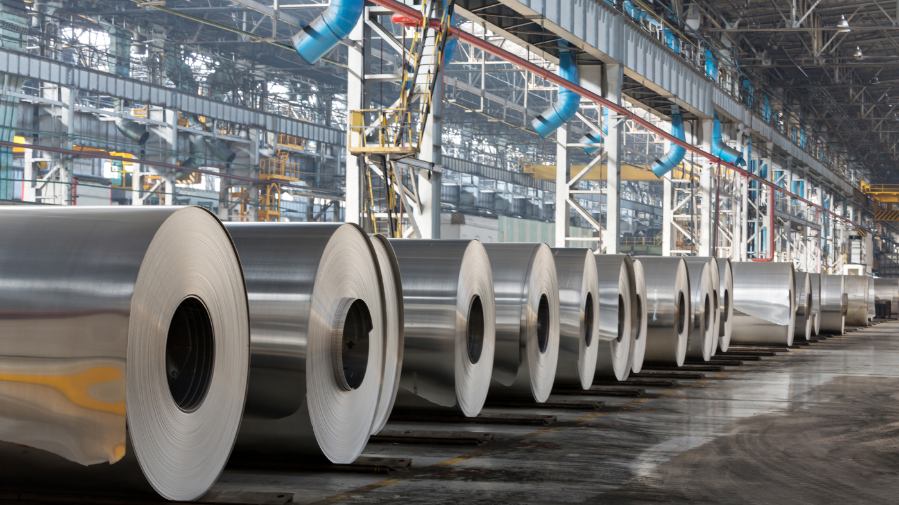
Canada offers tariff relief to some steel, aluminum products from US, China

Stock image.

Canada offered tariff relief on some steel and aluminum products imported from the US and China, a government document showed, in efforts to help domestic businesses battered by a trade war on two fronts.

Prime Minister Mark Carney is negotiating with US President Donald Trump, who imposed tariffs on Canadian steel and aluminum. His team also met with Chinese counterparts last week in an effort to secure relief on Chinese tariffs on Canadian agricultural goods.

Canada’s economy has come under strain as the impact of tariffs on Canadian exports to the US and China has taken a toll. Carney has rolled back many of the retaliatory tariffs his predecessor imposed on US imports as he tries to strike a deal with Trump.

In an amendment to the surtax remission order of 2024 on Chinese imports, the Ministry of Finance granted remission on some steel and aluminum varieties imported from China that are not produced in Canada, a document issued on Friday showed.

The order came into effect on October 15 and more details regarding the remission order will be published on November 5, the ministry’s communication to the industry showed.

The ministry also exempted from tariffs some US steel and aluminum products primarily linked to public health, national security, manufacturing, agriculture and food packaging, the document said.

“The remission process is to protect people who are in the downstream sector … to deal with exceptional circumstances,” Finance Minister François-Philippe Champagne said in remarks to reporters on Monday.

He said these were a group of very specific products that are needed to enter Canada to maintain the supply chains and will not impact much in terms of how much counter-tariffs are being collected.

(By Promit Mukherjee and Divya Rajagopal; Editing by Mark Porter)


U.S. tariffs could ‘put us over the edge,’ says Canadian steel group

By Robin Della Corte
 October 19, 2025 

Workers inspect sheets of stainless steel after being pressed from coils, at Magna Stainless and Aluminum in Montreal on Thursday, Sept. 18, 2025. THE CANADIAN PRESS/Christopher Katsarov (Christopher Katsarov/The Canadian Press)

An industry leader from the Canadian Institute of Steel Construction says a plan is needed to confront the impacts of U.S. trade actions on Canadian steel and aluminum.

In March, the U.S. placed a 25 per cent tariff on Canadian steel and aluminum, with Canada then enforcing a 25 per cent retaliatory tariff on American steel.

The U.S. doubled its tariffs on Canadian steel and aluminum to 50 per cent in June.

Canada also has a 25 per cent tariff on Chinese steel and aluminum.

Recently, the federal government announced that some steel and aluminum from China and the U.S. would be exempt from Canadian tariffs.


Keanin Loomis, president and CEO of the Canadian Institute of Steel Construction, says with anxiety and fear of job losses in the industry, retaliation is important.

“We do have to stay strong and certainly exact as much pain as we can from the United States on this, but certainty we need a plan,” Loomis told CTV News Channel on Sunday.

“We need to have a real focus on domestic procurement while we’re trying to maintain our access to the U.S. markets. We need to know that projects that are being done here, infrastructure dollars that are being spent here, especially taxpayer dollars that are being spent here, are using Canadian fabricators and Canadian steel to the best extent possible.”

In May, federal Industry Minister MĂ©lanie Joly wrote in a post on X that Canada is fighting the current tariffs with retaliatory ones, stating: “Our steel and aluminum workers and businesses deserve no less than our full commitment.”

Loomis says the impacts of the U.S. tariffs on Canadian steel and aluminum have been felt in the industry.

“I know that many of the steel producers in Canada have been really adamant to not lay off parts of their workforce, and thus far, we haven’t seen a lot,” he said. “But this might be the thing that puts us over the edge and calls into question the short to mid-term sustainability of our operations.”

Loomis says he is continuing to talk to U.S. counterparts, but the change will have to come from the U.S.

“Many (Americans) do not agree with this,” he said. “Everybody in the U.S. knows that tariffs are attacks, (and) really only a couple entities, these are steel producers in the U.S. who have outsized influence with the Trump administration, ... are going to be benefitting from this, at the expense of the rest of the U.S. and Canadian economy.”

“The change is going to come from the inside. It’s hard for us as Canada to exert the type of pressure that we need, but (we can) help Americans wake up to the fact that this is punishing them as much as it is us.”


Robin Della Corte
CTVNews.ca Journalist


Robert Friedland says global economy faces copper crisis


Robert Friedland in 2014 at the site of the initial Kamoa discovery. (Image: Govind Friedland via CEO.ca)

Global demand for copper is accelerating toward levels that could outstrip supply within two decades, creating what industry veteran Robert Friedland calls a once-in-history challenge for the world economy.

Over the next 18 years, he warns, humanity will need to mine as much copper as it has over the past 10,000 years combined to sustain even modest economic growth.

Friedland’s message, repeated over years of public appearances, has proven prescient. “This is the revenge of the old economy,” he said in 2021. “For two decades, not enough capital has gone into finding the metals we need for the energy transformation.”

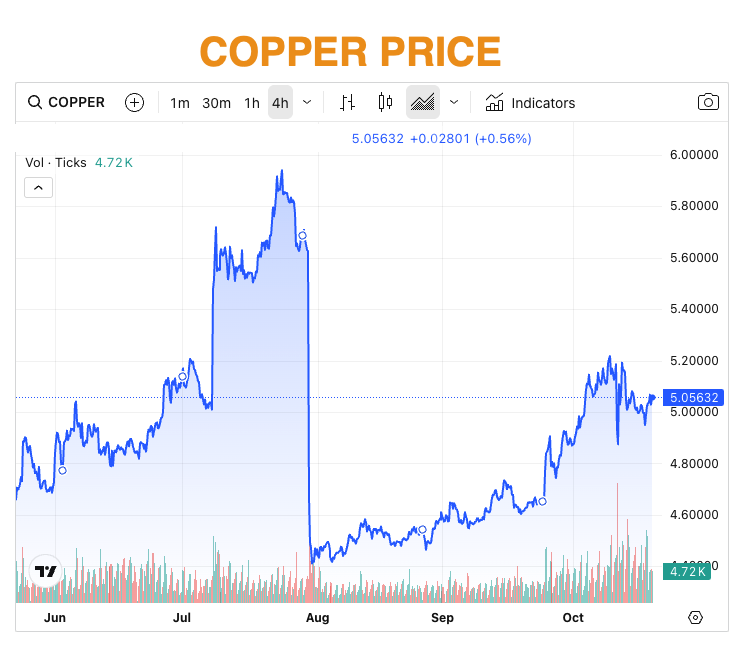
Copper, he argues, lies at the centre of both economic growth and national security. Used in everything from electric grids to military hardware, it has become the lifeblood of modern industry. As of October 2025, copper trades at over $5.00 per pound — roughly $11,000 per tonne — marking a 55% increase from just five years ago.

The economics of scarcity

Despite the rally, current prices remain far below what the industry needs to stimulate new production. Friedland predicts copper must reach $15,000 per tonne to justify the immense capital costs of building new mines. “Nine thousand dollars a tonne is not enough to take the risk,” he said in late 2023.

The gap between rising demand and limited supply poses an existential challenge. At today’s consumption rates, roughly 700 million tonnes of copper mined throughout history will need to be matched again by 2043 just to sustain 3.5% annual GDP growth, according to S&P Global.

Strategic imperatives

Copper’s importance extends far beyond economics. Friedland highlights its strategic role in national defense, pointing to US military concerns over shortages of 155-millimetre howitzer (type of artillery weapon) shells. “If somebody’s pointing a gun at you, you need that copper to shoot back,” he said earlier this year.

That urgency is driving calls for a renaissance in US copper mining, an industry that has seen virtually no new development in generations. Dependence on foreign sources now threatens both supply stability and security.

Policy and political shifts

Friedland credits recent US administrations, particularly under current President Donald Trump, for recognizing the need to secure raw materials domestically. “Speaking as a miner, we see a lot more government support,” he noted. “The new administration is correctly focused on making sure the world’s largest economy has stable access to raw materials at the scale of that economy.”

As copper prices climb toward his long-term projections, investors and policymakers are watching closely. Friedland describes the situation as a “powder keg ready to explode”, adding that copper demand is “essentially infinite” because “there is no rational price for something you absolutely must have.”


GIT Coatings Opens New Global Headquarters & Flagship Operations in Canada

GIT Coatings
GIT Coatings Opening

Published Oct 20, 2025 4:00 PM by The Maritime Executive


[By: GIT Coatings]

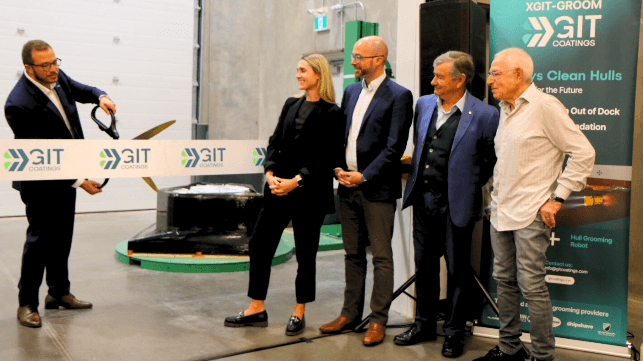
GIT Coatings (Graphite Innovation & Technologies Inc.), a global leader in biocide-free, graphene-based marine coatings, proudly announced an additional $5M in EDC funding during the Grand Opening of their new Global Headquarters and Flagship Operations this week at 409 Wilkinson Avenue in Dartmouth, Nova Scotia, Canada.

The opening event marked a major milestone in GIT Coatings’ mission to redefine marine sustainability through advanced materials innovation. The new building includes 10 times the square footage of their previous headquarters and manufacturing facility allowing the company to scale manufacturing, R&D, quality control, and global support functions under one carbon-neutral roof.

During the event, an additional scaleup fund from Export Development Canada (EDC) was also announced in GIT’s production area which saw 100+ attendees including local MPs, MLAs, investors and stakeholders. EDC will contribute up to $5m in financial support to further expand GIT’s global market presence and export capabilities.

With GIT Coatings now applied to over 500 vessels across 20+ countries, the graphene-based technologies are enabling shipowners to reduce fuel consumption, cut CO2 emissions, and eliminate toxic copper and silicon oil release from oceans. Collectively, these deployments have prevented nearly 250,000 tonnes of CO2 and copper pollution to date. A testament to Canadian innovation driving global environmental impact.

“Today is a proud milestone for our entire team and for Canada’s ocean and clean-tech communities” said Mo AlGermozi, CEO of GIT Coatings. “This world-class site lets us manufacture at scale, accelerate R&D, and serve customers in every major shipping market. All from right here in Dartmouth. With 95% of our revenue coming from exports, we’re proving that Canadian clean technology can compete globally while creating high-quality jobs at home.”

The company previously utilized a space at 1 Research Drive in Dartmouth, Canada, where economic development organization, Invest Nova Scotia, houses a production incubation centre for local companies. Minister of Environment and Climate Change, the Honurable Timothy Halman, Government of Nova Scotia stated the following: “We don’t follow — we lead. The innovation you’re showing the world is a testament to that. Innovation requires an innovative government and innovative regulators. Change doesn’t come from government; it comes from the private sector — from the innovators.

The Atlantic Canada Opportunities Agency (ACOA) also previously supported GIT’s expansion with a financial contribution, helping fund the building upgrades and production scale-up at the new headquarters and manufacturing site.

“Our government is proud to support GIT Coatings as they expand right here in Dartmouth,” said Braedon Clark, Member of Parliament for Sackville—Bedford—Preston, on behalf of the Honourable Sean Fraser, Minister of Justice and Attorney General of Canada and Minister Responsible for the Atlantic Canada Opportunities Agency. “This new carbon-neutral facility is a powerful example of how Atlantic Canadian innovation is creating good jobs while protecting our oceans. GIT Coatings is proof that local leadership can drive global impact. We’re excited to see what’s next for this homegrown success story.”

The Grand Opening of GIT Coatings’ new Global Headquarters & Flagship Operations was not just a celebration of a facility, but of a vision taking shape, one that positions Atlantic Canada as a hub for clean technology and maritime innovation. As the global shipping industry accelerates its transition toward decarbonization, GIT Coatings stands ready to deliver the solutions that make it possible. From Dartmouth to the world’s busiest trade routes, this new chapter ensures Canada remains at the forefront of sustainable ocean technologies for generations to come.

View the full event video here: https://youtu.be/_-1FEfF33IQ

The products and services herein described in this press release are not endorsed by The Maritime Executive.

Molson Coors cutting 9% of workforce in the Americas amid restructuring

WHITE, BLUE, PINK 
COLLARS DON'T MATTER 
WE ARE ALL PROLETARIANS NOW!

By Reuters
Updated: October 20, 2025

Cans of Molson Canadian Beers are shown during a plant tour at the Molson Coors Toronto Brewery in Toronto on Tuesday, May 27, 2025. 
THE CANADIAN PRESS/Nathan Denette

Beer maker Molson Coors Beverage Company said on Monday it would cut about 400 jobs, or nine per cent of its Americas salaried workforce by this year-end as part of a corporate restructuring plan.


In a statement to BNN Bloomberg, Molson Coors confirmed that the restructuring encompasses Canada, the United States and Latin America.

The company did not specify “a breakdown by country or province,” the statement said.

The move comes when U.S. alcohol companies are grappling with uncertainties driven by cautious consumer spending amid inflation and tariff-driven volatilities.

With the restructuring, Molson Coors said it aims to reinvest in its core categories of beers, non-alcohol beverages and energy drinks. It expects to incur charges of US$35 million to US$50 million in the fourth quarter.

The company, which produces beer locally at breweries in Colorado and houses brands such as Coors, Molson and Miller, had a total of 16,800 employees globally as of December 2024, according to its annual report.

Molson Coors had forecast a drop in its annual profit in August, anticipating tariff impacts from the cost of aluminum it uses for beverage cans.

Shares of the company, which named insider Rahul Goyal as its new CEO just weeks ago, were flat in early trading.

By Juveria Tabassum, Prerna Bedi and Neil J Kanatt
Brazil greenlights oil drilling in sensitive Amazon region

COP30 FERGET ABOUT IT


By AFP
 October 20, 2025 

Brazilian President Luiz Inacio Lula da Silva speaks during an event at Planalto presidential palace in Brasilia, Brazil, Friday, Aug. 1, 2025. (AP Photo/Eraldo Peres)

Petrobras said Monday it had received a licence to drill for oil near the mouth of the Amazon River, enraging environmentalists who said the move would undermine Brazil’s hosting of UN climate talks next month.

Plans to expand oil exploration in Brazil, already the world’s eighth largest producer, are backed by President Luiz Inacio Lula da Silva, who insists oil revenues will help fund Brazil’s climate transition.

Critics accuse him of a contradictory stance as he urges world leaders to step up in the fight against climate change ahead of COP30 talks in the Amazon city of Belem from Nov 10-21.

Petrobras was granted a licence to drill in the Foz de Amazonas region after a five-year battle for permission to explore the area.

Brazil’s environmental agency Ibama said it had given the go-ahead after “a rigorous environmental licensing process.”

However, Brazil’s Climate Observatory NGO said civil society organizations would go to court to fight the decision.

“The government is sabotaging the leadership it should have at COP30,” Suely Araujo, a former president of Ibama and coordinator of the Climate Observatory NGO, told AFP.

“How can our diplomats advocate for the shift away from fossil fuels ...when the country is intensifying fossil fuel exploration and production?”

This Sept. 15, 2009 photo shows a deforested area near Novo Progresso in Brazil's northern state of Para. Imazon, a non-government group that monitors the Amazon rainforest, said on Monday, May 27, 2019 that the pace of deforestation in the rainforest has increased by 20% since the same August-through-April period in 2018. (AP Photo/Andre Penner)


Opening the door

Araujo, who denied French oil giant Total a drilling license in nearby blocks in 2018, said granting the license had opened the door for other permits in the same region.

Foz de Amazonas is part of a promising new offshore oil frontier, with nearby Guyana emerging as a major oil producer in less than a decade following large offshore discoveries.

Petrobras said it would immediately start drilling an exploratory well at Block 59, an offshore site 500 kilometres (310 miles) from the mouth of the Amazon River.

Environmentalists have raised alarm about drilling for oil 160 kilometers off the coast of the world’s largest tropical rainforest, which is home to several Indigenous communities.

Petrobras has said its models show that an oil spill at the offshore site “would not be likely to reach the coast” and there would be “no direct impact” on Indigenous communities.

“We hope to obtain excellent results from this research and prove the existence of oil in the Brazilian portion of this new global energy frontier,” said Magda Chambriard, president of Petrobras, in a statement.

Brazil meets most of its energy needs through renewables and exports more than half of its oil, so emissions from new oil production won’t add to its own greenhouse gas tally, but will still be released globally.

“Authorising new oil licenses in the Amazon is not just a historic mistake — it’s doubling down on a model that has already failed,” said Ilan Zugman of the advocacy group 350.org
- Risk of ‘massive biodiversity loss’ -

Ibama denied Petrobras an exploration license in 2023, citing inadequate plans to protect wildlife in case of an oil spill.

As Petrobras appealed, pressure rose from Lula, who said earlier this year that Ibama was a government agency acting as if it was “against the government.”

In February, an Ibama technical opinion seen by AFP said the recommendation remained to “deny the environmental license,” citing the risk of “massive biodiversity loss in a highly sensitive marine ecosystem.”

Ibama’s technical staff noted that drilling conditions were very challenging in the Foz de Amazonas basin, which is prone to intense storms and strong ocean currents.

However, in May, Ibama president Rodrigo Agostinho overruled the opinion and allowed Petrobras to go ahead with an oil spill accident response drill that was considered the last step before the license is granted.

In September, Ibama approved the pre-operational environmental assessment, despite Petrobras failing to demonstrate it can “reliably protect fauna in the event of an oil spill.”

The federal public prosecutor’s office has also raised the alarm over the process, and filed a lawsuit Thursday to force Petrobras to conduct a new oil spill drill before the license was issued, due to failures in its wildlife rescue plan.
Disney+ and Hulu cancellations rose after ABC briefly pulled ‘Jimmy Kimmel Live!’

By The Associated Press
 October 20, 2025 

This image released by Disney shows Jimmy Kimmel hosting his late night show "Jimmy Kimmel Live!" in Los Angeles on Tuesday, Sept. 23, 2025. (Randy Holmes/Disney via AP)

Disney+ and Hulu subscription cancellations rose during the month that ABC briefly cancelled “Jimmy Kimmel Live!, ” according to data from subscription analytics company Antenna.

Walt Disney Co. owns the streaming platforms and ABC. ABC pulled the show off the air for less than a week in September in the wake of criticism over his comments related the killing of conservative activist Charlie Kirk.

Antenna estimates total cancellations in September were 4.1 million for Hulu and 3 million for Disney+. The “churn rate,” or the percentage of customers that cancel their subscriptions in a specific month, jumped from 5 per cent in August to 10 per cent in September for Hulu. That figure jumped four per cent in August to eight per cent in September for Disney+.

However, signups were higher in September for both Hulu and Disney+ than the prior five months.

Antenna is a subscription analytics company that tracks U.S. consumer data. The data excludes subscribers in bundle deals.


In its most recent earnings report for the quarter ended June 28, Disney reported 183 million Disney+ and Hulu subscriptions.

Disney declined to comment.

The Associated Press