Sunday, November 09, 2025

‘Nationwide surge’ in UK anti-Muslim hate as mosque attacks on rise: Watchdog

November 8, 2025


Anti-racist protesters take part in a Stop The Far Right National Day of Protest demonstration outside the Reform Party headquarter offices against recent far right extremist demonstrations against immigrants and the Muslim communities. in London, United Kingdom on August 10, 2024 [Ray Tang – Anadolu Agency]

A report found a sharp increase in attacks on mosques across the UK over the past three months, with religious and national symbols increasingly used to intimidate British Muslims, Anadolu reports.

According to data compiled by the British Muslim Trust (BMT), at least 27 verified attacks targeted mosques between July 26 and the end of October, including three cases where the same sites were attacked more than once.

The incidents include an attempted arson attack intended to endanger life, a projectile attack and numerous cases of graffiti, hate signage and flags or crosses being placed on mosque property.

By comparison, the BMT said it found no evidence of more than four mosque attacks in the previous six months using publicly available data.

‘A nationwide surge’

The report describes a “nationwide surge” in anti-Muslim hate between August and October. In total, 25 mosques were attacked in 27 incidents at 23 locations across the country.

More than 40% of incidents involved British or English flags or Christian symbols or slogans, while 11% featured other forms of graffiti or hate signage.

More than one-quarter of all recorded attacks were described as violent or destructive.

Following one verified incident in July, there was a sudden spike in August, with seven verified attacks nationwide. The number rose to nine in September and nine in October.

The BMT said the nature of the attacks also escalated, moving from vandalism to “coordinated symbolic intimidation and violent attacks”, culminating in arson and repeat targeting.

Link to nationalist campaigns

The report places the surge in the context of the summer’s Raise the Colors campaign and the Unite the Kingdom Rally, both of which were presented by organizers, as calls for national unity.

But the BMT found that “the two coincided with incidents where the flag itself became a tool of ethno-nationalist intimidation.”

“For many Muslims, these were not random acts but signals that their belonging in British society was being challenged because of their faith,” the report said.

‘Mosques targeted on staggering scale’

BMT Chief Executive Akeela Ahmed said the findings showed an alarming trend.

“The evidence from this summer is incontrovertible: anti-Muslim hate in Britain is rising in both visibility and severity – and Mosques are being targeted on a staggering scale.

“The current crisis is intolerable and concerted sustained action is urgently needed. At the British Muslim Trust we will continue to monitor hate and provide transparent, robust data — but that information must be acted upon,” said Ahmed.

The BMT warned that victims often report limited follow-up from police or online platforms, contributing to a perception that anti-Muslim hatred is being tolerated or minimized.

It is calling for faster response protocols for mosque attacks, better coordination between authorities, and simplified funding and security processes for places of worship.
8 Palestinians injured by illegal Israeli settlers in occupied West Bank, East Jerusalem

November 9, 2025


A view of a damaged house of a Palestinian family burned by Israeli settlers in the village of Abu Falah near Ramallah, West Bank on November 08, 2025. [Issam Rimawi – Anadolu Agency]

Eight Palestinians were injured in the illegal Israeli settlers’ assaults in the occupied West Bank and East Jerusalem on Sunday, according to local sources, Anadolu reports.

Illegal Israeli settlers attacked the Al-Arara Bedouin community north of occupied East Jerusalem with stones and sticks, leaving seven Palestinians with varying degrees of injuries, according to the Bedouin rights group Al-Baidar.

The settlers burned the container houses and caused material losses to the residents.

The organization warned that “the continuation of these violations poses a direct threat to the stability of the people and their presence on their lands and paves the way for forced displacement.”

In the Umm al-Khair village of southern Hebron, southern West Bank, another group of settlers attacked Palestinians in the morning while they were working on their lands, local sources told Anadolu.

A young Palestinian was transferred to a hospital for medical attention after getting injured on his face and head.

Israeli attacks have escalated across the occupied West Bank since October 2023, killing more than 1,069 Palestinians and injuring 10,300 others, Palestinian figures showed.

According to the official Colonization and Wall Resistance Commission, Israeli forces and illegal settlers carried out 766 attacks against Palestinians, their homes, property, and sources of livelihood across the West Bank in October alone.

In a landmark opinion last July, the International Court of Justice declared Israel’s occupation of Palestinian territory illegal and called for the evacuation of all settlements in the West Bank and East Jerusalem.


Illegal Israeli settlers set fire to Palestinian home, attack farmers, journalists in occupied West Bank

November 8, 2025 


A view of a damaged house of a Palestinian family burned by Israeli settlers in the village of Abu Falah near Ramallah, West Bank on November 08, 2025. 
[Issam Rimawi – Anadolu Agency]

Illegal Israeli settlers set fire early Saturday to a Palestinian home in the village of Abu Falah, northeast of Ramallah, and assaulted farmers, journalists, and foreign activists near Nablus in the occupied West Bank, local media said, Anadolu reports.

A group of illegal settlers stormed the outskirts of the Abu Falah village and torched the one-story home, causing parts of the house to burn, local sources told the state news agency Wafa.

Israeli forces raided the area and opened fire at residents who gathered near the scene, though no injuries were reported, the agency said.

The UN warned on Friday of a sharp rise in illegal Israeli settler violence against Palestinians in the occupied West Bank, reporting 264 settler attacks in October alone, the highest monthly toll in nearly two decades.

“That’s the highest monthly toll in nearly two decades of record keeping, averaging more than eight incidents every single day since 2006,” UN spokesperson Farhan Haq said, citing the Office for the Coordination of Humanitarian Affairs.

15 Palestinians injured as Israeli army fires live bullets, tear gas at anti-settlement protest in West Bank

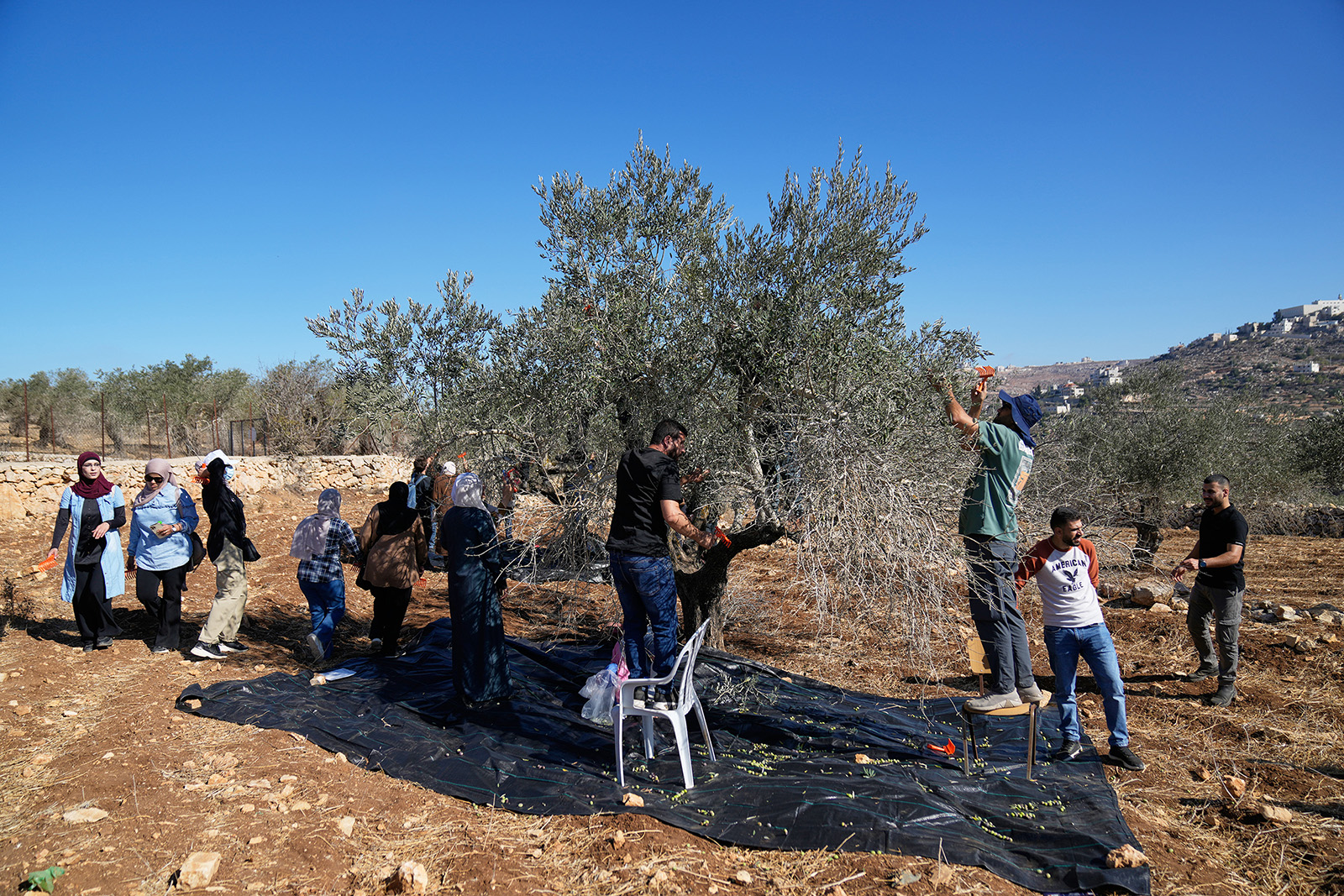
In a separate attack, Palestinian farmers, journalists, and foreign activists sustained fractures and bruises after illegal settlers assaulted them during an olive-harvesting activity in the town of Beita, south of Nablus, Wafa said.

Mohammad Hamayel, deputy mayor of Beita, said that illegal settlers attacked participants harvesting olives in the Qamas Mountain area.

The Palestinian Red Crescent Society said its medical teams treated several injured people and transferred them to hospitals, but did not specify a number.

Among those injured were foreign solidarity activists, paramedics, and journalists, including Reuters reporter Raneen Sawafta and two journalists from Al Jazeera, according to local sources cited by Anadolu.

In a landmark opinion last July, the International Court of Justice declared Israel’s occupation of Palestinian territory illegal and called for the evacuation of all settlements in the West Bank and East Jerusalem.


UN says illegal Israeli settler attacks hit highest monthly toll in nearly 20 years

November 7, 2025


Israeli forces takes extensive security measures as Jewish settlers under Israeli military protection attack Palestinian and international activists harvesting olives in the village of Soba, south of Hebron, on October 12, 2025. [Mamoun Wazwaz – Anadolu Agency]

The UN warned Friday of a sharp rise in illegal Israeli settler violence against Palestinians in the occupied West Bank, marking the highest monthly toll in October in nearly two decades, Anadolu reports.

Citing the Office for the Coordination of Humanitarian Affairs (OCHA), UN spokesperson Farhan Haq reported “a sharp rise in settler violence against Palestinians, both in frequency and severity,” during a news conference, adding: “Last month, OCHA recorded 264 settler attacks that caused casualties, property damage or both.”

He noted: “That’s the highest monthly toll in nearly two decades of record keeping, averaging more than eight incidents every single day since 2006.”

According to OCHA, more than 9,600 such attacks have been documented, with about 1,500 occurring this year alone — roughly 15% of the total, he said.

Emphasizing the “severe” impact on the humanitarian situation since October 2023, Haq said: “More than 3,200 Palestinians have been displaced due to settler violence and related access restrictions. Entire herding communities have been completely depopulated. People have been killed, hundreds injured, including with live fire, and many more have lost access to their livelihoods.”


Haq also cited OCHA data showing that “the number of Palestinian children killed by Israeli forces in the West Bank so far this year has reached 42,” meaning “one in every five Palestinians killed by Israeli forces in the West Bank in 2025 has been a child.”

Israeli attacks have escalated across the occupied West Bank since October 2023, killing more than 1,066 Palestinians and injuring 10,300 others, according to Palestinian figures.

According to the official Colonization and Wall Resistance Commission, Israeli forces and illegal settlers carried out 766 attacks against Palestinians, their homes, property, and sources of livelihood across the West Bank in October alone.

In a landmark opinion last July, the International Court of Justice declared Israel’s occupation of Palestinian territory illegal and called for the evacuation of all settlements in the West Bank and East Jerusalem.

Israel deports two US Jews who volunteered to help Palestinians pick olives


(RNS) — Israel has ramped up deportations of foreigners involved in advocacy for Palestinians or demonstrations against the occupation, but the deportation of US Jews sets a precedent.


Foreign peace activists and volunteers help Palestinian farmers harvest their olive trees in the West Bank town of Silwad, Wednesday, Oct. 29, 2025
. (AP Photo/Nasser Nasser)


Yonat Shimron
November 3, 2025


(RNS) — Two American Jewish women who had volunteered to harvest olives in a Palestinian village in the West Bank were deported from Israel and sent back to the United States on Friday (Oct. 31) in what human rights groups say is an escalation of hostilities toward anyone who aids or advocates for Palestinians.

The Americans, a physician in her 50s and an 18-year-old high school graduate, were volunteering as part of a four-month program run by a Jewish group, Achvat Amim, or Solidarity of Nations. Last week, the group partnered with Rabbis for Human Rights in their campaign to help Palestinians under attack from Israeli settlers.

The Jewish women’s deportations comes one week after 32 international volunteers — from the U.S. and Europe — were also deported from the same spot in the town of Burin, near the Palestinian city of Nablus, about 45 miles north of Jerusalem.

Israeli settlers have targeted the olive harvest in recent years, unleashing waves of violence and destruction. In Burin and other places across the West Bank, settlers have cut, bulldozed, uprooted and set olive trees on fire. The reasons have everything to do with the economic importance of olives.

The UN estimates that 80,000 to 100,000 Palestinian families rely on the olive harvest for their livelihoods.

The two women, whose names have not been released, are U.S. citizens with deep ties to Israel. They have family living there and have traveled there before.

“The concept of easily deporting Jews for showing up to a workday to stand with Palestinians is a complete antithesis of what the state of Israel claims to be as a refuge for Jews and a place that claims to respect human rights,” said Becca Strober, Achvat Amim’s education director. “It clearly shows the opposite.”

Deportations of U.S. Jews from Israel have been rare in the past but are growing. Since the Oct. 7, 2023 Hamas attack on Israel, the government has ramped up deportations of foreigners involved in advocacy for Palestinians in the West Bank. This is the first time that either Achvat Amim or Rabbis for Human Rights has had any of its volunteers deported.

The two women plan to appeal their deportation, with legal help from both Rabbis for Human Rights and Achvat Amim, which have jointly hired a civil rights lawyer to assist them.

A spokesperson for the Israeli Police wrote in an email that the women had violated the conditions of their tourist visas. It did not specify what the conditions of their visas or the violations were.

“Following repeated incidents of this nature, the Judea and Samaria District Police is acting firmly and in accordance with the policy of the Minister of National Security, Itamar Ben Gvir, and the directives of Israel Police Commissioner Daniel Levy, to locate and stop foreign elements engaged in intentional provocations that generate clashes and misrepresent events in the area, undermining public safety,” the police spokesperson said.

Avi Dabush, CEO of the 37-year-old Israeli social justice organization Rabbis for Human Rights, said there were no clashes or provocations with the authorities, and the group did not resist arrest.


FILE – Avi Dabush speaks to media during a Rabbis For Human Rights demonstration in front of the Knesset in Jerusalem. (Photo courtesy Rabbis for Human Rights)

Dabush said that on Oct. 29, the group of 11 volunteers had taken a minibus to the West Bank village of Burin. As they approached a checkpoint, the group was told that the military had declared the spot a closed military zone, but the group took an alternate route to the groves. When they arrived, soldiers detained the group and took them to the police station in the town of Ariel.

There, the Israelis were questioned and released with a promise not to return for 15 days. The two Americans were told they would be deported.

“We are, of course, nonviolent, but we are trying to obey the law,” Dabush said. “It’s really frustrating because the army and the police are doing nothing to stop the violent settlers, but on Wednesday, they spend so many hours, soldiers and police officers to deal with this.”

Rabbis for Human Rights is in the midst of a 14-day campaign to help these farmers harvest their olives.

Several American rabbis have traveled to Israel to aid the campaign, including 10 rabbis from T’ruah, the U.S. human rights group. Jill Jacobs, CEO of T’ruah, said she and nine other American rabbis picked olives at a different location in the West Bank without incident on Sunday.

The deportation of the two Americans set a worrying precedent.

“I’m very concerned about the Israeli government’s crackdown on people who are supporting Palestinians and on the total impunity for settlers who are carrying out violent attacks,” said Jacobs. “And I’m very concerned for what this means for Israel’s relationship with Jews across the world, in the US and beyond, if the place that is supposed to be the Jewish homeland is deciding that they’re going to deport some Jews based on their political opinion and activities.”


US-China Trade War: Truce Yes, But Road to Peace Uncertain


Prabir Purkayastha 


The larger trade war between the two economies will continue unless the US is willing to come back to a global trading regime.

The Donald Trump-Xi Jinping meeting in Busan, South Korea, on October 30, 2025, may have brought about a temporary relief in the US-China trade war. But unless we see the fine print of the agreement, it is difficult to assess whether this is a temporary truce or the beginning of a real rapprochement between the two nations. The jury is still out on that one and we will wait for a better understanding of what has really been achieved in Busan.

The hot topic starting with Trump’s second presidential term has been his tariff war, not only with China but with the entire world. Instead of trade policies in which tariffs—import and export duties—play a part, these have become the driver of US foreign policy, if not its larger political, economic and technology engagement with the world. It is not that its iron fist, the US military, is hidden from view. However, it seems more narrowly focussed on two regions. One is backing Israel in West Asia, and the second, going back to the Monroe doctrine, in which Latin America and the Caribbean is claimed as its “sphere of influence”.

The dreams of a new “rule based” global order, the World Trade Organisation (WTO) system launched with fanfare in 1995, seems to have faded under Trump. His policies are clearly weaponising tariffs, a throwback to the Cold War export control rules that had been directed primarily against the Soviet Union but also included countries, such as India. These export control rules were known as the COCOM Rules, and after the fall of the Soviet Union, became the Wassenaar Arrangement.

The WTO’s export and import regime launched in 1995, supposedly a part of the rules-based world order, has had a very short life. Its entire dispute settlement process is now in cold storage, with the US effectively sabotaging its apex body, the WTO Appellate Tribunal. The US refused to accept any nomination of new members to this body, and with the retirement of some existing members, the body is left with no quorum for any bench. Without this apex body, all trade disputes in WTO end up being unresolved, which is where we are right now.

What is different from even the earlier technology control regime— COCOM and the Wassenaar Arrangement—is that this one is an entirely ‘made-in-US policy’. Even its allies have no say: they have to accept whatever Trump decrees! Not surprisingly, the European Union (EU) and its would-be EU partners, have shown little spine, bending before Emperor Trump, and accepting whatever policy he decrees.

For the world, the trading regime has become a far more dangerous place. In Trump’s world, trade rules are essentially that there are no rules except what the US administration, meaning President Trump, says that day.

While the global media has focussed on the sweeping restrictions that China has put on its rare earth exports and the danger to the global supply chain, little has been written about the Export Control Rules that the US Department of Commerce issued on September 29 this year, preceding China’s rare earths export restrictions.

The September 29 US declaration expanded the number of Chinese companies on the US Export Control list from 1,300 to more than 20,000. This was a 15-fold increase in the number of companies that would have to comply with the new US export restrictions.

Even this is a tip of the iceberg. Writing in an article on the website of Peterson Institute for International Economics (PIIE), Martin Chorzempa writes (October 27, 2025), “Any US firm exporting even a soybean to China now needs to engage in lengthy corporate sleuthing to follow complex webs of Chinese customers’ entire ownership chain to avoid the risk of being hit with fines or even jail time...The 50 percent rule might seem like a small technical tweak, but the impact, especially on China, will be immense.”

I am not going to discuss here whether the US export restrictions and the Chinese response were equivalent or reciprocal. Suffice it to say that both the US September 29 Order and the Chinese Rare Earths restrictions effectively mean that global supply chains are facing the imminent danger of separating and splintering across the world. We are officially seeing the end of GATT (General Agreement on Tariffs and Trade), and then the WTO-led global trading system based on a common set of rules accepted by almost all countries. Even if it did privilege certain countries, particularly the West—Organisation of Economic Cooperation and Development (OECD) countries—there was at least a set of common rules that almost all countries had accepted to follow.

With the US 29 September order, and now China’s Rare Earths export restrictions, the global supply chains will have to be re-engineered by each country so that entities trading with one trading block do not trade with the other. We are back to the days when the economies of the West and the socialist countries were virtually separated, with the rest of the world charting a difficult path in dealing with both.

The difference between the COCOM regime then and now—and there is a huge difference—is that the complexity of each product today has grown significantly. Products today, for example a car, is much more complex now and has many more discrete components than in the past. This also means that the complexity of their supply chains is a magnitude higher than what existed then.

Let us look at the complexity, for example, the Model T Ford, the first mass produced car.  Its internal combustion engine, the heart of the car, had about 100 moving parts. Today, even an equivalent non-electric car has at least 1,000-2,000 moving parts, a 10 to 20-fold increase.

Even in Electric Vehicles (EVs), though the car engine—meaning the electric motor itself—has much less moving parts, the battery and its supply chain, is far more complex than the fuel supply chain of a diesel or petrol car. Even in a petrol or diesel car today, the cost of the electronic assemblies based on chips is about 40-50% of the cost of the car.

The separation of these complex supply chains today is a far more difficult task than the US seems to believe. It comes not from the complexity of the trading system, but fundamentally from the increased complexity of any consumer product, their manufacturing complexity, and therefore, the complexity of their supply chains. It is this complexity of the production and supply chain that makes the separation of the global economy into autarchic blocks, each with their independent and physically separated supply chains, near impossible. Much as the Trump administration might like to believe, there is no “Back to the Future” road for the world today.

To illustrate, let us take a quick look at two critical industries and their respective supply chains. The country that controls the bottlenecks or the critical choke points in these supply chains can assert effective control over the supply chains of these critical industries. For the current phase of the technology-cum-supply chain war between the US and China, let us look at the rare earth production system here, as we have already covered the chip wars quite often in these columns.


A significant part of the media naively believes that rare earth monopoly merely means mining rare earths, i.e., simply digging it out of the ground. What they do not seem to know or refuse to understand is that the technology control that China has built is in concentrating the ore, separating the actual rare earth minerals as they are present in the ore in low concentration often mixed with even radioactive substances, e.g., like thorium in monazite sands in Kerala. Lastly, some of these rare earths enter permanent magnets, present in almost all high-efficiency motors, and generators.

Even when the rare earth-bearing ores have been separated from others, purification from ore to the final product is again a complex process. For example, even though Australia does mine rare earths—it is the fourth largest supplier of rare earths—the final step of the separation, particularly for heavy rare earths, is done in China.

According to Benchmark Mineral Intelligence, a UK-based research firm, China accounts for as much as 99% of global heavy rare earth processing. According to Goldman Sachs, the West may need at least a decade to loosen China's control over the rare earths supply chain. 

Rare earths, particularly heavy rare earths, are required for permanent magnets. Rare earths enter not only the supply chain of renewable energy, but also a whole range of military arms and equipment: from missiles, drones to aircraft, ships and submarines. In other words, if the chipmaking eco-system, specifically lithography, is controlled by the US and its allies, China controls the rare earth eco-system. Not simply mining the rare earths, not only refining it, but also to produce permanent magnets, used in almost all major industrial and military products.

Interestingly, ASML’s lithographic machine, the lynch pin of the US control over the chip manufacturing supply chain, also needs large amount of rare earths for its lasers and permanent magnets in the laser beam focussing system!

The only edge that the US holds today is in defence, appropriately renamed by Trump as the Department of War. The US military spending is equal to that of next nine countries. His hope is, therefore, to leverage US military power and convert it to trade and financial power. In Trump’s books, extortion is the only game left for the US, and that is what is in play in global trade relations.

Can the US convert its military power, and the dollar as the global currency, into global economic dominance? This is at the core of the trade war that Trump has launched on the whole world, including his allies.

Yes, we may see a temporary truce between the US and China in the current tariff battle, as the immediate crisis may have indeed blown over with the Trump-Xi meeting in South Korea. But the larger trade war between the two economies will continue unless the US is willing to come back to a global trading regime. That at the moment seems unlikely, as gutting the world trading system—the WTO—was a bipartisan policy under both Trump and Joe Biden.

India’s Crony Corporate State and the Anatomy of Inequality


India’s crony economy thrives on the interdependence of politics and business. This nexus is not hidden; it is institutionalized through opaque political financing, regulatory discretion, and selective privatization.


File Photo

India’s adoption of the Western liberal economic model has positioned it as a junior partner to Western multinational corporations (MNCs), but unlike many European countries that coupled liberalization with robust social safety nets, India has largely failed to develop such protections for its population. This contrast is critical in understanding India’s socio-economic challenges today.

European nations completed their industrialisation by systematically dismantling feudal structures while establishing extensive social welfare programs—including public healthcare, universal education, pensions, and insurance schemes—which ensured broad-based societal benefits from economic progress. These measures created a foundation for social stability, increased human capital, and equitable distribution of growth dividends.

In contrast, India’s ruling class—comprising entrenched big corporate interests allied with feudal and communal forces—has aggressively pushed liberalisation and privatisation without embedding fairness, transparency, or accountability mechanisms. The dismantling of state-owned public sectors such as healthcare, education, railways, and even defence has weakened the state’s capacity to provide essential services and safeguard citizens’ welfare.

The Indian corporate sector's focus remains narrowly centred on profit maximization rather than fostering scientific and technological innovation or generating inclusive economic opportunities capable of driving societal transformation. Consequently, the promises of liberalisation have not translated into comprehensive development for India’s vast population.

The government has increasingly relied on external debt, borrowing approximately US$ 2.62 trillion against a GDP of about US$ 2.8 trillion (data from the World Bank and IMF), which places a significant fiscal burden on the nation. Meanwhile, unemployment rates especially among educated youth are alarming, with approximately 83.6% reported as unemployed, indicating a severe mismatch between education and job creation.

Rural poverty and social exclusion persist deeply, forcing over 100 million people to migrate to urban and metropolitan centers like Delhi, Mumbai, and Kolkata. These migrants often settle in severely inadequate slum conditions and work predominantly in the informal and unorganized sectors—as domestic workers or street labourers—where wages are minimal, and labour rights are frequently ignored.

A Liberal Dream Turned Crony Reality

When India embarked on economic liberalization in 1991, it heralded a new dawn of market freedom and global integration. The dismantling of the License Raj, once seen as a necessary evil, was celebrated as the first major step toward modern capitalism. The promise was clear: free markets would unleash entrepreneurship, foreign investment would spur innovation, and economic efficiency would replace bureaucratic stagnation.

More than three decades later, the results are paradoxical. India has become one of the fastest-growing major economies in the world, yet it is also one of the most unequal. The liberal dream, once driven by hopes of broad-based prosperity, has morphed into a crony corporate-led regime that rewards proximity to power rather than productivity.

According to the World Inequality Lab (2025), the richest 1% of Indians now control 62% of the nation’s wealth, while the top 10% accounts for 74%. The bottom half of the population, numbering over 700 million people, share a meagre 6%. Behind the glossy GDP numbers lies a grim economic and social imbalance that threatens the very ideals liberalization once promised.

The Genesis of Crony Capitalism

The roots of India’s crony capitalism lie in the very process of liberalisation itself. The early 1990s reforms—championed by then Finance Minister Dr. Manmohan Singh—were aimed at dismantling state monopolies, encouraging competition, and integrating India into the global market. However, while these reforms succeeded in attracting capital, they failed to build robust regulatory institutions capable of curbing elite capture.

The withdrawal of the state from production did not mean its withdrawal from power. Instead, the state became a selective enabler—granting licenses, contracts, and clearances to business conglomerates with political access. This pattern of “policy patronage” replaced the old bureaucratic controls with a new nexus between political elites and corporate capital.

This juxtaposition of Western-style liberal economic policies without comparable welfare frameworks has created a profound socio-economic crisis in India.

The Numbers Behind Inequality


In 1991, when reforms began, the top 1% of earners held about 16% of national wealth. Over the next three decades, that share nearly quadrupled. Meanwhile, the bottom 50% saw their wealth decline sharply—from 25% to just 6%.

The data tells a story of structural exclusion. As India’s economy expanded from $270 billion in 1991 to over $3 trillion in 2025, the rewards of growth became heavily skewed. The benefits of liberalization—foreign capital, high-end jobs, and stock market gains—remained concentrated in urban and corporate circles, while rural incomes stagnated.

Economists argue that inequality in India is not merely an economic outcome but a policy design feature—a product of deliberate choices that privilege corporate capital and suppress redistributive justice.

When the State Serves the Few

India’s crony economy thrives on the interdependence of politics and business. This nexus is not hidden; it is institutionalized through opaque political financing, regulatory discretion, and selective privatization.

High-profile scandals such as the 2G spectrum allocation (2010)coal block allocations, and more recent banking and infrastructure scams have revealed how public resources were channeled toward politically connected entities.

“Crony capitalism is not a side effect—it is the operating system of India’s neoliberal model,” argues V.R. Suryawanshi (2025) in his study on public policy and corporate influence.

Public-private partnerships, meant to boost infrastructure and investment, often turn into conduits of state capture. Major industrial houses expand into multiple sectors—from ports and power to telecom and finance—often aided by policy favors or regulatory exemptions.

The Competition Commission of India (CCI) and Telecom Regulatory Authority of India (TRAI), established to ensure fair competition, frequently face funding shortages and political interference, weakening their oversight capacity.

The Political Economy of Inequality

The concentration of wealth has far-reaching political consequences. As corporate power grows, so does its influence over electoral politics. The introduction of electoral bonds—a mechanism for anonymous political donations—has further deepened opacity, allowing large corporations to fund ruling parties without public scrutiny.

This creates a feedback loop: money buys policy, policy enriches donors, and donors fund political power. The outcome is a democracy tilted toward those who can afford to finance it.

Economist Joseph Stiglitz (2012) calls this “the rentier society of the 21st century”—where those who control assets and access, rather than those who create value, accumulate disproportionate wealth. In India, the rent-seeking logic of capitalism has penetrated the political process itself.

Growth Without Inclusion

On paper, India’s growth story is spectacular. The IT revolution, the boom in services, and rising foreign direct investment have transformed cities like Bengaluru, Hyderabad, and Gurgaon into global business hubs. Yet, this transformation has bypassed much of the population.

Rural distress, stagnant real wages, and unemployment remain chronic. Between 2011 and 2025, the bottom 50% of Indians saw their average income rise by less than 2% annually, while the top 1% saw increases of over 12% per year (World Inequality Report, 2025).

This lopsided growth pattern has led to a hollowing out of the middle class—once the aspirational engine of India’s post-liberalization narrative. The gap between rural and urban India, formal and informal sectors, and capital and labour has never been wider.

Meanwhile, social spending as a share of GDP remains low. India spends only 2.1% on healthcare and 2.9% on education, far below comparable emerging economies.

Theoretical Framework: Cronyism as Structural Capture

The phenomenon of crony capitalism can be explained through two interrelated frameworks:

  1. Crony Capitalism Theory (Haber, 2006):

It posits that when business success depends on political favour rather than competition, economic growth becomes unstable and inequitable. Over time, such systems foster monopolies, deter innovation, and erode public trust.

  1. State Capture (Hellman, Jones & Kaufmann, 2000):

In this framework, private entities influence policymaking, legal frameworks, and regulation to serve their interests. This “capture” weakens democratic institutions and diverts resources from public to private ends.

Together, they explain how India’s neoliberal state evolved from a regulator to a broker—a facilitator of private wealth accumulation through selective policy intervention.

The Social Consequences

The effects of inequality go beyond economics. Rising disparities have eroded social cohesiontrust in governance, and intergenerational mobility.

As wealth clusters in fewer hands, political polarization and populist politics rise in response to social frustration.

Urban India faces an emerging underclass of underemployed youth, while rural India continues to rely on precarious migration for survival. The promise of “New India”—a nation of digital innovation and middle-class dreams—exists alongside the reality of agrarian distress, jobless growth, and urban poverty.

Sociologists warn that this duality could fuel long-term instability. “Economic exclusion breeds political alienation,” writes C. Sen (2024) in his Azim Premji University Working Paper. “The legitimacy of democracy weakens when prosperity is visible but inaccessible.”

Breaking the Cycle: Towards Inclusive Capitalism

The challenge before India is clear: to reconcile growth with equity, capitalism with accountability, and markets with morality. To achieve this, a multidimensional reform agenda is needed.

1. Transparency and Anti-Corruption Frameworks

Strengthen anti-corruption laws and digitalize all public procurement and privatization processes. Transparency must become the norm, not the exception.

2. Empowering Regulators

Regulatory institutions must be granted genuine autonomy, secure funding, and legal authority to prevent monopolistic behaviour and cartelization.

3. Progressive Taxation

Reintroduce wealth and inheritance taxes on ultra-rich individuals and corporations, and close loopholes in capital gains taxation to ensure fair redistribution.

4. Political Finance Reform

Abolish opaque electoral bonds and mandate full disclosure of corporate donations. Political competition should be rooted in ideas, not in financial muscle.

5. Social Investment

Increase public spending on education, healthcare, and rural development. Human capital must become the foundation of sustainable growth.

6. Support for SMEs and Local Enterprises

Provide credit and infrastructure support to small and medium enterprises—the real drivers of employment and innovation.

Reclaiming the Liberal Promise

India’s liberalisation project was conceived as a transformative vision—one designed to unleash entrepreneurial dynamism, foster innovation, and build a globally competitive economy. In many respects, that vision materialized; yet, its rewards have been disproportionately captured by a privileged ruling elite, entrenched at the intersection of political and corporate power. The market, once imagined as an instrument of empowerment for the many, has instead consolidated the dominance of a new oligarchy—an alliance of capital and governance that thrives on exclusion.

This reality underscores an urgent need for policy recalibration—one that restores the moral equilibrium between profit and people. Economic liberalization must now be complemented by a renewed commitment to social safety nets, equitable public investment, and the generation of dignified employment opportunities. These are not adjuncts to growth; they are its ethical foundations.

India’s developmental trajectory must learn from inclusive growth models elsewhere—most notably China, which within three decades, managed to integrate rapid industrial expansion with broad-based poverty reduction. For India, the challenge lies not in growth itself, but in ensuring that its dividends reach the marginalized rural and urban poor who remain excluded from its promise.

The future of India’s democracy and economy hinges on reconciling growth with justice. Without structural reform and institutional accountability, the liberal dream risks collapsing under the unsustainable burden of inequality.

To reclaim that promise, India must move beyond crony capitalism toward a model of inclusive and sustainable socialism—a system grounded in collective cooperation, transparency, and social welfare as its guiding objectives. Such a transformation would redefine economic success not by the accumulation of wealth, but by the equitable distribution of opportunity.

Only then can the world’s largest democracy fulfill the emancipatory vision that liberalization once embodied: freedom not merely for capital, but for its people.

Author’s Bio: Akhilesh Chandra Prabhakar is an International Professor of Economics. He also serves as the Director of Global South Social Networks and a researcher of Sustainable Economic Development and the Political Economy of the Global South.

Multiplier Effects of ‘Bubbles’ Under Neo-Liberal Capitalism


Prabhat Patnaik 

When the ‘AI bubble’ bursts, as it inevitably will, there will be a substantial rise in unemployment rate in the US.

Neo-liberal capitalism has an immanent tendency toward stagnation, which arises because of the operation of two factors: the first is the growth in income inequality that it continuously spawns. Since the poor consume the bulk of their incomes while the rich “save” (that is, do not consume) most of it, consumption demand, and hence overall aggregate demand, tends to fall below the growth of producible output, resulting in a rise in unemployment and unutilised capacity that drives the economy down.

This continuous tendency toward a rise in income inequality arises from the fact that, owing to the mobility of capital across country borders, wages across the entire world have to suffer the baneful consequences of the massive Third World labour reserves; and the relative size of these reserves does not diminish despite such relocation of capital from the Global North.

On the one hand, the withdrawal of State support from petty production and peasant agriculture forces distressed producers from these sectors to move to towns in search of employment, thereby increasing the number of job-seekers; on the other hand, the rise in the rate of growth of labour productivity that is enjoined upon all countries because of trade “liberalisation”, via the adoption of new processes and products, keeps down the number of new jobs being created. Real wages across the world, therefore, fall behind labour productivity, causing a rise in the share of economic surplus in the output of each country and in world output as a whole; the observed rise in income inequality is an empirical manifestation of this phenomenon and constitutes the basic reason for the tendency toward stagnation under neo-liberal capitalism.

The second factor that underlies the realisation of this tendency is the inability of State intervention to rectify this deficiency of aggregate demand relative to producible output. Such state intervention is what John Maynard Keynes, the foremost bourgeois economist of the 20th century, had pinned his hopes on.

But since State intervention to yield results must mean larger State expenditure financed either by a fiscal deficit or by taxing the rich (the other alternative, of taxing the working people and spending the proceeds does not entail an increase in aggregate demand since the working people consume the bulk of their income anyway), and since both these means of financing State expenditure are disliked by globalised finance and hence ruled out, the Keynesian remedy ceases to work. The tendency toward stagnation arising from over-production relative to demand under neo-liberal capitalism has, therefore, no effective counterweight in the normal course.

But this is where “bubbles” come in. Speculation in the market for assets or claims to assets pushes up their prices sky-high which encourages extra investment in those sectors (because of the ease of raising finance) and extra consumption by the holders of such claims (who feel extremely wealthy and hence consume more, even though much of this wealth is actually fictitious). Hence even though the asset price bubble is primarily a financial phenomenon, it has an effect on the real economy. And such bubbles play the role of providing a temporary counterweight to the tendency toward stagnation under neo-liberal capitalism.

Such bubbles do not negate the tendency toward stagnation; they do not introduce a long-term growth trend. They occur from time to time, and introduce a temporary wave around the growth trend before dying out.

During the upward surge of the bubble, there would be some improvement in the performance of the real economy, just as when the bubble collapses, and a financial crisis ensues, the performance of the real economy would receive a setback.

Of course, a bubble does not arise entirely out of the blue; it is typically associated with the introduction of some new technology, in the form of some new product (or process). The euphoria generated by the new technology translates itself into a bubble that then gets metamorphosed into a speculative phenomenon, where the focus is no longer what the new technology would fetch, but on how other speculators would behave.

The Austro-American economist Joseph Scumpeter had rightly seen technology being introduced in such waves, but had erred grievously in not recognising the phenomenon of deficiency of aggregate demand and the consequent tendency toward over-production, and how that, in turn, affects the shape and nature of the wave through which technology gets introduced.

One consequence of this was Scumpeter’s vision that the economy is always at full employment (the wave caused by the introduction of new technology affecting only prices rather than employment), so that when the wave is finally over and dust has finally settled, the workers are decidedly better off owing to the higher labour productivity that the new technology has brought, whose benefits accrue to them in the form of higher wages. This idyllic picture, alas, does not hold, a point whose significance we shall presently see.

Such a temporary reprieve from the tendency toward stagnation under neo-liberal capitalism, had been provided by two such bubbles earlier, both occurring in the US: the dotcom bubble of the 1990s and the housing bubble that followed almost immediately afterwards (such immediate succession being deliberately engineered to an extent by Alan Greenspan, the then chairman of the Federal Reserve Board, which is the US central bank).

After the collapse of the housing bubble, the world economy sank into a prolonged stagnation, aggravated in its initial phase by the after effects of the collapse of this bubble. Not surprisingly, the growth rate of the world economy during the decade 2012-21 (that is, after the pandemic-induced drop had been reversed), was lower than the growth-rates during the previous three decades -- 1982-91, 1992-2001, 2002-2011-- which themselves were lower than during the decades of the post-war period.

There is an impression that the Artificial Intelligence (AI) bubble currently underway will not only offset the tendency toward stagnation for the present, but will also do so on a more sustained basis. This perception, however, is completely erroneous. While the size of the AI bubble in financial terms is quite significant, its impact on the real economy is not. Indeed, two points have to be noted about the impact of the AI bubble on the real economy.

First, its impact on the totality of the real economy within the US itself, though positive, is quite marginal. According to the US Bureau of Labour Statistics, the youth unemployment rate in that country in July 2025 was 10.8%, which was not only high in itself, but represented an increase over July 2024 when it was 9.8%. In other words, the boost to the level of activity in the real economy provided by the AI bubble today is not significant enough to cause a fall in the year-on-year youth unemployment rate.

What is more, and this is the second point to be noted, when this bubble bursts, as it inevitably will, there will be a substantial rise in unemployment rate in the US. This would be so for three reasons: first, the effect of the bursting of the bubble (and even if there was no speculative bubble, but just the introduction of technology in a wave, the effect of the ebbing of that wave), which would be in the nature of a cyclical downturn in employment. Second, the effect of AI itself in reducing employment even in normal times (that is, even if there were no cyclical downturn).

And third, the effect of reduced incomes of the employees as a whole (since wages would not be rising while employment falls) on aggregate demand and hence on the level of activity (this is what economists call the “multiplier effect”).

Even when the first of these effects has waned, the second and the third will continue, and will ensure that the net long-term consequence of the introduction of AI would have been a vastly increased permanent level of unemployment, which will further accentuate the tendency toward stagnation of neo-liberal capitalism.

Nothing demonstrates more clearly than the introduction of AI, the irrationality of capitalism as a mode of production and the unquestionable superiority of socialism over it. A technological breakthrough that in a socialist economy would be absorbed through increased leisure for everyone without any fall in real wages, and would in addition enhance human capacity, is causing reduced employment directly, reduced real wages because of it, and is accentuating both these reductions (in employment and real wages) through their multiplier effects via reduced aggregate demand.

Prabhat Patnaik is Professor Emeritus, Centre for Economic Studies and Planning, Jawaharlal Nehru University, New Delhi. The views are personal.