Sunday, November 09, 2025


US slams “Kremlin puppet’s” Gunvor Lukoil asset deal

US slams “Kremlin puppet’s” Gunvor Lukoil asset deal
By Newsbase November 7, 2025

Swiss-based commodities trader Gunvor pulled out of the deal to acquire assets of sanctioned Russian oil major Lukoil, after the US Treasury in a post on X called Gunvor a “Kremlin puppet”, according to The Bell and Reuters.

As followed by bne IntelliNews, Lukoil, Russia’s second-largest oil producer after Rosneft, announced plans to sell to Gunvor its global downstream assets, including refineries, fuel retail operations and its trading arm.

The US sanctioned both Rosneft and Lukoil, but the deal was reportedly under review by the Office of Foreign Assets Control (OFAC), which must approve any transfer involving sanctioned entities. Gunvor was reportedly  negotiating an extension to its existing license to transact with Lukoil, which expires on November 21. 

However, the Treasury appeared to double down on the sanctions by posting that the President Donald Trump "has been clear that the war must end immediately. As long as [Russian President Vladimir] Putin continues the senseless killings, the Kremlin's puppet, Gunvor, will never get a licence to operate and profit [from Lukoil assets]."

The statements refers to Gunvor's historical ties to Russia and its co-founder and a longtime ally of Vladimir Putin “stoligarch” Gennady Timchenko. Timchenko sold his stake in Gunvor in 2014, after being sanctioned by the US over Russia's invasion of Crimea.

Seth Pietras, Gunvor's corporate affairs director, said in an email to Reuters that Treasury's statement was "fundamentally misinformed and false" and it welcomed "the opportunity to ensure this clear misunderstanding is corrected."

However, Pietras confirmed that "in the meantime, Gunvor withdraws its proposal for Lukoil’s international assets," according to Reuters.

This reinforces a more hardline stance taken by the Trump administration on Kremlin’s continued full-scale military invasion of Ukraine with Rosneft and Lukoil sanctions.

The Bell also notes that the Treasury’s unusually sharp rhetoric signals a possible shift in policy enforcement under President Donald Trump, who recently tightened energy sanctions as part of his pressure campaign on Moscow.

Financial Times and Reuters also previously noted that the Gunvor-Lukoil deal’s structure raised immediate red flags. 

Gunvor, with net assets of $6.6bn as of end-1H25, was reportedly preparing to acquire a portfolio estimated at over $21bn without a clear financing plan. Sources told FT that the transaction was to be financed from future cash flows, with no upfront payment or guaranteed funding. 

There were also concerns about a potential buyback clause that would allow Lukoil to retain operational control, whether formally stated or not, although Gunvor’s CEO pledged that the deal would mark a “clear break” from Russia for the trader.

However, one senior Russian oil executive told FT that Lukoil “would never cede real control” and that only a truly trusted entity would be considered for such a sensitive handover. Competing oil traders also questioned Gunvor’s technical ability to manage such complex downstream assets, as Reuters previously reported.

Gunvor has tried to reassure regulators by pointing to its track record of compliance with Western sanctions. The company exited Russian crude trading after 2022, publicly condemned the invasion of Ukraine, and has grown its US operations, which now account for around 30% of its revenues.

According to FT, Gunvor also proposed using only American banks and legal advisers going forward. Nonetheless, these efforts appear insufficient to offset concerns about the firm’s historical ties to Russia and Timchenko. 

However, the aggressive move by the US Treasury was merely a social media post not backed by any concrete regulation. It could also prove to be part of Trump's escalation-deescalation rollercoaster tactic seen previously in the “tariff wars”, and could be quickly reversed.

The Bell also reminds that in parallel to the US sanctions, other governments are beginning to act unilaterally against Lukoil. Bulgaria is reportedly preparing legislation to nationalise Lukoil’s refinery in Burgas, further complicating any attempt to consolidate Lukoil’s foreign holdings under a single buyer.

Trump Admin Threatens to Penalize States That Don’t ‘Undo’ Full SNAP Payments

“This president will stop at nothing to take food out of the mouths of hungry kids across America. Soulless,” said Democratic Sen. Patty Murray.


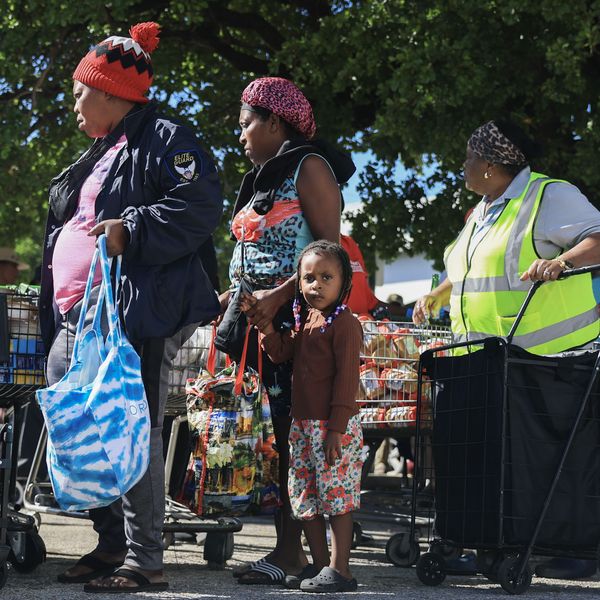
A driver accepts apples from a volunteers with Harris County Public Health during a Houston Food Bank drive at Bear Creek Pioneers Park in Houston, Texas on November 5, 2025.
(Photo by Elizabeth Conley/Houston Chronicle via Getty Images)

Jake Johnson
Nov 09, 2025
COMMON DREAMS

President Donald Trump’s Agriculture Department on Saturday threatened to penalize states that don’t “immediately undo” steps taken to pay out full Supplemental Nutrition Assistance Program benefits for November following a Supreme Court order that temporarily allowed the administration to withhold billions of dollars of aid.

In a memo, the US Department of Agriculture warned that “failure to comply” with the administration’s directive “may result in USDA taking various actions, including cancellation of the federal share of state administrative costs and holding states liable for any overissuances that result from the noncompliance.”


‘Illegal, Immoral, and Absolutely Cruel’: Trump Says He’ll Defy Court Order on SNAP Payments


‘As Ugly and Cruel As It Gets’: Trump Fights Order to Fully Fund November SNAP Benefits

Rep. Angie Craig (D-Minn.), the top Democrat on the House Agriculture Committee, said in a statement that it appears the Trump administration is “demanding that food assistance be taken away from the households that have already received it.”

“They would rather go door to door, taking away people’s food, than do the right thing and fully fund SNAP for November so that struggling veterans, seniors, and children can keep food on the table,” said Craig.

The USDA memo came after Supreme Court Justice Ketanji Brown Jackson temporarily blocked a lower court ruling that had required the Trump administration to distribute SNAP funds in full amid the ongoing government shutdown. SNAP is funded by the federal government and administered by states.

The administration took steps to comply with the district court order while also appealing it, sparking widespread confusion. Some states, including Massachusetts and California, moved quickly to distribute full benefits late last week. Some reported waking up Friday with full benefits in their accounts.

“In the dead of night, the Trump administration ordered states to stop issuing SNAP benefits,” Sen. Patty Murray (D-Wash.) said in response to the Saturday USDA memo. “This president will stop at nothing to take food out of the mouths of hungry kids across America. Soulless.”

Under the Trump administration’s plan to only partially fund SNAP benefits for November, the average recipient will see a 61% cut to aid and millions will see their benefits reduced to zero, according to one analysis.

Crystal FitzSimons, president of the Food Research & Action Center, stressed in a statement that “the Trump administration all along has had both the power and the authority to ensure that SNAP benefits continued uninterrupted, but chose not to act and to actively fight against providing this essential support.”

“Meanwhile, millions of Americans already struggling to make ends meet have been left scrambling to feed their families,” said FitzSimons. “Families and states are experiencing undue stress and anxiety with confusing messages coming from the administration. The Trump administration’s decision to continue to fight against providing SNAP benefits furthers the unprecedented humanitarian crisis driven by the loss of the nation’s most important and effective anti-hunger program.”

With Food Banks in ‘Disaster Response Mode,’ Supreme Court Lets Trump Pause SNAP Funds

“This is insane,” said US Rep. Pramila Jayapal. “Trump is jumping through hoops to block SNAP.”


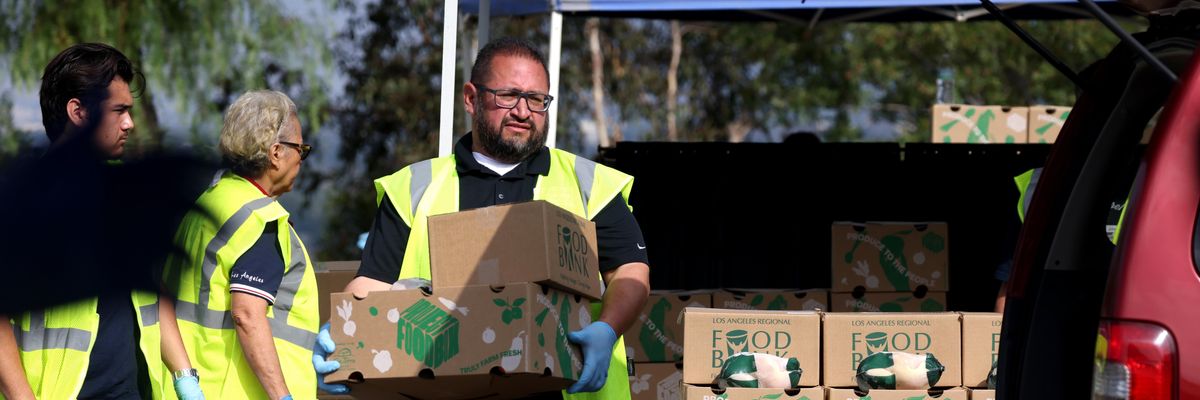
Volunteers hand out boxes of food at a drivethrough food distribution site provided by LA Food Bank on November 5, 2025.
(Photo by Genaro Molina/Los Angeles Times via Getty Images)

Jake Johnson
Nov 08, 2025
COMMON DREAMS

The US Supreme Court late Friday temporarily blocked a lower court order that required the Trump administration to fully fund Supplemental Nutrition Assistance Program benefits as the government shutdown drags on with no end in sight.

One wrinkle in the case is that the Supreme Court order, which came after the Trump administration appealed the lower court directive, was handed down by liberal Justice Ketanji Brown Jackson. Her brief order came after the Massachusetts-based US Court of Appeals for the 1st Circuit opted not to swiftly intervene in the case.


States in Emergency Mode as Trump GOP Refuses to Fund Food Aid for Poor Americans


25 State AGs Sue Trump Over Refusal to Fund Food Assistance for Poor

Jackson, who is tasked with handling emergency issues from the 1st Circuit, wrote that her administrative stay in the case will end 48 hours after the appeals court issues a ruling in the case.

The justice’s order came after states across the US had already begun distributing SNAP benefits after a district court judge directed the Trump administration to release billions of dollars in funds by Friday.

“Some people woke up Friday with the money already on the debit-like EBT cards they use to buy groceries,” NPR reported.

Steve Vladeck, a law professor at Georgetown University, wrote Friday that “it may surprise folks that Justice Jackson, who has been one of the most vocal critics of the court’s behavior on emergency applications from the Trump administration, acquiesced in even a temporary pause of the district court’s ruling in this case.”

He continued:
But as I read the order, which says a lot more than a typical “administrative stay” from the Court, Jackson was stuck between a rock and a hard place—given the incredibly compressed timing that was created by the circumstances of the case.

In a world in which Justice Jackson either knew or suspected that at least five of the justices would grant temporary relief to the Trump administration if she didn’t, the way she structured the stay means that she was able to try to control the timing of the Supreme Court’s (forthcoming) review—and to create pressure for it to happen faster than it otherwise might have. In other words, it’s a compromise—one with which not everyone will agree, but which strikes me as eminently defensible under these unique (and, let’s be clear, maddening and entirely f-ing avoidable) circumstances.

The Trump administration has fought tooth and nail to flout its legal obligation to distribute SNAP funds during the shutdown as low-income Americans grow increasingly desperate and food bank demand skyrockets.

“This is insane,” US Rep. Pramila Jayapal (D-Wash.) wrote after the administration appealed to the Supreme Court. “Trump is jumping through hoops to block SNAP. Follow the law, fund SNAP, and feed American families.”

Maura Healey, the Democratic governor of Massachusetts—one of the states that quickly moved to process SNAP benefits following the district court order—said in a statement that “Trump should never have put the American people in this position.”

“Families shouldn’t have had to go hungry because their president chose to put politics over their lives,” said Healey.

Feeding America, a nonprofit network of hundreds of food banks across the US, said Friday that food banks bought nearly 325% more food through the organization’s grocery purchase program during the week of October 27 than they did at the same time last year.

Donations to food banks, which were underresourced even prior to the shutdown, have also skyrocketed. The head of a Houston food bank said the organization is in “disaster response mode.”

“Across the country, communities are feeling the real, human impact the shutdown is having on their neighbors and communities,” said Linda Nageotte, president and chief operating officer at Feeding America. “Families, seniors, veterans, and people with disabilities are showing strength through the hardship, and their communities are standing beside them—giving their time and money, and advocating so no one faces hunger alone.”

Trump pushes wild debunked conspiracy theory about Obama: 'Wow!'

Alexander Willis
November 9, 2025 
RAW STORY


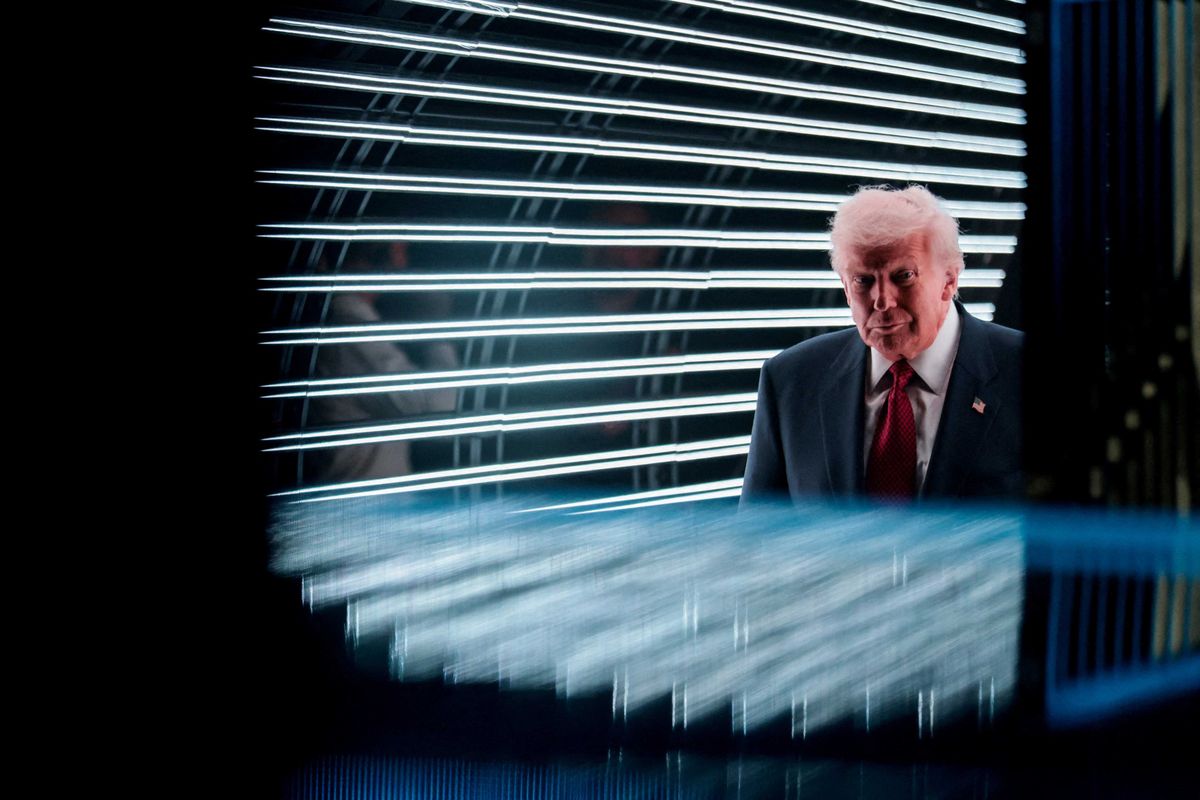
U.S. President Donald Trump attends the American Business Forum Miami at the Kaseya Center Arena in Miami, Florida, U.S. November 5, 2025. REUTERS/Jonathan Ernst TPX IMAGES OF THE DAY

President Donald Trump promoted a debunked conspiracy theory Sunday suggesting that former President Barack Obama has collected $40 million in taxpayer money since 2010 for “royalties linked to Obamacare,” Obama’s signature domestic policy.

“Wow!” Trump wrote, sharing an image of a social media post on X detailing the conspiracy theory.

Promoted by X user “The Patriot Oasis,” who has amassed more than 333,000 followers and frequently shares pro-Trump content, the conspiracy theory has been debunked numerous times over the past few months, and actually originates from a satirical social media page, “America’s Last Line of Defense,” which intentionally publishes fictional stories.

Several prominent right-wing social media influencers have since taken the satirical post and promoted it as truth, drawing hundreds of thousands of views, which as of Sunday now includes the president himself.

According to the debunked claim, Trump’s Department of Government Efficiency, or DOGE, halted the federal government’s payments to Obama, a component of the theory that suggests Trump is not briefed on major cuts instituted by the very government agency he created.

According to several law professors who spoke with AFP, the idea that Obama could have even registered a trademark in relation to Obamacare was unfeasible, given that the ownership of a government program would, in fact, be the government itself.

"[Trump] created the Space Force. And the name Space Force is a trademark pending that's owned by the US military," said Erik Pelton, an intellectual property lawyer and professor at Georgetown University, speaking with AFP. "Because it's a governmental program, that's who would own the name."

AFP had also conducted a search of the U.S. Patent and Trademark Office database and found no such registered trademarks for Obamacare.


The future of the GOP is not what it used to be: analysis

TO BE RESCUED BY WALL ST. DEMS


Lesley Abravanel, 
Alternet
November 9, 2025 


While 'Reaganism' is "still an article of faith for many conservatives," the future of the Republican Party despite it taking a beating at the ballot box last Tuesday, is 'Trumpism,' according to New York Times opinion writer Damon Linker.

"The second Trump administration has given the country 10 months of relentless power grabs, a globally disruptive trade war and, most recently, a demolition project at the White House — all while an inexorably rising cost of living continues to weigh on American workers," Linker writes.

"The result? A presidential approval rating that has plummeted from already middling levels," he adds.

Republicans, Linker says, are now contemplating whether Trump's "distinctive brand of right-wing populism" has any viability. Linker thinks it does.

"Could Mr. Trump prove to be a temporary aberration? Might the Republican Party return to its Reaganite essence once the man who has done so much to trash it finally leaves the Oval Office in a few years?" he asks.

Unfortunately, he writes, Reaganism seems to be over.

"In other words, is the future of the Republican Party Reaganism or Trumpism? The answer, I’m afraid, is most likely Trumpism," Linker says.

President Ronald Reagan, he notes, was a one-off, saying, "Reagan’s election in 1980, through the presidency of George W. Bush and the candidacies of John McCain and Mitt Romney, was an unusual and fleeting moment of moderation and responsibility for the G.O.P."

Reaganism, he writes, "was provoked and inspired by the sense of threat and moral clarity of the Cold War and its immediate aftermath."

Republicans have now returned to what Linker says is "a spirit of furious reaction to modern liberalism, an unwillingness to countenance compromise with the realities of governing a sprawling continentwide commercial nation and a conviction that political wisdom lay in the country’s turning inward and indulging a temptation toward self-absorption."

"Any serious effort to think through what’s likely to follow the Trump presidency needs to grapple with these potent and persistent strands in the right’s political DNA," Linker says.

A rebellious right, Linker says, started to emerge at the end of the Cold War.

"Discontented factions on the right first began to rebel against their marginalization immediately after the end of the Cold War and demise of the Soviet Union," he explains.

George W. Bush's administration, Linker says, rewrote "the Cold War script to portray the global war on terror as a battle for freedom against the enemies of civilization — largely satisfied the most rabid factions of the Republican base."

"Had a Democrat been president when Al Qaeda unleashed its attacks, the furiously reactive antiliberalism of the Old Right might have overwhelmed the G.O.P. more than a decade before it actually did," Linker says.

Republicans in the White House, Linker notes, "kept populist rage submerged — at least until it began to heat up in response to the financial crisis and Great Recession and then to boil over during the Obama administration, leading first to the Tea Party protest movement."

Today, Linker says, "we’ve been living in a world dominated by Mr. Trump and a newly emboldened hard right."

The MAGA movement, he writes, "aspires to take a wrecking ball to the 'administrative state' and career civil service, use extortionist threats to force ideological capitulation across civil society, deploy troops and a masked federal police force to round up and deport millions of immigrants, and bully other countries into submission to the president’s will."

When Trump eventually exits, and he will, Linker says, the stench of "the more personalistic dimensions of his rule — above all, its most breathtaking examples of corruption — will likely recede as well," he notes.

But other stains of Trumpism will linger, Linker says.

"Much of the rest will remain, including a willingness to use sweeping state power to combat anyone who dares to defy the destructive impulses of the rejectionist Republican base," he writes.

Removing this should become the Republican Party's number one issue, he writes.

"What might tame these reactive impulses is unclear, but doing so may be the G.O.P.’s, and the country’s, most pressing priority," Linker says.

"If Republicans receive a drubbing in next year’s midterm elections in proportion to the one they suffered this past week, many in the party will begin to think more anxiously about where it should turn in 2028. Such thoughts (and second thoughts) will need to grapple seriously with the right’s longstanding dark currents that are part of our national character and cannot be willed or wished away," he adds.


Heritage Foundation 

‘The whole thing is imploding’: Chaos erupts inside America's top right-wing think tank

David Badash,
The New Civil Rights Movement
November 9, 2025 

Kevin Roberts, Shutterstock

Founded in 1973, the Heritage Foundation has become what its president, Kevin Roberts, now hails as the “intellectual backbone” of the conservative movement. It crafted the policy blueprint that powered President Ronald Reagan’s right-wing revolution — and today, under Roberts’s leadership, it’s once again shaping the machinery of power. Through its highly controversial Project 2025 — a plan widely credited to Roberts as its chief architect — Heritage laid out a road map for President Donald Trump’s second-term agenda. But Roberts’s recent missteps have rattled the institution, raising strong questions about his leadership — and the future direction of the conservative movement itself.


Roberts gained widespread attention in July 2024 when he issued a warning to Democrats: “we are in the process of the second American Revolution, which will remain bloodless if the left allows it to be.”

At the time, Biden campaign spokesperson James Singer said, “they are threatening violence.”


ALSO READ: Pentagon Marine tied to '6 bullets to head' threat against Pete Hegseth won't face probe


As did others.

“Kevin Roberts is threatening violence to anyone not following his dear leader,” former Republican and former U.S. Congressman Denver Riggleman wrote. “Every network should cover this."


Roberts’s remarks had come just after the U.S. Supreme Court recognized a new constitutional principle of “presidential immunity” for official acts — a decision critics say President Donald Trump has wielded to expand his power.


Late last month, Roberts came under tremendous criticism after throwing his support behind former Fox News host Tucker Carlson, who had a two-hour interview with far-right extremist leader Nick Fuentes, whom many see as promoting Christian nationalism, white supremacy, racism, antisemitism, misogyny, and Islamophobia.

"There has been speculation that @Heritage is distancing itself from @TuckerCarlson over the past 24 hours," Roberts wrote on October 30 when posting the video that sparked this current firestorm. "I want to put that to rest right now."

The editors of the right-wing National Review in a scathing editorial explained the issue: “Tucker Carlson, knee-deep already, has taken another step into the muck with a friendly interview with Nick Fuentes.”


HERITAGE "WILL ALWAYS DEFEND OUR FRIENDS ... THAT INCLUDES TUCKER CARLSON"

Roberts had wasted no time in coming to Carlson's defense.

“The Heritage Foundation didn’t become the intellectual backbone of the conservative movement by canceling our own people or policing the consciences of Christians. And we won’t start doing that now,” he said in his video supporting Carlson.


Roberts insisted that Heritage "will always defend our friends against the slander of bad actors who serve someone else’s agenda. That includes Tucker Carlson, who remains, and as I have said before, always will be a close friend of the Heritage Foundation.”

Criticism of Roberts was immediate.

Journalist Yashar Ali called it a "watershed moment."


"In his statement," Ali wrote, "Kevin condemns what he calls a 'venomous coalition' that is 'sowing division' by attacking Tucker. That 'venomous coalition,' includes MAGA Republicans as well as Jewish conservative commentators, activists, and donors."

"Kevin also frames Nick Fuentes’s rhetoric as worthy of debate, rather than something to be condemned outright. A shift like this would’ve been unthinkable for Heritage just three years ago."

Condemnations came, and continue to do so — from both outside and inside Heritage.


CNN's Andrew Kaczynski on Thursday reported on what one senior staffer called the "absolute s--" swirling inside Heritage.

"The staff that we talked to told us the Heritage Foundation is in open revolt over the president's defense of Carlson," Kaczynski explained.

That senior staffer also told CNN that Roberts had "lost control over the organization."


Kaczynski noted that they also "said there's an open rebellion, and this really all came to a head [Wednesday], where they had this all hands meeting ... this was kind of going around social media, where Roberts publicly apologized, according to her recording we obtained, Roberts told employees, 'I made a mistake. I let you down. I let this institution down. I'm sorry.'"

"But," Kaczynski added, Roberts "also made clear he has no plans to resign."

On Friday, Reason senior editor Stephanie Slade wrote that at a Thursday night event, "I was asked if the crisis at Heritage Foundation seemed to be blowing over. This morning I received a message from someone inside the building about Kevin Roberts: 'He needs to be made to resign by the [Heritage] Foundation Board of Trustees.'"

"In speaking to current and former Heritage staffers over the last week," Slade continued, "the emotion I've most commonly encountered is disgust and the words I've most commonly heard are 'Kevin Roberts has to go.'"


By Wednesday, as Ali noted, Roberts had "made his fourth public statement on the Tucker Carlson/Nick Fuentes situation ... over the course of six days." After the initial video that ignited the firestorm, Roberts made three other attempts to "clean up" his remarks.

According to The Wall Street Journal's Elliot Kaufman, Heritage senior fellow Amy Swearer, in remarks before Heritage staff, told Roberts, "over the last week, you have shown a stunning lack of both courage and judgment."

She called Roberts' initial defense of Carlson "at best ... equal parts incoherent, unhelpful and naive."


"At worst, it was more akin to a master class in cowardice that ran cover for the most unhinged dregs of the far right."

"LOST MILLIONS OF DOLLARS IN DONATIONS"

Heritage also appears to be losing important donors.

"One major donor, whose organization contributes more than a half million dollars annually to Heritage Foundation, told us that they had totally lost faith in Roberts," Kaczynski reported.

"They said, 'I see how things play out, but if Kevin remains as president, we will not be giving to Heritage.'"

"Likewise, the Zionist Organization of America, that's actually the oldest pro-Israel group in the United States, announced that it has withdrawn from Heritage's initiative on antisemitism, unless Roberts publicly apologized, and retract his praise for Carlson."

Newsmax reported that "Zionist Organization of America President Morton Klein told Newsmax Friday that Heritage Foundation President Kevin Roberts should resign immediately."

"My organization has many of the same donors as Heritage," Klein also said. "They've told me that they're stopping all funding for Heritage until they get rid of Kevin Roberts, so yes, they have lost millions of dollars in donations since this controversy arose."

Klein also "pointed to longtime Heritage fellow Stephen Moore's recent departure."

"He doesn't want to be involved with Heritage, which is now tainted as an antisemitic, bigoted organization," Klein told Newsmax. "It's harmed everything else they do."

Mark Goldfeder, CEO of the National Jewish Advocacy Center, told The Wall Street Journal on Friday that “Any tent that is big enough for them ...is too big for me,” referring to Fuentes and his allies.

The Journal reported that "Goldfeder resigned from Heritage’s National Task Force to Combat Antisemitism in the aftermath of Roberts’s video."

"CIVIL WAR AT THE HERITAGE FOUNDATION"

Other critics outside Heritage have also been observing Roberts' crumbling support, and what it means for the future of the organization, its president, and the conservative movement.

"The civil war at the Heritage Foundation is far more consequential than most people realize," noted Mike Madrid, the prominent Latino Republican political consultant. "The divide seems irreconcilable and it could splinter the American right irreversibly."

Conservative New York Times opinion columnist David French wrote on Sunday, "I don’t know if Roberts will survive at Heritage."

"I do know that Carlson and Fuentes and their constellation of friends and allies are far too popular to cancel or even to contain," he noted, and observed: "The fight for the future of the Republican Party is underway."

And pointing to a Washington Post article on the crisis at Heritage, Madrid declared: "The whole thing is imploding."
Sindh High Court decides to examine ‘whole concept of keeping zoos and caging animals’

November 9, 2025 
DAWN

Children look at a tiger in a cage at the Karachi Zoological Garden. — AFP/File


• After Rano’s relocation to Islamabad, bench broadens scope of petition to welfare of all zoo animals
• In written order released on Saturday, court orders formation of new committee comprising govt officials and civil society members to inspect zoos across Sindh

KARACHI: The Sindh High Court has ordered formation of a new committee to visit zoos across the province and suggest steps for improvement as well as sending the exotic animals to their natural habitats.

Inviting suggestions to phase out zoos in the entire province, a two-judge SHC bench comprising Justice Mohammad Iqbal Kalhoro and Justice Syed Fiaz-ul-Hassan Shah declared that the court had decided to examine the whole concept of keeping zoos and caging animals.

The remarks were part of a written order issued on Saturday regarding the Nov 6 hearing of a petition seeking shifting of lone female bear Rano from Karachi Zoological Gardens to Bear Sanctuary, Islamabad Wildlife Management Board.

The order stated that the Karachi Metropolitan Corporation (KMC) and other respondents filed statements and reports and submitted that Rano had been successfully transported to the federal capital on Nov 5 in compliance with the orders issued by the bench earlier.

However, the bench enhanced the scope of the petition from Rano to the welfare of all animals kept in zoos and invited suggestions as to how to phase out zoos in the entire province.

Sindh Wildlife Conservator Javed Ahmed Mahar proposed that a committee may be constituted with the municipal commissioner, forest & wildlife secretary, wildlife conservator and KMC’s senior director-zoo as its members.

Representing the petitioner, Mohammad Jibran Nasir also suggested that philanthropist Ava Ardeshir Cowasjee, Dr Uzma Khan from Asia lead for WWF Pakistan, Advocate Nazia Hanjrah, Zhalay Sarhadi and petitioner/animal rights activist Jude Allen Preira may also be made part of the committee.

The bench ordered constitution of the committee and inclusion of all the names suggested by the wildlife conservator and the petitioner’s counsel.

The bench in its order stated: “In addition, the committee shall be given mandate to co-opt experts of the subject fields, who shall visit the zoos in the province and suggests steps for improvement in the zoos and identify issues being confronted by them at the moment to resolve them as a short term measure. As a long term measures, they shall recommend steps to be taken which may include but not limited to sending the exotic animals to their natural habitat.”

It further stated that as per the petitioner’s counsel the committee, constituted by the chief minister for shifting of Rano, had visited Karachi Zoo and found all the medical equipment out of order.

The bench stated that Zoo Director Aklaq Ahmed Yousufzai had undertaken to replace all out-of-order machines immediately and to outsource vets for treatment of the animals.

The hearing was adjourned till Nov 21.

At a previous hearing, the bench had directed the committee formed by the CM to visit the Karachi zoo and prepare a detailed report about the number of animals kept there as well as their physical and mental health.

It also asked the committee to examine the circumstances under which animals are being kept as well as to identify the animals as natives or exotic and must also make recommendations for improving the situation if it found the animals were kept in improper conditions.

The bench further ruled that since the issue was not of one bear but hundreds of animals being kept in captivity apparently just for entertainment of people and court has decided to examine the whole concept of keeping zoos and caging animals.

Published in Dawn, November 9th, 2025

India mega-zoo in spotlight again over animal acquisitions

By AFP
November 8, 2025


Vantara holds tens of thousands of animals, including some of the world's most endangered species - Copyright AFP/File Idrees MOHAMMED

Sara HUSSEIN

Leading wildlife protection experts have urged India to suspend all imports of the world’s most endangered species, endorsing long-running concerns by conservationists about mass acquisitions by mega-zoo Vantara.

The facility in western Gujarat state, officially known as the Green Zoological Rescue and Rehabilitation Centre, is run by the son of Asia’s richest man.

It has scooped up tens of thousands of animals in recent years, and was subject to an Indian Supreme Court review that cleared it of any wrongdoing.

But experts from the world’s top wildlife watchdog — the secretariat overseeing the Convention on International Trade in Endangered Species of Wild Fauna and Flora (CITES) — have warned Vantara may have imported highly endangered species in violation of international rules.

In a report published ahead of CITES talks this month, they found a “large number of imports… appear to be inconsistent” with rules protecting so-called Appendix I species, the world’s most threatened animals.

They recommended serious reforms to ensure Vantara does “not inadvertently become a driver of illegal harvest of wild animals”.

Vantara and India’s environment ministry did not respond to AFP requests for comment.

Experts have repeatedly sounded the alarm on Vantara’s massive animal intake. The facility claims to have 150,000 animals, though CITES officials said closer to 47,000 were reported during a September visit.

“This report raises more questions than it answers,” said Mark Jones, head of policy at wildlife group Born Free.

“Why the discrepancies in numbers? Why import so many animals from so many species across the world… Who is supplying these animals, and how can we be sure they’re not being traded for profit?”

– ‘Really, really shocking’ –

CITES examined a laundry list of allegations involving endangered animals including the world’s most endangered great ape — the Tapanuli orangutan.

AFP earlier this year reported that Vantara had acquired a Tapanuli orangutan from the United Arab Emirates that originated in Indonesia.

CITES prohibits trade in the world’s most endangered species, but there are exceptions, including for “captive-bred” animals.

The Tapanuli orangutan, like many of Vantara’s rarest acquisitions, was given this designation.

But multiple experts told AFP there are no captive breeding programmes for the species in Indonesia — home to all the estimated 800 Tapanuli orangutans left in the world.

Similar cases involving cheetahs from Syria, a gorilla from Haiti, and bonobos from Iraq are among those questioned by CITES.

The report “is evidence of Vantara’s problematic acquisitions,” said Panut Hadisiswoyo, founder and chairman of the Orangutan Information Centre in Indonesia.

He has been lobbying, so far unsuccessfully, for the return of several orangutans in Vantara, including a smuggled animal intercepted in India and handed to the facility.

The CITES report says Vantara has acquired more than 2,000 Appendix I animals and nearly 9,000 from less endangered species.

“It’s really, really shocking, the number is huge,” Panut said.

“Vantara is exploiting legal loopholes and undermining Appendix I.”

– ‘Exemplary action’ –


The CITES report acknowledges Vantara’s world-class facilities, but urges India to review its import procedures, bolster capacity and more closely scrutinise permits.

Independent wildlife trade expert Daniel Stiles said the report was “a true examination” of Vantara.

“We’ll see if anything changes for the better.”

CITES has asked India to report back on its progress, and it could face measures, including trade suspension, if it does not fully address the concerns.

The findings are “deeply concerning and damaging to India’s conservation credibility”, warned K. Yoganand, a longtime conservation expert in India and Southeast Asia.

“Restoring India’s global standing, damaged by the irregularities surrounding these imports, will require exemplary action.”


Beasts of burden - Antagonism and Practical History. An attempt to rethink the separation between animal liberationist and communist politics. (Published ...

A new group of Buddhist technologists is working to shape the future of AI

(RNS) — Launched publicly in August, their initiative is mapping how Buddhism and AI are already shaping each other and striving to infuse Buddhist principles into AI development.


Chris Scammell, right, co-founder of the Buddhism & AI Initiative, meets the Dalai Lama, left, at the 2025 Mind & Life Dialogue— “Minds, Artificial Intelligence, and Ethics”— in October 2025 in Dharamsala, India. (Photo courtesy of Chris Scammell)

Hayden Royster
November 4, 2025


(RNS) — When Chris Scammell arrived in London in 2022 to work at an artificial-intelligence safety startup, Conjecture, he moved into a Tibetan Buddhist monastery in the heart of the city.

It was an apt home base for Scammell. His spiritual practice had evolved alongside his mounting fears about AI.

Back in 2021, Scammell worked at a hedge fund in Manhattan and lived with friends, two machine learning engineers who became prominent voices in AI research. That winter, under the alias Janus, the trio began drafting “Simulators,” an early critique of large language models that made waves in Silicon Valley and beyond. In the spring of 2022, the engineers joined the founding team of Conjecture, and Scammell was invited aboard.

Scammell was deeply concerned by AI’s breakneck development, he said, especially considering that “relative nobodies” like him and his friends had “a lot to contribute to AI safety in a short amount of time.” Still, he found some harmony between the technology and his Buddhist faith, which had blossomed after a college program in Bodh Gaya, India.

“With vast oversimplification, some Buddhist schools believe we as entities are instantiated from a larger pool of consciousness,” he said. “That, metaphorically, is what a large language model is.”

Now, after three years at Conjecture, most recently serving as chief operating officer, Scammell is pouring himself into a new venture: the Buddhism and AI Initiative. Launched publicly in August, the project aims to bring together Buddhist practitioners, technologists and researchers to shape the future of AI.


Buddhism and AI Initiative logo. (Courtesy image)
RELATED: Pope Leo is focused on AI. What should his guidance offer the world?

In an announcement on web forums LessWrong and Effective Altruism Scammell described the initiative “as an attempt to get Buddhism as a stakeholder group ‘up to speed’ on AI.” He laid out domains of potential impact, including “AI governance and policy” and “awakening and alignment tech.”

In addition to Scammell, the organization’s core team includes Alex Sakarassian, a startup founder turned Buddhist chaplain; Ryan Stagg, a former digital strategist for the Dalai Lama’s Mind & Life Institute; Austin Pick, a longtime administrator at Naropa University, a Buddhist college in Boulder, Colorado; and Peter D. Hershock, an adjunct senior fellow at the East-West Center and author of the 2021 book “Buddhism and Intelligent Technology.”

Scammell first connected with Hershock through the Future of Life Institute, the nonprofit behind a recent open letter condemning the pursuit of artificial superintelligence, with signatories including Prince Harry and so-called AI godfather Geoffrey Hinton. The institute also provided initial funding for the Buddhism and AI Initiative.


Since the early days of the internet, Hershock has written about Buddhist philosophy and technology’s “colonization of consciousness,” as he calls it. In 2018, during a research trip to China, he encountered the country’s nascent AI systems and “was blown away,” he said. “I thought, what will the attention economy look like if it gets supercharged by AI?”

Now, Hershock believes we’re living in that world.

A guest speaker at the Dalai Lama’s recent summit on AI, consciousness and ethics, Hershock is especially concerned about alignment: the process of ensuring AI systems act in accordance with human interests and values.


Chris Scammell, left, and Peter Hershock in October 2025 in Dharamsala, India. (Photo courtesy of Chris Scammell)

“From a Buddhist perspective, aligning with human interests is the worst thing possible,” he said. “Look at Gaza, Ukraine, domestic violence, global hunger, climate disruption. … We’ve got some work to do first before we align our AI systems with us.”

In time, the Buddhism and AI Initiative intends to fund projects that infuse Buddhist wisdom into AI development and deployment. At this early stage, though, they are mapping the ways Buddhism and AI are already informing each other.

For instance, some Buddhist organizations are exploring how AI can aid meditation, education and translation. Seeking to translate all 230,000 pages of the Tibetan Buddhist Canon into English, the nonprofit 84000 is leaning into machine translation tools, which “can and do help achieve the best possible quality of the emerging translation,” said Thomas Doctor, 84000’s AI strategic consultant.

However, others point to limitations. Juewei Shi, director of the Humanistic Buddhism Centre at the Nan Tien Institute, a Buddhist graduate school in Australia, began her career developing AI for Singapore’s government before taking vows as a Fo Guang Shan Buddhist nun. She said she is impressed by the speed of AI translation and generation but finds its spiritual and historical accuracy lacking.


Juewei Shi. (Photo © Josh Brightman)

“It just takes everything in and then throws it back out in a form that is very poetic linguistically, very attractive and persuasive, but not necessarily true,” Shi said.

Much further on the tech end, companies working to ground advanced AI, even superintelligent AI — a hypothetical system that would advance past human intelligence — in Buddhist practice and principles is likely the most provocative domain the Buddhism and AI Initiative has tracked.

The buzziest example is Softmax, a startup co-founded by former Twitch CEO Emmett Shear that’s focused on “organic alignment” and AI agents discovering their “values” — even as those agents meet and aim to surpass human intelligence.

“Everything we know of reality is frame dependent,” Shear wrote in an April blog post, citing the Buddhist concept of śūnyatā, or the lack of inherent existence. “At Softmax, we strive to recognize the frame-dependence of the agents we build.”

Another organization in the space is the Center for the Study of Apparent Selves. Established with a goal of developing “models of intelligence that are ethically and aesthetically fulfilling,” the Nepal-based research institute includes experts in cognitive science, evolutionary biology, computer science, physiology and religion.


Thomas Doctor. (Courtesy photo)

In addition to consulting at 84000, Doctor is director and founder at CSAS. He sees overlap between the Buddhist goal of “awakening” and the pursuit of superintelligence. He noted the bodhisattva vow — “For the sake of all sentient life, I shall achieve awakening” — is inherently outward-focused. Similarly, Doctor and his CSAS colleagues propose that care should be considered the “driver of intelligence.” If AI were trained on its own bodhisattva vow, it would provide a “framework for thinking of superintelligence,” Doctor said. “It’s intrinsically an altruistic pursuit, and at the same time, it’s something you take very seriously.”
RELATED: Muslim voters didn’t cost Dems the 2024 election, a new poll says. But they may have found their voice

Scammell, for his part, is unsure that building and enlightening ASI “is the way we’re going to build a better future,” he said. “I’m more motivated by strategies that help a lot of people understand the problem and contribute personally.”

And while he said he is heartened by how the initiative is bringing together Buddhists with wide-ranging projects and views, the hard work is yet to come. Buddhists are practiced at coming together, but many are less familiar with engaging “policy professionals in shaping a better future,” he said.

“For Buddhism to have a very meaningful impact on the field of AI, there’s going to be a lot of stepping out of comfort zones that’s needed,” Scammell said.

Meanwhile, Shi acknowledged “we don’t have a central body like the Vatican that speaks on behalf of all Buddhists,” and she doesn’t necessarily see the need for them to have one defining document on AI — at least not immediately.

“We in Buddhism really believe in the pause,” Shi said. “Sometimes, we have to stand in the eye of that tornado, watch what’s happening and not be swept into it.”

This article was produced as part of the RNS/Interfaith America Religion Journalism Fellowship.


The Nine Billion Names of God

Arthur C. Clarke


“This is a slightly unusual request,” said Dr. Wagner, with what he hoped was commendable restraint. “As far as I know, it’s the first time anyone’s been asked to supply a Tibetan monastery with an Automatic Sequence Computer. I don’t wish to be inquisitive, but I should hardly have thought that your — ah — establishment had much use for such a machine. Could you explain just what you intend to do with it?”

“Gladly,” replied the lama, readjusting his silk robes and carefully putting away the slide rule he had been using for currency conversions. “Your Mark V Computer can carry out any routine mathematical operation involving up to ten digits. However, for our work we are interested in letters, not numbers. As we wish you to modify the output circuits, the machine will be printing words, not columns of figures.”

“I don’t quite understand....”

“This is a project on which we have been working for the last three centuries — since the lamasery was founded, in fact. It is somewhat alien to your way of thought, so I hope you will listen with an open mind while I explain it.”

“Naturally.”

“It is really quite simple. We have been compiling a list which shall contain all the possible names of God.”

“I beg your pardon?”

“We have reason to believe,” continued the lama imperturbably, “that all such names can be written with not more than nine letters in an alphabet we have devised.”

“And you have been doing this for three centuries?”

“Yes: we expected it would take us about fifteen thousand years to complete the task.”

“Oh,” Dr. Wagner looked a little dazed. “Now I see why you wanted to hire one of our machines. But exactly what is the purpose of this project?”

The lama hesitated for a fraction of a second, and Wagner wondered if he had offended him. If so, there was no trace of annoyance in the reply.

“Call it ritual, if you like, but it’s a fundamental part of our belief. All the many names of the Supreme Being — God, Jehovah, Allah, and so on — they are only man-made labels. There is a philosophical problem of some difficulty here, which I do not propose to discuss, but somewhere among all the possible combinations of letters that can occur are what one may call the real names of God. By systematic permutation of letters, we have been trying to list them all.”

“I see. You’ve been starting at AAAAAAA... and working up to ZZZZZZZZ....”

“Exactly — though we use a special alphabet of our own. Modifying the electromatic typewriters to deal with this is, of course, trivial. A rather more interesting problem is that of devising suitable circuits to eliminate ridiculous combinations. For example, no letter must occur more than three times in succession.”

“Three? Surely you mean two.”

“Three is correct: I am afraid it would take too long to explain why, even if you understood our language.”

“I’m sure it would,” said Wagner hastily. “Go on.”

“Luckily, it will be a simple matter to adapt your Automatic Sequence Computer for this work, since once it has been programmed properly it will permute each letter in turn and print the result. What would have taken us fifteen thousand years it will be able to do in a hundred days.”

Dr. Wagner was scarcely conscious of the faint sounds from the Manhattan streets far below. He was in a different world, a world of natural, not man-made, mountains. High up in their remote aeries these monks had been patiently at work, generation after generation, compiling their lists of meaningless words. Was there any limit to the follies of mankind? Still, he must give no hint of his inner thoughts. The customer was always right....

“There’s no doubt,” replied the doctor, “that we can modify the Mark V to print lists of this nature. I’m much more worried about the problem of installation and maintenance. Getting out to Tibet, in these days, is not going to be easy.”

“We can arrange that. The components are small enough to travel by air — that is one reason why we chose your machine. If you can get them to India, we will provide transport from there.”

“And you want to hire two of our engineers?”

“Yes, for the three months that the project should occupy.”

“I’ve no doubt that Personnel can manage that.” Dr. Wagner scribbled a note on his desk pad. “There are just two other points —”

Before he could finish the sentence the lama had produced a small slip of paper.

“This is my certified credit balance at the Asiatic Bank.”

“Thank you. It appears to be — ah — adequate. The second matter is so trivial that I hesitate to mention it — but it’s surprising how often the obvious gets overlooked. What source of electrical energy have you?”

“A diesel generator providing fifty kilowatts at a hundred and ten volts. It was installed about five years ago and is quite reliable. It’s made life at the lamasery much more comfortable, but of course it was really installed to provide power for the motors driving the prayer wheels.”

“Of course,” echoed Dr. Wagner. “I should have thought of that.”


The view from the parapet was vertiginous, but in time one gets used to anything. After three months, George Hanley was not impressed by the two-thousand-foot swoop into the abyss or the remote checkerboard of fields in the valley below. He was leaning against the wind-smoothed stones and staring morosely at the distant mountains whose names he had never bothered to discover.

This, thought George, was the craziest thing that had ever happened to him. “Project Shangri-La,” some wit back at the labs had christened it. For weeks now the Mark V had been churning out acres of sheets covered with gibberish. Patiently, inexorably, the computer had been rearranging letters in all their possible combinations, exhausting each class before going on to the next. As the sheets had emerged from the electromatic typewriters, the monks had carefully cut them up and pasted them into enormous books.

In another week, heaven be praised, they would have finished. Just what obscure calculations had convinced the monks that they needn’t bother to go on to words of ten, twenty, or a hundred letters, George didn’t know. One of his recurring nightmares was that there would be some change of plan, and that the high lama (whom they’d naturally called Sam Jaffe, though he didn’t look a bit like him) would suddenly announce that the project would be extended to approximately A.D. 2060. They were quite capable of it.

George heard the heavy wooden door slam in the wind as Chuck came out onto the parapet beside him. As usual, Chuck was smoking one of the cigars that made him so popular with the monks — who, it seemed, were quite willing to embrace all the minor and most of the major pleasures of life. That was one thing in their favor: they might be crazy, but they weren’t bluenoses. Those frequent trips they took down to the village, for instance...

“Listen, George,” said Chuck urgently. “I’ve learned something that means trouble.”

“What’s wrong? Isn’t the machine behaving?” That was the worst contingency George could imagine. It might delay his return, and nothing could be more horrible. The way he felt now, even the sight of a TV commercial would seem like manna from heaven. At least it would be some link with home.

“No — it’s nothing like that.” Chuck settled himself on the parapet, which was unusual because normally he was scared of the drop. “I’ve just found what all this is about.”

What d’ya mean? I thought we knew.”

“Sure — we know what the monks are trying to do. But we didn’t know why. It’s the craziest thing—”

“Tell me something new,” growled George.

“— but old Sam’s just come clean with me. You know the way he drops in every afternoon to watch the sheets roll out. Well, this time he seemed rather excited, or at least as near as he’ll ever get to it. When I told him that we were on the last cycle he asked me, in that cute English accent of his, if I’d ever wondered what they were trying to do. I said, ‘Sure’ — and he told me.”

“Go on: I’ll buy it.”

“Well, they believe that when they have listed all His names — and they reckon that there are about nine billion of them — God’s purpose will be achieved. The human race will have finished what it was created to do, and there won’t be any point in carrying on. Indeed, the very idea is something like blasphemy.”

“Then what do they expect us to do? Commit suicide?”

“There’s no need for that. When the list’s completed, God steps in and simply winds things up... bingo!”

“Oh, I get it. When we finish our job, it will be the end of the world.”

Chuck gave a nervous little laugh.

“That’s just what I said to Sam. And do you know what happened? He looked at me in a very queer way, like I’d been stupid in class, and said, ’It’s nothing as trivial as that.’ ”

George thought this over a moment.

“That’s what I call taking the Wide View,” he said presently. “But what d’you suppose we should do about it? I don’t see that it makes the slightest difference to us. After all, we already knew that they were crazy.”

“Yes — but don’t you see what may happen? When the list’s complete and the Last Trump doesn’t blow — or whatever it is they expect — we may get the blame. It’s our machine they’ve been using. I don’t like the situation one little bit.”

“I see,” said George slowly. “You’ve got a point there. But this sort of thing’s happened before, you know. When I was a kid down in Louisiana we had a crackpot preacher who once said the world was going to end next Sunday. Hundreds of people believed him — even sold their homes. Yet when nothing happened, they didn’t turn nasty, as you’d expect. They just decided that he’d made a mistake in his calculations and went right on believing. I guess some of them still do.”

“Well, this isn’t Louisiana, in case you hadn’t noticed. There are just two of us and hundreds of these monks. I like them, and I’ll be sorry for old Sam when his lifework backfires on him. But all the same, I wish I was somewhere else.”

“I’ve been wishing that for weeks. But there’s nothing we can do until the contract’s finished and the transport arrives to fly us out.

“Of course,” said Chuck thoughtfully, “we could always try a bit of sabotage.”

“Like hell we could! That would make things worse.”

“Not the way I meant. Look at it like this. The machine will finish its run four days from now, on the present twenty-hours-a-day basis. The transport calls in a week. O.K. — then all we need to do is to find something that needs replacing during one of the overhaul periods — something that will hold up the works for a couple of days. We’ll fix it, of course, but not too quickly. If we time matters properly, we can be down at the airfield when the last name pops out of the register. They won’t be able to catch us then.”

“I don’t like it,” said George. “It will be the first time I ever walked out on a job. Besides, it ’would make them suspicious. No, I’ll sit tight and take what comes.”


"I still don’t like it,” he said, seven days later, as the tough little mountain ponies carried them down the winding road. “And don’t you think I’m running away because I’m afraid. I’m just sorry for those poor old guys up there, and I don’t want to be around when they find what suckers they’ve been. Wonder how Sam will take it?” “It’s funny,” replied Chuck, “but when I said good-by I got the idea he knew we were walking out on him — and that he didn’t care because he knew the machine was running smoothly and that the job would soon be finished. After that — well, of course, for him there just isn’t any After That....”

George turned in his saddle and stared back up the mountain road. This was the last place from which one could get a clear view of the lamasery. The squat, angular buildings were silhouetted against the afterglow of the sunset: here and there, lights gleamed like portholes in the side of an ocean liner. Electric lights, of course, sharing the same circuit as the Mark V. How much longer would they share it? wondered George. Would the monks smash up the computer in their rage and disappointment? Or would they just sit down quietly and begin their calculations all over again?”

He knew exactly what was happening up on the mountain at this very moment. The high lama and his assistants would be sitting in their silk robes, inspecting the sheets as the junior monks carried them away from the typewriters and pasted them into the great volumes. No one would be saying anything. The only sound would be the incessant patter, the never-ending rainstorm of the keys hitting the paper, for the Mark V itself was utterly silent as it flashed through its thousands of calculations a second. Three months of this, thought George, was enough to start anyone climbing up the wall.

“There she is!” called Chuck, pointing down into the valley. “Ain’t she beautiful!”

She certainly was, thought George. The battered old DC3 lay at the end of the runway like a tiny silver cross. In two hours she would be bearing them away to freedom and sanity. It was a thought worth savoring like a fine liqueur. George let it roll round his mind as the pony trudged patiently down the slope.

The swift night of the high Himalayas was now almost upon them. Fortunately, the road was very good, as roads went in that region, and they were both carrying torches. There was not the slightest danger, only a certain discomfort from the bitter cold. The sky overhead was perfectly clear, and ablaze with the familiar, friendly stars. At least there would be no risk, thought George, of the pilot being unable to take off because of weather conditions. That had been his only remaining worry.

He began to sing, but gave it up after a while. This vast arena of mountains, gleaming like whitely hooded ghosts on every side, did not encourage such ebullience. Presently George glanced at his watch.

“Should be there in an hour,” he called back over his shoulder to Chuck. Then he added, in an afterthought: “Wonder if the computer’s finished its run. It was due about now.”

Chuck didn’t reply, so George swung round in his saddle. He could just see Chuck’s face, a white oval turned toward the sky.

“Look,” whispered Chuck, and George lifted his eyes to heaven. (There is always a last time for everything.)

Overhead, without any fuss, the stars were going out.