Sunday, November 09, 2025

Make Aristocracy Great Again: Lost Roots of Techno-Feudalism  


 November 7, 2025

It is difficult to interpret the Trump administration’s wholesale attacks on governmental programs as anything other than accelerationist efforts to destroy basic features of the American political and economic systems. From DOGE’s Artificial Intelligence-rampage through federal bureaus, the destruction of agencies like the Department of Education, or Trump’s expanding ICE as his well-funded private domestic army and occupying Democrat-governed cities; the destruction of old standards of normalcy are clear. While documents like Project 2025 reveal elements of Trump’s game plan, there are serious open questions concerning the administration’s long game and exactly how far the oligarchs influencing Trump want to take this antidemocratic movement.

While the destruction’s end-goal is less than clear, ever since Reagan it has been a safe default assumption that whatever foolish things were done by Republican or Democrat presidents supported neoliberal capitalism’s drive to privatize governmental services, transforming public services into private corporatized commodities. It remains possible that this will be the most significant outcome of Trump’s pillaging of governmental agencies, as businesses owned by crony capitalists fill the gaps lefts by the annihilated governmental services Trump attacks. But there are other, even more worrisome, possibilities.

If we take seriously the writings and statements of several of the powerful crackpot tech oligarchs whose ideas permeate Project 2025 and who played instrumental roles in placing JD Vance one-congestive-heart-failure-heartbeat from the presidency, there are reasons to wonder if more extreme desires fuel this destruction of government and attacks on portions of our economy.

A wealth of books and articles, by authors on the left and right, recently argue that as old forms of capitalism crumble, we are rushing towards some new type of feudalistic-adjacent economy. Some call this neo-feudalism, others, techno-feudalism. Books like Joel Kotkin’s 2020 The Coming of Neo-Feudalism or Curtis Yarvin’s (written under the pseudonym, Mencius Moldbug) Patchwork: A Political System for the 21st Century, present visions of new anti-democratic political formations where local sovereign polities run by wealthy lords replace the crumbling American system. Peter Thiel’s anti-democracy statements align with these visions. Even Yanis Varoufakis sees some sort of techno-feudalism on the horizon. Yarvin and Thiel’s visions are sometimes called, the NeoReaction (NRx) or Dark Enlightenment movement and they have features familiar to fans of dystopian fiction storylines, where local fiefdoms ruled by all powerful lords emerge after a Great Collapse. The familiar fictional tropes range from The Duke in Escape from New York, to various Road Warrior warlords, outposts in The Parable of the SowerThe Walking Dead, or The Road, with lots of variations—though few fictional visions seem to have benevolent lords. Patchwork: A Political System for the 21st Century’s thesis longs for a world where after, “the crappy governments we inherited from history are smashed, they should be replaced by a global spiderweb of tens, even hundreds, of thousands of sovereign and independent mini-countries, each governed by its own joint-stock corporation without regard to the residents’ opinions.” These joint-stock corporate mini-countries would function a lot like less-restrained versions of the human rights abusing “company-towns” of American logging or mining history, but without even the pretense of a human rights or a legal system.

The influence of Peter Thiel and other tech-bros in Trump’s second term brings renewed attention to the anti-democracy views of Silicon Valley billionaires and their followers. The recent tragicomedy film Mountainhead, playfully shows these dreams playing out in ways that should make us wonder if some elites are cheering for a great collapse—or in the language of Yarvin (who “jokes” about using the poor as biofuel), a “hard reset” or “rebooting,” to rid the world of progressive notions of equality and provide opportunities for those with surviving wealth to buy up chunks of the world at fire sale prices.

Tech bros’ politics have always been weird. A few decades ago it was easy enough to roll our eyes at the simplistic libertarian screeds some predictably spewed as early online culture developed, especially as their libertarianism used to be committed to induvial freedoms for things like sexual identities, drugs, abortion, demilitarization, and some elements of social issues generally embraced on the American Left (while abandoning the poor to the brutal ravages of market forces). But this desire for capitalism as we know it to collapse and give way to a system of networked feudal enclaves run by billionaire lords is something different. The roots of these dark enlightenment dreams of a resurrected aristocracy have an interesting not-quite-forgotten (because it wasn’t ever really known) prehistory within a larger genealogy of American anti-democracy that is worth considering.

I am referring to Rudolph Carlyle Evans’ strange book, The Resurrection of Aristocracy, published in 1988 by one of my favorite presses, Loompanics Unlimited—now defunct publishers of a wide range of wonderfully wild books, on topics like lockpicking, con artistry primers, living on abandoned islands, or treatises on hiding things in public places. In this lost work Evans envisions replacing our collapsing American capitalist republic with independent feudal regions managed by aristocrats. In doing so he lucidly expressed a crazed vision that now resonates with our present age’s dark enlightenment call for medieval solutions to our postmodern world’s problems.

Sometimes the clearest expressions of a group under increasing public scrutiny and wariness can be found in past writings from a less guarded time, when self-censorship was at a minimum, and the logic of a movement could be nakedly expressed without the trimmings and justifications needed when others are closely watching. Evans’ kooky treatise, The Resurrection of Aristocracy is an unheralded uninhibited, unhinged, classic work hawking the dreams of those who would demolish the American republic and replace it with independent aristocratic fiefdoms. If this sort of world is part of the shared vision of the robber barons of a new gilded age, no matter how insane a vision it is, we ignore it at our parrel.

Limited information about Rudolph Carlyle Evans survives on the web. He was born in Kingston, Jamaica in 1952, moved to England as a child, later graduated with a degree in sociology and anthropology from Hull College in 1976, later moving to the United States. While Evan’s work seems to largely be forgotten, the WayBack Machine records at least one brief, 2015, acknowledgement by an astute reader that his work prefigures much of the insanity of Mencius/Yarvin’s Dark Enlightenment pitch.

The Resurrection of Aristocracy has an unusual introduction by Robert Hertz (not, the famed French sociologist, who had been dead for seven decades), who frames the book in blunt insulting terms rare for any volume’s introduction, while complimenting its exploration of its utopian (for an elite few) vision for a world to come. Hertz explains that,

In Evans view, the main function of the common people is to beat the lily pads at night to keep the frogs quiet. That, and go to war when their well-rested masters demand it. Evans wants to see a two-tiered social morality: for the leaders—pride and booty and a chance to humiliate their enemies; for their enemies; for the mass of followers—at best, security, and a chance to take orders from those they fear and respect.

What Evans wants is a new feudalism. If the world once moved from castles and serfs into bourgeois cities and capitalism, he sees no reason why it cannot be reversed. Evans has read enough Karl Marx to appreciate his systemic approach to society, but he rejects Marx’s determinism and is frankly horrified by his egalitarian philosophy.

Hertz differentiates Evans views from those of his contemporary conservatives like William F. Buckley, because Evans rejects free enterprise, noting that Evans is “anti-Christian,” his political orientation is “somewhere to the right of Attila the Hun—and affectionately, too, because Evans has the clarity and courage to organize and articulate what I and other ‘reactionaries’ have been hinting at for years.”

Evans calls for a rejection of governance by efforts to achieve equality under the law to return to governance by “Great Men.” He insists that society is trapped in the “doldrums” and human efforts to solve social problems has been a complete failure, and the cure is a “new model of reality,” a model in which “not only must our modern ideals and values be overthrown, but our blind devotion to scientific rationalism must also be carefully reassessed and amended.”

For Evans, the source of all social problems is rooted in modern society’s efforts to give “equal opportunity to all even though all are not equally suited to succeed at being model citizens of modern industrial society. For those who fail to live up to expectation, alcohol and narcotics are two readily available alternatives, depending on age and circumstances.” Evans’ solution is to hasten “a transition to a new age, one more forthright and less complex than our own, an age based on the essentials of human nature which are known to us from history, rather than an idealized version of a good society, something which has been with us for the last hundred years and has almost succeeded in stifling our natural feelings and emotions.”

Evans’ blindness to less essentialized interpretations of the modern world and the self-assuredness with which he knows he has found solutions to society’s problems feels like reading a treatise on the problems of the modern world written by Confederacy of Dunces’ Ignatius J. Reilly. Yet, his neo-feudal vision expresses aloud the details of a desired anti-egalitarian world to come that increasing elites, and followers, increasingly express alignment with. Prefiguring Trump’s attacks on intellectuals and universities by over three decades, Evans preaches that,

Our much-praised access to education has probably done as much as anything else to make us susceptible to what I can only describe as the enfeeblement of the modern mind. We have been led to believe that the universal availability of education would solve many of the problems of western society and, despite setbacks, people still believe this. They believe it because modern industrial society continues to exist and so to believe anything else would be to turn one’s back on the only lifestyle and value system of which the individual, his family and friends are part. And yet, there is a certain amount of unease that runs through the worship of education; it has been most clearly apparent in the past decade during which the application of expert knowledge and careful reasoning (the hallmarks of our educated society) has utterly failed to come to grips with the most pressing problems of western society.

Evans declares universal education propagates an unhealthily unhappy citizenry, and he explicitly prescribes ignorance as the cure for this “enfeeblement of the modern mind.” Anything promoting equality or critiquing bias must be attacked using claims of bias.

To perfect society, Evans insists the existing political economic system must be replaced with a new feudal aristocratic age. These new aristocrats will do away with the “motto of justice for all, elevating the weak at the expense of the strong,” because mistaken views of human equality are “destroying life, not enriching it.” He promises that in the coming age of aristocratic rule with have clear cut gender rules as those

physical and psychological differences which distinguish men from women will once more come into prominence, the penchant of this age for the rights of women and others will be seen as a misunderstanding of the human condition. These days we speak about happiness as if it were the birthright of every man who lives, when in fact it is the birthright of no man be he rich or poor, brilliant or illiterate. The birthright of man is not happiness, but struggle and conflict with nature and with other men. This truism has receded well into the background but will one day return with a vengeance. The superabundance and lax social structure that characterizes western industrial society is, after all, just a brief interlude; it could never be a permanent way of life.

Not only has the modern world abandoned what Evans imagines are essentialized biological differences between male and female, but promises of equality left those he views as lesser-thans with unrealistic expectations. His Great Men have slunk away into the shadows, while society suffers from them not contributing to their full potential. Three and a half decades early, he’s says Trump’s quite part out loud:

The weak, the underprivileged and the indigent who expect happiness to be handed to them on a plate are living in a world of make-believe which is destined to be shattered. Not surprisingly, the strong-willed, independent-minded spirits no longer venture out in public. The one-sided stress of contemporary society on its fatuous attention to the needs of those least able to help themselves has worked hand in hand with our scientific materialism to denude our age of all those qualities which make for greatness. Instead, the popular ideals of contemporary western society embrace the most despicable and ignoble traits of mankind.

Even when the most qualified and gifted individuals became political leaders, their ability to affect change under our system is severely limited, Evans insists, because they become “subject to the limitations of his age” as he [yes, he] would “find himself re-echoing popular sentiment, or struggling vainly to keep an already hopeless situation from going totally out of control.” This leads to the “degradation of the finest intellects.” This is the inevitable outcome of our political system, because as Evans see it, democracy is “the system by which the unscrupulous are elected to office by the most incompetent.”

Even in the era when Ronald Reagan was attacking the common good and beginning the trajectory leading to the destruction we now live under with Donald Trump, writing thirty-seven years ago Evans declared he lived “in the tail end of an age which has become devoid of feeling. In our inane desire to stamp out all prejudices, all views, which do not conform to the fatuous ideals of late twentieth century liberalism, we are well on the way to draining life of all conflict, all sharp emotion; in fact, we are in the process of destroying the very essence of western civilization.”

Evans sloppily commandeers highly selected bits and pieces of social science literature for his analysis. Though he discusses biological and cultural evolution, he dismisses notions of “progress” as an ethnocentric distortion. He rejects August Comte’s notions of societal evolution ending in the age of positivism, but he admires Herbert Spencer’s approach to cultural evolution, which is unsurprising given Spencer’s nasty social Darwinism, his biological essentialist notions that certain people are inherently better than others, and that the poor must not be supported by society.

He uses Max Weber to critique the overbearing power of bureaucracy. In a passage that might have been written by Elon Musk to justify hacking apart large sections of the federal government, he declares “a bloated bureaucracy is one of the most consistent indications that a society has reached the limits of its development.” His Weberian analysis predicts shifts aways from legal-rational authority as his new aristocratic age “will be dominated by Traditional and Charismatic authority,” noting that such a shift to charismatic authority “indicates a serious loss of confidence in the established institutions.” Because of the “enormous human energy” these Charismatic leaders unleash, they are able to accomplish many of their goals, but as Weber established, these charismatic leaders don’t tend to last very long. Either this leader’s changes are institutionalized, or there is a reversion to former ways. Evans is convinced that once his predicted charismatic leader arrives, there will be no going back, and aristocracy will return humankind to its destiny—a destiny of haves and have nots, following the logic of eugenics.

He namedrops Horkheimer and Adorno supporting observations of shallowness of our modern age, as if they or others from the Frankfurt School might align with his vision of elites ruling without restraints. Not surprisingly, Evans’ failure to address more anthropological bodies of knowledge highlights his crude biological essentialism and social Darwinist models throughout, which seems odd given his background in anthropology. At one point he briefly discusses the Nuer of the Sudan and other societies without firmly recognized permanent hierarchal leaders; but this is only used to illustrate something lacking in what he designates as a lesser-developed society.

Explicitly rejecting Marxist critiques of class exploitation, Evans finds his intellectual inspiration in the works of Cecil Rhodes, whose colonialist conquests represent an ideal Great Man of History. The fervor of Evans’ admiration of Rhodes is striking and raises questions about just how much Evans would enjoy being a slave or a peasant in this brave new world he awaits.

Whereas Plato’s Republic dreamed of a world where the aristocrats ruling the masses had the best interests (or at least their conceptions of best interests) of society as a whole at heart, Evan argues elites should be allowed to do as they please, and the rest of society must follow, and this will be a better world because whatever these elites do will be good by virtue of them doing it. Evans fails to explain how this coming aristocracy would differ from an oligarchy—which at least Plato understood to be among the most corrupt and undesirable forms of governance.

Evans’ endorsement of E. F. Schumacher’s small is beautiful thesis is a surprising twist, and this vision significantly diverges from contemporary would-be techno-aristocrats, who generally have high tech infrastructure, controlled by elites, as a bedrock feature of their fantasies. Evans supports Schumacher anti-growth thesis that many of the planet’s problems come from capitalism’s need for eternal market growth. Evans incorporates portions of Schumacher’s critique, while insisting that the solution to capitalism’s problems is to replace it with feudalism, observing that, “the age in which we live compels us to pollute our environment, develop previously unspoiled open spaces, destroy our mental peace and break up our families.”

Churches in Evans’ coming Aristocratic Age will be dedicated to reinforcing and keeping people in their proper social roles and quelling uprisings. Evans assures readers that revolts will be rare, and that the “ruling class” won’t “have much need to suppress subversive ideas, for there will be very few of these,” as humanity’s consciousness easily adapts to this new, more naturally hierarchical social order. He assures readers that,

With the arrival of man’s complete [adaptation] to his environment, there will be no longer any need to strive for new interpretations of reality which would challenge the status quo. Intellectually, the mind of western man will at last be at rest; abstract theorizing and scientific investigations will no longer be of interest to him. As for those who believe a society lacking deep interest in science and technology would be an inferior civilization, they do well to remember the dictum that an unsubdued thirst for knowledge can lead to barbarism just as can extreme hatred of knowledge. This is especially so in an age such as ours when unlike the ancients who were content with theoretical speculation, we have an unstoppable urge to apply our knowledge, regardless of possible consequences.

Finally, humanity can stop asking all these bothersome questions as the end of history and class conflict arrives. Between the elites’ exclusive legitimate use of violence on the masses and the church’s total support for the new order, the new aristocracy will maintain order, as “the hegemony of the bourgeois world view will be broken by the new conception of reality.”

Evans eagerly awaits a period of social and economic upheaval. During this coming collapse “those who are successful in establishing supremacy within their area of operation” will “automatically distinguish themselves” as fit to become the new leaders. But those who “decry the fact that western society is destined once again to see the return of aristocracy” will fall by the wayside as new leaders seize power. While the majority of society has up until now been “brainwashed into believing that the utilitarian-humanist ideal of contemporary western society is the zenith” of western civilization, they will be shown the folly of their ways.

In Evans’ fantasized coming aristocratic new age a spirit of mutual aid will spread, as “neighbors will work all day in the fields side by side, help repair one another’s homes after damage by bad weather or other causes. Each individual will contribute to the community according to his strength, talent and experience…” A world where everyone knows their proper place, low on the pecking order with no assumptions of things like equal rights or inalienable human rights, brings social cohesion and eliminates strife.

…and so on.

You get the picture. While Evans’ embracement of a low tech small-is-beautiful ethos rather than high tech fiefdoms, his envisioned “utopia” foresaw many of the features that Yarvin and others advocating for techno- or neo-feudal futures incorporate.

Countering Aristocratic Fantasies

Maybe it was ridiculous for me to spend hours reading, digesting, note taking, then summarizing this odd long-lost crackpot book. But I found this worthwhile for several reasons, the most pertinent is that in our current moment of forgetting, there is value in critically considering these nonsensical ideas, portions of which apparently are attractive to contemporaries who have amassed great wealth and power. We should not ignore such insanity at a moment when various parts of our society that once housed intellectual critiques are under attack or struggling (universities, the fifth estate, public airwaves, presses, libraries, independent bookstores, etc.) while most Americans appear to have stopped reading anything longer than 75 words, outsourcing reading and writing to Artificial Intelligence systems designed by those positioned to become our new aristocracy.

While my reasons for writing this are to alert thinking people to the existence of this text and arguments, I wonder if unearthing this forgotten text could be used to empower this text to awaken the demons within it, much like Ash in The Evil Dead reciting, “khandar estrada khandos. . .” unleashed a torrent of deadites. May it not be so. Instead, I think we need to seriously critique this sort of bat-shit crazy philosophy, because our current stage of capitalism is facing enough contradictions that some elements of this deranged philosophy may well be where our elites want to drag us once they’ve demolished the broken world we now inhabit.

If it weren’t for the influence of Yarvin and others promoting notions of a techno-aristocracy to Vance and others in powerful positions, it would be easy to laugh off the lunacy of Evan’s book, but it reveals deep currents of anti-democratic thought in American society. Because Evans, Yarvin, Musk, Trump, and others cannot accept that stratification is created by society, not an expression of some sort of essential quality, they attack scholars studying the social creation of inequality as liars spreading propaganda. Fields like anthropology, sociology, cultural studies, labor studies, and gender studies are now under attack because of their research findings directly challenge elite supremacist views that hierarchy as an expression of natural abilities. These elites will never accept, as anthropologist, Jon Marks once observed, “perhaps the most important discovery of early anthropology was that social inequality was inherited, but not in the same way that natural features were. You pass on your complexion to your children and you pass on your social status to your children, but you do so by very different modes.” This is the sort of understanding that the current attacks on liberal arts programs hope to annihilate.

It does not matter how many peer-reviewed studies anthropologists and other scholars publish establishing that social forces, rather than trivial genetic differences, account for meaningful differences, racists cling to their beliefs of “natural” superiority. We regularly hear this in Trump’s rambling, as he insults women and people of color as having low IQs, or his claims of coming from a strong genetic background. While The Resurrection of Aristocracy has little chance of birthing the world it envisions, its bigoted assumptions align perfectly with the embrace of privileged anti-egalitarianist resonating with Trump World and the technocrats backing Vice President Vance and those charting the future course of the Republican Party. My concern with these present aristocratic dreams is less about these oligarchs achieving independent neo-feudal states anytime soon, my concern is that people harboring such anti-egalitarian fantasies are rapidly gaining unchecked power. I worry that powerful people holding such views can dismantle existing institutions, at least striving to achieve liberty, equality, and community. It should concern all of us who dream of a world where Americans have universal health care, food security, and meaningful work, that our oligarchs dream of a world where they have unchecked power and we are chattel.

Artificial Intelligence appears poised to bring waves of massive unemployment, and we can expect the victims of this techno revolution to be blamed for their fate, while those who own this new means of production declared worthy superiors. Such shifting economic conditions will be fertile ground for the sort of dangerous aristocratic false consciousness that Evans and more contemporary techno-feudalists pitch. As university departments housing the academics who spent careers studying the social basis of inequality are under attack, we need to be vigilant in our confrontations with this sort of elitist nonsense. Though such humane human views may become more difficult to access in a world where distorted tools like Musk’s Grokipedia becomes our social memory and arbiters of “truth.”

As an ideology justifying the elite’s “natural” supremacy, aristocracy fits the logic of capitalism. It maintains a socially-suspended-illusion which functions like a self-fulfilling prophecy as it obscures the roles of nurture, unequal opportunity, and chance in creating “winners.” Much like fascism, the problem with aristocracy worship is that its “logic” aligns with the social facts of capitalism. It embraces the values of a highly competitive political economy with decreasing opportunities for winners, and endless growth opportunities for the dispossessed–those growing numbers of dispossessed whom Evans and his ilk promise purpose and peace of mind as they become the human grease for the wheels of aspiring techno- or not-so-techno- feudal lords.

David Price is an anthropologist living in Olympia, Washington. His latest book is Cold War Deceptions: The Asia Foundation and CIA, published by University of Washington Press.

Serbia

The uprising after the collapse at Novi Sad

Sunday 9 November 2025, by Fourth International Serbia delegation


A year after the collapse of the canopy of the Novi Sad train station, which killed 16 people, the Serbian political landscape has been radically shaken by a student social movement of an intensity not seen in decades. A delegation from the Fourth International, composed of comrades from the GA (Gauche anticapitaliste, Belgium) and the NPA-A (Nouveau Parti Anticapitaliste, France), went to meet political, trade union, associative and student activists, to build bonds of solidarity with them and to bring their words back to our countries.

Violence, corruption, nepotism, nationalism: these words would probably not be enough to characterize the police state regime of Serbian President Aleksandar Vučić, who has been at the country’s helm since 2012. Its hold on the country’s institutions and land heritage is sprawling. To obtain a basic job in many sectors, or even a simple place to live, it is strongly recommended to take your card from the ruling party, the SNS (Serbian Progressive Party), and to participate in its propaganda meetings. Many Serbs consider themselves “under occupation.” And they speak of imperialist interference coming from the East as well as from the West, which closes its eyes to the reality of the regime.
Students as driving force of resistance

The Novi Sad disaster, a symptom of corruption that has devastated the country’s economic infrastructure, acted as a detonator. Teaching staff, going beyond its traditional corporatism, initiated a strike movement. It was quickly joined, and massively, by students from all over the country. Organized in assemblies that apply strict democratic practices, they have set up long marches throughout the country. From village to village, they are welcomed by the inhabitants as heroes. The majority of people enthusiastically supported the movement of those they call “our children.”

One of the most striking and moving symbols was the meeting of students from Novi Pazar, a city with a Muslim and Bosnian majority, with students from the rest of the country: a scene of incredible symbolic force in this region of Europe haunted by a genocidal civil war. “It was the first time I felt like a Serbian citizen,” said a student from Novi Pazar when he arrived in Belgrade.

Movement plans electoral challenge

Since September, the movement has struggled to find a second breath; blockades of universities have stopped almost everywhere. Lack of political coordination? Is the movement running out of steam over the long term? Failed convergence with the trade union movement? Conflictual relationship with a discredited political opposition? Intensification of repression by the regime? Structural blockage linked to Serbia’s position in the world economy? There are many explanations for the current impasses, and they testify to the richness of the strategic debates that run through the Serbian left.

To find a political outlet, the student movement, demanding Vučić’s departure and the holding of free and democratic elections, has chosen to present an independent electoral list. A student list that has engaged in extensive programmatic and organizational work, in conjunction with the rest of the population and civil society. Some polls credit them with more than 45% of voting intentions. The regime has understood this well, rejecting any early election and playing the card of rot and repression to the full. We will stand by them in this perilous fight and send them our full solidarity.

5 November 2025

Attached documentsthe-uprising-after-the-collapse-at-novi-sad_a9254.pdf (PDF - 899.9 KiB)
Extraction PDF [->article9254]

Fourth International Serbia delegation
This delegation visited Serbia in October 2025.


International Viewpoint is published under the responsibility of the Bureau of the Fourth International. Signed articles do not necessarily reflect editorial policy. Articles can be reprinted with acknowledgement, and a live link if possible.

Revolutionary degrowth in the Anthropocene

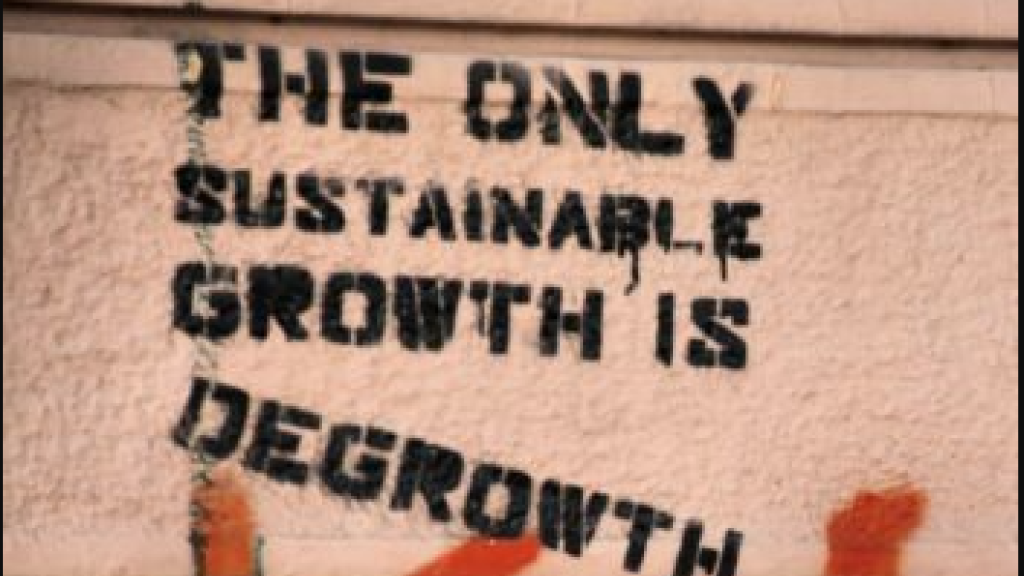
sustainable growth is degrowth

A statement issued by hundreds of scientists and others at the Global Tipping Points Conference, held at the University of Exeter on June 30-July 3 began with this rim prediction: “Global warming is projected to exceed 1.5°C within a few years, placing humanity in the danger zone where multiple climate tipping points pose catastrophic risks to billions of people.”

Current warming, the statement explained, has activated “irreversible changes and every fraction of additional warming dramatically increases the risk of triggering further damaging tipping point.” If this assessment is correct, any significant revolutionary change that takes place this century will have to do so amid catastrophic global climate change. 

Academic discourses on the global situation speak of “multi-crises,” but this is just a belated recognition of something that should have been observed decades ago. Political, social, economic and environmental crises are now deeply interlinked. The brutal and horrific genocide in Gaza is at the top of our minds today but equally horrific genocides continue to play out in Sudan and large swathes of sub-Saharan Africa.

All this is perhaps most stark in sub-Saharan Africa, where famine is more often the only harvest of the land. But in other parts of the world catastrophic floods, wildfires and mega storms are accentuating already severe political, social and economic crises and driving mass displacement. Countries such as Indonesia and Nigeria are political tinderboxes, capable of exploding into political revolt at any time, as we have seen. Significant parts of the Middle East, Africa, Asia and Latin America can also be described this same way.

In all these cases, the key elements of a revolutionary situation, as described by Russian revolutionary Vladimir Lenin, are either at play or coming into play. The ruling classes are increasingly unable to rule in the old way and the exploited classes are unable to live in the old way. 

But Lenin also pointed out that not every revolutionary situation leads to revolution. If a conscious revolutionary force has not developed its own organisation and earned enough political authority among working people, then revolts will be defeated or at best result in a change of elites.

Right-wing populism

All classes that are conscious of their interests are now making moves to protect them in this period of intensifying crisis. Today, the ruling capitalist class is most conscious of its situation; the lower working classes remain in a state of uncertainty, division and confusion. 

The political responses from growing sections of the billionaire class makes it clear that they are increasingly unable to rule in the old way and therefore lurching to right populism. We see this all around the world. 

United States President Donald Trump and his Make America Great Again (MAGA) movement have their own bizarre characteristics, accentuated by messaging on social media and Trump’s narcissistic and often bizarre statements. But the issues around which this right-wing populist movement was built — racism, sexism and anti-immigrant/refugee mobilisation — are common to rising right-populist movements in Europe and here in Australia.

Anti-refugee attacks are a key mobilising factor for these movements, as the numbers of people displaced by war, repression and insecurity in the Global South grows. Trump’s “drill, baby, drill” policy and the refusal of other major fossil-fuel exporting countries to stop their climate-destroying behaviour will only ensure the global refugee crisis worsens. This includes Australia, the world’s second biggest exporter of carbon pollution, which has plans to continue expanding mega fossil fuel mining projects.

The peer-reviewed 2025 Production Gap Report confirmed that governments collectively plan to produce more than double the amount of fossil fuels than would be consistent with achieving the Paris Agreement goal of limiting global warming to 1.5°C or 2°C. Consequently, even more people in the Global South will be forced to make the perilous attempts to get to relative safety in the Global North. 

Most will only make it to neighbouring countries in the Global South with capacities to support their peoples already stretched to the limit. The growing refugee crisis will be politically exploited by Trump and other right-wing populist governments, making it a vicious cycle.

The political ground for today’s right-wing populist movements was laid by the traditional parties of government in the imperialist countries — including the old social democratic parties — through four decades of neoliberalism, which cut real wages, worsened working conditions, reduced job security and slashed social services and welfare. 

These parties also targeted refugees. In Australia, for instance, Labor governments deployed policies of indefinite imprisonment-without-trial and deportation against refugees well before Trump tried to bring them in.

The traditional parties of government in the imperialist countries also fuelled racism and Islamophobia to legitimise their wars on Afghanistan and Iraq, and their war drive against China. Those and subsequent wars also turbocharged the refugee crisis.

Backed by billionaires

A growing sense of anger and disillusionment with traditional politicians was seized as an opening by billionaire-backed right-wing populist politicians, either within old parties or newer ones.

Billionaires have many ways to secretly channel funds and political support to political movements and their leaders. Undoubtedly, there is a lot of this going on unseen today. 

But with Trump’s second election, more billionaires have come out to openly support him. Not just US billionaires, but also European, South American and Australian billionaires. The richest person in Australia, Gina Rinehart, proudly supports Trump and Trumpism, as do others.

Zionists supporting the genocide in Gaza have also funded far-right groups. In Australia, the family trust of Jillian Segal, the Labor-appointed Special Envoy to Combat Antisemitism, is a major funder of far-right campaigns.

All this is evidence that more sections of the ruling class are now preparing the grounds to rule in a “new way”. So, what is happening on our side of the class divide?

Here the situation is grim. The working masses in most countries are angry, frustrated and dissatisfied, but also confused and divided over where their interests really lie. In addition, the trade union movement is weaker than it has been for a long time and its leaders are conservative and often politically compromised.

In Australia, we got a sense of this on August 31, as tens of thousands marched in a series of racist March For Australia demonstrations, which focused on anti-immigration demands but also raised explicit white supremacist politics. In the biggest cities, these marches were led by contingents of black-clad neo-Nazis belonging to the relatively small but growing National Socialist Network (NSN). 

These thugs assaulted several people in Melbourne and, after the march, launched a violent attack on the First Nations’-led Camp Sovereignty, hospitalising a number of First Nations women activists. In Sydney, some people returning from a simultaneous and peaceful Palestine solidarity and anti-racist march (which drew about 4000 people) were assaulted on a train by racists who had come from the March For Australia. 

The far-right took heart from this response and called for a further round of racist marches on September 16.

Material basis for racism

Long ago, Karl Marx, Friedrich Engels and Lenin identified the material basis for racism and chauvinism in the working class in imperialist countries. It rests on the relatively better off conditions of workers in the Global North, which the ruling classes use to promote the idea that workers have more in common with them than workers in the Global South.

Lenin also spotlighted the culpability of social democratic party leaders in selling this poison to the working class. The history of the labour movement in imperialist countries is replete with proof of this criminal betrayal. In Australia, the bulk of trade union leaders (who are totally enmeshed with the capitalist Labor party and aspire to graduate to a cushy Labor parliamentary seat) have failed to stand up to Labor and the Coalition’s anti-refugee and pro-war policies.

Over the past two years, the trade union movement and the Labor party (with a few exceptions) were notably absent as a huge Palestine solidarity movement grew through numerous mass mobilisations — including the 300,000-strong march across the Sydney Harbour Bridge and the 350,000 Nationwide March For Palestine.

Rather, Labor governments engaged in several attempts to suppress this movement, falsely accusing it of antisemitism. At the same time, they excused Israel’s genocide and continued to supplying it with arms and weapons components. They have been complicit in genocide and fuelling racism.

Most political parties condemned the March For Australia, but Labor PM Anthony Albanese shamefully said there were “good people” at those protests. This was an ugly echo of Trump’s defence of the 2017 white supremacist march in Charlottesville, Virginia, when he said they included “some very fine people”.

Imperialism 

What does this tell us about the intersections and intermeshing of the crises that are shaping the Anthropocene? Jason Hickel, in a thread on X hit the spot when he said: 

Imperialism and racism are central to the capitalist world economy. The barbarism is a feature, not a bug.

Imperialism is not a side-gig, not an over-reach committed by greedy individuals, it is a structural feature of the capitalist world economy.

Beginning in the long 16th century, the regions of what today we call the global South were forcibly integrated into the Europe-centred capitalist world economy as providers of cheapened labour, resources and goods. This was an extraordinarily violent process, involving colonization, dispossession, mass enslavement, and genocide.

How could anyone possibly justify these horrors? Race. Discourses of white supremacy and racial hierarchy were fabricated by the European ruling classes to dehumanize the majority world, hiving them off from the realm of rights, to provide the ideological scaffolding necessary to justify apocalyptic levels of exploitation and bloodshed in the periphery.

And of course these very same discourses were deployed within the core itself, to justify paying lower wages to racialised people, and to deny them equal access to resources.

Racial ideology was promoted so aggressively that it developed its own momentum of hatred and violence.

Racism, like imperialism itself, is not a side-show to capitalism but a structurally necessary feature of it. It is not a standalone problem that can be addressed with a few liberal reforms here and there. It has always been central to capitalism and it remains that way today.

Overcoming capitalism — in other words, transitioning to a democratic socialist economy — is ultimately necessary to end structural racism and imperialist violence.

The struggle against racism must be anti-capitalist, and the struggle against capitalism must be anti-racist.

Greenwashing

One of the political consequences of the enmeshment of the struggles against ecocide, racism, misogyny and imperialism and for working class living conditions, is that it is harder to sustain old-school “environmentalism” as a viable response to the overall crisis of the Anthropocene.

In their desperation to lobby established institutions of capitalist power to prove there is a win-win solution to the crisis for the capitalist class and the rest of us, many environmental NGOs have become tools of the greenwashing schemes of sections of the capitalist class. 

They have ended up lowering their expectations to fit in with dodgy “net-zero” carbon emissions targets, which in Australia’s case somehow shows “progress” despite actual rises in emissions from most sectors (mining, transport, manufacturing and construction).

It is true that sections of the capitalist class see opportunities to profit from the transition to renewable energy, especially now that technology has made it cheaper than energy from fossil fuel and nuclear energy. But the ways they seek to harness this shift prioritises their ability to profit from it.

So, rather than properly harnessing solar energy in ways that could address social needs such as housing and secure jobs — through programs such as the mass construction of ecologically sustainable public housing — capitalists come up with schemes such as building giant solar farms in the remote north and laying an underwater cable to sell electricity to Southeast Asian markets.

They come up with plans that depend on continuing the grossly unequal relations between the rich imperialist states of the Global North and those of the Global South — relations which are part of the climate emergency.

Capitalism

Addressing a conference in Havana, Cuba, last year Hickel said: 

We call it the Anthropocene, but we must be clear: it is not humans as such that are causing this crisis. Ecological breakdown is being driven by the capitalist economic system, and — like capitalism itself — is strongly characterised by colonial dynamics.

This is clear when it comes to climate change. The countries of the global North are responsible for around 90% of all cumulative emissions in excess of the safe planetary boundary — in other words, the emissions that are driving climate breakdown. By contrast the global South, by which I mean all of Asia, Africa and Latin America, are together responsible for only about 10%, and in fact most global South countries remain within their fair shares of the planetary boundary and have therefore not contributed to the crisis at all.

And yet, the overwhelming majority of the impacts of climate breakdown are set to affect the territories of the global South, and indeed this is already happening. The South suffers 80‒90% of the economic costs and damages inflicted by climate breakdown, and around 99% of all climate-related deaths. It would be difficult to overstate the scale of this injustice. With present policy, we are headed for around 3⁰C of global warming. At this level some 2 billion people across the tropics will be exposed to extreme heat and substantially increased mortality risk; droughts will destabilise agricultural systems and lead to multi-breadbasket failures; and hundreds of millions of people will be displaced from their homes.

Climate breakdown is a process of atmospheric colonisation. The atmosphere is a shared commons, on which all of us depend for our existence, and the core economies have appropriated it for their own enrichment, with devastating consequences for all of life on Earth, which are playing out along colonial lines. For the global South in particular, this crisis is existential and it must be stopped.

Hickel is obviously right on this. Through their own actual experience, climate activists around the world are also coming to similar conclusions.

Revolutionary degrowth

Like Japanese Marxist Kohei Saito, Hickel is an anti-capitalist proponent of degrowth as a necessary step to address the climate emergency. But where Hickel goes further than Saito is that he has drawn out the global and anti-imperialist nature of the struggle to address the climate emergency (and the more broader multi-crises).

Hickel’s argument is that it is not just reliance on fossil fuels that imperils the planet, but capitalism’s chronic pursuit of economic growth. Unlimited growth means more demand for energy. And more energy demand makes it more difficult to develop sufficient capacity for generating renewable energy in the short time left to avert catastrophic warming.

Ultimately, this is because, as Hickel says, “while it’s possible to transition to 100 percent renewable energy, we cannot do it fast enough to stay under 1.5°C or 2°C if we continue to grow the global economy at existing rates.”

We need a planned and purposeful reorganisation of the global economy to benefit the vast majority of people and to do that we have to overthrow capitalism. Growth for growth’s sake has to be abandoned, and addressing global inequality requires significant adjustments. 

Some leftists criticise Hickel saying he does not tell us how to overthrow capitalism. But who really has the complete recipe to do that? No one.

Others criticise him for only putting forward demands on governments. But that is the bread and butter of the practical struggles that we are all engage in. Our objective, as revolutionary ecosocialists, is to independently mobilise the working class in progressive struggles as the best way to educate and empower the only class with the potential to overthrow capitalism.

Others argue that we have to reject degrowth because it will never be popular with the working class under capitalism. It is true that it may not be a popular slogan, but it is still something that needs to be explained by revolutionary socialists, much like imperialism and racism. 

Arguing against economism, Lenin wrote in What Is To Be Done? that revolutionaries have a duty to go beyond immediate struggles between workers and bosses to explain the broader problems with capitalism and draw the working class into struggles against all oppressions.

The working class is already beginning to rebel against the capitalists’ demand for more economic growth and productivity, which only serves to make them even richer. 

Whether it is in movements to defend the environment from rapacious mining companies, to movements against the growing arms industry, to the battle for housing, education and other social needs, the question is posed: economy for who and for what? For profits or for the common good?

Based on a talk given to Ecosocialism 2025. Peter Boyle is a Socialist Alliance national executive member.

Despite U.S. Sanctions, Iran's Oil Exports Hit Record Levels

Iran's oil export volumes now rival the days when its ships operated openly, under the banner of NITC (file image courtesy NITC)
Iran's oil export volumes have reached levels that rival the days when its ships operated openly, under the banner of NITC (file image courtesy NITC)

Published Nov 9, 2025 11:43 PM by The Maritime Executive


As Russia faces tightening Western sanctions on its oil exports, its producers may well look to Iran for tactics to evade restrictions and keep the crude flowing to global markets. Despite "maximum pressure" U.S. sanctions, Iranian oil exports hit a seven-year high of 2.3 million barrels per day in October, per TankerTrackers.com - up from just 400,000 barrels per day five years ago. The achievement shows Iran's well-honed skill in disguising and moving its barrels, as well as China's constant appetite for discounted crude. 

Iranian oil analyst Homayoun Falakshahi put the number slightly lower at 2.1 million barrels per day, but noted that this would still be at near-record levels. September's numbers were also exceptional for Iran, coming in at about 2.1 million barrels per day at a price discount of about 5-10 percent below dated Brent. This is enough oil to raise roughly $4 billion per month to support the Iranian regime, according to Saeed Ghasseminejad of the Foundation for Defense of Democracies. 

Almost all of the oil is sold to buyers in China, where it is popular with the owners of private "teapot" refineries. China accounts for the sale of nine out of ten barrels from Iran, thanks in part to extensive use of subterfuge methods like ship-to-ship transfers, blending and falsified paperwork. 

"Despite the framework of U.S. economic pressure, Iran’s observed exports, averaging roughly 1.8 million bpd in 2025, exceed levels recorded during the first Trump administration’s maximum pressure campaign, reflecting the evolution of a parallel ecosystem of shadow tonnage, permissive registries, and non-transparent financing," commented Ghasseminejad in a research note published last month.  

The numbers show Iran's continued ability to flout American pressure. Upon taking office in January, President Donald Trump instructed the State Department to "impose maximum economic pressure on the government of Iran." The executive order was intended to deny Iran the financial ability to make nuclear weapons and ballistic missile systems; Iran's nuclear program was dealt a major setback in June when long-range American airstrikes hit its uranium enrichment facilities, but many analysts believe that its nuclear ambitions remain intact. 

The October numbers also follow the reimposition of UN sanctions on Iran's nuclear program. On September 27, with backing from European Union member states, the United Nations rebooted six sanctions resolutions that had been dormant since 2015 under the terms of the Joint Comprehensive Plan of Action (JCPOA), commonly known as the "Iran nuclear deal." The UN sanctions target Iranian nuclear and military activities, including its arms export industry, but do not take aim at its energy trade. 

Flying Taxis Edge Closer to Reality


  • eVTOL technology is advancing rapidly, with companies like Archer Aviation and Xpeng leading pilot projects for urban air taxis.

  • Governments and industry leaders are developing infrastructure such as Vertiports and air traffic management systems to support AAM operations.

  • Widespread adoption hinges on regulatory clarity, public acceptance, and investment in charging and safety systems.

Advanced air mobility (AAM) may no longer be a pipedream, as several cities around the globe are conducting pilot projects in the hope of launching commercial operations over the next decade. Innovations in AAM could lead to the launch of air taxi services in several spots worldwide, helping commuters to avoid traffic and get to their destinations faster.

Electric vertical take-off and landing (eVTOL) vehicles rely on electric propulsion, powered by electric motors that allow them to take off and land vertically, reducing the urban space needed to transport people. Unlike other aircraft that require a runway, eVTOLs are ideal for busy, urban environments. They are typically powered by batteries rather than internal combustion engines, meaning they do not burn fossil fuels. Some of the benefits of using eVTOL compared to other aircraft include reduced emissions, lower noise pollution, and higher efficiency.

Several companies have emerged in the eVTOL space in recent years, such as Joby Aviation and Volocopter. Companies investing in the space vary from established aerospace firms to innovative start-ups. As the lithium-ion batteries we use in electric vehicles (EVs) continue to improve in range, cost, weight, and efficiency, those same batteries can be used for eVTOL, which is generating more optimism in the AAM space.

The air taxi market is expected to grow from $43 billion in 2025 to $86.6 billion by 2034, according to a Research and Markets report. This anticipated improvement is owing to rapid technological and regulatory advancements and the growing demand for this type of transport. Advanced technologies, such as artificial intelligence (AI), are expected to drive innovation and boost efficiency in the coming years.

Laurie Garrow, the co-director of Georgia Tech’s Centre for Urban and Regional Air Mobility, said that the rollout of eVTOLs will require greater investments in associated infrastructure, such as the Vertiports needed for aircraft to take off and land vertically. In addition, “charging systems and robust fire safety protocols for high-energy batteries” will be key, said Garrow. “And perhaps most critically, we need ‘rules of the road in the sky’ to manage air traffic around existing airports.” 

Several countries worldwide are developing eVTOL operations to launch commercial air taxi services over the next decade. In South Korea, in October, Korean Air signed a deal with U.S.-based Archer Aviation to launch commercial electric air taxis, with a view to purchasing up to 100 aircraft.

Archer announced that the agreement means that its Midnight eVTOL will be used “across multiple applications and use cases, starting with government applications.” The aircraft is designed to carry out between a 10- and 20-minute flight, and a prototype recently completed a series of performance test flights, with two of its highest-altitude flights to date. The U.S. firm has gained the backing of some industry majors, including Boeing and Stellantis. It is currently producing six aircraft at two facilities in the U.S. In September, Archer won a bid to acquire rival Lilium’s portfolio of around 300 AAM patent assets for $21 million, thereby expanding its portfolio to over 1,000 patent assets.

The United Arab Emirates has big plans of its own. The Chinese EV maker Xpeng recently showcased its eVTOL in the Gulf state – the Land Aircraft Carrier, a two-seater EV that can be flown with or without a pilot. Ali Ahmad Al Blooshi, an aviation expert at Dubai Civil Aviation, stated, “We imagine the airspace as being like a street today.” Meanwhile, Michael Du, Xpeng Aeroht’s CFO and vice president, said, “During our R&D process, we have made 200 of those and conducted more than 5,000 safety testing flights in extreme heat, high altitude, extreme cold, moist areas.”

And it’s not just air taxis that the AAM sector is looking to develop. In a recent white paper published by the World Economic Forum (WEF) in collaboration with Kearney, they authors discuss the potential for multiple applications of AAM. “Advanced air mobility is spearheading innovative new technology in the aviation industry... Application opportunities for AAM are manifold across passenger and non-passenger (goods and services) transport clusters,” the report states.

It outlines how innovations in AAM are expected to reshape how we think about air travel, logistics and urban transport, as the aircraft could be used for passenger transport and goods delivery, as well as in emergency response and to access remote locations.

However, to achieve the commercial rollout of AAM, some hurdles must first be overcome. Governments hoping to launch eVTOL must establish clear regulatory frameworks and support public awareness campaigns to encourage social acceptance. In addition, greater investment must be seen in associated infrastructure, such as Vertiports and charging stations.

There is significant potential for the commercial rollout of eVTOL within the next decade, based on successful test flights and rapid innovations in technology. However, to achieve commercial flight, aviation companies must work with governments to develop informed regulatory frameworks, establish flight routes, and develop the infrastructure needed to support operations. 

By Felicity Bradstock for Oilprice.com