Thursday, December 18, 2025

How Jeff Bezos Uses the Washington Post to Promote Inequality



 December 18, 2025

Photograph Source: Steve Jurvetson – CC BY 2.0

With the country and world being inundated with Trump craziness on a daily basis, it feels wrong to step back to deal with more basic points about economics, but sometimes the urge is overwhelming. I couldn’t resist commenting on this WaPo column by Dominic Pino, one of the paper’s editorial writers, justifying a pay package for Starbuck’s CEO Brian Niccol that could net him $95 million.

The gist of Pino’s argument is that Niccol would be worth this much money if he turns around the company’s fortunes and substantially raises its stock price. In Pino’s telling, Niccol could add many times more than this to the value of the company’s stock, so what’s wrong with giving him a small cut? This is a standard line by promoters of inequality.

What’s Wrong with a Big Paycheck?

Probably the best place to start here is a simple comparison. The fire at Notre Dame Cathedral in 2019 was first discovered by a security guard. He promptly reported the fire, as he was supposed to do. Unfortunately, there were mistakes in the follow- up and the fire quickly spread and destroyed much of the structure.

However, if the people subsequently notified had not messed up, the fire might have been quickly extinguished, saving $760 million in damages. By the Pino logic, it would be perfectly reasonable to pay the security guard a share of the savings, say $76 million, or 10 percent.

My guess is that Pino does not think we should have security guards making $76 million. The reason is that notifying people when a fire alarm is triggered is a relatively straightforward task that most workers could do. It’s not necessary to pay someone $76 million to pass along an alarm.

That’s a good response, now let’s ask that one about Niccol. Does Mr. Niccol have some special sauce that allows him to turn lemons into fantastically profitable companies. This is apparently what Niccol accomplished at Chipotle, after first having a successful stint at Taco Bell.

Does this mean Mr. Niccol has some special ability to make a fortune for Starbuck’s shareholders? Perhaps, but there are some other possibilities.

Maybe Mr. Niccol is just a replacement level CEO or even high-level executive. Perhaps any other person with some experience in the fast-food industry could turn in a comparable performance, just as presumably many other security guards could have made the initial warning at Notre Dame.

In the case of Chipotle, Mr. Niccol may have just got lucky. It does happen. Would anyone think it makes sense to pay the Notre Dame security guard $76 million at their next job?

Tales of Luck and Failure

A quarter century ago Home Depot hired Bob Nardelli as its CEO, believing also that it was getting a superstar top executive. Nardelli had been a top executive at GE, then the most valuable company in the world, and was runner-up in the contest to replace Jack Welch when he stepped down. (The winner of the contest, Jeffrey Immault, also bombed as CEO, with GE’s stock price falling 30% under his tenure.)

Nardelli captained Home Depot for seven years, during which time its stock price sank by 40 percent. The stock of its main competitor, Loew’s, nearly doubled over the same period. Nardelli walked away with $240 million, which would be a bit less than $400 million in today’s dollars.

To take another example, Lee Raymond left Exxon Mobil with a $321 million severance package. His main accomplishment at Exxon Mobil was being CEO at a time when world oil prices quadrupled.

To take a more recent example, Boeing CEO Dennis Muilenberg left the company in 2020, pocketing $62 million. He was noted for his inadequate attention to safety, resulting in two crashes of the 737 Max plane, causing hundreds of deaths. This failure sent the company’s stock price plummeting.

These are extreme cases, but Pino could have easily written the same piece about each of these executives at the time they got their jobs. There surely was a good case for why the returns they would produce for shareholders would have warranted outlandish pay.

Moving Beyond Anecdotes, What the Evidence Shows

Fortunately, we don’t have to argue by anecdote, there is research on the correlation between CEO pay and returns to shareholders, and it mostly shows that it goes the wrong way.

In the textbook story of capitalism, the corporate board that hires and sets the pay of CEOs are supposed to look at their salaries the same way the CEO looks at the pay of retail clerks and assembly line workers. The board wants to pay as little as possible for their CEOs, to leave more money for profits and shareholders. It rarely works out that way.

While corporate boards are supposed to represent shareholders, they are largely self-perpetuating entities. It is extremely difficult for shareholders to defeat an incumbent supported by their colleagues. Well over 99 percent of board members who are nominated for re-election by their board win.

This means that the best way to stay on a board is to go along with your fellow board members and not make waves. Since being a board member is a very lucrative job, paying hundreds of thousands annually for a couple of hundred hours of work, most board members want to keep the job.

And since corporate boards usually owe their appointment to the CEO and other top management, they are not likely to make friends on the board by asking questions like “can we get someone just as good for half the pay?” That doesn’t explain outlandish pay for a newly hired CEO (except they are probably recommended by top management), but it does explain how CEO pay gets so bloated in the first place.

And it is important to remember that CEO pay is not just the pay of one person. If the CEO makes $95 million, it’s likely the rest of the C-Suite are all pocketing over $10 million, and the third-tier execs are also likely making multiple millions. That means much less money for everyone else.

Imagine how different things would be if CEO pay had grown in line with ordinary workers’ pay over the last half-century and they were just earning $3-$4 million a year. And this pay structure affects salaries outside the corporate sector. The heads of universities and major non-profits often are paid multiple millions. Cabinet officers routinely tell us of the great sacrifices they are making with their $250k annual paycheck.

Moving Beyond Shareholders

This discussion is just accepting that we should only be concerned about what the CEO produces for shareholders when assessing their pay, but let’s take a step further. Mr. Niccol could produce strong returns for the classic story of free market capitalism. Perhaps Starbucks will bring in swarms of customers because it serves better coffee and food at a lower price than its competitors. In that case, we could say that Niccol had actually produced real value for society as a whole.

But that is only one way that companies increase profits. Suppose Niccol breaks the Starbucks union by ruthlessly firing organizers, in violation of the law. Since Donald Trump says it’s fine to ignore laws protecting workers under his presidency, that is certainly a possibility.

Starbucks may also increase its profits through anticompetitive practices, using its size to kneecap competitors, as it arguably did in its growth to be a worldwide giant. And it could just lie, falsely advertising items as organic or having other desirable features, knowing that the law doesn’t apply to large corporations with Donald Trump in the White House.

In these cases, Mr. Niccol’s salary might be justified in terms of its returns to shareholders. But it would be hard to make a case that giving tens of millions to a CEO for breaking the law by screwing workers, competitors, or customers is a social good.

The 401(k) Story

The best part of Pino’s piece is when he tells us that Mr. Niccol’s big paycheck will benefit all of us because it will increase the value of retirement accounts invested in index funds. This doesn’t do the 40 percent of households that don’t have retirement accounts any good, many of whom undoubtedly work at Starbucks. Even for those who do have stock, half have less than $60,000, so getting another $10k a year in their paychecks would probably look much better than whatever incremental value a jump in Starbuck’s price might have on their retirement account.

But Pino’s case is actually even weaker. If Starbuck’s stock price rises because it beats out competitors, then whatever incremental value it might produce in people’s retirement accounts will be offset by the reduced value of other stocks in people’s holdings. The only true gain in retirement accounts would be if Mr. Niccol’s changes at Starbucks increased corporate profits as a whole. Even in this case, if the gains are from ripping off workers and/or consumers, those with little or no stock are still losers.

The Populists are Right

This is a long way of saying that Zohran Mamdani, Bernie Sanders, and the other populists that Pino derides for attacking Mr. Niccol’s paycheck have a case. But you can’t make the case for populism on the Jeff Bezos-owned Washington Post opinion page committed to justifying inequality.

This first appeared on Dean Baker’s Beat the Press blog.

Dean Baker is the senior economist at the Center for Economic and Policy Research in Washington, DC. 

Portugal

The general strike demonstrates that struggle can open up paths for the left

Thursday 18 December 2025, by Jorge Costa


Held on 29 and 30 November, the 14th Convention of the Left Bloc took place at a critical moment: a few days before the general strike on 11 December against the new labour law; after parliamentary and municipal elections with mediocre results for the left-wing parties; and less than two months before presidential elections that reflect the current hegemony of the right.


The general strike, the first since the days of the Troika, was called by the two main trade union confederations, CGTP and UGT, which has only happened in half of the ten general strikes held since the end of the dictatorship. Despite the current isolation of the left, the mere affirmation of the trade union movement’s initiative made it possible to change the terms of the public debate. It highlighted the process of social regression led by the right and camouflaged by the deafening noise of the campaigns of hatred and lies that monopolise the public space.

The brutality of the labour package reveals a minority and unstable government, which aims to do as much damage as possible as quickly as possible, while it still has the opportunity to permanently undermine the position of labour in the balance of social forces. In this context, the general strike was a success in terms of participation, not only in the state sector: minimum services in air transport, strikes at Volkswagen, Mitsubishi Fuso and also in the commerce and industry sectors. According to the CGTP, more than three million workers joined the struggle. Despite the almost total absence of transport, the demonstration in Lisbon brought together many thousands of people, mostly young and non-unionised workers, who made their presence felt.

The general strike is a political success: its call, after 12 years and in a unified manner, has created mass awareness of the seriousness of the offensive and has made it difficult to form a PSD-Chega parliamentary majority to pass the legislative package. Only employers are enthusiastic about the new laws; in surveys, two-thirds of respondents say they agree with the reasons for the strike; none of the right-wing presidential candidates dares to openly support the counter-reform; trade unionists affiliated with the ruling party participated in the general strike and, on the same day, the government’s attempt to describe the strike as insignificant was met with ridicule. The leader of the neo-fascists, who for weeks attacked the unions and defended the new laws, now claims to understand the strikers’ reasons and talks of withdrawing some of the absurd elements of the government’s proposal. We will see what political price André Ventura is willing to pay to please the bourgeoisie with his parliamentary vote.

The annus horribilis of 2025

With the left at its worst result in history and the PS overtaken by the neo-fascists, immediately after the parliamentary elections last May (read the assessment here), the new socialist leadership made it clear that it is willing to guarantee the approval of the Montenegrin government’s state budget. This, at the same time as the right-wing counter-reforms are being approved by agreement with Chega. We will return to the current political situation later.

In the October municipal elections, the shift to the right became more pronounced, with the right wing conquering the largest cities. The PCP, with a strong municipal tradition, lost a third of its elected representatives and the two district capitals it still governed. The Bloco and Livre, allied in some twenty major cities, obtained weak results, even worse when they ran separately.

As for the presidential elections, the polls give an advantage to two right-wing candidates (Marques Mendes and Gouveia e Melo) and the leader of the far right (André Ventura), all of them around 20%. The candidate supported by the PS – a figure on the far right of the party – appears to be out of the running for the second round and on a par with the ultra-liberal candidate (10%). The candidacy of the former coordinator of the Bloco, Catarina Martins, is around 5%, followed by those of the PCP and Livre. Thus, the Portuguese right could consolidate its hegemony in 2026, controlling the government, the presidency and, for the first time in history, a parliamentary majority of more than two-thirds, capable of passing constitutional reforms without the Socialist Party or any other left-wing party.

A party rethinking itself in new circumstances

Despite lower militant participation reflecting this cycle of setbacks, the Bloco Convention was a moment of respite and of encounter between the Bloco and its plurality. Four political motions were voted on at the 14th Congress, and motions A (65 elected), S (8), H (4) and B (3) will be represented on the elected National Bureau. For motion A, the Bloc ‘must be a driving force for convergence, while reclaiming the political space that only it occupies and from which it can grow: loyalty to the exploited classes and a strategy to expand its movements; a commitment to pluralism and convergence as the foundation for building the socialist party; internationalism against all empires and oligarchs’. José Manuel Pureza, 66, a university professor and former MP, succeeds Mariana Mortágua, who decided not to stand again as national coordinator. In recent years, Pureza has been the visible face of the fight for the right to assisted death and has participated in initiatives for dialogue between Marxists and Christians.

In addition to the political diagnosis, the Convention carried out a broad renewal and rejuvenation of the leadership bodies – the National Bureau and the Political Commission – whose composition includes 50% new members. The Convention debate was also marked by issues of party organisation and the need to intensify regularity, autonomy and participation in the democratic life of the Bloc. What decides political life is the creation of grassroots organisations and militant working groups, communities of reflection and action.

Five issues on the situation in Portugal


1. The PSD government and the PSD/Iniciativa Liberal/Chega parliamentary majority are carrying out a social assault on labour, immigration and housing. And Prime Minister Luís Montenegro has achieved the feat of getting the PS to normalise the process, turning the state budget into a product of the central bloc. The case is strange: Montenegro thus articulates a parliamentary base of 95% of MPs. We are witnessing the decomposition of traditional politics, which would not be bad news if this decomposition were not led by the oligarchy: the centre is being dragged to the right and both are following in the wake of Chega.

2. The weakness of the left is the result of the geringonça, the agreements between the PS, the Bloco and the PCP signed in 2015 and which remained in force until 2019. What remained engraved in the popular consciousness from that period was not the real progress achieved, nor the Bloco’s reasons after 2019, the vote against the PS’s budgets, nor the crisis orchestrated between Costa and Marcelo to fabricate an absolute majority. What remained engraved was the PS government from 2019 onwards, a post-Covid period led by mediocre rulers, who left the state coffers lacking money for healthcare, housing policy and working conditions.

The image of the left, even after the geringonça, remained stuck with the bad government of 2019-2022 and the absolute majority. We did not have the strength to avoid this. And that would not have changed, nor will it change, with words alone. It will change when we manage to interpret the revolt, take the initiative and play a new leading role in the struggle. Without that, nothing will be easy in the future for any left-wing party.

3. The difficulties faced by the parties do not mean that it is impossible to mount struggles. The Italian left has been in tatters for two decades, but it organised a general strike involving millions of people in support of Palestine. Here we are on the eve of another general strike, a critical moment to change the political atmosphere. And even in a year as bad as 2025, there have been very important signs: the largest demonstration of immigrant workers in the last decade, the emergence of black youth from the suburbs of Lisbon, the expansion of solidarity with Palestine in the days of the flotilla. In these struggles, the left grows stronger and breaks its isolation, contesting the issues of public debate through concrete mobilisation. This is also where the Bloc breathes.

4. It is not the difficulties of the parties that dictate the need for convergence. What imposes convergence today is the need to face the quagmire: we have a government allied with the neo-fascists and supported by the PS. In the struggles for public services and housing, for work and against the fascistisation of social life, it is necessary to identify the lines of confrontation. Let us then think about the politics of movements, encourage the presence of activists, and open all channels of dialogue.

5. Let us do the calculations that everyone has already learned to do: in separate electoral vehicles, the left offers councillors and deputies to Chega and contributes to the swamp overflowing and elevating the neo-fascists to the leading political force, as is already happening in several European countries. The Bloc has its social space, which comes from the difference in its politics and programme, its worldview and its party culture. All of this, as we well know, radically distinguishes us from parties such as Livre or the PCP. These differences are as important as the real need to converge in the struggles and offer the people an electoral alternative based on what the left has in common. A pole that prevents democracy from being reduced to power games between Luís Montenegro and his two partners, Chega and the PS.

12 December 2025

Translated by International Viewpoint from Vientosur.


Attached documentsthe-general-strike-demonstrates-that-struggle-can-open-up_a9316.pdf (PDF - 915.4 KiB)
Extraction PDF [->article9316]

Jorge Costa is a member of the full-time leadership of the Bloco de Esquerda and of the Executive Bureau of the Fourth International. He is co-author of The Owners of Portugal - One hundred years of economic power (1910-2010) and The Bourgeoisie – who they are, how they live and how they rule (2014) with Francisco Louçã and João Teixeira Lopes.


EU backtracking on its Green Deal

EU backtracking on its Green Deal
Economic and worries about competitiveness has led the EU to soften its Green Deal rules. / bne IntelliNews
By Leon Aris in Berlin December 18, 2025

The European Commission is preparing to scale back one of its most ambitious climate pledges as it seeks to relieve pressure on its lacklustre economy. The commission announced this week that it will drop plans for a complete ban on the sale of new internal combustion engine vehicles from 2035.

The shift reflects growing concern among governments and industry that targets agreed in the early 2020s are colliding with economic, geopolitical and competitiveness realities — a dynamic increasingly visible not only in the ongoing deindustrialisation  that started in Germany, but is now spreading to the agriculture sector.

The ban on combustion engines law, adopted in 2022, stipulated that from 2035 all new passenger cars and vans sold in the EU must produce zero carbon dioxide emissions. In practice, this amounted to a ban on new petrol and diesel vehicles and a requirement for a full transition to battery electric or hydrogen fuel cell models, a cornerstone of the bloc’s plan to achieve climate neutrality by 2050.

Agriculture, which was expected to deliver parallel emissions reductions through lower fertiliser use, pesticide cuts and land-use changes, has been subject to similarly rigid targets under the Green Deal that has been the signature initiative for the last decade.

Climate rules softened

Despite the roll back, Brussels insists it is not abandoning its climate goals. According to reports by the Financial Times and Reuters, the Commission is instead preparing to adjust the mechanism underpinning the car ban, that the industry hated.

Under revised proposals, carmakers would no longer be required to eliminate CO₂  emissions entirely. Residual emissions of up to 10% of 2021 levels could be permitted, provided strict conditions are met. A comparable shift has already taken place in farming, where the Commission has eased environmental conditions attached to Common Agricultural Policy subsidies and withdrawn a proposal to halve pesticide use by 2030 following widespread opposition.

“Farmers are not against sustainability, but the pace and scale of these targets are disconnected from economic reality,” said Pekka Pesonen, Secretary General of Copa-Cogeca, which represents EU farmers and cooperatives, in comments reported by Reuters. “If policies are not adjusted, production will simply move outside Europe.”

People familiar with the automotive discussions say the new conditions would include the use of low-carbon materials, particularly green steel, and the production of extended-range electric vehicles, which rely primarily on batteries but include a small internal combustion engine as a backup power source. Reuters has also reported that officials are discussing extending the effective ban by five years or softening it indefinitely, a move that would mark the EU’s most significant retreat from its climate agenda in recent years.

In agriculture, farmer groups argue that similar flexibility is needed on fertiliser use and crop rotation rules, warning that rigid mandates risk undermining food security.

In March, the Commission had already granted automakers a three-year grace period to meet separate CO₂  reduction targets originally due by 2025, signalling a broader willingness to introduce flexibility. That decision followed months of protests by farmers across France, Germany, Poland, Italy and Belgium, where growers blocked roads and borders to demand relief from environmental regulations, they said were being implemented faster than markets and technology could adapt.

“We are being asked to do more with less, while competing with imports that do not follow the same rules,” Arnaud Rousseau, head of France’s FNSEA farm union, told Reuters during protests earlier this year. “This is not a rejection of environmental goals, but a demand for fairness.”

“It is a geopolitical moment and a complicated context,” said Sara Aagesen, Spain’s minister for the ecological transition. “The Commission itself has already introduced flexibilities in the past.”

Under the emerging automotive framework, tailpipe emissions would be required to fall by 90% by the middle of the next decade rather than the current target of a 100% reduction, according to people briefed on the talks. Carmakers would also need to compensate for additional pollution by using low-carbon or renewable fuels or locally produced green steel.

Agricultural policymakers are pursuing similar offset-style approaches, emphasising soil carbon storage, precision farming and lower-emission fertilisers rather than blanket cuts to production.

“We believe that we must continue with that roadmap that was drawn up with the goal of ending the commercialization of combustion vehicles in 2035,” Aagesen said. “It is important to meet the commitments that have been defined in order to provide stability to investors and also to citizens.”

The Commission declined to comment, but the proposal is expected to be adopted by EU commissioners this week before being sent to the European Parliament and the EU Council. Farm policy revisions, including changes to CAP conditionality, are also moving through the same legislative channels, with member states pressing for greater national discretion.

Global green policy pullback

The policy rethink comes amid a wider global pullback from green transition targets, as governments confront the economic costs of rapid decarbonisation. In Europe, rising trade tensions with both the US and China have sharpened concerns about industrial competitiveness, highlighted by the report from former Italian Prime Minister and ex-European Central Bank boss Mario Draghi last year.

In agriculture, farmers have warned that EU producers face stricter environmental rules than overseas rivals, while imports produced under looser standards continue to enter the bloc.

Germany has played a pivotal role in pushing for changes to the car ban. Chancellor Friedrich Merz has argued that a blanket prohibition on internal combustion engines from 2035 does not reflect market realities and has called for a “technology-neutral” approach, echoing the calls from the industry, including plug-in hybrids, synthetic fuels and advanced biofuels.

Berlin has taken a similar stance in agriculture, backing demands for flexibility on fertiliser limits and land-use requirements. Italy and Poland supported Germany in a joint letter urging Brussels to abandon the outright automotive ban, with several central and eastern European countries also opposing it.

The automotive industry has added to the pressure. Electric vehicle sales in the EU are rebounding this year after a difficult 2024. According to industry body ACEA, EV sales rose by 38.6% between January and October, while hybrid sales increased by 9.4%. By contrast, agricultural producers continue to grapple with high input costs, particularly for fertilisers, where prices surged after Russia’s invasion of Ukraine and remain volatile.

The recovery in car sales has been supported by more affordable models and new subsidy programmes, already in place in France and recently launched in Germany. Even so, automakers argue that the transition remains slower and less profitable than expected. Farmers make a similar case, saying sustainable practices often carry higher upfront costs without guaranteed returns, particularly as voluntary carbon credit schemes struggle to gain traction.

Environmental groups warn that easing the rules risks creating loopholes that weaken Europe’s climate ambitions. They have voiced the same concern in agriculture, arguing that rolling back pesticide and fertiliser targets could lock in emissions and biodiversity loss for decades.

“Weakening Green Deal measures in agriculture sends the wrong signal at the worst possible moment,” Greenpeace EU said in a statement cited by Reuters, warning that delays could undermine the bloc’s credibility on climate leadership.

The electric vehicle race is increasingly global. A third of the 39 countries where EVs account for more than 10% of new car sales in 2025 are now outside Europe, according to energy think-tank Ember. Agricultural markets are equally globalised, with food companies warning that unilateral EU standards risk shifting production — and emissions — abroad rather than eliminating them.

Even so, the prospect of a 2035 ban triggered intense lobbying from groups including Stellantis NV and Mercedes-Benz Group AG. Farming organisations have mounted comparable campaigns, pressing Brussels to prioritise economic resilience and food security alongside climate objectives.

Automakers worldwide are struggling to make the transition pay. Ford Motor Co this week announced it would take $19.5bn in charges linked to a sweeping overhaul of its electric vehicle business. Across agriculture, governments are increasingly acknowledging similar trade-offs, as producers push for a slower, more flexible transition that mirrors the recalibration now under way in Europe’s car industry.


Kurdish forces reach preliminary agreement on integration into Syrian army

Kurdish forces reach preliminary agreement on integration into Syrian army
Picture of the SDF forces in the Rojava area near Turkey. / bne IntelliNews
By bnm Gulf bureau December 18, 2025

Syrian Democratic Forces will retain three divisions within the Syrian army structure under a preliminary agreement, the Negotiating Committee for the Administration of North and East Syria said on December 18.

Technical discussions continue through specialised committees from both sides to examine details related to roles and organisational structure, in a process expected to see practical steps in the coming period, the committee said in a statement on X.

The SDF operates as the de facto military force in the separatist Rojava area near the border with Turkey and serves as the main ground partner for the US-led international coalition to defeat the Islamic State in Syria.

SDF Commander-in-Chief Mazloum Abdi signed a historic agreement with interim Syrian President Ahmed al-Sharaa on March 10 to place Rojava's civilian and military institutions under central state authority and establish a nationwide ceasefire.

Whilst talks to implement the agreement have continued since March, the two sides differ on how to integrate the SDF.

Kurdish negotiators want to integrate forces as a unified bloc, whilst the Syrian side prefers absorbing them individually into regular army units.

The Communications Office said talks between Rojava and Damascus are progressing with international support encouraging "a political solution based on dialogue, as the most realistic option to ensure stability".

The committee indicated "any tangible progress requires refraining from media escalation and hate speech, focusing on understanding and partnership as the only path to building a sustainable solution in Syria".

The development comes despite recent attacks by Damascus-affiliated forces on SDF positions.

The SDF accused factions linked to Damascus of injuring two fighters in a suicide drone attack in Deir Hafer in eastern rural Aleppo on December 16.

A day earlier, the SDF reported "factions affiliated with Damascus government" shelled several areas near Tishrin Dam in eastern Aleppo "using artillery and heavy weapons".

Abu Omar al-Idlibi, a prominent commander in the Democratic North Forces, a component of the SDF, told Rudaw last week that progress remains hampered by Damascus leadership's lack of political will and unresponsiveness to SDF initiatives.

"The preliminary agreement maintains three divisions for Syrian Democratic Forces within the Syrian army structure, with technical discussions ongoing through specialised committees," the Negotiating Committee said.

How the world's first global trader, Jakob Fugger, got rich

Thomas Kohlmann
DW
December 14, 2025

Some 500 years ago, Jakob Fugger was the richest man alive. The German financed emperors and popes, and reshaped global trade and banking to set the economic course for the modern world.


Jakob Fugger, at his time the world's richest man, built his empire on free trade and modern bookkeeping
Image: GRANGER Historical Picture/IMAGO

For Greg Steinmetz, the Augsburg, Germany-born Jakob Fugger was "the first person to conduct trade on a truly global scale."

Steinmetz, a former correspondent for The Wall Street Journal, profiled Fugger in the 2015 biography The Richest Man Who Ever Lived.


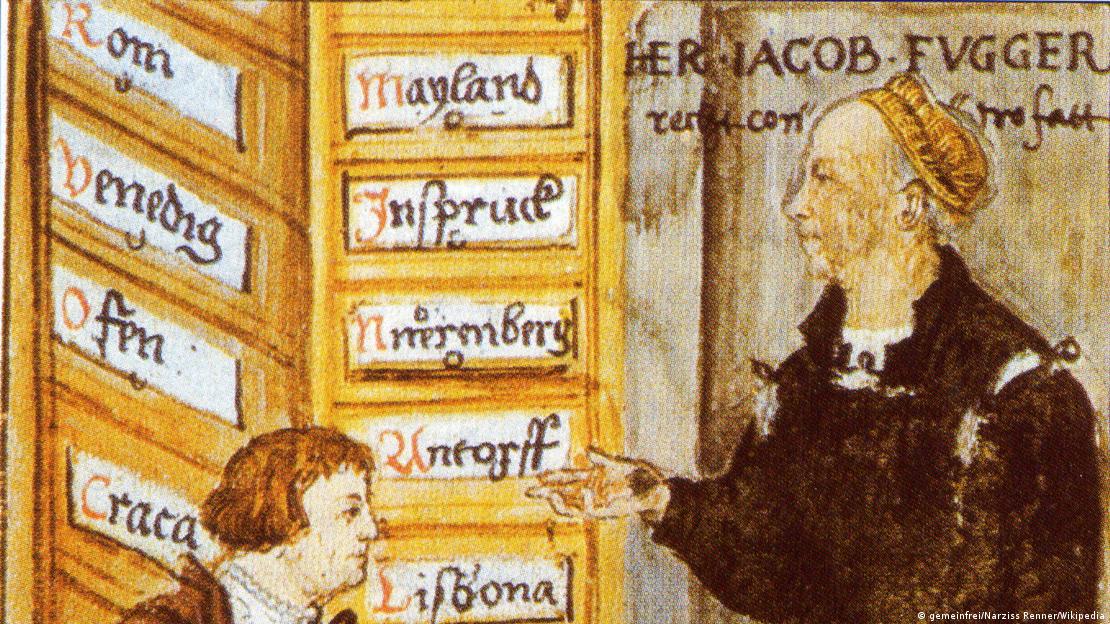
Jakob Fugger was the first merchant to conduct his trade on a global scale
Image: gemeinfrei/Narziss Renner/Wikipedia

Speaking with DW, Steinmetz said global commerce barely existed at the time, until German Emperor Charles V extended European control into South America during his reign as Holy Roman emperor and king of Spain in the 16th century.

There wasn't much of a globe to trade with, Steinmetz noted, apart from trade with India, and what is now Indonesia and China.

But merchants could only travel west after Columbus had discovered America in 1492, meaning "only half the globe" had been known to Europeans, and Fugger was "at the beginning of that phenomenon" later known as global trade.
How education changed everything

Born into a prosperous Augsburg family whose wealth began with his grandfather, master weaver Hans Fugger, Jakob received his commercial training in Venice, Italy. The city not only shaped Jakob's taste for the Renaissance but also introduced him to a breakthrough that would accelerate his rise: double-entry bookkeeping.

Since there were no business schools back then, Steinmetz said, merchant families would "send their boys out to become apprentices," and Germans heavily traded with Venice.

"He [Fugger] took all of those Venetian secrets, including double-entry bookkeeping, back to Germany with him. And he was the first in Germany to employ these modern methods," Steinmetz said.


With meticulous records, Fugger always knew where his finances stood — unlike many rivals. He also built an intelligence network of agents across major European cities and even small German towns.

"People would feed him with information, by courier and horses … so that he would know about things before his competitors did, and he could use that to his advantage. Information today is everything, and it was everything back then, too," Steinmetz said.

Banker to emperors

After his brothers died, Jakob Fugger took sole control of the family enterprise in 1510 and strengthened its ties to the Habsburg monarchy, lending aggressively to Emperors Maximilian I and Charles V.

In return, he secured access to lucrative silver and copper operations in Tyrol and what was then Hungary. He did not own the mines outright, but held rights and stakes that proved extraordinarily profitable.
\
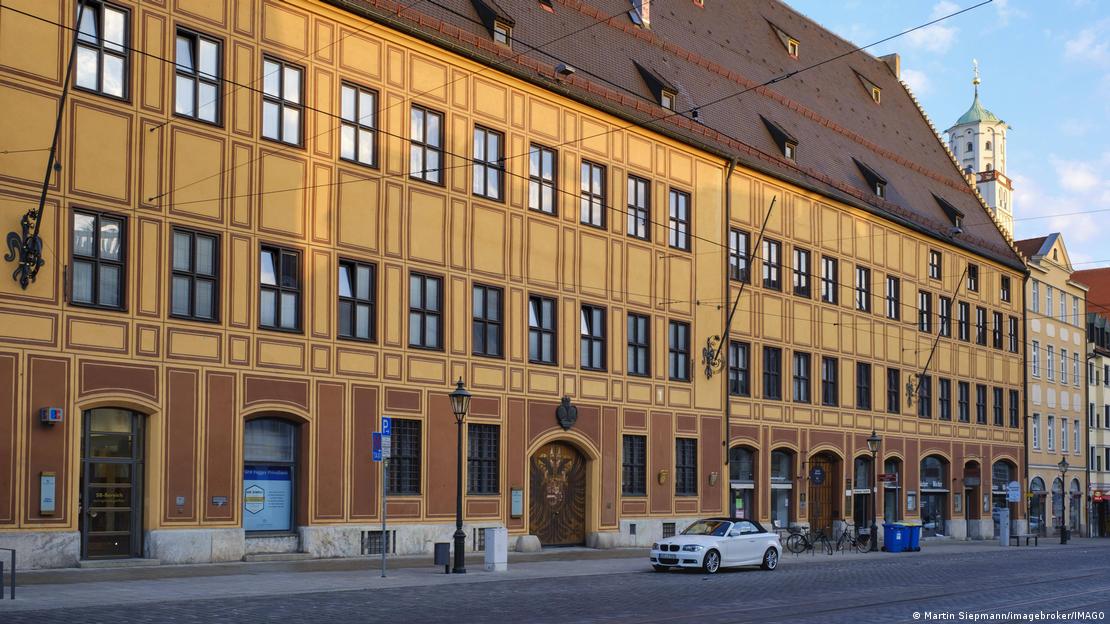
Fugger's city palace in Augsburg is testimony of the merchant family's wealth and power
Image: Martin Siepmann/imagebroker/IMAGO

Europe had little to offer Asia at the time besides precious metals. "Europe wasn't exporting technology or luxury goods," Steinmetz explained. "But it had silver, gold, and copper — and that's where Fugger became indispensable."

Copper powers an empire

Martin Kluger, CEO of the Context publishing house in Augsburg and Nuremberg, and also an author of several books on the Fugger family, said India — then technologically and economically ahead of Europe — suffered a chronic shortage of copper, which was a "stroke of extremely good luck" for the Fugger mining interests.

And timing amplified that advantage: "Vasco da Gama discovered the sea route to India in 1498, just three years after the Fuggers moved into large-scale copper mining in Neusohl [today Banska Bystrica in Slovakia]. Demand soared, and the Fuggers held the supply," said Kluger.


Copper consumption was rising in Europe as well — in shipbuilding, weaponry, cookware and monumental architecture. Kluger noted that the Habsburgs and the Hungarian crown often repaid debts by granting mining rights because they lacked other means.

"The aristocracy's limited commercial knowledge worked in the Fuggers' favor," he added.

Fugger also ensured that powerful yet hugely indebted borrowers kept paying. His strategy, Steinmetz said, was to "make himself indispensable."

"Emperor Maximilian was constantly fighting wars and had to pay mercenaries. The only one who could come up with money when Maximilian needed it quickly was Fugger."
A legacy that endures

Lars Börner, a German economic history expert, believes Fugger reshaped European finance because he persuaded the pope to relax the Catholic Church's ban on charging interest, which opened the door to modern lending practices.

"It's no secret that the pope also liked to pull in the highest returns possible. Interest ban or not," Börner recently told German public radio Deutschlandfunk.

In exchange, he said, Fugger shared in church revenues, including the controversial sale of indulgences used to fund St. Peter's Basilica in Rome — a practice that eventually sparked Protestant revolt, the Reformation.

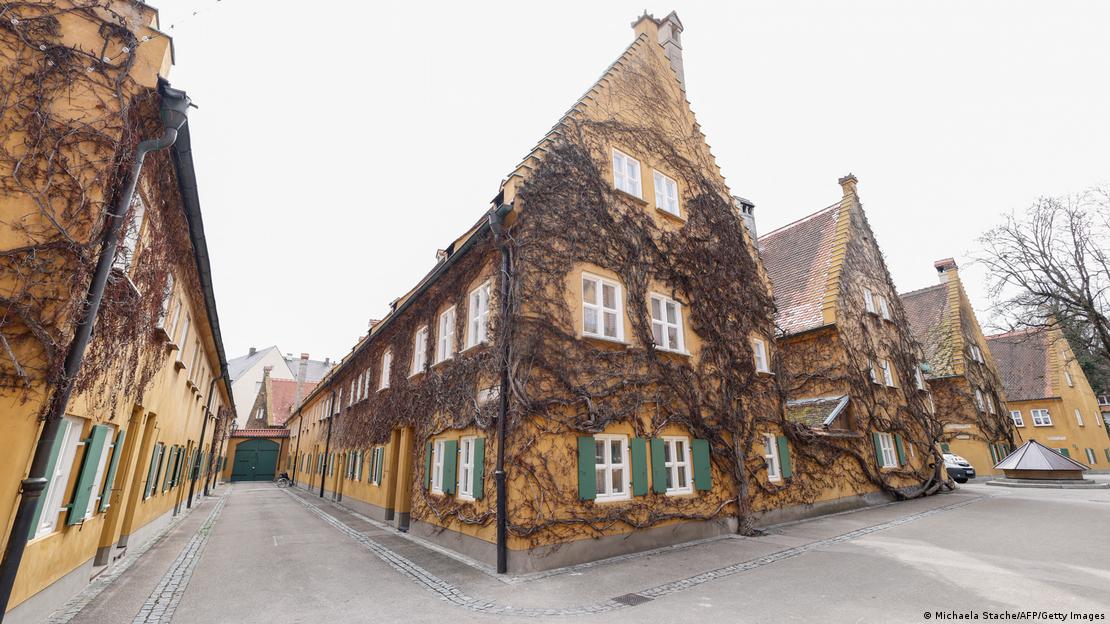
Yet Fugger's most visible legacy is situated in his Bavarian hometown of Augsburg: the so-called Fuggerei, the world's first social housing complex, founded in 1521.

It still operates today, and like 500 years ago, residents pay only a nominal rent. Visitors from around the world tour the community, which remains a tangible symbol of his influence.


The Fuggerei in Augsburg, where tenants today pay less than a euro rent enjoying the same privilege as generations before
Image: Michaela Stache/AFP/Getty Images

Historians estimate Fugger's total wealth at the equivalent of $300 billion to $400 billion today (€255 billion to €340 billion). In Fugger's time, this amounted to between 2% and 10% of the entire economic output of Europe — and well above the current wealth of Elon Musk or Jeff Bezos in comparison to the US gross domestic product.

While modern-day philanthropists such as Bill Gates work to shape their legacies through foundations, corporate historian Boris Gehlen told DW they are unlikely to match Fugger's long-term impact. "Their legacy won't be as significant as Fugger's," he said.

This article was originally written in German.
How the battle against Asian scam networks went global
DW
December 16, 2025

Global governments are freezing assets and imposing sanctions on scam hubs across Southeast Asia. Experts still warn that fragmented efforts fall short of a unified global strategy.


Many Koreans have been lured to Cambodia by fraudulent job offers promising high pay, Seoul has said
Image: YONHAPNEWS AGENCY/picture alliance

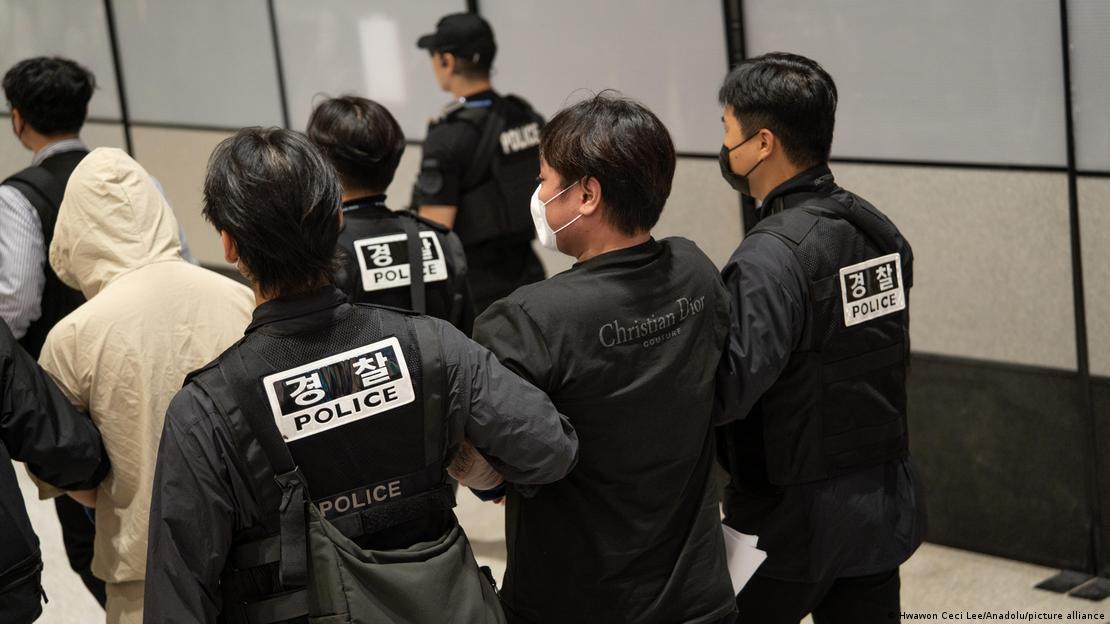
A trial got underway in Seoul last week for 46 South Koreans, mostly men in their 20s, accused of participating in online scam operations in Cambodia.

Since mid-October, South Korea has repatriated 107 nationals from Cambodia, where officials estimate upwards of 1,000 of its citizens are working either "voluntarily or involuntarily" in scam compounds.

The repatriation effort follows public outrage over the death of a South Korean college student who was reportedly lured to Cambodia and forced to work in a scam center. The 22-year-old man's body was discovered with injuries consistent with torture, suggesting that he may have been beaten to death.

An autopsy revealed he "died as a result of severe torture, with multiple bruises and injuries across his body," according to a Cambodian court statement.

South Korean President Lee Jae Myung said, "The government's greatest responsibility is to safeguard the lives and safety of our people.

"We must protect the victims and swiftly repatriate those involved in these incidents back to Korea."

A trial is underway in Seoul for 46 Korean suspects accused of participating in online scam rings in Cambodia
Image: Hwawon Ceci Lee/Anadolu/picture alliance

South Korea recently joined the US, UK and Singapore in imposing sanctions on Cambodia's Prince Holding Group, a multinational network whose founder is accused of running large-scale fraud operations across Southeast Asia — charges the company has rejected.

"What we have seen recently is that, like South Korea, there has been a push towards following the money and putting sanctions and freezing people's money," said Brian Hanley, Asia-Pacific director for the Global Anti-Scam Alliance (GASA), a global non-profit fighting online fraud. "And we think this has started to make a dent."
Billions lost to Southeast Asia scam networks

Southeast Asia has become a major hub for digital scam operations. The United Nations estimated in 2023 that over 200,000 people have been trafficked into countries like Myanmar, Laos and Cambodia under the guise of lucrative job offers. There, they work in massive scam centers that are part of a multibillion-dollar cyber fraud industry that runs online scamming schemes.

These large scam operations are concentrated in remote conflict zones of Southeast Asia, particularly along Thailand's borders with Cambodia and Myanmar.

Recent clashes between Thai and Cambodian forces have included strikes on suspected scam compounds in Cambodia. In Myanmar, such centers have proliferated and are reportedly financing both sides of the country's ongoing civil war.


Scam center workers are typically citizens of Asian countries who are often victims of human trafficking. The scams primarily target people in Western, English-speaking nations.

"We're talking about human trafficking and slavery so obviously this is a major human rights issue," said Hanley. "But it is also a national security issue, not just for the region but for the whole world."

In its State of the Scams 2025 report, GASA estimates that $442 billion (€375.4 billion) has been lost to scams worldwide in the 12 months ending October 2025. That figure could be higher, as many people do not report their losses to online scams.

GASA also found that 57% of adults worldwide have had a scam experience in the last 12 months.

Examples of scams include online shopping, investment and romance scams, which fraudsters refer to as "pig butchering," a term referring to "fattening" victims by gaining their trust, often through fictitious romantic relationships.

Once trust is established, scammers convince victims to transfer funds into fake cryptocurrency investment platforms, which are then laundered through accounts across Asia, making recovery extremely difficult.

Why the US is a top target for scammer networks

The US Federal Bureau of Investigation (FBI) estimates that the scam industry in Southeast Asia defrauds Americans of $9 billion to $10 billion (€7.7 billion to €8.5 billion) per year.

The GASA report says that $64.8 billion was stolen from Americans in the year ending in October 2025, with each victim losing an average of $1,087. It added that the average American now encounters a scam attempt every single day.


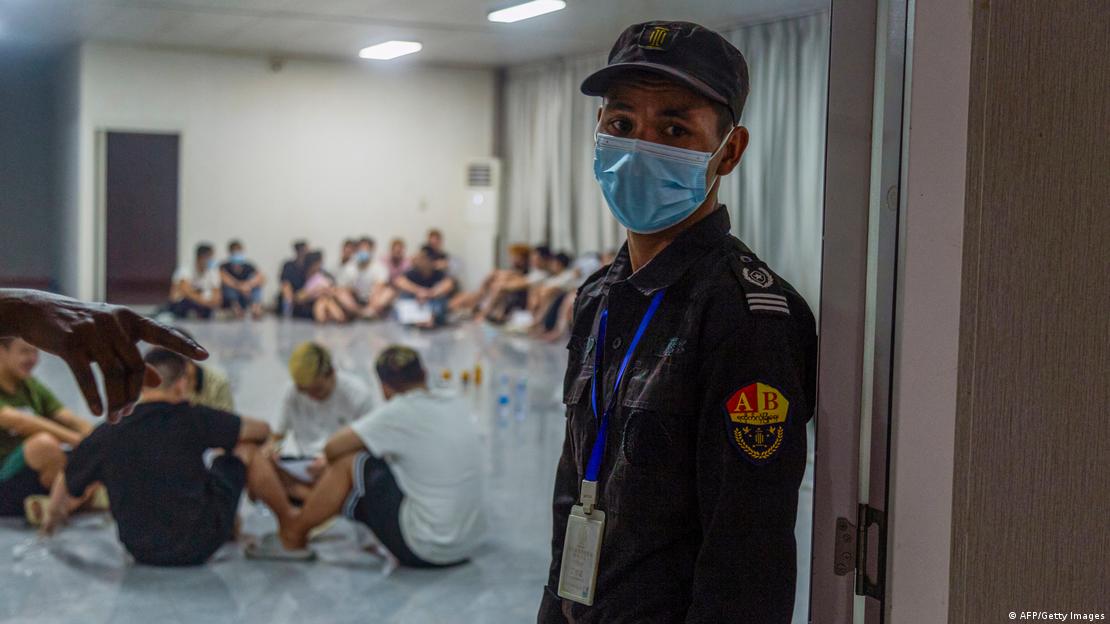
Authorities in Myanmar detain a group of suspected scam centre workers and victims during a crackdown operation
Image: AFP/Getty Images

In response to rising instances of cyber fraud, US authorities established the Scam Center Strike Force in November. It is an interagency task force focused on investigating, dismantling, and prosecuting scam centers and those who finance them.

"My office will not stand by as these Chinese organized crime enterprises empty out the bank accounts of hardworking Americans," said US Attorney Jeanine Pirro when launching the task force.

The US partnered with the UK in 2025 to sanction individuals and entities that operate illegal scam centers across Southeast Asia.

Australia and Singapore also made strides in enacting legislation to protect their citizens from scams and also cooperate with the US on law enforcement operations and sanctions.

For Jacob Sims, a visiting fellow at the Asia Center at Harvard University who has been tracking transnational crime in Cambodia and greater Southeast Asia, the issue of scams has gained significant political traction in the US over the past year.

"A year ago today in [Washington, DC], there was one sanction," said Sims. "And today, a large number of the prominent names and entities have been sanctioned, and there are a dozen bills in Congress."

However, these actions have also been hampered by cuts to USAID programs in Southeast Asia that monitored human trafficking along the Thai-Myanmar border and in Cambodia, which were eradicated under the Department of Government Efficiency (DOGE).

"The response thus far, as much momentum as there clearly is, does not yet constitute a truly strategic response and is not yet commensurate to the threat or sufficient to meaningfully disrupt it," said Sims.
The role of China in scam centers

Many of the massive scam centers across Southeast Asia are said to be run by Chinese criminal networks.


China has taken steps to shut down scam centers in Cambodia and Myanmar — but only those targeting Chinese people.

A report submitted to the US Congress in July found few links between these criminal networks to the Chinese government or members of the Chinese Communist Party (CPP), but stated that the actions of these organizations often further fuel these regional conflicts through corruption and crime.

Even with the recent announcements of sanctions and criminal investigations, countries like South Korea and even the US appear reluctant to criticize the governments of China or Cambodia and instead target the criminals and their networks directly.

According to Sims, as long as Phnom Penh performs just enough cooperation to preserve the illusion that it remains strategically "in play," Western capitals have proven reliably willing to tolerate industrial-scale scams targeting their own citizens.

"Many governments hesitate to confront Cambodia directly because they still view it as a pivotal chess piece in a China-versus-the-West geopolitical game," he said.

Edited by: Keith Walker

Ole Tangen Jr is a DW reporter and editor based in Bonn.
Have Iran's authorities given up on the mandatory hijab?

Paris (France) (AFP) – Women swaying to dance music at a DJ set, strolling without headscarves through cutting-edge art exhibitions and in coffee shops showing off trendy styles that could have come from the streets of Europe.


Issued on: 18/12/2025 - RFI

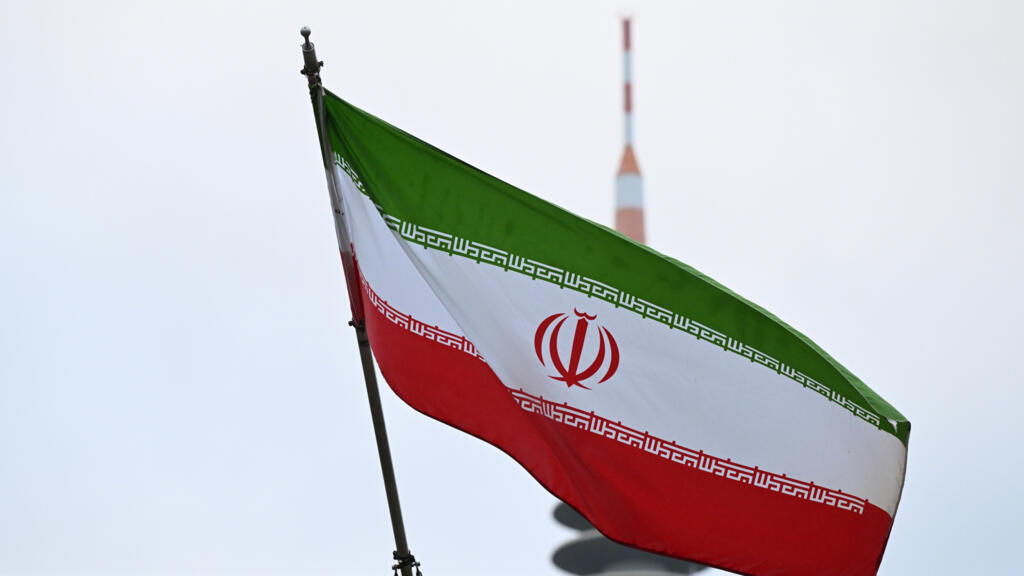
The hijab is mandatory for women in the Islamic republic © Kirill KUDRYAVTSEV / AFP

Until recently, such scenes would have been unthinkable in the Islamic Republic of Iran, whose strict dress code for women has required they wear the hijab in public since shortly after the 1979 revolution that ousted the pro-Western shah.

But while casually flouting the rule has become increasingly common, Iran's leadership insists the hijab is a legal obligation and is implementing a crackdown that has seen dissident figures who oppose the mandatory headscarf detained.

The tension has come at a critical moment for the clerical establishment, still recovering from the recent 12-day war with Israel and with supreme leader Ayatollah Ali Khamenei now 86.

The 2022-2023 nationwide protests, sparked by the custody death of Mahsa Amini who was arrested over alleged improper hijab, are still a recent memory.

Analysts and activists say authorities in recent months have indeed slackened off on imposing the mandatory hijab in daily life, but are far from abandoning an ideological pillar of the Islamic republic, warning a new wave of repression to re-impose it could come at any time.

Roya Boroumand, cofounder and executive director of the US-based Abdorrahman Boroumand Center for Human Rights in Iran, said it was "heartwarming" to see images of women without the headscarf, calling it the result of social pressure from below rather than "a reform granted from above".

"What we see today is unquestionably the result of years of persistent civil disobedience by Iranian women and girls who have fought to carve out and defend a small space of freedom in public life," she told AFP.

Women sporting braids, curls and even bleach-blond locks have now become common sights in public, while more traditional women wear the hijab or chador.

The trend, which has grown more visible in recent months in Tehran and other major cities, now extends to all generations to varying degrees.

Some women are also sporting tighter clothing and outfits that expose their shoulders, legs and midriffs, much to the dismay of conservatives who decry such "nudity" in public.
Hard to 'put the genie back'

Boroumand said enforcement of the mandatory hijab varied across the country and that authorities were still closing down businesses deemed to have failed to enforce the rule.

Authorities earlier this month arrested two people who organised a marathon event on Iran's Gulf island of Kish, viral images of which showed dozens of women running bareheaded through the streets. They also shut down a cafe that served as the start and finish point.

Arash Azizi, a postdoctoral associate and lecturer at Yale University, told AFP that "the regime has given up on harshly enforcing mandatory hijab but it has not at all given up on it as a principle yet".


© TIMOTHY A. CLARY / AFP


"It would be a grand ideological concession that it is not prepared to make. We still see places closed down and even people fined and arrested due to lax hijab. But the regime knows that it will be very difficult to put the genie back in the bottle."

Other recent incidents have also gone viral on social media: the grand opening of a mall in Tehran, for instance, saw young people dancing and swinging their arms to a DJ's beats.

And a match this month in Iran's second football division was unusual not just for the presence of women -- albeit in a segregated area of the stadium -- but for the fact that many were bareheaded, brandishing scarves of the home team.

Even the office of Khamenei, in power since 1989, came under fire last month from some ultraconservatives after it published in its newspaper a photo of Iranian woman Niloufar Ghalehvand, a pilates instructor killed during the Israeli attacks, wearing a baseball cap rather than hijab.

A design week exhibition at Tehran University saw bareheaded women mingling freely amid boldly experimental art exhibits.

But it closed down early after objections from clerics in a sign of the authorities' readiness to hit back.

'Very real risk'

Hardline judiciary chief Gholamhossein Mohseni Ejei recently warned of a new crackdown, saying that intelligence agencies had been instructed to identify and report "organised currents promoting immorality and non-veiling", adding authorities would take action against those involved.

Khamenei on December 3 defended the hijab in an address, saying Iranian women who respect Islamic dress "can progress more than others in all areas and play an active role both in society and in her home".

Campaigner Narges Mohammadi refuses to wear the headscarf © - / NARGES MOHAMMADI FOUNDATION/AFP/File

Nobel Peace Prize winner Narges Mohammadi, who had steadfastly refused to wear the hijab in public since her release from prison on medical grounds in December 2024, was arrested on December 12 along with dozens of other activists at a memorial ceremony for a lawyer who was found dead earlier this month.

"There is a very real risk of a renewed and harsher crackdown," said Boroumand.

Campaigners warn that while the images of coffee shops and concerts can give the impression of freedom, repression has been cranked up in recent months in the wake of the war against Israel.

The arrest of Mohammadi was just the latest of a prominent dissident figure. There have also been more than 1,400 executions so far this year -- hundreds more than in 2024 -- and groups including the Bahai, Iran's biggest non-Muslim religious minority, are experiencing increased persecution.

"We are seeing an escalation of repression elsewhere, not a trade-off," said Bouroumand.

The mandatory hijab has been key to Iran's Islamic system and a response to what the authorities have traditionally termed "Gharbzadegi", or the "West-toxification" of Iran under the shah.

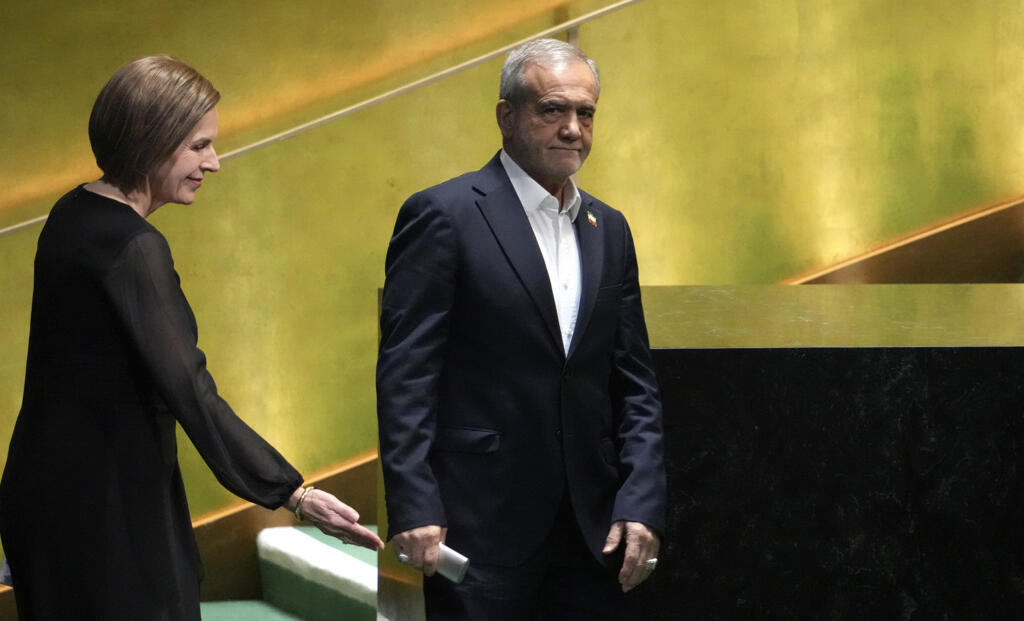
But the issue is a subject of division within the political establishment inside Iran, with less-hardline figures such as President Masoud Pezeshkian maintaining that women cannot be forced to wear the hijab.

"Khamenei insists on it but the future leadership of the regime, after he passes, will likely have to formalise what's already de-facto and give up on mandatory hijab," Azizi said.

© 2025 AFP