Friday, December 19, 2025


Venezuela Won’t Ever Again be a Colony: Maduro Says on Trump’s Oil Blockade


Pablo Meriguet 


In a controversial statement, Trump has declared that the sanctioned oil belongs to the United States. Caracas rejects the statement and considers it an “imperialist naval blockade.


Venezuelan President Nicolás Maduro holds up "El Libro Azul", a text about the birth and development of the Bolivarian Revolution in Venezuela, and a copy of the Venezuelan Constitution. Photo: Nicolás Maduro


The US president has once again lashed out against Venezuela. Following a series of economic sanctions and the military deployment of over 15,000 soldiers and war ships in the Caribbean Sea, Donald Trump has decided to take further action to suffocate the government of Nicolás Maduro economically.

“Recover our oil”?: Trump’s controversial statements

While for weeks the White House has been justifying its sanctions and threats of invasion against Venezuela by accusing it of being a key node in an international drug trafficking scheme, the imposition of the naval blockade seems to have a different motivation. Trump has declared that the “TOTAL AND COMPLETE BLOCKADE OF ALL SANCTIONED OIL TANKERS” is in order to take back resources that, according to Trump, belong to the United States.

“America will not allow Criminals, Terrorists, or other Countries to rob, threaten, or harm our Nation and, likewise, will not allow a Hostile Regime to take our Oil, Land, or any other Assets, all of which must be returned to the United States, immediately,” Trump said on Truth Social.

Trump threatened: “Venezuela is completely surrounded by the largest Armada ever assembled in the History of South America. It will only get bigger, and the shock to them will be like nothing they have ever seen before — Until such time as they return to the United States of America all of the Oil, Land, and other Assets that they previously stole from us.”

Trump declared that, “For the theft of our Assets, and many other reasons, including Terrorism, Drug Smuggling, and Human Trafficking, the Venezuelan Regime has been designated a FOREIGN TERRORIST ORGANIZATION.”

The announcement was made a week after the US military seized a Venezuelan oil tanker bound for Cuba. The Maduro government has denounced this act before the United Nations, which it considers an “act of international piracy.”

“Interventionism and imperialism,” says Caracas

Venezuelan authorities have stated that Trump’s announcement is a “grotesque threat” and a violation of international law, free trade, and freedom of navigation. They denounced that Trump “claims on his social media that Venezuela’s oil, land, and mineral wealth are his property” and that “consequently, Venezuela must immediately hand over all its riches.”

Furthermore, the statement affirms: “The true intention [of Trump’s measure], which has been denounced by Venezuela and by the people of the United States in large demonstrations, has always been to appropriate the country’s oil, land, and minerals through gigantic campaigns of lies and manipulation.”

According to the statement, Venezuela will report the incident to the United Nations through its ambassador. It also called on the US people and the rest of the world to reject this measure, “which once again reveals Donald Trump’s true intentions to steal the wealth of the country that gave birth to the Liberating Army of South America… The people of Venezuela, in perfect unity with the military and police, will defend their historic rights and triumph through peaceful means.”

Caracas declared: “Venezuela will never again be a colony of any empire or foreign power, and it will continue with its people along the path of building prosperity and defending its independence and sovereignty.”

Opposition to war with Venezuela grows within the US

Meanwhile, condemnation of Trump’s decision has also emerged within the United States. Congressman Joaquín Castro said, “A naval blockade is unquestionably an act of war. A war that the Congress never authorized and the American people do not want.”

Castro added that himself, US Representative Jim McGovern, and Representative Thomas Massie, will bring a resolution to the House of Representatives calling on President Trump to “end hostilities with Venezuela.” “Every member of the House of Representatives will have the opportunity to decide if they support sending Americans into yet another regime change war,” he stated.

For its part, the Party for Socialism and Liberation (PSL) issued a statement rejecting the blockade and denouncing it as an act of war: “In his administration’s latest act of war, Donald Trump has ordered a naval blockade of Venezuela. Its stated goal is to cut off all oil revenue to force the illegal overthrow of an independent government. This is a siege designed to cause economic collapse and a humanitarian crisis as a precursor to all-out war by the United States. This aggression is about controlling Venezuela’s oil and reversing its political independence. It follows a pattern of US intervention in Latin America, where governments that resist US control are targeted for regime change.”

Furthermore, the PSL states: “Trump has made his colonial intentions clear by stating US plans to steal Venezuelan land, oil, and minerals. The people of the United States have overwhelmingly opposed military intervention in Venezuela. This war, like the war on Iraq, is built on false pretenses and imperial ambition. We must organize and mobilize to stop this blockade and prevent a wider war. No war on Venezuela.”

Courtesy: Peoples Dispatch


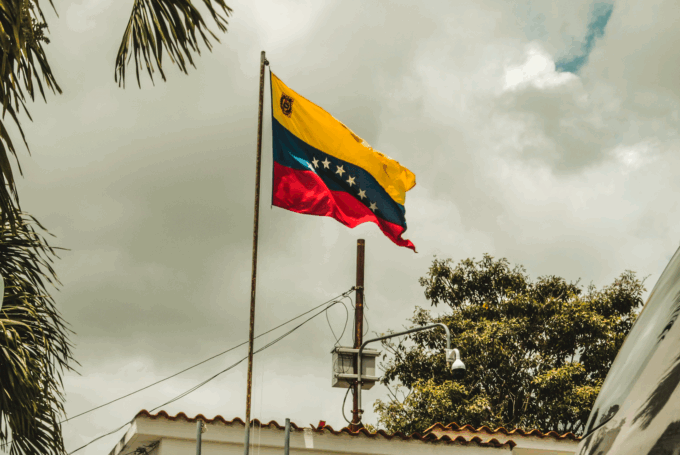
In Venezuela, We Have Not Been Invaded

 December 19, 2025


Photo by roger kuzna

I am writing these words from Caracas, the capital of Venezuela, on December 12, 2025, one day after María Corina Machado, the newly appointed Nobel Peace Prize winner, said at a press conference in Oslo, Norway, in response to a journalist’s question about whether she would accept a military invasion of Venezuela, that:

Venezuela has already been invaded. We have the Russian agents, we have the Iranian agents, we have terrorist groups such as Hezbollah, Hamas operating freely, in accordance with the regime. We have the Colombian guerrilla, the drug cartels that have taken control of 60 percent of our population, not only involving drug trafficking but in human trafficking, networks of prostitution. This has turned Venezuela into the criminal hub of the Americas.

In a week or two, my first daughter will be born, like thousands of other Venezuelan babies inside and outside the country who are about to be born or are newborns. It seems like a detail that would not matter to anyone other than the immediate circle of all our families and friends, but the words of María Corina Machado and the actions of the US government in recent months place all Venezuelans as targets of an apparently imminent military invasion which, given the narrative imposed on us—for MCM we are “the criminal hub of the Americas”—and the current global context, in which genocide in Gaza occurs with total impunity, it is logical and even prudent to think that it will seek to destroy everything in its path, hijack our future, and make us pay for our “freedom” with thousands and thousands of lives.

Venezuelan social and political forces are, and have been all these years, diverse in their positions and in their magnitudes. The problems that Venezuelans face on a daily basis have been exacerbated by the unilateral sanctions imposed on the Venezuelan people which, according to the 2014 report of the Special Rapporteur on the Negative Impact of Unilateral Coercive Measures of the United Nations, constitute a violation of international law seriously impacting the country’s population and preventing the enjoyment of human rights.

Our problems are not few, nor are they without enormous complexity, difficult to grasp in their entirety even for ourselves. We have problems, like any country; problems that have been part of our daily lives for years and have eroded in many ways the legitimacy of all political leadership in the country, whether in the government or the opposition. This diversity of political and social forces in Venezuela even includes clear and well-founded criticism of the Venezuelan government in many respects; clear and well-founded criticism from the left, from popular movements, and from Venezuelan workers of many of the paths we have taken in recent years.

Like any country, we are facing our own dilemma, a dilemma that includes, however, the fact that we are the world’s largest oil reserve and one of the largest reserves of gold, water, and coltan, at a time when the geopolitical map is being redrawn and the US empire is cynically playing its cards, Israel is seriously beginning to turn its attention to Latin America, and the major industrial and commercial powers are dividing up the world. So, while we are dealing with a circumstance common to the entire planet—the US empire in its most psychotic phase—we insist on the principle of self-determination and on our right to life, and on our conviction that we will be the ones to find the necessary channels to sustain ourselves and move forward on our own path.

The Dangerous Characterization of Venezuela for Its Possible Invasion

No, in Venezuela we are not living under invasion by China, Russia, Hamas, Hezbollah, Iran, or any other foreign force. There is no direct evidence of this. If we had been invaded, as MCM would have us believe, this would imply the direct intervention of specific forces from these countries in our daily lives, and that is not happening in any way. Government advisors, defense or trade agreements between nations —none of these things, which are regular for any country, imply any form of invasion. There is no evidence that any foreign armed, police, parapolice, or paramilitary force is operating in Venezuela with the authorization and/or support of the national government. Furthermore, unlike in other countries in the region, there are no armed conflicts arising from territorial disputes between drug cartels, nor even, at this point, more local or smaller-scale conflicts involving microtrafficking, so it would be impossible to claim that “drug cartels have taken control of 60 percent of our population.”

The idea that Trump and MCM are trying to construct, that Venezuela is the hub of operations for all the evils that populate the nightmares of the West, is nothing more than a global narrative that seeks to dehumanize Venezuela and the region enough so that, once again, as is currently the case with Gaza and Sudan and so many other conflicts, international public opinion does not know exactly whether, given the seriousness of our situation, the end does not justify the means in this case, that is, among other possibilities, our extermination. Let us never forget what happened in Libya or Iraq, to mention two of a long list of countries “liberated” from evil by the United States. And if we believe in the idea that it is impossible to replicate experiences in the Middle East or Africa in Latin America, let us not lose sight of the fact that, since September, the United States has killed at least 87 people in its attacks in the Caribbean under the same premise that Israel kills men, women, and children with impunity in Palestine: they are terrorists, not human beings, and they are terrorists because they say they are.

In the context of what has happened in Gaza—more than 70.000 children have been killed with impunity—and taking into account that MCM is a close ally of the Israeli government and Netanyahu, the words of the current Nobel Peace Prize winner are a direct attack on the lives of Venezuelans and a clear call for the genocide that the United States and Israel are committing in Gaza to be repeated in Venezuela.

Venezuelans both inside and outside the country deserve the opportunity to solve our problems according to our own criteria and our own capabilities. That is sovereignty. There is currently no invasion by any foreign force in our country, and there is no basis for thinking that we represent a threat to peace in the region.

The only and most likely possibility is that we will be invaded by the US government in pursuit of nothing more than the global maintenance of its hegemony at the expense of our resources, our sweat, and our blood, both ours and that of our children.

Footnote on December 17

Yesterday, Tuesday, December 16, US President Donald Trump declared on the social network Truth Social that:

Venezuela is completely surrounded by the largest Armada ever assembled in the history of South America. It will only get bigger, and the impact on them will be like nothing they have ever seen before —Until such time as they return to the United States of America all of the Oil, Land, and other Assets that they previously stole from us. The illegitimate Maduro Regime is using Oil from these stolen Oil Fields to finance themselves, Drug Terrorism, Human Trafficking, Murder, and Kidnapping. For the theft of our Assets, and many other reasons, including Terrorism, Drug Smuggling, and Human Trafficking, the Venezuelan Regime has been designated a FOREIGN TERRORIST ORGANIZATION. Therefore, today, I am ordering a TOTAL AND COMPLETE BLOCKADE OF ALL SANCTIONED OIL TANKERS going into, and out of, Venezuela.

It doesn’t take much analysis. It seems that between the FIFA Peace Prize and the Nobel Peace Prize, Venezuela (and the region) are about to experience levels of harmony, tranquility, and concord unlike anything we have seen before.

This article was produced by Globetrotter.

Giuliano Salvatore is a Venezuelan documentary filmmaker, photographer, and teacher based in Caracas, Venezuela.


US oil blockade of Venezuela: what we know

By AFP
December 17, 2025


US President Donald Trump's administration has been piling pressure on Venezuela's Nicolas Maduro - Copyright AFP/File Juan BARRETO

US forces in the Caribbean — where Donald Trump has deployed a massive flotilla of warships — have been tasked by the president with blockading “sanctioned oil vessels” going to and from Venezuela.

Trump’s administration has been piling pressure on the country and its government for months, in an apparent bid to oust leftist leader Nicolas Maduro — whom Washington accuses of heading a drug cartel.

The US president has said that Maduro’s “days are numbered” and pointedly refused to rule out a ground invasion, but the Venezuelan leader has remained defiant so far.

Below, AFP examines the situation in the Caribbean.


– US assets in the Caribbean –


Many questions remain over how the Venezuela blockade will play out, and it is not clear how many tankers will be impacted, or to what degree the US military — which currently has thousands of personnel in the Caribbean — would be involved.

There are currently 11 US warships in the Caribbean: the world’s largest aircraft carrier, an amphibious assault ship, two amphibious transport dock ships, two cruisers and five destroyers.

There are US Coast Guard vessels deployed in the region as well, but the service declined to provide figures on those assets “for operational security reasons.”

Washington has also flown a series of military aircraft — including long-range bombers — along the coast of Venezuela, and has reached deals with some countries in the region for the use of their airports for military flights.


– Tanker seized –


The United States has already seized one tanker off Venezuela’s coast, taking control of the M/T Skipper last week in a raid that provides a potential preview of future action.

A video released by US Attorney General Pam Bondi showed US forces descending from a helicopter onto the tanker’s deck, then entering the ship’s bridge with weapons raised.

A US court later released a heavily redacted warrant authorizing the seizure of the ship, which the document said was carried out by the Coast Guard.


– Strikes on alleged drug boats –


Washington’s forces began carrying out strikes on alleged drug-smuggling boats in the Caribbean in early September, later expanding those operations to the eastern Pacific Ocean.

The Trump administration has said the strikes — which have destroyed more than 25 vessels and killed at least 95 people — are aimed at curbing trafficking.

But White House Chief of Staff Susie Wiles told Vanity Fair magazine that the strikes are aimed at pressuring Venezuela’s leadership, saying Trump “wants to keep on blowing boats up until Maduro cries uncle.”


– ‘Quarantine’ of Cuba –


Latin American countries have been targeted with blockades in the past, most famously during the Cuban Missile Crisis in 1962, when Washington established a “quarantine” to stop the Soviet Union from bringing offensive weapons to its Caribbean ally.

Some Soviet ships decided to turn back before reaching the quarantine line, while others were stopped and searched by US forces but cleared to proceed to Cuba.

The measure — which was called a “quarantine” rather than a blockade because no state of war existed — was lifted after the United States and Moscow reached a deal to end the crisis, which is widely considered the closest the two countries came to nuclear war.


 INDIA

New Labour Codes: A Blow to Workers’ Rights


Although presented as “reforms”, the codes in effect give the government sweeping authority, weaken worker protections, undermine unions.


After years of struggle, India has built a framework of labour rights—an important social contract achieved through long struggle. But what happens when one set of laws changes this entire contract?

Around 2019- 2020, during the pandemic and without much parliamentary debate, the government passed four new labour codes. These were presented as “modernisation,” but deeper analysis shows something else: a major shift from worker rights to employer flexibility, from security to precarity. This is not just an update—it is the biggest restructuring of India’s labour market since Independence. And the resistance is intense. Why?

After Independence, leaders like B.R. Ambedkar emphasised that while industrial development was essential, protecting human dignity was even more important. This vision shaped crucial laws, such as the Industrial Disputes Act of 1947, which required government approval for large-scale retrenchment; the Trade Unions Act of 1926, safeguarding the right to form unions; the Factories Act of 1948, ensuring workplace safety; and the Minimum Wages Act of 1948, setting wage standards. Together, these laws established a social compromise: workers received rights, stability, and protection, while industries benefited from a dependable workforce.

However, after economic liberalisation in the 1990s, a new ideology—“Flexible Labour Market”—gained ground, prioritising ease of hiring and firing over job security. Many experts argue that the new labour codes do more than merely update existing laws; these fundamentally dismantle this long-standing social contract.

In November 2025, the Indian government quietly notified four new labour codes – covering wages, industrial relations, social security and occupational safety – replacing 29 existing laws The official line is that this overhaul “modernises” outdated regulations, simplifies compliance and extends social security to more workers.

In reality, trade unions charge, the codes herald a shift from secure jobs to precarious, contract work, tilting power toward employers. Nationwide protests erupted immediately, with unions denouncing the reform as a “deceptive fraud” that “bulldozes” workers’ rights. Even senior Bharatiya Janata Party (BJP) leader Basavaraj Bommai – who chairs the Parliament’s Standing Committee on Labour – has warned that the government’s failure to consult the traditional tripartite Labour Conference “undermines the democratic legitimacy” of these reforms.

The new Industrial Relations Code marks the beginning of an institutionalised recognition of temporary jobs, built on the expansion of fixed-term and hire-and-fire employment practices. Under the new framework, companies can hire workers on 6–11 month fixed-term contracts, with no obligation to provide compensation or renewal once the contract ends—and crucially, there is no requirement that the work itself be temporary.

Even roles that are permanent in nature can now be filled through short-term contracts. Retrenchment rules have also been relaxed: while earlier any establishment with more than 100 workers needed government permission for layoffs, the threshold has now been raised to 300 workers, with the government retaining the power to increase it further.

Under the Code on Occupational Safety, Health and Working Conditions, 2020, the definition of a “factory” has been altered, where earlier a factory was any premises where the manufacturing process is carried out and employs more than 10 workers, if the process is carried out using power, or  20 workers, if it is carried out without using power.  This was the same as the Factories Act, 1948, which is being subsumed by the codes.  

In 2020, the draft Bill on the labour codes increased this threshold to 20 workers for premises where the manufacturing process is carried out using power, and 40 workers for premises where it is carried out without using power. At the same time, contract labour safeguards were similarly weakened, as contractors would now need a licence only if they employ more than 50 workers, instead of the earlier threshold of 20.

Together, these changes make it far easier for companies to hire and fire at will, often resulting in more dismissals than stable employment. Even the traditional eight-hour workday has been diluted: although the code mentions it, another provision allows the government to extend shifts up to 12 hours, and overtime can run as high as 125 hours per quarter. Additionally, gig workers, platform workers, and those in the unorganised sector still lack universal, enforceable social security rights, depending instead on potential future schemes that may or may not materialise.

The Industrial Relations Code has attracted the strongest opposition because it significantly curtails fundamental labour rights, beginning with a narrower definition of who qualifies as a “worker.” Anyone earning above ₹18,000 or employed in a supervisory role is excluded, meaning key labour protections no longer apply to them.

Forming a union has also become considerably more difficult, as any new union must secure—and continually maintain—at least 20% membership, while the participation of “outsiders” in union leadership has been tightly restricted. Hence, even when unions do form, gaining official recognition will be nearly impossible. Also, a union can bargain on behalf of workers only if it holds 51% membership, and without a secret ballot, management interference has become far easier. The right to strike is similarly constrained. Workers must give 14 days’ notice, cannot strike during conciliation proceedings, and must wait another 60 days afterward, while any deviation risks criminal penalties, including fines and jail time. These restrictions effectively leave the right to strike only on paper.

Taken together, these provisions create an environment where forming unions is extremely difficult, achieving recognition is even harder, and organising any meaningful protest becomes almost impossible

All India Trade Union Congress or AITUC leader Amarjeet Kaur has warned that the “reforms” risk dragging Indian labour “back to the colonial era where [workers] can’t even raise their voice nor fight to form or legalise a trade union”

A major concern running through the new labour codes is the frequent use of the phrase “as may be prescribed by the government,” which effectively means that the actual rules will be defined later through executive notifications, leaving the laws as empty shells while real authority shifts to the government.

This shift is further reinforced by the transformation of labour inspectors into “Inspector-cum-Facilitators,” who must seek prior permission before conducting inspections, reducing them from watchdogs to mere assistants.

Under the labour codes, governments also gains sweeping powers: they can unilaterally alter rules relating to safety, wages, working hours, and retrenchment without parliamentary scrutiny; can exempt any company from labour laws under vague justifications like “public interest” or “promoting employment,” a provision that earlier applied only in emergencies; and they can even block or override tribunal decisions, including cases where the government itself is a disputing party. Together, these provisions mark a significant expansion of executive power and raise serious concerns about fairness, accountability, and the erosion of judicial independence.

Another serious issue within the labour codes is the presence of confusing and overlapping definitions, especially concerning fixed-term employment. The law offers no clarity on which types of jobs can be placed under fixed-term contracts or how long such contracts can last, raising the possibility that permanent roles may be quietly converted into contractual positions Similar ambiguity surrounds the categories of gig workers, platform workers, and unorganised workers. In many cases, the same individual, such as a delivery driver, could fall into all three groups, with no clear guidance on which protections or schemes apply. Adding to the confusion, key terms like “manager,” “supervisor,” and “contractor” are inadequately defined, leaving substantial room for interpretation and misuse.

Enforcement under the new labour codes is also significantly weakened, reducing employer accountability. Punishments for violations have been diluted—for instance, obstructing a labour inspector now carries a maximum jail term of only six months instead of the earlier one year. Even serious, imprisonable offences can be “compounded,” meaning employers can simply pay a fine to avoid prosecution, turning labour violations into nothing more than a manageable business expense for exploitative companies.

Access to justice has also become more difficult: the Occupational Safety, Health and Working Conditions (OSHW) Code under clause 125 bars civil courts from hearing related cases, forcing workers to approach the High Court instead -- a process that is far more expensive, time-consuming, and intimidating for ordinary labourers.

In practical terms, the new labour codes translate into less job security, longer working hours, fewer benefits, weaker unions, and a constant fear of losing employment. As states begin competing to appear more “business-friendly,” workers’ rights are likely to be diluted even further.

This is why large-scale protests, like the one on November 26, 2025, gained momentum In Delhi’s Jantar Mantar and factory towns from Kerala to Odisha, thousands of workers burned draft copies of the new codes and chanted anti-government slogans.  

While the government argues that greater flexibility will create more jobs, the reality is that falling wages and rising insecurity reduce household spending, which ultimately slows economic growth.

The larger question, then, is what kind of development is India aiming for: a model built on low wages, high precarity, and maximised corporate profits, or one that upholds workers’ dignity and provides stable livelihoods?

Although presented as “reforms”, the labour codes in effect give the government sweeping authority, weaken worker protections, undermine unions, and disregard several recommendations from the Parliamentary Committee. As a result, India’s labour framework has shifted from a rights-based system to one centred on flexibility, where workers’ security depends not on firm legal guarantees but on future government notifications that may change at any time.

The November 26 protestors’ message was simple: bring back labour laws that actually protect workers. For, without job security, fair minimum wages, the right to unionise, and basic safety rules, millions of Indian workers will be pushed codes new will undo decades of progress.

The writers are independent researchers. The views are personal.


The ‘Inside’ and ‘Outside’ of Capitalism’s Universe


Prabhat Patnaik 


A more “humane” society can only be built by transcending capitalism, and ushering in a system where the means of production are socially owned.


Banners at theOccupy London protest in Finsbury Square in the City of London. 2011.(File Image)

It is a well-known fact that contemporary “mainstream” economics, the only kind which is taught to students all over much of the world, does not capture the reality of capitalism. What is less recognised is that this “mainstream” economics, not just in its existing incarnations, but no matter what new incarnations it assumes, is incapable of capturing the reality of capitalism. Let us see why.

Any production requires the coordinated action of a number of individuals. Whether it is members of a tribal community hunting down a wild boar, or a modern capitalist factory manufacturing automobiles, it is important for those engaged in such activity to work according to a certain plan, which must necessarily demand coordinated action for its realisation.

Coordinated action in turn requires discipline. This discipline in most earlier modes of production was imposed through explicit coercion. If the actions of the slaves working together were not coordinated because some slackened in their work, then those who slackened would be physically punished by the agents of the slave-owner.

Likewise, in the feudal system, if the serfs working on the lord’s land did not act in a coordinated manner, say, in harvesting the crop, because of which a part of the crop got destroyed, then the allegedly laggard serfs would be beaten.

Production, in short, requires coordination, and in any society where the means of production are not owned in common, where in other words there is a distinction between the owners and the workers, so that the workers are not voluntarily interested in conforming to a coordinated action plan, there must exist some coercive means of making them conform.

Capitalism, however, despite being a class-divided society, does not resort to any explicit coercion. Not that capitalists do not occasionally use physical coercion, but that is not the rule under this system, which then raises the question: how is work-discipline maintained under capitalism so that workers are made to conform to the plan of coordinated action?

The answer is that this is achieved under capitalism through what the Polish Marxist economist Michal Kalecki had called the “threat of the sack”. Anyone who is deemed to be slacking, and hence upsetting the coordinated action plan is simply thrown out of employment. That person, in short, loses his place within the system and is thrown outside of it.

It follows, therefore, that capitalism as a system must have both an “inside” and an “outside”, to enforce work discipline that is so essential for production. While there is no explicit physical coercion, like starving a slave or beating a serf, there is implicit coercion imposed on the workers, without which of course production under this system would not be possible. For this implicit coercion to exist, a space “outside” of the system must exist where conditions of life are so difficult that those employed within the capitalist region dread being pushed into this “outside” region.

The totality of capitalism, therefore, consists of two regions: the “inside” and the “outside” regions. The Marxist tradition alone takes cognizance of this fact and notes the existence of a “reserve army of labour” as a necessary feature of capitalism constituting this “outside” sphere.

Even many Marxists or persons sympathetic to Marxism do not see this point. They see the reserve army of labour only as explaining why real wages under capitalism remain tied to a (historical) subsistence level, that is, only as playing the same role as the Malthusian theory of population played in the Ricardian system. In Ricardo’s view, the Malthusian theory explained the fact of real wages of workers remaining more or less tied to a subsistence level, for, according to Malthus, if wages rose above subsistence then workers procreated rapidly, causing labour supply to increase which pushed wages down again to subsistence level.

Marx had rejected Malthus’s theory, calling it a “libel on the human race”, and it is generally believed that Marx substituted his concept of the reserve army of labour, which served to keep real wages down to subsistence level, for Malthus’s libelous explanation.

This, however, is an incomplete reading of Marx. It is certainly true that the reserve army keeps down real wages to a historically-given subsistence level, but this is not its sole role. Without the reserve army there would be no work discipline under capitalism and hence capitalist production will become impossible.

All of contemporary “mainstream” economics, however, sees capitalism as a self-contained system where all “factors of production” are fully employed if markets are allowed to work freely; and those existing deviant traditions, such as the Keynesian tradition which does not accept this proposition, believe nonetheless that capitalism as a self-contained system can achieve full employment of all “factors of production” through the efforts of the state supplementing the working of the market.

In other words, both the orthodox and the heterodox traditions in non-Marxist economic theory that currently exist, see only the “inside” of capitalism, not its “outside”. In fact, they do not even see the necessity of an “outside”, that is, of a region containing a mass of unemployed, underemployed, and disguised-unemployed workers, such that being thrown into these ranks fills employed workers with dread and serves to instil in them an obedience to discipline that is absolutely essential for capitalist production.

The reason why contemporary “mainstream” economics and not even its heterodox critics do not see the necessity of this “outside” region, is because they do not analyse production sui generis but see it only as an extension of exchange. Their focus, in short, is on the process of exchange which markets are supposed to effect; and that is where their analysis stops.

What happens after the capitalist has purchased raw materials and labour-power on the market and retreated into the premises of the factory, is not something that occupies their attention. Their analysis, therefore, can at best cover production only in an imaginary world where all production is artisan production, with each artisan employing only his own labour, so that there is no separate need for having an arrangement for imposing work-discipline. But outside of this imaginary universe, and certainly for a capitalist economy, both “mainstream” economics and even its valid and insightful critical theories such as the Keynesian theory, clearly fall short.

Read Also: Two Expressions of Capitalism’s Dead-End

This has important implications. The existence of a reserve army is necessary not only for production, not only for keeping real wages down as already noted, but also for ensuring that workers act as a class of price-takers who are too weak to demand and obtain higher money wages even when their real wages are being eroded.

This is not to say that if the reserve army disappears or dwindles, the system will immediately collapse; but its functioning will become impossible over time, which basically means that the maintenance of full employment under capitalism is an impossibility. The Keynesian idea that through state intervention in “demand management” capitalist economies can maintain full employment, is a chimera, arising from the fact that Keynes saw the deficiency of aggregate demand as the only cause for involuntary unemployment.

This is not just an idle claim. The Keynesian idea put into practice in the post-war period came to grief with an explosion of money wages all over the advanced capitalist world in 1968, which in turn gave rise to an inflationary explosion, since the low unemployment rates that had been sustained had ended the workers’ role as “price-takers”. This inflationary explosion which was carried forward by primary commodity prices, was finally ended with US President Ronald Reagan and British Prime Minister Margaret Thatcher. They ended Keynesian “demand management” and re-created massive unemployment.

If the maintenance of full employment is impossible under capitalism, then so is the maintenance of a welfare State. Welfare State measures make the position of the reserve army less intolerable, and hence the punishment for an employed worker who is “given the sack”, for allegedly violating work-discipline, less severe. Such measures, therefore, undermine work-discipline within the capitalist system; what is more, they also enhance the bargaining power of the workers, thereby undermining their “price-taker” role. Such measures, of course, can be in force for some time, but the effort of the capitalists will always be to erode them.

In the 1950s and the early 1960s, there was much discussion about whether “capitalism had changed”, whether it had altered its nature from predatory to welfare capitalism; and many believed that it had. The imposition of neo-liberalism, however, altered the fortunes of the workers even in the advanced capitalist countries and this imposition was immanent within the system. All attempts at “reforming” capitalism, making it more “humane”, it follows, are bound to come a cropper. A more “humane” society can be built only by transcending capitalism, by ushering in a system where the means of production are socially owned.     

Prabhat Patnaik is Professor Emeritus, Centre for Economic Studies and Planning, Jawaharlal Nehru University, New Delhi. The views are personal.


Populism as a departure from neoliberalism in Hungary and Israel


University of Chicago Press Journals


At the end of the 20th century and the beginning of the 21st, write the authors of a new article from Polity, neoliberalism was “consolidated as the only legitimate form of doing politics.” But in the wake of the 2008 financial crisis, and with the entrenchment of far-right governments across the world, neoliberalism’s dominance was threatened by the rise of populism. And while some analyses of populism present the phenomenon as a continuation of neoliberalism, Asaf Yakir and Doron Navot argue that it in fact represents a rupture with the neoliberal order. In “Right Wing Populist Re-Politicization and the ‘Hollowing Out’ of the Neoliberal State,” Yakir and Navot use Viktor Orbán’s Hungary and Benjamin Netanyahu’s Israel as case studies to demonstrate neoliberalism’s vulnerability to populist rule.

Neoliberalism is often theorized as a withdrawal of the state from the economy, but, argue Yakir and Navot, it can be more accurately characterized as state intervention into markets for the benefit of private profit. And although right-wing populism as enacted by the Orbán and Netanyahu governments also necessitates increased state intervention, its strategies differ than those of neoliberalism in their rejection of bureaucracy, their re-politicization of state policy, and their subversion of institutional independence.

Viktor Orbán was once involved in Hungary’s neoliberalization program following the dissolution of the Soviet Union. But since his election in 2010, Orbán has instituted political reforms that clash with neoliberalism’s technocratic tendencies. His government replaced 274 judges with sympathetic allies, and solidified parliament as an extension of the executive branch, rather than an organ with any power of oversight. Orbán also reduced the independence of the Hungarian central bank, and, during an economic downturn in 2011, shifted significant capital into a “workfare” program that provided jobs to the nation’s unemployed at salaries above welfare benefits but below minimum wage. All of these initiatives align, write Yakir and Navot, with the populist insistence on enacting policy agenda even at the cost of a heavier fiscal burden and a greater entanglement of the state and the market.

Benjamin Netanyahu, too, write the authors, has challenged neoliberal governance through his transformations of the Israeli government. In 2015, the Israeli Prime Minister appointed his populist ally Moshe Kahlon to the head of the Ministry of Finance, an agency long viewed as the “cornerstone of the neoliberal Israeli state.” Under Kahlon, Netanyahu’s government involved itself in a controversial plan to address the nation’s housing crisis. The state sold land below market price to contractors and provided housing grants to buyers in lower-income districts that had supported Netanyahu’s party in the election. This program increased the country’s budget deficit and incurred the criticism of the International Monetary Fund, who “encouraged Israeli authorities to adopt supply-side measures that are more adaptable to the tenets of neoliberalism.”

Both Orbán’s and Netanyahu’s governments are conservative ones, guided by a populism that is right-wing in its “declared commitment to the well-being of ordinary people at the expense of other sections of society.” And as such, write the article authors, their brand of populism, unlike a left-leaning one like that of the Syriza party in Greece, poses “no threat to capitalism.” Nonetheless, Yakir and Navot conclude, the success of these populist overhauls shows that the neoliberal regime “could be more fragile than previously assumed by critics and sympathizers alike,” and undermines “the apparent solidity of the state, unmasking its existence as a contradictory form of social relations.”