Adani Explores Nuclear Power Foray With 1.6 GW Small Reactor Project
Adani Group, the conglomerate of Indian billionaire Gautam Adani, is in talks with the state government of India’s northern Uttar Pradesh state on a public-private partnership to build small modular reactors (SMRs) as India opens its nuclear energy sector to private investment.
Adani Group is in discussions with Uttar Pradesh officials to build eight SMRs with capacity of 200 megawatts (MW) each at yet-to-be-identified sites in the state, anonymous sources with knowledge of the matter told Bloomberg on Friday.
A potential deal would give Adani’s conglomerate a total of 1.6 GW of total nuclear capacity with SMRs and could place the private firm at the forefront of India’s nuclear development.
Adani’s reported efforts to enter India’s nuclear power sector come as the country is opening its nuclear industry to private investment and participation as it seeks to boost domestic power capacity to meet soaring demand.
This week, the government said that its Nuclear Energy Mission targets 100 GW capacity by 2047 “through deployment of existing and emerging advanced nuclear technologies, both indigenous & with foreign cooperation.”
The federal government plans to spend as much as $2.23 billion (200 billion Indian rupees) on research and development of SMRs.
Earlier this year, a panel set up by India’s power ministry said in a report that India’s goal to boost its installed nuclear power capacity to 100 GW by 2047, up from just 8.8 GW now, would require as much as 19.28 trillion Indian rupees, or $214 billion at current exchange rates, of cumulative capital.
“Substantial technical and financial resources will be required for accelerated deployment of 100 GW of nuclear capacity by 2047,” the panel said.
“The private sector has abundant capital, and inherent efficiency in timely construction and innovation adaption.”
A public-private partnership with Adani would give the conglomerate an early-mover status in India’s new nuclear power industry.
By Tsvetana Paraskova for Oilprice.com
India's atomic energy bill tabled in parliament
Minister of State Jitendra Singh has tabled the bill proposing a new legal framework for India's nuclear sector in the Indian parliament.
_63865.jpg)
The bill, approved by the Indian cabinet on 12 December, has been titled the Sustainable Harnessing and Advancement of Nuclear Energy for Transforming India Bill, 2025 - or SHANTI, for short. The proposed legislation seeks to repeal the Atomic Energy Act, 1962 and the Civil Liability for Nuclear Damage Act, 2010, and replace them with a single, comprehensive law aligned with India's present and future energy requirements, according to a statement from the Department of Atomic Energy.
"According to the Statement of Objects and Reasons accompanying the Bill, sustained research and development have enabled India to achieve self-reliance across the nuclear fuel cycle and to operate its nuclear power programme in a responsible manner. With this experience in place, the government sees scope to significantly enhance nuclear installed capacity to support clean energy security and provide reliable round-the-clock power for emerging needs such as data centres and future-ready applications," the Department of Atomic Energy said.
India needs to harness its own nuclear resources more fully and enable "active participation of both public and private sectors, while also positioning India as a contributor to the global nuclear energy ecosystem" if it is to meet its decarbonisation goals and its target of achieving 100 gigawatts of nuclear power capacity by 2047, the department said.
As well as provisions on licensing and regulation for nuclear and radiation technologies in areas such as healthcare, food and agriculture, industry and research, the bill "proposes a revised and pragmatic civil liability framework for nuclear damage, confers statutory status on the Atomic Energy Regulatory Board, and strengthens mechanisms related to safety, security, safeguards, quality assurance and emergency preparedness".
The bill will also enable private companies, including joint ventures and other entities, to apply for licences to set up and operate nuclear facilities and to transport nuclear fuel. Some activities - including uranium enrichment, the management of used fuel and heavy water production - will continue to remain under the exclusive control of the central government.
"By introducing the Bill, the government has signalled its intent to modernise nuclear governance in line with India's energy transition, technological progress and international obligations," the Department of Atomic Energy said. "The proposed legislation seeks to balance expansion of nuclear energy with safety, accountability and public interest, placing nuclear power within the broader national effort towards energy security and a lower-carbon future."
According to World Nuclear Association information, India currently has 24 operable nuclear reactors totalling 7,943 MW of capacity, with six reactors - 4,768 MW - under construction. (The Indian government often classes two units at Gorakhpur where site works have begun as being under construction, although the first concrete for the reactor buildings has not yet been poured.) A further 10 units - some 7 GW of capacity - are in pre-project stages. But India's Atomic Energy Act of 1962 prohibits private control of nuclear power generation: only government-owned enterprises Nuclear Power Corporation of India Ltd (NPCIL) and BHAVINI are legally allowed to own and operate nuclear power plants in India, and private sector companies and foreign investors are not allowed to invest directly in nuclear power.
Pre-feasibility study launched for Estonian SMR plant
_16439.jpg)
The study will analyse the technical, financial, legal, and market aspects of deploying advanced small modular reactor (SMR) technology in Estonia, supporting Fermi Energia's ongoing national designated spatial planning process.
One key component is a market study. This will comprise a comprehensive analysis of existing and planned dispatchable generation assets above 50 MW in Estonia, Latvia, and Lithuania, including capacity, technology, lifecycle, financial indicators, and ownership strategies. The study will also assess policy trends, carbon pricing impacts, and future capacity outlook, with Polish and Finnish data analysed at an aggregate level. The analysis will be conducted in cooperation with professional services firm Deloitte Latvia SIA.
The pre-feasibility study will also include an assessment supporting Estonia's National Designated Spatial Planning site selection process. This will include construction transport and logistics mapping, workforce needs, accommodation and service solutions, construction organisation and area-of-influence analysis, and a preliminary foundation and layout study for the reactor building and supporting infrastructure. The work will be conducted in cooperation with Estonian engineering company Norte OÜ.
Samsung C&T will deliver the final report in April 2026.
"This cooperation with Samsung C&T marks another important milestone in Estonia's journey toward introducing safe, modern, and reliable nuclear power," said Fermi Energia CEO Kalev Kallemets. "The study will provide practical inputs for planning, supply chain preparation, and investment readiness."
In April this year, Fermi Energia and Samsung C&T signed a teaming agreement to collaborate on the deployment of two BWRX-300 SMRs in Estonia. Under the teaming agreement, the cooperation between Fermi Energia and Samsung C&T will focus on key aspects of the project, including the formation of an Engineering, Procurement, and Construction (EPC) partnership, site constructability review, cost estimation, and financing strategies. The agreement also positions Samsung C&T as a potential EPC Prime Contractor and key commercial partner in the Estonian SMR project. This collaboration built upon a memorandum of understanding signed between the two companies in November 2024.
Fermi Energia was founded by Estonian energy and nuclear energy professionals to develop deployment of SMRs in Estonia. In July 2019, the company launched a feasibility study on the suitability of SMRs for Estonia's electricity supply and climate goals beyond 2030, following a financing round from investors and shareholders.
In February 2023, the company selected GE Vernova Hitachi Nuclear Energy's BWRX-300 SMR for potential deployment by the early 2030s. The BWRX-300 design is a 300 MWe water-cooled, natural circulation SMR with passive safety systems that leverages the design and licensing basis of the company's ESBWR boiling water reactor.
Fermi Energia submitted an application to Estonia's Ministry of Economic Affairs and Communications in January this year to begin the state spatial planning process for a 600 MW nuclear power plant. During the initial site pre-selection phase (to be conducted between 2025 and 2027) a comprehensive evaluation of potential locations will be carried out, with a focus on areas near Kunda in Viru-Nigula County and Aa village in Lüganuse County. During the site confirmation phase (2027-2029), detailed site-specific studies will be conducted, with an assessment of technical compatibility and an analysis of location-based parameters. The government announced the start of the spatial planning process and Strategic Environmental Impact Assessment in May.
Fermi Energia expects to submit a construction permit application for the proposed plant in 2029, with construction targeted to begin in 2031. The first of two SMRs is set to be operational by the second half of 2035.
Argentina and Brazil progressing their multipurpose reactors
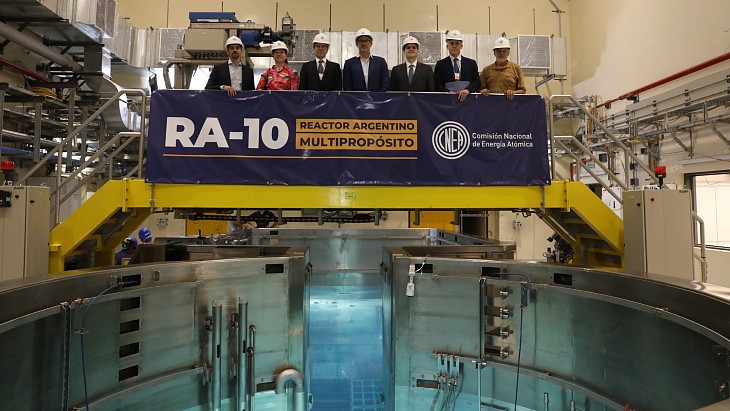
The new president of Argentina's National Atomic Energy Commission (CNEA), Martin Porro, and Secretary of Nuclear Affairs Federico Ramos Napoli, set out progress while hosting a tour for Argentina's ambassador to the USA - and tech business entrepreneur - Alec Oxenford.
The RA-10 multipurpose reactor is a 30 MWt open pool type reactor. The aim is for its commissioning to begin during 2026, with full operation in 2027.
Engineer Pablo Cantero, area manager of the RA-10 project, said: "Currently, 580 people are working on the project. This year's achievements include the installation of the water supply plant, the completion of the general assembly and the control room, and the start of pre-operational testing."
CNEA says the reactor is "designed to guarantee the national self-sufficiency of radioisotopes for medical diagnoses and treatments, such as molybdenum-99, iridium-192, and lutetium-177, which are also in high demand internationally. Argentina will become one of the leading exporters of these radioisotopes".
As well as producing radioisotopes for export it also aims to develop new radioisotope production and produce high quality doped silicon for high power electronics applications. It will also be able to test nuclear fuel and have facilities to be able to test materials such as radiation damage in nuclear power plants' reactor pressure vessels.
The RA-10 project was approved by the government and officially started by CNEA in June 2010. Argentina's Nuclear Regulatory Authority granted a construction licence for RA-10 in November 2014. The civil works for the reactor began in 2016. Nuclear technology firm Invap is involved in the design and construction of the reactor facility and related installations, playing the role of main contractor.
The assembly of the RA-10 pool - which will house the core of the reactor - was completed in August 2018. The RA-10 will replace the RA-3 reactor on the same site, a 10 MWt pool-type reactor which began operations in 1967. The RA-10 will also have associated facilities such as the Argentine Neutron Beam Laboratory and the Laboratory for the Study of Irradiated Materials.
Progress in Brazil
Meanwhile, in neighbouring Brazil, the aim is for construction of the Brazilian Multipurpose Reactor (RMB) to begin in the first half of 2026, according to the National Nuclear Energy Commission (CNEN).
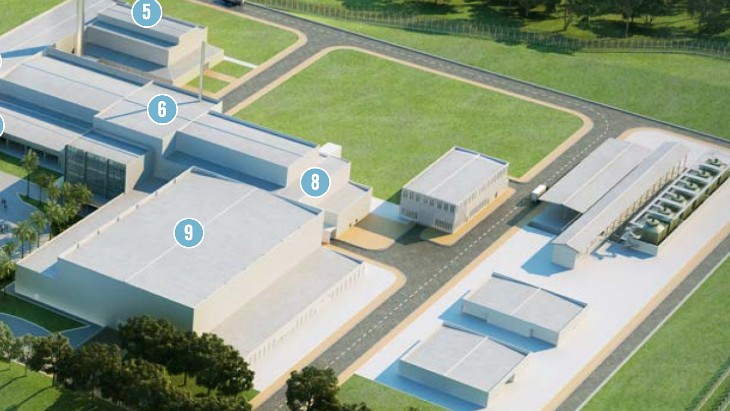
How the RMB centre might look, with the reactor building (8) and Neutron Beam Laboratory (9) (Image: CNEN)
The President of CNEN, Francisco Rondinelli, has been in Argentina holding meetings with Invap "focusing on establishing the basic terms of the engineering contract that will enable the new construction phase of the project".
The RMB is similar to Argentina's RA-10 multipurpose reactor. It has been in development since 2008. Invap signed an agreement in 2013 to build the two research reactors - one in each country - with the reference design to be the Open Pool Australian Light-water (Opal) research reactor that Invap supplied to the Australian Nuclear Science & Technology Organisation. At the time it was estimated that between them, the two new reactors would provide capacity to supply 40% of the world's isotope demand.
The Brazilian multipurpose reactor is to be part of a two-million-square-metre site which, it is proposed, will also host laboratories for researching nuclear fusion, particle accelerators and radiopharmaceutical development and production. Infrastructure work on the site began in February and the total project cost has been estimated at USD500 million, with a target completion date of 2030.
Ethiopia and Russia hold talks over potential nuclear power project
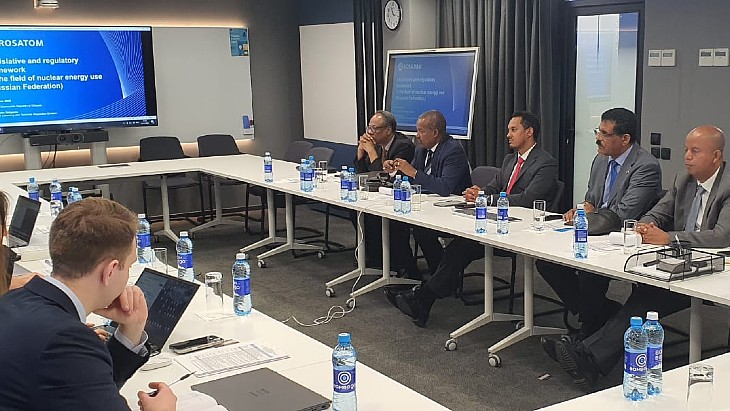
According to Russia's state nuclear corporation Rosatom, "the parties discussed a comprehensive range of issues related to the construction of a large-scale nuclear power plant in Ethiopia featuring Russian design”. And the two sides “reaffirmed their commitment to advancing joint work on the project".
Ethiopia's Ministry of Foreign Affairs said the two sides signed a Non-Disclosure Agreement "as part of the implementation of a prior agreement between the two countries aimed at advancing the development and construction of Ethiopia’s first nuclear power plant, a milestone project in the country’s development efforts" and added that a roadmap of next steps was also being presented.
Earlier this month the Ethiopian Nuclear Power Programme was officially launched in Addis Ababa, and the newly created Ethiopian Nuclear Energy Commission began work.
At that event, the Ministry of Foreign Affairs said, it was explained that the nuclear power programme was being "driven by rapidly growing electricity demand, the need for reliable baseload energy, and Ethiopia’s long-term industrial ambitions" as well as the role "nuclear power will play in ensuring energy security, supporting urbanisation, and powering emerging sectors such as data centres and advanced manufacturing".
Sandokan Debebe, Chief Commissioner of the Ethiopian Nuclear Energy Commission, said at the same event that Ethiopia’s nuclear vision extended beyond electricity generation "to include the peaceful application of nuclear science in healthcare, agriculture, industry, and research, delivering tangible socio-economic benefits". He also stressed that the country was aligning its national framework with International Atomic Energy Agency standards and "adhering strictly to all relevant international treaties and obligations, reaffirming the country’s commitment to a safe, secure, and lawful nuclear programme in support of a modern and industrialised nation".
Russia and Ethiopia signed a roadmap for bilateral cooperation in the use of atomic energy for peaceful purposes in 2023. According to Rosatom at that time: "The roadmap defines specific steps that the parties will take in 2023-2025 to explore the possibilities of building a nuclear power plant of large or small capacity, as well as a Nuclear Science and Technology Centre in Ethiopia. The parties plan to work together to develop Ethiopia's national nuclear infrastructure, organise technical tours and seminars, and meetings of specialised working groups."
In September this year Rosatom and the Ethiopian Electric Power Corporation signed an action plan for developing a nuclear power plant project in Ethiopia. It created a working group to prepare a roadmap for a feasibility study and intergovernmental agreement.
Following this week's negotiations the Ethiopian delegation toured the Kalinin nuclear power plant.
New York energy plan recognises role of nuclear
_31140.jpg)
The State Energy Plan - approved by the State Energy Planning Board on 16 December - provides broad policy direction that guides energy-related decision making within New York State. The plan includes an outlook up to 2040 with recommendations for meeting future energy demands that prioritise an energy system that is affordable, reliable, and clean while supporting economic development, equity, and a healthy environment.
The process to update the State Energy Plan was announced in August 2024. The State Energy Planning Board, comprised of the heads of ten state agencies and authorities, appointees from the Governor, Senate, and Assembly, and the president of the New York Independent System Operator, commenced its work to assess and compile data to inform the Draft State Energy Plan, which was released in July 2025 for public review and comment. The release of the 2025 Plan follows a robust public comment period which included ten public hearings, seven in-person and three virtual, and written comment.
"Nuclear power plants have provided reliable and zero-emission electricity in New York for decades," the plan says. "Nuclear energy is entering a new phase of technological advancement and deployment opportunities - with performance characteristics that align with the scale of emerging energy needs. The State's current nuclear facilities are supported, in part, by the Zero Emission Credit (ZEC) programme. Nuclear energy is expected to continue to play an important role in providing clean firm generation."
The plan recommends the State evaluate the extension of the ZEC programme prior to any federal relicensing application deadlines to ensure the continued operation of the existing nuclear fleet to help meet State climate goals as well as maintain fuel diversity and fuel security. Any extension, it says, should be done with ratepayer protection in mind, in addition to the reliability needs of the grid. Through its Master Plan for Responsible Advanced Nuclear Development, the State should also continue to examine key considerations for advanced nuclear for long-term planning.
In January, State Governor Kathy Hochul outlined plans to develop a Master Plan for Responsible Advanced Nuclear Development in New York as part of a USD1 billion proposal to achieve a more sustainable - and affordable - future for the state. The development of the master plan is being led by New York State Energy Research and Development Authority (NYSERDA) working with the Department of Public Service. Under the plan, the New York Power Authority (NYPA) is to begin evaluation of technologies, business models, and locations for the first new nuclear power plant immediately, and will secure the key partnerships needed for the project. This will include site and technology feasibility assessments as well as consideration of financing options. Candidate locations will be assessed for suitability based on public safety, strength of community support, compatibility with existing infrastructure, as well as skilled labour and land availability.
"The State's zero emissions by 2040 target is urgent, especially when viewed relative to the long development timelines of nuclear projects," the State Energy Plan says. "Early development efforts are therefore important. The State is already undertaking examples of such early deployment action through NYPA's role to develop 1 GW of advanced nuclear power generation as per Governor Hochul's direction in June 2025 and NYSERDA's support for an early site permitting funding application by Constellation. Early development efforts should be undertaken in coordination with the Master Plan process and reflect collaboration with other states to ensure that any deployment commitments leverage the insights and benefits from those initiatives."
NYSERDA President and CEO Doreen Harris, chair of the State Energy Planning Board, said: "The State Energy Plan is the product of a pragmatic and objective process that comes at a critical yet challenging time for energy planning in New York as we continue to build out renewable resources while factoring in new energy demands and confronting federal headwinds. I commend my fellow Board members and state agency staff for their dedication to developing this Plan, which identifies specific actions to advance over the next several years while maintaining resource diversity – which is key to continued energy reliability and affordability for all New Yorkers."
Four nuclear reactors - all operated by Constellation Energy - currently provide some 21.4% of all New York's electricity, and 41.6% of its carbon-free electricity, according to information from the Nuclear Energy Institute. The state has already supported the continued operation of those facilities - two units at Nine Mile Point and the single-unit Ginna and Fitzpatrick plants - by explicitly recognising the zero-carbon contribution of the plants in its 2016 Clean Energy Standard as critical in enabling it to meet its climate change targets.
EDF estimates EPR2 programme cost at EUR72.8 billion
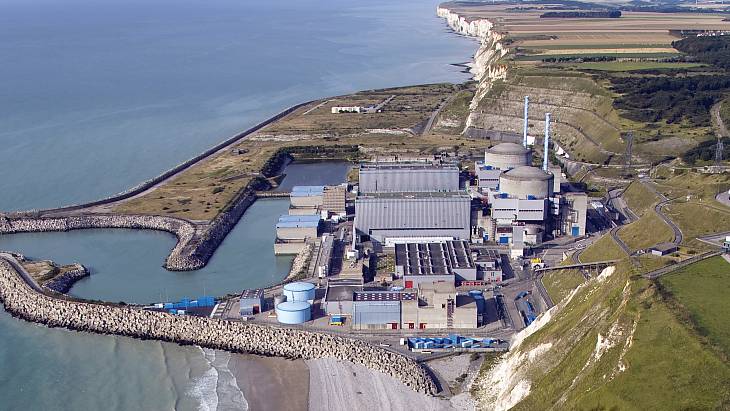
The figure was presented to its board of directors on Thursday. The board approved a EUR2.7 billion budget allocation to the programme for 2026, the company said.
The cost estimate is to be audited in the first three months of 2026 by France's Interministerial Delegation for New Nuclear Technology, which reports to the French president.
France submitted its proposed state aid measures for approval to the European Commission in November - they comprise a subsidised loan to finance at least half of the construction costs; a 40-year Contract for Difference; and risk sharing between the state and EDF.
A Contract for Difference is essentially where there is a future fixed price guaranteed for electricity generated, with the government either paying the difference between the market price and the agreed sale price, or receiving payment if the market price is higher.
The aim is to be able to take a Final Investment Decision by the end of 2026.
Bernard Fontana, Chairman and CEO of the EDF Group, said: "The establishment of the preliminary cost estimate for the EPR2 programme reflects the commitment of EDF teams, its subsidiaries, and all of our industrial partners to controlling deadlines and costs."
EDF said that "the completion of the EPR2 programme will contribute to France's energy and industrial sovereignty, as well as its energy transition, for decades to come".
In February 2022 President Emmanuel Macron announced that the time was right for a nuclear renaissance in France, saying the operation of all existing reactors should be extended without compromising safety, and unveiling the proposed programme for six new EPR2 reactors, with an option for a further eight EPR2 reactors to follow. The first three pairs of EPR2 reactors are proposed to be built, in order, at the Penly, Gravelines and Bugey nuclear power plant sites. Construction was expected to start in 2027 with commissioning in 2035, but that target date for commissioning the first reactor at Penly is now 2038, with subsequent units following at intervals of up to 18 months.
The cost was originally estimated at EUR51.7 billion (USD56.4 billion), but this was revised to EUR67.4 billion in 2023. The new estimate is at 2020 values.
The EPR2 reactor is a pressurised water reactor project developed by EDF and Framatome. It meets the general safety objectives of the third generation of reactors. Its aim is to incorporate design, construction and commissioning experience feedback from the EPR reactor, as well as operating experience from the nuclear reactors currently in service.
Urenco USA produces first LEU+ fuel
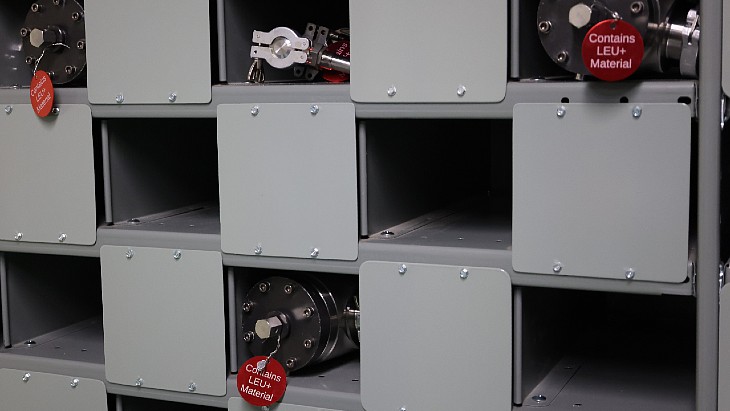
It completed the initial production run of the low-enriched uranium plus (LEU+) on 11 December. LEU+ is uranium enriched to between 5% and 10% U-235.
The company was given US Nuclear Regulatory Commission authorisation to enrich uranium up to 10% U-235 in September. Urenco USA aims to produce commercial quantities for customers from "mid-2026".
John Kirkpatrick, managing director of Urenco USA, said: "In 2025, we have delivered on our plans to launch a new advanced fuels capability and to install new production capacity, demonstrating Urenco USA's commitment to supporting the future needs of our customers and the US nuclear industry as the country increasingly relies on nuclear energy.
"Our employees' efforts this year will ensure that the United States continues to have a reliable domestic supplier of enriched uranium for our current reactor fleet and for the advanced reactors preparing for deployment in the coming years."
The nuclear fuel cycle
Unenriched, or natural, uranium contains about 0.7% of the fissile uranium-235 (U-235) isotope. ("Fissile" means it's capable of undergoing the fission process by which energy is produced in a nuclear reactor). The rest is the non-fissile uranium-238 isotope. Most nuclear reactors need fuel containing between 3.5% and 5% U-235. This is also known as low-enriched uranium, or LEU. Advanced reactor designs that are now being developed - and many small modular reactors - will require higher enrichments still. This material, containing between 5% and 10% U-235 - is known as LEU+, with that from 10% to 20% U-235 known as high-assay low-enriched uranium, or HALEU.
Enrichment increases the concentration of the fissile isotope by passing the gaseous UF6 (uranium hexafluoride) through gas centrifuges, in which a fast-spinning rotor inside a vacuum casing makes use of the very slight difference in mass between the fissile and non-fissile isotopes to separate them. As the rotor spins, the concentration of molecules containing heavier, non-fissile, isotopes near the outer wall of the cylinder increases, with a corresponding increase in the concentration of molecules containing the lighter U-235 isotope towards the centre.
Enriched uranium is then reconverted from the fluoride to the oxide - a powder - for fabrication into nuclear fuel assemblies.
Urenco USA’s new capacity
In another "December milestone", the company announced that this year’s third new cascade of centrifuges began production of LEU on 16 December.
The new centrifuge cascades are part of a programme to install 700,000 separative work units (SWU) of capacity by 2027 at Urenco USA’s New Mexico uranium enrichment plant.
Urenco USA says it "is the only company to have licensed, built, operated, and expanded a commercial uranium enrichment plant in the United States" and says the new capacity is required to meet the growing demand in the country and end reliance on Russian imports.
Korean floating SMR design certified
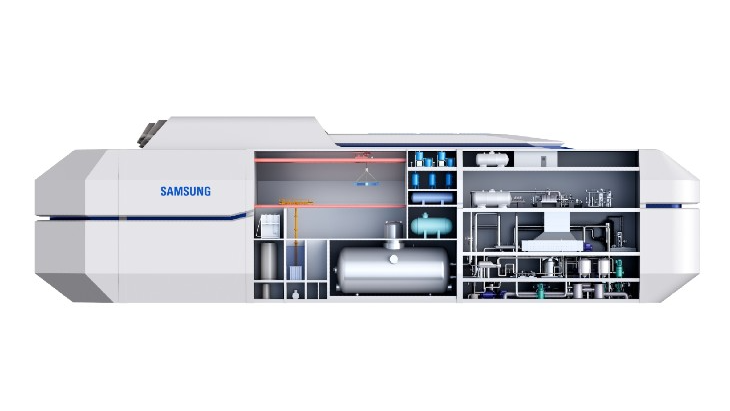
As part of the Novel Concept Class Approval process, the American Bureau of Shipping (ABS) grants an Approval in Principle (AIP) at an early conceptual design phase to assist the client in demonstrating project feasibility to its project partners and regulatory bodies. Approval in Principle confirms that the proposed novel concept which includes the new technology complies with the intent of the most applicable ABS Rules and Guides as well as required appropriate industry codes and standards, subject to a list of conditions.
Under the certification process, Samsung Heavy Industries was responsible for the integration of the small modular reactors (SMRs) with the floating structure, the overall design of the nuclear power generation facilities, and the development of a multi-barrier reactor containment system. The Korea Atomic Energy Research Institute (KAERI), meanwhile, adapted the land-based SMART100 SMR for offshore applications.
Although the Approval in Principle granted by the ABS is for a floating platform incorporating two SMART100 reactors, Samsung Heavy Industries said the concept can be adapted so that different SMR designs can be used.
"The FSMR (Floating SMR) is expected to be advantageous for commercialisation as it is a universal floating nuclear power facility model that can be equipped with various types of SMR," the company said. "FSMR is characterised by the application of the so-called 'compartment design', which groups and places the reactor and power generation facilities by function, and by changing the design of only the compartment where the SMR is placed makes it possible to develop FSMR with various types of SMRs applied."
In addition, the reactor and safety system - the core components of the floating nuclear power plant - have been modularised within a single containment vessel to enhance safety, and the SMR can be placed within the containment vessel to allow testing on land before being installed on board, thereby shortening the construction period, Samsung Heavy Industries added.
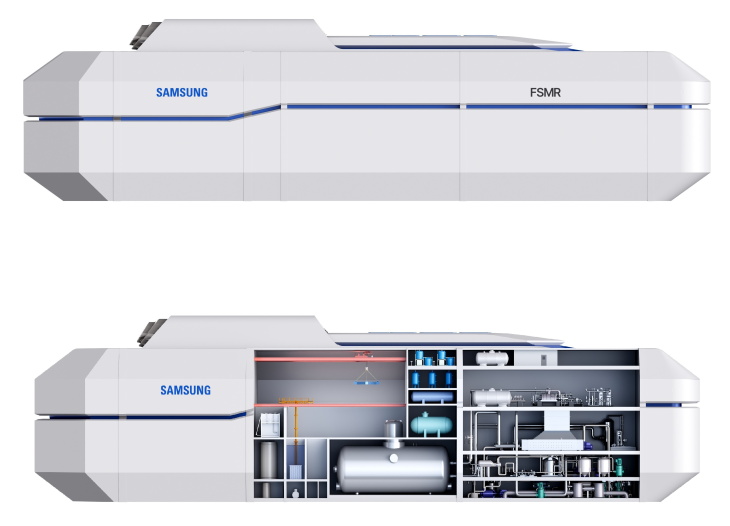
Floating SMR equipped with SMART100 (Image: KAERI)
"This AIP is an important milestone for pioneering the offshore nuclear power generation market,” said Ahn Young-kyu, vice president and head of technology development at Samsung Heavy Industries. "Going forward, Samsung Heavy Industries will continue to develop safe and economical offshore nuclear power plants based on its offshore plant technology."
Cho Jin-young, head of KAERI's Advanced Nuclear Reactor Research Institute, said: "This acquisition of AIP using SMART100 proves the innovativeness of our nuclear power technology," and added, "We will accelerate technology development so that our country can establish itself as a leading country in the marine nuclear power industry."
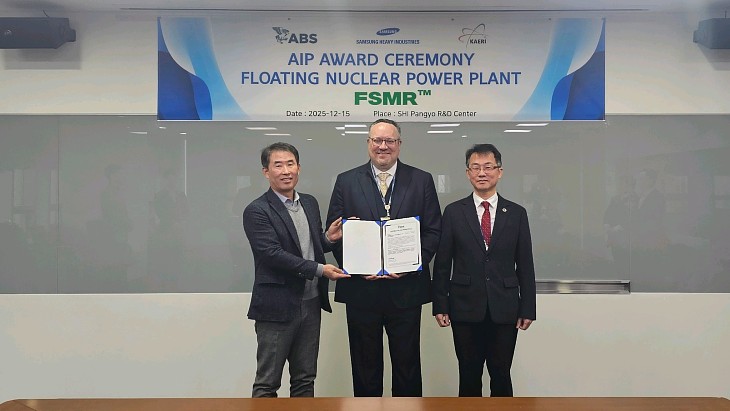
(Image: Samsung Heavy Industries)
The SMART100 (System-integrated Modular Advanced Reactor 100) is an advanced version of the original SMART design, which became the world's first SMR to receive standard design approval in mid-2012. SMART is a 330 MWt pressurised water reactor with integral steam generators and advanced safety features. The unit is designed for electricity generation (up to 100 MWe) as well as thermal applications, such as seawater desalination, with a 60-year design life and three-year refuelling cycle.
The SMART100 builds upon the safety, economic, and operational benefits of the SMART, offering enhanced power output and safety features. SMART100's development prioritised safety improvements, including the integration of a fully passive safety system. This system is capable of maintaining reactor cooling without the need for external power, using natural forces like gravity and fluid density differences to ensure the safe shutdown and cooling of the reactor during emergencies.
Along with these safety enhancements, SMART100 also offers increased thermal output, rising from 330 MW to 365 MW, while its electrical output has been boosted from 100 MW to 110 MW, significantly improving efficiency while maintaining a compact design. SMART100 received standard design approval in 2024.