Sunday, December 21, 2025

What Germans Think About AI

Source: Originally published by Z. Feel free to share widely.

In a recent AI study (November 2025), slightly more than 1,000 Germans were asked about artificial intelligence (AI), online security, deepfakes and democracy.

Overall, there is a strong increase in the uptake of AI in Germany. Roughly two out of three Germans use AI (65%) in one way or another. Given that ChatGPT started to appear in Germany around November 2022, the question “Have you already used AI?” shows a rapid rise. 

About half a year after the launch of ChatGPT, 23% of Germans said “yes”. By October 2023, the number had increased to 37%; by October 2024, it was 53%; and by October 2025, it had reached 65%.

Meanwhile, slightly more men than women are using AI. However, AI use appears to be related to age more than to gender. In other words, younger Germans are using AI more than older Germans – no surprise here. To the question “Have you ever tried or used an AI application?”, 67% of men said yes, while 63% of women said that they had used AI.

The gap is vastly greater when it comes to age. In 2025, 91% of 16- to 29-year-olds said they had used AI. For the 30- to 49-year-old cohort, the number is still 80%, while for 50- to 64-year-old Germans, it drops to 63%. Once people are 65 and older, the use of AI declines to about 35%.

Meanwhile, almost every second individual uses AI several times a week. That was the answer to the question “How often do you use AI?” Twelve per-cent said daily, 33% said several times a week, and 36% said once or twice per month. Among younger Germans, these numbers – as expected – are higher. In total, 55% of all 16- to 29-year-olds use AI frequently.

When it comes to using AI at work or privately, a clear 1/3 to 2/3 gap emerges. In other words, 61% use AI for private purposes, while only 32% use AI for professional or work-related purposes, including school, education, and studying. AI is thus used more at home than outside the home in Germany.

When asked whether they use paid AI accounts, 88% said they do not use “paid-for” accounts in the private sphere. This number declines to 67% when it comes to work-related use.

Meanwhile, the mobile phone or smartphone has overtaken laptops. When asked which device or devices they use for AI, the smartphone is the preferred choice for 82%, while PCs or laptops are used by 71%. Devices such as smart speakers (e.g., Amazon’s Alexa) and smartwatches are used by a meager 4% each.

Beyond all this, ChatGPT dominates AI usage in Germany. Eighty-five percent use ChatGPT, followed by Gemini (33%), Copilot (26%), DeepL (20%), Meta AI (18%), Google AI (14%), Bing Search (10%), Canva AI (8%), Perplexity (7%), DeepSeek (4%), Claude AI (3%), Grok (3%), Le Chat (1%), and others (4%).

On the question “What is AI used for?”, 72% said they use AI when searching for information. Forty-three percent said they use AI to create or improve texts. Thirty-eight percent use AI for brainstorming and the development of ideas. Thirty-four percent use AI for translations. Sixteen percent use AI to create images, videos, or audio files. Eleven percent let AI perform calculations, while only 8% use AI to create websites or code. The same share (8%) applies to analyzing datasets.

On the question of why they are using AI, 61% said it helps them work more productively, and the same share applies to learning and education (61%). Fifty-four percent use AI to deal with routine tasks, 50% to develop new ideas, and 47% to be creative. Interestingly – and perhaps surprisingly – 43% of Germans use AI to solve personal problems. Thirty-two percent use it to better organize everyday life, and 29% use AI for fun and entertainment.

Regarding how people communicate with AI, 96% said they do so via text input. Voice-to-text input is used by 38%, while voice dialogue mode is used by 33%.

On the more noteworthy question of how Germans describe their emotional relationship with AI applications, most (80%) said that AI is simply a tool and that they do not have an emotional relationship with it. Germans do not seem to “love” these machines. Twenty-seven percent see AI as a smart coach who supports them in different situations, while only 6% see AI as a good friend to whom they entrust personal things. Notably, zero percent (0%) said they see AI as a permanent partner. It gets even better: nobody (0%) sees AI as someone for whom they feel romantic or emotionally close.

Yet when it comes to trustworthiness, Germans trust AI more than ever before. In 2024, 48% reported a high degree of trust in AI. By 2025, this number had increased to 53%. Still, 41% expressed rather low confidence in AI delivering trustworthy answers. Absolutely no trust in AI was expressed by 4% in 2025 (up from 2% in 2024).

While 45% – slightly less than half – of Germans trust AI only to a limited degree (41%) or not at all (4%), Germans are extremely unwilling to share personal and confidential data with AI. To the question “Have you ever entered personal or confidential data – such as your name, address, health data, or passwords – into an AI program?”, a reassuring 86% said “no”.

This reluctance increases with age. In the 16- to 29-year-old cohort, 78% said “no”, while 22% said “yes”. In the 30- to 49-year-old group, 85% said “no”. Among 50- to 64-year-olds, 92% said “no”, with the same applying to those over 65. In other words, Germany’s elderly are less likely to hand over sensitive data to AI, whether dodgy or not.

On the question “How big is your concern that the data you have entered into an AI application could be hacked, misused, or even published without your consent?”, 13% said they are very worried. Thirty-seven percent said they are somewhat worried, 43% said they are less worried, and only 4% said they are not worried at all.

On deepfakes and the question “Which of the following experiences have you already had in connection with AI?”, 51% said they had come across manipulated AI videos online showing real people. Thirty-one percent said they had received AI-generated phishing emails with deceptively realistic texts. Twenty-six percent said they had been called by automated AI voices imitating human conversations. 

Another 26% agreed with the statement “I have the impression that frequent use of AI makes me think less”. In other words, AI-induced cognitive dulling – or “cognitive atrophy” – is not a figment of our imagination.

On the issue of AI-generated false images and the question “Have you ever fallen for AI-generated content such as texts, images, videos, or audio?”51% said yes. Twenty-six percent were surprised by how genuine the content appeared, while 25% said they noticed it very quickly. Thirty-two percent said they had never encountered this, and 16% said they were not sure. 

With 51% saying “yes” and another 16% unsure – together 67%, or two-thirds of all Germans – it is reasonable to argue that this is a serious problem. The arrest of Donald Trump (wishful thinking), the pope’s puffer jacket (funny), and Cambridge Analytica’s (dangerous) manipulation of democracy have already shown this.

Fittingly, Germans are worried about the use of AI to manipulate democracy. Germans see democracy and the media as being under the influence of AI. When asked about the consequences of AI – such as ChatGPT – for Germany’s media system and democracy, Germans expressed deep concern.

To the question “To what extent do you agree with the following statements?”, a whopping 91% said that AI makes it harder to distinguish between real and manipulated content. Simultaneously, 83% believe AI will massively accelerate the spread of accidental misinformation and deliberate disinformation. 

Seventy-three percent are convinced that AI negatively influences political opinion formation, while roughly half of all Germans (49%) think AI is a threat to democracy.

Many Germans are also worried about the “incalculable” risks of AI. To the question “How much do you agree with the following statements about possible opportunities and risks of generative AI?”, a staggering 97% said there are unpredictable risks associated with AI technology. 

Worse, a clear majority of almost 60% think they will lose their jobs as a result of AI. At the same time, 32% worry about losing out in AI competence. And just when one might think it cannot get worse, about half of all Germans (49%) are convinced that humanity will lose control over AI technology.

Set against this is the conviction that AI needs regulation. Germans clearly do not believe in the neoliberal myth that “the free market will fix it”. To the question on European regulation of AI, a massive 83% said regulation is necessary to responsibly manage AI development and use. 

Sixty-two percent said regulation makes them feel better protected from AI-related risks, and 47% believe regulation will promote innovation in Europe by creating clear rules and standards.

Meanwhile, 33% believe regulation will slow technological development, while 28% think it will help Europe gain competitiveness compared to the USA and China. Interestingly, 17% agreed that AI should be banned altogether.

While a ban is rather unlikely, regulation – most likely at the European level – has already occurred with the EU AI Act of August 2024.

On the question of how important specific measures are to ensure AI safety and ethical standards, a reassuring 89% said it should be mandatory for manufacturers and suppliers to indicate when AI is used in a product or application. Eighty percent said there should be mandatory safety and quality testing of AI systems by independent organizations. In other words, Germans do not want a mirage of so-called industry self-regulation.

They want independent oversight and appear not to trust Big Tech – the profit-driven and monopolistic GAFAM corporations (Google/Alphabet, Amazon, Facebook/Meta, Apple, and Microsoft) and their BATX counterparts (Baidu, Alibaba, Tencent, and Xiaomi). Among them, the “four headless horsemen of the apocalypse” – Alphabet, Amazon, Apple, and Meta—run the show.

In the end, Germans show a hefty dose of distrust toward Big Tech and its often-promoted notion of “industry self-regulation”. Al Capone should not make gun laws. Perhaps there are good reasons why ordinary cars require regular technical inspections rather than relying on owner self-regulation. Perhaps large profit-driven corporations should be trusted even less.

Beyond that, Germans are using AI – and usage is growing. With ChatGPT dominating, Germans shifted AI use from laptops to smartphones between 2024 and 2025, with 72% using AI primarily to search for information. Meanwhile, a comforting 80% see AI as a tool, and 0% see it as a romantic partner. AI is a machine, not a girlfriend.

This is further substantiated by the fact that roughly half of Germans believe AI could be hacked and that their data are not secure. Virtually the same number have encountered fake material online, while 91% believe AI will make it harder to distinguish between what is real and what is fake.

Most troubling, however, is that 73% believe AI will negatively influence political opinion formation. Worse still, about half of all Germans think AI poses a danger to democracy.Email

avatar

Thomas Klikauer has over 800 publications (including 12 books) and writes regularly for BraveNewEurope (Western Europe), the Barricades (Eastern Europe), Buzzflash (USA), Counterpunch (USA), Countercurrents (India), Tikkun (USA), and ZNet (USA). One of his books is on Managerialism (2013).

The Kurdish Freedom Struggle Is Facing a Crucial Moment

Source: Jacobin

“I encountered patriarchy and male dominance presiding over women and life, all in conjunction with the occupation of my homeland. We all knew that the state was the root cause,” says Peyman Viyan, the female coleader of PJAK, the most prominent Kurdish revolutionary group in Iran.

I am reading her responses, which have been sent to me and translated by intermediaries from a PJAK base in the mountainous border region of eastern Iraqi Kurdistan, on the border with Iran.

Kurdistan, divided and occupied by the regional powers of Turkey, Syria, Iraq, and Iran, is a nation without a state. But its various political groups have carved out a semblance of autonomy for themselves, especially in Iraq and Syria, where centralized government control has receded as both states crumbled into internal conflict.

Peyman Viyan is her nom de guerre, inspired by her comrade Viyan Peyman, a singer and sniper who died fighting ISIS at Kobane in 2015. She tells me she comes from the “small but strategic” city of Maku in northwest Iran, near the Turkish border.

“We were children when the influence of the Apoist movement and its members spread. When we became teenagers, that influence became stronger. At one point, they distributed CDs with teachings about the struggle for a life of freedom,” Viyan says. “Apo” is the affectionate name that supporters use for Abdullah Öcalan, founder of the Kurdistan Workers Party (PKK), who has been in jail on a small island near Istanbul since being captured by Turkey in 1999.

Despite his confinement, Öcalan’s influence among his Kurdish supporters and his importance to Turkish and Syrian politics have never been greater. He has become a key figure in the disarmament negotiations between Turkey and the PKK, and between the Syrian government and the Kurdish-led Syrian Democratic Forces (SDF) who have controlled the Autonomous Administration of North and East Syria (AANES) since the start of Syria’s civil war.

Potential for Peace

After Öcalan’s imprisonment on İmralı island, he turned toward studying and writing, incorporating the work of American anarchist Murray Bookchin into a new theory of government tailored to the needs of the Kurds. This political philosophy, called Democratic confederalism, rejects nationalism in favor of a confederation of autonomous, democratic, and decentralized political groups. Öcalan and the Kurdish parties in Turkey then modified their separatist demands to put forward a less antagonistic call for greater autonomy.

As beloved as Öcalan is by many Kurds, he is hated by Turkish nationalists. Around forty thousand people have been killed in the conflict between Turkey and the PKK, and many Turkish families have relatives who have died fighting the PKK. Nobody is keen to return to the dark days of the 1990s, with the Turkish army demolishing Kurdish villages and frequent extrajudicial killings.

Turkey’s pursuit of a conclusive peace process with the PKK at the end of 2024 began just as the Syrian civil war was ending. Thousands of Kurdish fighters with nothing to do in Syria could easily move to Turkey or Iran to help their fellow Kurds. For its part, Turkey is looking to consolidate its military supremacy and become a key hub for energy resources from the Gulf.

The goal of peace with the Kurds is key to Turkey’s regional hegemony. This puts Öcalan in a surprisingly important position as a figurehead for Kurds in Syria and Turkey. There are suggestions he could even be invited to address the Turkish parliament.

The top general of the Kurdish-led SDF, Mazloum Abdi, says that he wants to meet with Öcalan, and that a successful PKK disarmament process would lead to peace between Turkey and Syria’s Kurds: “There is currently a ceasefire with the Turkish army here. This came about thanks to the [peace] process. If the process reaches a conclusion, the ceasefire on our side will also become permanent.” However, Öcalan has warned that if the peace process breaks down again, as it did previously in 2015, Turkey could return to the “coup mechanics” that brought down governments in 1960, 1971, 1980, and 1997.

Negotiations between the SDF and the post-Assad Syrian government to integrate Kurdish fighters into the Syrian army have also stalled. Al-Monitor suggests that the pause is probably meant to give Öcalan space to broker an agreement that Ankara and the SDF would both find acceptable: “But that’s a tall order.”

“The process that began in Turkey is very important,” Viyan says:

If the Turkish state resolves the Kurdish question and recognizes Kurdish identity officially, then the war in Turkey will cease, politics will change, the economy will change, foreign policy will change, and all of that will have a ripple effect on the region.

Rojhelat

The Iranian part of Kurdistan, known as Rojhelat in Kurdish, has long been a problem for the Iranian state, under both the regime of the Shah and the Islamic Republic that replaced it. It was here that the only independent Kurdish state in history existed for a year at the end of World War II. The Shah’s forces crushed the Republic of Mahabad in 1946, but its memory continues to inspire Kurds who dream of autonomy.

Estimates of the number of Kurds in Iran vary, from seven to fifteen million (which would be somewhere between 8 and 17 percent of the total Iranian population). Data is patchy because Kurds often don’t receive documentation until the age of ten, while many ethnic and religious groups are simply denied identification as a way to pressure them to convert to the state religion, Twelver Shi’ism. Outside of the three recognized minority groups — Zoroastrians, Christians, and Jews — Iran often does not recognize the marriages of religious minorities, meaning that people from groups like the Baháʼí, Yarsan, and Sunni groups like the Shafi are not counted.

Rojhelat was the home of Mahsa Amini, the young Kurdish woman who was killed by members of Iran’s Guidance Patrol after being arrested for supposed improper wearing of the hijab. Her death sparked widespread anti-government protests in 2022. The slogan that came to be associated with these protests, “Woman, Life, Freedom” (“Jin, Jiyan, Azadi” in Kurdish), was also inspired by the prison writings of Öcalan, who has said that “a country cannot be free unless the women are free.”

Iranian Kurds like Peyman Viyan hope that peace between Turkey and the PKK will force Iran to address its own Kurdish question. PJAK representatives say they are not looking for open confrontation with the Iranian state but will retaliate when attacked. Small clashes took place in 2025, with Iran killing PJAK members and PJAK retaliating by killing soldiers from Iran’s Revolutionary Guards (IRGC).

In December, Iran launched a “counter-terrorism exercise” in the northwest with participants from the Shanghai Cooperation Organization (SCO). Launched with six members in 2001, most notably China and Russia, the SCO now comprises ten states, and Iran joined it in 2023.

According to PJAK Assembly Member Siamand Moeini, PJAK has the military capacity to take control of cities in Rojhelat, but it refrains from doing so because of the consequences that would follow for the people living there from retaliation by Iranian forces. Viyan insists that the ideas of Democratic confederalism can be applied here as well:

Whether the Iranian regime changes itself or collapses under pressure, opportunities for freedom will emerge for the peoples of Iran, the Kurds, and other ethnic groups. While the formula for the system we use is unique for Kurdistan, it can be adjusted to suit the needs and requirements of Iran.

Iran’s Kurds have been making common cause with the Baloch people, whose land is split between Iran and Pakistan, and who also dream of autonomy, although it is not clear how deep coordination with the Baloch goes. “I must be clear that our perspective is not nationalist,” Viyan insists. Democratic confederalism seeks the self-determination of all peoples, she says, and this has encouraged the trust of other peoples like the Baloch:

The Baloch are both historically and culturally close to Kurds and, in many cases, religiously closer to Sunni Kurds (given that there are also Shia Kurds in Rojhelat), and they also face similar levels of oppression by the regime. Geographically we have some distance between us. Spiritually and culturally our ties are very close.

An open fight with the IRGC is not one PJAK could win by themselves. Asked whether PJAK would accept Israeli or US help, Viyan says that “any help and assistance offered must respect our fundamental human rights and freedoms. We will not accept assistance that costs us our principles of freedom and equality.”

Iran’s access to water is a particularly important issue, with the government warning that Tehran may need to be evacuated if there is not significant rainfall in December. The Iranian authorities have even begun cloud seeding to induce rain. Viyan accuses Iran’s rulers of mismanaging the water resources of Rojhelat:

Over the decades, the Iranian regime has built thousands of kilometers of dams and underground wells, and diverted Kurdistan’s water to other cities, especially Iran’s capital and central cities. Part of this is connected to global climate change, but a large part is connected to the regime’s malicious policies and the corrupt and inept government.

Prospects

Kurds in Syria have welcomed the Turkey–PKK peace process. Hassan Mohamed Ali, the cochair of the Public Relations Office of the Syrian Democratic Council (SDC), says that if it makes progress, “it will have a positive impact on us as well. This progress could reduce the Turkish threat and lessen the dangers facing Rojava and northeast Syria. The more the process advances, the better it will be for us.”

Ali believes Turkey has no choice but to seek a diplomatic solution with the PKK as it aims to position itself as a hub for energy supplies coming from Gulf states via Iraq and possibly Syria: “For these plans to succeed, there must be stability and peace in the region.”

Progress in negotiations between the SDC and Damascus has been slow, though Ali says that there were some positive developments in the latest meeting: “It was agreed that the SDF will be transformed into three integral military divisions, each maintaining its own structure and distinct formation within the government forces.”

The SDC is maintaining its demand for a more decentralized Syria. According to Aldar Khalil, a leader of the PKK’s sister party, the PYD, Syria’s interim president Ahmed Al-Sharaa “went as far as to say that he was okay with decentralization as long as we did not use that term. We could have it in practice and call it something different, he said.”

According to Ali, the US ambassador to Turkey, Tom Barrack, has taken part in discussions between Al-Sharaa and the SDF commander Mazloum Abdi. Barrack, for his part, has said that he does not believe that decentralization is right for Syria, and that “benevolent monarchy” is what works best in the Middle East, which doesn’t bode well for the type of state the United States envisions in Syria.

The peace process is complicated by differing views of what its outcome should be. As the journalist Frederike Geerdink observes, Turkey’s governing parties AKP and MHP like to define the goal of negotiations as “a terror-free Turkey,” while DEM, a Turkish leftist party rooted in the Kurdish political movement, talk about the need for a democratic Turkey.

Berdan Öztürk, a DEM spokesperson, insists that a sustainable peace will require “the recognition, strengthening, and institutionalization of the Kurdish people’s political and cultural rights.” He adds that “concrete legal measures are needed to anchor the process on a solid and transparent foundation.”

What emerges from these conversations with Kurdish leaders is that everything now hinges on their ability — and that of Abdullah Öcalan — to reach an acceptable deal first with Turkey, and then with Syria. Peyman Viyan is optimistic that the ongoing processes of negotiation with Öcalan and the SDF will lead to greater freedom for Kurds throughout the Middle East: “Our motto for fifty years has been: either victory or victory. We see that victory is near now. With the hope of a liberated future.”


Mamdani Taps ‘Unafraid and Unbought’ Julie Su as First NYC Deputy Mayor for Economic Justice

“What a thrilling day for the working class of New York City,” said one local labor leader.


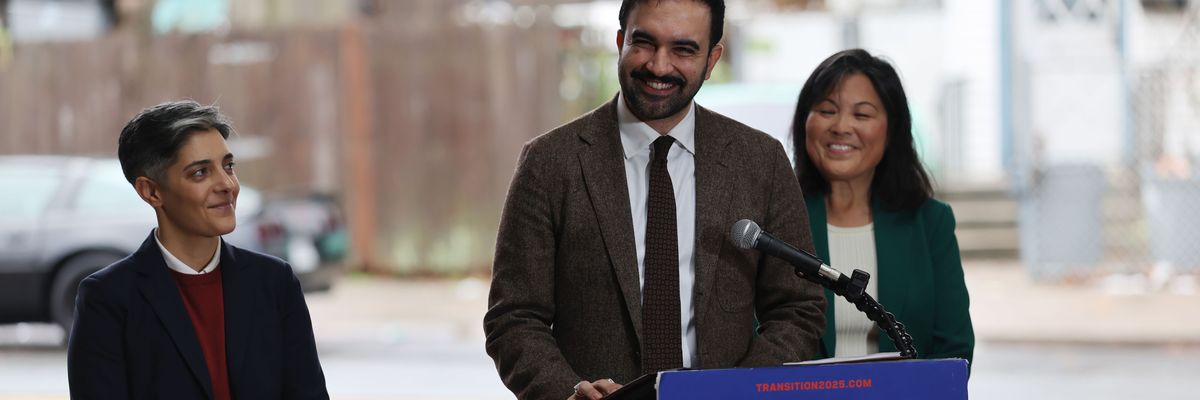
New York City Mayor-elect Zohran Mamdani stands beside Julie Su, his pick for deputy mayor for economic justice, and, further away, Deputy Mayor for Housing nominee Leila Bozorg, during a December 19, 2025 press conference in Staten Island.
(Photo by Spencer Platt/Getty Images)


Brett Wilkins
Dec 19, 2025
CONNON DREAMS

In a move cheered by advocates for the working class, New York City Mayor-elect Zohran Mamdani said Friday that former acting US Labor Secretary Julie Su will serve as the city’s first-ever deputy mayor for economic justice.

“Welcome to a new era, Julie Su,” Mamdani, a Democrat, said in a social media post announcing the appointment. “As former US secretary of labor, Julie played a central role in fighting for workers, ensuring a just day’s pay for a hard day’s work, and saving the pensions of more than a million union workers and retirees.”


‘Relentless Fighter for Working People’: Mamdani, Sanders Back Lander Bid for US House

Speaking at a Friday press conference in Staten Island with Mamdani and Deputy Mayor for Housing nominee Leila Bozorg, Su said: “In the richest city in the richest country in the world, no one should be treated as disposable. Dignity on the job is not a privilege but a right, justice is not abstract but it is felt in a paycheck you can live on, a schedule that you can build a life around, a workplace where your voice matters, and a city that has your back.”

Su, who had previously served as California labor secretary and deputy US labor secretary, was nominated by former President Joe Biden to permanently lead the Department of Labor. However, Republicans and some right-wing Democrats in the US Senate blocked her appointment, so Biden installed her in an acting capacity, in which she served from March 2023 until the end of the Democrat’s administration in January.

During her tenure, Su championed gig workers; fought to preserve pensions for retirees; pushed for workplace protections from Covid-19 and environmental harms; and helped negotiate labor agreements for healthcare professionals, flight attendants, and others.

Our people-powered journalism cannot survive without you

Your support allows Common Dreams to continue covering the stories and amplifying the voices that the corporate media never will. Make a tax-deductible year-end gift to ensure we can sustain the reporting needed to meet the challenges of 2026.


Su will now work with Mamdani, a democratic socialist, as he seeks to deliver on his campaign promises of free public childcare and municipal buses, a freeze on rent-stabilized housing, and city-owned grocery stores to residents of the nation’s largest city.

“What a thrilling day for the working class of New York City to have the first-ever deputy mayor for economic justice to ensure that our issues are front [and] center at every level of city government,” New York Taxi Workers Alliance executive director Bhairavi Desai said in a statement.

“With the appointment of the esteemed Julie Su—who is unafraid and unbought by corporate interests—Mayor-elect Zohran Mamdani is cementing the highest, uncompromised, and effective standards for a better life for New Yorkers abandoned and betrayed in decades past,” Desai added.

The NYC Central Labor Council of the AFL-CIO said on Bluesky: “Big news! Julie Su as deputy mayor for economic justice brings deep experience enforcing labor law, fighting wage theft, and standing up for working families.”

“She’s known and respected across the labor movement, including here in NYC,” the council added. “Looking forward to working with a proven champion for workers at City Hall!”

Service Employees International Union international president April Verrett said on X that Su “has spent her career standing with workers and holding powerful interests to account.”

“Bringing her into City Hall says New York is done talking and ready to throw down for the people who keep this city moving,” she added.
What Bondi Beach and Brown University Reveal About Stopping Gun Violence

Australia’s response to a December 14 mass shooting reminds us that violence is not an inevitability to be endured; it is a problem to be confronted.


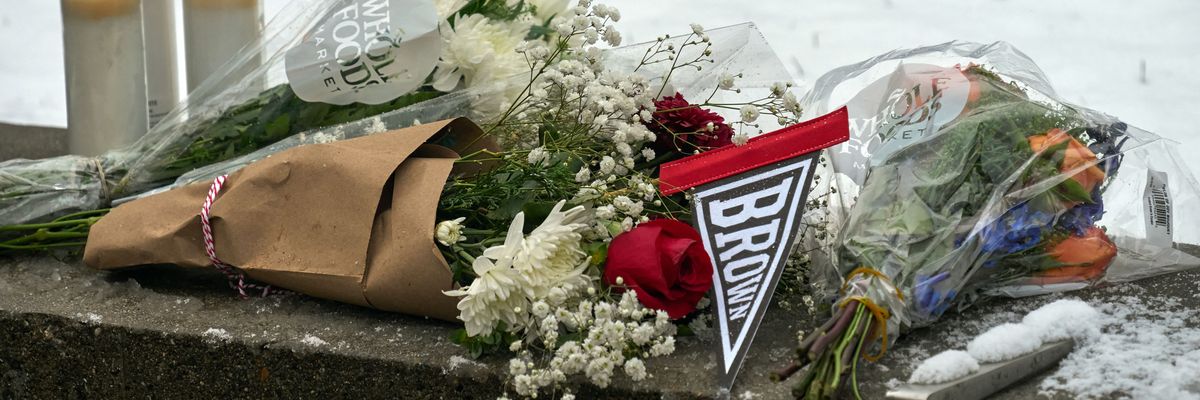
Flowers and candles are seen at a makeshift memorial outside the Barus & Holley engineering building on the campus of Brown University, in Providence, Rhode Island on December 14, 2025.
(Photo by Bing Guan / AFP via Getty Images)

Rob Okun
Dec 19, 2025
Common Dreams


Days ago, two tragedies unfolded on opposite sides of the world—each marked by gun violence and grief, yet met with starkly different national responses.

On December 14, on the first night of Hanukkah, a gathering on Bondi Beach in Sydney turned into horror when a father and son opened fire during a “Hanukkah by the Sea” celebration, killing 15 people and wounding 40 in what Australian authorities called an antisemitic terrorist attack. The carnage would have been much worse were it not for the heroic act of Ahmed al-Ahmed, an Australian citizen who migrated from Syria two decades ago.


‘We Don’t Have to Live This Way’: Deadly Brown Shooting Spurs Calls for Action on Guns


16 Dead After Shooters Target Hanukkah Celebration at Australia’s Bondi Beach

The day before in Providence, Rhode Island, a shooter opened fire at Brown University during finals, killing two students and wounding nine. As of this writing, authorities are actively searching for a suspect—and a motive.

These shootings—one at a beloved public beach, the other on an Ivy League campus—expose not only shared grief but radically different understandings of responsibility. In Australia, sorrow was quickly followed by collective resolve. The US followed a familiar ritual: shock, condolences, and political paralysis. If I had a dollar for every politician’s “thoughts and prayers,” I could join the billionaire class those officials so eagerly protect.

If we are serious about honoring the victims and survivors in Sydney, at Brown, and everywhere else touched by mass shootings, expressing grief is not enough.

Australian Prime Minister Anthony Albanese condemned the Bondi Beach massacre as an act of “evil beyond comprehension,“ pledging solidarity with the Jewish community and signaling renewed efforts to strengthen gun laws: tougher licensing, tighter oversight, and renewed limits on gun ownership.

Australians remember what followed the 1996 Port Arthur massacre. Within days, the country banned rapid-fire weapons, bought back and destroyed nearly 1 million firearms, and created a national gun registry. The result? Decades with virtually no similar mass shootings.

In the US, by contrast, each new tragedy yields the same results: more guns, more shootings, more grief; this in a country with more guns than people! And once again, the gendered reality of this violence is almost entirely ignored. There’s a reason we never hear the phrase, gunwoman.

The overwhelming majority of US mass shooters are male—frequently young, usually white, and commonly driven by grievance, isolation, and entitlement. This is not incidental. It’s a pattern demanding honest cultural reckoning. For decades, we’ve failed to challenge destructive norms of masculinity. No surprise that those norms keep finding their most lethal expression through guns.

Let’s be clear: This is not about demonizing men. It’s about telling the truth. We train boys to suppress vulnerability, to equate manhood with dominance, and to interpret frustration as humiliation. When that script collides with easy access to weapons designed to kill many people quickly, the outcome is predictable. Every time. Full stop.

Australia acted on that reality. After Port Arthur, it banned fully automatic weapons, semi-automatic rifles, and pump-action shotguns—and treated firearms not as sacred objects, but as regulated tools with enormous public risk. Rather than deny their grief, Australians transformed it into collective responsibility, identifying gun violence as a systemic problem requiring systemic solutions.

In the US, mass shootings are still framed as isolated incidents—acts of deranged individuals—or worse, as unavoidable features of national life: school shootings; movie theater shootings; grocery store shootings; church, mosque, and synagogue shootings. Together they form a normalized nightmare we refuse to confront honestly, ignoring the 393 mass shootings so far in 2025, according to the Gun Violence Archive.

At Brown University, students and families are now living with the trauma of a field of learning turned into a killing field. Final exams meant to test academic mastery became tests of life and death. The remainder of the semester was canceled, and students headed home to process a violent assault rather than celebrating the end of the semester.

And yet, even as Brown students grieve, politicians employ familiar distractions—talking about mental health or spiritual resilience—anything to avoid confronting easy access to weapons of mass destruction.

Australia’s response reminds us that violence is not an inevitability to be endured; it is a problem to be confronted. Their approach is not perfect; nor is their country. Their strategy reflects a fundamental belief: Government exists to protect lives, not to fetishize weapons. The US, trapped in a twisted love affair with the Second Amendment, continues to block meaningful reform.

Still, this country has a choice. We can center honest conversations about masculinity and how we raise boys. We can invest in early interventions for alienated youth. We can regulate weapons of mass killing. Or we can keep normalizing trauma and, laughably, calling it freedom.

When Brown students return to campus, many will have already spent weeks organizing for tougher gun laws. I predict students across the country will join them.

If we are serious about honoring the victims and survivors in Sydney, at Brown, and everywhere else touched by mass shootings, expressing grief is not enough. Action—the antidote to despair—is required. Now.


Our work is licensed under Creative Commons (CC BY-NC-ND 3.0). Feel free to republish and share widely.


Rob Okun
Rob Okun is editor-publisher of Voice Male, a magazine that’s been chronicling the antisexist men’s movement for 30 years.
Full Bio >