Tuesday, December 23, 2025

Why The Left Matters: A Century of Struggle, Social Justice And The Road Ahead

The future of the Left in India will be decided by the ability of the movement to rebuild and deepen its links with the working people.

MA Baby
Updated on: 12 December 2025 
OUTLOOK, INDIA
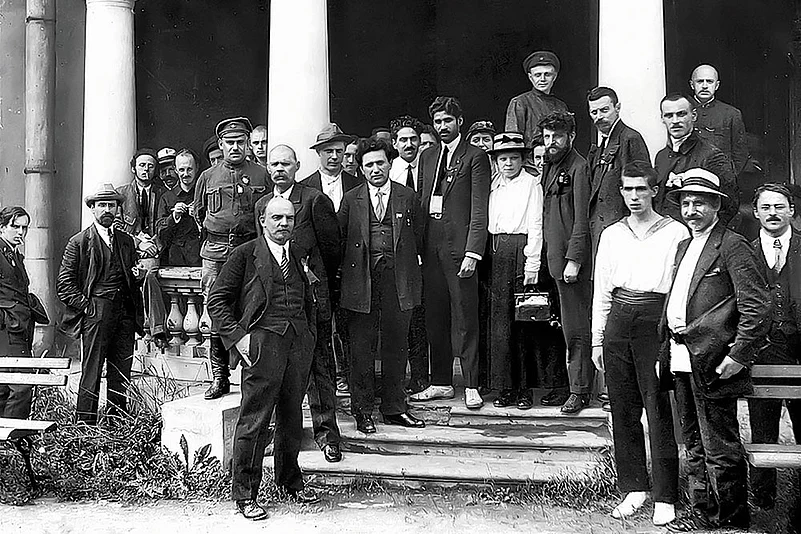

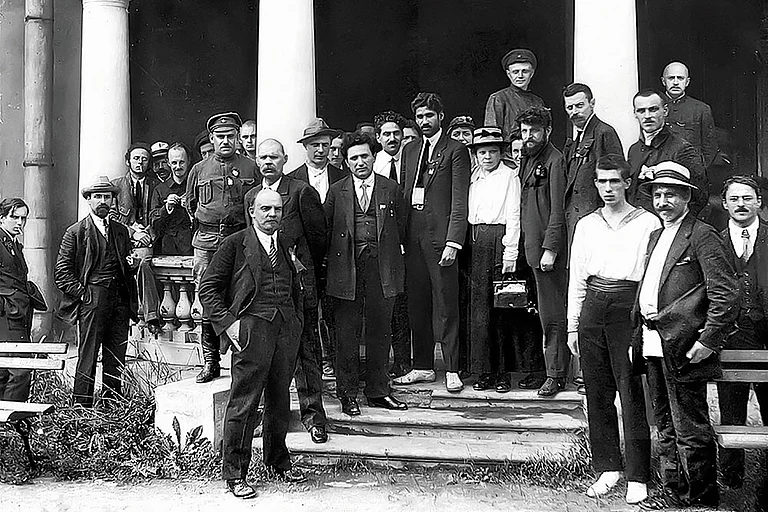
A Historic Gathering: Delegates to the second congress of the Comintern at the Uritsky Palace in Petrograd, including M.N. Roy, Vladimir Lenin, Maxim Gorky and Nikolai Bukharin

Summary of this article


The Left in India has endured for a century because it is rooted in the struggles, dignity and aspirations of workers and peasants.


Left ideas in India were not foreign imports but emerged organically from indigenous egalitarian traditions and early radical thought.


Communists played a decisive role in the freedom movement through organised mass struggles, trade unions, peasant uprisings and cultural platforms.


A hundred years is long enough for political currents to appear and disappear. Parties have risen on slogans and vanished in silence. What has endured in India, despite repression, distortions and political headwinds, is the Left movement. It has endured because it has always belonged to the working people of this country; to their labour, their dignity, and their dreams of a society free from exploitation. From the earliest murmurings of radical thought during anti-colonial resistance to the mass struggles of peasants and workers, from the severe blows of state repression to the experience of forming governments that delivered transformative reforms, the Left has left an indelible mark on modern India. The history of the Left is not parallel to the history of the nation, but it is rather interwoven with it.

The popular misconception that Left ideas were imported from abroad collapses the moment we revisit our own history with honesty. For example, in 1836, even before Karl Marx and Friedrich Engels joined the ‘League of the Just’, Vaikunda Swamikal, a social reformer who lived near the present day Marthandam (part of the erstwhile Travancore) started a utopian socialist movement called ‘Samathwa Samajam’. This is just one example. In fact, an investigation into the history of most societies and civilisations will reveal many examples of historical, mythological or intertwined narratives of a just and egalitarian society.
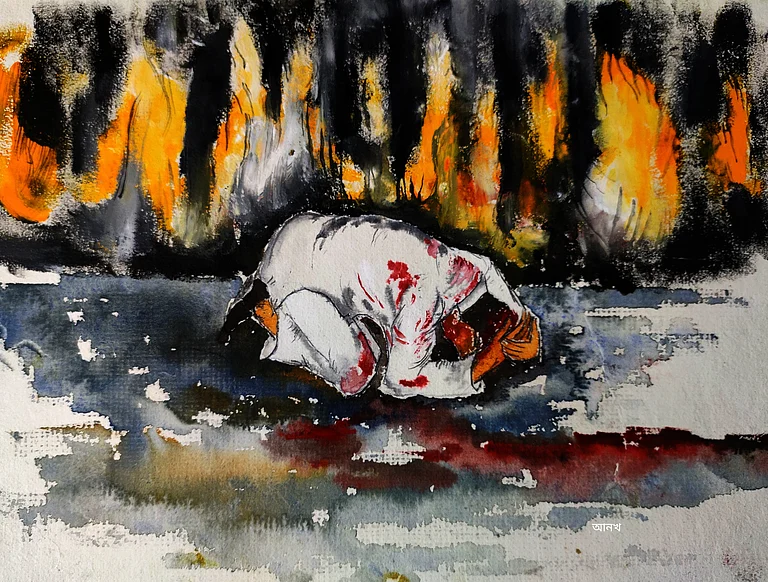


Images Against Darkness: 100 Years Of The Indian Communist Movement And The Culture Of Rebellion, In Photos


The 1905 Russian Revolution electrified the world, but India already had its own revolutionary impulses. The Anushilan Samiti in Bengal and the Ghadar Party in North America reflected an uncompromising resistance to colonial rule and a belief that freedom cannot be begged, it has to be seized. The Ghadarites, many of whom later became communists, carried the message that national liberation was inseparable from social liberation.

The October Revolution of 1917 provided inspiration, but not instruction. India’s young radicals were searching for tools to interpret the exploitation they experienced and witnessed in mills, plantations and villages. This search culminated in the formation of the Communist Party of India at Tashkent in 1920—five years before the party was organised publicly in Kanpur in 1925. The first Secretary of the Party, Mohammad Shafiq, symbolised a simple truth that the Left in India arose not from seminar rooms or drawing rooms, but from intense anti-colonial, anti-imperialist struggle.

Long before the Congress adopted the slogan of Poorna Swaraj in 1929, Hasrat Mohani, a communist, put forward the demand in 1921 at the Ahmedabad session of the AICC along with Swami Kumaranand, a peasant leader. The formation of the All India Trade Union Congress (AITUC) in 1920, and later organisations such as the Naujawan Bharat Sabha, the Hindustan Socialist Republican Association, the All India Kisan Sabha, the All India Students’ Federation and the Progressive Writers’ Association, turned radical thought into organised mass movements. Workers, peasants, women, students, youth, cultural activists and writers, all found in the Left a political home that combined the struggle for independence with the struggle for social transformation.

One of the final nails on the coffin of the morale of British rule in India was delivered by the sailors of the Royal Indian Navy uprising in 1946. It resulted in an insurrection by over 10,000 sailors and received massive support from the civilians and even police forces of the country. This mutiny was a loud message to the British that Indian soldiers will no longer aid or become a tool for the exploitation of their own people. It must not be forgotten that the sailors were proudly flying the Red Flag of the Communist Party on their ships (along with those of the Congress and the Muslim League flags) during the rebellion.
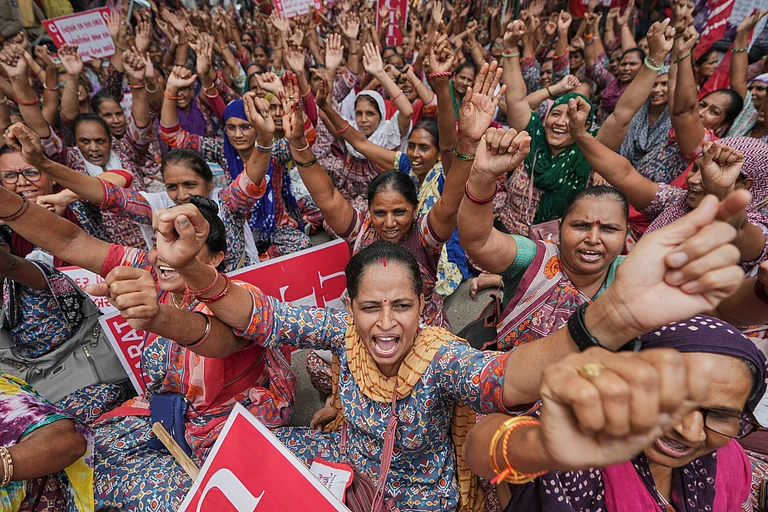

Crores On Strike: Bharat Bandh Disrupts Services Across India


Mass Struggles That Redefined India

What distinguishes the Left’s contribution to the freedom movement is not rhetoric but sacrifice. The communists led united struggles of workers and peasants that shook the pillars of colonial rule and feudal power. The Tebhaga movement in Bengal demanded two-thirds of the produce for the tiller. The Telangana struggle was carried forward by countless ordinary villagers, including women leaders like Mallu Swarajyam, and it confronted the nexus of feudal lords and the Nizam’s private militia. In the princely state of Travancore, the Punnapra-Vayalar uprising challenged autocratic rule. Each struggle was met with brutal repression. Yet each of them created a new political consciousness: that the land belongs to those who cultivate it, wealth belongs to those who produce it, and democracy means nothing without dignity.

Across the country, peasant movements asserted themselves in different contexts with shared aspirations. In Malabar, the struggles against Jenmi landlordism built the foundation of the Kisan Sabha. In Thane district, Adivasi struggles after 1947 challenged debt bondage and land dispossession under the leadership of the Sabha. P. Sundarayya, who would later lead the Communist Party of India (Marxist) as its General Secretary, dedicated his life organising poor peasants and farm workers, and towards the study of agrarian relations throughout undivided Andhra. In Tamil Nadu, G. Veeraiyan and others organised agricultural labourers against caste-linked exploitation and violence. The agrarian movement in Thanjavur was built by the CPI(M) and its mass/class organisations. This movement was intricately linked with the anti-caste struggle and over time, it gained so much strength that even the very idea of an agricultural union existing irked the landlords so much that they organised a gruesome massacre in the Keezhvenmani village, killing 44 Dalits, the majority of whom were women and children.
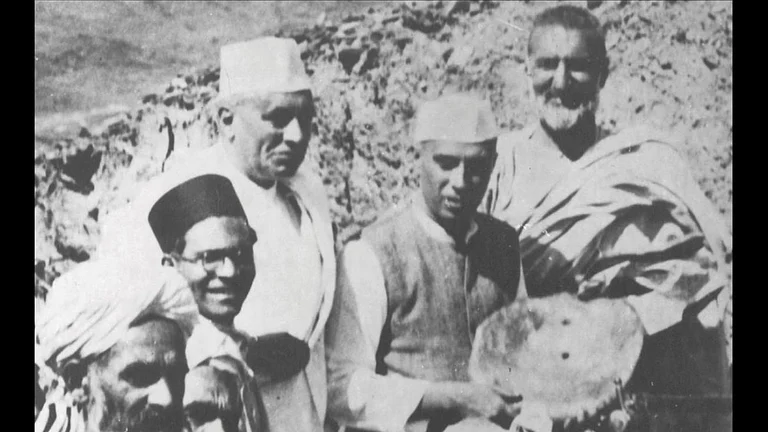
Kunwar Mohammad Ashraf (1903-1962): The Gandhi-ite Communist

Similarly, it was the CPI(M) and progressive class organisations that led a relentless struggle to get justice for the survivors of Vachathi state violence. These movements struck at the most deep-rooted structures of Indian society including but not limited to caste hierarchy, patriarchy and the culture of unpaid, invisible, unrecognised labour. In this sense, the Left did not wait for independence to begin fighting for social transformation. The battle for social equality was already underway in the fields and factories much before 1947. The Draft Platform for Action, 1930 was the first attempt towards preparing a programme for the party. This document recognised the ruthless abolition of the caste system along with agrarian revolution and overthrow of British rule as a necessity to achieve the complete social, economic, cultural and legal emancipation of all workers.

The years immediately after independence were marked by severe repression of the communists. The Telangana struggle was crushed with horrendous state repression. Leaders and cadres were jailed, forced to go underground, or killed in fake encounters. A distorted narrative was created to paint the Left as a threat to the nation precisely because the Left was demanding that land and power be returned to the people. Yet the repression did not erode the movement. Instead, it solidified the understanding that political democracy without economic democracy is hollow.

The turning point in parliamentary recognition came in 1957 when Kerala elected the first Communist government through the ballot. Land reforms, education reforms and democratic decentralisation fundamentally altered the social landscape of the state. The 1957 experiment proved that the Communists can govern, not just agitate; and govern in ways that expand people’s rights, not restrict them.

In later decades, Left governments deepened that legacy. In West Bengal, Operation Barga secured tenancy rights for millions of sharecroppers and laid the groundwork for rural poverty reduction. The panchayat system that empowered local democracy emerged in West Bengal and Kerala long before it was recognised in the Constitution in 1992. In Tripura, land redistribution ensured that two-thirds of land went to a tribal population that formed one-third of the state. These should be seen as parts of a coherent model of development in which human welfare is not an afterthought, but the starting point.

These experiences speak volumes about why Kerala continues to repose confidence in the Left, electing it twice in succession, something that has been unprecedented in the state’s political history. When governments deliver social justice in real terms, people do not forget.

Whenever India has been threatened by authoritarianism, the Left has taken an unmistakable stand. During the Emergency, when many parties compromised or justified excesses, we who opposed it paid a heavy price, but still refused to surrender constitutional and democratic rights. In the decades since, the Left has been the most consistent force against communal polarisation. It recognised much earlier than others that communal politics is inseparable from economic inequality, a divided society is easier to exploit.
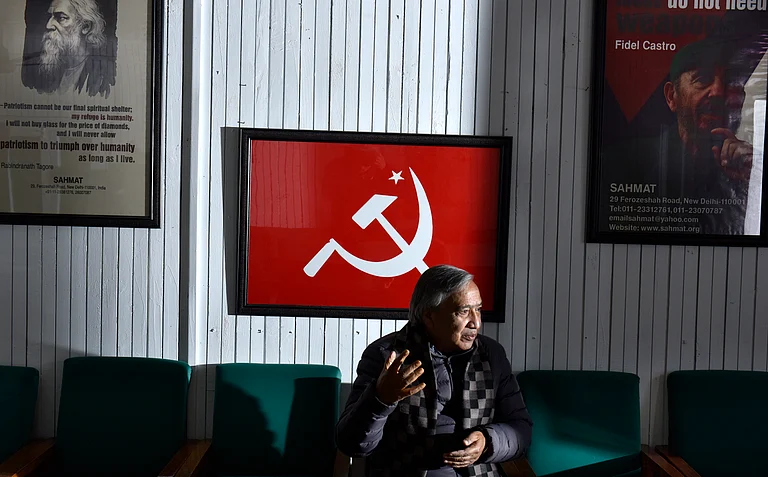

What's Left Of The Left: The Thin Red Line In J&K

The crises India faces are the outcome of policies that prioritise private profit over public good and division over unity. A different future is possible—one based on secularism, equality, dignity of labour and democratic rights.

The CPI(M) warned in its 23rd Party Congress about the rise of the communal-corporate nexus which is an alliance of reactionary social forces and big capital. Today, as public assets are being handed over to private monopolies and dissent is being increasingly criminalised, that warning reads not like a precise description of current reality.

Whenever labour rights, public sector enterprises or natural resources have been threatened, the working class with the Left at the forefront has fought back , whether it is to prevent the sale of strategic Public Sector Units or to resist anti-worker labour codes. The one-year-long farmers’ movement on the borders of Delhi, which forced the repeal of three farm laws, saw active, consistent and disciplined participation from peasant organisations like the All India Kisan Sabha and other democratic and Left forces. The Kisan Long March in Maharashtra, where thousands of poor peasants walked peacefully with red flags, became a symbol of how democratic mobilisation can achieve what electoral arithmetic cannot.

Why the Left Matters Even More Today


There is a popular trend to judge political relevance solely by election results. But the Left’s history in India shows that the yardstick for us has always been larger: the strength of our links with working people, our ability to organise struggles, and our capacity to offer an alternative vision. Even in a period when the Left’s electoral strength is seeing unprecedented setbacks, its ideological and organisational presence continues to shape resistance movements across the country.

Today, India faces economic stagnation, record unemployment, nutritional crisis, collapse of public health funding, increasing numbers of suicides among peasants and agricultural labourers, rising caste violence, attacks on women, systematic communal polarisation that includes attacks on minorities, dalits, tribals and transgender people. In such a situation, the Left remains the only political force that speaks not of temporary relief but of structural change that includes public investment, universal welfare, labour rights, land reforms, public education, and a secular democratic republic rooted in equality.

The recent achievements of the Extreme Poverty Eradication Programme launched in Kerala show that it was a policy initiative grounded in the conviction that no human being should live without dignity. It does not mean that Kerala is free of poverty, but the achievements of this programme are a significant step in that direction.

It is this orientation that explains the renewed interest among young people in progressive politics worldwide. Against the rise of the far-Right forces, the youth are also marching behind the new faces of the Left and progressive forces in their countries to challenge inequality, corporate power and racism. The examples of Anura Kumara Dissanayake, Catherine Conolly, Zohran Mamdani, and countless other unnamed organisers and forces, speak volumes about this renewed interest. India is not an exception to this global churn.



Dhoom Macha Le: How Zohran Mamdani’s NYC Mayoral Victory Challenges Authoritarian Trends


The Next 100 Years


The Left movement in India has completed more than a century, but its task is far from finished. It has fought for generations of workers, peasants, women, students and marginalised communities; not for the sake of abstract ideals, but for concrete improvements in their lives and in the society as a whole. The future of the Left will be decided by the ability of the movement to rebuild and deepen its living links with the working people and other toiling masses.

Applying the scientific understanding of Marxism-Leninism in the concrete conditions of India is pertinent to achieve the above. As Young Comrade Lenin once mentioned, “We do not regard Marx’s theory as something completed and inviolable; on the contrary, we are convinced that it has only laid the foundation stone of the science which socialists must develop in all directions if they wish to keep pace with life. We think that an independent elaboration of Marx’s theory is especially essential for Russian socialists; for this theory provides only general guiding principles, which, in particular, are applied in England differently than in France, in France differently than in Germany, and in Germany differently than in Russia. We shall therefore gladly afford space in our paper for articles on theoretical questions and we invite all comrades openly to discuss controversial points.” (Collected Works of Lenin, Vol. IV, pp. 211-212).

The crises India faces are the outcome of policies that prioritise private profit over public good and division over unity. A different future is possible—one based on secularism, equality, dignity of labour and democratic rights. For that to become a reality, the Left is not just relevant but indispensable. The struggles of the past 100-plus years have immensely contributed towards shaping the democratic foundations of India. The next 100 years must complete the unfinished task of revolutionary social transformation.


(Views expressed are personal)

https://www.outlookindia.com/magazine/


M.A. Baby is General Secretary, Communist Party of India (Marxist)

This article appeared as 'We Shall Overcome' in Outlook’s December 21, 2025, issue as 'What's Left of the Left' which explores the challenging crossroads the Left finds itself at and how they need to adapt. And perhaps it will do so.

INDIA

Left-Brahmin, Right-Bahujan And Caste Of Ideologies

The Left needs to shrug its Left-Brahmin configuration to emerge with newer forms of solidarity.


Ajay Gudavarthy
18 December 2025 
OUTLOOK, INDIA


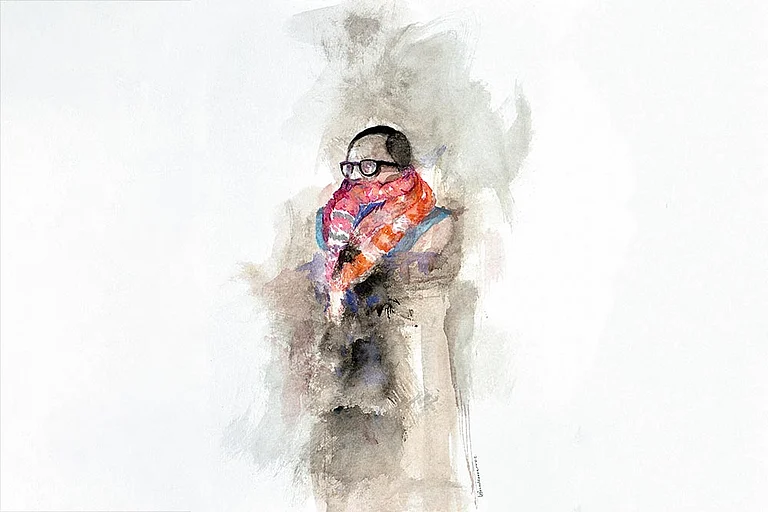
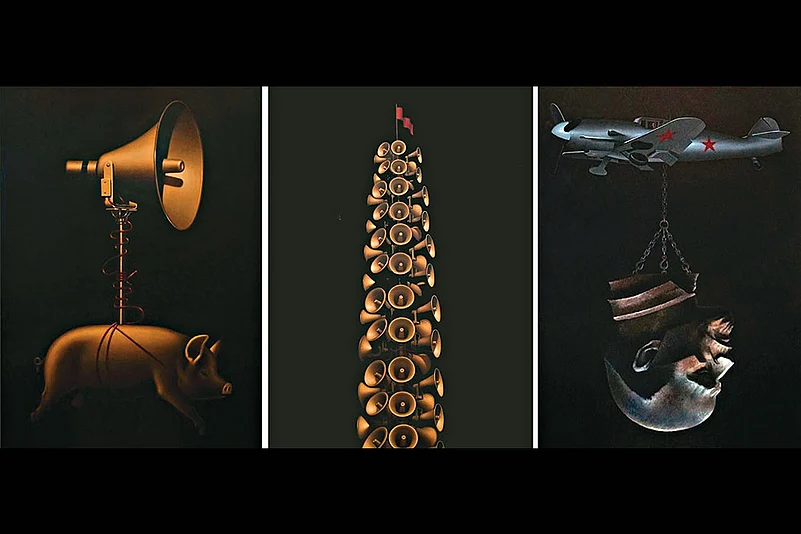
Marx Archive, 2018: Artwork by K. M. Madhusudhanan Photo: | Courtesy: Vadehra Art Gallery

Summary of this article


The Indian Left is in decline, increasingly seen as elite-driven (“Left-Brahmin, Right-Bahujan”) and out of sync with fragmented, pragmatic political behaviour shaped by neoliberalism.


It has failed to adapt to a new political idiom where culture, affect, symbolism and everyday experience shape politics—spaces the Right has successfully occupied.


To revive, the Left must shed elitism, reconnect class politics with culture and lived anxieties, rebuild unity, and create inclusive, popular forms of solidarity and organisation.


Left politics, for some time now, has been witnessing a terminal decline. There is a growing concern in university spaces that Left politics may end up attracting only the social elite, and those they are attempting to mobilise may move to the Right. It is a new political configuration that I refer to as Left-Brahmin, Right-Bahujan. The imagination of the Left has, over a period, been getting eroded in terms of its appeal and jouissance. Those who it was mobilising seem to be operating on a different register. It is a conflict between idealism and pragmatism, ideology and strategy, structural change and immediate survival. But what has changed so fundamentally?


What has changed fundamentally is the way transformation is being imagined after the neoliberal era. Farmer movements in the recent past have been a great exception in bringing back street protests in a big way. Farmer protests succeeded in pushing back the farm laws, but they did not succeed in electorally defeating the current political regime. It is in this context, some may argue, that farmers protested against the farm laws and not for the political defeat of the Bharatiya Janata Party (BJP). They may protest at Delhi’s borders, but may go back to voting for the BJP and Narendra Modi. Defeating the entire corporate model of development was never their intention; it was only about saving their land.

Why should the farmers defeat the political regime? This question does not make sense in Left-oriented politics. It is part of a structural logic, but some in today’s context may argue as to why burden the farmers with a regime change? Is it the logic of politics or the burden of morality? If farmers pushed back the farm laws, but went back to voting for the BJP for other considerations, how should one analyse such a thing? Some may argue in the current neoliberal context that expecting a continuity or consistency in the political behaviour or subjectivity is itself never empirically true. One should allow seeing that political action and choices are fragments and remain essentially fragmented.

The same political subjectivity can be framed in a different Left lexicon that fragmented behaviour is itself the product and symptom of neoliberal times. Should politics then not be about bringing a sense of a semblance of connection between the fragments? Or is it more liberating to think of change as disorderly, discontinuous and piece-meal? The later kind of a change imposes no moral burden on the political subject, while the aim and imagination of large change is burdensome and also totalitarian in character. This is the central question and challenge that the Left politics are facing in current times. Its old ways are not working and the new ways are not acceptable to it

The other major shift in Indian politics is that its idiom has changed. With representation becoming a significant dimension of social justice, there is a new local cultural idiom that has entered politics. There is a great shift to cultural symbolism and also making sense of economic and material issues through a cultural idiom. The BJP has been at the forefront of appropriating this phenomenon and the Left has not yet joined the party. It is still constrained by its social-ideological frameworks that lack affective depth. Revolutionary language brought in great symbolism of songs, dance, and slogans. They are now jaded and sound repetitive. The Left is often prone to confusing being repetitive with commitment. One could be tempted to compare it with the (Brahmin) Bhajan culture. It can be best understood by an anecdote when I took the initiative to arrange for a condolence meeting of a Left ideologue, and his comrades paid him rich tributes by saying that what he said in the 1950s, he said the same (or stood by the same) till 2000, when he passed away!

The Left certainly needs to reinvent itself. Both the parliamentary and non-parliamentary Left are on the wane. The decline becomes even more stark when you see that both the Communists and the Rashtriya Swayamsevak Sangh (RSS) began in 1925, and the opposite directions in which they seem to have travelled. With the coming of Gen Z, the Left begins to look even more archaic, even though it’s the Left student politics that continue to remain successful.

This is where the Left needs to link the questions of capital and exploitation to culture and more so everyday existential issues. The market and neoliberalism are not only an economic phenomenon, but also a cultural phenomenon. It impacts the way we think and interact. Is loneliness not the gift of late capitalism and distorted modernity? Anxiety is the product of excessive competitive ethic, and intrusive markets at the root of anomie. The Left fights the markets without linking it to anomie, and fights competition and monopoly without linking them to anxiety. It fights spatial inequalities without fighting boredom. One need not go too far, but take a detour to stop at Bollywood when it sings Khali bore do paharo se… jhola uthakar chale..Ramachandra ji (Fed up of these empty, boring afternoons, I’m packing my bag and leaving). Boredom has emerged as such a potent issue that populist authoritarians have reduced politics to entertainment. People are looking for new stories to celebrate life, and workers and peasants too possess mobiles. Entertainment and compensatory consumption have collapsed to be one. How can the Left enter and encroach such spaces? Mostly, the Left assumes all of culture to be conservative, and mistakes performance for manipulation.

The Left needs to move back into popular registers where everything that is popular is not necessarily progressive. But in order to recover the progressive one cannot eschew the popular. It is now clear that the progressive has to be built from within the popular by resignifying myths, mythologies, folklore and civilisational stories. Revolutionary poet Varavara Rao from Telangana was known for his robust interpretation of Karna for the caste question and Draupadi for the gender. With the emergence of independent Ambedkarite movements, mythologies were seen as casteist and they gradually receded from public discourse.

The rise of populism is questioning politics as a professional and a specialised field. It is bringing the everyday into the political. This is in itself radical. The intimate is bursting the opaqueness of the political as a distant and an indifferent field of discourses and policies. The Left got bamboozled with the intimate in the political. It needs to begin experimenting with a new organisational culture that is friendly, affable and above all, provides a deep sense of belonging. They need a new culture to settle differences without splits. They don’t need to learn from the RSS, but could well begin with Lenin’s ideas on concentric circles. While the RSS floats a great number of ‘shadow armies’, the Left is unable to hold on to corporeal bodies.

It is time for the Left to rethink the possibilities of a merger between various factions that have microscopic differences given disproportionate significance. They may need to open a fresh dialogue between the parliamentary and non-parliamentary factions. The ‘Great Debate’ is no longer as relevant as it once was. Neither China nor Russia has remained socialist. We need to make a fresh beginning in telling ourselves that we do not know how to build socialism. Bertrand Russell was among the first to return disappointed with his trip to the erstwhile Soviet Union and early to point to its bureaucratic culture and the absence of creative freedom. The Left needs to read and listen beyond its coterie sometimes to see what looked obvious to many.

Social elitism works in many ways in the Indian context. It is in this sense that the Left needs to shrug its Left-Brahmin configuration to emerge with newer forms of solidarity. As long as it fails to do so, it will, figuratively, remain an organisation of ‘Brahmin boys’.


(Views expressed are personal)


Ajay Gudavarthy is with the centre for political studies Jawaharlal Nehru University


https://www.outlookindia.com/magazine/

This article appeared as Left-Brahmin, Right-Bahujan in Outlook’s December 21, 2025, issue as 'What's Left of the Left' which explores how the Left finds itself at an interesting and challenging crossroad now the Left needs to adapt.
INDIA

Left’s Caste Blind Spot: Ambedkar And His Criticism of The Circle Of 'Brahmin Boys'

Dalit thinkers argue that caste as a dimension of social oppression was sidelined in communist practice. Intellectuals within the communist fold acknowledge that this neglect may be central to the crisis the Left faces today


N.K. Bhoopesh
Updated on: 11 December 2025 
OUTLOOK, INDIA


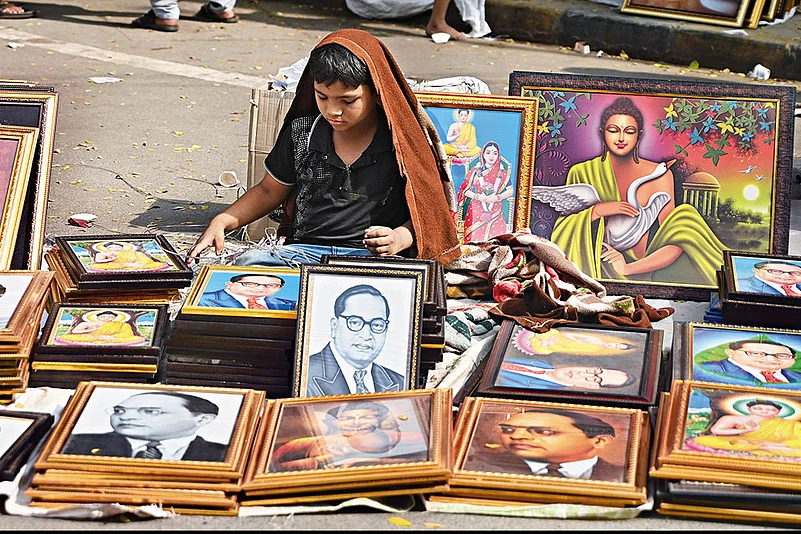
The Icon: A young boy sells portraits of Ambedkar | Photo: Imago/Hindustan Times

Summary of this article


Ambedkar accused communists of ignoring caste while CPI sought to dilute his influence.


Critics say Savarna-led Left long sidelined caste, pushing class over social oppression.


Late representational shifts expose ideological limits that haunt the modern Left.


Bhimrao Babasaheb Ambedkar never minced words.


For him, the Indian communist leadership was a circle of “Brahmin boys”, unable or unwilling to grasp the daily violence of caste. The communists, in turn, accused Ambedkar of siding with imperial interests and holding back the so-called untouchable masses from the wider democratic struggle.


The clash sharpened in 1952. After leading the Independent Labour Party (ILP), Ambedkar founded the Scheduled Caste Federation (SCF), shifting focus to specifically champion Dalit rights as a national political force, evolving from the ILP’s broader labour and anti-caste work into a platform dedicated solely to Scheduled Caste interests. The ILP was Ambedkar’s first political vehicle to address general labour rights and anti-caste issues. The SCF was formed to secure a distinct political platform to secure the rights of the Dalits.

Soon after, the Communist Party of India’s (CPI) central committee passed a resolution urging cadres to break Ambedkar’s influence among Dalits by taking up their demands and leading the fight against caste-Hindu oppression through common mass organisations. The resolution stated: “The party must sharply expose the policies of Ambedkar and wean the SCF masses away from his influence by boldly championing the democratic demands of the Scheduled Caste masses, by fighting caste-Hindu oppression against them and by drawing them into common mass organisations.”

Rooted in a classical Marxist framework, Indian communists largely saw caste as a secondary contradiction, something that would ultimately be resolved and subsumed within the broader context of class struggle. Yet, despite ideologically relegating caste to a lesser plane, it continues to haunt the Indian communist movement, especially after the Mandal era, which changed the Indian political landscape without recognition.

Related Content


Minimum Marxism: Reclaiming Class Politics


A Century of Red: The Indian Communist Movement


The Right In The Left: Lessons And Limits


Why The Left Matters: A Century of Struggle, Social Justice And The Road Ahead


Constitutional expert and former director of the National Law School of India, Mohan Gopal, argues that the Indian communist leadership’s longstanding discomfort with the anti-caste movement is rooted in its Savarna social orientation. To illustrate this, he cites Left ideologue EMS Namboodiripad. When Namboodiripad was invited to inaugurate a programme at Shivagiri on the birth anniversary of social reformer Sri Narayana Guru, he declined. Gopal notes that EMS reportedly justified his refusal by saying that if he had attended, he would have been expected to acknowledge Guru’s historical contributions, “which he did not like”.

Caste Is Poison, And Ambedkar Is The Antidote
BY Musafir Baitha


For Gopal, this episode captures a deeper pattern: a reluctance within sections of the communist leadership to recognise, let alone celebrate, the transformative role of anti-caste reformers. In his view, this reflects not merely ideological differences but a structural inability on the part of a Savarna-dominated leadership to engage fully with the politics of caste emancipation. The Indian Communist Party leadership’s caste elite domination has been pointed out by many as its inability to confront caste as a social reality.


“Caste was never brought as a subject that merits discussion within our organisation,” says O.K. Santhosh, professor at the University of Madras. Santhosh was a Students’ Federation of India (SFI) leader, a senate member, and a college union chairman in his college days. “In our committees, we used to discuss about liberalisation, privatisation and globalisation and a whole lot of things. But never caste issues. I don’t think it is deliberate. But growing up, I found the party’s approach inadequate to explain social realities and moved towards Ambedkarite movements,” he said.


C.K. Janu, a firebrand tribal leader, began her public life through the CPIM-led agricultural workers’ front, the Kerala Karshaka Thozhilali Union (KSKTU). She says the party and its leaders were impervious to the demands arising from the systemic issues tribals faced, such as landlessness and marginalisation. “Whenever I tried to present the case of the tribes, their problems and the ill-treatment meted out by the people who owned large swathes of land, it was given a short shrift. We were forced to form a tribal association—the Adivasi Gothra Mahasabha—because of the Left’s approach towards the tribals. They used us only for political processions and to stick posters,” she said.


A CPI(M) sympathiser, who did not wish to be identified, pointed to an interview given by former general secretary, the late Sitaram Yechury, to illustrate what he sees as the Left’s deeper ideological blind spot on caste. In that interview, Yechury recalled an exchange with the late Bahujan Samaj Party (BSP) founder Kanshi Ram. Kanshi Ram had asked him a seemingly simple question: How many Dalits are there in the West Bengal CPI(M) cabinet? Yechury admitted that he did not know and promised to check.


The sympathiser highlighted that even a close associate of Yechury—a CPI(M) minister—did not know the social background of his own colleague. Within the party culture, he said, “to be innocent of caste was regarded as a sign of ideological purity.” What is often celebrated as caste-blindness, he argued, is not an individual failing but a structural limitation of the Left’s ideological framework, which discourages acknowledging caste as a political reality even when it shapes access to power.


In 1989, when the VP Singh government announced the implementation of the Mandal Commission report, the Left’s vote share was at its highest, with the CPI (M) at 6.55 per cent and the CPI at 2.57 per cent. But the political decision that catapulted parties with a social justice agenda also sidelined the Left. Except in 2004, when the Left was instrumental in propping up the United Progressive Alliance government, its role has waned since then. Dalit thinkers argue that the cultural and identity-centred dimensions of social oppression, especially caste, were systematically sidelined in communist practice, even as anti-caste movements outside the Left dramatically reshaped India’s social landscape.


Interestingly, even intellectuals within the communist fold now acknowledge that this neglect may be central to the crisis the Left faces today. “The caste background of the earlier leaders could be one reason for not taking the caste issue seriously,” says Saira Shah Halim, author of Comrades and Comebacks. She notes that communist parties failed to recognise caste as a primary structure of oppression and instead relied almost exclusively on economic explanations. “They pushed the base-superstructure theory, believing that once the economic structure was corrected, every other social problem, including caste oppression, would disappear. That approach is deeply flawed,” she adds.

The Communist Party’s approach to identity politics is reflected starkly in the social composition of its leadership. For 58 years after its formation in 1964, the CPI(M) did not have a single Dalit member in its Politburo. It was only at the 2022 Party Congress that Ramachandra Dome, a Dalit leader from West Bengal, was inducted into the party’s highest decision-making body. The 2025 Congress added another leader from a marginalised community, Jitendra Chowdhury, a tribal leader from Tripura. The CPI, India’s oldest communist party, now has a Dalit general secretary in D. Raja, marking a late but notable shift in representational politics.

Engaging with caste has remained a persistent fault line in Indian politics, with Ambedkar on one side and nearly every other political formation, each in its own way, on the other. The communist approach, and its limitations, appear more pronounced because the Left explicitly claims a revolutionary mandate to abolish all classes. This makes its difficulty in fully grappling with caste even more glaring.

The question of how social markers such as caste and gender fit into the Left’s overarching class narrative is therefore unlikely to fade. In all likelihood, the Left will continue to animate political and intellectual debates, perhaps until both caste and class hierarchies are dismantled.


N.K. Bhoopesh is an assistant editor, reporting on South India with a focus on politics, developmental challenges, and stories rooted in social justice


MORE FROM THIS ISSUE


Tracing The Naxalites: How India’s Maoist Insurgency Is Crumbling in 2025


This article appeared as Reportage On Blind Spots Left Is Countering Ambedkar And The ‘Brahmin Boys’ in Outlook’s December 21, 2025, issue as 'What's Left of the Left' which explores the challenging crossroads the Left finds itself at and how they need to adapt. And perhaps it will do so.
Red Star, Lode Star: Where Does The Left Stand With The Global Rise Of The Right

The global rise of the Right has made the Left not irrelevant but indispensable


Brinda Karat
17 December 2025
OUTLOOK, INDIA


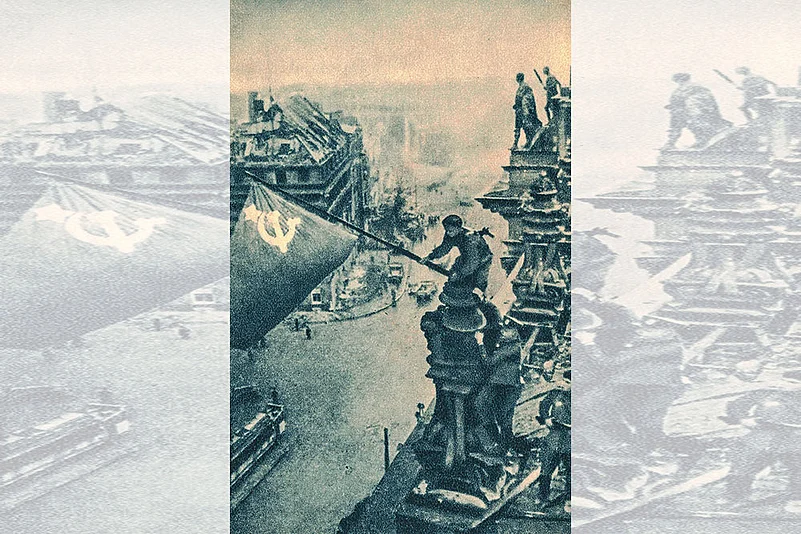
Flying High: Two Soviet soldiers plant a Soviet flag on top of the Reichstag building on May 2, 1945, symbolising the Soviet Union’s victory over Nazi Germany during the Battle of Berlin | Photo: Imago

Summary of this article


Persistent anti-Left rhetoric by Right-wing leaders reflects the enduring appeal of socialist ideas, which continue to resonate with working people.


The rise of neoliberalism after the collapse of the Socialist Bloc led to deregulation and soaring corporate power, deepening inequality and culminating in crises like the 2008 crash.


The global turn to the far-Right has been fuelled by economic insecurity, corporate backing and manufactured social polarisation.


Zohran Mamdani’s victory in New York underscores the continued relevance of egalitarian, despite aggressive attacks from leaders such as Trump.


It is striking that Right-wing leaders across the world continue to use communist and socialist-bashing as a central feature of their politics even while repeatedly declaring Left ideology “dead and buried”. If socialism is supposedly irrelevant, why is it still treated as a threat? The answer is simple: socialist ideas continue to resonate with working people everywhere, especially in times of deep crisis. This is why those in power remain preoccupied with discrediting the Left.

The vicious language used by US President Donald Trump against Zohran Mamdani—the self-declared democratic socialist who won the New York City mayoral election—is a telling example. While Mamdani was campaigning, Trump described him as a “lunatic communist,” a “subversive,” and condemned socialism as “the most noxious idea in human history”. Yet, Mamdani won decisively in the heart of global capitalism. His victory showed that even in metropolitan America, a political programme rooted in equality, public welfare and working-class rights has widespread support.

The collapse of the Soviet Union and the socialist bloc in the early 1990s was hailed by capitalist powers as “the end of history”. They celebrated the elimination of a model that had forced Western governments to adopt social security, welfare protections and labour rights. With its collapse, these concessions were treated as dispensable. Neoliberalism—the new template of global capitalism—proclaimed the privatisation of public assets, corporate tax concessions, sweeping deregulation, restrictions on labour rights and massive cuts in public expenditure as the formula for growth.


The Indian Left: Never Ruled, But Writing The Rules


On Bengali Cinema's Shift: From Socialist Ethos To Depoliticised Screens


Neoliberalism grew out of the demands of finance capital, merging into huge corporations across national borders for unfettered access to markets across the world without national regulations. Deregulation enabled speculative capital to flow across borders, unconstrained by concerns of social welfare or adherence to legal rights for workers, which were dismantled in many countries. The result was the dramatic enrichment of large corporations at the expense of ordinary people. Wages stagnated even as corporate profits and executive bonuses rose sharply. Public health and education systems were starved of funds. Pension guarantees and social security protections were steadily dismantled under the doctrine of “austerity”, while the wealthy enjoyed tax bonanzas. For workers, neoliberalism translated into outsourcing, contractualisation, the destruction of job security, and the weakening of unions. A vast population of precarious workers —with no guarantee of income or social protection—became the new global norm. The 2008 financial crash, which pushed millions into unemployment and poverty, was not an accident but the logical culmination of the neoliberal order.


When Absence Meant War


The absence of the Socialist Bloc of countries was felt throughout the world—by developing countries who lost a key ally against the hegemony of the Western imperialist powers, the working people in capitalist countries, those countries fighting for national sovereignty. It is no coincidence that this was when wars led by the US were waged, particularly on West Asian countries to grab their oil wealth. The US supported the most fundamentalist Islamist forces to overthrow regimes not compliant with US interests. The symbol of such forces, Osama Bin Laden, was a creation of this imperialist policy of the US as was the Taliban against the pro-socialist regime in Afghanistan.

As the social and economic consequences of neoliberalism hardened, discontent spread across the world. It was the betrayal of mainstream social-democratic parties and centrist parties, leading governments, that had earlier embraced neoliberal reforms themselves, unable to provide any alternatives which created the space for the far-Right. It channelled widespread economic insecurity into hatred—much like the Nazis did in 1930s Germany—replacing class anger with hostility towards immigrants, minorities and marginalised groups. In a kind of Right-wing International, these forces developed similar slogans and platforms: that authoritarian nationalism is the true guardian of culture, that corporate dominance represents development, and that attacks on minorities are legitimate expressions of majoritarian identity. The pattern has repeated itself across the US, Italy, Turkey, Hungary, the Philippines, and in India. In almost every case, the political rise of the far-Right has been achieved through the fusion of immense corporate backing with carefully manufactured social polarisation.

socialist ideas continue to resonate with working people everywhere, especially in times of deep crisis. This is why those in power remain preoccupied with discrediting the Left.


The scale of this shift is dramatic. A recent Global Parliament Index (Arden strategies) estimates that Right-wing governments now account for roughly 37 per cent of national leadership worldwide—the highest proportion in decades. Yet, contradictions are mounting. The neoliberal model that these governments championed is in crisis; protectionism is replacing globalisation, tariffs have been weaponised by the US to establish hegemony, and fears of another major financial collapse haunt Western economies. Public approval ratings for several Right-wing incumbents are falling sharply, including those of Trump in the United States.

At the same time, socialist China—which follows a model of state-led planning and public control of key resources—has emerged as a major pole in global politics against which the US is scrambling to build alliances. Whatever internal debates the global Left may have about the nature of Chinese socialism, the fact remains that a country once economically behind India now stands among the world’s most technologically advanced because it refused to submit to neoliberalism and retained what it describes as “Socialism with Chinese characteristics.” The relevance of socialism is proved by the example of China, which refused to bow under the bullying and intimidation of the US in its current tariff war, because it is confident of the strength of its own domestic economy based on socialist principles.

The Impact of the Left


The Left’s impact is often judged narrowly by electoral outcomes. But elections today are far from being democratic. Corporate financing plays an overwhelming role in shaping electoral success. Media houses across the world are owned by business conglomerates that openly champion Right-wing interests. Control of social media platforms enables the systematic spread of misinformation and the character assassination of dissenters. The question to be raised is: in so-called democracies are elections free and fair or is democracy corporate-driven, in which parties of the working classes, devoid of funds, have little chance to win an election?


Moreover, where electoral verdicts deliver a Left-wing victory, the US and its allies often intervene to instal compliant regimes. Look at what is happening in Latin America. The national sovereignty of the people of socialist Cuba, their lives, livelihoods and the very right to life, are under attack daily through the cruel decades-old sanctions imposed by the US and cowardly accepted by most so-called democratic governments. The people of Mexico, Columbia, Venezuela and Brazil defeated the US-backed efforts to impose pliant regimes electing governments committed to a pro-people policy framework influenced by socialist principles. Venezuela is currently being punished through the real threat of war.

Given this, it is misleading to assess the influence of the Left purely through its electoral strength, as though there has been a level playing field. The Left also shapes society through mass struggles, against class exploitation, against racial and caste violence and discrimination for the rights of marginalised communities, against war, ecological destruction. Its struggles have often been successful in defending peoples’ rights. The fightback of the working classes, the farmers, youth, students and women against neoliberal policies and for human dignity against Right-wing hatred, have been led by the Left through various organisations and platforms.

When most “centrist” political parties remained silent in the ongoing US-supported Zionist genocide in Gaza, it was the massive mobilisations of Left and progressive forces across campuses, workplaces and neighbourhoods that forced governments to shift their positions.

The Indian situation is inseparable from this global context. We are witnessing the consolidation of a political regime in which Hindutva ideology and corporate power reinforce each other—a communal corporate regime. The influence and control of the Rashtriya Swayamsevak Sangh (RSS) in determining the government agenda is clear. Economic and social policy today is structured simultaneously around neoliberal policies and majoritarian cultural domination marked by open hostility and escalating hate campaigns against minority communities and increasing attacks on all dissent.

The early 2000s showed that this trajectory was not inevitable. The surge in Hindutva mobilisation in the 1990s was checked by the emergence of the United Progressive Alliance (UPA) government in 2004, dependant on the Left, whose Common Minimum Programme (CMP)—drafted under Left pressure—forced a partial retreat from unrestrained neoliberalism. During this period, landmark legislation in which the Left played a critical role, such as the Forest Rights Act and the Mahatma Gandhi National Rural Employment Guarantee (MGNREGA) work guarantee were secured. Wherever the Left governed—in Kerala, West Bengal and Tripura—alternative policies took a systematic form. Land reforms; strengthened rights of agricultural workers and tenant farmers; minimum guaranteed wages; protection and advance of Dalits, Adivasis and minorities; defence of the public sector; and prioritisation of universal access to health and education. Kerala’s achievements, including its pioneering household-level micro-planning programme for poverty eradication, remain unmatched.

The Left’s strong stand prevented the hijacking of the political agenda by the Bharatiya Janata Party (BJP) when it was in Opposition. The rupture came when the Congress capitulated to corporate and US pressure to form a strategic alliance with the US, an instrument of which was the Indo-US nuclear deal, in violation of the CMP. Subsequently backed by the corporate media, the Congress spent its energies in attacking the Left even while the Right wing grew. Within five years, the coalition led by the Congress collapsed, leading to the victory of the BJP under Narendra Modi.

Despite the electoral setbacks, the Left has stood firm. In Kerala, confronting deliberate discrimination by the centre and resulting financial stress, the Left-led government has expanded welfare programmes and created new employment avenues. In Bengal, the unholy combination of parties from the extreme Left to the Right succeeded in defeating the Left Front government. Braving state-sponsored repression and murder of hundreds of cadre by the Trinamool Congress, through popular struggles, mobilisations and a rectification of past mistakes, the Left parties are building strong links with the people and are poised for a breakthrough. In Tripura, the party is regaining its strength through a brave resistance against BJP repression. The Left has played an important role in the significant struggles of workers and kisans (farmers), of students and women on their day-to-day issues, which have been an important aspect if not the backbone, of the fight against the current regime. The Left has been uncompromising in its defence of minority rights.

There are some well-wishers who urge the Left—and more specifically the Communist Party of India (Marxist)—to stop being “dogmatic” and “so ideological” and to become more practical. There are many legitimate criticisms of the CPI(M) or Left approaches which should and must be addressed. We have seen the sorry fate of those parties belonging to various hues, who sacrificed ideology for short-term gains. “Soft” Hindutva can never defeat Hindutva. The use of caste for political purposes can never eliminate the caste system. Compromise with policies which are anti-working class and which destroy the lives and livelihood of the rural poor and farmers in the name of development have to be strongly opposed. India needs a robust Left which will never compromise on the fundamental interests of the working people of India. To save those interests is to save and serve India. This is a battle for minds, not just for votes. A strong Left can help to bolster the wider platforms and combinations of secular political forces required to defeat the ongoing RSS-BJP project of a Hindutva rashtra.

The global rise of the Right has made the Left not irrelevant but indispensable. Capitalism is not the end of history. Injustice, inequality, hate and division are not human fate. The Left stands out as the enduring political current offering a coherent alternative based on public control of resources, an end to the exploitation of human labour, equitable access to the benefits of development, equality, secularism, peace and human dignity. This is why the Right cannot stop attacking socialism. It knows that an organised Left is the greatest obstacle to its project of division and exploitation. Socialism as an achievable goal fashioned in each country according to its national specificities, is the hope and the horizon to build a better world.


Brinda Karat is a politburo member of the CPI(M)

This article appeared as 'Red Star, Lodestar' in Outlook’s December 21, 2025, issue as 'What's Left of the Left' which explores the challenging crossroads the Left finds itself at and how they need to adapt. And perhaps it will do so.
 INDIA

In South Andamans District, Crocodiles Crawl Out After Floods


Leesha K Nair 


Climate-driven flooding and changing creek systems are bringing saltwater crocodiles into closer contact with people across South Andaman.

Port Blair, Andaman and Nicobar: As the heavy rains that battered South Andaman district in late September eased slightly, Navin Halder (35) set out one morning to fetch coconuts. His routine required him to cross the Guptapara Fish Landing Centre (FLC), a designated site where fishing boats unload and auction their catch, located about 25 kilometres from Port Blair, to reach a patch of land flanked by two creeks.

Along with a coworker, Navin usually plucked coconuts in the early hours and carried them on their backs to the market. But that morning, the presence of an unexpected visitor stretched their work until noon.

“We didn’t notice the crocodile at first,” Navin told 101Reporters. “I was plucking coconuts with my bamboo stick and my coworker was collecting the fallen ones. We know there are crocodiles in the creek, but they never came up, so we hardly looked around. While he was picking the coconuts, I saw the crocodile close to him and asked him to move away fast. We had no idea they could climb up to such heights.”

Navin lives in Guptapara, a village in the district. Like many creekside settlements across the islands, Guptapara has been witnessing more frequent crocodile sightings in recent years, sometimes far beyond the waterways where the animals were once largely confined.

Crocodiles, Conservation and Conflict

Saltwater crocodiles are apex predators, capable of taking down almost anything in their path. But there was a time when they were prey too. Until the mid-1900s, Andaman’s saltwater crocodiles, known as “salties”, were hunted extensively for their skin and eggs, or killed as pests, pushing the population close to extinction.

Their numbers began to recover after they were granted legal protection under Schedule I of the Wildlife (Protection) Act, 1972. Restrictions on mangrove cutting introduced in the 1980s further helped restore estuarine habitats critical to crocodile survival. Today, forest department estimates and conservation studies put the crocodile population in the Andaman and Nicobar Islands at around 400-500.

While officials describe this as a conservation success, residents living along creeks say they are increasingly bearing its costs.

“We used to fish in neck-deep waters earlier, but now we are afraid to enter even knee-deep water,” said V Karuppuswamy (40), a fisherman at the Guptapara fish landing centre. “A crocodile once came right next to my boat at night. It takes dogs straight from the jetty. This wasn’t seen earlier. We have been seeing this more over the last ten years.”

Similar accounts are common in Guptapara. Residents said crocodiles are now appearing in smaller streams and in areas where they were rarely seen earlier, moving beyond the main creeks and closer to jetties, fields and homes.

“Crocodiles were not present in all these streams earlier,” said Navin Halder. “Over the last eight to ten years, they have been seen more. They come to eat the leftover bait thrown near the jetty. Once they come up, they stay. Two or three years ago, one even came behind my house.”

Many residents attribute the increase in sightings to food waste entering the creeks. Fishermen said discarded bait and fish waste attract crocodiles, but argued that this has only intensified an already existing problem.

“If waste is being dumped in the creeks, everyone does it,” said Kumud Ranjan Saojal, a resident of Guptapara. “Why blame only fishermen? Earlier there were fewer people here. Now there are more people dumping meat waste into the creeks, so the crocodile will obviously come.”

Residents acknowledge that waste plays a role, but say it intersects with deeper ecological and demographic shifts.

Some fishermen also allege that crocodiles captured near settlements are released into the open sea rather than kept in captivity, from where they eventually swim back. According to them, such animals, accustomed to human-associated food sources, return repeatedly to areas close to settlements.

Forest Officials Reject Claims

“Whenever a crocodile is captured, it is kept at the Chidiyatapu Biological Park,” said Sanjay Kumar Sinha, Principal Chief Conservator of Forests. “We are currently feeding around 80 crocodiles there. Even if crocodiles had been released into the sea in the past, incidents would be concentrated in one area. Instead, sightings are spread out. We also have records of crocodile attacks dating back to the early 2000s, it is not a new issue.”

According to Sinha, official records show 22 crocodile attack incidents since 2002. “Earlier, there used to be three to four attacks annually. In fact, attacks have reduced over the last two to three years. There has been no incident in the past three years. Awareness has increased, warning signboards have been installed, and we are capturing more crocodiles. This year alone, I have issued 25 capture orders, and 13 crocodiles have already been caught,” he said.


Meera Oommen, a trustee of the Dakshin Foundation and the Madras Crocodile Bank Trust, said waste disposal near creeks is one of several factors driving human-crocodile conflict in the Andamans. She pointed to the species’ natural behaviour as another key reason for their expanding presence.

Saltwater crocodiles are highly territorial, she explained. Large males often force smaller individuals to disperse in search of new or vacant territories, while females become particularly aggressive during the nesting period. This territorial pressure, combined with changes in the landscape, pushes crocodiles into areas where they were previously uncommon.
“Organic waste disposal needs to be controlled near creeks and mangroves,” Oommen said. “Islanders did dump waste this way earlier too, but crocodile numbers were much lower, and the scale of dumping was limited because there were fewer locals and tourists.”  

She added that crocodile movement becomes easier during periods of heavy rainfall and flash floods, when larger areas are inundated. “During such times, they can stray into locations close to human settlements. Nutrient-rich areas such as the mouths of creeks and streams, where fish and other prey congregate, also become particularly attractive.”

When Waters Rise  

Shifting rainfall patterns have further amplified this movement. Heavier spells of rain cause creek systems to overflow, temporarily linking smaller streams, drains and even flooded village roads. These conditions allow crocodiles to access areas they could not reach earlier.
Flash floods triggered by erratic monsoons and cyclones can also displace crocodiles from their usual habitats, pushing them towards calmer waters closer to settlements. As creeks spill over their banks, the physical boundaries between waterways and villages blur, increasing the likelihood of encounters with people.
 A 2024 study found that the highest number of human-crocodile conflict incidents and sightings were recorded during the wet season, between June and December, with nearly half of the encounters occurring at creeks. The study documented a sharp rise in sightings—from just three in 2015 to 23 in 2016—an eightfold increase within a year. Since then, sightings have remained consistently in double digits. Manglutan nallah recorded the highest number of sightings in South Andaman, with the Guptapara nallah ranking fourth.

Official records, however, present a more limited picture of harm. Government data shows eight crocodile attacks across the Andaman and Nicobar Islands between 2020 and 2025, only two of them in South Andaman and none reported from Guptapara. Livestock losses are also low on record, with three cattle attacks documented across the islands, two of them in South Andaman.

Ground surveys conducted between 2020 and 2023 suggest a wider gap between official records and lived experience. Researchers documented several attacks that went unreported. By 2023, six attacks had been recorded across the Middle and South Andaman region, four of them concentrated in the Guptapara–Manglutan stretch alone.

“I stopped fishing in 1999,” said Kumud Ranjan Saojal (63), a fisherman-turned-shopkeeper in Guptapara. “But when I used to fish, neither were crocodiles seen here nor did the area flood. Now, both happen together.”

Residents say changes in rainfall patterns over the years have reshaped life in the islands. In South Andaman district, overall rainfall increased by about 20% between 2020 and 2024, despite year-to-year fluctuations. In 2025, the southwest monsoon arrived earlier than usual over the Andaman and Nicobar Islands. The India Meteorological Department recorded rainfall at over 104% of the Long Period Average for the country, with the monsoon core zone receiving more than 106% of its average rainfall.  

Climate models warn that such shifts are likely to intensify. The 2022 Intergovernmental Panel on Climate Change report flagged small islands as especially vulnerable to flash floods caused by erratic rainfall and stronger cyclones. The Andaman and Nicobar Islands fall within India’s very high cyclone damage risk zone, with wind speeds of up to 55 metres per second. Cyclone occurrences in the region have increased in recent years, nearly doubling from around five annually in 2020. A 2015 study had already identified Guptapara as highly vulnerable to flooding due to cyclonic storm surges.
As climate unpredictability worsens, villagers say they are grappling with two overlapping threats: rising waters and rising crocodile encounters. Local leaders believe that reviving a long-abandoned water project could help manage both.

A Long-Delayed Dam

Construction of the Guptapara Nallah Dam began in 1992-93 as an alternative to the islands’ primary water source, the Dhanikhari Dam. The project was later stalled due to technological limitations. Over the years, silt and gravel accumulated in the stream, reducing its depth and capacity.

“The stream needs to be desilted…only then can the water level be controlled,” said Prakash Adhikari, Adhyaksh of the Zilla Parishad, South Andaman. “A crocodile was even captured at the Guptapara junction during flooding. They are now regularly seen near the playground close to the police station. It is during floods that crocodiles come up. If the dam is completed, water can be regulated and even stored for the summer. The recent floods happened because of neglect.”

The administration accepted Adhikari’s plea, and the Andaman Public Works Department (APWD) has since revived the proposal.

“This dam has the potential to work as a good reservoir,” said T.K. Prijith Rekh, Chief Engineer of APWD. “If built in such a catchment area, water can be released in a controlled manner during heavy rains. We are waiting for paperwork and the memorandum of understanding to be finalised, after which work can begin. Even though desilting is not formally part of our mandate, we will carry it out.”

Flash floods have not been limited to South Andaman. In recent months, visuals from Diglipur, Swaraj Dweep (Havelock) and Car Nicobar have circulated widely on social media. Rekh attributed these floods to a combination of erratic rainfall, cyclones and unplanned construction near creeks. He cited Mannarghat village, close to the crocodile-frequented Wright Myo Creek, as a recent example.

Coexistence

“Coexistence is the only way forward,” said Sanjay Kumar Sinha, Principal Chief Conservator of Forests. “We face immense pressure from the Centre. In February, I issued a killing order—the first in the islands—and was questioned extensively. There was strong insistence on capturing rather than killing the animal. The best approach is to respect the crocodile, understand its behaviour and remain alert.”

At Kumud’s shop, fishermen often gather to wait out the rain. Their conversations drift between expiring fishing licences, thoughts of leaving the profession altogether, and reports of yet another crocodile sighting nearby.

“In the Andamans,” Kumud said with a laugh, offering paan, “the life of a crocodile has value, not the life of humans.”

While men are statistically more likely to be victims of crocodile attacks, women in affected families continue to live with the fear that lingers long after an incident.

“Before the attack, my father used to fish morning and night,” said a woman whose family member survived a crocodile attack several years ago. “Now he is bedridden. Earlier, everyone in the village went fishing. After his leg was injured, I don’t let my sons or husband go. One man in the house is already confined to the bed—what if it happens again? I stay home more now because the others have to go out to earn.”

Others say they have learned to adapt.

“The crocodile stays in the creek; we stay on higher ground,” said Mohamaya Saojal (59). “Earlier, around 2017 or 2018, there was a lot of fear. Now, after living with this for so many years, we have become used to it. It doesn’t affect us as much anymore.”

Leesha K Nair is a freelance journalist and a member of 101Reporters, a pan-India network of grassroots reporters.

Argentina: 2 Years of Milei’s Austerity & Alignment to Washington


Pablo Meriguet 


In this article, we review some of the general trends and attitudes of Javier Milei’s government two years into his term.

Argentina President Javier Milei. Photo: Javier Milei / X

Thousands of Argentines endured high temperatures as they took to the streets on December 18 to protest the labor reform of Javier Milei’s far-right government. The call to action by the General Confederation of Labor (CGT) was supported by several trade unions, which claimed that the measure seeks to destroy workers’ rights to benefit big business: “This reform will only deepen poverty, social exclusion, and job insecurity. We will not give up our fight for decent work,” the CGT said in a statement.

The government has justified the measure by citing an alleged need to modernize labor relations: “The text also incorporates specific incentives for the formalization of employment, new rules for the platform economy, more efficient employer contribution schemes, and mechanisms that reduce litigation, providing the system with greater predictability and long-term stability.”

However, organized workers claim that this is a labor flexibility project that aligns with President Milei’s neoliberal agenda. Cristian Jerónimo, leader of the CTE, said: “[The labor reform] does nothing to benefit the world of work; it is written in favor of Argentina’s large corporations and does not favor small and medium-sized enterprises.”

But for the protesters, this reform comes as no surprise. Long before becoming president, Milei announced that it was imperative to reform the entire structure of the Argentine state in order to put it on the “path to freedom,” which means neoliberalizing the economy, reducing state participation in the economy to a minimum, strengthening the apparatus of repression, and aligning the South American country geopolitically with Washington’s interests. In short, to return to the path of the Washington Consensus.

After the day of mass mobilization, the government announced that the debate on the reform would be postponed until February, an initial sign that Milei is feeling the pressure of the popular demonstrations. Yet, after two years in office, Milei has done everything possible to push forward his neoliberal agenda even amid many rounds of mass demonstrations. A series of laws, executive decrees, and international diplomatic engagements have been the clearest signs of the path taken by the right-wing libertarian leader who governs a country that, despite his promises, is once again returning to the path of economic crisis and political instability.

Economy: fiscal adjustment and social tension

In line with neoliberal orthodoxy, Milei has implemented a series of fiscal adjustments to eliminate the deficit, even though this has been at the expense of the material stability of the most disadvantaged sectors, who have taken to the streets to protest against cuts in health, education, and other areas that the Argentine state now refuses to cover in full or adjust in line with the current economic reality. Students, teachers, researchers, and university workers have also taken to the streets consistently, demanding improvements in higher education funding, funding for science and health research, and defending free and public education.

Repression of mass protests, ordered by Security Minister Patricia Bullrich, has been severe. Hundreds have been arrested and injured, including Pablo Grillo, a journalist who was nearly killed when a tear gas canister struck him in the head.

Nevertheless, Milei did not slow down. The elimination of subsidies, wage freezes, and widespread privatization of public companies generated the long-awaited fiscal surplus in more than a decade. Year-on-year inflation, which stood at around 211% at the end of 2023, was reduced to 3% at some point in 2025.

Despite this, several analysts have stated that the 2.3% increase in inflation in October 2025 reflects the shortcomings of a neoliberal model in sustaining a long-term surplus.

Furthermore, it is important to remember that this year, Donald Trump’s administration bailed out Argentina with a record payment of more than USD 20 billion, in addition to the IMF’s generous granting of USD 20 billion to Argentina.

In other words, the surplus that the executive branch promotes as its great economic success has been achieved thanks to enormous support from its international allies, who demand neoliberal macroeconomic change not only in Argentina but throughout the region. This, of course, comes at a price that Argentines will have to pay for decades to come. Argentina has the largest IMF debt in the world. Its debt of more than USD 64 billion is “the price of freedom.”

Politics: reduction of the state and open confrontation

Following his economic model, Milei’s government has pushed radical downsizing. More than 10 ministries and 200 government departments were eliminated in one fell swoop. This meant the dismissal of almost 50,000 people who suddenly found themselves thrown into unemployment and precarity.

These decisions were made abruptly and aggressively, political attitudes that the president has adopted as part of his communication strategy. Bypassing parliamentary approval whenever possible, Milei always sought to govern unilaterally whenever possible.

But Milei has also achieved significant legislative victories. At the beginning of his administration, he had the support of only 39 deputies and six senators; however, he managed to pass several laws, such as the Bases Law (which allowed for the radical privatization of the Argentine state) and tax reforms.

He achieved this thanks to the support of the PRO, a right-wing party led by former president Mauricio Macri, and certain dissident Peronists. The formation of the so-called “May Pact,” a major agreement between Argentina’s right-wing parties and governors, allowed him to negotiate and agree on several reforms desired by right-wing libertarianism.

This pact prevented an increase in pensions for the elderly, who have regularly protested to demand more money to buy medicine and food, which are now major obstacles in their lives. Despite this, the Pact has not budged and continues with its neoliberal drift.

Political and judicial scandals

Milei’s administration has also been marked by several scandals. Very early on, he began a dispute with Victoria Villarruel, his vice president, whom he accused of playing into the hands of his political enemies.

He was also involved in the “$LIBRA” scandal, in which he is accused of being part of an international fraud scheme related to the sale of cryptocurrencies. A parliamentary commission concluded that Milei did use his position as president to promote the scam, which caused millions in losses to investors around the world.

But the event that probably had the greatest impact on Milei’s popularity involved his sister. Karina Milei, who serves as Secretary to the President, is accused of participating in a bribery ring that operated through the National Disability Agency (ANDIS). Many saw the emergence of this scandal as the reason for his resounding defeat in the Buenos Aires Province elections on October 26.

Despite this, Milei managed to recover and his party, La Libertad Avanza (LLA), won the next legislative elections and increased its number of seats in the legislature. His strategy was the usual one: accusing Peronism of destroying Argentina and presenting himself as the only one capable of saving the country. However, this messianic communication strategy has begun to be questioned precisely because of the corruption and fraud scandals that have plagued his government.

Alignment with Washington

Milei has made a significant shift in the country’s foreign policy. Argentina’s vote against the UN resolution condemning the US economic and trade blockade of Cuba reflects an important change. Historically, Argentina has maintained a diplomatic position against any act of imperialism due to its claim over the Malvinas Islands, which, despite being off its coast, are governed by the United Kingdom. The dispute has escalated to military levels despite repeated claims by the Argentine authorities.

But the change is much more than nominal. Argentina has become the Trump administration’s greatest ally in South America. Milei has praised Trump’s personality, and Trump has publicly supported him, like when, in the last legislative elections, he suggested an end to cooperation between Buenos Aires and Washington if Milei lost. In response, the Argentine president has repeatedly declared his loyalty to Trump’s geopolitical project and has supported all of his initiatives both within and outside the region.

In this way, Milei has become a sort of archetype for the leaders of the new Latin American right. With radical fiscal adjustment at the expense of the most impoverished sectors, open confrontation with their opponents, and an international policy fully aligned with Washington (which has initiated a new chapter of the Monroe Doctrine), far-right governments are beginning to gain ground in the region: Kast in Chile, Paz in Bolivia, etc., are examples of an ideological and geopolitical shift in the region that is impossible to understand without the figure of Javier Milei.

Courtesy: Peoples Dispatch