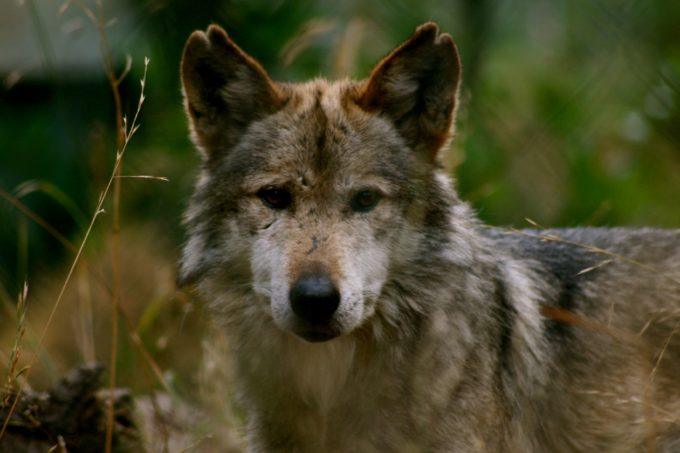
“Scarface,” a young Gray wolf in Hayden Valley, Yellowstone National Park. Photo: Jeffrey St. Clair.
Last week, Lauren Boebert’s cynically-named “Pet and Livestock Protection Act” passed the House of Representatives on a narrow, largely party-line vote. Five Democrats broke ranks and voted for it (Gleusenkamp Perez – WA, Cuellar – TX, Gonzalez – TX, Costa – CA, and Gray – CA), while four Republicans broke ranks and voted against it (Fitzpatrick – PA, Buchanan – FL, Van Drew – NJ, and Fine – FL). It is an attack on wolves, but just as importantly an attack on the Endangered Species Act itself. More to the point, the bill is an embodiment of Boebert herself – extreme, dishonest, and deeply anti-wildlife.
The bill forces the U.S. Fish and Wildlife Service to reissue its 2020 nationwide wolf delisting, a decision a federal court immediately overturned for the agency’s failure to base their decision on science. That outcome would dismantle all federal protections for wolves by turning wolf management over to state governments. The de-listing of wolves in Montana, Wyoming, and Idaho (also forced by a congressional rider) serves as a sobering preview of how removal of federal protections unfolds: All three states immediately instituted trophy hunting and trapping seasons under regulations so flimsy that wolves are targeted for night hunting with enhanced vision goggles, wolves are being run over with snowmobiles with impunity in Wyoming and Idaho, and in 86% of Wyoming, wolf killing is completely unregulated – no limits on hunting season, bag limits, or methods. Even a hunting license isn’t required.
The Boebert wolf delisting bill also blocks judicial review, an extreme and un-American step in seizing power from the public which prevents any appeal to the courts. So regardless of how badly the ecological trainwreck of wolf delisting becomes – even including extirpation of the species throughout the lower 48 states – there would be no avenue for legal accountability. Which is precisely Boebert’s goal.
Boebert first introduced wolf delisting legislation in February of 2023, titled the “Trust the Science Act.” The name was ironic since wolves protected by the U.S. Fish and Wildlife Service under the Endangered Species Act could only be delisted if the science showed that their populations were fully recovered, and the threats that risked extinction were removed. Neither had happened. So instead of trusting the science, Boebert proposed legislation that would force the delisting of wolves, circumventing the science and removing federal protections by political fiat, and blocking any legal accountability through the courts.
Exactly one year previously, conservation groups including Western Watersheds Project had successfully won a lawsuit challenging the first Trump administration’s nationwide delisting of wolves. The U.S. Fish and Wildlife Service had gone through the rulemaking process, prescribed under the Endangered Species Act, and issued a determination that wolves were fully recovered and no longer needed federal protection. But agency decisions are subject to judicial review, and conservation groups from across the country challenged this delisting as a political hatchet-job rather than a science-based conclusion. The court ultimately agreed and struck down the nationwide delisting for the agency disregarding the best available science and failing to undertake an adequate threats assessment.
Notwithstanding the fact that the judicial system had just resolved the question, Boebert ginned up a bill that would undermine the science, bypass the courts, and named it the Trust the Science Act.
Through ridiculous antics of all kinds, Lauren Boebert became so unpopular that she was basically run out of western Colorado. Her gun-themed restaurant in Rifle, Colorado – Shooter’s Grill, where waitresses openly carried firearms – was forced to close its doors in July 2022 when the landlord decided not to renew her lease. Her campaign office, leased from the same landlord, also was terminated. Boebert famously has a track record of voting against immigration included targeting ‘sanctuary cities’ for federal defunding, opposing a path to citizenship for “Dreamers,” undocumented adults brought to the United States as children. So it looked like karma when Boebert’s former restaurant location was leased out to Tapatios Family Mexican Restaurant.
Boebert’s extreme brand of politics was branded “angertainment” by a political opponent named Adam Frisch, a relative unknown who nearly won a bid to unseat Boebert in the 2022 congressional race. With 99% of the district reporting, Frisch led the race. After a recount, Boebert survived by a mere 546 votes. Rather than face Frisch (and western Colorado voters) again, Boebert decided to leave and run for Congress on Colorado’s eastern Plains, after incumbent Rep. Ken Buck announced that he would be retiring (citing disgust with the January 6th insurrection at the Capitol and Trump’s lies about the 2020 election results).
On January 6th, 2021, Boebert herself made a cryptic post stating that “Today is 1776,” at 5:30 in the morning (presumably Mountain Time). Four and a half hours later, at noon Eastern Time according to a timeline of the January 6th insurrection, President Trump made his speech claiming that the election result was fraudulent and called on Vice President Mike Pence not to certify it; the first rioters arrived at the Capitol building at 1 pm. After Donald Trump lost his re-election bid in November 2020, Lauren Boebert had been one of a handful of congressional lawmakers invited to meetings to plan the events of January 6th. At 1:55 pm, Boebert rose to make her first speech on the floor of the House. In the midst of her yelling rant, she blurted out, “Madame Speaker, I have constituents outside this building right now. I promised my voters to be their voice!” Years later, during the congressional investigation of the January 6th riot, a Proud Boys document came to light, laying out an eight-page blueprint for planning the insurrection. It was titled, “1776 Returns.”
But, if Lauren Boebert belongs to the lunatic fringe of the political spectrum, the “paramilitary wing of the GOP” as one newspaper editor put it, or was even a co-conspirator in the January 6th insurrection, why should that be relevant to her efforts to strip federal protections from the gray wolf? The answer is simple: Legislating to de-list a species under the Endangered Species Act is an extreme and dangerous precedent, requiring an extreme and environmentally unhinged proponent. Boebert’s unhinged approach disqualifies her as a representative to be taken seriously.
When Congress passed the Endangered Species Act in 1973 (92 to 0 in the Senate, 355 to 4 in the House), the central point was to make listing and de-listing decisions solely on the basis of science— to get rid of the political interference that had accelerated extinctions for the first two centuries of American history. Polling has shown overwhelming public support for the law ever since, despite the efforts of anti-conservation lobbyists to convince us otherwise. Harriet Hageman (R-WY), the sponsor of a similar bill to force the de-listing of grizzly bears to strip them of ESA protections, also supports selling off public lands and primaried incumbent Liz Cheney on the basis of her role in spotlighting efforts to overthrow the presidential election during January 6th Commission hearings. The credibility of the proponents of these attacks—on January 6th and on the ESA—undermines the credibility of their legislation.
Fast forward to April 2024, when Boebert was able to get her “Trust the Science Act” bill to force wolf delisting passed by a four-vote margin in the House. Yadira Caraveo (D-CO) was one of four Democrats who voted in favor, and she was voted out of office that year by a Colorado electorate that had voted in favor of a ballot measure to compel wolf reintroduction in the state just four years previously. The bill was then referred to the Senate, but died without ever receiving a floor vote.
Meanwhile, conservation groups were in court to challenge the U.S. Fish and Wildlife Service’s denial of two petitions (by Western Watersheds Project, seeking a West-wide listing and Center for Biological Diversity, seeking an emergency Northern Rockies listing) to re-list the federally-unprotected wolves in Montana, Idaho, Wyoming, and parts of eastern Oregon and Washington. In July of 2025, that lawsuit was successful. The judge ruled that a West-wide Distinct Population Segment was the most appropriate population unit qualifying for protection, and that the U.S. Fish and Wildlife Service’s decision to deny listing it was contrary to the best available science. The judge took particular note of the scientific shortcomings of unreliable population models in Idaho and Montana, and his ruling called into question the agency’s arbitrary decision to ignore the need to recover wolves in historic habitats they had not yet repopulated. So not only is wolf listing still warranted in the states with small and struggling wolf populations, it is even warranted in the states where wolf populations are largest. Because threats to the species are part of the calculus.
Now, in 2025, Boebert has rebranded an identical wolf-delisting bill as the “Pet and Livestock Protection Act” ( another misnomer because it does not contain any provisions to protect either livestock or pets). Once again, having passed the House, it heads to the Senate, this time during an election year roiled by a White House embroiled in controversy, putting seemingly safe Republican districts back in play. Senate Democrats have historically stood strong against attacks on the Endangered Species Act involving a variety of species, including wolves. After all, the whole point of the Endangered Species Act is to get political meddling out of the equation and put science in the driver’s seat. But in these anything-goes times, nothing can be taken for granted. Watch for a major push by conservation groups to block Boebert’s wolf-extinction agenda, and see which special interests support the bill, or stay silent on the sidelines.