Thursday, December 25, 2025

The Challenge of Food Ecomodernism: A Puzzle Outlined

Source: Resilience

Given the unfriendly nature of my debate with him – if ‘debate’ is the right word – I’ve tried to avoid further engagement with the writing of George Monbiot. But a recent Guardian article of his is such a perfect microcosm of the difficulties and dangers of ecomodernism (more on that term below) as applied to the food system that I think it merits attention.

I’ll begin by parsing the story George tells in the article as follows: There’s a problem with agriculture – it’s something quite technical, to do with a trade-off between crop yields and environmental impact. There’s a farmer near Oxford called Tolly who miraculously seems to have solved this problem and “found the holy grail of agriculture” – high yields and low impacts. His solution involves soil management which somehow affects the behaviour of soil bacteria, but nobody quite understands how he’s done it. If we could characterise soils more scientifically, then maybe this holy grail could be replicated and scaled up – but how can we do that? George meets a scientist for a drink in a pub in Oxford and it emerges from their conversation that there might be a way. The results are (literally) seismic.

“We stared at each other. Time seemed to stall. Could this really be true?”

With $4 million of start-up money from the Bezos Earth Fund George and two colleagues (a seismologist and a soil scientist) have developed a way of ‘seeing’ soil. The technology they needed for this was initially expensive, but allegedly should ultimately be zero cost, and they’ve started building the AI and machine learning tools they need. So far, George says, they’ve measured the volume of a peat bog more accurately (“The implications for estimating carbon stocks are enormous”). Eventually they hope that the technology will give farmers an almost instant readout from their soil that will help protect soil health and resilience, and ultimately help everyone find the high yield/low impact holy grail like Tolly.

That, in a nutshell, is the story. I will now comment on some of its elements.

There are essentially no politics or food system economics in this story. There are only apparently technical problems like yields and impacts, which can be addressed through technical means (the frame of analysis is entirely single farm scale, not food system scale). George has elsewhere defined ecomodernism as “a movement that treats green technology as a substitute for political and economic change”. If there are political or economic changes that could beneficially be made to improve the food and farming system – and I believe there are many – then this article is squarely ecomodernist in his terms. I believe it’s important to understand the evasion of politics that this kind of ecomodernist writing about food and the food system involves.

I’m not going to get into the detail here of where politics and economics meets the technicalities of farming at the individual farm and the farm system level. I’ve written a lot about it previously, as have many others. Generally, we have to understand the global farming system as a profit-driven one characterized by the overproduction of most food commodities, and global political systems as ones that inflict scarcity and lack of food and other entitlements upon many people. This means that high yields and low food prices often don’t benefit nature or consumers, especially poor consumers.

So it’s a lot more complicated than George implies in his article. The fact that high yields don’t necessarily benefit nature and low food prices don’t necessarily benefit consumers (including poor consumers) may be a bit counterintuitive, but it’s nevertheless well understood within food system scholarship (one clue to how it works is that farmers and food system workers are essentially the largest category of workers globally, and they are disproportionately poor). The people that high yields and low food prices unquestionably do benefit are the (usually corporate) providers of yield-boosting farm inputs and retail food distribution systems. Intentionally or otherwise, ecomodernist depoliticizations of the food system of the kind that George purveys in his article effectively support the status quo of overproduction, hunger and corporate control.

Moving on in the story, we come to Tolly. He’s a brilliant veg grower who’s influenced me a lot, but he hasn’t found the holy grail of agriculture. His approach is essentially the long-established one of mixed or ley farming. Historically, farmers have mostly done this by alternating crops and livestock. Modern farmers like Tolly can do it with tractors and without livestock if they choose. It amounts to much the same thing.

Most thoughtful people who’ve spent any time around the sharp end of food production and its ineluctable trade-offs treat the latest hosannas in the press about having found the holy grail of agriculture with a resigned eye roll. As shown by the likes of food system analyst Glenn Davis Stone (The Agricultural Dilemma: How Not to Feed the World), these hosannas are usually sung loudest by people who have new commercial inputs they want to bring to market, and are ultimately aimed at the governments or venture capitalists they think might fund them.

A few years back, such hosannas were being sung for bacterial protein (“food from thin air”) and for synbio alt-meats more generally (good old-fashioned plant-based alt-meats never got the same attention, for reasons that I suspect have a lot to do with their lesser promise for delivering full corporate control). Yet the prohibitive energetic and other costs of these synbio alt-meat technologies were always going to stymie them as viable mass food approaches, and venture capital now seems to be deserting them for sexier new fields like AI.

I can’t help noticing how prominent these fads are in George’s writing on food – from bacterial protein in his book Regenesis, to AI in his latest article. And also how his fiercely expressed opposition to neoliberalism and gloves-off capitalism in his political writing seems to go missing when he writes about food. Funding from the Bezos foundation “may cause some discomfort”, George writes, “but our experience has been entirely positive: the fund has helped us do exactly what we want”. This isn’t the hardest-hitting critique of techno-capitalism and the source of its funds you’ll ever hear.

An article on the Bezos Fund’s website about the project suggests that the techniques it’s developing will unlock “new ways to finance climate solutions, allowing transparent measurement and verification for soil carbon markets. This is how we can feed the world without devouring the planet”.  That last sentence echoes the subtitle of George’s Regenesis book, while the preceding one reveals a commitment to achieving it through the existing mechanisms of large-scale global capitalism. George builds his article out from a desire to spread the successful practice of a small-scale local veg grower, but perhaps this obscures what the project’s funders are really looking for. An alternative headline for his article might have been ‘Controversial funder bankrolled by one of the world’s richest men supports scientists to improve market information for global capitalism’. It would have been more factual, if less dramatic and upbeat.

Why is the Bezos Earth Fund controversial? Well, according to an expert quoted in a report in, er, The Guardian,  “The projects of the Bezos fund do not address the key issues of the fundamental climate crisis we are facing – they are nice but unfortunately cosmetic”. Another expert quoted in the same report stated, “In only a couple of years since it launched, the Bezos Earth Fund has become one of the most influential funders in the carbon market space, and has played a significant role in providing pro-market organisations with resources to promote the role of carbon markets. There is a real risk that excessively pro-market funding leads to drowning out more critical voices which provide the necessary counterbalance to the debate”.

In another article in The Guardian, the writer – who is, er, George Monbiot – argues:

“Essential as ecological carbon stores are, trading them against fossil fuel emissions, which is how these markets operate, cannot possibly work. The carbon that current ecosystems can absorb in one year is pitched against the burning of fossil carbon accumulated by ancient ecosystems over many years. Nowhere is this magical thinking more apparent than in soil carbon markets, a great new adventure for commodity traders …. Every form of wishful thinking, over-claiming and outright fraud that has blighted the carbon market so far is magnified when it comes to soil.”

Well said, sir. So it might surprise some that George is now taking grant funding from the Bezos Earth Fund to develop a product that, the Fund hopes, will allow verification for soil carbon markets.

I’ll pass as quickly as possible over the next part of the story, involving men staring at each other meaningfully in Oxford pubs. My guess is that if you could do a rank ordering of the venues historically where white guys have been apt to congratulate themselves for solving the problems of the world, then pubs in Oxford would come pretty high on the list – and I say this as a white guy from near Oxford who loves to put the world to rights over a pint.

Walter Haugen got straight to the point about what guys like us really ought to be doing to solve the problems of the world:

“You – the human engine that has a very low energy input/output ratio – need to get off your dead ass and actually grow some food using hand methods driven by the creativity of your grotesquely enlarged primate brain.”

Here, Walter touches uncomfortably on my own central contradiction, in which my efforts to grow more food are continually stymied by my Oxford pub syndrome that makes me think I might be more help to the world by writing articles like this about, well, the dangers of the Oxford pub syndrome. Do let me know if you’ve found this post useful so that I can adjust my priorities accordingly.

Anyway, one way or another this brings us to the crux of George’s article. What, practically, does the technology he’s working on actually achieve? He says that it’s measured the volume of a peat bog (called Whixall Moss), although the paper he cites in support of this says only that the bog’s depth was measured across an eighteen metre line using ten sensors, and that “it is not possible to extrapolate from this single line to an alternative peat volume for the entirety of Whixall moss” (George’s implication that his team surpassed in 45 minutes what fifty years of preceding soil science had achieved seems over-hyped in several respects). Still, maybe the technology really will be able to measure soil volumes and estimate carbon stocks in the soil cheaply and accurately someday. But I can’t see how it will tackle the more pressing political problem of reducing carbon stocks in the atmosphere, unless you subscribe to the view that better-evidenced capitalist carbon markets result in less capitalism.

George also says that the tech may eventually be able to give farmers instant readouts about their soils. But how will it help them find the yield/impact holy grail that he claims Tolly has found? By George’s account, this grail has something to do with soil bacteria and their behaviour, which his ‘soilsmology’ technique presumably can’t measure or characterise. Possibly, the technique may give farmers information that will help them protect their soils, though it’s not clear how it will overcome the wider pressures encouraging them toward soil destruction (politics goes missing here again).

I can’t help feeling there’s a kind of spivvy middleman sales patter about all this tech-happy food ecomodernism. Take a well-established technique like mixed farming, sex it up as a potential holy grail when accompanied by new tech inputs of a modest usefulness (but let’s not talk too much about that…), sell it to farmers while claiming that it’ll soon be cheap as chips, ignore the contemporary politics that make it so difficult to farm in ecologically wise ways, and on no account support the idea that more farmers and fewer middlemen might be a good way to go. It gets a lot of media airplay, but it doesn’t amount to a good analysis of the food system, and it sells most people and most of the biosphere short.

George recently trailed once again his scornful critique of my polemic against his book Regenesis, writing

“In any discussion of food and farming, unless your solution can be scaled to feed 8 billion people, you shouldn’t be taken seriously. Unfortunately, cottagecore fantasies that would feed only the richest consumers, leaving billions to starve, are all too common.”

He made no mention in that critique that he’d badly under-stated the prohibitive energetic cost of bacterial protein, as I showed in my polemic and has now been confirmed by researchers who developed the technology even as they continue to promote it. It’s abundantly clear that the bacterial solution he was touting won’t scale to feed 8 billion people. The priorities of the new CEO of Solar Foods, the bacterial protein manufacturer George promoted in Regenesis, include “driving growth in the Health & Performance Nutrition segment especially in the United States” and “increasing product price points”. To me, that sounds rather like feeding only the richest consumers.

So I guess it’s good that George seems to have quietly backtracked on bacterial protein and has swung more fully behind mixed farming of the kind that Tolly practices, even if he still wants to bang on about my alleged ‘cruel fantasies’ and my ‘formula for mass death’. This ‘cruel fantasy’ of mine is that ordinary people should have access to land to grow food. George thinks it’s cruel because he doesn’t believe local food systems can yield enough to feed the global population, but that’s an article of faith of his based on a poor understanding of food systems. For my part, I can’t see how George came to think that a monumentally energy-hungry industrial process for growing bacteria to make protein could ever scale better than growing beans, or was more likely to nourish poor consumers.

My approach may nevertheless prove a fantasy inasmuch as it doesn’t suit the economic and political powers that be to allow ordinary people the independent means to produce a modest livelihood. They prefer keeping people dependent on high-energy mass industrial food systems predicated on overproduction, monopoly rent and economic growth of the kind that generates ecological destruction and human poverty and hunger.

I think those systems will fail due to their own internal contradictions, and what happens next will arise out of the ensuing politics. There will be opportunities for agrarian localism and for people to take charge of generating local livelihoods ecologically. It’s very far from guaranteed that those opportunities will proliferate, but what I’d like to hear from those who dismiss agrarian localism as a fantasy is how they think high-energy mass industrial food systems will deliver good, population-wide nutrition and nature protection into the future. Food ecomodernism contains fantasies of its own, and a smattering of references to open source and anti-trust practices does not conceal them.

A bigger problem, though, is that since proponents of food ecomodernism have a much larger media and political platform than proponents of agrarian localism, they’re able to make their ‘cottagecore fantasy’ accusations stick to the extent they become self-fulfilling – ‘as everyone knows, we can’t possibly localise food systems’ … well, if everyone knows this supposed truth, then we certainly won’t – while ducking the problems of their own touted solutions. We’re up the proverbial creek without a paddle and nobody has an especially plausible plan to get us out. But it would be nice if we could at least debate our various unpromising options calmly.

I’ve written a lot about the vulnerabilities of the existing high-energy food system, about the benefits of local agroecological food production and about the ideologies of modernism that make facile accusations of cottagecore fantasies so easy to stick. In so doing, I’ve developed a small but dedicated readership. Love you all to bits, but I’ve got pretty much nowhere in the larger debate with ecomodernism which seems to be sweeping all before it. Maybe it’s a case of if you can’t beat ‘em, join ‘em.

Philip Loring – author of the excellent Finding Our Niche: Toward a Restorative Human Ecology – nails what’s at stake in this present moment of food ecomodernism:

“We can be sure that the greedy eyes of disaster capitalism are peering at us from around every corner, waiting to use the tremendous pain and suffering that is emerging around us to appoint themselves our saviours. I can hear it now: “Only we can solve this problem. Only we can feed the hungry. Only we can keep you safe.” These are the voices of manifest destiny. These are the voices of the white saviour. But in reality, the opportunists making these promises can deliver on none of these promises. Why? Because their approach – indeed, their very culture – is part of the system that creates these problems in the first place”.

Quite so. But the remarkable thing is how absent such responses are in the face of corporate-friendly food ecomodernism, especially when it’s packaged in the guise of eco-friendly farming, as in George’s article. In comments beneath the article and in his social media posts trailing it, I barely found a critical or even a sceptical voice. Perhaps the odd scientist mildly questioning the novelty or wider applicability of the technique. Very little about the funding and its aims. Many comments were positively hagiographic:

“What a wonderful example of human perseverance, conscientiousness about our planet and living sustainably, tireless quests to find progressive answers and especially George’s obvious deep desire to genuinely improve life for as many as possible. In these increasingly dark days for humanity, let’s hope there are many more like him. This example and George’s humane-based conscientiousness also give you hope that the cynics will not win.”

Herein lies the trap for we advocates of agrarian localism. Point to the threadbare achievements of food ecomodernism, the dodgy energy figures, the greenwash, and we can be dismissed as cynics. Advocate for low-energy local food systems and we can be dismissed as cottagecore fantasists. It’s a perfectly closed ideological system, and I don’t know how to open up the obvious cracks in its facade.

I found Vilhelm Nilsson’s comments under an earlier version of this post informative. The comment is worth reading in its entirety (as is everyone else’s, of course), but there’s this:

“…‘saving the planet’ can turn into such a dangerously hubristic set [of] unquestionable faiths that leads to epistemic close-down and cognitive protectionism against inconsistency in our thinking …. At the same time some values such as community sovereignty and traditional food production aren’t reducible to managing calories or carbon, which means the net effect ignores moral losses tied to local knowledge and diverse ways of life … a larger critique which is worthy of having is that of instrumental ways to reason about the world, as such perspectives invariably sever the connections between the social and natural worlds.”

To my mind, Vilhelm’s comment in its entirety is bang on, but it still leaves me uncertain about how best to make the case for agrarian localism, since what I might view as a larger critique of instrumental reason, the likes of George are easily able to dismiss as cottagecore fantasies or whatever – though it’d be nice at least if they could fully embrace instrumental reason and admit to their numerical mistakes.

Vilhelm’s comment also resonates with the philosopher Alasdair MacIntyre’s views on the historically grounded nature of knowledge. I touch on this in my recent book Finding Lights in a Dark Age. I’d recommend buying a copy – if you do, you may just be helping to ‘save the planet’! But you probably won’t be – the undergirding philosophy that Vilhelm calls meliorism may have to crash and burn before it’s possible to do much reconstruction. That’s not going to be fun – I didn’t call it a Dark Age for no reason.

Ah well, the urgency of staving off as best I can the disaster capitalism that Philip Loring mentions keeps me going, even if it feels like a dispiriting and unequal battle sometimes. Cheers!

Mark Davison Slaps Retired Oregon Teamsters with 31% Out-of-Pocket Medical Hikes 2-Years After “Historic” UPS Contract! So What Went Wrong?

Source: Originally published by Z. Feel free to share widely.

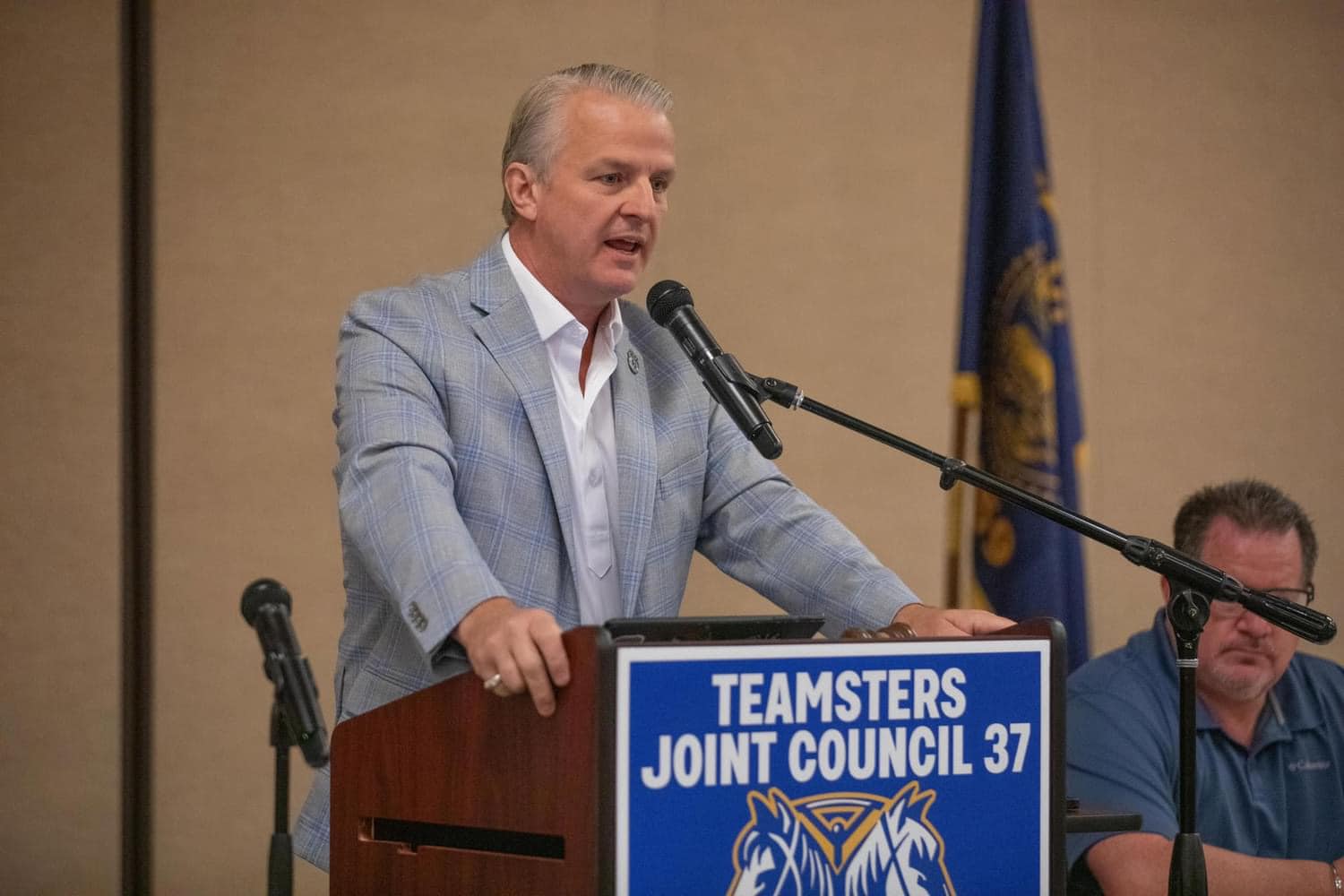
With less than a year before the next Teamsters general election; and less than two-and-half years since the catastrophic 2023 UPS-Teamsters agreement negotiated by Sean O’Brien was sold and ratified—the chickens have come home to roost. Ironically, the first casualty of the concessions filled deal has hit the state of Oregon which is home to UPS Western Package Director – Mark Davison. Based out of Portland’s Local 162 and Joint Council (JC) 37 – in early December retired Oregon Teamsters were caught off guard when they learned via mail that their monthly out-of-pocket retiree medical benefits are due to rise $292 per month in 2026—that is a 31% hike.

Broken into three different age groups, the new costs for participants of the multi-employer Oregon Teamsters Employers Trust (OTET) chaired by Davison will be: $792, $1,072 and $1,242 per month—an astronomical cost for retirees who are on a fixed income. For UPS retiree and former U.S. Marine veteran – Manny Silveira – who transferred up to Davison’s Local 162 from Orange County’s Local 952 in 2011 and retired in 2016, he has evaded paying for the expensive Oregon retiree plan and opted instead to use his Military Veteran Affairs (VA) benefits.

For the arrogant Davison who also serves as Western Region vice-president of the most bureaucratized and corrupt union in North America – this is gigantic blemish on his resume after gloating on a zoom session following the tentative agreement (TA) in 2023: “Health care benefits in this contract are protected for another five years, with UPS paying 100% of the premium. Most workers can’t say the same.” Unfortunately his statement excluded retirees.

After O’Brien, Davison and the rest of the intolerant ozholes1 on the general executive board (GEB) championed the 2023 UPS agreement as “historic,” how did this unjust tragedy arrive for retired Oregon Teamsters? In what has been argued by this author since 2023, a combination of negotiating 50% less in Health, Welfare & Pension (HW&P) for Western UPSers than the previous two bargaining agreements (2013 and 2018), plus massive layoffs facilitated by toothless language that has allowed AI to replace Teamster jobs—has resulted in a combined shortfall in medical contributions from UPS.

For Oregon UPS Teamsters which peaked at 5,000 total members at the height of the coronavirus pandemic, the layoff off 321 workers from the Swan Island Hub in 2024 followed by another 244 after the closure of the facility last Spring is a total loss of 565 UPS Teamster jobs. It is projected that the reduction of 11.3% of that state’s total UPS membership will result in a shortfall of close to $15 million in 2026 going into both the OTET for full-time UPS workers and the Teamsters Western Region and Local 177 Health Care Plan (TWR&L177HCP) for part-timers. Hence, such shortfall appears to have broken the small Oregon retiree medical plan—triggering Davison to hike their rates.

It is unknown how many more OTET contributions were lost as a result of 2,000 total UPS drivers across the US taking buyouts in 2025. That was 2.9% of the company’s total 70,000 driver workforce. But for Oregon Teamsters – Davison has carefully kept Local 162 and JC 37 from hosting social media pages in his attempt to avoid being scrutinized. Davison is also known to be evasive of media questions, so it is unknown how many Oregon UPSers took the buyout. However, Western officers speaking on the condition of anonymity shared that the Pacific Northwest took the largest buyouts.

Hence, Western Teamsters had held a conference call shortly before the buyouts were dispatched by UPS warning of the ensuing trouble ahead for Teamster medical plans, especially the smaller ones such as the OTET. O’Brien attempted to frighten members into submission by lying that the buyouts were illegal and that members would lose their “quality health insurance.” To no avail, 2,000 UPSers took the buyouts as a bonus and left the Teamster ranks.

When the TA was reached in 2023 following O’Brien’s forced non-disclosure agreements (NDA), it was clear that much like in 2013 and 2018—the IBT was looking to cut another sweetheart deal with UPS. But this time around, O’Brien had the support of the now discredited Teamsters for a Democratic Union (TDU) which have become just another layer of the intolerant O’Brien bureaucracy. In defense of O’Brien, TDU was quick to suppress opposition by joining the general president in promoting the concessions filled contract as “historic.”

When timid Western officers fearful of O’Brien leaked the pension concessions to rank-and-filers in the West, anger quickly brewed on social media. Davison who much like O’Brien is best known for his intolerance of constructive criticism, was quick to target those responsible for hitting the alarm bells, including this author who he challenged to a debate on a Local 952 podcast friendly to them and their conservative brand of pro-business unionist agenda. As for the Oregon retiree medical plan going bust just two years later: the podcast, Davison nor Ken Paff of TDU have yet to report on the crisis or issue a statement.

With the massive reduction of Teamster jobs at UPS since the 2023 agreement was signed, it is believed that up to 60,000 Teamster jobs have been trimmed, reducing the entire UPS Teamster workforce from 340,000 at the height of the pandemic down to a low of approximately 280,000. The question now is, how many more Teamster medical retiree plans are due to implode as a result of 60,000 less contributions going into medical plans and negotiating half ($2.50) of what was negotiated in the two previous ($5.00) bargaining agreements in HW&P? This was simple elementary math that the UMass flunky – O’Brien and the rest of his acolytes in the West failed to comprehend due to their clear fiscal illiteracy that followed the greatest inflation crisis in forty-years.

More embarrassing today, both the OTET and The Teamsters Care plan serving 7,200 participants at Boston’s Local 25 and home of O’Brien – appear to be the two most expensive retiree plans in the union. For Davison who serves as Western Package Director of the largest UPS region in the US and O’Brien who heads the 1.2422 million Teamsters union, such reality is beyond comprehension. The rates for Boston Teamsters retiring before age 65 are even more expensive than the Oregon plan and why the two ozholes have been envious of the superior 40,000 member Southwest Rider and the $150 per month retirees pay under the TWR&L177HCP.

Worse yet for the Teamsters, in mid-December UPS announced it will continue with its automation plan to boost profit by reducing more labor costs through continued job cuts in 2026 and 2027—that will result again in less contributions into union HW&P funds. Rumors swirling of a second round of buyouts from the package king in the first half of 2026 would only add more fuel to a wildfire the incompetent O’Brien administration has as of yet failed to contain.

For other small plans in the Western Region like the Utah-Idaho Teamsters Security Fund and the Washington Teamsters Welfare Trust they could possibly face the same consequences Oregon Teamsters are now stuck in. Interestingly, full-time Utah-Idaho Teamsters are currently diverting $1.253 per hour worked from wages into their retiree medical plan to help keep it afloat and at an affordable $100 a month. For twenty-three year Salt Lake City feeder driver – Tony Winters: “those may very well go up next year though.” He adds, “I might want to torque a couple more negatives about our plan, especially since our premiums have only been able to remain low due to the lifetime cap. It really isn’t an early retirement by any means.”

For Davison who according to T-union Link raked in a total of $282,220 out of three salaries from his positions as: Western Region vice-president, Local 162 president, JC 37 president and stipend as UPS Western Package Director—his performance has been a complete failure. This is why not only Oregon and Western Teamsters, but Teamsters internationally need to unite next fall to turn the page on this tragic chapter in Teamsters history and reject the failed polices of Mark Davison, his boss Sean O’Brien and the rest of the intolerant O’Brien-Zuckerman Teamsters United Slate – who deliberately lied about the actual sham the 2023 UPS agreement has turned out to be and send them packing.

Among timid officers internationally, it has been argued that the O’Brien administration is by far the most vindictive and corrupt since that of William McCarthy’s who in 1989 was forced to agree to a consent decree with the Southern District Court of New York (SDNY) over the union’s continuous ties to organized crime. Not surprising, the Teamsters have remained under a federal government oversight over its culture of violence and unending corruption scandals. This is why the most viable option for all Teamsters in 2026 is to vote for the Richard Hooker Jr. led Teamsters Fearless Slate 2026.

1 OZhole(s) is a term coined after the O’Brien-Zuckerman (OZ) administration to describe old-guard officers blindly loyal to them ushering a new era and degree of intolerance and thuggery against any constructive criticism that has superseded that of the Hoffa Jr. regime.

2 According to the last Teamsters General Executive Board (GEB) meeting the first week of December, there were under 1,242,000 million bargaining unit members and not the 1.3 million Sean O’Brien and the IBT have continued to claim on their press releases.

3 Joint Council No. 3 Feeder, Package, Mechanics & Combination Employees, (see page 305).Email

Edgar Esquivel is a Local 952 UPS Teamster, former activist for TDU and first generation-born Mexican-American in Orange County CA. He holds a Master’s Degree in History from Cal State University-Fullerton with an emphasis in Modern Latin America, labor movements and Marxist historiography. He has served as an adjunct professor of History at both Mt. San Antonio College and Santa Ana College in Southern California and have written for Cosmonaut, New Politics and Socialist Worker.

Global Complicity: Who Kills in the Congo?

Source: Counterpunch

In recent years, more people around the world have begun to encounter images of Congo’s suffering on their phones: a child emerging from a cobalt mine, a collapsed tunnel, families fleeing violence. Viral clips of displaced communities and reports of mass killings circulate across our screens. Yet even as this visibility grows, what remains almost entirely invisible is the full scale of the crisis and the direct connection between that violence and the very devices through which we witness it.

Congo’s devastation is not a local failure, but the logical outcome of a global economic system that profits from extraction, militarization, and silence. The world may be watching Congo more than before, but it still refuses to see itself in the story.

The Democratic Republic of the Congo (DRC), located at the heart of Africa, is the continent’s second-largest country and among the richest in natural resources. Yet for decades its people have endured relentless violence, mass displacement, poverty, and environmental devastation. Since colonial rule, Congo’s mineral wealth has been systematically exploited by foreign powers and corporate interests, with independence reshaping—but never dismantling—these extractive structures. Today’s crisis is therefore the continuation of a long history of plunder. Resource extraction for global markets remains a central driver of instability, drawing local, regional, and international actors into competition over control. More than 100 armed groups now operate in eastern Congo, many financed through illegal mineral trade, turning the country’s immense wealth into a weapon against its own people.

The current crisis

The contradiction between technological progress and human devastation is not incidental. It defines the present crisis in the DRC. Currently, the DRC provides the world with many natural resources,  such as copper, cobalt, coltan, lithium, gold, and diamonds, many of which are used in electronics, electric vehicles, batteries, and green-energy technologies. AI data centers are increasing demand for cobalt and other minerals even more. Controlling these resources is therefore crucial: the DRC holds 70% of the world’s coltan reserves and over 50% of cobalt, meaning whoever dominates Congo dominates the future of technology.

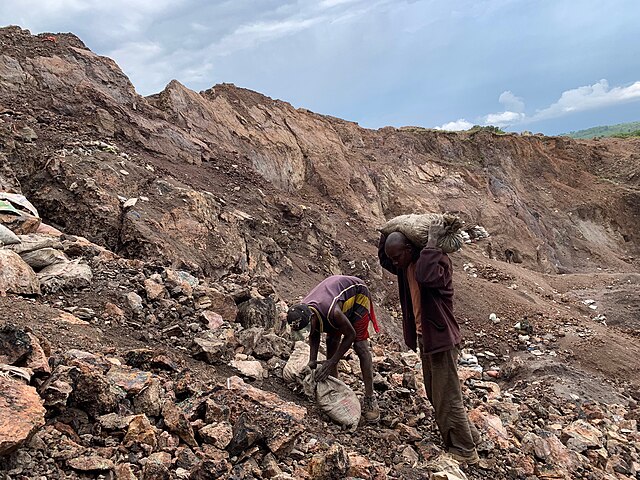
Rather than delivering prosperity, Congo’s extraordinary mineral wealth has produced a “resource curse.” Competition for coltan, cobalt, gold, and diamonds drives violent conflict, forcing miners, often children, into brutal, unsafe conditions while forests are cleared and rivers contaminated in the scramble for profit. In November 2025, dozens were killed when a bridge at a mine collapsed, a tragedy that illustrates how extraction proceeds with total disregard for human life. Because the richest deposits lie in the eastern provinces, these territories have become the epicentre of militarization, where armed groups, militias, and even state forces battle for control while communities are displaced and terrorized.

The environmental destruction deepens the crisis: forests are cleared to reach mineral deposits, mining releases vast amounts of carbon and nitrogen dioxide, and toxic mining waste poisons rivers and lakes, wiping out agriculture and fishing, the very means by which people survive.

The humanitarian consequences are catastrophic. By 2025, there are over 6.9 million people internally displaced, the highest number in Africa, 1.2 million refugees in neighbouring countries, and 28 million people suffering from malnutrition. Furthermore, more than 3 million people in eastern Congo are in the emergency phase of hunger. Children as young as five work in dangerous artisanal mines, digging by hand, inhaling toxic dust and risking suffocation or burial in tunnel collapses. Conflict-related sexual violence affects thousands, with almost 40% of sexual violence survivors being children. Armed groups are committing  gang rapes, abductions, attacks on hospitals, and unlawful detentions, abuses that may constitute war crimes. This is not simply a story of conflict happening near minerals; it is a system in which minerals fund the conflict, and conflict makes the minerals easier to steal.

Global Complicity

To understand why this violence persists, it is necessary to look beyond Congo’s borders. What unfolds in the DRC is not merely a local or regional conflict, but a transnational project sustained by states, corporations, and markets far beyond its borders.

Regional Involvement: Neighbouring countries remain central players in the ongoing conflict in eastern DRC, driving both strategic military interventions and illegal resource extraction. According to a 2025 report from UN experts, Rwanda exerts “de facto direction and effective control” over the armed group M23. The recruits are trained under Rwandan supervision and supported by high-tech Rwandan weaponry, rendering the Rwandan state liable for the group’s actions, including territorial seizure and mineral looting. Interestingly, Rwanda is often presented as the supplier of minerals while having very few reserves of its own. Many reports show that minerals, especially coltan and other critical resources, are frequently smuggled into Rwanda, laundered into upstream supply chains, and re-exported as “Rwandan” origin.

Moreover, Uganda has leveraged cross-border smuggling networks to profit from gold and other minerals, often entwined with militia trafficking routes. UN experts state Uganda has also supplied weapons, hosted rebel leaders and allowed cross-border movements of M23 fighters. Moreover, the Ugandan-led Allied Democratic Forces, killed at least 40 people, most of them hacked to death, at a funeral ceremony in September. This is just a small sample of what has recently been documented.

Burundi is involved in a similar way. A UN report demonstrates that gold was also being smuggled from the DRC to Burundi. Moreover, the Burundi National Defense Force was also deployed into the DRC even though it was denied by the DRC military headquarters. A different UN report also warned that Burundi’s military was involved with the Congolese army fighting against the M23 and Rwandan soldiers, exacerbating regional tensions.

Rwanda, Uganda, and Burundi have all turned Congo’s minerals into cash, and in doing so, turned its borders into corridors of violence.

Israel and the diamond industry: external actors beyond Africa also profit from Congolese exploitation. Israel has one of the largest diamond industries in the world, despite having no domestic reserves. Its polishing sector relies heavily on rough diamonds from African countries like the DRC. The profits of the extraction of these diamonds directly enable the occupation and genocide in Palestine since they finance for example drones, bomb and spyware used on Palestinians. In this sense, the profits from Congolese resources become entangled in wider structures of occupation and repression.

Israeli-linked businessmen have played a significant role in this sector, most notably Dan Gertler, who secured extensive mining and diamond concessions in the DRC through what U.S. sanctions describe as “hundreds of millions of dollars” in corruption and political bribery, depriving the Congolese state of over $1.36 billion in public revenue. Israel’s longstanding reliance on African rough diamonds and its economic partnerships, especially through the UAE which is now the world’s largest rough-diamond trading hub, create financial links between the exploitation of the Congo and the occupation of Palestine. Moreover, what appear to be Israeli-made arms have been found among multiple armed groups in the DRC.

Western complicity: Western governments and international financial institutions like the IMF and World Bank also sustain structures that enable resource exploitation. Through trade deals, investment guarantees, security cooperation, and aid packages, they stabilize extractive regimes. Trade deals and arms sales concentrate wealth in the Global North while distributing death in the Global South. Policies framed as “good governance” often become neoliberal reforms, dismantling public services and opening local markets to foreign extraction.

Moreover, the EU has a mineral deal with Rwanda, and are therefore knowingly allowing Rwanda and the M23 to benefit from illegally exploiting minerals in the DRC. The EU and its member states also sell arms to Rwanda, which may end up aiding Rwanda’s military operations in the Congo making the EU complicit.

The U.S.-brokered “peace deal” in June 2025 between DRC and Rwanda is a mineral deal first, and a possible opportunity for peace second. Again, prioritizing profit over the lives of millions of Congolese.

Multinational corporations: local and regional armed groups would not operate in the DRC without access to international markets. Multinational corporations and global markets supply goods and services, provide market outlets, pay taxes, licensing fees, and “protection” payments providing rebels and warlords with the money to sustain the violence. Corporations have treated militia-held territories as de facto sovereign states, using local commanders as conduits for illicit trade, undermining Congolese sovereignty while strengthening the rebels’ grip on territory.

Global Witness reports that European commodities trader Traxys purchased hundreds of tonnes of coltan in 2024 traced to conflict-controlled mines in eastern Congo, funneled through Rwanda’s smuggling networks. These corporate arrangements, contracts, deals, logistical support, and export channels, serve to finance and entrench the very actors driving violence. Because so many companies operate in the DRC, embedded in vast and deliberately opaque global supply chains, it is nearly impossible to map every link in the chain. Yet the effect is unmistakable: corporations make war profitable while hiding behind opacity, providing the capital, markets, and infrastructure that allow armed groups to continue extracting, killing, and ruling.

End consumers: at the final end of this global chain sit millions of consumers whose everyday purchases link them, however inadvertently, to Congolese suffering. Smartphones, laptops, electric vehicles, solar panels, and aerospace technologies all rely on cobalt, coltan, tin, and gold, minerals extracted in eastern Congo under conditions of extreme violence. These consumers, often unaware of the origins of raw materials, become participants in a system where human rights abuses, environmental degradation, forced labour, and mass violence are embedded in globalized supply chains.

When society celebrates the latest tech innovations or clean-energy breakthroughs, it often overlooks the grim reality behind the materials that make them possible. Unless there is serious demand for transparency, ethical sourcing, and supply-chain accountability, consumption in the Global North will continue to perpetuate and profit from the suffering of communities in the Global South.

Beyond Congo: A Global Pattern

The Congo is not an isolated case. Every nation suffering extreme conflict or genocide possesses resources coveted by the Global North: Congo has cobalt and coltan, Gaza has offshore gas reserves, Sudan has gold and oil, West Papua has copper and crude oil. These conflicts are not isolated “ethnic” struggles, despite how Western media often likes to portray them. They are direct expressions structural violence of global capitalism, which constantly needs to expand, exploit, and destroy to maintain profit.

The crises in the DRC, Sudan, and Palestine are therefore part of a shared global system, not separate tragedies. In all cases, the lives of people in the Global South are subordinated to the profitability of capital in the Global North. Borders, weapons, and sanctions function as tools that protect wealth while distributing death. Although the European Union and the United States present themselves as defenders of democracy and human rights, they remain deeply complicit in ongoing genocides and mass atrocities: financing authoritarian regimes, selling weapons, signing extractive contracts, and enforcing migration policies that punish the very victims of the violence they help produce. New regional powers, including Gulf states, operate as emerging imperialist powers, buying governments and militias to secure access to resources, while institutions like the IMF and World Bank impose neoliberal reforms and reinforce poverty and inequality. Together, these forces form a global machinery of domination that transforms the suffering of millions of people into the engine of capitalist accumulation.

From Congo to Gaza, Sudan to West Papua, the same logic of resource-driven exploitation and violence prevails — a world order in which entire peoples are sacrificed so corporations and states can gorge on what lies beneath their land.

The DRC’s crisis is thus not a distant tragedy but a central pillar of the modern global economy. The minerals extracted through violence, child labour, and ecological destruction power the technologies and green-energy transitions celebrated as progress in the Global North. This system did not end with colonialism; it evolved into a global network of states, corporations, and markets that continue to treat Congolese lives as expendable.

And the cruellest irony is this: many of us will finish reading about Congo’s horrors on the very devices built from the minerals that sustain those horrors. We watch the suffering of Congolese people through screens powered by their exploitation.

Until this contradiction is confronted, until people are placed before profit, nothing will change. Congo will remain the hidden foundation of a global system that calls itself progress, while millions continue to pay for that progress with their lives.Email

Laura Wittebroek is a writer and member of Clamour.