Thursday, December 25, 2025

A Wall of Separation Between Church & State: The First Amendment Under Threat

Source: Substack

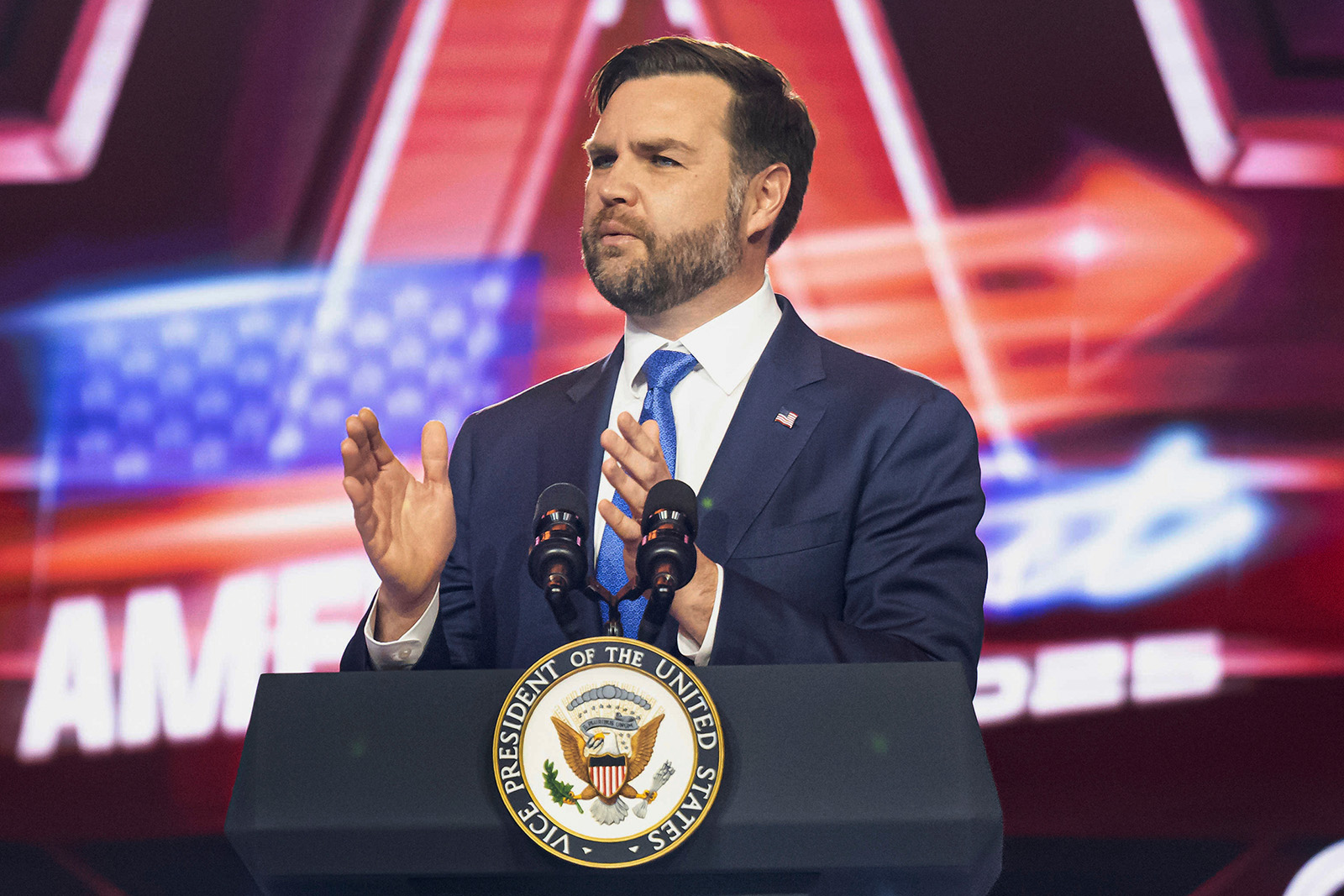
Speaking today at Turning Point USA’s annual “AmericaFest” conference, Vice President J.D. Vance said, to great applause: “The only thing that has truly served as an anchor of the United States of America is that we have been, and by the grace of God we always will be, a Christian nation.”

Actually, we haven’t.

Vance’s statement flies in the face of our Constitution, whose First Amendment reads: “Congress shall make no law respecting an establishment of religion, or prohibiting the free exercise thereof….” James Madison of Virginia, the key thinker behind the Constitution, had quite a lot to say about why it was fundamentally important to make sure the government kept away from religion.

In 1772, when he was 21, Madison watched as Virginia arrested itinerant preachers for attacking the established church in the state. He was no foe of religion, but by the next year, he had begun to question whether established religion, which was common in the colonies, was good for society. By 1776, many of his broad-thinking neighbors had come to believe that society should “tolerate” different religious practices; he had moved past tolerance to the belief that men had a right of conscience.

In that year, he was instrumental in putting Section 16 into the Virginia Declaration of Rights, on which our own Bill of Rights—the first ten amendments to the Constitution—would be based. It reads, “That religion, or the duty which we owe to our Creator, and the manner of discharging it, can be directed only by reason and conviction, not by force or violence; and therefore all men are equally entitled to the free exercise of religion, according to the dictates of conscience; and that it is the mutual duty of all to practice Christian forbearance, love, and charity toward each other.”

In 1785, in a “Memorial and Remonstrance against Religious Assessments,” he explained that what was at stake was not just religion, but also representative government itself. The establishment of one religion over others attacked a fundamental human right—an unalienable right—of conscience. If lawmakers could destroy the right of freedom of conscience, they could destroy all other unalienable rights. Those in charge of government could throw representative government out the window and make themselves tyrants.

Madison believed that a variety of religious sects would balance each other out, keeping the new nation free of the religious violence of Europe. He drew on that vision explicitly when he envisioned a new political system, expecting that a variety of political expressions would protect the new government. In Federalist #51, he said: “In a free government the security for civil rights must be the same as that for religious rights. It consists in the one case in the multiplicity of interests, and in the other in the multiplicity of sects.”

In 1790, the year after he took office as the nation’s first president, George Washington assured a Jewish congregation in Newport, Rhode Island, that in the United States of America, “[a]ll possess alike liberty of conscience and immunities of citizenship.” The government of the United States, he wrote, “gives to bigotry no sanction” and “to persecution no assistance.” He wished that Jewish Americans “continue to merit and enjoy the good will of the other inhabitants— while everyone shall sit in safety under his own vine and fig tree and there shall be none to make him afraid.”

The next year, the states ratified the First Amendment to the Constitution. In order to ensure men had the right of conscience, it reads: “Congress shall make no law respecting an establishment of religion, or prohibiting the free exercise thereof….”

In 1802, President Thomas Jefferson called this amendment “a wall of separation between Church & State.” In a letter of January 1, 1802, he explained to a group of Baptists from Danbury, Connecticut, how that principle made him refuse to call for national religious days of fasting and thanksgiving in his role as head of the government.

Like Madison, he maintained that “religion is a matter which lies solely between Man & his God, that he owes account to none other for his faith or his worship.” “[T]he legitimate powers of government reach actions only,” he wrote, “[and] not [religious] opinions.”

“[T]hat act of the whole American people which declared that their legislature should ‘make no law respecting an establishment of religion, or prohibiting the free exercise thereof,’” he wrote, built “a wall of separation between Church & State.”

In the early years of the nation, Americans zealously guarded that wall. They strictly limited the power of the federal government to reflect religion, refusing even to permit the government to stop delivery of the U.S. mails on Sunday out of concern that Jews and Christians did not share the same Sabbath and the government could not choose one over the other. The Constitution, a congressional report noted, gave Congress no authority “to inquire and determine what part of time, or whether any has been set apart by the Almighty for religious exercises.”

But the Civil War marked a change. As early as the 1830s, southern white enslavers relied on religious justification for their hierarchical system that rested on white supremacy. God, they argued, had made Black Americans for enslavement and women for marriage, and society must recognize those facts.

A character in an 1836 novel written by a Virginia gentleman explained to a younger man that God had given everyone a place in society. Women and Black people were at the bottom, “subordinate” to white men by design. “All women live by marriage,” he said. “It is their only duty.” Trying to make them equal was a cruelty. “For my part,” the older man said, “I am well pleased with the established order of the universe. I see…subordination everywhere. And when I find the subordinate content…and recognizing his place…as that to which he properly belongs, I am content to leave him there.”

The Confederacy rejected the idea of popular government, maintaining instead that a few Americans should make the rules for the majority. As historian Gaines Foster explained in his 2002 book Moral Reconstruction, which explores the nineteenth-century relationship between government and morality, it was the Confederacy, not the U.S. government, that sought to align the state with God. A nation was more than the “aggregation of individuals,” one Presbyterian minister preached, it was “a sort of person before God,” and the government must purge that nation of sins.

Confederates not only invoked “the favor and guidance of Almighty God” in their Constitution, they established as their motto “Deo vindice,” or “God will vindicate.”

The United States, in contrast, was recentering democracy during the war, and it rejected the alignment of the federal government with a religious vision. When reformers in the United States tried to change the preamble of the U.S. Constitution to read, “We, the people of the United States, humbly acknowledging Almighty God as the sources of all authority and power in civil government, the Lord Jesus Christ, as the Ruler among nations, and His revealed will as of supreme authority, in order to constitute a Christian government, and in order to form a more perfect union,” the House Committee on the Judiciary concluded that “the Constitution of the United States does not recognize a Supreme Being.”

That defense of democracy—the will of the majority—continued to hold religious extremists at bay.

Reformers continued to try to add a Christian amendment to the Constitution, Foster explains, and in March 1896 once again got so far as the House Committee on the Judiciary. One reformer stressed that turning the Constitution into a Christian document would provide a source of authority for the government that, he implied, it lacked when it simply relied on a voting majority. A religious amendment “asks the Bible to decide moral issues in political life; not all moral questions, but simply those that have become political questions.”

Opponents recognized this attempt as a revolutionary attack that would dissolve the separation of church and state, and hand power to a religious minority. One reformer said that Congress had no right to enact laws that were not in “harmony with the justice of God” and that the voice of the people should prevail only when it was “right.” Congressmen then asked who would decide what was right, and what would happen if the majority was wrong. Would the Supreme Court turn into an interpreter of the Bible?

The committee set the proposal aside.

Now, once again, we are watching a minority trying to impose its will on the majority, with leaders like Vice President J.D. Vance trying to rewrite American history.

Notes:

https://founders.archives.gov/documents/Madison/01-01-02-0027

https://www.archives.gov/founding-docs/virginia-declaration-of-rights

https://founders.archives.gov/documents/Madison/01-08-02-0163#JSMN-01-08-02-0163-fn-0014-ptr

https://www.loc.gov/loc/lcib/9806/danbury.html#:~:text=The%20unedited%20draft%20of%20the,was%20an%20offense%20to%20republicanism

https://loeb.columbian.gwu.edu/george-washingtons-letter-hebrew-congregation-newport-rhode-island

https://www.loc.gov/loc/lcib/9806/danpre.html

Gaines Foster, Moral Reconstruction: Christian Lobbyists and the Federal Legislation of Morality, 1865–1920 (Chapel Hill: University of North Carolina Press, 2002).

[Nathaniel Beverly Tucker], George Balcombe: A Novel (New York: Harper & Brothers, 1836).

https://avalon.law.yale.edu/19th_century/csa_csa.asp

https://americanhistory.si.edu/collections/object/nmah_412912

Bluesky:

atrupar.com/post/3majhhmtmie2oEmail

Heather Cox Richardson is an American historian. She is a professor of history at Boston College, where she teaches courses on the American Civil War, the Reconstruction Era, the American West, and the Plains Indians. She previously taught history at MIT and the University of Massachusetts Amherst.


Church repatriates sacred rock covered with petroglyphs after 14-year effort 
(STRUGGLE)

TREMONTON, Utah (AP) — The Church of Jesus Christ of Latter-day Saints said in a statement Wednesday that historians and conservators working on its behalf partnered with the tribe and the state to carefully remove and clean the 2,500-pound (1,134-kilogram) rock.


Associated Press
December 22, 2025

TREMONTON, Utah (AP) — A large rock bearing petroglyphs created more than 1,000 years ago by the ancestors of the Northwestern Band of the Shoshone Nation is finally back home in the mountains of northern Utah.

The repatriation effort, which began in 2011, culminated earlier this month when the sacred rock was airlifted to its original location after being freed from a concrete slab in front of a church meetinghouse in the community of Tremonton, about 80 miles (129 kilometers) north of Salt Lake City.

The Church of Jesus Christ of Latter-day Saints said in a statement Wednesday that historians and conservators working on its behalf partnered with the tribe and the state to carefully remove and clean the 2,500-pound (1,134-kilogram) rock. The process involved saws, chisels and eventually soap and water to remove years of lichen growth from the petroglyphs.

For Brad Parry, the tribe’s vice chair, it was emotional seeing the rock returned to the rugged hillside to rejoin other petroglyph-covered rocks. He said it’s a spiritual place where Shoshone ancestors would gather to camp and hunt.

Parry said the repatriation was like putting a puzzle piece in place.

“Our history is so fractured with a lot of things that happened to us,” he said in a statement. “To have these positive things now that are coming out — it’s rebuilding our history. And I can’t overstate that.”

People give different versions of how the rock found its way to the church meetinghouse some 80 years ago. Stories involve a group of people muscling the hefty rock into a pickup and hauling it to town.

It’s a mystery why it was brought to the church, said Ryan Saltzgiver, history sites curator for the Church History Department. For decades, it sat outside the building, first near the flagpole and then on the north side. Grainy black and white photos shared by the church showed the rock on display.

David Bolingbroke, research and outreach historian for the Church History Department, said the rock was likely placed at the chapel not out of malice, but out of a lack of proper understanding.

In 2011, amateur archaeologists used a 1937 rock-art survey to identify and track down the rock’s origin.

“We’ve been working since about that time on getting everything to line up so we could move the stone,” Saltzgiver said.

The Utah State Historic Preservation Office helped bring partners together, and the church worked with the tribe to finalize a preservation and repatriation plan. Saltzgiver said the church has a moral and ethical obligation to care for things that are in its possession as well as a responsibility to return sacred items to their rightful owners.

Once the rock was removed from its concrete base, it was taken to Provo where conservators with the Midwest Art Conservation Center used bamboo and plastic tools to remove the lichen without altering the original patina.

After trucking the rock to a spot near the Utah-Idaho line, a helicopter was used to move it into place. Officials did not disclose the exact location to ensure its safekeeping.

To mark the return, tribal spiritual leader Rios Pacheco offered a blessing in Shoshoni, the language spoken by the tribe.

“This rock was meant to be here,” Parry said. “It’s like this rock knows it’s home.”


Associated Press religion coverage receives support through the AP’s collaboration with The Conversation US, with funding from Lilly Endowment Inc. The AP is solely responsible for this content.

JD Vance, playing unifier, declares the US 'a Christian nation'

(RNS) — Call it inclusion, Christian nationalist style.


Vice President JD Vance speaks during Turning Point USA's AmericaFest 2025, Sunday, Dec. 21, 2025, in Phoenix. (AP Photo/Jon Cherry)

Mark Silk
December 22, 2025
RNS


(RNS) — On Sunday, at Turning Point USA’s annual AmericaFest, JD Vance began his closing remarks with a message of inclusion. Foreswearing “endless, self-defeating purity tests,” he promised to fight alongside “all of you” to “defend the country that we so dearly love.” He and President Donald Trump, he said, “don’t care if you’re white or black, rich or poor, young or old, rural or urban, controversial or a little bit boring or somewhere in between.”

Which was his way of saying that he would not be issuing any criticism of the right-wing antisemites and their enablers who, in the wake of Charlie Kirk’s assassination, have tumbled MAGAworld into civil war. Specifically, he was saying Ben Shapiro and his ilk are wrong to call for Nick Fuentes, Candace Owens, Tucker Carlson and their ilk to be kicked out of the movement.

Meanwhile, the civil war rumbles on.

In a New York Times opinion piece, Ohio gubernatorial candidate Vivek Ramaswamy denounced the “rapidly ascendent” view on the right that the purest American identity is based on “lineage, blood and soil.” Ramaswamy described how his own social media feeds “are littered with hundreds of slurs, most from accounts that I don’t recognize, about ‘pajeets'” and calls to deport him “back to India.” (He is a native-born U.S. citizen.)
RELATED: First Turning Point USA conference without Charlie Kirk exposes rifts in Christian right

Similarly, the conservative law professor Josh Blackman has posted his letter of resignation as senior editor of the Heritage Foundation’s multi-authored Guide to the Constitution. Addressing Heritage President Kevin Rogers, who declared undying support for Carlson after the talk-show host gave Fuentes a friendly interview in October, Blackman, who is Jewish, wrote, “Your initial remarks were indefensible. Your apology was underwhelming. And the lack of any meaningful followup over the past three months has been telling. For reasons only you know, you aligned the Heritage Foundation with the rising tide of antisemitism on the right.”

It is noteworthy that Vance, in his listing of demographic dualities who are all one in MAGA, did not include a religious pairing. It’s hard to believe that the omission was not on purpose.

The line in his speech that drew the greatest applause was, “The only thing that has truly served as an anchor of the United States of America is that we have been, and by the grace of God, we always will be, a Christian nation.” What followed by way of justifying his “Christian nation” claim — anticipating the media to twist it — was a tissue of half-truths, misrepresentations and outright falsehoods.

“I’m not saying you have to be a Christian to be an American,” he allowed. “I’m saying something simpler and truer.” As if there was something true about saying that. And exactly what was simpler and truer? “Christianity is America’s creed.” Really?

To go on to claim that “our country’s major debates have always centered on how we could best, as a people, please God” is nonsense. The point was not to say something simple and true, but to enable Turning Point USA’s Christian audience to come away assured they have the bragging rights in America, that those of other faiths are just the beneficiaries of a civilization that is not theirs.

RELATED: Who inherits the Seven Mountains Mandate after Charlie Kirk?

In 1790, President George Washington told the Hebrew congregation of Newport, “It is now no more that toleration is spoken of, as if it was by the indulgence of one class of people, that another enjoyed the exercise of their inherent natural rights.” In essence, Vance was telling AmericaFest the opposite.


Christian Nightmares spoofs the spectacle of Christianity's revivalist strain


(RNS) — Christian Nightmares’ most popular posts often feature people claiming moral authority over emotion, weather, women, politics and history.


Recent posts on the Christian Nightmares Instagram page. (Screen grab)
Fiona Murphy
December 24, 2025
RNS


(RNS) — What began as a Tumblr account in 2009, reposting grainy clips of 1990s televangelists, has grown into Christian Nightmares, a multiplatform account with more than 220,000 followers that curates short, viral videos documenting contemporary evangelical Christianity at its most bizarre and politically charged.

The account describes itself as “a satirical look at the world of evangelical Christianity and its effect on current politics,” though its posts rarely rely on overt commentary. The content speaks for itself.

Across several social media platforms, Christian Nightmares routinely goes viral by reposting unedited sermons, political speeches and worship moments. One post on X shows a group of young children appearing to be overcome by the Holy Spirit and is captioned “This is what indoctrination looks like,” with over 65 million views. Another post, reading simply “The Charlie Kirk memorial is a Christian nationalist political rally,” was viewed more than 430,000 times


Videos on Christian Nightmares’ YouTube channel open with a figure wearing a chrome silver mask and looking silently at the camera. He wears a white T-shirt, sometimes scrawled with black Sharpie, sometimes blank, and a long gray wig that moves slightly as he raises a hand in an eerie wave. “Hi, I am Christian Nightmares,” on-screen text announces. Then the videos begin.


Christian Nightmares. (Courtesy photo)

The man behind the account, who was raised fundamentalist Christian and now can’t seem to stop posting about it, guards his anonymity, he said, to keep the focus on the content, and the readers’ responses. “I’m anonymous, I’m ageless,” he said in an interview. “I’d much rather be somebody that people can project their experiences onto than just be this guy who talks about this stuff.”

Altogether, Christian Nightmares functions as an archive of evangelical spectacle, depicting old-fashioned religious fervor, Christian nationalism and celebrity culture. The characters in his posts all seem to exist in a reality keenly defined by a posture of moral certainty and a waning degree of restraint.

Christian Nightmares’ most popular posts often feature people claiming authority over emotion, weather, women, politics and history. With minimal captions, a recurring cast of characters and settings such as a pulpit, a podium or the White House lawn become the stars of a particularly modern spectacle.

In one clip with 100,000 views, Christian nationalist pastor Josh McPherson during a podcast warns that empathy is “dangerous” and “toxic” and says that it can “align believers with hell.” Women, McPherson said, are especially vulnerable because they have a greater capacity to “let the sinners in” and should therefore have their friendships closely controlled by their husbands.

In another post on X with over 400,000 views, U.S. Rep. Mary Miller, an Illinois Republican, dismisses climate change as a “sham” and explains that God controls the sun, and the sun “controls the weather primarily,” concluding that green deal policies go against “God’s design.”

Another post documents a three-piece Christian worship band leading a group of well-dressed attendees inside the White House, their eyes lifted toward the ceiling and their hands raised. A video that has drawn nearly a million views shows a pastor standing in what seems to be their backyard passionately “rebuking” a tornado that can be seen brewing up in the distance.

After initially simply finding preachers, televangelists and religious TV programs via Google, the author of Christian Nightmares said he now relies on his audience, which sends hundreds of submissions for the account. But its growth stalled in 2023, he said, about the time his following had reached about 175,000, when his account was deleted by Instagram. (He suspects Instagram was accommodating objections from a pastor whose sermon he had clipped and reposted for its homophobic language.) As when it had happened previously, he simply made a new page and continued.

What stands out about Christian Nightmares is not the drama of the clips but how seamlessly they fit into a contemporary American news feed. The people in his videos aren’t reliably fringe characters speaking from the margins, but elected officials, pastors of large congregations and popular influencers. “The kind of the things that people were saying in videos that I made 15 years ago, those are things we hear all the time now,” said Christian Nightmares.

Very often, Christian Nightmares’ posts depict the persistence of the tradition of the Christian revival. On X, Christian Nightmares reposted a video captioned “PASTORS LOUNGE ERUPTS WITH HOLY GHOST POWER,” showing three pastors rolling on the floor, shouting and appearing to writhe in pain as they are overtaken by the Holy Spirit. The scene shows a defining feature of revivalism: a bodily emotional experience of conversion or faith, one that is timelessly striking to watch.

Christian Nightmares’ early focus was on televangelists of the 1980 and ’90s, when the revival format migrated to television, and preachers such as Jimmy Swaggart reached into living rooms with the emotional cadence and theatrical intensity of their preaching. The account traces this line in American evangelicalism, and how little its rhetoric has changed.

What distinguishes the present moment in Christian Nightmares’ clips is the spectacle’s proximity to political and cultural power. In a post on TikTok, U.S. Rep. Troy Nehls, a Texas Republican, declares that if conservative activist Charlie Kirk had lived in biblical times, he would have been “the 13th disciple.” Nehls’ colleague Miller introduces legislation declaring June “Family Month,” positioning it as a spiritual response to policy.

But Christian Nightmares captures the way faith pops up everywhere across the American landscape. In one post on X that has collected more than 5 million views, Gwen Stefani, formerly of the pop band No Doubt, promotes the Hallow app, a digital prayer guide that has enlisted several high-profile celebrities to discuss how the platform has shaped their spiritual lives. “Join me and the millions of other Christians as we celebrate together the truth that God so loved the world that he gave us his only son,” Stefani says, dressed in a Christmas outfit and standing before a decorated tree. The caption gets to the heart of things: “Gwen Stefani?! Jesus Christ … ”

Another post features actress and Christian Candace Cameron Bure explaining on a podcast why she won’t allow scary movies to be viewed in her house, describing them as a “portal” for “something demonic.” She then calls out the podcast host for posting a photo with the popular water brand called “Liquid Death.” “Do you want to buy a product that is literally being cursed?” Bure said.

Since returning to Instagram, Christian Nightmares’ curator said, the growth of his following has stalled, a slowdown he attributes to what he believes is shadow-banning — limits on the visibility of posts for users who do not already follow an account. He said he has seen a similar decline in engagement on X after Elon Musk acquired the platform in 2022.

“It’s frustrating,” he said, while adding that wide popularity is not his primary goal. Rather, he hopes the account introduces a measure of accountability for rhetoric he views as harmful or hateful. “There is some power,” he said, “in being able to hold people accountable.”


The Challenge of Food Ecomodernism: A Puzzle Outlined

Source: Resilience

Given the unfriendly nature of my debate with him – if ‘debate’ is the right word – I’ve tried to avoid further engagement with the writing of George Monbiot. But a recent Guardian article of his is such a perfect microcosm of the difficulties and dangers of ecomodernism (more on that term below) as applied to the food system that I think it merits attention.

I’ll begin by parsing the story George tells in the article as follows: There’s a problem with agriculture – it’s something quite technical, to do with a trade-off between crop yields and environmental impact. There’s a farmer near Oxford called Tolly who miraculously seems to have solved this problem and “found the holy grail of agriculture” – high yields and low impacts. His solution involves soil management which somehow affects the behaviour of soil bacteria, but nobody quite understands how he’s done it. If we could characterise soils more scientifically, then maybe this holy grail could be replicated and scaled up – but how can we do that? George meets a scientist for a drink in a pub in Oxford and it emerges from their conversation that there might be a way. The results are (literally) seismic.

“We stared at each other. Time seemed to stall. Could this really be true?”

With $4 million of start-up money from the Bezos Earth Fund George and two colleagues (a seismologist and a soil scientist) have developed a way of ‘seeing’ soil. The technology they needed for this was initially expensive, but allegedly should ultimately be zero cost, and they’ve started building the AI and machine learning tools they need. So far, George says, they’ve measured the volume of a peat bog more accurately (“The implications for estimating carbon stocks are enormous”). Eventually they hope that the technology will give farmers an almost instant readout from their soil that will help protect soil health and resilience, and ultimately help everyone find the high yield/low impact holy grail like Tolly.

That, in a nutshell, is the story. I will now comment on some of its elements.

There are essentially no politics or food system economics in this story. There are only apparently technical problems like yields and impacts, which can be addressed through technical means (the frame of analysis is entirely single farm scale, not food system scale). George has elsewhere defined ecomodernism as “a movement that treats green technology as a substitute for political and economic change”. If there are political or economic changes that could beneficially be made to improve the food and farming system – and I believe there are many – then this article is squarely ecomodernist in his terms. I believe it’s important to understand the evasion of politics that this kind of ecomodernist writing about food and the food system involves.

I’m not going to get into the detail here of where politics and economics meets the technicalities of farming at the individual farm and the farm system level. I’ve written a lot about it previously, as have many others. Generally, we have to understand the global farming system as a profit-driven one characterized by the overproduction of most food commodities, and global political systems as ones that inflict scarcity and lack of food and other entitlements upon many people. This means that high yields and low food prices often don’t benefit nature or consumers, especially poor consumers.

So it’s a lot more complicated than George implies in his article. The fact that high yields don’t necessarily benefit nature and low food prices don’t necessarily benefit consumers (including poor consumers) may be a bit counterintuitive, but it’s nevertheless well understood within food system scholarship (one clue to how it works is that farmers and food system workers are essentially the largest category of workers globally, and they are disproportionately poor). The people that high yields and low food prices unquestionably do benefit are the (usually corporate) providers of yield-boosting farm inputs and retail food distribution systems. Intentionally or otherwise, ecomodernist depoliticizations of the food system of the kind that George purveys in his article effectively support the status quo of overproduction, hunger and corporate control.

Moving on in the story, we come to Tolly. He’s a brilliant veg grower who’s influenced me a lot, but he hasn’t found the holy grail of agriculture. His approach is essentially the long-established one of mixed or ley farming. Historically, farmers have mostly done this by alternating crops and livestock. Modern farmers like Tolly can do it with tractors and without livestock if they choose. It amounts to much the same thing.

Most thoughtful people who’ve spent any time around the sharp end of food production and its ineluctable trade-offs treat the latest hosannas in the press about having found the holy grail of agriculture with a resigned eye roll. As shown by the likes of food system analyst Glenn Davis Stone (The Agricultural Dilemma: How Not to Feed the World), these hosannas are usually sung loudest by people who have new commercial inputs they want to bring to market, and are ultimately aimed at the governments or venture capitalists they think might fund them.

A few years back, such hosannas were being sung for bacterial protein (“food from thin air”) and for synbio alt-meats more generally (good old-fashioned plant-based alt-meats never got the same attention, for reasons that I suspect have a lot to do with their lesser promise for delivering full corporate control). Yet the prohibitive energetic and other costs of these synbio alt-meat technologies were always going to stymie them as viable mass food approaches, and venture capital now seems to be deserting them for sexier new fields like AI.

I can’t help noticing how prominent these fads are in George’s writing on food – from bacterial protein in his book Regenesis, to AI in his latest article. And also how his fiercely expressed opposition to neoliberalism and gloves-off capitalism in his political writing seems to go missing when he writes about food. Funding from the Bezos foundation “may cause some discomfort”, George writes, “but our experience has been entirely positive: the fund has helped us do exactly what we want”. This isn’t the hardest-hitting critique of techno-capitalism and the source of its funds you’ll ever hear.

An article on the Bezos Fund’s website about the project suggests that the techniques it’s developing will unlock “new ways to finance climate solutions, allowing transparent measurement and verification for soil carbon markets. This is how we can feed the world without devouring the planet”.  That last sentence echoes the subtitle of George’s Regenesis book, while the preceding one reveals a commitment to achieving it through the existing mechanisms of large-scale global capitalism. George builds his article out from a desire to spread the successful practice of a small-scale local veg grower, but perhaps this obscures what the project’s funders are really looking for. An alternative headline for his article might have been ‘Controversial funder bankrolled by one of the world’s richest men supports scientists to improve market information for global capitalism’. It would have been more factual, if less dramatic and upbeat.

Why is the Bezos Earth Fund controversial? Well, according to an expert quoted in a report in, er, The Guardian,  “The projects of the Bezos fund do not address the key issues of the fundamental climate crisis we are facing – they are nice but unfortunately cosmetic”. Another expert quoted in the same report stated, “In only a couple of years since it launched, the Bezos Earth Fund has become one of the most influential funders in the carbon market space, and has played a significant role in providing pro-market organisations with resources to promote the role of carbon markets. There is a real risk that excessively pro-market funding leads to drowning out more critical voices which provide the necessary counterbalance to the debate”.

In another article in The Guardian, the writer – who is, er, George Monbiot – argues:

“Essential as ecological carbon stores are, trading them against fossil fuel emissions, which is how these markets operate, cannot possibly work. The carbon that current ecosystems can absorb in one year is pitched against the burning of fossil carbon accumulated by ancient ecosystems over many years. Nowhere is this magical thinking more apparent than in soil carbon markets, a great new adventure for commodity traders …. Every form of wishful thinking, over-claiming and outright fraud that has blighted the carbon market so far is magnified when it comes to soil.”

Well said, sir. So it might surprise some that George is now taking grant funding from the Bezos Earth Fund to develop a product that, the Fund hopes, will allow verification for soil carbon markets.

I’ll pass as quickly as possible over the next part of the story, involving men staring at each other meaningfully in Oxford pubs. My guess is that if you could do a rank ordering of the venues historically where white guys have been apt to congratulate themselves for solving the problems of the world, then pubs in Oxford would come pretty high on the list – and I say this as a white guy from near Oxford who loves to put the world to rights over a pint.

Walter Haugen got straight to the point about what guys like us really ought to be doing to solve the problems of the world:

“You – the human engine that has a very low energy input/output ratio – need to get off your dead ass and actually grow some food using hand methods driven by the creativity of your grotesquely enlarged primate brain.”

Here, Walter touches uncomfortably on my own central contradiction, in which my efforts to grow more food are continually stymied by my Oxford pub syndrome that makes me think I might be more help to the world by writing articles like this about, well, the dangers of the Oxford pub syndrome. Do let me know if you’ve found this post useful so that I can adjust my priorities accordingly.

Anyway, one way or another this brings us to the crux of George’s article. What, practically, does the technology he’s working on actually achieve? He says that it’s measured the volume of a peat bog (called Whixall Moss), although the paper he cites in support of this says only that the bog’s depth was measured across an eighteen metre line using ten sensors, and that “it is not possible to extrapolate from this single line to an alternative peat volume for the entirety of Whixall moss” (George’s implication that his team surpassed in 45 minutes what fifty years of preceding soil science had achieved seems over-hyped in several respects). Still, maybe the technology really will be able to measure soil volumes and estimate carbon stocks in the soil cheaply and accurately someday. But I can’t see how it will tackle the more pressing political problem of reducing carbon stocks in the atmosphere, unless you subscribe to the view that better-evidenced capitalist carbon markets result in less capitalism.

George also says that the tech may eventually be able to give farmers instant readouts about their soils. But how will it help them find the yield/impact holy grail that he claims Tolly has found? By George’s account, this grail has something to do with soil bacteria and their behaviour, which his ‘soilsmology’ technique presumably can’t measure or characterise. Possibly, the technique may give farmers information that will help them protect their soils, though it’s not clear how it will overcome the wider pressures encouraging them toward soil destruction (politics goes missing here again).

I can’t help feeling there’s a kind of spivvy middleman sales patter about all this tech-happy food ecomodernism. Take a well-established technique like mixed farming, sex it up as a potential holy grail when accompanied by new tech inputs of a modest usefulness (but let’s not talk too much about that…), sell it to farmers while claiming that it’ll soon be cheap as chips, ignore the contemporary politics that make it so difficult to farm in ecologically wise ways, and on no account support the idea that more farmers and fewer middlemen might be a good way to go. It gets a lot of media airplay, but it doesn’t amount to a good analysis of the food system, and it sells most people and most of the biosphere short.

George recently trailed once again his scornful critique of my polemic against his book Regenesis, writing

“In any discussion of food and farming, unless your solution can be scaled to feed 8 billion people, you shouldn’t be taken seriously. Unfortunately, cottagecore fantasies that would feed only the richest consumers, leaving billions to starve, are all too common.”

He made no mention in that critique that he’d badly under-stated the prohibitive energetic cost of bacterial protein, as I showed in my polemic and has now been confirmed by researchers who developed the technology even as they continue to promote it. It’s abundantly clear that the bacterial solution he was touting won’t scale to feed 8 billion people. The priorities of the new CEO of Solar Foods, the bacterial protein manufacturer George promoted in Regenesis, include “driving growth in the Health & Performance Nutrition segment especially in the United States” and “increasing product price points”. To me, that sounds rather like feeding only the richest consumers.

So I guess it’s good that George seems to have quietly backtracked on bacterial protein and has swung more fully behind mixed farming of the kind that Tolly practices, even if he still wants to bang on about my alleged ‘cruel fantasies’ and my ‘formula for mass death’. This ‘cruel fantasy’ of mine is that ordinary people should have access to land to grow food. George thinks it’s cruel because he doesn’t believe local food systems can yield enough to feed the global population, but that’s an article of faith of his based on a poor understanding of food systems. For my part, I can’t see how George came to think that a monumentally energy-hungry industrial process for growing bacteria to make protein could ever scale better than growing beans, or was more likely to nourish poor consumers.

My approach may nevertheless prove a fantasy inasmuch as it doesn’t suit the economic and political powers that be to allow ordinary people the independent means to produce a modest livelihood. They prefer keeping people dependent on high-energy mass industrial food systems predicated on overproduction, monopoly rent and economic growth of the kind that generates ecological destruction and human poverty and hunger.

I think those systems will fail due to their own internal contradictions, and what happens next will arise out of the ensuing politics. There will be opportunities for agrarian localism and for people to take charge of generating local livelihoods ecologically. It’s very far from guaranteed that those opportunities will proliferate, but what I’d like to hear from those who dismiss agrarian localism as a fantasy is how they think high-energy mass industrial food systems will deliver good, population-wide nutrition and nature protection into the future. Food ecomodernism contains fantasies of its own, and a smattering of references to open source and anti-trust practices does not conceal them.

A bigger problem, though, is that since proponents of food ecomodernism have a much larger media and political platform than proponents of agrarian localism, they’re able to make their ‘cottagecore fantasy’ accusations stick to the extent they become self-fulfilling – ‘as everyone knows, we can’t possibly localise food systems’ … well, if everyone knows this supposed truth, then we certainly won’t – while ducking the problems of their own touted solutions. We’re up the proverbial creek without a paddle and nobody has an especially plausible plan to get us out. But it would be nice if we could at least debate our various unpromising options calmly.

I’ve written a lot about the vulnerabilities of the existing high-energy food system, about the benefits of local agroecological food production and about the ideologies of modernism that make facile accusations of cottagecore fantasies so easy to stick. In so doing, I’ve developed a small but dedicated readership. Love you all to bits, but I’ve got pretty much nowhere in the larger debate with ecomodernism which seems to be sweeping all before it. Maybe it’s a case of if you can’t beat ‘em, join ‘em.

Philip Loring – author of the excellent Finding Our Niche: Toward a Restorative Human Ecology – nails what’s at stake in this present moment of food ecomodernism:

“We can be sure that the greedy eyes of disaster capitalism are peering at us from around every corner, waiting to use the tremendous pain and suffering that is emerging around us to appoint themselves our saviours. I can hear it now: “Only we can solve this problem. Only we can feed the hungry. Only we can keep you safe.” These are the voices of manifest destiny. These are the voices of the white saviour. But in reality, the opportunists making these promises can deliver on none of these promises. Why? Because their approach – indeed, their very culture – is part of the system that creates these problems in the first place”.

Quite so. But the remarkable thing is how absent such responses are in the face of corporate-friendly food ecomodernism, especially when it’s packaged in the guise of eco-friendly farming, as in George’s article. In comments beneath the article and in his social media posts trailing it, I barely found a critical or even a sceptical voice. Perhaps the odd scientist mildly questioning the novelty or wider applicability of the technique. Very little about the funding and its aims. Many comments were positively hagiographic:

“What a wonderful example of human perseverance, conscientiousness about our planet and living sustainably, tireless quests to find progressive answers and especially George’s obvious deep desire to genuinely improve life for as many as possible. In these increasingly dark days for humanity, let’s hope there are many more like him. This example and George’s humane-based conscientiousness also give you hope that the cynics will not win.”

Herein lies the trap for we advocates of agrarian localism. Point to the threadbare achievements of food ecomodernism, the dodgy energy figures, the greenwash, and we can be dismissed as cynics. Advocate for low-energy local food systems and we can be dismissed as cottagecore fantasists. It’s a perfectly closed ideological system, and I don’t know how to open up the obvious cracks in its facade.

I found Vilhelm Nilsson’s comments under an earlier version of this post informative. The comment is worth reading in its entirety (as is everyone else’s, of course), but there’s this:

“…‘saving the planet’ can turn into such a dangerously hubristic set [of] unquestionable faiths that leads to epistemic close-down and cognitive protectionism against inconsistency in our thinking …. At the same time some values such as community sovereignty and traditional food production aren’t reducible to managing calories or carbon, which means the net effect ignores moral losses tied to local knowledge and diverse ways of life … a larger critique which is worthy of having is that of instrumental ways to reason about the world, as such perspectives invariably sever the connections between the social and natural worlds.”

To my mind, Vilhelm’s comment in its entirety is bang on, but it still leaves me uncertain about how best to make the case for agrarian localism, since what I might view as a larger critique of instrumental reason, the likes of George are easily able to dismiss as cottagecore fantasies or whatever – though it’d be nice at least if they could fully embrace instrumental reason and admit to their numerical mistakes.

Vilhelm’s comment also resonates with the philosopher Alasdair MacIntyre’s views on the historically grounded nature of knowledge. I touch on this in my recent book Finding Lights in a Dark Age. I’d recommend buying a copy – if you do, you may just be helping to ‘save the planet’! But you probably won’t be – the undergirding philosophy that Vilhelm calls meliorism may have to crash and burn before it’s possible to do much reconstruction. That’s not going to be fun – I didn’t call it a Dark Age for no reason.

Ah well, the urgency of staving off as best I can the disaster capitalism that Philip Loring mentions keeps me going, even if it feels like a dispiriting and unequal battle sometimes. Cheers!