It’s possible that I shall make an ass of myself. But in that case one can always get out of it with a little dialectic. I have, of course, so worded my proposition as to be right either way (K.Marx, Letter to F.Engels on the Indian Mutiny)
Thursday, December 25, 2025
JERA Advances Plans to Ship Ammonia Produced in Louisiana to Japan
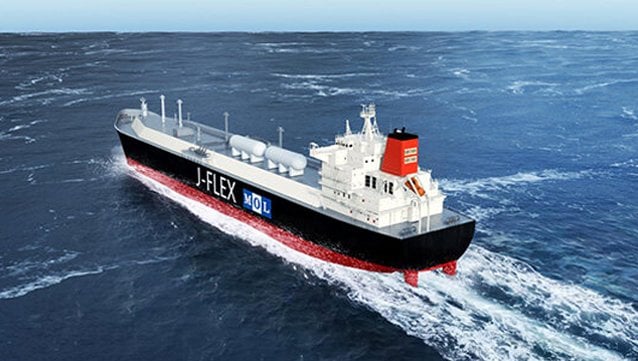
MOL is developing concepts for large gas carriers designed for ammonia shipping (MOL)
Japan’s largest power generation and energy company, JERA, is advancing its plans to ship low-carbon ammonia from a production facility in Louisiana to Japan to fuel a power generation plant. The project, working with shipping companies NYK and Mitsui O.S.K., is expected to become the first commercial-scale effort to import ammonia fuel to Japan.
The companies announced that they have signed contracts which will lead to the development of very large gas carriers designed specifically for ammonia transport. Mitsui O.S. K. completed a time charter contract with JWERA that calls for two vessels. Similarly, JERA also signed two time charters with NYK.
It is the next step in JERA’s plans to develop the Blue Point ammonia production facility in Louisiana. The company, along with partners CF Industries and Mitsui & Co., completed the investment decision for the project earlier this year. The total project is projected to cost approximately $4 billion, with JERA holding a 35 percent interest and the offtake agreements.
Blue Point is expected to be the world’s largest ammonia production facility when it comes online in 2029. It will have a nameplate capacity of approximately 1.4 million tons produced using natural gas and carbon capture technology. JERA said in the spring that it expects to supply markets in Europe, Asia, and other regions with ammonia as a fuel.
MOL and JERA have been working together for the past three years on studies for the transportation of large quantities of ammonia. They note that it is currently limited to fertilizer and chemicals. Japan looks to end its imports of coal, replacing the power generation capacity with ammonia-fueled plants.
The study with MOL focused on developing the characteristics for large gas carriers suitable for the domestic power plants and the required receiving stations. They were looking to develop the transport and receiving system and said they were also planning to operate the vessels with ammonia as the propulsion fuel.
NYK signed an agreement with JERA in December 2023 to demonstrate ammonia shipping. The deal provided the NYK vessel Berlian Ekuator (35,500 dwt) for a demonstration test to be undertaken in 2024.
MOL has already partnered with CMB.TECH for the operation of six Chinese-built chemical tankers. Two of the vessels will be ammonia-fitted on delivery, and the other four will be built ammonia-ready. The ships are due for delivery in 2028 and 2029. Both NYK and MOL are also working on ammonia bunker vessels.
Passenger Killed as Nile River Cruise Ships Collide
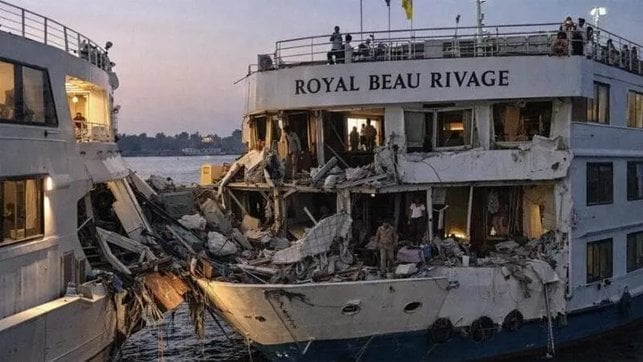
One passenger aboard the Royal Beau Rivage died from injuries sustained in the collision
Egyptian authorities are confirming that one passenger, an Italian tourist, has died from injuries sustained during the collision of two Nile River cruise ships. The captain of one of the vessels has had his license suspended and is under investigation for violations of the maritime regulations.
The General Authority for River Transport is accusing the captain of the cruise ship Royal Beau Rivage of making a sudden, sharp maneuver, which caused the two vessels to collide. The Royal Beau Rivage is considered to be one of the deluxe river boats on the Nile, with 71 cabins and a capacity for more than 140 passengers. It is 72 meters (236 feet) in length and was launched in September 2022.
The ship was carrying a group of approximately 80 Italian tourists. It was approaching the dock near Esna Lock, near Aswan, nearly 20 miles south of Luxor. The two river boats collided about 8:00 p.m. local time on Sunday night, December 21.
The Opera, a riverboat built in 2009 with a capacity for 199 passengers, reported damage to its bow from the collision. Three of four cabins at the front of the Royal Beau Rivage were heavily damaged. A 47-year-old female Italian tourist was in one of the cabins and sustained multiple injuries. She was rushed to an Egyptian hospital, but died from her injuries.
The Opera had cleared the lock on a trip from Aswan to Luxor. It was about 1.2 miles from the lock when the collision occurred with the Royal Beau Rivage, which was heading from Luxor to Aswan.
Some reports are saying that they also feared several other people might have been in the river after the impact. The authorities were seen on the river, but the Italian ambassador said there were no other reports of severe injuries. River traffic resumed on Monday.
The river authority is highlighting that the navigation rules give priority to vessels traveling with the current. They said the Royal Beau Rivage had violated the rules, reporting that the captain’s license was suspended, and the matter had been handed over to the general prosecutor for investigation.
HM Coastguard Responds After Lifeboat Beaches
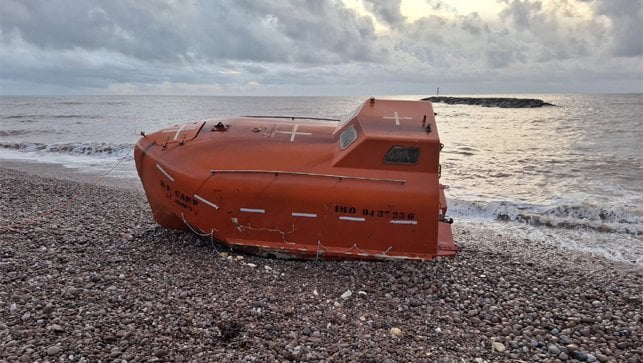
Residents were surprised to see a lifeboat on the shoreline Sunday morning and notified HM Coastguard (Beer Coastguard Rescue Team photos)
Members of the UK’s HM Coastguard were dealing with a mystery early on Sunday morning, December 21, when they started receiving reports of a lifeboat washed up on the rocky shoreline near Sidmouth on the English Channel. The Beer Coastguard Rescue Team was dispatched, and they found a larger emergency boat badly damaged sitting on the coastline.
The boat was clearly marked with an IMOP number and the name of a vessel, BF Carp. Checking with the Joint Rescue Coordination Centre, they confirmed the boat had broken free from the containership, and efforts had been underway to track it and determine where it would come ashore.
The boat, which has a capacity for 19 people, was reported missing from the BF Carp (12,000 dwt) on Wednesday, December 17, while the vessel was near the French coast. It had departed Antwerp earlier in the day, bound for Spain.
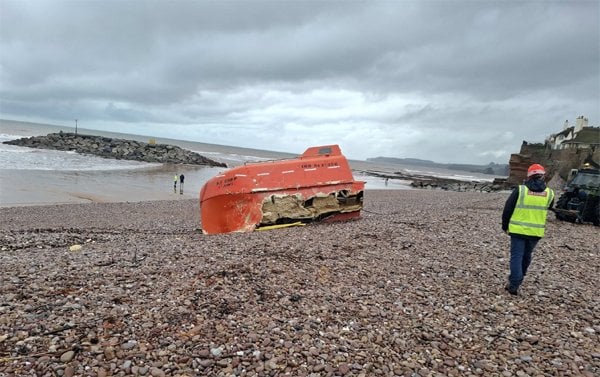
The Beer team was instructed to search the boat and remove and secure any equipment, including emergency flares. A quick visual check showed extensive damage to one side of the fiberglass hull. No one had been aboard the boat when it launched.
Tractor was used to pull the boat further on shore away from the tide (Beer Coastguard Rescue Team)
The boat was going to be held till a private contractor hired by the shipping company could come to collect it. However, concern was raised that the boat might be further damaged and break up, or wash back out to sea, when the evening tide came in. The Sidmouth Independence Lifeboat crew arrived with a tractor and pulled the boat further up the shore to a secure position above the evening tide line.
The Devon and Cornwall Police, the Receiver of Wrecks, and the Environmental Agency have also been notified of the unusual boat on the beach. HM Coastguard reports it is unclear how or why the lifeboat became detached and launched for the containership.
CMA CGM Sends ULCV Through Suez Canal as 2026 Traffic Return is Predicted
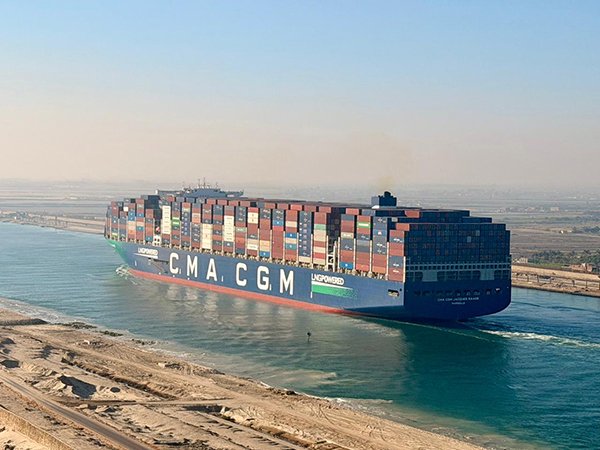
CMA CGM Jaques Saade was the first ULCV to return to the Suez Canal (SCA)
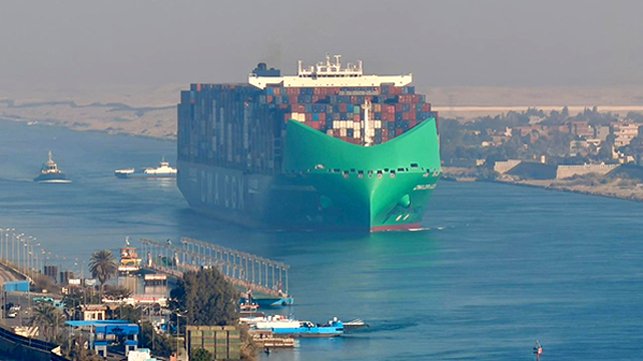
The Suez Canal Authority is highlighting what it is calling a “new phase in the return of containerships” as it marked the first transits in two years by ultra-large vessels. Today, December 23, was a milestone for the Suez Canal as two of CMA’s large vessels passed in the Canal while Maersk’s first ship completed its transit, the first time the majors have sent their large vessels back since the start of the Houthis’ campaign in late 2023.
Admiral Ossama Rabiee, Chairman and Managing Director of the Suez Canal Authority, said these transits were “significant steps,” predicting they would have a “profound impact” in bringing back volume to the Suez Canal. He is urging other shipping lines to adjust their schedules and resume voyages. Rabiee said that they expect next year will witness a gradual improvement in traffic, forecasting that they will reach normal rates in the second half of 2026.
CMA CGM, which had maintained a limited number of transits through the Suez Canal and the Red Sea when security was available, had already tested the Suez Canal with larger vessels. It had also announced that one of its routes between India and the United States would resume regularly scheduled transits in January.
CMA CGM is the first carrier to send its largest vessels through the Suez Canal since 2023 (SCA)
The CMA CGM Jaques Saade (23,000 TEU) made the southbound transit today. The vessel is sailing from Tangier Med, where it departed on December 16, bound for Port Klang, Malaysia. It became the first of the ultra-large vessels to make the Suez Canal transit since 2023. The ship operates one of the main routes, sailing from China to Northern Europe.
Northbound, the CMA CGM Adonis (15,536 teu) was traveling from Singapore. The Suez Canal Authority reports the vessel was carrying 154,000 tons of cargo. It operates on a route from Asia to the Eastern Mediterranean. CMA CGM has not commented on whether these transits are part of a regular return to its routes or test voyages.
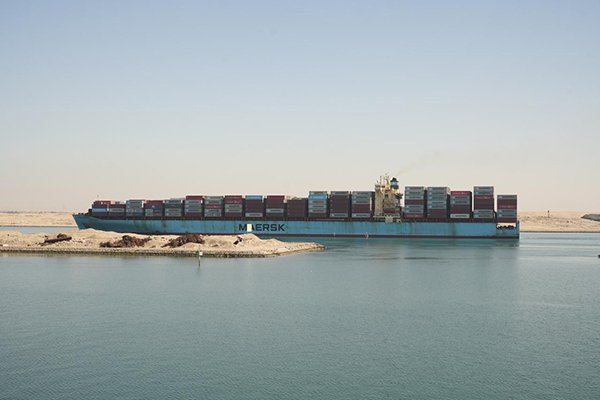
Maersk Sebarok completing the trip that also saw it transit the Red Sea (SCA)
Also in the northbound convoy was the Maersk Sebarok (6,648 teu), sailing from Oman bound for the U.S. East Coast. Last week, Maersk highlighted that the vessel was its first to transit the Red Sea since December 2023. Maersk, however, said it was a trial trip and that there were no immediate plans for additional transits through the region.
The Suez Canal Authority has been moving aggressively to restore traffic. It has met with the major shipping companies, encouraging a return, and offered special rates to further encourage the transits. The Canal is a major source of foreign income for Egypt.
SINOPHOBIA
Pentagon: China Plans to Build Nine Aircraft Carriers
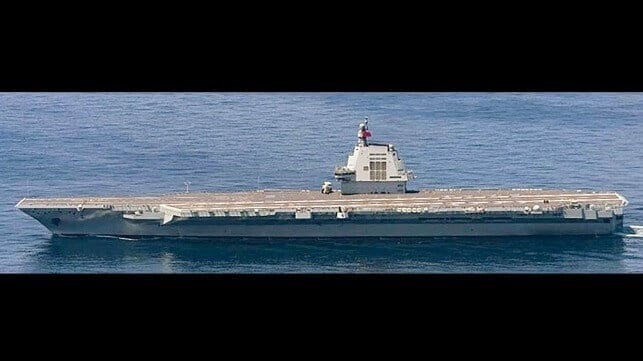
The new Chinese carrier Fujian (file image courtesy Japan Self Defense Force)
China's naval aspirations are more ambitious than previously understood, according to the Pentagon's annual assessment of the People's Liberation Army. The Chinese PLA Navy is already the largest naval force in the world by vessel count, and modernizing at breakneck speed - but this is not enough, according to the report. China plans to expand its carrier force to a total of nine vessels by 2035, enough to compete for sea control in the Western Pacific.
China's carrier technology has evolved rapidly since it finished and relaunched an ex-Soviet hull - the Liaoning - in 2012. It built its own adapted copy, the Shandong, in 2019. The third-generation design, Fujian, skipped over steam-catapult technology and jumped to high-tech electromagnetic launch and recovery. Though its powerplant is diesel-fueled rather than nuclear, Fujian is in all respects a modern CATOBAR carrier. Future Chinese carriers could incorporate nuclear power, potentially as early as the next hull, which is currently under construction at Dalian Shipyard.
Each additional carrier that the PLA Navy operates will have an outsize effect on the balance of power in the Western Pacific. Excepting the naval shipyard at Yokosuka and the harbor at Guam, U.S. Navy carrier strike groups in the Pacific have to operate thousands of miles from resupply and repair facilities, the nearest full-size base being Pearl Harbor. Fuel and dry stores have to travel a long way to reach Navy task forces in the region, and each combatant vessel rotating through the area has a long transit to and from the U.S. mainland, consuming time on station.
In addition, combatant commands in Europe and the Mideast have their own needs for presence and naval aviation. At any time, the U.S. Navy's deployed carrier strike groups have to respond to a global demand signal. But China's limited geographic interests allow it to focus all its assets on the Indo-Pacific. Its short lines of communication afford faster rotations in and out of port, along with shorter voyages for the naval auxiliaries providing replenishment. A fleet of nine Chinese carriers could potentially generate more deployed hulls in theater - under way, in the Indo-Pacific, at the same time - than the U.S. Navy's 11-carrier fleet.
In addition, China's future carriers are expected to exceed the U.S. Navy's Ford-class in size and aircraft count - though analysts note that quantity is no guarantee of capability. The Pentagon's nine-carrier count also omits China's Type 076 big-deck amphib, effectively an escort carrier in size and capability. The Type 076 is catapult-equipped, and is designed to carry and launch drone fighters, which could further augment China's carrier force.
China's growing force of combatant vessels would be only one component of its resources for a much-anticipated conflict in the Western Pacific. The PLA Rocket Force fields multiple classes of antiship ballistic missiles, in quantity, designed to strike American carriers as far away as Guam. China's PLA Air Force has begun testing a long-range "sixth-generation" stealth fighter, according to the Pentagon - likely a reference to the tailless, three-engine jet spotted in December 2024. And a new model of PLA early-warning aircraft will give Chinese forces a technological edge for detecting and targeting American fighters, the Pentagon warned.
Volunteers Seek $1M to Preserve Historic Great Lakes Car Ferry
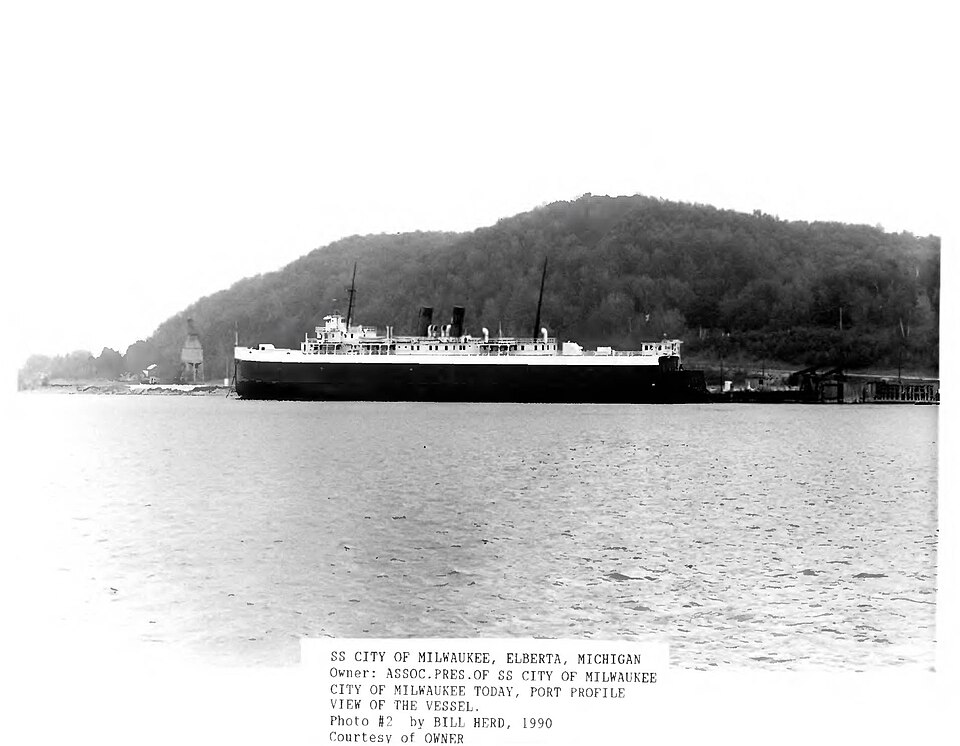
SS City of Milwaukee, 1990 (Bill Herd / public domain)
Efforts are underway to raise $1 million to help save a historic Great Lakes car ferry that is moored in Northern Michigan and whose preservation is under threat due to significant hull corrosion.
The Society for the Preservation of the S.S. City of Milwaukee says it’s hoping to raise the funds that will be used for the long term preservation of S.S. City of Milwaukee, a 1930-built steam-powered railroad car ferry that was instrumental in Michigan’s industrial revolution.
With a $1 million budget that will cover preparation, towing, shipyard services, and contingency for cost overruns, the aim is to have City of Milwaukee dry docked at the Fincantieri Bay Shipbuilding in Sturgeon Bay, Wisconsin, for critical works. The project will mark the first time that the National Historic Landmark ship will be out of the water in 45 years.
The City of Milwaukee was the last of six sister ships designed in the 1920s and built by the Manitowoc Shipbuilding company out of Wisconsin. She was launched in 1931 to replace SS Milwaukee, which sank with all hands in October 1929 during a gale.
The ship had an illustrious career and is known as one of Michigan’s most important surviving links to the Great Lakes’ industrial and transportation history. She remains as the last unmodified traditional Great Lakes railroad car ferry in existence, making her the most complete surviving example of the once-critical industry.
For decades, City of Milwaukee and other ships like her were a critical extension of Michigan’s rail system, carrying entire freight trains, automobiles, and passengers across Lake Michigan and supporting manufacturing, agriculture, travel, and jobs in communities throughout the state. The steel-hulled ship had a carrying capacity of 30 to 32 fully loaded rail cars.
When the Grand Trunk Western Railroad ended car ferry operations in 1978, the importance of the industry was so clear that the State of Michigan purchased the City of Milwaukee and leased her to the Ann Arbor Railroad until 1981 in an effort to keep the car ferry system alive and protect a transportation network that was vital to the state’s economy.
Retired in 1982, City of Milwaukee is today preserved in Manistee, Michigan, where she serves as a museum ship, attracting thousands of visitors annually. The society responsible for the ship’s preservation says that like all historic ships, the City of Milwaukee requires care to survive. Currently, much of the ship’s steel hull lies below the waterline and cannot be fully inspected or repaired while afloat, which makes a trip to dry dock critical to allow the vessel to be lifted out of the water for preservation works.
While in dry dock, the underwater hull will be power-washed and sandblasted, all sea chests and underwater openings will be sealed, the propellers will be removed and stern tubes sealed, and the hull will receive two coats of a marine epoxy coating with an estimated service life of 25 years or more.
“Significant progress has been made to preserve the ship; however, securing the long-term integrity of her hull is the next and most critical step,” said The Society for the Preservation of the S.S. City of Milwaukee in a statement.
The society added that once the project is finished, City of Milwaukee will return to her current home in Manistee where she will continue attracting visitors, offering overnight stays and special events.
China to Develop New Port in Kuwait for Regional and Global Trade
Kuwait has agreed to have China design and build a new regional and global trade port (Kuwait Ports Authority)
Kuwait and China formalized a new agreement, building on their cooperation and which aims to complete the development of a new port in northern Kuwait. Known as the Mina Mubarak Al-Kabeer port, it is a key part of Kuwait’s Vision 2035 project and China’s Belt and Road Initiative.
Plans have been discussed for the new port as part of Kuwait’s economic diversification project aimed at moving the country’s economy away from its total dependence on oil. In 2023, China signed a series of Memorandums of Understanding to aid Kuwait with major infrastructure projects, including the new port.
On December 22, the Ministry of Public Works signed the contracts for the engineering, supply, and construction with China Communications Construction Company (CCCC). The project calls for the development of the port in a project that is estimated to cost approximately $4 billion.
Few details were provided on the plan other than its role in the future economy. They said it would be focused on manufacturing and light industry and would emerge as a new center for regional and international trade. Kuwaiti officials highlight the historic assets, mutual political respect, and the intersection of confidence and interests between the two countries.
CCCC highlights that it will be its first Middle East port project partially built to Chinese standards. They said it would incorporate the company’s expertise and technology.
Kuwaiti officials asserted that the project has progressed with the first phase as much as 50 percent completed. It is to have four berths and is expected to be operational by 2026. They said the modern port will streamline cargo handling and improve supply chain efficiency as a regional hub. The port will also be linked to the Gulf Railway project.
According to media reports, when the port is completed, its area will have increased tenfold. It is to encompass approximately 116 million square meters.
The location on Bubiya Island is in northern Kuwait near the Iraqi border. The project is expected to spur a new regional competition as many of the countries vie for an increased role in regional trade.
MSC Strikes Deal for Construction of Bagamoyo Port in Tanzania
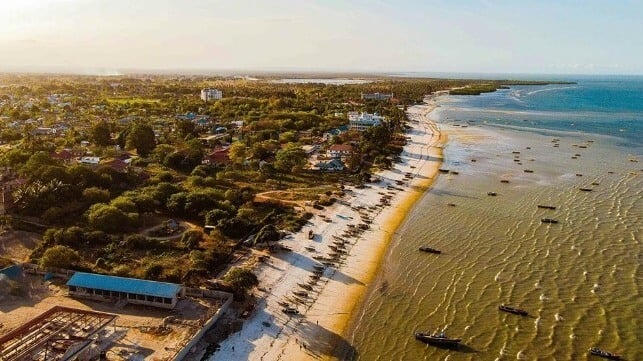
Central Bagamoyo's beachfront (Arnold Tibaijuka / CC BY)
After a decade of negotiating uncertainty, Bagamoyo Port project is finally moving ahead. Last week, Tanzania Ports Authority (TPA) revealed Africa Global Logistics (AGL), a subsidiary of the ocean carrier MSC, as the construction partner for the port. In a new agreement, TPA awarded AGL the rights to design, construct and operate the initial three berths at the Bagamoyo Port.
“We expect construction of the three new berths at Bagamoyo to begin early January,” said Plasduce Mbossa, TPA’s Director General. “We welcome more local and international investors to join the project, which aims to bring major transformation to port operations in Tanzania.”
The MoU marks an important milestone in re-launching the port project, which has suffered massive delays since it was first unveiled in 2013. At the time, the port was seen as a flagship project for China’s Belt and Road Initiative (BRI). However, the administration of the late President John Magufuli canceled the project in 2019. Magufuli accused China of exploitative terms in the deal for the port's construction, which included demands for massive tax exemptions.
When the current President Samia Suluhu Hassan took power in 2021, she restarted negotiations for the port project, describing it as a national priority. With the appointment of AGL, the shift from a Chinese to a European-led project seems complete. This comes at a time that MSC group is tightening its grip on African port operations, specifically through its terminals arm TIL and logistics division AGL.
In recent years, AGL has become increasingly being involved in port expansion projects across Africa, including in countries such as the Republic of Congo, Angola, Namibia and Ivory Coast. Now with the investment in Tanzania, AGL has said that it will further unlock its access to multiple African markets based on the strategic location of Bagamoyo port in the Indian Ocean.
If completed, the $10 billion Bagamoyo port project is planned to have 28 berths and a special economic zone, which could support up to 760 industrial facilities. In addition, the port is designed to have annual container capacity of 20 million TEUs, 25 times that of Dar es Salaam Port. Located just 42 miles north of Dar es Salaam port, Bagamoyo port is intended to address operational and capacity limits at the current gateway.
Most importantly, Bagamoyo hopes to compete with Kenya’s greenfield port of Lamu, which has benefitted from the realignment of liner schedules this year. Lamu port had remained unutilized since its commissioning in 2021 but is seeing a bump in traffic. In August, the port had a record nine ship calls.
The salvage operation for two recent containership fires, ONE Henry Hudson and Wan Hai 503, is continuing. The details show the intricate process required to recover from these incidents.
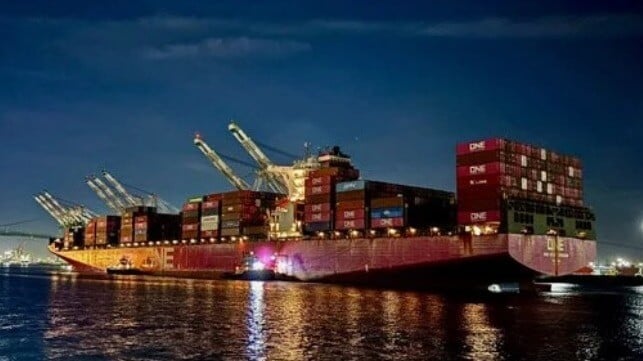
Ocean Network Express (ONE) reports that containers have started to be offloaded from the ONE Henry Hudson more than four weeks after the fire, while the ship was docked in the Port of Los Angeles. Reports indicated that the fire, which began on November 21, was possibly an electrical fire while the ship was handling export cargo.
The ship was briefly taken from the dock to outside the port and later returned while still under the supervision of the U.S. Coast Guard. The first step in the recovery operation included removing the firefighting water from the vessel’s hold. A barge was positioned alongside last week while at the Yusen Terminal, and ONE reports the water discharge operation in the affected cargo hold was completed on Friday, December 19.
Initial discharge operations have commenced for some of the containers. The containers are currently being held at Yusen Terminal for inspection by the U.S. Coast Guard. ONE reports that Yusen Terminal plans to complete this initial phase of discharge operations by the end of this week.
The owner of the vessel, which was chartered to ONE, in late November, declared General Average.
Wan Hai 503
The Wan Hai vessel is a far more complex operation that has been ongoing for more than two months after the vessel was docked and more than six months after the fire was first discovered on June 9. The fire was extinguished by late July, but there were delays in finding a suitable port of refuge. The ship reached Jebel Ali, United Arab Emirates, in mid-September and was docked by the beginning of October.
A small portion of the containers on the stern of the vessel had not been directly impacted by the fire. By mid-October, they reported that 356 containers had been discharged while over 1,300 remained.
Wan Hai provided its latest update dated December 23, reporting that the remains of approximately 38 containers were still aboard the vessel after 1,683 had been discharged. The company reports, however, that due to the condition of the containers remaining onboard, it has become increasingly difficult to identify individual containers as they are discharged.
Discharge of the firefighting water from the cargo holds is ongoing, but a total of approximately 11,440 tonnes has been discharged so far. Pumping of water, they note, has become challenging due to the amount of cargo residue, which is blocking the pump, pipe, or hold openings.
Cleaning of Cargo Hold 1 has been completed, but they are still working on clearing distressed cargo and debris from Cargo Holds 3, 4, and 5.
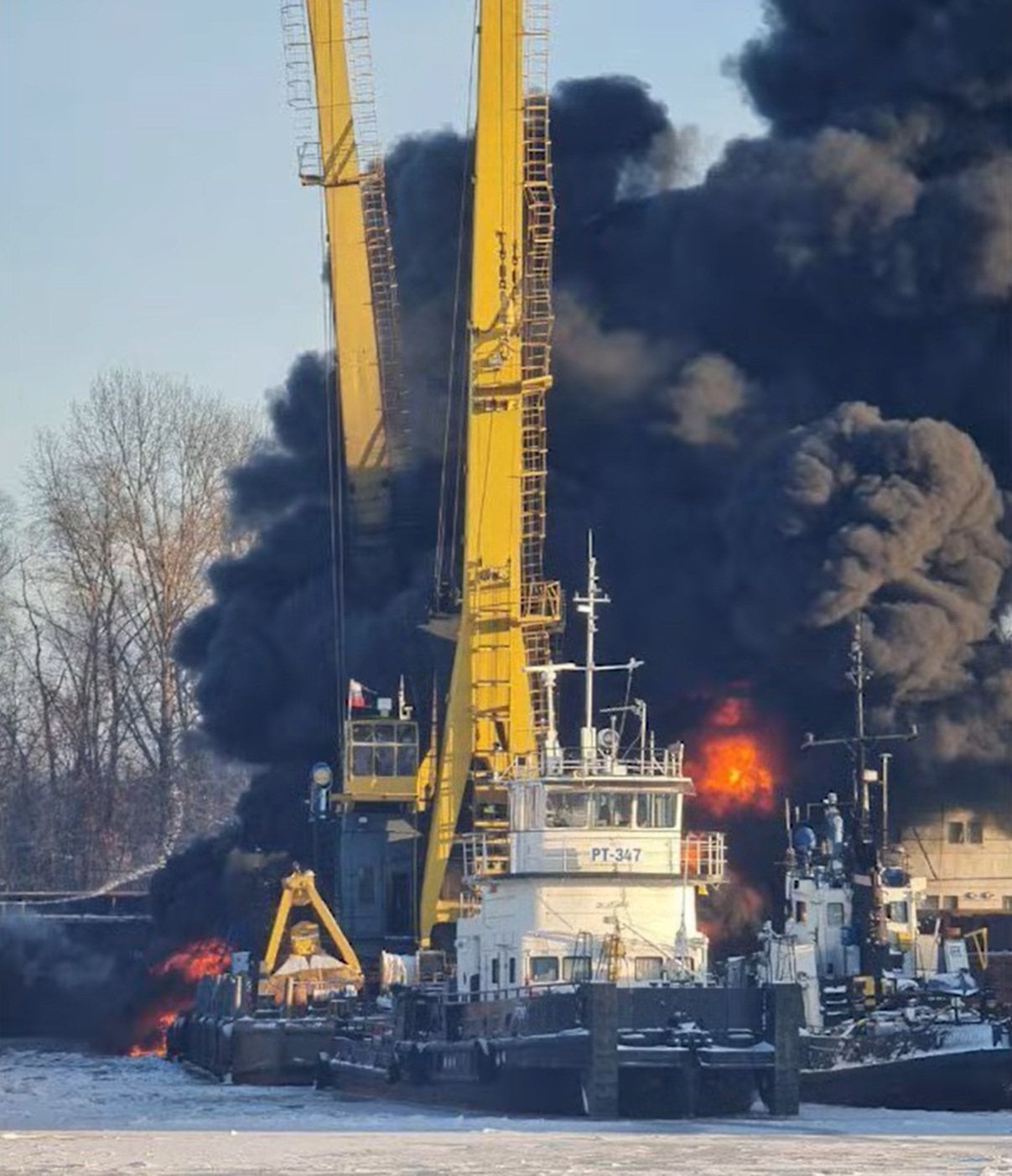
Floating Crane Catches Fire at Russian Ship Repair Yard
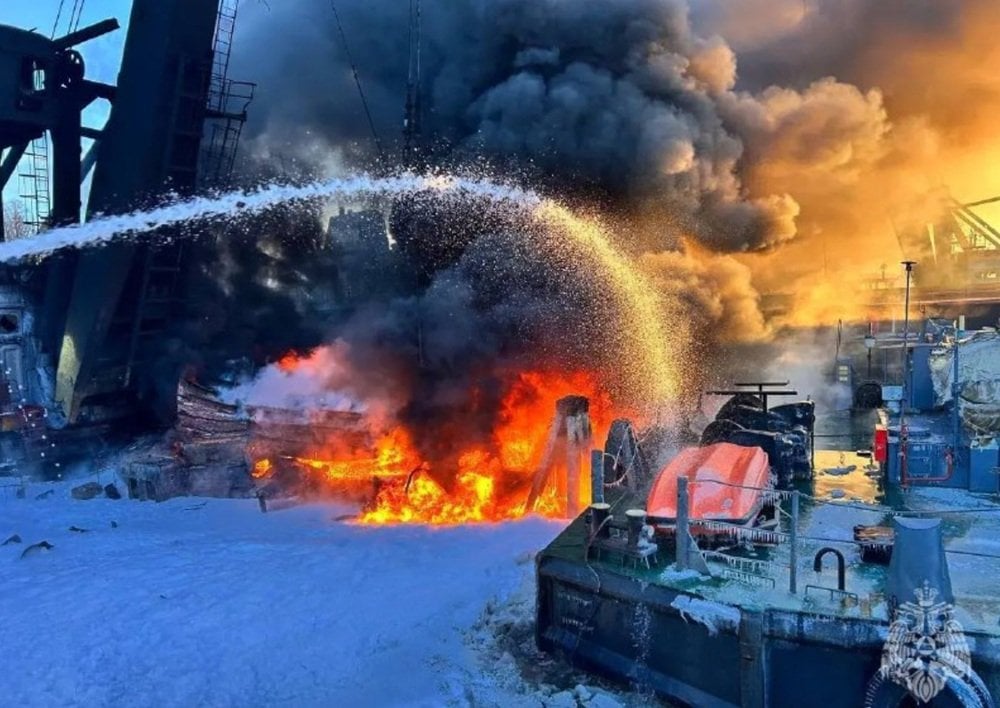
On Tuesday, a major fire broke out at a small ship repair yard in Nizhy Novgorod, a city on the Volga in western Russia.
The Ministry of Emergency Situations of Russia reported that a fire damaged a floating crane at the Borskaya Ship Repair Company, a commercial river-sea freighter repair yard. Fuel spilled from the vessel and burned over an area of about 1000 square feet, the agency said.
Photos provided by the ministry show firefighters applying foam in quantity to smother the fuel fire and extinguish the flames. The extent of the damage to the vessel was not reported.
The Volga Transport Prosecutor's Office said in a social media post that the fire started during routine work at the yard. Bystanders reported the sound of an explosion prior to the fire, according to local accounts.
Images courtesy Russian Ministry of Emergency Situations
Though online speculation has hinted at a Ukrainian attack or an act of sabotage, the blaze may well be accidental, as is common during shipyard work.
Ukraine has not claimed responsibility for the fire, and Nizhy Novgorod is located about 500 miles from the Ukrainian border - an inconvenient distance for a drone strike. Ukrainian forces have hit the region before, according to the Kyiv Independent, but only for a high-value target: a refinery operated by Russian oil major Lukoil. The Borskaya yard - also known as the Bor Repair and Operation Base - is a regional repair division of Volgaflot, and its assets have comparatively limited strategic relevance.
Volgaflot is subject to EU sanctions for its involvement in transporting Russian oil and oil products by sea. Its owner, Russian billionaire Vladimir Lisin, is sanctioned by Ukraine, Canada and Australia, but not by other western powers.
RUSSO-UKRAINE WAR AT SEA
Ukraine Disabled Russian Maritime Patrol Aircraft Before Submarine Strike
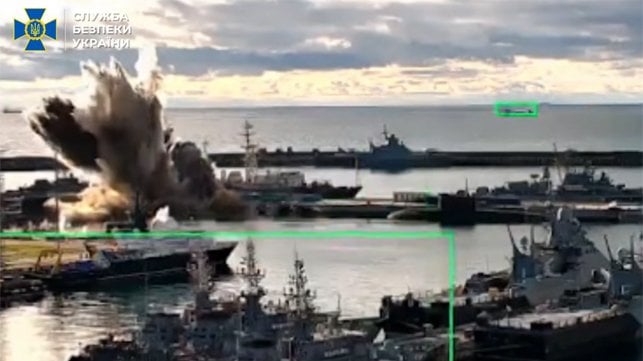
The unprecedented drone-submarine strike on a Russian attack submarine at Novorossiysk (SBU)
In advance of the drone sub strike on the Russian Navy submarine pen on the Black Sea, Ukraine's SBU security service paved the way by damaging the only Russian antisubmarine patrol aircraft in the area, the agency claims.
On December 15, the SBU released video showing a strike on a Kilo-class attack submarine at a pier in Novorossiysk, the protected port where the Russian Navy has relocated almost all of its combatant vessels in the Black Sea. The agency claimed that the strike was carried out by a drone submarine - a "Sub Sea Baby" - and that the Kilo-class sub suffered "critical damage." Satellite imaging from before and after the attack suggests that the drone struck the pier wall next to the target, leaving a crater. The Russian Navy claimed after the fact that the Kilo-class - the Varshavyanka - was undamaged and still operational.
To get to the target, Ukrainian forces needed to get a drone sub through to Novorossiysk without interception, requiring a crossing of some 400 nautical miles without detection. To prevent interception, the SBU planned and staged a preparatory operation behind the lines, targeting the only Russian asset that had a good chance of spotting the drone sub coming.
According to the spy agency, a Ukrainian aerial drone asset was delivered (by undisclosed means) within range of the airfield at Yeysk. The base is home to the only Russian Il-38N antisubmarine patrol aircraft in the Black Sea. This Soviet-era aircraft class has been upgraded with modern tracking systems for following targets above and below the surface, and SBU said that it was a known threat to Ukraine's drone boats and unmanned submersibles.
The agency said that it used an aerial drone to deliver an airburst warhead over the top of the Il-38N, damaging engines, sensors and radars with a shaped charge. SBU noted that the attack shows the continued vulnerability of Russian airfields to drone incursions, despite previous high-profile strikes.
"The disabling of this anti-submarine aircraft ensured the successful execution of the main part of the special operation - the explosion of the Varshavyanka class submarine," SBU claimed.
Russia's ministry of defense has not confirmed the details of the Yeysk airfield strike. If the Il-38N does require time to repair, it may well be replaceable with another airframe of the same class; Russian Naval Aviation is believed to have had an inventory of about 30 examples of the type before the start of the full-scale invasion.
Ukraine Intensifies Strikes on Oil Operations in Black Sea and Caspian
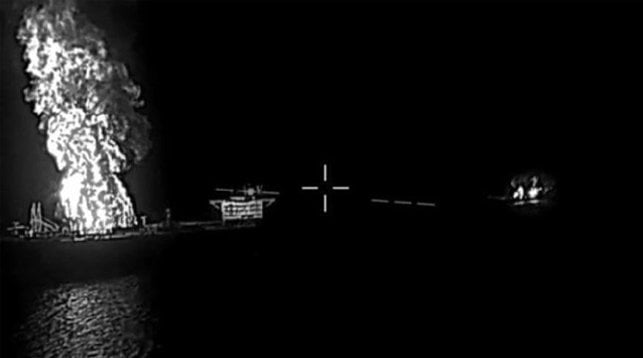
Ukraine claimed extensive damage including two tankers struck at the Taman port (HUR)
Ukraine’s Defense Intelligence Unit and Special Operations Forces revealed the latest round of drone strikes on Russia’s oil operations. The Defense Intelligence Unit also confirmed the obvious that Ukraine has intensified its assault on the oil sector to cut off badly needed revenues for Russia.
On the night of December 22, the Defense Intelligence Unit confirmed strikes on the strategic port of Taman, which lies off the Kerch Strait on the peninsula between the Black Sea and the Sea of Azov. It is a critical transshipment port for Russia used to maintain operations in oil, products, liquified gas, ammonia fertilizer, grains, and other cargoes.
The DIU said the attack was staged with drones targeting the Taman transshipment complex operated by Tamanneftegaz. While claiming to have destroyed 23 drones over the Black Sea, Russian officials also confirmed fires at the port complex.
The Administration of the Krasnodar Krai region reported that two piers, one supply pipeline, and two tankers were damaged in the drone attack. They said a fire had started on one of the tankers but was extinguished. Crews, however, were still battling the fire on the fuel supply pipeline, which they confirmed at 1,500 square meters. They said 119 people and 34 pieces of equipment were involved in the firefight. They also said two storage tanks had been damaged by debris, but there were no reports of oil pollution.
Ukrainian media reports are saying the damage is more extensive to the operations. Posts online talked of “pillars of fire” over Taman. Ukrainska Pravda wrote that sources stressed that military intelligence is stepping up strike pressure on the Russian energy sector.
The Special Operations Forces had posted on Sunday, confirming the rumored strikes on the Filanovsky oil and gas field in the Caspian Sea. Operated by Lukoil, they confirmed that drones had been used to strike the platform. It comes after earlier long-range attacks on other Lukoil operations in the Caspian.
The SOF is also claiming that they were able to damage a Russian patrol ship in the Okhotnik class. Russia has commissioned about a dozen of these vessels over the past 16 years, with reports saying they are designed to combat surface and airborne targets and threats. They are about 600 tons and 200 feet in length and are capable of speeds of 25 knots.
In its statement, SOF said it would continue to carry out asymmetric actions aimed at stopping Russia’s military aggression. These recent strikes came after Ukraine started using drones to attack oil tankers in the Black Sea and, at the end of last week, claimed its first strike on a tanker operating in the Mediterranean.
Cargo Ship and Ports Damaged During Massive Russian Attack on Ukraine
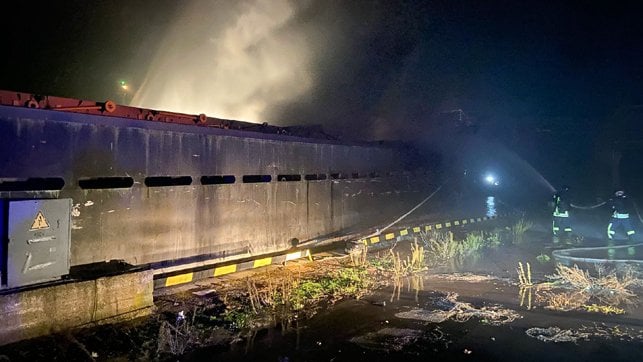
Cargo ship loading soybeans was damaged during the attacks on Odesa (State Emergency Service of Ukraine)
Ukrainian officials are reporting what they called a “massive Russian strike” directed overnight and into this morning broadly at the country’s infrastructure, including ports as well as power and other elements across at least 13 regions of the country. A smaller cargo ship was caught loading in the Odesa region and was reportedly damaged during the attacks.
According to the reports, Ukraine asserts that Russia launched at least 650 drones and more than three dozen rockets, with air raid sirens continuing to sound. Odesa regional administrator Oleh Kiper said that the was damage to the port, energy, transport, industrial, and residential elements, although there were no reported injuries.
The dry cargo vessel was docked in the Odesa port complex, loading soybeans. Reports only described the ship as being registered in Lebanon. Pictures showed fires burning on the ship and firefighters aboard.
“Once again, the Odesa region and port infrastructure are under enemy attack. Civilian warehouses and critical energy facilities have been damaged,” said Deputy Prime Minister for the Restoration of Ukraine Oleksii Kuleba.
Fire crews aboard the damaged vessel (State Emergency Service of Ukraine)
There were reports of damage to at least one warehouse in the port complex. The Ukrainian Sea Ports Authority also said there was damage in the port of Reni, impacting the infrastructure as well as administrative buildings.
An earlier Russian missile attack on the Odesa port complex and the city killed at least eight people, and 27 others were wounded. Some of the casualties were said to have been on a city bus that was struck.
The energy infrastructure remains one of the key targets. They said the thermal power plant operated by Ukraine’s largest private energy company, DTEK, was damaged and offline. The Zaporizhzhia Steel Works also reported a loss of power and an emergency shutdown of production.
Russia had also recently struck the port of Pivdennyi. A fire broke out in the port area, with about 30 storage tankers for flour and vegetable oil catching fire.
The Ukrainian media said talk of the possible pause in the assaults for the Christmas season now seems unlikely.