Friday, December 26, 2025

What is left of the Chinese Left?

Friday 26 December 2025, by Au Loong-Yu

With Trump in power, many parts of the world are swinging to the far right. This is the most pressing challenge we currently face. But what is the situation of the Left in China? And where is the Chinese far right?

The Left since 1989

About 25 years ago, at the turn of the century, the shock from the June 4th Massacre in Tinanmen Square in 1989 began fading away, and political life became slightly active again, especially among academia. Debates revived, with positions divided between the “Liberals” and the “New Left”. But the most vocal were neither liberals nor leftists. The former were more like neoliberals, interested in pushing for greater “marketisation”, rather than demanding liberal democracy. This was partly (and understandably) out of concern for their safety, and partly out of genuine belief in the (capitalist) market. The latter were mostly nationalists who defended the party state (after the massacre!) and saw it as the protector of the “national interest” or the “people’s” economic interest — but never their political rights).

On top of this, the age of the internet also brought forward voices from minjian, or “common folk”, from “Maoist” to “Trotskyist” or “Social-Democrat”. This was also the time of NGOs, which worked on and campaigned for different issues. Hong Kong’s academia and civil society organisations played a significant role in this process. Although these NGOs did not work on political campaigning, they were still closely monitored by the state (especially those working on labour issues), fearing they might radicalise.

The flourishing of political debates and of NGOs prompted many to believe that the age of liberalisation was coming. But the opposite was the case. In 2015, Xi Jinping rounded up and banned most of the labour NGOs in mainland China, and arrested human rights lawyers. In 2018 some Maoist students launched a solidarity campaign with workers at the Jasic factory, who wanted to found a workplace trade union. Soon they were arrested (or simply kidnapped), and this was followed by a ban on student-led “Marxism Societies” at various universities. In fact, targeting Maoists had begun more than 20 years ago, when some attacked the late president Jiang Zemin for giving party membership to capitalists. This in turn radicalised some Maoists, who founded the “Maoist Communist Party”. But before long, in 2009, their leader Ma Houzhi (馬厚芝) was sentenced to ten years in prison.

With the full-scale crackdown in Hong Kong in 2020, Beijing took revenge on its people for daring to resist Beijing’s extradition bill a year earlier. It exterminated all political opposition and social movements there, including trade unions and the small Left circles. Of the last players, the small Trotskyist group there was symbolic — it had been the CCP’s longest and most consistent Left opposition, dating back nearly a hundred years. Before the crackdown, the former colony had given a second chance of survival to a wide range of China’s political dissidents.

In the Mainland there has not been any organised opposition since 1949. From 1979, there was a strong liberal current, but it was not allowed to organise. From 2017, when Liu Xiaobo, the leading liberal advocate, died in prison, the liberals’ influence has dwindled under Xi’s repression, although it has managed to make noises occasionally. Only the nationalists have grown stronger and stronger, because they have the support of the regime. Nowadays, no visible Left current remains. Even more chilling: despite being persecuted for years, the Falun Gong remains the most vocal and organised current overseas (probably with an underground presence in China). As a religious cult which demands personal loyalty to its top leader, their political orientation is not helpful to working people.


What is this regime?

So how do we characterise a regime which suppresses all dissidents, from liberals to all shades of Left currents and independent civic associations? Before we give it a name, let’s briefly discuss its basic features:

1. State power is unlimited. Not only can all public affairs ultimately be controlled by the state, but also private lives as well, from women’s fertility, to holding a passport, to arresting young people enjoying Halloween.

2. The state is in turn under the absolute control of the party, which never bothers to hold free and open elections. And the party, in turn, is led by a top leader who can change the country’s constitution at will to make himself a lifelong autocrat.

3. There isThought control and indoctrination with the party’s ideology, whose essence is simple — tingdanghua, gendangzou (聼黨話,跟黨走), or “listen to the party and follow the party”.

4. Its Chinese nationalism is ethno-centric. It sees the nation as a homogenous whole and the party as its natural agent. Its Big Han chauvinism has now resulted in racism, including cultural genocide and mass incarceration of Tibetans and Uighurs.

5. The party also sees Chinese society as a homogeneous whole, so dissidents are a threat to the nation that need to be put down. Not only is organised opposition not allowed, but even individual opposition, once it becomes influential, is silenced.

6. To achieve the goal of zero political opposition, the party-state resorts to full-scale surveillance and the infamous social credit system. State-crafted digitalised money further enhances the Orwellian society.

7. Its economic strategy, since the mid-1950s, has always been to prioritise investment in infrastructure and heavy/advanced industries over people’s basic consumption and wellbeing, as the Great Leap Forward / the Great Famine have shown. Since 1979, the party has reintroduced capitalism to China, and along with it a massive influx of foreign capital. This has enabled the party to achieve the goals of both rapid industrialisation and feeding the people. Relative poverty (labour’s share of national income) has in fact risen, however, because the party bureaucracy has used its absolute power to grab and commercialise vital resources to enrich themselves. It is a bourgeoisified bureaucracy.

8. Its overseas investment has ranked in the top five of the world for many years, and it has sought commercial success and geopolitical power —this is not worse than other capitalist countries, but neither is it better. This has necessarily driven Beijing along the road of global economic expansionism. This has been followed by political expansionism, as it sees itself as the legitimate successor of imperial / Kuomintang (KMT) China, along with the “territory” it perceives to have belonged to it. This is why it has copied the KMT’s “nine-dash line” false claim over a big chunk of the South China Sea.

A far-right, imperialist regime

Only a far-right regime contains all of these features. While Trump is still in the first stage of autocratic engineering, Xi Jinping’s Orwellian autocracy has already advanced into its digitalised version, precisely because his party already has complete control. To see Beijing as something fundamentally more progressive than Trump’s administration is one of the greatest delusions.

In the midst of the trade war between the US and China, quite a few among the international Left feel happy about Beijing “standing up to Trump’s bullying”. While we are temporarily entertained by Trump’s failure, we must not forget that any Xi victory in his counter-offensive always requires the people to pay the price. And, in the face of both the trade war (an external pressure) and China’s internal of over-capacity / unemployment, Xi has resorted to accelerating China’s exports. This just shifts the problem elsewhere; it doesn’t solve it. In fact, it will magnify the global crisis.

Fundamentally speaking, Xi is not fighting imperialism. Rather, he is content with his personal agenda of haodaxigong (好大喜功) — a craving for greatness and glory, while serving the collective interest of the bourgeoisified bureaucracy. Whether Beijing has reached parity with US power is an important but secondary issue. The primary issue is that Beijing’s global expansionism has gone down the road of imperialism. Honest socialists do not wait until Beijing has fully achieved its goal before warning the world of this danger.

As a long-standing far right regime, with no checks on the state from within or from any opposition or social movement outside, Beijing poses grave dangers for the Chinese people and for the world. Yes, US imperialism is much stronger militarily and economically, and is now more harmful to the world. But China could potentially do immense harm as well. No one could stop Xi from starting an unjust war (just as Deng Xiaoping invaded Vietnam in 1979) or from prioritising his fight for hegemony over his people, just as Mao did. I have no answer to this mega challenge, but the least we can do is to call a Leviathan monster by its correct name.

First published in Amandla, December issue, 2025.

Attached documentswhat-is-left-of-the-chinese-left_a9328-2.pdf (PDF - 899.4 KiB)
Extraction PDF [->article9328]


Au Loong-Yu is a long-time Hong Kong labour rights and political activist. Author of China’s Rise: Strength and Fragility and Hong Kong in Revolt: The Protest Movement and the Future of China, Au now lives in exile.


Mona from the Corner

Set Aside Political Differences, Converge in Harmony for Truth and Justice


She’s a little lady, 70 something, with this cute, addictive smile. Drives an old bomb of a car, replete with Peace and End the Occupation type stickers on it. She’s a nurse, still works, doing home care for very ill folks with that special Mona type TLC.

I first met her at a progressive discussion event my friends and I organized back in ’03.

Many of us were disgusted with the government’s hog wash version of 9/11 and the ensuing illegal invasion and occupation of Iraq. We wanted to rally our community (those few who took the time to really care about such things in ’03) to speak out. Tiny, quiet Mona joined our monthly group of concerned citizens, acknowledging her ‘lack of depth’ on what was happening. Yet, she quickly added, that her inner self told her what was right and what was wrong. She became a regular member of our group.

When Michael Moore’s new film, Fahrenheit 911, was opening in Daytona, rumors spread that Bush supporters in this area were going to hold a protest outside the theater. I asked if anyone would join me in a counter demonstration. Mona raised her hand. We met outside the theater in the parking lot. She had told me that her daughter would accompany her, as this was the first time in both their lives that either of them had demonstrated. Mona was scared! What if? What if the Bush supporters got physical? What if a fight broke out? Here was this little lady going against … what and who? At the parking lot, at our allotted time to meet, Mona walked slowly towards me. Where was her daughter? “She stayed in the car. She’s frightened. So am I, but I gave my word. Let’s do it!” We did, and the Bush lovers protest never occurred (when does it?). Mona proudly held her sign, smiled a lot, and made a greater impression on the moviegoers than I ever could.

There are a bunch of folks who have been standing on the same corner in Port Orange, my town, each and every Tuesday. Some, like Mona, have been there from the beginning, which is now almost 3 and 1/2 years. She stands there, with her Honk for Peace sign, or whatever else she may decide to hold, and waves at the cars. Always that smile, that… well, that Mona Lisa half smile her namesake wore. She raises her hand as if to say to all who pass, “Hey, here I am, because I care!.” The others, those who come and stand with Mona, they care too. Enough to put aside political differences (not all are Democratic Party loyalists) and converge in harmony for truth and justice. And Mona? Well, she’s the glue, the non judgmental glue, that keeps it all together.

This writer has strayed from that corner recently, with my differences with the mainstream Democrats overpowering and frustrating my efforts. Then, while recently driving in our local shopping center, I spot Mona, walking to her car. “When are you coming back? We miss you on the corner.” If only there were more Monas in this community. Because of her I will be back!

Mona Hommell passed away on December 20th this year at 89. She will be missed!

Philip A Farruggio is regular columnist on Its the empire stupid website. He is the son and grandson of Brooklyn NYC longshoremen and a graduate of Brooklyn College, class of 1974. Since the 2000 election debacle Philip has written over 500 columns on the Military Industrial Empire and other facets of life in an upside down America. He is also host of the It’s the Empire… Stupid radio show, co produced by Chuck Gregory. Philip can be reached at paf1222@bellsouth.netRead other articles by Philip.

To a 2026 of Not Fighting Over Crumbs

Every single person in the United States, from those who’ve been most harmed to those who’ve been most privileged, would be better off if we had a normal government that put even a moderate effort into universally improving everyone’s lives. If we had a government that took trillions of dollars away from the war machine and the untaxed oligarchs and provided, as a matter of basic rights, for all

economic welfare,
education, preschool through college,
healthcare,
a clean and sustainable environment, and
public transit,
then nobody would ever be denied an education or a job for any reason of hateful idiocy. Why should they be when we’re absolutely rolling in wealth? We could obviously do a much better job of fighting over the crumbs we’ve got, with more context and nuance, but why should we, and how dare we? We need to be putting everything we’ve got into trying to preserve a habitable planet for our children, not fighting over crumbs.

That perfectly true statement is almost meaningless to someone who’s been wrongly imprisoned or denied housing or traumatized by racist police or prevented by cost from providing healthcare for a loved one. Those fortunate enough to not find the preservation of the environment, or the abolition of war, or the taxing of billionaires meaningless need, I think, to work at understanding how badly we are divided and conquered. A huge segment of the U.S. population is being trained to support racism, sexism, xenophobia, and all varieties of bigotry, while another huge segment of the population seems to think it would be joining in the same hideous beliefs if it were to admit that white men have ever had anything unfair done to them or grown their bitterness in any sort of realworld soil.

Young white U.S. males’ support for fascism is not excusable, sensible, or unpredictable. Discrimination against young white males that predictably leads to fascism is not a justification for, or the equivalent of, anything. Nor is it imaginary. In the United States, we have an enduring legacy of slavery and white supremacy, persistent racist police and vigilante killings, a rising tide of traditional bigotry, and also discrimination against white men. Millions of words would never suffice to detail the full complexity of the mess we’re in or to properly rank and compare the wide variety of injustices. No solution other than deeply addressing each injustice, and not even that, would satisfy all.

But we would care less about the distribution of the crumbs if we were to take the whole loaf of bread away from sociopathic billionaires and weapons dealers.

Dumping so much of our wealth into the war machine is key to generating the xenophobia and nationalism that allow us to think in terms of a struggle for crumbs internationally. But we don’t need to accept those terms either. The world has plenty of wealth for all. That indisputable fact is also very hard to grasp through the flood of nationalistic propaganda from all sides and in the face of extreme inequality nearby.

We’re not helped by corporate media, with its normalization of war and corruption, and its solemn debates over how Democrats should rebrand themselves in order to better pretend to give a damn. I think Zohran Mamdani’s dad had a good point when he said that his son was elected mayor of New York because he promised to actually improve people’s lives and because he refused to support a genocide, which allowed people to know he was an honest person who really meant that he would work to improve people’s lives. That combination is almost unheard of in Washington D.C.; and almost unmentionable is the more direct connection between ending wars and improving lives. Unless we end the wars, we will not be able to improve the lives of the people being killed or of the people paying for the killing.

Here’s to a strategic new year, moving the money from war to peace, Medicare for all, green energy, free college, fast rail, guaranteed basic income, and ending fascism by improving the lives of every single person.

David Swanson is an author, activist, journalist, and radio host. He is director of WorldBeyondWar.org and campaign coordinator for RootsAction.org. Swanson's books include War Is A Lie. He blogs at DavidSwanson.org and War Is a Crime.org. He hosts Talk Nation Radio. Follow him on Twitter: @davidcnswanson and FaceBookRead other articles by David.

 Is someone really listening to you? Watch their blinks


By Dr. Tim Sandle
SCIENCE EDITOR
DIGITAL JOURNAL 
December 25, 2025


Image: - Copyright AFP Richard A. Brooks

Your eyes may reveal when your brain is working overtime. Researchers from Concordia University found that people blink less when trying to understand speech in noisy environments, especially during the most important moments.

The effect stayed the same in bright or dark rooms, showing it’s driven by mental effort, not light. Blinking, it turns out, is a quiet marker of focused listening.

To demonstrate this, the researchers outline two experiments designed to observe how blinking behaviour changes when people are exposed to different listening conditions.
Fewer blinks equal greater mental effort

The researchers discovered that people tend to blink less when they are working harder to understand speech in noisy settings. This reduction in blinking appears to reflect the mental effort involved in listening closely during everyday conversations. Importantly, the pattern stayed the same regardless of lighting conditions — participants blinked at similar rates whether the room was bright, dim, or dark.

“We wanted to know if blinking was impacted by environmental factors and how it related to executive function,” explains lead author Pénélope Coupal, in a research brief. “For instance, is there a strategic timing of a person’s blinks so they would not miss out on what is being said?”

The results showed that blinking does appear to be timed in a purposeful way. In other words, we do not simply blink randomly. Instead, we blink systematically less when salient information is presented.
What did the study involve?

The study included nearly 50 adult participants. Each person sat in a soundproof room and focused on a fixed cross displayed on a screen. They listened to short spoken sentences through headphones while the level of background noise changed. The signal-to-noise ratio (SNR) ranged from very quiet to highly distracting.

Participants wore eye-tracking glasses that captured every blink and recorded exactly when each blink occurred. Researchers divided each listening session into three phases: before the sentence played, while it was playing, and immediately afterward.

Blink rates dropped most noticeably during the sentences themselves, compared to the moments before and after. The decrease was strongest when background noise was loudest and speech was hardest to understand.
Light levels are not relevant

In a second experiment, the team tested blinking behaviour again while changing the lighting conditions. Participants completed the listening tasks in dark, medium, and brightly lit rooms, across different SNR levels. The same blink suppression pattern appeared each time.

This consistency showed that the effect was driven by cognitive demands rather than changes in how much light entered the eyes.
Research significance

The researchers suggest the results support using blink rate as a simple and low-effort way to measure cognitive function, both in controlled laboratory experiments and in real-world situations.

The research appears in the journal Trends in Hearing, titled “Reduced Eye Blinking During Sentence Listening Reflects Increased Cognitive Load in Challenging Auditory Conditions”

How talking slows eye movements behind the wheel


New study shows that everyday conversations can delay eye movements, essential for safe driving


Fujita Health University

Talking Slows Critical Eye Movements During Driving 

image: 

A driver’s gaze shifts rapidly to detect hazards; this study shows talking slows these critical eye movements, risking safety

view more 

Credit: Envato from Flickr Image link: https://openverse.org/image/09b61da2-196c-4350-94e1-84d33d106fa7


Talking while driving is widely recognized as a major source of distraction, but the specific ways conversation interferes with the earliest stages of visual processing have remained largely unclear. While previous research has shown that cognitive distraction can slow braking or reduce situational awareness, the question of whether talking disrupts the foundational gaze processes that precede physical reactions has remained unanswered.

Now, researchers from Fujita Health University have demonstrated that talking imposes cognitive load strong enough to delay essential eye-movement responses, potentially affecting the fast visual assessments required for safe driving. A study led by Associate Professor Shintaro Uehara and the team, including Mr. Takuya Suzuki and Professor Takaji Suzuki, published online on October 6, 2025, in PLOS ONE, examined how talking alters the temporal dynamics of gaze behavior.

Gaze behavior is especially significant because approximately 90% of the information used for driving is acquired visually. Any delay in initiating or completing eye movements can cascade into slower recognition of hazards, reduced accuracy of visual scanning, and delayed motor responses. “We investigated whether the impact of talking-related cognitive load on gaze behavior varies depending on the direction of eye movement,” explains Dr. Uehara.

To investigate this, the researchers asked 30 healthy adults to perform rapid center-out eye-movement tasks under three different conditions: talking, listening, and a no-task control. Participants were instructed to look as quickly and accurately as possible toward a peripheral visual target presented in one of eight directions. In the talking condition, participants answered general knowledge and episodic questions adapted from the Wechsler Adult Intelligence Scale and additional custom prompts. In the listening condition, participants listened to passages from the Japanese novel I Am a Cat. The order of conditions was randomized across three separate days. Across all participants, talking produced clear and consistent delays in three key temporal components of gaze behavior: the time needed to initiate the eye movement after target appearance (reaction time), the time needed to reach the target (movement time), and the time needed to stabilize gaze on the target (adjusting time). None of these effects were observed during listening or control conditions, suggesting that the act of talking and the cognitive effort required to search for and produce verbal answers create meaningful interference with gaze control mechanisms.

These delays appear small in isolation, but during driving, they may accumulate into slower detection of hazards and delayed initiation of physical responses. Even hands-free conversations may introduce a cognitive load strong enough to interfere with the neural processes that initiate and guide eye movements. Because drivers often need to look downward toward pedestrians, debris, or objects on the road, these delays highlight the broad risks of conversation during visually demanding driving scenarios.

The authors note that their findings do not imply that talking is the sole or dominant cause of slowed physical reactions behind the wheel. Driving performance is influenced by multiple cognitive and perceptual factors, including inattentional blindness, divided attention, and the broader interference that occurs when the brain is forced to manage two demanding tasks at once. Even so, the study demonstrates that talking introduces delays at the earliest stage of visual processing before recognition, decision-making, or physical action, which means it may quietly undermine driving performance in ways that are not immediately obvious to drivers themselves. “These results indicate that the cognitive demands associated with talking interfere with the neural mechanisms responsible for initiating and controlling eye movements, which represent the critical first stage of visuomotor processing during driving,” concludes Dr. Uehara.

These insights carry meaningful implications for public safety. By understanding that the cognitive effort involved in conversation can degrade gaze accuracy and timing, drivers may become more mindful about when and how they choose to talk while driving. Over time, this knowledge could support safer driving behaviors, inform driver-training frameworks, inspire improvements in vehicle interface design, and guide policymakers in shaping future recommendations around cognitive distraction.


***


Reference
DOI: 10.1371/journal.pone.0333586


About Fujita Health University
Fujita Health University (FHU) is a private medical university located in Aichi, Japan. Established in 1964, it houses one of the largest university hospitals in Japan. It's 900-member faculty provides diverse learning and research opportunities to medical students worldwide. Guided by its founding philosophy of "Our creativity for the people," FHU believes that it's students can shape the future through creativity and innovation. FHU has earned global recognition, ranking eighth among all universities and second among private universities in Japan in the 2020 Times Higher Education (THE) World University Rankings. The university ranked fourth worldwide in the 2024 THE University Impact Rankings for contributions to the "Good Health and Well-being" SDG (Sustainable Development Goals) of the United Nations (UN). In June 2021, the university made history as the first Japanese institution to host the THE Asia Universities Summit. In 2024, FHU was awarded the Forming Japan’s Peak Research Universities (J-PEAKS) Program by the Japanese government to establish an innovative academic drug discovery ecosystem and hub of a multi-university consortium for research and education.

Website: https://www.fujita-hu.ac.jp/en/index.html


About Associate Professor Shintaro Uehara from Fujita Health University
Shintaro Uehara is an Associate Professor at the Fujita Health University School of Health Sciences. His research portfolio primarily focuses on rehabilitation science and the neural mechanisms underlying human movement behavior including motor learning. His work integrates behavioral experimentation with advanced motion-tracking and electrophysiological technologies, producing beneficial insights into clinical rehabilitation. He received his PhD in Human and Environmental Studies from Kyoto University in 2013 and held postdoctoral positions at the National Institute of Information and Communications Technology in Japan and Johns Hopkins Medicine in the US before joining Fujita Health University in 2018. To date, he has authored more than 50 publications with over 500 citations.

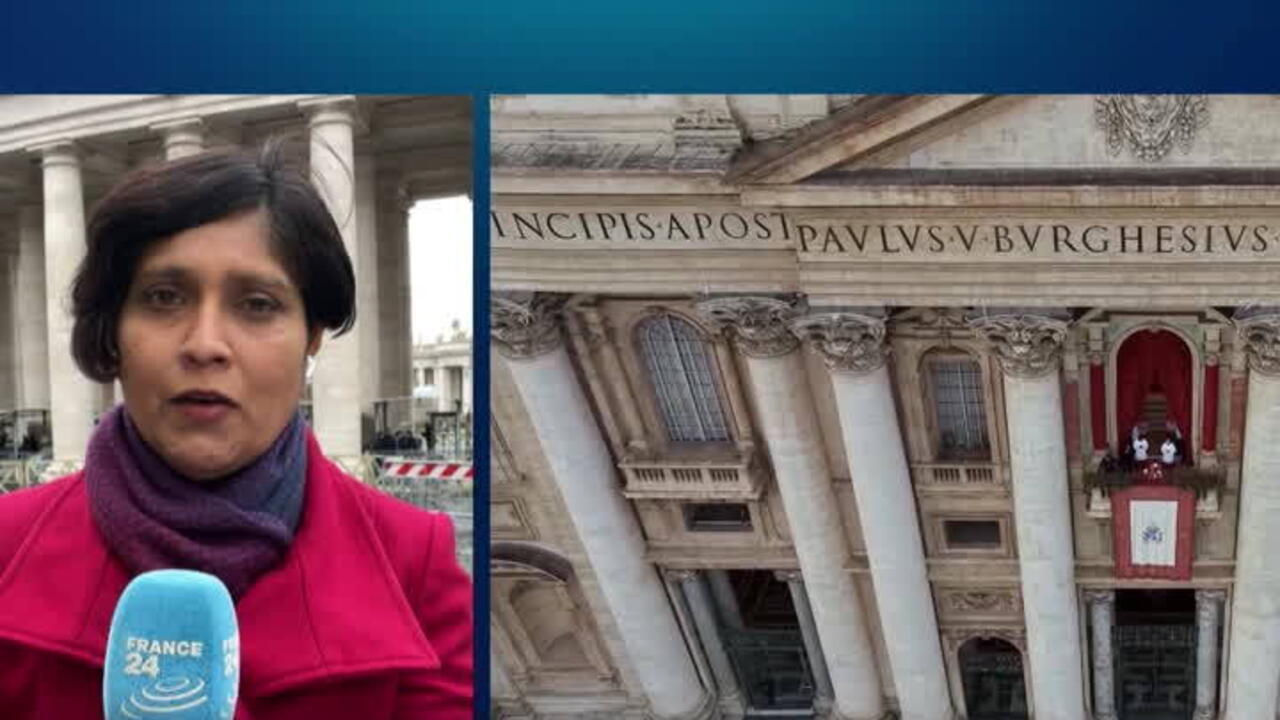
Pope speaks of Gaza's suffering, urges direct talks on Ukraine war in first Christmas blessing


Pope Leo XIV delivered his first Christmas “Urbi et Orbi” blessing from Vatican City on Thursday, at the end of a year overshadowed by conflict around the world, urging Ukraine and Russia to find the 'courage' to hold direct peace talks and speaking of the dire humanitarian situation in Gaza.


Issued on: 25/12/2025 

By: FRANCE 24

Video by: FRANCE 24


Pope Leo XIV renewed his calls for peace Thursday when he delivered his first Christmas blessing from St Peter's Basilica at the end of a year overshadowed by conflict, but also marked by hopes for peace in Gaza.

The pontiff urged Russia and Ukraine to find the "courage" to hold direct talks and spoke of the dire humanitarian situation in Gaza in his first Christmas message as the head of the Catholic Church.

The US pope, who was elected by fellow cardinals in May after the death of his predecessor pope Francis, condemned the "senselessness" of war and the "rubble and open wounds" it leaves behind.

Speaking to a crowd of some 26,000 people in St Peter's Square, the pope called for "solidarity with and acceptance of those in need" in Europe – a possible reference to growing anti-immigration sentiment on the continent.


"Let us pray in a particular way for the tormented people of Ukraine," he said.

"May the parties involved, with the support and commitment of the international community, find the courage to engage in sincere, direct and respectful dialogue," he added.

Russian and Ukrainian officials have spoken separately in recent weeks to US negotiators about proposals to end the war started by Russia's invasion of Ukraine in February 2022.
Pope Leo condemns war, calls for peace in Christmas ⁠sermon

© FRANCE 24
02:22


Tens of thousands have been killed, eastern Ukraine decimated and millions forced to flee their homes.

Ukrainian President Volodymyr Zelensky this week outlined key points of a plan to end the conflict after US talks.

But Russian President Vladimir Putin has so far shown no willingness to compromise, doubling down on his hardline demands.
'Return of life'

In his first Christmas homily as pontiff, Leo addressed the dismal conditions in Gaza, where hundreds of thousands of people are still living in temporary shelters in wintry conditions weeks after a fragile ceasefire took hold.

"How... can we not think of the tents in Gaza, exposed for weeks to rain, wind and cold," the pope said, adding that the territory's inhabitants "have nothing left and have lost everything."

The UN has said that an estimated 1.3 million people currently need shelter assistance in Gaza and has warned of the increasing risk of hypothermia as temperatures dip.

"The war, in all its forms, has been harsh on everyone living on this land," Elias al-Jalda, a Palestinian Christian from Gaza, told AFP after attending a Christmas mass at Gaza's only Roman Catholic Church late on Wednesday.

"We hope this year will mark the beginning of a new phase – one defined by a complete end to the war and the return of life to Gaza," said Jalda, one of dozens attending the mass.

(FRANCE 24 with AFP)


Pope calls for worldwide Christmas Day truce as fighting rages in Ukraine


Pope Leo XIV on Tuesday renewed his call for a worldwide truce on Christmas Day, expressing sadness that Russia had apparently rejected the appeal as fighting in Ukraine raged, civilians were killed in Russian air strikes, and diplomatic efforts involving the United States and Europe showed little sign of a breakthrough.


Issued on: 23/12/2025 
By: FRANCE 24


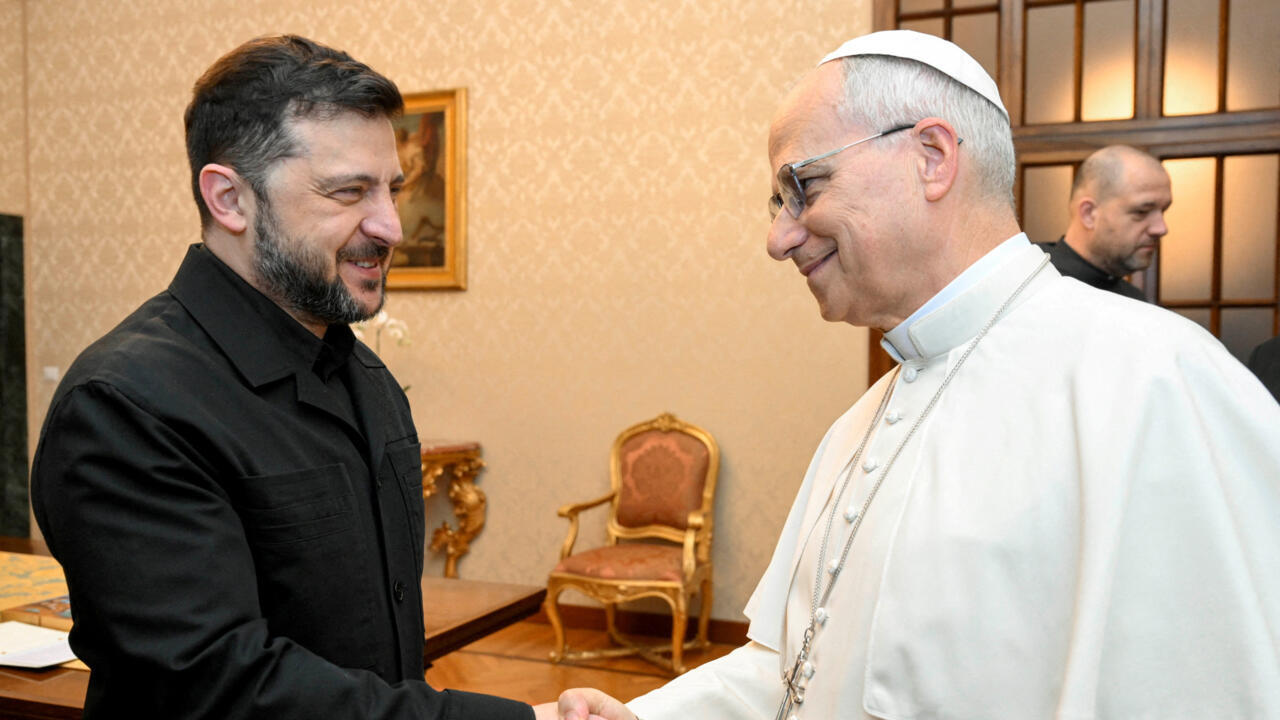
Pope Leo XIV and Ukraine's President Volodymyr Zelenskiy shake hands at Villa Barberini. © Simone Risoluti, Reuters

Pope Leo XIV on Tuesday called for a global truce on Christmas Day, expressing “great sadness” that “apparently Russia rejected a request” for one.

“I am renewing my request to all people of good will to respect a day of peace – at least on the feast of the birth of our Saviour,” Leo told reporters at his residence in Castel Gandolfo near Rome.

Russia invaded Ukraine in February 2022 and has repeatedly rejected calls for a ceasefire, saying it would only give a military advantage to Ukraine.

“Among the things that cause me great sadness is the fact that Russia has apparently rejected a request for a truce,” the pope said.

Referring to conflicts in general, Leo added: “I hope they will listen and there will be 24 hours of peace in the whole world.”

Ukraine on Tuesday pulled troops out of a town in the east of the country after fierce battles with Russian forces, as relentless strikes by Moscow killed three civilians and cut power to thousands in freezing winter temperatures.

There was no sign of an imminent breakthrough after top negotiators from both Russia and Ukraine were in Miami last weekend for separate meetings with US officials seeking a deal to end almost four years of fighting.

Pope Leo met Ukrainian President Volodymyr Zelensky earlier this month.

Asked whether he would accept Zelensky’s invitation to visit Ukraine, Leo later said, “I hope so,” but cautioned that it was not possible to say when such a trip might take place.

He also said that seeking peace in Ukraine without European diplomatic involvement was “unrealistic” and warned that US President Donald Trump’s proposed peace plan risked a “huge change” in the transatlantic alliance.

(FRANCE 24 with AFP)

Pope Leo, Donald Trump differ on course of United States

DW
12/25/2025

"Who is the world's most powerful American?" That was the question posed by international media when Robert Prevost became Pope Leo XIV. How has his relationship with his compatriot President Donald Trump developed?


Since taking office as the 267th pope, Leo has received baseball jerseys and bats as gifts
Vatican Media/CPP/ZUMA/IMAGO

In mid-December, 70-year-old Pope Leo XIV criticized US President Donald Trump (79) once again, albeit without naming him. "The remarks that are made about Europe, also in interviews recently, I think, are trying to break apart what I think needs to be a very important alliance, today and in the future," the pope said. Everybody understood whom he was talking about.

Since May 8, a US citizen has led the Catholic Church for the first time. That means that Trump, who began his second term as US president on January 20, became the first US president to have another American as head of the Vatican to contend with.

The United States is home to about 340 million people. Worldwide there are about 1.4 billion Catholics. In the 2024 presidential election, about 55% of US Catholics voted for Trump.

Observers had long ruled out the idea that a member of the Catholic clergy from the United States might become pope, given the country's significance as a world power. However, in the weeks that followed the death of Pope Francis on April 21, there were rumors that wealthy reactionary US Catholics had offered massive donations to the continually cash-strapped Vatican, should the next pope be a US citizen.

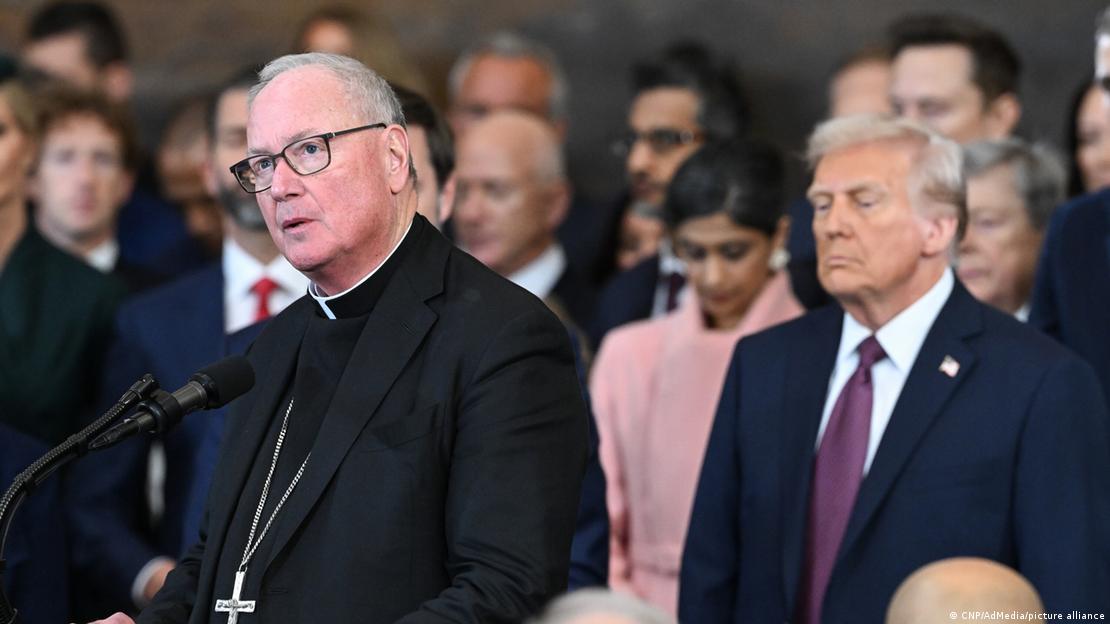
New York's archbishop, Cardinal Timothy Dolan (left) is close to President Donald TrumpImage: CNP/AdMedia/picture alliance


Trump's reaction to Leo: 'What excitement!'

Those donors probably did not have Archbishop Robert Prevost in mind. Prevost was born in Chicago and lived and worked in Peru for many years.

Still, in a post on his Truth Social platform shortly after the pope's election, Trump wrote that he was looking forward to meeting Leo XIV. "What excitement," Trump wrote, "and what a Great Honor for our Country."

They have yet to meet. Trump, who was raised Presbyterian, now calls himself a nondenominational Christian.

Leo has repeatedly and clearly criticized the US government's treatment of immigrants. Some US bishops joined him early on. Others joined in more gradually following the contionued release of brutal images of masked men dragging people out of vehicles or taking them from hospital corridors and other facilities.

Few had anticipated how strongly the United States Conference of Catholic Bishops, which includes about 270 bishops and auxiliary bishops, would position itself against Trump's immigration policies in mid-November. The USCCB lamented a "climate of fear" and the "vilification of immigrants." The bishops felt compelled to "raise our voices in defense of God-given human dignity."

For this statement, the USCCB issued its first "Special Message" in 12 years and began a social media campaign in which many bishops personally spoke out.

Who is Pope Leo XIV? 03:02


Conservative bishops in the United States


As a whole, US bishops tend to be more conservative than their counterparts in Europe. During his tenure from 2013 through his death in April, US bishops often stood in open opposition to Pope Francis. Many are politically aligned with the Republican Party.

They differ with the party, however, when it comes to migration. "The bishops have shown that very strongly," Benjamin Dahlke, a theologian at the Catholic University of Eichstätt-Ingolstadt, told DW. "No matter which political orientation the bishops themselves have, there was a very strong consensus from left to right." Dahlke, who spent time as a guest professor in the United States while researching a book, said it was "totally clear" to the bishops that the current US government's conduct against immigrants violated the law.

Migration is the issue on which the church has most strongly criticized Trump. Before the vote at the USCCB, there were noticeable signs that the pope was pressing for such a position statement. Several bishops visited him in the weeks before the USCCB convened. The Vatican's ambassador to the United States, French Archbishop Christophe Pierre, is a cardinal. It is rare for a nuncio to hold such a high position in the Catholic Church. It would likely bolster his authority on the ground.

"Pope Leo began to speak more openly on the topic of migration in September," Massimo Faggioli, a professor of historical and contemporary Eccles in the Department of Religion at Trinity College Dublin, told DW.

Leo has commented less, however, than Francis had on the state of democracy in the United States and elsewhere. "It is a topic he must engage with sometime," said Faggioli, an Italian American who was previously a professor at Villanova University in the United States.

Faggioli, who moved with his family to Ireland in 2025, said there were "MAGA Catholics" who support Trump's "Make America Great Again" agenda and view Pope Leo critically. However, he said, it does not compare to the massive MAGA criticism of Pope Francis.

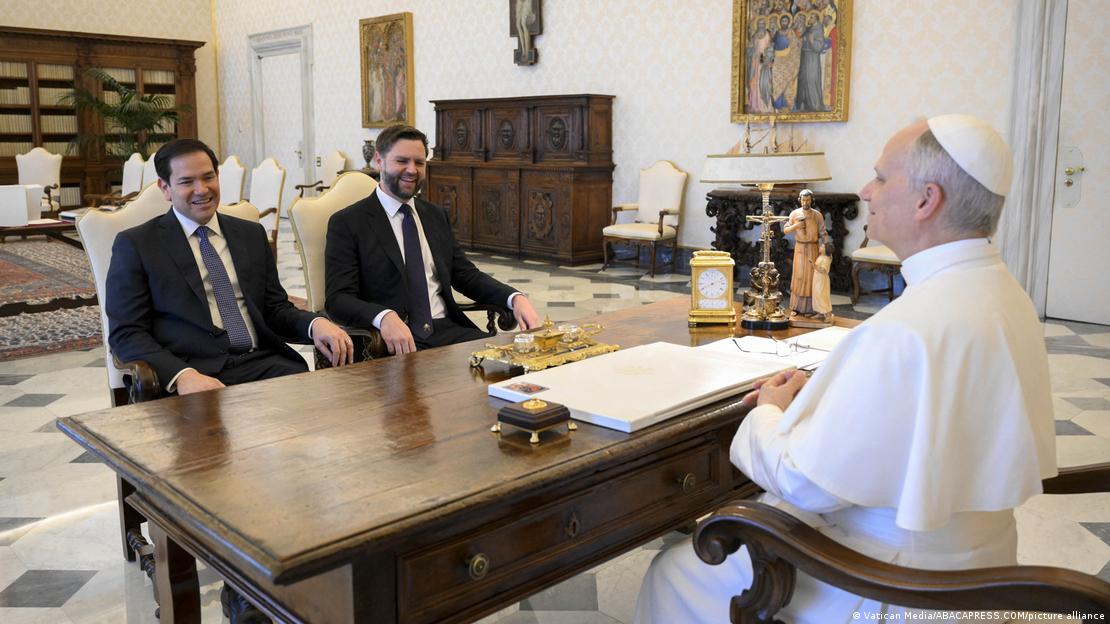
Vance (center) and Secretary of State Marco Rubio (left) met with Leo in the Vatican
Image: Vatican Media/ABACAPRESS.COM/picture alliance

The differences between MAGA Catholicism and the Vatican are enormous on many issues. However, there are still "many good vibrations between this Pope and Americans," Faggioli said, and that will continue until Leo says something more politically divisive than he has up to now.

Pope and President speak a common language

Faggioli noted that US Vice President JD Vance is Catholic. "Vance is always strategic, not naive," he said. The vice president has so far not openly criticized Pope Leo. Vance has even visited the pope on a joint trip to the Vatican with US Secretary of State Marco Rubio, who is also Catholic.

In addition to the "latent antagonism" on the issue of immigration between the president and the pope, Dahlke said, there is a "latent cooperation," with the president and the pope "going much in the same direction" on topics such as their understanding of gender and their definition of family.

The fact that both the pope and president are Americans is "a connection that shouldn't be underestimated," Dahlke said. Americans can interact with one another differently than they might with people from other countries: The pope and the president share a native language.

Will Trump and Leo XIV meet in 2026? In early December, upon his return to Rome from Beirut, the pope said his next trip would be to Africa, including a visit to Algeria. Another destination was Latin America, specifically Argentina and Uruguay. He did not mention the United States.

Trump is expected to visit Europe in 2026. German Chancellor Friedrich Merz hinted that the US president wanted to visit his ancestral village of Kallstadt in Rhineland-Palatinate. From there, it is not too far to Rome.

This article was originally written in German.

Could Pope Leo mediate between Russia and Ukraine?  02:21


Christoph Strack is a senior author writing about religious affairs.