I did not understand I grew up in a concentration camp until I left Gaza
Growing up in Gaza, I didn't realize that the siege I was living under was unique or that others didn't face a constant threat of death. It was only after I left that I understood I had grown up in a concentration camp, and that it shaped my life.
December 24, 2025
MONDOWEISS
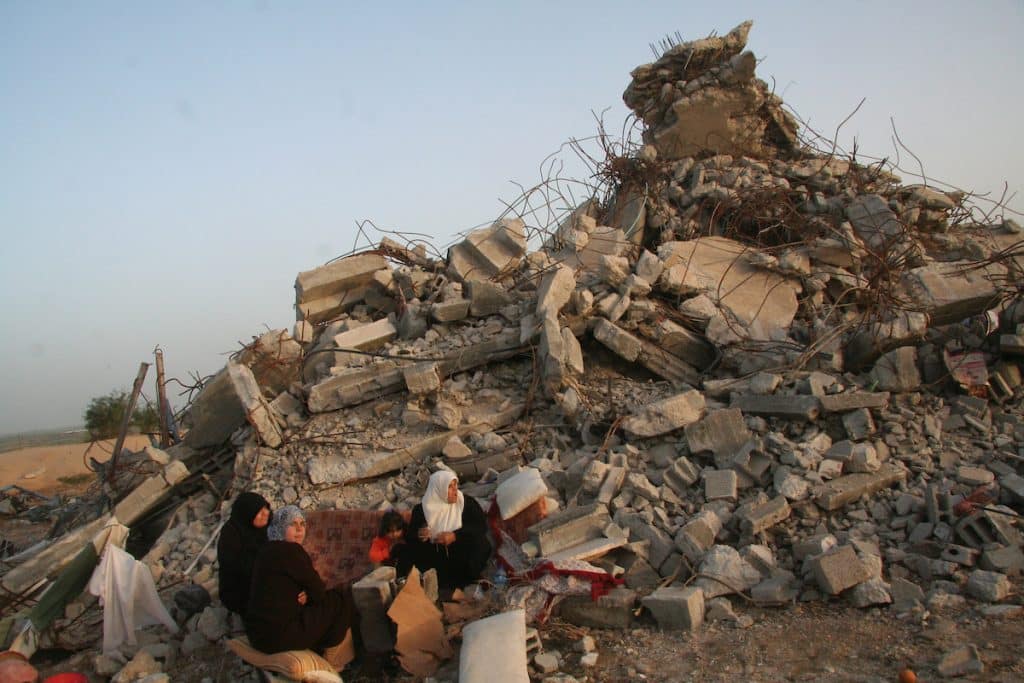
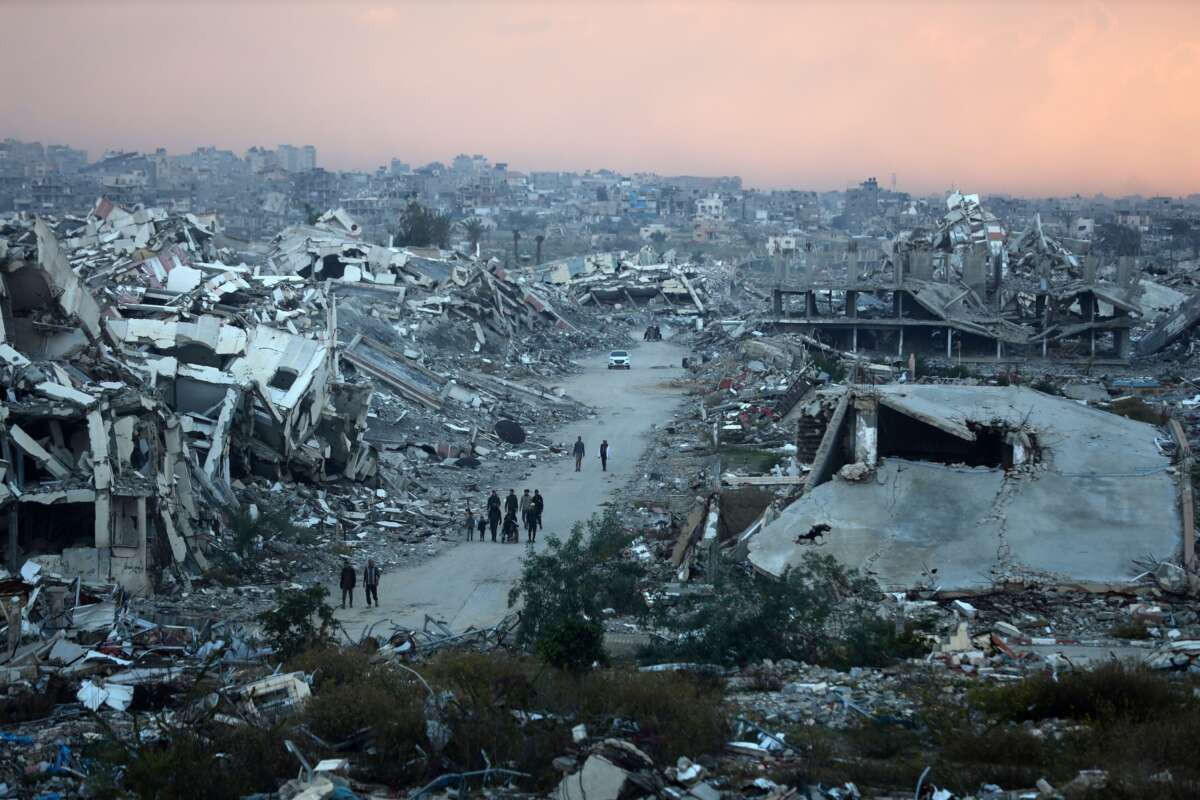
A Palestinian family sits on the rubble of their home destroyed during Israel’s 22-day offensive in Jabalia in the northern Gaza Strip on February 16, 2009. The attacks came despite ceasefires declared on January 18, 2009, after a three-week Israeli offensive against the territory’s Hamas rulers that killed 1,330 Palestinians (Photo: APAIMAGES PHOTO / Ashraf Amra)
I was around ten years old when I first saw death carried through the street like a neighbor.
I was outside our house in Gaza, playing in the street the way children do when they have no parks. I was kicking a crushed soda can like it was a football. The air was soft, the kind of afternoon when the sun is gentle and you forget, for a moment, that you live under occupation. Then I heard it. At first it was only a faint noise, something like a distant drum. Footsteps, many of them, all at once
I remember hearig voices before I saw faces. A wave of chanting rolled toward me, words I could not understand, broken by the rhythm of marching feet. For a few seconds, I thought it might be a wedding. In Gaza, chanting and loudspeakers can mean joy or grief, and as a child you do not always know which is which.
The crowd came closer. Men filled the street, packed shoulder to shoulder, moving with a kind of heavy purpose. In the middle of them, high above the heads, I saw a body wrapped in white.
They were not walking like people going to the market. They were marching. The body moved with them, lifted up on arms, swaying slightly with each step. I froze in the middle of the road. Dust stuck to my legs. The air smelled like sand and sweat. Someone near me whispered the word “shaheed.”
A martyr.
I did not know what that meant. I only knew that a human being was being carried past me and that nobody seemed surprised. Some people joined the march. Others watched from windows. The chants grew louder. I remember feeling very small, as if the crowd would swallow me. Then, suddenly, I ran.
I sprinted back home, heart racing, my slippers slapping against the ground. I burst through the door and asked my father what I had seen. He said it was a funeral procession of a martyr, a young man shot by Israeli soldiers because he was throwing stones, because he was protesting, because he wanted freedom and a decent life.
My father said it simply, like a weather report.
The word “martyr” settled in my mind long before I understood politics or international law. Funeral marches like that became part of the background of my childhood. They passed through our streets often enough that they stopped being strange. You might be doing homework, or buying bread, or visiting a relative, and somewhere in the distance you would hear the chant begin and know that another body was being carried through the city.
Death, at some point, stopped being an event and became a pattern.
Years later, another scene welded itself into me. By then I was in high school. It was late December 2008, the beginning of one of the major assaults on Gaza. That day I left school and walked, not to my parents’ house, but to the apartment of my sister who had just been married. I went there the way any younger brother would: to see how she was settling into her new home and, if I am honest, to eat baklava.
In Gaza, weddings mean sweets. Even in poverty, people borrow money to buy chocolates and pastries for guests. It is a way of insisting that joy still exists.
I reached her building, climbed the stairs, and sat on the couch in the new living room. The house still smelled like fresh paint and new furniture. My sister was smiling. There was a tray of sweets. I remember the taste of the baklava, the syrup and pistachio, still in my mouth.
Then the first bomb hit.
The sound was not like anything I had heard before. It was not just loud. It had weight. It grabbed the entire house and shook it. The doors flew open. The windows shattered. Glass exploded inward across the floor. We all jumped to the ground without planning it. My ears were ringing. The air tasted of dust and something metallic.
For a few seconds the world felt like it was breaking apart, and I did not know if the next bomb would land on us.
My sister screamed. Her husband tried to calm her, but his face was pale. I remember my own body trembling. Outside, more explosions. The house that had been “new” a few minutes earlier looked wounded, its windows blown out, its clean floors covered with shards and dust.
There is a moment in every war where your mind shifts from “this might happen” to “this is happening right now.” That was my moment.
I wanted to run back to my parents’ home. My sister did not want me to leave, because we did not know where the bombs would fall. For an hour I stayed there, my heart sprinting inside my chest, listening to the sound of distant strikes, wondering if my family knew where I was. She called my father to tell him I was safe with her. Eventually, when there was a pause in the bombing, I ran home through streets that felt different from the ones I had walked in that morning.
It took years for me to understand that these scenes were not just “war memories” or “a hard life.” They were the daily rituals of a place designed to keep people inside and under control. I did not know the language of “open air prison” or “concentration camp.” I only knew that my world was full of bodies in the street, glass on the floor, and a silence in my father’s eyes that I could not yet read.
Later, much later, I would find the words. Human Rights Watch would publish a report marking fifteen years of blockade and say clearly that the closure “trapped” more than two million Palestinians in a small coastal strip, turning Gaza into an open air prison. The Norwegian Refugee Council would describe Gaza in the same terms, as would War Child, sharing testimonies of Palestinian children who say they feel like they are growing up in a prison without a roof. UN experts would go further and describe the entire occupied territory as a system of open air imprisonment, and would call Gaza “the open air prison of our time.”
By the time I read those words, the camp was already there, all around me. I was just a child growing up inside it
I was around ten years old when I first saw death carried through the street like a neighbor.
I was outside our house in Gaza, playing in the street the way children do when they have no parks. I was kicking a crushed soda can like it was a football. The air was soft, the kind of afternoon when the sun is gentle and you forget, for a moment, that you live under occupation. Then I heard it. At first it was only a faint noise, something like a distant drum. Footsteps, many of them, all at once
I remember hearig voices before I saw faces. A wave of chanting rolled toward me, words I could not understand, broken by the rhythm of marching feet. For a few seconds, I thought it might be a wedding. In Gaza, chanting and loudspeakers can mean joy or grief, and as a child you do not always know which is which.
The crowd came closer. Men filled the street, packed shoulder to shoulder, moving with a kind of heavy purpose. In the middle of them, high above the heads, I saw a body wrapped in white.
They were not walking like people going to the market. They were marching. The body moved with them, lifted up on arms, swaying slightly with each step. I froze in the middle of the road. Dust stuck to my legs. The air smelled like sand and sweat. Someone near me whispered the word “shaheed.”
A martyr.
I did not know what that meant. I only knew that a human being was being carried past me and that nobody seemed surprised. Some people joined the march. Others watched from windows. The chants grew louder. I remember feeling very small, as if the crowd would swallow me. Then, suddenly, I ran.
I sprinted back home, heart racing, my slippers slapping against the ground. I burst through the door and asked my father what I had seen. He said it was a funeral procession of a martyr, a young man shot by Israeli soldiers because he was throwing stones, because he was protesting, because he wanted freedom and a decent life.
My father said it simply, like a weather report.
The word “martyr” settled in my mind long before I understood politics or international law. Funeral marches like that became part of the background of my childhood. They passed through our streets often enough that they stopped being strange. You might be doing homework, or buying bread, or visiting a relative, and somewhere in the distance you would hear the chant begin and know that another body was being carried through the city.
Death, at some point, stopped being an event and became a pattern.
Years later, another scene welded itself into me. By then I was in high school. It was late December 2008, the beginning of one of the major assaults on Gaza. That day I left school and walked, not to my parents’ house, but to the apartment of my sister who had just been married. I went there the way any younger brother would: to see how she was settling into her new home and, if I am honest, to eat baklava.
In Gaza, weddings mean sweets. Even in poverty, people borrow money to buy chocolates and pastries for guests. It is a way of insisting that joy still exists.
I reached her building, climbed the stairs, and sat on the couch in the new living room. The house still smelled like fresh paint and new furniture. My sister was smiling. There was a tray of sweets. I remember the taste of the baklava, the syrup and pistachio, still in my mouth.
Then the first bomb hit.
The sound was not like anything I had heard before. It was not just loud. It had weight. It grabbed the entire house and shook it. The doors flew open. The windows shattered. Glass exploded inward across the floor. We all jumped to the ground without planning it. My ears were ringing. The air tasted of dust and something metallic.
For a few seconds the world felt like it was breaking apart, and I did not know if the next bomb would land on us.
My sister screamed. Her husband tried to calm her, but his face was pale. I remember my own body trembling. Outside, more explosions. The house that had been “new” a few minutes earlier looked wounded, its windows blown out, its clean floors covered with shards and dust.
There is a moment in every war where your mind shifts from “this might happen” to “this is happening right now.” That was my moment.
I wanted to run back to my parents’ home. My sister did not want me to leave, because we did not know where the bombs would fall. For an hour I stayed there, my heart sprinting inside my chest, listening to the sound of distant strikes, wondering if my family knew where I was. She called my father to tell him I was safe with her. Eventually, when there was a pause in the bombing, I ran home through streets that felt different from the ones I had walked in that morning.
It took years for me to understand that these scenes were not just “war memories” or “a hard life.” They were the daily rituals of a place designed to keep people inside and under control. I did not know the language of “open air prison” or “concentration camp.” I only knew that my world was full of bodies in the street, glass on the floor, and a silence in my father’s eyes that I could not yet read.
Later, much later, I would find the words. Human Rights Watch would publish a report marking fifteen years of blockade and say clearly that the closure “trapped” more than two million Palestinians in a small coastal strip, turning Gaza into an open air prison. The Norwegian Refugee Council would describe Gaza in the same terms, as would War Child, sharing testimonies of Palestinian children who say they feel like they are growing up in a prison without a roof. UN experts would go further and describe the entire occupied territory as a system of open air imprisonment, and would call Gaza “the open air prison of our time.”
By the time I read those words, the camp was already there, all around me. I was just a child growing up inside it
.
Palestinians stuck in Egypt wait to cross into Gaza at Rafah’s border crossing, in the southern Gaza Strip. Egypt has warned Palestinians against trying to break through its resealed Gaza border about two weeks after Hamas militants blew it open to defy an Israeli-led blockade in January 2008. (Photo: APA Images)
The blockade did not arrive in my life as a headline. It arrived in my father’s breathing.
I was in high school when it began. People talked about “al hisar,” the siege, as if it were just another word in the long dictionary of Palestinian suffering. At first I did not understand what it really meant. I only understood that my father’s world began to collapse.
Before the blockade, he worked in construction. He brought building materials into Gaza, especially cement. He dealt with suppliers, trucks, crossings. His work was not easy, but it was a life. He could provide for eight children, his wife, and his mother. He was proud of that.
Then the borders tightened.
Cement stopped coming in. One restriction after another, one permit after another denied, until his entire business simply died. There was no big announcement. No one from any government came to our house and said: “From now on, your father will not work, your family will not have a stable income, your future will narrow to the width of this strip.”
It just ended.
Much later, when I began to read economists like Sara Roy, I saw my father’s story turned into data. She calls it “de development,” a deliberate policy that makes normal economic life impossible, that turns a society from productive to dependent. In her books on Gaza, she shows how closures and restrictions are not side effects. They are design. When I read her work, I saw my father’s shoulders inside every chart about unemployment and every paragraph about destroyed industry.
Our house was small. Three narrow bedrooms and a living room that did not deserve to be called a living room. At first I shared a room with my brother, who is five years older than me. As he grew up, he needed his own space. I understood that. There was nowhere else to go, so I moved my mattress into the living room. That became my bed.
My father’s computer was also in the living room.
From the day the blockade started, a new routine entered our home. Every morning, after the dawn prayer, he would sit at the computer and open the news. These were the years before social media became central. He moved between local sites and Hebrew news, trying to read the decisions that controlled our lives.
I would wake up as soon as he turned on the computer. The light from the screen cut across the dark room. I did not tell him I was awake. I lay there on my mattress, my back to him, listening.
He rarely spoke, but I could hear his breathing. Long exhale. Short inhale. Sometimes a small sound, not even a word, just something like “ah” that slipped out of him before he pulled it back. I waited for a sentence that never came. He did not say, “The crossings opened.” He did not say, “Cement is allowed in again.” He did not say, “Things will go back to how they were.”
Day after day, he searched for a different answer. Day after day, the answer stayed the same.
I did not yet have the language of “collective punishment” or “economic strangulation.” I only had the image of my father’s shoulders becoming heavier over time. I do not remember seeing him truly relaxed or financially comfortable after the blockade began. His face became more serious, his patience shorter, his smile rarer. He was not sick. He was not weak. He was a man who could no longer fulfill his role in a place where roles were broken on purpose.
There were eight of us children. At one point, four of us were at university at the same time. Tuition, books, transportation, daily expenses, all resting on a man whose business had been wiped out not by market failure, but by policy.
He tried different things. Small projects. New ideas. Each time he hoped this one would work. Each time, the same walls appeared. Closures. Shortages. A shattered economy inside an already shattered place. Failure did not mean he was not trying hard enough. It meant the cage was doing what it was designed to do. Researchers like Sara Roy describe this as making Gaza “unviable.” Think tank reports speak about policies that “make Gaza unlivable.” I did not need those words to know that our living room, with its glowing computer screen and silent man in the dark, was part of that same design.
I do not think he ever stopped looking up news about the crossings. He just stopped talking about what he wanted to rebuild.
It was not only my father who changed. The atmosphere around us shifted. Before the blockade, life in Gaza was never “normal,” but people still imagined futures. They talked about working in Israel, or finding a way to study abroad, or saving to build a house. After the blockade, those dreams sounded more and more like fiction.
People stopped making long-term plans. You cannot plan ten years ahead when you do not know if you will have electricity tomorrow. You cannot plan a life that moves when all the exits are locked. Human Rights Watch and B’Tselem describe this reality in legal language. They talk about a “closure” regime that controls who and what goes in or out, how materials are rationed, how even medical patients and students are blocked from travel. When I read their reports, I recognize the small conversations that disappeared from our house, the way people stopped saying “one day I will” and started saying “inshallah” with less and less conviction.
Even worship was affected. My mother, like many older women in Gaza, always dreamed of going to Mecca for Hajj. It is one of the pillars of her faith, one of the deepest wishes of her life. She has still never gone. Not because she did not save money. Not because she did not want to. Simply because the borders insist that a woman in Gaza, who has done nothing but raise a family in a refugee strip, cannot move.
In testimonies collected by human rights groups, you can read stories about people blocked from leaving Gaza to get life saving treatment, to study, to work, to reunite with family. They speak of “separation,” of families torn apart by travel bans and closed crossings. Each testimony sounds like it was written in my parents’ living room, under that same dim light.
This is not the kind of prison you see in movies, with bars and guards in uniforms. It is a different kind of cage, built out of permits and crossings and invisible decisions made in offices far away. A cage that makes you fight with your own poverty and then blames you for losing. Scholars of carceral geography now study Gaza as an example of how space itself can be turned into a punishment, a place where an entire population is confined and monitored without the walls of a traditional prison. But before the theory, there was my father at the computer, reading the invisible walls in the morning news.
While all this was happening, the infrastructure of our days was slowly stripped away.
The blockade did not arrive in my life as a headline. It arrived in my father’s breathing.
I was in high school when it began. People talked about “al hisar,” the siege, as if it were just another word in the long dictionary of Palestinian suffering. At first I did not understand what it really meant. I only understood that my father’s world began to collapse.
Before the blockade, he worked in construction. He brought building materials into Gaza, especially cement. He dealt with suppliers, trucks, crossings. His work was not easy, but it was a life. He could provide for eight children, his wife, and his mother. He was proud of that.
Then the borders tightened.
Cement stopped coming in. One restriction after another, one permit after another denied, until his entire business simply died. There was no big announcement. No one from any government came to our house and said: “From now on, your father will not work, your family will not have a stable income, your future will narrow to the width of this strip.”
It just ended.
Much later, when I began to read economists like Sara Roy, I saw my father’s story turned into data. She calls it “de development,” a deliberate policy that makes normal economic life impossible, that turns a society from productive to dependent. In her books on Gaza, she shows how closures and restrictions are not side effects. They are design. When I read her work, I saw my father’s shoulders inside every chart about unemployment and every paragraph about destroyed industry.
Our house was small. Three narrow bedrooms and a living room that did not deserve to be called a living room. At first I shared a room with my brother, who is five years older than me. As he grew up, he needed his own space. I understood that. There was nowhere else to go, so I moved my mattress into the living room. That became my bed.
My father’s computer was also in the living room.
From the day the blockade started, a new routine entered our home. Every morning, after the dawn prayer, he would sit at the computer and open the news. These were the years before social media became central. He moved between local sites and Hebrew news, trying to read the decisions that controlled our lives.
I would wake up as soon as he turned on the computer. The light from the screen cut across the dark room. I did not tell him I was awake. I lay there on my mattress, my back to him, listening.
He rarely spoke, but I could hear his breathing. Long exhale. Short inhale. Sometimes a small sound, not even a word, just something like “ah” that slipped out of him before he pulled it back. I waited for a sentence that never came. He did not say, “The crossings opened.” He did not say, “Cement is allowed in again.” He did not say, “Things will go back to how they were.”
Day after day, he searched for a different answer. Day after day, the answer stayed the same.
I did not yet have the language of “collective punishment” or “economic strangulation.” I only had the image of my father’s shoulders becoming heavier over time. I do not remember seeing him truly relaxed or financially comfortable after the blockade began. His face became more serious, his patience shorter, his smile rarer. He was not sick. He was not weak. He was a man who could no longer fulfill his role in a place where roles were broken on purpose.
There were eight of us children. At one point, four of us were at university at the same time. Tuition, books, transportation, daily expenses, all resting on a man whose business had been wiped out not by market failure, but by policy.
He tried different things. Small projects. New ideas. Each time he hoped this one would work. Each time, the same walls appeared. Closures. Shortages. A shattered economy inside an already shattered place. Failure did not mean he was not trying hard enough. It meant the cage was doing what it was designed to do. Researchers like Sara Roy describe this as making Gaza “unviable.” Think tank reports speak about policies that “make Gaza unlivable.” I did not need those words to know that our living room, with its glowing computer screen and silent man in the dark, was part of that same design.
I do not think he ever stopped looking up news about the crossings. He just stopped talking about what he wanted to rebuild.
It was not only my father who changed. The atmosphere around us shifted. Before the blockade, life in Gaza was never “normal,” but people still imagined futures. They talked about working in Israel, or finding a way to study abroad, or saving to build a house. After the blockade, those dreams sounded more and more like fiction.
People stopped making long-term plans. You cannot plan ten years ahead when you do not know if you will have electricity tomorrow. You cannot plan a life that moves when all the exits are locked. Human Rights Watch and B’Tselem describe this reality in legal language. They talk about a “closure” regime that controls who and what goes in or out, how materials are rationed, how even medical patients and students are blocked from travel. When I read their reports, I recognize the small conversations that disappeared from our house, the way people stopped saying “one day I will” and started saying “inshallah” with less and less conviction.
Even worship was affected. My mother, like many older women in Gaza, always dreamed of going to Mecca for Hajj. It is one of the pillars of her faith, one of the deepest wishes of her life. She has still never gone. Not because she did not save money. Not because she did not want to. Simply because the borders insist that a woman in Gaza, who has done nothing but raise a family in a refugee strip, cannot move.
In testimonies collected by human rights groups, you can read stories about people blocked from leaving Gaza to get life saving treatment, to study, to work, to reunite with family. They speak of “separation,” of families torn apart by travel bans and closed crossings. Each testimony sounds like it was written in my parents’ living room, under that same dim light.
This is not the kind of prison you see in movies, with bars and guards in uniforms. It is a different kind of cage, built out of permits and crossings and invisible decisions made in offices far away. A cage that makes you fight with your own poverty and then blames you for losing. Scholars of carceral geography now study Gaza as an example of how space itself can be turned into a punishment, a place where an entire population is confined and monitored without the walls of a traditional prison. But before the theory, there was my father at the computer, reading the invisible walls in the morning news.
While all this was happening, the infrastructure of our days was slowly stripped away.
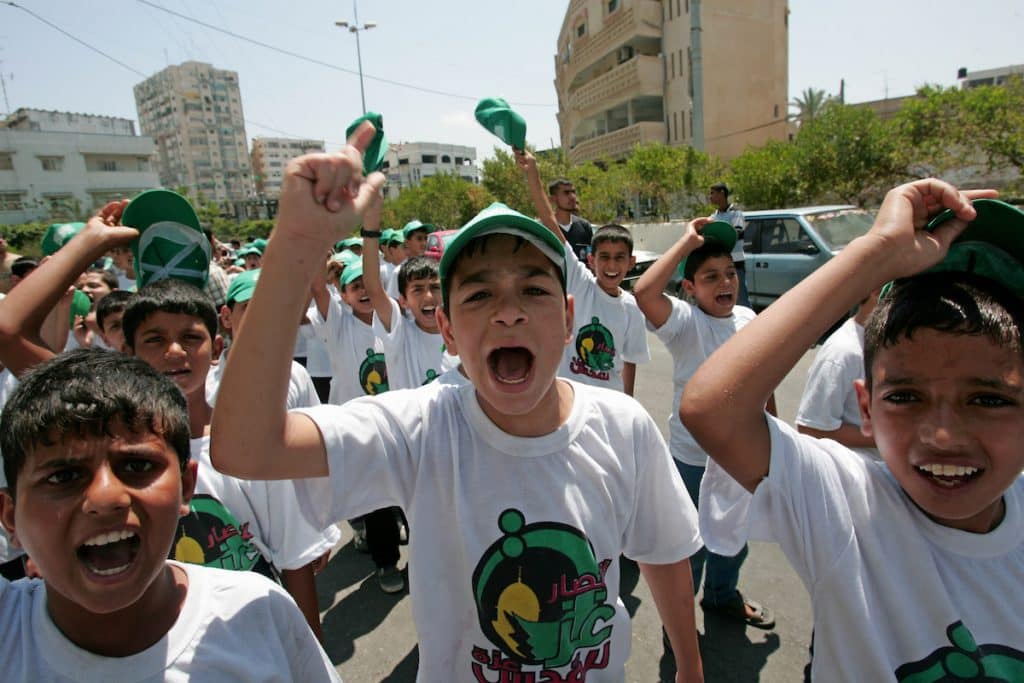
Palestinian boys take part in a rally calling for an end to the siege on Gaza in front of the UN headquarters in Gaza City on July 07, 2009. (Photo: Naaman Omar/APA Images)
Electricity became a timetable rather than a constant. At the beginning, we might have fourteen hours of power, then fewer and fewer. After each war, after each major assault, the power plant would be hit again. First you hear the news, then you feel it when the lights go out for longer periods. Ten hours without power. Twelve. Sixteen. In the last years before I left, we had around four hours of electricity a day.
Health experts now write about how Gaza’s health system is collapsing inside this open air prison. They talk about hospitals that cannot run equipment because of fuel shortages, water that is unsafe to drink, sewage that cannot be treated. Policy reports explain that this is not an accident but a result of a blockade that limits fuel, materials, and even calorie counts. For us, it showed up as spoiled food in the fridge, dark classrooms, and nights when the only light came from phones and candles.
Time itself bent around the schedule of the grid. You learn to count your life by those hours. When to cook. When to wash clothes. When to study. When to charge your phone and the emergency batteries. The rest of the day belongs to the dark.
Charging a phone should be a thoughtless act. You plug it in, you forget about it. Under the blockade, it became a task, a small journey. Some people in each neighborhood had fuel and generators. They became the unofficial charging stations. You would see people walking with phones, chargers, and power strips, heading there when the power was off in their own homes.
Imagine having to leave your house and walk to another street just to give your phone a little life. Imagine doing this again and again, week after week, year after year, not because of a natural disaster, but because someone decided that this is how you should live.
When I was a university student, this took a special kind of cruelty. Professors started assigning online homework and quizzes, trying to keep up with the modern world. We would sit in front of our screens, our eyes on the questions, our minds on the ticking clock in the corner and the invisible clock of the electricity cut.
You begin an online quiz knowing that at any moment the power might go out. The screen could go black in the middle of a sentence, and all your answers would disappear with it. Sometimes that meant losing grades. Sometimes you could not retake the quiz. Then came the explanations: messages to professors, begging them to understand that you are not lazy, you are just plugged into a fragile grid controlled by people who do not know your name and do not care about your GPA.
Even when teachers believed us, the fear stayed. Every assignment became a small test not only of knowledge, but of whether the electricity gods would be kind for an hour.
The shrinking of Gaza was not only political. It was personal. The shrinking lived inside my chest before I ever named it. I felt it when I hesitated to dream about simple things, like choosing a career because I loved it or imagining a future house that was not already cracked. I felt it when relatives told me to “be realistic,” not because my grades were bad, but because the borders were. Even my hopes had to fit inside the map of Gaza, inside the hours of electricity, inside whatever work my father could still find. Little by little, I stopped asking “What do I want to do with my life?” and started asking “What is even possible here?”
It showed itself in small, almost embarrassing comparisons with people my age who lived normal lives.
I remember one moment clearly. I had a friend named Steve, an African American guy from Miami. We met online because I wanted to improve my English. Most of our conversations were simple. What we ate for breakfast, what classes we were taking, how the day was going. Nothing deep. Nothing political. Just daily life.
Then one day Steve told me he was moving to Poland.
Not forever. Not because of danger. Not because he was fleeing anything. Simply because he wanted to study there. He decided it, booked a flight, moved, started classes, and then came home for winter break like it was a weekend trip.
He told the story casually, the way someone tells you they changed their phone plan. But for me, something cracked. I realized he had the ability to move in and out of countries like someone opening and closing doors in their own house. I realized that if he woke up one morning and wanted to study in another place, he could just go. There were airports. Visas. Consulates. Borders that opened.
The thought felt unreal, like hearing that someone can breathe underwater.
Then there were the video calls.
We would talk, laugh, argue about stupid things. And then, suddenly, in the middle of a sentence, the electricity would cut. The screen would freeze, blink, and disappear. The room would fall dark. Eight hours. Ten hours. Sometimes more. No explanation. No apology. Just silence.
When I came back online, Steve would ask:
“What happened? Are you okay?”
I had to explain every time.
The power cut.
The electricity schedule.
The generator shortage.
The siege you can hear in the walls.
For him, a power cut was something announced in advance or caused by a storm. For me, it was a constant reality. A thing that could interrupt any moment of life.
Years later, after arriving in the US, I received a text message from the electricity company saying:
“The power will go off for five minutes between this time and this time.”
A warning.
A courtesy.
A luxury so simple it hurt.
I stared at the message as if it were written in another language. For twenty years of my life, electricity never announced its absence. It vanished like a punishment.
That was the moment I realized the world outside Gaza was not just different. It was larger. Softer. Built for human beings. Built for planning, dreaming, leaving, returning. Built for people who were allowed to exist without rationing light.
Gaza, by contrast, had become a world where even a phone battery felt like borrowed time.
These details might sound like simple hardships, the way people talk about “life is hard in poor countries.” But Gaza is not just “a poor place.” Poor places usually let you leave. In Gaza, poverty is welded to confinement. The blockade does not simply make life difficult. It arranges difficulty in such a way that your energy is spent on basic survival instead of on building a future.
Writers and activists have been trying for years to name this combination. Some call Gaza a ghetto, a bantustan, a carceral zone. As early as the 1980s, analysts were already comparing Gaza to apartheid townships in South Africa. Later, an Israeli sociologist would call it the world’s largest concentration camp, and other commentators would argue that the shift from slow “spacio cide” to open massacre has turned parts of Gaza into something closer to an extermination camp. UN experts now warn that what is happening in Gaza is not only an open air prison but a test of the whole international order.
The funeral marches I saw as a child and the bombs that shook my sister’s new home were open acts of violence. The blockade is quieter. It comes as a morning ritual at a computer, as a mother who cannot go to Hajj, as a son sleeping in a living room listening to his father breathe, as a student racing against a power cut, as a phone in your hand that is always close to dying.
If a city can be turned into a kind of cell, this is how it begins. Not with a single event. With a long, slow shrinking of what is possible, until you wake up one day and realize that almost no one you love believes that “things will get better soon” anymore.
Electricity became a timetable rather than a constant. At the beginning, we might have fourteen hours of power, then fewer and fewer. After each war, after each major assault, the power plant would be hit again. First you hear the news, then you feel it when the lights go out for longer periods. Ten hours without power. Twelve. Sixteen. In the last years before I left, we had around four hours of electricity a day.
Health experts now write about how Gaza’s health system is collapsing inside this open air prison. They talk about hospitals that cannot run equipment because of fuel shortages, water that is unsafe to drink, sewage that cannot be treated. Policy reports explain that this is not an accident but a result of a blockade that limits fuel, materials, and even calorie counts. For us, it showed up as spoiled food in the fridge, dark classrooms, and nights when the only light came from phones and candles.
Time itself bent around the schedule of the grid. You learn to count your life by those hours. When to cook. When to wash clothes. When to study. When to charge your phone and the emergency batteries. The rest of the day belongs to the dark.
Charging a phone should be a thoughtless act. You plug it in, you forget about it. Under the blockade, it became a task, a small journey. Some people in each neighborhood had fuel and generators. They became the unofficial charging stations. You would see people walking with phones, chargers, and power strips, heading there when the power was off in their own homes.
Imagine having to leave your house and walk to another street just to give your phone a little life. Imagine doing this again and again, week after week, year after year, not because of a natural disaster, but because someone decided that this is how you should live.
When I was a university student, this took a special kind of cruelty. Professors started assigning online homework and quizzes, trying to keep up with the modern world. We would sit in front of our screens, our eyes on the questions, our minds on the ticking clock in the corner and the invisible clock of the electricity cut.
You begin an online quiz knowing that at any moment the power might go out. The screen could go black in the middle of a sentence, and all your answers would disappear with it. Sometimes that meant losing grades. Sometimes you could not retake the quiz. Then came the explanations: messages to professors, begging them to understand that you are not lazy, you are just plugged into a fragile grid controlled by people who do not know your name and do not care about your GPA.
Even when teachers believed us, the fear stayed. Every assignment became a small test not only of knowledge, but of whether the electricity gods would be kind for an hour.
The shrinking of Gaza was not only political. It was personal. The shrinking lived inside my chest before I ever named it. I felt it when I hesitated to dream about simple things, like choosing a career because I loved it or imagining a future house that was not already cracked. I felt it when relatives told me to “be realistic,” not because my grades were bad, but because the borders were. Even my hopes had to fit inside the map of Gaza, inside the hours of electricity, inside whatever work my father could still find. Little by little, I stopped asking “What do I want to do with my life?” and started asking “What is even possible here?”
It showed itself in small, almost embarrassing comparisons with people my age who lived normal lives.
I remember one moment clearly. I had a friend named Steve, an African American guy from Miami. We met online because I wanted to improve my English. Most of our conversations were simple. What we ate for breakfast, what classes we were taking, how the day was going. Nothing deep. Nothing political. Just daily life.
Then one day Steve told me he was moving to Poland.
Not forever. Not because of danger. Not because he was fleeing anything. Simply because he wanted to study there. He decided it, booked a flight, moved, started classes, and then came home for winter break like it was a weekend trip.
He told the story casually, the way someone tells you they changed their phone plan. But for me, something cracked. I realized he had the ability to move in and out of countries like someone opening and closing doors in their own house. I realized that if he woke up one morning and wanted to study in another place, he could just go. There were airports. Visas. Consulates. Borders that opened.
The thought felt unreal, like hearing that someone can breathe underwater.
Then there were the video calls.
We would talk, laugh, argue about stupid things. And then, suddenly, in the middle of a sentence, the electricity would cut. The screen would freeze, blink, and disappear. The room would fall dark. Eight hours. Ten hours. Sometimes more. No explanation. No apology. Just silence.
When I came back online, Steve would ask:
“What happened? Are you okay?”
I had to explain every time.
The power cut.
The electricity schedule.
The generator shortage.
The siege you can hear in the walls.
For him, a power cut was something announced in advance or caused by a storm. For me, it was a constant reality. A thing that could interrupt any moment of life.
Years later, after arriving in the US, I received a text message from the electricity company saying:
“The power will go off for five minutes between this time and this time.”
A warning.
A courtesy.
A luxury so simple it hurt.
I stared at the message as if it were written in another language. For twenty years of my life, electricity never announced its absence. It vanished like a punishment.
That was the moment I realized the world outside Gaza was not just different. It was larger. Softer. Built for human beings. Built for planning, dreaming, leaving, returning. Built for people who were allowed to exist without rationing light.
Gaza, by contrast, had become a world where even a phone battery felt like borrowed time.
These details might sound like simple hardships, the way people talk about “life is hard in poor countries.” But Gaza is not just “a poor place.” Poor places usually let you leave. In Gaza, poverty is welded to confinement. The blockade does not simply make life difficult. It arranges difficulty in such a way that your energy is spent on basic survival instead of on building a future.
Writers and activists have been trying for years to name this combination. Some call Gaza a ghetto, a bantustan, a carceral zone. As early as the 1980s, analysts were already comparing Gaza to apartheid townships in South Africa. Later, an Israeli sociologist would call it the world’s largest concentration camp, and other commentators would argue that the shift from slow “spacio cide” to open massacre has turned parts of Gaza into something closer to an extermination camp. UN experts now warn that what is happening in Gaza is not only an open air prison but a test of the whole international order.
The funeral marches I saw as a child and the bombs that shook my sister’s new home were open acts of violence. The blockade is quieter. It comes as a morning ritual at a computer, as a mother who cannot go to Hajj, as a son sleeping in a living room listening to his father breathe, as a student racing against a power cut, as a phone in your hand that is always close to dying.
If a city can be turned into a kind of cell, this is how it begins. Not with a single event. With a long, slow shrinking of what is possible, until you wake up one day and realize that almost no one you love believes that “things will get better soon” anymore.
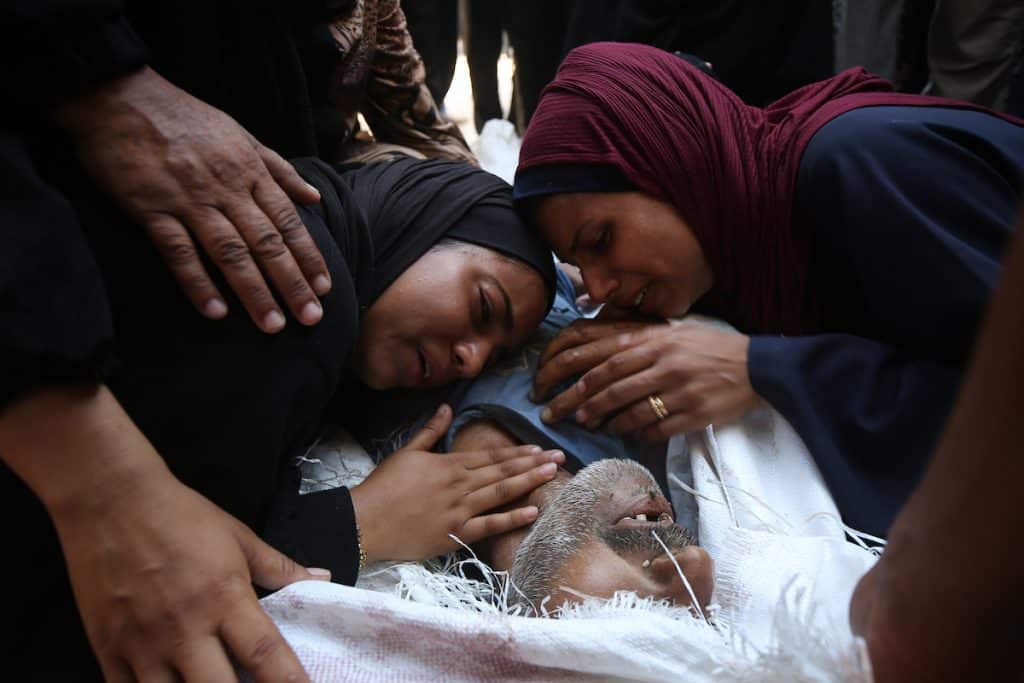
Palestinians mourn over the bodies of loved ones who were killed by Israeli fire while trying to receive aid, according to medics, at Al-Shifa Hospital, in Gaza City, August 4, 2025. (Photo by Omar Ashtawy/APA Images)
On August 4, 2025, my sister, Elham, was devastated by an unspeakable act. Israeli forces took the life of her husband, my brother in law, Haitham. He was a father simply trying to fulfill the most basic duty: securing food for his wife and their five young children. He was killed in one of the most cruel and senseless ways imaginable, caught in the death traps surrounding the humanitarian aid trucks near the borders.
Report after report now documents how families in Gaza are killed while trying to reach food or water, how entire families are wiped out in attacks that human rights groups call possible war crimes. Amnesty International describes whole families being erased in a moment. Gideon Levy collects dispatches about “the killing of Gaza.” To the outside world these are case studies and evidence. To my sister, they are the empty side of the bed and five children asking where their father went.
Abdalrahim Abuwarda
Abdalrahim Abuwarda is a Palestinian scholar and PhD candidate in English (Public Humanities) at the University of Wyoming. His research and teaching explore media representation, rhetoric, and the politics of storytelling in Palestine and beyond.
On August 4, 2025, my sister, Elham, was devastated by an unspeakable act. Israeli forces took the life of her husband, my brother in law, Haitham. He was a father simply trying to fulfill the most basic duty: securing food for his wife and their five young children. He was killed in one of the most cruel and senseless ways imaginable, caught in the death traps surrounding the humanitarian aid trucks near the borders.
Report after report now documents how families in Gaza are killed while trying to reach food or water, how entire families are wiped out in attacks that human rights groups call possible war crimes. Amnesty International describes whole families being erased in a moment. Gideon Levy collects dispatches about “the killing of Gaza.” To the outside world these are case studies and evidence. To my sister, they are the empty side of the bed and five children asking where their father went.
Abdalrahim Abuwarda
Abdalrahim Abuwarda is a Palestinian scholar and PhD candidate in English (Public Humanities) at the University of Wyoming. His research and teaching explore media representation, rhetoric, and the politics of storytelling in Palestine and beyond.