Saturday, December 27, 2025

The Rebirth of ISIS, Israel and the Continuation of Syria’s Civil War – Analysis

Can Syrians overcome attempts, particularly by Israel, to divide their country? (Image: via Al-Mayadeen)

By Robert Inlakesh

Earlier this year, Israel also took advantage of tensions between Syria’s Druze community and sectarian militants aligned with Damascus, backing Druze separatist militias.

The chaotic predicament in which Syria now finds itself was, in many ways, predictable, yet this makes it nonetheless tragic. Despite the recent removal of the US’s crushing Caesar Act sanctions, the challenges ahead are so numerous as to render this a minor victory for the country.

In order to begin to understand what is happening inside Syria, we first have to begin to comprehend what happened following the fall of Bashar al-Assad. Although the moment that Hayat Tahrir al-Sham (HTS) entered Damascus, and Ahmed al-Shara’a declared himself leader, was dubbed a liberation of the country, thus interpreted as the end to the nation’s civil war, what had really happened was the birth of a new chapter in the Syrian war.

On December 8, 2024, the Israeli air force saw its opportunity and hatched a long-planned strategy to destroy Syria’s strategic arsenal and occupy key portions of territory in the south of the nation. That day, however, much of the Arabic language world’s media completely ignored the historic event and refused to cover its ramifications.

Another key point was that, beyond Israel’s land grab, the country’s territory still remained divided, as the US-backed Kurdish-led Syrian Democratic Forces (SDF) maintained its control over the northeast of the country. This movement believes that the territory it controls, with Washington’s backing, is called Rojava and is part of the land of Kurdistan.

Türkiye, to the north, views the Kurdish movement as a strategic threat and treats the SDF as an extension of other Kurdish organizations it deems terrorist groups. The majority of the people living inside SDF-controlled territory are Arabs, an issue that can also not be overlooked.

HTS Ascendant and the Collapse of the State

Then we have the HTS government that took over Damascus, which originally pledged to rule for all Syrians and not just the Sunni majority. However, HTS is a rebranding of Jabhat al-Nusra, al-Qaeda’s Syrian offshoot. Understanding this fact is key, because HTS was the de facto government in the territory called Idlib, in northwestern Syria; although a secular leadership was on paper, supposed to be the ruling authority.

In 2018, when Bashar al-Assad’s forces halted their offensive and sent all the armed groups opposing them on “Green Buses” to the Idlib enclave, Ahmed al-Shara’a, who called himself Abu Mohammed al-Jolani at the time, had started to consolidate power. This led to HTS establishing its own prisons and undergoing a process whereby it managed to control various al-Qaeda-affiliated Salafist armed groups inside the territory.

When HTS took Damascus, it did so with a ragtag army composed of militants from dozens of armed groups from inside Idlib, including many former ISIS fighters and others from different groups that were given the options to join forces with HTS, lay down their weapons, or face fierce crackdowns. 

The way these crackdowns on dissidents were carried out, along with corruption in the governance of Idlib, even led to protests inside the province against HTS. Many hardline militants had also accused al-Shara’a of providing the US with details on the whereabouts of former ISIS leader Abu Bakr al-Baghdadi.

Keep in mind now that when HTS took over Damascus, they did so without a fight and the former regime simply collapsed in on itself. So here was HTS, now tasked with managing the majority of Syria and had to do so without any army, because the Syrian Arab Army (SAA) had been disbanded.

Many elements of the former government, intelligence, and military under Bashar al-Assad were told they had been granted amnesty, yet forces aligned with HTS, and in some cases those within it, decided to take the law into their own hands through brutal field executions. 

This eventually led to a group of former SAA fighters in the coastal region taking up arms against the new HTS security forces, triggering a response from a broad range of sectarian groups and others who were seeking “revenge” in blood feuds. The result was the mass murder of Alawite civilians across the coast.

Israel, the Druze File, and Syria’s External Fronts

Earlier this year, Israel also took advantage of tensions between Syria’s Druze community and sectarian militants aligned with Damascus, backing Druze separatist militias. This had been a strategy that Tel Aviv attempted to implement all the way back in 2013, when Israel began backing some dozen opposition groups, including al-Qaeda- and ISIS-linked militants that were committing massacres against the Druze.

The Syrian Druze population is primarily situated in the Sweida province in southern Syria. Israel long sought to create a Druze rump state there, which would serve as a land bridge to the Euphrates and allow for the total Israeli domination of the south. The Israelis are also allied with the SDF, although not as overtly as the Americans are, meaning that if their strategy works, then they have secured their domination all the way through to the Iraqi border.

This Monday, tensions again flared up between the Syrian forces aligned with Damascus and HTS in eastern Aleppo, with both sides blaming each other for the violence. Periodically, tensions continue to escalate in Sweida, yet come short of the large-scale sectarian battles we saw earlier this year.

Meanwhile, US forces have now expanded their footprint throughout Syria and have taken over more military air bases, even working alongside Damascus as a partner in the “fight against ISIS,” or “Operation Inherent Resolve.”

On December 13, an attack that killed three US servicemembers was blamed on a lone-wolf ISIS fighter. In response, the US then declared it was launching a retaliatory bombing campaign across the country. 

The narratives of both Washington and Damascus make little sense, regarding this being a lone-wolf ISIS attack. Instead, the evidence suggests that the attack was carried out by a member of the HTS security forces, but this is perhaps a story for another day.

Now we hear report after report about the rise of ISIS. And while it is certainly true that ISIS is on its way back, even if in a weaker state, the context is never mentioned.

Internal Fractures, ISIS, and an Unstable Future

Not only has the current Syrian administration managed to play right into Israel’s hands with the management of the situation in Sweida, set up a shadow governance model that is even more corrupt than the previous regime, while isolating all of Syria’s minority communities in one way or another, but it has also effectively turned many of its own allies against it.

There is no actual “Syrian Army” to be spoken of right now, at least there isn’t one that is professionally trained or big enough to handle any major war. Instead, the Syrian state will rely on its allies, like major tribes and a range of militant groups. However, as time goes on, more and more of HTS’s allies and even many who now fill the ranks of its own security forces are growing tired of the government’s antics.

A large component of their anger comes from issues concerning tight Syrian relations with the US, leading to the hunting down of Sunni militants across the country, but particularly in and around Idlib. As mentioned above, HTS had integrated many ISIS fighters and those belonging to other hardline Salafist Takfiri fighting groups, but many of these militants have never been willing to sacrifice their core beliefs for a secular state.

For years, the man they knew as Jolani had preached against the United States and Israel, yet, after taking power, he began cozying up with them and targeting Sunni militants alongside the US military. In addition to this, the large number of foreign fighters inside the country have not been granted citizenship and feel as if their futures are threatened.

In other words, the conditions are ripe for some kind of revolt, and Ahmed al-Shara’a is surrounded by countless threats. If ISIS were to begin gaining traction, there is a good chance many of these fighters, currently allying themselves with the Damascus government, will switch sides. In fact, this is something that has already been happening, although in small numbers and isolated cases.

What we see is a recipe for disaster, one which could explode in any direction, triggering a much larger chain of events in its wake. So far, it appears as if there are four primary threats to the stability of the HTS government. These are the Sweida front, the Israel front, the SDF front, and the potential for an internal insurgency.

Mike Huckabee, the US ambassador to Israel, recently gave an interview during which he commented that Ahmed al-Shara’a “does know that any pathway for stability in Syria, his pathway for survival, is that he has to be able to have peace with Israel.”

It is important to understand that the two most powerful influences on Damascus are Washington and Ankara, yet it is clear that the US has the edge and could quickly overthrow the HTS regime at any time of its choosing.

Türkiye now has enormous influence inside Syria, where it is competing with the Israelis and attempting to set red lines, yet has failed to impose any equations as of yet. Perhaps the only way that the Turkish state could deter the Israelis is through backing a resistance front in the south of the country, yet it is clear that the US will not allow such a scenario to develop.

Even if a rather weak resistance group, or collection of groups, were to be formed and pose little strategic threat to Israel, this could also end up presenting a challenge to the rule of HTS in the long run. This is because such a resistance organization would enjoy enormous popular support and likely encourage other armed actors inside the country to join forces, creating a Lebanon-style system, whereby the forces of the state are incapable of confronting the occupier and instead, a resistance group would handle security instead.

The United States and Israel would never permit something like this to evolve, likely moving to commit regime change before such a plot is even conceived.

This leaves Ahmed al-Shara’a in an impossible position. He has no confidence in him as a ruler from the country’s minorities, growing anguish amongst the majority Sunni population, and no real army to be spoken of. Instead of resisting the Israelis, as his men and population at large seek, he sends his officials to sit around the table with them, while Syria’s official social media pages publish images of Syria without including the occupied Golan Heights.

Since 1967, most of the Syrian Druze living in the occupied Golan Heights had refused to take Israeli citizenship. After the sectarian bloodshed that occurred earlier this year, these Syrian Druze began applying for Israeli citizenship en masse. This is the impact that the rulers in Damascus have had on their own people; they have pushed Syrians who resisted Israeli citizenship for decades to switch sides, playing right into Tel Aviv’s hands.

Meanwhile, little is being done to reassure the disillusioned militants who had fought alongside HTS and believed they were fighting for a liberation cause and/or Islamic Caliphate, only to realize that they fought for a regime that negotiates with Israel and bows to the White House. Therefore, it is no wonder that when a group like ISIS appeals to them through its propaganda, it manages to convince them to join the organization’s fight.

What’s more is that this outcome was barely difficult to predict; only days after the fall of Bashar al-Assad, militants from Idlib were posting photos on Facebook of themselves holding up pictures of Abu Bakr al-Baghdadi in the Umayyad Mosque, the most important mosque to Sunni Muslims in Syria.

Not only this, while ISIS networks on social media were, in the past, blocked almost instantly, they began popping up in the open on places like Facebook again. This begs the question as to why such obvious ISIS glorification and supporters were permitted to begin operating so openly online during this period.

When it comes to Takfiri Salafist doctrine, whether someone is affiliated with ISIS or al-Qaeda offshoots, they do not simply abandon this ideology overnight because of changing political circumstances.

Now, Takfiri militants idolize a man named Mohammed ibn Abd al-Wahhab, which is why these Salafi groups are often referred to as Wahhabis. Historically speaking, this ideology was the bedrock on which the Saudi family launched their offensives to conquer Arabia, declaring the Ottomans kafir (disbelievers) and justifying their alliance with Britain, against other Muslims, on this basis. Therefore, some may justify the actions of al-Shara’a on the basis of their doctrine, but only to a certain extent.

When HTS began killing fellow Sunni Muslims, alongside the United States and cozying up to individuals responsible for the mass murder of their co-religionists, this started to become a major problem. It could no longer be branded an “alliance with the people of the book,” especially when fellow Salafists were kidnapped and killed by HTS government forces.

Some attention has recently been placed on the comments of the US envoy to Syria, Tom Barrack, who remarked that Syria should not be a democracy and instead a monarchy, even explicitly stating that this plan could include merging Syria with Lebanon. Such a system would certainly please many allies of al-Shara’a, and comments like these could be made in the interest of restoring faith in the leader.

Nonetheless, the current system is still operating on a knife-edge and is far from achieving a monarchy that rules the northern Sham region. In the distance, the Israelis are watching on and simply waiting for the next opportunity to achieve even more of their goals.

This is all because the war in Syria never truly ended; the only thing that changed is that Bashar al-Assad’s government fell, and perhaps if that had occurred during the first years of the war, there wouldn’t have been so many issues.

As is normally the case with human psychology, we seek to frame things in a favorable way to our worldview, meaning that we simply ignore evidence to the contrary. Yet, the case of Syria is really not all that dissimilar from the post-US-backed regime change realities currently existing in Libya, although there are key differences, of course.

So long as Syria remains without an effective resistance front against the Israelis, it will never recover and remain trapped. In Lebanon, it took years before such a resistance force truly took off in the south, and even then, it took decades to expel and then deter the Israelis. Syria is a much more complex picture, which makes predicting outcomes even more difficult.
– Robert Inlakesh is a journalist, writer, and documentary filmmaker. He focuses on the Middle East, specializing in Palestine. He contributed this article to The Palestine Chronicle.

'Jesus is Palestinian' in New York's Times Square stirs debate, draws ire of pro-Israelis

An ad placed in Times Square has attempted to highlight the plight of Palestinians, but Israel supporters are furious


The New Arab Staff
26 December, 2025

The ADC described the ad as an 'act of resistance' [Getty]


A billboard in New York's Times Square shared a Christmas message declaring that "Jesus is Palestinian", drawing praise from social media users, and outrage from pro-Israelis.

The ad, along with another which displayed a Quranic verse, was funded by the American-Arab Anti-Discrimination Committee (ADC), who described the campaign as an "act of resilience".

"Our two NY billboards are an act of cultural resilience: 1. 'Jesus is Palestinian. Merry Christmas.' 2. The Quranic verse (3:45) announcing the blessed birth of Jesus, with 'Merry Christmas' in English and Arabic," the ADC wrote on its Instagram page.

The post drew hundreds of messages of support, with many agreeing with the statement.

"Thank you for spreading truth! Those who truly follow and relate to the teachings of Christ do recognize this," wrote one Instagram user.


"Truly remarkable and inspiring," wrote another.

However, many supporters of Israel expressed anger with the ad.

Writing on X, ADC Director Abed Ayoub said: "Christians and Christianity are under attack in the birthplace of Jesus - doesn’t matter what you want to call it. There is no disputing that."

"This billboard upset more people than the actual attack on Christians by Israel. You may disagree with it, but it finally got you talking about Christians and Palestine. The Israel First crowd really got triggered today because they don’t want you to know Christians reside in Palestine, including in Gaza," he added, referring to the growing US political divide between those branded as "Israel First" and those seen as "America First".

"They want to push back against us so much that the Israeli Foreign Minister purchased ad space on the same billboard to counter us. At least we didn’t use American taxpayers dollars for our ads," he added, likely referring to Washington's multi-billion-dollar financial support for Israel.

The festive season has increasingly become a cultural battleground between supporters of Israel and their critics. While bombing and displacing Palestinians - including Muslims and Christians - Israel has sought to whitewash its image by claiming to be a safe haven for the Middle East's Christians.

In the occupied West Bank - home to the birthplace of Jesus - Israel's increasing checkpoints and restrictions on Palestinians have restricted access to Christianity's holiest sites in Bethlehem, including during Christmas.
Palestinian resilience is mind-boggling, says Kneecap rapper

Roddy Keenan 
23 December 2025


Móglaí Bap (right) argues that it is Ireland’s turn to speak out against oppression.
 ANP via ZUMA Press

Kneecap, the Irish hip hop group, was widely criticized by Israel’s supporters earlier in the year after using its performance at the Coachella festival in California to denounce the genocidal war against Gaza.

In the aftermath of the event, the band found itself at the center of controversy, with concerts canceled, reports that its members had lost their US work visas, and even terrorist charges being brought against one of them by the British state.

Yet through it all, the three members of the band – who go by the stage names Móglaí Bap, Mo Chara and DJ Próvaí – have refused to remain silent, continuing to raise awareness, campaign and participate in practical initiatives to support the Palestinian people.

In an interview with The Electronic Intifada, Kneecap’s Móglaí Bap (given name: Naoise Ó Cairealláin) spoke about the band’s activism.

Hailing from Belfast, Móglaí Bap attributed his support for the Palestinian cause to his upbringing in the British-occupied north of Ireland.

“Growing up in Belfast, we were more aware of the politics of colonialism and the consistent trends associated with it,” he explained. “And what we have in Palestine is colonialism.”

“I remember going on marches with my ma, and when I was 15 or 16 tagging along with her to protests against Israeli products being sold at a local supermarket,” he recalled.

“I think within Irish consciousness generally, there is an awareness of colonialism, and what that means, especially in Belfast. But across the island, amongst young people, there seems like there’s big shifts, with a lot more awareness of Palestine and anti-colonialist movements in general.”

Móglaí Bap has observed how support for the Palestinian people has grown among young people internationally during the Gaza genocide.

“Even on TikTok there was a survey done, which is used by mainly young people, and most were pro-Palestine. That’s the direction it’s going because they’re watching what’s happening there every day over there on their phones.”
Practical support

While the band’s support of Palestine has been widely recognized in recent months, Kneecap has a long association with the Palestinian cause.

In the past, the band was involved in helping raise funds to establish a gymnasium in Bethlehem’s Aida refugee camp in the occupied West Bank.

The Aclaí Palestine community gym, located in Aida’s Lajee Center, was set up by Naoise Ó Cairealláin’s brother Ainle, who previously ran a gym in Cork in the southwest of Ireland. The Aida facility opened in 2020 and provides free access to the entire community.

“One of the lessons we learned in the north [of Ireland] is that activism can extend to something practical,” explained Naoise Ó Cairealláin (Móglaí Bap), “and practical support is sometimes the most worthwhile form of activism because it has an impact on people.”

Consistent with this approach, he also spoke of plans to build a community music studio in Aida. Funds for the project will be raised in a collaboration between Kneecap and Bohemians, a football club in Dublin, which sees the band sponsoring the club’s 2026 away jersey.

The white shirt is patterned with a kuffiyeh – Palestinian checkered scarf – design and features interwoven Irish and Palestinian flags.

Thirty percent of profits from sales of the shirt will go to Aclaí Palestine to build the music studio in the Lajee Center.

While paying tribute to the “mind-boggling resilience and spirit” of the Palestinian people in the face of occupation, oppression and the daily brutality of the Israeli apartheid regime, Móglaí Bap pointed to the importance of these practical initiatives and the provision of community resources such as the music studio.

“It’s something where people can go to be expressive and enjoy life and not have to just be in survival mode all the time,” he said.
Media pile on

In April, Kneecap hit the headlines when, performing at the annual Coachella festival in California, the band took aim at the genocide in Gaza. At the end of their performance, the Kneecap trio flashed up a few messages on the screen behind them.

“Israel is committing genocide against the Palestinian people,” read the first, followed by, “it is being enabled by the US government who arm and fund Israel despite their war crimes.” The final message read, “Fuck Israel. Free Palestine.”

The extraordinary repercussions of the band’s actions were swift, as a political and establishment media pile on ensued.

Móglaí Bap said the band was as surprised as anyone by the frenzy which greeted its stance.

“We had done the same graphics at all our gigs in Europe and never thought it would cause the storm it did as we had done it everywhere,” he explained. “In fact, it seemed just like a normal gig, despite reports about people leaving, fearing for their safety, we didn’t see anything like that. It was actually a great concert, yet nobody talks about that.”

“But as we were on our way back on the plane from Coachella, we saw we were on Fox News and thought, ‘this is different.’”

In the weeks and months to follow, the band’s members would find themselves in the eye of the storm as the political and media establishment colluded in what Kneecap’s manager Daniel Lambert called a “concerted campaign” to silence the band because of its temerity to call out the Israeli apartheid regime.

The TV personality Sharon Osbourne called for the band’s US visas to be revoked. The band has been forbidden from going to Hungary for three years and a Canadian politician announced the group was banned from entering that country (although the politician in question did not have the power to impose such a ban).

The lengths to which the British establishment would go to try and silence Kneecap became evident in May. The British authorities brought charges against band member Mo Chara (given name: Liam Óg Ó hAnnaidh) under anti-terror legislation, over allegations that he displayed the flag of a proscribed organization at a concert approximately six months earlier.

While terror charges against Mo Chara were thrown out by a London court in September, the British authorities refused to let the case go and have appealed the court’s decision. The appeal has not yet been heard.

Móglaí Bap acknowledged that the proceedings have been an ordeal.

“It was tough, but we knew [we had to], just bear the storm and get through it,” the rapper said. “We knew we were on the right side.”

“It’s important to speak out and counter those that are trying to control the narrative – it’s a propaganda war. But this is what happens when you do speak out,” Móglaí Bap explained.

“We see the same thing happening with Bob Vylan – they’ve been labeled anti-Semitic for criticizing Israel, which is crazy,” he added. “It’s like with us, when we wrote ‘fuck Israel.’ It’s a shortened version of ‘fuck the Israeli government.’”

The British band Bob Vylan is currently taking legal action against Ireland’s RTE for defamation after the broadcaster accused the duo of leading anti-Semitic chants. The band’s chants of “death to the IDF” at the Glastonbury festival in England had actually been focused on the Israeli military, which is carrying out a genocide.

While Móglaí Bap feels that Kneecap’s stance could act as a source of encouragement to other musicians and empower them to speak up, he admitted that some would be reluctant to do so.

“If you’re in a band, you might be afraid to speak out because there are repercussions, especially if you are an up-and-coming band, dependent on small gigs – it can be a hard place to be,” he explained. “We’re established now, it’s different for us, so I would never judge up-and-coming bands.”

However, when it comes to established performers refusing to speak out, Móglaí Bap has no sympathy.

“If you’re a big artist, yet you’re getting sponsored by McDonald’s, that’s different,” he said. “There’s not saying anything, and then there’s actively supporting a group that’s on the BDS [boycott, divestment and sanctions] list.”

As Kneecap’s profile and popularity continues to grow, it is evident that efforts to muzzle the band will not work.

“We’re in a privileged position here in Ireland, so we don’t have to remain quiet. We can use our platform to speak out. And in Ireland we have a long tradition of resistance to colonialism.”
“Huge impact”

Móglaí Bap also pointed out how even the smallest action of defiance can become an act of resistance and have an impact far greater than one might imagine.

He referred to the example set by Mary Manning, a worker in the Irish retail chain Dunnes Stores, a few decades ago. Manning and a number of her colleagues went on strike rather than facilitate the sale of South African goods during that country’s apartheid era.

“We saw how the Dunnes Stores staff and Mary Manning in Dublin during the 1980s refused to handle products from apartheid South Africa,” Móglaí Bap said. “Working class people taking action and having a huge impact. And, of course, Ireland is where the concept of the ‘boycott’ originated.”

The Kneecap rapper recalled how at the time of Ireland’s Great Famine in the 1840s – a hunger crisis exacerbated by Britain – the Choctaw Nation demonstrated practical solidarity with the starving.

“We need to remember that during the famine, the Choctaw Nation gave food to the Irish although they themselves had very little,” he reflected. “Small acts of solidarity can raise the spirits and give energy to people.”

“For so long, we saw the colonial myths about Ireland, calling the Irish backward and subhuman, and we see this same dehumanization being done in Palestine to justify mass murder and genocide against the Palestinian people,” he added.

“But, as I’ve said, we’re in a privileged position now. We have a platform and a pretty comfortable life in Ireland, so it’s our turn to speak out.”

Originally from Ireland, Roddy Keenan is a freelance journalist and author based in the UK.
Archbishop of York says he was 'intimidated' by Israeli 'militias' in West Bank

Archbishop of York Stephen Cottrell recounted his experience on a recent visit to the Occupied West Bank during his Christmas Day Sermon
.


The New Arab Staff
26 December, 2025


Rev Stephen Cottrell has previously described the situation in the occupied West Bank as 'apartheid' [Getty]


The Archbishop of York said he was "intimidated" by Israeli militias during a visit to the Occupied West Bank earlier this year, in a Christmas Day sermon that highlighted the stark reality of the Israeli occupation.

The Most Rev Stephen Cottrell, who is the second most senior clergyman in the Church of England, gave the sermon at the York Minster on Thursday.

"We were stopped at various checkpoints and intimidated by Israeli militias who told us that we couldn’t visit Palestinian families in the occupied West Bank," Cottrell said.

“We have become — and really, I can think of no other way of putting it — we have become fearful of each other, and especially fearful of strangers, or just people who aren’t quite like us.

“We don’t seem to be able to see ourselves in them, and therefore we spurn our common humanity,” he added.


Recounting a visit to the Young Men's Christian Association (YMCA) in Bethlehem, the archbishop described a nativity carving gifted to him, which included a "large grey wall" - likely a reference to Israel's separation wall in the West Bank - which blocks the three kings from visiting the infant Jesus.

“It was sobering to see this wall for real on my visit to the Holy Land,” he said.

“But this Christmas morning, as well as thinking about the walls that divide and separate the Holy Land, I’m also thinking of all the walls and barriers we erect across the whole of the world and, perhaps most alarming of all, the ones we build around ourselves and construct in our hearts, and of how our fearful shielding of ourselves from strangers."

This is not the first time the Archbishop has spoken on the situation in the occupied West Bank, which he described in an interview with the Church Times in November as "apartheid" and "ethnic cleansing".

Cottrell has also said Israel is committing "genocidal acts" in Gaza, where its forces have killed over 71,000 Palestinians since October 2023


Opinion...

The penalty for disagreeing with UK government policy on Palestine is 14 Years in prison

December 27, 2025
 Middle East Monitor
 

Protesters called for “an end to the occupation and a halt to arms sales to Israel” during the national march organized in London by the Palestine Solidarity Campaign in London, United Kingdom on November 29, 2025. [Raşid Necati Aslım – Anadolu Agency

by Tony Greenstein

On 5 January I will go on trial at Kingston Crown Court charged with an offence under Section12 of the Terrorism Act 2000. The maximum penalty if found guilty is 14 years in gaol. There are others due to follow me.

You might be forgiven for thinking that my ‘offence’ was preparing a bomb intended for the Israeli Embassy. In fact, it was disagreeing with government policy and received opinion.

I was arrested on 20 December 2023 by Counter-Terrorism Police in a dawn raid under the Terrorism Act 2000. My ‘crime’ was posting a tweet, one month previously, saying that I supported the Palestinian resistance against the Israeli Defence Forces.

The anti-terrorism police are reminiscent of the Thought Police (Thinkpol) in George Orwell’s 1984, who spent their time hunting down “thought crime.” Britain’s equivalent of seized my electronic devices – computers, laptop, mobile phone etc. When I applied to the courts to recover these items, the police justified their retention by saying that they provided a ‘highly relevant insight’ into my mind.

The aim of Orwell’s Thought Police was to enforce mental conformity, ensuring citizens police their own minds. In his Expert Witness Statement in the Case for the Deproscription of Hamas, Jonathan Cook, a journalist who has worked on The Guardian, The Observer and The Times amongst other papers and a recipient of the Martha Gellhorn Special Prize for Journalism in 2011, wrote:

Over the past several months, I have been watching with growing professional alarm – and personal trepidation – what I can only describe as a campaign of political intimidation and persecution of a number of journalists in the UK. The journalists who have been targeted share one thing in common: they report and comment on Israel’s actions in Gaza from a critical perspective that judges those actions to be genocidal…


A legal victory that shakes the Zionist narrative: What comes after the Bob Vylan and Reginald D Hunter cases?

(This) has been justified under an expansive interpretation of both Section 12 of the 2000 Terrorism Act and Sections 1 and 2 of the 2006 Terrorism Act. These laws tightly restrict commentary about Hamas and other Palestinian organisations the UK government has proscribed.

I now find myself in a situation where, for the first time in my 36-year professional career, I am no longer sure what by law I can write or say in my capacity as a journalist on an issue of major international importance.

The fact that Hamas was freely elected as the government of Gaza in 2006 is irrelevant. By opposing Israel militarily they have become ‘terrorists’.

I have been charged ‘inviting support for a proscribed organisation’. By posting a blog Full Support for the Gaza Ghetto Uprising I was inviting support for Hamas as an organisation.

I have posted many articles opposing the politics and practices of Hamas including an article condemning torture by Hamas and its attacks on NGOs in Gaza.

However I support resistance to the Israeli occupation, whoever is participating in it. The proscription of Hamas as a ‘terrorist’ organisation, when it has never operated outside Palestine, demonstrates that contrary to its official position, in practice the British government supports Israel’s unlawful occupation of the Palestinian Territories. The justification for the proscription is that.

Hamas has used indiscriminate rocket or mortar attacks, and raids against Israeli targets. During the May 2021 conflict, over 4,000 rockets were fired indiscriminately into Israel. Civilians, including 2 Israeli children, were killed as a result.

Presumably Israel using snipers to deliberately target children isn’t terrorism. Over 20,000 children have been killed by Israel since October 7 but what is that compared to two Israeli children? The racist hypocrisy of the British government is exposed for what it is.

Overseas doctors operating in Gaza during the genocide have all testified that Palestinian children are being targeted. Why? Because children are seen as the future of the Palestinian people.

At a conference of pre-military yeshivas on 7 March 2024, Rabbi Eliyahu Mali of the Bnei Moshe yeshiva in Jaffa explained that Palestinian children should be killed because they are the future generation of Palestinian fighters. Mali spoke about how in the case of Gaza, they shouldn’t leave “a soul” alive there.

Today’s terrorists are the children of the prior [military] operation that left them alive. The women are essentially the ones who are producing the terrorists,… It’s not only the 14 or 16-year-old boy, the 20 or 30-year-old man who takes up a weapon against you but also the future generation. There’s really no difference.

This is the same argument that Himmler made about exterminating Jewish children. At Posnan on 6 October 1943 he told SS Generals:

“For I did not consider myself justified in exterminating the men… and then allowing their children to grow up to wreak vengeance on our children and grandchildren.

In a poll conducted by Pennsylvania University 47% of respondents said that the Israeli army should kill all the inhabitants of any city they conquer. This rose to over 60 per cent when asked whether they believe there is a ‘current incarnation of Amalek’ – the tribe that god said the ancient Hebrews had to wipe out. This is what Starmer and our rulers believe constitutes the ‘right to self defence’.

In July 2024 the International Court of Justice ruled that Israel’s occupation of the Palestinian territories was unlawful. By saying that armed resistance to that occupation is ‘terrorist’ the British government is de facto supporting the occupation, despite claims to support a two state solution.

What Blair and Straw did with the passing in 2000 of the Terrorism Act was to make it a crime to support a national liberation or anti-colonial movement that is seeking to free itself from colonial domination or occupation, when the British government is friendly with the occupying power.

If the Terrorism Act had been in force during the era of Apartheid in South Africa then the ANC would have been classified as a ‘terrorist’ group.

When I gave my support to the 7 October attack I wasn’t giving my support to Hamas as an organisation, despite the attempts of the Crown to pretend that this is what it amounted to.

The example I gave to the Police was that of the Polish Home Army. In 1944 its officers told Jewish servicemen in Britain that when they went into battle then they would be shot in the back. Their slogan was that ‘Every Pole has two bullets—the first for a Jew and the second for a German’. The problems that Jewish servicemen faced in the Polish forces stationed in this country were debated in the Commons on 6 April 1944 in a debate initiated by Tom Driberg MP.

If I had been alive then I would not have supported the AK as an organisation but when they led the Warsaw Uprising in August 1944 I would have supported them against the Nazi occupiers.


From Guantanamo to UK prisons: In solidarity with the hunger strikers

What is happening is a naked attempt to use the anti-terrorism laws in order to curtail free speech on Palestine. As John Dugard, an Emeritus Professor of Law at the Universities of Leiden and Witwatersrand and an ad-hoc Judge of the ICJ wrote:

Terrorism is an emotive word that has no place in the assessment of the conduct of either a government or a resistance movement. One man’s freedom fighter is another man’s terrorist. Few would today label members of the French resistance in World War II as “terrorist” and most would have no hesitation in describing the Nazi forces as “terrorist”.

One piece of legislation that has remained a dead letter is the International Criminal Court Act 2001, Section 52 of which renders assistance to the commission of genocide abroad an offence meriting a sentence of 30 years imprisonment. In allowing the supply of arms to Israel and providing military help via the overflight of RAF planes, this government is guilty of having actively supported genocide.

Fortunately though the permission of a member of the government, the Attorney General, is required in order that a prosecution can be initiated. Thus in order to bring a criminal prosecution against the government permission first has to be sought from that government!

Speaking of the corruption of the government’s law officers it was necessary in my case that the Attorney General approve my prosecution as being ‘in the public interest’. Because Richard Hermer is on record as saying that ‘I have dear family members currently serving in the IDF’ he chose to delegate the task to the Solicitor General, Sarah Sackman, who gave the go ahead.

And who is Sarah Sackman if not a dedicated Zionist, who was Vice-Chair of the Jewish Labour Movement from 2015 to 2024. The JLM waged the ‘anti-Semitism’ smear campaign against Jeremy Corbyn and the Labour Left. It is not surprising that on her promotion to Minister of State at the Ministry of Justice the JLM wrote ‘We’re so pleased for Sarah, our former vice chair, and know she’ll be fantastic in this new position.’ I imagine they are very pleased that one of her first tasks as Solicitor General was to approve the prosecution of a leading Jewish anti-Zionist. In the process she accused me of ‘anti-Semitism’ terming me ‘problematic’.

Since Sackman is supposed to act in a quasi-judicial role it beggars belief that she didn’t think there was a conflict of interest.

On 5th January I am calling for a protest demonstration outside Kingston Crown Court to demonstrate the strength of feeling at the deployment of the Terrorist Act against those who support the Palestinians.

The views expressed in this article belong to the author and do not necessarily reflect the editorial policy of
  Tne Middle East Monitor


Opinion

Is the UK imprisoning pro-Palestine activists on Israel's behalf?

As Western states arm Israel, they criminalise Palestine activists. Beauty Dhlamini explains the link between Israel’s prisoners and UK hunger strikers.


Beauty Dhlamini
23 December, 2025 
THE NEW ARAB
Voices


Protestors block Whitehall outside Downing Street in support of the Palestine Action hunger strikers on December 11, 2025. [GETTY] in London, United Kingdom

Whilst Western governments continue to provide protection and support for Israel, including by supplying arms which the Israeli Offense Forces (IOF) use in the ongoing genocide in Gaza, a brutal persecution is being waged against those in support of Palestinian liberation.

The criminalisation of solidarity with Palestinian liberation, has come under sustained attack since 7 October 2023. A report by the International Federation for Human Rights (FIDH) revealed how the UK, the US, France and Germany, continue to misuse their immigration, counter-terrorism legislation as well as antisemitism hate crime laws to suppress support for Palestinian rights in Gaza and the occupied West Bank.

Despite the laws of all the mentioned countries differing, it is clear they represent a persistent trend of global repression.
Prisoners of war

As Western governments continue to pretend to call for an end to Israel’s punitive governance and policy of ethnic cleansing, and displacement, they have adopted the relentless legislative pursuit of those actively trying to prevent it. This is not new, and only proves what has been true since the 1917 Balfour Declaration: Israel exists as a proxy state for Western imperialism and settler-colonialism

Rabeea Eid

In the face of this repression, however, coverage in the mainstream media is still limited. This is representative of a wider failure to interrogate how governments and prison systems inflict terror, whilst conflating the identities and beliefs of minorities being illegally detaining, with terrorism.


To understand the stakes of Western media complicity is to therefore expose the reality these actionists are fighting to dismantle when they interfere with the infrastructures their governments build, sustain and fund to enact genocidal violence. For example, the UK government continues operations of Elbit Systems, Israel’s largest weapons manufacturer which provides its airforce with 85% of its combat drones, and its land forces with 80% of the weapons and equipment they use against Palestinians.

This is why all those detained for taking action against the complicity, are seen as prisoners of war proxy by solidarity movements around the world, they too are targets of Israel’s brutal apparatus. And this is made more apparent with the revelation by Declassified through a Freedom of Information (FOI) request to the Home Office, that government officials had a private meeting with Elbit Systems in December 2024.
Extending and exporting repression

Indeed, the persecution of activists in the West is merely an extension of the cruelty of the Israeli prison system, where over 10,000 Palestinian political prisoners (over 2,900 of them from Gaza), are still fighting for their freedom Palestinians.

Over 3,500 of these Palestinian prisoners are held under the Israeli system of 'administrative detention’ which allows them to imprison Palestinians for up to six months without charge or trial. Since 7 October, this system has only intensified, with scenes of systemic torture, starvation, lack of access to lawyers or family members, punitive strip searches and humiliation of detainees becoming the norm.

Detention orders are reified by an Israeli military court, and the six-month period of imprisonment can be renewed indefinitely, with none of the detainees or their legal teams having access to evidence detailing the reasons. Many have consequently been imprisoned for years without any due process.
Related

The same repressive playbook is being used globally, and an archipelago of political prisoners is being built by Israel with the facilitation of Western governments. In October 2025, 11 of 27 members of the Greek delegation participating in the Global Sumud Flotilla were captured and shortly after, announced their collective hunger strike to protest their illegal detention by Israeli authorities under anti-terrorist laws.

In Italy Palestinians, Anan Yaeesh, Mansour Doghmosh and Ali Irar continue to be held since March 2024, where they exist in the same judicial limbo as Palestinian administrative detainees. An Italian Court of Appeal refused the extradition bid by Israel for Yaeesh – who has been on hunger strike since October – because he faces the risk of torture in Israeli prison. This begs the question why the Italian judiciary system continues to detain him in “preventative custody“ for supporting the resistance of the illegal military occupation in Tulkarem, in the West Bank.

Similarly, a Palestinian who was granted asylum has been held in remand within a French prison for over a year and half after being detained under France’s anti-terrorism legislation at the Israeli government's request. Having already experienced administrative detentions prior to leaving Palestine in 2014, it seems Israel is determined to insure its punitive unjust judiciary process follows him wherever he goes.

Even in the US, Palestinian student Leqaa Kordia, who participated in the Columbia University protests whilst grieving the murder of hundreds of family members by the IOF, has been held in ICE immigration detention in Texas for nine months.
A global struggle

Meanwhile, in the UK the largest pro-Palestinian hunger strike remains steadfast. Of the 29 pro-Palestine activists (Filton 24 and Brize Norton 5) who are being held without trial in remand over their alleged involvement in actions against UK subsidiaries of Elbit Systems and the Royal Air Force (RAF) Brize Norton base, eight have been on hunger strike (some for up to 50 days). Whilst none have been charged with terrorism, the counter-terrorism laws that keep them in remand, and the forced retrospective association with the now proscribed group Palestine Action, exemplifies how Western governments punish those who carry out direct action in support of Palestine liberation.

The hunger strikers are demanding: an end to censorship as they await trial, immediate bail, immediate release, guarantee of safety as full citizens (especially those with a migrant status), the end of Israeli interference in their judiciary processes, and the end of the genocide in Gaza. These sit within the broader demands to de-proscription Palestine Action and exonerate the over 2,000 citizens arrested under the Terrorism Act for holding signs indicating support for the group.

Despite being geographically separated, the resolve of all of Israel’s global political prisoners is connected. For the actionists, activists and organisers alike who have been detained and imprisoned, parallels should constantly be drawn between their resistance and those of Palestinian prisoners in Israeli jails.

This is particularly important in the face of bigger Palestine solidarity platforms either being selective or largely ignoring the plight of the prisoners, especially the UK hunger strike currently taking place.

It is clear that growing crackdowns are linked to Western governments failing to quash the unshakeable international solidarity and resistance efforts over recent years. Whilst the growing number of Israel’s global political prisoners of war is supposed to instil fear in the rest of us, and to dissuade us from organising and protesting against Israel’s crimes, movements have only grown bigger and stronger.


Beauty Dhlamini is a Tribune columnist. She is a global health scholar with a focus on health inequalities and co-hosts the podcast Mind the Health Gap.
Follow her on Twitter: @BeautyDhlamini

Opinions expressed in this article remain those of the author and do not necessarily represent those of The New Arab, its editorial board or staff.


Palestinian factions have come together to thwart Israeli plans in Gaza, for now

The U.S. appears ready to reassess its tactics in carrying out Donald Trump’s plan for Gaza. The news vindicates the strategy Palestinians have used during the ceasefire to avoid the surrender Israel has demanded in exchange for ending the genocide.

 December 26, 2025 
MONDOWEISS

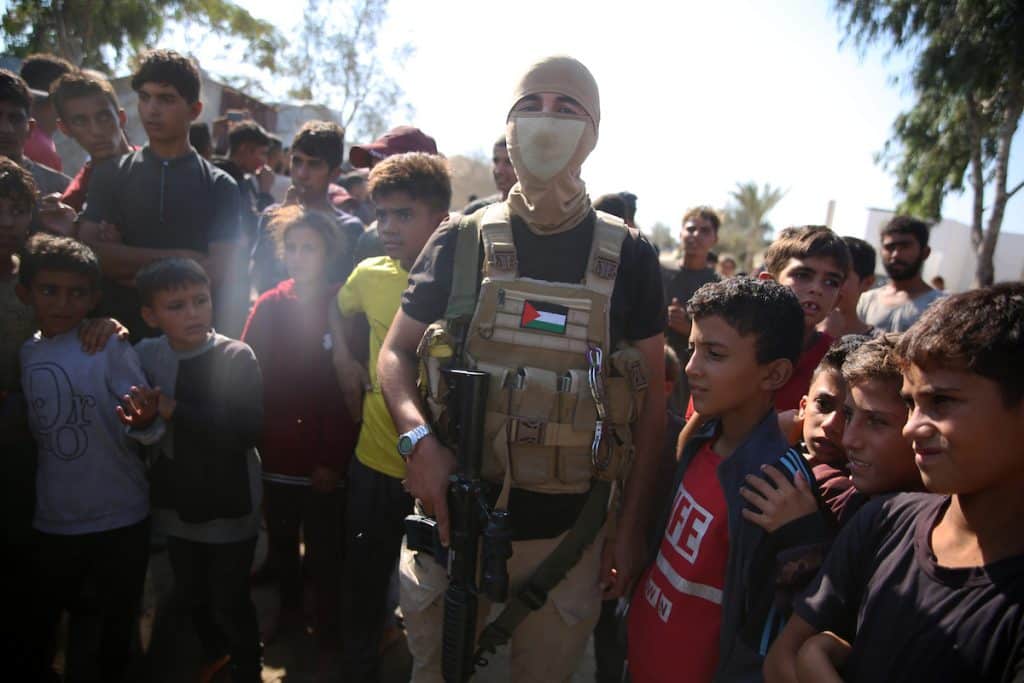
Palestinian militants of the Izz al-Din al-Qassam Brigades, the military wing of Hamas, stand guard next to a crowd watching the transfer of released Israeli hostages to the Red Cross in the south of Deir el-Balah in the central Gaza Strip, October 13, 2025. (Photo: Omar Ashtawy/APA Images)


The United States seems to be poised to reevaluate its tactics in implementing President Donald Trump’s plan for the Gaza Strip. It seems they are considering installing a Palestinian technocrat government and Palestinian police force before assembling their International Stabilization Force (ISF), which they are finding no country wants to be part of.

While this remains very far from acknowledging the rights of the Palestinian people, and even farther from realizing those rights in practice, it is a real vindication for the strategic decisions that the assortment of Palestinian factions — not only Hamas — made in the wake of the diminishment of Israel’s genocide in October.

According to recent reports, the governments of Egypt, Türkiye, and Qatar have managed to make the Trump administration understand that their push for quick Palestinian disarmament in Gaza and the subsequent occupation of the Strip by an international force that would not include Palestinians is a non-starter.

Now, Washington is trying to come up with a formula that is more in keeping with what they’ve heard from their allies and would still be something they can sell to Israel. For its part, Israel has been conspicuously silent about all of this, probably waiting for their prime minister’s visit to Washington next week to voice their objections.

On paper, that all seems to amount to a minor victory at best, but digging deeper, we can see it vindicates the strategy the Palestinians have pursued to end Israel’s genocide and avoid the total surrender that Israel has pursued as the price for ending that horror.
A Palestinian gamble pays off

It’s worth keeping in mind that, while most media portray Hamas as the sole conductor of diplomacy in Gaza, decisions that affect all the people of Gaza and Palestine have actually been reached by a consensus of a wide array of Palestinian factions. This has even included Palestinian Authority President Mahmoud Abbas’ Fatah party, although it has been an inconsistent member and has often acted independently, often undermining the loosely unified factions.

That coalition agreed to the first stage of Trump’s plan, in which the militant factions, led by Hamas, ceased their offensive operations against Israelis, released all the remaining living hostages, as well as the bodies of those who are deceased (save two, one Israeli and one Thai hostage, who remain buried under rubble).

However, they never agreed to the rest of the plan, neither accepting nor rejecting it outright. In what was a bold but very risky move, the Palestinians insisted on more negotiations to find an accommodation that would allow Hamas to step aside from governance and lay down their arms without disappearing completely from Palestine or sacrificing the principle that they have the right to resist Israel’s violent occupation and apartheid, even with force, as international law provides.

The factions gambled that the Trump administration really wanted the worst of the ceasefire to stop, and that the U.S. would negotiate to maintain the ceasefire, however illusory it may be. And thus the very worst of the genocide was diminished.

It seemed a pyrrhic victory. The United States pressed forward with its efforts to assemble an international force to disarm Hamas and police Gaza, while its “Board of Peace” would govern Gaza with Palestinian technocrats merely operating the administrative, day-to-day tasks. Israel continued its attacks and refused to allow sufficient aid, including material for shelter in the winter months, and Palestinians continued dying and suffering, albeit at a lower rate. Yet the factions held to their bet.

Finally, now, it seems the bet has paid off. The Trump administration seems to have gotten the message that disarming Hamas cannot happen by force or coercion. Israel was unable to accomplish the feat in two years of violence that the Trump administration does not want to return to. The countries the U.S. was trying to recruit for its International Stabilization Force are willing to act as peacekeepers but unwilling to go and fight Israel’s battles for it.

That became even more apparent this week when Azerbaijan backed out of the ISF. It had been one of the first countries to indicate willingness to participate in the force, but could not agree to it once it became clear that they would actually have to fight Palestinians. The exclusion of Azerbaijan’s ally, Türkiye, whose participation in the ISF was vetoed by Israel, made it clear what the intent of the ISF was, and the Azerbaijanis, were unwilling to take that on.

The same was true of other states. They are unwilling to enter into a force whose mandate is not clear, and which might be used as an occupying force.

Türkiye, Qatar, and Egypt seem to have finally been able to make Washington understand that they were not going to be able to get a foreign army to disarm Hamas.

Implicit in that understanding was the realization that the U.S., much to Israel’s chagrin, would have to pursue a diplomatic avenue with Hamas on disarmament. Contrary to widespread misinformation, Hamas, while unwilling to accept terms of surrender that include completely giving up all its weapons, is willing to negotiate terms that would, essentially, see it mothball most of them.

According to Drop Site News — one of the very few news outlets that actually reports directly on what Palestinian factions themselves are saying and discussing — “Hamas has expressed an openness to a deal that would see the weapons of Hamas and Islamic Jihad stored or ‘frozen,’ a configuration that would come with the endorsement of the Palestinian resistance groups themselves.” Such an agreement would be a lot more trustworthy and efficient, even from Israel’s point of view, than trying to simply confiscate all of the factions’ small weaponry. Israel, of course, would never admit that this is true, but it is. If the goal is to ensure that Hamas won’t attack Israel again as it did in October 2023, this would be by far the best way to do that.

The factions are not going to make any public commitments until there is a specific plan they can discuss, and that is sensible. But they bet that, by maintaining ambiguity about Trump’s plan and a clear openness to reasonable negotiation, they could get Trump’s Arab and Muslim friends to prevail upon Washington to back away from Israel’s maximalist demands that were clearly intended to collapse the so-called “ceasefire” and reignite the genocide.

That bet had long odds, but it paid off.

American reassessment

Last week, U.S. Secretary of State Marco Rubio sounded a very different tone on Hamas disarmament than he had in the past.

Speaking at a press conference in Washington, Rubio said, “You’re not going to convince anyone to invest money in Gaza if they believe another war is going to happen in two, three years. So, I would just ask everyone to focus on what are the kind of weaponries and capabilities that Hamas would need in order to threaten or attack Israel—as a baseline for what disarmament would look like.”

That is a far cry from the sort of rhetoric we had been hearing. It sounds a lot closer to the tone set by the Turkish Foreign Minister Hakan Fidan after his meetings in Washington, when he said the discussions had centered on “arrangements aimed at ensuring that Gaza is administered by the people of Gaza.”

Reports are that Qatar’s Prime Minister echoed these views at the same meeting. And, of course, it makes sense even on the most pragmatic level.

While news outlets have repeatedly portrayed Hamas as attempting to “reestablish control” over Gaza, the reality is that Hamas fighters have, for the most part, been trying to fill the vacuum in Gaza where there is no police force and rival gangs and thieves are, like the rest of the people of Gaza, at their most desperate. They have also pursued some militias that had aligned themselves with Israel during the genocide, but for the most part, they have simply been trying to fill the void in Gaza until some more structured solution can be agreed to.

Thus, Qatar, Egypt, and Türkiye have been pressing hard to arrange for thousands of Palestinian Authority police officers to be deployed in Gaza. While PA police may not have a great reputation, this is not at all unprecedented. When Hamas took over in Gaza in 2006, PA police simply switched uniforms. A similar situation would occur in Gaza today.

In fact, police in both the West Bank and Gaza are largely functionaries, civil service employees, much like in other places. They aren’t really “PA” or “Hamas” police.

The factions have been active in these discussions as well, and they would support such a police force, even to the extent that they would agree that this force would have a monopoly on the use and carrying of firearms, a key component of the kinds of “disarming” they are proposing.

Qatar, Egypt, and Türkiye are keen to see this force coalesce as soon as possible. They are pushing the Trump administration to agree to the idea before Israeli Prime Minister Benjamin Netanyahu’s visit to Washington next week. Although Netanyahu is expected to try to use the trip primarily to drum up support for a new attack on Iran, the Muslim states are concerned that Netanyahu will influence Trump to also take a harder stand on Gaza. Getting an agreement and starting the process of bringing a Palestinian police force to Gaza would make that more difficult for Netanyahu.

While all of this remains very far from Palestinians governing themselves in Gaza, as any people have a right to do, it still represents tremendous progress compared to Trump’s initial, purely colonial plan. That Palestinian success has not gone unnoticed among Washington hawks.

Speaking from Israel after meeting with Netanyahu, the uberhawk Republican Senator Lindsey Graham said that, “Hamas is not disarming. They’re rearming. Hamas is not abandoning power. They’re consolidating power.”

Graham went on to say that the U.S. should “Put [Hamas] on the clock. If they don’t disarm in a credible way, then unleash Israel on ’em.”

Graham’s voice carries little weight in the Republican Party these days and is not often heard in the White House. But he is as close to Netanyahu as any American official, and his words certainly reflected a message from the Israeli PM.

The effort to dissuade the Trump administration from the course Israel has laid out for it—a course which is intended to lead back to all-out genocide—remains a difficult and fraught one.

However, it has taken a significant step forward this week due to the efforts of a unified Palestinian leadership, albeit one that remains largely outside the spotlight. It is a testament to what Palestinians can accomplish with such unity, and it explains why Israel has worked so tirelessly for decades to block it.
Opinion

The problem with Jewish advocacy for a ‘one-state solution’: Clarifying the role of Jewish anti-Zionists in dismantling Zionism

Jewish advocacy for a one-state solution represents a form of Zionism that centers Jews in Palestine's future. Instead, anti-Zionist Jews must aim to accelerate the dismantling of Zionism both in Palestine and worldwide.
 December 27, 2025 
MONDOWEISS


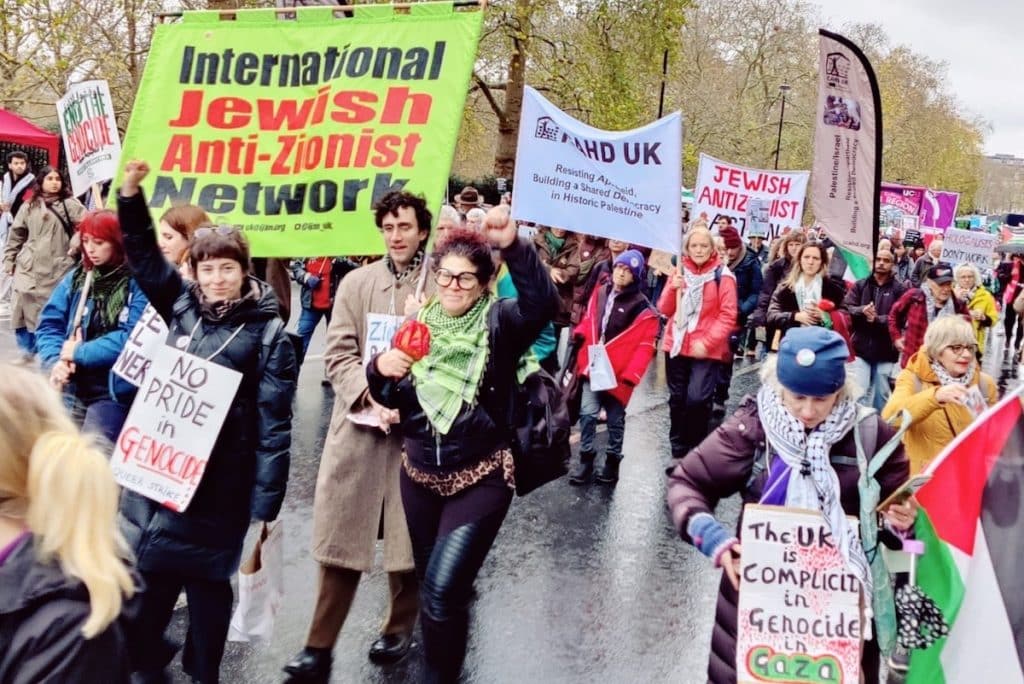
International Jewish Anti-Zionist Network contingent at the Palestine Solidarity March, London, UK, on November 29, 2025.


The clarity and questions raised by Lara Kilani’s astute piece, “Liberation Is Not Integration: On liberal Zionism, one-state fantasies, and what Palestinians actually want” and Rima Najjar’s incisive response, “The Settlers Are Not Leaving: Decolonization, not coexistence,” place the discussion of the future Palestine where it belongs – among Palestinians. The questions both pieces raise affirm a long-standing opinion of the International Jewish Anti-Zionist Network, of which I am a co-founder, that Jews do not and should not play a role in envisioning, directing, or participating in the designs of a liberated Palestine. Instead, as anti-Zionist Jews, our role lies in expediting the dismantling of Zionism – both its genocidal, colonial expression and expansion in Palestine and its fortification through organizations and institutions across the globe. As Najjar argues, such de-Zionization is a precondition of sorts for Palestinians to have the space and possibility to determine what liberation looks like and the society they want to build in its aftermath.

As anti-Zionist Jews, our role lies in expediting the dismantling of Zionism – both its genocidal, colonial expression and expansion in Palestine and its fortification through organizations and institutions across the globe.

It is and has always been Palestinians who must determine the nature of “the state” and the society they want to live in once colonialism is dismantled. “Greater Israel” is closer to being secured than ever before – through collaboration and shared interests of the ruling elite in the United States, Saudi Arabia, the United Arab Emirates (UAE), Qatar and Turkey. As Najjar notes, calls for one state without a clear plan for decolonization and de-Zionization risk replicating rather than dismantling Zionism. Furthermore, discussions of a one-state solution that fails to assert the centrality of Palestinian self-determination – particularly the right to not be forced to integrate with those who have not only committed but celebrated genocide against you – is not only abstract, but damaging.

When Jewish academics, activists and organizations call for and lift up their vision of a one-state in Palestine, it is Zionism. One way or another, it is based on an investment in Palestine remaining a place in which Jews are central to the vision of the state and society. It is, therefore, our mandate to be unwavering in our support for the decolonization and de-Zionization of Palestine and the means necessary to shift the structural conditions in this direction.
Your donation will be MATCHED!


At minimum, this includes engaging in the divestment and dismantling of all Zionist institutions and structures and BDS, and reinforcing, without hesitation, the Palestinian right to resist, right to return, and right to rebuild, as well as broader anti-imperial, anti-monarchy, anti-capitalist struggles in the region.


Our mandate to be unwavering in our support for the decolonization and de-Zionization of Palestine and the means necessary to shift the structural conditions in this direction.

For the very small number of anti-Zionist Jews from ‘48 (“Israelis”) who have worked, often over decades, with Palestinians calling for a “democratic one-state,” it could be argued that the role in these discussions might be different. However, this movement does not currently exist. Until there is a mass movement led by Palestinians in which Jews on the ground in Palestine are participating in the dismantling of colonialism, fully supporting the right of return, and taking action in solidarity with Palestinian resistance, any individuals currently dedicated to one state are just that – a handful of individual Jews against a majority that is actively participating, complicit and/or not active in stopping genocide and colonial expansion. In light of this reality, when anti-Zionist Jews from ‘48 or elsewhere organize with the explicit goal of a one-state solution, they are assuming that Jewish people remain a central consideration and feature of Palestine once Zionist colonization is dismantled.

Our work against Zionism is specific and, of course, different from the work of Palestinians in their own liberation. The self-determination of Palestinians includes their agency to set the terms of their struggle, to not, as Najjar says, have their aspirations overwritten by the interests of others. Against “neutralizing” the “political meaning of Palestinian suffering” through liberal and abstract notions of integration, “equity” and/or “co-existence” in an attempt to ameliorate Jewish anxiety and advance self-interest, the goal of anti-Zionist organizing is, as she names, supporting the conditions for “building decolonial power.”

Kilani’s questions highlight the need to translate this goal into concrete strategies. In addition to participation in the broader work of the growing mass movement for Palestine, Jewish anti-Zionists can play a more specific role in expanding BDS to target Zionist organizations, funders and corporations. Campaigns like Stop the Jewish National Fund, can expose the parastatal nature of Zionist organizations (directly facilitating the work of the State of Israel through funding, lobbying and attacks on its opponents). It should not just be the State of Israel who returns “more than a hundred years of looted wealth, land, and resources.” As we call for the stripping of their farcical “non-profit” status, we can also call for seizing of the assets of Zionist organizations as a consequence for their participation in genocide; redirecting them towards the rebuilding of Gaza and Palestine more broadly as a form of reparations.

Additionally, it is our work to expose, dismantle and/or reclaim so-called Jewish community organizations, and institutions, including religious ones, that have been repurposed, warped into vehicles for defending and advancing Zionism. Jewish Anti-Zionists can organize civil society and social justice groups to isolate and begin to reject funding from Zionist funders, such as the Jewish Federation, who both use their funding of social justice organizations as a “form of philanthropy-washing” and economic coercion to silence criticism and solidarity. Another role of Jews living outside of Palestine could be to facilitate the mass exodus of Jews who do not have the means and wish to relocate. This could mean turning the early “Renounce Aliyah” campaigns of anti-Zionist Jews into a practical project – a sort of anti-Zionist Jewish (relocation) Agency, particularly for working class and poor Southwest Asian North African, Ethiopian, ultra-Orthodox (anti-Zionist), and Russian Jews.

As raised by both pieces, harder questions arise about the process of decolonization in relation to the settlers committed to retaining “sovereignty, military dominance, and demographic permanence.” The de-Zionization of Palestine is unlikely without the forced removal of settlers that will be met with the violence they have consistently used and are prepared to escalate. As Najjar names, this is a reality that cannot be avoided nor the flight of settlers assumed. Instead, anti-Zionist Jews must be ready to support how Palestinians chose to address this aspect of their anti-colonial struggle.

Picking up where Najjar concludes, “A just future depends not on selecting the correct blueprint but on reorganizing Palestinian political life, weakening the structures that sustain Israeli supremacy, cultivating international leverage, and restoring Palestinian agency to the center of political imagination.” As Palestinians reorganize the representatives political leaders of that self-determination in the aftermath of the long-standing political undermining and assassinations of their political leaders, it is imperative that the “left,” including and particularly anti-Zionist Jews, does not rush in to pre-define the “endpoint of Palestinian liberation.” Just as the liberation of Palestine is not limited to the choice of liberal or reactionary Zionism, Palestinian liberation and political imagination is not limited to either a liberal one-democratic state or a two-state solution. The endpoint must and will arise from the decolonization itself; the needs, priorities and political imagination of Palestinians, and not from a proscribed state vision of socialism, secularism or liberal democracy.

The proximity, stake and therefore role of anti-Zionist Jews in the process of de-Zionization is, of course, different than that of Palestinians. It is, first and foremost, solidarity with the struggle for the survival, self-determination and liberation of Palestinians, yet dismantling Zionism is ultimately also critical for Jews. It is central to redirecting history away from the most violent strands of the 20th century, including the most successful genocide of Jews, but moreso, it is central to the collective future of humanity. In 2005, we traveled to Palestine to present the idea of an international network of Jewish anti-Zionists to combat the international role and impact of Zionism to Palestinian organizers. Founding organizer of the Palestinian BDS National Committee (BNC) and founder of Stop the Wall, Jamal Juma’s response was that, “we don’t need Jewish people for the liberation of Palestine, we need anti-Zionist Jews as part of the broader global struggle against imperialism,” of which Israel, with the U.S., is a watchdog and key beneficiary.

Meaning, the stake is not based on the “intertwining of fates” or vague concerns for “safety” that liberal Zionists attempt to push and that leave Jews short from truly fulfilling our mandate as anti-Zionists. It is the willing, principled and self-motivated participation we enact as anti-Zionists in anti-imperialist struggle, which represents a return to and affirmation of historical Jewish participation in struggles towards collective liberation. This is not only a mandate for anti-Zionist Jews but for all those who understand that Zionism is part of the devaluing of life, the unsustainable extraction and depletion of resources, the destruction of the planet, and escalating authoritarianism required to suppress growing dissent. Therefore, contributing to the conditions in which Palestinians build the power to decolonize their homeland is at the heart of building the power we all need for the pressing fight for the preservation of humanity and life on the planet. Anti-Zionist Jews are part of this, but not exceptionally so. Our ability to participate with clarity is part of rejoining us with the rest of humanity from which Zionism – its Jewish exceptionalism and supremacy – has separated us. To do so, we need to know and claim our place without displacing the centrality of Palestinian will and imagination.