Sunday, December 28, 2025

Beijing's men on the Northern Dvina

As a mounting number of Russia's shadow fleet ships sails across the Northern Sea Route to Chinese ports, a Beijing-led business delegation comes to Arkhangelsk to discuss shipping.


Chinese General Consul in St. Petersburg Luo Zhanhui takes a closer look at the Northern Dvina, the river that plays a key role in current Chinese-Russian Arctic cooperation. Photo: Port of Arkhangelsk on VK

Atle Staalesen
27 November 2025
THE BARENTS OBSERVER

Our sea port is the key point of cooperation between Arkhangelsk and China, the port administration declared as a Chinese delegation paid a visit in mid-November.

The delegation was headed by General Consul in St. Petersburg Luo Zhanhui. It included several business representatives, among them Ke Jin, the leader of the New New Shipping Line.


A Chinese business delegation headed by Consul General in St. Petersburg Luo Zhanhui met with Arkhangelsk Minister of Economic Development Yevgenia Shelyuk and representatives of the Arkhangelsk Sea Port. Photo: Arkhangelsk Sea Port on VK

The Chinese shipping company is in the process of significantly strengthening its position in the Russian North. Reportedly, a total of 17,500 containers have been shipped between Chinese ports and northern Russia since 2024. The number of import and export shipments amounts to 14, according to the Arkhangelsk Sea Port.

The NewNew Shipping Line is known as the owner of the NewNew Polar Bear, a ship that was suspected of sabotage against underwater infrastructure in the Baltic Sea in 2023.


The company NewNew Shipping Lines has major plans for container traffic in Arctic waters. Picture: Poster on website of the NewNew Shipping Lines

Since 2024, the NewNew Polar Bear and several of its sister ships have shuttled along the Northern Sea Route. According to Arkhangelsk Governor Aleksandr Tsybulsky, his region primarily supplies woodworking products to China and receives mainly technological products, machine-building products and components for the automotive industry in return.
 

The first Chinese container carrier arrived in Arkhangelsk in August 2024. Photo: Chinese General Consulate in St. Petersburg on Telegram

The Chinese shipping company cooperates with Torgmoll, a company which is closely connected with Russian business interests.

The NewNew Shipping Line is actively seeking to boost cooperation also with the region of Murmansk, and Director Fan Yuxin in late September met with regional Governor Andrei Chibis.

Both parties are determined to work for more shipments and better port infrastructure in the region, Chibis emphasised in the meeting, and added that the ultimate plan is to be able to offer year-round shipments between the countries on the Northern Sea Route.

In the Chinese business delegation that visited Arkhangelsk this month was also Denpak Dao, a representative of the Chinese city of Qingdao. The port of Qingdao is known as a Chinese hub for Russian crude oil imports. It also has direct container shipping route connections with Russian ports like Vladivostok and Vostochny.

Russia's so-called shadow fleet tankers have made hundreds of port calls at Qingdao.

Since the start of its full-scale war of aggression against Ukraine and the subsequent introduction of massive international sanctions, Moscow has developed a major fleet of shadow vessels that brings sanctioned oil and other goods to international markets.

The shadow fleet is increasingly sailing also in the Arctic. In 2025, a major share of the vessels that made transit voyages on the Northern Sea Route was 'shadow tankers.' Many of them had Chinese ports as their destinations.

Other Chinese ports involved in Arctic shipments are Dalian, Shanghai, Ningbo-Zhoushan and Taicang.

Symptomatically, one of the last ships to sail on the route in November before sea ice covered the waters was the Buran, an LNG carrier that is sanctioned by the EU, USA, UK and several other countries.
 

The Buran (previously named North Air) is among Russia's sanctioned 'shadow fleet' carriers. Photo: belokamenka51 on VK

The Buran has, along with its sister vessels Iris, Voskhod and Zarya, repeatedly transported LNG from the sanctioned gas plant Arctic LNG 2 to China.

Arctic shipments between the two dictatorships are due to increase even more in the coming years. In connection with the first container shipment to Arkhangelsk in August 2024, a Chinese diplomat emphasised that shipments on the Northern Sea Route "demonstrate the successful cooperation between China and Russia in the field of logistics routes."


Chinese visitors at the Port of Arkhangelsk pay respect at a new war memorial. Photo: Arkhangelsk Sea Port on VK

The rulers in Beijing have a clear plan to strengthen Chinese engagement in the Arctic, and in 2018 published an ambitious Arctic Policy.

According to the NewNew Shipping Company, its plans for shipments on the Northern Sea Route is a response to the government's white paper.

"[…] NewNew Shipping actively responded to the national call and expanded its business with a strong sense of mission, successfully opening up Arctic shipping routes. NewNew Shipping deeply understands that participating in the development of Arctic routes is not only a good opportunity for corporate development, but also a sacred mission to contribute to the country's strategic layout," a statement [translated from Chinese] from the company reads.

The cooperation with Russia appears to be a key part of China's Arctic strategy.

In a column that praises China's 15th Five-Year Plan, Consul General in St. Petersburg Luo Zhanhui highlights the importance of Chinese-Russian relations.

"Currently, under the strategic guidance of the two heads of state, China-Russia relations are at their best historical period. […]China is willing to work with Russia, guided by the consensus reached by the two heads of state, to strengthen solidarity and cooperation in various fields, jointly implement global development initiatives, global security initiatives, global civilization initiatives, and global governance initiatives, and work together to build a community with a shared future for mankind."


With backing from Beijing, LNG carrier sails Arctic route to banned Russian gas terminal

The Buran is part of a tanker fleet that continues to shuttle to Novatek's sanctioned LNG terminal in the far northern Gydan Peninsula. The Russian company now gives Chinese buyers a major discount on gas from the Arctic LNG 2 project.


'Shadow fleet' tankers shuttle on Northern Sea Route with liquified gas from Novatek's Arctic LNG 2 project. Chinese buyers now get a major discount on the sanctioned LNG. Photo: Novatek

Atle Staalesen
20 November 2025 
THE BARENTS OBSERVER 

The 293-metre-long gas carrier arrived in the port of Utrenny on November 14, and a few days later set out from the ice-covered Gulf of Ob. On November 20, the tanker was on its way into the Kara Sea with the course for China.


After having sailed the Northern Sea Route from China, the Buran on November 20, 2025 set out from the port of Utrenny fully loaded with gas from the Arctic LNG 2 project. Map: goradar.ru

Utrenny is the name of the terminal of the Arctic LNG 2. The major Russian gas project is built on the tundra of the Gydan Peninsula. It has been sanctioned by the US since 2023 and the UK since 2024.

The international ban against the Arctic LNG 2 notwithstanding, production at the project's two gravity-based production structures has continued and LNG carriers have made at least 12 shipments to the Utrenneye terminal in 2025.

It is China that is keeping the controversial project running. And the backing from Beijing is likely to continue. Project owner Novatek is now granting Chinese buyers a major discount on LNG from the project.


According to Reuters, Chinese companies can now buy gas from the Arctic LNG 2 with a 30-40 percent discount.

It is the Buran and its sister vessels Iris, Voskhod and Zarya that serve the Russian-Chinese cooperation.

The four tankers, all of them on international sanction lists, are operating as 'shadow vessels' for Novatek. In April 2025, they all changed names. The North Air, North Mountain, North Sky and North Way became Buran, Voskhod, Iris and Zarya respectively. They also changed their flag state from Panama to Russia.

The ships all have standard Arc4, which allows them to sail in light sea ice. Under tougher conditions, Arc4 tankers need escort from icebreakers.

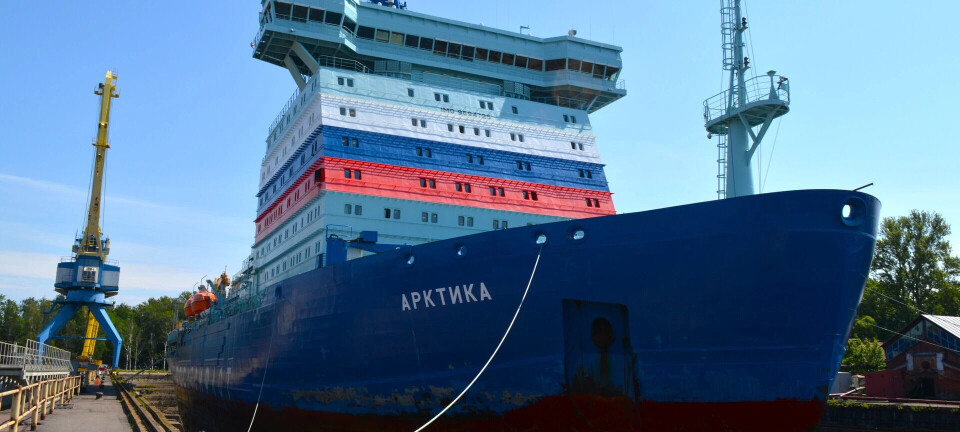
As the Buran made its way across the Northern Sea Route in early November this year it was escorted by the nuclear-powered icebreaker Arktika


Putin orders building of North Pole ice base

The Artur Chilingarov Ice Base will be located on an ice floe and house researchers and tourists who are ready to pay a minimum of €40,000 for a five-day visit.


Dictator Putin commissions his government to participate in efforts to build an ice camp on the North Pole. Photo: Artur Chilingarov Ice Camp on Telegram

Atle Staalesen
16 December 2025 
BARENTS OBSERVER

The decree signed by the Russian dictator on December 15 orders the government to participate in the establishment of a North Pole base.

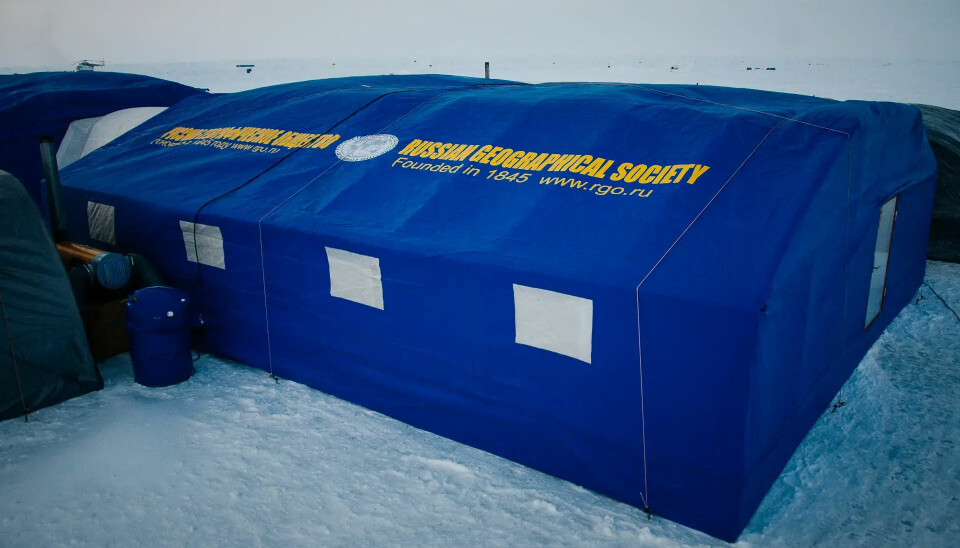
The base is to be developed in cooperation with the Russian Geographical Society and the Academy of Sciences. The decree follows Putin's participation in the Geographical Society's congress in October this year.


The Russian Geographical Society is one of the main organisers of the Artur Chilingarov Ice Base. Photo: northpolecamp.ru

Russia has a long tradition of organising research expeditions on drifting Arctic ice. However, it has become increasingly difficult to find ice floes solid enough to hold the research stations. The last “real” ice station, the “North Pole-40”, was established in October 2012, and had to be evacuated in May 2013, because the ice floe the base was placed on started to break apart.

For many years, a group of Russian businesspeople also organised the Barneo Ice Camp. The camp was built near the North Pole. Because of the unstable ice conditions, the last Barneo camp was held in 2018. Nevertheless, the organisers say that they intend to set up the camp in 2026.


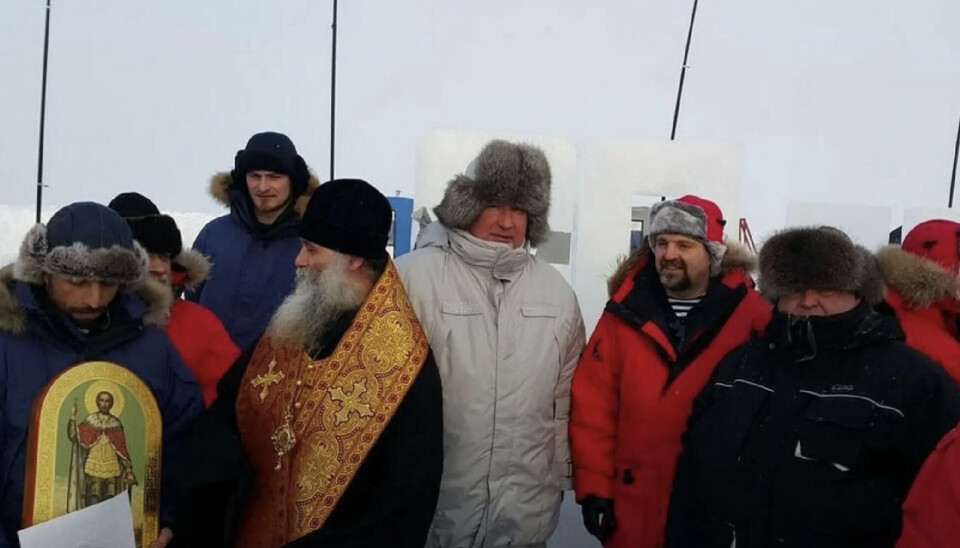
Visitors to the Barneo Ice Camp in April 2015: Russia's deputy prime minister Dmitri Rogozhin (in white jacket) and Bishop Iyakov of Naryan-Mar. Photo: From the archive

It is not clear whether the Artur Chilingarov Ice Base will interact with the Barneo Camp. It is also an open question whether it will be possible to build the camp at all because of the vanishing sea ice.

According to the Artur Chilingarov Ice Base website, a five-day visit costs a minimum of 3,7 million rubles (€40,000). All visits are due to take place in April 2026.

Artur Chilingarov was a famous Soviet-Russian explorer who died in 2024.

Putin's participation at this year's congress of the Russian Geographical Society showed a major level of Kremlin support to the expansionist efforts of the Society.

During the congress, prominent members of the Russian elite discussed initiatives aimed at the Arctic as well as the occupied parts of Ukraine.

In his address, the Russian dictator highlighted the role of the Geographical Society in territorial issues and said that 2027 would be declared the 'year of geography.'

“Given the contribution made by our geographers throughout history to strengthening the state and the paramount importance of geographical science, I ask the government to consider declaring 2027 the Year of Geography,” the Russian ruler said.

"This is important for us from a political point of view,” he explained, and emphasized that "the main event of the year will be consolidation of maps — new maps — of the Russian Federation.”


Putin: “I am confident that the new icebreaker Stalingrad will bear this proud name with dignity”

The keel-laying ceremony for the nuclear-powered icebreaker Stalingrad took place at the Baltic Shipyard in St. Petersburg


The Stalingrad will be painted in the colours of the Russian flag. On its front, the icebreaker will get a painting of the colossal war memorial sculpture Rodina-mat' zovyot! (The Motherland Calls) erected to commemorate the casualties of the battle of Stalingrad. Illustration: Rosatomflot


Thomas Nilsen
18 November 2025 - 
THE BARENTS OBSEVER

The Stalingrad will be the seventh icebreaker in the Project 22220 series.

The Arktika, Ural, Sibir and Yakutia are already sailing in Arctic waters, breaking the ice for petroleum tankers and other vessels sailing along the Northern Sea Route. The two icebreakers Chukotka and Leningrad are under construction at the Baltic Shipyard and are expected to be delivered to Rosatomflot by the end of 2026 and 2028.

On November 18, Vladimir Putin attended the keel-laying ceremony for the Stalingrad, but only via video-link from one of his bunkers, likely in Moscow.

The icebreaker with the "glorious name of Stalingrad," Putin said, "is yet another tribute to the memory and unwavering courage of the defenders and residents of the Volga stronghold, the valour and bravery of the participants in the grand battle, which largely determined the outcome of not only the Great Patriotic War, but also the entire Second World War, and, without exaggeration, influenced the fate of humanity."

As a modern-day dictator, Putin plays on the collective memory of World War II to mobilise society to legitimise current policies by drawing parallels between WWII and present-day conflicts. In this way, the leader in the Kremlin aims to shape the young generation's understanding of sacrifice and war.

Names from geography to mass murderers

When Russia in 2013 laid down the first of the new generation icebreakers, the Arktika, the decision was made to give all vessels geographical names from the northern regions.


Nuclear icebreaker had to sail all to St. Petersburg for basic hull work as Russia's lacks northern dock


That policy changed with the full-scale war against Ukraine, and it was decided that the next two icebreakers to be built should carry the names of the Soviet Union's two dictators and mass-murderers.

The Kamchatka became Stalingrad, and the Sakhalin was renamed to Leningrad.

Also, the two last icebreakers with Soviet hero city names are to be painted differently than the previous vessels. The Leningrad and Stalingrad will be painted in the colours of the Russian flag, and both will have a huge image of a Soviet-style World-War II statue from the relevant city painted on its front.

Stalingrad was officially renamed Volgograd in 1961 as part of the Soviet Union's "de-Stalinization" campaign to distance itself from the dictator Joseph Stalin.

"I am confident that the new icebreaker Stalingrad will bear this proud name with dignity. Operating in the harsh Arctic conditions, blazing a path through the ice, it will become yet another symbol of the talent, strength, and creative energy of our people, their ability to set and implement the most daring plans, and to persevere in the most difficult times," Vladimir Putin said in his video-transmitted speech to the construction yard in St. Petersburg.

Year-round navigation

The new generation icebreakers are powered by two RITM-200 nuclear reactors (2 × 175 MWt). Capable of breaking ice that is 2,8 meters thick or more, the goal is for Russia to provide for year-around sailings from the Kara Sea in the west to the Bering Strait in the east.

All Russia's nuclear-powered icebreakers are based at Atomflot, the service base in Murmansk.


Rosatomflot's service base is located in the northern part of Murmansk on the shores of the Kola Bay. Photo: Thomas Nilsen
On Christmas Day, Moscow sent strategic bombers to Norwegian Sea

Only two days after Tu-95 strategic bombers took off from Olenya, Kola Peninsula, as part of a massive terror raid against Ukraine, similar aircraft from the same base set off towards the Norwegian Sea.


A Tupolev-95 strategic bomber takes off from the Olenya airbase on the Kola Peninsula and sets course for the Barents Sea and Norwegian Sea. Photo: screenshot of video


Atle Staalesen
27 December 2025 
THE BARENTS OBSERVER

There was no proper ground deicing of the Tu-95 strategic bomber that took off from the Olenya air base in the Kola Peninsula this week. A video posted by the Russian armed forces shows the large, four-engine turboprop-powered strategic bomber taking off with snow on its wings and body.

On December 23, bombers from the same airbase had taken part in raids against Ukraine. Two days later, on December 25, the aircraft chose a northern trajectory.

In the former operation, the aircraft carried cruise missiles. In the latter, there were apparently no missiles on board. But the external suspension for the missiles were visible under the wings.

Reportedly, the Tu-95 strategic bombers flew more than 7 hours through the Barents Sea and to the Norwegian Sea. Allegedly, the flight was part of a planned operation and was made over “neutral waters.”

The video shows that the bombers were refueled in the air by a tanker aircraft.

The bombers were accompanied by several of the Northern Fleet’s Su-33 fighter jets, the Russian Defence Ministry reports.

According to the Russian ministry, at certain stages of the flight the bombers were accompanied by fighter jets from foreign countries.

The Norwegian Air Force has not issued any official information about the Russian aircraft.

It is not clear how many aircraft that took part in the operation. According to Russia's war ministry, there were more than one bomber in the air. The operation came only two days after aircraft from the same air force division took off from the same airbase to engage in a major bombing raid against Ukraine.

According to Ukrainian military authorities, aircraft from four Russian airbases, among them the Olenya, took part in the massive attack aimed at Ukrainian cities and infrastructure on December 23.

In the course of Russia’s almost four years of full-scale war of aggression, bombers based in Olenya have repeatedly carried out terror raids against Ukraine.

The airbase in the Kola Peninsula has become a key target for Ukrainian retaliation. Ukrainian drones have several times targeted the base. In the spectacular Operation Spiderweb, the Ukrainians succeeded in destroying several strategic bombers in Olenya, as well as in other Russian strategic airbases.
Man who detonated first nuclear bomb on Novaya Zemlya is honoured with name on Arctic peak

With nuclear tensions on the rise, Russia names mountain peak on Novaya Zemlya after a Soviet rear admiral who was instrumental in developing the nuclear test site in the 1950s.


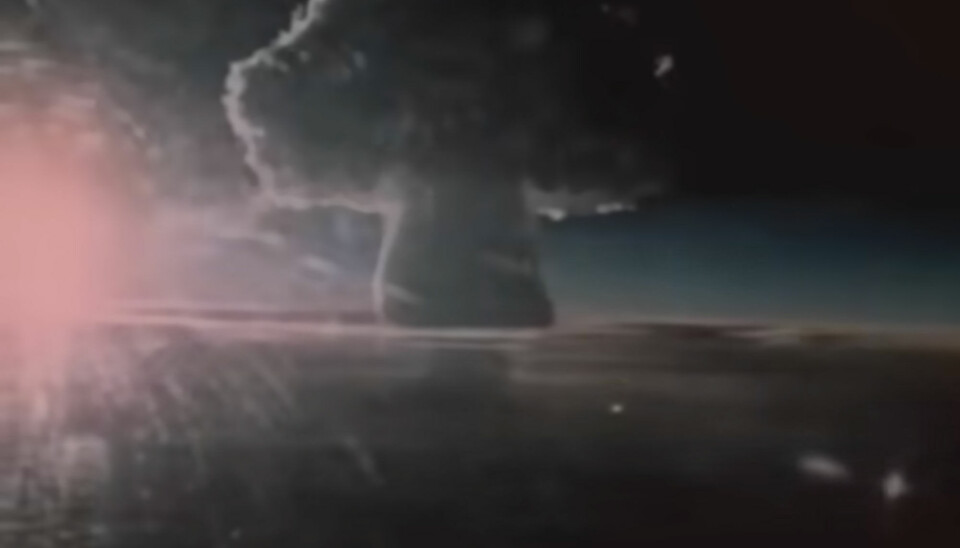
The 50 megaton 'Tsar Bomba' was detonated on Novaya Zemlya on October 30, 1961. Photo: Screenshot of video

Atle Staalesen
3 December 2025 
THE BARENTS OBSERVER

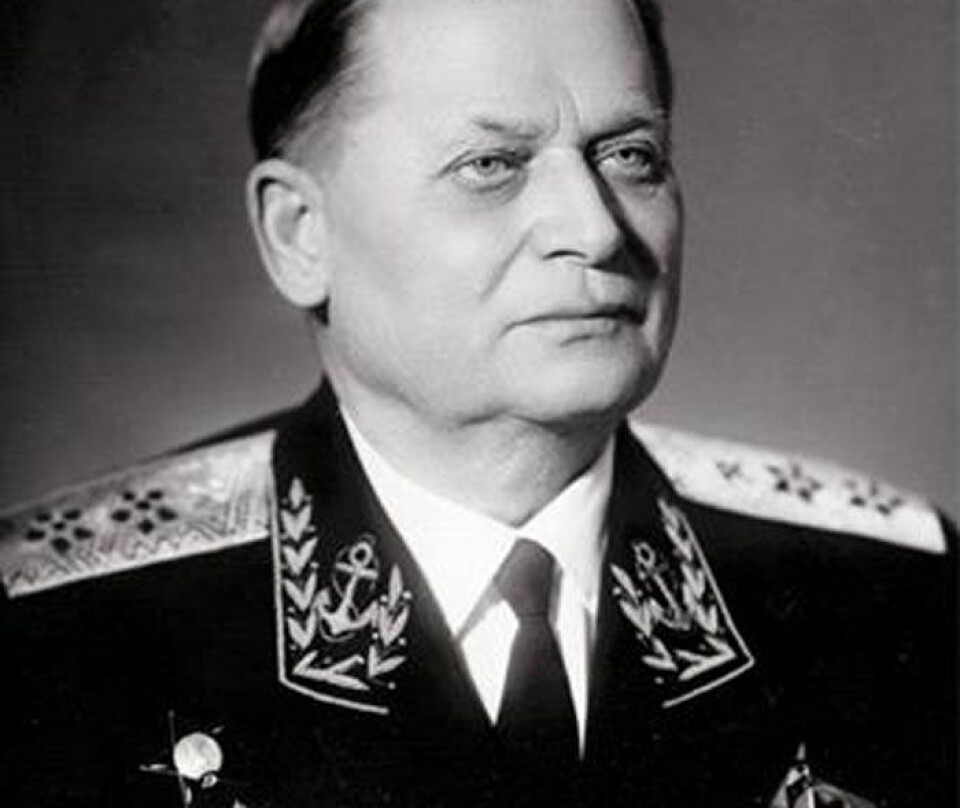
Russian Prime Minister Mikhail Mishustin has signed a decree, according to which a mountain top in the archipelago of Novaya Zemlya will be named after Pyotr Fomin.

The 1241-metre-high peak did not have a name until explorer and colonel Sergei Churkin in 2024 came up with the proposal to name it after the rear admiral. The legislative assembly in Arkhangelsk subsequently organised a poll, which reportedly showed public support for the proposal.


The 'Mount Pyotr Fomin' is located on the northern part of Ostrov Yuzhny, Novaya Zemlya. Photo: Arkhangelsk regional assembly on VK

The mountain is located about 30 km southwest of Severny, a secretive military settlement in the Matochin Strait.

Pyotr Fomin had participated in the building of the Soviet Union's first nuclear submarine, the Leninsky Komsomol, before he was commissioned to lead the development of the nuclear test site on Novaya Zemlya.

He was the first head of the Soviet 6th Naval Command, a body responsible for developing new types of nuclear weapons.

In 1954, the Novaya Zemlya test site was officially opened and Fomin had the responsibility to prepare and organise the testing. It ultimately had catastrophic consequences for the arctic archipelago.


As many as 224 nuclear detonations were set off in Novaya Zemlya in the period between 1955 and 1990. The detonations had a total explosive energy equivalent to 265 megatons of TNT.

Among the detonations was the 'Tsar Bomba,' a 50 megaton explosion that could be seen many hundreds of kilometres away.

According to Andrei Sakharov, the nuclear physicist that turned into a human rights activist, Petr Fomin was shocked by the force of the explosions.


Pyotr Fomin was a rear admiral and head of the Soviet Navy's 6th Command.

Fomin reportedly told Sakharov that "sailors are used to fighting an armed enemy in open battle" and that for him "the very idea of such a massacre is disgusting."

Nevertheless, the rear admiral is praised for his efforts by leaders of today's militant and aggressive Russia.

"He is truly a significant figure for our country and region. Pyotr Fomin has made a significant contribution to strengthening the defence capabilities of our homeland," regional legislator from Arkhangelsk Aleksandr Frolov said.

The Soviet Union conducted several atmospheric nuclear tests, and also tested nuclear torpedoes in Novaya Zemlya. However, the Mount Pyotr Fomin is located in an area where only underground detonations were set off.

The last nuclear test was held in 1990, but Russia has continued to conduct subcritical nuclear tests at Novaya Zemlya. The archipelago is also home to the test site for the infamous Burevestnik nuclear-powered missile currently under development.


In early November this year, Russian defence minister Andrei Belousov hinted that nuclear testing could be resumed. "It is appropriate to begin immediate preparations for full-scale nuclear tests at Novaya Zemlya," he said in a meeting with dictator Vladimir Putin. The statement came after US President Donald Trump said his country could start tests.
‘Does anyone know what Somaliland is?’ Trump responds after Israel’s sudden move

Ryan Prosser
Published December 27, 2025
METRO UK


Reports suggest Trump is not interested in acknowledging Muslim-majority Somaliland 

Donald Trump has indicated he is not yet prepared to fully recognise Somaliland.

On Friday, Israel broke ranks to become the first state to formally support the breakaway republic.


Somaliland is located on the Horn of Africa and shares borders with Djibouti to the north, Ethiopia to the south and west, and Somalia, from which it has broken away, to the east.

Israeli PM Benjamin Netanyahu vowed to bring up the subject during his scheduled meeting with the US president on Monday.

However, the New York Post reported Trump was not interested in acknowledging the Muslim-majority state.

‘Does anyone know what Somaliland is, really?’, he is quoted as asking at his West Palm Beach golf course.

Israeli Prime Minister Benjamin Netanyahu became the first world leader to formally recognise Somaliland on Friday (Picture: Reuters)

Somaliland, a former British protectorate, has offered to join the Abraham Accords, which comprises Arab nations that have normalised relations with Israel.

It has successfully held democratic elections and is viewed as a stable entity, in contrast with unstable Somalia.

It has also extended an offer of land for a possible US naval base in the Gulf of Aden in the Red Sea.

However, Trump seemed largely dismissive of both suggestions. He remarked, ‘big deal’ and added that all proposals were ‘under study’.

‘I study a lot of things and always make great decisions and they turn out to be correct,’ he said.

Abdirahman Mohamed Abdullahi has been the president of Somaliland since 2024 (Picture: Reuters)

The president further suggested his talks with Netanyahu would be dominated by the situation in the Gaza Strip rather than other affairs.

Among US proponents for Somaliland is arch Trump loyalist Congressman Scott Perry, who has submitted an act to recognise the nation.


A former British protectorate, Somaliland gained de facto independence from its civil war-torn neighbour in 1991.


While it enjoys strong relations with neighbouring Ethiopia and some Arab nations including the UAE, other countries in the region advocate against its independence, including Egypt and Turkey.

EU backs Somalia’s unity after Israel's Somaliland recognition

The EU said it encourages meaningful dialogue between Somaliland and the Federal Government of Somalia.

The European Union has said respecting Somalia’s unity, sovereignty and territorial integrity is “key for the peace and stability of the entire Horn of Africa region,” following Israel’s recognition of Somaliland as an independent state a day earlier.

In a statement on Saturday, the bloc said it “reaffirms the importance of respecting the unity, the sovereignty and the territorial integrity of the Federal Republic of Somalia,” in line with its constitution and the charters of the African Union and the UN.

The EU said it “encourages meaningful dialogue between Somaliland and the Federal Government of Somalia to resolve long-standing differences.”

The recognition of the Somaliland region by Israeli Prime Minister Benjamin Netanyahu is against international law, Somali President Hassan Sheikh Mohamud said.

“The illegal aggression of PM Netanyahu in recognising a part of Somalia’s northern region is against international law,” Mohamud wrote on X.

“Meddling with Somalia’s internal affairs is contrary to established legal & diplomatic rules. Somalia & its people are one: inseparable by division from afar,” he added.

Israel became the world’s first country on Friday to recognise Somaliland as a sovereign state, drawing condemnation from Türkiye and countries in Africa and the Middle East, among others.


China drafts stricter rules to regulate AI for emotional interaction

China's cyber regulator proposed draft rules to oversee AI simulating human personalities and emotional interaction, requiring user safety measures, addiction monitoring, data protection, algorithm review, and banning harmful content or behavior.


A humanoid robot Tiangong by Beijing Innovation Center of Humanoid Robotics Co, moves an orange as a demonstration at its company, during an organised media tour to Beijing Robotics Industrial Park. (Reuters Photo)


Reuters
New Delhi,
Dec 28, 2025 03:15 IST


China's cyber regulator on Saturday issued draft rules for public comment that would tighten oversight of artificial intelligence services designed to simulate human personalities and engage users in emotional interaction.

The move underscores Beijing's effort to shape the rapid rollout of consumer-facing AI by strengthening safety and ethical requirements.

The proposed rules would apply to AI products and services offered to the public in China that present simulated human personality traits, thinking patterns and communication styles, and interact with users emotionally through text, images, audio, video or other means.

The draft lays out a regulatory approach that would require providers to warn users against excessive use and to intervene when users show signs of addiction.

Under the proposal, service providers would be required to assume safety responsibilities throughout the product lifecycle and establish systems for algorithm review, data security and personal information protection.

The draft also targets potential psychological risks. Providers would be expected to identify user states and assess users' emotions and their level of dependence on the service. If users are found to exhibit extreme emotions or addictive behaviour, providers should take necessary measures to intervene, it said.

The measures set content and conduct red lines, stating that services must not generate content that endangers national security, spreads rumours or promotes violence or obscenity.

- Ends
CANADA

Annette Dionne, last surviving Dionne quintuplet, dies aged 91

BBC
Grace Eliza Goodwin


Toronto Star via Getty Images
Annette, Yvonne and and Cécile Dionne pictured in 1998

Annette Dionne, the last surviving sister of the Canadian quintuplets, has died at 91, the Dionne Quints Home Museum has announced.

The five identical sisters, born in Ontario at the height of the Great Depression in 1934, were the first known quintuplets to survive past infancy.

They quickly became a global sensation during their childhood - starring in feature films, appearing on the covers of magazines, and endorsing products from toothpaste to syrup.

"Much beloved, Annette had championed children's rights," the museum said in a statement announcing her death.


The Dionne quintuplets on their fourth birthday in 1938

The museum, which seeks to preserve their legacy and educate the public on the quintuplets' controversial upbringing, added: "She believed it was important to maintain the Dionne Quints Museum and the history it provides for the future of all children."

The quintuplets - Annette, Yvonne, Cécile, Émilie, and Marie - were taken away from their parents by the Ontario government when they were infants.

For several years, the authorities displayed the children in a compound dubbed "Quintland", which became a popular tourist attraction.

The children were constantly examined and observed, and had limited contact with their parents and siblings.

Their parents later regained custody of the quintuplets.

The quintuplets on their second birthday


As adults Annette, Cécile, and Yvonne sued the Ontario government for compensation over the circumstances of their childhood, and they received a settlement totalling nearly C$3m in 1998.

Annette was the last surviving sibling out of the 14 Dionne children, the Dionne Quints Home Museum said.

Prior to Annette and Cécile's deaths this year, Émilie died in 1954, Marie died in 1970 and Yvonne died in 2001.

Getty Images
The Dionne sisters at their first formal American press conference in 1952
Kennedy Center demands $1M in damages from musician after canceled Christmas performance - AP

The cancellation followed the White House’s decision last week to rename the center in honor of US President Donald Trump, the Associated Press reported on Friday.

The newly added lettering for US President Donald Trump's name is displayed at the facade of the John F. Kennedy Center for the Performing Arts in Washington, DC, US, December 19, 2025(photo credit: REUTERS/Kevin Lamarque TPX IMAGES OF THE DAY)

DECEMBER 28, 2025 

The John F. Kennedy Center for the Performing Arts Venue President Richard Grenell has reportedly demanded $1 million dollars in damages from musician Chuck Redd who cancelled the center’s traditional Christmas Eve performance on Wednesday.

The cancellation followed the White House’s decision last week to rename the center in honor of US President Donald Trump, the Associated Press reported on Friday.

“When I saw the name change on the Kennedy Center website and then hours later on the building, I chose to cancel our concert,” AP said, quoting an email written to them by Redd, adding that the cancelled Christmas Eve performance was a popular tradition which was why “it was one of the many reasons that it was very sad to have had to cancel.”

Grenell had reportedly written a letter to Redd, which was shared with AP, slamming his decision to withdraw and cancel the performance at the last minute in response to the Center's renaming as "classic intolerance and very costly to a non-profit Arts institution."

The letter also claimed that Grenell would demand $1 million dollars from Redd over the “political stunt,” according to AP.

US President Donald Trump participates in NORAD Santa tracker phone calls, on Christmas Eve, from the Mar-a-lago club in Palm Beach, Florida, US, December 24, 2025. (credit: REUTERS/Jessica Koscielniak)


Kennedy Center renamed 'Trump Kennedy Center'“The Kennedy Center Board of Trustees voted unanimously today to name the institution The Donald J. Trump and The John F. Kennedy Memorial Center for the Performing Arts," Center spokeswoman Roma Daravi announced in a statement released following the vote.

"The new Trump Kennedy Center reflects the unequivocal bipartisan support for America’s cultural center for generations to come.”

The Center did not respond to questions regarding whether congressional approval was sought out or required for the name change.

Trump expressed that he was “honored” and “surprised” by the board's decision during an event in the Oval Office later that day.

“We saved the building,” he later remarked. “The building was in such bad shape, both physically and financially, and in every other way.”

Reuters contributed to this report.


Drone Power And Political Islam: How Turkey’s Military-Tech Complex Fuels Interventionism – Analysis

LONG READ

This paper explores the intersection of drone warfare and political Islam in contemporary Turkish foreign policy, arguing that Turkey’s burgeoning military-tech complex—anchored by companies like Baykar—has enabled a new form of interventionism across West Asia, North Africa, and the Caucasus. By examining Turkey’s drone deployments in Libya, Syria, Nagorno-Karabakh, and beyond, the study highlights how unmanned aerial systems (UAS) have become instruments not just of hard power but also of ideological projection aligned with Ankara’s vision of neo-Ottomanism and Islamist solidarity. The analysis situates Turkey’s drone diplomacy within broader geopolitical ambitions where the fusion of defense-industrial innovation and political Islam under Erdoğan’s leadership enables a unique form of assertive, technologically driven interventionism. This paper also interrogates how Turkey’s use of drones blurs the lines between state security interests and transnational religious-political networks, reshaping conventional paradigms of regional influence, alliance making, and sovereignty.

Turkey’s sudden emergence as an emerging drone power has fundamentally reconfigured its foreign engagements. In the last decade, Ankara has constructed an indigenous unmanned aviation sector—headed by Baykar’s Bayraktar TB2 combat drones—that has become both a strategic instrument and a source of national pride. These drones have allowed Ankara to project military power cheaply in Libya, Syria, Nagorno-Karabakh, and elsewhere, reshaping regional battlefields and projecting Ankara’s power. Domestically, the triumph of Turkey’s drone industry under President Recep Tayyip Erdoğan has been spun into an ideological mythology about a rising Turkey restoring its Ottoman-era glories and dominating the Muslim world. This fusion of Islamist-guided ideology and military technology is remaking the Middle East and threatening US interests.

The analysis below describes Turkey’s drone revolution, its battlefield uses, its ideological sources, and its larger strategic implications, with clear takeaways and policy recommendations for US policymakers.[1] Turkey’s defense industry has made the transition from foreign dependency to assertive domestic production, led by drones. The Bayraktar TB2, a medium-altitude, long-endurance UAV produced by private company Baykar, is a prime example. Once a modest aviation venture, co-owned by President Erdoğan’s family (Baykar’s founder, Selçuk Bayraktar, is Erdoğan’s son-in-law), the firm became internationally renowned by the late 2010s. The TB2 is comparably inexpensive (in the range of a few million dollars per vehicle) but can carry precision-guided munitions and last more than twenty-four hours. It was decisive in initial use against insurgents in Syria and, subsequently, in intense conflicts with conventional forces. Turkey has since added to its unmanned aerial vehicle (UAV) arsenal the more heavy-duty Bayraktar Akıncı UCAV (a large-scale combat drone) and the short-takeoff TB3 for its forthcoming aircraft carrier. Other Turkish companies—particularly state-owned Turkish Aerospace Industries (TAI)—have also created drones (such as, the Anka series), but Baykar’s offerings have been the showpiece success.[2]

This indigenous drone boom has been spurred on by enormous state investment and political favor. Turkey’s Presidency of Defense Industries (SSB) has channeled funds into private companies to bypass import controls and sanctions, resulting in a healthy supply chain. By 2024 alone, Baykar earned more than $1.8 billion in exports (approximately 90 percent of its turnover), selling drones to dozens of nations. Turkey has allegedly taken about 65 percent of the world’s export market for medium-altitude weapons drones. Baykar has already secured contracts for its TB2 variant, which it has sold to over thirty governments, and another ten for the Akıncı, as well as establishing production joint ventures internationally (e.g., in Ukraine). Scale-up has been spectacular: by the early months of 2025, Bayraktar systems had accumulated more than 400,000 flight hours globally, and Turkish sales of Baykar’s drones surpassed those of the United States, Israel, and China. Erdoğan’s government touts these records loudly as proof of Turkey’s technological independence, and the drone sector becomes an issue of national prestige.


This reshaping of Turkey’s defense industry coincided with political purges of the traditional military leadership. Post-2016, Erdoğan and the AKP marginalized the secularist generals who had controlled national security for years, further entrenching presidential authority in procurement.[3] Today, these new generation factories run with little interference or pushback: Baykar, the drone program, is officially taboo to criticize in Turkish media. In Erdoğan’s account, the drone program is not merely a source of income but a validation of Turkey’s “indigenous” and “Muslim-rooted” science. Baykar’s factories and proving grounds have become national icons, covered by the media and even celebrated in textbooks. The proliferation of drone production in Turkey—frequently through family-linked conglomerates—highlights how the military-tech complex has been intertwined with the political regime.


Drones on the Battlefield: Intervention in Practice


Turkey’s military UAVs have not stayed limited to domestic symbol status. Beginning in the mid-2010s, Bayraktar TB2 drones and their relatives have been rolled out in several theaters actively, frequently changing conflict dynamics for Turkey. Turkish drones have been employed in remote theaters, but some of the most significant use cases have been the government’s interventions and proxy wars in Libya, Syria, and the Caucasus. In Libya, Turkey militarily intervened in 2019–2020 on behalf of the UN-recognized Government of National Accord (GNA) of Tripoli against rival Libyan National Army (LNA) leader Khalifa Haftar. Erdoğan sent a combination of Turkish soldiers, Syrian militia fighters, and advanced weapons—preeminently Bayraktar drones and air defense missiles. The TB2 played a decisive role: it destroyed LNA artillery and tanks with missile attacks, breaking Haftar’s siege of Tripoli. Turkish drones gained time for the GNA to regroup until a UN ceasefire was negotiated. Mid-2020 saw Turkey’s intervention reverse Haftar’s advances and victories for the GNA that ultimately compelled a politically negotiated resolution. In Libya, Bayraktar drones thus effectively became Ankara’s spearpoint, allowing a modest Turkish military deployment to exert disproportionate influence.[4]

In Syria and northern Iraq, Turkey has used its UAVs in a series of cross-border strikes against the Kurdistan Workers’ Party (PKK) and allied forces (the Syrian Kurdish YPG/SDF) and, to a lesser degree, surviving ISIS fighters. Starting from about 2016, Turkish drones mounted intensive surveillance and strike flights along the Iraqi border and in northeast Syria. In 2019–2020, Turkey conducted mass incursions (Operations Olive Branch, Peace Spring, Spring Shield, etc.) to drive Syrian Kurdish elements from the Turkish border and to create “safe zones.” Bayraktar drones attacked Kurdish outposts, entrenched defensive positions, and even hit IS cells. These attacks demoralized Kurdish militia forces and aided in the advance of Turkish-backed rebel forces. In 2020, Turkey also used drones to protect its interests in Idlib province: when a spring Syrian regime (Russia-backed) offensive was launched, Turkish TB2s strafed advancing columns and missile batteries, blunting the assault. Turkish drones in Syria also made US plans difficult, as Washington’s primary local ally (the SDF/YPG) was attacked. Overall, Turkey’s drones were central to its sustained effort to remake northern Syria and prevent any Kurdish-controlled enclave on its frontier.

Another exemplar of drone diplomacy by Turkey was the 2020 war between Armenia and Azerbaijan over Nagorno-Karabakh. Turkey supported Baku vigorously, furnishing its ally with hundreds of Bayraktar TB2s and training Azerbaijani pilots. The outcome was a complete Azerbaijani military triumph. Turkish drones pursued Armenian armored forces, anti-aircraft defenses, and troop densities throughout the disputed territory. Footage and testimony depicted Armenian tanks and rocket launchers destroyed from the air. This aerial domination by unmanned aircraft so conclusively altered modern warfare in the region that analysts said it radically shifted the face of war. The conflict concluded with a new truce significantly tilting in Azerbaijan’s favor, allowing it to reoccupy most disputed land. Bayraktar TB2s thereby provided Turkey with a force multiplier that enabled it to reshape the South Caucasus—a region long rooted in Ottoman historic ties—on Ankara’s own terms.[5]

Outside of these flagship conflicts, Turkey’s drones have also appeared in other wars. They have assisted Turkish-backed militias in Libya and Somalia and have been exported to Algeria, Tunisia, and North African nations. Bayraktar drones were used by the military of Ukraine to some success in countering the Russian invasion, and in 2024, Turkey even contracted to build a drone assembly facility in Ukraine. In 2021–2022, Ethiopia imported TB2s for use in its civil war. Reuters and others reported that Pakistani forces employed Turkish drones in a skirmish with India (the first use of Turkish UAVs in South Asia). In every case, TB2s and similar drones impressed by striking targets at standoff range and operating for long hours. A notable feature is that Bayraktar drones can loiter over battlegrounds for a day or more, relaying real-time imagery to commanders and independently dropping guided munitions.

Turkish politicians commemorate these victories. As Erdoğan frequently reminds everyone, Bayraktar drones are a “national weapon” capable of blasting missile defenses and aircraft from the air.[6] At home, the story is that a humble Turkish drone with its “white flag” (the logo of Baykar) killed tanks and helicopters in enemy bases, something even America would struggle with. Indeed, during the Ukraine conflict, even governments and foreign volunteers have crowdfunded to purchase Bayraktar drones for Ukraine for about $5 million each. Such tales buttress the way Ankara markets the drone program as evidence of how “Muslim minds” can out-innovate conventional great powers.

Islamist Ideology and Neo-Ottoman Ambitions


Turkey’s drone capabilities are not an isolated phenomenon; they are part of a wider strategy on the part of President Erdoğan to combine nationalism, political Islam, and Ottoman nostalgia. Erdoğan’s foreign policy has moved emphatically away from secular Kemalism toward an “ambitious Islamist and neo-Ottoman vision,” according to analysts. Erdoğan invokes symbols and memories of the Ottoman era in speeches and in rhetoric in order to mobilize a pan-Turkish, pan-Islamic constituency. He famously alluded in a 2011 election victory speech to cities formerly subject to Ottoman dominance—Sarajevo, Beirut, Damascus, Ramallah, Jerusalem—assuring that “they would benefit” from Turkey’s ascendance. This sort of rhetoric is not merely verbiage. It outlines an ideological agenda of reinvigorating Turkey as a regional hegemon of the Muslim world and an emancipator from Western patronage.[7]

Erdoğan himself comes from Islamist politics (the AKP has its roots in the Islamist Welfare Party), and, during his tenure, Turkish identity has become more intertwined with Islamic and Ottoman themes. He has reopened the historically closed Hagia Sophia museum as a mosque, promoted Turkey as the guardian of Palestinians and other Muslims, and fostered alliances with Sunni Islamist forces globally. The Jerusalem Post’s recent commentary refers to Erdoğan’s group as a “Turkish version of the Muslim Brotherhood, a radical anti-Western movement,” highlighting how profound are these currents. This translates into foreign policy as support for fellow Islamist-led governments or movements, opposition to secular military governments (e.g., Egypt post-2013), and brazenly forging independent trajectories even when in opposition to NATO or EU allies. For instance, Turkey’s agreement with Libya’s GNA was couched as standing in favor of a “legitimate” Muslim-led regime against a secular Western-backed warlord.

Drones comfortably fit this blend by performing both instrumental and propagandistic purposes. Instrumentally, UAVs enable Turkey to intervene in Muslim-majority nations with few “boots on the ground,” reducing casualties among religious or ethnic kin. The digital warfare approach can be marketed domestically as a contemporary tool for protecting Muslim interests. Ideologically, UAV success nourishes Turkish domestic pride: every success is framed as a victory of Turkish creativity and an Islamic identity. Erdoğan and his supporters tend to stress that these weapons are “made in Turkey” by Muslim engineers—a subtle comparison with Western-made weapons. Effectively, the drone revolution is part of Erdoğan’s rhetoric of a “national technology leap” (milli teknoloji hamlesi) that will bring Turkey to its rightful place in the Islamic world.[8]

This neo-Ottoman shift has regional aspirations as well. Turkish naval strategy now openly conceives of dominance of the Aegean and Eastern Mediterranean (the Mavi Vatan or “Blue Homeland” idea). Exercise of control over energy and sea lanes goes with military activism in former Ottoman domains: the Levant, Caucasus, North Africa. Drones also make such ambitions affordable: a dozen TB2s and a few consultants can replace a big ground army or fleet. In Libya, Turkey even invoked history by giving its Libyan expeditionary force the name of Omar al-Mukhtar (the Libyan anti-colonial warrior), framing its intervention as anti-imperialist solidarity rather than conquest. Such ideological presentation—connecting Ottoman heritage to current Islamist solidarity—is a recurring motif. Briefly, Erdoğan’s Turkey sees contemporary military technology such as drones as facilitators of a grand strategy inspired by Islamism.

Alliances in Arms: Islamist Networks and Strategic Partnerships

Turkey’s drone capability is not apolitical; it is matched by an equally ideological tradition of alliance and proxies. Erdoğan’s administration has established a strategic alliance between its military establishment and a constellation of similarly like-minded Islamist forces. The most well-known ally is Qatar. Doha’s ruling family, which funded Erdoğan’s ascent amid his economic tribulations in the 2010s, has a common soft power policy with Ankara of backing the Muslim Brotherhood and Islamist forces at the regional level. Qatar became one of Baykar’s very first international customers; its affluent military bought Bayraktar TB2s and training packages. In return, Turkey granted Doha military training facilities and logistical assistance. Together, they provided backing to friends. Turkey shielded Qatar in the 2017 Gulf crisis, and Qatar invested funds into Gaza and Syria via Turkish conduits. This Turkish–Qatari “Sunni alliance” supported Hamas, Muslim Brotherhood franchises in Libya and Tunisia, and Syrian Islamist elements. The Jerusalem Post mentions that Qatar “is a long-time supporter of Muslim Brotherhood activities across the globe” and that Turkey’s motives are “augmented by the economic generosity of Qatar.” In reality, Baykar drones and Qatari petrodollars have turned into twin levers, driving Islamist agendas.

Turkey also openly aligned with some militants beyond traditional Middle Eastern monarchies. Erdoğan invited Hamas leaders to Turkey for years, giving them political cover and a home base. Hamas officials have established Istanbul as a second headquarters, hosting press conferences and raising money with no Israeli pressure. Turkey’s military and intelligence officials had contact with the Gaza group for years. In turn, Turkish NGOs have cooperated with Brotherhood-affiliated parties in Egypt (prior to the Sisi crackdown) and Tunisia’s Ennahda (particularly in the Arab Spring aftermath). In Libya, Turkey became patron to the GNA militias, most of which were derived from or based on the Libyan Muslim Brotherhood. As a report by an Israeli think tank (Dado Center) remarks, Ankara’s Libyan strategy was positively carried out “under the cloak of Ankara’s relation with the Muslim Brotherhood.” This involved supplying arms (including drones) and combatants to GNA-aligned militias, while Western powers called out all foreign fighters to leave. During the Syrian civil war, there were some indications that Turkish-backed rebels had included hard-line Islamists (from Ahrar al-Sham to HTS) that coexisted with one another in operations. Turkey’s patronage had helped such groups to endure as a buffer against Assad and Kurdish forces.[9]

Ankara has, according to reports, facilitated networks that transfer money from Iran to Hezbollah-held Lebanese operations, and some Turkish NGOs maintain contacts in Iran for commercial purposes. Ankara’s collaboration with Iran (for instance, concerning airspace or proxy coordination in Iraq and Syria) has been identified as concerning in capitals such as Riyadh and Tel Aviv. One of the senior Israeli officials warned that Turkey’s combination of Islamist and Turkish nationalism renders it “a greater threat than Iran” since it can walk across Sunni–Shia fault lines and organize Islamist solidarity. In reality, Turkey has already sold drones to a variety of non-western states —Algeria, Pakistan, Malaysia—expanding the circle of influence of its military-tech exports. With these alliances, Turkish drones have even marched in parades and air shows from Islamabad to Tripoli, broadcasting a clear message: Turkish military capabilities are for lease to those who can match its strategic or ideological affinity.

The Erdoğan period has witnessed the convergence of Turkey’s defense industry and Islamist foreign policy. High-tech drones are at once a diplomatic bargaining chip and a force multiplier for Islamist-linked proxies. We observe this in synergistic arms contracts (e.g., Baykar securing deals from Pakistan and Qatar), in mercenary groups (Syrian militants transited through Turkey to Libya), and in technology trade (even talks started about co-manufacturing TB2s with Egypt after ties were normalized).[10] For anti-Western and Islamist movements, Turkish drones provide cutting-edge support; for Baykar and its sponsors, providing these customers secures additional global market presence and strategic depth. This strategic partnership complicates regional order: it empowers militias in Libya, supports Hamas in Gaza, and even connects Turkey to Islamist groups in Europe through diaspora networks. And always at its center is the notion that drones, invented by “Muslim engineers” as Turkish propaganda insists, empower a sort of pan-Islamic resistance to Western hegemony.

Regional Impact and Challenges to the United States


Turkey’s interventionist approach—mixing Islamist ideology with advanced drones—is redefining regional dynamics that directly impinge on US interests.

Turkey is still a member of NATO, with the organization’s second-largest military, but its actions frequently conflict with other allies and with the US strategic agenda. Turkish drones and military deployments have emerged as a wild card in theaters where the United States has long been the security guarantor.[11] In the Eastern Mediterranean, Turkish assertiveness endangers a precarious regional balance. Ankara’s exploration endeavors and sea claims (accompanied by military actions) provoke Greece, Cyprus, and Israel, all of them US allies. The 2019 naval agreement with Tripoli effectively created a vast sea zone that disregarded Greek and Cypriot interests and outraged EU allies. Turkish drones have been used to patrol and exercise in Cypriot airspace, increasing the risk of collisions with EU-backed naval patrols. This undermines US leverage: Washington has fostered alliances with Greece, Cyprus, Israel, and Egypt to secure Eastern Mediterranean hydrocarbons and push back against Iran and Russia. Turkey’s drone-backed provocations in these waters put new stress on NATO cohesion, forcing Washington to repeatedly mediate between Athens and Ankara to avoid a crisis.[12]

In the Middle East, Ankara’s moves balance out US and regional interests. The United States long sought stable relations with Egypt, the UAE, Saudi Arabia, and Israel as a counter to Iran and jihadist extremism. Turkey’s support for Qatar and the Muslim Brotherhood set up a parallel Sunni axis that often thwarted those aims. Even as Egypt drifted closer to Greece and Israel against Turkey’s regional designs, Ankara has retaliated by backing Islamist blocs and safe havens that resist Egyptian and Emirati agendas (for example, having Muslim Brotherhood ideologues on its territory). In Syria, US policy too frequently has been to shore up areas controlled by Kurdish-led SDF troops, but Turkey regards those troops as terrorists and made repeated attacks upon them, even pushing the United States out of certain border zones.[13] The net impact is that an ally of the United States—Turkey—utilizes cutting-edge equipment in a manner that makes the US struggle more difficult against extremism. Likewise, in Libya, Turkey’s backing for one set of forces effectively guaranteed the survival of a government many Gulf Arab powers had opposed (and some Western interests did not actively support either).

Turkey’s orientation towards Russia and other non-Western nations also makes Washington nervous. Turkey’s acquisition of the Russian S-400 missile defense system resulted in its removal from the F-35 program and strained relations with the Pentagon. But while Ankara claims autonomy, it continues to use membership in NATO—hosting American troops at Incirlik Air Base and allegedly on board to sanction Iran—even as it pursues policies the Pentagon abhors (such as letting Iran-backed militias into Syria to battle American forces). Erdoğan’s tightrope act— courting China’s Belt-and-Road and joining the Moscow-sponsored Shanghai Cooperation Organization as a dialogue partner—warns US policymakers that Turkey may be drifting out of the West. In the Black Sea and wider world, Turkey’s expanding arms exports assist it in making new friends (Ukraine, Pakistan) at the expense of the United States.[14]

The test for the United States is how to react without weakening NATO and alliance institutions. US troops in Europe and the Mediterranean now have to factor Turkish drones into considerations that would previously have been deemed unlikely. Middle Eastern allies observe how US focus on Iran and Russia increases the leeway for Ankara. Domestically, Washington policymakers are under pressure from constituencies alarmed at Turkey’s Islamist shift. Congressional hearings have brought Turkey’s support for Hamas and Hezbollah to the fore, triggering proposals to sanction the Turkish parties involved. The picture is one of a nation that is no longer simply a “good ally” in the US-led system but neither is it absolutely an enemy. It is a rather mercurial ally—powerful militarily, volatile politically—equipped with drones that lend its foreign policy a cutting edge.[15]


Key Takeaways


•Turkey’s drone surge is real and significant: Over a few years, Turkey has constructed a globally competitive UAV sector. Bayraktar TB2 attack drones and more advanced variants have provided Ankara with the capacity to strike well beyond its borders at relatively low expense.[16] Turkey now sells this technology extensively and dominates the international market for armed drones.

•Turkey has facilitated military adventurism: Turkish drones played a significant role in altering the dynamics of wars from Libya to Nagorno-Karabakh. They multiply Turkish firepower wherever Ankara has intervened, destroying hostile defenses, cutting supply lines, and backing friendly proxies. In all instances, drone attacks have been a force multiplier that enhances Turkey’s leverage without necessitating massive troop deployments.

•The importance of ideological and identity factors: Erdoğan’s administration attributes its drone victories to an overarching story of Islamic unity and Ottoman revival. Sophisticated UAVs are hailed as “Muslim technology” products capable of holding their own against conventional Western weaponry. This serves to reinforce Ankara’s outreach to Islamist forces beyond its borders and prop up propaganda domestically. [17] The drone initiative is as much about pride and identity as it is about military strength.

•Turkish defense exports stream to Islamist-aligned forces: Turkish drones and weaponry consistently wind up in the hands of governments and forces with Ankara’s political perspective. Allies like Qatar and Pakistan, partners in fights such as Libya’s GNA or Palestinian Hamas, and even missions in locations like Syria’s Islamist fronts have been assisted by Turkish weapons.[18] Turkey has also been accused of supporting Hezbollah financing and cooperating with Iran on certain security matters, demonstrating that its arrangements extend to openly anti-Western circles.

•American interests are confronted with strategic headwinds: Turkey’s belligerent employment of drones makes the United States more complicated to defend. It increases tensions in NATO, strains diplomacy with essential Mideast allies, and empowers militaries and militias that are sometimes in opposition to US objectives. Turkish drones have been directed against Western-backed fighters and have taken out targets intended to restrict ISIS or Iran.[19] Without restraint, Turkey’s new model—marrying Islamist politics to military high-tech—threatens to change balances in the Levant, the Eastern Mediterranean, and North Africa in ways that run counter to US policy.
Policy Recommendations

•Enhance assistance for regional allies: Reinforce security cooperation with the most endangered US allies threatened by Turkish behavior. This involves augmenting the military capabilities of Greece, Cyprus, Israel, and Egypt through exercises and arms transfers (e.g., Patriot missile batteries or Western drones). Augment naval and air presence in the Eastern Mediterranean to counter Turkish intimidation.[20] Make sure that Gulf Arab allies have alternatives to Turkish weaponry—for instance, provide US or European drone technology to nations such as Saudi Arabia and the UAE to balance Bayraktar sales.

•Regulate drone proliferation and countermeasures: Coordinate with NATO and export-control regimes to limit the spread of sensitive drone technology to conflict areas and potential competitors. Promote anti-drone defenses (such as electronic warfare and kinetic interceptors) to US and allied forces. Invest in next-generation US UAV development[21] (loitering munitions, long-range drones) to sustain technological advantage. Promote intelligence sharing regarding Turkish UAV deployments to enhance situational awareness among partners.

• Leverage alliance avenues and sanctions where viable: Utilize NATO platforms to criticize Turkey’s differences publicly (e.g., protest unmanned attacks that thwart coalition objectives). Link US military aid or sales (such as F-16 modernization) to advancement on common aims; demand Turkish efforts against Hamas, Hezbollah, or other listed groups; or condition future arms collaboration on conformance with NATO policy.[22] Where violations occur (such as financing of Iranian proxies), consider targeted sanctions on the facilitating entities to impose a real cost on Ankara’s dubious transactions.

• Engage Turkey diplomatically, but guard principles: Continue dialogue with Ankara on areas of common interest (counterterrorism against ISIS, economic ties, NATO modernization) to keep Turkey anchored in the West’s orbit. Simultaneously, reaffirm publicly US positions on global law to balance Turkey’s one-sided actions (e.g., patrols off Cyprus, contended maritime boundaries). Invite EU allies to include human rights and rule of law issues in EU–Turkey relations so that Turkey’s drift is not unremarked.[23] Offer support to civil society and moderate forces within Turkey by way of cultural and educational exchanges, making clear that US engagement honors Turkey’s prosperity as a stable democracy.

•The coordination of like-minded countries: Form alliances within the region against the destabilizing influence of unilateral drone warfare. For instance, join forces with Egypt, France, and others on diplomatic efforts to contain foreign fighters in Libya. Coordinate with the Gulf Cooperation Council to align their security planning and cut reliance on any one supplier.[24] Also, involve major players such as Russia and China to communicate that Turkey’s deployment of sophisticated UAVs can fuel wars (e.g., in Syria and Libya) and ought to be regulated collaboratively.

•Promote non-military options where possible: Because Turkey’s model is premised on the rhetoric of being the defender of Muslim causes, the United States can respond to bad-faith ideology with open-ended assistance. Ratchet up assistance for reconstruction and governance initiatives in post-conflict areas (Libya, Syria, Gaza), emphasizing pluralistic institutions.[25] Demonstrate that Muslim-majority nations can thrive with inclusive, non-ideological politics and thereby diminish the attractiveness of Turkey as the only protector of Muslim interests.

By blending these strategies of security guarantees to friends, export restrictions, principled statecraft, and ideational counterbalances, Washington can start to counterbalance Turkey’s rising power. Turkey’s drone complex and Islamist-tainted activism cannot be reversed, but the United States can frame the context so that they do not single-handedly upset regional order. The age of interventionism by drones requires a candid policy reaction: one that dissects both the hard technology on the battlefield and the soft ideology behind it to safeguard US and allied interests.


1 Sibel Düz, “The Ascension of Turkey as a Drone Power: History, Strategy, and Geopolitical Implications,” SETA Analysis, July 3, 2020, https://www.setav.org/en/the-ascension-of-turkey-as-a-drone-power/

2 Can Kasapoğlu, “Techno‑Geopolitics and the Turkish Way of Drone Warfare,” Atlantic Council Issue Brief, March 2022.

3 Çağlar Kurç, “Between Defence Autarky and Dependency: The Dynamics of Turkish Defence Industrialization,” Defence Studies 17, no. 3 (2017): 260–81.

4 Hüseyin Bağcı and Çağlar Kurç, “Turkey’s Strategic Choice: Buy or Make Weapons?,” Defence Studies 17, no. 1 (2017): 38–62.

5 Brendon J. Cannon, “Turkey’s Military Strategy in Africa,” in Turkey in Africa: A New Emerging Power?, eds. Elem Eyrice Tepeciklioğlu and Ali Onur Tepeciklioğlu (Routledge, 2021).

6 Kareem Fahim, “Turkey’s Military Campaign Beyond Its Borders Is Powered by Homemade Armed Drones,” Washington Post, Nov. 30, 2020.

7 Laura Pitel, “Turkey’s Armed Drones Bolster Erdogan’s Hard‑Power Tactics,” Financial Times, Oct. 8, 2020.

8 Raphael D. Marcus, “Learning ‘Under Fire’: Israel’s Improvised Military Adaptation to Hamas Tunnel Warfare,” Journal of Strategic Studies 42, nos. 3–4 (2019): 344–370.

9 Edward J. Erickson, “Turkey as Regional Hegemon—2014: Strategic Implications for the United States,” Turkish Studies 5, no. 3 (2004): 25–45.

10 E. C. Hay Yanarocak, “Turkey’s Giant Leap: Unmanned Aerial Vehicles,” Turkey Scope 4, no. 6 (2020): 1–12.

11 Nargorno-Karabakh conflict referenced in Alex Gatopoulos, “The Nagorno‑Karabakh Conflict Is Ushering in a New Age of Warfare,” Al Jazeera, Oct. 11, 2020.

12 Glenn D. Hook, Militarization and Demilitarization in Contemporary Japan (Routledge, 2003).

13 Ash Rossiter, “Turkey’s Path to Drone Power,” TRENDS Research & Advisory, Dec. 8, 2021,

14 Özgür Özdamar and Devlen Balkan, “Man vs. the System: Turkish Foreign Policy After the Arab Uprisings,” in Fear and Uncertainty in Europe: The Return to Realism?, eds. Roberto Belloni, Vincent Della Sala, and Paul Viotti (Springer, 2019).

15 Ash Rossiter and Brendon J. Cannon, “Turkey’s Rise as a Drone Power: Trial by Fire,” Defence & Security Analysis (2022): 1–20.

16 Diğdem Soyaltin‑Collela and Tolga Demiryol, “Unusual Middle‑Power Activism and Regime Survival: Turkey’s Drone Warfare and Its Regime‑Boosting Effects,” Third World Quarterly 43, no. 8 (2022): 1542–1560.

17 Bruno Oliveira Martins, Pinar Tank, and Beste Işleyen, “Drone Diplomacy: How Turkish Military‑Tech Exports Shape Islamist Soft Power,” Globalizations 20, no. 4 (2023): 587–606.

18 Binnaz Toprak, “Islam and the Secular State in Turkey,” in Turkey: Political, Social, and Economic Challenges in the 1990s, eds. Çiğdem Balım et al. (Brill, 1995).

19 Soyaltin‑Collela and Demiryol, “Unusual Middle‑Power Activism.”

20 Martins, Tank, and Işleyen, “Drone Diplomacy.”

21 Dominika Kunertova, “Drones Have Boots: Learning from Russia’s War in Ukraine,” Security Dialogue 54, no. 3 (2023): 225–244.

22 Cihan Tuğal, “Islamism as Religio‑Moral Populism in Turkey,” Comparative Studies in Society and History 44, no. 4 (2002): 693–722.

23 Aslı Ege, “Foreign Policy as a Means of the AKP’s Struggle with Kemalism in Relation to Domestic Variables,” Turkish Studies 23, no. 4 (2022): 554–575.

24 Kurç, “Between Defence, Autarky, and Dependency.”

25 Cihan Tuğal, “Islamism in Turkey: Beyond Instrument and Meaning,” Sociological Theory 21, no. 4 (2003): 406–436.

About the author: Mohammad Taha Ali is a researcher with an MA in Conflict Analysis and Peace Building. His work examines the intersection of ideology and strategy in the Middle East, with a focus on the evolving strategic autonomy of regional states. He writes on security issues, regional rivalries, and the influence of clerical authority in shaping state policy.

Source: This article was published at the Middle East Quarterly

Middle East Quarterly

Middle East Quarterly, published since 1994 and edited by Efraim Karsh, it is the only scholarly journal on the Middle East consistent with mainstream American views. Delivering timely analyses, cutting-edge information, and sound policy initiatives, it serves as a valuable resource for policymakers and opinion-shapers.
Mapping The Maldives: Why Hydrography Is The New Geopolitics Of The Indian Ocean – Analysis


December 28, 2025 
IPCS
By Sayantan Bandyopadhyay

Malé, the capital of the Maldives, witnessed a large ‘Lootuvaifi’ (‘Stop the Looting’) rally on 3 October 2025. This was the biggest public demonstration against President Mohamed Muizzu since his election. The opposition Maldives Democratic Party (MDP) issued five key demands during the rally. Strikingly, none addressed the protection of the country’s hydrographic information and maritime data.

This omission comes against the backdrop of China’s expanding presence in the Indian Ocean. Despite President Muizzu’s commitment to the Maldives mapping its own waters, his government has signed opaque agreements with China for hydrographic mapping, and allowed China’s dual-use research vessel, Xiang Yang Hong 03, to dock in Malé. These developments introduce new uncertainties regarding Beijing’s intentions, and raise serious questions about the Maldives’ maritime sovereignty.
Hydrography and Strategic Cartography

Hydrography has emerged as an important instrument in Indian Ocean geopolitics. Whoever has greater control over oceanic data can wield it to their geopolitical advantage. For smaller states like the Maldives, hydrography thus is both a development and a security issue. For context, hydrography is the science of measuring and describing the physical features of oceans, seas, coastal areas, and the seabed. Though it may seem benign, its use goes beyond mapping. Hydrographic data, as per the International Hydrographic Organisation, is a foundational asset for maritime governance and state rights. It involves collecting and analysing data on water depths, tides, currents, and shorelines, physical features such as seabed compositions, and underwater obstructions, to describe and predict changes over a period of time.

Hydrography supports essential civilian uses, including safe navigation, resource management, infrastructure planning, disaster prediction, and scientific research. It is also a dual-usetechnology with significant military applications in strategic planning, battlefield operations, maritime domain awareness, intelligence, surveillance, and equipment testing. Hydrography provides the data for strategic cartography, where maps become tools of influence, surveillance, leverage, and territorial control. The UK’s post-1982 hydrographic activities in the Falklands, China’s use of cartography to legitimise claims in the South China Sea, and the US Navy’s Freedom of Navigation Operations to contest Chinese claims all illustrate how mapping functions as a tool of maritime power.


Maldives’ Pursuit of Hydrographic Autonomy

With 1,192 islands, a total land area of 298 sq km, and an Exclusive Economic Zone (EEZ) spanning 900,000 sq km, the Maldives faces a strategic cartography challenge in mapping the entirety of its EEZ. After cancelling its 2024 hydrographic cooperation agreement with India, President Muizzu announced that the Maldives would conduct its own surveys to safeguard marine data. However, debts ranging from US$ 557 million in 2025 and over US$ 1 billion in 2026 complicate the Maldives’ ability to import the necessary hardware and software for this exercise.

The now-terminated India-Maldives agreement had enabled the Maldives to gain capacity-building, technical training, and to conduct hydrographic surveys under the Maldives National Defence Force (MNDF) leadership. The decision to end the agreement stemmed from Muizzu’s ‘Maldives First’ policy announced in 2023, which sought to assert national autonomy in maritime governance and reduce external dependence. Malé, following the termination of the agreement, sought to indigenise hydrographic activities by engaging domestic firms. However, limited technical expertise and lack of sophisticated equipment necessary for independent operations stymied their efforts.

China’s interest in the Indian Ocean region poses strategic challenges for small island states such as the Maldives in safeguarding hydrographic data. The Chinese survey vessel docking in Malé after conducting hydrographic surveys in the Maldives’ EEZ, followed by a 2025 agreement between the Maldives Environmental Protection Agency and the South China Sea Institute of Oceanology, has heightened concerns about opaque data collection. Maldivian media have reported on China retaining exclusive data access of seabed devices and fish-aggregating systems capable of monitoring currents, acoustics, and the movement of ships and submarines. China has a history of using hydrographic data in the South China Sea for sea-denial and A2/AD (anti-access/area-denial) strategies. This is a serious development for the Maldives’ data sovereignty, with downstream implications for other regional and extra-regional actors such as India, the US, France, Japan, and Australia.
Way Forward

The Maldives has sought to address capacity gaps and balance against external monopoly by seeking assistance from abroad. If developed fully, such a strategy would have the long-term goal of transforming the country into a hydrography powerhouse, strengthen its maritime agency, and protect its blue economy. The short-term approach would involve prioritising existing resources and building domestic capacity through selective and transparent international partnerships. A hedging strategy remains its most viable path, with partnerships based on transparency, economic benefits, and data autonomy. Malé has already approached partners such as Australia for hydrographic equipment. The maritime security provisions of the 2020 Maldives US Defence Framework Agreement can also be used for future hydrographic capacity-building. India, too, offers a credible model with a record of transparent, win-win hydrographic cooperation. China may also be leveraged cautiously as it recalibrates its image toward capacity-building.


About the author: Sayantan Bandyopadhyay is a doctoral research scholar with the Centre for South Asian Studies (CSAS) at the School of International Studies (SIS), JNU, New Delhi.


Source: This article was published by IPCS


IPCS

IPCS (Institute for Peace and Conflict Studies) conducts independent research on conventional and non-conventional security issues in the region and shares its findings with policy makers and the public. It provides a forum for discussion with the strategic community on strategic issues and strives to explore alternatives. Moreover, it works towards building capacity among young scholars for greater refinement of their analyses of South Asian security.