Monday, December 29, 2025

Hyundai says can't buy back Russian plant as buyback deadline looms

Hyundai says can't buy back Russian plant as buyback deadline looms
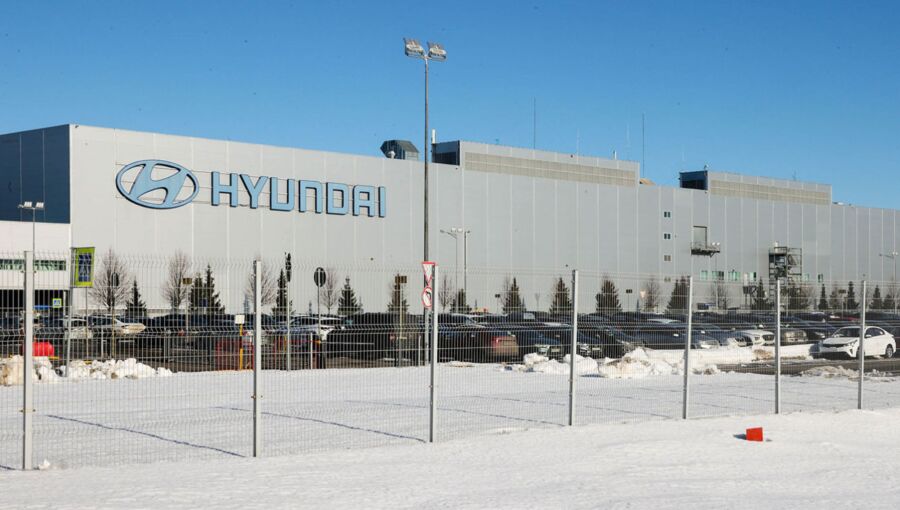
Hyundai production facility. / Tass: CC
By bne IntelliNews December 29, 2025

South Korean automaker Hyundai Motor Group, in the current situation, cannot" exercise its right to buy back its former St Petersburg plant due to the Ukraine conflict, with the buyback option expiring in January, US-based Reuters and Russian Tass reported on December 29.

The Hyundai Motor plant opened in 2010, producing Hyundai Solaris, Hyundai Creta and Kia Rio models with annual output exceeding 200,000 vehicles. The facility halted production in March 2022 following the start of Russia's military operation in Ukraine due to component supply disruptions. The company has been registering and maintaining trademarks in Russia, which analysts read as keeping the door open for a possible re‑entry once sanctions or political risks ease, though the firm says it is not yet ready to buy back its former plant.

"This is not a situation in which we can buy back [our] shares," a source familiar with internal company discussions stated, according to TASS. The source did not specify reasons but indicated the Ukraine conflict must be concluded.

The right to buy back the former plant expires in January. The agency does not have information on whether Hyundai Motor may attempt to negotiate an extension of the buyback right deadline.

The South Korean automotive giant sold its St Petersburg plant in 2024 for a symbolic sum with a two-year buyback option. According to South Korean media, the price was approximately RUB10,000 (KRW140,000, $120).

Hyundai Motor told the agency that a final decision on the matter has not been taken. AGR Automotive Group, the new owner, produced a test batch of Chinese brand GAC vehicles at the former Hyundai plant on December 17.

Production of automobiles under the new Solaris brand was previously launched there. First Deputy Prime Minister Denis Manturov stated on December 26 that all automotive plants abandoned by foreign companies in Russia will be operational by summer 2026.

Japanese automaker Mazda has reportedly resumed deliveries of its vehicles to Russia via intermediated import channels, drawing criticism that renewed sales and tax contributions could indirectly support the Russian state, the Business and Human Rights Centre previously reported.

Ariston Holding (Italian white goods and heating firm) plans to restart operations at its Russian plant after the Kremlin restored control of the unit to the company, making it one of the clearest industrial “return” cases this year.

Sen. Bernie Sanders: Congress ignoring the threat AI poses to workers, humanity


In this Nov. 9, 2018, file photo, a Bossa Nova robot scans shelves to help provide associates with real-time inventory data at a Walmart Supercenter in Houston. Robots aren’t replacing everyone, but a quarter of U.S. jobs will be severely


By Seth McLaughlin - The Washington Times - Sunday, December 28, 2025


Sen. Bernie Sanders warned that the rapid rise of artificial intelligence poses profound risks for American workers and society, arguing that the billionaires driving the technology’s development are motivated by profit and power rather than public well-being.

Speaking on CNN’s “State of the Union,” the Vermont independent said Congress has failed to grapple with the economic and social upheaval AI could unleash, particularly for workers whose jobs may be eliminated.


Mr. Sanders also said younger generations are increasingly turning to AI for emotional support instead of human relationships, raising broader questions about the technology’s impact on humanity.

He noted that some experts believe AI could soon surpass human intelligence, making once‑far‑fetched scenarios more plausible.

“So the science fiction fear of AI running the world is not quite so outrageous a concept as some have thought it was,” Mr. Sanders said.

The rise of AI is fueling an intensifying debate over the pros and cons of the technology and over whether elected officials — many of them Baby Boomers — have responded with enough urgency.

Even skeptics believe that AI could strengthen health care and education and help develop new, more effective drugs to treat disease.

“Along with those wonderful things come some scary things, and I don’t think people are putting enough work into how we can mitigate those scary things,” Geoffrey Hinton, a British-Canadian computer scientist known as the “Godfather of AI,” said, also on CNN’s “State of the Union.”

Mr. Hinton said some companies have been more responsible than others in striking a balance between AI safety and profitability. He said the government must do more to test chatbots now that they have been linked to suicide.

Mr. Sanders, meanwhile, singled out Elon Musk, Mark Zuckerberg, Jeff Bezos and Peter Thiel as key figures investing heavily in AI, arguing their goal is to consolidate wealth and influence. Mr. Sanders cited comments from Mr. Musk predicting that AI and robotics could eliminate all jobs, and from Bill Gates suggesting that humans may not be needed for most tasks in the future.

“Well, I got a simple question: If there are no jobs and humans won’t be needed for most things, how do people get an income to feed their families, to get health care, or to pay the rent?” Mr. Sanders said. “There has not been one serious word of discussion in the Congress about that reality.”


Copyright © 2025 The Washington Times, LLC.
FREE SPEECH IS UNCOMFORTABLE

Activist Alaa Abd El-Fattah apologises for historic tweets - but says some were 'misunderstood'

The historic social media posts by Alaa Abd El-Fattah emerged after he returned to the UK on Boxing Day following several years of imprisonment in Egypt.


Monday 29 December 2025 
SKY NEWS


PM under pressure over activist


A British-Egyptian activist has apologised "unequivocally" for "shocking and hurtful" past social media posts in which he appears to call for violence against "Zionists" - but said some had been "completely twisted".

The historic tweets by Alaa Abd El-Fattah emerged after he returned to the UK on Boxing Day following several years of imprisonment in Egypt.

"I am shaken that, just as I am being reunited with my family for the first time in 12 years, several historic tweets of mine have been republished and used to question and attack my integrity and values, escalating to calls for the revocation of my citizenship," he said in a statement on Monday.

"Looking at the tweets now - the ones that were not completely twisted out of their meaning - I do understand how shocking and hurtful they are, and for that I unequivocally apologise."

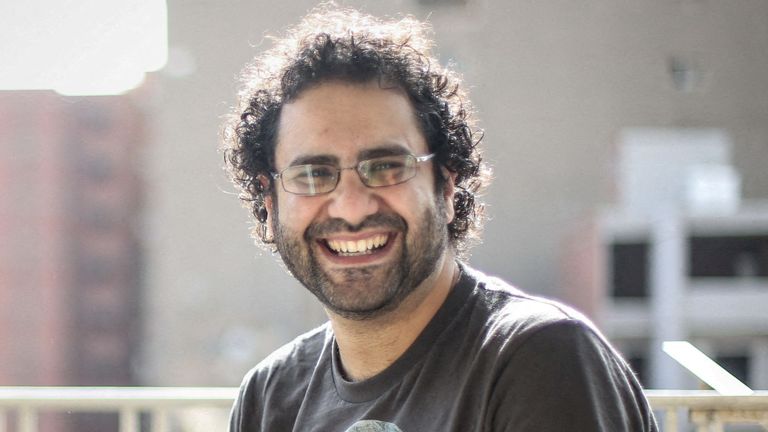
Alaa Abd El-Fattah was pardoned in September 2025. Pic: AP

Mr Abd El-Fattah was a leading voice in Egypt's 2011 Arab Spring uprising and went on hunger strikes behind bars.


He was most recently detained in September 2019 and sentenced to five years in prison in December 2021, on charges of spreading false news.

UN investigators branded his imprisonment a breach of international law, and both Conservative and Labour governments lobbied for his release.

Egyptian president Abdel-Fattah el-Sisi pardoned the activist earlier this year and he flew to the UK to reunite with his young son, who lives in Brighton, last week.

He had been granted UK citizenship in December 2021 under Boris Johnson, reportedly through his UK-born mother.


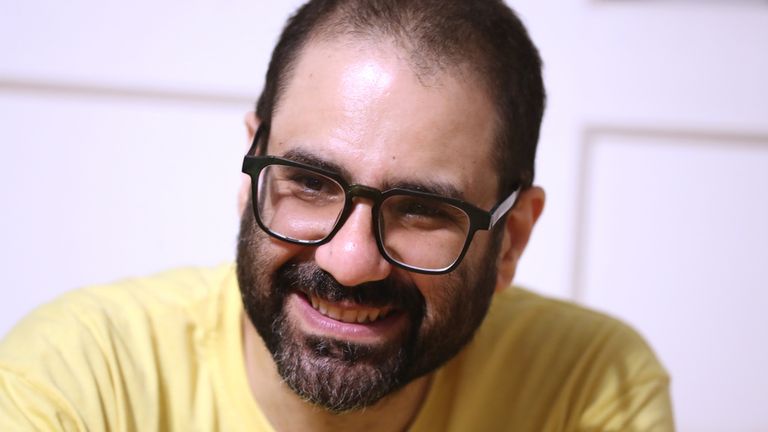
Mr Abd El-Fattah with his sister after his release from prison. Pic: Twitter/@monasosh

'I take allegations of antisemitism very seriously'

After the historic social media posts came to light, Conservative leader Kemi Badenoch, shadow justice secretary Robert Jenrick and Reform UK leader Nigel Farage called for the home secretary to look into whether the activist can be stripped of his UK citizenship and deported.

In his statement, the activist highlighted that he is now a middle-aged father, but said the posts were "mostly expressions of a young man's anger and frustrations in a time of regional crises" and the "rise of police brutality against Egyptian youth".

He continued: "I particularly regret some that were written as part of online insult battles with the total disregard for how they read to other people. I should have known better."

Mr Abd El-Fattah said he took allegations of antisemitism "very seriously" and that some of the tweets had been "misunderstood, seemingly in bad faith".

A tweet being shared to allege homophobia was actually ridiculing homophobia, he said, while another had been "wrongly interpreted to suggest Holocaust denial - but in fact the exchange shows that I was clearly mocking Holocaust denial".

Mr Abd El-Fattah said he had been looking forward to celebrating his son's birthday with him for the first time since 2012, when he was just a year old.

He missed those birthdays because of his "consistent promotion of equality, justice and secular democracy", he said. This included "publicly rejecting anti-Jewish speech in Egypt, often at risk to myself, defence of LGBTQ rights, defence of Egyptian Christians, and campaigning against police torture and brutality - all at great risk".

Mr Abd El-Fattah said it had been "painful" to see some people who supported calls for his release now feeling regret.

"Whatever they feel now, they did the right thing," he continued. "Standing up for human rights and a citizen unjustly imprisoned is something honourable, and I will always be grateful for that solidarity."

He finished by saying he had "received huge empathy and solidarity from people across the UK, enough to win me my freedom, and I will be forever grateful for this".

A Foreign Office spokesperson said it had been a "long-standing priority under successive governments" to work for Mr Abd El-Fattah's release, "and to see him reunited with his family in the UK".

However, the government condemns the "abhorrent" historic tweets, the spokesperson added.

It is understood Prime Minister Keir Starmer was not aware of the social media posts when he celebrated Mr Abd El-Fattah's returned to the UK.


UK’s Starmer under fire over Egyptian activist’s ‘abhorrenosts


By AFP
December 28, 2025

UK Prime Minister Keir Starmer was under pressure Sunday after “abhorrent” social media posts by a British-Egyptian activist came to light days after he welcomed his return to the country.

Alaa Abdel Fattah only got back to the UK a few days ago after years of diplomatic efforts by London to secure his release from detention in Egypt.

But after old social posts emerged of him calling for violence against Zionists and the police, the opposition conservatives called Sunday for him to be stripped of his citizenship and deported to Egypt.

Posting on X Friday, British Prime Minister Keir Starmer had said he was “delighted” Abdel Fattah had been reunited with his loved ones in the UK, after Egypt lifted its travel ban.

Now Starmer is facing calls to retract those comments over the content of the activist’s posts, which date back to 2010.

A Foreign Office statement said Sunday: “Mr El-Fattah is a British citizen. It has been a long-standing priority under successive governments to work for his release from detention, and to see him reunited with his family in the UK.

“The Government condemns Mr El-Fattah’s historic tweets and considers them to be abhorrent.”

Shadow justice minister Robert Jenrick, of the opposition Conservatives, has called for El-Fattah to be stripped of his citizenship.

“If the Prime Minister really was unaware that El Fattah was an extremist, he should immediately retract his comments expressing ‘delight’ at his arrival and begin proceedings to revoke his citizenship and deport him,” Jenrick said on X.


Alaa Abdel Fattah only got back to the UK a few days ago after years detention in Egypt – Copyright AFP Farhan Aleli

Abdel Fattah was a leading voice in Egypt’s 2011 Arab Spring uprising.

He was detained in Egypt in September 2019, and in December 2021 was sentenced to five years in prison on charges of spreading false news.

His imprisonment was branded a breach of international law by UN investigators and international campaigns were launched to get him freed.

His mother went on a long-running hunger strike as part of her efforts to secure his release.

Abdel Fattah himself went on hunger strike this March whilst behind bars and was later released after being pardoned by Egyptian president Abdel-Fattah el-Sisi.

UK government orders review after ministers "unaware" of Alaa Abd El Fattah's historical tweets

UK government orders review after ministers
UK government orders review after ministers "unaware" of Alaa Abd El Fattah's historical tweets. / bne IntelliNews
By bne IntelliNews December 29, 2025

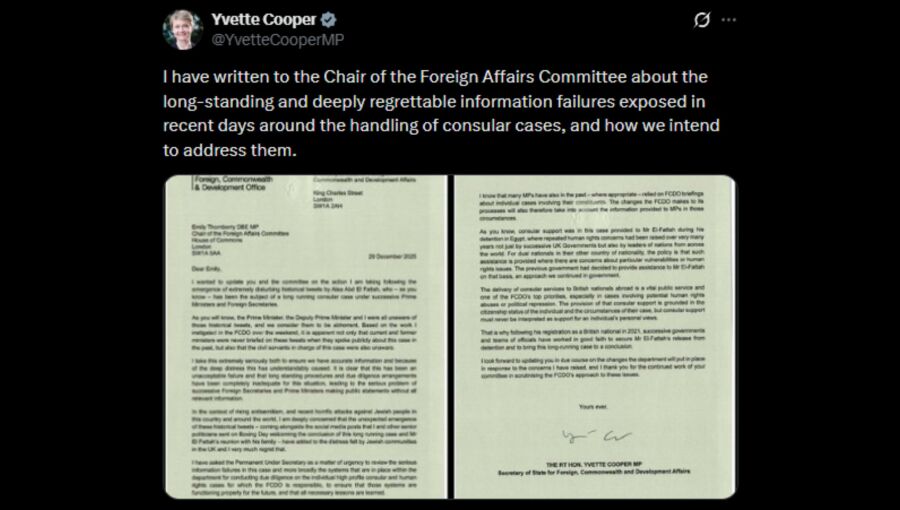
British Foreign Secretary Yvette Cooper has ordered an urgent review of information failures after discovering Prime Minister Keir Starmer, Deputy Prime Minister Angela Rayner and herself were unaware of historical tweets by Egyptian-British activist Alaa Abd El Fattah when making public statements about his case, according to a letter to the Foreign Affairs Committee dated December 29.

After Egypt lifted Abd El Fattah's travel ban and he arrived in Britain earlier this week, decade‑old tweets attributed to him resurfaced, including posts interpreted as endorsing violence against “Zionists” and police, both the British conservative-leaning parties' right‑wing and commentators branded them racist and incisive.

Figures in Reform UK and the Conservative Party have urged the government to strip him of his British citizenship or deport him, arguing it was wrongly granted in 2021 via his Egyptian UK‑born mother.

Cooper stated in the letter to committee chair Emily Thornberry that the Prime Minister, Deputy Prime Minister and herself "were all unaware of those historical tweets, and we consider them to be abhorrent".

An investigation revealed current and former ministers were never briefed on the tweets when speaking publicly about the case, with civil servants handling the matter also unaware.

"It is clear that this has been an unacceptable failure and that long standing procedures and due diligence arrangements have been completely inadequate for this situation, leading to the serious problem of successive Foreign Secretaries and Prime Ministers making public statements without all relevant information," Cooper wrote.

The Foreign Secretary stated that the unexpected emergence of historical tweets alongside social media posts by senior politicians on Boxing Day welcoming the conclusion of the long-running case and Abd El Fattah's reunion with his family "have added to the distress felt by Jewish communities in the UK and I very much regret that".

Cooper has asked the Permanent Under Secretary to review serious information failures and systems within the Foreign, Commonwealth and Development Office for conducting due diligence on high-profile consular and human rights cases.

The UK provided consular support to Abd El Fattah during his detention in Egypt, where human rights concerns were raised over many years by successive governments and world leaders.

The previous government decided to provide assistance on the basis of vulnerabilities and human rights issues, an approach continued by the current administration.

"The provision of that consular support is grounded in the citizenship status of the individual and the circumstances of their case, but consular support must never be interpreted as support for an individual's personal views," Cooper stated.

Following Abd El Fattah's belated registration as a British national in 2021, successive governments and officials worked to secure his release from detention and bring the long-running case to a conclusion.

Alaa issued an “unequivocal” apology, calling the posts “shocking and painful” and saying some had been distorted, while insisting they do not reflect his current views.  

The UK government has said the apology was proper but reaffirmed that he remains a British citizen, further inciting comments from right wing pundits and politicians in recent hours.


Bishop Of Columbus Grants Mass Dispensation To Immigrants Who Fear Deportation


December 30, 2025 
CNA
By Amira Abuzeid

The bishop of the Diocese of Columbus, Ohio, has granted a dispensation from Mass for parishioners who fear deportation by immigration enforcement officers, who have increased activity in the area since mid-December.

Bishop Earl Fernandes announced in a letter and video last week that those who fear immigration enforcement action are free from the obligation to attend Sunday Mass until Jan. 11, 2026. The bishop said the dispensation was precipitated by increased immigration enforcement activity in Ohio stemming from Operation Buckeye, a U.S. Immigration and Customs Enforcement (ICE) initiative launched Dec. 16 that is allegedly targeting “the worst of the worst criminal illegal aliens in Columbus and throughout Ohio.”

Fernandes told EWTN News on Monday that after he began receiving messages from pastors throughout his diocese informing him that Hispanic parishioners were afraid to attend Mass due to the increased enforcement by ICE officers, he asked diocesan personnel in the Office of Catholic Social Doctrine and the Hispanic ministry office to help him get a clearer picture of “what is happening on the ground.”

“They told me there were ICE trucks in front of parishes; even in front of schools,” Fernandes said. “All of a sudden, there were half or fewer attendees at the Posadas [traditional pre-Christmas] celebrations.”

He said he decided to issue the dispensation “even though I did not want to” because “people need Mass and the sacraments more than ever” and he wanted families to be together without fear for Christmas.

During a Mass he celebrated on Saturday, Dec. 20, Fernandes told EWTN News the pastor of the church remained at the front door and saw an ICE truck nearby. Because of this, the Posada [traditional pre-Christmas] procession was moved from outdoors to a hallway inside the building because “the people were too afraid to go outside.”

The procession took place inside the building. “We had a meal, there was a piñata and some celebrations,” Fernandes said. “But it was clear there were a lot of people who weren’t there.”

The bishop said he began receiving calls from pastors more than two hours from Columbus who were reporting ICE’s presence.

Sharp drops in Mass attendance

“The atmosphere of fear was keeping people away,” he said. One pastor reported that only one-third of his congregation attended weekend Mass. Another said only one-quarter were present, Fernandes said.

Of the increased enforcement against immigrants, Fernandes reflected: “It’s easy to say immigrants should have come to our country legally. But what if your parents came here illegally and you are a U.S. citizen? … What if one spouse is documented and the other is not. What’s in the best interest of their children and society at large?”

Of the Mexican population in Columbus, Fernandes said that “many are the grandchildren of the Cristeros,” resistors to the Mexican government’s attempts in the 1920s to suppress Catholicism in the country.

He said a large group of Hispanics came to the midnight Mass on Christmas at the cathedral because they did not think ICE would be there. “I think they felt safe at the cathedral.”

Fernandes said the Diocese of Columbus also has large numbers of Catholic African migrants who have “tons of children” and make up “young communities full of life and full of faith.”

Fernandes said he talked to the pastor of a multiethnic parish made up of Nigerians, Filipinos, and others, and “they’re afraid too.”

He said the Mass dispensation expires on Jan. 11, the end of the Christmas season, at which time he will reevaluate the situation.


CNA

The Catholic News Agency (CNA) has been, since 2004, one of the fastest growing Catholic news providers to the English speaking world. The Catholic News Agency takes much of its mission from its sister agency, ACI Prensa, which was founded in Lima, Peru, in 1980 by Fr. Adalbert Marie Mohm (†1986).


Deterring Turkey And Containing Russia In The Eastern Mediterranean – Analysis

Map of the Eastern Mediterranean region. Source: U.S. Energy Information Administration, Global Energy Monitor, Global Gas Infrastructure Tracker, and the World Bank Group

December 29, 2025 
By Scott N. Romaniuk


Key Takeaways:

Corridor-Centred Security: Israel, Greece, Cyprus, and the U.S. are building interlocking military, energy, and infrastructure networks to increase resilience and strategic flexibility across the Eastern Mediterranean and South Caucasus.

Redundancy Over Concentration: Investments in missiles, ports, cables, and rail corridors prioritise redundancy, enabling Europe and NATO to maintain operational continuity even if key transit states or chokepoints are disrupted.

Dual-Track Strategic Logic: Simultaneous support for Eastern Mediterranean and Zangezur corridors reflects a U.S. strategy of optionality, balancing competing regional alignments while reducing reliance on Russia and limiting single-route vulnerabilities.

Energy and Military Integration: Infrastructure projects such as the Great Sea Interconnector and Zangezur corridor are both commercial and strategic, serving as conduits for energy, trade, and military logistics in a multipolar competition.

Geography as Leverage: Greece, Cyprus, Israel, and the U.S. are converting geographic position into strategic advantage, making the region harder to coerce, easier to defend, and more effective as a bridge for power, information, and energy flows.


Corridor Logic and Regional Redundancy

What appears as an Israel–Greece–Greek Cypriot military and energy alignment directed against Türkiye also conforms to a broader corridor logic that has become more explicit since 2022. The region is being reorganised around redundancy, not only in combat power but also in the routes that transport energy, data, and materiel. These developments reflect a layered approach: securing against conventional military threats from Türkiye, mitigating European reliance on Russian energy, and ensuring the operational flexibility of North Atlantice Treaty Organization (NATO) reinforcement on the south-eastern flank.

Viewed in this way, Eastern Mediterranean procurement, basing choices, and infrastructure projects are not solely concerned with deterrence in the Aegean. They also protect the physical and political arteries that could sustain Europe during a prolonged confrontation with Russia, or in any scenario where choke points or single transit states become unreliable. Simultaneously, this alignment needs to be considered from Türkiye’s perspective, where strategic concerns regarding encirclement, loss of influence, and constrained mobility shape its own countermeasures and force posture.

The deeper logic is that security cooperation and infrastructure planning are merging into a single strategic portfolio. Missiles, ports, undersea cables, and rail corridors are treated not as isolated instruments but as interlocking components of a system designed for resilience, operational continuity, and leverage management across a complex, multipolar environment. The emerging architecture prioritises redundancy, multi-use capability, and adaptability, recognising that future competition will not be defined solely by territorial control but by dominance over energy flows, lines of communication, and strategic chokepoints.


Fortifying the Flank: Military and Strategic Networks


Greece’s Operational Modernisation

On the Türkiye-facing layer, the military dimension has become operational rather than symbolic. Greece’s recent approval to acquire 36 Israeli-made PULS rocket artillery systems for approximately €650 million, with reported ranges of up to 300 kilometres, is a tangible example of long-range cost imposition aimed at the north-eastern land border and the island environment. This sits within a broader modernisation plan publicly discussed at around €28 billion through 2036, and is paired with negotiations for an air and missile defence architecture reportedly costing roughly €3 billion.

This matters because the strategic effect is not merely an increase in firepower. It reshapes the geometry of crisis, whereby dispersed launchers, improved sensing capabilities, and layered defences reduce the credibility of limited coercion and heighten the risks of escalation for any actor attempting to exploit ambiguity in the Aegean or around Cyprus.


Cyprus and Infrastructure Security

Cyprus, in turn, is being increasingly integrated into the same ecosystem, partly due to the Cyprus dispute but also owing to infrastructure security considerations. The Great Sea Interconnector concept, frequently discussed as a Greece–Cyprus link that could later extend to Israel, is reported at approximately €1.9–1.94 billion and described as roughly 1,240 kilometres long, reaching depths of up to 3,000 metres, with European Union funding reportedly around €800 million. Cyprus has also publicly outlined a future in which it could produce approximately 4 gigawatts of electricity while currently consuming around 0.5 gigawatts, making interconnection not a luxury but a structural transformation.

Placing such projects at the centre of national strategy creates strong incentives for maritime domain awareness, seabed monitoring, and air defence modernisation, since cables, survey vessels, and power nodes become strategic targets in a contested sea.
NATO and US Reinforcement Posture

The Russia-facing layer is where the United States’ (US) posture in Greece becomes most consequential, even when public debate frames issues primarily through Greek–Turkish rivalry. After 2022, NATO’s central challenge is not simply deterrence by presence but deterrence by reinforcement, i.e., the capacity to move and sustain forces at scale under pressure. Greece offers both logistical redundancy and political flexibility for the south-eastern flank.

Consequently, nodes such as Alexandroupolis have been identified as valuable for moving equipment towards Bulgaria, Romania, and the wider eastern flank, while Souda Bay on Crete continues to function as a high-value platform for naval and air operations across the Eastern Mediterranean and beyond. In this interpretation, the same hardening of bases and networks that supports Greece in a Turkish contingency also underpins alliance planning aimed at constraining Russian options and sustaining operations within a connected theatre that links the Black Sea, the Balkans, and the Eastern Mediterranean.


Zangezur and Strategic Connectivity

Zangezur is where the corridor logic becomes unmistakably explicit and where energy security, great power competition, and regional alignments fuse.


The US-Brokered Corridor

In August 2025, the US facilitated an Armenia–Azerbaijan peace framework that included exclusive US development rights for a transit corridor linking mainland Azerbaijan to Nakhchivan through Armenia, a route widely discussed as the Zangezur corridor concept. Reports describe the corridor as approximately 43 kilometres long, with development rights framed for roughly 99 years, and US officials citing interest from nine companies, including three US firms.

The significance lies not only in Washington’s mediation. The corridor itself is envisaged as multi-use infrastructure, encompassing not just road and rail connections but also potential trade, fibre connectivity, and future energy lines. Strategically, it represents a means of reducing reliance on Russia-mediated formats in the South Caucasus while embedding a US-anchored commercial and political stake along a sensitive junction near Iran, at the edge of Russia’s traditional sphere of influence, and on the connective tissue between the Caspian and Anatolia.


Balancing Regional Alignments

The simultaneous development of competing corridor strategies—one through Greece and Cyprus, the other via Zangezur—demonstrates a deliberate US approach to optionality and route diversity, transforming an apparent contradiction into strategic clarity. The Israel–Greece–Greek Cypriot posture is often interpreted as a balancing coalition against Türkiye, while a Zangezur-style corridor strengthens the Türkiye–Azerbaijan land bridge and could enhance Ankara’s connectivity leverage. Yet the US can rationally support both concurrently if its primary objective is route diversity and leverage management, rather than choosing a single regional camp permanently.

A corridor through Armenia can dilute Russian influence, reduce Iran’s ability to monopolise or threaten north–south access, and expand options for moving goods, data, and potentially energy across Eurasia. Simultaneously, reinforcing Greece and deepening Israel–Greece–Cyprus cooperation helps ensure that Europe has alternative maritime and electricity routes that do not depend on a single transit state and that can be defended in a high-threat environment. In other words, Washington can construct a portfolio of corridors, some running through Türkiye, others bypassing it, because the strategic goal is optionality under pressure.


Strategic Incentives and Optionality

When considered as a unified plan, the underlying logic is not a secret blueprint but a consistent set of incentives. Europe seeks reduced vulnerability to Russian energy coercion. The US desires a Europe less dependent on Russia while maintaining multiple logistical pathways for NATO reinforcement. Israel seeks secure export and connectivity options that mitigate isolation and bolster strategic depth, particularly following regional shocks. Greece and Cyprus aim to convert geography into leverage, becoming hubs for power, ports, and connectivity while fortifying themselves against coercion.

The outcome is a corridor-centred security architecture stretching from the South Caucasus into the Eastern Mediterranean, wherein Zangezur-type connectivity, Aegean and Cyprus military modernisation, Souda Bay and Greek logistics nodes, and flagship projects such as the subsea interconnector collectively reinforce a single strategic objective: a region that is harder to coerce, more resistant to blockade, and more valuable as a bridge for energy and military movement in a protracted competition where Russia remains the central pacing threat, even when Türkiye dominates local headlines.

Building Resilient Corridors in a Contested Eastern Mediterranean

The emergent corridor logic in the Eastern Mediterranean and South Caucasus transcends a collection of bilateral deals or military acquisitions—it constitutes a strategic system designed for redundancy, resilience, and leverage. Greece, Cyprus, and Israel are fortifying not merely borders but the arteries of energy, data, and materiel that sustain Europe and the broader alliance network. Zangezur and US-backed transit corridors demonstrate that multi-use infrastructure can simultaneously serve as commercial lifelines, deterrence mechanisms, and instruments of geopolitical optionality.

For policymakers, the lesson is clear: investments in corridors, ports, cables, and layered defences are not merely local or symbolic—they are central to sustaining operational freedom, deterring coercion, and shaping strategic competition in a multipolar environment. Success will depend on integrating military, economic, and infrastructure planning into a coherent portfolio in which the value of redundancy outweighs the temptation to concentrate on any single theatre or route.

In short, corridor-centred thinking transforms geography into strategy. Those who control the flows of missiles, power, and information—not merely territory—will define the security architecture of the Eastern Mediterranean and beyond for decades to come.


Dr. Scott N. Romaniuk is a Senior Research Fellow, Centre for Contemporary Asia Studies, Corvinus Institute for Advanced Studies (CIAS), Corvinus University of Budapest, Hungary.
China’s Latest 5-Year Plan Will Be Watched By The World – OpEd

December 29, 2025 
Arab News
By Andrew Hammond

The coming year will surely have some significant surprises in store, both politically and economically. However, one relatively predictable feature of the global landscape will be the launch of China’s new five-year plan, the 15th such iteration.

Beijing’s five-year plans have long been defining characteristics of not just the Chinese but also the wider international calendar. So, it is not only China, but much of the rest of the world, including the Middle East, which will be watching the blueprint for the nascent superpower’s development in the period to 2030.

This time frame may be a tumultuous period. This is not least with the second Trump presidency, which runs through to January 2029, potentially providing a historic context for the plan’s activation.

While the full details of the new plan will not be known until release, significant clues were provided at the Chinese Communist Party’s so-called fourth plenum last October. At the big event, the party leadership published a plan framework which will be formally approved in March during the National People’s Congress.

Several key elements are likely to be dialed up, including artificial intelligence. In the context of continued tensions with the US in areas such as computer chips, advanced software, rare earths, and magnets, the party decided at the plenum to focus the new plan on “substantial improvements in scientific and technological self-reliance … and steer the development of new quality productive forces.”

The reference to “new quality productive forces” means the need for greater homegrown, advanced technology, including in the defense area, so that Beijing can increasingly export this intellectual property. A growing number of these Chinese homegrown firms are proving to be internationally competitive earning a significant share of their revenue abroad, with the potential to become growth drivers.

On the face of it, this long-term, relatively predictable approach embodied in China’s five-year planning could not be more different from the short-termist, US policy-by-social media experience of Trump. Chinese President Xi Jinping recently asserted that, when it comes to China’s “revitalization,” long-term planning creates “a vital political advantage” vis a vis other world powers.

This core point has been echoed by Jiang Jinquan, a key party official. He declared that “scientifically formulating and continuously implementing the five-year plan is … a key political advantage … gaining strategic initiative in the midst of intense international competition.”

To be sure, China’s approach is far from perfect. A number of its five-year plans have backfired, such as under Mao Zedong in the late 1950s and early 1960s. Critics are also far from sure that this is the best way now to tackle the many domestic challenges that Beijing faces, for instance, in the property sector, uneven consumer demand, and deflation, let alone the international ones, as well.

Nevertheless, this emphasis on the long term continues to be a defining feature of Beijing’s grand strategy. This remains founded on a gradualist transition to power, allowing the nation to try to grow stronger over an extended horizon.

Since Xi became Chinese Communist Party secretary-general, more than a decade ago, when Barack Obama was still US president, he has sought to project Beijing as a responsible global stakeholder. Yet, much has changed in that long period, including international perceptions of the balance of power and Beijing’s place in it.

Many countries now increasingly perceive China as a significantly stronger global player. In recent years, the country has become a major force in areas such as electric cars, wind and solar industries, plus robotics. At the macro level, moreover, the International Monetary Fund asserts that the Chinese economy is now larger than its US counterpart on a purchasing power parity basis which adjusts for the fact that goods are cheaper in China and other countries relative to the US.

The consequences of this, especially when matched with the extended economic weakness in some of the West, have been more than economic. In terms of perceptions, the fact that many internationally believe the global balance of power has swung significantly has sometimes created tensions, and not only in Beijing’s relations with Washington.

While many in China welcome recognition of the country’s growing power, this shift is not without headaches for Beijing. It has exposed the country to greater foreign scrutiny and fed into perceptions, sometimes fuelled by Trump and some anti-establishment politicians, to try to tap into growing angst about China’s rise.

This may only become a bigger challenge in the future if the new plan seeks to give Beijing “markedly stronger” international influence, as was advocated in the plenum. Potentially, this jars with China’s longstanding grand strategy which has so far been premised on keeping a relatively low profile and avoiding major controversy.

When a bright spotlight has been shone on Beijing in recent years, it has sometimes exposed a soft-power deficit. Soft power is recognized by China as a valuable political commodity, but one it has had limited success in cultivating, so far. As international perceptions of the country’s power change, its global favorability has become more of a challenge to try to manage.

If China wants to develop markedly stronger international influence, Beijing will need to find better ways to tackle this. This includes doubling down on a process of addressing foreign concern about its intentions as a rising power.

For instance, China’s reputation might benefit significantly from greater public diplomacy to win more foreign hearts and minds. Example measures could include utilizing the country’s growing capabilities in space travel for high-profile international cooperation projects for the potential good of mankind as a whole.

This agenda may not be easy to address. However, China’s soft-power deficit will only persist, unless it is tackled, as part of its broader grand strategy and long-term planning.

• Andrew Hammond is an associate at LSE IDEAS at the London School of Economics.