Wednesday, December 31, 2025

Unrest in Iran, Plausible Deniability, and the Ghosts of 1953

In a world where information warfare blurs fact and narrative, we must resist the temptation to treat capability as conspiracy. But we must also resist the delusion that the absence of evidence today means an absence of action.
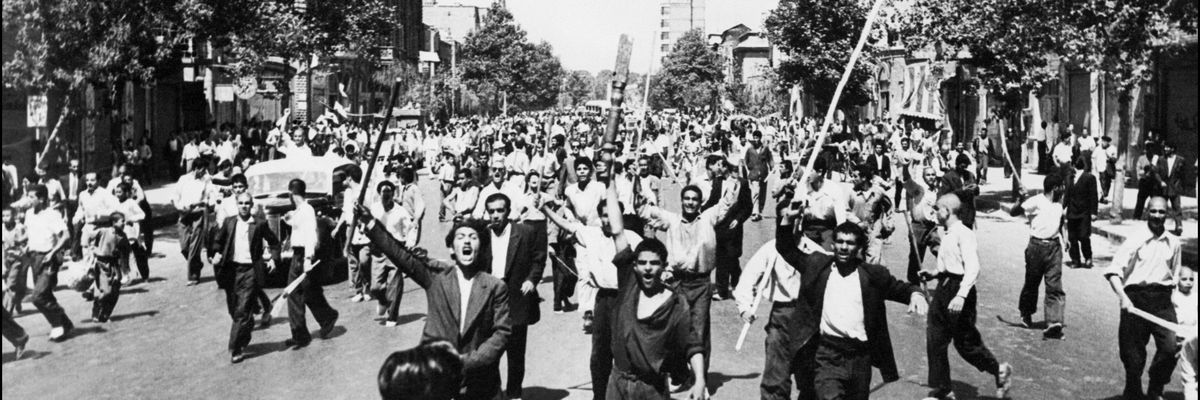

Rioters armed with staves shout slogans during riots in Tehran, Iran in August 1953.
(Photo by - / INTERCONTINENTALE / AFP via Getty Images)

Angel Gomez
Dec 31, 2025
Common Dreams

Speculation about covert operations tends to rise with geopolitical heat, and few places are as historically charged as Iran when it comes to foreign interference. The memory of the 1953 CIA-backed coup remains vivid in Tehran’s political consciousness, shaping both internal paranoia and external discourse. In today’s climate of US-Iran hostility—marked by sanctions, nuclear disputes, and regional proxy conflicts—whispers of destabilization efforts inevitably resurface. But plausibility should not be mistaken for proof.

Yet there are ghosts worth heeding…

In 1953, the CIA executed Operation TPAJAX—a covert operation that overthrew Iran’s democratically elected Prime Minister Mohammad Mossadegh, reinstating the autocratic Shah. This operation was denied, downplayed, and hidden for decades. It wasn’t until 2017—64 years later—that the US government officially declassified key documents from the Foreign Relations of the United States (FRUS) series detailing the planning and implementation of the coup. The materials that confirmed America’s role in the 1953 coup were not fully acknowledged through official channels until generations had passed, long after their geopolitical consequences had reshaped the Middle East.

Given that historical precedent, it’s not unreasonable to wonder: If something like that were happening today, would we know?

If the CIA is involved in orchestrating unrest in Iran today, we may not know until 2089.

Currently, Iran is again roiled by protests. Slogans like “Death to the Dictator” echo in the streets. Western headlines frame this as grassroots unrest, and it may well be. But for a country with a long and painful history of foreign interference cloaked in democracy rhetoric, the line between internal dissent and external orchestration is never clean.

From a strategic standpoint, the United States clearly possesses the capacity to conduct covert influence operations. Legal mechanisms for such actions exist under US law, with covert operations authorized by the president and subject to congressional oversight. The intelligence community, with decades of institutional experience, is equipped with modern tools ranging from cyber operations to narrative influence and financial pressure. These capabilities are real. But capacity alone tells us nothing about intent.

Public policy statements from the US government consistently emphasize deterrence and nonproliferation, not regime change. While tensions are undeniable, open endorsement of covert destabilization would carry significant political and legal costs. Congress, the media, and public opinion create substantial friction for any administration considering escalation by clandestine means. Adversarial relationships can foster suspicion, but they do not constitute motive.

Environmental conditions further complicate the picture. Iran, despite internal pressures and unrest, retains a strong security apparatus and hardened counter-intelligence services. Regional dynamics—involving militias, proxies, and overlapping crises—do not create the same permissive environment that existed in the early Cold War. On the contrary, they elevate the risks of blowback and exposure. Modern operations would need to be diffuse, multi domain, and plausibly deniable—relying on soft pressure through economic levers, information warfare, and alliances rather than the heavy-handed political interventions of the past.

And yet, these more nuanced forms of influence are precisely what make attribution difficult. In a world of cyber shadows, targeted sanctions, and disinformation, it’s easy to see ghosts. But serious allegations require serious evidence. Credible investigative reporting, declassified documents, congressional disputes, or allied intelligence consensus are necessary to move the needle from theoretical possibility to actionable suspicion—let alone attribution.

That’s where Dan Kovalik’s The Plot to Attack Iran enters the conversation. Kovalik draws clear lines from historical US interventions—including the CIA’s own admission of past regime change—to present-day provocations and misinformation. He details a long history of fabricated threats, from nonexistent Iraqi WMDs to exaggerated fears about Iran’s nuclear program. He argues that current rhetoric and actions—sanctions, assassinations, drone incursions, proxy pressures—form a consistent pattern of provocation meant to destabilize Iran under the guise of security policy.

Kovalik also reminds us that accusations of terrorism, often leveled at Iran, are selectively applied. While Iran is listed as a state sponsor of terrorism, US allies like Saudi Arabia—implicated in exporting Wahhabi extremism—are exempt from such labels. Groups like Hezbollah, which Iran supports, are framed by the US as terroristic, while Kovalik argues they act in regional resistance to Israeli occupation. This asymmetry of language is not just semantic—it builds the ideological scaffolding for war.

Legal oversight, international norms, and the specter of asymmetric retaliation all serve as meaningful deterrents. A misstep in this space could trigger regional escalation, damage US credibility, or backfire diplomatically. These are not trivial constraints. They are built-in brakes against rash or covert adventurism. And yet, none of them prevented the 1953 coup. Nor did they stop covert operations in Iraq, Libya, or Syria. History shows us that legal deterrents and political norms often collapse under the weight of perceived strategic necessity.

Bottom line: While it is analytically sound to say the United States could conduct covert operations against Iran under the right conditions, there is no defensible basis to assert that such actions are underway without evidence. Plausibility is not a claim—it is a lens for understanding risk, not a substitute for proof.

But perhaps the more sobering truth is this: If the CIA is involved in orchestrating unrest in Iran today, we may not know until 2089. Sixty-four years is a long time to wait for the truth. In that gap, entire wars can be fought, nations broken, and histories rewritten. The ghosts of TPAJAX aren’t just historical—they’re prophetic. And Iran, perhaps more than any other nation, knows that ghosts have long memories.

In a world where information warfare blurs fact and narrative, we must resist the temptation to treat capability as conspiracy. But we must also resist the delusion that the absence of evidence today means an absence of action. The stakes—diplomatic, strategic, and human—are far too high for anything less than disciplined analysis and historical awareness.

The past may not repeat, but it whispers—and in Iran, it is whispering loudly.


Our work is licensed under Creative Commons (CC BY-NC-ND 3.0). Feel free to republish and share widely.


Angel Gomez
Mr. Angel Gomez is a researcher specializing in the societal impact of government policies. He has a background in psychoanalytical anthropology and general sciences.
Full Bio >
The World Must Act Now to Abort the Next Phase of Extermination in Gaza

Another Israeli genocide is not a distant threat; it is an encroaching reality that will be finalized unless it is stopped.


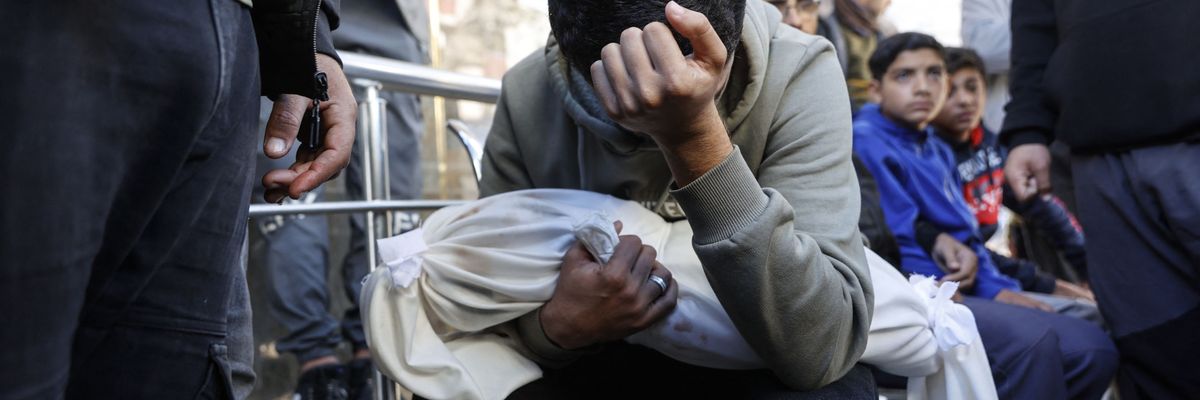
A Palestinian man carries the body of his 5-month-old brother, Ahmed Al-Nader, who was reportedly killed the previous day along with other family members in an Israeli shelling on a school-turned-shelter in the Tuffah neighbourhood of Gaza City, ahead of his funeral on December 20, 2025.

(Photo by Omar al-Qattaa / AFP via Getty Images)


Ramzy Baroud
Dec 31, 2025
Common Dreams

Suppose we accept the fiction that none of us expected Israel to launch a full-scale genocide in Gaza—a premeditated campaign to erase the Strip and exterminate a significant portion of its inhabitants. Let us pretend that nearly 80 years of relentless massacres were not a prelude to this moment, and that Israel had never before sought the physical destruction of the Palestinian people as outlined by the 1948 Genocide Convention.

If we go so far as to accept the sterile, ahistoric claim that the Nakba of 1948 was “merely” ethnic cleansing rather than genocide—ignoring the mass graves and the forced erasure of a civilization—we are still left with a terrifying reality. Having witnessed the unmasked extermination that began on October 7, 2023, who can dare to argue that its perpetrators lack the intent to repeat it?

The question itself is an act of charity, as it assumes the genocide has actually stopped. In reality, the carnage has merely shifted tactics. Since the implementation of the fragile ceasefire on October 10, Israel has killed over 400 Palestinians and wounded hundreds more. Others have perished in the frozen mud of their tents. They include infants like 8-month-old Fahar Abu Jazar, who, like others, froze to death. These are not mere tragedies; they are the inevitable results of a calculated Israeli policy of destruction targeting the most vulnerable.

During this two-year campaign of extermination, more than 20,000 Palestinian children were murdered, accounting for a staggering 30% of the total victims. This blood-soaked tally ignores the thousands of souls entrapped beneath the concrete wasteland of Gaza, and those currently being consumed by the silent killers of famine and engineered epidemics.

In the dominant Western narrative, the Palestinian is the eternal aggressor. They are the occupied, the besieged, the dispossessed, and the stateless; yet they are expected to die quietly in the world’s “largest open-air prison.”

The horrifying statistics aside, we bear witness to the final agonies of a people. We have watched their extermination in real time, broadcast to every handheld screen on Earth. No one can claim ignorance; no one can claim innocence. Even now, we watch as 1.3 million Palestinians endure a precarious existence in tents ravaged by winter floods. We share the screams of mothers, the hollowed-out faces of broken fathers, and the haunted stares of children, and yet, the world’s political and moral institutions remain paralyzed.

If Israel resumes the full, unrestrained intensity of this genocide, will we stop it? I fear the answer is no, because the world refuses to dismantle the circumstances that permitted this slaughter in the first place. Israeli officials never bothered to hide their intent. The systematic dehumanization of Palestinians was a primary export of Israeli media, even as Western corporate outlets worked tirelessly to sanitize this criminal discourse.

The record of intent is undeniable. National Security Minister Itamar Ben-Gvir openly championed the “encouragement of migration” and demanded that “not an ounce of humanitarian aid” reach Gaza. Finance Minister Bezalel Smotrich argued that the starvation of 2 million people could be “just and moral” in the pursuit of military aims. From the halls of the Knesset to the pop charts, the refrain was the same: “Erase Gaza,” “Leave no one there.” When military leaders refer to an entire population as “human animals,” they are not using metaphors; they are issuing a license for extermination.

This was preceded by the hermetic siege—a decades-long experiment in human misery that began in 2006. Despite every Palestinian plea for the world to break this death grip, the blockade was allowed to persist. This was followed by successive wars targeting a besieged, impoverished population under the banner of “security,” always shielded by the Western mantra of Israel’s “right to defend itself.”

In the dominant Western narrative, the Palestinian is the eternal aggressor. They are the occupied, the besieged, the dispossessed, and the stateless; yet they are expected to die quietly in the world’s “largest open-air prison.” Whether they utilized armed resistance, threw rocks at tanks, or marched unarmed toward snipers, they were branded “terrorists” and “militants” whose very existence was framed as a threat to their occupier.

Years before the first bomb of this genocide fell, the United Nations declared Gaza “uninhabitable.” Its water was a toxin, its land a graveyard, and its people were dying of curable diseases. Yet, aside from the typical ritual of humanitarian reports, the international community did nothing to offer a political horizon, a just peace.

This criminal neglect provided the vacuum for the events of October 7, allowing Israel to weaponize its victimhood to execute a genocide of sadistic proportions. Former Defense Minister Yoav Gallant explicitly stripped Palestinians of their humanity, launching a collective slaughter directed by Prime Minister Benjamin Netanyahu.

The stage is being set for the next phase of extermination. The siege is now absolute, the violence more concentrated, and the dehumanization of Palestinians more widespread than ever. As the international media drifts toward other distractions, Israel’s image is being rehabilitated as if the genocide never happened.

Tragically, the conditions that fueled the first wave of genocide are being meticulously reconstructed. Indeed, another Israeli genocide is not a distant threat; it is an encroaching reality that will be finalized unless it is stopped.

The 1948 Convention on the Prevention and Punishment of the Crime of Genocide was a legal vow to “liberate mankind from such an odious scourge.” If those words possess a shred of integrity, the world must act now to abort the next phase of extermination. This requires absolute accountability and a political process that finally severs the grip of Israeli colonialism and violence. The clock is ticking, and our collective voice—or our silence—will make the difference.


Our work is licensed under Creative Commons (CC BY-NC-ND 3.0). Feel free to republish and share widely.


Ramzy Baroud
Ramzy Baroud is a journalist and the Editor of the Palestine Chronicle. He is the author of five books including: "These Chains Will Be Broken: Palestinian Stories of Struggle and Defiance in Israeli Prisons" (2019), "My Father Was a Freedom Fighter: Gaza's Untold Story" (2010) and "The Second Palestinian Intifada: A Chronicle of a People's Struggle" (2006). Dr. Baroud is a Non-resident Senior Research Fellow at the Center for Islam and Global Affairs (CIGA), Istanbul Zaim University (IZU). His website is www.ramzybaroud.net.
Full Bio >
As Trump Claims He’s Slashing Costs, Big Pharma Jacks Up Prices on 350 Drugs

One critic charged that Trump’s earlier deals with pharmaceutical companies “just nibble around the margins in terms of what is really driving high prices for prescription drugs in the US.”


Packaging and pills of different types of psychotropic medications are seen in this illustration photo taken in Warsaw, Poland on April 22, 2025.
(Photo by Jaap Arriens/NurPhoto via Getty Images)


Brad Reed
Dec 31, 2025
COMMON DREAMS

President Donald Trump in recent months has made ludicrously false claims about his administration slashing prescription drug prices in the US by as much as 600%, which would entail pharmaceutical companies paying people to use their products.

In reality, reported Reuters on Wednesday, drugmakers are planning to raise prices on hundreds of drugs in 2026.


Citing data from healthcare research firm 3 Axis Advisors, Reuters wrote that at least 350 branded medications are set for price hikes next year, including “vaccines against COVID, RSV, and shingles,” as well as the “blockbuster cancer treatment Ibrance.”

The total projected number of drugs seeing price increases next year is significantly higher than in 2025, when 3 Axis Advisors estimated that pharmaceutical companies raised prices on 250 medications.

The median price increase for drugs next year is projected at 4%, roughly the same as in 2025.

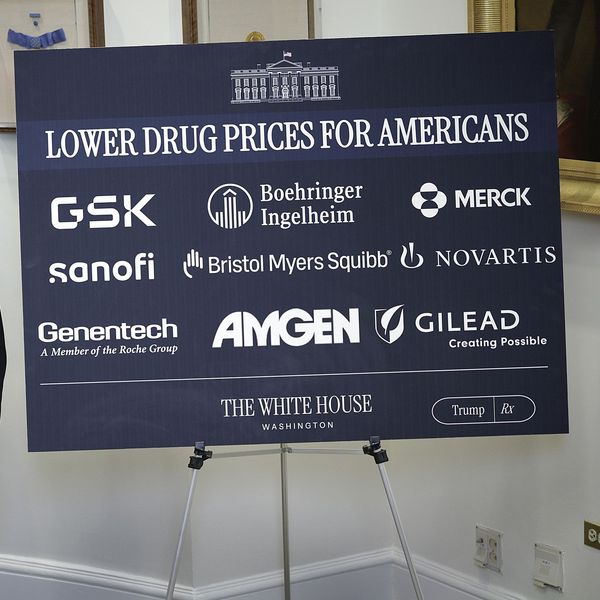
Reuters also found that some of the companies raising prices on their drugs are the same ones who struck deals with Trump to lower the costs of a limited number of prescriptions earlier this year, including Novartis, Pfizer, Boehringer Ingelheim, and GSK.

In announcing the deals with the pharmaceutical companies, Trump declared that “starting next year, American drug prices will come down fast and furious and will soon be the lowest in the developed world.”

But Dr. Benjamin Rome, a health policy researcher at Brigham and Women’s Hospital in Boston, told Reuters that the projected savings for Americans under the Trump deals are a drop in the bucket compared with the continued price hikes on other drugs.

“These deals are being announced as transformative when, in fact, they really just nibble around the margins in terms of what is really driving high prices for prescription drugs in the US,” Rome explained.

Merith Basey, CEO of Patients For Affordable Drugs Now, a patient advocacy organization focused exclusively on lowering the cost of medications, also said she was unimpressed by Trump’s deals with drugmakers.

“Voluntary agreements with drug companies—especially when key details remain undisclosed—are no substitute for durable, system-wide reforms,” she said earlier this month. “Patients are overwhelmingly calling on Congress to do more to lower prescription drug prices by holding Big Pharma accountable and addressing the root causes of high drug prices, because drugs don’t work if people can’t afford them.”
AMERIKA

‘A National Disgrace’: 19 States to Raise Minimum Wage But Federal Rate Stuck at $7.25

One Fair Wage noted that “tipped workers can still legally be paid as little as $2.13 an hour, a system advocates describe as a direct legacy of slavery.”


Labor unionists rally for a higher minimum wage outside New York City Hall on April 10, 2023.
(Photo by Lev Radin/Pacific Press/LightRocket via Getty Image


Brett Wilkins
Dec 31, 2025
COMMON DREAMS

Over a third of US states are set to raise their minimum hourly wage in 2026, but worker advocates including Sen. Bernie Sanders on Wednesday decried a federal minimum wage that’s remained at $7.25 since 2009—and just $2.13 an hour for tipped workers for over three decades.

Minimum wage hikes are set to go into effect in 19 states on Thursday: Arizona, California, Colorado, Connecticut, Hawaii, Maine, Michigan, Minnesota, Missouri, Montana, Nebraska, New Jersey, New York, Ohio, Rhode Island, South Dakota, Vermont, Virginia, and Washington.

Increases range from 28 cents in Minnesota to $2 in Hawaii, with an average hike of 67 cents across all 19 states. More than 8.3 million workers will benefit from the increases, according to the Economic Policy Institute (EPI). The mean minimum wage in those 19 states will rise to $14.57 in 2026, up from $13.90 this year.

Three more states—Alaska, Florida, and Oregon—plus Washington, DC are scheduled to raise their minimum wages later in 2026.

In addition to the state hikes, nearly 50 counties and municipalities plan to raise their minimum wages in the coming year, according to the National Employment Law Project (NELP). These include San Diego, California—where the minimum wage for hospitality workers is set to rise to $25 an hour by 2030—and Portland, Maine, where all workers will earn at least $19 by 2028.

However, the federal minimum wage remains at $7.25, and the subminimum rate for tipped workers is $2.13, where it’s been since 1991—and has lost more than half its purchasing power since then.

“Tipped workers can still legally be paid as little as $2.13 an hour, a system advocates describe as a direct legacy of slavery,” the advocacy group One Fair Wage (OFW) said in a statement Tuesday.


Sanders (I-Vt.) said on social media on the eve of the hikes: “Congratulations to the 19 states raising the minimum wage in 2026. But let’s be clear: A $7.25 federal minimum wage is a national disgrace. No one who works full time should live in poverty. We must keep fighting to guarantee all workers a living wage—not starvation wages.”

Yannet Lathrop, NELP’s senior researcher and policy analyst, said earlier this month that “the upcoming minimum wage increases are incremental and won’t magically turn severely underpaid jobs into living-wage jobs, but they do offer a bit of relief at a time when every dollar matters for people.”

“The bigger picture is that raising the minimum wage is just one piece of a much larger fight for a good jobs economy rooted in living wages and good benefits for every working person,” Lathrop added. “That’s where we need to get to.”

Numerous experts note that neither $7.25, nor even $15 an hour, is a livable wage anywhere in the United States.

“The gap between wages and real living costs is stark,” OFW said. “According to the MIT Living Wage Calculator, there is no county in the United States where a worker can afford to meet basic needs on less than $25 an hour. Even in the nation’s least expensive counties, a worker with one child would need at least $33 an hour to cover essentials like rent, food, childcare, and transportation.”

“Advocates argue that policies like President [Donald] Trump’s ‘no tax on tips’ proposal fail to address the underlying problem of poverty wages,” OFW continued. “While the policy has drawn attention, they say it is a headline rather than a solution, particularly since nearly two-thirds of tipped workers do not earn enough to owe federal income taxes.”

Frustrated by the long-unchanged $7.25 federal minimum wage, numerous states in recent years have let voters give themselves raises via ballot initiatives. Such measures have been successful even in some red states, including Missouri and Nebraska.

Rising minimum wages are a legacy of the union-backed #FightFor15 movement that began among striking fast-food workers in 2012. At least 20 states now have minimum wages of $15 or higher.

However, back then, “the buying power of a $15 minimum wage was substantially higher than it is today,” EPI noted. “In 2025, a $15 minimum wage does not achieve economic security for working people in most of the country. This is particularly true in the highest cost-of-living cities.”

In April, US senators voted down an amendment that would have raised the federal minimum wage to $17 an hour. Every Democratic and Independent upper chamber lawmaker voted in favor of the measure, while all Republicans except Sen. Josh Hawley (Mo.) rejected it.

As Trump administration and Republican policies and practices—such as passing healthcare legislation that does not include an extension of Affordable Care Act tax credits, which are set to expire on Wednesday and send premiums soaring—coupled with persistently high living costs squeeze workers, advocates say a living wage is more important than ever.

The issue is underscored by glaring income and wealth inequality in the US, as well as a roughly 285:1 CEO to worker pay gap among S&P 500 companies last year.


“Minimum wage doesn’t cover the cost of living,” Janae van De Kerk, an organizer with the Service Employees International Union (SEIU) Airport Workers union and Phoenix Sky Harbor International Airport employee, said in a video posted Tuesday on social media.

“Many of my co-workers have to choose between food on the table or health insurance, or the choice between having food and paying the electric bill,” van De Kerk—who advocates a $25 hourly minimum wage—continued.

“We shouldn’t have to worry about those things,” she added. “We shouldn’t have to stress about those things. We’re willing to work and we wanna work, and we should be paid for our work.”


Rubio's shocking decision makes RFK Jr.'s cuts look like child's play

Will Humble, 
Arizona Mirror
December 31, 2025 


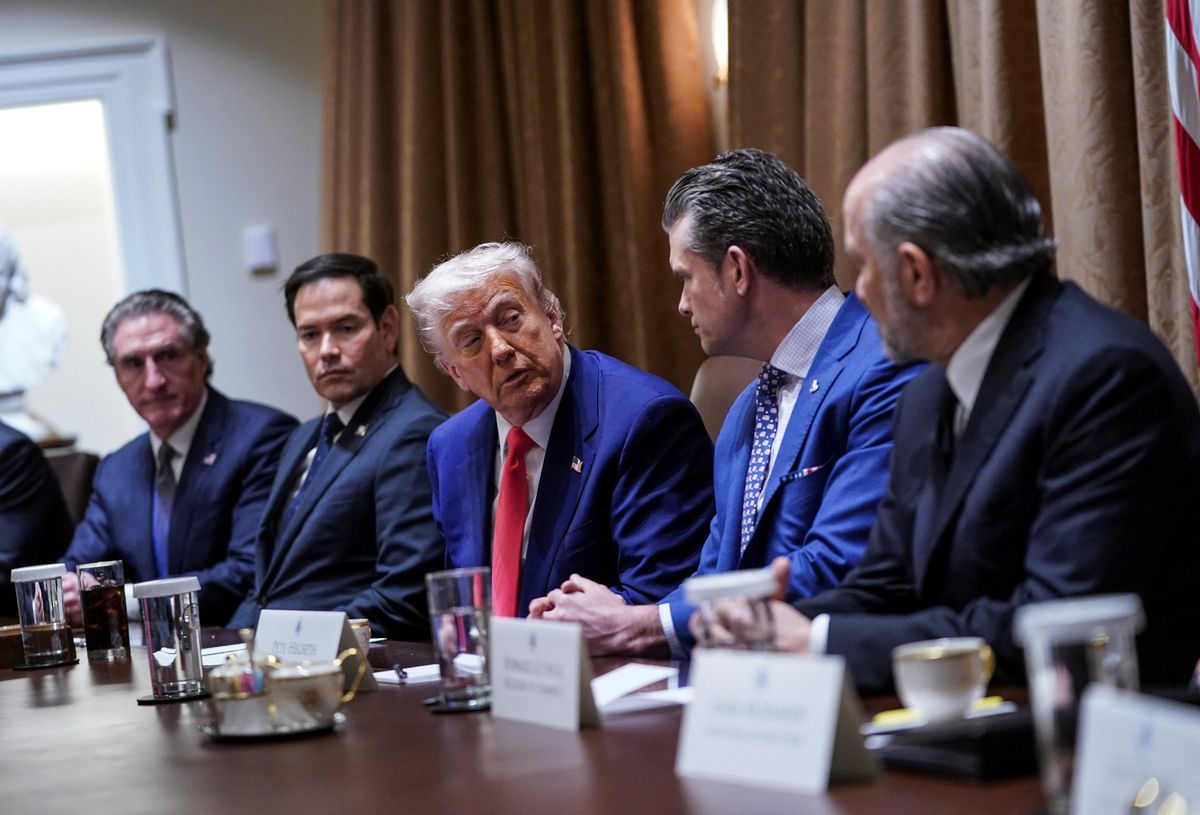
Donald Trump attends a cabinet meeting. REUTERS/Nathan Howard

For much of 2025, public-health debates in the United States have focused on the damage being caused by Health Secretary Robert F. Kennedy Jr. with his reckless vaccine policy decisions, deep funding cuts, the wholesale firing of experienced public health professionals across Health and Human Services agencies, and the loss of trust in public health institutions like the Centers for Disease Control and Prevention.

His actions weakened domestic health protections and further eroded trust in science, evidence based decision making and the scientific method itself.

But even accounting for all of Kennedy’s harm, the most destructive public health decision of 2025 didn’t come from his agency. It came from the Secretary of State Marco Rubio via elimination of the U.S. Agency for International Development.

That decision will cost more lives, undermine more health systems and increase global health risk more than any other public health policy choice made this year. It also delivered a severe blow to America’s ability to lead through diplomacy.

USAID provided key global public health infrastructure


For decades, USAID was one of the most important public-health institutions on the planet, arguably more consequential than the World Health Organization or the Gates Foundation. It served as a core pillar of global disease prevention and health-system stability. Today, it’s gone.

USAID funded (and held partners accountable for) infectious disease surveillance, HIV treatment, tuberculosis and malaria prevention, maternal and child health services, clean water and sanitation systems, nutrition programs for mothers and infants, vaccine delivery infrastructure and health workforce training in developing nations.

USAID’s work stopped outbreaks before they became pandemics. It reduced mass displacement. It stabilized regions where collapsing health systems fuel hunger, conflict and migration. It improved women’s health, helped families plan their futures and helped entire populations escape poverty.

USAID focused on upstream prevention on a global scale. It was also one of our most effective tools for building diplomatic influence.

Hard power, soft power: why USAID mattered


In international affairs, countries project power in two ways. Hard power relies on forces like military strength, sanctions and the threat of punishment. Soft power relies on trust, humanitarian aid, scientific cooperation and being seen as a reliable partner acting in good faith.

USAID was a cornerstone of American soft power. When the U.S. helped countries prevent disease, strengthen health systems, and keep children alive and families out of poverty, it built credibility. We earned cooperation and trust. It made American leadership legitimate rather than coercive.

Eliminating USAID didn’t just dismantle public health infrastructure; it dramatically weakened our soft power. It broadcasts that the U.S. is transactional, unreliable and disinterested in shared global responsibility.

That erosion of trust will make cooperation during future emergencies far more difficult not only for this administration, but for future ones that may want to restore America’s role as a force for good.

Damage is under way

Thanks to Secretary Rubio disease surveillance is collapsing, meaning outbreaks are detected later or not at all. Interruptions in HIV and tuberculosis treatment are fueling drug resistance, which will inevitably reach us as well.

Gaps in maternal and child health services are translating into preventable deaths. Weakening vaccine infrastructure invites the return of diseases that were on the decline.

Responsibility for this decision is clear. As Secretary of State, Rubio presided over, defended, and even trumpeted the dismantling of USAID. President Donald Trump supported it. Elon Musk helped drive the ideological and operational wrecking ball that made it possible.

Together, they reframed global public health as expendable “foreign aid” rather than what it is: A frontline defense against disease, instability, humanitarian catastrophe and a key source of American soft power.

What history will remember

Robert F. Kennedy Jr. has done real damage to public health in 2025. But history will judge the elimination of USAID as something even worse: an abdication of public health responsibility trading several decades of disease prevention and diplomacy for personal ambition and professional survival.

History will remember Rubio’s decision as an abandonment of global public health and soft power, not dollars “saved.”

Will Humble is a long-time public health enthusiast and is currently the Executive Director for the Arizona Public Health Association (AzPHA). His 40 years in public health include more than 2 decades at the Arizona Department of Health Services, where he served in various roles including as the Director from 2009 to 2015. He continues to be involved in health policy in his role as the Executive Director for the Arizona Public Health Association.
Chaos at DC golf courses as Trump axes key lease: report


Matthew Chapman
December 31, 2025 
RAW STORY


U.S. President Donald Trump holds a golf ball at Trump Turnberry resort in Turnberry, Scotland, Britain, July 27, 2025. REUTERS/Phil Noble

President Donald Trump's administration has moved to terminate the lease of a nonprofit that has run the Washington, D.C. golf courses for years, putting the future of these courses in uncertainty and raising the possibility Trump could move to put his own influence on them.


According to The Washington Post, "The Interior Department issued the termination letter Tuesday, formally severing ties with the nonprofit National Links Trust, which has managed Langston Golf Course, Rock Creek Park Golf and East Potomac Golf Links — all public courses on federal land — under a lease agreement since 2020. In the letter, Interior officials said the decision was based on what they described as National Links Trust’s failure to complete required capital improvements and to provide a satisfactory plan to cure alleged defaults under the lease."


National Links Trust responded with a statement that they were "devastated" by the revocation, and added that they are “fundamentally in disagreement with the administration’s characterization” of how they managed the courses. They also vowed to remain operating the courses for the time being to avoid a disruption that would cost people their jobs.

Trump's move against D.C.'s golf courses "marks an extraordinary federal intervention into the management of District recreational assets and reflects a broader push by President Donald Trump to remake high-profile civic spaces in the nation’s capital, including the Kennedy Center and White House grounds, while expanding the federal government’s role in policing the city," noted the report.

Trump, an avid golfer himself who is known for taking routine golfing breaks from the presidency at inopportune moments, has made a number of other moves to radically transform D.C.

Earlier this week, a new report revealed Trump wants to demolish 13 historic D.C. buildings, setting up a fight between himself and local preservationists.
WIDE ANGLE : CINEMA TO LIVE

It’s A Wonderful Life is not a feel-good Christmas film — but it is incredibly therapeutic
Published December 28, 2025
THE CONVERSATION


A Wonderful Life | Pictorial Press Ltd


Despite the reputation of It’s A Wonderful Life as a heartwarming Christmas classic, both its fans and detractors like to remind audiences that it’s no feel-good film. For at least two-thirds of its running time, it is essentially the story of a man’s suicide attempt.

We watch as kind-hearted George Bailey has his dreams quashed, his ambitions curtailed and his business ruined. Then it gets even worse. At about two hours in, we watch this poor, despairing man standing on a bridge outside his idyllic small town, crippled by anxiety, overwork, debt and depression, wishing that he had never been born.

The fact that It’s A Wonderful Life remains such a popular Christmas film despite this potentially upsetting subject matter highlights something worth remembering both at Christmas and any time of the year.

We live in an age where suicide remains the number one preventable cause of death for men under 50. Anxiety levels are rocketing among young people. The World Health Organisation recently declared rising loneliness a global health threat. For increasing numbers of people, it is most certainly not feeling like a wonderful life.


It’s A Wonderful Life is not a feel-good Christmas film — but it is incredibly therapeutic

Understandably, we want to do everything we can to help our fellow George Baileys. We try to think of ways to provide respite from suffering and distress, usually through some pleasant form of distraction. A well-meaning boss might organise a mindfulness class on company time for their employees. A friend might take another friend to a wellness retreat.

All of this might work, temporarily at least. Finding space to relax and escape your worries is important, and cinema has provided that to so many people throughout its history. Yet, as many mental health experts will attest, distraction is not a long-term strategy for true well-being.

The more effective solution to suffering is to find a way of seeing the world differently. Replacing a negative narrative formed about life with a more positive one is not easily done, but it is possible. We might seek the advice of experts, consult privately with our friends or family, or read self-help books to assist us in this exercise. Or, we can go to the movies.

Alongside helping us to temporarily forget, cinema can help us to live. It’s A Wonderful Life is a great example of that.

As the film enters its final act, its most famous moment occurs. Just at the height of his despair, George is saved from jumping off the bridge by the arrival of a guardian angel named Clarence. At first, the angel distracts George, cracking a few jokes and forcing him to think about something other than his own perilous state. But then Clarence does something miraculous, showing George a vision of what the world would be like if he had never been born.

George is ultimately saved by this profound act of therapy. By showing a world without him, Clarence gives George not a magical solution to his problems, but an opportunity to see the events of his life differently.

Crucially, George gains three things as a result. He learns gratitude. By taking away his accomplishments and privileges, George is able to be reminded of them. He learns purpose. He sees that his life has not been a series of failings, but a series of actions that have helped to shape the world around him.

And he learns about the profound and meaningful connection he has with others around him. As the film’s climax emerges, we see those connections play out, and learn that life is troubling, messy, challenging, unfair, hard and unreliable. It is also utterly wonderful, exactly for that reason.

I’ve never liked “feel-good” films. I’m glad E.T. went home. I think Andy Dufresne shouldn’t have escaped from Shawshank prison. I don’t like it when Bill Murray stops reliving Groundhog Day. But I love It’s A Wonderful Life, not despite its heartwarming capabilities but because of them.

For me, the film is not a distraction. It isn’t designed to make us feel better by distancing us from the hardship of life. Instead, it’s a profoundly therapeutic film about the hardship of life, one that, remarkably, finds a positive message that chimes with a lot of what we are finally beginning to learn about the basic principles that grounds human well-being.

Gratitude. Purpose. A sense of conn­ection. These are things that will sustain us, at Christmas and throughout the years that follow. Cinema that profound isn’t just “feel-good”. It could be life-saving.

The writer is Lecturer in Digital Media Production at the University of Westminster in the UK

Republished from The Conversation

Published in Dawn, ICON, December 28th, 2025


PHILOSOPHY: THE EXISTENTIAL ELK THEORY

Published December 28, 2025
DAWN/EOS


A 1928 painting of the Irish elk by Charles R. Knight | Field Museum of Natural History


You might want to sit down for this one.

About 100 years ago, a Norwegian philosopher named Peter Zapffe wrote what’s now considered one of the darkest, most unsettling philosophies in history. He called it The Last Messiah, but people often refer to it through an image he used — the existential elk.

Zapffe compared humanity to a species of giant elk that once actually existed — magnificent creatures whose antlers grew so large and heavy that they eventually doomed them. Their beauty became their curse. Their own biological evolution led to their extinction.

He believed that we are that elk. That human consciousness — our capacity for reflection, abstraction, self-awareness — evolved too far. We became so smart that we broke the game. We realised that we’re going to die, that the universe is absurd and that existence itself has no inherent meaning. We became animals cursed with godlike awareness.

In Zapffe’s view, human intelligence reached a point where we could finally “do the math” — weigh the costs and benefits of existence — and realise that maybe non-being is preferable to being.


Can a species become too self-aware to survive? Philosopher Peter Zapffe thought so. His dark vision argues consciousness is a curse we manage through elaborate self-deception…

So, if that’s the case, why haven’t we gone extinct like the elk?

Zapffe said it’s because we’ve learned to saw off our own antlers. We’ve developed defence mechanisms to dull our awareness, to keep ourselves from staring too long into the void. He outlined four main ways we do this — four grand strategies of self-deception.

1. Isolation

We suppress or repress any thoughts that disturb us. We just don’t talk about death, absurdity or the meaninglessness of existence. Bring that up at a dinner party and people will shift in their chairs. Society trains us not to look at the abyss directly.

2. Anchoring

We attach ourselves to stable structures — religion, family, career, ideology — and let them give us artificial meaning. We create routines and rituals to stay busy. We check things off our to-do lists as if the box-ticking itself makes existence justified.

3. Distraction

We flood our senses so we never have to think. A screen for every hand, a playlist for every silence, a thousand notifications to make sure no genuine thought ever slips through. The modern human condition is just noise — so much stimulation that introspection becomes impossible.

4. Sublimation

The rarest one. It’s when we transform our anguish into creation — art, philosophy, science. We take the absurdity and shape it into something beautiful. It’s what every great artist and thinker has done: turned despair into a monument.

But even this, Zapffe said, is still a kind of self-deception. A prettier way of cutting down your antlers. Because in every case — isolation, anchoring, distraction and sublimation — you’re limiting your full self-awareness, diluting the terrifying honesty of what it means to be human.

So then comes the question: what if I’m the elk that refuses to cut down my antlers?

What if I can’t unsee the absurdity anymore?

That’s when Zapffe introduces the last messiah — a figure who chooses to live without self-deception. Someone who faces the full horror of consciousness without reaching for false comfort.

When religions promise salvation and philosophies promise understanding, the last messiah sees only biological overreach — a species that evolved too far for its own good. Where past messiahs called humanity to repentance or revelation, this one calls us to stop reproducing. To end the project.

He is “the last” because, once his insight is accepted, no further messiahs are needed. Humanity’s story would end not with war or apocalypse, but with a quiet, voluntary extinction — a conscious decision to stop perpetuating the curse of awareness.

This wasn’t a call for self-annihilation, like the German Philip Mainländer’s nihilism. Zapffe didn’t advocate suicide — that only solves the individual problem. He called for self-limitation, the refusal to bring new life into a world of absurdity. To live fully human, fully awake, fully tragic — but to end the cycle with yourself.

And he lived it.

Zapffe never had children. He climbed mountains, wrote philosophical essays and darkly humorous stories. He was a mountaineer who found solitude in absurd heroism — climbing peaks no one cared about, laughing at the void and living out his philosophy in full awareness. He turned anguish into art and humour — sublimation, yes, but done with eyes wide open. A life without illusions.

He became, in his own way, that absurd hero — like Camus’ Sisyphus or, in pop culture terms, Rust Cohle from the series True Detective — a character directly inspired by Zapffe’s philosophy. Rust, too, is a man who sees too much, who knows that “time is a flat circle”, and who carries the burden of awareness, like antlers too heavy for his skull.

The writer is a banker based
in Lahore. X: @suhaibayaz

Published in Dawn, EOS, December 28th, 2025


COP30 unpacked

Jamil Ahmad 
Published December 31, 2025
DAWN

The writer is director of intergovernmental affairs, United Nations Environment 


COP30 in Brazil last month was a high mark of multilateralism in 2025. In the background of geopolitical tensions, it held its ground and deliberated a spectrum of critical issues, produced positive outcomes, and launched several new initiatives for stronger climate action under the Belém Package. The meeting was also viewed with disappointment by some as its proposals for much-needed climate finance could have been stronger and its plans for decarbonisation more clearly defined.

Here is a quick look at some major outcomes of the Belém Package.

National climate plans: The 2015 Paris accord reflects a shared desire for global action with a well-crafted time-bound roa­dmap. Since then, successive COPs have taken decisions to support governments in the implementation of their five-year climate plans known as Nationally Deter­mined Contributions. As COP30 coincided with the five-year cycle, 122 countries accounting for almost 74 per cent of global carbon emissions submitted their new NDCs — expected to be more ambitious by including a wide range of policy options and measures for supporting economic shifts necessary for a just transition.

To complement national climate plans, COP30 launched two new initiatives: the Global Implementation Accelerator ,which will support countries in implementing their NDCs, and the ‘Belém Mission to 1.5’ — billed as an action-oriented platform to bridge the NDCs gap and enhance international cooperation across mitigation, adaptation and investment. Both initiatives are voluntary and will be led by the current and next COP presidencies.

Climate finance: The Achilles heel of climate action was at the centre of the discussions. COP30 agreed to triple adaptation finance by 2035, building on a previous pledge to double adaptation funds by 2025. It decided to scale up climate finance from both public and private sources for developing countries to at least $1.3 trillion annually by 2035, and established a two-year work programme to follow up the implementation of this pledge and mobilisation of $300 billion by developed countries for adaptation.


A resolve to work collectively was evident.

Another outcome is the establishment of the Global Climate Finance Accountability Framework to bring coherence to fragmented pledges and ensure transparency and credibility in financial disbursement. From the perspective of developing countries, the decision calls for enhancing the role of concessional and grant-based finance as well as debt-for-climate swaps.

Global goal on adaptation: This is apart of the Paris accord. It aims to scale up adaptation, strengthen resilience, and reduce vulnerability to climate change. However, its implementation was very slow until an overarching framework was agreed two years ago that identified key areas for action, including water, health, and food in which countries needed to build resilience. To move things further, COP30 adopted a set of indicators to measure progress and monitor implementation of pledges on finance and technology support — a decision that will boost efforts towards realising global adaptation goals. This is good news for developing countries.

Trade policies: These and their links with climate action are well recognised, but are a sensitive issue at COPs. Developing countries seek assurances against ‘unilateral economic measures’, which they fear could translate into economic restrictions disguised as import regulations. COP30 launched a new dialogue on climate and trade to discuss the issues in detail. UNCTAD, WTO, and the International Trade Centre have been invited to join the dialogue.

Fossil fuels: These were again under the spotlight. Eyes were fixated on an expected outcome that would provide clarity on a formal approach to transition away from fossil fuels — a decision taken at COP28. Unfortunately, this did not happen. COP30 president André Corrêa do Lago acknowledged that expectations on this count were not met. As a compromise, he announced plans to design a voluntary roadmap to transition away from fossil fuels “in a just, orderly and equitable manner”. The proposed roadmap to be developed with input from scientists and industry will be sent back to the COP process.

A just transition: Global climate goals cannot be attained without a level playing field. To ensure a just transition to low-carbon and environmentally sustainable economies that safeguards the rights of poor nations and vulnerable communities, COP30 established a ‘just transition mechanism’ to be operationalised at the next COP.

The outcome of COP30 might not have satisfied all, but it did reflect an international resolve to combat climate change collectively. This resolve must be matched by implementing the Belém Package, fulfilling climate finance pledges, and meeting all other commitments.

Published in Dawn, December 31st, 2025
Syria needs democracy, not war

Most of Syria is not in the mindset of HTS. To the extent that the forces that want freedom and democracy come together and organize, the way for the democratization of Syria will be opened. Foreign intervention and the neutralization of the invaders are ensured.


ZEKİ BEDRAN

ANF
NEWS CENTER
Wednesday, December 31, 2025 


There were demonstrations in Syria upon the calls of Alawite leaders. HTS's response to unarmed, peaceful demonstrations was again to use weapons. As it is known, Alevis were subjected to massacres in March. Alevis were also completely unorganized, they did not know what to do. They were generally writhing in fear, uncertainty and anxiety. HTS, on the other hand, did not have a mentality of recognizing and covering the different colors of Syria. He preferred to digest and take allegiance.

Weapons, oppression and disinformation do not solve social problems. It may have a tactical function, but it is not possible to achieve a healthy result. These are the ways and methods that have been widely used in Turkey, Syria and the region. For a century, Turkey has been saying, "There are no Kurds, everyone is Turkish." Those who said they were Kurds were declared separatists and traitors. There was incalculable suffering and destruction. But in the end, this strategy of denial and lies did not yield the desired result. The Baath regime did not follow a different path. He used oppression and denial to the fullest. It engaged in social engineering and implemented the "Arab Belt" policy to dilute the Kurdish population. It did not allow the Syrian people to breathe. He established a one-party coercive regime. Eventually, the Baath regimes in Iraq and Syria collapsed.

There has been a regime change in Syria, but unfortunately there has been no change in mentality. HTS, which has a more reactionary mentality than the Baath, was brought to power. An overly centralized and authoritarian, more rigid ideological structure is being tried to dominate by adding religion to Arab nationalism. HTS could have formed a transitional government that included Kurds, Alawites, Druze, Christians and Arabs who want democracy. There was a need for a government of national accord that would lead Syria to elections. Peace and unity cannot be achieved in Syria with a management approach and model that concentrates all power in its hands and excludes other powers. As a matter of fact, it cannot be achieved. The Druze were also massacred and had to take refuge in Israel to protect themselves.

Can subjugation and allegiance be a model of government in this age? In recent days, Kurdish neighborhoods in Aleppo have been attacked again. What problem will Syria solve by crushing the Kurds, who have settled there for many years and have become a texture and color of the region? Moreover, there were negotiations for that place, and an agreement and compromise was reached that would be a model of living together. But there is no commitment to the law of coexistence and no such desire or sensitivity.

Of course, Turkey has a negative role in this. But explaining everything with Turkey does not solve the problem. There are provocations by armed groups affiliated with the Turkish army there. There are also plans to cleanse those neighborhoods of Kurds. But the Damascus government is either a partner or indifferent to them.

We had told that "Turkey is darkening the future of Syria". The problem is not limited to Kurdish hostility and genocide. The strategy of the Turkish state is to oppress the Kurds in Syria, to leave them without status and to put them under the control of a strict regime. When a strict regime is established in Syria, the future of the entire Syrian people will be darkened. If all peoples, beliefs and thoughts are free in Syria and a democratic regime is established, this will be a gain for both the Middle East and Turkey. The devastated and oppressed Syrian people will also breathe a sigh of relief and have the opportunity to live together in peace. Differences will add color to life as richness that will no longer be a reason for separation and conflict.

The Damascus administration and the SDF-Autonomous Administration reconciled and signed the March 10 Agreement. There is an article here that accepts a ceasefire throughout Syria. But somehow the ceasefire in Syria does not really come to life. Other articles were never put into practice. Meetings are not held regularly between the designated negotiating teams. More precisely, if it were up to HTS, there would be no meetings or dialogue. However, some meetings can be held with the mediation of coalition forces.

The talks insisted on the integration of the SDF. Impositions were made to make it a priority issue. The SDF delegation accepted this as well. It was agreed that SDF forces would join the Syrian army in the form of divisions. But the Turkish state continues to block the process and impose war. HTS said "yes", but the Turkish state says "no". "The SDF will be disbanded, they will be able to join the army as individuals," he imposes. By highlighting their own security concerns, they continue to darken and endanger the future of Syria.

Turkey supported the Alevi and Druze massacres. He did not condemn or criticize. He declares that he will support the Damascus government under all circumstances. This negatively affects HTS's flexibility and search for ways for internal peace. HTS is being provoked against the Kurds and forced to fight.

Alevis finally saw that fear and panic would not bring them any benefit. They came to the point of organizing and revealing their reactions. Most of Syria is not in the mindset of HTS. To the extent that the forces that want freedom and democracy come together and organize, the way for the democratization of Syria will be opened. Foreign intervention and the neutralization of the invaders are ensured.