Friday, January 02, 2026

U.S. interventions in Latin America and the Caribbean haven't always gone as planned

January 2, 2026
NPR


An April 1961 file photo shows a group of CIA-backed Cuban counterrevolutionaries after their capture in the Bay of Pigs, Cuba.Miguel Vinas/AFP via Getty Images

President Trump's pressure campaign against Venezuelan leader Nicolás Maduro is the latest chapter in a long history of U.S. intervention in the Caribbean basin, rooted in the 1823 Monroe Doctrine but fully realized in the 20th century — ostensibly to protect U.S. interests and counter communism.


Trump's Venezuela Moves Follow Long History Of Intervention In Latin America

In recent months, U.S. strikes on boats that the White House says were transporting Venezuelan drugs, the seizure of Venezuelan oil tankers, and most recently, a CIA strike on a Venezuelan dock reflect a "Big Stick" approach to regional policy that dates back more than a century to President Theodore Roosevelt. In it, Roosevelt built on the Monroe Doctrine, which was formulated originally by President James Monroe to warn European powers away from interfering in the region.

Roosevelt, who himself fought against Spain in Cuba in 1898, expanded that doctrine to assert a U.S. right to act unilaterally as a regional policeman — using military force to reinforce diplomatic pressure to advance its interests.

Following World War II, and especially since the Cuban Revolution that brought Fidel Castro to power in Havana, that focus shifted primarily to stopping what Washington said was the potential spread of communism in the region.

"During the Cold War, intervention was mostly covert. In the 1980s, you begin to see more overt actions," says Eduardo Gamarra, a professor of politics and international relations at Florida International University.

U.S. policy in the region was one of strategic denial, Gamarra says. That meant deterring non-American actors in the region.

"In the 1800s, that meant Europeans; in the 20th century, especially after World War II, it meant the Soviet Union," he says.


The U.S. is interested in Venezuelan oil, but that's not all

This led to a shared post-World War II notion between the U.S. and many right-wing governments in Latin America that communism "was not indigenous to the Americas," says Edward Murphy, a professor of history at Michigan State University. "They justified this through the logic of the Monroe Doctrine, because this was a foreign ideology that needed to be extirpated from the Americas."

By the mid-1980s, the U.S. "transitioned from the Cold War to the drug war" in the region, according to Gamarra.

U.S. policy, underpinned by the Monroe Doctrine, has shaped the region in the decades since World War II, leading to overt and covert interventions that have often — but not always — resulted in bad outcomes and unintended consequences.

Here are five examples:

The overthrow of Guatemala's government


By 1954, President Dwight D. Eisenhower was concerned about a Guatemalan land-reform program that nationalized property owned by the U.S.-based United Fruit Company (now Chiquita Brands International). The initiative was carried out under Guatemalan President Jacobo Árbenz, the nation's second democratically elected leader, whose term began in 1951. Secretary of State John Foster Dulles accused Árbenz of establishing what he described as a "communist-type reign of terror."


Indigenous women beg in Guatemala in June 2004 in front of a propaganda mural that speaks against U.S. interventions in the region.
Orlando Sierra/AFP via Getty Images

The U.S., Gamarra says, "responded by undermining Árbenz and supporting a military coup."

The CIA launched a successful covert plan of psychological warfare designed to destabilize the Árbenz government while backing a coup to topple it. Coup leader Carlos Castillo Armas, who came to power after Árbenz, was the first in a series of brutal U.S.-backed authoritarians to rule Guatemala before civilian rule returned in the mid-1980s.


Mario Vargas Llosa explores 1954 Guatemalan coup in new novel

The U.S. overthrow of Árbenz emboldened right-wing elements in the country to engage in a campaign of repression, Murphy says. "What the overthrow of Árbenz really did was fortify illiberal forces in Guatemala."

Murphy says what happened in Guatemala became a model for other repressive right-wing governments in the region, such as Chile, to follow.


The Bay of Pigs invasion


Fidel Castro's soldiers at Playa de Giron, Cuba, after thwarting the ill-fated U.S.-backed Bay of Pigs invasion in 1961.
Graf/Getty Images/Hulton Archive

Shortly after taking office in 1961, President John F. Kennedy approved a covert plan to overthrow Cuban leader Fidel Castro, who had grown increasingly aligned with the Soviet Union since seizing power two years earlier. The secret operation, originally developed under the Eisenhower administration, relied on a force of about 1,400 CIA-trained Cuban exiles who were expected to seize the Bay of Pigs on Cuba's southern coast and spark a popular uprising against Castro.


50 Years Later: Learning From The Bay Of Pigs

Instead, the Bay of Pigs invasion ended in disaster. Castro ordered some 20,000 troops to the beach, forcing most of the U.S.-backed invasion force to surrender. More than 100 were killed. The incident became a major embarrassment for the United States.

The Bay of Pigs convinced Castro and Soviet leader Nikita Khrushchev that the United States would attempt another invasion of Cuba. Castro convinced Khrushchev he needed Soviet nuclear weapons in Cuba to deter further U.S. aggression, precipitating the Cuban Missile Crisis in 1962. The resulting confrontation over the missiles brought the U.S. and the Soviet Union to the brink of nuclear war before Kennedy and Khrushchev worked out a delicate compromise that averted a direct conflict between the two superpowers.


60 years after the Cuban missile crisis, Russia's threats reignite Cold War fears

It was an extreme Cold War confrontation that came close to a nuclear catastrophe, Gamarra says. The long-term consequences, he says, resulted in "a misguided embargo that hasn't changed the regime and instead consolidated Cuba's relationship with the Soviet Union and now Russia."

The U.S. invasion of Grenada

By 1983, the southern Caribbean island of Grenada was undergoing a period of political instability after the 1979 overthrow of Prime Minister Eric Gairy by Maurice Bishop, a socialist leader aligned with Cuba and the Soviet Union

"Cuba was making inroads across the Caribbean," Gamarra says.

President Ronald Reagan's White House was suspicious of Havana's involvement in the construction of a large international airport in Grenada, which had only gained independence from Britain in 1974.

In its first major combat deployment since the end of the Vietnam War, U.S. forces landed on Oct. 25, 1983, as part of Operation Urgent Fury. Reagan cited regional security concerns and the need to protect U.S. medical students attending the island's St. George's University School of Medicine as justification for intervention.


U.S. soldiers arrest suspected Marxist activist in St. George's, the capital of the Grenada Island, on Oct. 30, 1983, three days after American forces invaded the island, ousting the Marxist government.
AFP/via Getty Images

Although U.S. forces encountered stronger resistance and more logistical difficulties than expected, military operations took only a few days. The U.S. helped install a provisional government and elections were held in 1984.

Since then, Grenada has experienced stable, democratic governance, with elections and peaceful transfers of power. Today, it is generally regarded as more politically stable than most of its Caribbean neighbors.


U.S. support for the Nicaraguan Contras


After decades of U.S. support for the oppressive and corrupt Somoza family that ruled Nicaragua, Anastasio Somoza was overthrown in 1979 during a popular uprising led by the Sandinista National Liberation Front (FSLN). Daniel Ortega, a committed Marxist at the time and prominent FSLN leader, assumed control of the government.

President Reagan opposed the Sandinistas and in 1981 issued a covert directive for U.S. aid to support a group of anti-Sandinista insurgents known as the Contras.

In 1982, the U.S. Congress passed the Boland Amendment to block U.S. support for the Contras. Despite these restrictions, the Reagan administration secretly continued aiding the group through a scheme that illegally sold weapons to Iran and funneled the proceeds to the Nicaraguan rebels. When the operation was exposed, it became one of the most significant scandals of Reagan's presidency: the Iran-Contra affair.


U.S. Army Lt. Col. Oliver North, former aide to National Security Adviser John Poindexter, is sworn in on July 7, 1987, before the House and Senate Foreign Affairs Committee hearing in Washington, D.C., on arms sales to Iran and diversion of profits to Nicaraguan Contra rebels.
Chris Wilkins/AFP via Getty Images

"The Contra war was devastating — socially, economically, and politically," says Murphy.

Despite efforts to topple him, Ortega remained in power and won a decisive electoral victory in 1984. He lost in 1990 to Violeta Chamorro, a wealthy, U.S.-educated newspaper owner who served as president until 1997.

"In the end, it was … soft power that led to the Sandinistas' loss in the elections and the victory by Chamorro," Gamarra notes.

Subsequently, Ortega's political stance evolved away from Marxism, and he won elections in 2006, 2011, 2016 and 2021. Today Ortega is president of Nicaragua along with his wife, co-President Rosario Murillo.

Murphy says it's a different Ortega now — one that "looks more like a Somoza government than a Sandinista government because it's a family dictatorship."

Ortega and Murillo, who Murphy calls "the power behind the throne," have "followed almost to the letter what Somoza was doing."


The U.S. invasion of Panama


Although brutal and corrupt, Panama's Gen. Manuel Noriega was useful to the U.S. in the 1980s, due to the de facto leader's cooperation with the CIA in providing a base of operations for the Contras in Nicaragua.

But Noriega's drug trafficking, which included a relationship with notorious Colombian narcotrafficker Pablo Escobar, soon transformed him into a net liability for the U.S. By 1986, mounting evidence of his ties to drug cartels, extrajudicial killings and selling of U.S. secrets to Eastern European governments was an embarrassment. In 1988, federal grand juries in Miami and Tampa indicted Noriega on racketeering, drug smuggling and money laundering charges.


Panamian leader Gen. Manuel Antonio Noriega, right, fakes a punch to a supporter on May 2, 1989, at the laying of the foundation of a group home in the neighborhood of Panama City where boxer Roberto Duran was born. Months later, Noriega would be driven from power by a U.S. invasion of Panama.
Manoocher Degahti/AFP via Getty Images

The following year, President George H.W. Bush took office. Bush was briefly CIA director in the 1970s, when Noriega was considered a valuable intelligence asset. But in 1989, Bush decided that Noriega needed to go. The administration backed a failed coup attempt in October. But two months later, Bush launched Operation Just Cause, an invasion by 20,000 U.S. troops that ultimately overthrew Noriega and took him into U.S. custody.

Since Noriega's ouster, Panama has maintained a stable democracy with regular, peaceful elections and significant economic growth.

Gamarra says Panama is a rare example of a successful American intervention in the region. "We went in there, we got rid of Manuel Noriega," he says.

"We had a clear exit plan, which is not something the U.S. is very good at anywhere else," Gamarra says, referring to the emphasis on capturing Noriega in a quick and limited military operation. Today, he says, "at least in terms of its economic system, [Panama] is still extraordinarily successful."

However, Murphy is less sanguine.

"I don't think the invasion is responsible for anything positive that comes later," he says, "other than the fact that Noriega was no longer in power."

BULLY, BLUFF & BLUSTER 

Trump Threatens Intervention as Iran’s Economic Protests Turn Violent


World | January 2, 2026, Friday 

Bulgaria: Trump Threatens Intervention as Iran’s Economic Protests Turn Violent


US President Donald Trump has warned that Washington is prepared to intervene if Iranian authorities use lethal force against peaceful protesters, as demonstrations over worsening economic conditions spread across the country and turn increasingly violent.

In a post on his Truth Social platform on Friday, Trump said the United States would act if Iranian security forces shot and killed demonstrators. He wrote that such actions were customary for the Iranian regime and added that the US was “locked and loaded and ready to go.” The statement followed reports of deaths during Iran’s most serious wave of protests in three years.

Iranian officials quickly pushed back. Ali Larijani, a former speaker of parliament and current secretary of Iran’s Supreme National Security Council, accused Israel and the United States of fueling the unrest, though he provided no evidence. Writing on X, a platform blocked in Iran, Larijani warned that US intervention in what he described as a domestic issue would trigger chaos across the region and damage American interests. He added that Americans should understand that Trump was embarking on dangerous adventurism and urged them to be mindful of the safety of US soldiers.

The protests began over sharp price increases and economic hardship after Iran’s national currency plunged to record lows. What started as a merchants’ strike in Tehran has since spread to multiple provinces, with shop owners, bazaar traders and university students joining demonstrations and chanting slogans against the government. While the scale remains smaller than the nationwide unrest seen in 2022, the current protests represent the largest outbreak of public anger since then.

Clashes between demonstrators and security forces have intensified in recent days. State television reported that a volunteer member of the Basij paramilitary force was killed overnight during protests in the western city of Kuhdasht. According to various reports, at least six civilians have also died in confrontations with security forces across the country.

Semi-official media outlet Fars News Agency said two people were killed in clashes in Lordegan, in the southwestern province of Chaharmahal and Bakhtiari, while three others died in Azna, in neighboring Lorestan province. A human rights group, Hengaw, also reported fatalities, saying security forces had fired on protesters, killing and wounding several people. Hengaw added that another protester was shot dead in central Isfahan province.

Footage shared online, though unverified, appeared to show demonstrators throwing stones at police in Lordegan. Fars claimed that protesters attacked the governor’s office, banks and other state buildings and alleged that armed individuals exploited the protests. The agency said authorities later seized firearms from several people, though no evidence was provided

The earliest reported death linked to the unrest occurred on Wednesday night, when a member of the Basij was killed and 13 others were injured in Kuhdasht, according to state-affiliated media. Fars broadcast images of a police officer receiving medical treatment after allegedly being set on fire during the clashes. The Basij force, which is loyal to Supreme Leader Ayatollah Ali Khamenei and affiliated with the Islamic Revolutionary Guard Corps, is often deployed to suppress protests.

Authorities have moved quickly to make arrests. The prosecutor in Kuhdasht said 20 people were detained during the protests there. In Malard county, west of Tehran, officials reported the arrest of 30 individuals on charges of disturbing public order. A local official said those detained were abusing their lawful right to protest and claimed some had traveled from neighboring areas to take part.

The unrest reflects deep frustration with Iran’s prolonged economic crisis. The economy has been under severe strain since the United States reimposed sweeping sanctions in 2018, following Trump’s withdrawal from the international nuclear agreement during his first term. Inflation exceeded 40 percent in December, further eroding living standards.

Iranian President Masoud Pezeshkian has attempted to ease tensions by replacing the central bank chief and instructing the interior minister to listen to what he described as the protesters’ legitimate demands. Speaking on state television, Pezeshkian said that failing to address people’s livelihoods would have grave moral consequences. At the same time, authorities have warned against exploiting the situation and have promised a firm response to unrest.

The US State Department said it was alarmed by reports of intimidation, violence and arrests of protesters and called on Iranian authorities to halt the crackdown. In a message posted in Farsi, the department expressed support for Iranians demanding respect for their voices and rights.

Many Iranians remain wary of what may come next. The death of a young Basij volunteer has raised fears that the authorities could use it as a pretext for a harsher crackdown, similar to the response that followed the Women, Life, Freedom protests in 2022 after the death of Mahsa Amini in police custody. That movement was suppressed with heavy force, leaving hundreds dead and thousands imprisoned.


Iran’s Supreme National Security Council

secretary warns US interference 

would destabilize region


Statements by Israeli officials and Trump make 'what has been going on behind the scenes ... clear,' says Ali Larijani, responding to online remarks by Trump saying US is 'locked and loaded'


Seyit Kurt |02.01.2026 - TRT/AA


ISTANBUL

US interference in Iran would both destabilize the Middle East and devastate US interests as well, warned the secretary of Iran’s Supreme National Security Council on Friday.

Responding in English to recent remarks by US President Donald Trump, Ali Larijani said on US social media company X: “With the statements by Israeli officials and Trump, what has been going on behind the scenes is now clear.”

He said Iran distinguishes between the stance of Iran’s “protesting shopkeepers and the actions of disruptive actors,” warning that US interference in what he described as an internal matter would “destabilize the entire region and destroy America’s interests.”

"The American people should know — Trump started this adventurism. They should be mindful of their soldiers’ safety," he added.

Larijani’s remarks came after US President Donald Trump warned that Washington would intervene if Iran “shoots and violently kills peaceful protesters,” saying that the US is “locked and loaded and ready to go.”


Javid Shah war cry in Iran: A taboo phrase

becomes chant in anti-Khamenei unrest

Protests against the regime of Ayatollah Ali Khamenei are raging across Iran. Fuelled by economic distress, protestors are calling for the clerical regime to step down and restoration of the Shah's monarchy. The slogan, "Javid Shah" ("Long Live the Shah"), is being raised. The Shah, whose regime was toppled in 1979, has now become the voice of Iranian resistance against the theocratic regime which ousted the monarchy.


Iranians are calling for the return of the Shah's rule, 47 years after it was ousted in the Islamic Revolution in 1979. (Image: AP/Queen Farah Pahlavi)


India Today World Desk
New Delhi,
 Jan 2, 2026 
Written By: Shounak Sanyal


Protests against Iran's regime of Ayatollah Ali Khamenei have spread nationwide, beginning in Tehran among the merchants before expanding to dozens of cities. By Friday, January 2, protests were reported in more than 30 cities, including Qom, the bastion of Iran's ruling clerical class. The unrest is the largest since the 2022 protests following Mahsa Amini's death, which saw pro-monarchy chants backing the former Pahlavi Shah and its crown prince, Reza Pahlavi.

Along with chants of "Mullahs must leave Iran", the slogan of "Javid Shah," meaning "long live the Shah", was raised by the protestors.

Economic distress initially fuelled the protests, driven by a sharply depreciating currency, trading at around 42,000 rials to the United States dollar, and inflation of up to 42 percent. The protests have evolved into open calls for the theocratic regime to step down. Iranian American journalist Masih Alinejad said protesters were chanting slogans "Death to the

So, who is the Shah that Iranians are now invoking to oppose the rule of Ayatollah Ali Khamenei? It was during the rule of the Shah that protests led by Ruhollah Khomeini, the predecessor of Ayatollah Ali Khamenei, ousted the monarchy in 1979. As a result, a Shia clerical system was established in Iran, with the office of the Ayatollah, or Supreme Leader, at the head of the state.

Reza Pahlavi, who is now the crown prince of the long-deposed Pahlavi dynasty, and is living in exile in the United States, has voiced support for the protests. He praised demonstrators for resisting the regime and called for unity while honouring those who have died seeking greater freedom.

Who is Reza Pahlavi? What is the Pahlavi dynasty, calls for whose restoration, is being raised? The name of the Shah had been a taboo in Iran. It has now become the rallying cry for the latest movement against the rule of Supreme Leader Ayatollah Ali Khamenei.

WHO IS REZA PAHLAVI?

Reza Pahlavi was born in 1960, in Tehran, the capital of Iran. He is the eldest son of Mohammad Reza Pahlavi, the Shah of Iran, whose regime was toppled in the 1979 Iranian Revolution.

A proponent of liberal democracy, he is the founder and leader of the National Council of Iran, an exiled opposition group.

He advocates a free referendum to determine Iran's future system of government. Pahlavi was formally named Crown Prince in 1967 during his father's coronation. He has been active in the Iranian democracy movement and is a prominent critic of the Islamic Republic, led by the Ayatollah. He has repeatedly called for nationwide protests and for the removal of the current regime.


During the current protests, Pahlavi has once again announced his support for the movement.

Writing on X, he urged Iranians to "use every opportunity, gathering, and event in the coming days to expand this movement," and called for protestors to "honour each and every fallen hero of this national uprising" and "continue until the day Iran is free."

WHAT IS THE PAHLAVI DYNASTY AND WHY DID IT FALL?

The Pahlavi dynasty ruled Iran from 1925 to 1979.

It was founded by Reza Shah Pahlavi, a British-trained military officer who rose to power after the Qajar dynasty was weakened and formally deposed in 1925. Reza Shah ruled until 1941, when a joint British and Soviet invasion during the Second World War forced him to abdicate in favour of his son, Mohammad Reza Pahlavi.

Iran remained under Allied occupation for much of the war and emerged in 1946 as a constitutional monarchy. Political life briefly expanded, with major forces including the communist Tudeh Party and the National Front led by Mohammad Mosaddegh. Iran's brief tryst with democracy ended in 1953, when Mosaddegh, who had become prime minister and moved to nationalise Iran’s oil industry, was overthrown in a CIA and MI6-backed coup. Mohammad Reza Pahlavi was restored as the dominant ruler.
advertisement

From 1953 to 1979, Mohammad Reza Pahlavi governed as an increasingly autocratic monarch. Oil revenues fuelled rapid economic growth and close ties with the United States and its allies. Major cities modernised quickly, but development remained uneven, and political freedoms were tightly restricted. The Shah's land reforms, Westernisation policies, and repression of dissent through the SAVAK secret police alienated religious leaders, traditional elites, and large sections of society. His extravagant lifestyle, highlighted by the costly 1971 Persepolis celebrations, further fuelled resentment.

Economic decline brought on by declining oil revenues and increased military spending, cultural backlash, and mounting opposition led by the exiled cleric Ayatollah Ruhollah Khomeini sparked mass protests from 1978.

The monarchy collapsed in 1979, paving the way for the establishment of the Islamic Republic.

The Shah and his family fled Iran, and Mohammad Reza Pahlavi died in exile in Egypt in 1980.

His son, Reza Pahlavi, who is now the crown prince and is living in exile in the United States, is supporting the anti-Ayatollah protestors in Iran.
advertisement


'JAVED SHAH': WHY TABOO SLOGAN NOW RULES THE STREETS OF IRAN?

The Pahlavi dynasty had been overthrown in 1979 as a result of a long-drawn period of unrest and resentment against the Shah. His push for modernity and harsh repression had led to economic inequality, cultural alienation, and united all facets of Iranian society under the religiously driven revolutionary movement led by Khomeini, the Uttar Pradesh-born predecessor of the incumbent Supreme leader.

After 1979, the Pahlavi Dynasty was widely hated, while the newly established Islamic Republic enjoyed popular support.

So what has changed in the last 47 years?

The Islamic Republic of Iran proved to be as repressive, if not more, than the Pahlavi Dynasty it had deposed.

The Ayatollah regime isolated Iran from the rest of the world, which led to the country entering an economic free fall from which it has yet to recover.

The regime's support for terrorist and extremist movements across the Middle East exacerbated the situation as the US and its allies imposed crippling sanctions on the country. The policies cut Iran off from the global economy.

The regime's heavy-handed imposition of Islamic rule and all of its practices has led to incalculable damage to Iran's rich cultural legacy.

Moreover, Iranians are no strangers to resistance and protests.

With the Iranian rial plunging to over 42,000 against the US dollar, and inflation rising to over 42%, the clerical regime of Supreme Leader Ayatollah Ali Khamenei is facing the biggest protest in three years.

"Many videos are coming in from Iran, showing people chanting in unison in the streets: 'Mullahs must leave Iran' and 'death to the dictatorship...' This is the voice of a people who do not want the Islamic Republic," Iranian-American journalist and author Masih Alinejad posted on X earlier this week.

The country has witnessed numerous mass protests and uprisings in its history against the most repressive of the Ayatollah's policies, such as the 2009–2010 Iranian presidential election protests, and the 2022–2023 Mahsa Amini protests.

But what makes the latest movement different from all the rest is the massive outpouring of support for the once hated Pahlavi Dynasty.

The slogan which now echoes on the streets of Iranian cities, "Javid Shah", is a call for restoration of what the Iranians had ousted decades ago.

Although the regime of the Ayatollahs has weathered many such protests and uprisings through brutal crackdowns, the question remains if it can this time? But one thing is crystal clear, the Pahlavi Dynasty has emerged as a face and force in the fight of the Iranians against the theocratic regime.

- Ends


CIA finds Ukraine did not target Putin residence as claim surfaces after Trump phone row

US intelligence briefs president says no evidence of drone strike on Russian leader as Moscow threats harden talks while Kyiv strongly denies the allegation

Julian E. Barnes, Eric Schmitt, Tyler Pager 
Published 02.01.26

The CIA has determined that Ukraine did not target President Vladimir V. Putin of Russia or one of his residences in an attack this week, according to US officials, rebutting an assertion Putin made in a phone call to President Donald Trump on Monday.

John Ratcliffe, the CIA director, briefed Trump on the finding, a person familiar with the matter said.

Trump has not directly acknowledged the intelligence, but on Wednesday, he posted on social media a link to a New York Post editorial that blamed Putin for standing in the way of a peace deal with Ukraine and cast doubt on the veracity of his claim that he was the target of an attack. On Monday, he had said he was “very angry” about the purported attack when Putin told him about it.

The CIA declined to comment, and the White House referred questions to Trump’s social media post.

Russia had used the claim to threaten to harden its stance in negotiations as thorny issues already appear to be hampering talks to end the war. But it has not presented any clear-cut evidence of the purported drone attack, which it said was aimed at Putin’s residence in the Novgorod region, a rural part of the country.

Instead, the finding by US intelligence officials, which was reported earlier by The Wall Street Journal, aligns with the Ukrainians, who adamantly denied the Russians’ allegations.

In a post on social media, President Volodymyr Zelensky of Ukraine called the claim "a complete fabrication intended to justify additional attacks against Ukraine, including Kyiv, as well as Russia’s own refusal to take necessary steps to end the war".

On Monday, even as Trump said he was angry about the purported attack, he conceded that he had no independent confirmation and that it was “possible” it had not happened.

“It’s a delicate period of time,” he said. “This is not the right time. It’s one thing to be offensive because they’re offensive. It’s another thing to attack his house.”

The episode came shortly after Trump and Zelensky met at Mar-a-Lago, the President’s private club and residence in Florida. The two leaders appeared upbeat on Sunday after meeting, though they appeared to make little progress on two of the biggest obstacles to lasting peace: security guarantees for Ukraine against future Russian aggression and Russia’s demands for Ukraine to cede significant amounts of territory.

Steve Witkoff, Trump’s special envoy, said on Wednesday that he and other senior administration officials had spoken with Rustem Umerov, a top Ukrainian national security official, and other European national security officials about their efforts to end the war.

“We focused on how to move the discussions forward in a practical way on behalf of @POTUS’ peace process, including strengthening security guarantees and developing effective deconfliction mechanisms to help end the war and ensure it does not restart,” he wrote on social media, referring to Trump.

New York Times News Service


Russia hands to US what it says attempted Ukrainian strike on Putin residence


A Russian service member stands next to the remains of a drone, which, according to the Russian Defence Ministry, was downed during the repelling of an alleged Ukrainian attack on the Russian presidential residence in the Novgorod Region, in an unknown location in Russia, in this still image from a video released Dec 31, 2025.
PHOTO: Russian Defence Ministry via Reuters file


PUBLISHED ONJanuary 01, 2026 


MOSCOW — A senior Russian military chief handed to a US military attache on Thursday (Jan 1) what he said was part of a Ukrainian drone containing data he said proved that the Ukrainian military this week had targeted a Russian presidential residence.

Moscow accused Kyiv on Monday of trying to strike a residence of President Vladimir Putin in Russia's northern Novgorod region with 91 long-range attack drones. It said Russia would review its negotiating position in ongoing talks with the US on ending the Ukraine war.

Ukraine and Western countries have disputed Russia's account of the alleged attempted strike.

A video posted on the Russian Defence Ministry's Telegram channel showed Admiral Igor Kostyukov, head of the Main Directorate of the General Staff of Russia's Armed Forces, handing to the US attache what he described as the controlling mechanism of a drone found among downed fragments.

"The decryption of the content of the memory of the navigation controller of the drones carried out by specialists of Russia's special services confirms without question that the target of the attack was the complex of buildings of the Russian president's residence in Novgorod region," Kostyukov said.

"We presume that this measure will do away with any questions and allow for the truth to be established."

The Ministry had earlier posted a statement on Telegram saying its findings would be turned over to the United States.

The Wall Street Journal reported on Wednesday that US national security officials had found Ukraine did not target Putin or one of his residences in a drone strike. Reuters could not immediately verify the report.

US President Donald Trump initially expressed sympathy for the Russian charge, telling reporters on Monday that Putin had informed him of the alleged incident and that he was "very angry" about it.

By Wednesday, Trump appeared more sceptical, sharing on social media a New York Post editorial accusing Russia of blocking peace in Ukraine.

Ukraine has denied carrying out such an attack and described the accusation as part of a Russian disinformation campaign meant to drive a wedge between Kyiv and Washington after a weekend meeting between Trump and Ukraine's President Volodymyr Zelenskiy.

Year of the bizarre: Strange and shocking events of 2025 capture global headlines

Roundup of the year’s strangest news reveals a world full of surprises

Dildar Baykan Atalay and Gizem Nisa Demir |02.01.2026 - TRT/AA


- A look back at 2025 shows a year defined not only by global politics but by weird, unbelievable incidents that stunned audiences worldwide

ANKARA/ISTANBUL

With the new year just beginning, looking back at 2025 reveals a period marked not only by major political developments but also by a remarkable string of strange and unusual events that made headlines around the world.

From an Italian village where getting sick was forbidden to drug-addicted mice in a police evidence locker, and from a thieving monkey lured by coffee to a woman who woke up in her own coffin, these incidents provided moments of astonishment, humor, and sheer disbelief.

January

Italy bans illness while drug-addicted mice raid evidence locker

The year began with some of its most peculiar stories.

In Italy, the small village of Belcastro, with a population of 1,200 and located 28 miles (45 kilometers) from the nearest hospital, saw its local government issue an extraordinary decree: residents were instructed to avoid getting sick.

The ordinance explicitly stated that villagers should steer clear of illnesses requiring emergency medical intervention.

It urged residents to "refrain from potentially harmful behaviors, avoid domestic accidents, not go out too often, not travel or play sports, and instead rest most of the time."

Mayor Antonio Torchia described the act as a "humorous provocation" aimed at exposing the inadequacies of the regional healthcare system. He noted that the roads to the hospital posed "more risk than any disease," highlighting the perilous journey for those in need of care.

Meanwhile, in the US, the Houston Police Department in Texas reported a unique infestation.

An evidence locker containing approximately 180 tons of confiscated narcotics had become the target of mice.

Police officials said they were struggling to combat the "drug-addicted" rodents, which had consumed a significant quantity of the substances.

They emphasized the challenge of the situation, noting that the disposal of the remaining drugs must still adhere to strict environmental procedures.

February


Uninvited guest in a Dutch hotel room

In February, a guest at a hotel near the coast in Vlissingen, Netherlands received a startling surprise.

Upon entering their room, the customer discovered a seal fast asleep on the floor. The guest immediately notified hotel staff about the uninvited visitor.

After being awakened, the seal reportedly became grumpy but was safely handed over to authorities to be released back into its natural habitat.

March

Thief who swallowed earrings valued around $769,000

A brazen heist took place in the US state of Florida in March.

A thief named Jaythan Gilder posed as an assistant to an NBA basketball player to gain access to a special collection at a jewelry store. While distracting the staff, Gilder swallowed a pair of earrings valued at approximately $769,000.

He also stole a ring worth $575,000 before being apprehended shortly after. Gilder was kept under hospital supervision for days until the earrings were recovered through natural means.

Officials confirmed the jewelry was authenticated and returned to the store.

April


Man unknowingly buys his own stolen car; woodpecker 'charged' with vandalism

April brought a case of incredible coincidence in the UK.

A man named Ewan Valentine, whose car had been stolen, unknowingly purchased his own vehicle back.

After reporting the theft to the police, he found what he thought was an identical car for sale online. He didn't suspect anything initially because the license plate had been changed.

However, Valentine grew suspicious over time as he discovered personal belongings in the trunk and found his own home address saved in the car's navigation system.

Across the Atlantic in the US state of Massachusetts, a woodpecker was blamed for causing damage to more than 25 vehicles in a neighborhood. Resident Janelle Favaloro captured a photo of the avian culprit in the act.

In a social media post, she humorously reported the perpetrator: "There's a punk in our neighborhood. The punk has been identified as being 18 to 24 inches tall, dressed in black and white, and wearing a red hat."

The woodpecker primarily targeted reflective surfaces like side-view mirrors and windows. It is believed that the bird, likely in its mating season, was mistaking its own reflection for a rival. In response, some residents began covering their cars to prevent further damage.

May


Monkeys kidnap infants of another species for unknown reasons

In May, researchers from Germany's Max Planck Institute for Animal Behavior made a baffling discovery on Jicaron Island, Panama.

They observed white-faced capuchin monkeys "kidnapping" the infants of another species, howler monkeys, for no apparent reason. Video evidence showed the capuchins snatching the young howler monkeys when they were isolated in the treetops.

Researchers are still unable to explain this behavior but speculate that the capuchins' parental instincts may be misdirected, leading them to "adopt" the young of another species.

June


Hungry elephant helps itself to snacks in Thai market

A wild elephant in Thailand went on a snack run in June.

The owner of a convenience store shared security camera footage of the large animal wandering into his shop. The footage showed the hungry elephant using its trunk to grab and eat snacks from the shelves.

The owner reported that the elephant consumed about nine packs of rice crackers, a sandwich, and several bananas. Staff from a nearby national park were called to help coax the elephant out, and it eventually left the store on its own.

July


'Service with lions' at Chinese restaurant sparks investigation

An unusual dining experience at a restaurant in China's Shanxi province drew media attention in July.

The establishment was reportedly offering an afternoon tea service where, for a fee of 1,078 yuan ($154) for four people, customers could interact with lions. The service also included opportunities for patrons to pet deer and alpacas.

A restaurant employee defended the practice, claiming they had obtained the necessary permits and were "operating like a zoo."

However, the local forestry department issued a statement clarifying that close interaction between humans and such animals is prohibited and announced that an investigation had been launched into the matter.

August

Stolen WWII painting found in real estate ad; zoo asks for pet donations

A long-lost piece of art surfaced in an unexpected place in August.

"Portrait of a Lady," a painting by Italian artist Giuseppe Vittore Ghislandi that was stolen from the Netherlands during World War II, was spotted hanging on the wall of a house in a real estate listing in Mar del Plata, Argentina.

Researchers from the Dutch government's cultural heritage unit said there was "no need to question its authenticity," though formal verification would be required upon recovery.

The painting was later digitally removed from the 3D tour in the online listing.

Argentine police raided the home to find the artwork, which had been missing for over 80 years. While the painting was not found, police seized weapons and carvings that could be useful to the investigation, which is now focused on charges of "concealment and trafficking of the artwork."

In Denmark, the Aalborg Zoo caused a public outcry by announcing that it would accept "pet donations" to feed its predators, such as the European lynx. An announcement on the zoo's Instagram account called on the public to donate "small pets" like chickens, rabbits and guinea pigs, as well as live horses.

The post emphasized that donated animals would be "gently euthanized" by trained staff before being used as food.

"Thus, nothing is wasted, and we ensure the natural behavior, nutrition, and welfare of our predators," the statement said.

The zoo even offered a tax deduction to owners who donated healthy horses shorter than 147 centimeters. The announcement was met with widespread public condemnation.

September

Woman scammed by fake astronaut; grandfather picks up wrong child from daycare

September saw a scam of cosmic proportions in Japan.

An 80-year-old woman on the island of Hokkaido was defrauded after meeting a man on social media who pretended to be an astronaut.

The scammer convinced her that his spaceship was under attack and he urgently needed cash to purchase oxygen. The woman sent him approximately 1 million yen (around $6,377).

In Sydney, Australia, a grandfather experienced a stressful mix-up when he went to pick up his grandchild from daycare. He was mistakenly given the wrong child and went home without realizing the error.

The child's mother discovered the mistake upon their arrival, leading to a panic. The grandfather quickly returned the child to the daycare, resolving the situation. The teacher responsible for the mix-up was suspended and an investigation into the daycare center was initiated.

October

Escaped monkey captured with a cup of coffee

A clever tactic led to the capture of an escaped monkey in the US state of South Carolina.

A spider monkey named "Ava" fled from her owner during an autumn festival in the town of Eutawville. Town officials began searching for the primate after learning she was roaming free.

Although they located Ava quickly, she refused to approach any humans. In a stroke of ingenuity, officials placed a cup of coffee on the ground to pique her curiosity. As Ava approached to investigate the coffee, authorities were able to safely capture her and return her to her owner.

November

Woman declared dead wakes up in coffin

One of the year's most shocking events occurred in Thailand in November.

A 65-year-old woman who had been brought to a funeral home for her own funeral was discovered to be alive.

Staff at the funeral home heard noises coming from her coffin and then noticed her moving. The woman's brother explained that she had been bedridden for the past two years and had stopped breathing two days earlier.

She had been transported 310 miles (499 kilometers) in the coffin for the funeral service. Upon the discovery that she was alive, the woman was immediately rushed to a hospital.

*This article is a special report compiling the most remarkable events that made headlines worldwide in 2025, based on coverage by Anadolu correspondent Dildar Baykan Atalay​​​​​​​*

*Originally written in Turkish, it was later translated and adapted into English by Anadolu correspondent Gizem Nisa Demir*
Japan PM joins fight for more female toilets in parliament

Kelly Ng
BBC
2/1/2026

AFP via Getty Images
Japan's first female leader Sanae Takaichi is among one of 58 women MPs who signed the petition for more female toilets

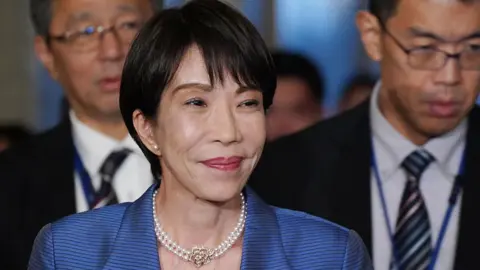
Japan's Prime Minister Sanae Takaichi is among some 60 female lawmakers petitioning for more women's toilets in the parliament building to match their growing representation in the legislature.

A record 73 women were elected into the 465-seat Lower House in October 2024, exceeding the previous high of 54 in 2009.

One opposition lawmaker, Yasuko Komiyama, said there were often "long queues in front of the restroom... before plenary sessions start", and quoted another MP who said she had "given up" going to the toilet before a session began.

There is one female toilet with two cubicles near the plenary chamber, though the entire building itself has nine female toilets with 22 cubicles.

There are a total of 12 men's toilets with 67 stalls and urinals across the building, according to local media reports.

The current situation is "often inconvenient" because female staff and visitors also share the toilets, said Ms Komiyama from the opposition Constitutional Democratic Party.

"I want to raise my voice and prepare myself for the day when women hold more than 30% of [parliamentary seats] in the future," she wrote in a post on Facebook.

Japan's parliament building was built in 1936, a decade before women were given the right to vote in 1945. The first women were appointed to parliament in 1946.

The parliament building is a sprawling three-storey structure, with a central portion that is nine storeys high. The building occupies 13,356 square metres (143,800 sq ft), the equivalent of about two football pitches, with a total floor area of 53,464 square metres.

"If the administration is serious about promoting women's empowerment, I believe we can count on their understanding and cooperation," Komiyama said, according to Japanese media.

Chair of the Lower House committee Yasukazu Hamada has "expressed a willingness" to consider the proposal for more women's toilets, said an Asahi Shimbun report.

The Japanese government earlier set a target of having 30% of leadership roles across all sectors of society held by women by 2020, but at the end of that year the timeframe was quietly pushed back by a decade.

Women currently hold nearly 16% of the seats in the Lower House and about a third – or 42 out of 125 seats – in the Upper House.

Takaichi, who became Japan's first female leader in October last year, had pledged to raise female representation in her cabinet to levels comparable to Nordic countries, which hold the top spots in terms of female leadership.

But she has appointed just two other women to her 19-member cabinet.

In Japan, the dearth of women's restrooms extends beyond the legislative chamber.

Long lines in front of women's public restrooms are a common sight nationwide.

Former Prime Minister Shigeru Ishiba had said his government would look into "enhancing women's restroom facilities" to make Japan a society where "women can live their lives with peace of mind".
New York Mayor Zohran Mamdani redefines oath with Quran, a first in the city’s history

Showcasing the Quran that belonged to Schomburg, an Afro-Latino writer whose work shaped the Harlem Renaissance, underlines the city’s blend of faiths and racial and ethnic backgrounds

Maya King Published 02.01.26, 
THE TELEGRAPH CALCUTTA


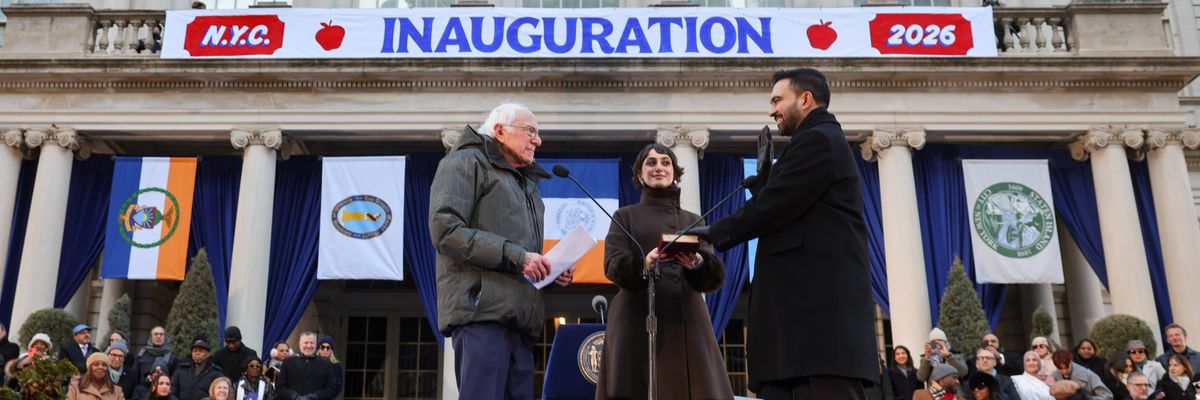
Zohran Mamdani being sworn in using a Quran as mayor of New York City, flanked by his wife Rama Duwaji (right) and attorney-general Letitia James, at Old City Hall Station on Thursday. Amir Hamja/Pool via Reuters

Mayor Zohran Mamdani represents a range of demographics that New York City has not seen before in top leadership: South Asian, millennial, Muslim.

For the hundreds of thousands of Muslim residents who have taken pride in seeing one of their own rise to the mayoralty, his inauguration brought another significant first.

During his swearing-in ceremony shortly after midnight on Thursday, he put his hand on the Quran, Islam’s holiest book, making him the first mayor in New York City to do so.

One of the Qurans was from Mamdani’s grandfather. The other once belonged to Arturo Schomburg, the Black writer and historian. It was lent to the mayor by the New York Public Library.

For a separate public ceremony at City Hall on Thursday afternoon, Mamdani used his grandfather’s Quran and one owned by his grandmother.

Showcasing the Quran that belonged to Schomburg, an Afro-Latino writer whose work shaped the Harlem Renaissance, underlines the city’s blend of faiths and racial and ethnic backgrounds.

“It’s a highly symbolic choice because we’re about to have a Muslim mayor swearing in using the Quran, but also a mayor who was born on the African continent, in Uganda,” Hiba Abid, the library’s curator for Middle Eastern and Islamic Studies, said ahead of Mamdani’s swearing-in ceremony.

Abid helped Zara Rahim, a senior adviser to Mamdani, and Rama Duwaji, Mamdani’s wife, select the Quran for the inauguration. “It really brings together here elements of faith, identity and New York history,” she said.

Schomburg’s Quran will be on public display for the first time as part of a special exhibit at the New York Public Library that coincides with a yearlong celebration of the 100th anniversary of the Schomburg Center. The exhibit will begin on Tuesday.

Schomburg, who was born in Puerto Rico, was not a Muslim but kept the Quran as part of his archive of books and artefacts. He sold his collection, which contained more than 4,000 pieces, to the New York Public Library in 1926, building the foundation of the Schomburg Center for Research in Black Culture. He died in 1938.

His inclusion of the Quran in his collection was meant to show the full expanse of Black artistic, cultural and religious life.

He also wanted to rebut a claim from a childhood teacher, who once remarked to him that Black people lacked significant figures or history. His Quran was acquired from Ottoman Syria and was written and designed for everyday use, as evidenced by the style of its script and binding.

Abid said she hoped that putting Schomburg’s Quran on display would allow New Yorkers to learn more about the holy book and Muslim life in the city. She and Mamdani’s advisers also plan to use the display to encourage more people to take advantage of the archival resources that are available at the library.

Though it is traditional for most elected officials to take the oath of office with their hand on a religious text, they are not required by law to use one — or any book,for that matter.

Most past mayors have placed their hands on a Bible. But Mamdani’s faith was a defining feature of his campaign.

In a statement, Rahim said that Mamdani’s use of the Quran would correct “a long-deferred absence” of Muslims in the city’s public life.

“This moment will mark a turning point in the civic history of New York City, and it belongs to every New Yorker whose lives shaped this city quietly, without ever being reflected back to them,” she said.

Mayors have opted for a mix of personal heirlooms and artefacts while being sworn in. In 2021, Eric Adams took his oath of office with one hand on his mother’s Bible and in the other a framed photo of her image floating in a brandy snifter. His predecessor, Bill de Blasio, put his hand on a Bible that once belonged to President Franklin D. Roosevelt.

Mamdani will join a small group of prominent elected officials in the US to use a Quran for their swearing-in. Keith Ellison, Minnesota’s attorney general, became one of the first American elected officials to put his hand on the book when he was sworn into Congress in 2007. Representative Ilhan Omar of Minnesota, who succeeded Ellison, also put her hand on a Quran for her swearing-in.

In New York, Shahana Hanif was sworn in to the City Council in 2022 with her hand on a family Quran that her sister used during her wedding. Hanif said Mamdani’s plan to use the Quran highlighted the inroads that Muslims have made in city politics.

“Let’s be honest, Muslims have not been in electoral life for decades like other ethnic groups and communities,” she said. “I think the Quran represents this example of extending solidarity to the Muslim community in New York City and, really, abroad.”

New York Times News Service

New York Mayor Mamdani vows to enact democratic socialist agenda


New York City Mayor Zohran Mamdani delivers a speech during his inauguration ceremony in New York City, US, Jan 1, 2026.
PHOTO: Reuters

January 01, 2026 


NEW YORK — Democrat Zohran Mamdani became New York City's mayor on Thursday (Jan 1), vowing during a public swearing-in ceremony on the steps of City Hall to enact an aggressive agenda aimed at making the nation's largest city more affordable for working people.

Mamdani, a member of his party's left-wing democratic socialist faction, was elected last November in a prominent victory that could influence this year's midterm elections that will determine control of the US Congress. Some Democrats have embraced his style while Republicans portray him as a foil on the national political stage.

The 34-year-old campaigned heavily on cost-of-living issues and was sharply critical of Republican President Donald Trump, whose approval rating has fallen over the past year amid economic concerns.

Many of New York's eight million residents — some with hope, some with trepidation — expect him to be a disruptive political force. In a speech following his public swearing-in, Mamdani promoted core campaign promises of universal childcare, affordable rents and free bus service.

"We will answer to all New Yorkers, not to any billionaire or oligarch who thinks they can buy our democracy," he said. "I was elected as a democratic socialist and I will govern as a democratic socialist."

Crowd chants 'tax the rich'

The programme for Mamdani's inauguration included remarks by US Senator Bernie Sanders and US Representative Alexandria Ocasio-Cortez, fellow democratic socialists at the vanguard of the Democratic Party's liberal wing.

Sanders, whom Mamdani calls his inspiration, defended Mamdani's agenda.

"Making sure that people can live in affordable housing is not radical," Sanders said. "It is the right and decent thing to do."

The crowd of several thousand cheered loudly when Sanders called on America's millionaires and billionaires to pay more in taxes, breaking into a chant of "tax the rich."

Even with temperatures well below freezing, the city set up a viewing area along Broadway to allow thousands more to watch a livestream of the ceremony, which included musical performances.

Mae Hardman-Hill, 27, volunteered for Mamdani's campaign and said it felt like his political momentum was growing.

"I'm a native New Yorker. I've watched the city like you just become less and less affordable, less and less livable," Hardman-Hill said. "I'm really excited for... regular people to get some power back again."

Prior to the public ceremony, Mamdani was privately sworn in as New York City's mayor in the first minutes of the New Year on Thursday at the historic City Hall subway station, which was decommissioned decades ago and is accessible only a few times a year through guided tours.

Reflecting his Muslim faith, he used a Quran, Islam's holiest book, for his swearing-in, a first for a New York City mayor.

Republicans blast Mamdani


Hours after Mamdani took office, the lead group tasked with electing Republicans to the US House of Representatives sought to portray him as a "radical socialist."

"Every time Mamdani opens his mouth or swipes his pen, he tattoos the Democrat Party's failures onto every House Democrat facing voters in 2026," spokesperson Mike Marinella said in a statement that signalled the sizable role Mamdani is likely to play on the national campaign stage.

Mamdani, a former state lawmaker, promised a freeze on rents and free buses and childcare, building a campaign around affordability issues that some have seen as a path forward for the Democratic Party around the country ahead of November midterm elections.

Dean Fuleihan, the incoming deputy mayor, told the Financial Times that Mamdani will move ahead with plans to increase taxes on millionaires to pay for his campaign promises and balance New York's budget. He added that he doesn't expect rich people to leave the city as a result of potentially higher taxes.

New York Governor Kathy Hochul has said she opposes raising personal income taxes but is considering raising corporate taxes to pay for a potential budget shortfall amid federal cuts.

In one early reversal, Mamdani said on Wednesday that he would no longer seek to end mayoral control of New York City's public school system, the largest in the US, naming veteran educator Kamar Samuels as chancellor.

Mamdani inspired a record-breaking turnout of more than two million voters and took 50 per cent of the vote in November, nearly 10 points ahead of Andrew Cuomo running as an independent and well ahead of Republican Curtis Sliwa.

Inauguration of a new era

The Uganda-born Mamdani has been a sharp critic of Trump on issues such as immigration and said his differences with the president were numerous after a warm White House meeting.

Mamdani raised US$2.6 million (S$3.33 million) for the transition and celebrations from nearly 30,000 contributors, more than other mayors on record this century, both by the total and single donations, according to official campaign data that presents disclosures of inaugural expenses beginning with Michael Bloomberg's first term in 2001.

As mayor, Mamdani will move from his one-bedroom Astoria apartment, protected from sharp price hikes by the city rent-stabilisation programme, to Gracie Mansion, the official residence of New York City mayors on Manhattan's upscale Upper East Side.

Bankers and others in New York, the nation's financial capital, had expressed concern about Mamdani, but since his election many have explored how to work with him.

Source: Reuters


New Yorkers brave the cold to welcome Zohran Mamdani as their new mayor

FRANCE24
Issued on: 02/01/2026 

Zohran Mamdani was sworn in as New York City's mayor after his election in November 2025. Mamdani won on his promise to tackle cost-of-living issues in the city while sharply criticising the US president, Republican Donald Trump. Many New York residents expect him to be a disruptive political force. FRANCE 24's Jessica Le Masurier went to ask them what Mamdani represented for them.


Thursday, January 01, 2026

Trump welcoming 'loyalists with little expertise' for commission on DC projects


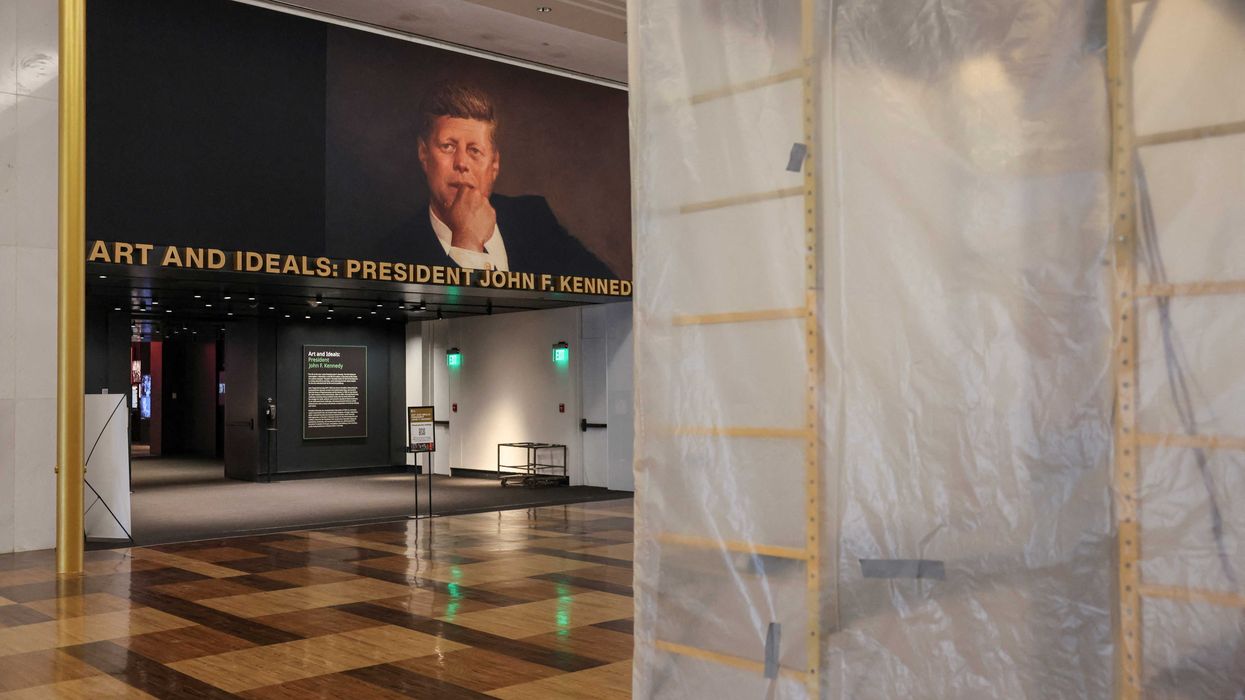
The entrance to the "Art and Ideals: President John F. Kennedy" exhibition at the recently renamed Donald J. Trump and John F. Kennedy Memorial Center for the Performing Arts, in Washington, D.C., U.S., December 29, 2025. REUTERS/Tyrone Siu

January 01, 2026

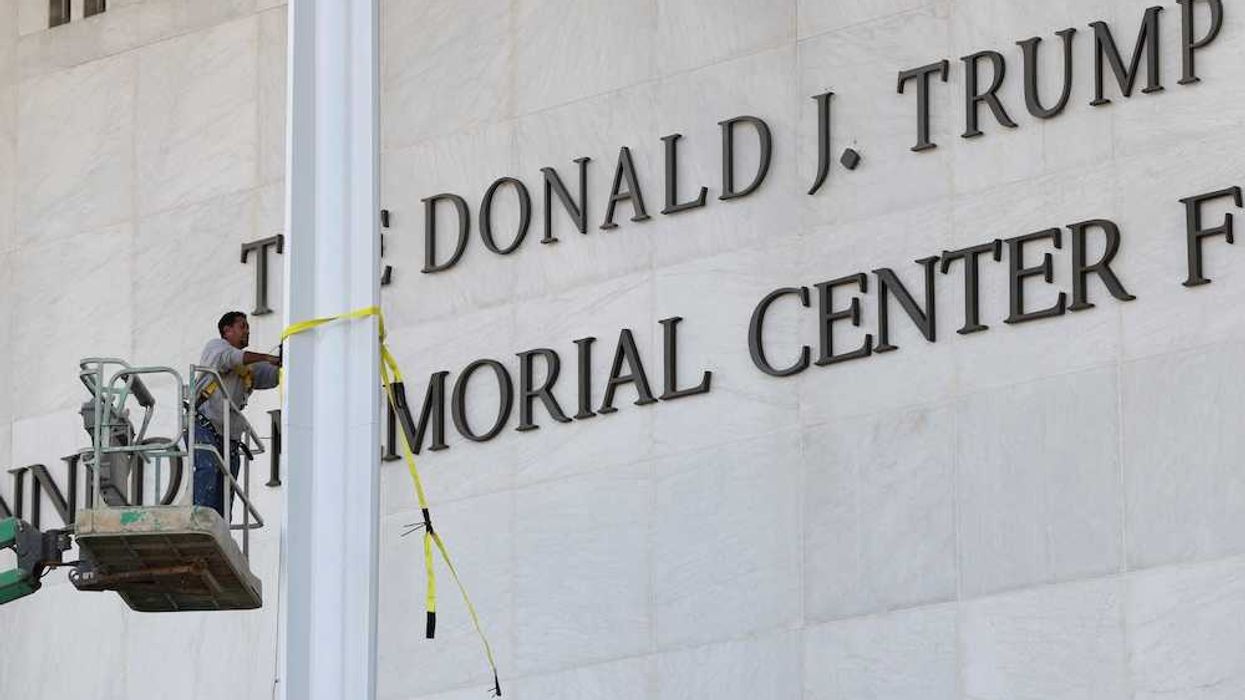
In predominantly Democratic Washington, D.C., President Donald Trump is putting his stamp on a wide range of projects — from a lavish White House ballroom that will replace the recently demolished East Wing to renaming the Kennedy Center the Donald J. Trump and John F. Kennedy Center for the Performing Arts. And according to Washington Post reporters Dan Diamond and Jonathan Edwards, Trump White House officials are "moving to install Trump-aligned appointees to a commission charged by Congress with reviewing Washington's public art and national memorials."

In an article published on New Year's Day 2026, Diamond and Edwards note that Trump's allies are "seeking members likely to clear the way for" his "controversial ballroom and other projects."

"The White House is expected to invite past Trump appointees to rejoin the Commission of Fine Arts, according to three people who spoke on the condition of anonymity to discuss those plans," the Post journalists explain. "Trump officials have described the move as returning former members to uncompleted four-year terms that were cut short by the Biden Administration, the people said. It is not yet clear whether those former members — architectural critic Justin Shubow, developer and designer Rodney Mims Cook Jr., sculptor and painter Chas Fagan, landscape architect Perry Guillot and architect Steven Spandle — would accept the invitation."

Diamond and Edwards report that according to Post sources, the commission is prioritizing loyalty to Trump over experience.

"White House officials have also considered appointing Trump loyalists with little formal arts expertise, according to one of the people and another who spoke on the condition of anonymity to discuss private conversations," the Post journalists note. "The commission faces intensifying scrutiny over the president's building agenda, which includes a proposed 90,000-square-foot ballroom addition to the White House that is now the subject of a legal challenge."

Diamond and Edwards add, "Beyond the ballroom, the commission is expected to review future projects that would shape Washington's landscape, including a planned triumphal arch."

Read Dan Diamond and Jonathan Edwards' full article for The Washington Post at this link (subscription required).


Neuroscientist shatters MAGA’s testosterone claim

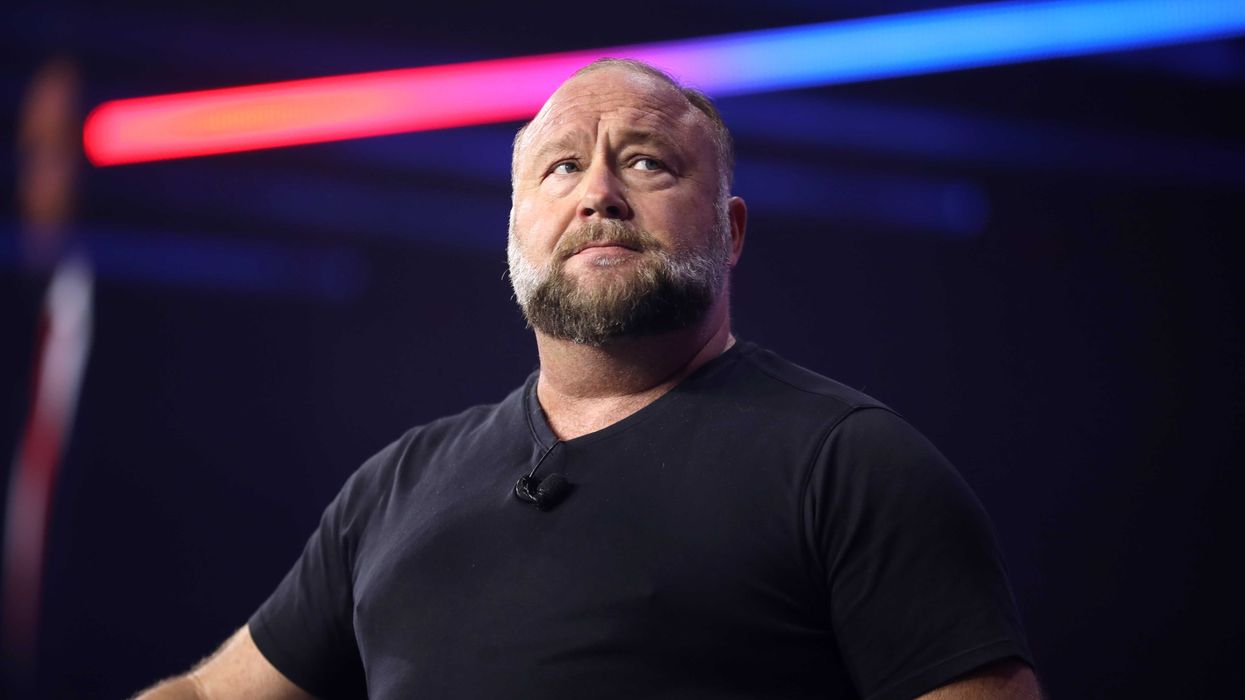
Alex Jones at The People's Convention in Detroit on June 16, 2024 (Gage Skidmore/Flickr)


January 01, 2026
ALTERNET

In the Manosphere, a variety of anti-feminist ideologies — from PUAs (pickup artists) to MGTOW (Men Going Their Own Way) to incels — often accuse feminists and progressives of trying to make men less masculine. And a conspiracy theory pushed by Infowars' Alex Jones and others on the far right claims that the left, in its quest for political dominance, is using soy products to decrease men's testosterone and make them weak and passive. "Soy boys," Jones contends, are effeminate progressive males and the result of a leftist war on masculinity.

But neuroscientist Robert Sapolsky, in an article published by the New York Times on New Year's Day 2026, stresses that high levels of testosterone aren't necessarily synonymous with masculine traits.

"In particularly prickly corners of MAGA World," Sapolsky explains, "a low-blow way of dissing the men you despise — often left-leaning guys with a fondness for empathy, equality, even democracy — is to charge them with having low levels of testosterone. Take Elon Musk, who, a while back, reposted a screed about how 'low T' men can't think freely because they 'can’t defend themselves physically.' Or consider the 'soy boy' insult popular a few years ago in the same circles, based on the false idea that chemical compounds in soy feminize men's hormonal makeup."

However, Sapolsky — a biology professor at Stanford University in California — says that extensive scientific research isn't consistent with MAGA's "soy boy" claims.

"Beyond my own research," Sapolsky notes, "decades of data show that testosterone does not ensure dominance, nor does it act as a straightforward trigger of aggression. This may come as a surprise. Males of endless species, including us, tend to have higher testosterone levels and to be more aggressive than females; aggression and testosterone levels rise in males at puberty; and males of species that compete for territories annually show increased aggression and testosterone levels at those times."

Sapolsky adds, "Note, however, that there's some evidence that the causality could run in the other direction: Engaging in aggressive behaviors may trigger a spike in testosterone."

Sapolsky points out that "within normal ranges," testosterone levels "are not strongly predictive of aggression."

"Scientists now believe that testosterone makes people and animals more sensitive to threats to their status — to the point of perceiving threats that are imagined and amplifying the aggressive response to such threats," according to the neuroscientist. "For instance, a male impala with high testosterone may be more sensitized to challenges to his territory, attacking an interloper when it comes within 100 yards of him, instead of the usual 50…. If society is riddled with aggression, don't blame testosterone; blame us for being too prone to dole out status for aggression."

Read Robert Sapolsky's full New York Times article at this link (subscription required).
Christian leader debunks MAGA claim that America was 'intended to be a theocracy'


Alex Henderson
January 01, 2026
ALTERNET

When Vice President JD Vance spoke at Turning Point USA's recent AmericaFest 2025 convention in Phoenix, he told the MAGA crowd that the United States "always will be a Christian nation." And Vance isn't the only MAGA Republican who is claiming that there is no separation of church and state in the U.S. Constitution.

Many Christian nationalists are claiming that the Constitution was designed to be a religious document even though the First Amendment clearly states, "Congress shall make no law respecting an establishment of religion or prohibiting the free exercise thereof." The First Amendment promises freedom of religion, but it also forbids government to give one religion preferential treatment over another.

In an op-ed published by The Philadelphia Inquirer on New Year's Day 2026, a Baptist minister, the Rev. Michel J. Faulkner, debunks the "Christian nation" argument coming from Vance and other Christian nationalists.

"America was shaped by Judeo-Christian principles, but it was never intended to be a theocracy," argues Faulkner, who chairs of the Philadelphia Council of Clergy's board of directors. "America's unity is powerful precisely because we do not have a state religion. Faith compelled by law is no faith at all. Genuine belief cannot be coerced; it must be chosen. The Gospel advances by witness, persuasion, and sacrificial love, not by legislation or force."

The 68-year-old Faulkner has a background in both sports and religion. In the early 1980s, he played American football for the New York Jets. And he has a connection to the Religious Right: After meeting the Moral Majority's Rev. Jerry Falwell Sr. in 1985, Faulkner, a registered Republican, worked at Falwell's Liberty University in Lynchburg, Virginia.

Yet Faulkner rejects the Christian nationalist claim that the U.S. government was meant to be operated as a theocracy.

"I say this as a Christian and a follower of Jesus Christ: The church does not need the power of the state to fulfill its mission," Faulkner continues writes. "History shows that when the church weds itself too closely to political power, it loses its prophetic voice and relinquishes its spiritual authority. America is not the Kingdom of God, and it was never meant to be…. If we confuse America with the Kingdom of God, we will ultimately diminish both — robbing the nation of its moral responsibility and the Gospel of its eternal power."

The Rev. Michel J. Faulkner's full op-ed for The Philadelphia Inquirer is available at this link (subscription required).
Release of Jack Smith interview shows 'why Jim Jordan didn’t want public testimony': experts

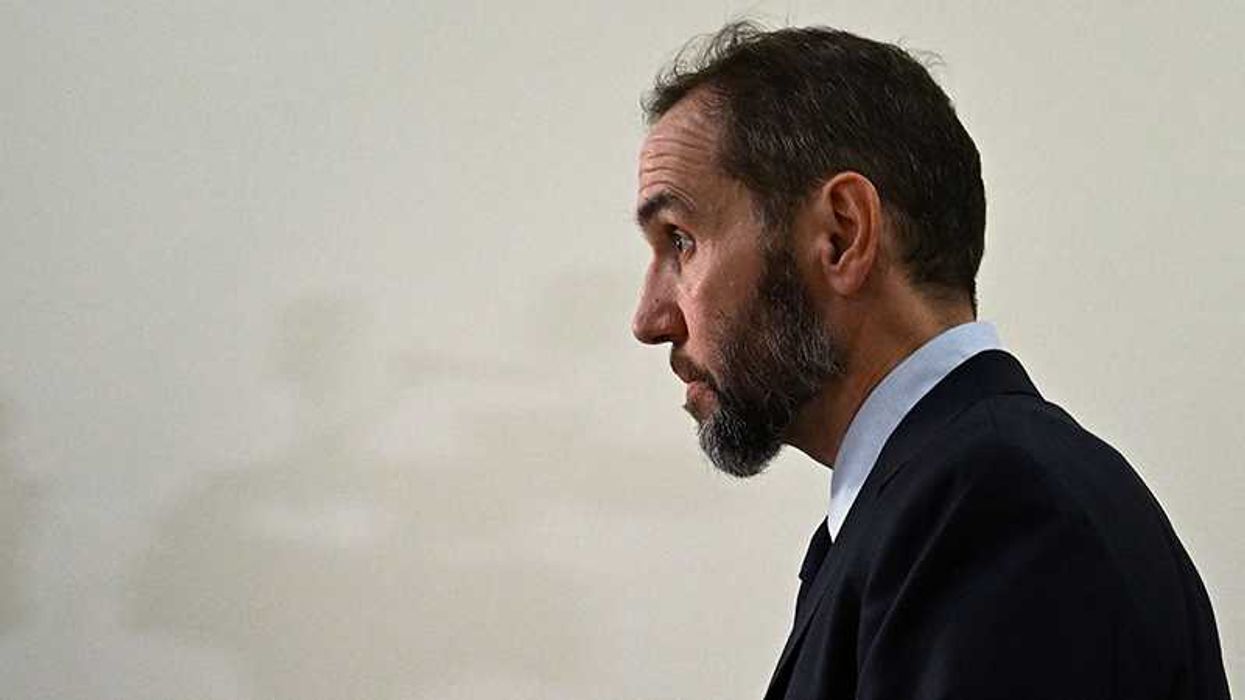
Former U.S. Special Counsel Jack Smith walks, on the day of a closed-door deposition as part of a House Judiciary Committee inquiry into his now-dismissed cases against U.S. President Donald Trump over his efforts to overturn the 2020 election results and his retention of classified documents, on Capitol Hill in Washington, D.C., U.S., December 17, 2025. REUTERS/Annabelle Gordon

January 01, 2026
ALTERNET


The video of a closed-door interview with former special counsel Jack Smith was released at the end of the day, New Year's Eve, but it hasn't stopped legal analysts from walking through some of the most important details.

Elections lawyer Marc Elias couldn't help but laugh that he still "live[s] rent free in the heads of these MAGA idiots." The Smith interview took place before the House Judiciary Committee, where Chairman Jim Jordan (R-Ohio) did a large part of the questioning

Legal analyst Allison Gill, who co-hosted a podcast named "Jack" about the special counsel, noted that she understands now why Jordan wanted to bury the interview.

"Half way through the Jack Smith transcript and it’s become abundantly clear why Jim Jordan didn’t want public testimony. Jordan spends a lot of time whining about the toll subpoenas, and Jack Smith shuts him down every time," Gill wrote on BlueSky.

In the morning podcast, Gill and co-host Dana Goldberg cited an exchange between Jordan and Smith where the former probed him on specific actions he took.


"The whole time Jim Jordan had the microphone, which was a long time," Gill began, "he winged about the toll record thing where the members of Congress against the 'Speech or Debate Clause' got their phone records subpoenaed by Jack Smith, and it should be against the law. And every time Jack Smith was like, yeah, that's cool, bro, but it's not against the law, and the courts agreed. So, we did it. And if you have a problem, guess what? You make laws."

"You fix the f—— law!" Goldberg added with a chuckle.

Gill also pointed out a key point in the Smith probe about Rudy Giuliani, who Smith's team asked whether he believed his 2020 election lies. Giuliani confessed he didn't "and that neither did Donald Trump."

"The President of the United States is a criminal. Thank you for your service, Jack Smith," echoed Trump foe George Conway on BlueSky.

NBC News' justice reporter Ryan Reilly highlighted Jack Smith saying that he wouldn't be surprised if Trump told the DOJ to indict him.

MeidasTouch legal commentator Katie Phang detailed the questions about Smith's proof that Trump was the instigator of the Jan. 6 Capitol attack.

"The first is the evidence here made clear that President Trump was by a large measure the most culpable and most responsible person in this conspiracy," Phang explained. "These crimes were committed for his benefit. The attack happened at the Capitol, part of this case does not happen without him. The other co-conspirators were doing this for his benefit. So, in terms of why we would pressure a case against him, I entirely disagree with any characterization that our work was in any way meant to hamper him in the Presidential election."

Smith went on to confirm that the evidence they gathered showed Trump prompted the Jan. 6 attack.

"As I said, our evidence is that he in the weeks leading up to January 6th created a level of distrust," Smith said. "He used that level of distrust to get people to believe fraud claims that weren't true. He made false statements to state legislatures, to his supporters in all sorts of contexts and was aware in the days leading up to January 6th that his supporters were angry when he invited them and then he directed them to the Capitol. Now, once they were at the Capitol and once the attacks on the Capitol happened, he refused to stop it. He instead issued a tweet that without question in my mind endangered the life of his own vice president. And when the violence was going on, he had to be pushed repeatedly by his staff members to do anything to quell it. And then, even afterwards, he directed co-conspirators to make calls to Members of Congress, people who had — were his political allies, to further delay the proceedings."