Thursday, November 27, 2025


Great Lakes Bulker Grounds in the Detroit River

bulker grounded near Detroit
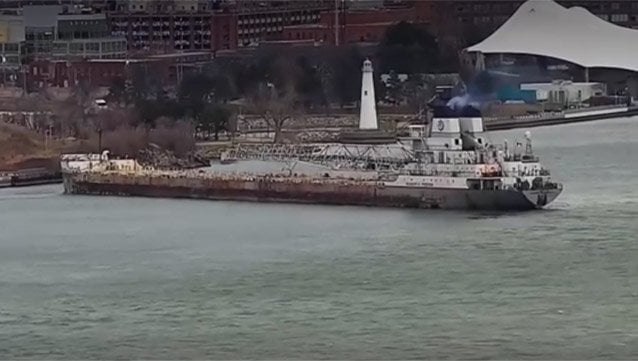
Laker became stuck diagonally across the Detroit River (Detroit webcam)

Published Nov 27, 2025 4:16 PM by The Maritime Executive


The Canadian-flagged cargo ship Robert S. Pierson (19.000 dwt) briefly became stranded diagonally across the Detroit River overnight on November 26. Reports are blaming the grounding on strong winds that were disrupting shipping all along the Great Lakes overnight and into today.

Built in 1974, the vessel is part of the "river class" of self-unloading bulk freighters operating in the region owned currently by Rand Logistics. At 630 feet (190 meters) in length, the vessel was specifically designed to sail the winding Cuyahoga River.

The vessel loaded 18,000 tons of stone in Windsor, Ontario, Canada, and was heading for Loraine, Ohio, in the United States. CBC reports the vessel attempted to drop anchor on Wednesday evening due to the strong winds to wait out the storm. However, it reports the vessel was dragged down the Detroit River. Around 10:30 p.m. local time, the ship grounded and became stuck in a diagonal position in the river not far from downtown Detroit. 

The U.S. Coast Guard reports it was notified around 1:15 a.m. this morning of the incident. It was working with the operators to review a refloating plan. Yesterday, the Coast Guard issued a warning for high winds and waves across the Great Lakes. It reported that the Welland Canal in the east connecting Lake Ontario to Lake Erie had suspended navigation due to the high winds. The canal was expected to reopen this afternoon.

Media reports spotted two tugs alongside the Pierson at midday. CBC reports the ship was freed around noon local time. It was moved to a berth for an inspection. The Coast Guard is saying that low water levels contributed to the grounding.

The reports are highlighting that it was the second grounding in less than a month in the same area of the Detroit River.  At the beginning of November, the Canadian vessel Rt. Hon. Paul J. Martin had also attempted to anchor to discharge a sick crewmember. CBC reports that when the vessel tried to get back underway, it was blown off course and grounded. The low water levels were also cited in this incident. The Martin was refloated the following day with the assistance of four tugs.


First Power From Germany’s Largest Offshore Wind Farm Using 15 MW Turbines

German offshore wind farm
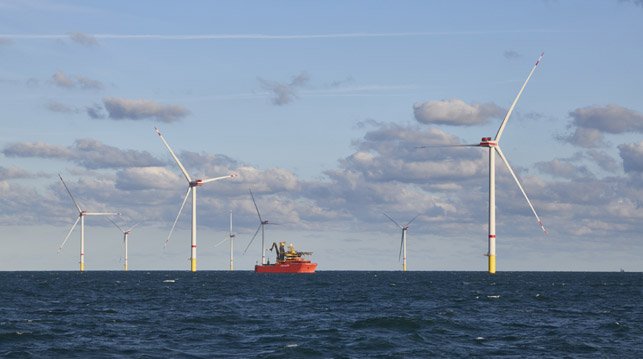
He Dreiht will be Germany's largest offshore wind farm so far and the first to use Vestas' 15MW turbines (Rolf Otzipka photo courtesy of EnBW)

Published Nov 27, 2025 5:36 PM by The Maritime Executive


Germany’s largest offshore wind farm to date, EnBW’s He Dreith project, achieved key milestones as it proceeds with construction and provides encouragement for a somewhat beleaguered industry. The project generated and delivered its first kilowatt-hour of electricity on November 25 as it started the commissioning process for its turbines.

Peter Heydecker, EnBW Board Member for Sustainable Generation Infrastructure, called it a significant milestone for the company. He noted that the company has been planning, building, and operating offshore wind farms in Germany for 15 years, and it is now pushing toward the goal of having 80 percent of its generation portfolio consisting of renewable energies by 2028. At the same time, it expects to phase out coal-powered generation.

He Dreiht is also unique as it is the first to deploy the 15 MW turbines by Vestas. The company highlights that a single rotation of the rotor on the 15 MW wind turbine is enough to supply the equivalent of four households with electricity for a day. S&P Global writes that the turbine “could reshape offshore wind economics in the North Sea.” 

At a hub height of 142 meters (466 feet), the rotor with a diameter of 236 meters (774 feet) sweeps through an area of 43,742 square meters per revolution. The company says this is equivalent to the area of six football fields and notes the dramatic advancement from the 2.3 MW turbines it installed at its first wind farm 15 years ago.

Nils de Baar, President of Vestas Northern and Central Europe, the wind turbine manufacturer, explains, “The 15 MW turbine is a world first in terms of technology, setting new standards in offshore wind power. Its efficiency and performance enable a significant increase in energy yield per turbine.”

The project is located approximately 85 kilometers (53 miles) northwest of Borkim in the North Sea and 110 kilometers (68 miles) west of Heligoland. The project was awarded in a 2017 tender.

EnBW highlights that the total investment is projected at €2.4 billion and that it is proceeding without state funding. A partner consortium made up of Allianz Capital Partners, AIP, and Norges Bank Investment Management owns 49.9 percent of the shares in He Dreiht.

The company reports that internal wind farm cabling and the connections to the converter platform were completed in August. Currently, 27 out of the total of 64 wind turbines have been installed and are in the process of commissioning. EnBW expects that further turbines will begin to supply power gradually in the coming weeks.

While the project is slightly behind schedule, EnBW reports that full commissioning is set to be completed by the summer of 2026.


Port of Rotterdam Plans Terminal to Support Offshore Wind Sector Growth

offshore wind terminal Rotterdam
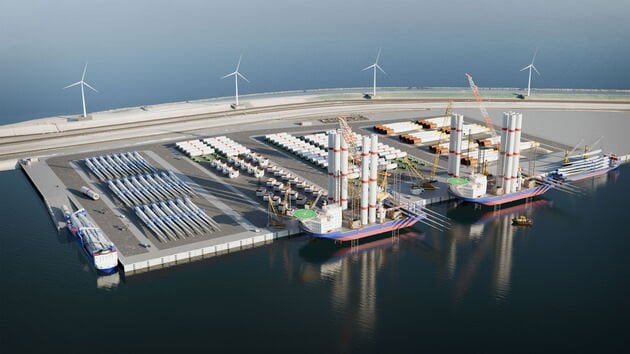
Port of Rotterdam is starting the design process for its wind terminal to support growth in the North Sea (Port of Rotterdam)

Published Nov 26, 2025 7:30 PM by The Maritime Executive


The Port of Rotterdam Authority announced plans to develop a 45-hectare site in the northwest corner of Maasvlakte dedicated to the needs of the offshore wind sector. It believes the new terminal will be a crucial link in the energy transition, featuring an 835-meter deep-sea quay and capabilities specifically designed for the industry.

With this project, the Port of Rotterdam Authority says that it aims to provide the offshore wind industry with the necessary capacity and stimulate growth in the sector. While countries are moving forward with plans to develop more wind farms in the North Sea in the coming years, Rotterdam officials highlight a lack of port facilities. It says the required port capacity at the right specifications is currently a limiting factor. With the completion of the terminal, the Port Authority is providing the large-scale, high-quality infrastructure that the market demands.

With this new terminal, we are making an important contribution to the necessary capacity for the offshore wind sector,” said Matthijs van Doorn, Vice President Commercial of the Port of Rotterdam Authority. “Due to its direct location on the North Sea, deep draught and existing offshore cluster, the port of Rotterdam is ideally suited for these activities.”

The plans for the new terminal call for providing space for storage, transshipment, assembly, and installation of wind turbine components and foundations. The quays will be prepared for jack-up operations and equipped with heavy-load zones and equipped with a dedicated Roll-on/Roll-off facility.

The port said that this terminal will support the growing demand for offshore wind projects in the North Sea and contribute to the energy and raw materials transition, including future repowering and decommissioning of existing wind farms. In doing so, Rotterdam aims to strengthen its position as Europe’s leading offshore wind hub. The terminal is expected to be operational in mid-2029.

Starting today, November 26, the port authority is inviting participants in the industry to contribute ideas about the design of the terminal and to share their ambitions, needs, and technical knowledge. Following this RFI (Request for Information) phase, the Port Authority will further define the following steps and make the final decision on how the terminal is to be operated. The comment period will close on January 8, 2026, and the next steps will be announced in March.


Disruptions and Delays at Maritime Chokepoints Could Cost $14B Per Year

containership at sea
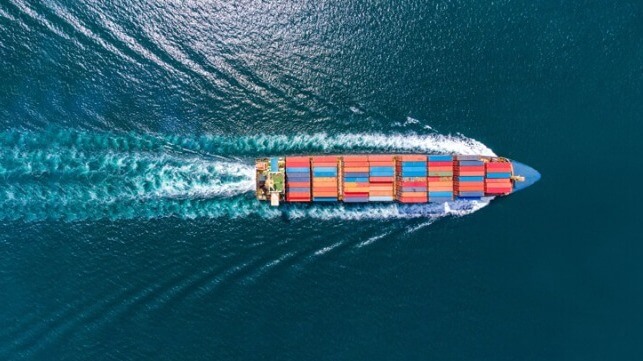
Study warns of the costs and repercussions of delays at chokepoints

Published Nov 27, 2025 6:11 PM by The Maritime Executive


The challenges of the past few years have increased the awareness of the vulnerability of the shipping industry to delays as congestion builds in key ports and routes faced disruptions ranging from geopolitical issues to piracy, terrorism, or natural hazards driven by extreme weather.

A new study estimates that disruptions at these critical points affect around $192 billion worth of maritime trade each year. These disruptions result in estimated economic losses of about $14 billion annually, through delays, rerouting, insurance premiums, and higher freight costs. The researchers suggest that international cooperation and coordinated risk management will be essential to prevent and mitigate future disruptions.

The researchers analyzed 24 major maritime chokepoints, including the Suez Canal, Bab el-Mandeb Strait, and Strait of Malacca — vital trade arteries through which much of the world’s goods and energy supplies flow. They found that chokepoint disruptions lead to around $10.7 billion in annual direct economic losses, equivalent to 0.04% of global trade. The greatest impacts are concentrated in countries such as Egypt, Yemen, Iraq, and Panama, given their strong dependency on at-risk maritime chokepoints. 

An additional $3.4 billion is lost each year globally due to rising shipping costs, as freight rates spike when trade routes are blocked or ships have to reroute. These increases affect all countries, not only those directly linked to the disrupted chokepoint, by driving up the cost of transport and subsequently consumer prices.

“Our global economy depends on just a handful of maritime chokepoints,” said Dr. Jasper Verschuur, lead author of the report. He notes that, “When one of these narrow passages is disrupted, the consequences can quickly ripple across continents. Understanding these risks is vital for building resilience into global supply chains.”

The study found that many of these threats — whether human-induced, like armed conflict and piracy, or natural, such as cyclones— are interconnected. Armed conflict and terrorism often occur together at certain chokepoints such as the Bab el-Mandeb Strait, the Bosporus, and the Lombok Strait, while around 40 percent of tropical cyclones affect more than one chokepoint at the same time. In some cases, piracy in one region appeared to increase the likelihood of attacks elsewhere.

These overlapping risks, the report concludes, mean that multiple chokepoints could be disrupted simultaneously, severely limiting the world’s ability to reroute ships and maintain trade flows.

“The co-occurrence of hazards shows how interlinked our maritime system really is. A single event in one part of the world can trigger or amplify risks elsewhere,” said Dr. Johannes Lumma. “Analysing these dependencies helps us anticipate compound disruptions and better prepare for them.”

The authors report that the findings underscore the systemic vulnerabilities within global trade networks. Disruptions at key chokepoints can cause cascading effects — from factory shutdowns due to missing components to price increases felt by consumers worldwide.

The researchers argue that reducing these risks will require a layered resilience strategy, tailored to the types of chokepoint each country or company depends on. This could include maintaining emergency stockpiles, diversifying supply chains, investing in security, and developing insurance products that cover rare but severe disruptions.

“Maritime chokepoints may be geographically small, but they have an enormous impact on how the global economy functions,” said Professor Jim Hall, co-author and Director of OPSIS. “Keeping them open and secure is a global priority. By identifying where and how the system is most vulnerable, we can help governments and businesses strengthen resilience to future shocks.”

The research was published in Nature Communications and titled “Systemic impacts of disruptions at maritime chokepoints.” It was conducted by Dr. Jasper Verschuur, Dr. Johannes Lumma, and Prof. Jim Hall, researchers at the Oxford Programme for Sustainable Infrastructure Systems (OPSIS) at the Environmental Change Institute (ECI), University of Oxford. The study was supported by The Oxford Martin Systemic Resilience Initiative and received additional support from the Gallagher Research Centre.


Four People Survive for 20 Hours Aboard Upturned Catamaran

Courtesy USCG
Courtesy USCG

Published Nov 25, 2025 11:33 PM by The Maritime Executive


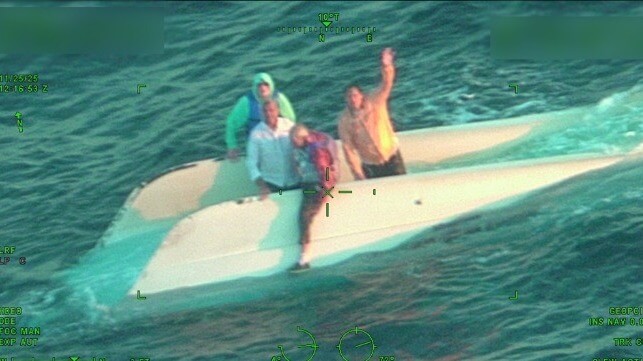
On Tuesday morning, the U.S. Coast Guard rescued four people from the upturned hull of a pleasure vessel about 26 miles off the coast of Clearwater, Florida. The boat's passengers had been stranded at sea for about 20 hours overnight.

The four family members aboard the boat got under way on Monday at about 0930 hours, planning to return in the afternoon. At about 2100 hours on Monday night, a family member ashore contacted the Coast Guard and reported that the small 24-foot boat was overdue. 

Coast Guard Sector St. Petersburg launched multiple search crews, including an HC-144 SAR plane aircrew, which located the vessel at about 0715 hours on Tuesday. The boat had capsized, and was drifting in calm conditions of 2-3 foot seas and winds of about 5-10 knots. The aircrew dropped an inflatable life raft and a location marker in anticipation of a surface vessel rescue. 

Shortly after, a boat crew out of Station Sand Key arrived on scene and rescued the boaters. The four boaters were in stable condition, and the crew transported them to an EMS team at Station Sand Key for evaluation.

The survivors have been named as Dennis Woods, 70, Clarence Woods, 90, Cris Harding Sr., 42 and Chris Harding Jr., 18. Woods told Fox News that water had filled one side of the catamaran, and that it capsized within about five minutes. Water temperatures near Clearwater were about 72 degrees, within the survivable range for an extended period.

"Through the efforts of multiple Coast Guard crews and partner agencies we were able to safely recover the missing boaters and reunite them with their loved ones," said Ensign Gaige Garrett, Operational Unit Controller at Sector St Petersburg Command Center. "We want to remind anyone going out on the water to have all necessary safety equipment to include Coast Guard approved life jackets, VHF radio, signaling devices and an emergency position locator beacon or personal locator beacon."


Poland Buys Ultra-Stealthy Submarines From Sweden

Saab's A-26 (Saab Kockums)

Published Nov 26, 2025 10:59 PM by The Maritime Executive


In an increasingly tense Baltic Sea security environment, Sweden and Poland are strengthening their naval capabilities with new acquisitions: Poland is buying Sweden's A-26 class submarine, and Sweden will be buying a new class of frigate, its largest surface combatant in years. 

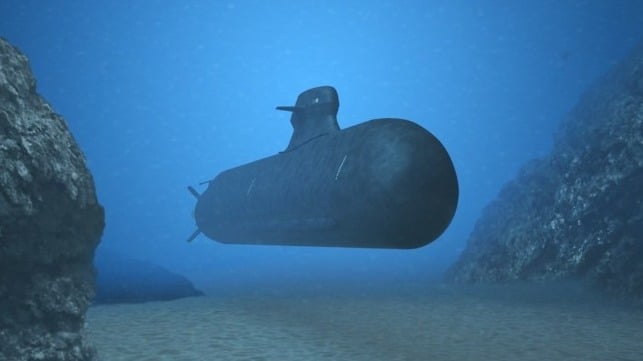
The sub acquisition will be a game-changer for Poland's small navy, which currently operates just one Cold War-era Kilo-class submarine. The Saab-built A-26 sub design won out over a panoply of well-qualified competitors, from Thyssenkrupp to Hanwha Ocean to Navantia. The all-in price for three hulls is reported to be about $2.5 billion.

The A-26 is purpose built for the shallows of the Baltic Sea, and for an unusual degree of stealth. As a diesel-electric vessel, it does have to periodically surface, but not very often. It has an advanced air-independent propulsion system that can provide power for weeks at a stretch, running an efficient Stirling engine on diesel fuel and liquid oxygen. It has modern features for signature reduction, like an X-style rudder  and a flared, specially-shaped sail. It also has a lockout chamber (or "multi-mission portal") at the bow for deploying divers or larger AUVs. Stretched versions are available for long-distance operations. From a practical and operational standpoint, Saab has designed A-26 to take on fuel and stores at sea, and has previously claimed that it will have a replenishment timeline of about six hours. 

The previous Saab model, the Kockums Gotland-class, is well-known for its stealth capability. Famously, first-in-class HSwMS Gotland managed to "hit" aircraft carrier USS Ronald Reagan during wargames in the Pacific, having evaded all of Reagan's escorts. 
                                                                                                     
"We are honored to have been selected and look forward to the coming negotiations with the Armaments Agency in Poland. The Swedish offer, featuring submarines tailored for the Baltic Sea, is the right choice for the Polish people. It will significantly enhance the operational capability of the Polish Navy and benefit Polish economy," said Micael Johansson, President and CEO of Saab.

Separately, Sweden is planning to buy a full-size frigate for the first time in years, and hopes to take delivery of the first hulls by 2030 - an ambitious timeline. Sweden wants to make a decision next year, and will select from among proven hull designs to reduce acquisition risk. The vessel will be built at a foreign yard.  

At present, the Swedish Navy's largest surface combatants are the Visby-class stealth corvettes, five of which were built; they have all-domain capabilities, including anti-submarine warfare. 


Five Decades On, Polar Star is Still Getting Under Way for Antarctica

Cold War-era engineering and an intensive maintenance program keep the mission going

USCG cutter Polar Star
USCGC Polar Star prepares to depart Seattle, Nov. 20, 2025

Published Nov 26, 2025 8:25 PM by The Maritime Executive


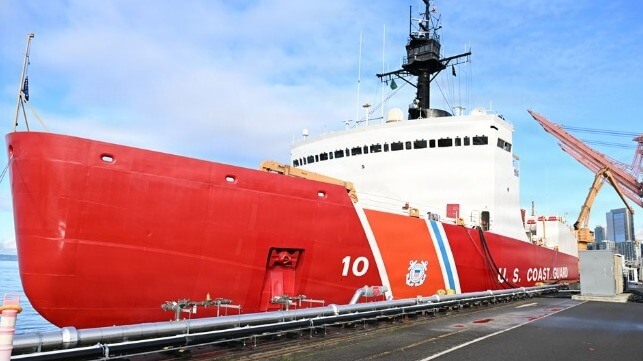
The U.S. Coast Guard cutter USCGC Polar Star has departed Seattle for her annual voyage to Antarctica for Operation Deep Freeze, the annual breakout to cut through the ice to resupply McMurdo Station. In most years, the long voyage south is the aging icebreaker's sole mission. 

Until the Polar Security Cutter program delivers its first hull, Polar Star is the only vessel in the American inventory capable of breaking through ultra-thick Antarctic ice. During Operation Deep Freeze, the heavy and powerful ship makes a channel through ice in the Ross Sea to allow merchant ships to reach McMurdo Station's temporary pier. This is the primary means of providing fuel and provisions for the National Science Foundation's Antarctic Program, supplying multiple outposts around the region.  

Polar Star is now 49 years old, ten years over the age of the average American citizen and twice the end-of-life age of a standard container ship. She is continually maintained and spends most of the time period between her Antarctic trips in overhaul. To keep her operating this far past her intended service life, she goes into drydock every year, which helps offset the wear and tear of five decades of icebreaking - a task characterized by extremely low air temperatures, extreme vibration, high engine loads and (during transit) heavy rolling. In some years, the crew has to perform significant unplanned maintenance under way, sometimes extending to underwater repairs with divers. 

Notwithstanding her age, she is a capable vessel. Five decades on, Polar Star remains the most powerful non-nuclear icebreaker in the world, thanks to a combination of a diesel-electric drivetrain and gearbox-coupled gas turbine power. With this Cold War-era powerplant, Polar Star can generate up to 75,000 shaft horsepower within the tight confines of a 400-foot, 13,000-tonne hull; transit more than 28,000 nautical miles at her most efficient speed; and break ice up to 21 feet thick. And with graceful 1970s-era lines - and abundant yard time for painting - she tends to attract attention, too. 

"Polar Star’s crew does remarkable work maintaining and operating this ship," said Capt. Jeff Rasnake, commanding officer of Polar Star. "Each year brings unique challenges, and I’m proud to say this crew has risen to meet them all. The way we’ve come together over the course of maintenance, and our logistical preparations is exciting as we enter the operational phase of our annual deployment cycle."


Beer giant Asahi not engaging with ransomware hackers


By AFP
November 27, 2025


The maker of Asahi Super Dry, one of Japan's most popular beers, said on September 29 that it was hit by a ransomware attack - Copyright AFP Ernesto BENAVIDES

Hiroshi HIYAMA

Japanese beer giant Asahi said Thursday it was not negotiating with the hackers behind a “sophisticated and cunning” ransomware attack that is about to enter its third month.

“Even if we had a ransom demand, we would not have paid it,” CEO Atsushi Katsuki said.

“We have not been in touch with the attacker. So we don’t know their specific demand,” he told a news conference as the firm again delayed the release of financial results.

The maker of Asahi Super Dry, one of Japan’s most popular beers, said on September 29 that it was hit by the ransomware cyberattack, becoming the latest high-profile global corporate target.

In such an incident, online actors use malicious software to lock or encrypt a victim’s systems and then demand payment to get them up and running again.

The company on Thursday again stopped short of disclosing the identity or the demands of the attacker.

But hacker group Qilin, believed to be based in Russia, has issued a statement that Japanese media interpreted as a claim of responsibility.

“We thought we had taken full and necessary measures (to prevent such an attack). But this attack was beyond our imagination. It was a sophisticated and cunning attack,” Katsuki said.

Asahi had already delayed the release of third-quarter earnings and on Thursday said that full-year results had also been postponed.

These and further information on the impact of the hack “on overall corporate performance will be disclosed as soon as possible once the systems have been restored and the relevant data confirmed”, it said.

– Jaguar hit –


“Regarding product supply, shipments are resuming in stages as system recovery progresses. We apologise for the continued inconvenience and appreciate your understanding,” it said.

Output at Asahi’s 30 domestic factories was not directly affected by the system shutdown but production had to stop due to the company-wide problem.

The brewer said early last month that production at six beer factories had resumed, while it was processing orders by hand in an effort to swerve potential drinks shortages.

Japanese media reported last week that it would take until February for Asahi to restore its systems.

Other global brands have recently experienced similar attacks.

Indian-owned Jaguar Land Rover was forced to seek emergency funding after a damaging cyberattack halted operations at its British factories.

Japanese retailer Muji said in October that it had stopped its domestic online shopping service after a ransomware attack on delivery partner Askul.

A survey released in June found that a third of Japanese businesses have experienced cyberattacks of some sort.

“Japan has always been a little bit complacent in terms of cybersecurity,” Renata Naurzalieva, director of Japan operations at business development consultancy Intralink, told AFP.

High-profile cases are “a terrible thing” but “I do hope that it opens the eyes for the wider sector that — guys, you need to up your game”, she said.

“A lot of Japanese companies… when they think about investment in cyber security, they still try to justify the return on investment,” Naurzalieva added.

But “it’s not the return on investment that you’re looking for, it’s, ‘can it protect my assets, can it protect my network data’.”
Insurance giant Allianz signals job cuts in AI shift

planned to cut between 1,500 and 1,800 jobs in the next 12 to 18 months

By AFP
November 26, 2025


German insurance giant Allianz flag job cuts due to AI adoption
 - Copyright AFP/File Jonathan NACKSTRAND

German insurance giant Allianz signalled Wednesday looming job cuts due to its adoption of artificial intelligence with a report saying up to 1,800 roles, mainly in call centres, could be axed.

Allianz Partners, the company’s subsidiary dealing principally with travel insurance, said it was “leveraging AI” to strengthen its position in the industry and improve its services.

Such changes could however “impact positions which are heavily reliant on manual processes today,” it said in a statement.

A spokesperson declined to give further details.

But a report in the Sueddeutsche Zeitung newspaper said the subsidiary planned to cut between 1,500 and 1,800 jobs in the next 12 to 18 months, citing company sources.

That is up to eight percent of the 22,600 people employed by Allianz Partners, many of whom work in call centres. Jobs will be lost in Germany, France, Spain and Britain, the report said.


Sources close to the company told AFP that discussions with staff representatives are still at an early stage.

Allianz Partners receives about 200,000 calls worldwide every day, many relating to simple matters such as the status of a claim, according to the paper.

In future many such enquiries will be dealt with by automated AI responses.

The news comes with Allianz in good financial shape — the group earlier this month reported a sharp jump in third quarter profits and raised its outlook for the year.

Many companies have been announcing job cuts due to adoption of AI as the boom in the technology gathers pace.


Campbell’s responds to ‘absurd’ charge it uses 3D-printed chicken


By AFP
November 26, 2025


The Campbell's brand enjoys iconic status at home and abroad, and is best known for its line of canned soups which Andy Warhol made the subject of a series of paintings that became synonymous with the artist - Copyright AFP Yuichi YAMAZAKI

Food giant Campbell’s has dismissed as “absurd” claims allegedly made by a senior executive, who has since been placed on leave, that its soups are made with “3D-printed” chicken and consumed by “poor people.”

The company said Martin Bally, a vice president and chief information security officer, had been put on temporary leave pending an investigation, after an employee lawsuit accused him of making racist comments and denigrating Campbell’s products during an hour-long, expletive-laced rant.

The employee, Robert Garza, said the comments were made in a conversation he secretly recorded and later shared with a local media outlet in Michigan.

In the audio, a voice — allegedly Bally’s — is deriding Campbell’s “highly processed foods” as “shit for … poor people.”

“Bioengineered meat — I don’t wanna eat a piece of chicken that came from a 3-D printer,” he reportedly says.

Garza, who charges the company fired him for reporting the rant, said Bally also called Indian employees “idiots” and stressed how he disliked working with them.

The Campbell’s brand enjoys iconic status at home and abroad, and is best known for its line of canned soups which Andy Warhol made the subject of a series of paintings that became synonymous with the artist.

While Campbell’s acknowledged using genetically modified crops such as corn and soybean, the chicken “comes from long-trusted” federally-approved suppliers “and meets our high quality standards,” it said in a statement.

“The comments heard on the recording about our food are not only inaccurate, they are absurd,” Campbell’s said. “We do not use lab-grown chicken or any form of artificial or bioengineered meat in our soups. We are proud of the food we make and the high-quality ingredients we use.”


How To Topple Elliott Abrams’ Delusion


A Response to Elliot Abrams’s Latest Call for Regime Change in Venezuela

by  | Nov 27, 2025 |

Elliott Abrams has resurfaced with familiar instructions on how to “fix” Venezuela, a country he neither understands nor respects, yet feels entitled to rearrange like a piece of furniture in Washington’s living room. His new proposal is drenched in the same Cold War fever and colonial mindset that shaped his work in the 1980s, when U.S. foreign policy turned Central America into a graveyard.

My childhood in Venezuela was shaped by stories from our region that the world rarely sees: stories of displacement, of death squads, of villages erased from maps, of governments toppled for daring to act outside Washington’s orbit. And I know exactly who Elliott Abrams is, not from think-tank biographies, but from the grief woven into Central America’s landscape.

Abrams writes with the confidence of someone who has never lived inside the countries his policies have destabilized. His newest argument rests on the most dangerous assumption of all: that the United States has the authority, by virtue of power alone, to decide who governs Venezuela. This is the original sin of U.S. policy in the hemisphere, the one that justifies everything else: the sanctions, the blockades, the covert operations, the warships in the Caribbean. The assumption that the hemisphere is still an extension of U.S. strategic space rather than a region with its own political will.

In this telling, Venezuela becomes a “narco-state,” a convenient villain. But anyone who bothers to study the architecture of the global drug trade knows that the world’s largest illegal market is the United States, not Venezuela. The money laundering happens in New York and London, not in Caracas. The guns that sustain the drug corridors of the continent used to threaten, to extort, to kill, come overwhelmingly from American producers. And the history of the drug war itself, from its intelligence partnerships to its paramilitary enforcement wings, was written in Washington, not in the barrios of Venezuela.

Even U.S. government data contradicts Abrams’ narrative. DEA and UNODC reports have long shown that the vast majority of cocaine destined for U.S. consumers travels from Colombia through the Pacific, not through Venezuela. Washington knows this. But the fiction of a “Venezuelan narco-route” is politically useful: it turns a geopolitical disagreement into a criminal case file and prepares the public for escalation.

What’s striking is that Abrams never turns to the real front line of the drug trade: U.S. cities, U.S. banks, U.S. gun shows, U.S. demand. The crisis he describes is born in his own country, yet he looks for the solution in foreign intervention. The United States has long armed, financed, and politically protected its own “narco-allies” when it suited larger strategic goals. The Contras in Nicaragua, paramilitary blocs in Colombia, and death squads in Honduras. These were policy tools, and many of them operated with Abrams’ direct diplomatic support.

I grew up with the stories of what that machinery did to our neighbors. You don’t need to visit Central America to understand its scars; you only need to listen. In Guatemala, Maya communities still grieve a genocide that U.S. officials refused to acknowledge, even as villages were erased and survivors fled into the mountains. In El Salvador, families continue lighting candles for the hundreds of children and mothers killed in massacres that Abrams dismissed as “leftist propaganda.” In Nicaragua, the wounds left by the Contras, a paramilitary force armed, financed, and politically blessed by Washington, remain visible in the stories of burned cooperatives and murdered teachers. In Honduras, the word disappeared is not historically remote; it is widely remembered, a reminder of the death squads empowered under the banner of U.S. anti-communism.

So when Abrams warns about “criminal regimes,” I don’t think of Venezuela. I think of the mass graves, the scorched villages, the secret prisons, and the tens of thousands of Latin American lives shattered under the policies he championed. And those graves are not metaphors. They are the cartography of an entire era of U.S. intervention, the era Abrams insists on resurrecting.

Abrams now adds new threats to the old script: warnings about “narco-terrorism,” anxieties about “Iranian operatives,” alarms over “Chinese influence.” These issues are stripped of context, inflated, or selectively highlighted to manufacture a security crisis where none exists. Venezuela is not being targeted because of drugs, Iran, or China. It is being targeted because it has built relationships and development paths that do not answer to Washington. Independent diplomacy, South-South cooperation, and diversified alliances are treated as threats—not because they endanger the hemisphere, but because they weaken U.S. dominance within it.

His fantasy for Venezuela rests on another imperial delusion. The notion that the United States can bomb air bases, sabotage infrastructure, deploy Special Forces into a sovereign country, tighten sanctions until society buckles, and then “install” a compliant government as if Venezuela were an uninhabited outpost is a breathtaking escape from reality. Venezuela is a nation of 28 million people, with a national identity shaped by resisting foreign control, above all, control over oil. Abrams presents a military-assisted overthrow as if it were a routine administrative task, erasing the human cost, the regional fallout, and the absolute certainty of popular resistance. It is the same imperial fantasy that has haunted Latin America for generations: the belief that our countries can be redesigned by force and that our people will obediently accept it.

He also assumes that once Washington’s preferred government is installed, the oil will conveniently flow. Nothing could reveal a deeper ignorance about Venezuela. Oil in Venezuela is not merely an export or a source of revenue; it is the ground on which its sovereignty was fought for, betrayed, reclaimed, and fought for again. It was the terrain of foreign concessions, the site of the 2002 sabotage, the backbone of the Bolivarian project. Venezuelan refineries, pipelines, and fields are the archive of a century of struggle to control its own destiny. Believing that foreign troops would be welcomed as managers of their most intimate sovereignty is to be utterly blinded by arrogance.

Then there is the matter of sanctions. In Washington, they are treated as technical measures, policy levers, bargaining chips. In Venezuela, there are shortages in hospitals, lines at pharmacies, collapsed revenue, currency freefall, and families forced into migration. And here Abrams’ fingerprints are impossible to ignore: during Trump’s first administration, he served as “Special Representative for Venezuela,” helping design and defend the very sanctions that strangled the economy he now blames the government for failing to manage. Abrams says sanctions “failed,” as though they were meant to improve Venezuelan life. But sanctions did not fail. They succeeded at destabilizing society, suffocating public services, and manufacturing the humanitarian crisis now used to justify further intervention. It is circular logic: create the conditions of collapse and then point to the collapse as evidence that the government must be removed.

Abrams now frames regime change as a solution to migration, but history tells another story entirely. U.S. interventions do not stop migration; they generate it. The largest waves of displacement in our region came in the wake of U.S.-backed coups, civil wars, counterinsurgency campaigns, and, more recently, the weaponization of economic sanctions. People fled not because their governments were left alone, but because Washington treated their countries as battlefields or, in the case of sanctions, as laboratories for economic collapse. Central Americans ran from bullets and death squads; Venezuelans have been pushed out by a siege designed to break the economy and fracture society. The result is the same: migration engineered by U.S. policy, then used as justification for further intervention.

Washington’s case against Venezuela now leans on a familiar set of fabricated alarms: claims that the country has become a hub of “narco-terrorism,” that it harbors Iranian operatives, that Chinese investment is a Trojan horse for hostile influence. Venezuela is not being targeted because of drugs, Iran, or China. It is being targeted because it has built relationships and development projects that do not answer to Washington’s dictates. Independent diplomacy, South-South cooperation, and diversified alliances are treated as threats, not because they endanger the hemisphere, but because they weaken U.S. dominance within it.

Until Washington abandons the idea that it owns the hemisphere, Latin America will never be safe. Not from Abrams, not from coups, not from CIA programs, not from blockades, and not from the Monroe Doctrine.

And perhaps the clearest sign of this imperial hypocrisy is watching Trump accuse his domestic opponents of “sedition” for a simple video where lawmakers remind U.S. service members that they are legally bound to refuse unlawful orders. Yet the very same political forces praise the idea of Venezuelan officers breaking their own constitutional order to topple a government Washington dislikes. Latin America has lived long enough under that double standard, and we are done paying the price for it.

Michelle Ellner is a Latin America campaign coordinator of CODEPINK. She was born in Venezuela and holds a bachelor’s degree in languages and international affairs from the University La Sorbonne Paris IV, in Paris. After graduating, she worked for an international scholarship program out of offices in Caracas and Paris and was sent to Haiti, Cuba, The Gambia, and other countries for the purpose of evaluating and selecting applicants.


Maduro bans six airlines after carriers halt Venezuela flights amid US warning
Maduro bans six airlines after carriers halt Venezuela flights amid US warning
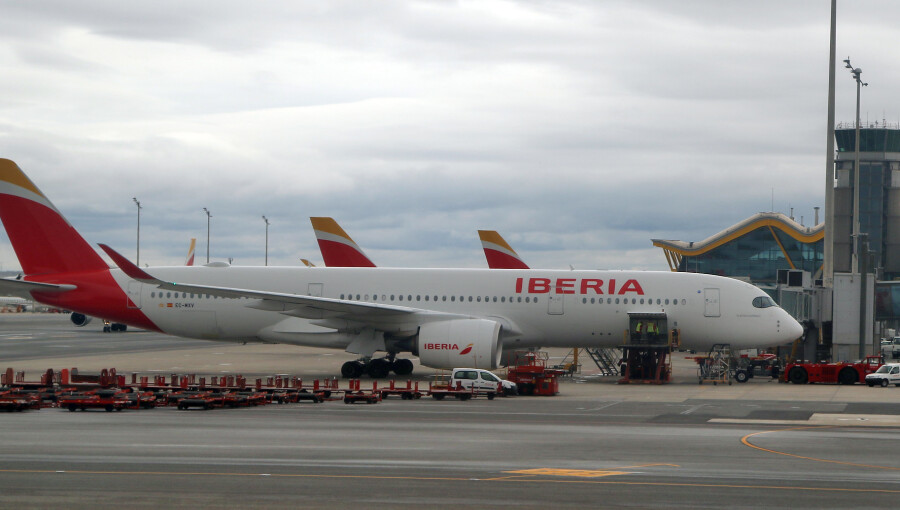
Regime-aligned authorities cancelled the landing rights of Iberia, TAP Portugal, Gol, Latam, Avianca and Turkish Airlines, declaring they had aligned themselves with what the government characterised as "US-sponsored aggression against Venezuela." / Victor
By bnl editorial staff November 27, 2025

Venezuela has stripped six international airlines of their operating permits after the carriers suspended services to Caracas in response to American warnings about military operations in the region, in a move that has stranded thousands of passengers and deepened the country's international isolation.

Authorities in Caracas on November 26 cancelled the landing rights of Iberia, TAP Portugal, Gol, Latam, Avianca and Turkish Airlines, declaring they had aligned themselves with what the government characterised as "US-sponsored aggression against Venezuela."

The sanctions came after the airlines stopped flying to the Venezuelan capital over safety concerns following an advisory from the US Federal Aviation Administration, which cautioned operators about risks linked to deteriorating security conditions and increased military movements around Venezuela.

The carriers had been given two days to restart their operations or face losing access to Venezuelan airspace. The deadline expired, prompting the regime of President Nicolas Maduro to publish the ban in the official gazette.

Washington has positioned 15,000 military personnel and the USS Gerald Ford aircraft carrier near Venezuelan waters in what it describes as an anti-narcotics mission. American forces have struck at least 21 vessels suspected of drug smuggling, resulting in more than 80 deaths, though no evidence of narcotics has been made public.

The scale of the deployment — the largest American military presence in the Caribbean since the Panama intervention in 1989 — has fuelled suspicions in Caracas that the true objective is regime change. Maduro's government views the operation as a pretext to remove the president, whose re-election was widely dismissed as fraudulent by opposition forces and international observers.

The FAA had advised flight operators to take precautions when using Maiquetía airport at all flight levels, citing the worsening situation and military build-up in and around Venezuela.

According to El Pais, Portugal's infrastructure minister Miguel Pinto Luz responded firmly to the ban, stating his country would not bow to intimidation of any form. He said that the state carrier TAP made decisions based solely on Portuguese national interests and passenger safety.

Spain's foreign minister José Manuel Albares pledged his government's backing for affected Spanish companies, whilst the Spanish aviation regulator AESA had issued its own warning advising operators to avoid Venezuelan airspace until early December. The Spanish advisory cited dangers from military activities, air defence systems effective at all flight levels, and poor coordination among conflicting parties.

Two other Spanish carriers, Air Europa and Plus Ultra, escaped sanctions despite also grounding their Venezuela services, apparently because they acted after the ultimatum was issued rather than before.

Iberia stated that passenger and crew safety remained paramount and expressed hope of resuming operations when stability returned to the area. The airline typically runs daily rotations between Madrid and Caracas on most days of the week.

The cancellations have disrupted approximately 6,000 passengers on Spanish routes alone through early December, with at least 36 weekly flights normally operating between Madrid and Caracas. Colombian officials reported that roughly 1,500 travellers on their Venezuela routes faced disruption.

Whilst some smaller, mostly domestic operators continue serving Venezuela, the loss of major international carriers has significantly reduced connectivity for a country already facing diplomatic isolation and restricted air services.

Both Trump and Maduro have recently indicated openness to direct dialogue. Speaking to reporters, the American president said he was willing to engage with his Venezuelan counterpart but warned that Washington was prepared to pursue either diplomatic or forceful options.

Meanwhile, US officials have told Reuters that the start of unspecified covert activities in Venezuela is expected in the coming days. These would likely constitute the opening phase of fresh measures, although neither the precise schedule nor full extent have been established, and it remains unclear whether Trump has issued definitive approval.

Venezuela foreign airline ban slammed as ‘disproportionate’


By AFP
November 27, 2025


Spain's flagship carrier Iberia is among six airlines that have been banned from Venezuela for suspending flights to the country over security concerns - Copyright POOL/AFP Thomas Padilla

Venezuela’s decision to ban foreign airlines that stopped flying to the Caribbean country over concerns about US military activity was branded “disproportionate” on Thursday as thousands of passengers scrambled to save their travel plans.

Venezuela’s aviation authority said Wednesday that it had banned six airlines — Spain’s Iberia, Portugal’s TAP, Colombia’s Avianca, Chile and Brazil’s LATAM, Brazil’s GOL and Turkish Airlines — for “joining the actions of state terrorism promoted by the United States government.”

The airlines, which account for much of the air travel in South America as well as air links to Europe, suspended flights to Venezuela last week following safety warnings from Washington, which has deployed warships in waters off Venezuela for what it calls an anti-narcotics operation.

The suspension infuriated Caracas, which issued the carriers with a 48-hour ultimatum on Monday to resume flights or be banned from Venezuela, which they ignored.

Portuguese Foreign Minister Paulo Rangel accused Venezuela on Thursday of a “disproportionate” reaction.

Portugal has “no intention of canceling our routes to Venezuela, and that, obviously, we only did so for security reasons,” he said.

A source from Iberia told AFP that the company hoped to resume flights to Venezuela “as soon as possible, as soon as full security conditions are met.”

It added that the Spanish airline “cannot operate in areas where there is a high security risk” and added that Spain’s aviation authority had recommended not flying at this time to Venezuela.

The flight suspension has so far affected more than 8,000 passengers on at least 40 different flights, according to the Venezuelan Association of Travel and Tourism Agencies (AVAVIT).

A small number of Venezuelan companies, including Avior and Laser, continue to offer a limited number of flights to Spain and regional cities.


– ‘Worsening security’ –


The US Federal Aviation Administration last week urged civilian aircraft operating in Venezuelan airspace to “exercise caution” due to the “worsening security situation and heightened military activity in or around Venezuela.”

President Donald Trump has deployed the world’s biggest aircraft carrier and 10 other ships to the Caribbean.

Washington has also carried out multiple shows of force with B-52 and B-1B bombers flying near Venezuela’s coast.

Venezuela’s leftist President Nicolas Maduro, whose re-election last year was widely rejected by the international community as fraudulent, believes the operation is secretly aimed at overthrowing him.

He has reacted defiantly, staging military exercises and mass rallies aimed at projecting strength and popular support.

“Keep your planes, and we will keep our dignity,” Interior Minister Diosdado Cabello said.

Apart from the naval build-up, the United States has carried out strikes on over 20 alleged drug boats in the region, killing dozens.

Washington has not yet provided any evidence that the boats were smuggling narcotics or posed a threat to the United States.

This week, the Trump administration continued to pile pressure on Venezuela, despite the US president saying he was open to dialogue with Maduro.

On Monday, Washington designated an alleged Venezuelan drug cartel a foreign terrorist organization.

And on Wednesday, the Dominican Republic, a US ally in the Caribbean, told visiting US Defense Secretary Pete Hegseth that Washington could use an air base and an airport for its counter-narcotics operations.