First Power From Germany’s Largest Offshore Wind Farm Using 15 MW Turbines
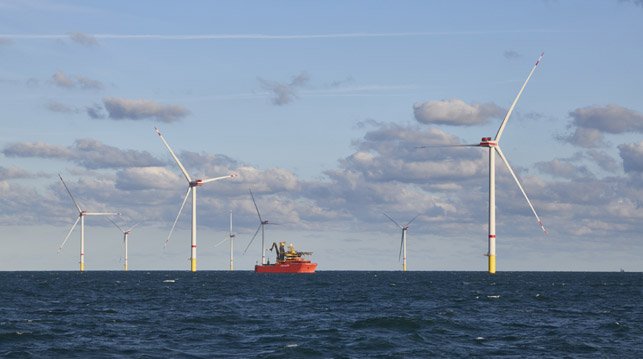
Germany’s largest offshore wind farm to date, EnBW’s He Dreith project, achieved key milestones as it proceeds with construction and provides encouragement for a somewhat beleaguered industry. The project generated and delivered its first kilowatt-hour of electricity on November 25 as it started the commissioning process for its turbines.
Peter Heydecker, EnBW Board Member for Sustainable Generation Infrastructure, called it a significant milestone for the company. He noted that the company has been planning, building, and operating offshore wind farms in Germany for 15 years, and it is now pushing toward the goal of having 80 percent of its generation portfolio consisting of renewable energies by 2028. At the same time, it expects to phase out coal-powered generation.
He Dreiht is also unique as it is the first to deploy the 15 MW turbines by Vestas. The company highlights that a single rotation of the rotor on the 15 MW wind turbine is enough to supply the equivalent of four households with electricity for a day. S&P Global writes that the turbine “could reshape offshore wind economics in the North Sea.”
At a hub height of 142 meters (466 feet), the rotor with a diameter of 236 meters (774 feet) sweeps through an area of 43,742 square meters per revolution. The company says this is equivalent to the area of six football fields and notes the dramatic advancement from the 2.3 MW turbines it installed at its first wind farm 15 years ago.
Nils de Baar, President of Vestas Northern and Central Europe, the wind turbine manufacturer, explains, “The 15 MW turbine is a world first in terms of technology, setting new standards in offshore wind power. Its efficiency and performance enable a significant increase in energy yield per turbine.”
The project is located approximately 85 kilometers (53 miles) northwest of Borkim in the North Sea and 110 kilometers (68 miles) west of Heligoland. The project was awarded in a 2017 tender.
EnBW highlights that the total investment is projected at €2.4 billion and that it is proceeding without state funding. A partner consortium made up of Allianz Capital Partners, AIP, and Norges Bank Investment Management owns 49.9 percent of the shares in He Dreiht.
The company reports that internal wind farm cabling and the connections to the converter platform were completed in August. Currently, 27 out of the total of 64 wind turbines have been installed and are in the process of commissioning. EnBW expects that further turbines will begin to supply power gradually in the coming weeks.
While the project is slightly behind schedule, EnBW reports that full commissioning is set to be completed by the summer of 2026.
Port of Rotterdam Plans Terminal to Support Offshore Wind Sector Growth
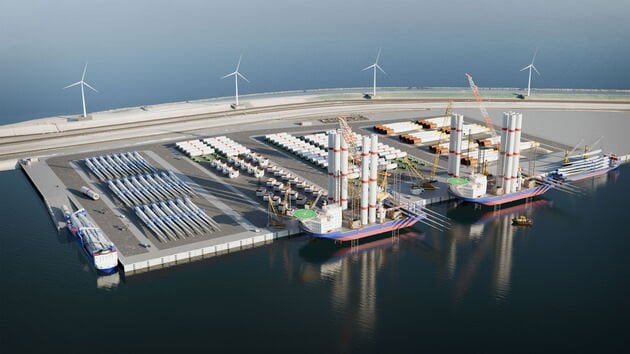
The Port of Rotterdam Authority announced plans to develop a 45-hectare site in the northwest corner of Maasvlakte dedicated to the needs of the offshore wind sector. It believes the new terminal will be a crucial link in the energy transition, featuring an 835-meter deep-sea quay and capabilities specifically designed for the industry.
With this project, the Port of Rotterdam Authority says that it aims to provide the offshore wind industry with the necessary capacity and stimulate growth in the sector. While countries are moving forward with plans to develop more wind farms in the North Sea in the coming years, Rotterdam officials highlight a lack of port facilities. It says the required port capacity at the right specifications is currently a limiting factor. With the completion of the terminal, the Port Authority is providing the large-scale, high-quality infrastructure that the market demands.
With this new terminal, we are making an important contribution to the necessary capacity for the offshore wind sector,” said Matthijs van Doorn, Vice President Commercial of the Port of Rotterdam Authority. “Due to its direct location on the North Sea, deep draught and existing offshore cluster, the port of Rotterdam is ideally suited for these activities.”
The plans for the new terminal call for providing space for storage, transshipment, assembly, and installation of wind turbine components and foundations. The quays will be prepared for jack-up operations and equipped with heavy-load zones and equipped with a dedicated Roll-on/Roll-off facility.
The port said that this terminal will support the growing demand for offshore wind projects in the North Sea and contribute to the energy and raw materials transition, including future repowering and decommissioning of existing wind farms. In doing so, Rotterdam aims to strengthen its position as Europe’s leading offshore wind hub. The terminal is expected to be operational in mid-2029.
Starting today, November 26, the port authority is inviting participants in the industry to contribute ideas about the design of the terminal and to share their ambitions, needs, and technical knowledge. Following this RFI (Request for Information) phase, the Port Authority will further define the following steps and make the final decision on how the terminal is to be operated. The comment period will close on January 8, 2026, and the next steps will be announced in March.


No comments:
Post a Comment