Saturday, May 08, 2021


Ransomware attack leads to shutdown of major U.S. pipeline system

Ellen Nakashima, Yeganeh Torbati, Will Englund 

A ransomware attack led one of the nation’s biggest fuel pipeline operators to shut down its entire network on Friday, according to the company and two U.S. officials familiar with the matter.

© Jay Reeves/AP FILE — This Sept. 16, 2016, file photo shows tanker trucks lined up at a Colonial Pipeline Co. facility in Pelham, Ala. (AP Photo/Jay Reeves, File)

While it is not expected to have an immediate impact on fuel supply or prices, the attack on Colonial Pipeline, which carries almost half of the gasoline, diesel and other fuels used on the East Coast, underscores the potential vulnerability of industrial sectors to the expanding threat of ransomware strikes.

It appears to have been carried out by an Eastern European-based criminal gang — DarkSide, according to a U.S. official and another person familiar with the matter.

Federal officials and the private security firm Mandiant, a division of FireEye, are still investigating the matter, they said.The Cybersecurity 202: A group of industry, government and cyber experts have a big plan to disrupt the ransomware crisis

“We are engaged with the company and our interagency partners regarding the situation,” said Eric Goldstein, executive assistant director of the cybersecurity division at the Department of Homeland Security’s Cybersecurity and Infrastructure Security Agency, or CISA. “This underscores the threat that ransomware poses to organizations regardless of size or sector. We encourage every organization to take action to strengthen their cybersecurity posture to reduce their exposure to these types of threats.”

President Biden was briefed on the incident on Saturday morning, a White House statement said. It said the federal government is working to assess the incident’s implications, avoid disruption to supply and help Colonial Pipeline restore operations “as quickly as possible.”

Colonial Pipeline said in a statement on Friday that it had temporarily shut down all its pipeline operations after learning it had been hit by a cyber attack on some of its “information technology” or business network systems that day. As a result, the firm said, it “proactively took certain systems offline to contain the threat.” Early on Saturday afternoon, the company confirmed that the attack “involves ransomware.” It said it had notified law enforcement and other federal agencies.


© The Washington Post

Colonial’s 5,500 miles of pipelines carry fuel from refineries on the Gulf Coast to customers in the southern and eastern United States. It says it transports 45 percent of the fuel consumed on the East Coast, reaching 50 million Americans.

Ransomware attacks, in which hackers lock up computer systems — usually by encrypting data — and demand payment to free up the system, are a global scourge. In recent years, they have affected everyone from banks and hospitals to universities and municipalities — almost 2,400 organizations in the United States were victimized last year alone, one security firm reported. But the attackers are increasingly targeting industrial sectors because these firms are more willing to pay up to regain control of their systems, experts say.

“The downtime for industrial companies can cost millions,” said Robert M. Lee, the chief executive of Dragos, a major cybersecurity firm that handles incidents in the industrial control sector.

U.S. officials and experts in industrial control security said such attacks are more common than is publicly known and that most just do not get reported.

“There are absolutely cases in industrial operations where ransomware impacts operations,” but often the stories don’t hit the news, Lee said. “There are lots of industrial control companies that are battling ransomware around the United States.”The Cybersecurity 202: Lawmakers scramble for legislative solutions to a growing ransomware crisis

The trend exploded in the last three years after the WannaCry and NotPetya computer worms showed cyber criminals how targeting companies in critical industrial sectors is more likely to make companies pay out, Lee said.

The DarkSide group has hit utility firms before, said Allan Liska, intelligence analyst at the cyber threat research firm Recorded Future. In February, ransomware attacks disrupted operations at two Brazilian state-owned electric utility companies, Centrais Eletricas Brasileiras (Eletrobras) and Companhia Paranaense de Energia (Copel), he said.

Private firms that investigate cyber intrusions say they are handling cases involving DarkSide using ransomware to target American industrial companies. But there are many other ransomware groups that seem to be targeting such firms in greater numbers than ever before, analysts said.

Carrying off a ransomware attack does not require great technical sophistication, Liska said. In the world of criminal ransomware operations, some crews specialize in gaining access and others pay for that access and then lock up the data, he said. DarkSide generally falls into the lock up crew category, he said.

“The last few years have been incredibly busy” because the proliferation of vulnerabilities in firewalls and virtual private networks have allowed ransomware criminals to gain access to networks at an unprecedented scale, Lee said.

“To put it simply, we are on the cusp of a global digital pandemic driven by greed,” former top DHS cyber official Christopher Krebs told Congress on Wednesday. He called the ransomware emergency a “digital dumpster fire.”

Last year, CISA warned pipeline operators about the threat of ransomware. CISA responded to a ransomware attack on a natural gas compression facility in which the attacker gained access to the corporate network and then pivoted to the operational network, where it encrypted on various devices. As a result, the firm shut down operations for about two days, CISA said.

The DHS warning to operators came after members of Congress in 2018 urged the agency to do more to protect pipelines from cyber attacks.

Though there is as yet no known foreign government nexus to the Colonial Pipeline incident, the U.S. government has in the past asserted links between Russian spy services and ransomware rings. Last month, the Treasury Department stated that the Russian internal security service, FSB, “cultivates and co-opts criminal hackers, including” a group called Evil Corp., “enabling them to engage in disruptive ransomware attacks.” Treasury sanctioned Evil Corp. in late 2019.

Cybersecurity researchers believe that DarkSide operates mostly out of Russia, which U.S. officials and cybersecurity experts have accused of harboring cyber criminals. These criminals avoid targeting victims in Russia, experts say.

In January 2019, the Director of National Intelligence, Daniel Coats, warned at an annual worldwide threat briefing that China has the ability to launch cyber attacks that cause temporary disruptive effects on critical infrastructure, “such as disruption of a natural gas pipeline for days to weeks” in the United States. He did not specify what type of cyber tool or mention ransomware explicitly.

A task force of more than 60 experts from industry, government, nonprofits and academia last month urged a series of coordinated actions by industry, government and civil society. Their recommendations include mandating that organizations report ransom payments and requiring them to consider alternatives before making payments. Governments, they said, could provide support to help firms hold out longer. The recommendations also call for global diplomatic and law enforcement efforts to induce countries from providing safe havens to ransomware criminals.

“Proposing this framework is merely the first step,” the task force said, “and the real challenge is in implementation.”

The Biden administration is expected in the coming weeks to issue an executive order aimed at shoring up the cybersecurity of federal civilian agencies. Though it will not specifically address private critical infrastructure, it is expected to drive standards for federal contractors that experts hope will ripple across the private sector.

Last month, the White House and Energy Department launched a 100-day action plan focused on boosting the cybersecurity of electricity sector industrial systems. The idea is to eventually expand that effort to gas pipelines and water systems.

Prices for refined oil products are slumping on the Gulf Coast because of the shutdown. Analysts say that depending on how long the pipelines are out of service, prices for gasoline and jet fuel could rise in the New York area, as they did in 2017 when a hurricane forced a shutdown.

Bob McNally, founder of the Rapidan Energy Group, said although the shutdown of the Colonial system is “massive,” if the company is able to restart operations within a couple of days, he does not expect an impact on fuel prices.

“The critical thing now is the duration,” he said. “Right now, everything depends this weekend on news that the market gets about the duration of the outage.”

Storage in both the Gulf Coast region and the Northeast “can largely mitigate the impact of a short-term event,” said Bernadette Johnson, senior vice president of power and renewables at a company called Enverus.

But if the shutdown lasts much longer than a few days, there could be a cascade of dramatic impacts, including higher prices and consumer hoarding of gasoline supplies, McNally said. Gasoline prices have been edging higher in recent weeks, in line with typical seasonal trends.

The Colonial pipeline system “is an irreplaceable, vital jugular for fuel supply to the East Coast,” McNally said. “It’s the major artery and there are no real other good options to replace it.”

One of Colonial’s two pipelines ruptured last summer in North Carolina, spilling 1.2 million gallons of gasoline, the largest spill in the state’s history.

On March 29, the Pipeline and Hazardous Materials Safety Administration (PHMSA), a division of the Department of Transportation, informed Colonial that its investigation of the North Carolina spill raised serious concerns about safety.

“PHMSA’s ongoing investigation indicates that conditions may exist on the Colonial Pipeline System that pose a pipeline integrity risk to public safety, property or the environment,” it said in a proposed safety order.

“The conditions that led to the failure potentially exist throughout the Colonial Pipeline System. Further, Colonial’s inability to effectively detect and respond to this release, as well as other past releases, has potentially exacerbated the impacts of this and numerous other failures over the operational history of Colonial’s entire system. ... It appears that the continued operation of the Colonial Pipeline System without corrective measures would pose a pipeline integrity risk to public safety, property, or the environment.”

In 2016, a Colonial pipeline exploded and released 4,400 barrels of gasoline into a pond in Shelby County, Ala. One worker was killed. Recovery and repair procedures were hampered by dangerous clouds of gasoline and benzene vapors, PHMSA reported.

Later that year, an underground leak of more than 7,000 barrels was discovered by a mine inspector in Alabama. That leak was attributed to pipe fatigue caused by improper preparation of the soil beneath it. For both incidents, the company agreed to pay the state $3.3 million to cover damages and penalties.
Edmonton Journal 
Saturday's letters: Province should step up for idled workers

With the recent announcement of restrictions on restaurant patios and personal services, it begs the question: where’s the data to support the shutdowns on these businesses? Are these just the easy pickings for the government to shut down?

© Larry Wong High Level Diner restaurant employee France Vargas serves a customer on the restaurant's outdoor patio in Edmonton on Wednesday May 5, 2021. The Alberta government announced new pandemic health restrictions yesterday. Indoor restaurant dining is prohibited and all outdoor restaurant patios must shut down effective 11:59pm on Sunday May 9, 2021.

My daughter is a hair stylist and server at a popular restaurant and has now been cut off from earning a living three times in the last year and a couple of months. What has the provincial government done to support my daughter with the lockdowns as it is their decision to shut down these businesses?

The federal government has stepped in but our province has neglected their duty. It would be interesting to see what would happen if our provincial government leaders were to stop accepting their pay for the same period they have shut down these businesses. I am safe to say this would not happen.

Andrew Patrick, Edmonton

Police hand out tickets to dozens leaving anti-lockdown protest in Alberta

MIRROR, Alta. — RCMP ticketed protesters leaving an anti-lockdown rally outside a central Alberta café Saturday, after the establishment was closed by health officials earlier in the week.
© Provided by The Canadian Press

Despite pouring rain and a pre-emptive court injunction, hundreds gathered outside the Whistle Stop Café in the hamlet of Mirror, Alta., for the "Save Alberta Campout Protest."


Demonstrators were there to support café owner Chris Scott and challenge Public Health Orders meant to curb the spread of COVID-19.


A spokesman for the RCMP said officers took the first three hours of the protest to educate demonstrators on COVID-19 regulations and notify them that they were contravening the injunction.

"There was a decision at one point to start mounting enforcement," said Cpl. Troy Savinkoff. "That was around 4 p.m."

Savinkoff said police would provide a more thorough update on how many people were ticketed later Saturday.

On Wednesday, AHS said it closed the café after the agency received more than 400 complaints about the business since January. Health authorities said the café is to remain closed until Scott can demonstrate the ability to comply with health restrictions.


Alberta Health Services said after hearing about plans for the protest that the provincial government would take legal action that would allow RCMP officers to use reasonable force in arresting and removing any person at the rally who contravenes public health orders.


Video: Dozens gather in central Alberta to rally against COVID-19 regulations (The Canadian Press)


But that didn't stop people without masks from standing together to cheer and clap when Scott stood on a stage and encouraged them to fight for their freedom.


"I've been accused of a lot of things over this. They think it's about money. They think it's about popularity. I could care less about that," Scott told the crowd.

"I'm not fine with anyone telling me what to do with my body or how to earn an income."
 CAN I QUOTE YOU WHEN YOU OPPOSE A WOMAN'S RIGHT TO CHOOSE!

Scott then asked the crowd to follow COVID-19 regulations at the rally due to the injunction.

Three hours later, RCMP officers with body cameras began handing out tickets under the Public Health Act to those leaving the area for participating in the illegal gathering.

Last weekend, hundreds of people gathered near Bowden, also in central Alberta for a pre-advertised maskless "No More Lockdowns'" protest rodeo.

Days later, the premier announced stronger restrictions and doubled fines for scofflaws.

This report by The Canadian Press was first published May 6, 2021.

---

This story was produced with the financial assistance of the Facebook and Canadian Press News Fellowship.

Fakiha Baig, The Canadian Press


KULTURKAMPF TOO
Advocates say Jenner is 'out of touch' with LGBTQ issues — and America at large

Jo Yurcaba 
NBC NEWS
7/5/2021

Caitlyn Jenner made comments during an interview on Fox News’ “Hannity” show Wednesday that some transgender people say proves she’s “out of touch” — not only on LGBTQ issues, but also with the way most Americans live.
© Provided by NBC News

During the interview — her first since announcing her run for California governor — Jenner, a Republican, was asked by the host Sean Hannity to grade the performance of Gov. Gavin Newsom, a Democrat. In her answer, Jenner said her friends are leaving the state.

“My hangar, the guy right across, he was packing up his hangar, and I said, ‘Where are you going?,’” Jenner, a former Olympian and a reality television star, said, referring to their private plane hangars. “And he says, 'I'm moving to Sedona, Arizona. I can't take it anymore. I can't walk down the streets and see the homeless.'"

Jenner faced criticism for the comment, including from those who pointed out that transgender Americans disproportionately experience homelessness.

Citing a statistic from the 2015 U.S. Transgender Survey, Gillian Branstetter, a longtime trans advocate and the media manager for the National Women’s Law Center, noted on Twitter that nearly one-third of trans people face homelessness at some point in their lifetimes.


She added that Jenner’s experience as a trans person is not reflective of most trans people’s lives.


Video: Caitlyn Jenner: ‘It just isn’t fair’ for trans girls to play women’s sports (
MSNBC)

During her “Hannity” interview, Jenner also reaffirmed her opposition to trans girls playing on girls sports teams at school — a stance she first made public when a TMZ reporter questioned her Saturday.

“I stick to the statements that I made,” she told Hannity. “We have to make sure that the integrity of girls’ sports is there. I think that’s extremely important. But there’s more to it than just what I said, because I just said ‘biological boys in sports’ — there’s more to it than that, and I think in the future I will explain more of that.”
WHY DON'T THEY EVER TALK ABOUT TRANSBOYS/ TRANSMEN LIKE PAT CALIFA

Jenner then added that “as a trans woman, I think role models are extremely important for young people. Trans issues people struggle with big time. Our suicide rate is nine times higher than the general public. And for me to be a role model for them, to be out there — I am running for governor for the state of California. Who would’ve ever thunk that? We’ve never even had a woman governor.”

When Hannity told Jenner that some people are mad at her for her stance on trans girls playing sports, she said “I move on.”
er
In response to the interview, Equality California, an LGBTQ advocacy group in the state, called Jenner “completely out of touch with California families” and said she dismissed the majority of Amicans who don’t support legislation targeting trans people.

Tweeting a clip of the interview, transgender activist Charlotte Clymer called Jenner’s candidacy a “grift set up by the Republican Party.”


Some people are worried that Jenner’s comments will be used to support the increasing number of state bills seeking to ban trans girls from competing on girls sports teams at school. Seven states currently ban trans people from competing on teams that align with their gender identity — six of which passed bans in 2021.

Follow NBC Out on Twitter, Facebook & Instagram


KULTURKAMPF
Red meat politics: GOP turns culture war into a food fight

DES MOINES, Iowa — Conservatives last week gobbled up a false news story claiming President Joe Biden planned to ration red meat. Colorado Rep. Rep. Lauren Boebert suggested Biden “stay out of my kitchen.” Texas Gov. Greg Abbott tweeted out a headline warning Biden was getting “Up in your grill.”

© Provided by The Canadian Press

The news was wrong — Biden is planning no such thing — but it was hardly the first time the right has recognized the political power of a juicy steak. Republican politicians in recent months have increasingly used food — especially beef — as a cudgel in a culture war, accusing climate-minded Democrats of trying to change Americans' diets and, therefore, their lives.

“That is a direct attack on our way of life here in Nebraska,” Gov. Pete Ricketts, a Republican, said recently.

The pitched rhetoric is likely a sign of the future. As more Americans acknowledge the link between food production and climate change, food choices are likely to become increasingly political. Already, in farm states, meat eating has joined abortion, gun control and transgender rights as an issue that quickly sends partisans to their corners.

“On the right, they are just going for the easiest applause line, which is accusing the left of declaring war on meat. And it’s a pretty good applause line,” said Mike Murphy, a Republican consultant. “It’s politically effective, if intellectually dishonest.”

Ricketts was among the first to seize on the issue in recent months. In March, the governor — whose state generated $12 billion from livestock and meat products last year — slammed his Colorado counterpart, Democratic Gov. Jared Polis, for suggesting Coloradans lay off the red meat one day as a way of cutting back on greenhouse gas emissions.

Republican Iowa Gov. Kim Reynolds followed Ricketts' comments quickly, claiming in a campaign fundraising email, “Democrats and liberal special interest groups are trying to cancel our meat industry."

In her weekly column a few weeks later, Republican Sen. Joni Ernst of Iowa blasted “everyone from out-of-touch politicians to Hollywood elites" as leading the left's "war on meat.”

But the issue blew up last week after a Daily Mail news story — debunked within 24 hours — suggested the Biden administration could ration how much red meat Americans can consume as part of its goal to slash greenhouse gas pollution.

During the story's short life, conservative figures pilloried Biden's apparent invasion into America's dining room.

While the story was false, there’s little doubt the livestock industry is a contributor to climate change.

A 2019 Environmental Protection Agency report noted agriculture was responsible for 10% of all greenhouse gas emissions, a quarter of which is emitted by livestock before they are butchered.

There are signs that Americans may be adjusting their diets out of concern for climate change. About a quarter of Americans reported eating less meat than they had a year earlier, according to a 2019 Gallup poll, chiefly for health reasons but also out of environmental concerns. About 30% of Democrats polled said they were eating less meat, compared to 12% of Republicans.

For some, it's hard to imagine Americans abandoning beef and easy to see its power as a political symbol, said Chad Hart, an Iowa State University agriculture economist.

Americans don't get overly sentimental about barns crammed with chickens or thousands of hogs, but few images are as quintessentially American as cattle grazing over rolling hills.

“When you think about American food, beef is what is in the centre of that plate,” Hart said. “And that’s likely to remain a national identity when it comes to what an American food plate looks like.”

To be sure, food isn't new to culture war politics.

First lady Michelle Obama was attacked as intrusive by conservatives for championing higher nutritional standards in school lunches.

As a presidential candidate in 2007, Barack Obama was accused of food elitism when he asked a group of Iowa farmers whether they had seen the price of arugula at Whole Foods, an upscale grocery chain that had not yet made it to Iowa. Obama still won the state's caucuses.

Even more famously, Democratic presidential candidate Michael Dukakis was pilloried by Republicans as far out of touch with rural America in the midst of the 1980s farm crisis when he suggested Iowa farmers consider diversifying crops by planting Belgian endive.

That prompted GOP vice-presidential nominee Dan Quayle to hold up a head of endive, a green used in salads, to show a crowd in Omaha ?just how the man from Massachusetts thinks he can rebuild the farm economy."

In the past, food was a way of painting Democrats as out of touch with rural America. Today, the message is about climate and the economy.

There is a growing movement to discourage meat-eating and a massive market for meat replacement foods. The Green New Deal, a sweeping environmental outline championed by liberal New York Rep. Alexandria Ocasio-Cortez, calls for a sharp reduction in livestock production.

Biden has called the plan an “important framework" but has not endorsed it.

As these policies remain only plans for now, Republicans complaining about them have offered little substance with their claims of a war on meat.

Still, Republicans have looked for ways to signal which side they're on. In April, Ernst introduced a bill that would bar federal agencies from setting policies that ban serving meat to employees.

Ricketts declared “Meat on the Menu Day” in March and came back Wednesday to name all of May “Beef Month."

These efforts do little to address the beef industry's substantial problems, including a backlog in slaughterhouses stemming from the pandemic, drought and the high cost of feed.

And a spokesperson for the National Cattlemen’s Beef Association kept her distance from the food fight.

“When emotions and rhetoric run high on either side of the political aisle, NCBA remains focused on achieving lasting results,” said spokesperson Sigrid Johannes.

___

Associated Press writer Grant Schulte contributed to this report from Lincoln, Neb.

This story has been corrected to show that Quayle was vice-presidential nominee, not vice-president, when he joked about Dukakis' endive remark.

Thomas Beaumont And Scott McFetridge, The Associated Press
#ENDCUBAEMBARGO

The Guardian picture essay

Cuba during the pandemic – photo essay


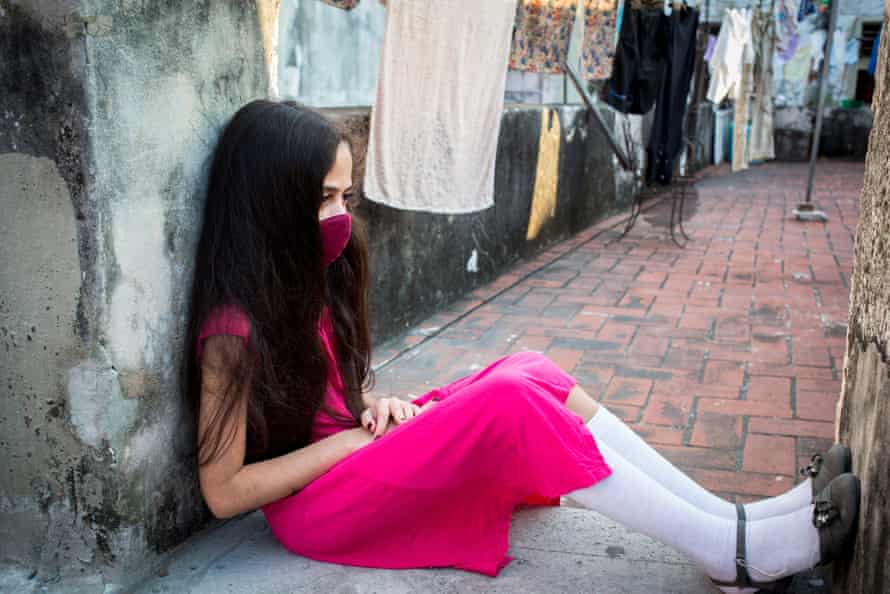
Avril and her friend are students at the National Ballet School, and train at
home.

Photographer Leysis Quesada Vera describes life during the pandemic in Havana’s Los Sitios neighbourhood. Her work is supported and produced by the Magnum Foundation, with a grant from the Henry Luce Foundation. Magnum Foundation is a nonprofit organisation that expands creativity and diversity in documentary photography. Through grant making and mentorship, Magnum Foundation supports a global network of social justice and human rights-focused photographers and experiments with new models for storytelling

by Ruaridh Nicoll

Fri 7 May 2021

Los Sitios lies to the south of Centro, the careworn barrio that gives Havana its coarse voice and whose northern limit is the Malecon, the famous corniche set against the Florida Straits.

The photographer Leysis Quesada Vera describes Los Sitios – her neighbourhood – as home to “people who work with tourists but not in the hotels. They sell cigars, probably illegally, clean the houses where tourists stay, sell souvenirs.”

The pandemic has pauperised these people. “What they’re doing now is queueing to buy things from the store to resell them on the black market.” She understands. She is raising two children and hasn’t had any income for a year.


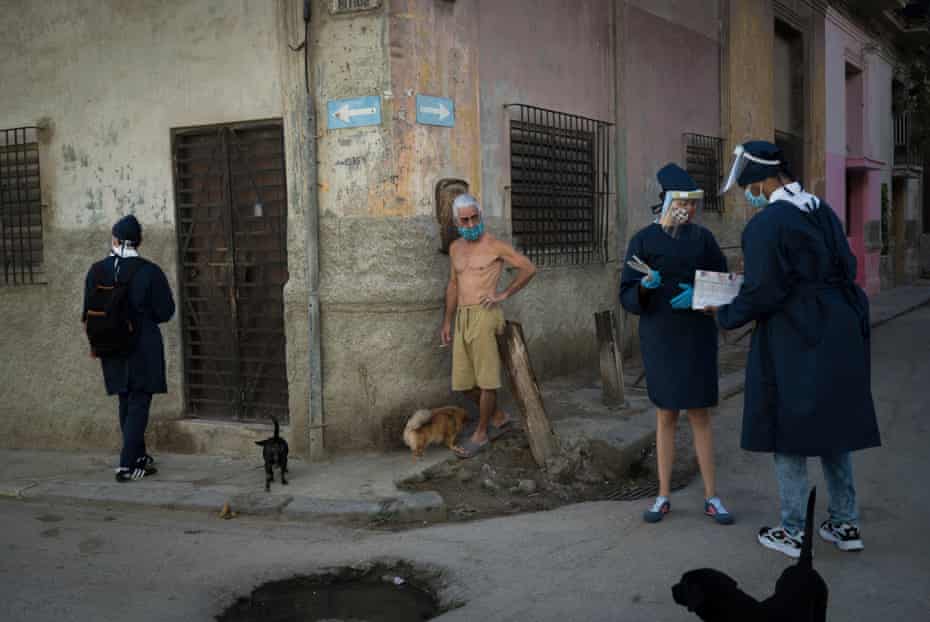
Tracers, medical students who screen households and undertake contact tracing, confer in the street.
Advertisement


For much of 2020, Cuba’s extensive health system kept the virus all but beyond the island’s borders, but at the cost of tourism. The economy contracted by 11% , imports fell by 40%.

Still, even the few reported cases spooked residents. There was an outbreak in Los Sitios and the authorities blocked the roads in and out.

Leysis is from San Francisco, a village of 50 houses without electricity in the state of Matanzas. She came to Havana in 1996 “like a crazy girl without any home. I’ve been living in all the tough neighbourhoods.”


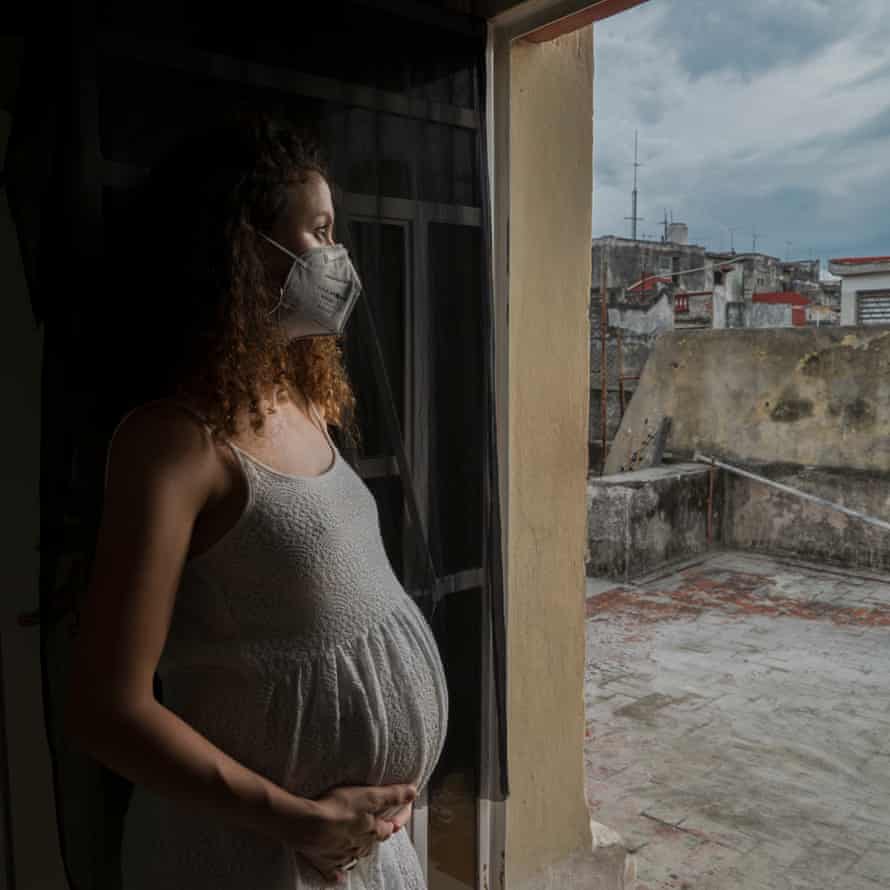
Yenifer Almeida in the last months of her pregnancy.

She was an English teacher, but hung out with photographers, and in photography studios. “l was going to every exhibition – photography and painting – and I loved the bohemian life.” Her first camera was a Nikon FM2; her greatest subjects would become her daughters, Avril and Mia.

“At the beginning of the pandemic I think everyone was afraid.” Certainly she stayed at home at first, but as the streets were sealed off, she ventured out. “It was a mess before they realised they needed to organise,” she says.
Advertisement


Even prior to the virus, Cuba was suffering. Donald Trump’s administration had tightened the 60-year-old US embargo, shutting down the channels through which Cubans abroad could send money home. Cuba’s antiquated infrastructure was already crumbling, the city falling down around Leysis.
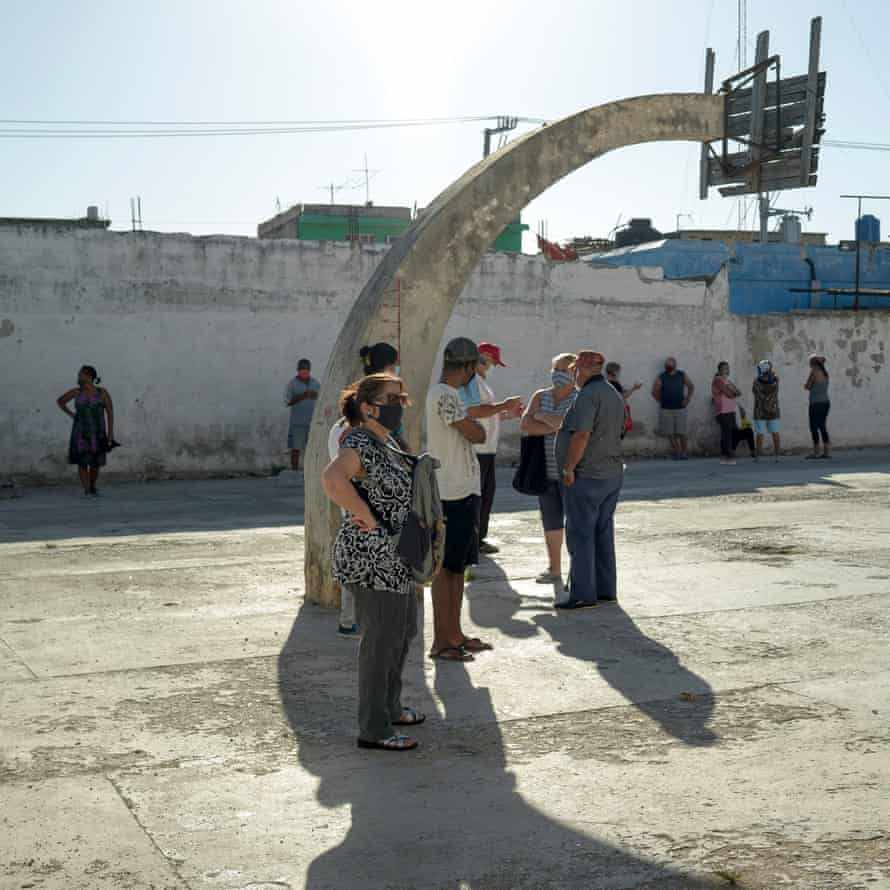
Crowds wait in the streets - an everyday occurrence.

The virus added hunger. The government maintains controls of all imports but now has little hard currency to pay for them. Huge queues formed whenever there were rumours of chicken, oil or medicine.

“It used to be easy for me to walk in the street and take pictures,” she says. “But now, with people suffering and stressed it is different. They’d watch me taking pictures of the queues and were sometimes aggressive. One day a woman attacked me.”

At the same time, medical students were spreading out through the streets, asking door to door for news of symptoms. Leysis photographed them as they slipped by like modern-day plague doctors.


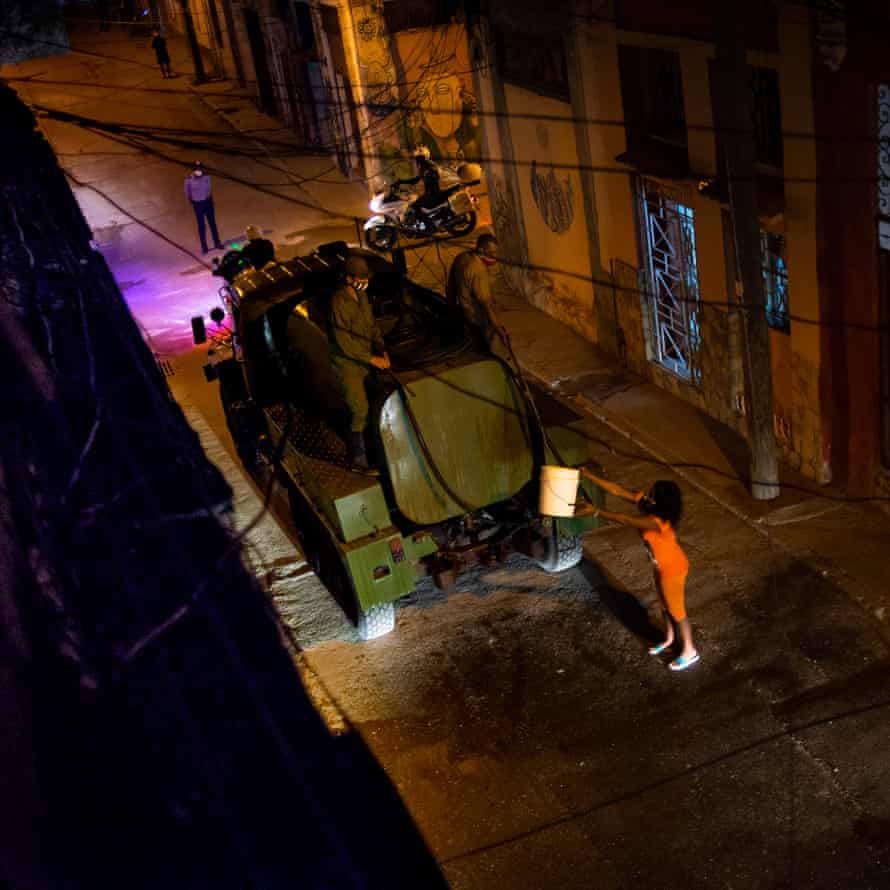
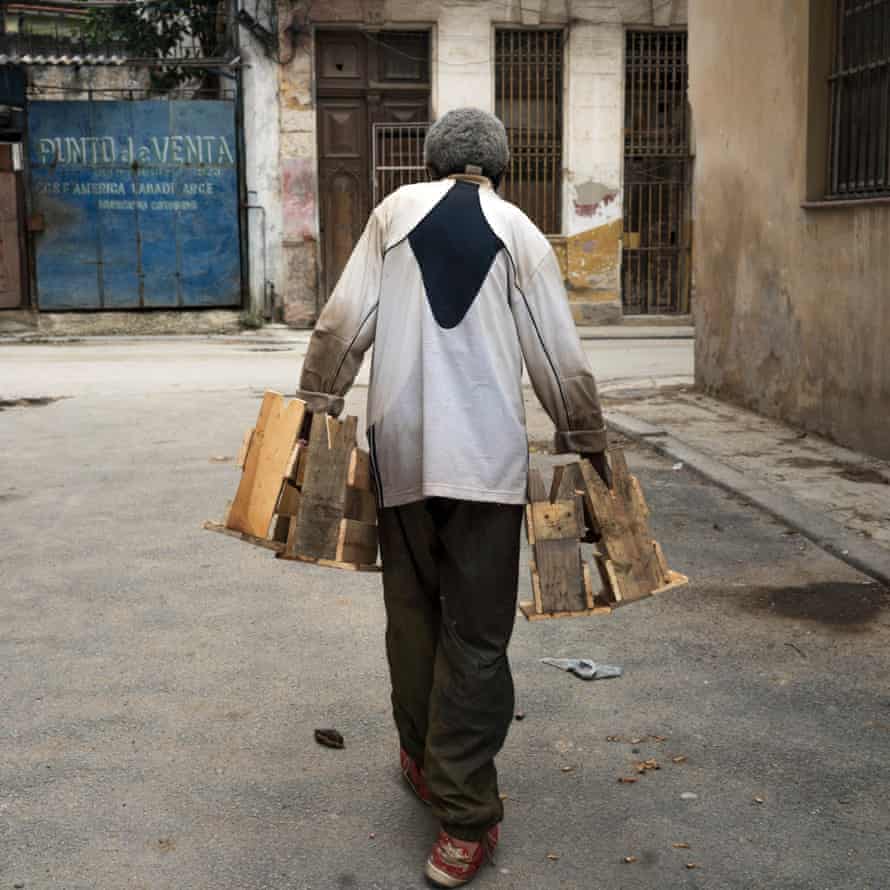
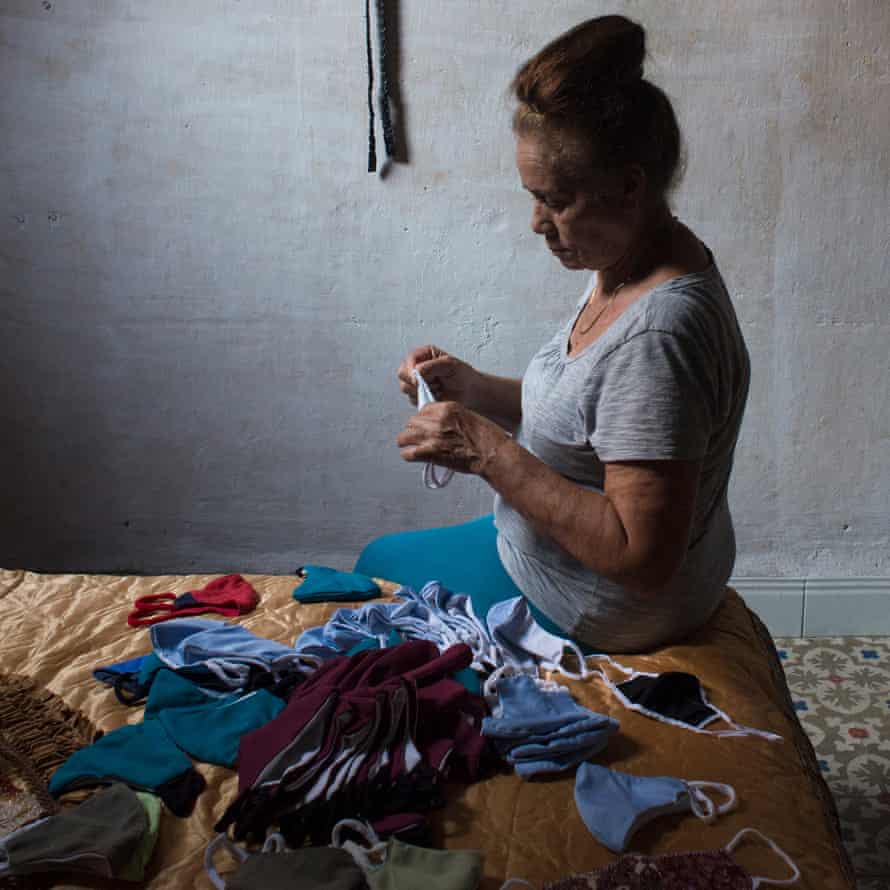
Clockwise from top left: a bread queue forms in the morning; a woman collects chlorine from trucks disinfecting the streets; a retired woman works as a seamstress to make a living; a man sells stools in Reunion Street.
Advertisement


“You know though,” she says. “The best pictures are still in my mind. I saw really amazing pictures, but the people, they were looking at me with faces that said, ‘Please don’t do that’. Sometimes I’d see people in tears.”

She was keeping close focus on her daughters, Avril who is 17 and Mia who is nine.

Avril is a senior at Havana’s storied National Ballet School. Before the pandemic, she would rehearse and train all day in the school’s palatial, light-filled studios. This was reduced to an hour on the ground floor of Leysis’ building. “Although not any more because there are a lot of cases in our neighbourhood and some other guys like to practise there,” Leysis says.

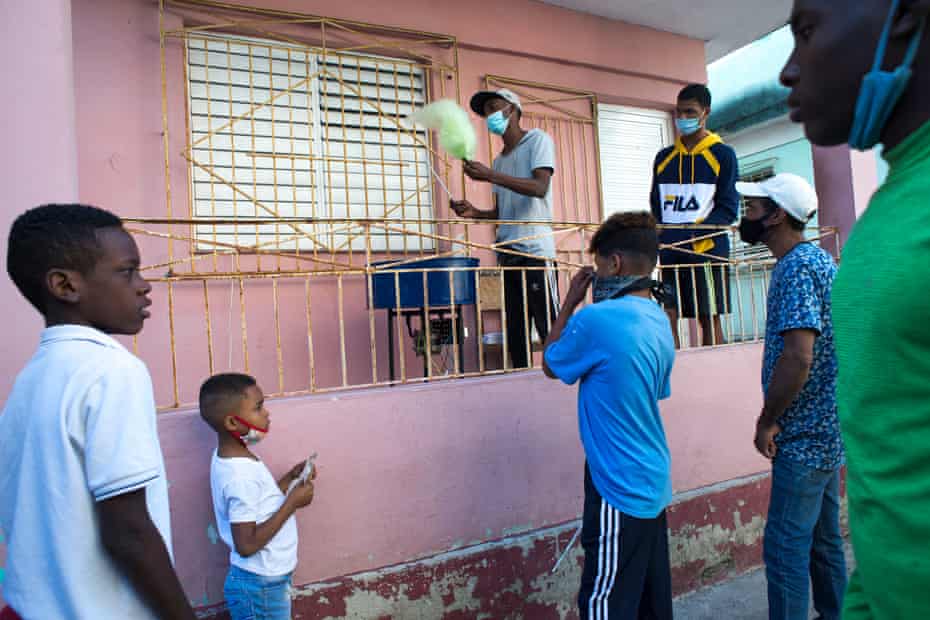
Customers queue for cotton candy.

On 15 November last year Cuba – for reasons both sentimental and economic – reopened its airports. The day before the island had 27 new cases, while the US had 159,003. Planes arrived from Florida packed with exiled family who rushed to all corners of Cuba’s 1,250km length, taking Covid-19 with them.

Avril, almost an adult, could go out and queue for bread, but early in the pandemic the government ruled that children couldn’t be on the streets, so Mia had to stay at home.

“She has been a long time without going anywhere,” says Leysis. “Sometimes I don’t know what to do with her. You cannot buy anything in the shops now and I have run out of paper for her to draw on.


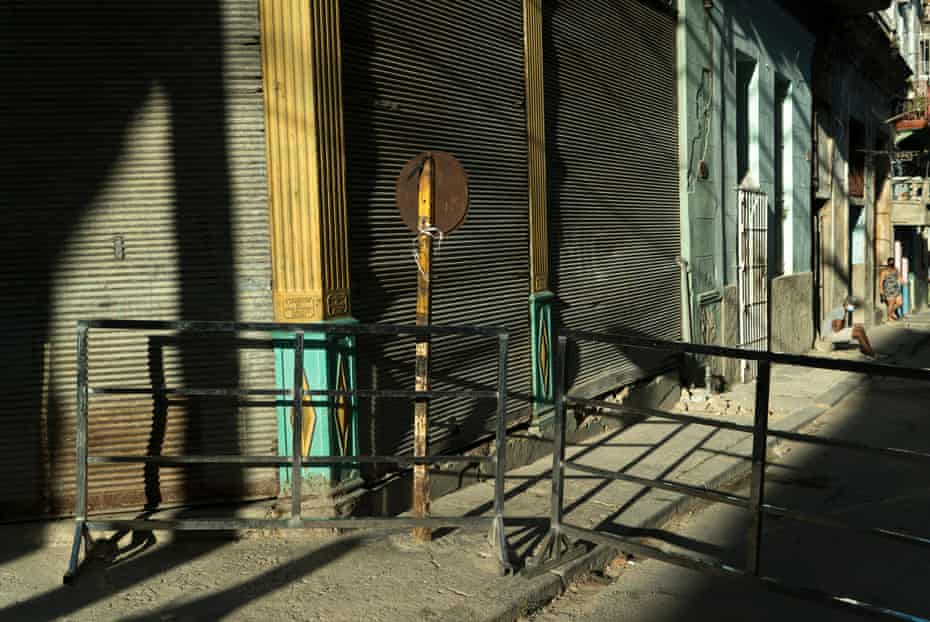
Entry is barred to quarantined blocks in Los Sitios neighbourhood.
Advertisement


“But she is very happy. She is creating all the time. I have no thread because we live on the roof and she has used it to make spider webs. I don’t know how many times she has dressed up.”

Cases have been steadily rising since Christmas. Now reports of the newly infected daily average above 1,000; still far below other countries but people are dying.

Good healthcare and emigration has aged Cuba – the median is 42 (in the US it is 38 and neighbouring Haiti 22) – and so it is a vulnerable population. The authorities plan to start immunising Havana’s population this month in a 1.7m strong trial of two homegrown vaccines, Soberana-02 and Abdala.


Mia sad and in a bad mood, due to the confinement after almost a year without being able to leave the house.


In the meantime the queues grow longer and food more scarce. “Last year, I spent like, eight hours, nine hours to buy things,” says Leysis. “But now it’s maybe two or three days. I can’t do that. I was walking in the street yesterday and people were fighting. I came back without anything. I felt so, so bad.”


Voters 16, 17 years old cast ballots for the first time in Wales

Crystal Goomansingh 
© THE CANADIAN PRESS/Chris Young 


After lowering the voting age to 16 in 2020, younger voters participated for the first time on May 5, 2021.

Marking ballots and history, young residents in Wales walked into polling stations Thursday, May 6, paper voter registration cards in hand.


"Extending the franchise to as many people as possible is a really sensible move," said Harvey Jones.

At 22 years old, Jones is one of the youngest candidates vying for a seat in the Senedd Cymru, or Welsh parliament.

"I wasn't old enough to vote in the last election in 2016, so this is exciting," said Jones.


Read more: Millennials can have a very strong voice in deciding Canada’s future — if they choose to vote


When the Senedd and Elections (Wales) Act 2020 was passed, lowering the voting age from 18 to 16, more than 70,000 new voters became eligible to select a local candidate as well as a regional representative in the Senedd.

Active citizenship and democratic participation by young people in the United Kingdom is an area of research for Andy Mycock.

"When the U.K. lowed the voting age to 18 in 1969, within a decade, every other liberal democracy had followed suit. It was like a domino effect," said Mycock, reader at the University of Huddersfield.

"Vote at 16 has taken a much, much longer time to introduce and I think that highlights the fact that there is more complexity about this tension between the age of enfranchisement and the age of majority. But it's happening," said Mycock.

Scotland was the first to grant 16-year-olds the right to vote during the 2014 Independence vote.

Read more: ‘Students are the future’: N.B. youth cast ballots in mock federal election


The Electoral Reform Society would like to see the voting age reduced across the U.K.


"We've really learned from going into schools, we've spoken to hundreds of young people over the past couple of years, and they are absolutely more informed and more excited and more engaged," said Jess Blair, director of the Electoral Reform Society Cymru.


Federal Election 2019: Jagmeet Singh proposes lowering voting age to 16


It's not known how many of the newly-eligible voters cast ballots.

Younger voters, however, cautioned people against rushing to judgments about interest levels based on this one election, saying time is needed.

In general, voter turnout has been low for previous Welsh parliamentary elections.

The COVID-19 pandemic also changed how candidates were able to engage with voters in an attempt to build excitement.

Still, researchers see the opening up of the democratic process in Wales leading to more younger people gaining the right to vote.

Read more: B.C. premier considering lowering the voting age to 16

"I think that that effect will also then reach into other countries. What we're seeing in Canada is also debates around the idea that the voting age should be lowered. The Vote16 campaign in B.C. is certainly making a lot of gains and a lot of noise. We're also we're seeing it in New Zealand and Australia," said Mycock.

For now, though, the voting age remains 18 in Canada, as well as New Zealand and Australia.
Military coup puts Telenor's future in Myanmar on the line

By Victoria Klesty, Gwladys Fouche and John Geddie 
REUTERS 6/5/2021

©
 Reuters/INTS KALNINS FILE PHOTO: Telenor flag flutters next to the company's headquarters in Fornebu

OSLO (Reuters) - Since Myanmar's military ordered telecoms operators to shut their networks in an effort to end protests against its February coup, Telenor's business there has been in limbo.

As one of the few Western companies to bet on the South East Asian country after it emerged from military dictatorship a decade ago, the return to army rule led to a $783 million write-off this week for Norway's Telenor.

The Norwegian state-controlled firm, one of the biggest foreign investors in Myanmar, must now decide whether to ride out the turmoil, or withdraw from a market which last year contributed 7% of its earnings.


"We are facing many dilemmas," Telenor Chief Executive Sigve Brekke told Reuters this week, highlighting the stark problems facing international firms under increased scrutiny over their exposure in Myanmar, where hundreds have been killed in protests against the Feb. 1 coup.

While Telenor plans to stay for now, the future is uncertain, Brekke said in a video interview.


Although Telenor had won praise for supporting what at the time was a fledgling democracy, activist groups have long voiced concerns about business ties to the military, which have intensified since the army retook control of the country.


Chris Sidoti, a United Nations expert on Myanmar, said Telenor should avoid payments such as taxes or licence fees that could fund the military directly or indirectly, and that if it cannot be independently determined that Telenor is "doing more good than harm" in Myanmar, then it should withdraw.

However, Espen Barth Eide, who was Norway's foreign minister at the time Telenor gained a licence in Myanmar in 2013, told Reuters that Telenor should stay and use its position as a well-established foreign firm to be a vocal critic of the military.

A spokeswoman for Norway's Ministry of Trade, Industry and Fisheries, which represents the Norwegian government as a shareholder, said on Thursday that "under the current circumstances Telenor faces several dilemmas in Myanmar".

"From a corporate governance perspective the investment in Myanmar is a responsibility of the company's Board and Management. Within this framework the Ministry as a shareholder keep a good dialogue with Telenor regarding the situation," the spokeswoman added in an emailed response to Reuters.

The Myanmar junta, which has said it seized power because its repeated complaints of fraud in last year's election were ignored by the election commission, has blamed protesters and the former ruling party for instigating violence.

And it said on March 23 that it had no plans to lift network restrictions. It has not commented on the curbs since and did not answer Reuters calls on Thursday.

NEW MARKET

Telenor is no stranger to operating under military rule in both Pakistan and Thailand, where it challenged the Thai junta over what it said was an order to block social media access.

At around the same time, Telenor was signing up its first customers in Myanmar.

Its then-CEO, Jon Fredrik Baksaas, told Reuters that Telenor had thought "a lot" about the risk that Myanmar's experiment with democracy might not last.

"But we argued at that time that, when we get in a western company that delivers telecommunication in a country, we stand also with some responsibility, and a bit of a guarantee that things are done correctly," Baksaas said.

Its position had support internationally at the time after Barack Obama became the first U.S. President to visit Myanmar in 2012, the year after a military junta was officially dissolved and a quasi-civilian government installed.

For its part, the Norwegian government, which owns a majority of Telenor, had long supported democracy in Myanmar, hosting radio and TV stations reporting on it under military rule.

And in 1991, the Norwegian Nobel Committee gave the Nobel Peace Prize to Aung San Suu Kyi, who spent 15 years under house arrest in Myanmar before leading a civilian government which retained power in last year's election.

Suu Kyi was detained after the coup and charged with offences that her lawyers say are trumped up.

While Norway was supportive of Telenor's Myanmar venture, the government also warned of the risks, Barth Eide, Norway's foreign minister at the time, said.

"We told them that it's a complicated country which had a harsh military dictatorship. Telenor was very much aware of it ... It's not like they were novices," he added.

Telenor was one of two foreign operators granted licences in 2013, alongside Qatar's Ooredoo. The other operators in Myanmar are state-backed MPT and Mytel, which is part-owned by a military-linked company.

About 95% of Telenor's 187 million customers worldwide are in Asia and it has around 18 million customers in Myanmar, serving a third of its 54 million population.

(Graphic: Telenor subscribers worldwide, https://graphics.reuters.com/MYANMAR-POLITICS/TELENOR/qzjvqbqyrpx/chart.png)

(Graphic: Telenor's earnings in Myanmar, https://graphics.reuters.com/MYANMAR-POLITICS/TELENOR/xegpbdndqpq/chart.png)

'NO DIRECT LINKS'

For Telenor, doing business in Myanmar had its challenges, including trying to avoid commercial ties to the military.

Former CEO Baksaas said for the first couple of weeks after it began operations in Myanmar, staff had to sit on the office floor because Telenor refused to pay bribes to customs officials for furniture which it had imported.

He also said they had to navigate corruption risks when acquiring land to build mobile towers.

Then there was dealing with the military, whose economic interests range from land to firms involved in mining and banking. The military has faced allegations of human rights abuses including persecuting minorities and violently suppressing protests going back decades. It has repeatedly denied such allegations.

Activist group Justice for Myanmar said in a 2020 report that Telenor had shown "an alarming failure" in its human rights due diligence over a deal struck in 2015 to build mobile towers that involved a military contractor.

Another report by the United Nations in 2019 said Telenor was renting offices in a building built on military-owned land.

The report said firms in Myanmar should end all ties with the military due to human rights abuses.

A Telenor spokesperson said in an email on April 9 responding to Reuters questions that it had addressed the matter of the 2015 deal, without elaborating, and that its choice of office was "the only viable option" given factors like safety.

"Telenor Myanmar has been focused on having minimal exposure to the military and have no direct links to military-controlled entities," the spokesperson said.

Since the coup, Telenor has cut ties with three suppliers after finding links to the military, the spokesperson added.

BALANCING ACT

On the day of the coup, the military ordered Telenor and other operators to shut down networks. Telenor criticised the move but complied. Services were allowed to resume but there have been intermittent requests to close since, and the mobile internet has been shut since March 15.

Ooredoo has also said it "regretfully complied" with directives to restrict mobile and wireless broadband in Myanmar, which hit its first quarter earnings. It declined further comment on the outlook for its Myanmar business.

Like other operators, Telenor paid license fees to the now military-controlled government in March, which critics argue may help it finance repression of public protest.

Telenor said in the emailed response to Reuters that it made the payment "under strong protest against recent developments".

One of its major shareholders, Norway's KLP, said it had been in a dialogue with Telenor after the coup to ensure it was identifying the human rights risks.

"It is a challenging situation because Telenor cannot choose what it can and can't do. They get their directives from the authorities," said Kiran Aziz, senior analyst for responsible investments at KLP. "It is difficult to assess how positive Telenor's contribution can be in this context."

Weighing up human rights is just one of the dilemmas Telenor now faces, said CEO Brekke, alongside safely serving its customers and maintaining network access for them.

"We work on that balance every single day," he said.

And although that balance, for now, is tilted to Telenor staying in the country, it is not a given.

"We make a difference like we have done since we arrived. But with the situation being this unpredictable, it is impossible in many ways to speculate about the future and how this will develop," Brekke added.

(Additional reporting by Nerijus Adomaitis in Oslo, Poppy McPherson in Bangkok and Saeed Azhar in Dubai; Editing by Alexander Smith)

In Colombia, death toll following protests mounts as unrest continues
Carmen Sesin 

Colombia entered its eighth day of national anti-government protests, with police firing tear gas at crowds in the capital, Bogotá, after they attacked a police station.

 
© Provided by NBC News

There have been 24 confirmed deaths so far, about half of which have been linked to police violence; some independent groups say the death toll is as high as 37. Colombia's Defensoría del Pueblo, its public ombudsman, has said 89 people were missing following the protests. International organizations, like the European Union and the U.N. human rights office, warned about the use of excessive force.

The demonstrations were ignited by a plan for tax reform that has since been canceled. But the protests continued, morphing into calls on the government to address growing poverty, inequality and police violence.

The tax increase that President Iván Duque insisted is necessary to fix the country’s economy has been scrapped, and Duque said he would seek a new one. The Andean country’s economy fell by almost 7 percent last year because of the coronavirus pandemic.

Colombia anti-government protest death toll rises as unrest continues

The pandemic-related lockdowns have aggravated Colombia’s inequality, with 42.5 percent of the country’s population now living in poverty.

Duque has said his government will create “spaces” for civil society groups, political parties and the private sector to meet with government representatives. Some groups say he failed to deliver on similar promises during protests in 2019.

BS

In a video Wednesday, Duque repeated claims by other government officials that criminal organizations were hiding among the protesters. “The extreme vandalism and the urban terrorism that we are observing is financed and articulated by narco-trafficking mafias,” he said.


Colombia is a close ally of the U.S., making the situation a delicate balance for the Biden administration to address.

© Sebastian Benavides Protesters gather around a statue of Simon Bolivar in Bogota on Wednesday. (Sebastian Benavides / NBC / Telemundo)

Juan S. Gonzalez, who heads the National Security Council’s Western Hemisphere Affairs Bureau, struck a diplomatic tone in a tweet Wednesday.

Gonzalez, who was born in Colombia, said that “the right to peaceful protest is a fundamental freedom," adding: "Needless destruction is not. Violence that endangers lives is not. And proper observance of use of force standards is NOT negotiable.”

THEY LIE

Sen. Marco Rubio, R-Fla., took a swipe at Colombia’s leftists, echoing the Colombian government's claims, as the affinity between Colombia’s right wing and some in the U.S. Republican Party appears to strengthen.

In a tweet Thursday, retweeted by former Colombian President Álvaro Uribe and conservative Colombian Sen. María Fernanda Cabal, Rubio wrote, “Behind much of the violence occurring in #Colombia this week is an orchestrated effort to destabilize a democratically elected government by left wing narco guerrilla movements & their international marxist allies.”


The country is intensely polarized as its presidential elections approach next May. Socialist candidate Gustavo Petro, a former guerrilla, is leading in recent polls.

On Tuesday, the U.S. State Department said in a statement about the situation in Colombia that “all over the world, citizens in democratic countries have the unquestionable right to protest peacefully."

"Violence and vandalism is an abuse of that right,” it said.

Follow NBC Latino on Facebook, Twitter and Instagram.
#FREEPALESTINE      #BDS
Beefed-up Israel police clash with Palestinians in Jerusalem

JERUSALEM — Israeli police on Saturday clashed with Palestinian protesters outside Jerusalem's Old City during the holiest night of Ramadan in a show of force that threatened to deepen the holy city's worst religious unrest in several years. Earlier, police blocked busloads of pilgrims headed to Jerusalem for prayer at Islam's third holiest site.
© Provided by The Canadian Press

Police defended their actions as security moves, but these were seen as provocations by Muslims who accuse Israel of threatening their freedom of worship. Competing claims to east Jerusalem, home to major shrines of Judaism, Islam and Christianity, lie at the heart of the Israeli-Palestinian conflict and have triggered serious violence in the past.

The unrest came a day after violence in which Palestinian medics said more than 200 Palestinians were wounded in clashes at the Al-Aqsa mosque compound and elsewhere in Jerusalem. Friday's violence drew condemnations from Israel’s Arab allies and calls for calm from the United States and Europe and the United Nations. The Arab League scheduled an emergency meeting on Monday.

Early Sunday, the Israeli military said Palestinian militants in the Gaza Strip fired a rocket at the country's south that fell in an open area. In response, aircraft struck a military post for Hamas, the militant group ruling the territory. There were no reports of casualties in either attack.

Police chief Koby Shabtai said he had deployed more police in Jerusalem following Friday night's clashes, which left 18 police officers wounded. After weeks of nightly violence, Israelis and Palestinians were bracing for more conflict in the coming days.

“The right to demonstrate will be respected but public disturbances will be met with force and zero tolerance. I call on everyone to act responsibly and with restraint,” Shabtai said.

Saturday night was “Laylat al-Qadr” or the “Night of Destiny,” the most sacred in the Muslim holy month of Ramadan. Islamic authorities estimated 90,000 people gathered for nighttime prayers at Al-Aqsa, the third-holiest site in Islam.

A large crowd of protesters chanted “God is great” outside the Old City's Damascus Gate, and some pelted police with rocks and water bottles. Police patrols fired stun grenades as they moved through the area, and a police truck periodically fired a water cannon.

Palestinian medics said 64 Palestinians were wounded, mostly by rubber bullets, stun grenades or beatings, among them a woman whose face was bloodied. Eleven people were hospitalized, medics said.

One man with a small boy yelled at the police as they marched by. “You should be ashamed!" he said.

Earlier, police reported clashes in the Old City, near Al-Aqsa, and in the nearby east Jerusalem neighbourhood of Sheikh Jarrah, where dozens of Palestinians are fighting attempts by Israeli settlers to evict them from their homes. Police reported several arrests, and said one officer was struck in the face with a rock.

Earlier Saturday, police stopped a convoy of buses that were filled with Arab citizens on the main highway heading to Jerusalem for Ramadan prayers. Israel’s public broadcaster Kan said police stopped the buses for a security check.

Muslims fast from dawn to dusk during Ramadan, and travellers, upset that they were stopped without explanation on a hot day, exited the buses and blocked the highway in protest. Kan showed footage of the protesters praying, chanting slogans and marching along the highway toward Jerusalem. The road was reopened several hours later.

Video: Israeli police, Palestinians clash at Jerusalem's Al-Aqsa mosque (cbc.ca)


Ibtasam Maraana, an Arab member of parliament, accused police of a “terrible attack” on freedom of religion. “Police: Remember that they are citizens, not enemies,” she wrote on Twitter.

The current wave of protests broke out at the beginning of Ramadan three weeks ago when Israel restricted gatherings at a popular meeting spot outside Jerusalem’s Old City. Israel removed the restrictions, briefly calming the situation, but protests have reignited in recent days over the threatened evictions in east Jerusalem, which is claimed by both sides in their decades-old conflict.

Other recent developments, including the postponement of Palestinian elections, deadly violence in which a Palestinian teenager, two Palestinian gunmen and a young Israeli man were killed in separate incidents in the West Bank, and the election to Israel’s parliament of a far-right Jewish nationalist party, also have contributed to the tense atmosphere. One right-wing lawmaker, Itamar Ben-Gvir, briefly set up an outdoor “office” in the heart of a Palestinian neighbourhood last week, infuriating residents.

On Sunday evening, Jewish Israelis begin marking “Jerusalem Day,” a national holiday in which Israel celebrates its annexation of east Jerusalem and religious nationalists hold parades and other celebrations in the city. On Monday, an Israeli court is expected to issue a verdict on the planned evictions in Sheikh Jarrah.

Israel captured east Jerusalem, along with the West Bank and Gaza — territories the Palestinians want for their future state — in the 1967 Mideast war.

Israel annexed east Jerusalem in a move not recognized internationally, and views the entire city as its capital. The Palestinians view east Jerusalem — which includes major holy sites for Jews, Christians and Muslims — as their capital, and its fate is one of the most sensitive issues in the conflict.

The Al-Aqsa mosque compound is the third holiest site in Islam. It is also the holiest site for Jews, who refer to it as the Temple Mount because it was the location of the biblical temples. It has long been a flashpoint in the Israeli-Palestinian conflict.

In recent days, protests have grown over Israel's threatened eviction in Sheikh Jarrah of dozens of Palestinians embroiled in a long legal battle with Israeli settlers trying to acquire property in the neighbourhood.

The United States said it was “deeply concerned” about both the violence and the threatened evictions. The so-called Quartet of Mideast peace makers, which includes the U.S., European Union, Russia and United Nations, also expressed concern.

Egypt and Jordan, which made peace with Israel decades ago, condemned Israel's actions, as did the Gulf countries of Bahrain and the United Arab Emirates, two of the four Arab countries that signed U.S.-brokered normalization agreements with Israel last year. The UAE expressed “strong condemnation” of Israel's storming of Al-Aqsa.

In a call to Palestine TV late Friday, President Mahmoud Abbas praised the “courageous stand” of the protesters and said Israel bore full responsibility for the violence. Abbas last week postponed planned parliamentary elections, citing Israeli restrictions in east Jerusalem for the delay.

Israel's Foreign Ministry had earlier accused the Palestinians of seizing on the threatened evictions, which it described as a “real-estate dispute between private parties,” in order to incite violence.

Hamas, which rules the Gaza Strip and opposes Israel's existence, has called for a new intifada, or uprising.

Late Saturday, several dozen protesters gathered along Gaza's volatile frontier with Israel, burning tires and throwing small explosives. Israeli forces fired tear gas at the crowd. No injuries were immediately reported.

In an interview with a Hamas-run TV station, the group's top leader Ismail Haniyeh warned Israeli Prime Minister Benjamin Netanyahu not to “play with fire” in Jerusalem.

“Neither you, nor your army and police, can win this battle,” he said.

___

Akram reported from Gaza City, Gaza Strip.

Josef Federman And Fares Akram, The Associated Press

Blaze rips through London tower with same cladding as Grenfell

AFP

Medics treated 44 people on Friday after a fire tore through a London tower block covered in the same cladding blamed for the 2017 Grenfell Tower tragedy that killed 72.
© Tolga Akmen Firefighters brought the blaze in east London under control

London Fire Brigade said the blaze in Poplar, east London, was under control but two men were taken to hospital with smoke inhalation and a further 38 adults and four children treated at the scene.

Twenty fire engines tackled the fire at the 19-storey block of flats near the Canary Wharf financial district, with reports that parts of the eighth, ninth and 10th floors were alight.

The blaze evoked memories of the 2017 tragedy, when Grenfell Tower in west London was completely gutted after the cladding on the outside of the building caught fire.

Around 20 percent of the facade of the tower block in Friday's fire features aluminium composite material polyethylene cladding panels, which were found to be a key factor in the Grenfell fire.


Survivors and relatives of those who died at Grenfell said Friday that "enough is enough".

"The government promised to remove dangerous cladding by June 2020 -- it has completely failed its own target and every day that goes by lives are at risk," support group Grenfell United said in a statement.

"Today more people have lost their homes in another terrifying fire."

Mayor of London Sadiq Khan said it was "vital that government, developers, building owners and regional authorities work together to urgently remove the cladding from every affected building."

Work to replace the cladding was already "under way", according to building developer Ballymore.

jwp/phz/bp


NO SURPRISE HE IS A WHITE SUPREMACIST
Maxime Bernier uttered racist slur about Jagmeet Singh, according to statement filed in court

Elizabeth Thompson 
CBC 7/5/2021
© Adrian Wyld / Canadian Press People's Party of Canada Leader Maxime Bernier is suing political strategist Warren Kinsella for defamation.

People's Party of Canada Leader Maxime Bernier once discounted NDP Leader Jagmeet Singh's chances of winning a seat in the House of Commons by saying he'd "never get elected with that rag on his head," according to an affidavit filed recently in an Ottawa court case.

In a separate affidavit, however, Bernier says that he's not a racist and that the affidavit is the only eyewitness account of him "supposedly saying something racist" filed by the lawyer for political strategist Warren Kinsella.

Bernier said Kinsella was hired to paint him and the People's Party of Canada as racist to draw support away from his fledgling party during the last election.

The allegations and counter-allegations are part of hundreds of pages of affidavits and exhibits filed recently in Ontario Superior Court in an acrimonious defamation suit that pits Bernier against Kinsella.

In October 2019, it was reported that Kinsella's Daisy Group had been hired in the months prior to the 2019 federal election to mount Project Cactus, a campaign to draw attention to xenophobic or racist comments made by People's Party of Canada (PPC) candidates or their supporters.

At the time, a source said that Daisy Group had been hired by the Conservative Party of Canada. In a recent affidavit, however, Kinsella said the client was a lawyer who was a member of the Conservative Party — not the party itself.

In February 2020, Bernier sued Kinsella and Daisy Group for defamation, alleging that the campaign damaged his reputation.

In an affidavit filed by Kinsella's lawyer dated April 15, former Conservative communications adviser Matthew Conway describes what he said was an incident involving Bernier in February 2018, when Bernier was still a Conservative Party critic.

Conway said he was standing with Bernier in the House of Commons' foyer, waiting for him to go on television to comment on the budget, when Singh walked by.
 Ben Nelms/CBC NDP leader Jagmeet Singh celebrates after his election victory in Burnaby South on Oct. 21, 2019.

"When Mr. Singh entered the foyer, Mr. Bernier said, referring to Mr. Singh, 'Il ne se fera jamais élire avec ce torchon sur sa tête,'" wrote Conway. He translated the phrase into English as, "He'll never get elected with that rag on his head."

The affidavit claims that, a few minutes later, Bernier asked what Singh was "doing with that knife," referring to Singh's kirpan — the sacred ceremonial dagger that observant Sikhs are supposed to wear at all times.

"Both of these comments made me nervous," Conway wrote in his affidavit. "Not only did I consider them to be offensive and racist, but I was concerned, in my role as a communications adviser, that members of the press who were nearby may have overheard the comments

In an affidavit dated May 3, Bernier calls into question Conway's account.

"This is the only eyewitness account of me supposedly saying something racist ever offered by Mr. Kinsella, and it comes from someone connected to the party that paid Kinsella for 'Project Cactus' and stands to benefit if Mr. Kinsella is vindicated," Bernier wrote. "It is the only eyewitness claim of me making a racist statement that Kinsella has included in his motion material."

The statements made by both sides in the dispute have not yet been tested in a court of law.

While Bernier went on to lose his seat in the Quebec riding of Beauce in the 2019 election, Singh won the British Columbia riding of Burnaby South.

Bernier's lawyer Andre Marin declined to comment when reached by CBC News.

The documents filed recently in court are the latest twist in a tale that began in October 2019 when a source told media outlets about Project Cactus.

At the time, a source told CBC News that the campaign was funded by the Conservative Party of Canada (CPC) — something that then-Conservative leader Andrew Scheer refused to confirm or deny.

In his affidavit dated April 15, however, Kinsella said that "Daisy was not hired by the CPC."

"Rather, for a six-week period ending June 29, 2019, a lawyer who was a member of the CPC paid Daisy to supplement work Daisy was already doing about the PPC," Kinsella wrote. "Daisy did not take direction from the lawyer or submit any work for his review or comment."

By wrapping up the work by June 29 — the date after which pre-election spending would have to be declared — the money spent to hire Daisy Group did not have to be reported to Elections Canada.

© CBC/Lisa Xing Political strategist Warren Kinsella is asking the Ontario Superior Court of Justice to throw out a defamation suit launched by People's Party of Canada leader Maxime Bernier.

In a recording of a Daisy Group meeting — which was leaked to CBC News in November 2019 by a source who attended the meeting and asked not to be named — Kinsella said "Hamish and Walsh" would start to ask what Daisy Group was delivering if they don't start "spilling some blood."

Hamish Marshall, who was the Conservatives' 2019 federal election campaign manager, has a background in marketing. John Walsh, a former president of the Conservative Party who was co-chair of the 2019 election campaign, is a lawyer.

At the time, Walsh refused to comment on Daisy Group's work on Project Cactus. Walsh did not return a phone call from CBC News this week.

Bernier's defamation suit is seeking $325,000 in damages. In his affidavit, he encourages the court to "curb dirty political tricks."

"My reputation suffered serious harm," Bernier wrote, adding he needed a chance to clear his name in court so that voters will know he has "been a target of paid defamation and dirty tricks."

Kinsella has applied to have Bernier's defamation lawsuit thrown out, arguing it is a "strategic lawsuit against public participation" (SLAPP) suit. SLAPP suits are those used to intimidate or silence critics.

The motion to dismiss the case is scheduled to be heard by the court in June.

Elizabeth Thompson can be reached at elizabeth.thompson@cbc.ca.

Jagmeet Singh Responds To A Former MP Allegedly Calling His Turban A 'Rag'

Lisa Belmonte 

It has been alleged that Jagmeet Singh's turban was called a "rag" by a former MP, and the NDP leader responded.
© Provided by Narcity

He posted a series of tweets in response to that allegation and said he's "no stranger to hate" but this isn't about him, "it's about systemic racism in the halls of power and having the courage to confront it."

Singh noted that the situation runs deeper than allegations of racial slurs, and that the problem isn't that someone called his turban a rag.


"It's about how we treat one another," he said. He continued by saying that, for this reason, he will "never back down" or stop fighting.

In 2019, Singh was told that he should cut off his turban to "look more like a Canadian." He responded by saying, "I think Canadians look like all sorts of people. That's the beauty of Canada."


THE NEW COLD WAR/RED SCARE 2.0


China-based chain says rows of surveillance cameras in Canadian restaurants for security, not spying

Tom Blackwell 

The photos posted online show rows of surveillance cameras, their apparent focus the dining area of Canadian restaurants owned by a popular China-based chain.

© Provided by National Post Surveillance cameras — about one per table — can be seen on the ceiling of a Haidilao Hot Pot restaurant in Markham, Ont.

The company, Haidilao International Holding, says its video equipment is there to ensure everyone’s safety and security — not, as a recent report suggested, to track staff and customers on behalf of authorities in Beijing.

But the cameras, installed by a business whose home government employs surveillance pervasively, are sparking concern among Canadian critics of the People’s Republic, and interest from the federal privacy commissioner.

Haidilao may intend to use the equipment just for security purposes, said Ivy Li of Canadian Friends of Hong Kong. But Chinese law requires its companies to co-operate with security services if requested — and makes all firms subject to the controversial “social-credit” monitoring system, she noted.

“The possibility that someone (in China) could take that data and use it, that is a concern,” said Li. “We have (Chinese) businesses here that operate directly subject to the corporate credit-score system. They become, whether wittingly or unwittingly, part of the Chinese security system.”

In fact, a 2018 Canadian Security Intelligence Service report on an academic workshop warned that under the social-credit system “data can be collected on companies and individuals abroad, posing a challenge for countries not wishing to be part of a Chinese system of social control.”

The federal privacy commissioner’s office has not looked into the matter, but will “follow up” with Haidilao, said spokesman Vito Pilieci this week after being contacted by the National Post.

Meanwhile, Haidilao, which has four outlets in the Toronto and Vancouver areas, strongly refuted the article by a Canadian journalist and a military-intelligence veteran alleging video from the cameras was being sent back to China as part of the social-credit program.

“There is no audio recording and no facial recognition function,” said Haidilao spokesman Yang Xibei. “The recorded video is stored on-site only and does not get transmitted or backed up to anywhere outside Canada. Haidilao Canada has no connection with China’s social credit program.”

The article, which quoted a manager of the Vancouver location as saying the two cameras per table were there to “people track” and “punish” errant employees, was defamatory, the firm charged. Haidilao abides by all applicable laws here, Yang said.

But freelance journalist Ina Mitchell and the recent article’s co-author, Scott McGregor , a former military intelligence officer and intelligence advisor to the RCMP, said they stand by their story. It was based on a formal, recorded interview with the restaurant manager, a follow-up call and “other testimony,” said Mitchell.

For security reasons, Yang said he could not comment on the quantity or location of the video gear. But photos on a website for the Markham, Ont., restaurant — some of which have now been removed — show what appear to be at least 25 cameras in the ceilings, about one per table below.

Even if they are just meant to prevent theft and other crimes as the company maintains, that seems like “overkill,” said Cheuk Kwan, spokesman for the Toronto Association for Democracy in China.

“This is beyond having CCTV going in and going out of a restaurant,” he said. “This is people maybe holding hands under the table, or whatever they’re doing, and not wanting other people to find out.”

Citing the rise in anti-Asian hate incidents recently, Kwan stressed that the issue concerns a China-based chain, not restaurants run by Chinese Canadians.

B.C.’s information and privacy commissioner can’t comment on specific situations in case they become the subject of a complaint, said spokesman Noel Bovin. But the province’s Personal Information Protection Act requires businesses to obtain consent before collecting, using or disclosing personal information, he noted.

Overt video surveillance should only be used as a last resort after trying less intrusive options, says a commission document .

“Organizations need to consider whether video surveillance will achieve the intended purpose and whether the concerns are serious enough to warrant implementing this highly invasive technology.”

With headquarters in Beijing, Haidilao International Holding Ltd. owns 935 restaurants from Australia to the U.S., cheerful places where diners cook meat and vegetables in pots of bubbling broth
© Peter J. Thompson/National Post “The recorded video is stored on-site only and does not get transmitted or backed up to anywhere outside Canada,” a spokesman for Haidilao says.

But it was born in a country where the government uses technology to monitor people on a massive scale. China employs an estimated 200 to 600 million closed-circuit cameras, producing eight of the 10 most surveillance-heavy cities in the world, according to the consumer research site Comparitech .

The omnipresent video is coupled with widespread use of facial recognition software. The People’s Daily tweeted in 2018 that the government’s “Skynet” facial-recognition system could scan China’s 1.4 billion people in a second.

Then there is the social-credit system Beijing is building, where citizens are given ratings based on their “trustworthiness,” with privileges like access to train tickets denied for those with too many demerits. Video and facial-recognition is expected to play a part, while private companies like Haidilao are already subject to a more advanced, parallel social credit system for corporations.

The Canadian writers’ article in the Indian newspaper Sunday Guardian quoted a manager of Haidilao’s Vancouver restaurant as saying its cameras were part of social credit, used against staff who didn’t follow corporate standards and to people track.

The company’s B.C. operation did not respond to a phone message from the Post.

From corporate headquarters, Yang said the story was false and the employee misquoted. The company has hired lawyers to look into the matter, he said. The video equipment is to protect staff and customers from robbery, theft and vandalism, said Yang.

“Closed circuit camera systems are standard in almost every business directly serving the public, and there are video surveillance signs posted throughout the restaurant.”

(Modified May 7 10:14 a.m. to clarify nature of CSIS report.)

• Email: tblackwell@postmedia.com | Twitter: tomblackwellNP
ABOUT TIME
Alberta gets court injunction against planned anti-COVID-19 health order protests


EDMONTON — The Alberta government says it has taken legal action to stop any planned protests of COVID-19 public health orders, including one at a central Alberta cafe that was closed for not following the rules.
© Provided by The Canadian Press

On Wednesday, Alberta Health Services closed the Whistle Stop Cafe in the hamlet of Mirror until its owner can demonstrate the ability to comply with health restrictions.

The agency says it had received more than 400 complaints against the business since January.

Alberta Health Services says it has been granted a pre-emptive court injunction against a planned protest by the cafe owner and supporters.

It says it also has received a court order against all other organizers of advertised illegal gatherings and rallies breaching COVID-19 public health orders.

There is an ad promoting a rally this weekend at the cafe in Mirror called "The Save Alberta Campout Protest."

The ad says the event is a response to "harmful restrictions" imposed by Premier Jason Kenney, Health Minister Tyler Shandro, Dr. Deena Hinshaw, Alberta's chief medical officer of health, and "the United Conservative Party caucus' ongoing attack on the rights and freedoms of the people of Alberta."


Video: Alberta promises more enforcement of public health rules (cbc.ca)


Alberta Health Services says the court order restrains the cafe owner and others from organizing, promoting and attending the event.

"AHS has taken this step due to the ongoing risk to Albertans created by those breaching COVID-19 public health restrictions and advertising social gatherings which, if held, breach current and active CMOH Orders and pose a risk to public health," the agency said in a release Thursday.

"AHS strongly condemns the intentional disobeying of COVID-19 public health restrictions,"

The agency says with COVID-19 cases increasing in the province, including the more easily transmitted and potentially more severe variants, there is urgent need to minimize spread to protect all Albertans.

Last weekend, hundreds of people gathered near Bowden, also in central Alberta, for a pre-advertised maskless "No More Lockdowns'' protest rodeo.

Days later, the premier announced stronger restrictions and doubled fines for scofflaws

This report by The Canadian Press was first published May 6, 2021

The Canadian Press