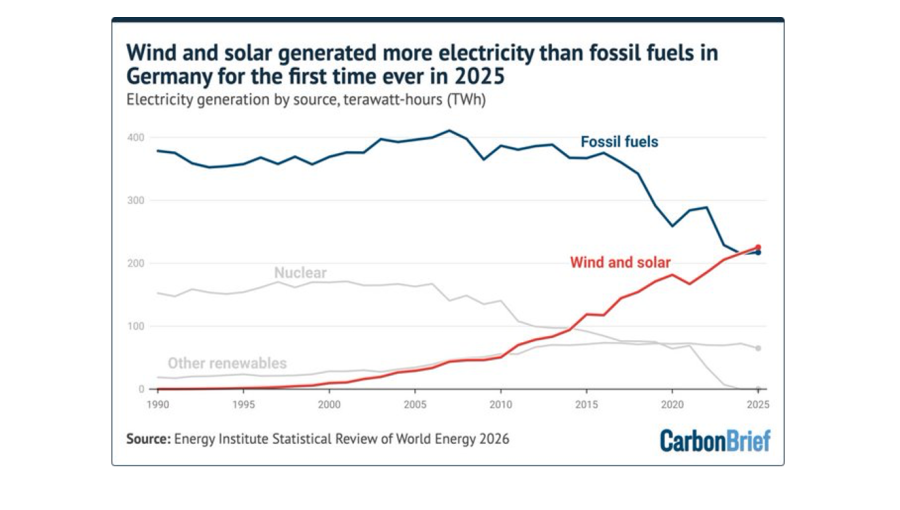
More of Germany's electricity came from wind and solar power than from fossil fuels for the first time ever in 2025, according to Carbon Brief's analysis of Energy Institute Statistical Review of World Energy data. Wind and solar together generated 225 terawatt hours (TWh) of electricity, 44% of the total, against 217 TWh (43%) from fossil fuels – a milestone Germany shares with the EU as a whole, which also saw wind and solar overtake fossil-fuel generation for the first time in 2025.
The shift reflects two decades of rapid growth in solar and onshore wind under Germany's "Energiewende" strategy, as the country transitions away from both coal and nuclear power. Germany aims to install 115 gigawatts (GW) of onshore wind by 2030, and approved a record 20.8 GW of new capacity in 2025 alone. Official targets require economy-wide net-zero emissions by 2045, an 80% renewables share of electricity consumption by 2030, and a "largely climate neutral" power system by 2035.
Germany has to lean on renewables harder than neighbours such as France and the UK to hit those goals, precisely because of its nuclear phaseout – a core plank of the Energiewende that remains politically settled despite recent pushback. Centre-right Chancellor Friedrich Merz described the phaseout as a "strategic mistake" earlier this year, but his government has ruled out returning to conventional nuclear power. Coal remains the bigger near-term challenge: Germany still relies on it far more than most other European countries, with an official phaseout deadline of "no later than" 2038, though experts believe the country is on track to eliminate coal from its power supply years ahead of that date despite pressure during the recent energy crisis to slow the transition.
Renewables now face a different kind of opposition, however: mounting resistance from the far-right Alternative for Germany (AfD), even as the current coalition simultaneously pursues new gas-fired power plants of its own – legislated as a bridge technology, with the plants intended to convert to run on green hydrogen by 2045 to stay consistent with the climate-neutrality target. Very few voices outside the AfD are calling to scrap the coal phaseout altogether, but the government is due to publish a review of its timelines in August, which will be the next test of how firmly Berlin intends to hold the line.

No comments:
Post a Comment