
It's not malicious, it's indifference: Thousands of books sent to AI woodchipper
 Cover image: © France 24
Issued on: 18/09/2026 Play (13:55 min)
In this edition, FRANCE 24’s François Picard speaks to investigative journalist Emanuel Maiberg, Co-founder of 404 Media. As we embark on AI's uncharted waters, Maiberg has made a most unexpected discovery: the mass acquisition, dismemberment and scanning of rare books for use as training data. His investigation reveals a globalised and deliberately opaque supply chain in which books purchased through anonymous marketplaces arrive at large-scale scanning facilities, where their bindings are removed so that pages can be processed at great speed.
Maiberg’s analysis reaches far beyond the striking dystopian image of books being destroyed. What happens when knowledge changes form, changing ownership and accessibility? A book can circulate between readers, libraries and generations. Once destroyed and absorbed into a proprietary AI system, however, its contents survive virtually, encoded within a model whose outputs and rules of access are controlled by a private company. The paradox is striking: an industry seeking to ingest ever more human knowledge may simultaneously erase the very sources of that knowledge.
Maiberg does not to portray this process as a diabolical campaign to rid society of books. His more unsettling interpretation is that the destruction is driven by something more mundane: indifference. In the race to build increasingly capable AI systems, books become inputs to be optimized, and their destruction becomes an acceptable operational cost. That logic, he argues, belongs to a broader concentration of informational power already visible in search engines and social media. And now AI is taking it to a whole new level.
The investigation raises a larger question in the world of culture and academia: as more of the world's accumulated knowledge is mediated through AI systems, who controls the infrastructure through which that knowledge can be accessed?
VIDEO BY: François PICARD
Issued on: 18/09/2026
In this edition, FRANCE 24’s François Picard speaks to investigative journalist Emanuel Maiberg, Co-founder of 404 Media. As we embark on AI's uncharted waters, Maiberg has made a most unexpected discovery: the mass acquisition, dismemberment and scanning of rare books for use as training data. His investigation reveals a globalised and deliberately opaque supply chain in which books purchased through anonymous marketplaces arrive at large-scale scanning facilities, where their bindings are removed so that pages can be processed at great speed.
Maiberg’s analysis reaches far beyond the striking dystopian image of books being destroyed. What happens when knowledge changes form, changing ownership and accessibility? A book can circulate between readers, libraries and generations. Once destroyed and absorbed into a proprietary AI system, however, its contents survive virtually, encoded within a model whose outputs and rules of access are controlled by a private company. The paradox is striking: an industry seeking to ingest ever more human knowledge may simultaneously erase the very sources of that knowledge.
Maiberg does not to portray this process as a diabolical campaign to rid society of books. His more unsettling interpretation is that the destruction is driven by something more mundane: indifference. In the race to build increasingly capable AI systems, books become inputs to be optimized, and their destruction becomes an acceptable operational cost. That logic, he argues, belongs to a broader concentration of informational power already visible in search engines and social media. And now AI is taking it to a whole new level.
The investigation raises a larger question in the world of culture and academia: as more of the world's accumulated knowledge is mediated through AI systems, who controls the infrastructure through which that knowledge can be accessed?
VIDEO BY: François PICARD
China's Ulanqab plans 5mn server racks in AI compute race with US
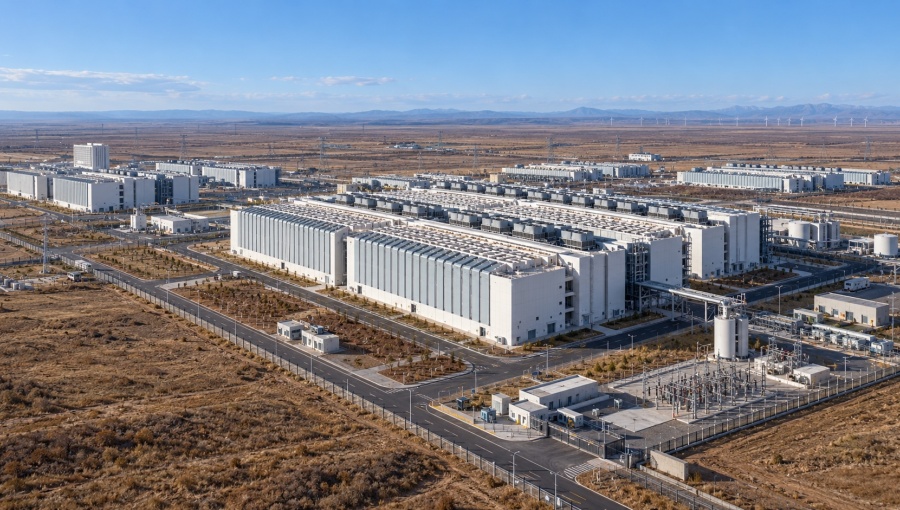
A remote prefecture in China's Inner Mongolia is becoming a global centre of AI computing power. Ulanqab, home to 1.5mn people on the grasslands of the Mongolian plateau, consumes nearly 1% of all the electricity used in China, and its demand is growing by double digits every year.
Spread across the prefecture's households, that load would work out at about 105,000 kWh each a year, roughly 10 times the consumption of an average American home, by his calculation. The power is going into servers.
Over the past few years Ulanqab has signed investment agreements worth more than CNY500bn ($74bn) with China's largest technology companies, and the build-out planned there runs to more than 5mn data centre racks, according to Science and Technology Daily, the newspaper of China's Ministry of Science and Technology.
Set that against Elon Musk's Colossus supercomputer in Memphis, Tennessee, which xAI markets as the world's largest AI supercomputer. On xAI's own count of 200,000 chips, Colossus fills something like 5,000-6,000 racks, Bertrand estimated, which implies roughly a thousand times as many racks. The comparison does not measure equivalent computing power: Chinese standard racks are rated at 2.5 kW, while modern Nvidia AI cabinets can draw more than 100 kW.
"What we see appearing in this Inner Mongolian steppe may be the closest thing to a world brain humanity has ever built - a place where a large share of the world's thinking will physically happen," commentator Arnaud Bertrand wrote on X on September 14.
Anthropic chief executive Dario Amodei said China presented the hardest problem for his proposal to slow AI development, CNBC reported on September 13.
If AI turns out to be the defining technology of the century, as Bertrand argues both Washington and Beijing believe, that makes Ulanqab "one of the single most relevant geopolitical places in the world right now", he wrote.
From cloud valley to token capital.
Inner Mongolia signed 12 commercial deals worth CNY186.46bn ($27.6bn) at a green computing and AI conference in Hohhot on August 22, with China Telecom (SHA: 601728), chipmaker Cambricon Technologies (SHA: 688256) and Volcano Engine, the cloud platform of TikTok owner ByteDance, among the signatories. Active processing power in Ulanqab had by then reached 172,000 PFlops, with more than 95% of it allocated to AI work.
The largest single project so far belongs to Envision, the Shanghai-based wind turbine and battery maker, which commissioned its Galaxy campus in Ulanqab in August. The company says the 2 GW AI campus runs on renewable power and contains the world's largest single data centre building.
The Chinese business magazine Caixin devoted an in-depth report on August 14 to how the city turned itself into an AI powerhouse. Inner Mongolia is one of eight national computing hubs designated under Beijing's "East Data, West Computing" programme, which shifts data processing from the crowded, power-hungry coast to the resource-rich interior.
Cheap wind and cold air
Electricity makes up 55% of a data centre's cost, according to a McKinsey Global Institute study published in June, so the price of power decides where the servers go.
Inner Mongolia is China's "green power bank", regularly producing more wind and solar electricity than it can use at home. Envision finished a 12.8 GWh battery storage cluster across the region at the end of 2025, with sites in Ulanqab, Hohhot, Ordos and elsewhere, to soak up the surplus.
The surplus comes cheap: firm wind power backed by batteries cost about $59/MWh in Inner Mongolia in 2025, against $88-94/MWh in Brazil, Germany and Australia, the International Renewable Energy Agency (Irena) said in May.
Ulanqab's wind already runs a 1 GW electrolysis plant supplying Sinopec's green hydrogen pipeline to Beijing, nearly 400 km away, and the cool plateau climate trims the bill for keeping servers from overheating.
The data centre boom is the latest expression of China's rise as the first Electrostate, an economy built on cheap electrons, and of its position as the world's green energy champion, building two-thirds of the world's new wind and solar plants.
Racks are not chips
Chinese planners typically count data centre capacity in "standard racks" rated at 2.5 kW, while a single cabinet of the latest Nvidia AI servers draws more than 100 kW, so a rack-for-rack comparison with Colossus overstates the gap.
Measured in power, 5mn standard racks come to about 12.5 GW, in line with the planned capacity for Ulanqab reported by the newsletter AI Weekly. That is still more than six times the size of Envision's Galaxy campus. China's total data centre capacity is on course to top 60 GW by 2030, doubling the sector's power demand, according to Rystad Energy.
China's handicap lies in the chips. American hardware keeps a 9:1 lead in raw computing performance, according to American Enterprise Institute researcher Ryan Fedasiuk, and even in the most optimistic 2028 scenario Huawei would supply at most an eighth of the compute available in the US. The AEI's most pessimistic case still has domestic AI chips meeting a third of China's compute demand by 2028, up from about a fifth in 2026.
Chinese chips burn more electricity per calculation than their American rivals, which puts a premium on power that is abundant and cheap. Abundant wind power could lower operating costs, but does not by itself close the chip-performance gap.
Demand to fill it
Daily token requests to AI models across China jumped from about 100bn in early 2024 to 140 trillion by March 2026, and Inner Mongolia has started building a trade platform in the Hohhot free trade zone to sell clean computing power and access to Chinese AI models to foreign developers.
Neighbouring Mongolia unveiled plans for a renewable-powered data centre in August, pitching the same cool, dry climate and wind and solar resources, plus a location between China and Russia.
Bertrand said he had travelled to Inner Mongolia twice without hearing of Ulanqab before he began researching it. "It's really surprising this hasn't been talked about more because the scale is beyond anything else, and by an immense margin," he wrote.

Foreign direct investment into China's high-tech industries rose 35.1% year on year to CNY200.26bn ($29.88bn) in the first eight months of 2026, even as total inflows declined, Xinhua reported on September 19.
The divergence points to a shift in the composition of foreign capital entering the world's second-largest economy, where Beijing has been courting research centres and advanced manufacturing plants while overall investor appetite has cooled. High-tech sectors accounted for 41.7% of all FDI in the period, up 12.4 percentage points from a year earlier, according to the Ministry of Commerce.
Actual FDI in use across all sectors fell 5.3% to CNY479.95bn. A total of 42,582 new foreign-invested enterprises were established, an increase of 0.3%.
Manufacturing drew CNY119.55bn, while the service sector took CNY350.42bn. Investment in research and development and design services jumped 74%, services for the commercialisation of scientific and technological achievements rose 64.2%, and electronic and telecommunications equipment manufacturing gained 41.9%.
Zhang Xiaotao, director of the International Investment Research Center at the Central University of Finance and Economics, said the country's growing pull in high-tech sectors marks a shift in what attracts global capital, from cost-driven to "innovation-driven," he told Xinhua.
By source country, actual investment from France grew 39.2%, from Switzerland 16.7% and from South Korea 16.5%, with flows routed via free ports included.
South Korean semiconductor equipment maker STI is building a chip manufacturing base in Guangzhou with total investment of about CNY12.4bn, while German automotive parts group Schaeffler is adding CNY1bn to a humanoid robotics plant in Jiangsu province.
In June, Beijing issued a 15-measure action plan on foreign investment covering market access, investment procedures and protections for foreign investors. A revised Catalog of Encouraged Industries for Foreign Investment took effect on February 1, directing capital towards advanced manufacturing, modern services and the central, western and northeastern regions.

No comments:
Post a Comment