Carney is right on EU associate membership — the name is irrelevant, the politics aren’t
Each week, Euronews’ chief Europe editor Maria Tadeo debriefs the ins and outs of continental politics. This week, reporting from Strasbourg, she examines the EU’s pitch for associate membership for Canada.
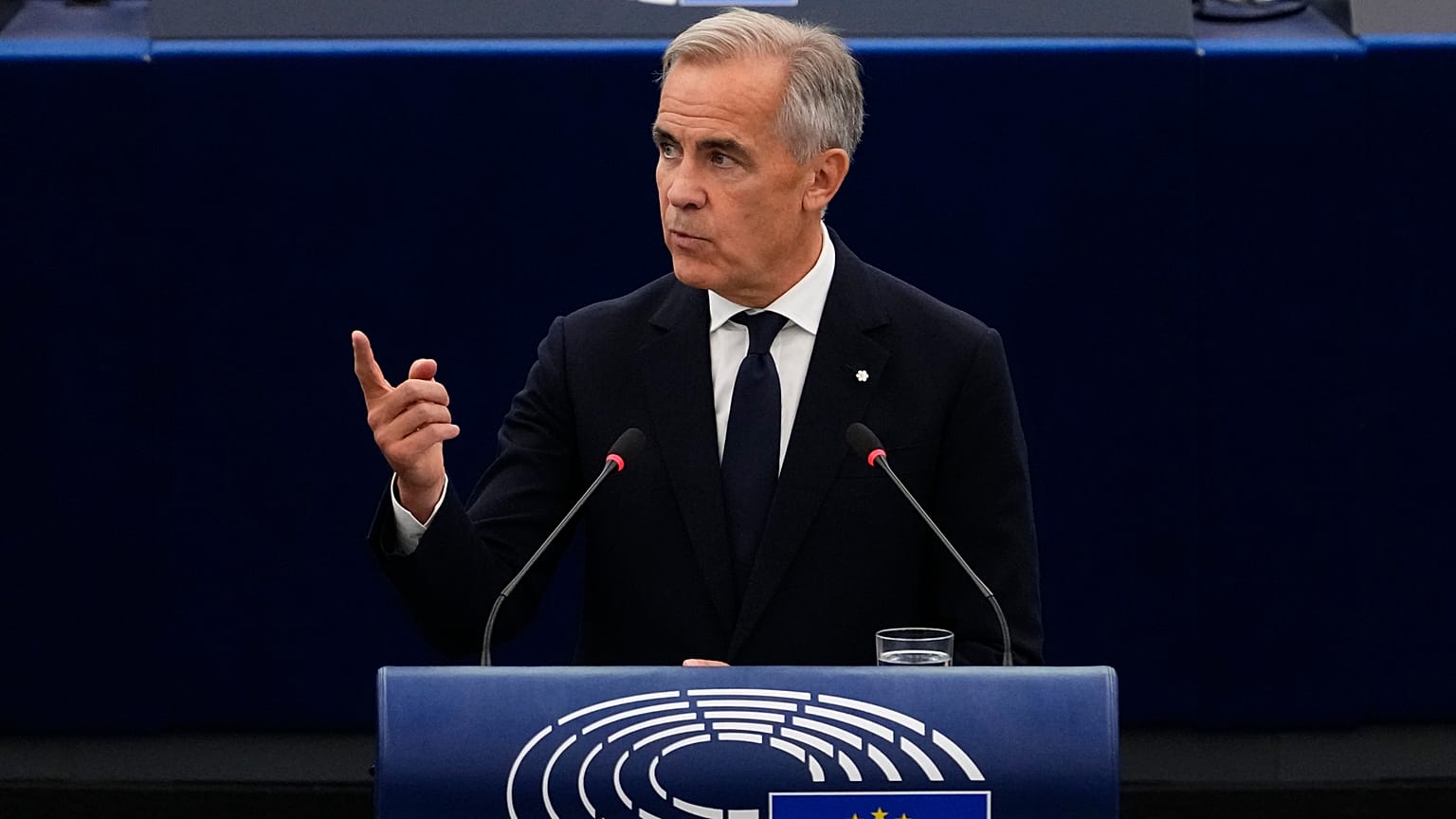
Welcome back to this newsletter, written en route from Strasbourg to Brussels, after a week of parliamentary coverage. In case you missed it, Mark Carney stole the show and Canada is our new associate BFF, whatever that means.
It's easy to be cynical about the Canadian Prime Minister, but anyone who makes an intellectual effort citing Goethe on a Thursday morning gets my attention amid the sea of poor orators that populate the annual State of the Union (the EU's, to be clear).
Carney chose his references deliberately, reaching for Faust right off the bat. One can only hope the MEPs — including the gentleman who shouted "USA! USA!" as he took the stand — appreciated the reference. Goethe argued that freedom is neither a condition nor a possession: it must be conquered. Nor can it be taken for granted, as freedom is as fragile as it is precious.
Carney evoked that spirit from the get-go of his six-page address, taking the hemicycle on a journey through the forest of Ettersberg. Nur der verdient sich Freiheit wie das Leben, der täglich sie erobern muß (Only those who strive for freedom every day are deserving of it). Canada and the EU share that spirit, he told the European Parliament — and both are being tested on their ability to forge their own paths.
His pitch? A new alliance between two sovereign blocs that looks beyond zero-sum geopolitics and builds on their complementary strengths and dependencies. A single tree, he said, can fall in a storm; a forest will not. For Europe, as for Canada, the storm has three names: Trump, Xi, Putin.
Still, lumping them together would be intellectually lazy. The US doesn't threaten Europe's security architecture the way Russia does — NATO is still largely bankrolled by American taxpayers. Nor is China's economic predation on the European industry the result of Trump's economic agenda.
But together, they have upended the status quo on both sides of the Atlantic and left Europeans feeling defeated, orphaned from a political offer that stands up to bullies. Carney is now their patron saint and newfound maple hero.
You could say this is simply a rerun of speeches we've heard before.
Carney himself said as much in Davos at the start of the year, calling for an alliance of middle powers to stabilise a world increasingly governed by brute force. In 2023, cameras caught China's Xi telling Putin that the world was witnessing changes not seen in a century. He was right. The question is whether nations can still decide their own paths, seal their own alliances, and resist the pull of the tide.
Carney is playing politics — that's true. He owes his political success to Donald Trump: going elbows-up on the US, walking away from lopsided trade talks, and putting sovereignty above all else has resonated with Canadians — a country whose sole raison d'être is not being America.
Carney, a product of the establishment and elite education, would never have been elected had it not been for Trump's provocations, and yet he is now the most popular Canadian PM; every dust-up adds points.
His political calculus is very different to that of the EU, which desperately sought to cool down tensions and had the head of the European Commission, Ursula von der Leyen, inking a deal on American terms. And that stings. Large swathes of the European electorate are hungry for political courage — courage von der Leyen lacks, and would struggle to project even if she had it, since doing politics has never been her strength. In Carney, Europeans see an alternative.
Von der Leyen has amassed enormous power. She could have been a transformative Commission President; instead, she plays it safe. Let's be honest: Carney saved her State of the Union address — without him, she would have had little new to say. Too afraid to raise the question of joint debt and European financing, her "independence" moment comes without financial muscle.
Mario Draghi put a number on the cost of an independent Europe: €800 billion a year. You cannot implement the Draghi report without addressing the elephant in the room — but she won't touch it. You can argue her institutional neutrality doesn't allow for it, but her peer Christine Lagarde has no problem saying Europe should at least debate joint borrowing.
Plenty can be said about the tribulations and hurdles ahead for a transatlantic partnership meant to deepen trade, cultural, political and educational ties.
CETA is proof enough: the Canada-EU trade deal, still unratified in countries like France, was painful to negotiate and remains unpopular in sectors like agriculture (and farmers are untouchable in Europe).
Most MEPs we spoke to on the floor told us they didn't quite understand what an associate member would look like, but welcomed the move. The head of the European Parliament, Roberta Metsola, went a step further, telling Euronews in an exclusive interview that Canada could pave the way for other countries "with so much in common," like New Zealand and Australia. My colleague Vincenzo Genovese overheard a group of Renew MEPs debating the interview over lunch — that's zeitgeist for you.
It’s tempting to write this pairing off as bluff — I mean, they can’t even agree on a name: an alliance for the future, or associate membership? But dismiss it at your peril, because Carney is right: at this point, the nomenclature is irrelevant.
What matters is the political signal, and it's not a futile one — just ask the US president, who has already threatened tariffs if the two turn hostile to American interests. As you know, in MAGA world, you either align or you get punished. And yes, the US already has a deal in place with the EU which cut tariffs on American products.
Before I go, I want to thank our team of reporters, correspondents, producers and cameramen for two marathon days in which Euronews brought you 16 interviews, an exclusive sit-down with the Parliament's President, the Commissioners that mattered on the day, and non-stop coverage. It's long hours and it's not easy. I had cold chicken nuggets for dinner each night, and believe me, you don't want that.
But we take pride in what we do, and Euronews is Europe's newsroom — time to consider an antenna in Ottawa.
Macron, Carney hail new chapter in France-Canada ties at symbolic archipelago meeting
French President Emmanuel Macron and Canadian Prime Minister Mark Carney on Sunday called for stronger bilateral ties in the face of new global threats at a meeting on Saint Pierre and Miquelon, a French territory off Canada's Newfoundland. The first-ever visit by a Canadian leader to the North Atlantic archipelago came as both countries have increasingly awkward relations with the US.
Issued on: 20/09/2026

French President Emmanuel Macron said France and Canada were "two great independent nations who want to stay that way" in a joint news conference with Canadian leader Mark Carney Sunday.
Carney, visiting France's tiny North Atlantic territory of Saint Pierre and Miquelon just off the Canadian coast, said the moment had come to tighten links with France and the European Union.
The leaders' meeting, in the tiny overseas French territory off the coast of Canada's Newfoundland came as both countries have increasingly awkward relations with the US under President Donald Trump.
The meeting came days after Carney embraced the prospect of Canada becoming the European Union’s first associate member, saying closer ties with the continent would ensure no country could control Canada’s markets or undermine its sovereignty.
Trump’s tariffs, demands for economic concessions and repeated talk of making Canada the 51st state have pushed Ottawa to reduce its dependence on its neighbour and pursue deeper economic, security and political relationships with Europe.
At a joint press conference in Saint Pierre and Miquelon on Sunday, Macron said the two countries would work together for closer ties on fishing, security and energy.
"We both believe in democracy, the rule of law, respect for international law, respect for free and fair trade, science as the basis for our decisions, and the strategic autonomy that we defend," he said.

16:21
Carney called for joint action to counter new challenges. "Our societies are being shaken by new storms: the upheavals, caused by climate change, the erosion of democratic norms, and new threats to our sovereignty," he said. "The time has come to strengthen our ties."
Fuel, critical minerals and rare earths
Earlier Sunday, Macron posted a video on X of him welcoming Carney at the airport.
"In a world in crisis, our friendship is a strength," said Macron. "Together, we affirm our sovereignty, our freedom to decide and our willingness to build a future of peace and prosperity," he added.
Macron also said that Sunday’s talks are part of broader efforts to help France secure oil and gas supplies as the Iran war disrupts global energy markets and raises fears of higher prices for fuel and other essentials.
“Canada is a country with significant resources of critical minerals and rare earths. It is also a major oil and natural gas producer,” Macron said. “What we want to do is conclude agreements to secure more liquefied natural gas that can be shipped to Europe’s Atlantic coast.”
The visit came weeks after Trump posted an image that showed the US flag draped over Canada, Greenland, Iceland, Mexico, Central America and the Caribbean and was labelled "United States of America".
It included Saint Pierre and Miquelon and French Caribbean territories.
Sunday’s meeting followed Trump’s announcement of a deal on Greenland that would expand the US military presence there while keeping the island under Danish control. The agreement followed months of threats by Trump to seize the semiautonomous territory of a NATO ally.
Macron welcomed the agreement Saturday.
“Danish sovereignty is being respected, international law is being respected,” he said. “Anything that helps ease tensions is a good thing.”
Visit of symbolic weight
Diplomats said the visit by Macron, who was en route to the annual UN General Assembly of world leaders, had a symbolic weight following Trump's social media post.
France did not respond publicly to the post at the time.
For France, Saint Pierre and Miquelon is strategically important due to its location on the doorstep of the US and the Arctic, a French presidency official told reporters in a briefing ahead of the visit.
St. Pierre and Miquelon: History of French fishermen settlements

01:15
The territory also occupies a key place in France's cooperation with Canada, including over energy, one of the issues in focus for the meeting on Sunday between Macron and Carney.
Macron, whose government is facing increased pressure at home over rising fuel prices, said he would like Canada to broaden its exports of liquefied natural gas (LNG) to Europe rather than primarily Asia.
(FRANCE 24 with AFP, AP and Reuters)
Macron touts relationship with Canada in visit to Saint Pierre and Miquelon
Macron said he saw the planned meeting with Mark Carney as "a very strong gesture of friendship" and pointed to the Canadian leader's blossoming relationship with Brussels.
French President Emmanuel Macron hailed France's relationship with Canada during a trip to Saint Pierre and Miquelon this weekend.
Macron is visiting the French overseas collectivity from 19 to 21 September and is due to meet with Canadian Prime Minister Mark Carney there on Sunday.
Speaking to reporters from the archipelago, which sits just off the Canadian province of Newfoundland and Labrador, Macron said the goal of the visit was to help the territory "turn a new page" and gently pushed back on suggestions that the trip was intended to make a statement.
"We shouldn't be so obsessed with sending messages," he said, adding that France had "close friends" including Canada in the region.
On the planned meeting with Carney, Macron said he saw it as "a very strong gesture of friendship" and pointed to the Canadian leader's blossoming relationship with Brussels.
He also noted Canada's substantial reserves of critical raw materials and rare earth elements, as well as its liquefied natural gas production. He said France and the EU would be seeking contracts and arrangements to secure supplies of strategic minerals and LNG for Europe.
It comes after US President Donald Trump hit out at Ottawa and the EU following European Commission President Ursula von der Leyen's announcement that Canada could become the bloc's first "associate member."
Trump called the idea "laughable" but warned that if the move went ahead and he considered it "at all a hostile act," then he would put "very serious tariffs or stop trading with Europe on many things."
Earlier this month, Trump also posted an image on his Truth Social account showing a map of North America, including Saint Pierre and Miquelon and Greenland, marked with the US flag.
The US and Denmark announced on Friday that they had reached an agreement over Greenland, with Trump saying the deal would give Washington "permanent control" of the island's security.
Carney
Carney is due to arrive in Saint Pierre and Miquelon at around 12:30 pm local time, according to his office.
He will then attend a "working lunch" with Macron before the pair take part in a wreath-laying ceremony. They will later deliver a joint statement before Carney heads to Ottawa.
Macron is due to travel on to New York for the UN General Assembly next week - where Trump's Greenland security deal is also expected to be signed.
In a post on X on Saturday, Macron said he was "very proud and happy" to be in Saint Pierre and Miquelon.
"The ocean separates us, but what truly unites us are our values, a shared destiny, and the Republic," he wrote.

Macron welcomes Canada's Carney to French Atlantic territory
Saint-Pierre (AFP) – French President Emmanuel Macron on Sunday welcomed Canada's Prime Minister Mark Carney to France's tiny North Atlantic territory of Saint Pierre and Miquelon, just off the Canadian coast.
Issued on: 20/09/2026 - FRANCE24
The leaders' meeting was being held at a time when both their countries were experiencing strained relations with the United States.
Macron was waiting for Carney as he stepped off his airplane and the two leaders greeted each other with a warm handshake and a long embrace in the bright sunshine.
They were expected to confirm Canada's close relations with both France and the European Union in a joint statement following a working lunch.
"In a world in crisis, our friendship is a strength," Macron posted on X, above a video of him welcoming Carney at the airport.#photo1
"Together, we affirm our sovereignty, our freedom to decide and our willingness to build a future of peace and prosperity," he added.
Carney is the first Canadian prime minister to visit the territory.
Macron's three-day visit to the French territory, a three-island archipelago of fewer than 6,000 people just 25 kilometres (15 miles) off Newfoundland, is the first by a French president in more than a decade.
Tensions with US
The trip carries significant symbolic resonance.
The archipelago is France's only remaining possession in North America, a vestige of the vast territories Paris once controlled in what is now Canada and the United States.
Macron argues that US President Donald Trump's second mandate has reinforced the case he has promoted that Europe needs to become more sovereign, especially on security.#photo2
Carney, caught up in an intensifying dispute with US President Donald Trump -- who has even threatened to annex Canada -- has welcomed a proposal for his country to become the European Union's first "associate member".
He has described his nation as "the most European of non-European countries".
Trump's repeated remarks about making Canada the 51st US state have been strongly rejected by Ottawa.
On Monday, Trump posted an image to social media with a map of North America in which Canada, Greenland and Mexico, much of central America and the Caribbean, as well as Iceland, were coloured in with the US flag.
The image also encompassed several French overseas territories, such as Guadeloupe, Martinique -- and Saint Pierre and Miquelon.
But the territory is French, Macron reaffirmed on his arrival in the territory late Saturday: "It's obvious," he added, dismissing "strange ideas" on the subject.
'Common values'
The joint visit will underscore that Canada and France share "the same values of freedom, democracy, the rule of law and respect for the sovereignty of nations", the French president's office said ahead of the meeting.
"In a world marked by the return of power politics, geopolitical tensions and new forms of dependency, France and Canada share a common ambition: to work together, and with all countries that share these values, to strengthen their capacity to make decisions and act independently," the Elysee Palace added.
Carney's office quoted him as saying that "Canada and France share more than a border.
"We share a history, common values, and a resolute commitment to building a more secure and prosperous world. In an uncertain world, President Macron and I understand the importance of this relationship."
The archipelago is one of several strategically located French overseas territories that span the globe, and has economic and social problems familiar to many such remote territories.
In what French officials describe as France's first climate-driven community relocation, the village of Miquelon has started moving inland to escape the growing threat of sea level rise, with a second phase due to begin.
The population is falling, deaths outnumber births and young people leave to study in mainland France or Canada and often do not come back.
© 2026 AFP
Tiny French outpost off Canada the unlikely stage for new transatlantic courtship
A tiny piece of France just off Canada’s Atlantic coast will become the setting for a much bigger geopolitical story on Sunday, when President Emmanuel Macron welcomes Canadian Prime Minister Mark Carney to Saint-Pierre and Miquelon. The meeting brings Canada’s push for closer ties with Europe to a territory that has long sat at the crossroads of French, Canadian and US interests in the North Atlantic.
Issued on: 18/09/2026 - RFI

Home to around 6,000 people and lying about 20 kilometres off Newfoundland, the archipelago is the last surviving territorial remnant of France’s former North American empire – French soil beside Canada but more than 4,000 kilometres from Paris.
Carney’s trip on Sunday will be the first official visit to the islands by a Canadian prime minister. It comes as Canada looks increasingly towards Europe and both sides explore a much closer relationship.
Just days before the meeting, European Commission President Ursula von der Leyen proposed an unprecedented new relationship with Canada, potentially giving it a new form of association with the European Union.
Canada is not seeking full EU membership, but Carney on Thursday welcomed the ambition behind the proposal and called for a much stronger alliance with Europe.
The two sides are looking at deeper cooperation in defence, energy, critical minerals, artificial intelligence, space and digital trade, although exactly what “associate membership” would mean has yet to be defined.

France beside Canada
That makes Saint-Pierre and Miquelon an unusual and symbolic place for Macron and Carney to meet.
Although Saint-Pierre and Miquelon is French territory, it is not part of the European Union, but has a special relationship with the bloc. The unusual status adds another twist to the choice of the archipelago for talks about closer ties between Canada and Europe.
France has warmly welcomed the prospect of strengthening ties with Canada.
“We are committed to forging ever closer ties with Canada,” Foreign Minister Jean-Noël Barrot said on Thursday, pointing ahead to Macron’s meeting with Carney in Saint-Pierre and Miquelon.
Closer relations with Canada were “a very good idea”, Europe Minister Benjamin Haddad said, while cautioning that the precise institutional form still had to be worked out.
The French reaction came after US President Donald Trump threatened further tariffs if Washington judged the EU initiative hostile, calling the proposed relationship with Canada “laughable”.
It was not for the United States to determine Europe’s geopolitical choices, Haddad responded, while Barrot said sovereignty was “non-negotiable”.
A history of sovereignty disputes
The choice of Saint-Pierre and Miquelon also carries its own history of disputes over sovereignty.
France and Britain fought over the islands for generations before they became definitively French in 1816. More than a century later, they became the focus of a wartime dispute involving Charles de Gaulle and US president Franklin Roosevelt.
In December 1941, Free French forces seized control of the islands from authorities loyal to the Vichy government, despite strong objections from Washington, which wanted to preserve the status quo.
A Christmas Day vote overwhelmingly backed the islands’ rallying to Free France, adding to tensions between de Gaulle and Roosevelt.

Eighty-five years later, the circumstances are different. But a territory once caught in an argument between France and the United States over sovereignty is again being used to underline the freedom of countries to choose their own partnerships.
France and Canada have also clashed over the waters surrounding the islands.
For much of the modern era, their importance was determined by fishing. Disputes over access to rich North Atlantic stocks and maritime boundaries culminated in international arbitration in 1992.
The ruling granted France a 12,400-square-kilometre exclusive economic zone around the archipelago, including an unusual corridor stretching 200 nautical miles south but only 10.5 nautical miles wide – a strip sometimes nicknamed the “French baguette”.
The ruling coincided with Canada’s moratorium on cod fishing, bringing Saint-Pierre and Miquelon’s industrial fishing industry virtually to a halt and dealing a severe blow to the islands’ economy.
Relations subsequently became more cooperative, with a 1994 bilateral agreement establishing a framework for managing shared fish stocks.
From cod to quantum technology
The agenda for Sunday’s meeting shows how much the relationship has changed.
Macron and Carney are due to discuss aerospace, energy, critical minerals and advanced technologies including quantum computing, satellites and supercomputing – sectors far removed from the fishing disputes that long shaped relations between the islands and their Canadian neighbour.
The discussions also closely mirror the wider agenda now taking shape between Canada and Europe.
Von der Leyen has proposed moving beyond the existing CETA trade agreement towards what she called an “Alliance for the Future”, covering defence industries, energy, batteries, critical minerals, AI, quantum technology, cyber security and economic security.
“We share one ocean, one set of values, one way of seeing the world,” she told Carney in Strasbourg on Wednesday.

Carney went further in an address to the European Parliament on Thursday, calling for a broad strategic alliance spanning critical minerals, defence, AI, computing, energy, space and payments.
But the shape of that relationship remains unresolved. There is currently no formal EU status of “associate member” and the proposal would need the backing of EU member states.
Conservative leader Pierre Poilievre has backed closer trade and defence cooperation with Europe while warning against any arrangement that could see Canadians subject to European taxation, regulation or border policies.
Canada also remains deeply integrated economically and militarily with the US. But Carney has pledged to expand trade beyond the US as his government seeks to diversify Canada’s international partnerships.
Away from Sunday’s geopolitical discussions, Saint-Pierre and Miquelon is confronting challenges much closer to home.
On Miquelon, a village of several hundred people is preparing to move to higher ground because of coastal erosion, flooding and rising sea levels, with climate change expected to make the present settlement increasingly vulnerable.
The visit will also bring rare international attention to a territory that has often complained of being overlooked by Paris.
Canadian Prime Minister Mark Carney on Thursday welcomed a proposal for his country to become the European Union's first "associate member", shrugging off threats from United States President Donald Trump.
Issued on: 17/09/2026 - RFI

Canada and the 27-nation European Union are seeking to take ties to a new level in the face of aggression from Trump – who reinforced their concerns by menacing tariffs.
Speaking in the European Parliament in Strasbourg, Carney said Canada "welcomes" the ambition expressed by EU chief Ursula von der Leyen to make the country an associate member.
"We are not fair-weather allies. We do not pursue zero-sum deals. We hold common values for which we have always fought, and in whose defence we must always remain vigilant," Carney said to applause from European lawmakers.
"Canada and Europe are each strong. Europe and Canada are stronger together."
Both the EU and Canada have been buffeted by tariffs and territorial threats from the US, as well as competition from China.
Trump called von der Leyen's unprecedented offer "laughable" on Wednesday, telling reporters he could impose "very serious tariffs" or "stop trading with Europe" should the plan go ahead.
Carney rejected these threats, saying: "Nobody is going to tell us what language we speak, no one is going to dictate our culture, or with whom we can strike agreements internationally."
He insisted that an EU-Canada alliance aimed to be a "beacon for democracies".
Pursuit of resilience
"I am not proposing a third bloc in order to become a great-power rival, only with better manners," he continued.
"We do not seek power to dominate others. On the contrary, we are pursuing resilience so that no one can control our open markets, impair our sovereignty, threaten our territorial integrity, or undermine our freedoms, our democracies, our rule of law."
Carney, who was elected in April 2025, listed a raft of areas where he wanted to ramp up cooperation.
"Canada and Europe should secure our strategic autonomy through deep cooperation in the full range of strategic capabilities, including critical minerals, defence industrial capacity, AI and computing, energy security, space and payments."
He also said the EU and Canada should move towards "seamless digital trade" and allow young people to work and study on either side of the Atlantic.
From labels to Netflix, how Quebec's fight to protect French collides with US trade
This year, Canada became the first non-EU country to join a flagship defence loan programme. Von der Leyen has also proposed that Canada join the future European Security Council, which would bring together the EU and partners including the United Kingdom, Norway and Ukraine.
Under EU rules, member states have to approve any form of partnership with a third country, and it was unclear how much support von der Leyen's proposal would receive from capitals.
French Foreign Minister Jean-Noël Barrot said that Paris was in favour of "creating ever-closer ties with Canada", but that the plan would be "debated, scrutinised and analysed" before France took a definitive position.
The Canada-EU partnership 'a classic win-win situation', economist says

Issued on: 17/09/2026 -

Speaking with FRANCE 24's Monte Francis, Fabian Zuleeg, Chief Economist at the European Policy Center, says that the partnership between Canada and the EU "is a classic win-win situation – Canada has many resources, has many of the economic strengths that the European Union lacks, the EU has a very large market, it is an important trading partner".
BY: Monte FRANCIS
VIDEO BY: Monte FRANCIS

No comments:
Post a Comment