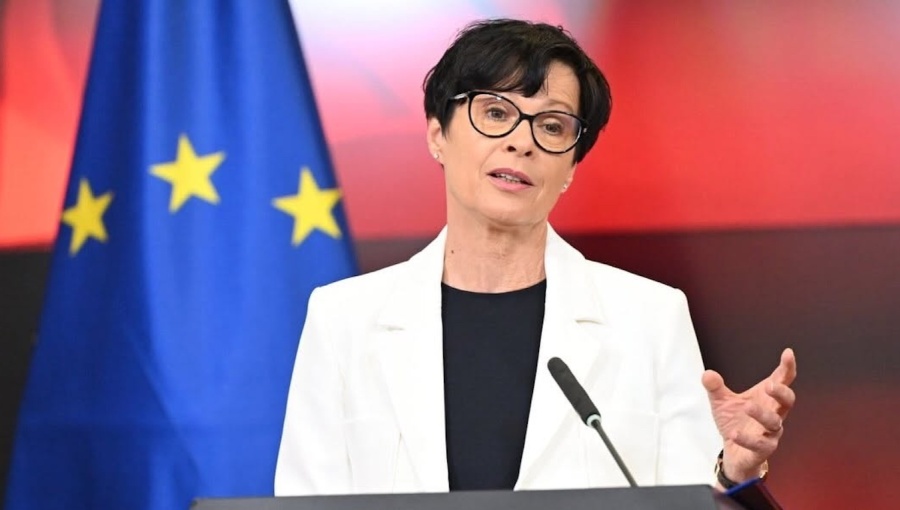
EU Enlargement Commissioner Marta Kos cancelled a planned visit to Serbia on September 4, saying the public “glorification” of convicted Bosnian Serb war criminal Ratko Mladic was incompatible with the values underpinning the country's path towards European Union membership.
Kos had been due in Belgrade on September 10 for talks with government officials, opposition representatives and civil society groups. The EU delegation in Serbia notified participants that the visit had been postponed but initially gave no reason.
Kos later said she had decided not to make the trip because of the reaction to Mladic's death and burial, warning that the episode cast doubt on Serbia's commitment to European values.
"The glorification that follows his death is incompatible with the values on which the path to the EU is built," Kos said in a statement on September 4. "That path requires confronting the past, true reconciliation and respect for the victims of war crimes."
Mladic, who died last week aged 83 while serving a life sentence in The Hague, was convicted of genocide, crimes against humanity and war crimes for his role in the 1992-95 Bosnian war.
He was found responsible for the 1995 Srebrenica massacre, in which more than 8,000 Bosniak Muslim men and boys were killed, and for the 43-month siege of Sarajevo, in which about 10,000 people died.
His body was returned to Serbia on a state plane on September 3 and is due to be buried at Belgrade's Topcider cemetery on September 7. Serbian authorities have said tens of thousands of people could attend.
Serbian President Aleksandar Vucic said he would not attend the funeral because he would be hosting Uzbek President Shavkat Mirziyoyev, whose visit had been scheduled months ago.
Vucic rejected Kos's criticism, calling the explanation for cancelling her visit "extremely short, but stupid" and questioning who had glorified Mladic.
"I guess we should have banned people from showing up, we should have banned burials," Vucic told reporters.
Council of Europe Commissioner for Human Rights Michael O'Flaherty also condemned the alleged "glorification" of Mladic, calling it an insult to victims of the Bosnian war.
Belgian Foreign Minister Maxim Prévot described reports that Mladic would receive state and military honours as "shameful and insulting".
Meanwhile, Serbia's Minister for European Integration Nemanja Starovic said on September 4 that Belgrade remained firmly committed to EU membership and was ready to meet the bloc's accession criteria.
Serbia has been an EU candidate since 2012, but its accession process has made limited progress in recent years. The dispute over Mladic adds to tensions between Belgrade and Brussels over political values.
The episode also risks further straining relations with Serbia's neighbours, particularly Croatia and Bosnia & Herzegovina.
Croatian Prime Minister Andrej Plenkovic said this week that Serbia could not advance towards EU membership while its officials honoured a convicted war criminal. His comments drew ridicule in Belgrade, where Serbian commentators point to Plekovic’s double standards in dealing with their countries’ wartime past.
Croatia continues to commemorate Operation Storm, the 1995 offensive that ended its war of secession from Yugoslavia but drove hundreds of thousands of Croatian Serbs from their homes. Plenkovic has also defended nationalist singer Marko Perkovic Thompson despite his use of Ustasha symbols and slogans.
The dispute highlights the continuing political impact of the wars that accompanied the breakup of Yugoslavia more than three decades ago, and the difficulty Serbia faces in balancing its EU ambitions with nationalist sentiment at home.

No comments:
Post a Comment