Showing posts sorted by date for query IVF. Sort by relevance Show all posts

Saturday, August 29, 2026


Cattle research may provide answers to father’s role in pregnancy loss

Texas A&M AgriLife researcher investigates paternal epigenetics to uncover causes of early pregnancy loss


 - by Kay Ledbetter

When a pregnancy ends early and unexplained, the search for answers usually begins with the mother. Lacey Luense, Ph.D., wants to know what the father’s sperm might have to do with it.

Lacey Luense, Ph.D., an assistant professor in the Texas A&M Department of Animal Science, is studying the male role in early pregnancy loss. (Courtney Sacco/Texas A&M AgriLife)

Luense, an assistant professor in the Texas A&M College of Agriculture and Life Sciences Department of Animal Science, studies the causes of early pregnancy loss — a problem that cuts across species and carries both personal and economic costs.

She is working with cattle, where almost 50% of pregnancies are estimated to end prematurely, to study the root causes of human infertility, where over 50% of all conceptions are estimated not to result in birth.

“We know that maternal issues can be involved,” Luense said. “Sometimes it can be a chromosomal abnormality, disease or problems with the uterine environment. But we don’t know the causes of many pregnancy losses. It’s unexplained, and we are still trying to figure out why this happens so frequently.”

Luense, who also has an appointment with Texas A&M AgriLife Research, is joining forces with Ky Pohler, Ph.D., administrator for the Texas A&M AgriLife Animal Reproductive Biotechnology Center and associate professor, Department of Animal Science, on a $1.65 million National Institutes of Health grant to look at how paternal epigenetic contributions, or non-genetic changes to DNA, are delivered to the embryo.

Determining the male factor in unsuccessful pregnancies

Luense said one potential cause for pregnancy loss could be the male’s sperm and epigenetics — or everything above and around the DNA sequence — that affect how the DNA is structured or packaged.

“We are talking about nongenetic changes that can alter how those genes are turned on or off,” she said. “Our research is trying to understand how dad’s epigenetics or the epigenetic changes carried by the sperm can affect fertility, pregnancy and then long-term health and development.”

The overall goal is to understand the nongenetic changes to DNA that are delivered to cattle embryos. The team will use sperm from bulls of high and low fertility to investigate the role of the paternal epigenome in abnormal embryo development and pregnancy loss.


Texas A&M AgriLife research is trying to understand how the male epigenetics can affect fertility and pregnancy. (Laura McKenzie/Texas A&M AgriLife)

One focus is histones, the proteins that DNA wraps around like a spool and thread. Previous studies indicate males with abnormal sperm histones are more likely to have partners who experience pregnancy loss.

“However, we don’t know why that happens,” Luense said. “This is something we have been learning much about over the last decade or two. We know a clinical correlation exists, but we do not understand the reasons it occurs. Determining that is our challenge.”

Cattle can answer questions humans cannot

Luense is determined to help with human pregnancy loss, but experimenting with human embryos is not an option. And, while she has also worked with mouse models, cattle offer something they couldn’t: early embryonic development that more closely mirrors human embryo development, particularly in cell division and timing when genes from the new embryo activate.

Where discovery meets industry

Department of Animal Science faculty are asking questions with answers that reach far beyond agriculture — into human health and everyday life.

Explore the research

Her team will conduct different molecular and genomic analyses on the semen samples from the high- and low-performing bulls to try to understand their biomarkers and to identify changes in the sperm to predict pregnancy loss. 

Through in vitro fertilization, IVF, they will be able to generate embryos from bulls with specific changes to the sperm epigenome. These embryos will undergo time-lapse imaging and cutting-edge genomic analyses to determine if changes to sperm histones alter development and gene regulation. Performing such experiments in humans is not possible, making the use of cattle an exciting opportunity to further our understanding of human fertility and pregnancy, Luense said.

The new Animal Reproductive Biotechnology Center, which opened in 2025, will allow them to perform gene editing, including CRISPR/CAS 9, to advance knowledge about pregnancy loss and how treatments can be developed to solve the issue.

“We are trying to identify changes in gene expression that are happening very early in pre-implantation embryo development in cattle and how that might give us information about what is happening in humans,” Luense said.

The goal of the research is to find ways to achieve a higher rate of live births and calves on the ground. (Michael Miller/Texas A&M AgriLife)

Biomarkers to predict, and someday prevent, pregnancy loss

Beyond the human health question, the findings could give cattle producers new tools to address a costly problem — roughly half of cattle pregnancies do not result in live births. Better prediction could mean real savings for the industry.

“We hope that, after five years, we will be able to identify biomarkers or alterations to sperm chromatin or sperm histones that may predict pregnancy loss in humans and cattle,” Luense said. “If we know what to look for, maybe it can be treated. We are trying to understand the specific gene pathways regulated by sperm epigenetics occurring in the early embryo and are necessary for a healthy pregnancy and a live birth.”

The results could impact reproductive efficiency and help clinical management of human patients and livestock diagnosed with infertility, poor embryogenesis and pregnancy loss, she said.


Wednesday, August 26, 2026


People say they would not want to test embryos for traits like low IQ. But if given the information, they act on it


University of Oxford
Visual Abstract 

image: 

Available for use with credit to Awad et al., Nature Human Behaviour (2026).

view more 

Credit: Awad et al., Nature Human Behaviour (2026).


A study of more than 2,000 people in the United States and China finds that the line between medical and non-medical traits, which underpins the rules on embryo testing in most countries, does not match the preferences of the public .

If undertaking artificial fertility treatment, most people say they are more comfortable testing embryos for a disease than for a trait like low IQ or antisocial behaviour. But when they are shown that information and asked to pick an embryo, the distinction largely disappears. They decide not to implant  embryos with a raised chance of low IQ or antisocial behaviour about as often as they decide not to implant embryos with a raised chance of heart disease.

That is the finding of a study published today in Nature Human Behaviour by researchers at the University of Oxford, the University of Exeter, the Yong Loo Lin School of Medicine, National University of Singapore (NUS), and colleagues in the UK, Canada, China and Australia.

IVF clinics and commercial companies now offer polygenic testing of embryos, which estimates an embryo's chances of developing common conditions such as heart disease or diabetes, and in some cases traits such as height, eye colour or cognitive ability. Most countries have rules that draw  a distinction between medical and non-medical uses of embryo selection. Earlier surveys supported that line, finding strong public backing for testing for serious illness and much weaker backing for testing for traits.

The new study separated two things those surveys ran together: whether people want the information, and what they do if they have it.

In a US sample of 1,467 adults, quota-sampled to match the national population, 735 people were asked whether they would test embryos for four attributes. Willingness to test was highest for heart disease at 79 per cent and lowest for vision impairment at 55 per cent, with low IQ at 65 per cent and antisocial behaviour at 58 per cent in between. On average, people were more willing to test for the two medical conditions than for the two non-medical traits.

The other 732 people were instead given information about the genetic properties of pairs of embryos and asked to choose between them. Here the pattern changed. An embryo with an above-average chance of heart disease was 40 percentage points less likely to be picked (compared with one with an average chance). For antisocial behaviour the gap was 36 points and for low IQ 32 points. For vision impairment, a medical condition, it was 19 points, far below both non-medical traits.

The same study run with 623 adults in China produced the same shape of result, with the gaps slightly larger.

Dr Edmond Awad of the University of Exeter and the Uehiro Oxford Institute, who led the study, said:

"People are uneasy about asking for this kind of information, but they act on it once it is in front of them. Psychologists call that deliberate ignorance. Choosing not to look is not the same as not caring."

Professor Julian Savulescu of NUS Medicine and the University of Oxford, the study's senior author, said: 

"Regulation in this area rests on a category. Our results suggest people do not think in categories when the choice is in front of them. If policy is going to track what matters to people, it will have to talk about the effect a condition or trait has on a child's life, not the label attached to it."

Professor Dominic Wilkinson, a neonatologist at the John Radcliffe Hospital and a corresponding author of the study, said: 

"This study has important implications  for consent for genetic testing in fertility treatment. When deciding whether to undertake testing, prospective parents may find it helpful to reflect not on what they wish to know, but instead, on what information would impact their decisions about embryos.. " 

The authors are careful about what the study does and does not show. It measures what people say they would do in hypothetical scenarios, not what they do in a clinic. It covers four attributes, chosen as test cases, rather than the full range of things a test might report. And the scenarios presented every attribute in the same clean format, which flatters the science: polygenic prediction for behavioural traits such as cognitive ability is far weaker within families than these scenarios imply, so the real-world gains from selecting on them would be much smaller.

The study also found that public willingness to test for non-medical traits was higher than earlier work had suggested, with 61 per cent open to it. The authors note that their questions asked about avoiding low IQ and antisocial behaviour, whereas earlier studies asked about selecting for high IQ and prosocial behaviour, and that the difference in wording may account for much of the gap.

The team is now running a larger version of the question through Tinker Tots (https://tinker-tots.net), an online citizen-science platform, which invites the public to work through embryo selection dilemmas across a wider range of traits and in more countries. The study published today used a separate sample recruited through Prolific.


Notes to editors

Paper: Awad, E., Colombatto, C., Demaree-Cotton, J., Earp, B. D., Everett, J. A. C., Liu, P., Schaefer, G. O., Singh, I., Wilkinson, D., & Savulescu, J. "Public perceptions of polygenic testing and embryo selection for non-medical traits." Nature Human Behaviour (2026). DOI: 10.1038/s41562-026-02562-w

Available from 26 August at: https://www.nature.com/articles/s41562-026-02562-w

Registered Report. The study design, hypotheses and analysis plan were reviewed and accepted by the journal before the data were collected, on 7 October 2025. The results could not be shaped after the fact. Two of the seven preregistered hypotheses were not supported, and both are reported.

Data, code and materials: https://osf.io/vb9c2

Ethics: Approved by the Social Sciences and Humanities Interdivisional Research Ethics Committee, University of Oxford (R80692), and the Research Ethics Board of the Center for Psychological Sciences, Zhejiang University (2025-002).

Funding: This research was funded in part by the Wellcome Trust (grant number: 226801) for Discovery Research Platform for Transformative Inclusivity in Ethics and Humanities Research (ANTITHESES). For the purpose of open access, the author has applied a CC BY public copyright licence to any Author Accepted Manuscript version arising from this submission. This research was also supported by the National University of Singapore under J.S.’s NUS Start-Up grant (NUHSRO/2022/078/Startup/13). It was also supported by the Social Science Research Council (Singapore) and administered by the Ministry of Education, Singapore, under its Social Sciences Research Thematic Grant (SSRC2023-SSRTG-006). This research was also supported by the National Institute for Health and Care Research (NIHR) Oxford Health Biomedical Research Centre (NIHR203316). The views expressed are those of the authors and not necessarily those of the NIHR or the Department of Health and Social Care. Study 1b was supported by P.L.'s Start-up Fund for 'Hundred Talents Program' of Zhejiang University. B.D.E. was supported by NUSMed and ODPRT (NUHSRO/2024/035/Startup/04) for the project 'Experimental Philosophical Bioethics and Relational Moral Psychology'. J.A.C.E. was supported through a Philip Leverhulme Prize (PLP-2021-095). J.S. was further supported through the Murdoch Children's Research Institute by the Victorian State Government's Operational Infrastructure Support (OIS) Program. None of the funders had any role in study design, data collection and analysis, decision to publish or preparation of the article.

Media contacts:

[Edmond Awad, e.awad@exeter.ac.uk]

[Julian Savulescu, jsavules@nus.edu.sg]

[Dominic Wilkinson, dominic.wilkinson@uehiro.ox.ac.uk]


Interviews available: Edmond Awad (Exeter and Oxford, UK), Julian Savulescu (NUS, Singapore and Oxford, UK).


Tuesday, August 11, 2026

Alexandria Ocasio-Cortez says she hasn’t ruled out a potential run for president or Senate in 2028


Alexandra Marquez
Updated Sun, August 9, 2026
NBC


Rep. Alexandria Ocasio-Cortez, D-N.Y., also said she has begun the process of freezing her eggs. (Sarah Rice / Getty Images file)

Rep. Alexandria Ocasio-Cortez, D-N.Y., said Sunday that she hasn't ruled out a potential run for president or the Senate in 2028, echoing remarks she has made while campaigning for congressional candidates ahead of November's midterm elections.

"I'm focused on winning the midterms. I'm running for Congress right now," Ocasio-Cortez first told ABC's "This Week" on Sunday when asked whether she plans to run for president in two years.

Pressed further by "This Week" host Jonathan Karl, Ocasio-Cortez added, "I haven't ruled out the possibility. And I'm very humbled to the tremendous amount of support out there." But she reiterated her focus on the upcoming midterms over her own political future.

Asked whether she'd consider running for the Senate in New York in 2028, when Senate Minority Leader Chuck Schumer, D-N.Y., will be up for re-election, Ocasio-Cortez, 36, answered, "I think that anything is possible at this juncture."

The congresswoman's political future has been the subject of speculation for years as she has wielded her national political power to endorse insurgent progressive candidates who have beaten more moderate, establishment candidates with bigger campaign war chests.

Most recently, Abdul El-Sayed, a candidate who pledged to reject funding for Israel and promote "Medicare for All," beat Rep. Haley Stevens, D-Mich., in the Great Lakes State's Democratic primary for Senate last week, overcoming the tens of millions of dollars spent by Stevens' supporters to attack him.

"I think that we are in a time of renewal for the Democratic Party. And it's tremendously exciting for all of us, for the big tent of the Democratic Party," Ocasio-Cortez said Sunday in the wake of El-Sayed's victory. "We have really an ascendance of a young, inspiring, exciting electorate, energizing wave of candidates that I think really inject a new energy to the Democratic Party and add to the toolbox of candidates that we have to win the midterm elections hopefully in November."

El-Sayed's victory was fueled in part by Ocasio-Cortez's endorsement and by the backing of Sen. Bernie Sanders, I-Vt., who ran for president twice as a progressive, anti-establishment alternative to traditional Democrats.

Sanders has all but ruled out another presidential run in 2028, drawing questions about who might take up the mantle of the movement he began in 2016.

Ocasio-Cortez, to some, appears to be a natural successor, especially as she and Sanders crisscrossed the nation together since the last presidential election, urging supporters to fight oligarchy and support Medicare for All.

In July, while campaigning for El-Sayed in Michigan, the congresswoman told Politico when asked about a presidential run: "I mean, I can't say that I've ruled it out."


She was first elected to Congress in 2018, winning her party's nomination for New York's 14th Congressional District in a shocking upset to the Queens machine after she challenged longtime Rep. David Crowley in the Democratic primary


On Sunday, Ocasio-Cortez reflected on her political rise since 2018, telling Karl:

"It has been the greatest privilege of my life to be able to represent the working people of my congressional district. And I think some of the ways that it's changed me has been to be able to come in with so many aspirations for our country, and then to have the remarkable opportunity to be in the arena and try to make the country a better place, challenges and all."

"And I love that it's hard," she added. "I love that I have to and I get to engage with people from all across the country, elected officials from all across the country, to try to actually fulfill our dreams to guarantee healthcare to every American."

The congresswoman also spoke about a personal milestone she revealed on Instagram last week — freezing her eggs — and why she decided to publicly share such a personal decision.

On Saturday, Ocasio-Cortez posted videos of herself on Instagram administering the first injections in the egg-freezing process. "I want to share this because I've been weighing this for a very long time … and there isn't a lot out there, and sometimes it can feel very daunting," she said in her posts from Saturday night.

Asked by Karl about the decision, Ocasio-Cortez said: "In this political environment where this administration is denying reproductive care to women across the country, from abortion rights to the ability to carry out a healthy pregnancy, I think it's important for us as leaders to have these conversations and share these processes, especially for working women across the country, and normalize them."

This article was originally published on NBCNews.com

IVF

Alexandria Ocasio-Cortez says she's freezing her eggs

Toby Mann
BBC
Mon, August 10, 2026 


US Congresswoman Alexandria Ocasio-Cortez has revealed she has decided to freeze her eggs, and has shared her first steps in the process on social media.

The 36-year-old New York Democrat posted the clips on Sunday, hours before telling ABC News's This Week programme that she had not "ruled out the possibility" of running for president.

In the clips, Ocasio-Cortez shows herself taking an injection and talks through tips she has learnt, before answering questions about costs, clinical procedures, storage and how fertility care works under what she calls the US's "broken" medical system.

In her later interview with ABC, she explained that she wanted to "normalise" conversations about the process.


[Reuters]

She said it was important "especially in this political environment".

"This administration is denying reproductive care to women across the country, from abortion rights to the ability to carry out a healthy pregnancy," she said. "I think it's important for us as leaders to have these conversations and share these processes," she added.

In her earlier social media post, she said she wanted to share the information even though there was a "political risk" in doing so.

Ocasio-Cortez rarely appears on the Sunday political shows and in her conversation with ABC's Jonathan Karl, she appeared to go further than before at indicating she may run for higher office.

When pressed on whether she was open to a White House run and whether it was a realistic prospect, she said: "I haven't ruled out the possibility and I'm very humbled to the tremendous amount of support out there."

But the focus must remain on the midterm elections in November and not on "individual aspirations or plans", she added.

More in Politics

The congressional elections are held every two years and fall in the middle of the president's four-year term of office.

They are due to be held in early November. Votes will be cast for all 435 seats in the US House of Representatives, while a third of the 100 seats in the Senate will also be up for grabs.


Left-wing Democrats are on a winning run - but can they lure back crucial swing voters?

When she was asked about a possible Senate run in New York against Minority Leader Chuck Schumer, the US Senate's top Democrat, Ocasio-Cortez replied that "anything is possible".

A divide between the party's left wing and its establishment, which is embodied by Schumer, has become more apparent in recent months.

The Democratic voter base, which is hungry for radical change, has delivered some big wins in recent primary elections for left-wing candidates who have run against centrist candidates backed by party leadership.

Last week, Abdul El-Sayed won a Senate primary in a key swing state, Michigan, after a campaign centred on Medicare for all, stopping military aid to Israel and abolishing ICE, the federal immigration enforcement agency.

El-Sayed's victory sends tremors through Democratic Party

Unlike Ocasio-Cortez, who endorsed him, El-Sayed is not a member of the Democratic Socialists of America (DSA) but he was supported by some of their leading figures.

In the ABC interview, Ocasio-Cortez said the rise of these new, younger candidates was exciting for the "big tent" of the party and showed this was a "time of renewal".

She also distanced herself from aspects of the DSA platform which appears in the group's guiding document, such as defunding the police and abolishing the Senate.

But she said it was important that her party appealed to a wide audience.

"Democrats have a responsibility to build a winning coalition, and young people are engaging in mediums and conversations that we have a responsibility to attend to and be responsive to," she said.


'This isn't a winner': Trump insiders recoil as far-right takes the 'bait' and attacks AOC

Tom Boggioni
August 11, 2026 
RAW STORY


U.S. Representative Alexandria Ocasio-Cortez (D-NY) speaks with reporters after the House of Representatives passed its version of the fiscal 2027 National Defense Authorization Act (NDAA) on Capitol Hill in Washington, D.C., U.S., July 22, 2026. REUTERS/Eric Le

Insiders in President Donald Trump's White House are cringing at the latest conservative attack on Rep. Alexandria Ocasio-Cortez (D-NY).

According to a report from Marc Caputo at Axios, there was a groundswell of sneering aimed at the popular New York lawmaker who admitted she plans to freeze some of her eggs, should she want children at a later date.

Ocasio-Cortez announced her decision on Instagram, preemptively acknowledging the reaction she expected. "Don't be weird about this, even though I know all of you will be," she wrote, with Axios suggesting her statement sparked speculation about potential political ambitions, including a possible White House bid in 2028

Conservative gadfly Matt Walsh went low on social media and ranted, "She'll turn 37 in a couple months. If she got pregnant now, it would technically be a geriatric pregnancy. This desire to start having children late in life is completely baffling to me."

The criticism prompted pushback from within conservative circles where there has been an emphasis on women having more children under the Trump administration.

Alexa Henning, a MAGA consultant who recently departed the State Department, countered the messaging with, "Conservative men dunking on AOC for freezing her eggs is not a winning message with women voters."

She then lectured, "I have many conservative friends who, because they decided to put careers first, froze their eggs and had babies and families later in life. That should be celebrated."

Trump administration officials recognize the political liability the controversy presents, Caputo is reporting. At the White House, where the president has previously championed in-vitro fertilization, officials are distancing themselves from Walsh's criticism.

"We most certainly want to encourage more women and families to have children, period," a senior White House official told Axios. "That's a diplomatic way of saying, 'Yes, the Matt Walsh messaging is not helpful.'"

A Trump adviser also acknowledged the strategic problem by stating "This isn't really a winner for Republicans," with midterm elections less than three months away.

Republican pollster Adam Geller advised the party to ignore the issue entirely.

"AOC knows how to get attention. She knows how to stand out. This should be treated as a stunt. And my advice to Republicans is, don't take the bait," Geller said.


Wednesday, August 05, 2026


No clear evidence that common embryo transfer techniques improve IVF success


Preparation techniques used before embryo transfer, considered the most critical step in the IVF process, show no proven effect on pregnancy rates and remain inconclusive due to limited or low-quality data, a new Cochrane review finds.


Cochrane


Preparation techniques used before embryo transfer, considered the most critical step in the IVF process, show no proven effect on pregnancy rates and remain inconclusive due to limited or low-quality data, a new Cochrane review finds.


Embryo transfer is the final and most vulnerable stage in in vitro fertilization (IVF) with only a third of transfers resulting in pregnancy. To improve the odds, clinicians use various techniques, but it’s uncertain which techniques result in higher pregnancy rates. 


Practice varies across clinics. Some centres routinely use preparatory techniques such as adjusting bladder fullness, while others do not consider them necessary and omit them entirely.
The researchers analyzed 11 studies involving a total of 2,524 women undergoing embryo transfer. They examined three categories of preparation techniques used by fertility clinics: straightening the utero-cervical angle by having women arrive with a full bladder, removing cervical mucus before transfer, and "afterloading," a technique for guiding the embryo through the cervix.


Overall, the researchers found that none of the three techniques was backed by reliable evidence of benefit. The included trials were small and were riddled with methodological weaknesses, meaning the evidence was rated low or very low certainty, and the authors did not find grounds to recommend any of these practices over standard care.


“To an extent, this is a case of tradition driving practice rather than the evidence,” says Dr Ryosuke Akino, practicing obstetrician-gynaecologist from Kato Ladies Clinic. “Current practices in this area often reflect local protocols, clinician preference, and historical convention rather than strong, high-quality evidence.”


Little data was available on side effects, but the review team – comprising methodologists and practising obstetrician-gynaecologists – noted that full bladder preparation and cervical mucus removal are generally considered safe, with no clear evidence of harm or major complications.


"While these techniques are generally considered safe, it’s still important to test their effectiveness," says Dr James Brown, obstetrician-gynaecologist from Women’s Health and Research Institute Australia. 


Dr Akino and Dr Brown add: "A full bladder can be uncomfortable, although it may ease catheter insertion in certain uterine positions and reduce procedural difficulty. Mucus removal is usually quick, but if done roughly and causes bleeding, it may affect the woman’s experience. Overall, the risks are minor and relate mostly to discomfort and procedural factors rather than clinical harm."


While most aspects of IVF have advanced considerably over the past few decades, this particular step has remained largely unchanged. Research attention has instead shifted toward embryo quality and genetic factors, which have a greater bearing on success rates than transfer technique. Embryo transfer is also highly dependent on the person doing the procedure and hard to standardize, making large, rigorous trials difficult to design. Women are often reluctant to risk valuable embryos in a randomized trial. 


“Sixteen years of research still haven’t answered a basic IVF technique question,” says Dr Noyuri Yamaji from Showa Medical University, Japan. “This is a critical step in the IVF process and these small changes and techniques have the possibility to make a massive difference, but we won’t know more until more robust, better-quality trials are conducted.” 


All the studies included were conducted in high-income countries, meaning the findings may not generalize to other healthcare settings and populations. Because these procedures are inexpensive and simple to change, the authors argue it may be especially valuable to prioritize research in resource-limited settings, where basic procedural standardization could matter more than advanced technical modifications.
 

Monday, July 27, 2026

Embryo personhood, once on the margins of abortion debates, is moving closer to the center

(The Conversation) — In vitro fertilization has become a bigger part of reproductive rights debates as a once-fringe movement to recognize embryos as people grows louder.

Nitrogen tanks holding tens of thousands of frozen embryos and eggs sit in a lab at New Hope Fertility Center in New York on Dec. 20, 2017. (Carolyn Van Houten/The Washington Post via Getty Images)

(The Conversation) — About 100,000 babies were born through in vitro fertilization in 2024, according to the most recent U.S. data. But IVF commonly involves trying to create multiple embryos, because success is never guaranteed. If unused, those embryos can be frozen, discarded, donated to research or donated to another fertility patient.

In the eyes of some anti-abortion activists, those frozen IVF embryos are already children – children who need to be “adopted” into families. And that idea now appears in a federal document: grant guidelines announced by the Department of Health and Human Services in June 2026.

The department’s Embryo Adoption Awareness and Services program has existed since 2002. But this year’s funding notice describes IVF embryos as “children who already exist and are in need of a family.” Rather than presenting “embryo adoption” as one option among many for patients with remaining embryos, the document describes the practice as centered on embryos’ “rights” and “best interests.”

This language draws from a decades-long movement to give personhood status to fetuses and embryos, including those made in fertility clinics. The personhood movement is rooted in a belief embraced by many conservative Christians: that human life begins at fertilization and should receive legal protection from that moment.

Embryo adoption occupies a niche corner of U.S. fertility care. But the notice brings far-reaching questions about reproductive politics into sharper focus, including the future of IVF – a fertility treatment that many of those same conservative Christians support.

In my 2023 book, “Conceiving Christian America: Embryo Adoption and Reproductive Politics,” I show how embryo adoption developed as a Christian pro-life response to the accumulation of embryos remaining after IVF, recasting embryos as vulnerable children requiring rescue. Once a fringe view even among anti-abortion activists, that claim is now moving closer to the mainstream of reproductive politics.

Donation vs. adoption

Some fertility patients who no longer plan to use their frozen embryos donate them to other patients in the United States. An embryo is transferred through contracts and clinic consent forms, after which it can be transferred into a recipient’s uterus.

The small network of agencies, nonprofits and churches that offer embryo “adoption,” on the other hand, recast the donation process as one that saves “pre-born children.” Modeled on domestic adoption, many programs require home studies that assess prospective parents and their households. Many also allow donors to select who receives their embryos and encourage families to get to know each other rather than remain anonymous.

Legally, though, embryos in the U.S. generally are not adopted, because states do not classify them as children under adoption law. Instead, they are often transferred by contract as personal property.

The distinction between donation and adoption is not merely semantic, however, but part of a larger political project. Advocates seek to change how the public understands embryos and, ultimately, how the law classifies them.

As one advocate for embryo personhood told me in 2008, “What we call things matters.” Adoption language gives the process “some meaning and some dignity,” he said, by recasting IVF embryos as children deserving protection rather than as surplus tissue or research material.

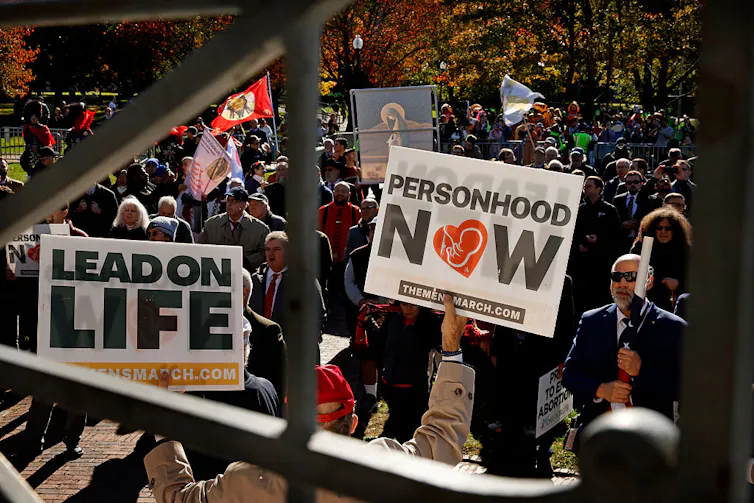
A crowd of people outside holding signs that say 'Personhood now' and 'Lead on life.'

Demonstrators rally on Boston Common during the National Men’s March to Abolish Abortion and Rally for Personhood on Nov. 1, 2025.
Craig F. Walker/The Boston Globe via Getty Images

Pushing for personhood

The world’s first embryo adoption program was launched in 1997 by Nightlight Christian Adoptions, which also facilitates traditional domestic and international adoptions. But the idea emerged from a longer effort that began taking shape in the 1960s, led largely by conservative Christian organizations, to establish legal personhood from the moment of fertilization onward.

In 1973, the Supreme Court’s Roe v. Wade ruling found that the Constitution protected the right to have an abortion – a decision grounded in the right to privacy, stemming from the 14th Amendment’s due process clause. But the majority’s opinion also observed that the case for abortion rights would “collapse” if a fetus were recognized as a person under the 14th Amendment, with a constitutional right to life.

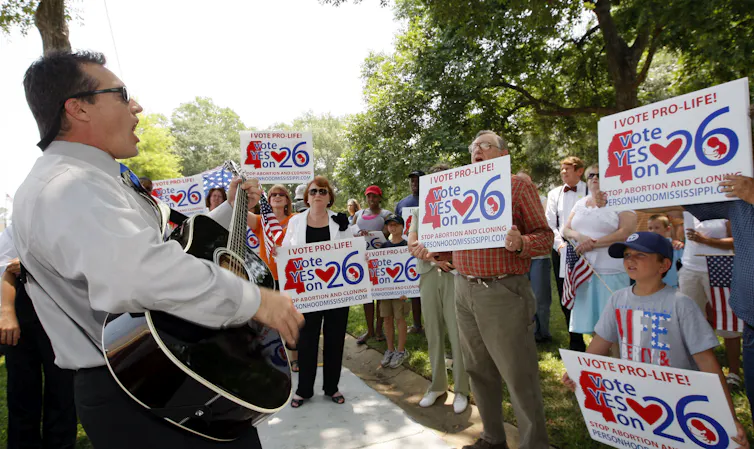
It was a watershed moment for personhood politics, and anti-abortion strategists responded quickly. One week later, Maryland Rep. Lawrence Hogan proposed the Human Life Amendment, which sought to extend constitutional personhood to “the moment of conception.” Similar efforts repeatedly failed in Congress and at the ballot box, including a prominent 2011 measure that Mississippi voters rejected.

A man plays a guitar to a crowd of people outside holding signs that say 'I vote pro-life!'

A prayer rally gathers at the Capitol in Jackson, Miss., in 2011, in support of a proposed amendment to recognize human life as beginning at fertilization.
AP Photo/Rogelio V. Solis

As IVF advanced, the treatment raised new questions about when and where personhood begins. Some anti-abortion advocates extended claims about life beginning at fertilization to embryos created outside the body, but IVF was not one of the movement’s main targets.

In the late 1990s and early 2000s, debates over human embryonic stem cell research drew national attention to what happens to embryos that remain after IVF. Scientists and patient advocates viewed embryos remaining after IVF as valuable materials for research that might lead to treatments for serious diseases.

To anti-abortion activists, however, using embryos in research destroyed human life. Embryo adoption entered the debate as a “life-affirming alternative” to discarding them or donating them to research.

President George W. Bush brought families from Nightlight’s embryo adoption program to White House press conferences opposing expanded federal funding for embryonic stem cell research. These children helped convey Bush’s message that “there is no such thing as a spare embryo.”

From margins to mainstream

Embryo politics changed dramatically in 2022, when a new Supreme Court ruling, Dobbs v. Jackson Women’s Health Organization, overturned the constitutional protection for abortion.

Before Dobbs, persuading courts to recognize embryos and fetuses as persons had been a potent but divisive goal among anti-abortion groups. Some embraced it, while others favored a different strategy – in part because public support for IVF is so strong.

After Dobbs, however, activists intensified efforts to extend legal rights to embryos and fetuses. Personhood arguments now surface in not only abortion restrictions but also disputes involving pregnancy loss, child support and taxes. Fertility care, in particular, has moved toward the center of anti-abortion politics.

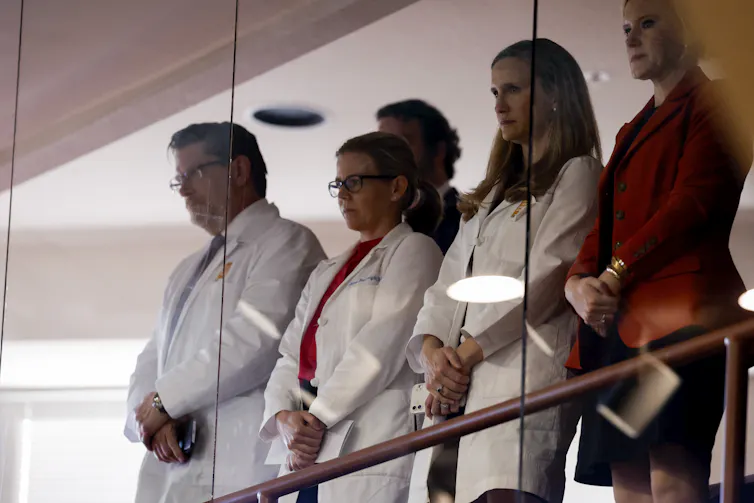
Alabama became a bellwether in 2024 when its Supreme Court ruled that frozen embryos created during IVF treatment qualified as “children” under the state’s wrongful death law, which allows parents to sue over the death of a child. The case arose after a patient entered a fertility clinic’s cryogenic storage area and dropped a container holding frozen embryos. Concerned about liability, clinics paused services, and the state quickly passed a law giving providers immunity for embryo damage or death during IVF services.

Five people, three of whom wear white doctor coats, stand behind a pane of glass, holding their hands in front of them.

Doctors from the Alabama Fertility Clinic watch the state Legislature debate a bill to protect IVF providers on March 6, 2024, in Montgomery, Ala.
AP Photo/Butch Dill

New territory

Today, the Health and Human Services funding notice signals a shift toward the personhood movement’s central premise: that embryos are children.

To be sure, embryo adoption occupies a small corner of U.S. fertility medicine. Few people choose to donate remaining embryos for procreative use. Nor is embryonic personhood a popular idea: Only 39% of Americans support laws declaring that human life begins at fertilization. A majority of white evangelical Protestants, Hispanic Protestants and Latter-day Saints support that view, yet majorities of these religious groups also oppose banning IVF.

But embryo adoption’s political power has never depended on widespread participation or public support. It lies in the story the movement tells about what embryos are, and advocates’ efforts to embed that story in institutions, policies and law.

I would argue the funding notice is one sign that the personhood movement is gaining force after the Dobbs decision. The question it raises is what legally recognizing embryos as children would mean for reproductive health and rights.

(Risa Cromer, Associate Professor of Anthropology, Purdue University. The views expressed in this commentary do not necessarily reflect those of Religion News Service.)

The Conversation

The Conversation religion coverage receives support through the AP’s collaboration with The Conversation US, with funding from Lilly Endowment Inc. The Conversation is solely responsible for this content.