Sunday, December 10, 2023

Fossil of enormous sea monster and 'ultimate killing machine' discovered by scientists

Story by Catherine Shuttleworth • 

Fossil of enormous sea monster and 'ultimate killing machine' discovered by scientists

The skull of a colossal sea monster has been extracted from the cliffs of Dorset's Jurassic Coast.

The pliosaur was a marine reptile that terrorised the oceans roughly 150 million years ago. The fossil is two metres long and one of the most complete specimens of its type ever discovered.Palaeontologist Steve Etches told BBC News "it's one of the best fossils I've ever worked on. What makes it unique is it's complete."

"The lower jaw and the upper skull are meshed together, as they would be in life. Worldwide, there's hardly any specimens ever found to that level of detail. And if they are, a lot of the bits are missing, whereas this, although it's slightly distorted - it's got every bone present."

You really get a sense of how big the creature was when you realise the skull is longer than most humans are tall.

The fossil has 130 teeth, each tooth marked with fine ridges. These would have helped the pliosaur to pierce the flesh and then quickly extract its dagger-like fangs, ready for a rapid second attack.

"The animal would have been so massive that I think it would have been able to prey effectively on anything that was unfortunate enough to be in its space," says Dr Andre Rowe from Bristol University.

"I have no doubt that this was sort of like an underwater T. rex."

Fossil enthusiast Phil Jacobs came across the tip of the snout of the pliosaur lying in the shingle after a stroll along a beach near Kimmeridge Bay. Too heavy to carry, he rigged a makeshift stretcher to take the fossil fragment to safety with Steve Etches.

The soul will be featured in a special David Attenborough programme 'Attenborough and the Giant Sea Monster' on BBC One on New Year's Day.

Licence plates to raise money for MMIWG2S

Story by The Canadian Press • 1d

The Manitoba Métis Federation’s Infinity Women Secretariat is applauding the provincial government’s decision to sell specialty licence plates in support of Missing and Murdered Indigenous Women, Girls, and Two-Spirited people.

On Friday, the Manitoba government announced the plates would be available for purchase at Autopac agents across the province. Thirty dollars from the sale of each set of place, which cost $70, will go toward supporting Ka Ni Kanichihk, a Winnipeg-based Indigenous-led organization.


Adrienne Carriere, the vice-spokesperson for the Manitoba Métis Federation’s Infinity Women Secretariat, was present at the announcement on Friday and said it moved her deeply.

“We heard from three family members about the importance and the significance of this work that’s being done by the families — work that’s been started by the families and has been propelled forward,” Carriere told the Sun. “It was an extremely beautiful ceremony.”

The licence plates will be a powerful stimulus for grassroots education and efforts to prevent the issue of MMIWG2S and is very significant for families who have been affected, she said.

“It’s an epidemic, and its been an epidemic for a long time, so this is another step in that process to continue to advocate and hopefully, at some point, not have to have these kinds of things.”

Housing, Addictions and Homelessness Minister Bernadette Smith said she introduced the bill to create the licence plates on behalf of MMIWG2S families as it is very close to her heart and has impacted her own family.

“We wanted to make sure other Manitobans recognized the significant impact of the reality we face. Ka Ni Kanichihk has incredible programs that support families who have been impacted by the loss of missing and murdered loved ones,” she said. “This will truly make a difference in our community.”

Dodie Jordaan, executive director of Ka Ni Kanichihk, said the licence-plate initiative not only raises awareness about MMIWG2S, but also provides support to Ka Ni Kanichik’s programs towards education.

“Together, we drive change, honouring the lives of missing and murdered Indigenous women, girls and 2SLGBTQ+ while supporting survivors and communities on the path to healing and justice,” she said.

Smith’s bill, called Bill 204, received royal assent on May 30 and unanimous support from all parties. If all the 6,000 plates available are sold, Ka Ni Kanichihk will receive $180,000 by springtime, Justice Minister Matt Wiebe, the minister responsible for Manitoba Public Insurance, said.

Miranda Leybourne, Local Journalism Initiative Reporter, Brandon Sun

Poll: Most Americans disapprove of Biden's handling of Israel-Hamas war

Story by Anthony Salvanto • 3h

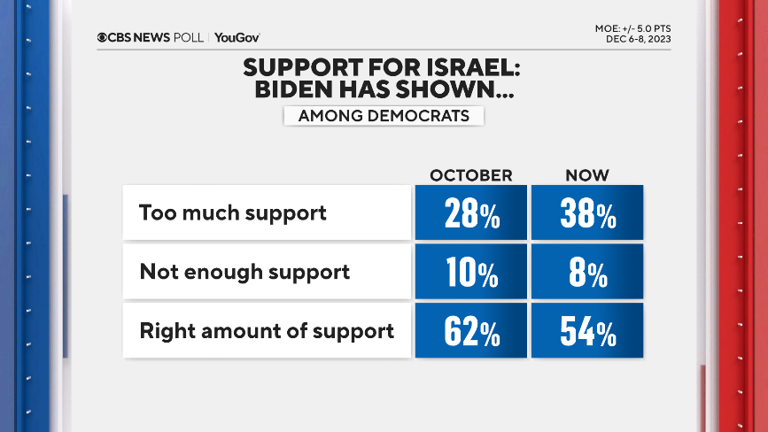
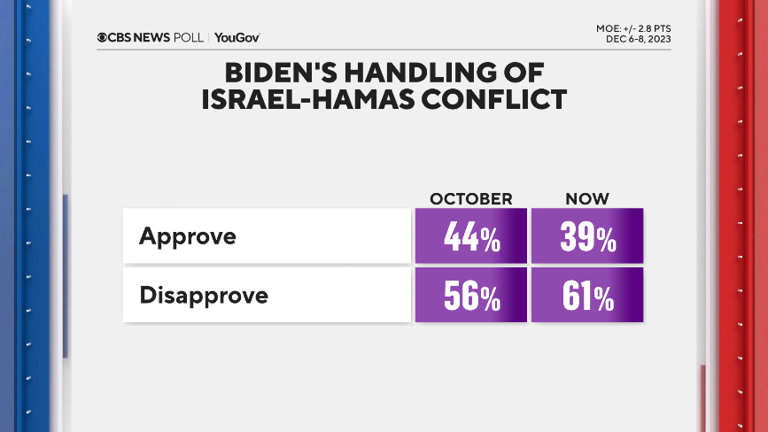
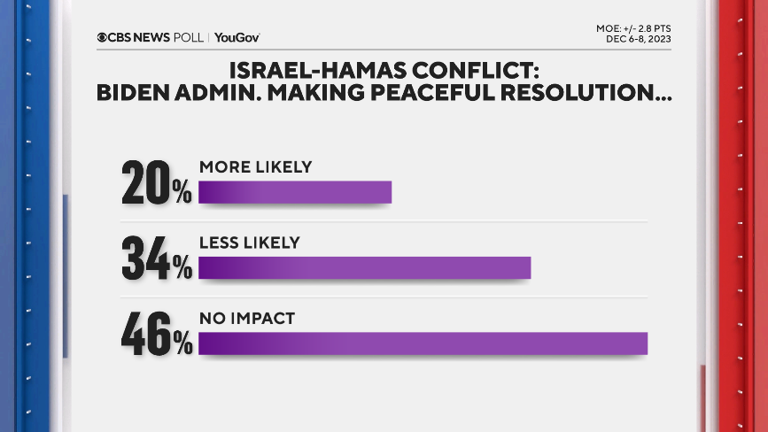
President Biden's handling of the Israel-Hamas war continues to meet with majority disapproval as relatively few Americans think his administration's actions are bringing things closer to a peaceful resolution, and a rising number of Democrats feel he's showing too much support for Israel.

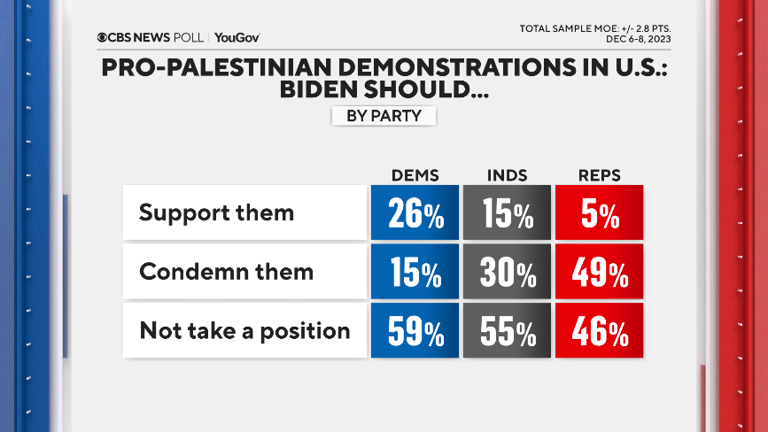
As for Mr. Biden's approach toward any pro-Palestinian protests that take place in the U.S., most would favor no comment, and then there are relatively more who'd like him to condemn those than support them. Republicans, in particular, are the ones most looking for condemnation.


© Provided by CBS News

(That said, it isn't impacting Mr. Biden's overall approval rating, which is generally holding steady and is at 41%, in part because Americans don't rank the war among the U.S.' top problems.)

The president's approach toward Israel elicits increasing differences within his own Democratic party. Now, more than a third of Democrats think he's showing too much support for Israel, which is up from October.


© Provided by CBS News

Back home, regarding pro-Palestinian protests taking place, most would prefer Biden take no position on these in the U.S., or else condemn them —more than support them. Republicans are relatively more inclined to want him to condemn them; a quarter of Democrats would look for support.


© Provided by CBS News

The differentiator is that it's generally older Americans — it's Gen X and Boomers, people over 45 — who tend to want comparably more condemnation. It's not strongly associated with just whether or not someone is college-age.

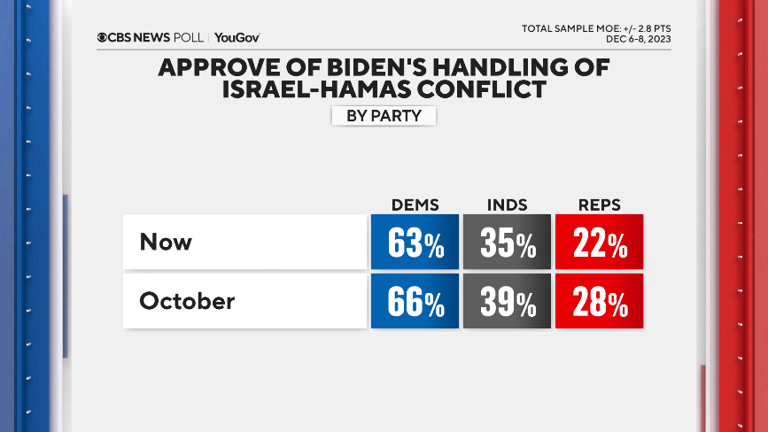
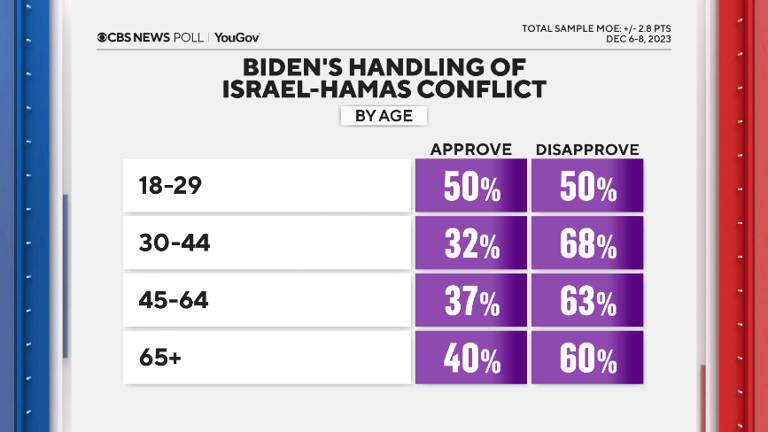
Mr. Biden's overall approval rating for handling of the conflict has declined slightly since October among all partisans and age groups, not any one in particular.


© Provided by CBS News


© Provided by CBS News


© Provided by CBS News

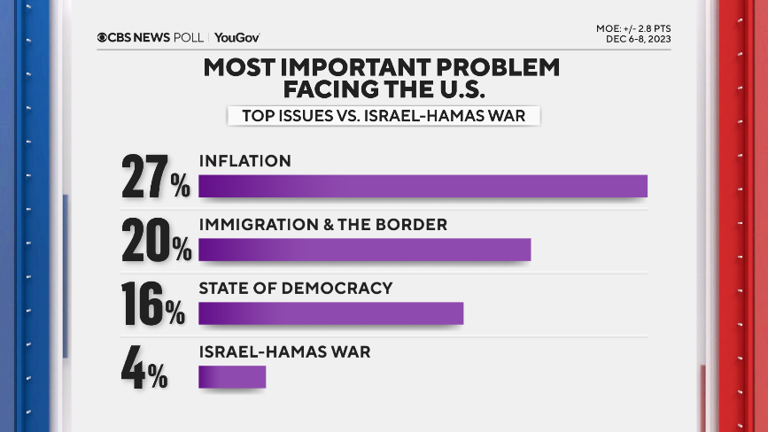
But for context, as Americans assess the U.S.' top problems, the Israel-Hamas war is not among them. It's low single-digits far below inflation, and below the state of democracy, the border, and gun violence when people are asked to pick.


© Provided by CBS News

This CBS News/YouGov survey was conducted with a nationally representative sample of 2,144 U.S. adult residents interviewed between December 6-8, 2023. The sample was weighted according to gender, age, race, and education based on the U.S. Census American Community Survey and Current Population Survey, as well as past vote. The margin of error is ±2.8 points.


Biases behind transgender athlete bans are deeply rooted

George B. Cunningham, University of Florida 
 Kelsey Garrison, University of Florida
Thu, December 7, 2023

A California teacher takes part in a demonstration in September 2023 to support the rights of transgender people. Leonard Ortiz/Orange County Register via Getty Images


In 2023, 24 states had laws or regulations in place prohibiting transgender students from participating on public school athletic teams consistent with their gender identity. These bans mean that a person whose sex assigned at birth was male but who identifies as a girl or woman cannot play on a girls or women’s athletic team at a public school in that state.

The topic has spurred many debates about fairness, the science behind sports performance, civil rights and sports as a human right.

As researchers who study diversity, equity and inclusion in sport, we were interested in understanding what prompted such bans. Though not a surprise, we showed for the first time through an in-depth study set to be published in the peer-reviewed Journal of Sport Management that state-level politics and public biases against transgender people are largely to blame.

Our research

We collected two years of data in 2021 and 2022 on states that passed legislation prohibiting transgender athletes from participating in sports on teams that connect with their own gender identities.

To determine the political leanings of a state’s population, we collected data about the share of Republican state senators and the party affiliation of the governor.

Finally, we collected information about the biases people had toward transgender individuals. The data came from responses to the Project Implicit website. People visiting the site can take tests aimed at measuring their biases toward different groups, including transgender people. Administrators then remove identifying information and make the data freely available. For our study, we aggregated the responses to have transgender bias scores for each state.

The politics of transgender bans


States whose residents have conservative political leanings tend to have more restrictive views on civil rights issues such as immigration, health care and the use of the death penalty.

These patterns hold for transgender rights, too.

In our work, we found that states with conservative-leaning legislatures such as in Wyoming and West Virginia were most likely to enact transgender athlete bans. As were states with Republican governors, such as Ron DeSantis in Florida and Greg Abbott in Texas.

These statewide patterns are consistent with national political actions.


In 2023, the Biden administration proposed a change to Title IX, the federal law that bans sex discrimination at K-12 schools and colleges that receive federal funds. Under Biden’s proposed changes, Title IX would also ban discrimination based on sexual orientation and gender identity.

In response, nearly all – 25 of the 26 Republican governors – called on Biden to delay or withdraw the rule change. To date, Biden has not made a final decision and has delayed the change.

Bias against transgender people

But politics tells only part of the story.


We found that conservative political leanings spurred collective biases against transgender people, which in turn prompted the bans.

Political scientists have previously shown that politicians craft narratives and frame their arguments in ways that help shape people’s attitudes about social issues. In fact, people will sometimes adjust their perspectives to align with those held by their political representatives.

That’s what we found.

Impact on sports and athletes

Biases that are prevalent in a community or state represent systemic forms of oppression. Coupled with laws that limit rights, collective biases serve to stigmatize transgender people, hurting their overall health and well-being.

The impact is far-reaching.

Transgender athletes face the real possibility of participating in a sport one day, only to be prohibited from doing so the next. Ending a career in sports, regardless at what age, can harm the mental health of some athletes, something only likely to be magnified given the reason for the end.


Bloomfield High School transgender athlete Terry Miller, second from left, wins the final of the 55-meter dash over transgender athlete Andraya Yearwood, far left, at a Connecticut girls Class S indoor track meet in 2019.
AP Photo/Pat Eaton-Robb

Coaches and sport administrators living in conservative states might find themselves having to navigate laws affecting who can play on their teams. They can do so by partnering with campus counselors and ensuring their athletic departments are inclusive spaces.

What’s next?

The links among conservative politics, collective biases against transgender people and transgender rights are unlikely to diminish any time soon. National political reporters Adam Nagourney and Jeremy Peter explained that social conservatives have targeted transgender rights as a way of galvanizing their constituents. The GOP efforts came about after planning by national conservative organizations to “harness the emotion around gender politics.”

Proponents of transgender inclusion have offered counterarguments, showing that transgender athletes are not a threat to women’s sports, nor have they ever been.

This data is important but will go only so far when combating biases.

Education and the chance to be around transgender people in everyday life also help curb prejudice. These collective factors, when combined with compelling stories about transgender inclusion in sports, may be what’s needed to overcome the biases in place.

This article is republished from The Conversation, a nonprofit, independent news organization bringing you facts and analysis to help you make sense of our complex world.

It was written by: George B. Cunningham, University of Florida and Kelsey Garrison, University of Florida.

Read more:

How high school sports became the latest battleground over transgender rights

Indiana, Iowa and Texas advance anti-transgender agendas – part of a longtime strategy by conservatives to rally their base


Old Bridge school board first to affirm NJ policy protecting transgender students

Cheryl Makin, MyCentralJersey.com
Thu, December 7, 2023 at 3:12 AM MST·6 min read

OLD BRIDGE – The school district is the first in New Jersey to officially affirm the state’s transgender student policy, an issue that has roiled many school districts in the state and became a GOP rallying cry in last month’s legislative election.

Under the policy, school districts are not required to inform parents if a student confides in a teacher about their gender identity or sexual orientation. The policy also allows transgender students to participate in gender-segregated activities and use school facilities, such as bathrooms or locker rooms, that are consistent with their gender identity.

Opponents have said the policy, which has been in effect since former Gov. Chris Christie signed it into law in 2017, infringes on “parental rights.”

At least nine New Jersey school districts, including neighboring Manalapan-Englishtown, have adopted policies requiring school officials to notify parents of students’ gender expression. Attorney General Matthew J. Platkin has sued some of those districts, saying their policies violate New Jersey’s Law Against Discrimination.

New Jersey Attorney General Matthew Platkin

The Old Bridge Board of Education vote to affirm the policy was 4-3 with one abstention. Board members Jay Slade, Lisa Lent, Jennifer D’Antuono and Marjorie Jodrey voted in favor while Devinder Singh, Matt Sulikowski and Frank Weber voted against. Board President Salvatore Giordano, who earlier this year unsuccessfully ran in the GOP primary for a state Assembly seat, abstained.

The vote came after weeks of often spirited discussion at board meetings about the policy.

At the Nov. 14 school board meeting, a 14-year-old student whose mother said she had “transitioned a long time ago” spoke in favor of the policy.

"I feel as if the people who were speaking for this cause are constantly repeating themselves, because the people on the opposing side won't listen," she said. "I've heard people compare this policy to people going through substance abuse and home life abuse, which is completely different from a gender identity. One is someone's identity, and one is someone's way of coping with something. Please for the sake of transgender children and the overall small group of kids that need this policy, please keep it in."

More: Ramapo College faces controversy, threats after transgender swimmer breaks school record

Soon after she spoke, an audience member berated the teen, calling her "he" and a "sexual deviant." The board stopped the man from continuing to speak.

Anne Ettinger, the student’s mother, told the board the man’s comments may have been a blessing in disguise.

"He was easily emotionally abusive to my child so what is going to stop him from doing it again?" Ettinger said. "In 2015, JAMA (Journal of the American Medical Association) found emotional abuse is equally as detrimental to mental and behavioral health as violent abuse. These kids need to be protected. And you just saw a little taste of what my daughter goes through."

Ettinger said there are more parents and transgender students in favor of the policy but can't speak up because "they don't feel safe."

"I think it actually turned out to be a good thing that he stood up and spoke because I think the Board of Ed really needed to see what these kids go through," Ettinger said. "And what she had been going through at school. I think it opened up their eyes to the emotional trauma that these kids go through. I'm happy that they affirmed the policy that's been in effect for six years with no problem. I'm so grateful to the board. I am very thankful that they were supportive."

Superintendent of Schools David Cittadino likened the situation to his experience in parochial school.

"You went to that Confession," he said. "You could tell them you murdered somebody. And they couldn't tell your parents. They couldn't tell the police. They can't tell anyone. Parental rights? I know I had a conversation with my clergy about things that I wasn't sure about. But Father Tom never called my parents. The gender identity is the area we are discussing, but sometimes I feel it gets lost in there."

Cittadino said teachers do not instruct about gender identity, hand out gender-affirming medications, or give suggestions or recommendations for gender-affirming doctors. They do, however, report abuse, and would do so if a transgender child is experiencing abuse.

"Sadly, at least weekly, sometimes twice a week, one of our staff members by law has to call DCP&P (state Division of Child Protection and Permanency) because of a concern of child neglect or abuse and that doesn't separate between gender identities. All students, we protect them, and as I said last week that is that same thing we would do in this situation," the superintendent said. "A third of a percentage point, we're talking about students that are impacted by this policy. And I have no record of how many times it's been applied. I can tell you how many times a parent has come to me and said they were upset that they found out that their child was transgender, and we knew first and didn't tell them, and that's been zero."

More: 'Nothing sufficient was done': Manville schools sued over transgender student's suicide

Cittadino said parents are not notified when a child confides other things to teachers, such as losing their virginity or if they are gay.

Louise Walpin, director of advocacy and organizing for the statewide grassroots group SWEEP (Suburban Women Engaged, Empowered and Pissed), said other school districts should follow Old Bridge’s lead.

"We believe that this vote is newsworthy as it shows that this board supports the transgender community," Walpin said.

"These are just kids that have to be protected," she said. "It's not a matter of keeping a secret. It's a matter of helping these children, who maybe at this point in time can't come out. This policy is just to protect these kids. A child has to be safe."

Ettinger, the student’s mother, told the board that the policy is "not about taking parental rights away" but rather "politicians are making you think that your rights are being taken away because their end goal is taking away basic human rights from transgender children."

"There is such a hypocrisy within this world," Ettinger said. "What a beautiful world it could be, where everyone is different, and we all have different opinions. I just don't understand why that's not okay. Boring − it would be boring if we're all exactly the same."

Slade, one of the school board members, said the board needed to take a stand on the policy so it could concentrate on more pressing issues, such as infrastructure, overcrowding, teacher shortages, transportation, supply chain delays, the state of staff and student mental health and learning loss.

"We can't have these meetings and keep hearing the same thing," he said. "We need to concern ourselves with other things."

Cheryl Makin is an award-winning features and education reporter for MyCentralJersey.com, part of the USA Today Network. Contact: Cmakin@gannettnj.com or @CherylMakin. T


House GOP will introduce a second transgender athlete ban next week

Brooke Migdon
Fri, December 8, 2023 


House Republicans are planning to launch a second legislative effort to bar transgender women and girls from competing on female school sports teams, cementing the issue as a priority for the GOP ahead of 2024.

The proposed “Save Women’s Sports Act” would require public K-12 schools and colleges to designate sports teams — including intramural and club teams — based on sex assigned at birth, rather than gender identity. The bill’s restrictions would also apply to private schools that receive federal financial assistance, according to a draft obtained by The Hill.

A second clause states that membership of athletic teams “designated only for females shall only be open to biological females at birth.” Schools that violate the provision risk losing access to all federal funding, according to the bill, which is set to be introduced next week by Rep. Lisa McClain (R-Mich.).

The congresswoman’s proposal is modeled after an identically titled law passed in Montana in 2021. A federal judge last year ruled the law’s restrictions on transgender college athletes unconstitutional, but allowed a provision barring transgender K-12 students from competing on sports teams consistent with their gender identity to remain in effect.

Similar bans have been implemented in at least two dozen states since 2020, according to the Movement Advancement Project, which tracks LGBTQ legislation. Restrictions adopted by lawmakers in Idaho, Arizona, Utah and West Virginia, however, are temporarily blocked by court orders.

The House passed a separate bill to prevent transgender women and girls from competing on school sports teams in April.

Rep. Greg Stuebe’s (R-Fla.) “Protection of Women and Girls in Sports Act” aims to restrict the participation of transgender athletes by amending Title IX — the federal civil rights law prohibiting sex-based discrimination at federally funded schools — to recognize sex as “based solely on a person’s reproductive biology and genetics at birth.”

The measure, which passed in a party-line 219-203 vote, has not been taken up by the Senate, which is controlled by Democrats. The White House in April warned that President Biden would veto the bill if it reached his desk.

McClain’s office did not immediately respond to questions about her bill, including whether she believes the proposal goes further than Stuebe’s. The congresswoman was not one of the measure’s 93 Republican co-sponsors.

Still, McClain, who has represented Michigan’s 9th Congressional District since 2021, is one of Congress’s most outspoken critics of transgender female athletes.

During a Dec. 5 House subcommittee hearing titled “The Importance of Protecting Female Athletics and Title IX,” McClain repeatedly referred to transgender women as “men” and claimed that allowing transgender athletes to participate in girls’ sports puts other student-athletes in danger and is “fundamentally unfair.”

“We are placing our daughters in danger every time they step onto the field,” she said. “This hearing is about protecting women, period.”

McClain during the nearly 3-hour hearing also alluded to her forthcoming bill, telling a panel of witnesses that transgender people can “be who [they] want to be, but the American people don’t have to fund it.”

McClain and other House Republicans lauded the testimony of Riley Gaines, a former University of Kentucky swimmer who has traveled the country to testify in favor of legislation to bar transgender women and girls from female sports teams, restrooms and locker rooms.

Gaines, who accompanied McClain to Biden’s State of the Union address in February, tied with former University of Pennsylvania swimmer Lia Thomas — the first transgender woman to win a national Division I title — for fifth place at last year’s NCAA championships.

Privacy concerns persist in transgender sports case after Utah judge seals only some health records

HANNAH SCHOENBAUM
Thu, December 7, 2023 

A 12-year-old transgender swimmer is seen waiting by a pool, Feb. 22, 2021, in Utah. She and her family spoke to The Associated Press on the condition of anonymity. Transgender teenagers challenging a Utah law banning trans girls from playing on girls' sports teams can keep portions of their mental health records confidential after a state judge ruled Thursday, Dec. 7, 2023, that some details were irrelevant to the case.
 (AP Photo/Rick Bowmer, File) 

SALT LAKE CITY (AP) — Transgender teenagers who are challenging a Utah law banning trans girls from playing on girls' sports teams can keep portions of their mental health records confidential after a state judge ruled Thursday that some details are irrelevant to the case.

Two student-athletes whose families sued over the 2022 state law were ordered in September by Judge Keith Kelly to give state attorneys access to the last seven years of their mental health records, as well as all documents related to medical transition and puberty.

Kelly temporarily blocked the state from enforcing the ban, which took effect last year after the Republican-controlled Legislature overrode Gov. Spencer Cox’s veto, while the court continues to assess its legality.

Cox drew national attention as one of the few Republican governors who pushed back against state lawmakers’ restrictions on transgender youth, warning that such bans target kids already at a high risk for suicide. Utah is one of more than a dozen states that have passed such bans.

Kelly ruled last August that transgender girls could return to athletic competition after hearing several hours of student testimony describing how exclusion from sports was causing them significant distress. He described the ban as “plainly unfavorable treatment” and said it must be put on pause to protect the girls from “irreparable harm” and a severe impact on their mental health.

But because the girls' “physical, mental and emotional circumstances” factored into his decision to grant the preliminary injunction, he also determined that their mental health records were relevant to the case.

His ruling Thursday does little to alleviate privacy concerns raised by the plaintiffs' attorneys, who argue the state should not have access to the deeply personal mental health records of children who have not waived their therapist-client privilege.

Only details concerning irrelevant third parties, certain isolated events and the students' deadnames, or the birth names that they no longer use, will remain redacted, Kelly said Thursday.

“These children should have the ability to speak freely in their therapy sessions without an intrusion into that privilege that exists between patients and providers,” Amy Whelan, an attorney for the plaintiffs, told The Associated Press after the hearing. “And the issues that they're discussing are really not at issue in a sports case."

Whelan said the next step is to work out internally with the state’s lawyers how those records can be used in court. Before defense attorneys begin taking depositions, the families' lawyers will outline what they think is and is not appropriate to ask the minor plaintiffs to try to minimize “any potential harm or stress that could result," she said.

Lawyers from the attorney general’s office, which represents the state, have argued they should have full access to the girls’ mental health records, including portions that might not seem relevant to the case, so they can assess whether the state law is responsible for the distress the girls have described. By centering their arguments around the alleged mental health impacts of the ban, defense attorney Jason Dupree argues the plaintiffs opened the door to a complete examination of their mental health history.

The attorney general’s office did not immediately respond to phone messages seeking comment on the outcome of Thursday’s hearing.

The girls' families argue in their lawsuit that categorical bans on transgender athletes single out their daughters for less favorable treatment than other girls. Their lawyers say the law treats a student’s transgender status as a proxy for athletic ability and fails to consider individual circumstances.

But supporters of the law say transgender athletes have inherent advantages and compromise fairness in girls’ sports.

There have been few cases of potential competitive advantages in K-12 sports in Utah and in other states passing similar bans.

With the ban on hold, a back-up plan for vetting transgender athletes has been met with similar criticism.

A commission of politically appointed experts from the athletic and medical fields can now decide on a case-by-case basis whether a transgender athlete's participation compromises fairness. Republican state lawmakers created the commission in another 2022 law as a fallback plan to be implemented in case of an injunction. The panel can review a child’s height and weight and whether they are taking puberty blocking drugs or hormones, which some critics say crosses a line.
Chronic fatigue syndrome is not rare, says new CDC survey. It affects 3.3 million U.S. adults


MIKE STOBBE
Updated Fri, December 8, 2023 

Nancy Rose, who contracted COVID-19 in 2021 and exhibits long-haul symptoms including brain fog and memory difficulties, pauses while organizing her desk space, Tuesday, Jan. 25, 2022, in Port Jefferson, N.Y. Rose, 67, said many of her symptoms waned after she got vaccinated, though she still has bouts of fatigue and memory loss. U.S. health officials estimate 3.3 million Americans have chronic fatigue syndrome — a bigger number than previous studies have suggested, and one likely boosted by patients with long COVID, according to results released by the Centers for Disease Control and Prevention on Friday, Dec. 8, 2023. (AP Photo/John Minchillo, File) (ASSOCIATED PRESS)More


NEW YORK (AP) — Health officials on Friday released the first nationally representative estimate of how many U.S. adults have chronic fatigue syndrome: 3.3 million.

The Centers for Disease Control and Prevention's number is larger than previous studies have suggested, and is likely boosted by some of the patients with long COVID. The condition clearly "is not a rare illness,” said the CDC's Dr. Elizabeth Unger, one of the report's co-authors.

Chronic fatigue is characterized by at least six months of severe exhaustion not helped by bed rest. Patients also report pain, brain fog and other symptoms that can get worse after exercise, work or other activity. There is no cure, and no blood test or scan to enable a quick diagnosis.


Doctors have not been able to pin down a cause, although research suggests it is a body's prolonged overreaction to an infection or other jolt to the immune system.

The condition rose to prominence nearly 40 years ago, when clusters of cases were reported in Incline Village, Nevada, and Lyndonville, New York. Some doctors dismissed it as psychosomatic and called it “yuppie flu.”

Some physicians still hold that opinion, experts and patients say.

Doctors "called me a hypochondriac and said it was just anxiety and depression,” said Hannah Powell, a 26-year-old Utah woman who went undiagnosed for five years.

The new CDC report is based on a survey of 57,000 U.S. adults in 2021 and 2022. Participants were asked if a doctor or other health-care professional had ever told them they had myalgic encephalomyelitis or chronic fatigue syndrome, and whether they still have it. About 1.3% said yes to both questions.

That translated to about 3.3 million U.S. adults, CDC officials said.

Among the other findings: The syndrome was more common in women than men, and in white people compared with some other racial and ethnic groups. Those findings are consistent with earlier, smaller studies.

However, the findings also contradicted long-held perceptions that chronic fatigue syndrome is a rich white woman's disease.

There was less of a gap between women and men than some previous studies suggested, and there was hardly any difference between white and Black people. The study also found that a higher percentage of poor people said they had it than affluent people.

Those misperceptions may stem from the fact that patients who are diagnosed and treated “traditionally tend to have a little more access to health care, and maybe are a little more believed when they say they're fatigued and continue to be fatigued and can't go to work,” said Dr. Brayden Yellman, a specialist at the Bateman Horne Center in Salt Lake City, Utah.

The report relied on patients’ memories, without verifying their diagnoses through medical records.

That could lead to some overcounting, but experts believe only a fraction of the people with chronic fatigue syndrome are diagnosed, said Dr. Daniel Clauw, director of the University of Michigan’s Chronic Pain and Fatigue Research Center.

“It’s never, in the U.S., become a clinically popular diagnosis to give because there’s no drugs approved for it. There’s no treatment guidelines for it,” Clauw said

The tally likely includes some patients with long COVID who were suffering from prolonged exhaustion, CDC officials said.

Long COVID is broadly defined as chronic health problems weeks, months or years after an acute COVID-19 infection. Symptoms vary, but a subset of patients have the same problems seen in people with chronic fatigue syndrome.

“We think it's the same illness," Yellman said. But long COVID is more widely accepted by doctors, and is being diagnosed much more quickly, he said.

Powell, one of Yellman's patients, was a high school athlete who came down with an illness during a trip to Belize before senior year. Doctors thought it was malaria, and she seemed to recover. But she developed a persistent exhaustion, had trouble sleeping and had recurrent vomiting. She gradually had to stop playing sports, and had trouble doing schoolwork, she said.

After five years, she was diagnosed with chronic fatigue and began to achieve some stability through regular infusions of fluids and medications. She graduated from the University of Utah and now works for an organization that helps domestic violence victims.

Getting care is still a struggle, she said.

“When I go to the ER or to another doctor’s visit, instead of saying I have chronic fatigue syndrome, I usually say I have long COVID,” Powell said. “And I am believed almost immediately.”

___

The Associated Press Health and Science Department receives support from the Howard Hughes Medical Institute’s Science and Educational Media Group. The AP is solely responsible for all content.
'Poisoning people and the planet’: Britons to be worst e-waste offender in the world

'Mountains' of e-waste are being shipped by the UK to developing countries with concerning consequences

Rabina Khan
·Contributor
Updated Thu, December 7, 2023

Britons are on course to become the worst contributors of electronic waste - or 'e-waste' - in the world. (PA/Alamy) (Geo-grafika)


The UK has never been more obsessed with gadgets and our willingness to use and then discard broken or out-of-date phones, laptops and TVs is impacting some of the world's most vulnerable communities.

In fact, according to recent research, Britons are on course to become the worst contributors of electronic waste - or "e-waste" - in the world.

Data published by the Global E-waste monitor in 2020 and analysed by Uswitch in January this year found that the UK generates 23.9 kg per capita of e-waste, the second highest amount of per capita in the world - just behind Norway's 26 kg and Switzerland's 23.4 kg.

The study, the most recent from the monitoring group, also warned that Britons were on course to hit the top spot by 2024.

Global E-Waste Monitor told Yahoo News that it will publish the latest data in 2024, including on Europe and the UK.

The issue is considered so significant it is set to be discussed during COP28. Professor Richard Herrington, head of the earth sciences department at the Natural History Museum in London, who was part of the museum's delegation in the UAE on 4 December, told Yahoo News that e-waste was part of the agenda.

The impact on vulnerable communities was likely a key talking point. "Whole computers are sent to China, Africa or India, where entire villages including children just sort components,' Herrington has previously said.

Jim Puckett, executive director at environmental watchdog, Basel Action Network (BAN), echoed the warnings, telling Yahoo News: “The mountains of e-waste humans are producing tend to find their way far too quickly and easily on a path of least economic resistance to developing countries."

Read more: COP28: What is it, who's going and what are the key sticking points?

Electronic waste, refers to discarded electrical or electronic devices, including these cable wires on a dumpsite next to a main road in Guiyu, China. (Photo by MediaNews Group/The Mercury News via Getty Images) (MediaNews Group/The Mercury News via Getty Images via Getty Images)

What is e-waste?

Electronic waste refers to discarded electrical or electronic devices such as old or obsolete computers, laptops, smartphones, tablets, televisions and refrigerators..

E-waste can contain hazardous materials like lead, mercury, and cadmium, which can pose environmental and health risks if not properly managed.

In the last year, the UK discarded nearly half a billion small "FastTech" electronics, like headphones and mini fans, according to a research by Material Focus.

That means these items, which cost around £4 on average, are being chucked away at a rate of one product every 16 seconds and include 260 million disposable vapes, 26 million cables, 29 million lights, 9.8 million USB sticks, and 4.8 million mini fans.

According to a House of Commons environmental audit committee report, approximately 40% of the UK’s e-waste is illegally exported to be disposed of in other countries, fuelling a dangerous industry by putting millions of children’s health and that of women of childbearing age at risk in developing countries.


E-waste exported to emerging countries like Bangladesh is not in a reusable condition and are often non-repairable.(Supplied) (Supplied)
How does the UK dispose of e-waste?

E-waste, now known as WEEE (waste electrical and electronic equipment) is regulated by the UK government with a view to reducing the amount of broken or unwanted items that are dumped in landfill, resulting in toxic substances such as lead and mercury leaching into the soil and water.

In addition, they contain valuable non-renewable resources such as gold, silver, copper, platinum, aluminium and cobalt. Anything that has a plug, battery or cable is classed as WEEE waste.

Read more: Climate change will jump to a whole new level in 2024 thanks to El Niño

Under the government’s set annual targets, electrical appliance manufacturers are expected to meet these targets. 2023 WEEE target is set at 511,376 tonnes.

Failure to do see results in a compliance fee, which is paid into the WEEE Fund.

This fund is used to improve the WEEE system, including research, behaviour change activities, communications and the implementation of more recycling points across the UK.

Warehouse full of computer parts system boxes monitors to be recycled or resold many in boxes or pallet wrapped. (PA) (ni press photos, Radharc Images)

“The majority of waste electricals that are sent for recycling in the UK are managed by reputable waste companies in the UK," Scott Butler, executive director at Material Focus told Yahoo News.

"However, we are concerned that there are some illegal exports of waste electricals which should instead be safely recycled in the UK."

Despite the UN Basel Convention regulations on hazardous waste trade, questionable recycling firms act as brokers and some export e-waste to less developed nations.

Read more: ‘Bad politics, bad leadership’: Expert hits out at Rishi Sunak's flagship energy policy ahead of COP28

By exploiting lax labour laws, weak environmental regulations, and poor human rights records, these companies shift dismantling and recycling responsibilities to poorer countries, turning former farming villages in places like Vietnam, China, and Nigeria into toxic e-waste dumping grounds, according to BAN.

In these communities, so-called "recycling" often involves harmful practices like burning circuit boards, acid-soaking microchips, and toxic plastic burning, "poison people and the planet".

As world leaders meet at COP28, the latest estimates from Climate Action Tracker suggests that the global median temperature is dangerously higher than the 1.5°C target formalised by the Paris Agreement. (Statista)
Impact of e-waste disposal

E-waste exposure may be linked to increased rates of stillbirth and premature birth, learning and behaviour outcomes and respiratory conditions especially associated with lead released through informal e-waste recycling activities, according to the World Health Organization.

Digital dumpsites are prone to scavenging, dumping in land or water, landfilling alongside regular waste, open burning, acid baths, stripping plastic coatings, and manual disassembly of equipment.

The UN reports the world generates 53.6 million metric tonnes of e-waste and is projected to grow to 75.7 million tonnes by 2030.

"The wastes - which are in fact toxic wastes - are exported, often illegally, to Southeast Asia, South Asia and Africa, where only a fraction of their value is recovered, and the recycling processes used are highly polluting and harmful to workers" said Puckett.

Bangladesh Rural Advancement Committee (BRAC) works to mitigate risk to people working as e-waste recyclers and cite that the main challenge in Bangladesh lies in the lack of any kind of formal channel to recycle e-waste, as well as any formal laws or regulations to monitor it.

"A significant portion of e-waste is handled by informal recyclers, often in unsafe environments, leading to severe health and environmental hazards," BRAC told Yahoo News, adding that in some workplaces there are no safety precautions in case a fire breaks out.


Bangladesh Rural Advancement Committee (BRAC) in Dhaka works with people who re-fix disposed electric items for a living making it safer. (BRAC) (Supplied)
Action on e-waste

A lack of effective monitoring of illegal e-waste dumping amid a growing industry severely impacts on the world’s poorest.

“People want the things they own to be long-lasting and repairable, but the UK generates more e-waste more than three times the global average. One reason for this contradiction is it can be difficult and expensive to repair our gadgets or buy them second-hand," Libby Peake, head of resource policy at Green Alliance, told Yahoo News.

She added that the UK government could ensure that products are designed with repair in mind, making it clear how easy it is to repair products when they’re sold, and eliminating VAT on spare parts and repair work.

For those looking to dispose of their electronic goods correctly, Material Focus's Butler advised people to go to the Recycle Your Electricals to locate their nearest recycling point.

Watch The E-waste Tragedy
FedEx faces US racketeering lawsuit by former delivery contractor

Fri, December 8, 2023 


By Lisa Baertlein

LOS ANGELES (Reuters) - A company that FedEx once contracted to deliver packages on the California-Oregon border has sued the shipper, alleging it engages in a systemic pattern of illegal and wrongful business practices that violate U.S. anti-racketeering law.

The lawsuit filed Nov. 14 in a California federal court by PYNQ Logistics Services, which has not been previously reported, seeks a court determination that PYNQ's relationship with FedEx Ground is that of an employee rather than a contractor. PYNQ also reserved the right to pursue the case as a class action.

If successful, the case could threaten the promised cost-savings from a restructuring through which FedEx has been shifting significant package volume from its employee-staffed Express unit to its Ground unit that relies on about 6,000 contractors to handle delivery and transportation services.

The case appears to be the first where a former FedEx Ground contractor has sued the global delivery giant under the U.S. Racketeer Influenced and Corrupt Organizations Act (RICO), said attorney Jeffrey Possinger, who represents the plaintiff.

"This is a twist of an attack on the independent contractor relationship. They set this up as fraud claims to avoid arbitration," said Frank Botta, former in-house attorney for the company that FedEx bought and rebranded as its Ground business. He now defends companies facing legal challenges involving contractors as a partner at Lynch Law Group in Pennsylvania, though he is not involved in this case.

FedEx in a statement said it was aware of the allegations and would "vigorously defend the lawsuit." As of the close of business on Thursday, FedEx had not filed a response in court.

"The biggest concern is that this case might morph into a class action case. If that happens, it's going to be a long, hard-fought battle," said Botta.

PYNQ alleged that FedEx violates laws governing contractors by exercising the same level of control over those service providers as it would over employees.

Using contractors enables Ground to shift employee and other expenses to those service providers. It also helps FedEx control labor costs by thwarting union organizing efforts, which are more complex at many small companies than at one large company.

PYNQ, owned by former airline pilot Tara Wright, in 2021 spent $1.13 million to buy two FedEx Ground delivery areas with routes serving northern California's McKinleyville and Crescent City. FedEx sent termination letters on both service areas in May and sold one of them without her consent and without compensation. There was not time to sell the second area, leading to a loss, PYNQ's attorney Possinger said.

FedEx used new systems that rate delivery service and value areas to help support its actions, according to the complaint.

PYNQ claimed that FedEx knowingly withheld information that would have been material to its decision to become a contractor.

FedEx also prevented PYNQ from changing its business to improve profitability or from recouping its investment through the sale of its delivery areas, according to the lawsuit.

PYNQ alleged that many of the company's operating policies and procedures were not disclosed, were unfairly applied or subject to change without notice, and that they were elements of a systemic pattern of deceptive practices that rose to the level of racketeering.

(Reporting by Lisa Baertlein in Los Angeles; additional reporting by Jonathan Stempel in New York and Tom Hals in Wilmington, Delaware; Editing by David Gregorio)
Tesla CEO And World's Richest Man Elon Musk Is Fighting To Avoid Paying Child Support To Ex-Girlfriend Grimes

Musk is trying to prove that Grimes lived in Texas so he can minimize child support payments


By Logan Carter
Published Friday, Dec 8, 2023

Photo: Theo Wargo/Getty Images

Elon Musk is using ex-girlfriend Grimes’ tweets to prove to custody courts that she primarily lived in Texas despite her claims that she lived in California. This distinction is important, because Texas has a cap on maximum child support payments where California has no maximum cap.

No cap, this billionaire with a “B” is fighting to minimize child support payments to the mother of three of his children, and is thus fighting for his kids to have less access to his grossly abundant financial resources, dependent on the outcome of the custody battle.


Musk and Grimes were dating on-and-off from 2018 until earlier this year, and musical artist Grimes, whose legal name is Claire Boucher, is the mother of three of Musk’s 10 children. Musk made the first move when he filed a lawsuit in Texas against Grimes on September 7 and initiated the custody battle, claiming he wanted to establish a parent-child relationship with his kids after Grimes moved to California with their two youngest children. According to Business Insider, Grimes then filed a lawsuit against Musk in California where she requested physical custody of their children and included an order to prevent either parent from moving the children out of California. Business Insider reports,

In previous filings, Musk has accused Grimes of moving to California in order to avoid Texas courts. The Tesla CEO has good reason to want the case to play out in Texas, which caps monthly child-support payments at just $2,760 per month for three children. He would likely face much heftier child support payments in California, which has no cap.

This is shaping up to be quite a messy custody battle, as the two celebrity parents are often traveling around the globe, causing confusion when determining the family’s legal state of residence. To determine which court has jurisdiction over the case, judges normally look to where the children lived the longest over the past six months, and if that is inconclusive then judges usually lean toward the state where the children have roots via primary care doctors and school attendance. As Business Insider states,

In an amended petition filed Monday, the X owner said Grimes posted on the site on multiple occasions saying that she lives in Texas. Musk cites seven posts from social media that Grimes wrote between February 2021 and October 2023 in the court document.

The “tweets reflected her continued residence,” Musk’s filing reads. He alleges Grimes and the kids lived with him in a shared Texas home as recently as July of 2023.

In her California suit, however, Grimes claimed she moved with the children to California on December 31, 2022. But Musk said her posts on X indicate otherwise.

Grimes’ tweets are becoming incriminating, as they seem to indicate that she was living in Texas for longer than she claimed while under oath in California. Musk claims her tweets reflected her continued residence in Texas, and a California family law attorney said the tweets in question are extremely damaging to her credibility.

Though it seems that Grimes took the two one-year-olds with her to live in California against Musk’s wishes, Musk has kept their eldest son with him in Texas against Grimes’ wishes. This is shaping up to be a case of more money more problems, but given that the future of three children are dependent on the outcome of the case and Musk’s herculean wealth continues to grow each day, I wish the two adults would reach an amicable agreement and focus on the wellbeing of their kids instead of focusing on petty games.


Harvard's First Black President Terrifies Billionaire Bill Ackman

Jessica Washington
Fri, December 8, 2023 

NEW YORK, NY - OCTOBER 19: Bill Ackman attends Legion of Honour Award Ceremony and Dinner for Olivia Tournay Flatto at the Park Avenue Armory on October 19, 2022 in New York City.


Billionaire hedge fund manager Bill Ackman went on a racist tirade against Harvard’s first Black President, Claudine Gay, on Thursday, claiming she was a diversity hire. Ackman said she would likely not have gotten the role if “not for a fat finger on the scale.”

In his post on X, Ackman claimed to have inside knowledge of the search process, stating, “the @Harvard president search that the committee would not consider a candidate who did not meet the DEI office’s criteria.”

Circumstances aside, the attacks on Gay are nothing new to any Black person who’s achieved even an ounce of success, especially when that success triggers insecurity in the privileged and mediocre. Conservatives have long argued that Black students don’t really belong at elite colleges and that Affirmative Action puts them in a position they’re not prepared for. However, the data says the opposite. Forbes analyzed the Department of Education database and found that Black students at Harvard and Princeton actually graduate at higher rates than the overall student body.

When Justice Ketanji Brown Jackson was nominated to the Supreme Court, conservatives similarly claimed that she was unqualified. Fun fact: Justice Jackson has more trial court experience than any sitting Supreme Court Justice since 1923. She previously served as a federal judge at both the district and circuit court levels, and had more years of experience as a judge than four of the other Supreme Court justices combined. Put another way, the only folks who thought she was unqualified were those for whom her resume is a reminder of their inadequacy.

The same is true of Gay, who holds a Stanford degree in economics and a Ph.D. from Harvard. She also served as a professor at both institutions for more than 20 years. She’s a bona fide heavyweight of academia, not some random off the street whose only qualification is that she’s Black. That seems to unsettle some folks who couldn’t wait to use the occasion of a Congressional hearing at the intersection of freedom of expression, hate speech and an international humanitarian crisis to focus on why a Black woman got her job.

You don’t have to agree with how Gay has handled on-campus protests at Harvard to feel a bit weird about a man born into privilege and wealth calling her a diversity hire.

The Root