Tuesday, June 30, 2026

Marine biobanks: the science of 'stopping time' for an ecosystem under pressure

In labs around the world, the ocean is being kept in jars. Some of it is alive, bubbling in flasks, while some lies frozen in liquid nitrogen. They're marine biobanks – collections of coral cells, algae, bacteria and other living materials that scientists are working to preserve before warming seas and disappearing habitats consume them.


Issued on: 27/06/2026 - 

A scientist at an EMBRC marine laboratory in Spain, where researchers collect, study and preserve marine organisms for research and conservation. © EMBRC Spain/ECIMAT


By: Amanda Morrow


These aren't just collections for the future, but records of the present. Part archive and part insurance policy, biobanks are emerging as a front line of marine science, as climate change reshapes the life of the ocean faster than researchers can study it.

They also raise questions that go far beyond biology. What does it mean to preserve life in artificial environments? Who controls it once it is frozen and stored, then potentially turned into medicines or commercial products?

And can an entire ecosystem ever really be kept alive in a freezer?

“We are probably losing without knowing what we’re losing,” said Nicolas Pade, who runs the European Marine Biological Resource Centre – a network of marine laboratories and research stations stretching from Greece to Norway.

Scientists have been collecting from the natural world for centuries – from the cabinets of curiosities of early collectors to today's cryogenic freezers. But what was once about discovery is now increasingly about survival.

Pade describes laboratories filled with flasks of bubbling cultures, where tubes pump oxygen through the seawater and metal tanks of liquid nitrogen hold frozen material at temperatures cold enough to almost halt biological activity.

"It looks very much like a laboratory you would expect, except you get all these different coloured liquids that kind of almost looks like a smoothie bar," he told RFI.

Frozen libraries

The organisms growing inside laboratory bottles are alive, reproducing and, as Pade says, "constantly evolving". Over time they gradually become different from the organisms first collected in the wild.

Cryopreservation, on the other hand, Pade explained, is a way to "stop time" – preserving a specimen as it was when it left the ocean. If the life in a bottle keeps changing, researchers can no longer be certain they are studying the same organism they collected years earlier.

These collections may also hold clues to future medicines, cosmetics, manufacturing technologies and even alternatives to chemical fertilisers.

Some are strange enough to seem almost alien. Diatoms – microscopic algae that build intricate shells resembling glass – are extraordinarily light yet remarkably strong, inspiring research into new engineering materials.

Cryogenic storage containers preserve marine biological samples at ultra-low temperatures, allowing scientists to maintain living material for the future. © EMBRC


Private interests

Commercial interest is already shaping the field. In one French laboratory, a large pharmaceutical company helped set up and run a marine culture collection for decades, hunting for compounds with potential cosmetic and pharmaceutical uses.

"The problem with that sort of approach is very often it becomes proprietary," Pade said. "They don't necessarily want to share it."

The scientific challenge, however, runs deeper.

"The reality is that most organisms don't actually exist in isolation," Pade explained. "The vast majority of the microbiome exists in symbiosis. That means that they live together, they work together. They depend on each other."

Freezing a single organism captures a fragment, but not the web of relationships that keeps an ecosystem working.

"What we really should be trying to preserve are whole communities – multiple organisms existing together. And that's very, very tricky."


A scientist examines a phytoplankton culture at the EMBRC lab in Portugal. © EMBRC Portugal/ACOI Collection

'Coral IVF'

On the other side of the world, scientists are using marine biobanks not just to preserve ocean life, but to help rebuild it. Carly Randall works to restore damaged coral reefs at the Australian Institute of Marine Science in Townsville, North Queensland.

Each year she waits for the reef's annual coral spawning, when billions of eggs and sperm are released into the sea. Divers describe the spectacle as "underwater snow".

Randall's team works on what researchers informally call "coral IVF". During the spawning they collect eggs and sperm, fertilise them in the laboratory and return the young corals to damaged reefs.

"We collect the eggs and sperm, we fertilise the eggs, and then we grow those embryos out," Randall told RFI. "We then seed back on to the reef. But during that process, we also cryopreserve some of that material for later use and for preserving the biodiversity of what spawned in a particular time, in a particular place."


Acropora tenuis coral releases eggs and sperm during its annual spawning, which scientists collect to perform 'coral IVF'. AFP - AIMS

Australia opened its first frozen coral biorepository in 2012. Today it also stores material from kelp forests, oyster reefs and seagrass meadows, as marine heatwaves strip away those ecosystems.

Much of the work centres on the Great Barrier Reef, which has suffered six mass bleaching events since 2016. When ocean temperatures stay too high for too long, corals expel the algae living inside their tissues. Without them, many eventually die.

The frozen material can last "many, many years, if not decades and beyond" in a secure facility, Randall said. Some is held at minus 80C.

From archive to action


In the Caribbean, frozen coral is already helping to restore damaged reefs.

In some areas, coral populations have fallen so dramatically that the survivors are now too scattered to reproduce naturally. Scientists are stepping in, using cryopreserved sperm from one reef to fertilise eggs on another.

Researchers are also freezing the microscopic algae that live inside coral tissue and provide much of its food. Some tolerate heat better than others, making them another way of banking resilience against a warming ocean.

Australia has not reached that point. The Great Barrier Reef still retains considerable resilience, but researchers fear there is a tipping point beyond which recovery becomes far more difficult.

"The modellers are telling us that the sooner we can start deploying resilient corals on to the Great Barrier Reef, the better chance we'll have to maintain the health of the system in the face of climate change," Randall said.

"What we aim to do is increase its resilience and accelerate adaptation to warming."

The urgency is sharpened by how much remains unknown. Randall recently attended a workshop on a single coral symbiont genus thought to contain more than 100 species that have yet to be identified.

Rising ocean temperatures cause corals to expel the algae they depend on for food, leaving them vulnerable to death if the heat persists. Getty Images - Brett Monroe Garner

Who owns a coral?

As marine biobanks grow, questions about ownership and control are becoming harder to ignore. In Australia, they have prompted researchers to rethink how they work with indigenous communities.

In 2022, Randall's team worked with the Woppaburra people, the traditional custodians of the Keppel Islands in central Queensland, to develop a cultural biobanking protocol.

The principle is simple: a coral sample may be removed from the reef and stored hundreds of kilometres away, but for the Woppaburra it remains connected to sea country – the traditional waters and marine environments they have cared for over generations.

"We don't do any work on the Great Barrier Reef without free, prior and informed consent from the traditional owner groups of that sea country," Randall said.

The protocol allows the Woppaburra to retain ownership of samples held in storage, even when they are kept elsewhere. The samples remain under Woppaburra stewardship and can be returned in the future.

For Randall, the partnership reflects a broader shift in how reef science is carried out.

"They were the first scientists," she said. "They had ways of managing country for many, many years. And so there's a lot we can learn from that relationship."
THE LAST COLONY 

New Caledonia election tests territory's future after unrest and deadlock


Polling stations have just closed in New Caledonia following provincial elections in a vote that will test the French Pacific territory's future after years of political deadlock and unrest.


Issued on: 28/06/2026 -  RFI

People vote at the Veyret-Kafoa polling station during New Caledonia's provincial elections in the Riviere Salee neighbourhood of Noumea, New Caledonia, on 28 June, 2026. AFP - DELPHINE MAYEUR


By: 
Alison Hird

The provincial elections are often described as the most important vote in New Caledonian politics because they determine not only who governs the territory, but also who represents each camp in negotiations over its future relationship with France.

Voters across the archipelago will elect members of three provincial assemblies and the local parliament, known as Congress.

The 54-member Congress will then choose a new government and play a central role in future negotiations with Paris over New Caledonia's political status.

Political balance

Currently, pro-France loyalists hold 13 seats, the leading pro-independence groups hold 25 and the remaining seats are divided between smaller parties.

The vote was originally due to take place in June 2024 but was postponed three times after riots in May that year left 14 people dead and caused more than €2 billion in damage.

Voting rules have changed since the last provincial elections in 2019. Around 10,500 additional people born in New Caledonia have been added to the electoral roll, taking the number of eligible voters to 192,584. About 27,000 residents remain excluded.

The elections are also the first territory-wide vote since three independence referendums in 2018, 2020 and 2021, all of which returned votes in favour of remaining part of France, although the 2021 poll was boycotted by the pro-independence FLNKS (Kanak and Socialist National Liberation Front).

Long-standing divide


The result of Sunday's vote will help determine who leads the next round of talks on the territory's future.

The election is largely being fought between two rival camps: parties that want New Caledonia to remain part of France and those that ultimately seek independence.

Pro-France parties have united behind a single Loyalist list. While the main pro-independence coalition, FLNKS, remains a leading force, divisions within the movement mean several independence-supporting groups are contesting separately.

A growing number of smaller parties are also trying to offer an alternative to the traditional divide. Many focus on social issues, inequality and economic recovery rather than constitutional questions.

Their challenge is turning that message into seats, since any list must secure at least 5 percent of registered voters to enter the assemblies.


Future status

The roots of the current power struggle go back a long way.

France annexed New Caledonia in 1853 and the archipelago's modern semi-autonomous status was shaped by the Matignon Agreements in 1988 and the Nouméa Accord in 1998, which transferred greater powers to local institutions and set out a path towards self-determination.

Voting rights remain at the heart of ongoing divisions.

The Nouméa Accord created a restricted electoral roll for provincial elections, designed to protect the political influence of the Indigenous Kanak population, which now makes up around 40 percent of New Caledonia's 297,000 people.

In 2024, the French government sought to "unfreeze" the electoral roll, prompting widespread protests mainly from supporters of independence, who argued the move would weaken protections established under the Nouméa Accord.

The proposed change was suspended in June 2024 after President Emmanuel Macron dissolved parliament, but a partial unfreezing was approved in May this year.

An attempt to break the political deadlock between Paris and the archipelago's political groups came with the Bougival Agreement in 2025. The proposal offered greater autonomy while keeping New Caledonia within the French Republic and included measures aimed at supporting economic recovery.

Most importantly, it brought rival political camps back into the same discussion about the territory's future. But the compromise failed to secure lasting support and was rejected first by the FLNKS and later by French MPs.

Sunday's election will therefore serve as a new test of political strength before fresh negotiations between local leaders and Paris.

Struggling economy

Political uncertainty has been compounded by economic difficulties.

Two years after the unrest, the archipelago still bears the scars. Despite €130 million in state aid in state aid, many businesses have not recovered. Around 11,000 jobs have been lost after companies were damaged or destroyed.

Transport services remain disrupted in parts of the territory while health services are also under pressure, with some areas struggling to maintain staffing levels as health professionals return to mainland France.

The legacy of the 2024 unrest also hangs over the election.

France has maintained a strong security presence during the campaign. Investigations are continuing into several recent incidents, including vandalism and theft of telecommunications infrastructure.

Prime Minister Sébastien Lecornu has also warned of possible foreign digital interference during the campaign, citing concerns raised by France's cyber-monitoring authorities.

Europe’s current heatwave is just a ‘dress rehearsal,’ WHO warns

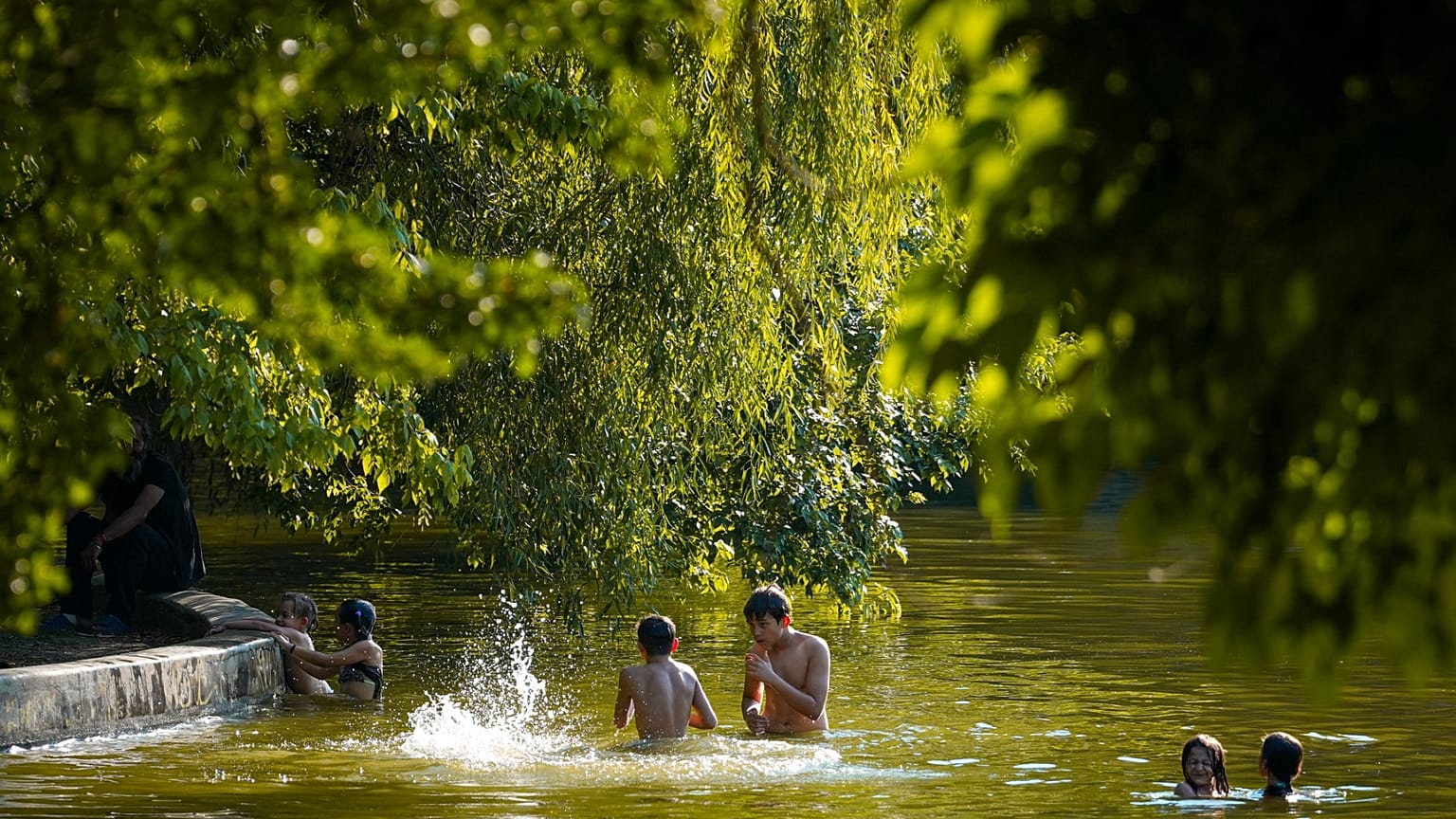
Youngsters play in a lake on a torrid day, as the National Weather forecaster issued an extreme heat code red warning for most parts of the country, in Bucharest, Romania.
Copyright AP Photo/Vadim Ghirda

By Marta Iraola Iribarren
Published on

As Europe continues to face a record-breaking heatwave, the World Health Organization warns future summers will only be hotter.

June has been one of the hottest months on record in Europe, with temperatures reaching unmatched highs in multiple countries and causing an increased in heat-related deaths.

And it is only the beginning. The World Health Organization (WHO) has warned that the summers ahead will be harder.

“This heatwave is a dress rehearsal,” said Dr Hans Henri Kluge, WHO Regional Director for Europe.

Europe is warming at more than twice the global average and heatwaves are no longer one-off freak events. They are recurring crises, and they are becoming more frequent, stronger and longer-lasting, Kluge added.

In the past month, France has reported over 1,000 deaths since 24 June alone, with the majority among people aged 65 and over, and emergency calls have risen by up to 50% in some cities.

Spain's mortality monitoring system has already estimated 892 heat-associated excess deaths in June.

Kluge warned that every summer we fail to prepare for is a summer we pay for in lives.

However, for the WHO, it is not all bad news as the agency stresses that prevention works.

According to WHO’s Europe chief, estimates show that heat-related deaths in Europe in 2023 would have been around 80% higher without the adaptation measures already in place. For people aged 80 or above, deaths could have been twice as high.

“Heat-health action plans, early warnings, cooling spaces, outreach to vulnerable people — these are not bureaucratic exercises. They are saving lives right now — we need more of them, across all of the European Region,” Kluge added.

The heatwave is now expected to spread over large parts of Western, Central and Southern Europe and the Balkans by 30 June, according the World Meteorological Organization.


Europe braces for Super El Niño as scientists warn extreme weather could intensify

Europe braces for Super El Niño as scientists warn extreme weather could intensify
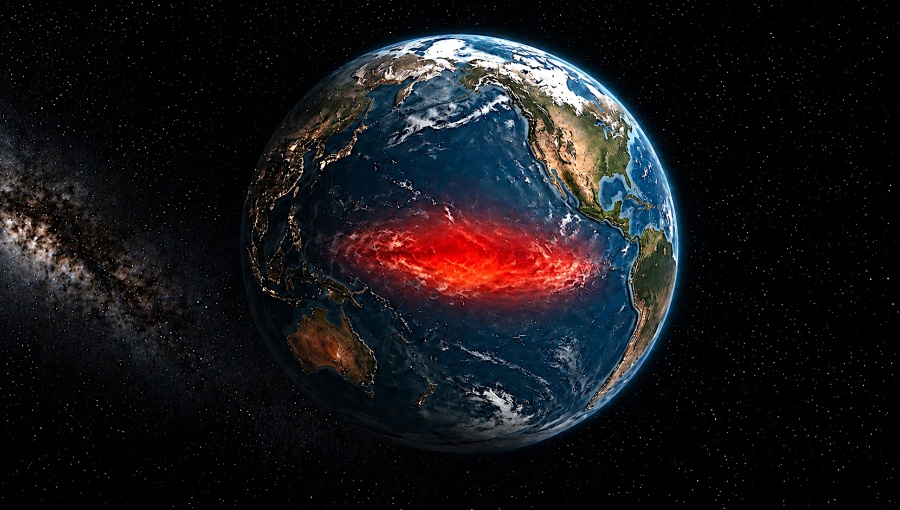
Temperature records were smashed in June, but now a super El Nino is building that will disrupt weather patterns and raise temperatures in the autumn too. / bne IntelliNewsFacebook
By bne IntelliNews June 30, 2026

Europe is enduring its most intense early summer heatwave on record, with temperatures exceeding 40°C in several countries and breaking local June records across southern and western Europe. But climate scientists warn that the continent's current ordeal could merely be a precursor to an even more volatile period as one of the strongest El Niño events ever recorded gathers strength in the Pacific Ocean.

Meteorologists stress that the current European heatwave was not caused by El Niño which is still building, but that the first measurable signs are there and their extremity is alarming scientists.

El Niño reflects a combination of persistent high-pressure systems, unusually warm seas surrounding Europe and the continuing influence of long-term global warming.


This year’s Little Boy is expected to become the dominant driver of global weather over the coming year, dramatically raising the likelihood of more severe floods, droughts, storms and temperature extremes across much of the world during what has been dubbed an annual disaster season of extreme weather events.

"All official predictions and analysis shows that an El Niño event will be the main global weather driver in 2026/2027," according to the latest assessments of ocean and atmospheric conditions by Severe Weather Europe, an online resource of weather forecasts, outlooks and long-range trends.

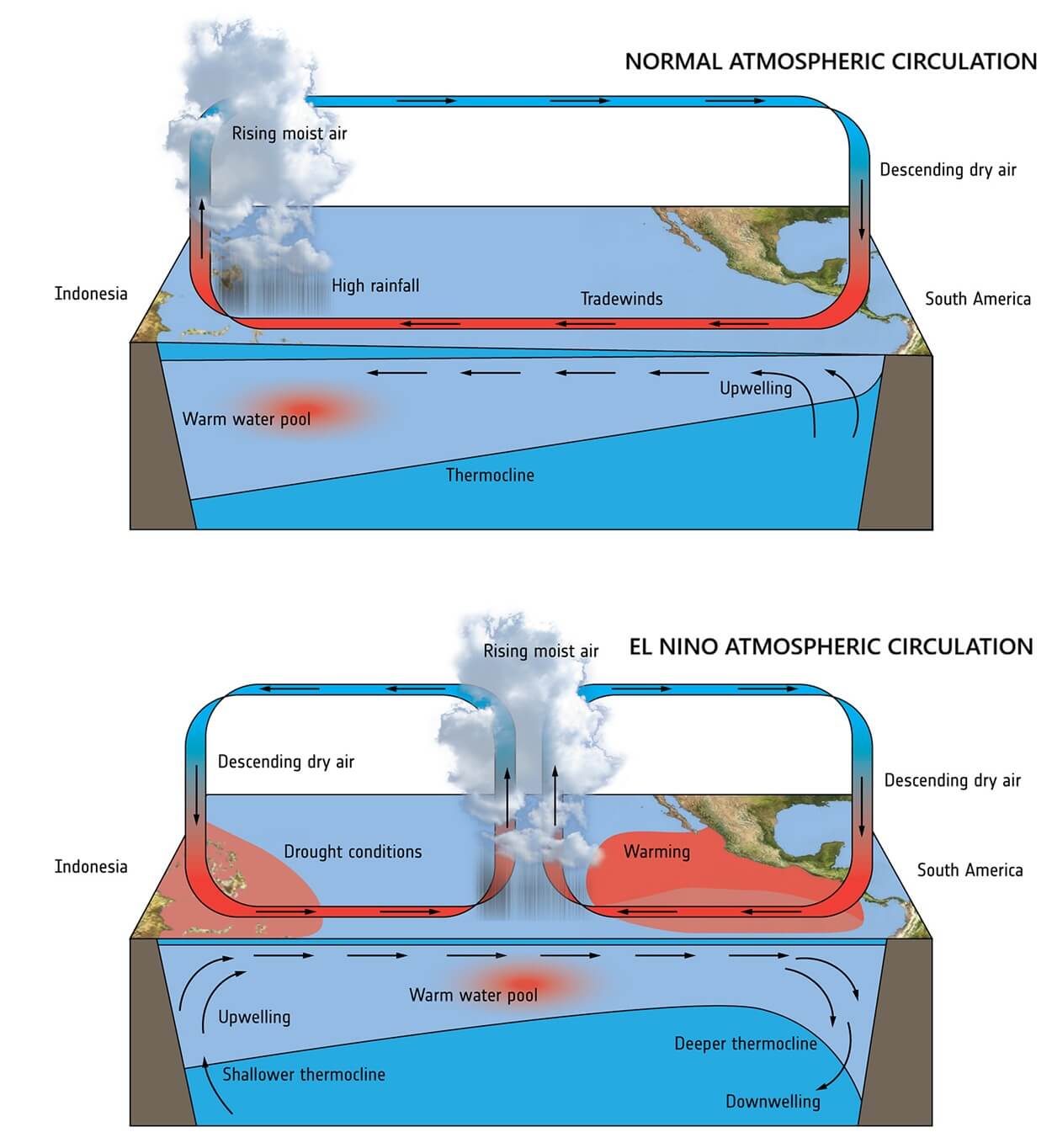
El Niño is the warm phase of the El Niño-Southern Oscillation (ENSO), a naturally occurring climate cycle in which sea surface temperatures in the equatorial Pacific Ocean fluctuate between warm (El Niño), cool (La Niña) and neutral phases every two to seven years. Although the phenomenon originates thousands of kilometres from Europe, it alters atmospheric circulation across the globe, influencing rainfall patterns, storm tracks and temperatures on every continent.

Scientists are increasingly concerned because current forecasts suggest this year's event could reach "Super El Niño" status — a rare category reserved for only the strongest warming episodes, including those of 1982-83, 1997-98 and 2015-16, all of which were associated with widespread weather disasters and record-breaking global temperatures.

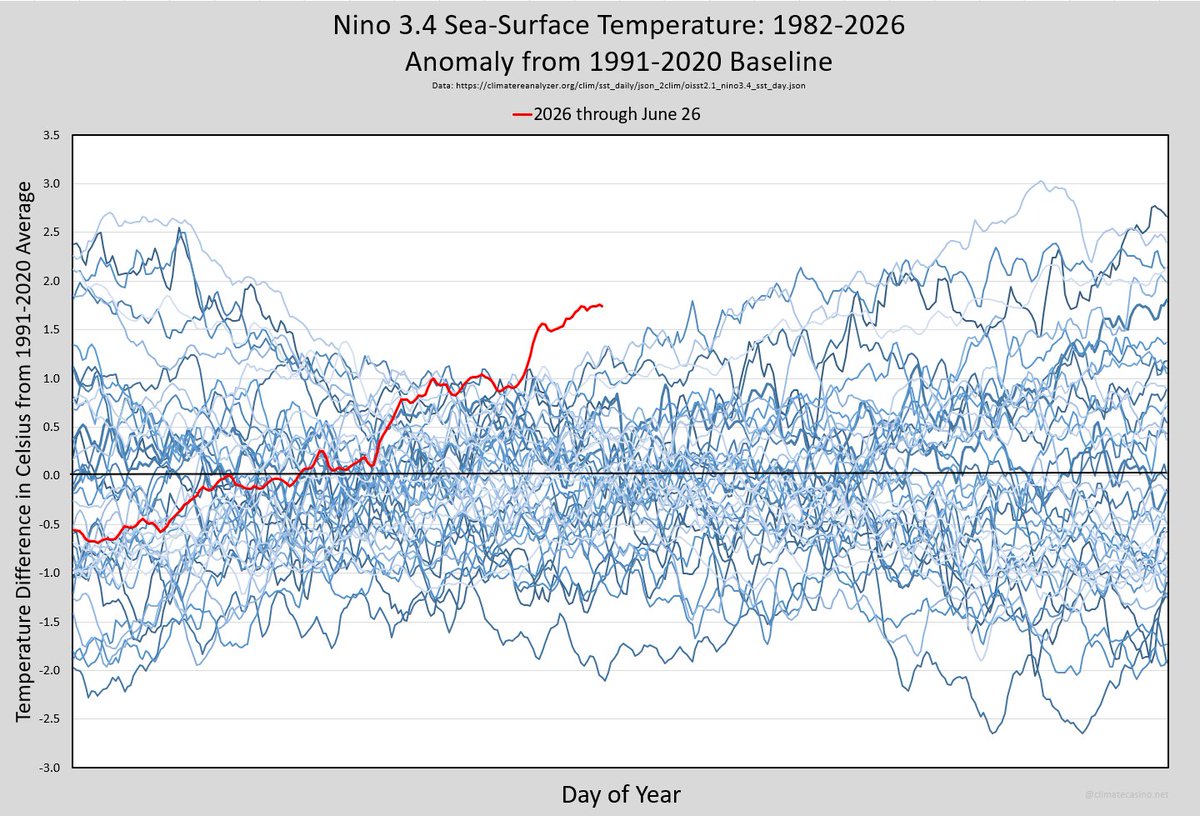
"The latest ocean analysis below shows a significant warm anomaly already emerging in the main ENSO regions," the report says. "This analysis is with the global average anomaly removed, so it shows the clean warm signal of the rising El Niño, creating a growing warm anomaly signature, expected to reach into the +4-5° anomalies at peak strength."

Those ocean temperatures are already beginning to reshape atmospheric circulation.

"A powerful Super El Niño is rapidly developing in the tropical Pacific, and the first clear atmospheric response is already showing up in the weather patterns," the report says. "Latest ocean and forecast data show the event strengthening toward rare intensity, with the atmospheric signal already visible in the analysis and forecast data."

June has already displayed weather patterns resembling previous Super El Niño years, particularly across North America.

Meteorologists note that North America typically experiences the first atmospheric impacts because of its proximity to the tropical Pacific, while Europe usually responds several months later in the autumn.

"This is reflected in the latest ENSO forecast from the NCEP CFSv2 model. It shows a very strong El Niño developing, exceeding the super El Niño threshold (+2°C above average), having an immediate impact on the summer, fall, and winter patterns. The current 2026 development shows a similar signature to the previous strongest events, forecast to rise even higher, as one of the strongest events on record."

One of the principal drivers behind the rapid intensification has been the development of a massive underwater pulse of warm water known as a Kelvin Wave.

"Strong westerly wind events have helped develop a massive underwater warm anomaly, called a Kelvin Wave. This wave rises from below, now visible as a warm anomaly on the ocean surface."

The warming ocean is already producing measurable changes in the atmosphere. According to the latest forecast from the European Centre for Medium-Range Weather Forecasts (ECMWF), rising air over the eastern Pacific and sinking air over the Indian Ocean are establishing what meteorologists describe as the “atmospheric bridge” linking tropical ocean temperatures with global weather systems that is typical in an El Niño year.

Historically, Super El Niños have contributed to flooding across parts of South America, droughts in Australia and Southeast Asia, disruptions to the Asian monsoon, increased wildfire risk and unusually warm winters across parts of North America.

Europe has yet to display the classic atmospheric signature associated with previous Super El Niño episodes, but forecasters say early indications are beginning to emerge.

Forecast models suggest northern and central Europe could increasingly come under the influence of persistent high-pressure systems later this summer, while lower-pressure systems develop farther south.

"Over Europe, we see a reversed pattern, with a strong blocking high-pressure anomaly over the northern and north-central parts, and a low-pressure anomaly undercut over the southern half. This is a Rex-block type pattern, while over North America, we see an Omega blocking trend," Severe Weather Europe reports.

Europe has just been through an “omega block” that trapped a “heatcap” over France and the rest of northern Europe leading to sweltering temperatures. And meteorologists are warning of a second omega block developing in the first half of July that may be even hotter and more persistent.


‘We Were Warned,’ Says WHO Chief as More Than 1,300+ Dead Across Europe From Climate-Driven Heat Wave

“It’s time to turn the heat on the fossil fuel giants that caused this heatwave but are doing nothing to cover the costs.”


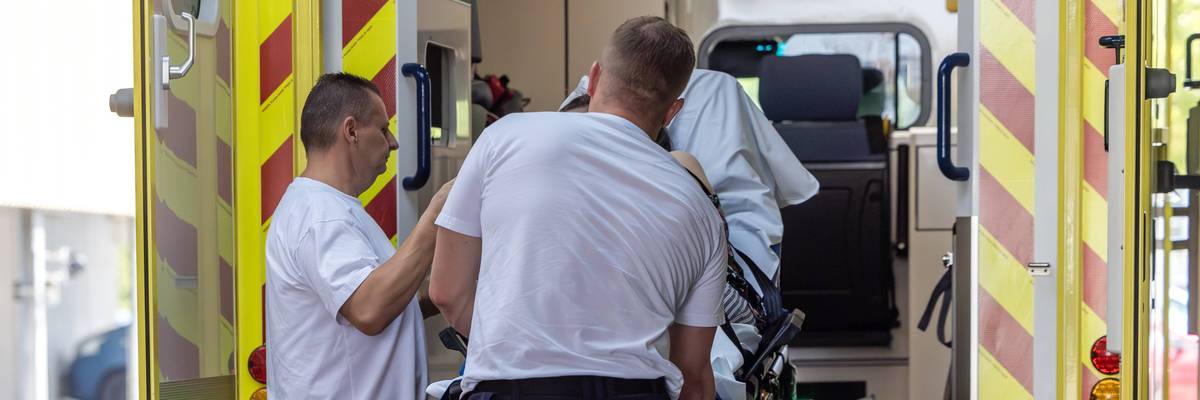
Paramedics at the emergency room of the Medical University of Lausitz Carl Thiem are lifting a stretcher carrying a patient out of their ambulance in Southern Brandenburg, Germany on Sunday, June 28, 2026. There has been an increase in emergency calls due to heat-related illnesses.
(Photo by Frank Hammerschmidt/picture alliance via Getty Images)


Jon Queally
Jun 28, 2026
COMMON DREAMS


The head of the World Health Organization on Sunday said the deadly heat wave now boiling across Europe—which French authorities say caused more than 1,000 deaths last week alone—is the predicted and horrifying result that climate scientists and human rights advocates have been warning about for decades.

In a social post Sunday, WHO secretary-general Dr. Tedros Adhanom Ghebreyesus said, “Driven by climate change and global warming, the phenomenon of the ‘once-in-a-generation’ heatwave is now occurring nearly annual. We were warned.”


Scientists: Fossil Fuel-Driven Climate Crisis ‘Directly Responsible’ for Deadly European Heatwave


Citing over 1,300 excess deaths across Europe in the last week—as temperatures broke records in nation after nation—Tedros added that “heat stress is often called the ‘silent killer’—and European homes, workplaces and schools were not built for these temperatures.”

“Europe is the fastest-warming continent on Earth, heating at twice the global average,” he said. “Right now 150 million people are living under extreme heat, hundreds have died, schools are shut, grids are buckling.”

According to the Associated Press:

Germany marked a new record for the third day in a row with 41.7 degrees Celsius (107 degrees Fahrenheit) in Neißemünde, near the border with Poland. The Czech Republic also experienced its hottest day ever with 41.1 C (106.4 F).

A new study from the World Weather Attribution, a Europe-based collaboration of scientists, reported Friday that the record-breaking heat and humidity in Europe this past week would not have been possible without climate change.

The rapid study found that the heat would have been virtually impossible just five decades ago, and is 200 times more likely today than it would have been 20 years ago.

On Sunday, authorities in France said over 1,000 excess deaths attributable to the heat were recorded last week, with at least 100 or more over the previous 24 hours.

The threat of extreme heat related to the climate crisis is not only in Europe.

In 2024, a peer-reviewed study in the Journal of the American Medical Association showed that heat-related deaths in the United States rose 117% between 1999 and 2023.

Last year, a joint analysis by The Guardian and Pro Publica estimated that the industry-friendly policies of US President Donald Trump could result in the otherwise preventable deaths of 1.3 million people worldwide over the next 80 years, most of them among poor people in nations that did very little to cause the planetary crisis driven by the consumption of fossil fuels.

In a comment last week, as the deadly heatwave made international headlines, Sen. Bernie Sanders (I-Vt.) was among those who pointed his finger directly at Trump for his vicious policies related to energy and climate.

“There is a record-breaking heat wave in Europe and hundreds are dying,” said Sanders. “There is drought all across America and farmers are going out of business. Yet, Trump thinks climate change is a ‘hoax’ and cuts funding for sustainable energy. Insane. He is threatening the very future of our planet.”

On Friday, the climate group 350.org said the polluting companies, namely those in the coal, oil, and gas industry, should be made to pay for the deaths and damage they have caused and continue to cause.

“It’s time to turn the heat on the fossil fuel giants that caused this heatwave but are doing nothing to cover the costs,” said Lisa Rose, a campaigner with the group. “Both science and the law are clear: polluters must answer for climate damage. Now it’s up to our leaders to make them pay.”

“Forcing fossil fuel companies to cut emissions and pay their fair share is the only effective lasting response,” she added. “Half-measures won’t cool this crisis, only a faster shift to renewables can.”
France's deadly heatwave triggers accusations of government inaction

After 11 days of an exceptional heatwave and in the face of the heavy human toll that is beginning to emerge, politicians are accusing the French government of "incompetence" and "inaction." This comes after health officials said Sunday there had been around 1,000 more deaths than expected compared to previous months.


29/06/2026 - RFI

A healthcare worker enters the adult emergency department at the Pellegrin University Hospital during a heatwave in Bordeaux, south-western France on 23 June 2026. AFP - PHILIPPE LOPEZ

"We must fully shed light on the looming, devastating human toll in order to determine political accountability," Marine Tondelier, leader of the French Greens, stated on social media platform X on Sunday morning.

"And some will have to face the consequences."

Clémence Guetté, an MP for hard-left France Unbowed party, also slammed the handling of the heatwave as "a disaster" in an appearance on France 3 television, denouncing the government's "lack of preparedness."

Since last Wednesday, approximately 1,000 excess deaths have been recorded compared to the norm, according to national health agency Santé publique France.

The agency said areas under red alert for heat had been particularly badly affected, and 85 percent of the deaths had been those aged 65 and over.

The sharpest increases, the agency said, involved people dying at home, especially in the Ile-de-France region that includes Paris and its suburbs.

"This observation serves as a reminder of the need for measures of solidarity toward people who are isolated or experiencing profound loneliness, including in highly urbanised areas," the statement said.
'Not a fiasco'

The agency stressed that the figures were preliminary and were likely to be an underestimate.

Interior Minister Laurent Nunez said that since 18 June, emergency responses had risen by 20 percent compared to the same period last year, reaching a cumulative total of 122,000 interventions.

Despite this, he insisted in Le Parisien newspaper that the situation was "not a fiasco."

"We were prepared, contrary to what some politicians are saying."

Health Minister Stephanie Rist said Saturday warned that pressure on already overwhelmed hospital facilities is likely to continue even after temperatures drop.

The effects of the heatwave for patients with chronic illnesses "can last for several weeks," Rist told La Tribune newspaper.

"But providing reliable figures takes time. Only 60 percent of death certificates are issued electronically. We have to wait for the paper certificates to come in," she said.

The minister said she would then make the figures public "with full transparency" using the "most reliable figures possible".

She also confirmed this week that Prime Minister Sébastien Lecornu had approved an order for 30,000 air conditioners for hospitals. "I have released €100 million to urgently finance cooling equipment," she said.

The heat eased slightly across some parts of France on Sunday after days of punishing temperatures that saw the mercury rising above 40C in many areas.
Drop in 'green' funds

But storms overnight Saturday wreaked havoc in some areas.

In the Aisne department, north of Paris, lightning sparked several fires, including one in Laon that left five people with minor injuries.

Nationwide, electricity provider Enedis reported 63,000 customers without power due to the storms, primarily in the north of the country.

Weather bureau Météo-France noted on Saturday that this heatwave – a phenomenon intensified by climate change, which is driven primarily by the burning of fossil fuels – "surpasses the August 2003 event in terms of intensity and is equivalent in terms of duration."

The 2003 heatwave caused some 15,000 deaths, highlighting the unsuitability of many hospitals and nursing homes.

Many have criticised the sharp cut in funding for the so-called Green Fund in recent years, with allocations dropping from €2.5 billion in 2024 to €837.5 million in 2026.

Presidential hopeful Édouard Philippe argued that the Green Fund should be "doubled and refocused on adaptation and air-conditioning in public spaces," pledging that "adapting to global warming will be one of (his) priorities."

The World Health Organization chief Tedros Adhanom Ghebreyesus said on X that heat stress was a 'silent killer' and called on European countries to "implement heat health action plans" to help safeguard health in the face of climate change.

(with newswires)
Punishing heatwave exposes cracks in France's nuclear power fleet

Three French nuclear plants halted production during this week's record-breaking heatwave as rivers became too warm to cool them, raising questions over the long-term future of Europe's biggest nuclear fleet.


Issued on: 26/06/2026 -  RFI

Record high temperatures forced EDF to close the two nuclear reactors at the Golfech plant this week. REUTERS/Benoit Tessier


By: Alison Hird

EDF, France's electricity operator, shut down one reactor at its Golfech nuclear plant on the Garonne on Monday after river temperatures approached the site's operating limit of 28C. Output has also been reduced at reactors in Bugey on the Rhône and Nogent-sur-Seine.

The disruption remains limited. France's grid operator RTE said electricity supplies remain secure. EDF said the loss of 2.2 gigawatts – about 3.5 percent of the country's nuclear capacity – does not threaten the balance between supply and demand.

But ecologists and some energy experts say the shutdowns are part of a growing pattern that raises questions about how a nuclear fleet largely designed in the 1970s will cope with a warming planet.

Water shortages

"Nuclear power is clearly a 20th-century technology that is ill-suited to the 21st," said Yves Marignac, an independent nuclear expert and spokesperson for the think tank négaWatt.

"The warning signs are becoming stronger every year."

France generates around 70 percent of its electricity from nuclear power – more than any other country in the world. Most of its 56 reactors are built beside rivers or the coast because they require vast quantities of water for cooling.

"We're talking nearly one cubic metre per second," Marignac said.

EDF figures reported by French daily Le Monde show about 15.3 billion cubic metres of water are withdrawn from rivers each year to cool France's nuclear plants, making the sector the country's second-largest user of water with 31 percent, behind agriculture on 45 percent and ahead of drinking water on 21 percent.

"Given projections of a drop of up to 40 percent in available freshwater in France by 2050, maintaining both agriculture and the nuclear fleet in their current form becomes extremely difficult," Marignac said.

Most of France's 18 nuclear plants are inland. As rivers shrink during dry periods there is less water available for cooling. Warmer rivers also cannot absorb as much heated cooling water without harming fish and other wildlife.

"We now see these limitations every summer," Marignac said. "It's never the whole fleet and usually only for relatively short periods. But each year the alert becomes a little stronger."

French environmental regulations require EDF to reduce output when river temperatures reach certain thresholds, around 28C, to protect local ecosystems.

"The choice becomes one between producing electricity and preserving ecosystems," Marignac said.


Growing pressure


The reactors most exposed are those on the Rhône and Garonne, including Bugey, Saint-Alban, Cruas, Tricastin and Golfech, where operators depend on enough cool water to remain within environmental limits.

EDF said climate-related restrictions currently reduce annual nuclear production by around 0.3 percent. Without adaptation, the company estimates that figure could rise to around 1.5 percent by 2050.

The state-owned utility plans to invest 8.7 billion euros by 2040 to adapt its nuclear and hydroelectric power stations to a warmer climate.

Marignac said some of the risks are also becoming harder to predict.

Last August EDF temporarily shut down the Gravelines nuclear plant on the North Sea coast after a "massive and unpredictable presence of jellyfish" clogged its filter system. Algae blooms, which are also increasing because of warmer temperatures and greater use of nitrate-based fertilisers, have also disrupted water intake systems.

"We're entering a period where climate change and biodiversity loss are producing changes that are no longer linear," Marignac said. "That makes them much harder to anticipate."

Future designs


France's planned EPR2 reactors are expected to rely on the same basic cooling system as existing plants.

"The cooling principle doesn't change at all," Marignac said. "Each reactor is actually more powerful, so the cooling requirements are even greater."

Cooling towers can reduce the amount of heated water released into rivers but cannot remove the need for large volumes of water in the first place, Marignac said. Retrofitting them to older plants, while possible, is technically difficult and expensive.

EDF is studying other options, including cooling water before returning it to rivers, but Marignac said these are not long-term solutions.


"The technology is fundamentally rigid. When you want to adapt it, you're forced into technical workarounds – bolting a second cooling loop onto the first, and so on.

"You draw water to cool the reactor, that heats the water, then you use the reactor's own electricity to cool it again before discharge. It's a sticking plaster on a design that's no longer fit for purpose."

Supporters of nuclear power have long argued it helps ensure France's energy sovereignty in an increasingly unstable world. Marignac argued renewable energy offers a more sovereign path in the long term.

"Once they're installed, nobody can take the wind or the sun away from us."
Why Germany is turning to Algeria for Europe's hydrogen future

Germany is strengthening its energy partnership with Algeria, as Europe searches for new long-term energy supplies and invests in renewable hydrogen to help cut emissions.


Issued on: 28/06/2026 - 

Algeria is emerging as an important partner in Europe's renewable hydrogen plans, with Germany and Algeria this month signing two new energy agreements. AFP - LUDOVIC MARIN

Two agreements signed in Algiers last week mark the latest step in a relationship that has grown steadily in recent years.

One will help modernise Algeria's electricity grid so it can integrate more renewable energy. The other aims to develop green hydrogen projects and reduce methane emissions.

Together, they reflect Germany's search for future low-emission energy supplies and Algeria's ambition to diversify its energy production.

The first deal launched DigiEnR, a German-funded project to modernise Algeria's electricity grid as the country expands renewable energy. The project will digitalise the network and make it easier to connect new energy systems.

"The industrial and technical partnership between Algiers and Berlin has entered a new era," Algeria's Energy Ministry said in a statement after the agreement was signed on 15 June.

The second deal brought together Algeria's state-owned energy company Sonatrach and German energy company VNG AG.

It expands an earlier partnership on green hydrogen and broadens it to include efforts to reduce methane emissions and explore future hydrogen supplies to Europe.

Beyond natural gas


One goal is to find out whether Algeria could become a future supplier of green hydrogen to Europe, particularly Germany. The companies will study how the fuel could be produced, delivered and eventually carried through parts of Algeria's existing gas infrastructure.

For VNG, Algeria's potential makes it an important long-term partner.

"The demand for low-emission energy sources in Germany and Europe is steadily increasing," VNG board member Hans-Joachim Polk said. "Europe will continue to rely heavily on imports. Algeria offers significant long-term potential."

Sonatrach said the renewed partnership reflected both companies' shared commitment to addressing the challenges facing the energy sector.

"We intend to build upon our previous successes and explore new synergies in the production and transportation of green hydrogen and its derivatives, as well as in reducing methane emissions."

Why hydrogen matters


Hydrogen has become a central part of Europe's plan to reduce emissions from industries that are difficult to run on electricity alone, including steel and chemicals.

Green hydrogen is made using electricity from renewable sources to separate hydrogen from water. European governments hope it can help industries lower emissions while supporting the shift away from fossil fuels.

The EU also sees renewable hydrogen as one way to reduce dependence on imported fossil fuels. In May, the European Commission approved a €1.3 billion German support scheme to boost renewable hydrogen production through the European Hydrogen Bank.

The programme forms part of the EU's Hydrogen Strategy and its REPowerEU plan, which aims to reduce dependence on Russian fossil fuels while strengthening Europe's energy security.

Algeria is also expected to play a role beyond its partnership with Germany. Since 2024, it has worked with several European countries on the SoutH2 Corridor, a planned 3,300-kilometre pipeline designed to transport green hydrogen from North Africa to Europe.

The hydrogen industry has expanded across Europe in 2026, with new projects announced in several countries. But many projects still face high costs, uncertain demand and the need for new infrastructure.

Germany and Algeria have steadily expanded their cooperation in recent years. Last year's first German-Algerian investment summit produced agreements covering industry and digital technology.

The two countries are expected to deepen those ties further during Algerian President Abdelmajid Tebboune's first state visit to Germany in mid-July.
Remains of people exhibited in ‘human zoos’ to be returned to French Guiana

In 1892, around 30 men, women and children from the Kali’na and Arawak peoples of French Guiana were brought to Paris to be put on display at "human zoos". Six of them did not survive the winter. A bill allowing the repatriation of their remains to their homeland has now received final approval – the culmination of a long struggle waged by their descendants.


Issued on: 28/06/2026 - RFI

A shaman travelled from French Guiana to hold a spiritual ceremony for the six Arawak and Kali’na Indigenous people on 17 September, 2024 at the Musée de l’Homme in Paris. © Arame Mbengue / RFI


The remains were initially buried and then later exhumed for scientific study, and have been held at the National Museum of Natural History in Paris ever since.

On 15 June, the National Assembly gave final approval to a bill already passed by the Senate allowing for the removal of the remains from public collections, which are usually inalienable, making it legally possible to return them to their community.

Martin Friess, head of the biological anthropology collections at the Museum of Mankind, part of the National Museum of Natural History, showed RFI six large grey boxes stacked on top of one another in a climate-controlled storeroom at the museum.

"Inside are the human remains of the six individuals. They were brought to France for the 1892 World’s Fair, where they were exhibited in the Jardin d’Acclimatation's 'human zoo'," he said.

These six people died in the same year.

"Most were buried and were exhumed in 1897, at which point they were transferred to the collections of the National Museum of Natural History," Friess explained.

"So we had these boxes made specifically for these individuals, because they are more or less complete skeletons that have been mounted – that is to say, articulated – which was the practice in the 19th century, mainly to facilitate exhibitions. They are assembled as if they were standing upright."

'A blessed and historic year'

For their descendants, the final vote at the National Assembly on 15 June marks 2026 as a historic year.

"It’s an exceptional year. A year which, I think, resonates with everyone’s memories, as it’s also the year of the Taubira Law," says Corinne Toka-Devilliers, chair of the Moliko Alet+po campaign group, referring to the law enacted in 2001 which made made France the first country in the world to officially classify the slave trade as a crime against humanity. This law was spearheaded by Christiane Taubira, an MP from French Guiana.

"So 2026 is truly a blessed and historic year, in every sense of the word, for the overseas territories, for the DOM-TOMs, for the local authorities and for French Guiana."

France confronts enduring legacy of slavery, 25 years on from Taubira Law

Corinne Toka-Devilliers stands before the remains of her ancestors during the spiritual ceremony held in September 2024. © Arame Mbengue / RFI

A shamanic ceremony was held in September 2024 at the museum to soothe the souls of the six people and prepare for their return.

This will take place in three stages, explained Toka-Devilliers.

"It will begin with an official ceremony at the Elysée Palace, as announced to us by the adviser to the president of the Republic.

"Next, there will be a ceremony on arrival at Félix Éboué Airport in Cayenne, and afterwards they will be taken to their burial site where a vigil will be held, in accordance with our ancestral Kali’na and Arawak culture, so that the following day they may finally find their final resting place and eternal rest."

This article has been adapted from the original version in French by Arame Mbengue.
French journalist Gleizes marks one year in Algerian prison as RSF renews appeal

French sports journalist Christophe Gleizes has now spent a year in detention in Algeria, prompting fresh calls from Reporters Without Borders and his family for his immediate release and a presidential pardon.


Issued on: 29/06/2026 - RFI

The President of the Bouches-du-Rhone Departmental Council Martine Vassal unveils a banner bearing French sports journalist Christophe Gleizes, detained in Algeria, in the main hall of the Departmental Archives and Library Gaston Deferre in Marseille on 2 June 2026. AFP - MIGUEL MEDINA

37-year-old Gleizes, who contributes to the magazines So Foot and Society, was sentenced on 29 June 2025 to seven years in prison for “glorifying terrorism”.

He had been arrested in May 2024 while working on a report about Jeunesse Sportive de Kabylie – better known as JSK – one of Algeria’s most prominent football clubs.

Reporters Without Borders, known by its French acronym RSF, said on Monday that the anniversary should serve as a renewed appeal to Algerian President Abdelmadjid Tebboune.

“It has been a year since Christophe Gleizes was unjustly detained,” said Thibaut Bruttin, RSF’s director-general, in a statement. RSF heads the support committee set up for the journalist.

Bruttin said Gleizes should have been reporting from the World Cup, which began on 11 June and runs until 19 July.

“The World Cup is taking place with an empty chair bearing his name in the press box; his official accreditation serves as a reminder that his place is in the stadiums, amongst the journalists covering the event, and not in a prison cell,” he said.


Hope for a presidential pardon


On the eve of the World Cup’s opening, FIFA president Gianni Infantino said he hoped Gleizes would be granted a presidential pardon and be able to attend the tournament. FIFA had accredited the journalist to cover the competition.

Gleizes was first arrested in Algeria in May 2024 while reporting on JSK. He was placed under judicial supervision before being convicted the following year.

In March, he withdrew an appeal before Algeria’s Court of Cassation in the hope that doing so would clear the way for a presidential pardon. In May, Algerian courts also rejected an appeal filed by the public prosecutor’s office, bringing the legal proceedings to a close.

His family and supporters say that should now open the door to a humanitarian gesture.

“We welcome the recent legal developments in Algeria,” his parents, Sylvie and Francis Godard, said in a statement on Monday, urging that “these advances” should “lead swiftly to a presidential pardon”.

They added: “We continue to wait, with hope and dignity, for Christophe’s return to us.”

‘Cut off from the world’


Gleizes’s brother visited him on Sunday at Kolea prison, his parents told RTL radio.

His mother said the conditions in prison were “very good” and that her son was physically well. But she said the strain of detention was increasingly difficult.

“Health-wise, he’s doing well, but being locked up is really starting to take its toll on him: he’s cut off from the world and from current events,” she said.

His family also referred to his 102-year-old grandmother, who marked what they called a “sad anniversary” by renewing her plea in a video to see her grandson again.

RSF and Gleizes’s relatives have maintained that he was in Algeria as a journalist carrying out legitimate reporting work.
Uganda dissidents on trial as president’s son tightens control

Uganda's army chief, General Kainerugaba, has ordered the arrest of leading activists and politicians in recent weeks, and this weekend shut down the country's main independent media group. Two of those arrested appear in court this Tuesday: opposition figure Kizza Besigye and his lawyer.


Issued on: 30/06/2026 - RFI

Uganda's veteran opposition leader Kizza Besigye during a court session at Nakawa Chief Magistrate's Court in Kampala on 23 May, 2025. © Badru Katumba / AFP

Uganda's opposition leader Kizza Besigye, held in detention since his abduction from Kenya in 2024, is to appear in a Kampala court regarding the long-standing treason charges against him.

Besigye's lawyer, Erias Lukwago, who was arrested this month on Kainerugaba's orders, will be heard in a separate case.

Both arrived in court in the morning. The High Court has scheduled the hearing of the bail application for 3 July at 2pm.

The trials of these two Ugandan government critics resume as the crackdown on critics by army chief General Muhoozi Kainerugaba tightens in an increasing show of power.

His father, President Yoweri Museveni, who won a seventh term in office less than six months ago, has made no comment on his son's recent actions.

Analysts say Kainerugaba, 52, has already become the dominant force in the country in recent weeks amid a mounting crackdown on critics.

General clampdown

Amnesty International's Regional Director for East and Southern Africa, Tigere Chagutah, warned last week that the arbitrary detention and torture of Kizza Besigye's lead defence counsel Erias Lukwago points to "a continuation of a long and disturbing pattern of arbitrary arrests, torture and ill treatment of Kizza Besigye's legal team."

Early on Sunday, the army chief also ordered the shutdown of the leading independent media group that runs the Daily Monitor newspaper and NTV station, declaring: "I do not believe in a free press!"

Kainerugaba regularly posts controversial comments on social media that range from threats to abduct and torture opponents to jokes about stealing Beyoncé from her husband, while repeatedly saying he will be the next president after the 81-year-old Museveni, who has ruled Uganda for 40 years, leaves office.

People had at first taken Kainerugaba's threats "as a joke," according to Gerald Walulya, senior lecturer in the journalism department at Makerere University, but now, "we are seeing him being able to demonstrate power without any form of restraint from the father," he said.

Much of the Ugandan opposition has been neutered since the last electoral campaign that led to Museveni's re-election in January.

Besigye, 70, has run several times against Museveni, but was abducted in Nairobi by armed men, which raised international condemnation.

His family have accused the Ugandan state of torturing him and said he faces health issues.

Museveni's main opponent in recent years, the singer-turned-politician Bobi Wine, ran for the presidency in January but had to flee the country after Kainerugaba threatened to hunt him down and behead him.

Besigye’s lawyer, Lukwago was preparing to serve legal papers summoning Kainerugaba over the abduction when he was himself arrested earlier this month. He is now accused of failing to reveal an alleged plot against the state.

Kainerugaba wrote on X shortly after the lawyer’s detention: “I’m proud of ALL the hurt and pain I will inflict on the CRIMINAL LUKWAGO!“

He has also targeted several Ugandan rights groups, including Agora, which has been summoned to appear before police last week over allegations of fraud and money laundering.

‘Cultivating fear’


Many observers say Museveni is grooming his son to take over from him, which he never officially acknowledged.

According to Yusuf Serunkuma, political columnist for The Observer newspaper, Kainerugaba, often just called by his first name Muhoozi, is still insisting that he is only following his father’s orders.

“I’m not sure whether exhibiting power and cultivating fear is part of the strategy for Muhoozi or if he is simply doing what comes naturally to him. as a soldier,” Serunkuma said.

With 1.3 million followers on the social network X, Kainerugaba's real popularity around the country remains untested.

“If he were strategic, he would have taken lessons from his father and cultivated connections with the general public and the international community,” said Serunkuma. “Instead he’s gone out of his way to break those connections.”